Anatomical changes in
Pregnancy

10th

Prepared by
Hazrat Bilal Malakandi
semester, DPT, IPM&R KMU
Peshawar
Group members
•
•
•
•
•

Hazrat Bilal
Heera Nawaz
Asmat Saeed
Bushra Bakht
Atif Nazir
• Pregnancy is the fertilization and development
of one or more offspring, known as an embryo
or fetus, in a woman's uterus.
• Pregnancy results in many anatomical changes
• Few of them are discussed shortly in next slides
Changes in Reproductive organs
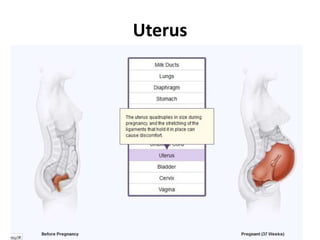
I. Uterus:

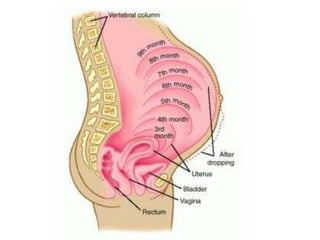
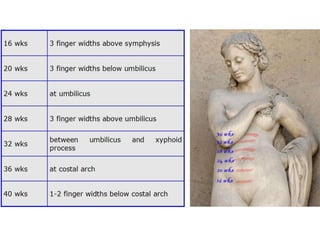
– The uterus expands from a strictly pelvic organ
before 12 weeks to become an abdominal
organ for the remainder of gestation.
– the uterus increases in weight from 60 to
1000g (20 times its original weight).
– In size, it changes from 6.5 to 32 cm.
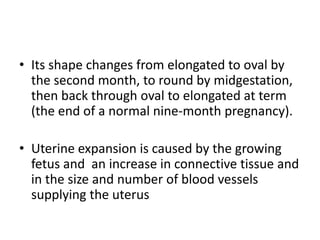
• Its shape changes from elongated to oval by
the second month, to round by midgestation,
then back through oval to elongated at term
(the end of a normal nine-month pregnancy).
• Uterine expansion is caused by the growing
fetus and an increase in connective tissue and
in the size and number of blood vessels
supplying the uterus
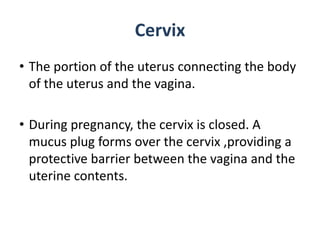
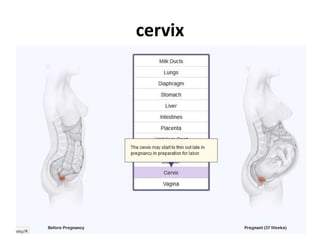
Cervix
• The portion of the uterus connecting the body
of the uterus and the vagina.
• During pregnancy, the cervix is closed. A
mucus plug forms over the cervix ,providing a
protective barrier between the vagina and the
uterine contents.
• During labour and delivery, the cervix shortens
and widens (or dilates).
• A 10 cm opening is left between the uterus
and the vagina to allow for passage of the
fetus into the birth canal.
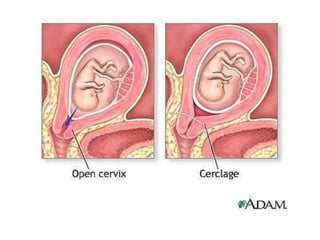
• If the cervix begins dilating prematurely, it is
sometimes stitched together during the
second trimester, until the fetus in mature.
This procedure is known as a cerclage.
Changes in Musculo-skeletal system
Ligaments
• Placental production of the hormone relaxin causes
pelvic ligaments and the pubic symphysis to relax,
widen, and become more flexible.
• This increased motility eases birth passage, but it
may also result in a waddling gait during pregnancy.
• Changes in joint laxity occurring during pregnancy.
By M Calguneri, H A Bird, V Wright
http://ard.bmj.com/content/41/2/126
Lumbar region
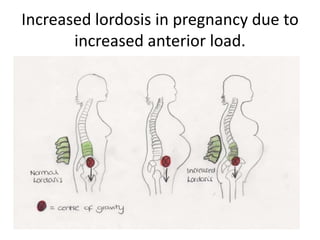
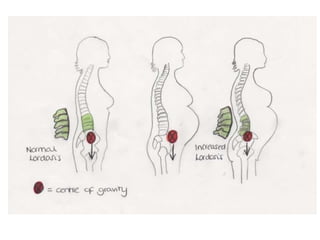
• The expanding uterus causes an
progressive lumbar lordosis.
• Lumbar lordosis leads to low back pain in 40 to
50 percent of all pregnant women.
Carlson HL, Carlson NL, Pasternak BA, Balderston KD. Understanding and managing the
back pain of pregnancy. Curr Womens Health Rep 2003; 3:65.

• Pregnancy and Back Pain . . . . By Kristen Schott, PT, MPT
http://www.sportspti.com/research/articles/pregnancy-and-back-pain.aspx
Increased lordosis in pregnancy due to
increased anterior load.
Center of Gravity
• The increasing bulkiness of the abdomen changes
the woman's center of gravity forward. This shift
increases the stress on your joints and causes your
back to curve forward.
• The change of the center of gravity location in late
pregnancy is temporary and two months after
delivery the center of gravity is located as it was at
the beginning of pregnancy.
• Journal of Huan Kinetics. Volume 26, Issue -1, Pages 5–11, ISSN (Online) 18997562, ISSN (Print) 1640-5544, DOI: 10.2478/v10078-010-0042-1, January 2011
Changes in Respiratory system
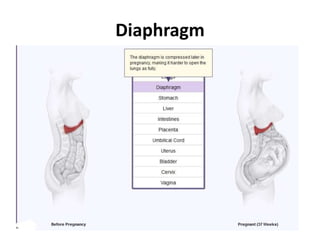
• The diaphragm is progressively elevated and
compressed. Possibly because of expansion
and elevation of the rib cage.

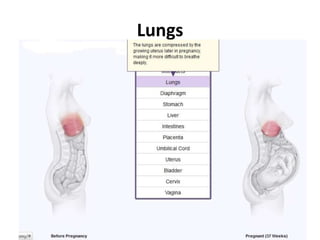
• The lungs are compressed due to growing
uterus in later pregnancy making it more
difficult to breathe deeply.
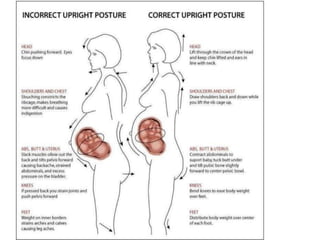
Postural changes:
During pregnancy, postural changes occurred.
• These changes include
• forward head,
• rounded shoulders,
• increased lumbar lordosis,
• Center of gravity shift,
• hyperextended knees, and
• pronated feet.
• Muscular changes are also typical. often
noted alterations include shortened hip
flexors, lower back musculature, and
pectorals.
• Abdominal muscles, neck, and upper back
muscle groups elongate.
• Functional Changes in Back Muscle Activity Correlate
With Pain Intensity and Prediction of Low Back Pain
During Pregnancy
• http://www.ncbi.nlm.nih.gov/pubmed/9779673
Changes in cutaneous system
• They are usually more marked below the
umbilicus, on the breasts and may appear on the
buttocks and thighs.

• In some women they are not marked or even
don't appear during pregnancy.
• Falling of hairs and brittleness of nails may occur
during pregnancy.
Pigmentation
It is due to suprarenal changes, it usually begins to
appear after the 4th month. The pigmentation
may appear anywhere but the commonest sites
are:

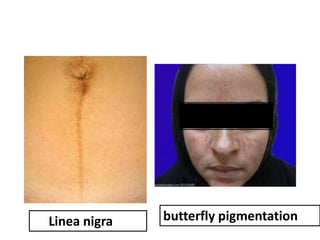
1. Linea nigra: which is a line of pigmentation
between the umbilicus and the symphysis pubis.
2. Cloasma gravidarum or mask face of pregnancy
which is butterfly pigmentation of the forehead,
nose, upper lip and the adjoining parts of the
checks.
Linea nigra

butterfly pigmentation
Changes in weight
• In normal pregnancy the average gain is
– 0.3 Kg/week up to 18 weeks,
– 0.45 Kg/week from 18-28 weeks and
– a slight reduction with a rate of 0.36- 0.41 Kg/week
until term.

• Slight weight loss may occur in the last 2 weeks.
The average weight gain for primigravidae is
12.5 Kg. and is probably about 0.9 Kg. less for
multigravidae.
Weight gain is produced by:
– Fetus ----------- ------3.63-3.88 Kg
– Placenta -------------- 0.48-0.72 Kg
– Amniotic fluid ------- 0.72-0.97 Kg
– Uterus and breasts - 2.42-2.66 Kg
– Blood and fluid ------ 1.94-3.99 Kg
– Muscle and fat ------ 0.48-2.91 kg
Total=

9.70-14.55Kg
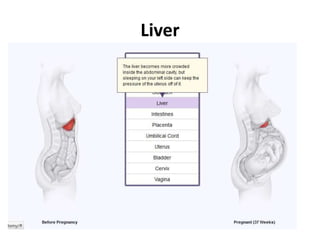
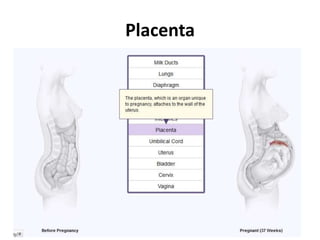
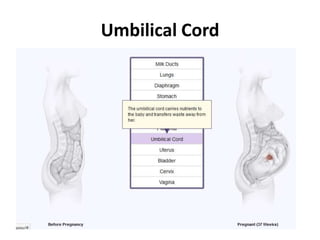
Anatomy comparison
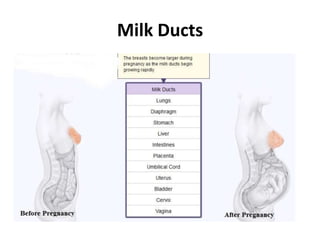
Milk Ducts
Lungs
Diaphragm
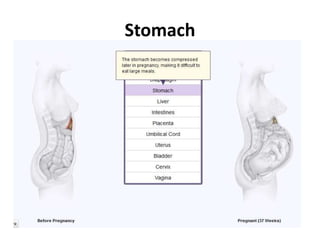
Stomach
Liver
Intestines
Placenta
Umbilical Cord
Uterus
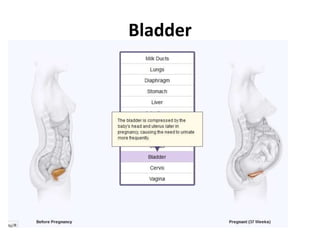
Bladder
cervix
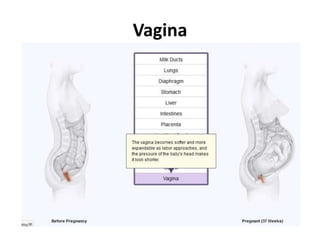
Vagina
Anatomical changes in Pregnancy

Anatomical changes in Pregnancy

  • 1.
    Anatomical changes in Pregnancy 10th Preparedby Hazrat Bilal Malakandi semester, DPT, IPM&R KMU Peshawar
  • 2.
    Group members • • • • • Hazrat Bilal HeeraNawaz Asmat Saeed Bushra Bakht Atif Nazir
  • 3.
    • Pregnancy isthe fertilization and development of one or more offspring, known as an embryo or fetus, in a woman's uterus. • Pregnancy results in many anatomical changes • Few of them are discussed shortly in next slides
  • 4.
    Changes in Reproductiveorgans I. Uterus: – The uterus expands from a strictly pelvic organ before 12 weeks to become an abdominal organ for the remainder of gestation. – the uterus increases in weight from 60 to 1000g (20 times its original weight). – In size, it changes from 6.5 to 32 cm.
  • 5.
    • Its shapechanges from elongated to oval by the second month, to round by midgestation, then back through oval to elongated at term (the end of a normal nine-month pregnancy). • Uterine expansion is caused by the growing fetus and an increase in connective tissue and in the size and number of blood vessels supplying the uterus
  • 8.
    Cervix • The portionof the uterus connecting the body of the uterus and the vagina. • During pregnancy, the cervix is closed. A mucus plug forms over the cervix ,providing a protective barrier between the vagina and the uterine contents.
  • 9.
    • During labourand delivery, the cervix shortens and widens (or dilates). • A 10 cm opening is left between the uterus and the vagina to allow for passage of the fetus into the birth canal. • If the cervix begins dilating prematurely, it is sometimes stitched together during the second trimester, until the fetus in mature. This procedure is known as a cerclage.
  • 11.
    Changes in Musculo-skeletalsystem Ligaments • Placental production of the hormone relaxin causes pelvic ligaments and the pubic symphysis to relax, widen, and become more flexible. • This increased motility eases birth passage, but it may also result in a waddling gait during pregnancy. • Changes in joint laxity occurring during pregnancy. By M Calguneri, H A Bird, V Wright http://ard.bmj.com/content/41/2/126

  • 12.
    Lumbar region • Theexpanding uterus causes an progressive lumbar lordosis. • Lumbar lordosis leads to low back pain in 40 to 50 percent of all pregnant women. Carlson HL, Carlson NL, Pasternak BA, Balderston KD. Understanding and managing the back pain of pregnancy. Curr Womens Health Rep 2003; 3:65. • Pregnancy and Back Pain . . . . By Kristen Schott, PT, MPT http://www.sportspti.com/research/articles/pregnancy-and-back-pain.aspx
  • 13.
    Increased lordosis inpregnancy due to increased anterior load.
  • 14.
    Center of Gravity •The increasing bulkiness of the abdomen changes the woman's center of gravity forward. This shift increases the stress on your joints and causes your back to curve forward. • The change of the center of gravity location in late pregnancy is temporary and two months after delivery the center of gravity is located as it was at the beginning of pregnancy. • Journal of Huan Kinetics. Volume 26, Issue -1, Pages 5–11, ISSN (Online) 18997562, ISSN (Print) 1640-5544, DOI: 10.2478/v10078-010-0042-1, January 2011
  • 16.
    Changes in Respiratorysystem • The diaphragm is progressively elevated and compressed. Possibly because of expansion and elevation of the rib cage. • The lungs are compressed due to growing uterus in later pregnancy making it more difficult to breathe deeply.
  • 17.
    Postural changes: During pregnancy,postural changes occurred. • These changes include • forward head, • rounded shoulders, • increased lumbar lordosis, • Center of gravity shift, • hyperextended knees, and • pronated feet.
  • 18.
    • Muscular changesare also typical. often noted alterations include shortened hip flexors, lower back musculature, and pectorals. • Abdominal muscles, neck, and upper back muscle groups elongate. • Functional Changes in Back Muscle Activity Correlate With Pain Intensity and Prediction of Low Back Pain During Pregnancy • http://www.ncbi.nlm.nih.gov/pubmed/9779673
  • 20.
    Changes in cutaneoussystem • They are usually more marked below the umbilicus, on the breasts and may appear on the buttocks and thighs. • In some women they are not marked or even don't appear during pregnancy. • Falling of hairs and brittleness of nails may occur during pregnancy.
  • 21.
    Pigmentation It is dueto suprarenal changes, it usually begins to appear after the 4th month. The pigmentation may appear anywhere but the commonest sites are: 1. Linea nigra: which is a line of pigmentation between the umbilicus and the symphysis pubis. 2. Cloasma gravidarum or mask face of pregnancy which is butterfly pigmentation of the forehead, nose, upper lip and the adjoining parts of the checks.
  • 22.
  • 23.
    Changes in weight •In normal pregnancy the average gain is – 0.3 Kg/week up to 18 weeks, – 0.45 Kg/week from 18-28 weeks and – a slight reduction with a rate of 0.36- 0.41 Kg/week until term. • Slight weight loss may occur in the last 2 weeks. The average weight gain for primigravidae is 12.5 Kg. and is probably about 0.9 Kg. less for multigravidae.
  • 24.
    Weight gain isproduced by: – Fetus ----------- ------3.63-3.88 Kg – Placenta -------------- 0.48-0.72 Kg – Amniotic fluid ------- 0.72-0.97 Kg – Uterus and breasts - 2.42-2.66 Kg – Blood and fluid ------ 1.94-3.99 Kg – Muscle and fat ------ 0.48-2.91 kg Total= 9.70-14.55Kg
  • 25.
  • 26.
  • 27.
  • 28.
  • 29.
  • 30.
  • 31.
  • 32.
  • 33.
  • 34.
  • 35.
  • 36.
  • 37.

Editor's Notes

  • #12 Myopathic gait (or waddling gait) is a form of gait abnormality.The "waddling" is due to the weakness of the proximal muscles of the pelvic girdle.The patient uses circumduction to compensate for gluteal weakness.
  • #19 Haemostatic changes in pregnancyhttp://www.sciencedirect.com/science/article/pii/S0049384804004475
  • #22 Pregnancy-Associated Changes in the Thyroid-Stimulating Antibody of Graves’ Disease and the Relationship to Neonatal Hyperthyroidism*http://jcem.endojournals.org/content/57/5/1036.short