Uterine Prolapse
Sandhya Kashyap
Nursing Tutor (OBG)
Metro College of Nursing, Greater Noida
Metro College of Health Sciences & Research
Contents
 Introduction
 Definition
 Causes
 Types of Prolapse
 Degrees of Prolapse
 Diagnosis & Investigations
 Sign & Symptoms
 Management
Introduction
 It is one of the common clinical condition
met in day to day gynecological practice
 It is most often seen in multiparous women.
 It is a form of herniation
 Uterine prolapse can happen to women of
any age, but it affects post menopausal
women who had one or more vaginal
deliveries.
 The incidence of prolapse is about one in
250 pregnancies.
Contd…
 Uterine prolapse occurs when pelvic floor
muscles and ligaments stretch and weaken,
providing inadequate support for the uterus . The
uterus then slips down into or protrudes out of the
vagina.
 Weakening of the pelvic muscles that leads to
uterine prolapse can be caused by:
1) Damage to supportive tissue during pregnancy
and child birth
2) Effects of gravity
3) Loss of oestrogen
Support of Uterus
 Round ligaments
 Broad ligaments
 Pubocervical ligaments
 Pelvic floor muscles
 Utero sacral ligaments
Definition
 Uterine prolapse means the uterus has
descended from its normal position in the
pelvis farther down into the vagina.
 Uterine prolapse is a form of female
genital prolapse It is also called pelvic
organ prolapse or prolapse of the uterus
(womb).
Causes
1. Birth injury : it is a important cause. A perineal
tear is less harmful than the excessive stretching
of the pelvic floor muscles and ligaments that
occur during child birth because over stretching
causes atonicity where as torn muscle could be
stitched or toned up.
2. Peripheral nerve injury: such as pudendal
nerve injury during child birth causes prolapse
which is reversible in 60% and it may be
responsible for stress in continence also.
Contd…
3. Bear down : before full dilatation of the cervix
and when the bladder is not empty.
Heavy work just after delivery without any rest or
pelvic floor exercises
4. Delivery of a big baby: also stretches the
perineal muscles and leads to patulous introitus
and prolapse. Precipitate labour and fundal
pressure may be responsible for prolapse.
Rapid succession of pregnancies.
5. Loss of pelvic support which results in uterine
prolapse
6. Post partum cough
Other causes
1. Congenital weakness: congenital weakness of the uterus and vagina is the
most important causative factor of the utero-vaginal prolapse in is
nulliparous women.
2. Acquired defects: in multiparous women overstretching of the ligaments
3. Menopausal atrophy: After menopause due to withdrawal of oestrogen
there is atrophy of the genital tract and its supports. In women due to
atrophy of the ligamentous supports of the uterus and vagina prolapse
develop.
4. Activating factors: the utero vaginal prolapse is aggravated by
a. Small fibroids or traction on the uterus.
b. Pelvic tumors.
5. Body type: some women have softer connective tissue than others which
means the ligaments that support your pelvic organs loosen more easily,
they are more prone to stretch during pregnancy and child birth so there
may be a higher risk for developing a prolapse.
6. Obesity
Types of Prolapse
1. Uterovaginal prolapse:
 It is the prolapse of uterus, Cx & upper vagina.
 Commonest type
 It is accompanied by Cystocele.
2. Congenital prolapse:
 No cystocele
 Often seen in nulliparous, so called as
nulliparous prolapse.
 Cause-congenital weakness of supports of Us.
Degrees of Prolapse
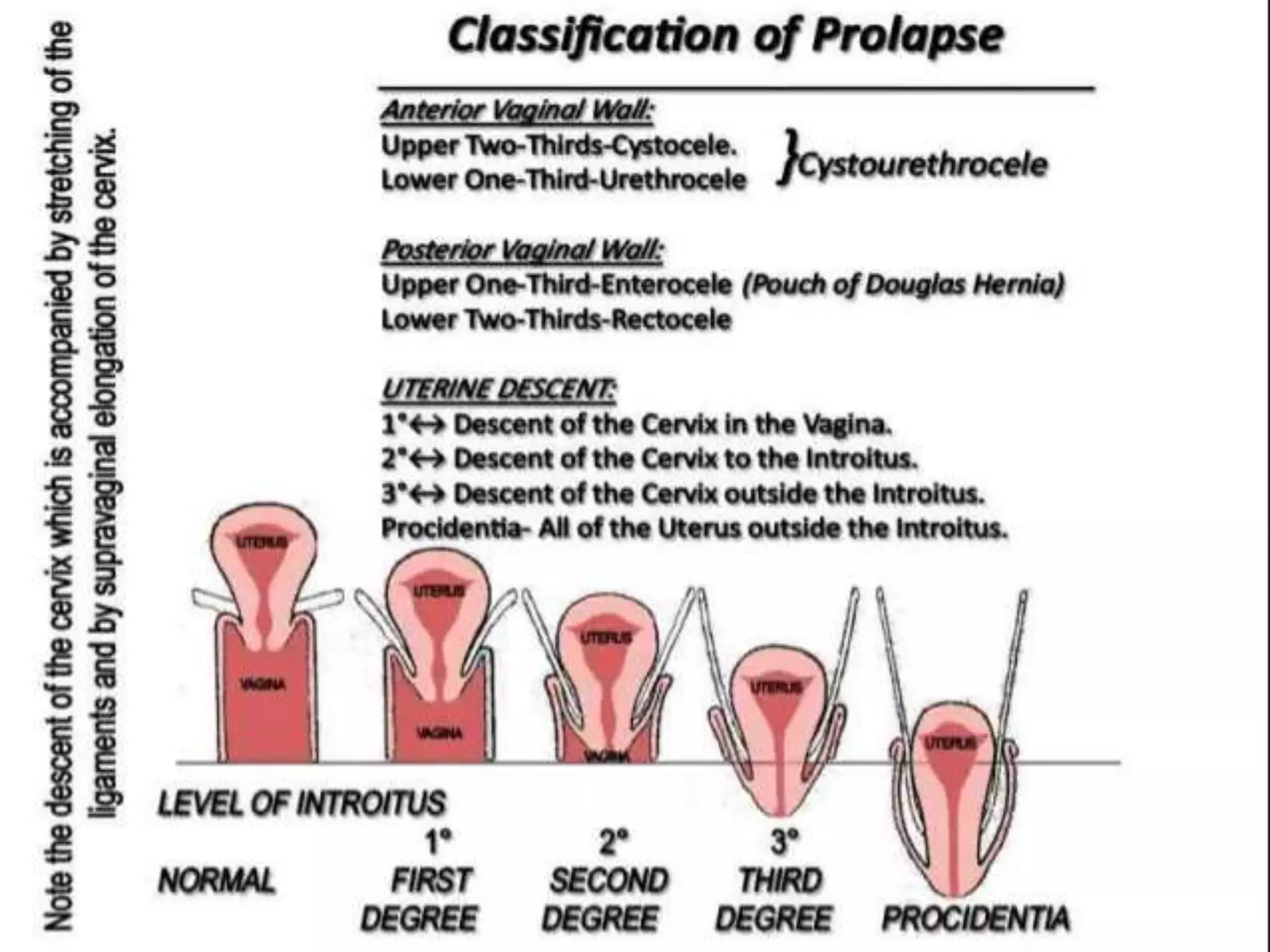
 FIRST DEGREE: The uterus descends
down from its anatomical position
(external os at the level of ischial spines)
but the external os still remains inside
vagina.
 SECOND DEGREE: The external os
protrudes outside the vaginal introits but
the uterine body still remains inside the
vagina
Contd.
 THIRD DEGREE: The uterine cervix
and body descends to lie outside the
introitus. It is also known as Procidentia
OR complete prolapse.
 Procidentia – Prolapse of the uterus with
eversion of entire vagina. It is inevitably
associated with cystocele and an
enterocele
Investigation
 Hematology
 Rectal exam
 Pelvic exam
 Vaginal exam
 USG
 X-ray
 MRI
Differential Diagnosis
 Cystic swelling in the vagina
 Chronic inversion of the uterus
 Hypertropy of the cervix
 All other causes of low backache and
urinary symptoms
 Virginities: congestion of the vagina in
case of severe virginities may give the
feeling of fullness of vagina.
Signs
 Utero-vaginal prolapse may be visible
during inspection of the vulva.
 In case of minor prolapse it may become
visible on straining.
 Rectal examination also differentiate
between rectocele and enterocele
Symptoms
 Feeling of something coming down per vagina ⇨ discomfort
on walking.
 Backache or dragging pain in the pelvis
 Dyspareunia
 Urinary symptoms : (in presence of cystocele)
 Difficulty in passing urine ⇨ elevate anterior vaginal wall for
bladder evacuation
 Incomplete evacuation lead to frequent desire to pass urine
 Urgency and frequency of maturation may also be due to
cystitis
 Painful maturation is due to infection
 Stress incontinence is usually associated due to urethrocele
 Retention of urine
Management
The Management of Uterine prolapse is
described under the following headings.
1. Prevention
2. Physiotherapy
3. Pessary
4. Surgical treatment
1- Prevention
 Repeated childbirth with short intervals cause UV prolapse
 Women should be advised to avoid pregnancies in quick succession Labour
1. 1st stage
• Avoid bearing down
• Breech or forceps delivery before full dilatation of cervix shouldn’t be
attempted
2. 2nd stage
• Avoid prolongation of this stage
• Perform episiotomy if tears or overstretching of perineum is feared
3. 3rd stage
• Avoid Crede’s method
• Episiotomy or tears should be carefully sutured
4. Puerperium
• Treat chronic cough and constipation
• Avoid strenuous exercises and standing for prolonged time
2- Physiotherapy
 Early cases of UV prolapse are helped by
pelvic floor exercises Particularly during
puerperium and while waiting to undergo
surgical treatment.
 Kegel exercises are used to tone up pelvic
musculature These exercises are done 3
times a day for 20 min each
3- Pessary Treatment
 A mechanical device for correcting and
controlling UV prolapse
 A pessary does not cure UV prolapse
 It only holds the genital tract in position
 Advised for patients who cannot undergo
surgery
 Types
1. Ring pessary
2. Hodge pessary
Indications
 During pregnancy (1st trimester)
 During puerperium
 Unfit for surgical treatment
 Patient’s choice
Management
 Choice of pessary ( ring pessaries commonly
used)
 Size (depends upon size of vagina)
 Sterilization
 Insertion - before insertion the pessary is kept in
hot water for few minutes so that pessary become
soft and easy to insert
 Follow up
 Pessary should be removed ,cleaned and
reinserted at regular intervals of 6-12 months.
Surgical Treatment
 Vaginal Hysterectomy – most common operation and
its indications are:
• Post-menopausal prolapse
• Uterine pathology like small fibroids or
adenomyosis
• Menstrual disorders such as dysfunctional uterine
bleeding
• Prolapse during childbearing age , after completion of
family
 Burch Operation – for relief of symptoms of
cystocele.
Contd…
 Anterior Colporrhaphy – for anterior
vaginal wall prolapse.
 Posterior Colporrhaphy – for repair of the
posterior vaginal wall and perineum.
 Manchester Repair (Fothergill’s Operation)
– for repair of uterovaginal prolapse. Carried
out in women of child bearing age and
haven’t completed their families and insist
on preservation of uterus
Bibliography
 1. D.C. DATTA’S ; ‘‘A TEXT BOOK OF OBSTETRICS’’
SEVENTH EDITION;PUBLISHED BY NEW CENTRAL BOOK
AGENCY MEDICAL PUBLISHERS (P) LIMITED;KOLKATA;
P.NO.312 TO 314.
 2.PV BOOKS; ‘‘ A TEXT BOOK OF MATERNAL HEALTH
NURSING’’ FIFTH EDITION;EDITED BY
R.K.GUPTA;P.NO.497 TO 500.
 3.MYLES; ‘‘A TEXT BOOK FOR MIDWIVES’’SIXTEENTH
EDITION; INTERNATIONAL EDITION;PUBLISHED BY
SAUNDERS ELSEVIER; EDITED BY JAYNE MARSHALL &
MAUREEN RAYNOR P NO.-477 TO 479 & 486 TO 488.
 4. WEBPAGE; ‘‘WWW.WIKIPEDIA.COM &
WWW.ENCYCLOPEDIA.COM’’; TOPIC OF UTERINE
PROLAPSE;TEXT AND PICTURES OF ANAEMIA
Uterine prolapse

Uterine prolapse

  • 1.
    Uterine Prolapse Sandhya Kashyap NursingTutor (OBG) Metro College of Nursing, Greater Noida Metro College of Health Sciences & Research
  • 2.
    Contents  Introduction  Definition Causes  Types of Prolapse  Degrees of Prolapse  Diagnosis & Investigations  Sign & Symptoms  Management
  • 3.
    Introduction  It isone of the common clinical condition met in day to day gynecological practice  It is most often seen in multiparous women.  It is a form of herniation  Uterine prolapse can happen to women of any age, but it affects post menopausal women who had one or more vaginal deliveries.  The incidence of prolapse is about one in 250 pregnancies.
  • 4.
    Contd…  Uterine prolapseoccurs when pelvic floor muscles and ligaments stretch and weaken, providing inadequate support for the uterus . The uterus then slips down into or protrudes out of the vagina.  Weakening of the pelvic muscles that leads to uterine prolapse can be caused by: 1) Damage to supportive tissue during pregnancy and child birth 2) Effects of gravity 3) Loss of oestrogen
  • 5.
    Support of Uterus Round ligaments  Broad ligaments  Pubocervical ligaments  Pelvic floor muscles  Utero sacral ligaments
  • 6.
    Definition  Uterine prolapsemeans the uterus has descended from its normal position in the pelvis farther down into the vagina.  Uterine prolapse is a form of female genital prolapse It is also called pelvic organ prolapse or prolapse of the uterus (womb).
  • 8.
    Causes 1. Birth injury: it is a important cause. A perineal tear is less harmful than the excessive stretching of the pelvic floor muscles and ligaments that occur during child birth because over stretching causes atonicity where as torn muscle could be stitched or toned up. 2. Peripheral nerve injury: such as pudendal nerve injury during child birth causes prolapse which is reversible in 60% and it may be responsible for stress in continence also.
  • 9.
    Contd… 3. Bear down: before full dilatation of the cervix and when the bladder is not empty. Heavy work just after delivery without any rest or pelvic floor exercises 4. Delivery of a big baby: also stretches the perineal muscles and leads to patulous introitus and prolapse. Precipitate labour and fundal pressure may be responsible for prolapse. Rapid succession of pregnancies. 5. Loss of pelvic support which results in uterine prolapse 6. Post partum cough
  • 10.
    Other causes 1. Congenitalweakness: congenital weakness of the uterus and vagina is the most important causative factor of the utero-vaginal prolapse in is nulliparous women. 2. Acquired defects: in multiparous women overstretching of the ligaments 3. Menopausal atrophy: After menopause due to withdrawal of oestrogen there is atrophy of the genital tract and its supports. In women due to atrophy of the ligamentous supports of the uterus and vagina prolapse develop. 4. Activating factors: the utero vaginal prolapse is aggravated by a. Small fibroids or traction on the uterus. b. Pelvic tumors. 5. Body type: some women have softer connective tissue than others which means the ligaments that support your pelvic organs loosen more easily, they are more prone to stretch during pregnancy and child birth so there may be a higher risk for developing a prolapse. 6. Obesity
  • 11.
    Types of Prolapse 1.Uterovaginal prolapse:  It is the prolapse of uterus, Cx & upper vagina.  Commonest type  It is accompanied by Cystocele. 2. Congenital prolapse:  No cystocele  Often seen in nulliparous, so called as nulliparous prolapse.  Cause-congenital weakness of supports of Us.
  • 14.
    Degrees of Prolapse FIRST DEGREE: The uterus descends down from its anatomical position (external os at the level of ischial spines) but the external os still remains inside vagina.  SECOND DEGREE: The external os protrudes outside the vaginal introits but the uterine body still remains inside the vagina
  • 15.
    Contd.  THIRD DEGREE:The uterine cervix and body descends to lie outside the introitus. It is also known as Procidentia OR complete prolapse.  Procidentia – Prolapse of the uterus with eversion of entire vagina. It is inevitably associated with cystocele and an enterocele
  • 18.
    Investigation  Hematology  Rectalexam  Pelvic exam  Vaginal exam  USG  X-ray  MRI
  • 19.
    Differential Diagnosis  Cysticswelling in the vagina  Chronic inversion of the uterus  Hypertropy of the cervix  All other causes of low backache and urinary symptoms  Virginities: congestion of the vagina in case of severe virginities may give the feeling of fullness of vagina.
  • 20.
    Signs  Utero-vaginal prolapsemay be visible during inspection of the vulva.  In case of minor prolapse it may become visible on straining.  Rectal examination also differentiate between rectocele and enterocele
  • 21.
    Symptoms  Feeling ofsomething coming down per vagina ⇨ discomfort on walking.  Backache or dragging pain in the pelvis  Dyspareunia  Urinary symptoms : (in presence of cystocele)  Difficulty in passing urine ⇨ elevate anterior vaginal wall for bladder evacuation  Incomplete evacuation lead to frequent desire to pass urine  Urgency and frequency of maturation may also be due to cystitis  Painful maturation is due to infection  Stress incontinence is usually associated due to urethrocele  Retention of urine
  • 22.
    Management The Management ofUterine prolapse is described under the following headings. 1. Prevention 2. Physiotherapy 3. Pessary 4. Surgical treatment
  • 23.
    1- Prevention  Repeatedchildbirth with short intervals cause UV prolapse  Women should be advised to avoid pregnancies in quick succession Labour 1. 1st stage • Avoid bearing down • Breech or forceps delivery before full dilatation of cervix shouldn’t be attempted 2. 2nd stage • Avoid prolongation of this stage • Perform episiotomy if tears or overstretching of perineum is feared 3. 3rd stage • Avoid Crede’s method • Episiotomy or tears should be carefully sutured 4. Puerperium • Treat chronic cough and constipation • Avoid strenuous exercises and standing for prolonged time
  • 24.
    2- Physiotherapy  Earlycases of UV prolapse are helped by pelvic floor exercises Particularly during puerperium and while waiting to undergo surgical treatment.  Kegel exercises are used to tone up pelvic musculature These exercises are done 3 times a day for 20 min each
  • 27.
    3- Pessary Treatment A mechanical device for correcting and controlling UV prolapse  A pessary does not cure UV prolapse  It only holds the genital tract in position  Advised for patients who cannot undergo surgery  Types 1. Ring pessary 2. Hodge pessary
  • 28.
    Indications  During pregnancy(1st trimester)  During puerperium  Unfit for surgical treatment  Patient’s choice
  • 29.
    Management  Choice ofpessary ( ring pessaries commonly used)  Size (depends upon size of vagina)  Sterilization  Insertion - before insertion the pessary is kept in hot water for few minutes so that pessary become soft and easy to insert  Follow up  Pessary should be removed ,cleaned and reinserted at regular intervals of 6-12 months.
  • 31.
    Surgical Treatment  VaginalHysterectomy – most common operation and its indications are: • Post-menopausal prolapse • Uterine pathology like small fibroids or adenomyosis • Menstrual disorders such as dysfunctional uterine bleeding • Prolapse during childbearing age , after completion of family  Burch Operation – for relief of symptoms of cystocele.
  • 32.
    Contd…  Anterior Colporrhaphy– for anterior vaginal wall prolapse.  Posterior Colporrhaphy – for repair of the posterior vaginal wall and perineum.  Manchester Repair (Fothergill’s Operation) – for repair of uterovaginal prolapse. Carried out in women of child bearing age and haven’t completed their families and insist on preservation of uterus
  • 33.
    Bibliography  1. D.C.DATTA’S ; ‘‘A TEXT BOOK OF OBSTETRICS’’ SEVENTH EDITION;PUBLISHED BY NEW CENTRAL BOOK AGENCY MEDICAL PUBLISHERS (P) LIMITED;KOLKATA; P.NO.312 TO 314.  2.PV BOOKS; ‘‘ A TEXT BOOK OF MATERNAL HEALTH NURSING’’ FIFTH EDITION;EDITED BY R.K.GUPTA;P.NO.497 TO 500.  3.MYLES; ‘‘A TEXT BOOK FOR MIDWIVES’’SIXTEENTH EDITION; INTERNATIONAL EDITION;PUBLISHED BY SAUNDERS ELSEVIER; EDITED BY JAYNE MARSHALL & MAUREEN RAYNOR P NO.-477 TO 479 & 486 TO 488.  4. WEBPAGE; ‘‘WWW.WIKIPEDIA.COM & WWW.ENCYCLOPEDIA.COM’’; TOPIC OF UTERINE PROLAPSE;TEXT AND PICTURES OF ANAEMIA