Does taking vitamin D supplements reduce
fall-related fractures among geriatric
patients?
Mohamad Beydoun
Kim Kirkpatrick
Jeffrey Oboite
Rafael Otero De Santiago
Patient case
MC is a 68 y/o caucasian female who lives at villages of Homeland apartments
alone. She comes to the pharmacy to pick up her medications and asked the
pharmacist a question regarding vitamin D supplements. A close friend of
hers recently had a fall-related fracture and has her worried. She has heard
that vitamin D can help lower your chances of falls and fractures and wants to
know if vitamin D would be beneficial for her in the future.
Home Medications:
● Escitalopram 10mg PO QD
● Metoprolol Succinate 25mg PO QD
● Simvastatin 10mg PO QD
● Albuterol 1-2 puffs every 4-6 hrs PRN
PMH:
● Depression
● Hypertension
● Hyperlipidemia
● Asthma
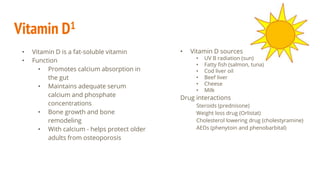
Vitamin D1
• Vitamin D is a fat-soluble vitamin
• Function
• Promotes calcium absorption in
the gut
• Maintains adequate serum
calcium and phosphate
concentrations
• Bone growth and bone
remodeling
• With calcium - helps protect older
adults from osteoporosis
• Vitamin D sources
• UV B radiation (sun)
• Fatty fish (salmon, tuna)
• Cod liver oil
• Beef liver
• Cheese
• Milk
Drug interactions
Steroids (prednisone)
Weight loss drug (Orlistat)
Cholesterol lowering drug (cholestyramine)
AEDs (phenytoin and phenobarbital)
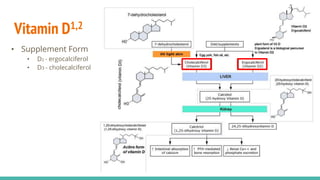
Vitamin D1,2
• Supplement Form
• D2 - ergocalciferol
• D3 - cholecalciferol
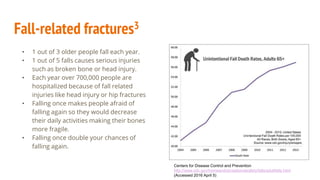
Fall-related fractures3
• 1 out of 3 older people fall each year.
• 1 out of 5 falls causes serious injuries
such as broken bone or head injury.
• Each year over 700,000 people are
hospitalized because of fall related
injuries like head injury or hip fractures
• Falling once makes people afraid of
falling again so they would decrease
their daily activities making their bones
more fragile.
• Falling once double your chances of
falling again.
Centers for Disease Control and Prevention
http://www.cdc.gov/homeandrecreationalsafety/falls/adultfalls.html
(Accessed 2016 April 5)
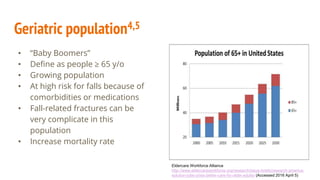
Geriatric population4,5
• “Baby Boomers”
• Define as people ≥ 65 y/o
• Growing population
• At high risk for falls because of
comorbidities or medications
• Fall-related fractures can be
very complicate in this
population
• Increase mortality rate
Eldercare Workforce Alliance
http://www.eldercareworkforce.org/research/issue-briefs/research:america-
solution-jobs-crisis-better-care-for-older-adults/ (Accessed 2016 April 5)
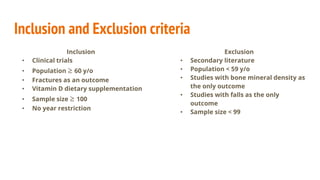
Inclusion and Exclusion criteria
Inclusion
• Clinical trials
• Population ≥ 60 y/o
• Fractures as an outcome
• Vitamin D dietary supplementation
• Sample size ≥ 100
• No year restriction
Exclusion
• Secondary literature
• Population < 59 y/o
• Studies with bone mineral density as
the only outcome
• Studies with falls as the only
outcome
• Sample size < 99
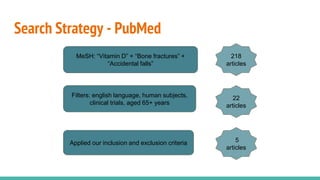
Search Strategy - PubMed
Filters: english language, human subjects,
clinical trials, aged 65+ years
MeSH: “Vitamin D” + “Bone fractures” +
“Accidental falls”
218
articles
22
articles
Applied our inclusion and exclusion criteria 5
articles
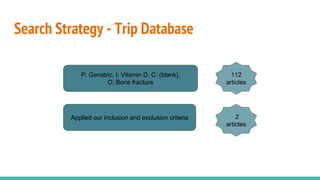
Search Strategy - Trip Database
Applied our inclusion and exclusion criteria
P: Geriatric, I: Vitamin D, C: (blank),
O: Bone fracture
112
articles
2
articles
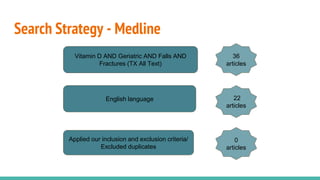
Search Strategy - Medline
English language
Vitamin D AND Geriatric AND Falls AND
Fractures (TX All Text)
36
articles
22
articles
Applied our inclusion and exclusion criteria/
Excluded duplicates
0
articles
POEM
P Geriatric population
I Vitamin D dietary supplementation
C No vitamin D dietary supplementation or Placebo
O Incidence of fall-related fractures
Article #1 Can Vitamin D
Supplementation Reduce
the Risk of Fracture in the
Elderly? A Randomized
Controlled Trial
Meyer et al. Can Vitamin D Supplementation
Reduce the Risk of Fracture in the Elderly? A
Randomized Controlled Trial. Journal of Bone and
mineral research. 2002. Vol 17, Num 4: 709-15.
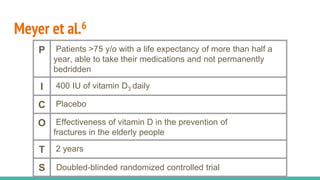
Meyer et al.6
P Patients >75 y/o with a life expectancy of more than half a
year, able to take their medications and not permanently
bedridden
I 400 IU of vitamin D3 daily
C Placebo
O Effectiveness of vitamin D in the prevention of
fractures in the elderly people
T 2 years
S Doubled-blinded randomized controlled trial
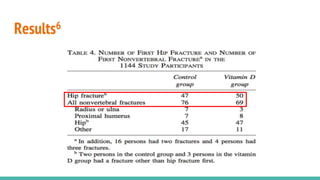
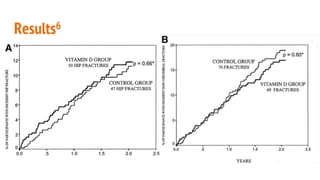
Results6
Results6
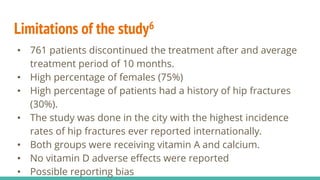
Limitations of the study6
• 761 patients discontinued the treatment after and average
treatment period of 10 months.
• High percentage of females (75%)
• High percentage of patients had a history of hip fractures
(30%).
• The study was done in the city with the highest incidence
rates of hip fractures ever reported internationally.
• Both groups were receiving vitamin A and calcium.
• No vitamin D adverse effects were reported
• Possible reporting bias
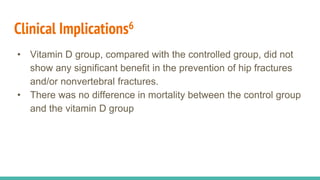
Clinical Implications6
• Vitamin D group, compared with the controlled group, did not
show any significant benefit in the prevention of hip fractures
and/or nonvertebral fractures.
• There was no difference in mortality between the control group
and the vitamin D group
Article #2 Vitamin D
Supplementation and
Fracture in Elderly
Persons: A Randomized,
Placebo-Controlled
Clinical Trial
Lips et al. Vitamin D Supplementation and Fracture
in Elderly Persons: A Randomized, Placebo-
Controlled Trial. Ann Intern Med. 1996. 124: 400-
406.
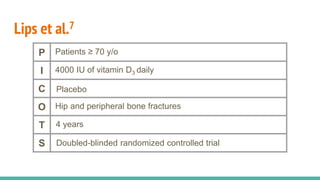
Lips et al.7
P Patients ≥ 70 y/o
I 4000 IU of vitamin D3 daily
C Placebo
O Hip and peripheral bone fractures
T 4 years
S Doubled-blinded randomized controlled trial
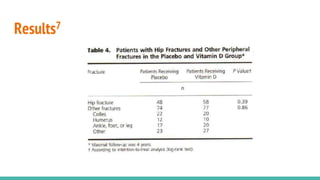
Results7
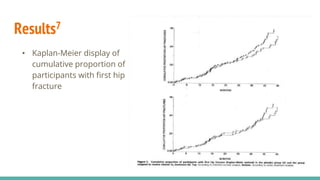
Results7
• Kaplan-Meier display of
cumulative proportion of
participants with first hip
fracture
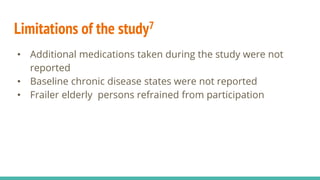
Limitations of the study7
• Additional medications taken during the study were not
reported
• Baseline chronic disease states were not reported
• Frailer elderly persons refrained from participation
• Subgroup analysis may reveal confounding variables
• Vitamin D3 4000 IU daily does not reduce incidence of bone
fracture in Dutch elderly population
Clinical Implications7
Article #3 Annual High-Dose Oral
Vitamin D and Falls and
Fractures in Older Women A
Randomized Controlled Trial
Sanders et al. Annual High-Dose Oral Vitamin D
and Falls and Fractures in Older Women
A Randomized Controlled Trial. JAMA. 2010;
303(18): 1815-22
Sanders et al.8
P Women >70 y/o with a high risk of hip fracture
I 500,000 IU of vitamin D3 orally once a year
C Placebo
O Falls and fractures
T 4 years
S Double-blinded, placebo-controlled randomized trial
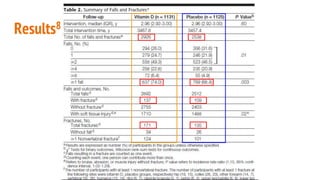
Results8
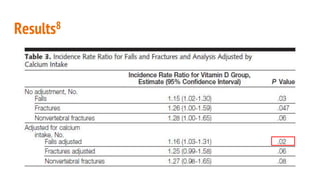
Results8
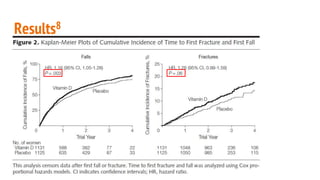
Results8
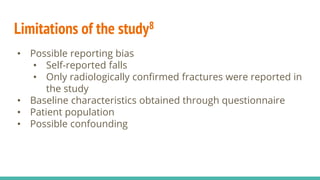
Limitations of the study8
• Possible reporting bias
• Self-reported falls
• Only radiologically confirmed fractures were reported in
the study
• Baseline characteristics obtained through questionnaire
• Patient population
• Possible confounding
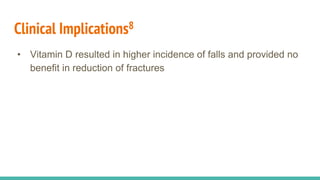
Clinical Implications8
• Vitamin D resulted in higher incidence of falls and provided no
benefit in reduction of fractures
Article #4 Vitamin D supplementation
and the prevention of
fractures and falls: results
of a randomised trial in
elderly people in
residential accommodation
Law et al. Vitamin D supplementation and the
prevention of fractures and falls: results of a
randomised trial in elderly people in
residential accommodation. Age and ageing.
2006; 35: 482-486
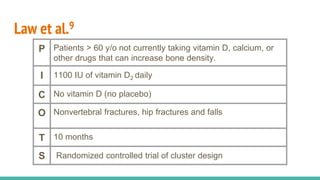
Law et al.9
P Patients > 60 y/o not currently taking vitamin D, calcium, or
other drugs that can increase bone density.
I 1100 IU of vitamin D2 daily
C No vitamin D (no placebo)
O Nonvertebral fractures, hip fractures and falls
T 10 months
S Randomized controlled trial of cluster design
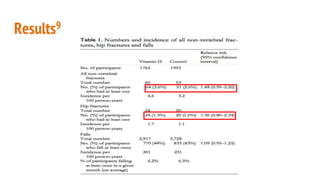
Results9
Limitations of the study9
• Possible selection bias since data on ineligible patients was not provided.
• 10 months long
• No blinding
• No placebo
• Follow up was only 6 or 12 months
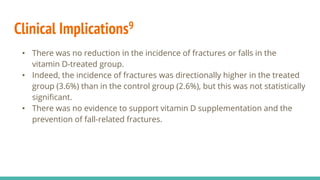
Clinical Implications9
• There was no reduction in the incidence of fractures or falls in the
vitamin D-treated group.
• Indeed, the incidence of fractures was directionally higher in the treated
group (3.6%) than in the control group (2.6%), but this was not statistically
significant.
• There was no evidence to support vitamin D supplementation and the
prevention of fall-related fractures.
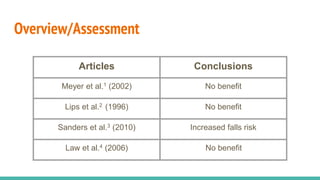
Overview/Assessment
Articles Conclusions
Meyer et al.1 (2002) No benefit
Lips et al.2 (1996) No benefit
Sanders et al.3 (2010) Increased falls risk
Law et al.4 (2006) No benefit
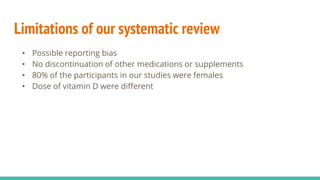
Limitations of our systematic review
• Possible reporting bias
• No discontinuation of other medications or supplements
• 80% of the participants in our studies were females
• Dose of vitamin D were different
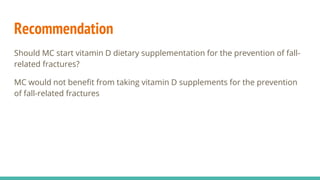
Recommendation
Should MC start vitamin D dietary supplementation for the prevention of fall-
related fractures?
MC would not benefit from taking vitamin D supplements for the prevention
of fall-related fractures
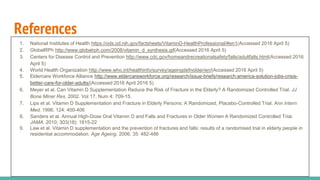
References
1. National Institutes of Health https://ods.od.nih.gov/factsheets/VitaminD-HealthProfessional/#en1(Accessed 2016 April 5)
2. GlobalRPh http://www.globalrph.com/2008/vitamin_d_synthesis.gif(Accessed 2016 April 5)
3. Centers for Disease Control and Prevention http://www.cdc.gov/homeandrecreationalsafety/falls/adultfalls.html(Accessed 2016
April 5)
4. World Health Organization http://www.who.int/healthinfo/survey/ageingdefnolder/en/(Accessed 2016 April 5)
5. Eldercare Workforce Alliance http://www.eldercareworkforce.org/research/issue-briefs/research:america-solution-jobs-crisis-
better-care-for-older-adults/(Accessed 2016 April 2016 5)
6. Meyer et al. Can Vitamin D Supplementation Reduce the Risk of Fracture in the Elderly? A Randomized Controlled Trial. JJ
Bone Miner Res. 2002. Vol 17, Num 4: 709-15.
7. Lips et al. Vitamin D Supplementation and Fracture in Elderly Persons: A Randomized, Placebo-Controlled Trial. Ann Intern
Med. 1996. 124: 400-406
8. Sanders et al. Annual High-Dose Oral Vitamin D and Falls and Fractures in Older Women A Randomized Controlled Trial.
JAMA. 2010; 303(18): 1815-22
9. Law et al. Vitamin D supplementation and the prevention of fractures and falls: results of a randomised trial in elderly people in
residential accommodation. Age Ageing. 2006; 35: 482-486
Questions

Group 8 Systematic Review Presenation

  • 1.
    Does taking vitaminD supplements reduce fall-related fractures among geriatric patients? Mohamad Beydoun Kim Kirkpatrick Jeffrey Oboite Rafael Otero De Santiago
  • 2.
    Patient case MC isa 68 y/o caucasian female who lives at villages of Homeland apartments alone. She comes to the pharmacy to pick up her medications and asked the pharmacist a question regarding vitamin D supplements. A close friend of hers recently had a fall-related fracture and has her worried. She has heard that vitamin D can help lower your chances of falls and fractures and wants to know if vitamin D would be beneficial for her in the future. Home Medications: ● Escitalopram 10mg PO QD ● Metoprolol Succinate 25mg PO QD ● Simvastatin 10mg PO QD ● Albuterol 1-2 puffs every 4-6 hrs PRN PMH: ● Depression ● Hypertension ● Hyperlipidemia ● Asthma
  • 3.
    Vitamin D1 • VitaminD is a fat-soluble vitamin • Function • Promotes calcium absorption in the gut • Maintains adequate serum calcium and phosphate concentrations • Bone growth and bone remodeling • With calcium - helps protect older adults from osteoporosis • Vitamin D sources • UV B radiation (sun) • Fatty fish (salmon, tuna) • Cod liver oil • Beef liver • Cheese • Milk Drug interactions Steroids (prednisone) Weight loss drug (Orlistat) Cholesterol lowering drug (cholestyramine) AEDs (phenytoin and phenobarbital)
  • 4.
    Vitamin D1,2 • SupplementForm • D2 - ergocalciferol • D3 - cholecalciferol
  • 5.
    Fall-related fractures3 • 1out of 3 older people fall each year. • 1 out of 5 falls causes serious injuries such as broken bone or head injury. • Each year over 700,000 people are hospitalized because of fall related injuries like head injury or hip fractures • Falling once makes people afraid of falling again so they would decrease their daily activities making their bones more fragile. • Falling once double your chances of falling again. Centers for Disease Control and Prevention http://www.cdc.gov/homeandrecreationalsafety/falls/adultfalls.html (Accessed 2016 April 5)
  • 6.
    Geriatric population4,5 • “BabyBoomers” • Define as people ≥ 65 y/o • Growing population • At high risk for falls because of comorbidities or medications • Fall-related fractures can be very complicate in this population • Increase mortality rate Eldercare Workforce Alliance http://www.eldercareworkforce.org/research/issue-briefs/research:america- solution-jobs-crisis-better-care-for-older-adults/ (Accessed 2016 April 5)
  • 7.
    Inclusion and Exclusioncriteria Inclusion • Clinical trials • Population ≥ 60 y/o • Fractures as an outcome • Vitamin D dietary supplementation • Sample size ≥ 100 • No year restriction Exclusion • Secondary literature • Population < 59 y/o • Studies with bone mineral density as the only outcome • Studies with falls as the only outcome • Sample size < 99
  • 8.
    Search Strategy -PubMed Filters: english language, human subjects, clinical trials, aged 65+ years MeSH: “Vitamin D” + “Bone fractures” + “Accidental falls” 218 articles 22 articles Applied our inclusion and exclusion criteria 5 articles
  • 9.
    Search Strategy -Trip Database Applied our inclusion and exclusion criteria P: Geriatric, I: Vitamin D, C: (blank), O: Bone fracture 112 articles 2 articles
  • 10.
    Search Strategy -Medline English language Vitamin D AND Geriatric AND Falls AND Fractures (TX All Text) 36 articles 22 articles Applied our inclusion and exclusion criteria/ Excluded duplicates 0 articles
  • 11.
    POEM P Geriatric population IVitamin D dietary supplementation C No vitamin D dietary supplementation or Placebo O Incidence of fall-related fractures
  • 12.
    Article #1 CanVitamin D Supplementation Reduce the Risk of Fracture in the Elderly? A Randomized Controlled Trial Meyer et al. Can Vitamin D Supplementation Reduce the Risk of Fracture in the Elderly? A Randomized Controlled Trial. Journal of Bone and mineral research. 2002. Vol 17, Num 4: 709-15.
  • 13.
    Meyer et al.6 PPatients >75 y/o with a life expectancy of more than half a year, able to take their medications and not permanently bedridden I 400 IU of vitamin D3 daily C Placebo O Effectiveness of vitamin D in the prevention of fractures in the elderly people T 2 years S Doubled-blinded randomized controlled trial
  • 14.
  • 15.
  • 16.
    Limitations of thestudy6 • 761 patients discontinued the treatment after and average treatment period of 10 months. • High percentage of females (75%) • High percentage of patients had a history of hip fractures (30%). • The study was done in the city with the highest incidence rates of hip fractures ever reported internationally. • Both groups were receiving vitamin A and calcium. • No vitamin D adverse effects were reported • Possible reporting bias
  • 17.
    Clinical Implications6 • VitaminD group, compared with the controlled group, did not show any significant benefit in the prevention of hip fractures and/or nonvertebral fractures. • There was no difference in mortality between the control group and the vitamin D group
  • 18.
    Article #2 VitaminD Supplementation and Fracture in Elderly Persons: A Randomized, Placebo-Controlled Clinical Trial Lips et al. Vitamin D Supplementation and Fracture in Elderly Persons: A Randomized, Placebo- Controlled Trial. Ann Intern Med. 1996. 124: 400- 406.
  • 19.
    Lips et al.7 PPatients ≥ 70 y/o I 4000 IU of vitamin D3 daily C Placebo O Hip and peripheral bone fractures T 4 years S Doubled-blinded randomized controlled trial
  • 20.
  • 21.
    Results7 • Kaplan-Meier displayof cumulative proportion of participants with first hip fracture
  • 22.
    Limitations of thestudy7 • Additional medications taken during the study were not reported • Baseline chronic disease states were not reported • Frailer elderly persons refrained from participation
  • 23.
    • Subgroup analysismay reveal confounding variables • Vitamin D3 4000 IU daily does not reduce incidence of bone fracture in Dutch elderly population Clinical Implications7
  • 24.
    Article #3 AnnualHigh-Dose Oral Vitamin D and Falls and Fractures in Older Women A Randomized Controlled Trial Sanders et al. Annual High-Dose Oral Vitamin D and Falls and Fractures in Older Women A Randomized Controlled Trial. JAMA. 2010; 303(18): 1815-22
  • 25.
    Sanders et al.8 PWomen >70 y/o with a high risk of hip fracture I 500,000 IU of vitamin D3 orally once a year C Placebo O Falls and fractures T 4 years S Double-blinded, placebo-controlled randomized trial
  • 26.
  • 27.
  • 28.
  • 29.
    Limitations of thestudy8 • Possible reporting bias • Self-reported falls • Only radiologically confirmed fractures were reported in the study • Baseline characteristics obtained through questionnaire • Patient population • Possible confounding
  • 30.
    Clinical Implications8 • VitaminD resulted in higher incidence of falls and provided no benefit in reduction of fractures
  • 31.
    Article #4 VitaminD supplementation and the prevention of fractures and falls: results of a randomised trial in elderly people in residential accommodation Law et al. Vitamin D supplementation and the prevention of fractures and falls: results of a randomised trial in elderly people in residential accommodation. Age and ageing. 2006; 35: 482-486
  • 32.
    Law et al.9 PPatients > 60 y/o not currently taking vitamin D, calcium, or other drugs that can increase bone density. I 1100 IU of vitamin D2 daily C No vitamin D (no placebo) O Nonvertebral fractures, hip fractures and falls T 10 months S Randomized controlled trial of cluster design
  • 33.
  • 34.
    Limitations of thestudy9 • Possible selection bias since data on ineligible patients was not provided. • 10 months long • No blinding • No placebo • Follow up was only 6 or 12 months
  • 35.
    Clinical Implications9 • Therewas no reduction in the incidence of fractures or falls in the vitamin D-treated group. • Indeed, the incidence of fractures was directionally higher in the treated group (3.6%) than in the control group (2.6%), but this was not statistically significant. • There was no evidence to support vitamin D supplementation and the prevention of fall-related fractures.
  • 36.
    Overview/Assessment Articles Conclusions Meyer etal.1 (2002) No benefit Lips et al.2 (1996) No benefit Sanders et al.3 (2010) Increased falls risk Law et al.4 (2006) No benefit
  • 37.
    Limitations of oursystematic review • Possible reporting bias • No discontinuation of other medications or supplements • 80% of the participants in our studies were females • Dose of vitamin D were different
  • 38.
    Recommendation Should MC startvitamin D dietary supplementation for the prevention of fall- related fractures? MC would not benefit from taking vitamin D supplements for the prevention of fall-related fractures
  • 39.
    References 1. National Institutesof Health https://ods.od.nih.gov/factsheets/VitaminD-HealthProfessional/#en1(Accessed 2016 April 5) 2. GlobalRPh http://www.globalrph.com/2008/vitamin_d_synthesis.gif(Accessed 2016 April 5) 3. Centers for Disease Control and Prevention http://www.cdc.gov/homeandrecreationalsafety/falls/adultfalls.html(Accessed 2016 April 5) 4. World Health Organization http://www.who.int/healthinfo/survey/ageingdefnolder/en/(Accessed 2016 April 5) 5. Eldercare Workforce Alliance http://www.eldercareworkforce.org/research/issue-briefs/research:america-solution-jobs-crisis- better-care-for-older-adults/(Accessed 2016 April 2016 5) 6. Meyer et al. Can Vitamin D Supplementation Reduce the Risk of Fracture in the Elderly? A Randomized Controlled Trial. JJ Bone Miner Res. 2002. Vol 17, Num 4: 709-15. 7. Lips et al. Vitamin D Supplementation and Fracture in Elderly Persons: A Randomized, Placebo-Controlled Trial. Ann Intern Med. 1996. 124: 400-406 8. Sanders et al. Annual High-Dose Oral Vitamin D and Falls and Fractures in Older Women A Randomized Controlled Trial. JAMA. 2010; 303(18): 1815-22 9. Law et al. Vitamin D supplementation and the prevention of fractures and falls: results of a randomised trial in elderly people in residential accommodation. Age Ageing. 2006; 35: 482-486
  • 40.

Editor's Notes

  • #2 Raf
  • #3 Jeff
  • #4 Moh National Institutes of Health https://ods.od.nih.gov/factsheets/VitaminD-HealthProfessional/#en1 (Accessed 2016 April 5) Promotes calcium absorption in the gut Maintains adequate serum calcium and phosphate concentrations to enable mineralization of bone Needed for bone growth and bone remodeling by osteoblasts and osteoclasts Without it Bones can become thin and brittle
  • #5 Moh http://www.globalrph.com/2008/vitamin_d_synthesis.gif (Accessed 2016 April 5)
  • #6 Jeff Centers for Disease Control and Prevention http://www.cdc.gov/homeandrecreationalsafety/falls/adultfalls.html (Accessed 2016 April 5)
  • #7 Jeff World Health Organization http://www.who.int/healthinfo/survey/ageingdefnolder/en/ (Accessed 2016 April 5) Eldercare Workforce Alliance http://www.eldercareworkforce.org/research/issue-briefs/research:america-solution-jobs-crisis-better-care-for-older-adults/ (Accessed 2016 April 5)
  • #8 Raf
  • #9 Moh
  • #10 Kim
  • #11 Raf
  • #12 Kim
  • #13 Raf
  • #17 332 persons discontinued the treatment because of death (after an average treatment period of 10.2 months), and 429 persons stopped taking the treatment for a variety of other reasons (after an average treatment period of 9 months; Table 2). Of these 429 persons, 159 died after they had stopped taking the treatment and before end of follow-up. Females have smaller skeletal size and less bone mass than males, which already puts them at a higher risk for fall-related fractures Which means they were at higher risk already for falling and fracturing a bone Vitamin A is harmful to bone health
  • #19 Kim
  • #25 Moh
  • #26 Maternal hip fracture, past fracture, self-reported faller
  • #30 Self-reported falls, only serious fractures were likely to be reported, study population was never evaluated at the study center so no information was available regarding baseline characteristics
  • #32 Jeff I chose this article because not only was in very thorough in the data analysis of the effect of vitamin D to patients with y
  • #34  For patients receiving vitamin D, the number of participants that had at least one fall incident was 64, while control group was 51 For patients that had at least 1 fall under the active arm, the number was 24, while controlled group is 20 So as we can see, there’s not only does the intervention of vitamin D not improve risk of falls and fractures, but it increases risk, but this isnt statistically significant since the relative risk crosses 0. Not statsitically signinficance because the relative risk crosses 0
  • #35 If there’s no placebo in place, then the participants in the controlled arm know that they are not getting anything, so they have no expectation, which could affect their chances of falls and fractures.
  • #37 Jeff
  • #38 Raf
  • #39 Kim