Next Generation Sequencing
and
Bioinformatics Analysis Pipelines
Adam Ameur
National Genomics Infrastructure
SciLifeLab Uppsala
adam.ameur@igp.uu.se
INF R S RU URE
A T CT
ENOMI S
G C
ATCA GT
N ION L
GA CTAC
AT A
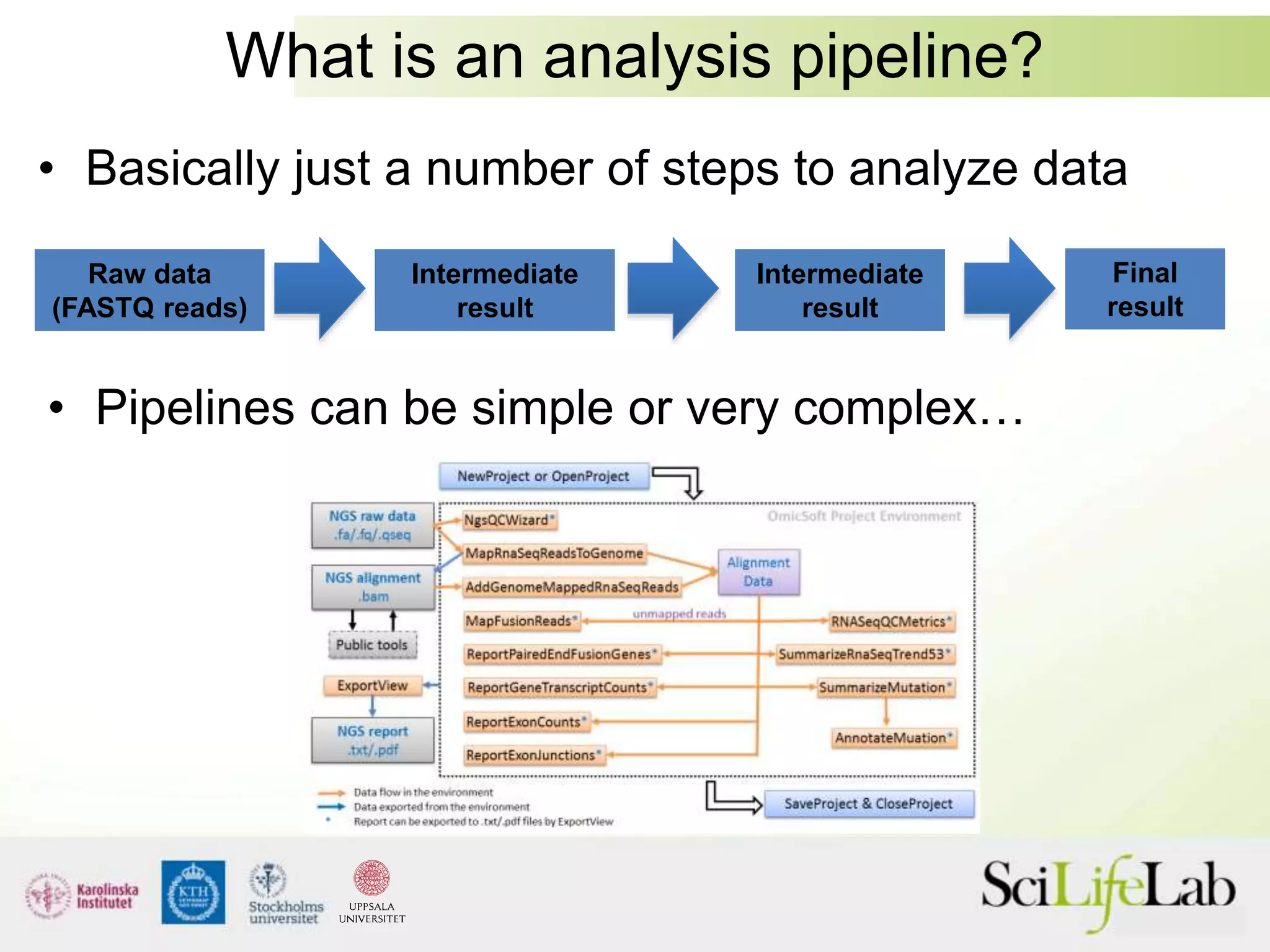
What is an analysis pipeline?
• Basically just a number of steps to analyze data
Raw data
(FASTQ reads)
Intermediate
result
Intermediate
result
Final
result
• Pipelines can be simple or very complex…
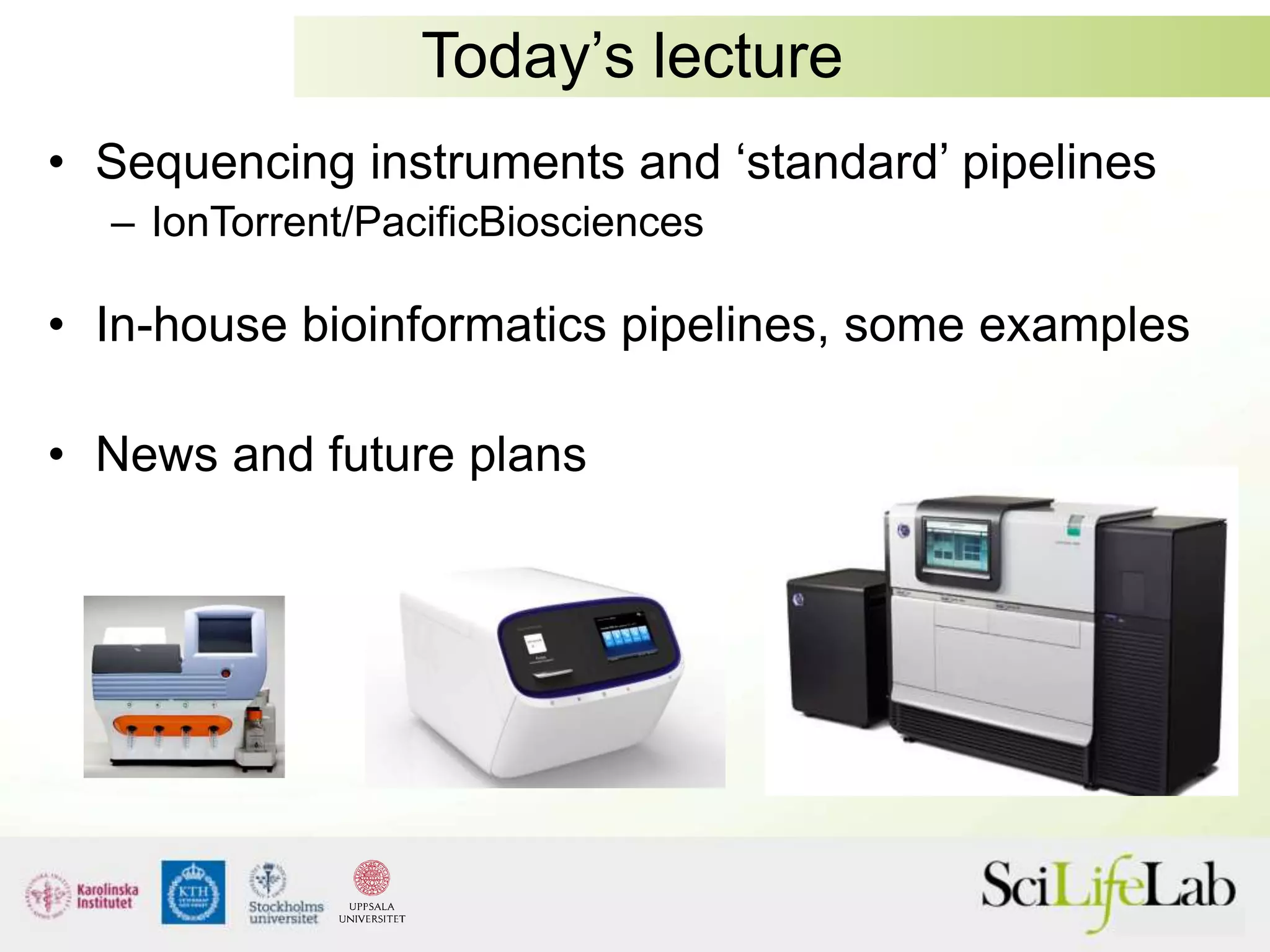
Today’s lecture
• Sequencing instruments and ‘standard’ pipelines
– IonTorrent/PacificBiosciences
• In-house bioinformatics pipelines, some examples
• News and future plans
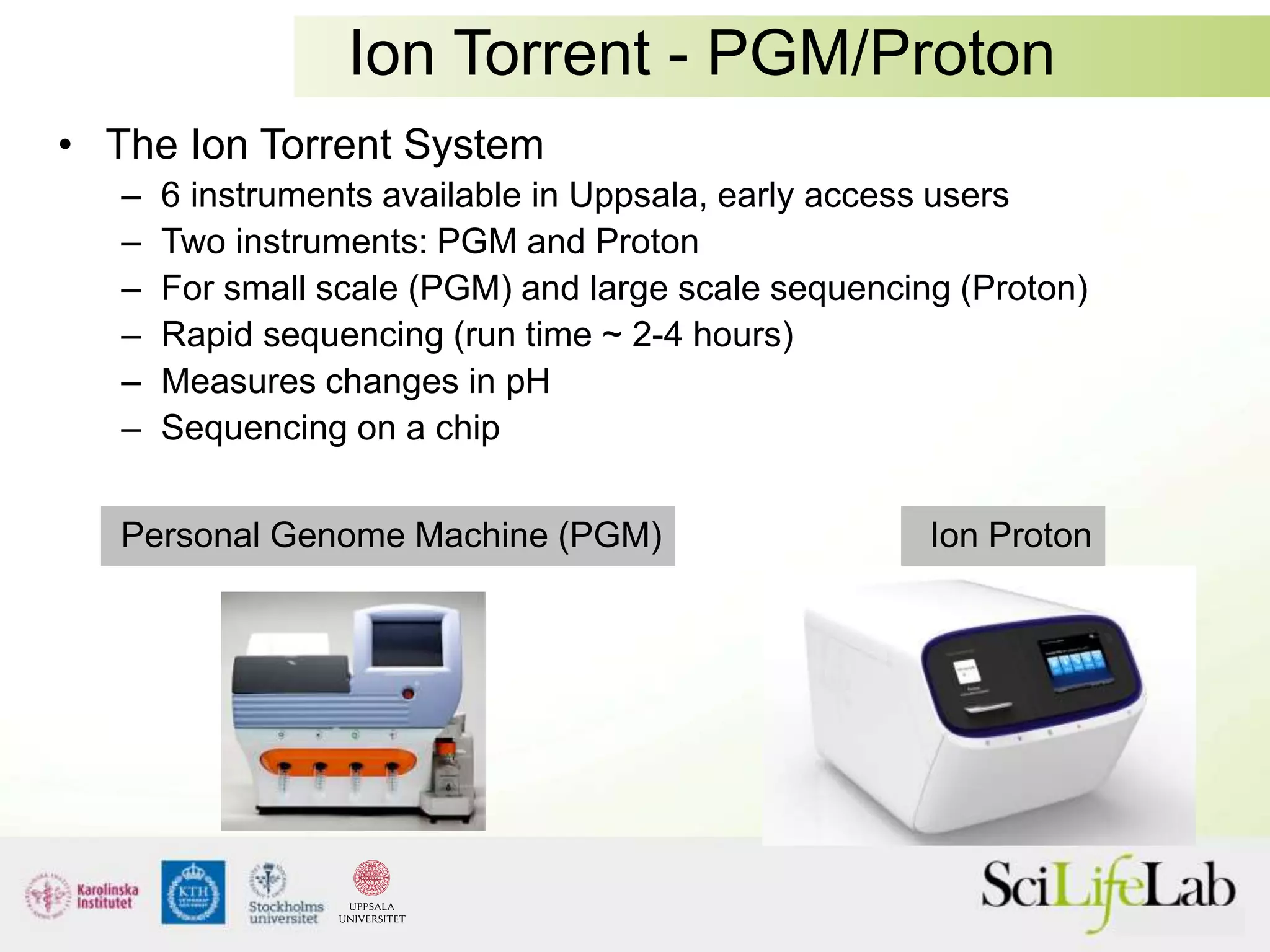
Ion Torrent - PGM/Proton
• The Ion Torrent System
– 6 instruments available in Uppsala, early access users
– Two instruments: PGM and Proton
– For small scale (PGM) and large scale sequencing (Proton)
– Rapid sequencing (run time ~ 2-4 hours)
– Measures changes in pH
– Sequencing on a chip
Personal Genome Machine (PGM) Ion Proton
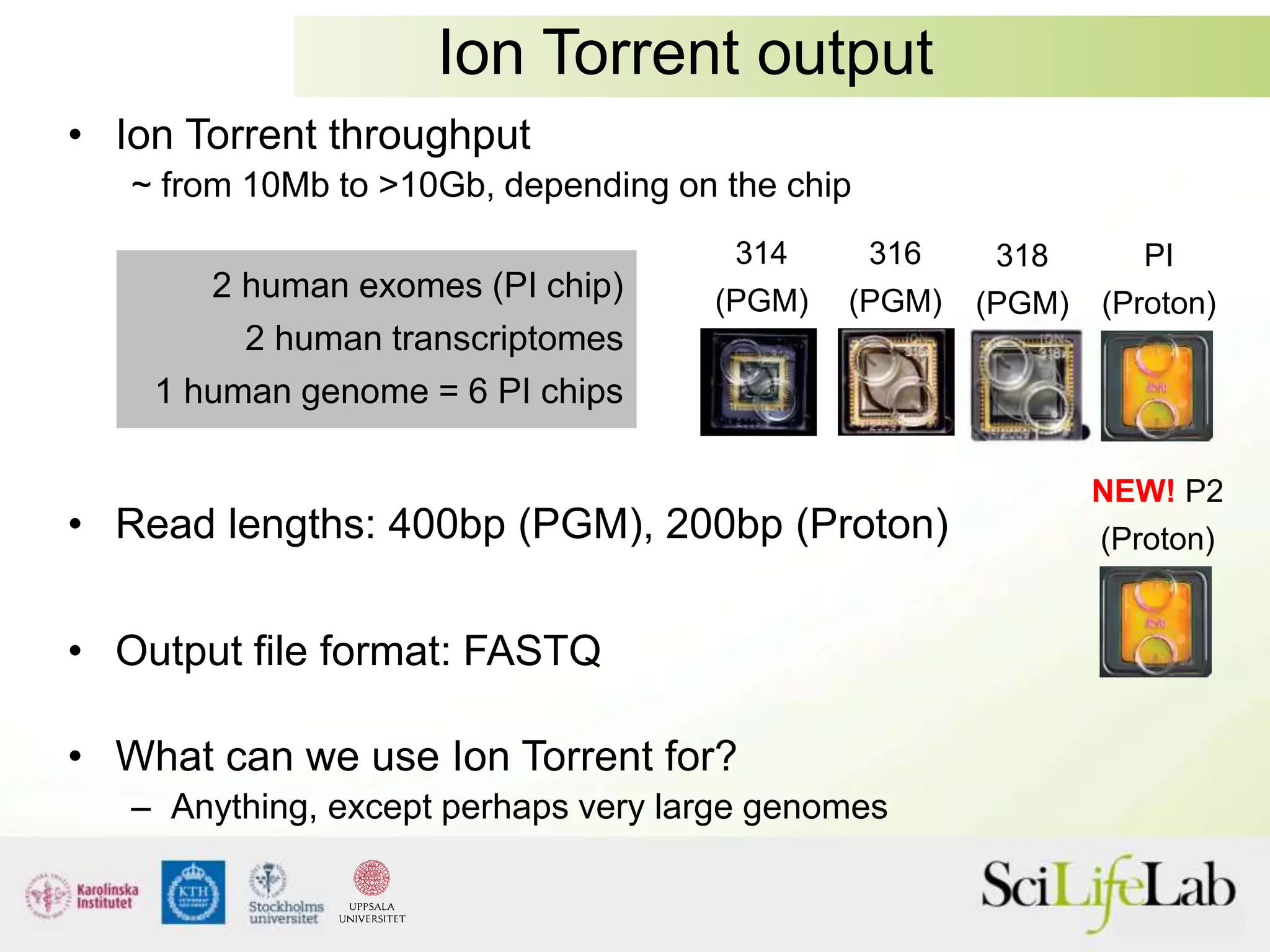
Ion Torrent output
• Ion Torrent throughput
~ from 10Mb to >10Gb, depending on the chip
• Read lengths: 400bp (PGM), 200bp (Proton)
• Output file format: FASTQ
• What can we use Ion Torrent for?
– Anything, except perhaps very large genomes
2 human exomes (PI chip)
2 human transcriptomes
1 human genome = 6 PI chips
PI
(Proton)
318
(PGM)
316
(PGM)
314
(PGM)
NEW! P2
(Proton)
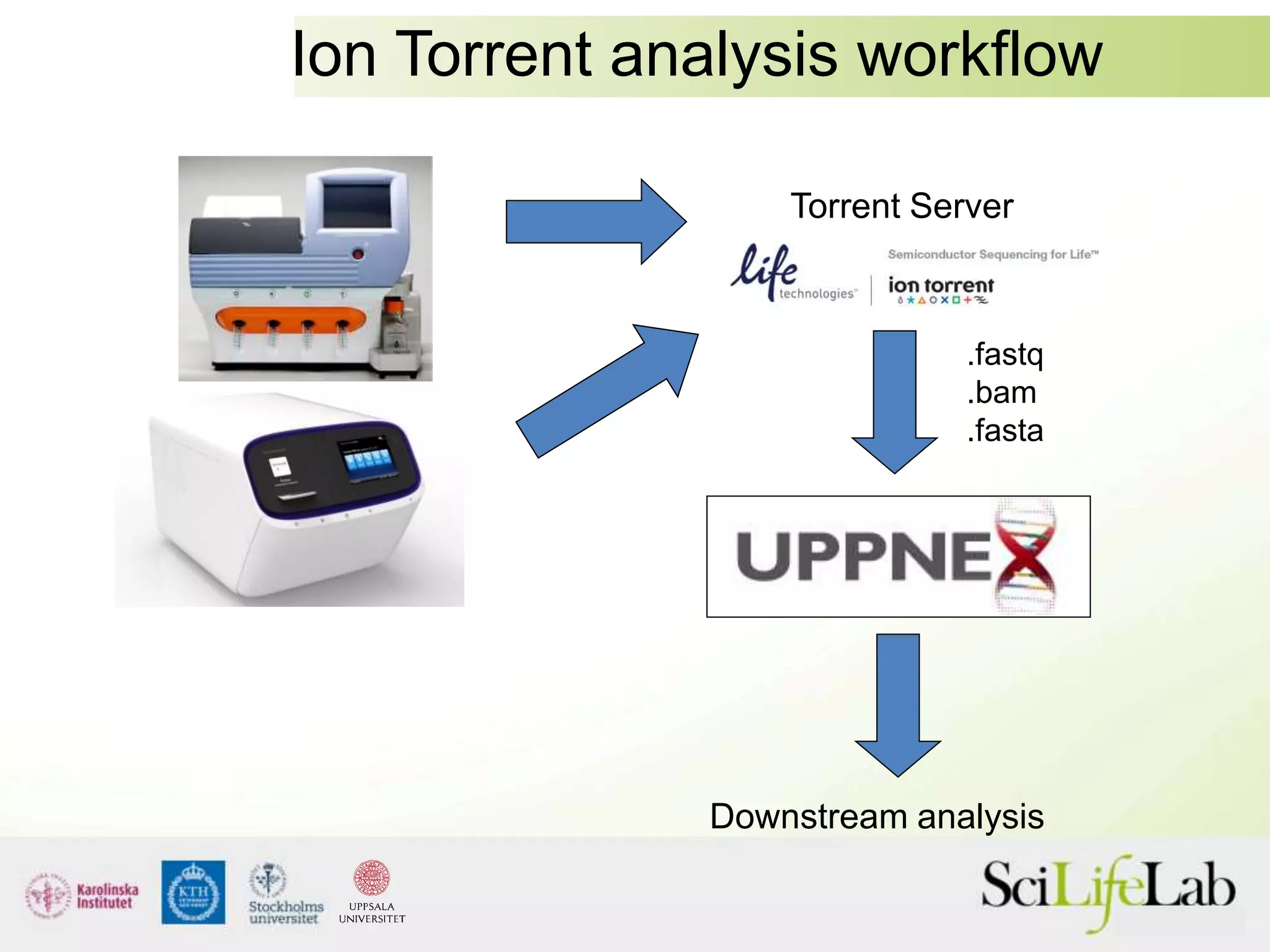
Ion Torrent analysis workflow
Downstream analysis
Torrent Server
.fastq
.bam
.fasta
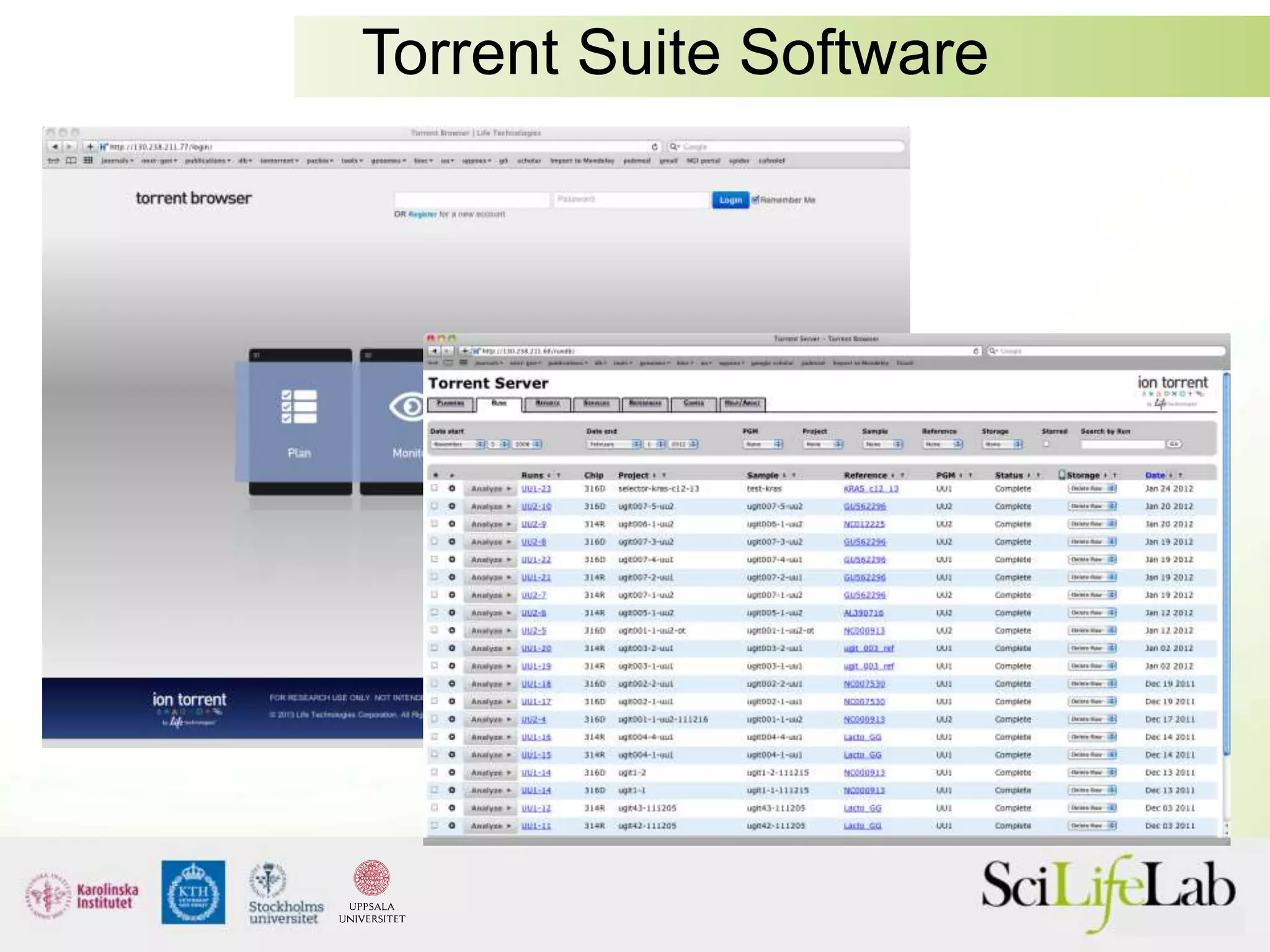
Torrent Suite Software
Torrent Suite Software Analysis
• Plug-ins within the Torrent Suite Software
– Alignment
• TMAP: Specifically developed for Ion Torrent data
– Variant Caller
• SNP/Indel detection
– Assembler
• MIRA
– Analysis of gene panels (Human exomes, cancer panels, etc…)
• SNP/Indel detection in amplicon-seq data
– Analysis of human transcriptomes
– …
• Analyses are started automatically when run is complete!
Pacific Biosciences
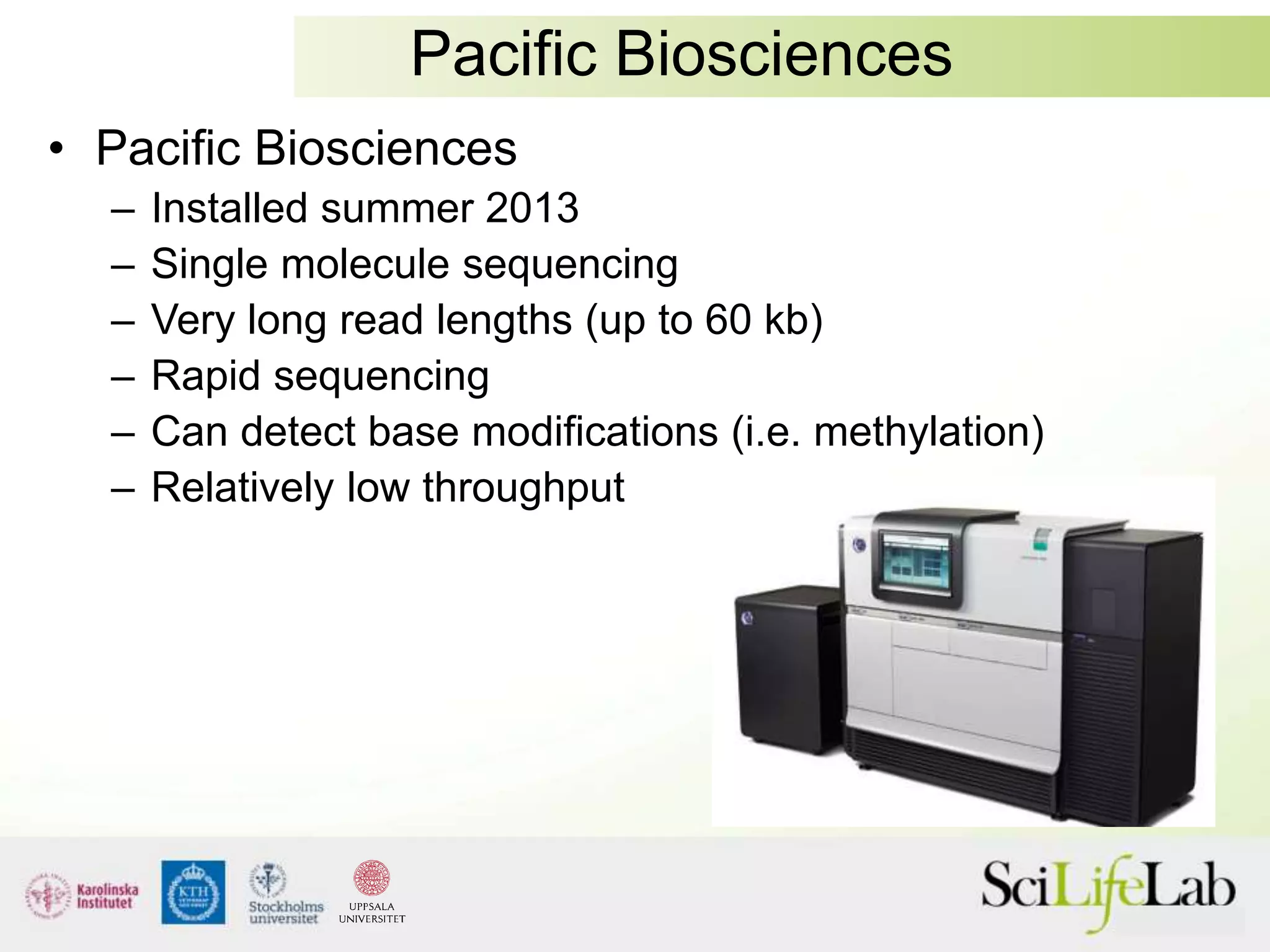
• Pacific Biosciences
– Installed summer 2013
– Single molecule sequencing
– Very long read lengths (up to 60 kb)
– Rapid sequencing
– Can detect base modifications (i.e. methylation)
– Relatively low throughput
PacBio output
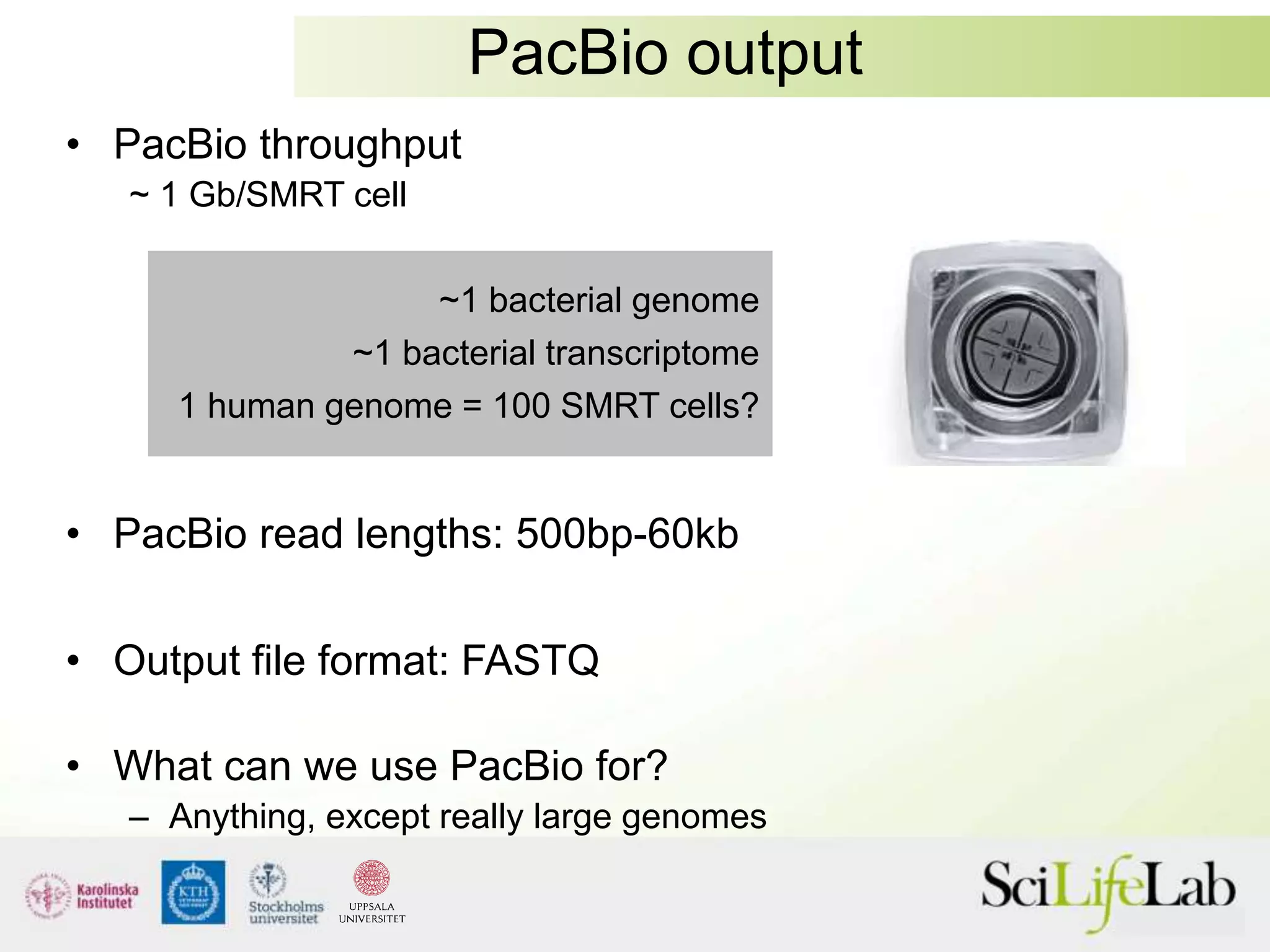
• PacBio throughput
~ 1 Gb/SMRT cell
• PacBio read lengths: 500bp-60kb
• Output file format: FASTQ
• What can we use PacBio for?
– Anything, except really large genomes
~1 bacterial genome
~1 bacterial transcriptome
1 human genome = 100 SMRT cells?
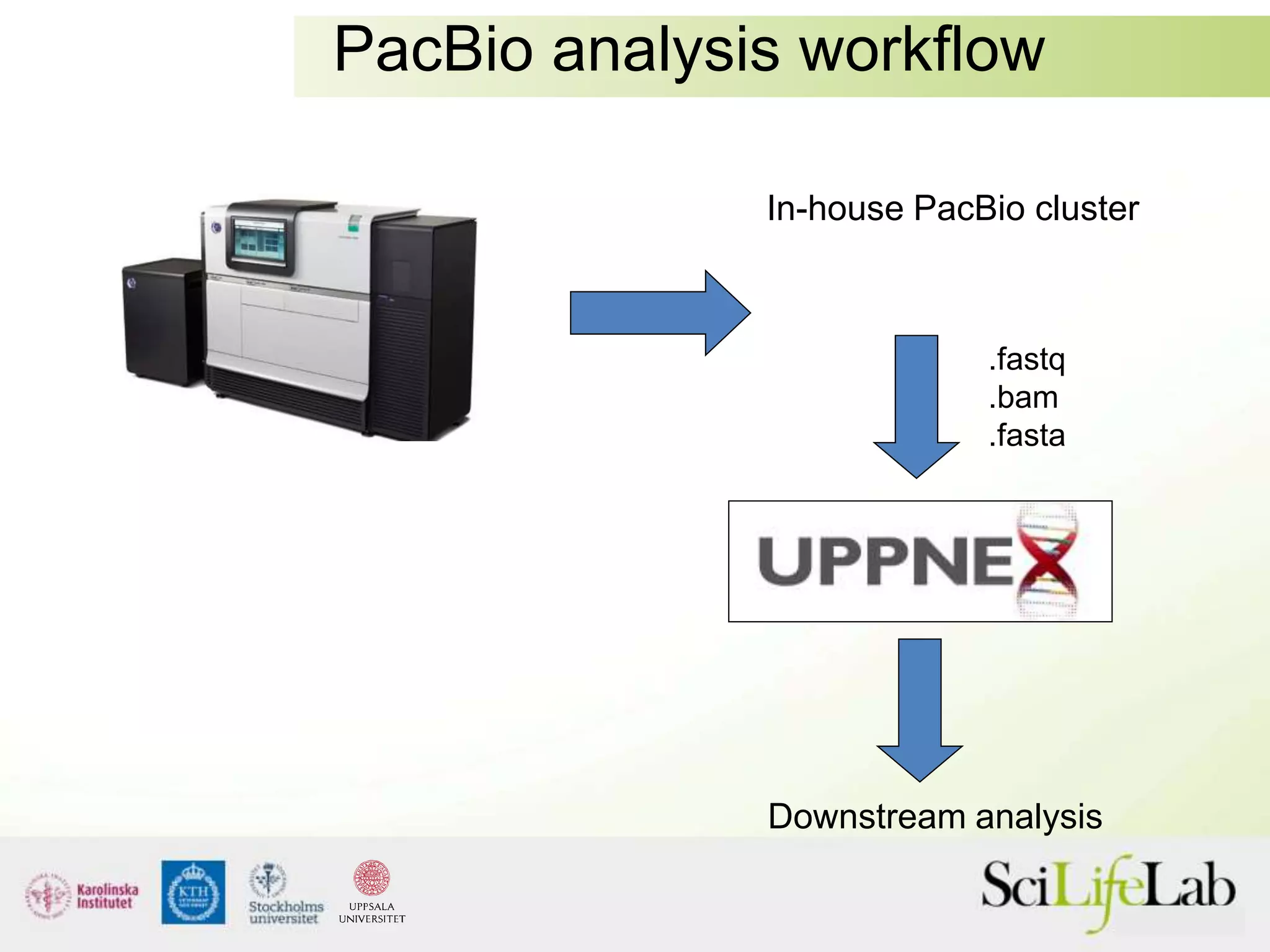
PacBio analysis workflow
In-house PacBio cluster
Downstream analysis
.fastq
.bam
.fasta
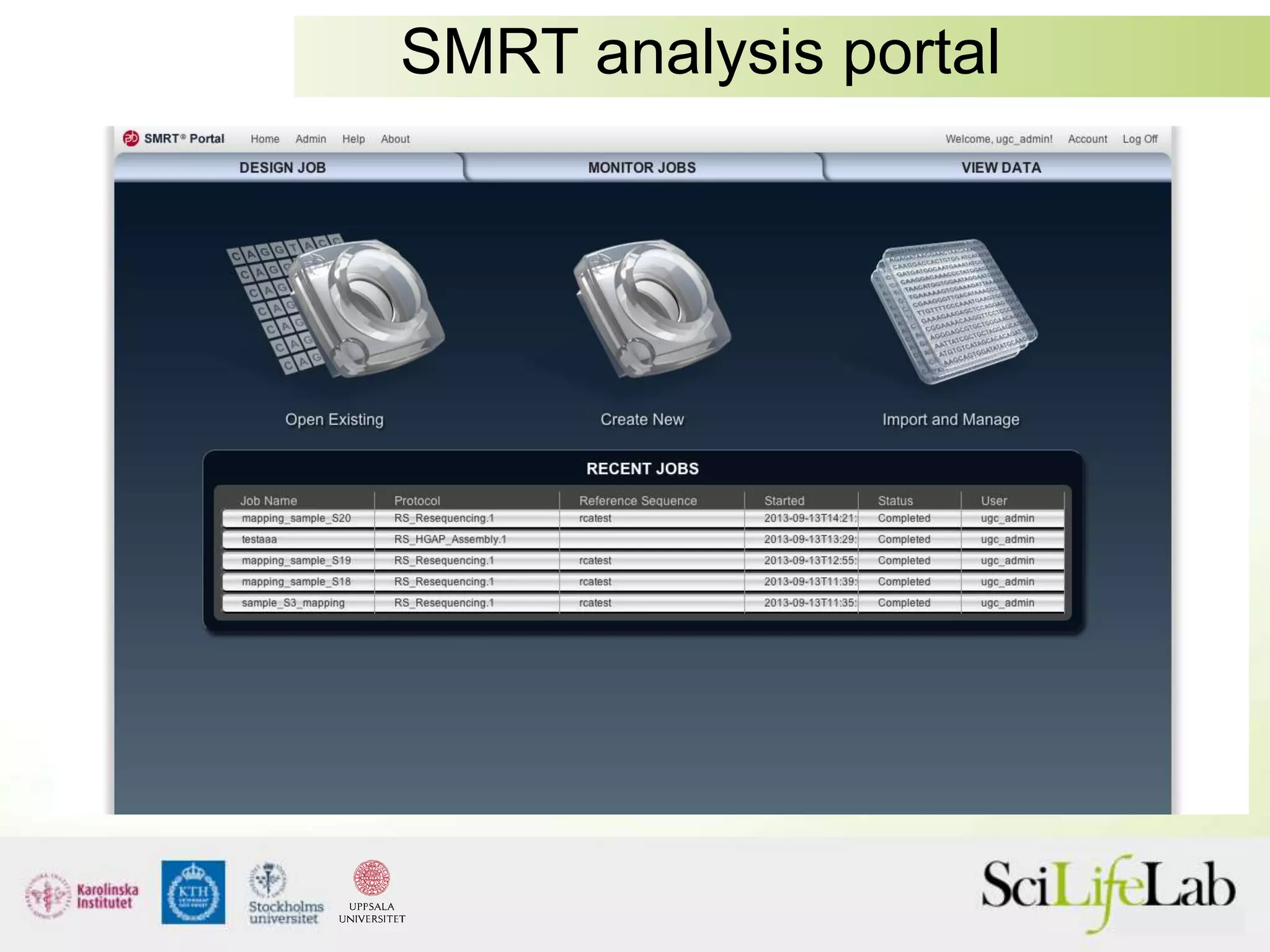
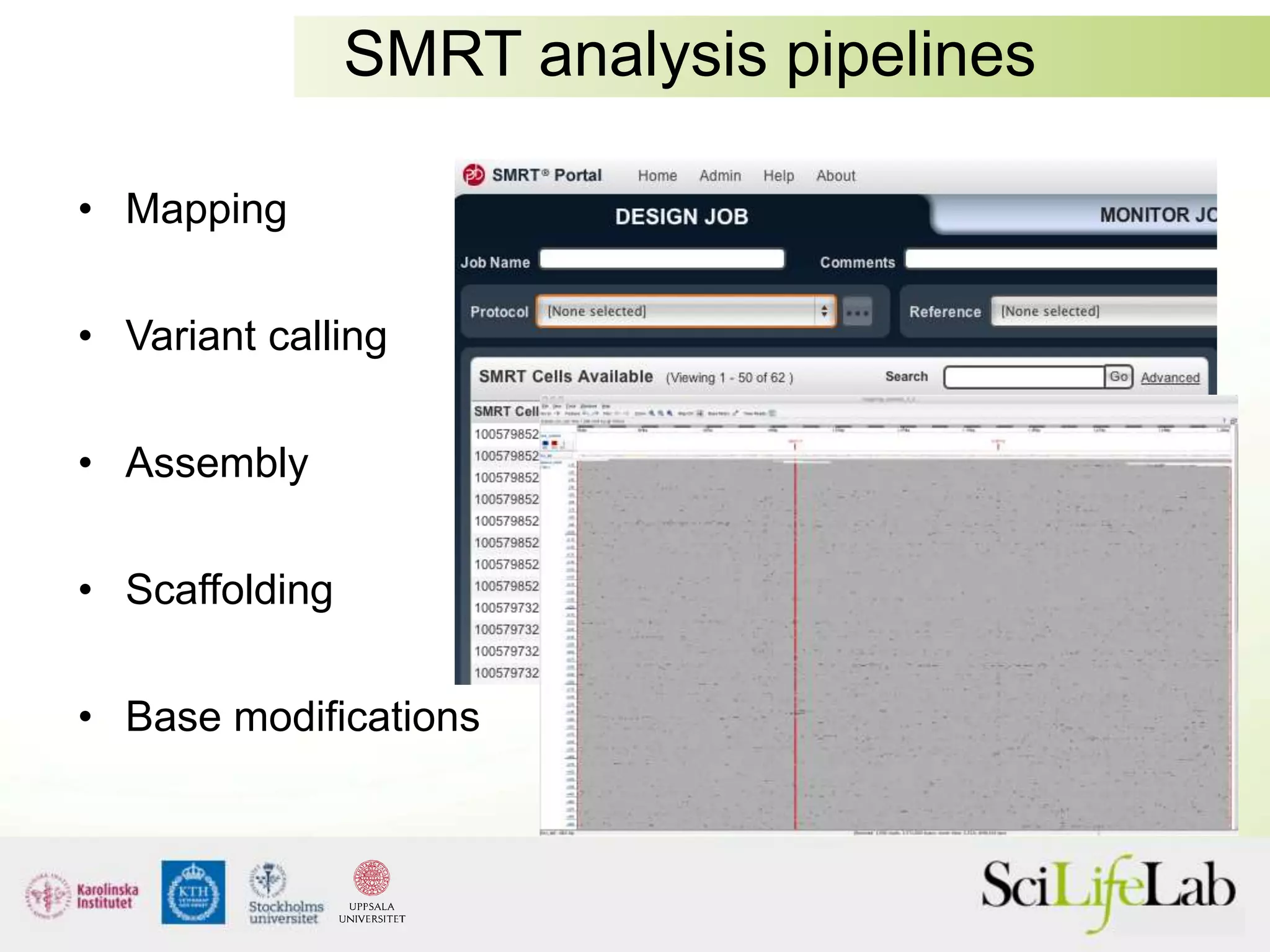
SMRT analysis portal
SMRT analysis pipelines
• Mapping
• Variant calling
• Assembly
• Scaffolding
• Base modifications
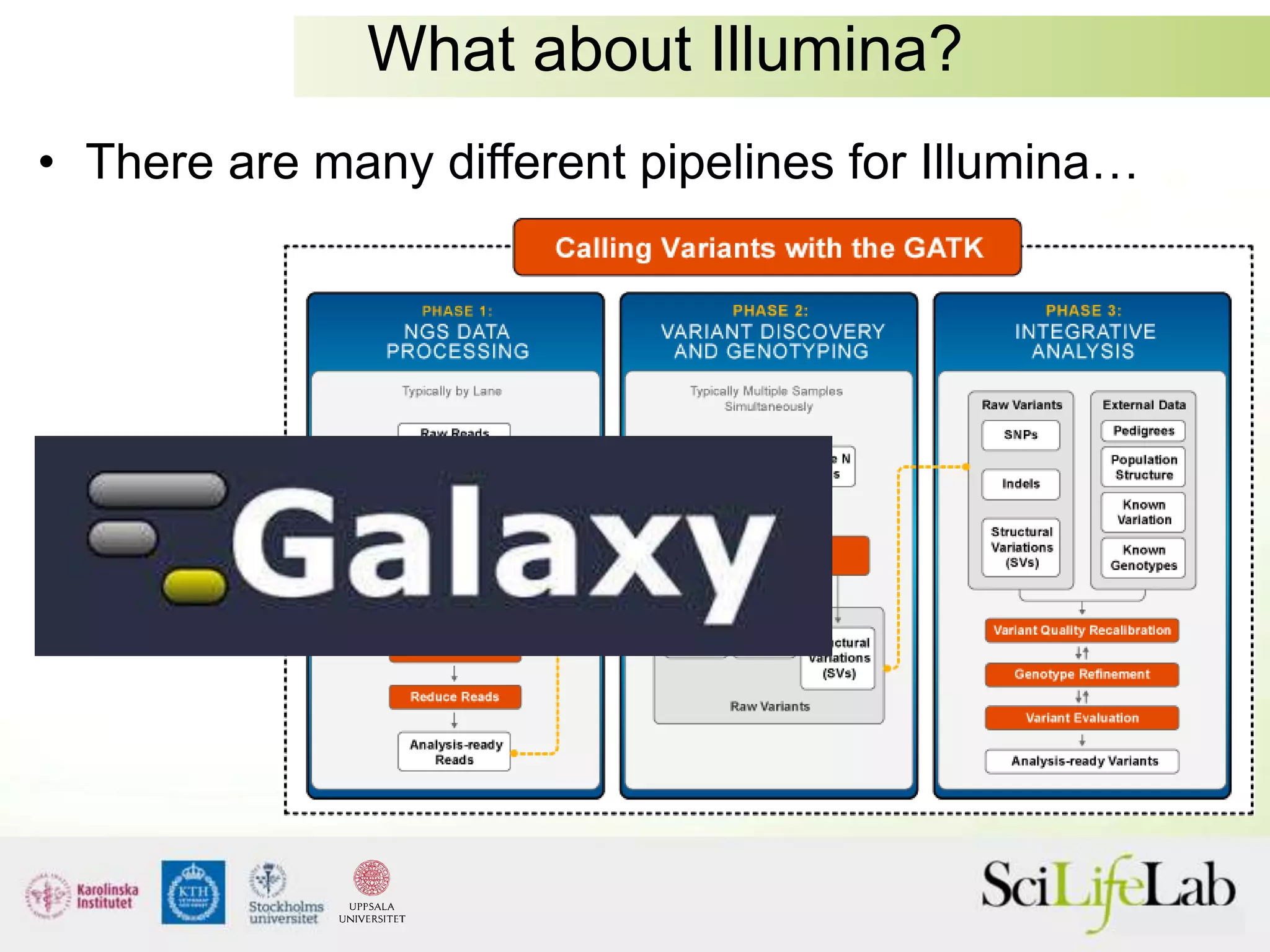
What about Illumina?
• There are many different pipelines for Illumina…
In-house development of pipelines
• The standard analysis pipelines are nice…
… but sometimes we need to do own developments
… or adapt the pipelines to our specific applications
• Some examples of in-house developments:
I. Building a local variant database (WES/WGS)
II. Assembly of genomes using long reads
III. Clinical sequencing – Leukemia Diagnostics
*
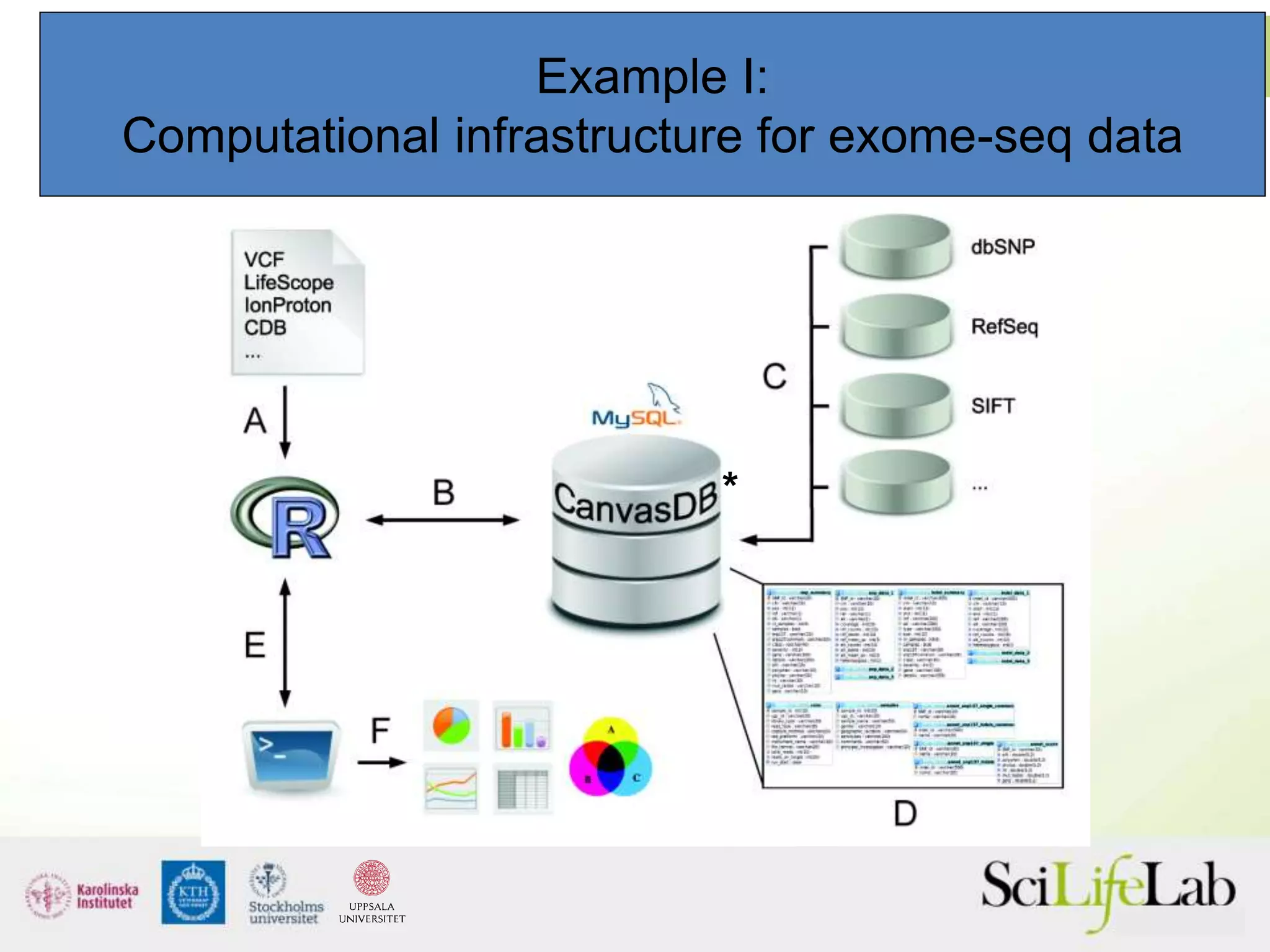
Example I:
Computational infrastructure for exome-seq data
Background: exome-seq
• Main application of exome-seq
– Find disease causing mutations in humans
• Advantages
– Allows investigate all protein coding sequences
– Possible to detect both SNPs and small indels
– Low cost (compared to WGS)
– Possible to multiplex several exomes in one run
– Standardized work flow for data analysis
• Disadvantage
– All genetic variants outside of exons are missed (~98%)
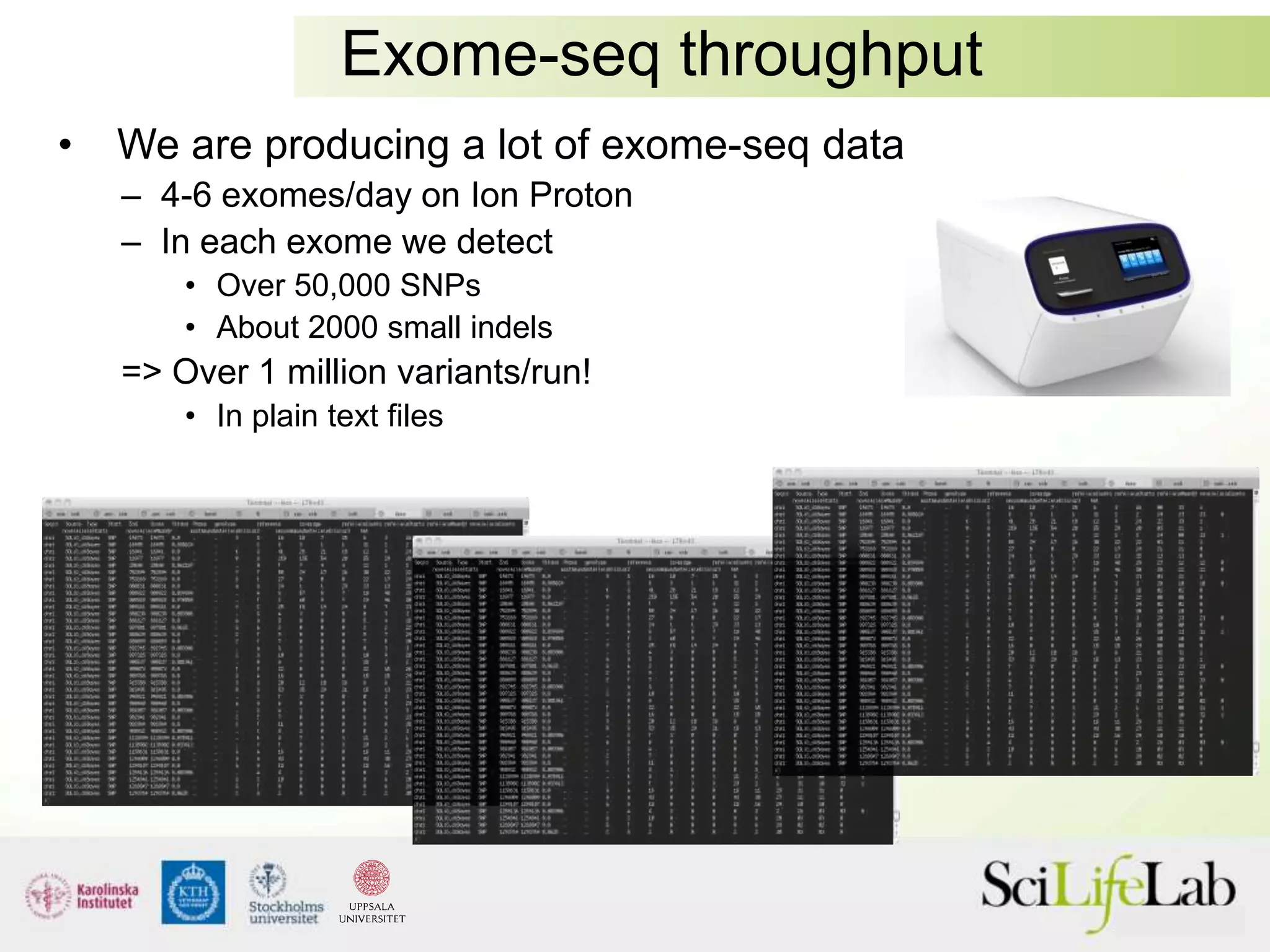
Exome-seq throughput
• We are producing a lot of exome-seq data
– 4-6 exomes/day on Ion Proton
– In each exome we detect
• Over 50,000 SNPs
• About 2000 small indels
=> Over 1 million variants/run!
• In plain text files
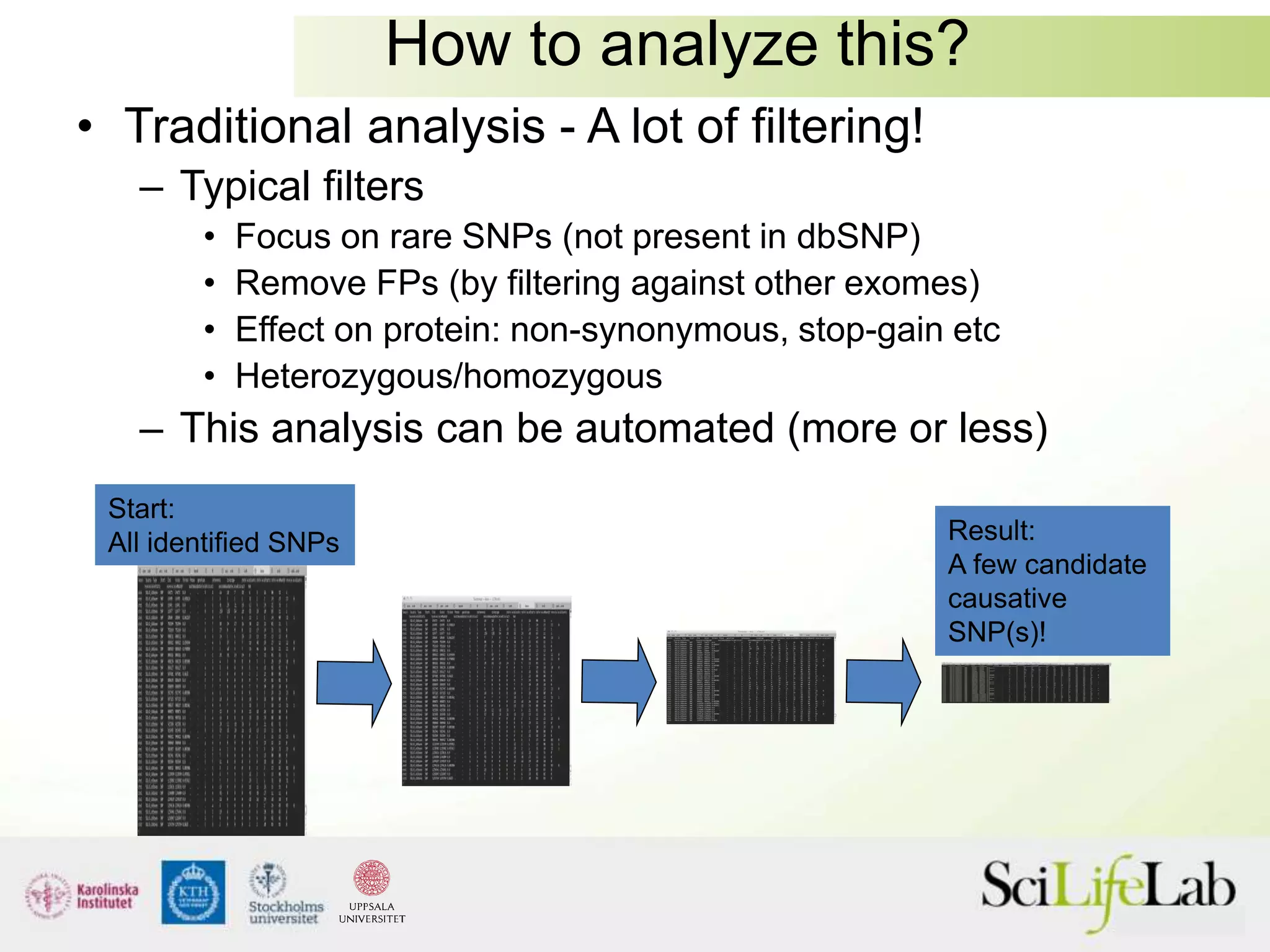
How to analyze this?
• Traditional analysis - A lot of filtering!
– Typical filters
• Focus on rare SNPs (not present in dbSNP)
• Remove FPs (by filtering against other exomes)
• Effect on protein: non-synonymous, stop-gain etc
• Heterozygous/homozygous
– This analysis can be automated (more or less)
Result:
A few candidate
causative
SNP(s)!
Start:
All identified SNPs
Why is this not optimal?
• Drawbacks
– Work on one sample at time
• Difficult to compare between samples
– Takes time to re-run analysis
• When using different parameters
– No standardized storage of detected SNPs/indels
• Difficult to handle 100s of samples
• Better solution
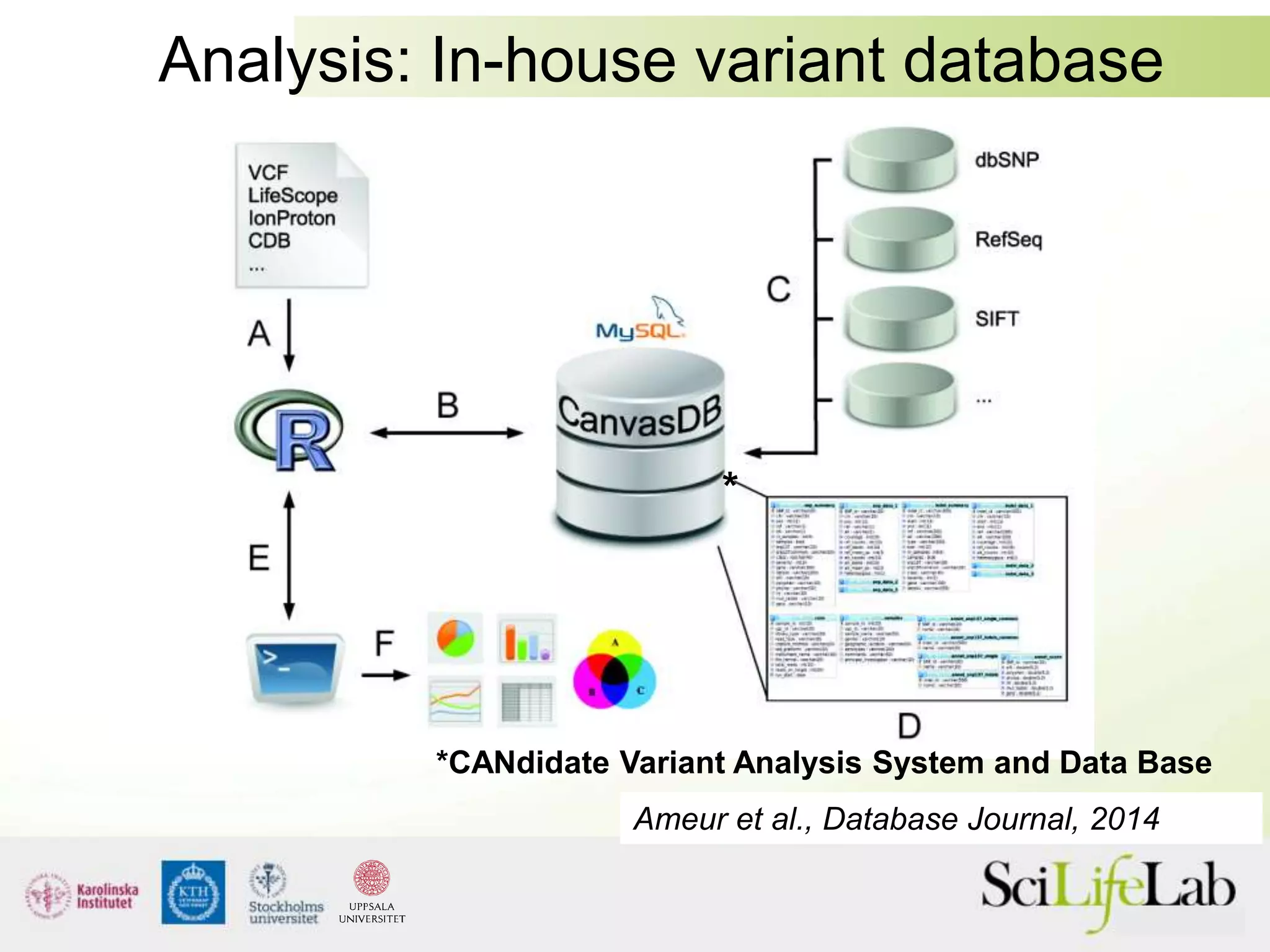
– A database oriented system
• Both for data storage and filtering analyses
Analysis: In-house variant database
Ameur et al., Database Journal, 2014
*CANdidate Variant Analysis System and Data Base
*
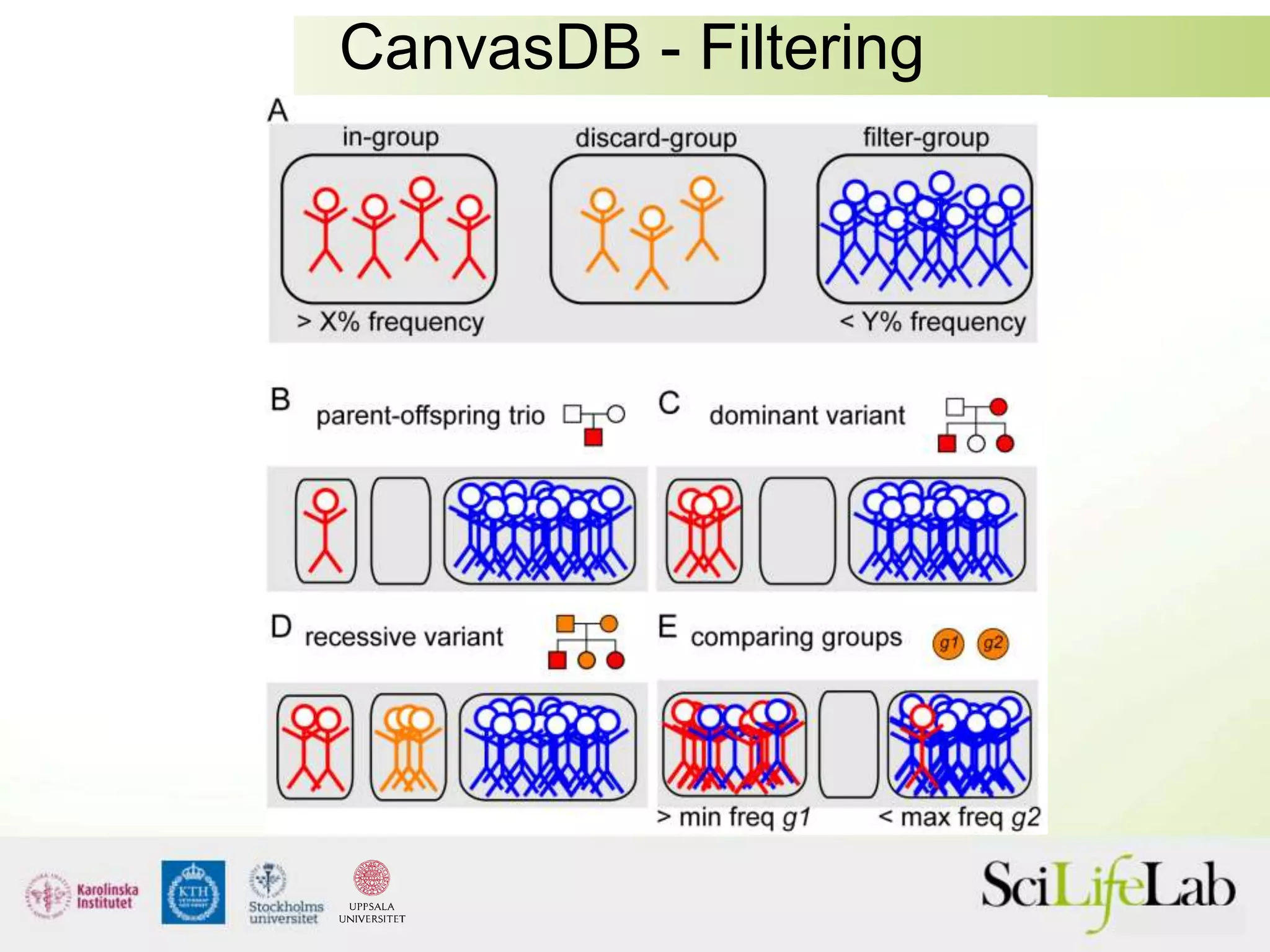
CanvasDB - Filtering
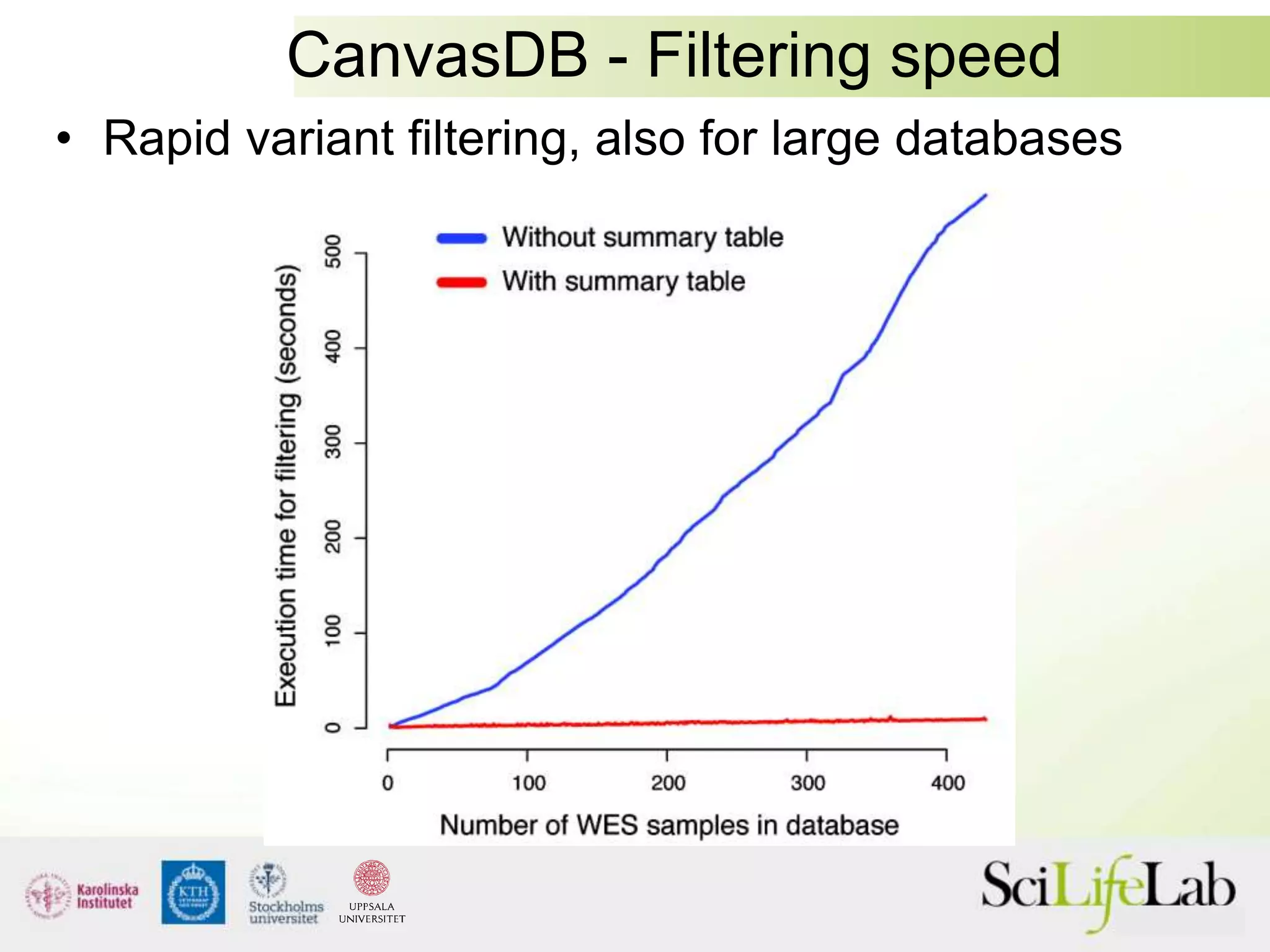
CanvasDB - Filtering speed
• Rapid variant filtering, also for large databases
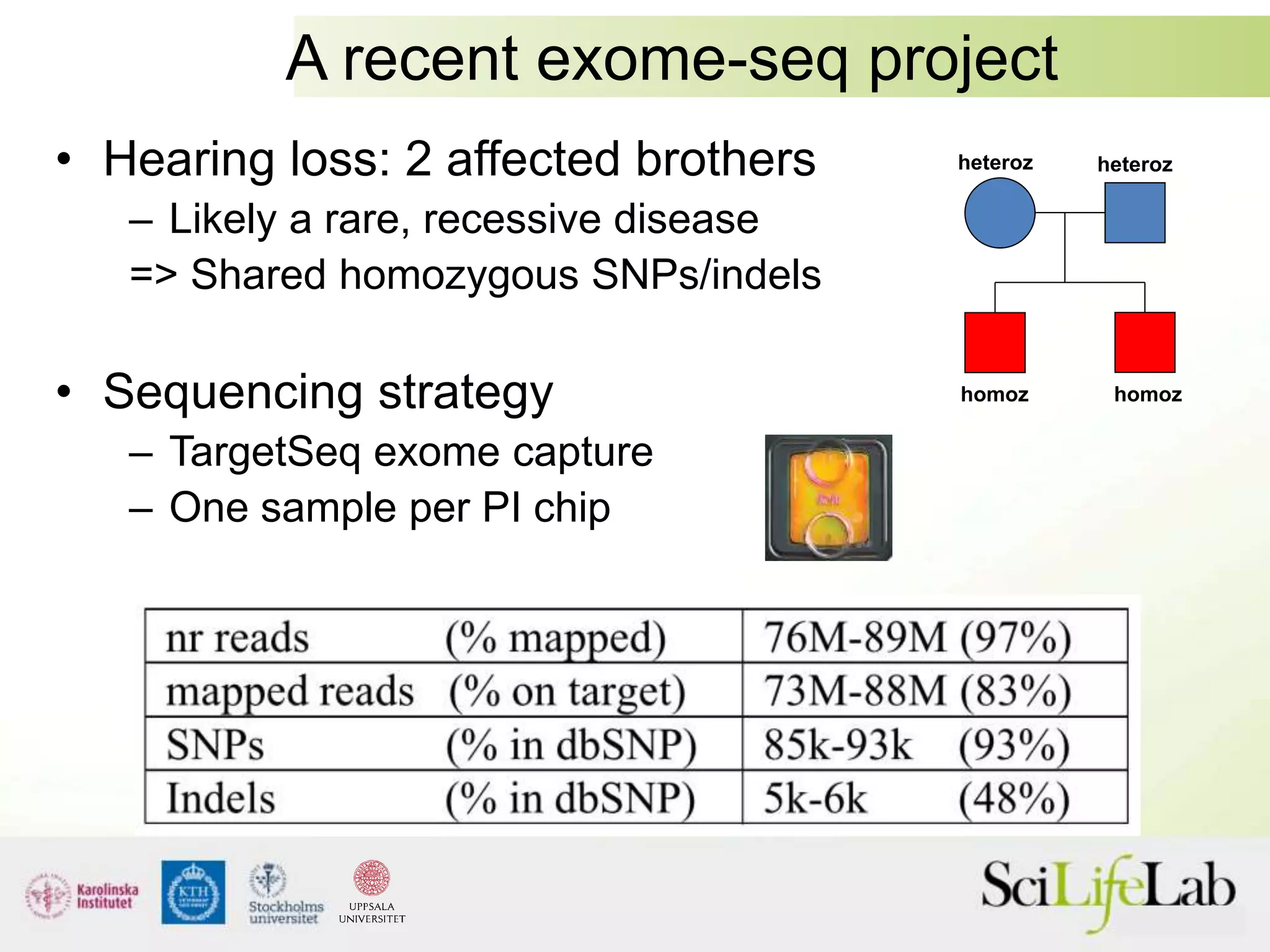
A recent exome-seq project
• Hearing loss: 2 affected brothers
– Likely a rare, recessive disease
=> Shared homozygous SNPs/indels
• Sequencing strategy
– TargetSeq exome capture
– One sample per PI chip
homoz
homoz
heteroz
heteroz
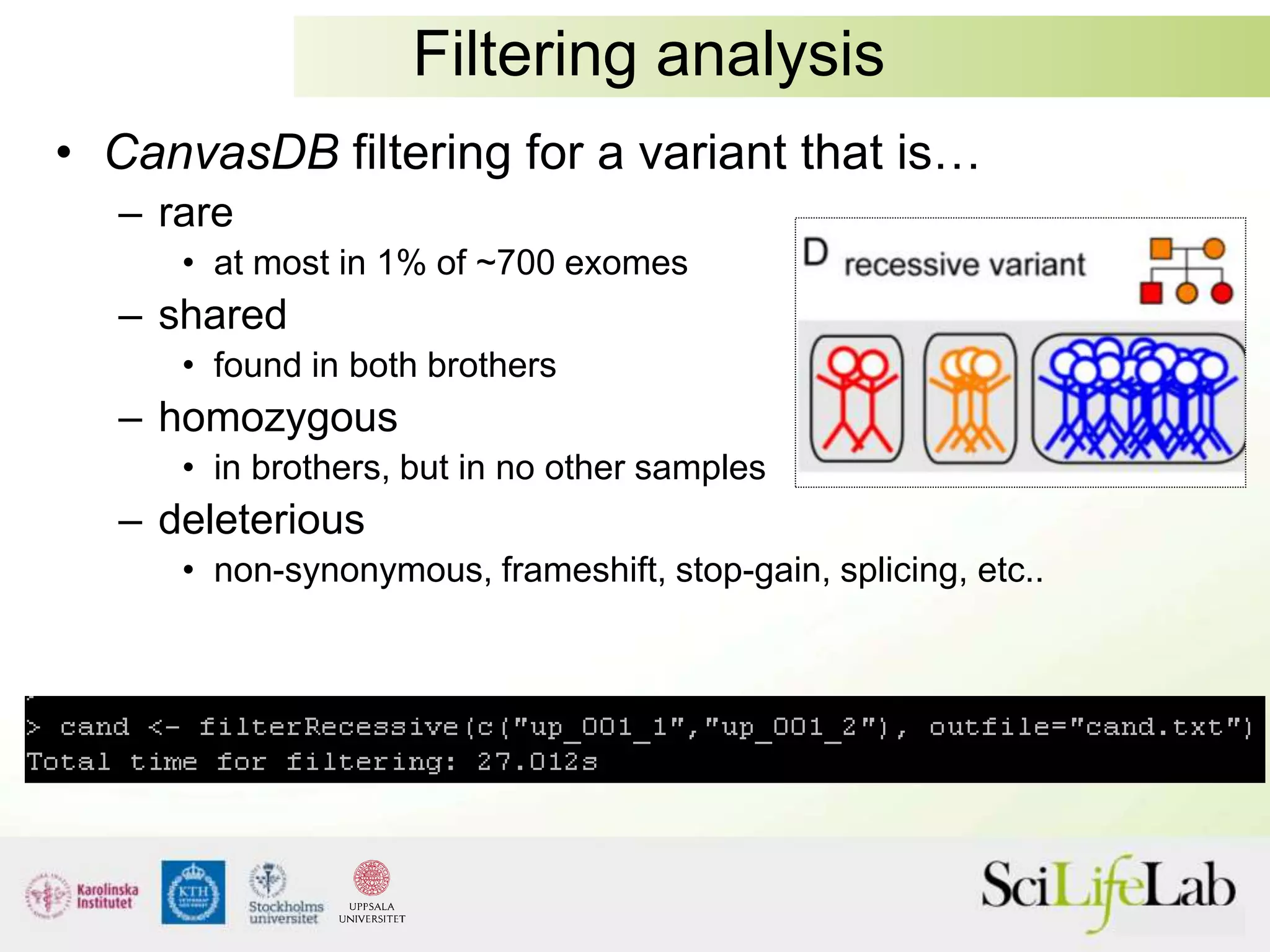
Filtering analysis
• CanvasDB filtering for a variant that is…
– rare
• at most in 1% of ~700 exomes
– shared
• found in both brothers
– homozygous
• in brothers, but in no other samples
– deleterious
• non-synonymous, frameshift, stop-gain, splicing, etc..
Filtering results
• Homozygous candidates
– 2 SNPs
• stop-gain in STRC
• non-synonymous in PCNT
– 0 indels
• Compound heterozygous candidates (lower priority)
– in 15 genes
=> Filtering is fast and gives a short candidate list!
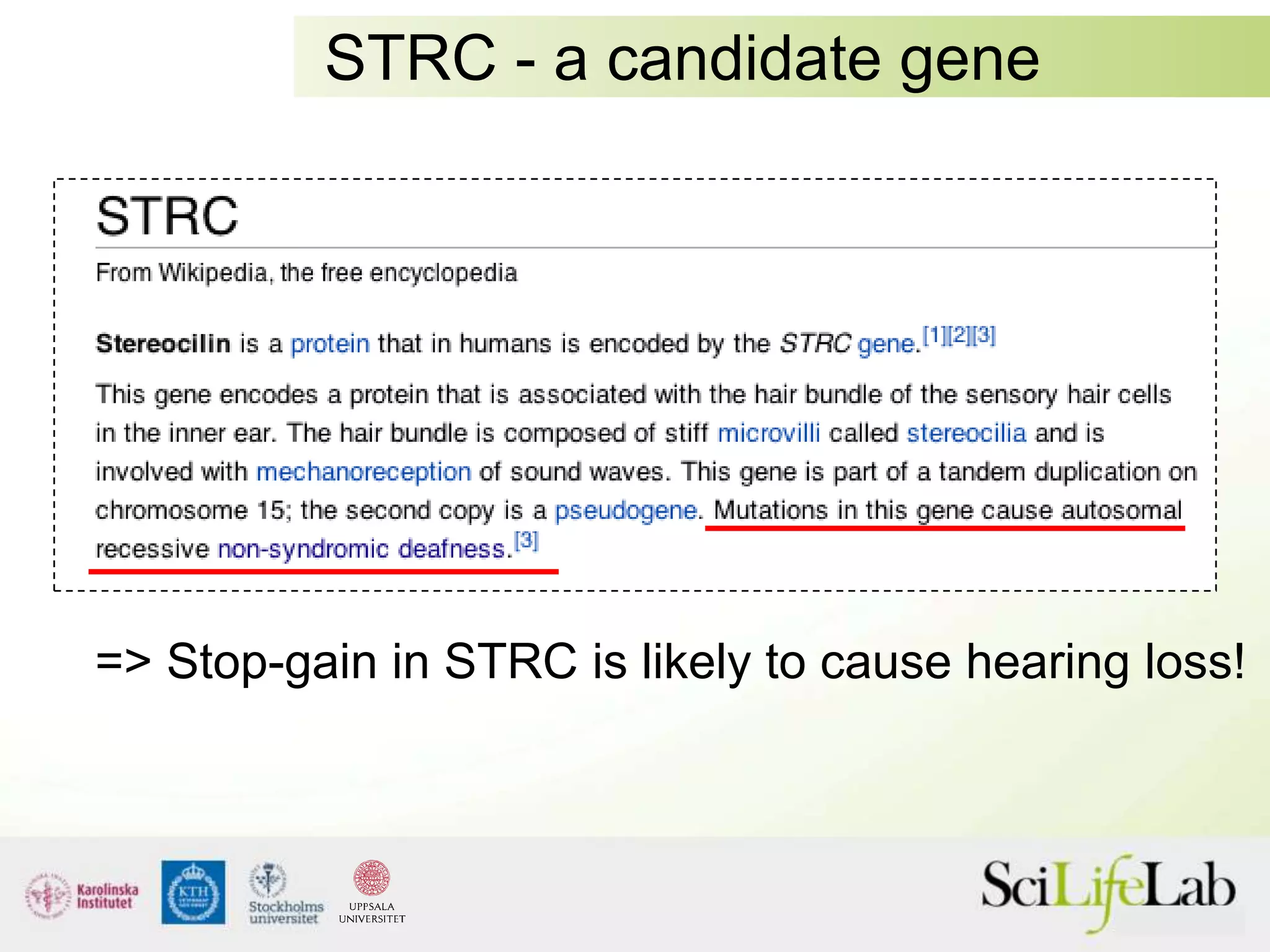
STRC - a candidate gene
=> Stop-gain in STRC is likely to cause hearing loss!
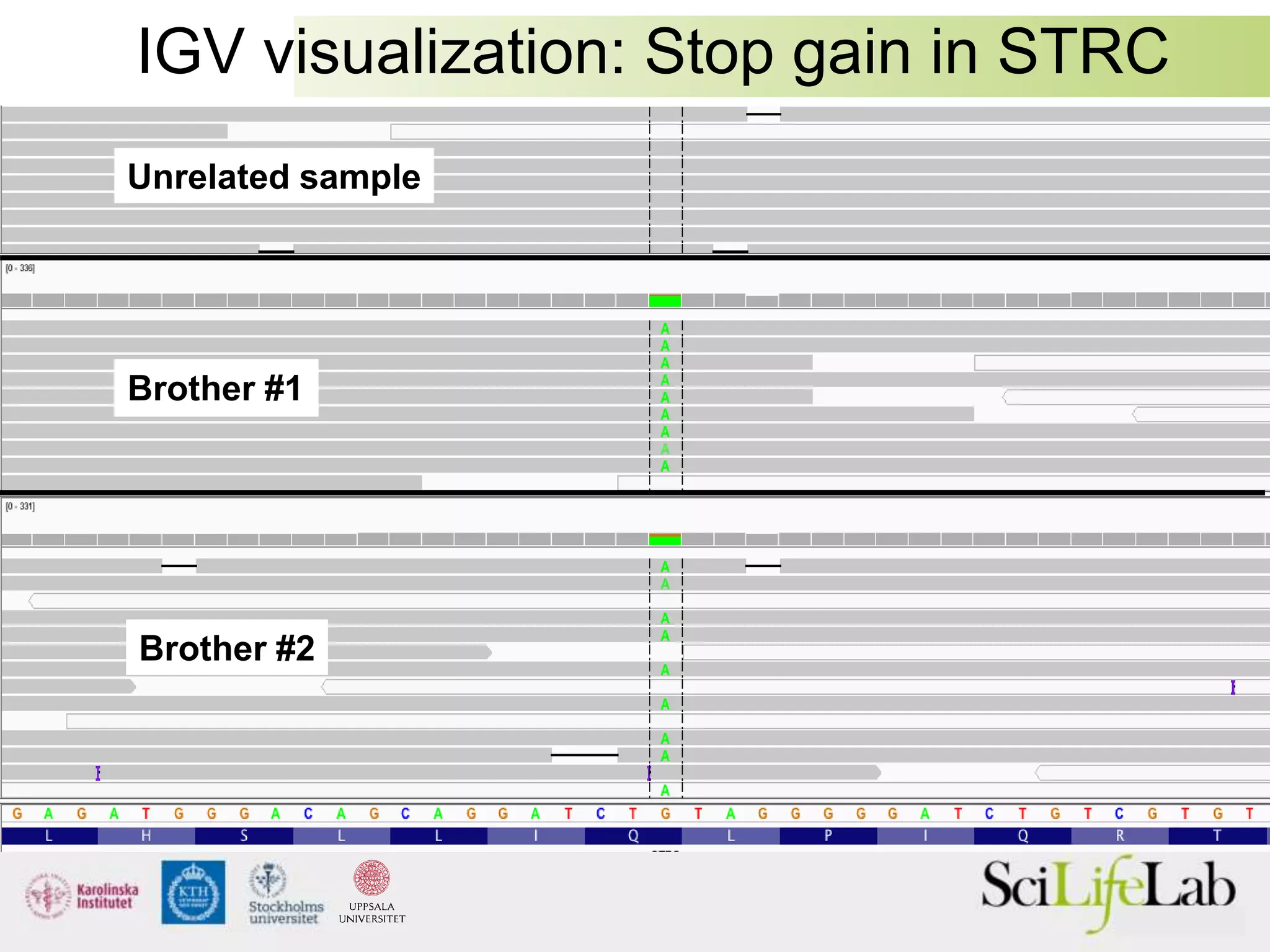
Brother #1
Brother #2
Unrelated sample
IGV visualization: Stop gain in STRC
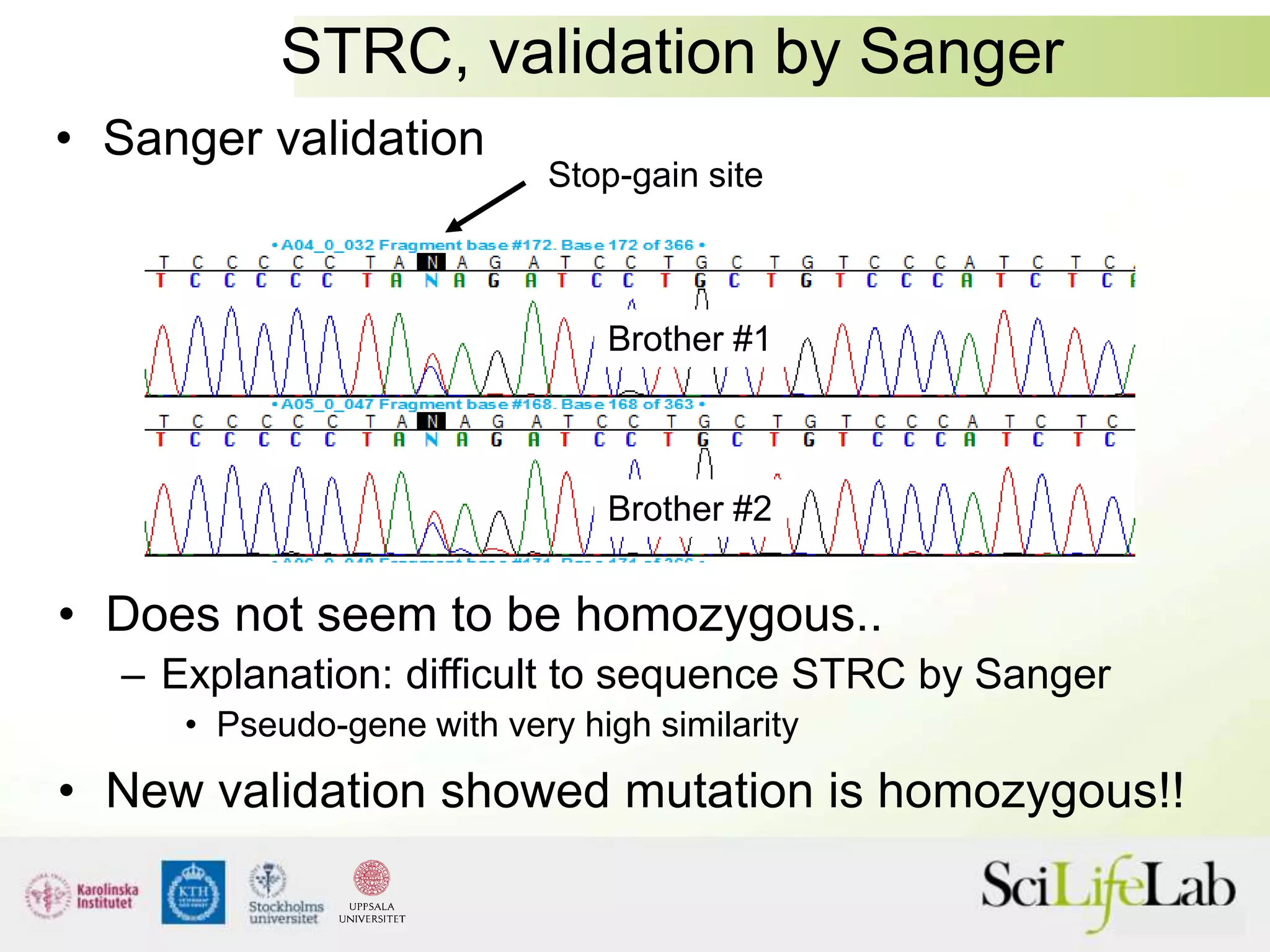
STRC, validation by Sanger
Brother #1
Brother #2
Stop-gain site
• Sanger validation
• Does not seem to be homozygous..
– Explanation: difficult to sequence STRC by Sanger
• Pseudo-gene with very high similarity
• New validation showed mutation is homozygous!!
CanvasDB – some success stories
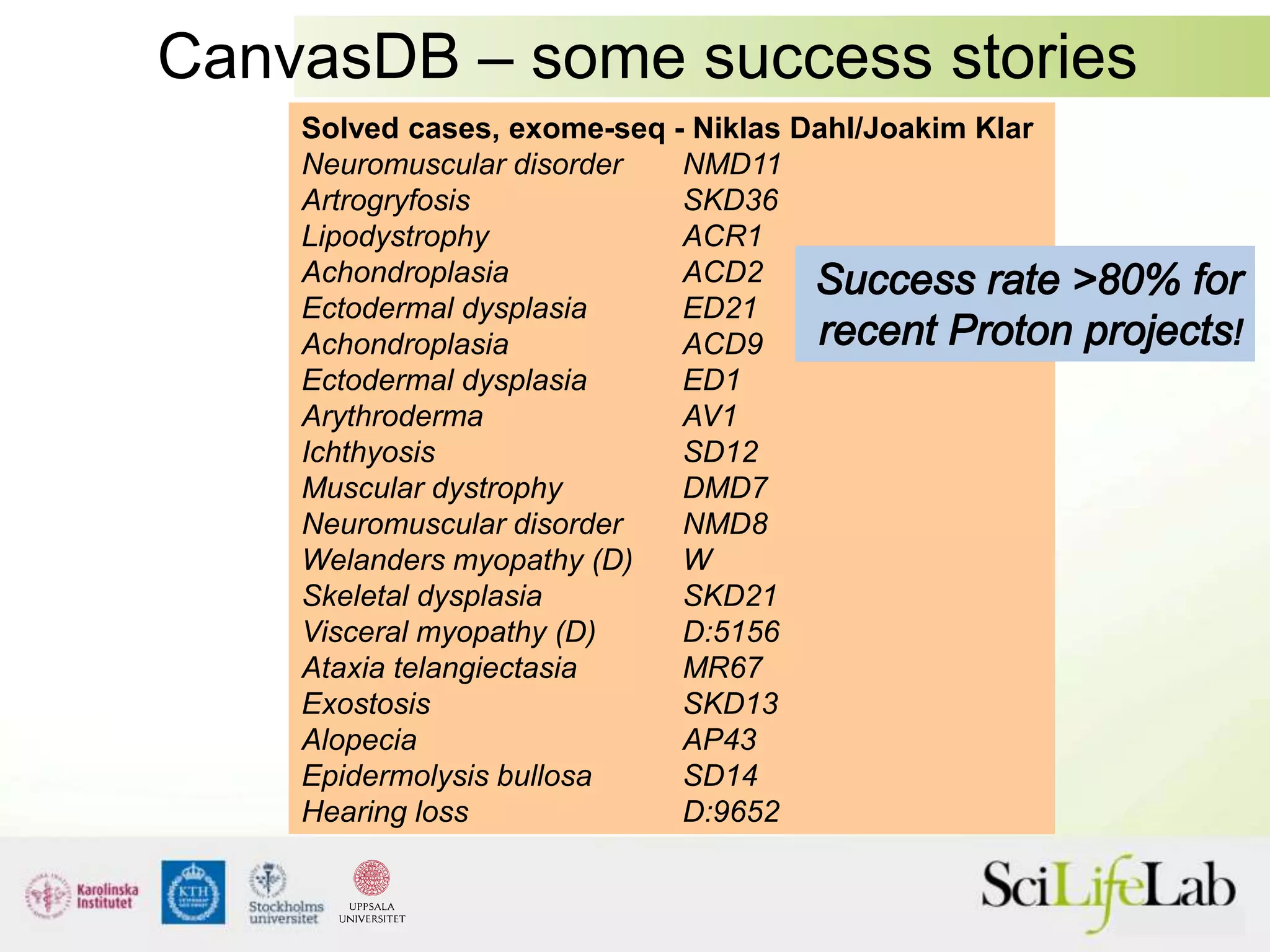
Solved cases, exome-seq - Niklas Dahl/Joakim Klar
Neuromuscular disorder NMD11
Artrogryfosis SKD36
Lipodystrophy ACR1
Achondroplasia ACD2
Ectodermal dysplasia ED21
Achondroplasia ACD9
Ectodermal dysplasia ED1
Arythroderma AV1
Ichthyosis SD12
Muscular dystrophy DMD7
Neuromuscular disorder NMD8
Welanders myopathy (D) W
Skeletal dysplasia SKD21
Visceral myopathy (D) D:5156
Ataxia telangiectasia MR67
Exostosis SKD13
Alopecia AP43
Epidermolysis bullosa SD14
Hearing loss D:9652
CanvasDB - Availability
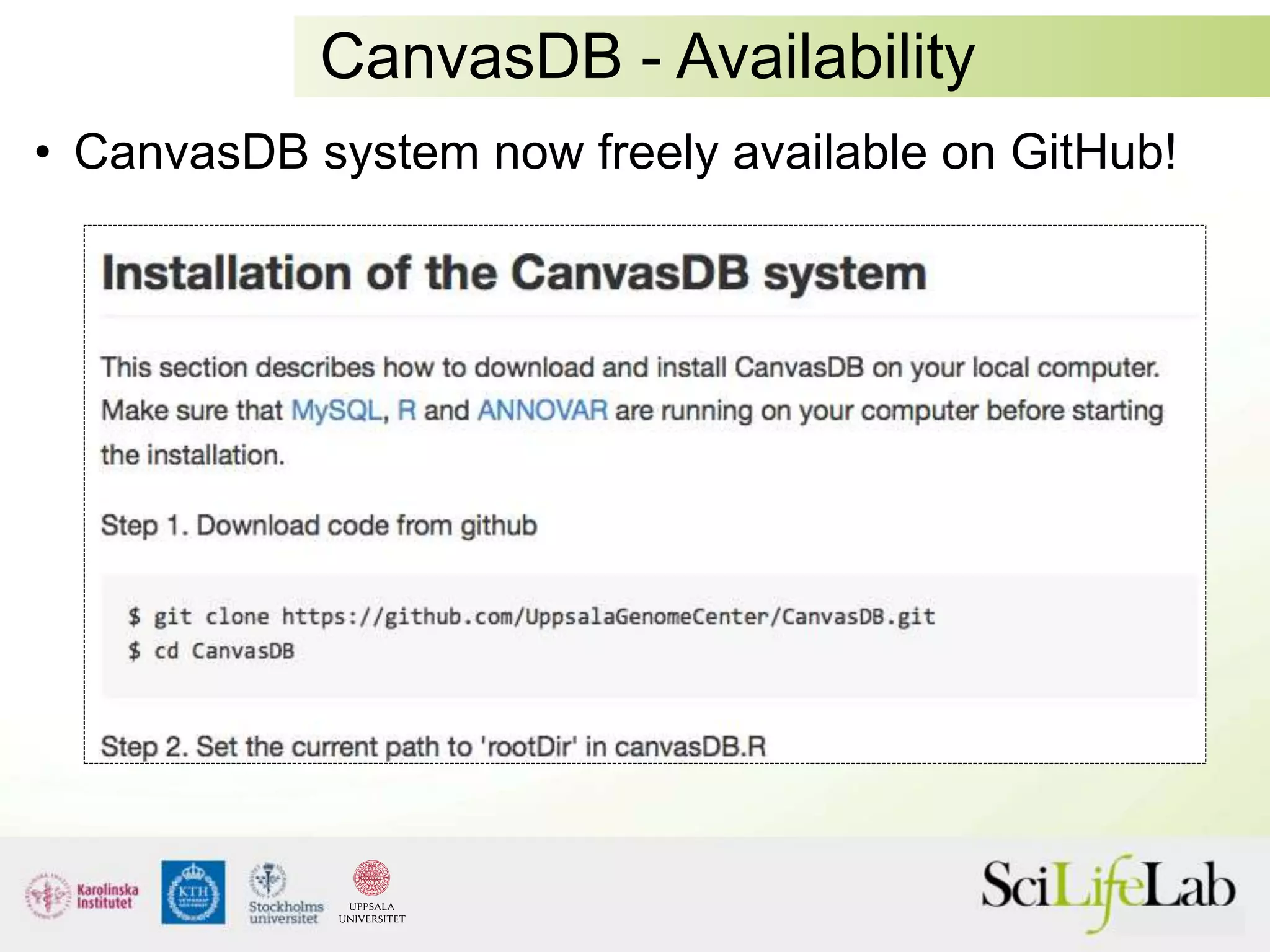
• CanvasDB system now freely available on GitHub!
Next Step: Whole Genome Sequencing
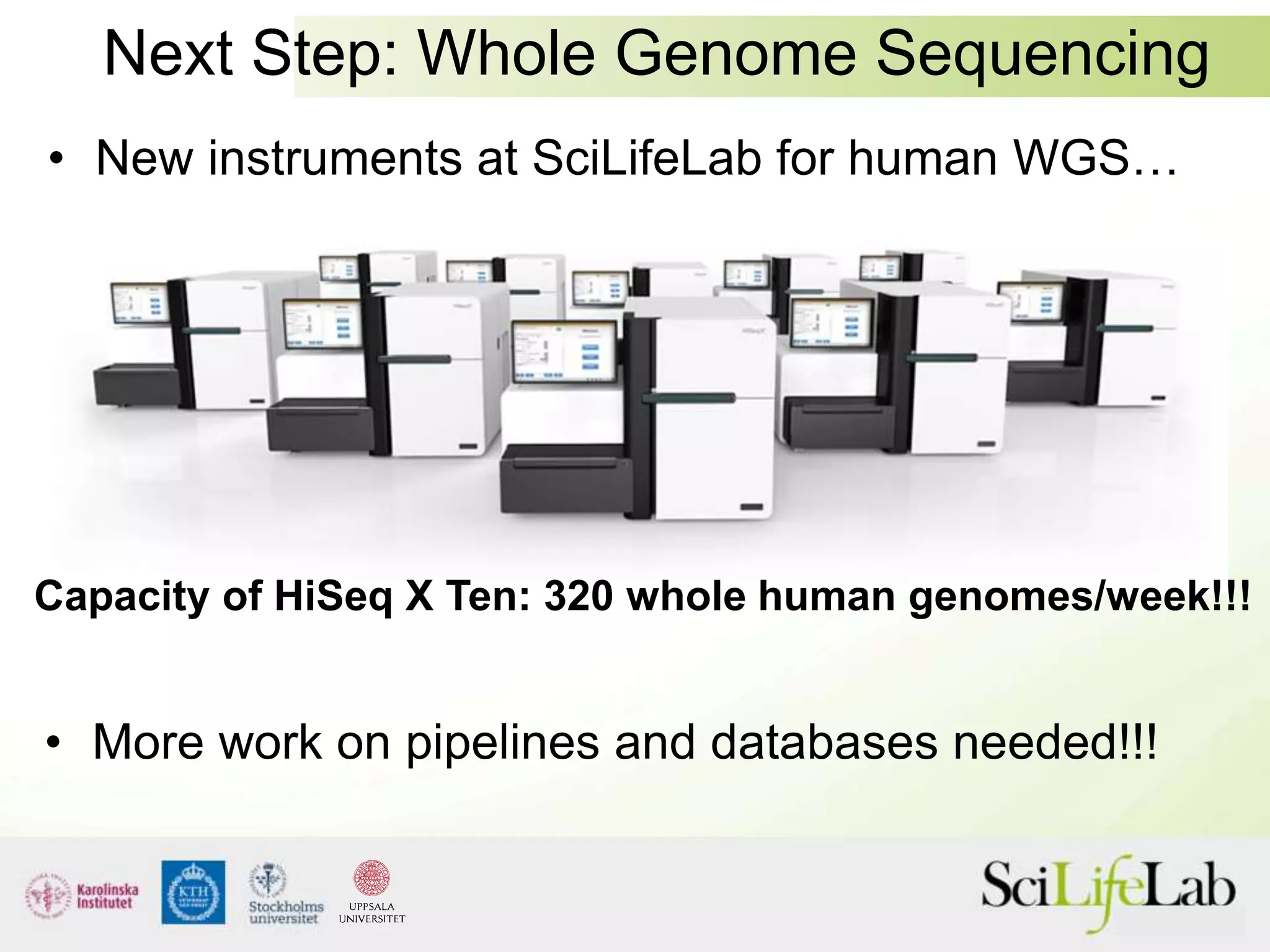
Capacity of HiSeq X Ten: 320 whole human genomes/week!!!
• More work on pipelines and databases needed!!!
• New instruments at SciLifeLab for human WGS…
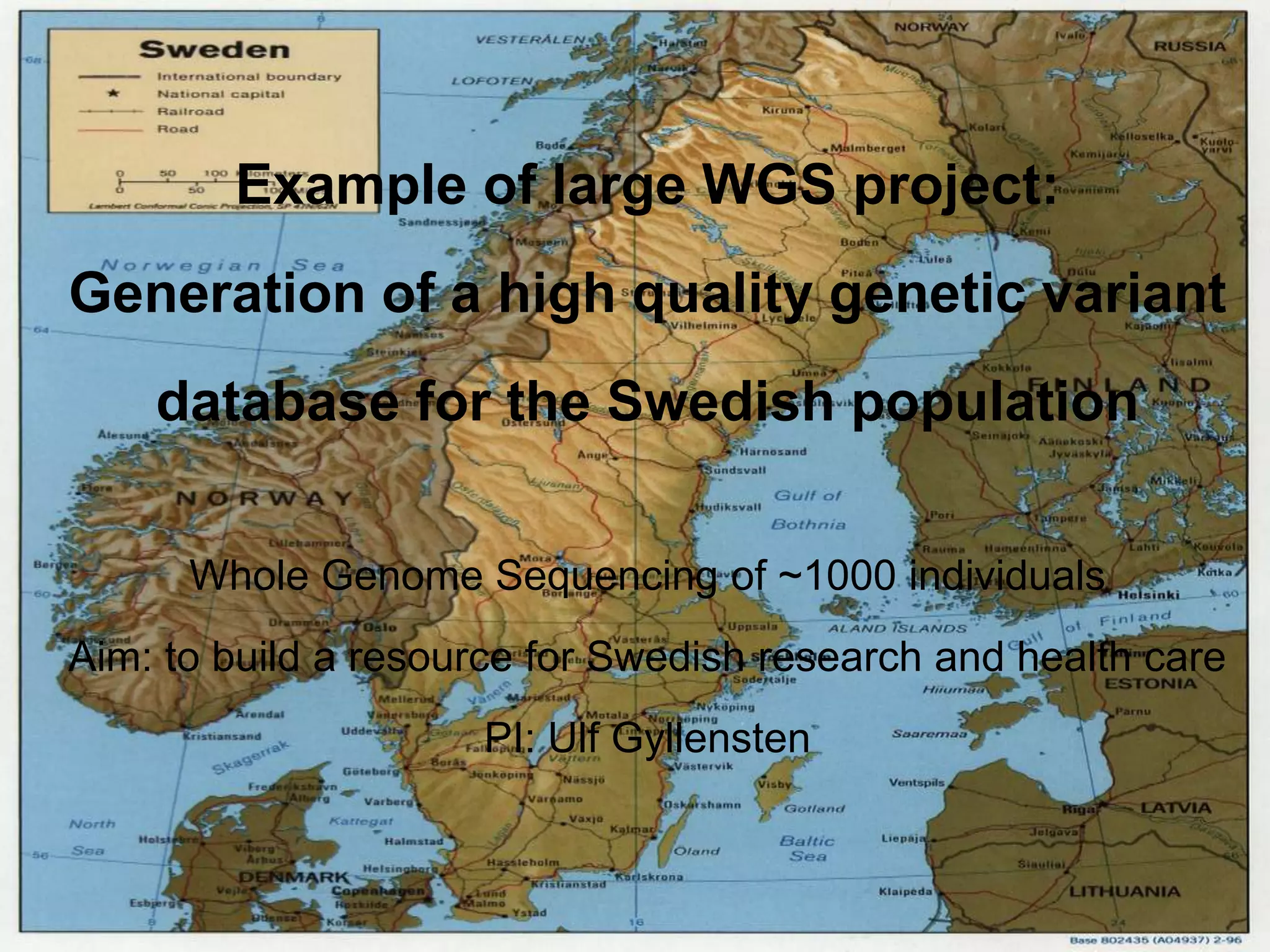
Example of large WGS project:
Generation of a high quality genetic variant
database for the Swedish population
Whole Genome Sequencing of ~1000 individuals
Aim: to build a resource for Swedish research and health care
PI: Ulf Gyllensten
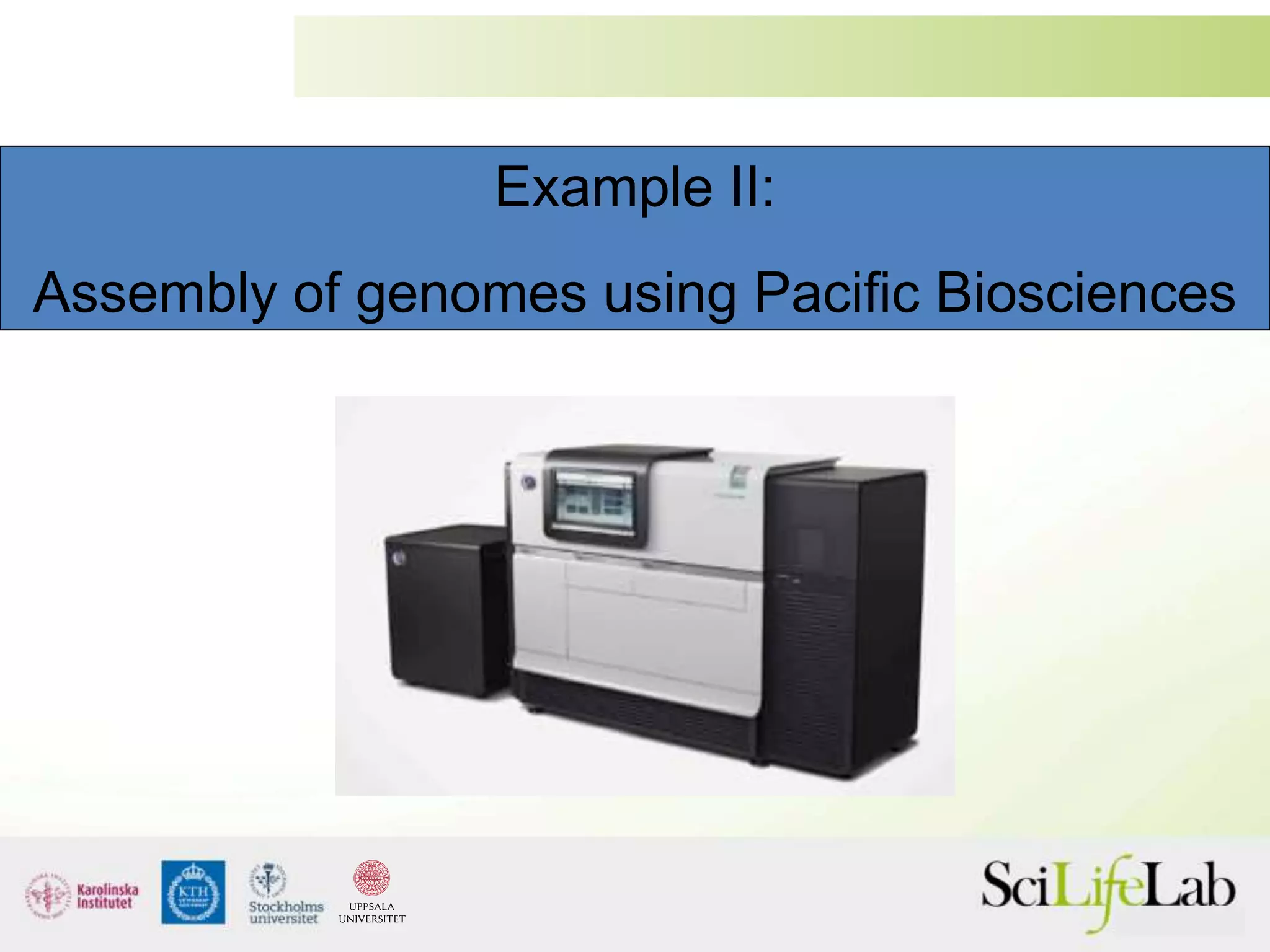
Example II:
Assembly of genomes using Pacific Biosciences
Genome assembly using NGS
• Short-read de novo assembly by NGS
– Requires mate-pair sequences
• Ideally with different insert sizes
– Complicated analysis
• Assembly, scaffolding, finishing
• Maybe even some manual steps
=> Rather expensive and time consuming
• Long reads really makes a difference!!
– We can assemble genomes using PacBio data only!
HGAP de novo assembly
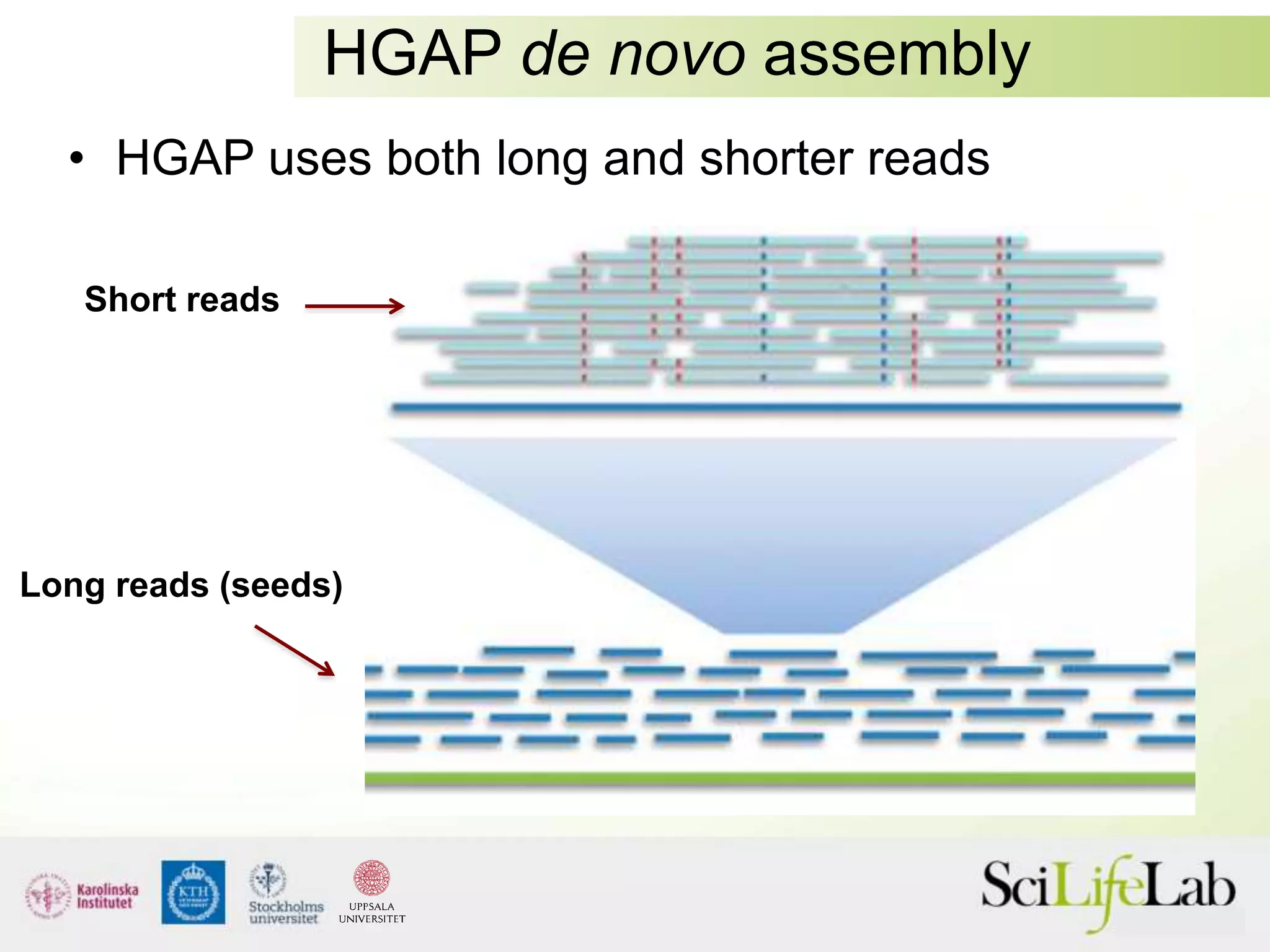
• HGAP uses both long and shorter reads
Long reads (seeds)
Short reads
PacBio – Current throughput & read lengths
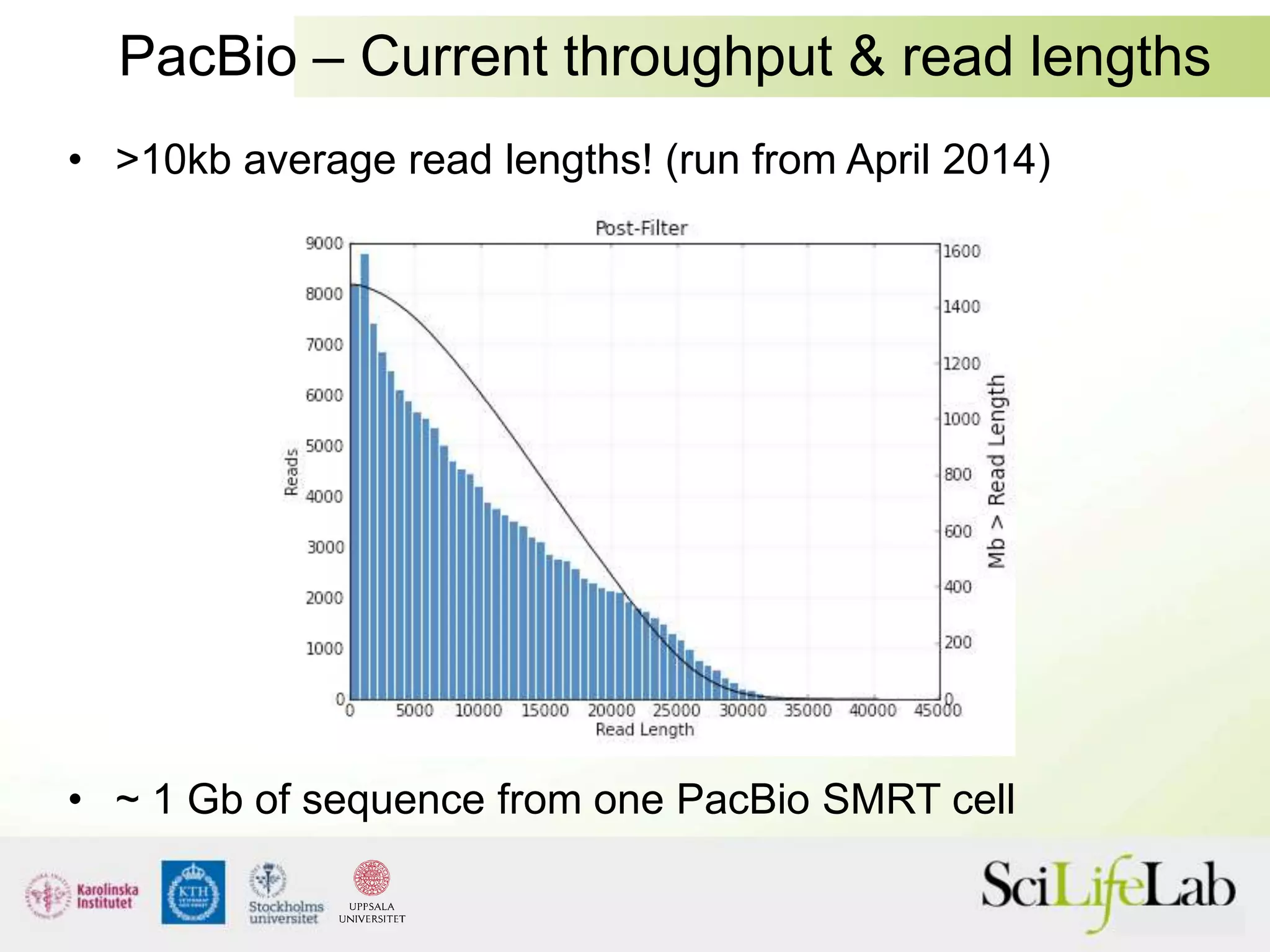
• >10kb average read lengths! (run from April 2014)
• ~ 1 Gb of sequence from one PacBio SMRT cell
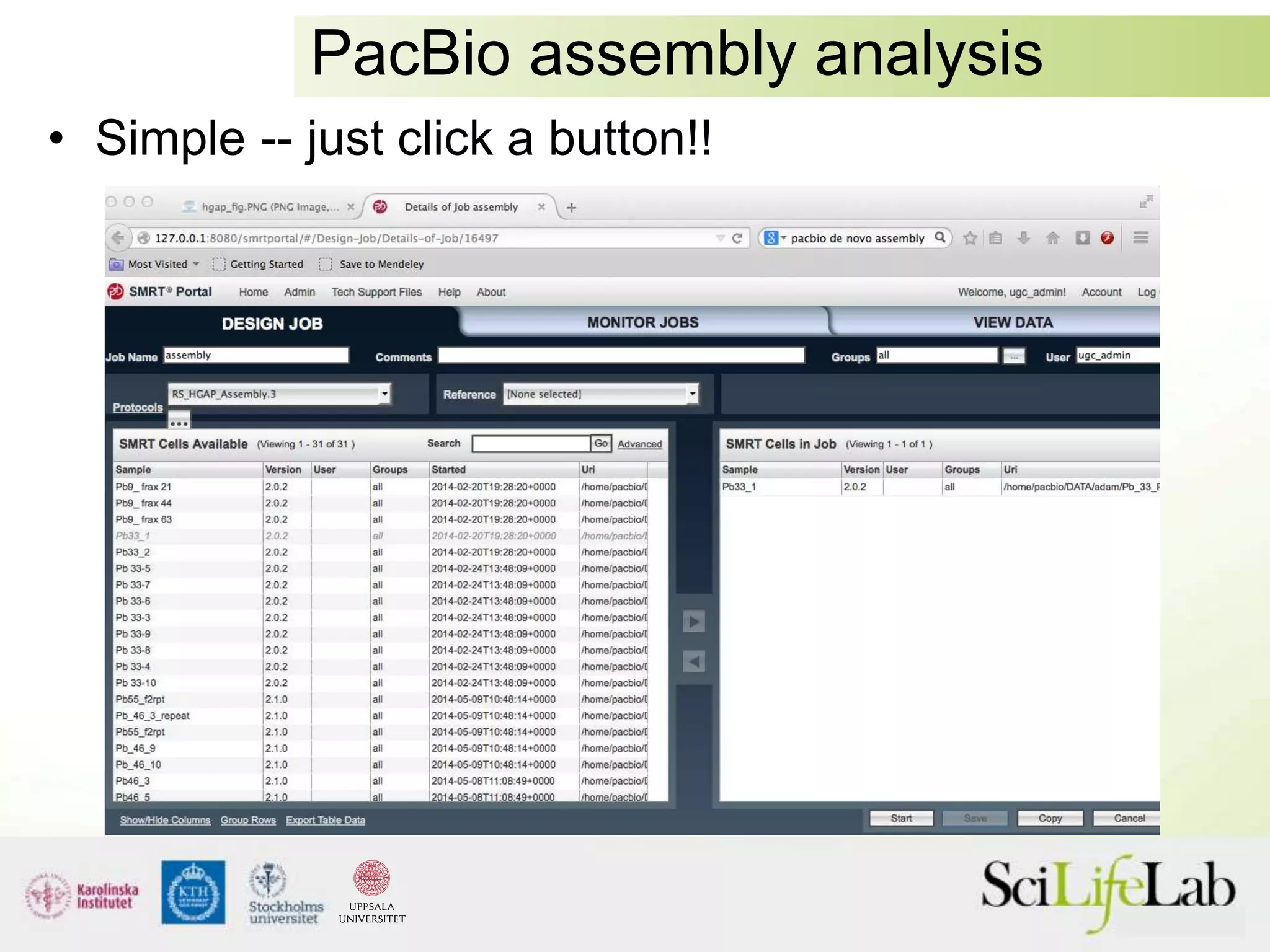
PacBio assembly analysis
• Simple -- just click a button!!
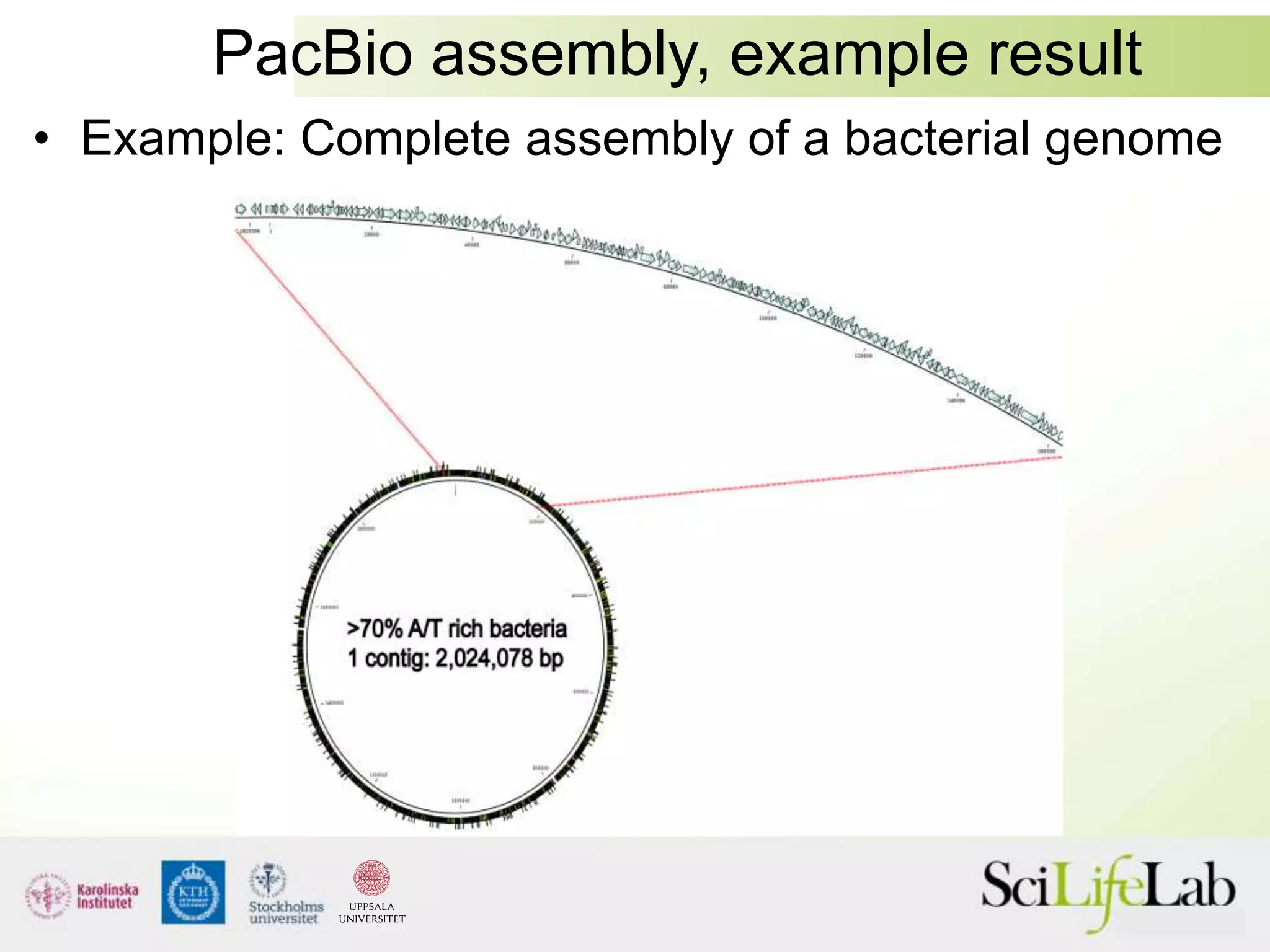
PacBio assembly, example result
• Example: Complete assembly of a bacterial genome
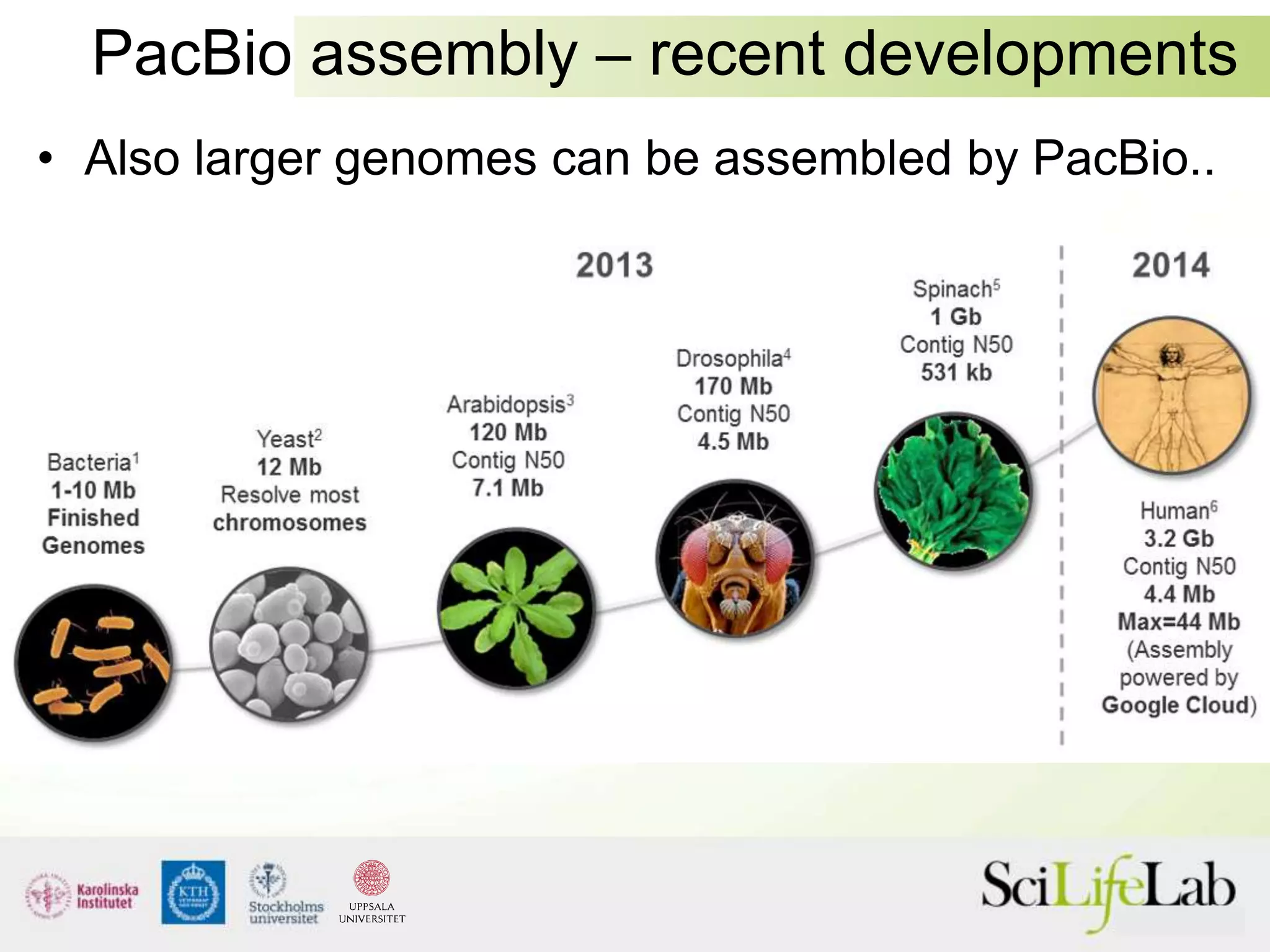
PacBio assembly – recent developments
• Also larger genomes can be assembled by PacBio..
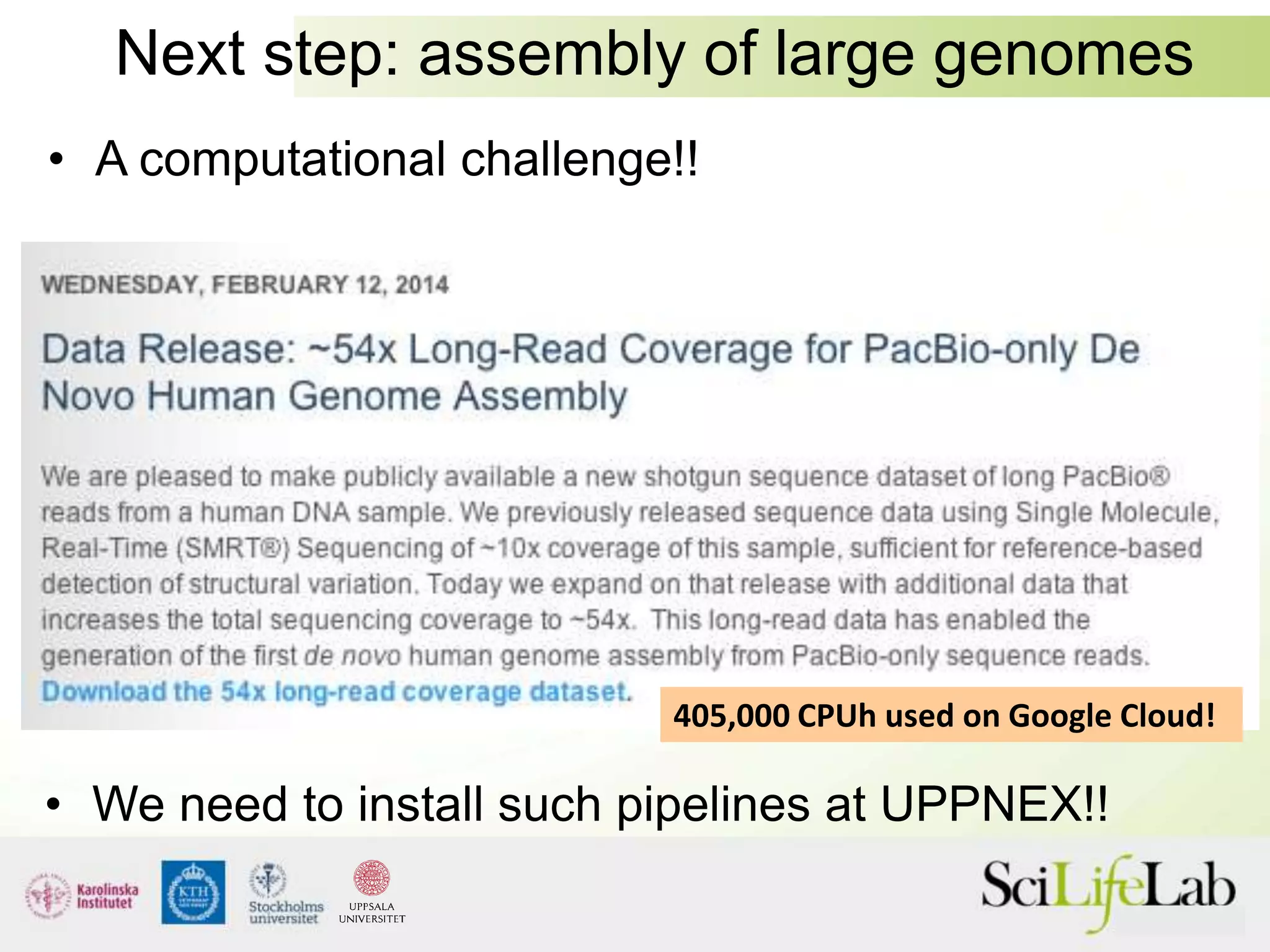
Next step: assembly of large genomes
• We need to install such pipelines at UPPNEX!!
405,000 CPUh used on Google Cloud!
• A computational challenge!!
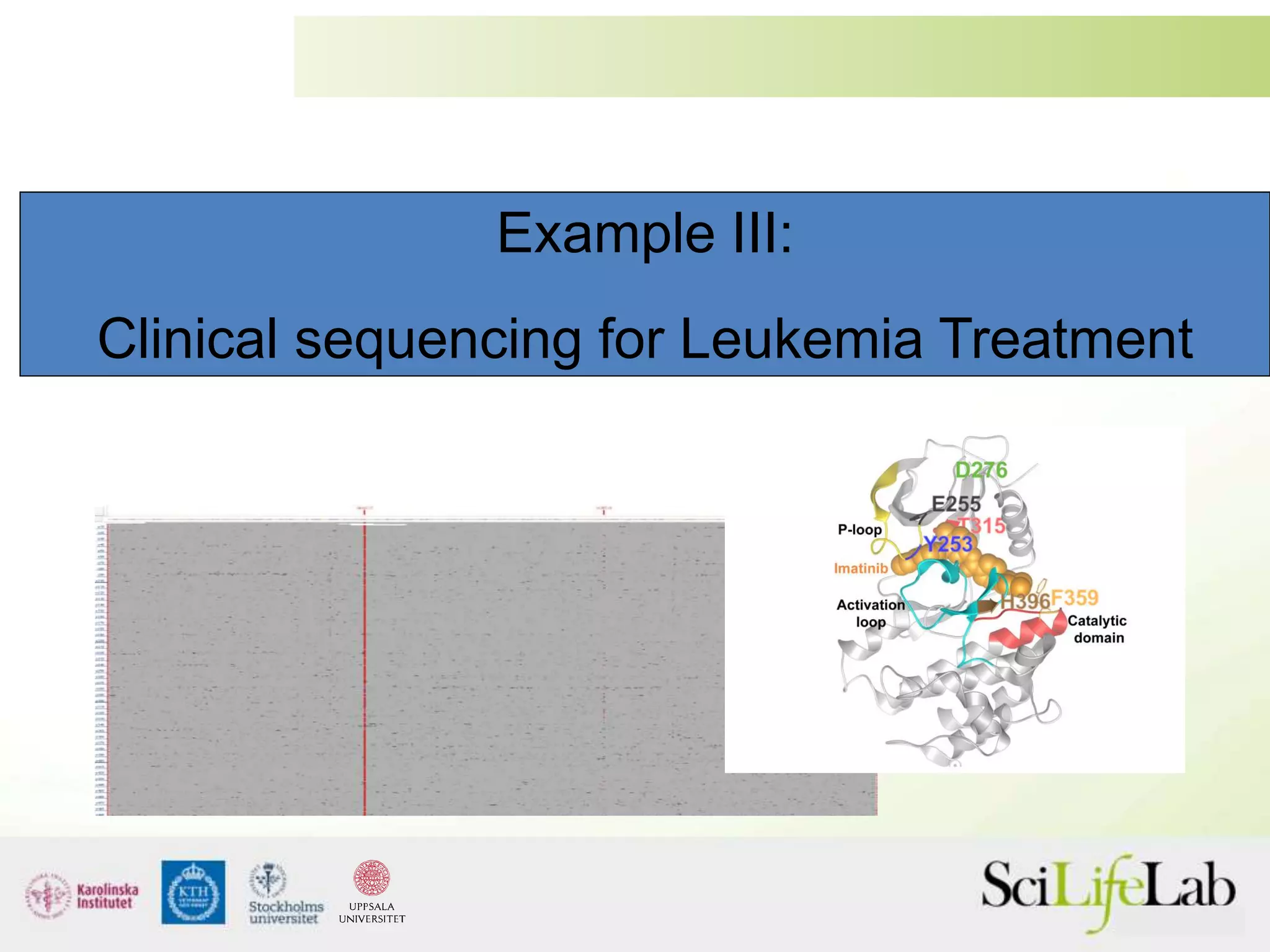
Example III:
Clinical sequencing for Leukemia Treatment
Chronic Myeloid Leukemia
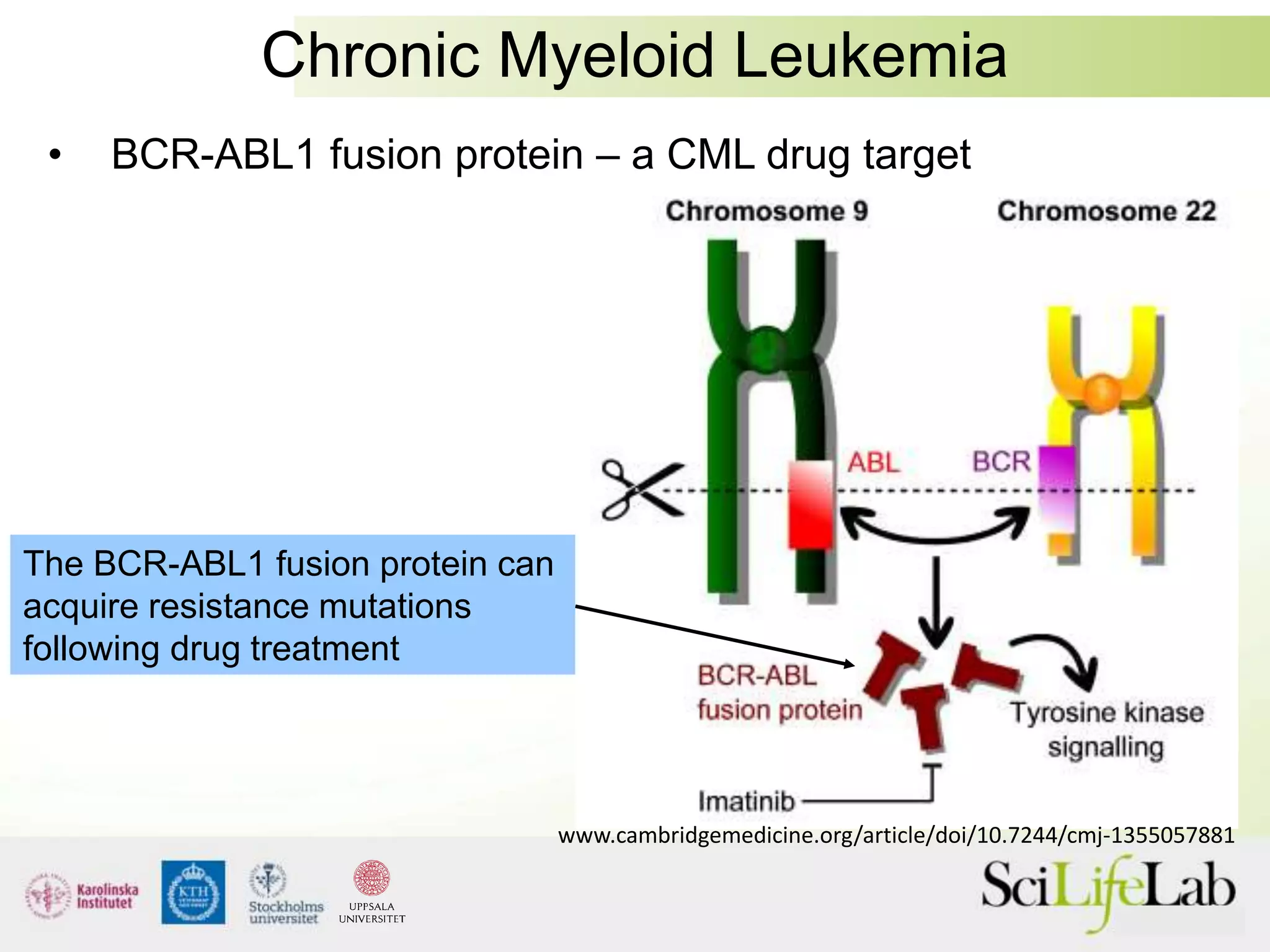
• BCR-ABL1 fusion protein – a CML drug target
www.cambridgemedicine.org/article/doi/10.7244/cmj-1355057881
The BCR-ABL1 fusion protein can
acquire resistance mutations
following drug treatment
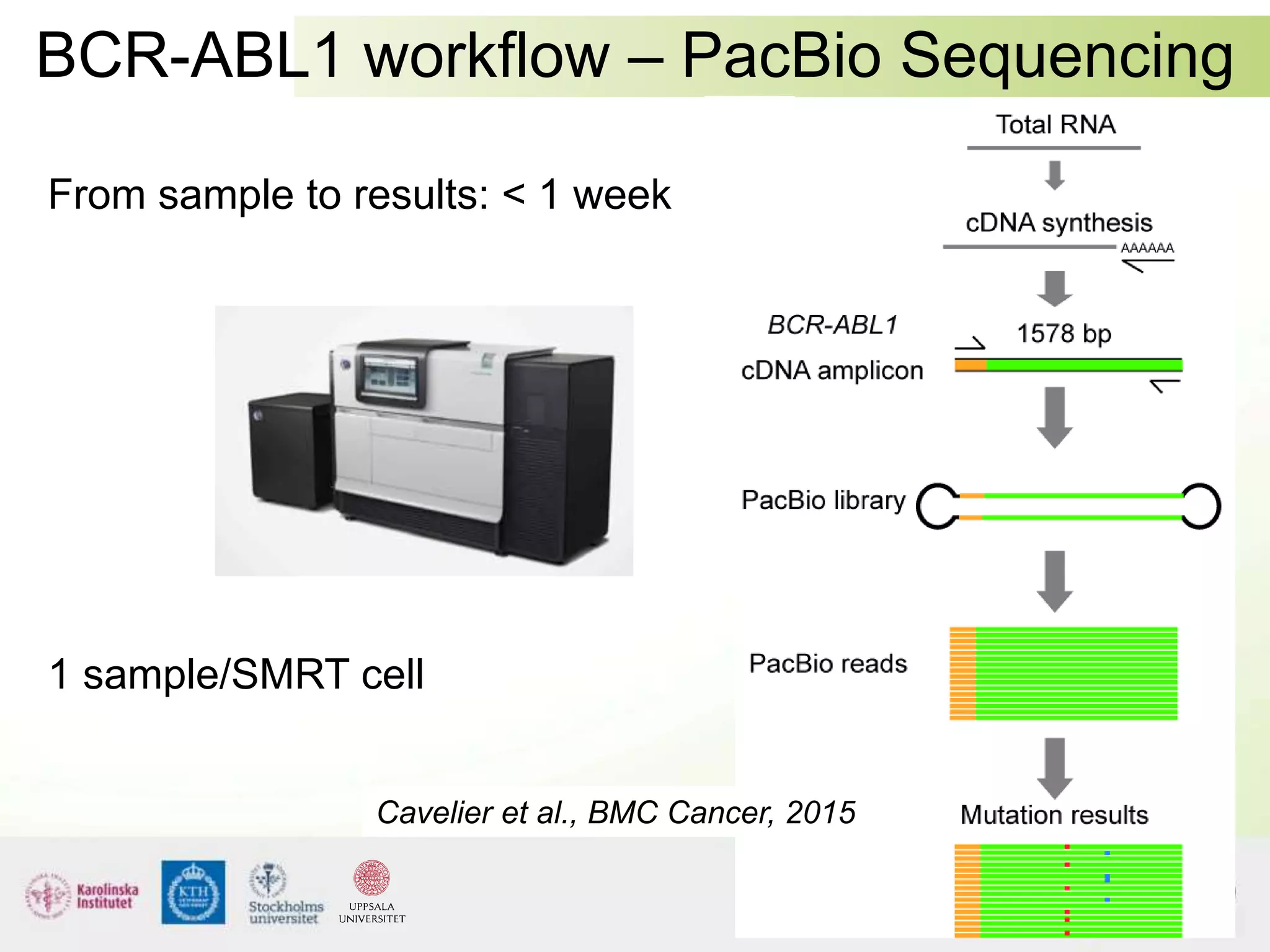
BCR-ABL1 workflow – PacBio Sequencing
From sample to results: < 1 week
1 sample/SMRT cell
Cavelier et al., BMC Cancer, 2015
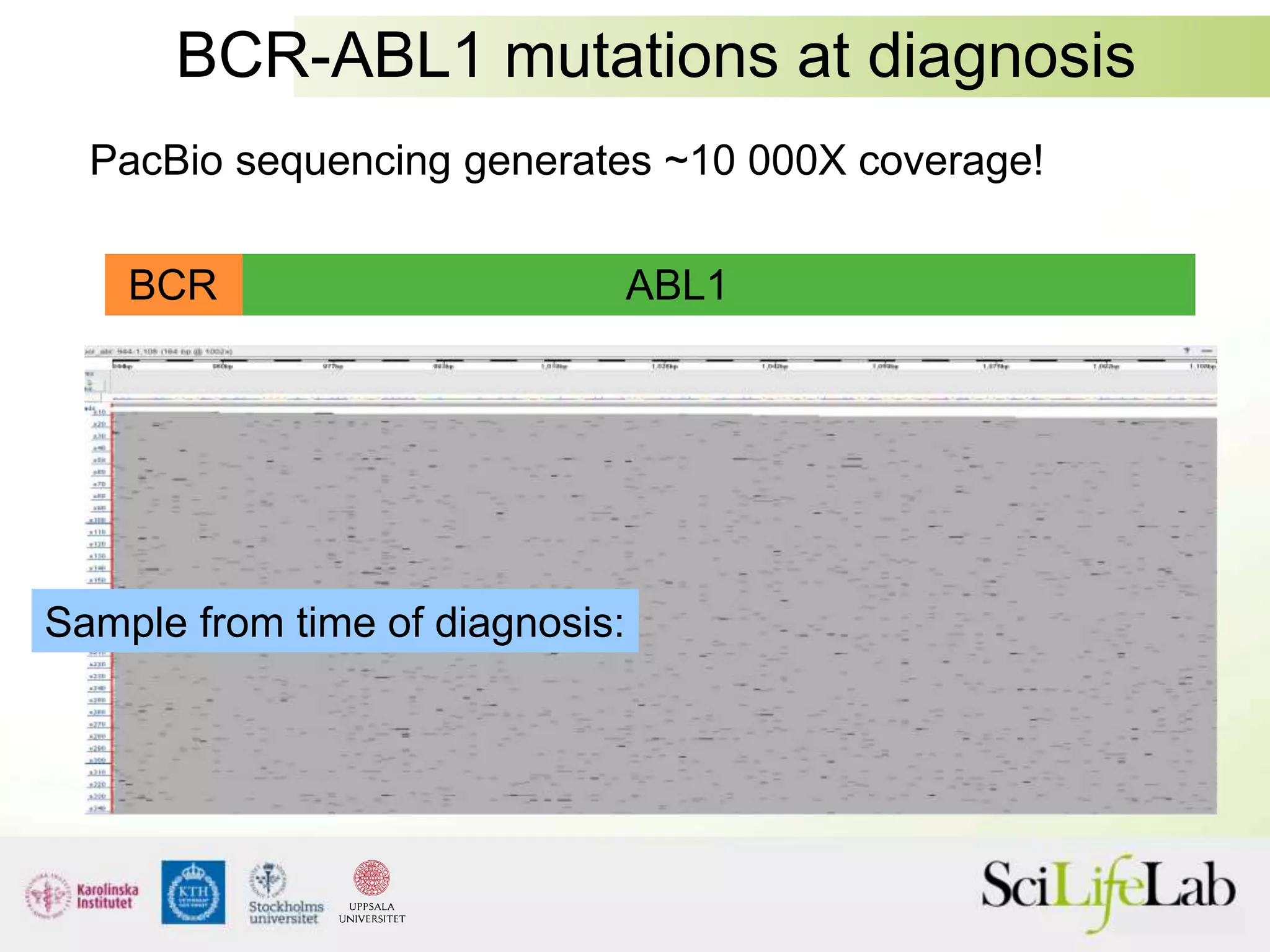
BCR-ABL1 mutations at diagnosis
BCR ABL1
PacBio sequencing generates ~10 000X coverage!
Sample from time of diagnosis:
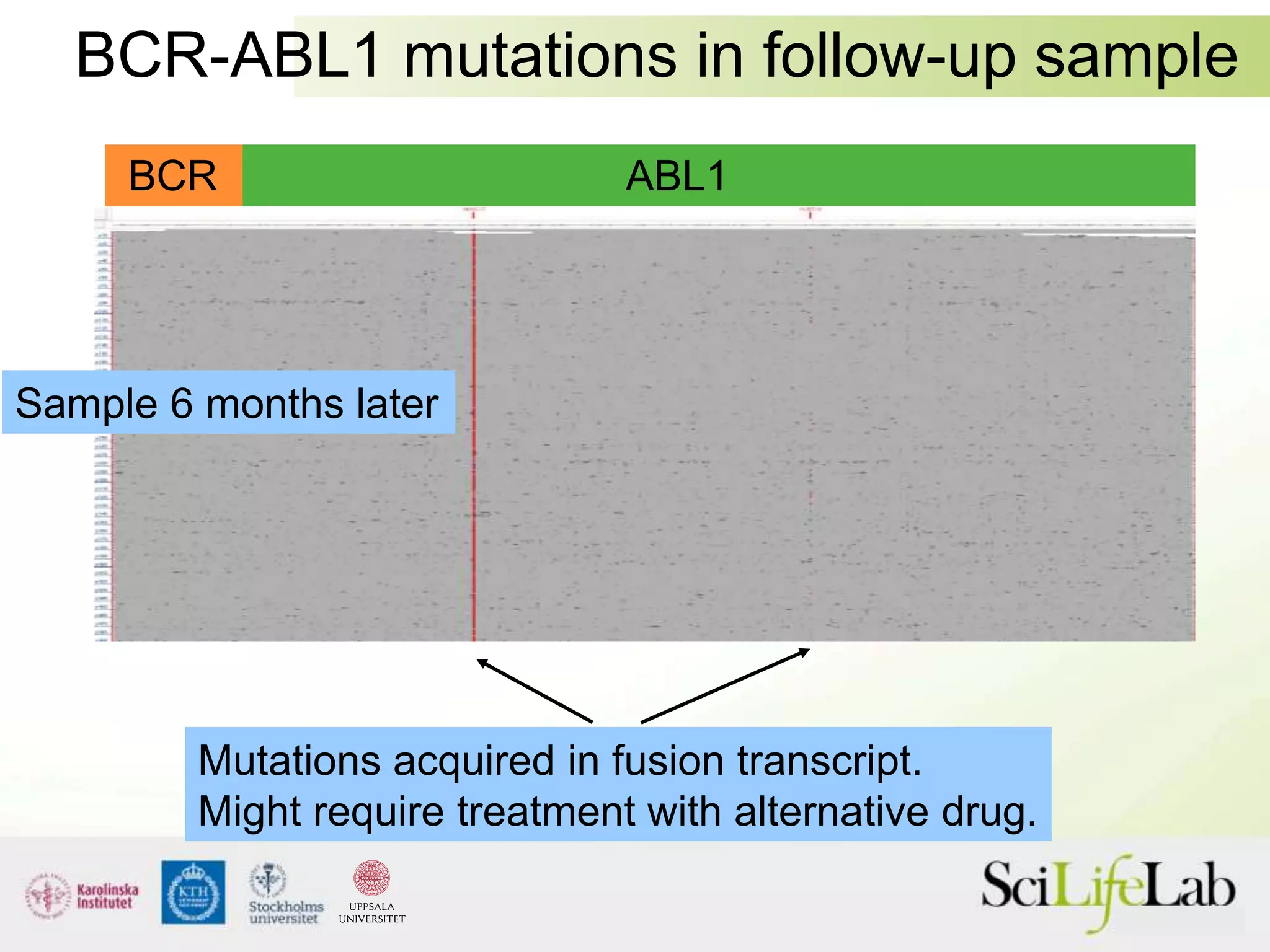
BCR-ABL1 mutations in follow-up sample
Sample 6 months later
Mutations acquired in fusion transcript.
Might require treatment with alternative drug.
BCR ABL1
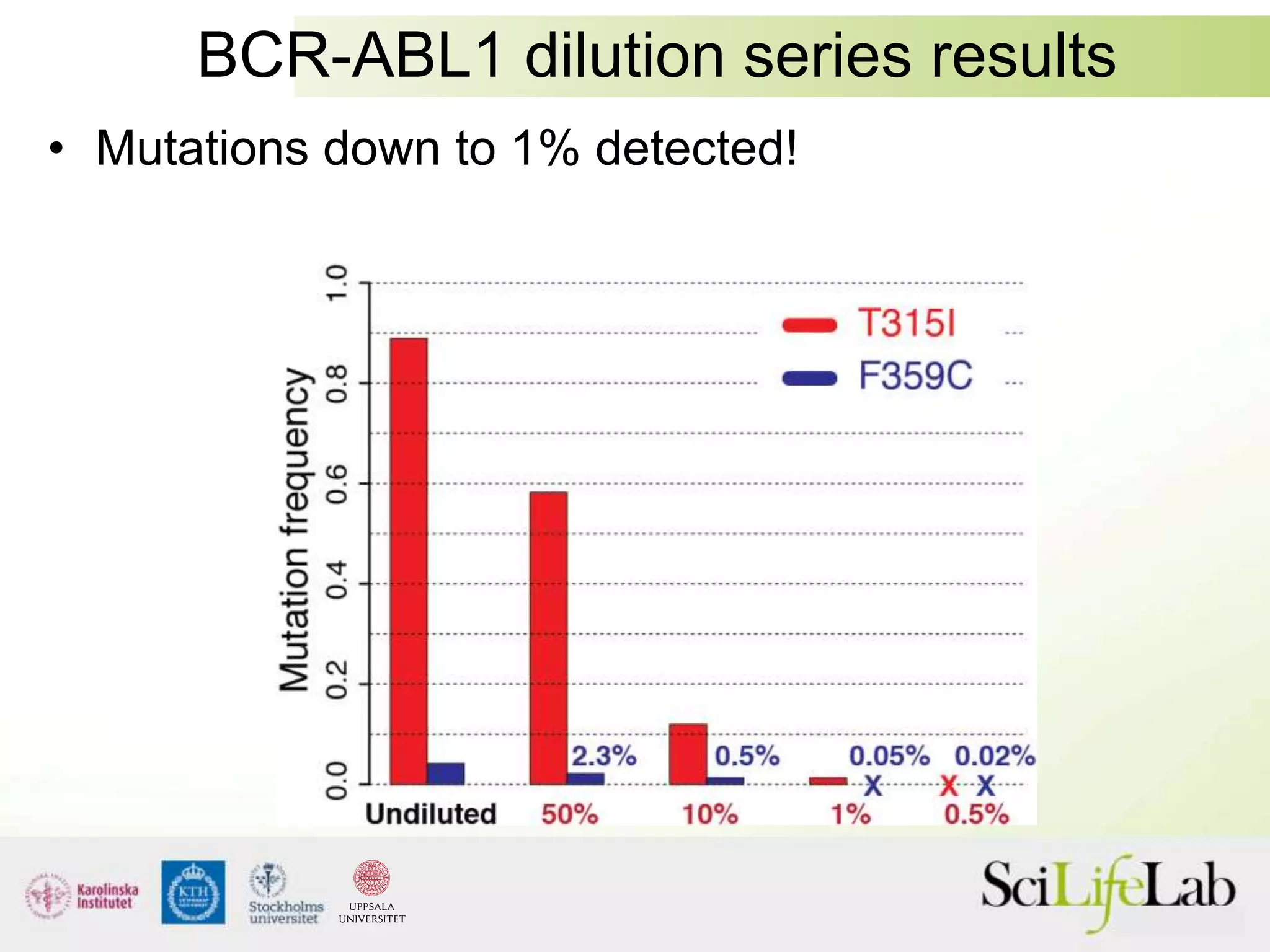
BCR-ABL1 dilution series results
• Mutations down to 1% detected!
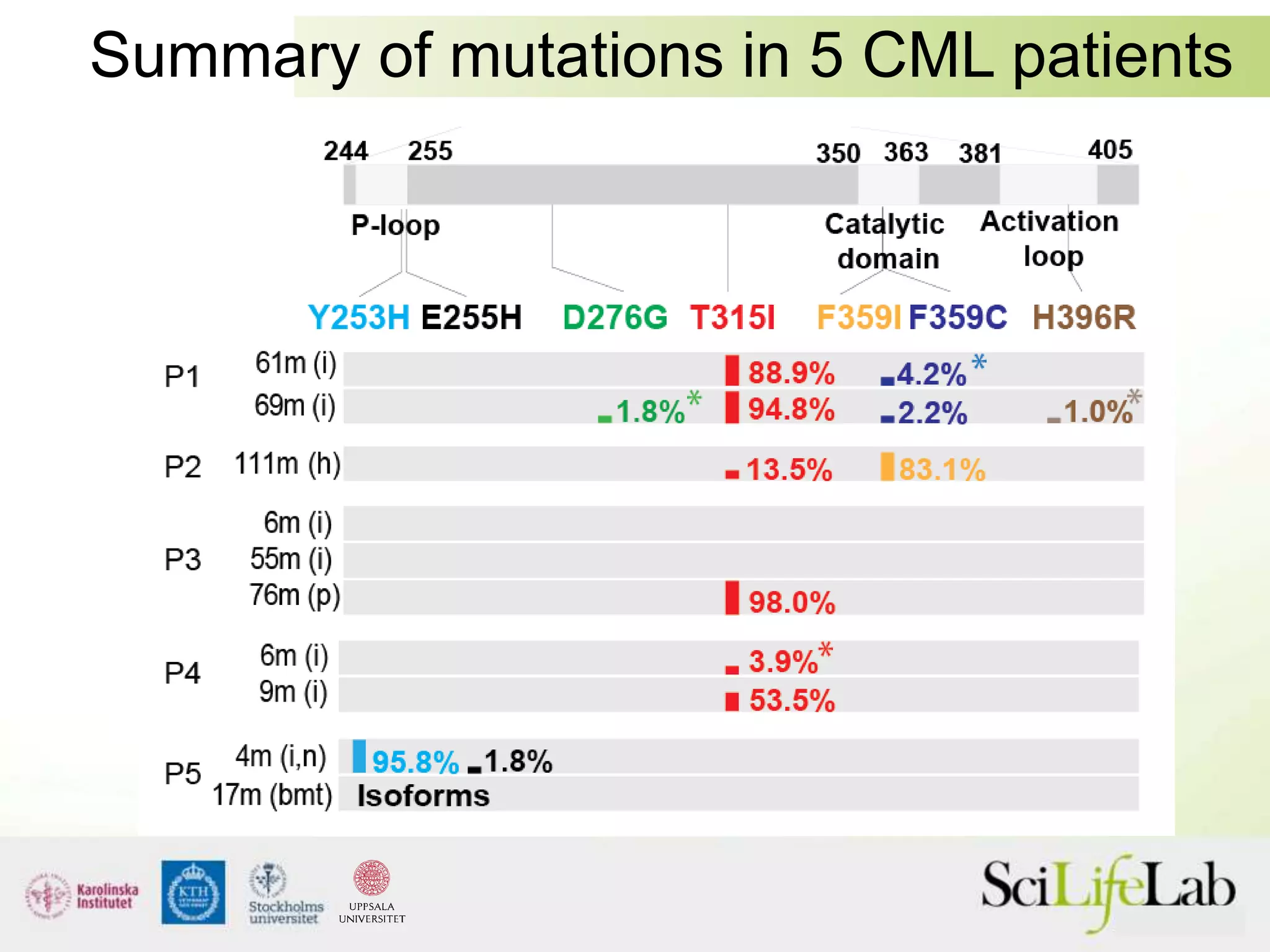
Summary of mutations in 5 CML patients
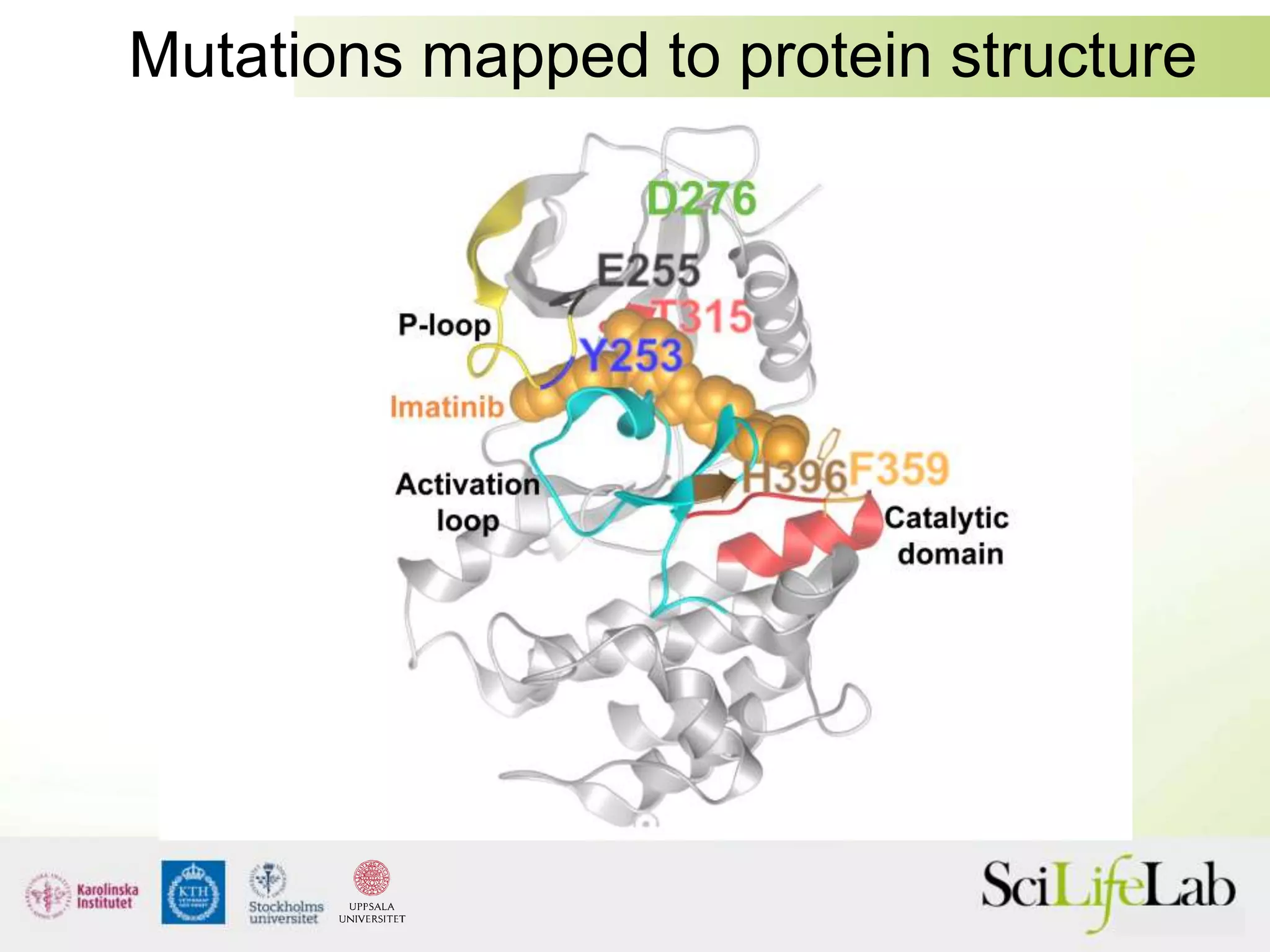
Mutations mapped to protein structure
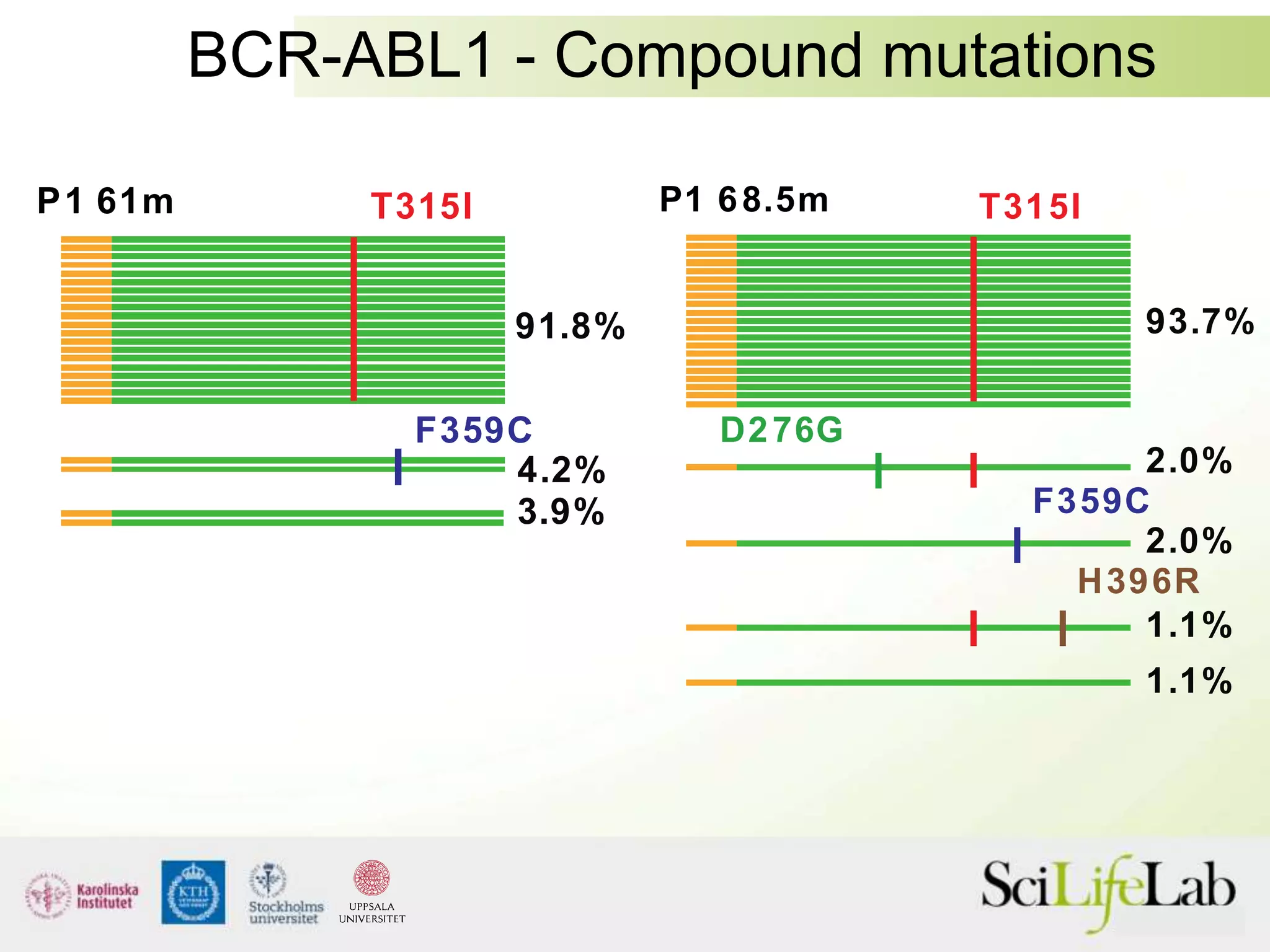
BCR-ABL1 - Compound mutations
P1 61m T315I
F359C
91.8%
4.2%
3.9%
P1 68.5m T315I
F359C
H396R
D276G
93.7%
2.0%
1.1%
2.0%
1.1%
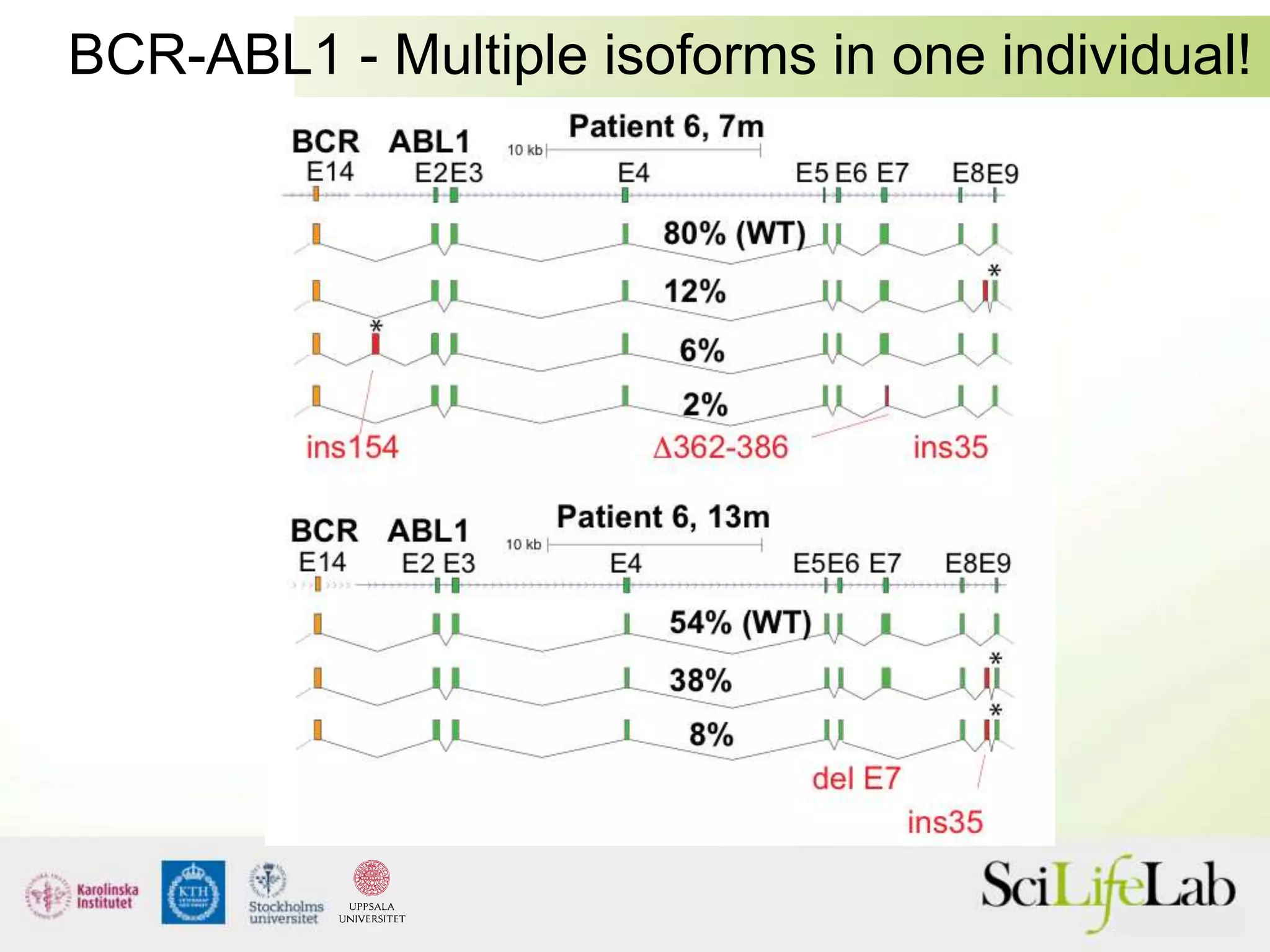
BCR-ABL1 - Multiple isoforms in one individual!
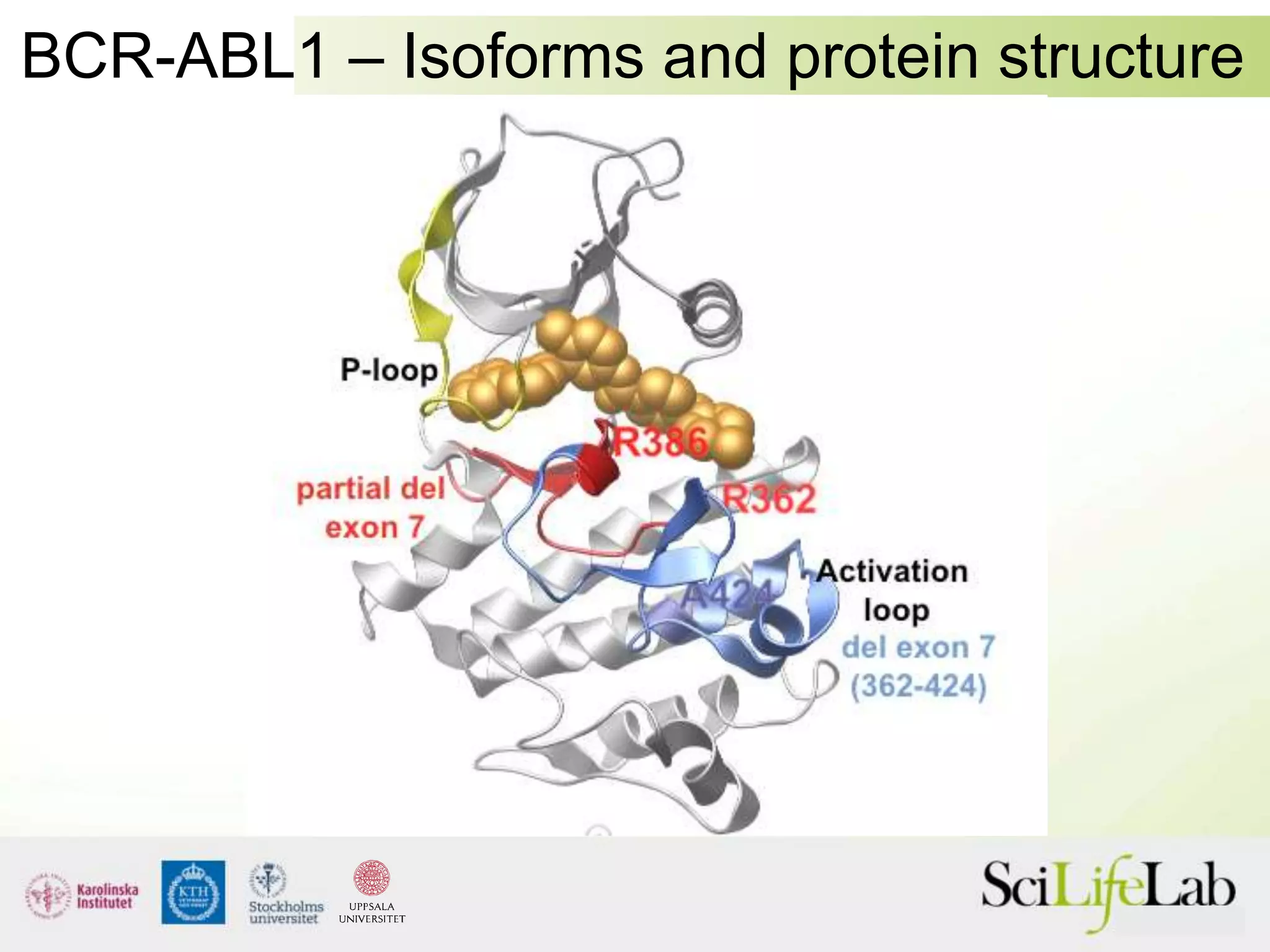
BCR-ABL1 – Isoforms and protein structure
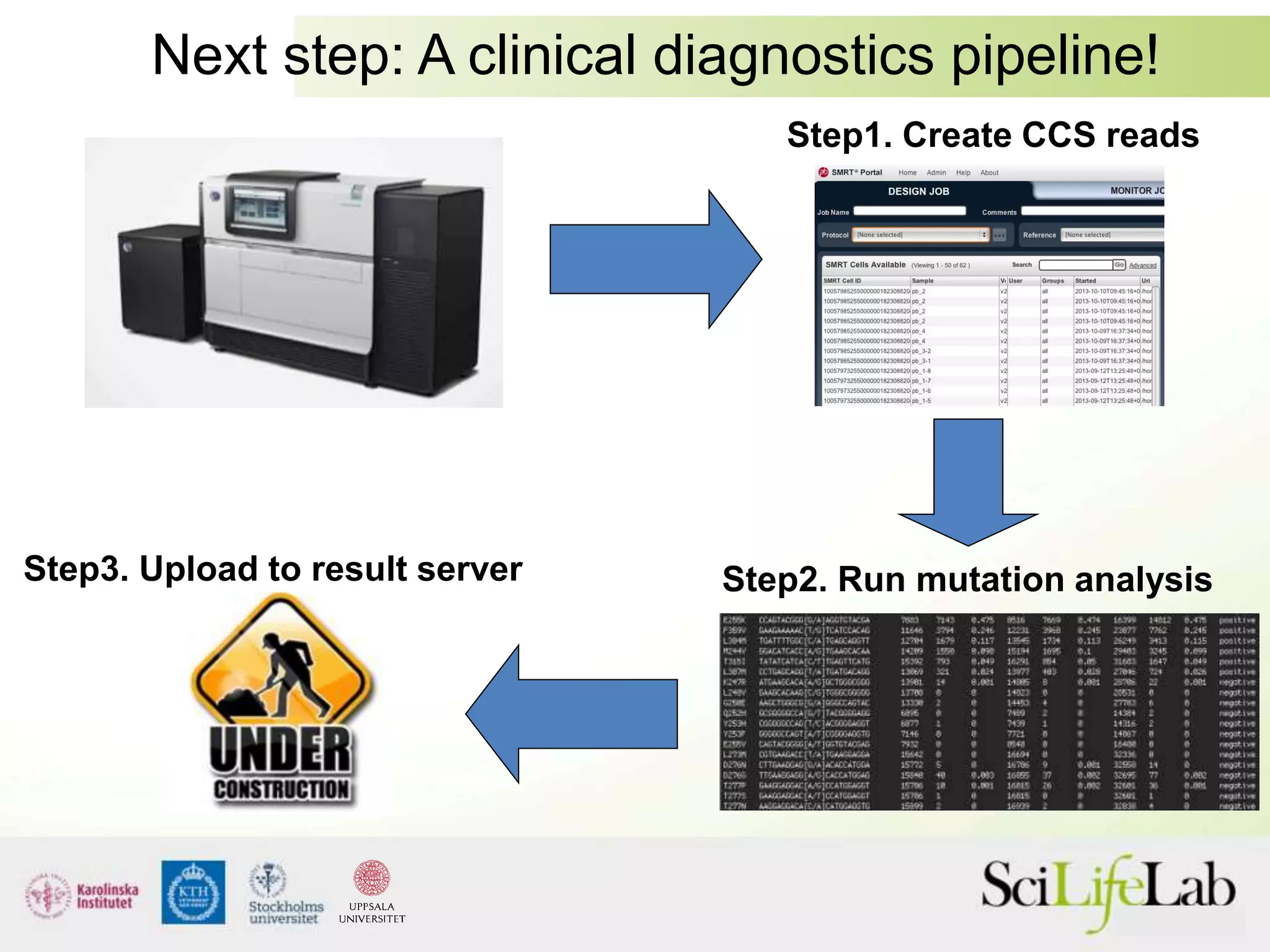
Next step: A clinical diagnostics pipeline!
Step1. Create CCS reads
Step2. Run mutation analysis
Step3. Upload to result server
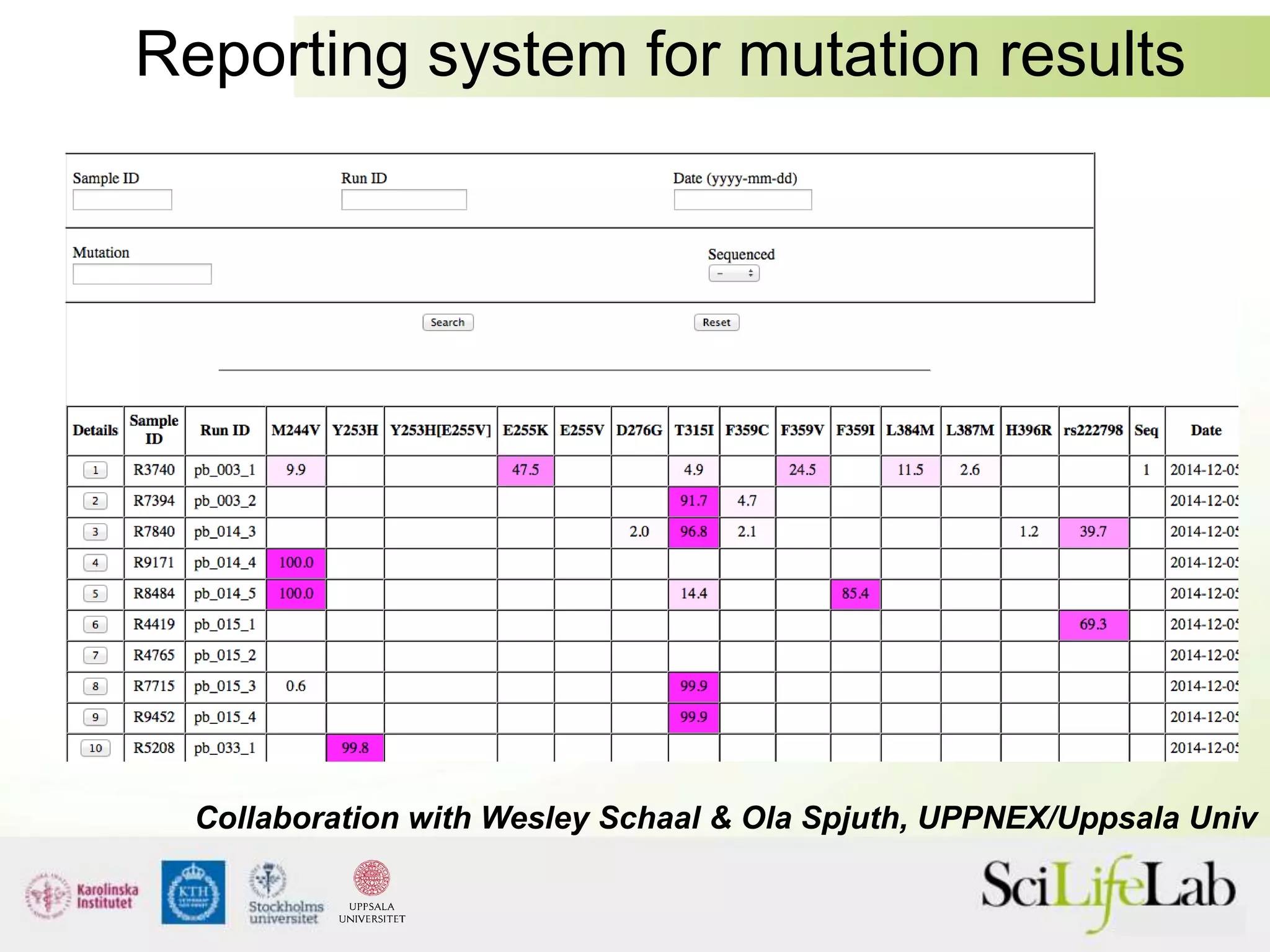
Collaboration with Wesley Schaal & Ola Spjuth, UPPNEX/Uppsala Univ
Reporting system for mutation results
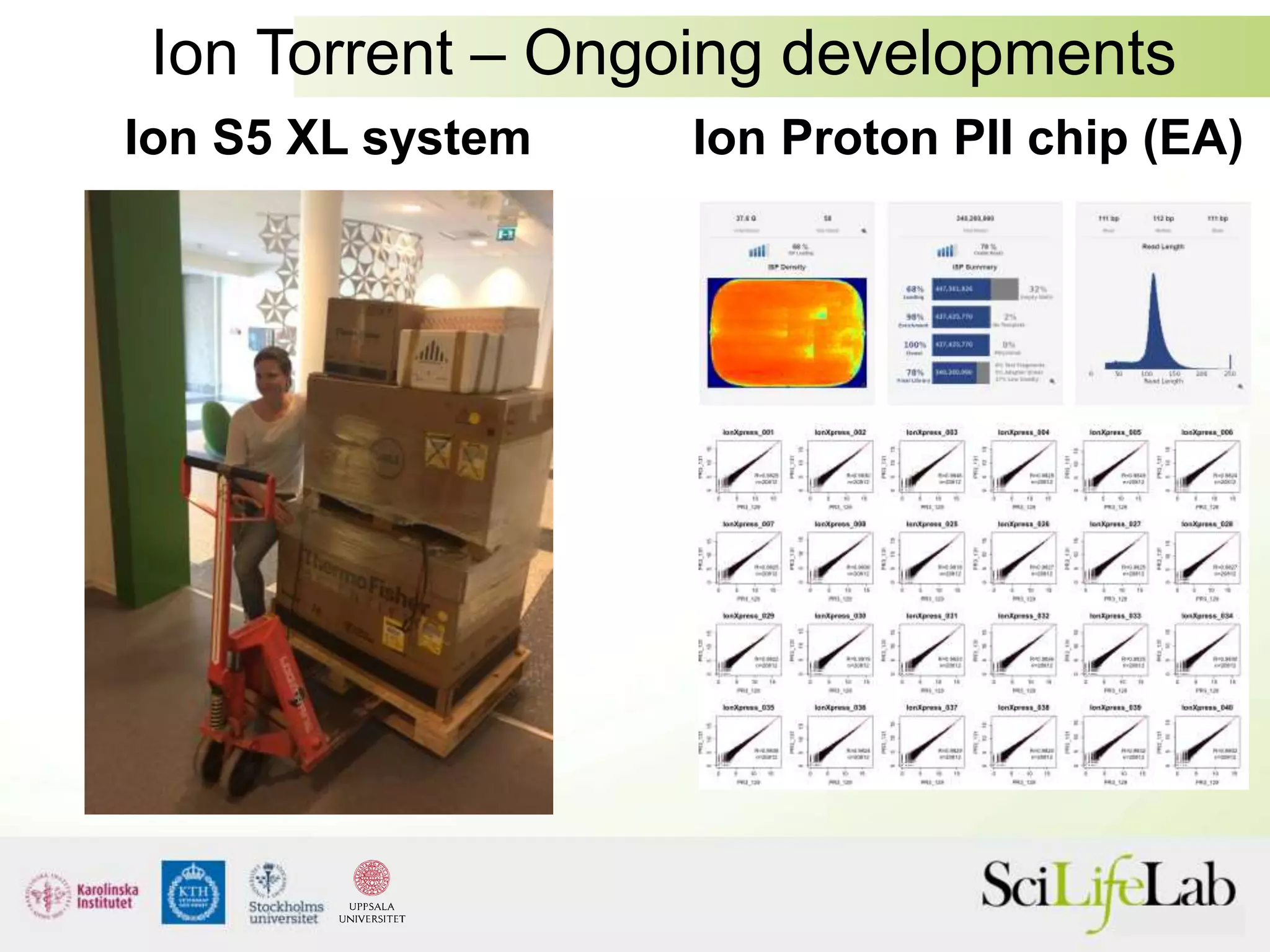
Ion Torrent – Ongoing developments
Ion S5 XL system Ion Proton PII chip (EA)
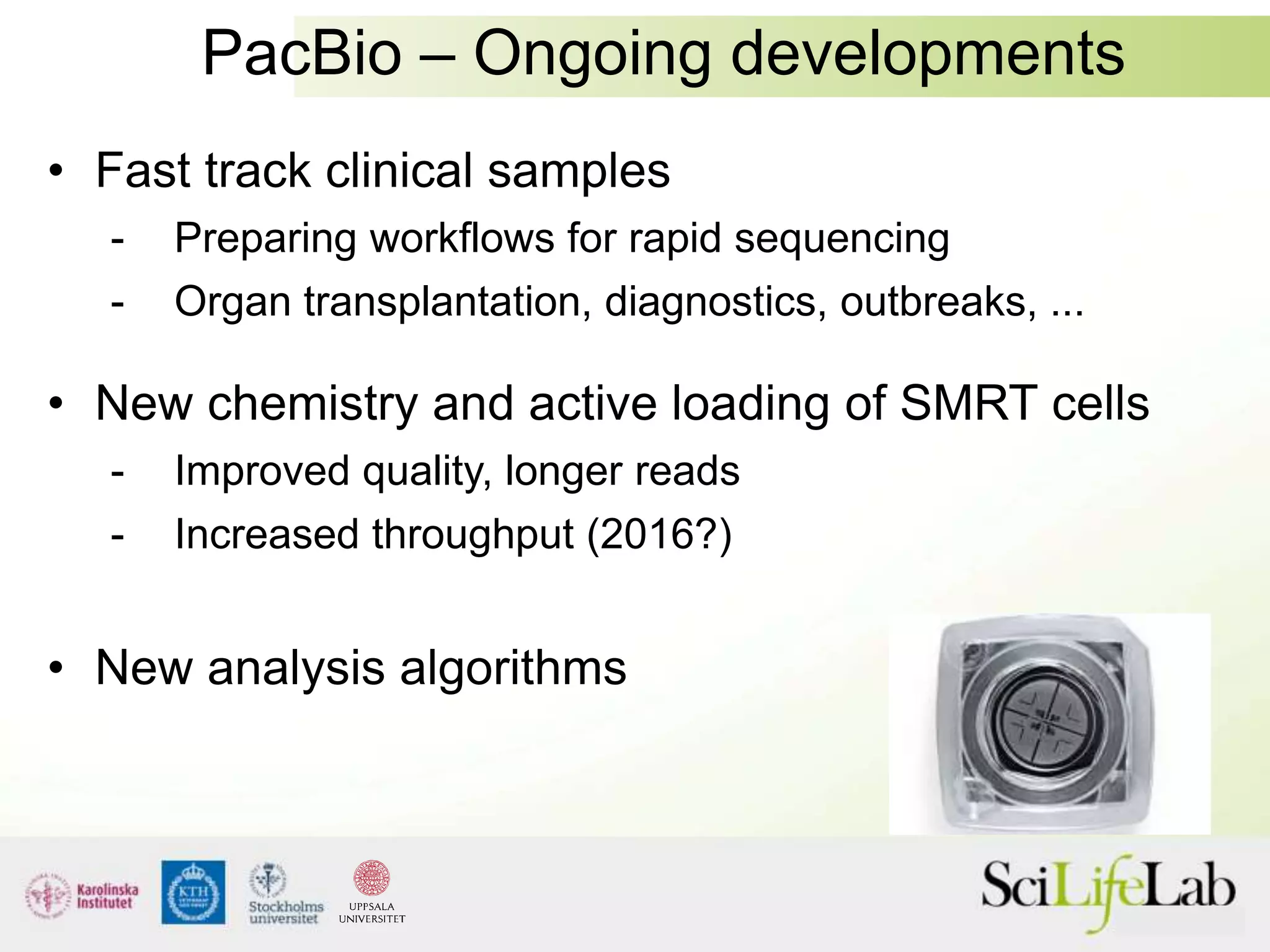
PacBio – Ongoing developments
• Fast track clinical samples
- Preparing workflows for rapid sequencing
- Organ transplantation, diagnostics, outbreaks, ...
• New chemistry and active loading of SMRT cells
- Improved quality, longer reads
- Increased throughput (2016?)
• New analysis algorithms
INFR S RU URE
A T CT
ENOMI S
G C
ATCA GT
N ION L
GA CTAC
AT A
Thank you!

AdamAmeur_SciLife_Bioinfo_course_Nov2015.ppt

  • 1.
    Next Generation Sequencing and BioinformaticsAnalysis Pipelines Adam Ameur National Genomics Infrastructure SciLifeLab Uppsala adam.ameur@igp.uu.se INF R S RU URE A T CT ENOMI S G C ATCA GT N ION L GA CTAC AT A
  • 2.
    What is ananalysis pipeline? • Basically just a number of steps to analyze data Raw data (FASTQ reads) Intermediate result Intermediate result Final result • Pipelines can be simple or very complex…
  • 3.
    Today’s lecture • Sequencinginstruments and ‘standard’ pipelines – IonTorrent/PacificBiosciences • In-house bioinformatics pipelines, some examples • News and future plans
  • 4.
    Ion Torrent -PGM/Proton • The Ion Torrent System – 6 instruments available in Uppsala, early access users – Two instruments: PGM and Proton – For small scale (PGM) and large scale sequencing (Proton) – Rapid sequencing (run time ~ 2-4 hours) – Measures changes in pH – Sequencing on a chip Personal Genome Machine (PGM) Ion Proton
  • 5.
    Ion Torrent output •Ion Torrent throughput ~ from 10Mb to >10Gb, depending on the chip • Read lengths: 400bp (PGM), 200bp (Proton) • Output file format: FASTQ • What can we use Ion Torrent for? – Anything, except perhaps very large genomes 2 human exomes (PI chip) 2 human transcriptomes 1 human genome = 6 PI chips PI (Proton) 318 (PGM) 316 (PGM) 314 (PGM) NEW! P2 (Proton)
  • 6.
    Ion Torrent analysisworkflow Downstream analysis Torrent Server .fastq .bam .fasta
  • 7.
  • 8.
    Torrent Suite SoftwareAnalysis • Plug-ins within the Torrent Suite Software – Alignment • TMAP: Specifically developed for Ion Torrent data – Variant Caller • SNP/Indel detection – Assembler • MIRA – Analysis of gene panels (Human exomes, cancer panels, etc…) • SNP/Indel detection in amplicon-seq data – Analysis of human transcriptomes – … • Analyses are started automatically when run is complete!
  • 9.
    Pacific Biosciences • PacificBiosciences – Installed summer 2013 – Single molecule sequencing – Very long read lengths (up to 60 kb) – Rapid sequencing – Can detect base modifications (i.e. methylation) – Relatively low throughput
  • 10.
    PacBio output • PacBiothroughput ~ 1 Gb/SMRT cell • PacBio read lengths: 500bp-60kb • Output file format: FASTQ • What can we use PacBio for? – Anything, except really large genomes ~1 bacterial genome ~1 bacterial transcriptome 1 human genome = 100 SMRT cells?
  • 11.
    PacBio analysis workflow In-housePacBio cluster Downstream analysis .fastq .bam .fasta
  • 12.
  • 13.
    SMRT analysis pipelines •Mapping • Variant calling • Assembly • Scaffolding • Base modifications
  • 14.
    What about Illumina? •There are many different pipelines for Illumina…
  • 15.
    In-house development ofpipelines • The standard analysis pipelines are nice… … but sometimes we need to do own developments … or adapt the pipelines to our specific applications • Some examples of in-house developments: I. Building a local variant database (WES/WGS) II. Assembly of genomes using long reads III. Clinical sequencing – Leukemia Diagnostics
  • 16.
  • 17.
    Background: exome-seq • Mainapplication of exome-seq – Find disease causing mutations in humans • Advantages – Allows investigate all protein coding sequences – Possible to detect both SNPs and small indels – Low cost (compared to WGS) – Possible to multiplex several exomes in one run – Standardized work flow for data analysis • Disadvantage – All genetic variants outside of exons are missed (~98%)
  • 18.
    Exome-seq throughput • Weare producing a lot of exome-seq data – 4-6 exomes/day on Ion Proton – In each exome we detect • Over 50,000 SNPs • About 2000 small indels => Over 1 million variants/run! • In plain text files
  • 19.
    How to analyzethis? • Traditional analysis - A lot of filtering! – Typical filters • Focus on rare SNPs (not present in dbSNP) • Remove FPs (by filtering against other exomes) • Effect on protein: non-synonymous, stop-gain etc • Heterozygous/homozygous – This analysis can be automated (more or less) Result: A few candidate causative SNP(s)! Start: All identified SNPs
  • 20.
    Why is thisnot optimal? • Drawbacks – Work on one sample at time • Difficult to compare between samples – Takes time to re-run analysis • When using different parameters – No standardized storage of detected SNPs/indels • Difficult to handle 100s of samples • Better solution – A database oriented system • Both for data storage and filtering analyses
  • 21.
    Analysis: In-house variantdatabase Ameur et al., Database Journal, 2014 *CANdidate Variant Analysis System and Data Base *
  • 22.
  • 23.
    CanvasDB - Filteringspeed • Rapid variant filtering, also for large databases
  • 24.
    A recent exome-seqproject • Hearing loss: 2 affected brothers – Likely a rare, recessive disease => Shared homozygous SNPs/indels • Sequencing strategy – TargetSeq exome capture – One sample per PI chip homoz homoz heteroz heteroz
  • 25.
    Filtering analysis • CanvasDBfiltering for a variant that is… – rare • at most in 1% of ~700 exomes – shared • found in both brothers – homozygous • in brothers, but in no other samples – deleterious • non-synonymous, frameshift, stop-gain, splicing, etc..
  • 26.
    Filtering results • Homozygouscandidates – 2 SNPs • stop-gain in STRC • non-synonymous in PCNT – 0 indels • Compound heterozygous candidates (lower priority) – in 15 genes => Filtering is fast and gives a short candidate list!
  • 27.
    STRC - acandidate gene => Stop-gain in STRC is likely to cause hearing loss!
  • 28.
    Brother #1 Brother #2 Unrelatedsample IGV visualization: Stop gain in STRC
  • 29.
    STRC, validation bySanger Brother #1 Brother #2 Stop-gain site • Sanger validation • Does not seem to be homozygous.. – Explanation: difficult to sequence STRC by Sanger • Pseudo-gene with very high similarity • New validation showed mutation is homozygous!!
  • 30.
    CanvasDB – somesuccess stories Solved cases, exome-seq - Niklas Dahl/Joakim Klar Neuromuscular disorder NMD11 Artrogryfosis SKD36 Lipodystrophy ACR1 Achondroplasia ACD2 Ectodermal dysplasia ED21 Achondroplasia ACD9 Ectodermal dysplasia ED1 Arythroderma AV1 Ichthyosis SD12 Muscular dystrophy DMD7 Neuromuscular disorder NMD8 Welanders myopathy (D) W Skeletal dysplasia SKD21 Visceral myopathy (D) D:5156 Ataxia telangiectasia MR67 Exostosis SKD13 Alopecia AP43 Epidermolysis bullosa SD14 Hearing loss D:9652
  • 31.
    CanvasDB - Availability •CanvasDB system now freely available on GitHub!
  • 32.
    Next Step: WholeGenome Sequencing Capacity of HiSeq X Ten: 320 whole human genomes/week!!! • More work on pipelines and databases needed!!! • New instruments at SciLifeLab for human WGS…
  • 33.
    Example of largeWGS project: Generation of a high quality genetic variant database for the Swedish population Whole Genome Sequencing of ~1000 individuals Aim: to build a resource for Swedish research and health care PI: Ulf Gyllensten
  • 34.
    Example II: Assembly ofgenomes using Pacific Biosciences
  • 35.
    Genome assembly usingNGS • Short-read de novo assembly by NGS – Requires mate-pair sequences • Ideally with different insert sizes – Complicated analysis • Assembly, scaffolding, finishing • Maybe even some manual steps => Rather expensive and time consuming • Long reads really makes a difference!! – We can assemble genomes using PacBio data only!
  • 36.
    HGAP de novoassembly • HGAP uses both long and shorter reads Long reads (seeds) Short reads
  • 37.
    PacBio – Currentthroughput & read lengths • >10kb average read lengths! (run from April 2014) • ~ 1 Gb of sequence from one PacBio SMRT cell
  • 38.
    PacBio assembly analysis •Simple -- just click a button!!
  • 39.
    PacBio assembly, exampleresult • Example: Complete assembly of a bacterial genome
  • 40.
    PacBio assembly –recent developments • Also larger genomes can be assembled by PacBio..
  • 41.
    Next step: assemblyof large genomes • We need to install such pipelines at UPPNEX!! 405,000 CPUh used on Google Cloud! • A computational challenge!!
  • 42.
    Example III: Clinical sequencingfor Leukemia Treatment
  • 43.
    Chronic Myeloid Leukemia •BCR-ABL1 fusion protein – a CML drug target www.cambridgemedicine.org/article/doi/10.7244/cmj-1355057881 The BCR-ABL1 fusion protein can acquire resistance mutations following drug treatment
  • 44.
    BCR-ABL1 workflow –PacBio Sequencing From sample to results: < 1 week 1 sample/SMRT cell Cavelier et al., BMC Cancer, 2015
  • 45.
    BCR-ABL1 mutations atdiagnosis BCR ABL1 PacBio sequencing generates ~10 000X coverage! Sample from time of diagnosis:
  • 46.
    BCR-ABL1 mutations infollow-up sample Sample 6 months later Mutations acquired in fusion transcript. Might require treatment with alternative drug. BCR ABL1
  • 47.
    BCR-ABL1 dilution seriesresults • Mutations down to 1% detected!
  • 48.
    Summary of mutationsin 5 CML patients
  • 49.
    Mutations mapped toprotein structure
  • 50.
    BCR-ABL1 - Compoundmutations P1 61m T315I F359C 91.8% 4.2% 3.9% P1 68.5m T315I F359C H396R D276G 93.7% 2.0% 1.1% 2.0% 1.1%
  • 51.
    BCR-ABL1 - Multipleisoforms in one individual!
  • 52.
    BCR-ABL1 – Isoformsand protein structure
  • 53.
    Next step: Aclinical diagnostics pipeline! Step1. Create CCS reads Step2. Run mutation analysis Step3. Upload to result server
  • 54.
    Collaboration with WesleySchaal & Ola Spjuth, UPPNEX/Uppsala Univ Reporting system for mutation results
  • 55.
    Ion Torrent –Ongoing developments Ion S5 XL system Ion Proton PII chip (EA)
  • 56.
    PacBio – Ongoingdevelopments • Fast track clinical samples - Preparing workflows for rapid sequencing - Organ transplantation, diagnostics, outbreaks, ... • New chemistry and active loading of SMRT cells - Improved quality, longer reads - Increased throughput (2016?) • New analysis algorithms
  • 57.
    INFR S RUURE A T CT ENOMI S G C ATCA GT N ION L GA CTAC AT A Thank you!