Academic text
Structures
English for Academic and
Professional Purposes
Learning Objectives
1) Define academic text and differentiate it from
non-academic text;
2) Determine text structure of an academic text;
and
3) Create a poster that shows the do’s and don’ts
in writing academic text.
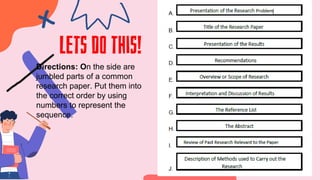
Lets do this!
Directions: On the side are
jumbled parts of a common
research paper. Put them into
the correct order by using
numbers to represent the
sequence.
What is an Academic text?
 Academic text is defined as critical, objective,
specialized texts written by experts or professionals
in a given field using formal language.
 This means that academic texts are based on facts
with solid basis.
 Academic writing, therefore, is generally quite formal,
objective (impersonal) and technical.
 It is formal by avoiding casual or conversational
language, such as contractions or informal vocabulary.
Examples of
Academic Writing
1. Literary Analysis
 examines, evaluates, and makes an
argument about a literary work.
 goes beyond mere summarization.
 requires careful close reading of one or
multiple texts and often focuses on a
specific characteristic, theme, or motif.
2. RESEARCH PAPER
 Uses outside information to support a
thesis or make an argument.
 written in all disciplines and may be
evaluative, analytical, or critical in nature.
 involves synthesizing this external
information with your own ideas.
3. Dissertation
 A dissertation (or thesis) is a document
submitted at the conclusion of a Ph.D.
program.
 a book-length summarization of the
doctoral candidate’s research.
Examples of non academic text:
Personal Opinions
Magazines
Non fiction
Digital Media
News
etc.
● A well-structured text enables the reader to follow
the argument and navigate the text.
● These are the two common structures of academic
texts that you need to learn which depends on the
type of assignment you are required: the three-part
essay structure and the IMRaD structure.
Structure is an important feature of
academic writing.
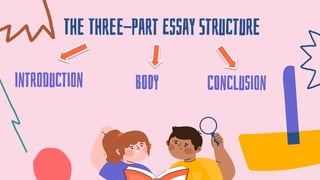
The Three-Part Essay Structure
Introduction BODY COnclusion
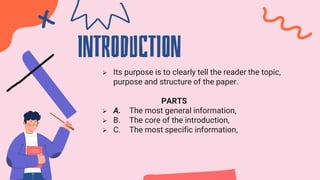
INTRODUCTION
 Its purpose is to clearly tell the reader the topic,
purpose and structure of the paper.
PARTS
 A. The most general information,
 B. The core of the introduction,
 C. The most specific information,
body
 It develops the question, “What is the topic about?”.
 It may elaborate directly on the topic sentence by
giving definitions, classifications, explanations,
contrasts, examples and evidence.
 This is considered as the heart of the essay.
cONCLUSION
 The conclusion is closely related to the introduction
and is often described as its ‘mirror image’.
 The conclusion usually begins by briefly summarizing
the main scope or structure of the paper, confirms the
topic that was given in the introduction, ends with a
more general statement about how this topic relates to
its context.
I - introduction
m-methods
r - results
a- and
d - Discussion
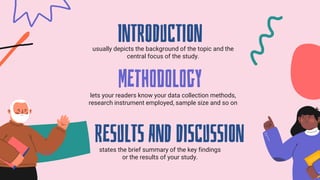
INTRODUCTION
usually depicts the background of the topic and the
central focus of the study.
MEthodology
lets your readers know your data collection methods,
research instrument employed, sample size and so on
RESULTS AND DISCUSSION
states the brief summary of the key findings
or the results of your study.
Activity 1: WHICH IS WHICH?
Directions: Write ACADEMIC if the statement is correct
and NON-ACADEMIC if it is wrong. Do this in your
answer sheet.
1. Formality in academic writing requires precision to make a
legitimate piece of writing.
2.Writing is a form of communication that is shaped by the
following factors: topic, role, and audience.
3.The use of personal pronouns such as I, you, and we is
acceptable in academic writing.
Activity 1: WHICH IS WHICH?
Directions: Write ACADEMIC if the statement is correct
and NON-ACADEMIC if it is wrong. Do this in your
answer sheet.
4.“How can these problems be solved?” is an example of a
critical question.
5. Because is an example of transitional device that
expresses cause and effect.
6. An abstract is a summary of a novel.
Activity 1: WHICH IS WHICH?
Directions: Write ACADEMIC if the statement is correct
and NON-ACADEMIC if it is wrong. Do this in your
answer sheet.
7. The conclusion is the section that summarizes the main
points of the essay.
8. A summary is a condensed form of a text which is usually
half of the original material.
9. To introduce a topic in an essay, the writer must be able
to explain its details.
10. A research paper contains background of the study,
body and recommendations.
Activity 2: TABLE COMPLETION
Directions: Complete the table below to show the difference
among the given academic writing. Additional research is
needed in this activity. (20 pts)
Academic
Writing
What are its
parts/structures?
Where is it done?
( part of a class, in a
program of study, or for
publication )
Literary Analysis
Research Paper
Dissertation
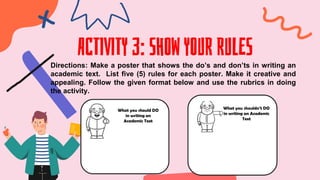
ACTIVITY 3: SHOW YOUR RULES
Directions: Make a poster that shows the do’s and don’ts in writing an
academic text. List five (5) rules for each poster. Make it creative and
appealing. Follow the given format below and use the rubrics in doing
the activity.
What you should DO
in writing an
Academic Text
What you shouldn’t DO
in writing an Academic
Text
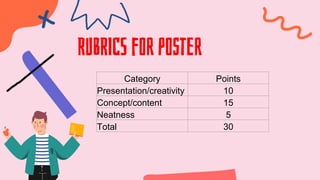
RUBRICS for poster
Category Points
Presentation/creativity 10
Concept/content 15
Neatness 5
Total 30
CRÉDITOS: Esta plantilla de presentación fue
creada por Slidesgo, que incluye iconos de
Flaticon, infografías e imágenes de Freepik
Thank you and
Happy learning!
Ma. Rubellee V. Patolot
Subject Teacher

Week 1. ACADEMIC TEXT STRUCTURES.pptx

  • 1.
    Academic text Structures English forAcademic and Professional Purposes
  • 2.
    Learning Objectives 1) Defineacademic text and differentiate it from non-academic text; 2) Determine text structure of an academic text; and 3) Create a poster that shows the do’s and don’ts in writing academic text.
  • 3.
    Lets do this! Directions:On the side are jumbled parts of a common research paper. Put them into the correct order by using numbers to represent the sequence.
  • 4.
    What is anAcademic text?  Academic text is defined as critical, objective, specialized texts written by experts or professionals in a given field using formal language.  This means that academic texts are based on facts with solid basis.  Academic writing, therefore, is generally quite formal, objective (impersonal) and technical.  It is formal by avoiding casual or conversational language, such as contractions or informal vocabulary.
  • 5.
  • 6.
    1. Literary Analysis examines, evaluates, and makes an argument about a literary work.  goes beyond mere summarization.  requires careful close reading of one or multiple texts and often focuses on a specific characteristic, theme, or motif.
  • 7.
    2. RESEARCH PAPER Uses outside information to support a thesis or make an argument.  written in all disciplines and may be evaluative, analytical, or critical in nature.  involves synthesizing this external information with your own ideas.
  • 8.
    3. Dissertation  Adissertation (or thesis) is a document submitted at the conclusion of a Ph.D. program.  a book-length summarization of the doctoral candidate’s research.
  • 9.
    Examples of nonacademic text: Personal Opinions Magazines Non fiction Digital Media News etc.
  • 10.
    ● A well-structuredtext enables the reader to follow the argument and navigate the text. ● These are the two common structures of academic texts that you need to learn which depends on the type of assignment you are required: the three-part essay structure and the IMRaD structure. Structure is an important feature of academic writing.
  • 11.
    The Three-Part EssayStructure Introduction BODY COnclusion
  • 12.
    INTRODUCTION  Its purposeis to clearly tell the reader the topic, purpose and structure of the paper. PARTS  A. The most general information,  B. The core of the introduction,  C. The most specific information,
  • 13.
    body  It developsthe question, “What is the topic about?”.  It may elaborate directly on the topic sentence by giving definitions, classifications, explanations, contrasts, examples and evidence.  This is considered as the heart of the essay.
  • 14.
    cONCLUSION  The conclusionis closely related to the introduction and is often described as its ‘mirror image’.  The conclusion usually begins by briefly summarizing the main scope or structure of the paper, confirms the topic that was given in the introduction, ends with a more general statement about how this topic relates to its context.
  • 15.
    I - introduction m-methods r- results a- and d - Discussion
  • 16.
    INTRODUCTION usually depicts thebackground of the topic and the central focus of the study. MEthodology lets your readers know your data collection methods, research instrument employed, sample size and so on RESULTS AND DISCUSSION states the brief summary of the key findings or the results of your study.
  • 17.
    Activity 1: WHICHIS WHICH? Directions: Write ACADEMIC if the statement is correct and NON-ACADEMIC if it is wrong. Do this in your answer sheet. 1. Formality in academic writing requires precision to make a legitimate piece of writing. 2.Writing is a form of communication that is shaped by the following factors: topic, role, and audience. 3.The use of personal pronouns such as I, you, and we is acceptable in academic writing.
  • 18.
    Activity 1: WHICHIS WHICH? Directions: Write ACADEMIC if the statement is correct and NON-ACADEMIC if it is wrong. Do this in your answer sheet. 4.“How can these problems be solved?” is an example of a critical question. 5. Because is an example of transitional device that expresses cause and effect. 6. An abstract is a summary of a novel.
  • 19.
    Activity 1: WHICHIS WHICH? Directions: Write ACADEMIC if the statement is correct and NON-ACADEMIC if it is wrong. Do this in your answer sheet. 7. The conclusion is the section that summarizes the main points of the essay. 8. A summary is a condensed form of a text which is usually half of the original material. 9. To introduce a topic in an essay, the writer must be able to explain its details. 10. A research paper contains background of the study, body and recommendations.
  • 20.
    Activity 2: TABLECOMPLETION Directions: Complete the table below to show the difference among the given academic writing. Additional research is needed in this activity. (20 pts) Academic Writing What are its parts/structures? Where is it done? ( part of a class, in a program of study, or for publication ) Literary Analysis Research Paper Dissertation
  • 21.
    ACTIVITY 3: SHOWYOUR RULES Directions: Make a poster that shows the do’s and don’ts in writing an academic text. List five (5) rules for each poster. Make it creative and appealing. Follow the given format below and use the rubrics in doing the activity. What you should DO in writing an Academic Text What you shouldn’t DO in writing an Academic Text
  • 22.
    RUBRICS for poster CategoryPoints Presentation/creativity 10 Concept/content 15 Neatness 5 Total 30
  • 23.
    CRÉDITOS: Esta plantillade presentación fue creada por Slidesgo, que incluye iconos de Flaticon, infografías e imágenes de Freepik Thank you and Happy learning! Ma. Rubellee V. Patolot Subject Teacher