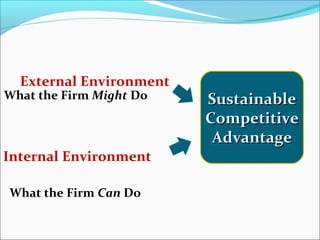
External Environment
What the Firm Might Do
Internal Environment
What the Firm Can Do
SustainableSustainable
CompetitiveCompetitive
AdvantageAdvantage
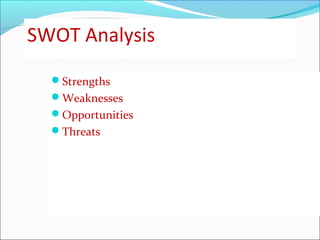
SWOT Analysis
Strengths
Weaknesses
Opportunities
Threats
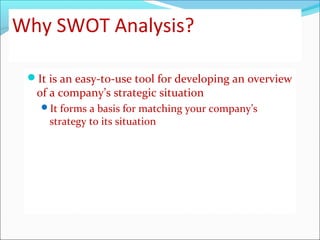
Why SWOT Analysis?
It is an easy-to-use tool for developing an overview
of a company’s strategic situation
It forms a basis for matching your company’s
strategy to its situation
S W O TS W O T analysis involves more than just developing
the 4 lists of strengths, weaknesses, opportunities, and
threats
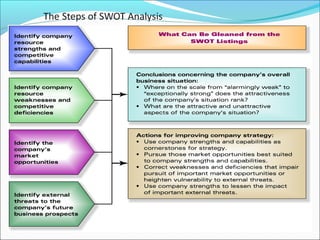
The most important part of S W O TS W O T analysis is
Using the 4 lists to draw conclusions
about a company’s overall situation
Acting on the conclusions to
 Better match a company’s strategy to its
resource strengths and market opportunities
 Correct the important weaknesses
Role of SWOT Analysis in
Crafting a Better Strategy
Strengths
A STRENGTH is something a company is good at
doing or a characteristic that gives it an important
capability.
Possible Strengths:
Name recognition
Proprietary technology
Cost advantages
Skilled employees
Loyal Customers
A strength is something a firm does well or an
attribute that enhances its competitiveness
Valuable skills, competencies, or capabilities
Valuable physical assets
Valuable human assets
Valuable organizational assets
Valuable intangible assets
Important competitive capabilities
An attribute placing a company in a position of market
advantage(Group exercise to identify such attributes)
Alliances or cooperative ventures with partnersResource strengths and competitive
capabilities are competitive assets!
Identifying Resource Strengths
and Competitive Capabilities
Weaknesses
A WEAKNESS is something a company lacks or
does poorly (in comparison to others) or a
condition that places it at a disadvantage
Possible Weaknesses:
Poor market image
Obsolete facilities
Internal operating problems
Poor marketing skills
Identifying Resource Weaknesses
and Competitive Deficiencies
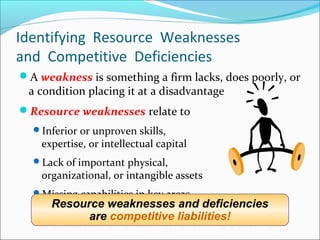
A weakness is something a firm lacks, does poorly, or
a condition placing it at a disadvantage
Resource weaknesses relate to
Inferior or unproven skills,
expertise, or intellectual capital
Lack of important physical,
organizational, or intangible assets
Missing capabilities in key areas
Resource weaknesses and deficiencies
are competitive liabilities!
Strengths and Weakness form a
basis for INTERNAL analysis
By examining strengths, you can discover
untapped potential or identify distinct
competencies that helped you succeed in the past.
By examining weaknesses, you can identify gaps in
performance, vulnerabilities, and erroneous
assumptions about existing strategies.
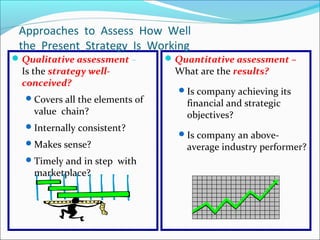
Qualitative assessment –
Is the strategy well-
conceived?
Covers all the elements of
value chain?
Internally consistent?
Makes sense?
Timely and in step with
marketplace?
Quantitative assessment –
What are the results?
Is company achieving its
financial and strategic
objectives?
Is company an above-
average industry performer?
Approaches to Assess How Well
the Present Strategy Is Working
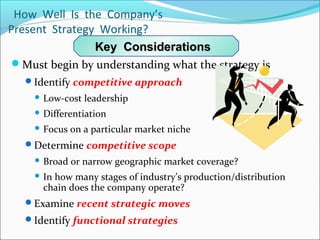
How Well Is the Company’s
Present Strategy Working?
Must begin by understanding what the strategy is
Identify competitive approach
 Low-cost leadership
 Differentiation
 Focus on a particular market niche
Determine competitive scope
 Broad or narrow geographic market coverage?
 In how many stages of industry’s production/distribution
chain does the company operate?
Examine recent strategic moves
Identify functional strategies
Key ConsiderationsKey Considerations
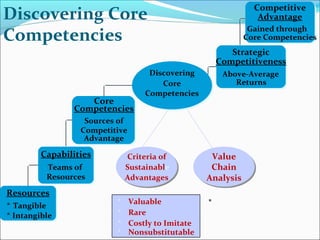
Resources
* Tangible
* Intangible
Capabilities
Teams of
Resources
Sources of
Core
Competencies
Competitive
Advantage
Strategic
Competitiveness
Above-Average
Returns
Competitive
Advantage
Gained through
Core Competencies
Discovering
Core
Competencies
Discovering Core
Competencies
Criteria of
Sustainable
Advantages
Value
Chain
Analysis
Valuable
Rare
Costly to Imitate
Nonsubstitutable
*
*
*
*
*
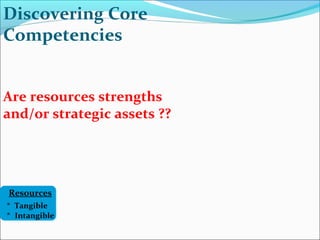
Resources
* Tangible
* Intangible
Discovering Core
Competencies
Are resources strengths
and/or strategic assets ??
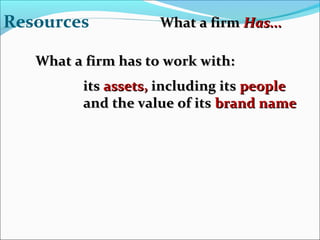
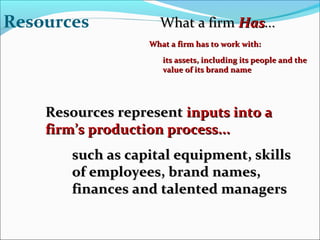
What a firm has to work with:What a firm has to work with:
itsits assets,assets, including itsincluding its peoplepeople
and the value of itsand the value of its brand namebrand name
What a firmWhat a firm Has...Has...Resources
Resources representResources represent inputs into ainputs into a
firm’s production process...firm’s production process...
such as capital equipment, skillssuch as capital equipment, skills
of employees, brand names,of employees, brand names,
finances and talented managersfinances and talented managers
What a firmWhat a firm HasHas......
What a firm has to work with:What a firm has to work with:
its assets, including its people and theits assets, including its people and the
value of its brand namevalue of its brand name
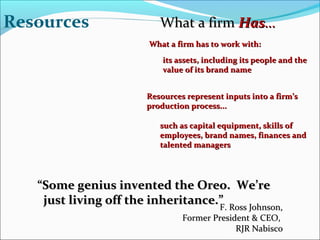
Resources
What a firm has to work with:What a firm has to work with:
its assets, including its people and theits assets, including its people and the
value of its brand namevalue of its brand name
Resources represent inputs into a firm’sResources represent inputs into a firm’s
production process...production process...
such as capital equipment, skills ofsuch as capital equipment, skills of
employees, brand names, finances andemployees, brand names, finances and
talented managerstalented managers
““Some genius invented the Oreo. We’reSome genius invented the Oreo. We’re
just living off the inheritance.”just living off the inheritance.”
F. Ross Johnson,F. Ross Johnson,
Former President & CEO,Former President & CEO,
RJR NabiscoRJR Nabisco
What a firmWhat a firm HasHas......Resources
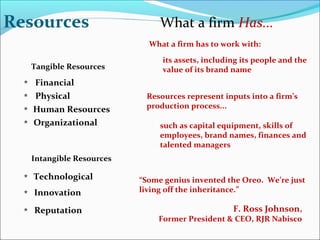
Tangible Resources
Financial*
Physical*
Human Resources*
Organizational*
What a firm Has...
What a firm has to work with:
its assets, including its people and the
value of its brand name
Resources represent inputs into a firm’s
production process...
such as capital equipment, skills of
employees, brand names, finances and
talented managers
Intangible Resources
Technological*
Innovation*
Reputation*
“Some genius invented the Oreo. We’re just
living off the inheritance.”
F. Ross Johnson,
Former President & CEO, RJR Nabisco
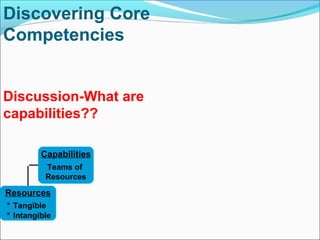
Resources
Resources
* Tangible
* Intangible
Capabilities
Teams of
Resources
Discovering Core
Competencies
Discussion-What are
capabilities??
What a firm Does...
Capabilities represent:Capabilities represent:
the firm’s capacity or ability tothe firm’s capacity or ability to integrateintegrate
individual firm’s resourcesindividual firm’s resources to achieve ato achieve a
desired objective.desired objective.
Capabilities
What a firm Does...
Capabilities develop over time as a result of
complex interactions that take advantage of the
interrelationships between a firm’s tangible and
intangible resources that are based on the
development, transmission and exchange or
sharing of information and knowledge as carried
out by the firm's employees.(Discussion on
examples )
Capabilities represent:
the firm’s capacity or ability to integrate individual firm resources
to achieve a desired objective.
Capabilities
What a firm Does...
Capabilities represent:
the firm’s capacity or ability to integrate individual firm resources
to achieve a desired objective.
Capabilities develop over time as a result of complex interactions that take
advantage of the interrelationships between a firm’s tangible and
intangible resources that are based on the development, transmission and
exchange or sharing of information and knowledge as carried out by the
firm's employees.
Capabilities become important when they areCapabilities become important when they are
combined incombined in unique combinationsunique combinations which createwhich create
core competencies which havecore competencies which have strategic valuestrategic value andand
can lead tocan lead to competitive advantagecompetitive advantage..
Capabilities
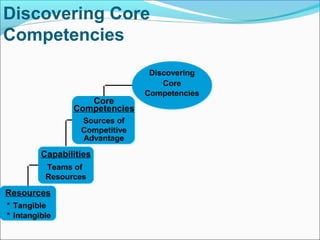
Resources
* Tangible
* Intangible
Capabilities
Teams of
Resources
Discovering Core
Competencies
Sources of
Core
Competencies
Competitive
Advantage
Discovering
Core
Competencies
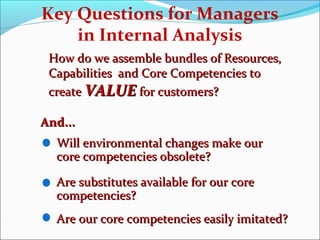
How do we assemble bundles of Resources,How do we assemble bundles of Resources,
Capabilities and Core Competencies toCapabilities and Core Competencies to
createcreate VALUEVALUE for customers?for customers?
Will environmental changes make ourWill environmental changes make our
core competencies obsolete?core competencies obsolete?
And...And...
Are substitutes available for our coreAre substitutes available for our core
competencies?competencies?
Are our core competencies easily imitated?Are our core competencies easily imitated?
Key Questions for Managers
in Internal Analysis
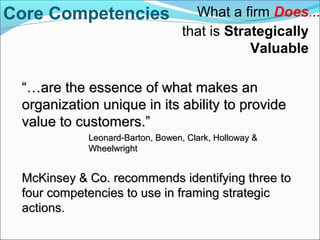
What a firm Does...
that is Strategically
Valuable
“…“…are the essence of what makes anare the essence of what makes an
organization unique in its ability to provideorganization unique in its ability to provide
value to customers.”value to customers.”
Leonard-Barton, Bowen, Clark, Holloway &Leonard-Barton, Bowen, Clark, Holloway &
WheelwrightWheelwright
McKinsey & Co. recommends identifying three toMcKinsey & Co. recommends identifying three to
four competencies to use in framing strategicfour competencies to use in framing strategic
actions.actions.
Core Competencies
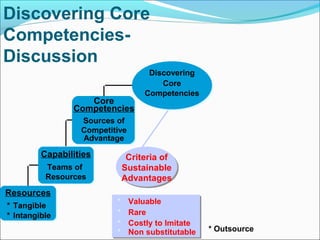
Resources
* Tangible
* Intangible
Capabilities
Teams of
Resources
Sources of
Core
Competencies
Competitive
Advantage
Discovering
Core
Competencies
Criteria of
Sustainable
Advantages
Valuable
Rare
Costly to Imitate
Non substitutable
*
*
*
*
Discovering Core
Competencies-
Discussion
* Outsource
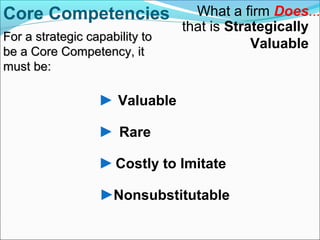
For a strategic capability toFor a strategic capability to
be a Core Competency, itbe a Core Competency, it
must be:must be:
Core Competencies
Valuable
Rare
Costly to Imitate
Nonsubstitutable
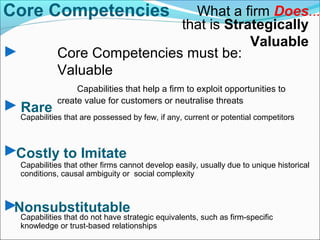
What a firm Does...
that is Strategically
Valuable
Core Competencies must be:
Valuable
Capabilities that help a firm to exploit opportunities to
create value for customers or neutralise threats
Nonsubstitutable
Capabilities that do not have strategic equivalents, such as firm-specific
knowledge or trust-based relationships
What a firm Does...
that is Strategically
Valuable
Core Competencies
Rare
Costly to Imitate
Capabilities that other firms cannot develop easily, usually due to unique historical
conditions, causal ambiguity or social complexity
Capabilities that are possessed by few, if any, current or potential competitors
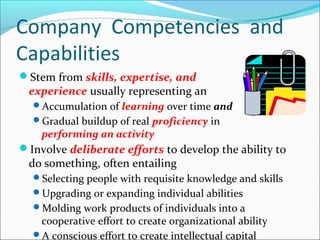
Stem from skills, expertise, and
experience usually representing an
Accumulation of learning over time and
Gradual buildup of real proficiency in
performing an activity
Involve deliberate efforts to develop the ability to
do something, often entailing
Selecting people with requisite knowledge and skills
Upgrading or expanding individual abilities
Molding work products of individuals into a
cooperative effort to create organizational ability
A conscious effort to create intellectual capital
Company Competencies and
Capabilities
Core Competencies –
A Valuable Company
Resource
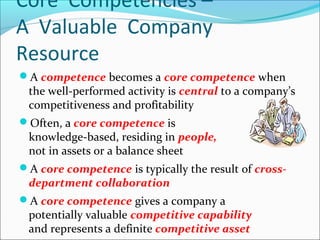
A competence becomes a core competence when
the well-performed activity is central to a company’s
competitiveness and profitability
Often, a core competence is
knowledge-based, residing in people,
not in assets or a balance sheet
A core competence is typically the result of cross-
department collaboration
A core competence gives a company a
potentially valuable competitive capability
and represents a definite competitive asset
Examples: Core Competencies
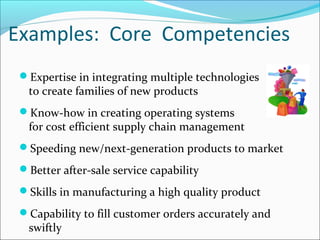
Expertise in integrating multiple technologies
to create families of new products
Know-how in creating operating systems
for cost efficient supply chain management
Speeding new/next-generation products to market
Better after-sale service capability
Skills in manufacturing a high quality product
Capability to fill customer orders accurately and
swiftly
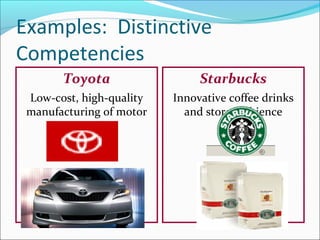
Examples: Distinctive
Competencies
Toyota
Low-cost, high-quality
manufacturing of motor
vehicles
Starbucks
Innovative coffee drinks
and store ambience
Determining the Competitive
Power of a Company Resource
To qualify as competitively valuable or to be the basis
for sustainable competitive advantage, a
“resource” must pass 4 tests:
1. Is the resource hard to copy?
2. Is the resource durable – does it have staying
power?
3. Is the resource really competitively superior?
4. Can the resource be trumped by
the different capabilities of rivals?
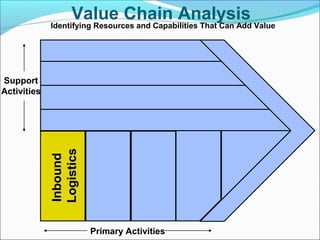
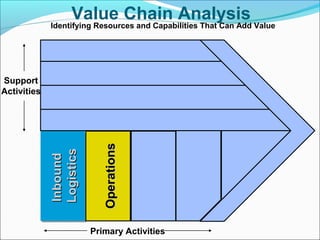
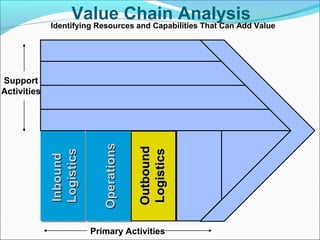
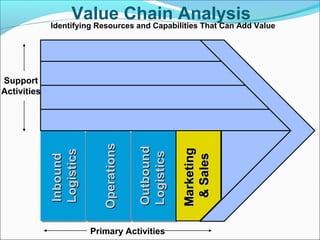
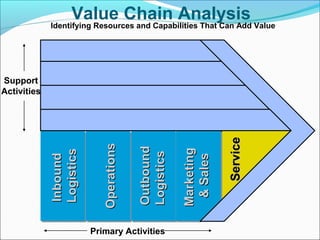
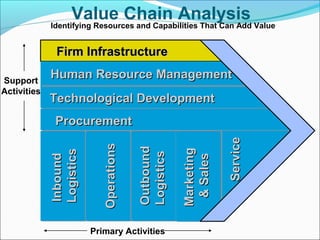
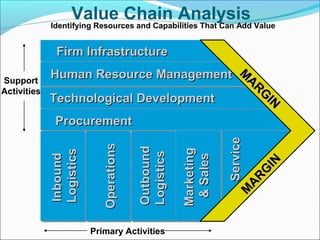
A company’s business consists of all activities
undertaken in designing, producing, marketing, delivering,
and supporting its product or service
All these activities that a company performs internally
combine to form a value chain—so-called because the
underlying intent of a company’s activities is to do things
that ultimately create value for buyers
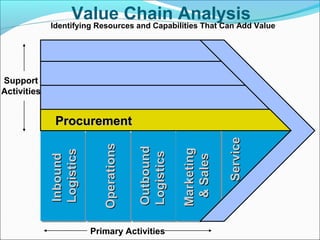
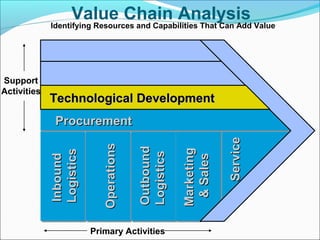
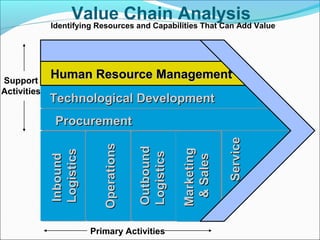
The value chain contains two types of activities
Primary activities (where most of
the value for customers is created)
Support activities that facilitate
Concept: Company Value
Chain
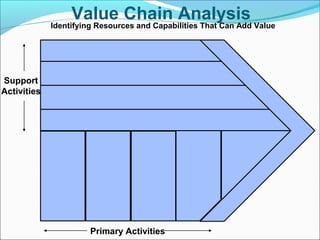
Support
Activities
Primary Activities
Value Chain Analysis
Identifying Resources and Capabilities That Can Add Value
Support
Activities
Primary Activities
InboundInbound
LogisticsLogistics
Value Chain Analysis
Identifying Resources and Capabilities That Can Add Value
Support
Activities
Primary Activities
InboundInbound
LogisticsLogistics
OperationsOperations
Value Chain Analysis
Identifying Resources and Capabilities That Can Add Value
Support
Activities
Primary Activities
InboundInbound
LogisticsLogistics
OperationsOperations
OutboundOutbound
LogisticsLogistics
Value Chain Analysis
Identifying Resources and Capabilities That Can Add Value
Support
Activities
Primary Activities
InboundInbound
LogisticsLogistics
OperationsOperations
OutboundOutbound
LogisticsLogistics
MarketingMarketing
&Sales&Sales
Value Chain Analysis
Identifying Resources and Capabilities That Can Add Value
Support
Activities
Primary Activities
InboundInbound
LogisticsLogistics
OperationsOperations
OutboundOutbound
LogisticsLogistics
MarketingMarketing
&Sales&Sales
ServiceService
Value Chain Analysis
Identifying Resources and Capabilities That Can Add Value
Support
Activities
Primary Activities
InboundInbound
LogisticsLogistics
OperationsOperations
OutboundOutbound
LogisticsLogistics
MarketingMarketing
&Sales&Sales
ServiceService
ProcurementProcurement
Value Chain Analysis
Identifying Resources and Capabilities That Can Add Value
Support
Activities
Primary Activities
InboundInbound
LogisticsLogistics
OperationsOperations
OutboundOutbound
LogisticsLogistics
MarketingMarketing
&Sales&Sales
ServiceService
ProcurementProcurement
Technological DevelopmentTechnological Development
Value Chain Analysis
Identifying Resources and Capabilities That Can Add Value
Support
Activities
Primary Activities
Technological DevelopmentTechnological Development
ProcurementProcurement
InboundInbound
LogisticsLogistics
OperationsOperations
OutboundOutbound
LogisticsLogistics
MarketingMarketing
&Sales&Sales
ServiceService
Human Resource ManagementHuman Resource Management
Value Chain Analysis
Identifying Resources and Capabilities That Can Add Value
Support
Activities
Primary Activities
Technological DevelopmentTechnological Development
Human Resource ManagementHuman Resource Management
Firm InfrastructureFirm Infrastructure
ProcurementProcurement
InboundInbound
LogisticsLogistics
OperationsOperations
OutboundOutbound
LogisticsLogistics
MarketingMarketing
&Sales&Sales
ServiceService
Value Chain Analysis
Identifying Resources and Capabilities That Can Add Value
Support
Activities
Primary Activities
Technological DevelopmentTechnological Development
Human Resource ManagementHuman Resource Management
Firm InfrastructureFirm Infrastructure
ProcurementProcurement
InboundInbound
LogisticsLogistics
OperationsOperations
OutboundOutbound
LogisticsLogistics
MarketingMarketing
&Sales&Sales
ServiceService
M
A
R
G
IN
M
A
R
G
IN
M
A
R
G
IN
M
A
R
G
IN
Value Chain Analysis
Identifying Resources and Capabilities That Can Add Value
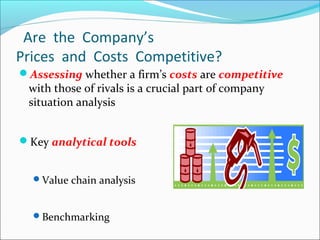
Assessing whether a firm’s costs are competitive
with those of rivals is a crucial part of company
situation analysis
Key analytical tools
Value chain analysis
Benchmarking
Are the Company’s
Prices and Costs Competitive?
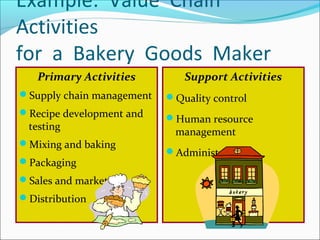
Example: Value Chain
Activities
for a Bakery Goods Maker
Primary Activities
Supply chain management
Recipe development and
testing
Mixing and baking
Packaging
Sales and marketing
Distribution
Support Activities
Quality control
Human resource
management
Administration
Example: Value Chain Activities
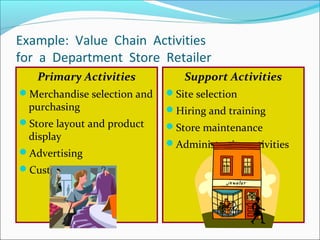
for a Department Store Retailer
Primary Activities
Merchandise selection and
purchasing
Store layout and product
display
Advertising
Customer service
Support Activities
Site selection
Hiring and training
Store maintenance
Administrative activities
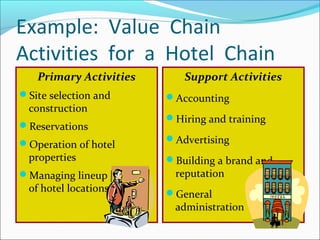
Example: Value Chain
Activities for a Hotel Chain
Primary Activities
Site selection and
construction
Reservations
Operation of hotel
properties
Managing lineup
of hotel locations
Support Activities
Accounting
Hiring and training
Advertising
Building a brand and
reputation
General
administration
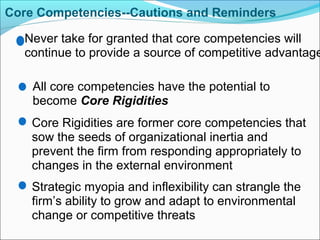
Core Competencies--Cautions and Reminders
Never take for granted that core competencies will
continue to provide a source of competitive advantage
All core competencies have the potential to
become Core Rigidities
Core Rigidities are former core competencies that
sow the seeds of organizational inertia and
prevent the firm from responding appropriately to
changes in the external environment
Strategic myopia and inflexibility can strangle the
firm’s ability to grow and adapt to environmental
change or competitive threats
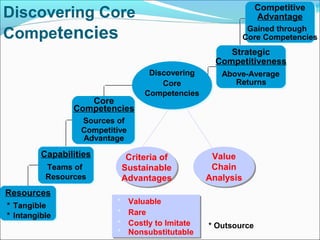
Resources
* Tangible
* Intangible
Capabilities
Teams of
Resources
Sources of
Core
Competencies
Competitive
Advantage
Strategic
Competitiveness
Above-Average
Returns
Competitive
Advantage
Gained through
Core Competencies
Discovering
Core
Competencies
Value
Chain
Analysis
Valuable
Rare
Costly to Imitate
Nonsubstitutable
*
*
*
*
* Outsource
Criteria of
Sustainable
Advantages
Discovering Core
Competencies

Environment analysis

  • 2.
    External Environment What theFirm Might Do Internal Environment What the Firm Can Do SustainableSustainable CompetitiveCompetitive AdvantageAdvantage
  • 3.
  • 4.
    Why SWOT Analysis? Itis an easy-to-use tool for developing an overview of a company’s strategic situation It forms a basis for matching your company’s strategy to its situation
  • 5.
    S W OTS W O T analysis involves more than just developing the 4 lists of strengths, weaknesses, opportunities, and threats The most important part of S W O TS W O T analysis is Using the 4 lists to draw conclusions about a company’s overall situation Acting on the conclusions to  Better match a company’s strategy to its resource strengths and market opportunities  Correct the important weaknesses Role of SWOT Analysis in Crafting a Better Strategy
  • 7.
    Strengths A STRENGTH issomething a company is good at doing or a characteristic that gives it an important capability. Possible Strengths: Name recognition Proprietary technology Cost advantages Skilled employees Loyal Customers
  • 8.
    A strength issomething a firm does well or an attribute that enhances its competitiveness Valuable skills, competencies, or capabilities Valuable physical assets Valuable human assets Valuable organizational assets Valuable intangible assets Important competitive capabilities An attribute placing a company in a position of market advantage(Group exercise to identify such attributes) Alliances or cooperative ventures with partnersResource strengths and competitive capabilities are competitive assets! Identifying Resource Strengths and Competitive Capabilities
  • 9.
    Weaknesses A WEAKNESS issomething a company lacks or does poorly (in comparison to others) or a condition that places it at a disadvantage Possible Weaknesses: Poor market image Obsolete facilities Internal operating problems Poor marketing skills
  • 10.
    Identifying Resource Weaknesses andCompetitive Deficiencies A weakness is something a firm lacks, does poorly, or a condition placing it at a disadvantage Resource weaknesses relate to Inferior or unproven skills, expertise, or intellectual capital Lack of important physical, organizational, or intangible assets Missing capabilities in key areas Resource weaknesses and deficiencies are competitive liabilities!
  • 11.
    Strengths and Weaknessform a basis for INTERNAL analysis By examining strengths, you can discover untapped potential or identify distinct competencies that helped you succeed in the past. By examining weaknesses, you can identify gaps in performance, vulnerabilities, and erroneous assumptions about existing strategies.
  • 12.
    Qualitative assessment – Isthe strategy well- conceived? Covers all the elements of value chain? Internally consistent? Makes sense? Timely and in step with marketplace? Quantitative assessment – What are the results? Is company achieving its financial and strategic objectives? Is company an above- average industry performer? Approaches to Assess How Well the Present Strategy Is Working
  • 13.
    How Well Isthe Company’s Present Strategy Working? Must begin by understanding what the strategy is Identify competitive approach  Low-cost leadership  Differentiation  Focus on a particular market niche Determine competitive scope  Broad or narrow geographic market coverage?  In how many stages of industry’s production/distribution chain does the company operate? Examine recent strategic moves Identify functional strategies Key ConsiderationsKey Considerations
  • 14.
    Resources * Tangible * Intangible Capabilities Teamsof Resources Sources of Core Competencies Competitive Advantage Strategic Competitiveness Above-Average Returns Competitive Advantage Gained through Core Competencies Discovering Core Competencies Discovering Core Competencies Criteria of Sustainable Advantages Value Chain Analysis Valuable Rare Costly to Imitate Nonsubstitutable * * * * *
  • 15.
    Resources * Tangible * Intangible DiscoveringCore Competencies Are resources strengths and/or strategic assets ??
  • 16.
    What a firmhas to work with:What a firm has to work with: itsits assets,assets, including itsincluding its peoplepeople and the value of itsand the value of its brand namebrand name What a firmWhat a firm Has...Has...Resources
  • 17.
    Resources representResources representinputs into ainputs into a firm’s production process...firm’s production process... such as capital equipment, skillssuch as capital equipment, skills of employees, brand names,of employees, brand names, finances and talented managersfinances and talented managers What a firmWhat a firm HasHas...... What a firm has to work with:What a firm has to work with: its assets, including its people and theits assets, including its people and the value of its brand namevalue of its brand name Resources
  • 18.
    What a firmhas to work with:What a firm has to work with: its assets, including its people and theits assets, including its people and the value of its brand namevalue of its brand name Resources represent inputs into a firm’sResources represent inputs into a firm’s production process...production process... such as capital equipment, skills ofsuch as capital equipment, skills of employees, brand names, finances andemployees, brand names, finances and talented managerstalented managers ““Some genius invented the Oreo. We’reSome genius invented the Oreo. We’re just living off the inheritance.”just living off the inheritance.” F. Ross Johnson,F. Ross Johnson, Former President & CEO,Former President & CEO, RJR NabiscoRJR Nabisco What a firmWhat a firm HasHas......Resources
  • 19.
    Tangible Resources Financial* Physical* Human Resources* Organizational* Whata firm Has... What a firm has to work with: its assets, including its people and the value of its brand name Resources represent inputs into a firm’s production process... such as capital equipment, skills of employees, brand names, finances and talented managers Intangible Resources Technological* Innovation* Reputation* “Some genius invented the Oreo. We’re just living off the inheritance.” F. Ross Johnson, Former President & CEO, RJR Nabisco Resources
  • 20.
    Resources * Tangible * Intangible Capabilities Teamsof Resources Discovering Core Competencies Discussion-What are capabilities??
  • 21.
    What a firmDoes... Capabilities represent:Capabilities represent: the firm’s capacity or ability tothe firm’s capacity or ability to integrateintegrate individual firm’s resourcesindividual firm’s resources to achieve ato achieve a desired objective.desired objective. Capabilities
  • 22.
    What a firmDoes... Capabilities develop over time as a result of complex interactions that take advantage of the interrelationships between a firm’s tangible and intangible resources that are based on the development, transmission and exchange or sharing of information and knowledge as carried out by the firm's employees.(Discussion on examples ) Capabilities represent: the firm’s capacity or ability to integrate individual firm resources to achieve a desired objective. Capabilities
  • 23.
    What a firmDoes... Capabilities represent: the firm’s capacity or ability to integrate individual firm resources to achieve a desired objective. Capabilities develop over time as a result of complex interactions that take advantage of the interrelationships between a firm’s tangible and intangible resources that are based on the development, transmission and exchange or sharing of information and knowledge as carried out by the firm's employees. Capabilities become important when they areCapabilities become important when they are combined incombined in unique combinationsunique combinations which createwhich create core competencies which havecore competencies which have strategic valuestrategic value andand can lead tocan lead to competitive advantagecompetitive advantage.. Capabilities
  • 24.
    Resources * Tangible * Intangible Capabilities Teamsof Resources Discovering Core Competencies Sources of Core Competencies Competitive Advantage Discovering Core Competencies
  • 25.
    How do weassemble bundles of Resources,How do we assemble bundles of Resources, Capabilities and Core Competencies toCapabilities and Core Competencies to createcreate VALUEVALUE for customers?for customers? Will environmental changes make ourWill environmental changes make our core competencies obsolete?core competencies obsolete? And...And... Are substitutes available for our coreAre substitutes available for our core competencies?competencies? Are our core competencies easily imitated?Are our core competencies easily imitated? Key Questions for Managers in Internal Analysis
  • 26.
    What a firmDoes... that is Strategically Valuable “…“…are the essence of what makes anare the essence of what makes an organization unique in its ability to provideorganization unique in its ability to provide value to customers.”value to customers.” Leonard-Barton, Bowen, Clark, Holloway &Leonard-Barton, Bowen, Clark, Holloway & WheelwrightWheelwright McKinsey & Co. recommends identifying three toMcKinsey & Co. recommends identifying three to four competencies to use in framing strategicfour competencies to use in framing strategic actions.actions. Core Competencies
  • 27.
    Resources * Tangible * Intangible Capabilities Teamsof Resources Sources of Core Competencies Competitive Advantage Discovering Core Competencies Criteria of Sustainable Advantages Valuable Rare Costly to Imitate Non substitutable * * * * Discovering Core Competencies- Discussion * Outsource
  • 28.
    For a strategiccapability toFor a strategic capability to be a Core Competency, itbe a Core Competency, it must be:must be: Core Competencies Valuable Rare Costly to Imitate Nonsubstitutable What a firm Does... that is Strategically Valuable
  • 29.
    Core Competencies mustbe: Valuable Capabilities that help a firm to exploit opportunities to create value for customers or neutralise threats Nonsubstitutable Capabilities that do not have strategic equivalents, such as firm-specific knowledge or trust-based relationships What a firm Does... that is Strategically Valuable Core Competencies Rare Costly to Imitate Capabilities that other firms cannot develop easily, usually due to unique historical conditions, causal ambiguity or social complexity Capabilities that are possessed by few, if any, current or potential competitors
  • 30.
    Stem from skills,expertise, and experience usually representing an Accumulation of learning over time and Gradual buildup of real proficiency in performing an activity Involve deliberate efforts to develop the ability to do something, often entailing Selecting people with requisite knowledge and skills Upgrading or expanding individual abilities Molding work products of individuals into a cooperative effort to create organizational ability A conscious effort to create intellectual capital Company Competencies and Capabilities
  • 31.
    Core Competencies – AValuable Company Resource A competence becomes a core competence when the well-performed activity is central to a company’s competitiveness and profitability Often, a core competence is knowledge-based, residing in people, not in assets or a balance sheet A core competence is typically the result of cross- department collaboration A core competence gives a company a potentially valuable competitive capability and represents a definite competitive asset
  • 32.
    Examples: Core Competencies Expertisein integrating multiple technologies to create families of new products Know-how in creating operating systems for cost efficient supply chain management Speeding new/next-generation products to market Better after-sale service capability Skills in manufacturing a high quality product Capability to fill customer orders accurately and swiftly
  • 33.
    Examples: Distinctive Competencies Toyota Low-cost, high-quality manufacturingof motor vehicles Starbucks Innovative coffee drinks and store ambience
  • 34.
    Determining the Competitive Powerof a Company Resource To qualify as competitively valuable or to be the basis for sustainable competitive advantage, a “resource” must pass 4 tests: 1. Is the resource hard to copy? 2. Is the resource durable – does it have staying power? 3. Is the resource really competitively superior? 4. Can the resource be trumped by the different capabilities of rivals?
  • 35.
    A company’s businessconsists of all activities undertaken in designing, producing, marketing, delivering, and supporting its product or service All these activities that a company performs internally combine to form a value chain—so-called because the underlying intent of a company’s activities is to do things that ultimately create value for buyers The value chain contains two types of activities Primary activities (where most of the value for customers is created) Support activities that facilitate Concept: Company Value Chain
  • 36.
    Support Activities Primary Activities Value ChainAnalysis Identifying Resources and Capabilities That Can Add Value
  • 37.
    Support Activities Primary Activities InboundInbound LogisticsLogistics Value ChainAnalysis Identifying Resources and Capabilities That Can Add Value
  • 38.
  • 39.
  • 40.
  • 41.
  • 42.
  • 43.
  • 44.
    Support Activities Primary Activities Technological DevelopmentTechnologicalDevelopment ProcurementProcurement InboundInbound LogisticsLogistics OperationsOperations OutboundOutbound LogisticsLogistics MarketingMarketing &Sales&Sales ServiceService Human Resource ManagementHuman Resource Management Value Chain Analysis Identifying Resources and Capabilities That Can Add Value
  • 45.
    Support Activities Primary Activities Technological DevelopmentTechnologicalDevelopment Human Resource ManagementHuman Resource Management Firm InfrastructureFirm Infrastructure ProcurementProcurement InboundInbound LogisticsLogistics OperationsOperations OutboundOutbound LogisticsLogistics MarketingMarketing &Sales&Sales ServiceService Value Chain Analysis Identifying Resources and Capabilities That Can Add Value
  • 46.
    Support Activities Primary Activities Technological DevelopmentTechnologicalDevelopment Human Resource ManagementHuman Resource Management Firm InfrastructureFirm Infrastructure ProcurementProcurement InboundInbound LogisticsLogistics OperationsOperations OutboundOutbound LogisticsLogistics MarketingMarketing &Sales&Sales ServiceService M A R G IN M A R G IN M A R G IN M A R G IN Value Chain Analysis Identifying Resources and Capabilities That Can Add Value
  • 47.
    Assessing whether afirm’s costs are competitive with those of rivals is a crucial part of company situation analysis Key analytical tools Value chain analysis Benchmarking Are the Company’s Prices and Costs Competitive?
  • 48.
    Example: Value Chain Activities fora Bakery Goods Maker Primary Activities Supply chain management Recipe development and testing Mixing and baking Packaging Sales and marketing Distribution Support Activities Quality control Human resource management Administration
  • 49.
    Example: Value ChainActivities for a Department Store Retailer Primary Activities Merchandise selection and purchasing Store layout and product display Advertising Customer service Support Activities Site selection Hiring and training Store maintenance Administrative activities
  • 50.
    Example: Value Chain Activitiesfor a Hotel Chain Primary Activities Site selection and construction Reservations Operation of hotel properties Managing lineup of hotel locations Support Activities Accounting Hiring and training Advertising Building a brand and reputation General administration
  • 51.
    Core Competencies--Cautions andReminders Never take for granted that core competencies will continue to provide a source of competitive advantage All core competencies have the potential to become Core Rigidities Core Rigidities are former core competencies that sow the seeds of organizational inertia and prevent the firm from responding appropriately to changes in the external environment Strategic myopia and inflexibility can strangle the firm’s ability to grow and adapt to environmental change or competitive threats
  • 52.
    Resources * Tangible * Intangible Capabilities Teamsof Resources Sources of Core Competencies Competitive Advantage Strategic Competitiveness Above-Average Returns Competitive Advantage Gained through Core Competencies Discovering Core Competencies Value Chain Analysis Valuable Rare Costly to Imitate Nonsubstitutable * * * * * Outsource Criteria of Sustainable Advantages Discovering Core Competencies