1
McGraw-Hill/Irwin © 2003 The McGraw-Hill Companies, Inc., All Rights Reserved.
EVALUATING COMPANY
RESOURCES AND
COMPETITIVE
CAPABILITIES
CHAPTER 4
Screen graphics created by:
Jana F. Kuzmicki, PhD, Mississippi University for Women
2
McGraw-Hill/Irwin © 2003 The McGraw-Hill Companies, Inc., All Rights Reserved.
What is the Strategy?
 Identify competitive approach
 Low-cost leadership
 Differentiation
 Focus on a particular market niche
 Determine competitive scope
 Stages of industry’s production/distribution
chain
 Geographic coverage
 Customer base
 Identify functional strategies
 Examine recent strategic moves
3
McGraw-Hill/Irwin © 2003 The McGraw-Hill Companies, Inc., All Rights Reserved.
Key Indicators of How Well
the Strategy is Working
 Trend in sales and market share
 Acquiring and/or retaining customers
 Trend in profit margins
 Trend in net profits, ROI, and EVA
 Overall financial strength and credit ranking
 Efforts at continuous improvement activities
 Trend in stock price and stockholder value
 Image and reputation with customers
 Leadership role(s) -- technology, quality,
innovation, e-commerce, etc.
4
McGraw-Hill/Irwin © 2003 The McGraw-Hill Companies, Inc., All Rights Reserved.
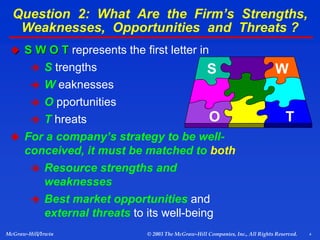
Question 2: What Are the Firm’s Strengths,
Weaknesses, Opportunities and Threats ?
 S W O T represents the first letter in
 S trengths
 W eaknesses
 O pportunities
 T hreats
 For a company’s strategy to be well-
conceived, it must be matched to both
 Resource strengths and
weaknesses
 Best market opportunities and
external threats to its well-being
S W
O T
5
McGraw-Hill/Irwin © 2003 The McGraw-Hill Companies, Inc., All Rights Reserved.
Identifying Resource Strengths
and Competitive Capabilities
 A strength is something a firm does well or a characteristic
that enhances its competitiveness
 Valuable competencies or know-how
 Valuable physical assets
 Valuable human assets
 Valuable organizational assets
 Valuable intangible assets
 Important competitive capabilities
 An attribute that places a company in
a position of market advantage
 Alliances or cooperative ventures with capable partners
Resource strengths and competitive capabilities are
competitive assets !
6
McGraw-Hill/Irwin © 2003 The McGraw-Hill Companies, Inc., All Rights Reserved.
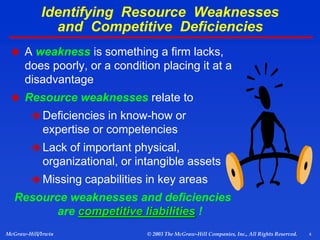
Identifying Resource Weaknesses
and Competitive Deficiencies
 A weakness is something a firm lacks,
does poorly, or a condition placing it at a
disadvantage
 Resource weaknesses relate to
 Deficiencies in know-how or
expertise or competencies
 Lack of important physical,
organizational, or intangible assets
 Missing capabilities in key areas
Resource weaknesses and deficiencies
are competitive liabilities !
7
McGraw-Hill/Irwin © 2003 The McGraw-Hill Companies, Inc., All Rights Reserved.
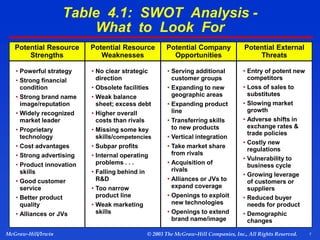
Table 4.1: SWOT Analysis -
What to Look For
Potential Resource
Strengths
Potential Resource
Weaknesses
Potential Company
Opportunities
Potential External
Threats
• Powerful strategy
• Strong financial
condition
• Strong brand name
image/reputation
• Widely recognized
market leader
• Proprietary
technology
• Cost advantages
• Strong advertising
• Product innovation
skills
• Good customer
service
• Better product
quality
• Alliances or JVs
• No clear strategic
direction
• Obsolete facilities
• Weak balance
sheet; excess debt
• Higher overall
costs than rivals
• Missing some key
skills/competencies
• Subpar profits
• Internal operating
problems . . .
• Falling behind in
R&D
• Too narrow
product line
• Weak marketing
skills
• Serving additional
customer groups
• Expanding to new
geographic areas
• Expanding product
line
• Transferring skills
to new products
• Vertical integration
• Take market share
from rivals
• Acquisition of
rivals
• Alliances or JVs to
expand coverage
• Openings to exploit
new technologies
• Openings to extend
brand name/image
• Entry of potent new
competitors
• Loss of sales to
substitutes
• Slowing market
growth
• Adverse shifts in
exchange rates &
trade policies
• Costly new
regulations
• Vulnerability to
business cycle
• Growing leverage
of customers or
suppliers
• Reduced buyer
needs for product
• Demographic
changes
8
McGraw-Hill/Irwin © 2003 The McGraw-Hill Companies, Inc., All Rights Reserved.
Competencies vs. Core Competencies
vs. Distinctive Competencies
 A company competence is the product of
organizational learning and experience and
represents real proficiency in performing an internal
activity
 A core competence is a well-performed internal
activity that is central (not peripheral or incidental) to a
company’s competitiveness and profitability
 A distinctive competence is a competitively
valuable activity that a company performs better
than its rivals
9
McGraw-Hill/Irwin © 2003 The McGraw-Hill Companies, Inc., All Rights Reserved.
Company Competencies and Capabilities
 Stem from skills, expertise, and experience
usually representing an
 Accumulation of learning over time and
 Gradual buildup of real proficiency in
performing an activity
 Involve deliberate efforts to develop the ability to do
something, often entailing
 Selection of people with requisite knowledge and
expertise
 Upgrading or expanding individual abilities
 Molding work products of individuals into a cooperative
effort to create organizational ability
 A conscious effort to create intellectual capital
10
McGraw-Hill/Irwin © 2003 The McGraw-Hill Companies, Inc., All Rights Reserved.
Core Competencies: A
Valuable Company Resource
 A competence becomes a core competence when
the well-performed activity is central to the
company’s competitiveness and profitability
 Often, a core competence results
from collaboration among different
parts of an organization
 Typically, core competencies
reside in a company’s people, not in
assets on the balance sheet
 A core competence gives a company a potentially
valuable competitive capability and represents a
definite competitive asset
11
McGraw-Hill/Irwin © 2003 The McGraw-Hill Companies, Inc., All Rights Reserved.
Distinctive Competence -- A
Competitively Superior Resource
# 1
 A distinctive competence is a competitively
significant activity that a company performs better
than its competitors
 A distinctive competence
Represents a competitively
valuable capability rivals do not have
Presents attractive potential for
being a cornerstone of strategy
Can provide a competitive edge in the
marketplace—because it represents a
competitively superior resource strength
12
McGraw-Hill/Irwin © 2003 The McGraw-Hill Companies, Inc., All Rights Reserved.
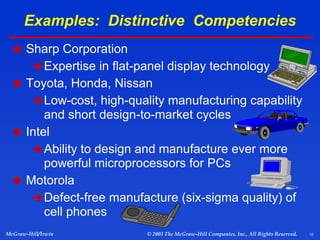
Examples: Distinctive Competencies
 Sharp Corporation
Expertise in flat-panel display technology
 Toyota, Honda, Nissan
Low-cost, high-quality manufacturing capability
and short design-to-market cycles
 Intel
Ability to design and manufacture ever more
powerful microprocessors for PCs
 Motorola
Defect-free manufacture (six-sigma quality) of
cell phones
13
McGraw-Hill/Irwin © 2003 The McGraw-Hill Companies, Inc., All Rights Reserved.
Determining the Competitive
Value of a Company Resource
 To qualify as the basis for sustainable
competitive advantage, a “resource” must
pass 4 tests
1. Is the resource hard to copy ?
2. Does the resource have staying power --
is it durable ?
3. Is the resource really competitively
superior ?
4. Can the resource be trumped by the
different capabilities of rivals ?
14
McGraw-Hill/Irwin © 2003 The McGraw-Hill Companies, Inc., All Rights Reserved.
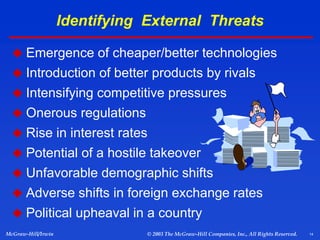
Identifying External Threats
 Emergence of cheaper/better technologies
 Introduction of better products by rivals
 Intensifying competitive pressures
 Onerous regulations
 Rise in interest rates
 Potential of a hostile takeover
 Unfavorable demographic shifts
 Adverse shifts in foreign exchange rates
 Political upheaval in a country
15
McGraw-Hill/Irwin © 2003 The McGraw-Hill Companies, Inc., All Rights Reserved.
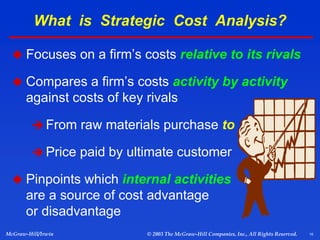
What is Strategic Cost Analysis?
 Focuses on a firm’s costs relative to its rivals
 Compares a firm’s costs activity by activity
against costs of key rivals
 From raw materials purchase to
 Price paid by ultimate customer
 Pinpoints which internal activities
are a source of cost advantage
or disadvantage
16
McGraw-Hill/Irwin © 2003 The McGraw-Hill Companies, Inc., All Rights Reserved.
Correcting Supplier-Related Cost
Disadvantages: Options
 Negotiate more favorable prices with suppliers
 Work with suppliers to help them achieve lower
costs
 Use lower-priced substitute inputs
 Collaborate closely with suppliers to identify
mutual cost-saving opportunities
 Integrate backwards
 Make up difference by initiating cost savings in
other areas of value chain
17
McGraw-Hill/Irwin © 2003 The McGraw-Hill Companies, Inc., All Rights Reserved.
Correcting Forward Channel Cost
Disadvantages: Options
 Push for more favorable terms with distributors
and other forward channel allies
 Work closely with forward channel allies and
customers to identify win-win opportunities to
reduce costs
 Change to a more economical distribution
strategy
 Make up difference by initiating cost savings
earlier in value chain
18
McGraw-Hill/Irwin © 2003 The McGraw-Hill Companies, Inc., All Rights Reserved.
Correcting Internal Cost
Disadvantages: Options
 Reengineer how the high-cost activities or business
processes are performed
 Eliminate some cost-producing activities altogether
by revamping value chain system
 Relocate high-cost activities to lower-cost geographic
areas
 See if high-cost activities can be performed cheaper
by outside vendors/suppliers
 Invest in cost-saving technology
 Simplify product design
 Make up difference by achieving savings in backward
or forward portions of value chain system

strm04.ppt

  • 1.
    1 McGraw-Hill/Irwin © 2003The McGraw-Hill Companies, Inc., All Rights Reserved. EVALUATING COMPANY RESOURCES AND COMPETITIVE CAPABILITIES CHAPTER 4 Screen graphics created by: Jana F. Kuzmicki, PhD, Mississippi University for Women
  • 2.
    2 McGraw-Hill/Irwin © 2003The McGraw-Hill Companies, Inc., All Rights Reserved. What is the Strategy?  Identify competitive approach  Low-cost leadership  Differentiation  Focus on a particular market niche  Determine competitive scope  Stages of industry’s production/distribution chain  Geographic coverage  Customer base  Identify functional strategies  Examine recent strategic moves
  • 3.
    3 McGraw-Hill/Irwin © 2003The McGraw-Hill Companies, Inc., All Rights Reserved. Key Indicators of How Well the Strategy is Working  Trend in sales and market share  Acquiring and/or retaining customers  Trend in profit margins  Trend in net profits, ROI, and EVA  Overall financial strength and credit ranking  Efforts at continuous improvement activities  Trend in stock price and stockholder value  Image and reputation with customers  Leadership role(s) -- technology, quality, innovation, e-commerce, etc.
  • 4.
    4 McGraw-Hill/Irwin © 2003The McGraw-Hill Companies, Inc., All Rights Reserved. Question 2: What Are the Firm’s Strengths, Weaknesses, Opportunities and Threats ?  S W O T represents the first letter in  S trengths  W eaknesses  O pportunities  T hreats  For a company’s strategy to be well- conceived, it must be matched to both  Resource strengths and weaknesses  Best market opportunities and external threats to its well-being S W O T
  • 5.
    5 McGraw-Hill/Irwin © 2003The McGraw-Hill Companies, Inc., All Rights Reserved. Identifying Resource Strengths and Competitive Capabilities  A strength is something a firm does well or a characteristic that enhances its competitiveness  Valuable competencies or know-how  Valuable physical assets  Valuable human assets  Valuable organizational assets  Valuable intangible assets  Important competitive capabilities  An attribute that places a company in a position of market advantage  Alliances or cooperative ventures with capable partners Resource strengths and competitive capabilities are competitive assets !
  • 6.
    6 McGraw-Hill/Irwin © 2003The McGraw-Hill Companies, Inc., All Rights Reserved. Identifying Resource Weaknesses and Competitive Deficiencies  A weakness is something a firm lacks, does poorly, or a condition placing it at a disadvantage  Resource weaknesses relate to  Deficiencies in know-how or expertise or competencies  Lack of important physical, organizational, or intangible assets  Missing capabilities in key areas Resource weaknesses and deficiencies are competitive liabilities !
  • 7.
    7 McGraw-Hill/Irwin © 2003The McGraw-Hill Companies, Inc., All Rights Reserved. Table 4.1: SWOT Analysis - What to Look For Potential Resource Strengths Potential Resource Weaknesses Potential Company Opportunities Potential External Threats • Powerful strategy • Strong financial condition • Strong brand name image/reputation • Widely recognized market leader • Proprietary technology • Cost advantages • Strong advertising • Product innovation skills • Good customer service • Better product quality • Alliances or JVs • No clear strategic direction • Obsolete facilities • Weak balance sheet; excess debt • Higher overall costs than rivals • Missing some key skills/competencies • Subpar profits • Internal operating problems . . . • Falling behind in R&D • Too narrow product line • Weak marketing skills • Serving additional customer groups • Expanding to new geographic areas • Expanding product line • Transferring skills to new products • Vertical integration • Take market share from rivals • Acquisition of rivals • Alliances or JVs to expand coverage • Openings to exploit new technologies • Openings to extend brand name/image • Entry of potent new competitors • Loss of sales to substitutes • Slowing market growth • Adverse shifts in exchange rates & trade policies • Costly new regulations • Vulnerability to business cycle • Growing leverage of customers or suppliers • Reduced buyer needs for product • Demographic changes
  • 8.
    8 McGraw-Hill/Irwin © 2003The McGraw-Hill Companies, Inc., All Rights Reserved. Competencies vs. Core Competencies vs. Distinctive Competencies  A company competence is the product of organizational learning and experience and represents real proficiency in performing an internal activity  A core competence is a well-performed internal activity that is central (not peripheral or incidental) to a company’s competitiveness and profitability  A distinctive competence is a competitively valuable activity that a company performs better than its rivals
  • 9.
    9 McGraw-Hill/Irwin © 2003The McGraw-Hill Companies, Inc., All Rights Reserved. Company Competencies and Capabilities  Stem from skills, expertise, and experience usually representing an  Accumulation of learning over time and  Gradual buildup of real proficiency in performing an activity  Involve deliberate efforts to develop the ability to do something, often entailing  Selection of people with requisite knowledge and expertise  Upgrading or expanding individual abilities  Molding work products of individuals into a cooperative effort to create organizational ability  A conscious effort to create intellectual capital
  • 10.
    10 McGraw-Hill/Irwin © 2003The McGraw-Hill Companies, Inc., All Rights Reserved. Core Competencies: A Valuable Company Resource  A competence becomes a core competence when the well-performed activity is central to the company’s competitiveness and profitability  Often, a core competence results from collaboration among different parts of an organization  Typically, core competencies reside in a company’s people, not in assets on the balance sheet  A core competence gives a company a potentially valuable competitive capability and represents a definite competitive asset
  • 11.
    11 McGraw-Hill/Irwin © 2003The McGraw-Hill Companies, Inc., All Rights Reserved. Distinctive Competence -- A Competitively Superior Resource # 1  A distinctive competence is a competitively significant activity that a company performs better than its competitors  A distinctive competence Represents a competitively valuable capability rivals do not have Presents attractive potential for being a cornerstone of strategy Can provide a competitive edge in the marketplace—because it represents a competitively superior resource strength
  • 12.
    12 McGraw-Hill/Irwin © 2003The McGraw-Hill Companies, Inc., All Rights Reserved. Examples: Distinctive Competencies  Sharp Corporation Expertise in flat-panel display technology  Toyota, Honda, Nissan Low-cost, high-quality manufacturing capability and short design-to-market cycles  Intel Ability to design and manufacture ever more powerful microprocessors for PCs  Motorola Defect-free manufacture (six-sigma quality) of cell phones
  • 13.
    13 McGraw-Hill/Irwin © 2003The McGraw-Hill Companies, Inc., All Rights Reserved. Determining the Competitive Value of a Company Resource  To qualify as the basis for sustainable competitive advantage, a “resource” must pass 4 tests 1. Is the resource hard to copy ? 2. Does the resource have staying power -- is it durable ? 3. Is the resource really competitively superior ? 4. Can the resource be trumped by the different capabilities of rivals ?
  • 14.
    14 McGraw-Hill/Irwin © 2003The McGraw-Hill Companies, Inc., All Rights Reserved. Identifying External Threats  Emergence of cheaper/better technologies  Introduction of better products by rivals  Intensifying competitive pressures  Onerous regulations  Rise in interest rates  Potential of a hostile takeover  Unfavorable demographic shifts  Adverse shifts in foreign exchange rates  Political upheaval in a country
  • 15.
    15 McGraw-Hill/Irwin © 2003The McGraw-Hill Companies, Inc., All Rights Reserved. What is Strategic Cost Analysis?  Focuses on a firm’s costs relative to its rivals  Compares a firm’s costs activity by activity against costs of key rivals  From raw materials purchase to  Price paid by ultimate customer  Pinpoints which internal activities are a source of cost advantage or disadvantage
  • 16.
    16 McGraw-Hill/Irwin © 2003The McGraw-Hill Companies, Inc., All Rights Reserved. Correcting Supplier-Related Cost Disadvantages: Options  Negotiate more favorable prices with suppliers  Work with suppliers to help them achieve lower costs  Use lower-priced substitute inputs  Collaborate closely with suppliers to identify mutual cost-saving opportunities  Integrate backwards  Make up difference by initiating cost savings in other areas of value chain
  • 17.
    17 McGraw-Hill/Irwin © 2003The McGraw-Hill Companies, Inc., All Rights Reserved. Correcting Forward Channel Cost Disadvantages: Options  Push for more favorable terms with distributors and other forward channel allies  Work closely with forward channel allies and customers to identify win-win opportunities to reduce costs  Change to a more economical distribution strategy  Make up difference by initiating cost savings earlier in value chain
  • 18.
    18 McGraw-Hill/Irwin © 2003The McGraw-Hill Companies, Inc., All Rights Reserved. Correcting Internal Cost Disadvantages: Options  Reengineer how the high-cost activities or business processes are performed  Eliminate some cost-producing activities altogether by revamping value chain system  Relocate high-cost activities to lower-cost geographic areas  See if high-cost activities can be performed cheaper by outside vendors/suppliers  Invest in cost-saving technology  Simplify product design  Make up difference by achieving savings in backward or forward portions of value chain system