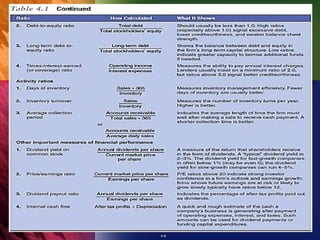
4

                            Evaluating a
                             Company’s
                             Chapter Title
                           Resources and
                            Competitive
                               Position
                      Screen graphics created by:
15/e PPT                Jana F. Kuzmicki, Ph.D.
                     Troy University-Florida Region

 McGraw-Hill/Irwin          © 2007 The McGraw-Hill Companies, Inc. All rights reserved.
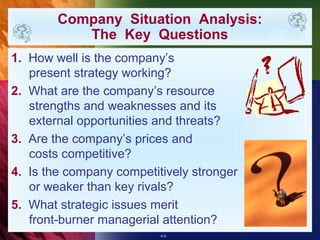
Company Situation Analysis:
           The Key Questions
1. How well is the company’s
   present strategy working?
2. What are the company’s resource
   strengths and weaknesses and its
   external opportunities and threats?
3. Are the company’s prices and
   costs competitive?
4. Is the company competitively stronger
   or weaker than key rivals?
5. What strategic issues merit
   front-burner managerial attention?
                          4-2
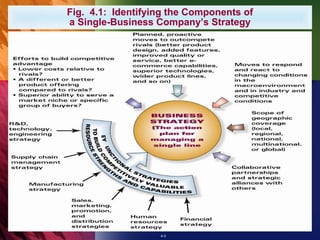
Fig. 4.1: Identifying the Components of
a Single-Business Company’s Strategy


                   4-3
Question 1: How Well Is the Company’s
           Present Strategy Working?
              Key Considerations
 Must begin by understanding what the strategy is
     Identify competitive approach
         Low-cost leadership
         Differentiation
         Focus on a particular market niche
     Determine competitive scope
         Broad or narrow geographic market coverage?
         In how many stages of industry’s production/distribution
          chain does the company operate?
     Examine recent strategic moves
     Identify functional strategies
                                  4-4
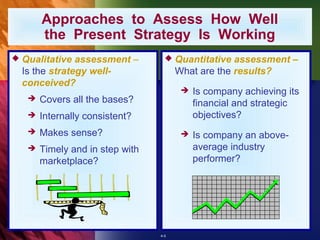
Approaches to Assess How Well
         the Present Strategy Is Working
   Qualitative assessment –            Quantitative assessment –
    Is the strategy well-                What are the results?
    conceived?
                                             Is company achieving its
        Covers all the bases?                financial and strategic
        Internally consistent?               objectives?
        Makes sense?                        Is company an above-
        Timely and in step with              average industry
         marketplace?                         performer?


                                   4-5
Key Indicators of How Well
             the Strategy Is Working
 Trend     in sales and market share
 Acquiring    and/or retaining customers
 Trend     in profit margins
 Trend     in net profits, ROI, and EVA
 Overall    financial strength and credit ranking
 Efforts   at continuous improvement activities
 Trend     in stock price and stockholder value
 Image     and reputation with customers
 Leadership  role(s) – Technology, quality,
  innovation, e-commerce, etc.
                                4-6
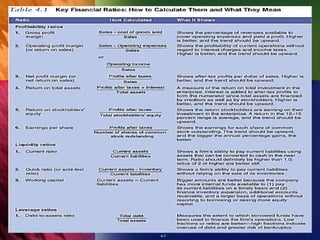
4-7
4-8
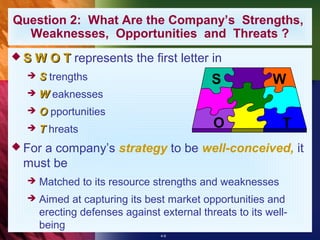
Question 2: What Are the Company’s Strengths,
  Weaknesses, Opportunities and Threats ?
 S W O T represents       the first letter in
     S trengths                            S            W
     W eaknesses
     O pportunities
     T hreats                              O              T
 For
    a company’s strategy to be well-conceived, it
 must be
     Matched to its resource strengths and weaknesses
     Aimed at capturing its best market opportunities and
      erecting defenses against external threats to its well-
      being
                                4-9
Identifying Resource Strengths
         and Competitive Capabilities
A strength is something a firm does well or an attribute
 that enhances its competitiveness
    Valuable skills, competencies, or capabilities
    Valuable physical assets
    Valuable human assets
    Valuable organizational assets
    Valuable intangible assets
    Important competitive capabilities
    An attribute placing a company in a position of market
     advantage
    Alliances or cooperative ventures with partners

         Resource strengths and competitive
         capabilities are competitive assets!
                                4-10
Competencies vs. Core Competencies vs.
       Distinctive Competencies
A competence is the product of organizational
 learning and experience and represents real
 proficiency in performing an internal activity

A  core competence is a well-performed
 internal activity central (not peripheral or incidental)
 to a company’s competitiveness
 and profitability

A distinctive competence is a competitively
 valuable activity a company performs better
 than its rivals
                           4-11
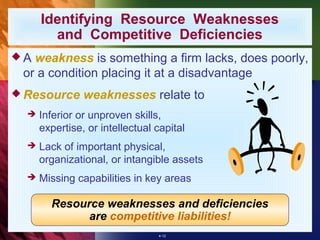
Identifying Resource Weaknesses
        and Competitive Deficiencies
A weakness is something a firm lacks, does poorly,
 or a condition placing it at a disadvantage
 Resource      weaknesses relate to
     Inferior or unproven skills,
      expertise, or intellectual capital
     Lack of important physical,
      organizational, or intangible assets
     Missing capabilities in key areas

        Resource weaknesses and deficiencies
              are competitive liabilities!
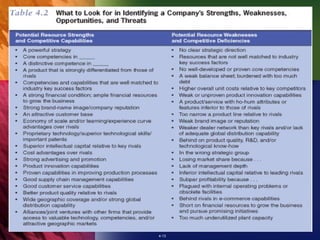
                                 4-12
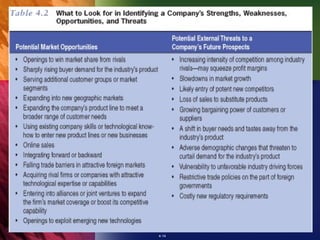
4-13
4-14
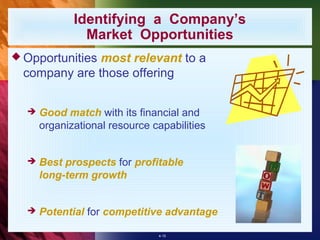
Identifying a Company’s
               Market Opportunities
 Opportunitiesmost relevant to a
  company are those offering


     Good match with its financial and
      organizational resource capabilities


     Best prospects for profitable
      long-term growth


     Potential for competitive advantage

                               4-15
Identifying External Threats

 Emergence      of cheaper/better technologies
 Introduction   of better products by rivals
 Entry   of lower-cost foreign competitors
 Onerous     regulations
 Rise   in interest rates
 Potential   of a hostile takeover
 Unfavorable     demographic shifts
 Adverse     shifts in foreign exchange rates
 Political   upheaval in a country
                              4-16
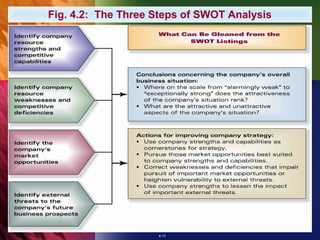
Fig. 4.2: The Three Steps of SWOT Analysis


                    4-17
Question 3: Are the Company’s
        Prices and Costs Competitive?

 Assessing  whether a firm’s costs are competitive
 with those of rivals is a crucial part of company
 situation analysis


 Key   analytical tools


     Value chain analysis


     Benchmarking
                             4-18
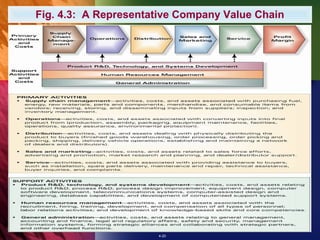
Concept: Company Value Chain
   A company’s business consists of all activities
    undertaken in designing, producing, marketing, delivering,
    and supporting its product or service
   All these activities that a company performs internally
    combine to form a value chain—so-called because the
    underlying intent of a company’s activities is to do things
    that ultimately create value for buyers
   The value chain contains two types of activities
       Primary activities (where most of
        the value for customers is created)
       Support activities that facilitate
        performance of the primary activities
                                    4-19
Fig. 4.3: A Representative Company Value Chain


                      4-20
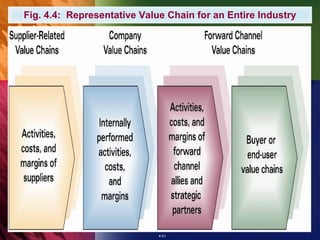
Fig. 4.4: Representative Value Chain for an Entire Industry


                             4-21
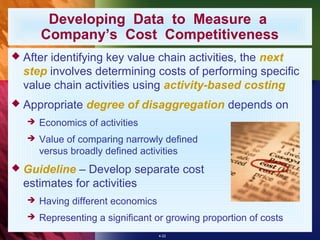
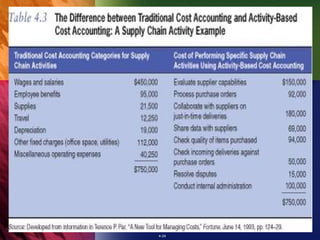
Developing Data to Measure a
       Company’s Cost Competitiveness
 Afteridentifying key value chain activities, the next
  step involves determining costs of performing specific
  value chain activities using activity-based costing
 Appropriate     degree of disaggregation depends on
      Economics of activities
      Value of comparing narrowly defined
       versus broadly defined activities
 Guideline  – Develop separate cost
  estimates for activities
      Having different economics
      Representing a significant or growing proportion of costs
                                    4-22
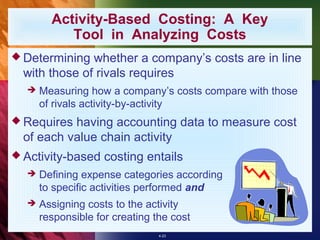
Activity-Based Costing: A Key
           Tool in Analyzing Costs
 Determining  whether a company’s costs are in line
  with those of rivals requires
     Measuring how a company’s costs compare with those
      of rivals activity-by-activity
 Requires having accounting data to measure cost
  of each value chain activity
 Activity-based    costing entails
     Defining expense categories according
      to specific activities performed and
     Assigning costs to the activity
      responsible for creating the cost
                                4-23
4-24
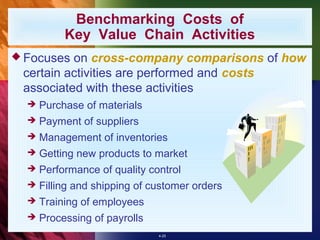
Benchmarking Costs of
           Key Value Chain Activities
 Focuses on cross-company comparisons of how
 certain activities are performed and costs
 associated with these activities
     Purchase of materials
     Payment of suppliers
     Management of inventories
     Getting new products to market
     Performance of quality control
     Filling and shipping of customer orders
     Training of employees
     Processing of payrolls
                               4-25
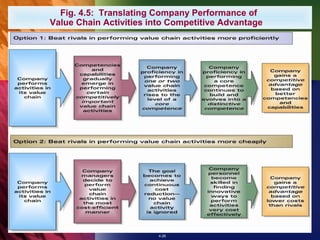
Fig. 4.5: Translating Company Performance of
Value Chain Activities into Competitive Advantage


                         4-26
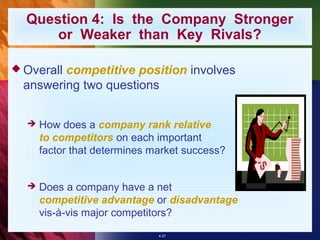
Question 4: Is the Company Stronger
      or Weaker than Key Rivals?

 Overallcompetitive position involves
  answering two questions


     How does a company rank relative
      to competitors on each important
      factor that determines market success?


     Does a company have a net
      competitive advantage or disadvantage
      vis-à-vis major competitors?
                              4-27
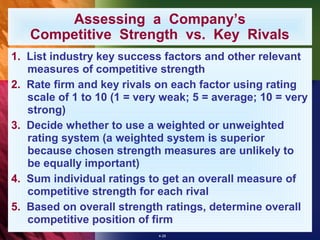
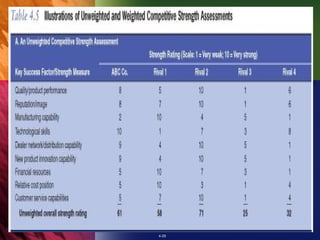
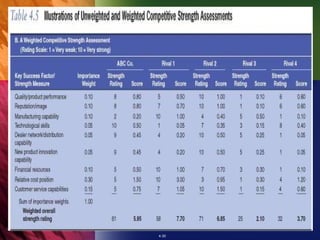
Assessing a Company’s
   Competitive Strength vs. Key Rivals
1. List industry key success factors and other relevant
   measures of competitive strength
2. Rate firm and key rivals on each factor using rating
   scale of 1 to 10 (1 = very weak; 5 = average; 10 = very
   strong)
3. Decide whether to use a weighted or unweighted
   rating system (a weighted system is superior
   because chosen strength measures are unlikely to
   be equally important)
4. Sum individual ratings to get an overall measure of
   competitive strength for each rival
5. Based on overall strength ratings, determine overall
   competitive position of firm
                            4-28
4-29
4-30
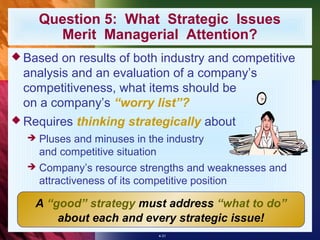
Question 5: What Strategic Issues
        Merit Managerial Attention?
 Based on results of both industry and competitive
 analysis and an evaluation of a company’s
 competitiveness, what items should be
 on a company’s “worry list”?
 Requires   thinking strategically about
     Pluses and minuses in the industry
      and competitive situation
     Company’s resource strengths and weaknesses and
      attractiveness of its competitive position

   A “good” strategy must address “what to do”
       about each and every strategic issue!
                              4-31

M5 evaluating and competitive position

  • 1.
    4 Evaluating a Company’s Chapter Title Resources and Competitive Position Screen graphics created by: 15/e PPT Jana F. Kuzmicki, Ph.D. Troy University-Florida Region McGraw-Hill/Irwin © 2007 The McGraw-Hill Companies, Inc. All rights reserved.
  • 2.
    Company Situation Analysis: The Key Questions 1. How well is the company’s present strategy working? 2. What are the company’s resource strengths and weaknesses and its external opportunities and threats? 3. Are the company’s prices and costs competitive? 4. Is the company competitively stronger or weaker than key rivals? 5. What strategic issues merit front-burner managerial attention? 4-2
  • 3.
    Fig. 4.1: Identifyingthe Components of a Single-Business Company’s Strategy 4-3
  • 4.
    Question 1: HowWell Is the Company’s Present Strategy Working? Key Considerations  Must begin by understanding what the strategy is  Identify competitive approach  Low-cost leadership  Differentiation  Focus on a particular market niche  Determine competitive scope  Broad or narrow geographic market coverage?  In how many stages of industry’s production/distribution chain does the company operate?  Examine recent strategic moves  Identify functional strategies 4-4
  • 5.
    Approaches to AssessHow Well the Present Strategy Is Working  Qualitative assessment –  Quantitative assessment – Is the strategy well- What are the results? conceived?  Is company achieving its  Covers all the bases? financial and strategic  Internally consistent? objectives?  Makes sense?  Is company an above-  Timely and in step with average industry marketplace? performer? 4-5
  • 6.
    Key Indicators ofHow Well the Strategy Is Working  Trend in sales and market share  Acquiring and/or retaining customers  Trend in profit margins  Trend in net profits, ROI, and EVA  Overall financial strength and credit ranking  Efforts at continuous improvement activities  Trend in stock price and stockholder value  Image and reputation with customers  Leadership role(s) – Technology, quality, innovation, e-commerce, etc. 4-6
  • 7.
  • 8.
  • 9.
    Question 2: WhatAre the Company’s Strengths, Weaknesses, Opportunities and Threats ?  S W O T represents the first letter in  S trengths S W  W eaknesses  O pportunities  T hreats O T  For a company’s strategy to be well-conceived, it must be  Matched to its resource strengths and weaknesses  Aimed at capturing its best market opportunities and erecting defenses against external threats to its well- being 4-9
  • 10.
    Identifying Resource Strengths and Competitive Capabilities A strength is something a firm does well or an attribute that enhances its competitiveness  Valuable skills, competencies, or capabilities  Valuable physical assets  Valuable human assets  Valuable organizational assets  Valuable intangible assets  Important competitive capabilities  An attribute placing a company in a position of market advantage  Alliances or cooperative ventures with partners Resource strengths and competitive capabilities are competitive assets! 4-10
  • 11.
    Competencies vs. CoreCompetencies vs. Distinctive Competencies A competence is the product of organizational learning and experience and represents real proficiency in performing an internal activity A core competence is a well-performed internal activity central (not peripheral or incidental) to a company’s competitiveness and profitability A distinctive competence is a competitively valuable activity a company performs better than its rivals 4-11
  • 12.
    Identifying Resource Weaknesses and Competitive Deficiencies A weakness is something a firm lacks, does poorly, or a condition placing it at a disadvantage  Resource weaknesses relate to  Inferior or unproven skills, expertise, or intellectual capital  Lack of important physical, organizational, or intangible assets  Missing capabilities in key areas Resource weaknesses and deficiencies are competitive liabilities! 4-12
  • 13.
  • 14.
  • 15.
    Identifying a Company’s Market Opportunities  Opportunitiesmost relevant to a company are those offering  Good match with its financial and organizational resource capabilities  Best prospects for profitable long-term growth  Potential for competitive advantage 4-15
  • 16.
    Identifying External Threats Emergence of cheaper/better technologies  Introduction of better products by rivals  Entry of lower-cost foreign competitors  Onerous regulations  Rise in interest rates  Potential of a hostile takeover  Unfavorable demographic shifts  Adverse shifts in foreign exchange rates  Political upheaval in a country 4-16
  • 17.
    Fig. 4.2: TheThree Steps of SWOT Analysis 4-17
  • 18.
    Question 3: Arethe Company’s Prices and Costs Competitive?  Assessing whether a firm’s costs are competitive with those of rivals is a crucial part of company situation analysis  Key analytical tools  Value chain analysis  Benchmarking 4-18
  • 19.
    Concept: Company ValueChain  A company’s business consists of all activities undertaken in designing, producing, marketing, delivering, and supporting its product or service  All these activities that a company performs internally combine to form a value chain—so-called because the underlying intent of a company’s activities is to do things that ultimately create value for buyers  The value chain contains two types of activities  Primary activities (where most of the value for customers is created)  Support activities that facilitate performance of the primary activities 4-19
  • 20.
    Fig. 4.3: ARepresentative Company Value Chain 4-20
  • 21.
    Fig. 4.4: RepresentativeValue Chain for an Entire Industry 4-21
  • 22.
    Developing Data toMeasure a Company’s Cost Competitiveness  Afteridentifying key value chain activities, the next step involves determining costs of performing specific value chain activities using activity-based costing  Appropriate degree of disaggregation depends on  Economics of activities  Value of comparing narrowly defined versus broadly defined activities  Guideline – Develop separate cost estimates for activities  Having different economics  Representing a significant or growing proportion of costs 4-22
  • 23.
    Activity-Based Costing: AKey Tool in Analyzing Costs  Determining whether a company’s costs are in line with those of rivals requires  Measuring how a company’s costs compare with those of rivals activity-by-activity  Requires having accounting data to measure cost of each value chain activity  Activity-based costing entails  Defining expense categories according to specific activities performed and  Assigning costs to the activity responsible for creating the cost 4-23
  • 24.
  • 25.
    Benchmarking Costs of Key Value Chain Activities  Focuses on cross-company comparisons of how certain activities are performed and costs associated with these activities  Purchase of materials  Payment of suppliers  Management of inventories  Getting new products to market  Performance of quality control  Filling and shipping of customer orders  Training of employees  Processing of payrolls 4-25
  • 26.
    Fig. 4.5: TranslatingCompany Performance of Value Chain Activities into Competitive Advantage 4-26
  • 27.
    Question 4: Isthe Company Stronger or Weaker than Key Rivals?  Overallcompetitive position involves answering two questions  How does a company rank relative to competitors on each important factor that determines market success?  Does a company have a net competitive advantage or disadvantage vis-à-vis major competitors? 4-27
  • 28.
    Assessing a Company’s Competitive Strength vs. Key Rivals 1. List industry key success factors and other relevant measures of competitive strength 2. Rate firm and key rivals on each factor using rating scale of 1 to 10 (1 = very weak; 5 = average; 10 = very strong) 3. Decide whether to use a weighted or unweighted rating system (a weighted system is superior because chosen strength measures are unlikely to be equally important) 4. Sum individual ratings to get an overall measure of competitive strength for each rival 5. Based on overall strength ratings, determine overall competitive position of firm 4-28
  • 29.
  • 30.
  • 31.
    Question 5: WhatStrategic Issues Merit Managerial Attention?  Based on results of both industry and competitive analysis and an evaluation of a company’s competitiveness, what items should be on a company’s “worry list”?  Requires thinking strategically about  Pluses and minuses in the industry and competitive situation  Company’s resource strengths and weaknesses and attractiveness of its competitive position A “good” strategy must address “what to do” about each and every strategic issue! 4-31