VALIDATION OF PHARMACEUTICAL
PROCESSES
Presented By..
Mr. Rahul S. Dalvi
M. Pharm. (SEM – I)
Dept. of Pharmaceutics
Guided By..
Dr. A. J. Shinde
Asso. Professor of
Pharmaceutics
BHARATI VIDYAPEETH
COLLEGE OF PHARMACY, KOLHAPUR
2015-2016
1
Date: 02/12/2015
Contents :
 Introduction
 Need of Validation
 Scope of Validation
 Documentation of Validation
 Validation Master Plan
 Types of Validation
 Process Validation
 Cleaning Validation
 Equipment Validation
 Validation of Analytical method
 Conclusion
 References
2
Introduction
 The concept of validation was first proposed by Food and Drug
Administration(FDA) officials, Ted Byers and Bud Loftus, in the
mid 1970s in order to improve the quality of pharmaceuticals.
 Validation is "Establishing documented evidence that provides a
high degree of assurance that a specific process will consistently
produce a product meeting its pre-determined specifications and
quality attributes.
 This is to maintain and assure a higher degree of quality of food
and drug products.
3
Need for validation
 Customer satisfaction
 Customer mandated
 Product liability
 Control production cost
 The development of the next generation
 Safety
4
Scope of validation
 Analytical Test Methods
 Instrument Calibrations
 Process Utility Services
 Raw Material
 Equipment
 Facilities
 Product Design
 Cleaning
 Operators
5
Documentation of Validation
The validation activity cannot be completed without proper
documentation of each and every minute activity with utmost details.
Documentation of validation is generally different types such as:
 Validation Master Plan(VMP)
 Validation Protocol(VP)
 Validation Reports(VR)
 Standard Operating Procedure(SOP)
6
Advantages :
It gives idea about future performed:
 What activities are to be performed?
 Who is going to perform these activities?
 When the activities should start and when
they should get over?
 What documents will be generated?
 What the policy on revalidation?
Validation master plan
7
V.M.P. includes..
 Premises
 Processes
 Products
 Format for protocol and other documentation
 List of relevant SOPs
 Planning and scheduling
 Location
 Estimation of staffing requirements
 A time plan of the project
8
Guidelines on Preparing V.M.P.
 V.M.P. write on A4 size paper.
 File in a presentable form.
 Have sufficient explanatory drawings.
 Clearly divide the V.M.P. in different form.
 It must be dated and signed properly by authorized
persons.
 If found any step inappropriate is discuss this the
F.D.A. people in advance.
9
Types of Validation
The major types of Validation :
 Process validation
 Cleaning validation
 Equipment validation
 Validation of analytical methods
10
Process validation
Definition
 As per FDA Nov.2008,‘The collection of data from the process
design stage throughout production,which establishes scientific
evidence that a process is capable of consistently delivering quality
products.
11
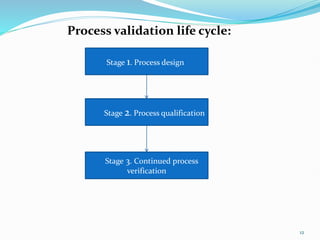
Process validation life cycle:
Stage 1. Process design
Stage 2. Process qualification
Stage 3. Continued process
verification
12
Types of Process validation:
 Prospective validation.
 Retrospective validation.
 Concurrent validation.
 Revalidation.
13
Process validation Flow chart:
14
Cleaning validation :
Definition: “A process of attaining and documenting sufficient
evidence to give reasonable assurance, given the current state of Science
and Technology, that the cleaning process under consideration does, and
/ or will do, what it purpoes to do.”
Objective..
 To minimize cross contamination.
 To determine efficiency of cleaning process.
 To do troubleshooting in case problem identified in the
cleaning process and give suggestions to improve the process.
15
Source of contamination:
 Cross contamination product of one product into another.
 Product contamination by a foreign material.
 Microbial contamination.
Cleaning methods:
 Manual cleaning method.
 Semi automated procedures.
 Fully automated procedures.
16
Factors Influencing Cleaning validation :
 Product.
 Equipment.
 Facilities.
 Cleaning methods.
 Cleaning agents.
 Sampling.
 Testing, Limits, and acceptance criteria.
17
Cleaning validation
Flow chart :
18
Equipment Validation
Definition
 As per FDA, May 1987,‘Action of proving that any equipment
works correctly and leads to the expected result is equipment
qualification.
 It is not a single step activity but instead result from many
discrete activities.
19
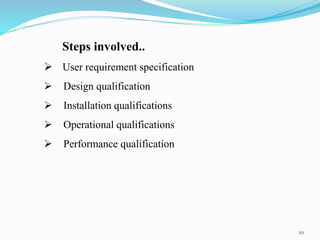
Steps involved..
 User requirement specification
 Design qualification
 Installation qualifications
 Operational qualifications
 Performance qualification
20
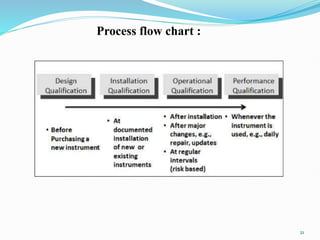
Process flow chart :
21
Validation of analytical methods
22
Definition : “The process by, which it is established, by laboratory studies, that
the performance characteristics of the method meet the requirements for the
intended analytical application”.
Accuracy :
“The closeness of test results obtained by that method to the true value. This
accuracy should be established across its range.”
Precision:
“The degree of agreement among individual test results when the method is
applied repeatedly to multiple sampling of a homogenous sample.”
23
Specificity :
“The ability to assess unequivocally the analyte in the presence of
components that may be expected to be present, such as impurities
degradation products and matrix components.”
Limit of Quantitation :
“A characteristic of quantitative assays for low levels of compounds in
sample matrices such as impurities in bulk substances and degradation
products in finished pharmaceuticals. It is the lowest amount of analyte in
a sample that can be determined with acceptable precision and accuracy
under the stated experimental conditions.”
24
Range :
“Interval between the upper and lower of analyte (including these levels) that
have been demonstrated to be determined with a suitable level of precision ,
accuracy and linearity using the method as written. The range is normally
expressed in the same units as test results. ( e.g. Percentage , parts per
million, etc.) obtained by the analytical method.”
Ruggedness:
The degree of reproducibility of test results obtained by the analysis of the
same sample under a variety of conditions such as different laboratories,
different analysts, different instruments , different lots of reagents, different
elapsed assay times, different assay temperatures, different days, etc.”
25
Robustness:
"A measure of its capacity to remain unaffected by small but deliberate
variations in method parameters and provides an indication of its reliability
during normal usage.”
Linearity :
“Its ability to elicit tests that are directly or by a well defined mathematical
transformations proportional to the concentration of analyte in samples
within a given range.”
Limit of Detection :
The lowest amount of analyte in a sample that can be detected but not
necessarily quantitated, under the stated experimental conditions.”
Conclusion
 Validation has been proven assurance for the process efficiency and
sturdiness and it is the full fledged quality attributing tool for the
pharmaceutical industries.
 Validation is the commonest word in the areas of drug development,
manufacturing and specification of finished products. It also renders
reduction in the cost linked with process monitoring, sampling and
testing.
 Apart from all the consistency and reliability of a validated process
to produce a quality product is the very important for an industry.
26
References
1. Fundamental of quality assurance techniques..by Ramesh Sawant and
Sandip Hapse,First edition Dec 2011, Career publications.
2. Pharmaceutical Quality Assurance..by Manohar Potdar,Second edition Dec
2007,Nirali Prakashan.
3. IJRPC 2011 ‘An overview of pharmaceutical validation: quality
assurance view point’ by Nandhakumar et al.
4. TJPR Review Article ‘An Overview of Pharmaceutical Validation and
Process Controls in Drug Development’ Elsie Jatto and Augustine
O.Okhamafe
27
28

pharmaceuticalvalidationppt-170316132324.pdf

  • 1.
    VALIDATION OF PHARMACEUTICAL PROCESSES PresentedBy.. Mr. Rahul S. Dalvi M. Pharm. (SEM – I) Dept. of Pharmaceutics Guided By.. Dr. A. J. Shinde Asso. Professor of Pharmaceutics BHARATI VIDYAPEETH COLLEGE OF PHARMACY, KOLHAPUR 2015-2016 1 Date: 02/12/2015
  • 2.
    Contents :  Introduction Need of Validation  Scope of Validation  Documentation of Validation  Validation Master Plan  Types of Validation  Process Validation  Cleaning Validation  Equipment Validation  Validation of Analytical method  Conclusion  References 2
  • 3.
    Introduction  The conceptof validation was first proposed by Food and Drug Administration(FDA) officials, Ted Byers and Bud Loftus, in the mid 1970s in order to improve the quality of pharmaceuticals.  Validation is "Establishing documented evidence that provides a high degree of assurance that a specific process will consistently produce a product meeting its pre-determined specifications and quality attributes.  This is to maintain and assure a higher degree of quality of food and drug products. 3
  • 4.
    Need for validation Customer satisfaction  Customer mandated  Product liability  Control production cost  The development of the next generation  Safety 4
  • 5.
    Scope of validation Analytical Test Methods  Instrument Calibrations  Process Utility Services  Raw Material  Equipment  Facilities  Product Design  Cleaning  Operators 5
  • 6.
    Documentation of Validation Thevalidation activity cannot be completed without proper documentation of each and every minute activity with utmost details. Documentation of validation is generally different types such as:  Validation Master Plan(VMP)  Validation Protocol(VP)  Validation Reports(VR)  Standard Operating Procedure(SOP) 6
  • 7.
    Advantages : It givesidea about future performed:  What activities are to be performed?  Who is going to perform these activities?  When the activities should start and when they should get over?  What documents will be generated?  What the policy on revalidation? Validation master plan 7
  • 8.
    V.M.P. includes..  Premises Processes  Products  Format for protocol and other documentation  List of relevant SOPs  Planning and scheduling  Location  Estimation of staffing requirements  A time plan of the project 8
  • 9.
    Guidelines on PreparingV.M.P.  V.M.P. write on A4 size paper.  File in a presentable form.  Have sufficient explanatory drawings.  Clearly divide the V.M.P. in different form.  It must be dated and signed properly by authorized persons.  If found any step inappropriate is discuss this the F.D.A. people in advance. 9
  • 10.
    Types of Validation Themajor types of Validation :  Process validation  Cleaning validation  Equipment validation  Validation of analytical methods 10
  • 11.
    Process validation Definition  Asper FDA Nov.2008,‘The collection of data from the process design stage throughout production,which establishes scientific evidence that a process is capable of consistently delivering quality products. 11
  • 12.
    Process validation lifecycle: Stage 1. Process design Stage 2. Process qualification Stage 3. Continued process verification 12
  • 13.
    Types of Processvalidation:  Prospective validation.  Retrospective validation.  Concurrent validation.  Revalidation. 13
  • 14.
  • 15.
    Cleaning validation : Definition:“A process of attaining and documenting sufficient evidence to give reasonable assurance, given the current state of Science and Technology, that the cleaning process under consideration does, and / or will do, what it purpoes to do.” Objective..  To minimize cross contamination.  To determine efficiency of cleaning process.  To do troubleshooting in case problem identified in the cleaning process and give suggestions to improve the process. 15
  • 16.
    Source of contamination: Cross contamination product of one product into another.  Product contamination by a foreign material.  Microbial contamination. Cleaning methods:  Manual cleaning method.  Semi automated procedures.  Fully automated procedures. 16
  • 17.
    Factors Influencing Cleaningvalidation :  Product.  Equipment.  Facilities.  Cleaning methods.  Cleaning agents.  Sampling.  Testing, Limits, and acceptance criteria. 17
  • 18.
  • 19.
    Equipment Validation Definition  Asper FDA, May 1987,‘Action of proving that any equipment works correctly and leads to the expected result is equipment qualification.  It is not a single step activity but instead result from many discrete activities. 19
  • 20.
    Steps involved..  Userrequirement specification  Design qualification  Installation qualifications  Operational qualifications  Performance qualification 20
  • 21.
  • 22.
    Validation of analyticalmethods 22 Definition : “The process by, which it is established, by laboratory studies, that the performance characteristics of the method meet the requirements for the intended analytical application”. Accuracy : “The closeness of test results obtained by that method to the true value. This accuracy should be established across its range.” Precision: “The degree of agreement among individual test results when the method is applied repeatedly to multiple sampling of a homogenous sample.”
  • 23.
    23 Specificity : “The abilityto assess unequivocally the analyte in the presence of components that may be expected to be present, such as impurities degradation products and matrix components.” Limit of Quantitation : “A characteristic of quantitative assays for low levels of compounds in sample matrices such as impurities in bulk substances and degradation products in finished pharmaceuticals. It is the lowest amount of analyte in a sample that can be determined with acceptable precision and accuracy under the stated experimental conditions.”
  • 24.
    24 Range : “Interval betweenthe upper and lower of analyte (including these levels) that have been demonstrated to be determined with a suitable level of precision , accuracy and linearity using the method as written. The range is normally expressed in the same units as test results. ( e.g. Percentage , parts per million, etc.) obtained by the analytical method.” Ruggedness: The degree of reproducibility of test results obtained by the analysis of the same sample under a variety of conditions such as different laboratories, different analysts, different instruments , different lots of reagents, different elapsed assay times, different assay temperatures, different days, etc.”
  • 25.
    25 Robustness: "A measure ofits capacity to remain unaffected by small but deliberate variations in method parameters and provides an indication of its reliability during normal usage.” Linearity : “Its ability to elicit tests that are directly or by a well defined mathematical transformations proportional to the concentration of analyte in samples within a given range.” Limit of Detection : The lowest amount of analyte in a sample that can be detected but not necessarily quantitated, under the stated experimental conditions.”
  • 26.
    Conclusion  Validation hasbeen proven assurance for the process efficiency and sturdiness and it is the full fledged quality attributing tool for the pharmaceutical industries.  Validation is the commonest word in the areas of drug development, manufacturing and specification of finished products. It also renders reduction in the cost linked with process monitoring, sampling and testing.  Apart from all the consistency and reliability of a validated process to produce a quality product is the very important for an industry. 26
  • 27.
    References 1. Fundamental ofquality assurance techniques..by Ramesh Sawant and Sandip Hapse,First edition Dec 2011, Career publications. 2. Pharmaceutical Quality Assurance..by Manohar Potdar,Second edition Dec 2007,Nirali Prakashan. 3. IJRPC 2011 ‘An overview of pharmaceutical validation: quality assurance view point’ by Nandhakumar et al. 4. TJPR Review Article ‘An Overview of Pharmaceutical Validation and Process Controls in Drug Development’ Elsie Jatto and Augustine O.Okhamafe 27
  • 28.