Validation of Analytical Methods
Introduction
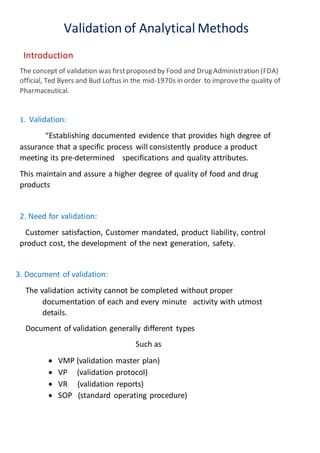
The concept of validation was firstproposed by Food and Drug Administration (FDA)
official, Ted Byers and Bud Loftus in the mid-1970s in order to improvethe quality of
Pharmaceutical.
1. Validation:
“Establishing documented evidence that provides high degree of
assurance that a specific process will consistently produce a product
meeting its pre-determined specifications and quality attributes.
This maintain and assure a higher degree of quality of food and drug
products
2. Need for validation:
Customer satisfaction, Customer mandated, product liability, control
product cost, the development of the next generation, safety.
3. Document of validation:
The validation activity cannot be completed without proper
documentation of each and every minute activity with utmost
details.
Document of validation generally different types
Such as
 VMP (validation master plan)
 VP (validation protocol)
 VR (validation reports)
 SOP (standard operating procedure)
Validation of Analytical Methods
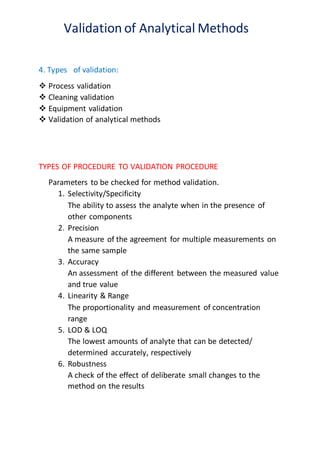
4. Types of validation:
 Process validation
 Cleaning validation
 Equipment validation
 Validation of analytical methods
TYPES OF PROCEDURE TO VALIDATION PROCEDURE
Parameters to be checked for method validation.
1. Selectivity/Specificity
The ability to assess the analyte when in the presence of
other components
2. Precision
A measure of the agreement for multiple measurements on
the same sample
3. Accuracy
An assessment of the different between the measured value
and true value
4. Linearity & Range
The proportionality and measurement of concentration
range
5. LOD & LOQ
The lowest amounts of analyte that can be detected/
determined accurately, respectively
6. Robustness
A check of the effect of deliberate small changes to the
method on the results
Validation of Analytical Methods
5.Conclusion
Validation has been proven assurance for the process efficiency
and sturdiness and its full-fledged quality attributing tool for the
pharmaceutical industries
Validation common word in the areas of drug development,
manufacture & specifications of finished products.
Presented by
Mr. VIGNYAN MACHIDI
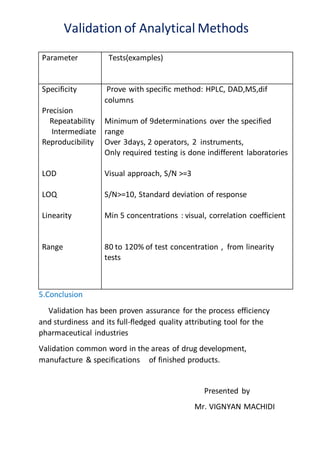
Parameter Tests(examples)
Specificity
Precision
Repeatability
Intermediate
Reproducibility
LOD
LOQ
Linearity
Range
Prove with specific method: HPLC, DAD,MS,dif
columns
Minimum of 9determinations over the specified
range
Over 3days, 2 operators, 2 instruments,
Only required testing is done indifferent laboratories
Visual approach, S/N >=3
S/N>=10, Standard deviation of response
Min 5 concentrations : visual, correlation coefficient
80 to 120% of test concentration , from linearity
tests
Validation of Analytical Methods

Analytical validation

  • 1.
    Validation of AnalyticalMethods Introduction The concept of validation was firstproposed by Food and Drug Administration (FDA) official, Ted Byers and Bud Loftus in the mid-1970s in order to improvethe quality of Pharmaceutical. 1. Validation: “Establishing documented evidence that provides high degree of assurance that a specific process will consistently produce a product meeting its pre-determined specifications and quality attributes. This maintain and assure a higher degree of quality of food and drug products 2. Need for validation: Customer satisfaction, Customer mandated, product liability, control product cost, the development of the next generation, safety. 3. Document of validation: The validation activity cannot be completed without proper documentation of each and every minute activity with utmost details. Document of validation generally different types Such as  VMP (validation master plan)  VP (validation protocol)  VR (validation reports)  SOP (standard operating procedure)
  • 2.
    Validation of AnalyticalMethods 4. Types of validation:  Process validation  Cleaning validation  Equipment validation  Validation of analytical methods TYPES OF PROCEDURE TO VALIDATION PROCEDURE Parameters to be checked for method validation. 1. Selectivity/Specificity The ability to assess the analyte when in the presence of other components 2. Precision A measure of the agreement for multiple measurements on the same sample 3. Accuracy An assessment of the different between the measured value and true value 4. Linearity & Range The proportionality and measurement of concentration range 5. LOD & LOQ The lowest amounts of analyte that can be detected/ determined accurately, respectively 6. Robustness A check of the effect of deliberate small changes to the method on the results
  • 3.
    Validation of AnalyticalMethods 5.Conclusion Validation has been proven assurance for the process efficiency and sturdiness and its full-fledged quality attributing tool for the pharmaceutical industries Validation common word in the areas of drug development, manufacture & specifications of finished products. Presented by Mr. VIGNYAN MACHIDI Parameter Tests(examples) Specificity Precision Repeatability Intermediate Reproducibility LOD LOQ Linearity Range Prove with specific method: HPLC, DAD,MS,dif columns Minimum of 9determinations over the specified range Over 3days, 2 operators, 2 instruments, Only required testing is done indifferent laboratories Visual approach, S/N >=3 S/N>=10, Standard deviation of response Min 5 concentrations : visual, correlation coefficient 80 to 120% of test concentration , from linearity tests
  • 4.