Analysis of
 ivities and Benefeciaries
Two nearby Anganwadis


                 By Dr. RAKHI DCRUZ…
INTRODUCTION
   Anganwadi comes under the icds
    scheme(integrated child devpt services)
   Started by the Government of India in 1975

    Has been instrumental in improving the health and wellbeing of
    mothers and children under 6 by providing health and nutrition
    education, health services, supplementary food, and pre-
    school education.

   The ICDS national development program is one of the largest
    in the world. It reaches more than 34 million children aged 0-6
    years and 7 million pregnant and lactating mothers
ICDS OBJECTIVES
   To improve the nutritional status of
    preschool children 0-6 years of age group.

   To lay the foundation of proper psychological
    development of the child
   To reduce the incidence of mortality, morbidity
    malnutrition and school drop out

   To achieve effective coordination of policy and
    implementation in various departments to
    promote child development
   To enhance the capability of the mother to look
    after the normal health and nutritional needs of
    of the child through proper nutrition and health
    education.
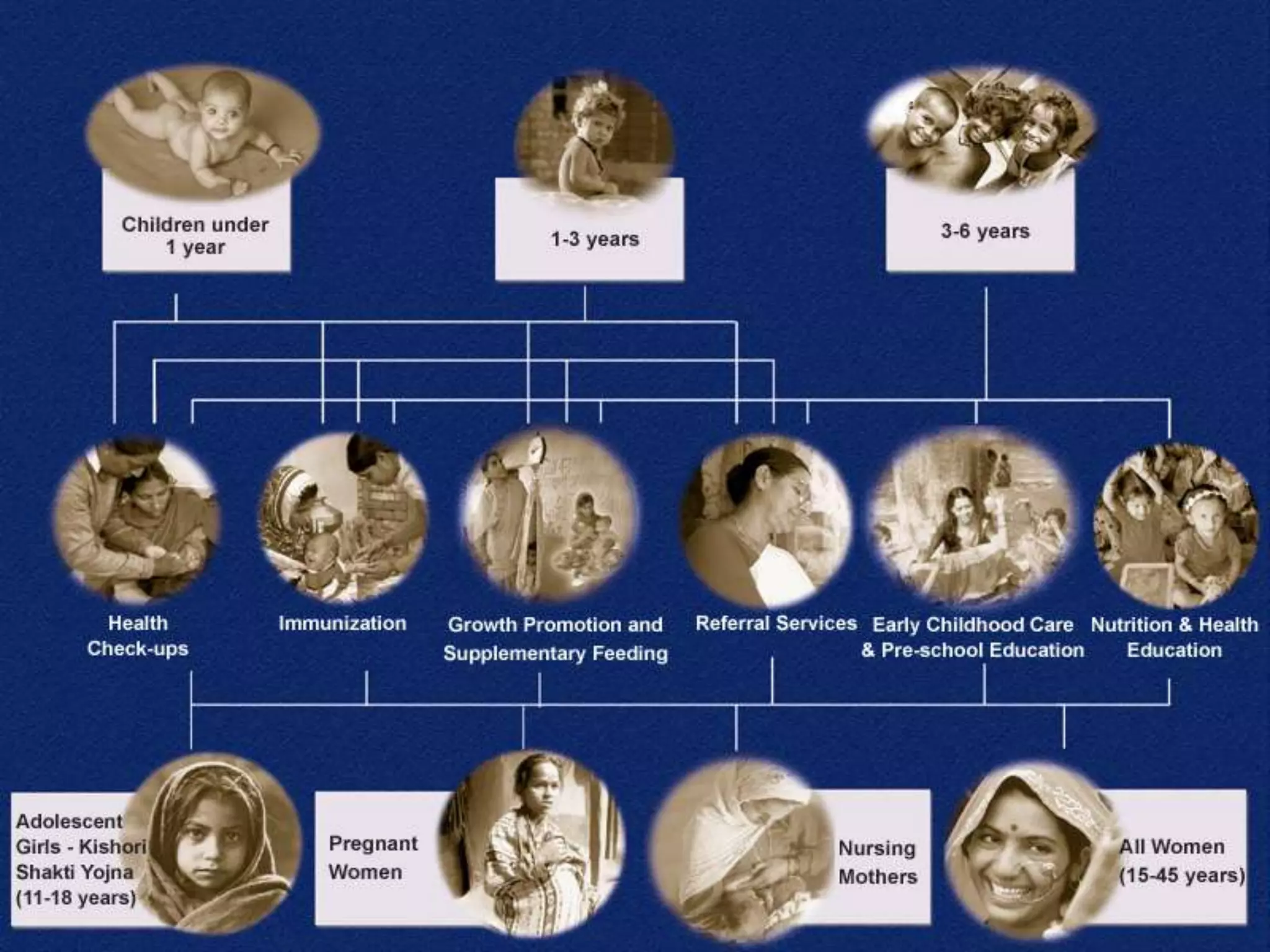
Components..
   Health Check-ups& referral services

   Immunization.

   Growth Promotion and Supplementary Feeding

   Referral Services.

   Early Childhood Care and Pre-school Education.

   Nutrition (vit A & iron and folic)and Health Education.
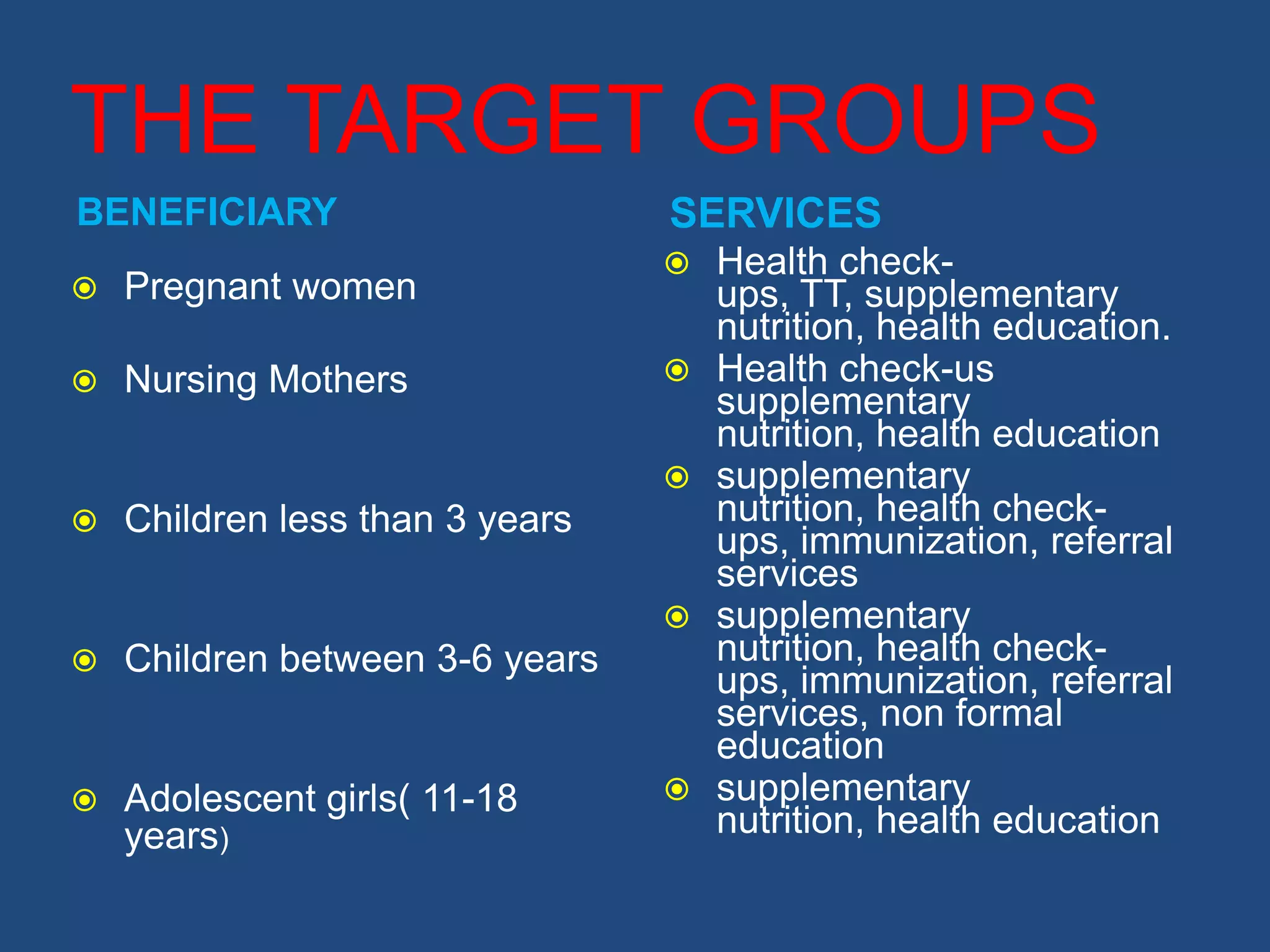
THE TARGET GROUPS
BENEFICIARY                      SERVICES
                                    Health check-
   Pregnant women                   ups, TT, supplementary
                                     nutrition, health education.
   Nursing Mothers                 Health check-us
                                     supplementary
                                     nutrition, health education
                                    supplementary
   Children less than 3 years       nutrition, health check-
                                     ups, immunization, referral
                                     services
                                    supplementary
   Children between 3-6 years       nutrition, health check-
                                     ups, immunization, referral
                                     services, non formal
                                     education
   Adolescent girls( 11-18         supplementary
    years)                           nutrition, health education
Non-formal Pre-School
Education (PSE)
 Non-formal Pre-school Education (PSE)
  component of the ICDS may well be considered
  the backbone of the ICDS program.
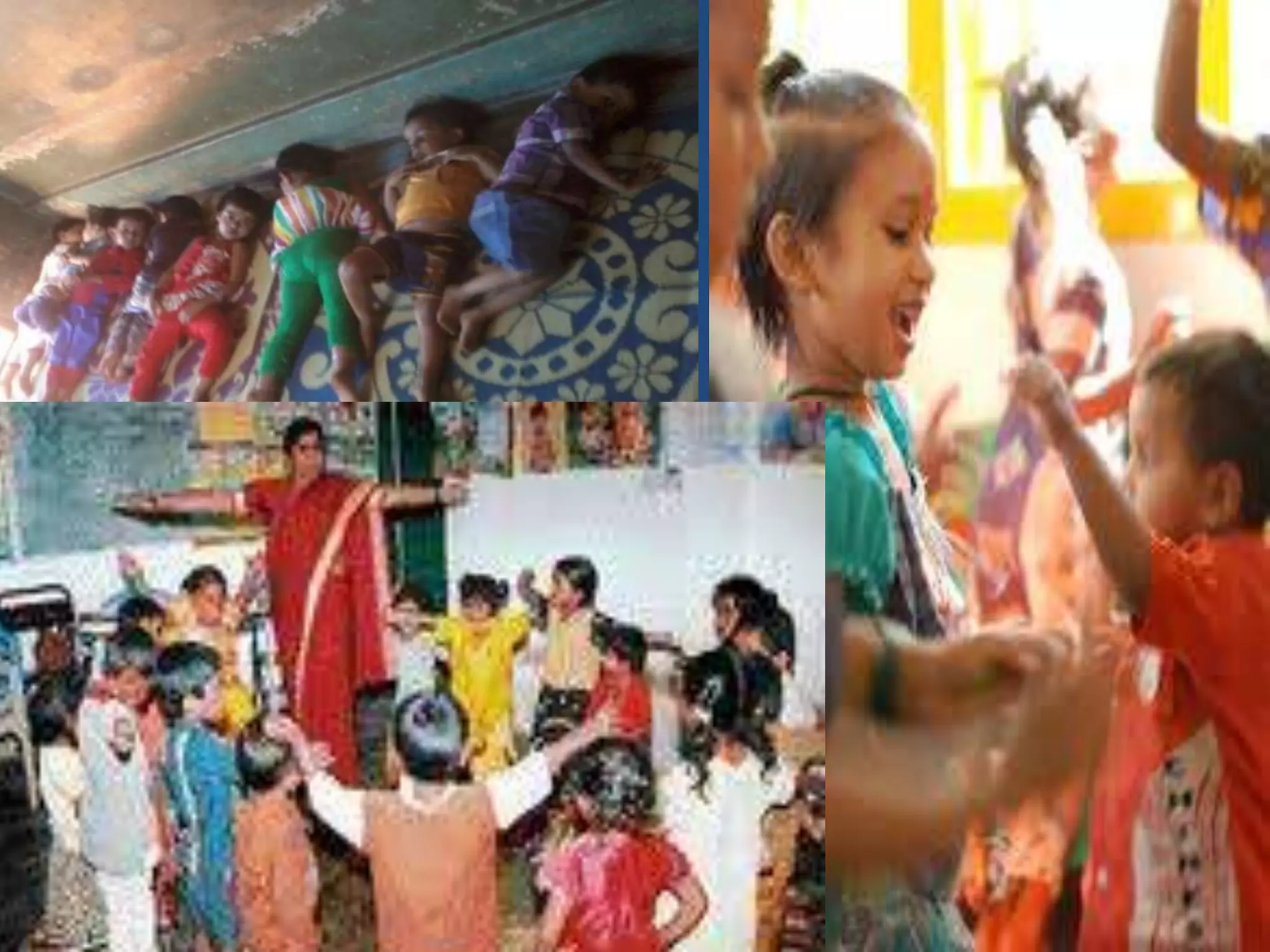
 This is also the most joyful play-way daily
  activity, visibly sustained for three hours a day. It
  brings and keeps young children at the
  anganwadi centre.
 Anganwadi is directed towards providing and
  ensuring a natural, joyfuI and stimulating
  environment, with emphasis on necessary
  inputs for optimal growth and development
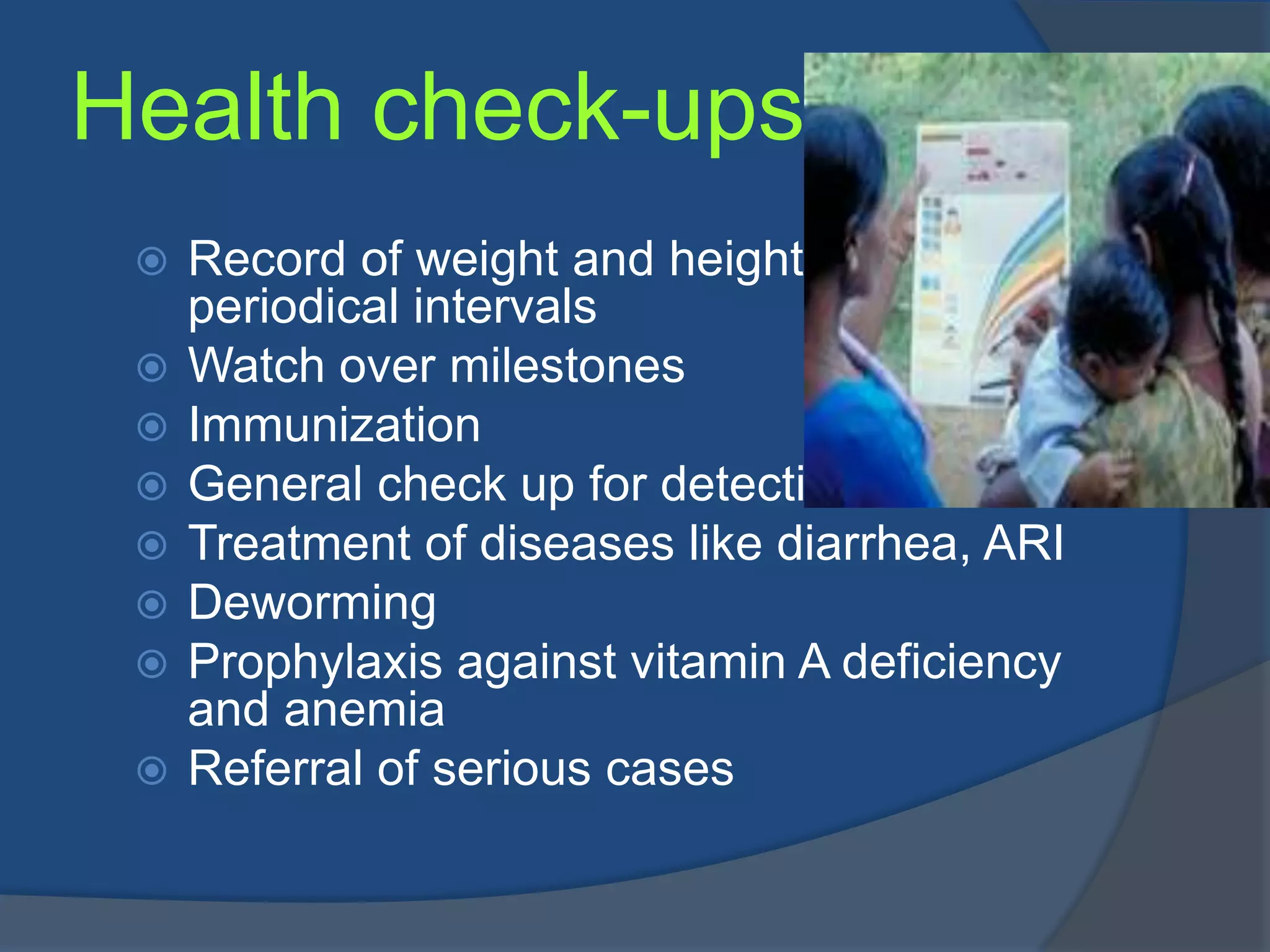
Health check-ups
    Record of weight and height of children at
     periodical intervals
    Watch over milestones
    Immunization
    General check up for detection of disease
    Treatment of diseases like diarrhea, ARI
    Deworming
    Prophylaxis against vitamin A deficiency
     and anemia
    Referral of serious cases
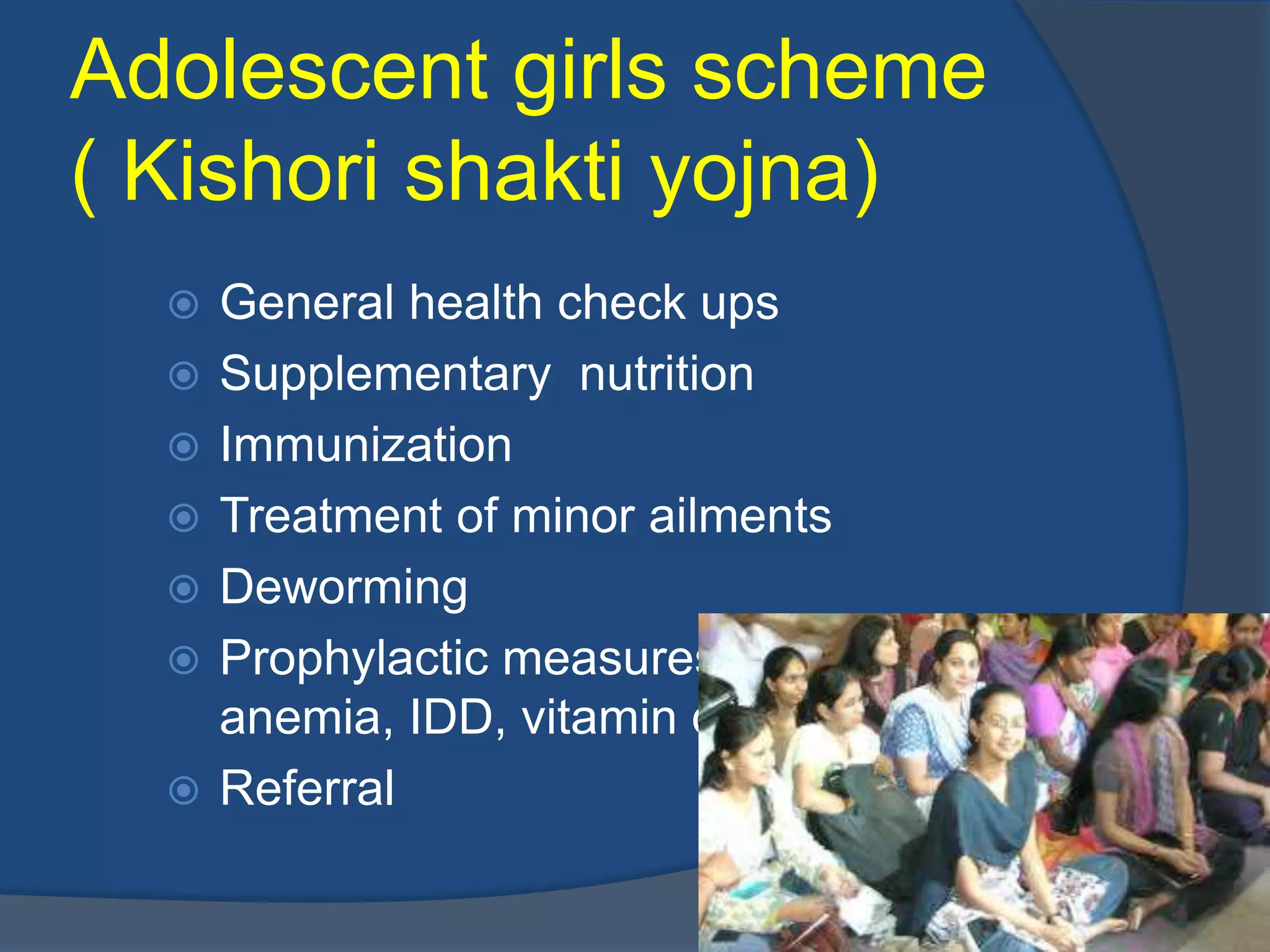
Adolescent girls scheme
( Kishori shakti yojna)
     General health check ups
     Supplementary nutrition
     Immunization
     Treatment of minor ailments
     Deworming
     Prophylactic measures against
      anemia, IDD, vitamin deficiency
     Referral
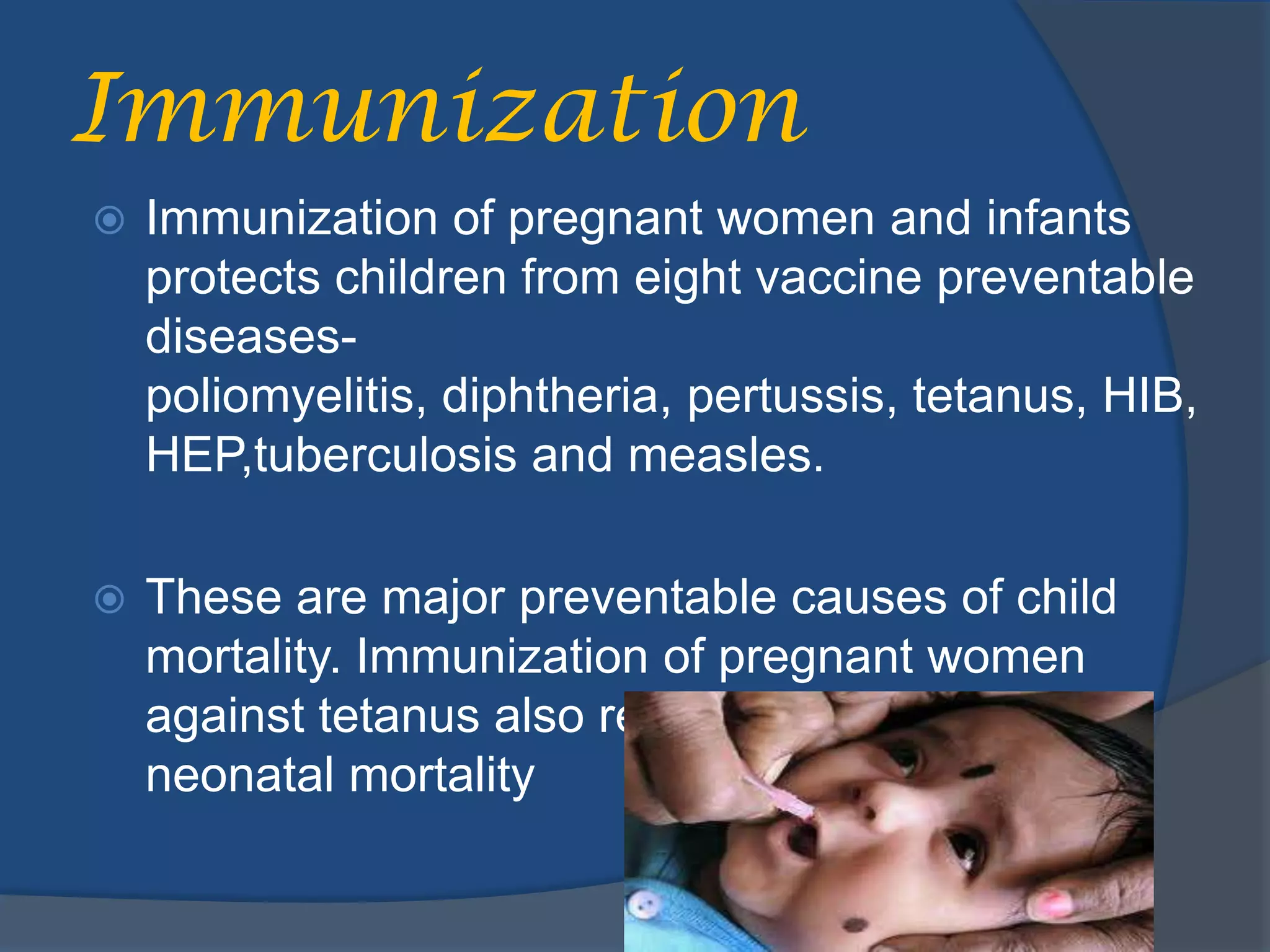
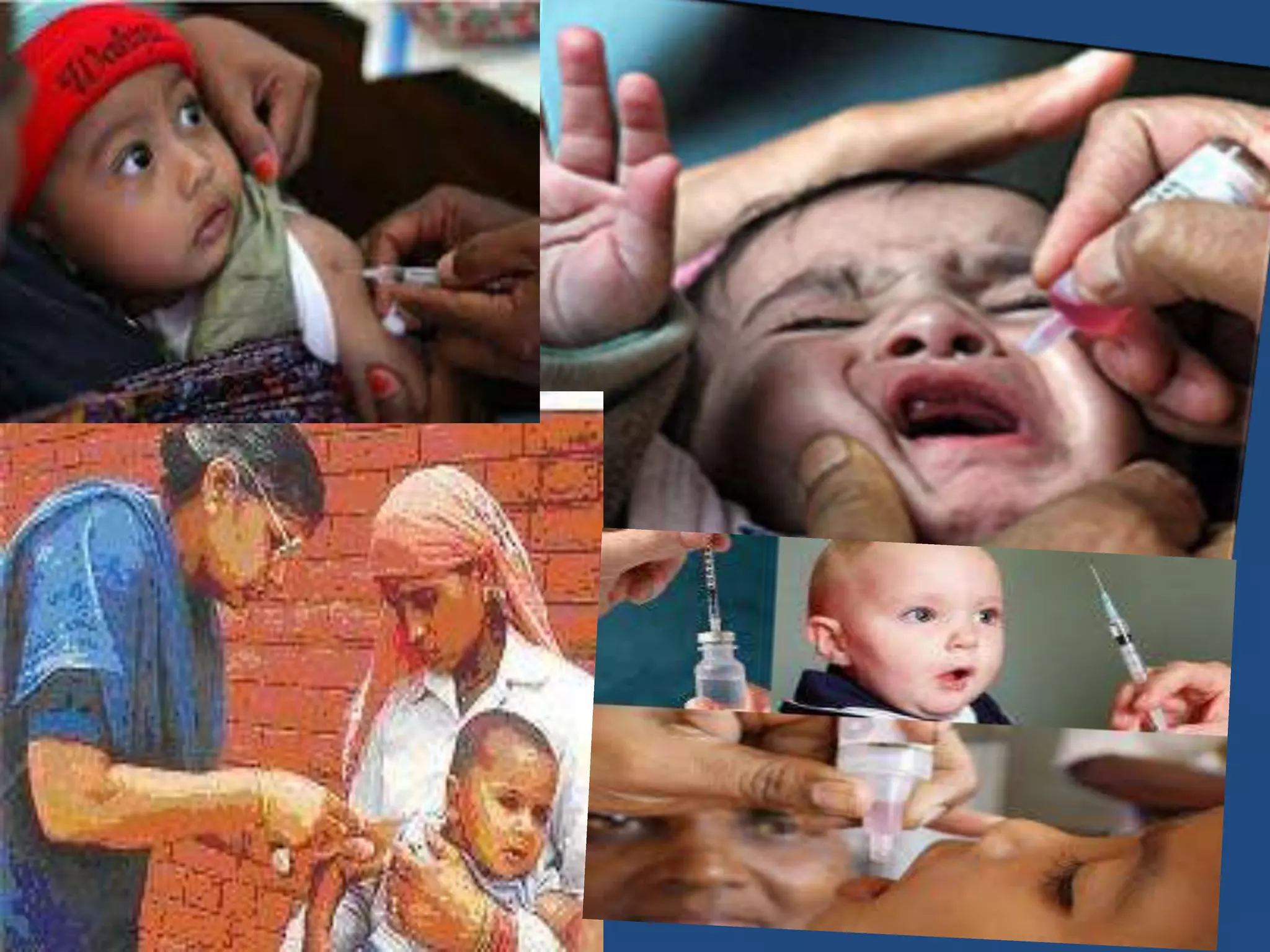
Immunization
   Immunization of pregnant women and infants
    protects children from eight vaccine preventable
    diseases-
    poliomyelitis, diphtheria, pertussis, tetanus, HIB,
    HEP,tuberculosis and measles.

   These are major preventable causes of child
    mortality. Immunization of pregnant women
    against tetanus also reduces maternal and
    neonatal mortality
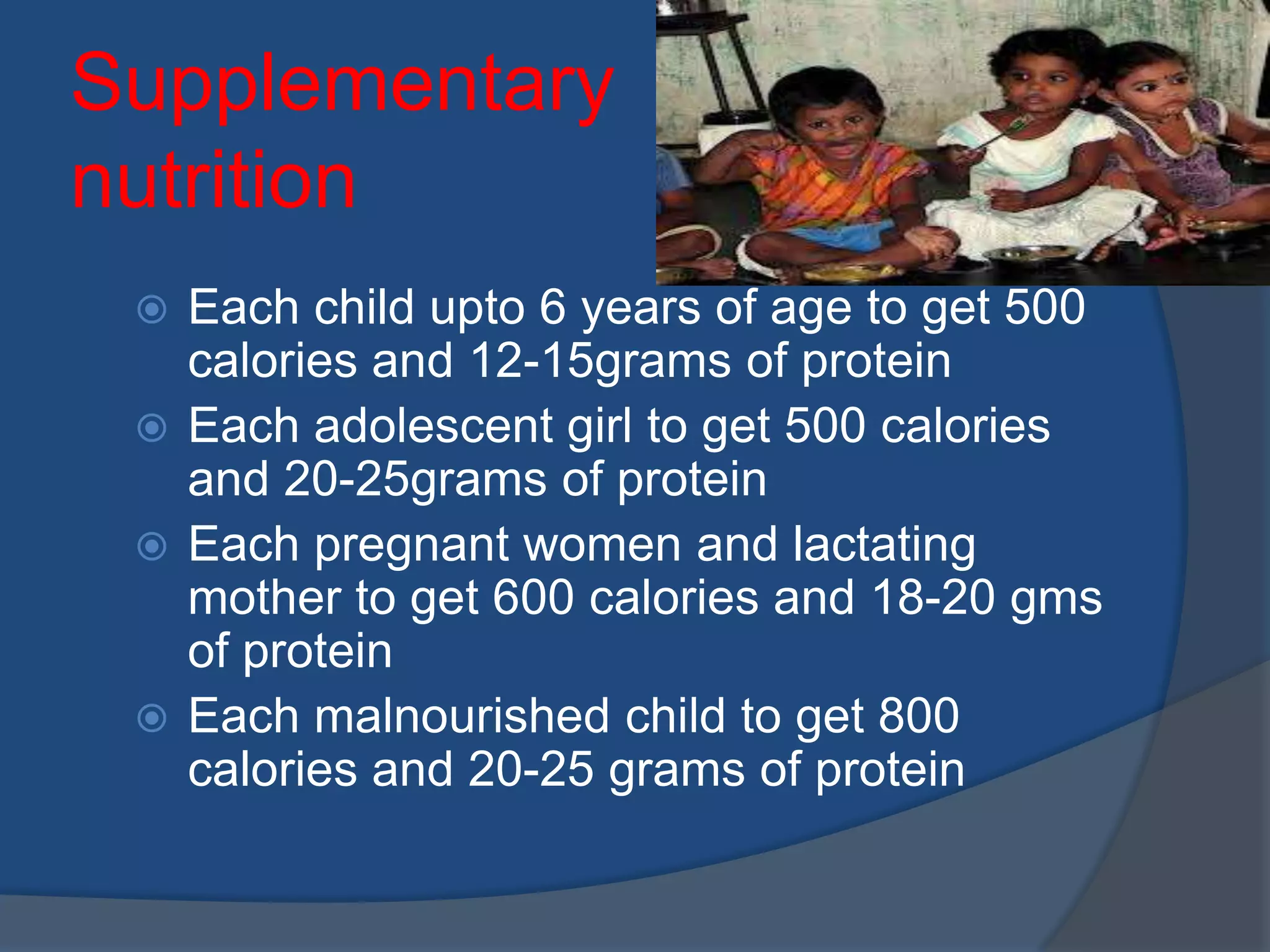
Supplementary
nutrition
  Each child upto 6 years of age to get 500
   calories and 12-15grams of protein
  Each adolescent girl to get 500 calories
   and 20-25grams of protein
  Each pregnant women and lactating
   mother to get 600 calories and 18-20 gms
   of protein
  Each malnourished child to get 800
   calories and 20-25 grams of protein
Anganwadi
      Centre
 Anganwadi is the Focal Point for Delivery of
  ICDS Services.
 Anganwadi is run by an AWW who is selcted
  from the community , supported by a Helper.
 AWW is the 1st Point of Contact for
  Families Nutrition and Health Problems.
 She is trained for a period of 4 months and
  is paid nearly 3500Rs and her helper is
  given 2300 Rs.
Role of AWW
   Non formal education of children 3-6 yr old
   Make home visits
   Assist PHC staff
   Guide ASHA
   Assist in implementation of Kishori Shakti Yojana (KSY)
   ROLE OF HELPER
     Cook & serve food

     Clean the Anganwadi premises

     Cleanliness of small children

     Bring small children to Anganwadi
Supplementary Nutrition

Beneficiary                  Pre-revised                         Revised w.e.f.
                                                                 Feb. 2009
                             Calories Protein                    Calories Protein
                             (KCal)   (G)                        (KCal)   (Gm)

Children (6-72               300                  8-10           500      12-15
months)
Severely              600                         20             800      20-25
malnourished children
(6-72 months)

Pregnant & Lactating         500                  15-20          600      18-20
                 SIHFW: an ISO9001: 2008 certified institution                    15
CENTRES OF STUDY….
1.KORANPEEDIKA &
2.PARIYARAM SCHOOL ANGANWADIS
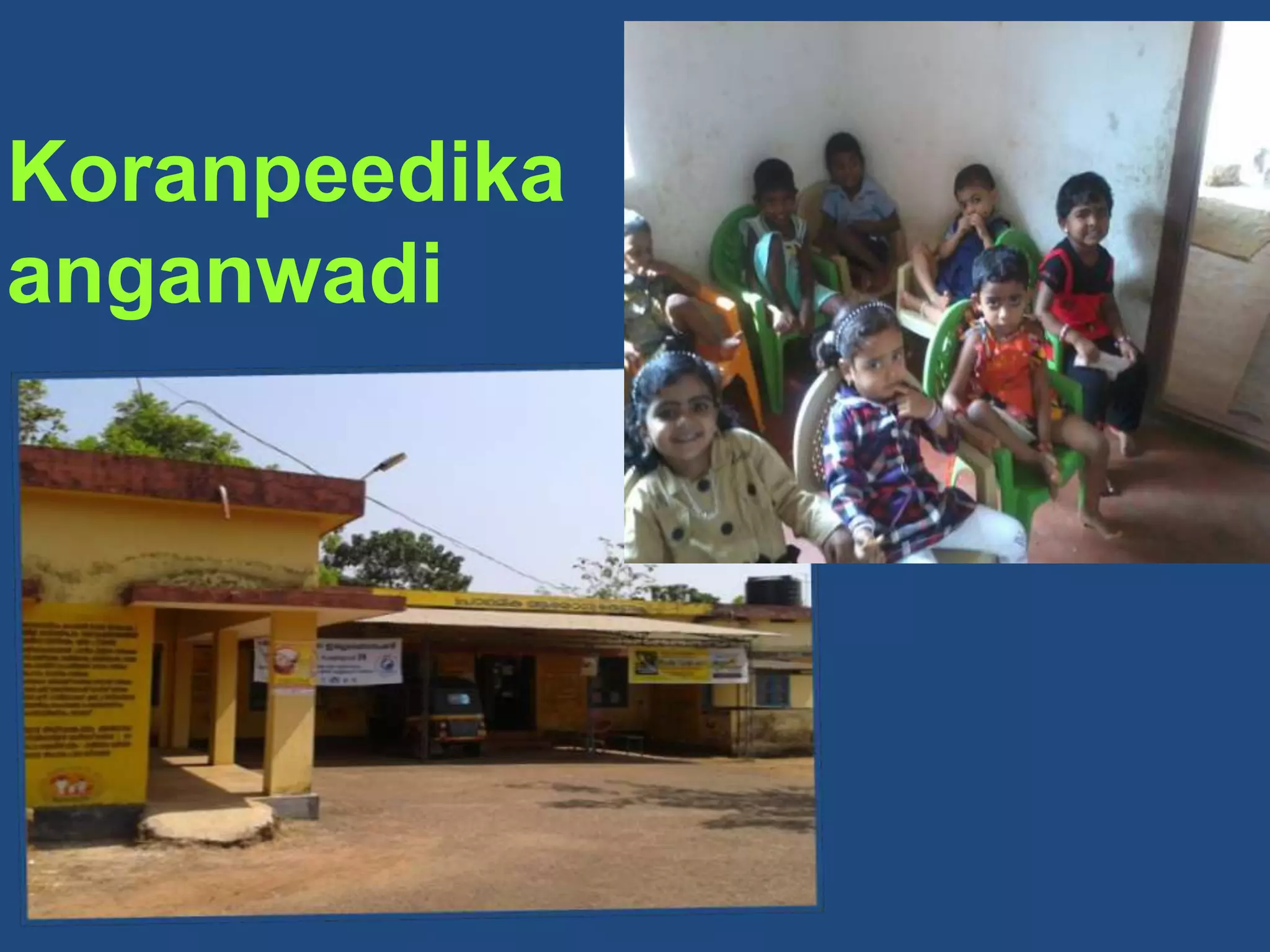
Koranpeedika
anganwadi
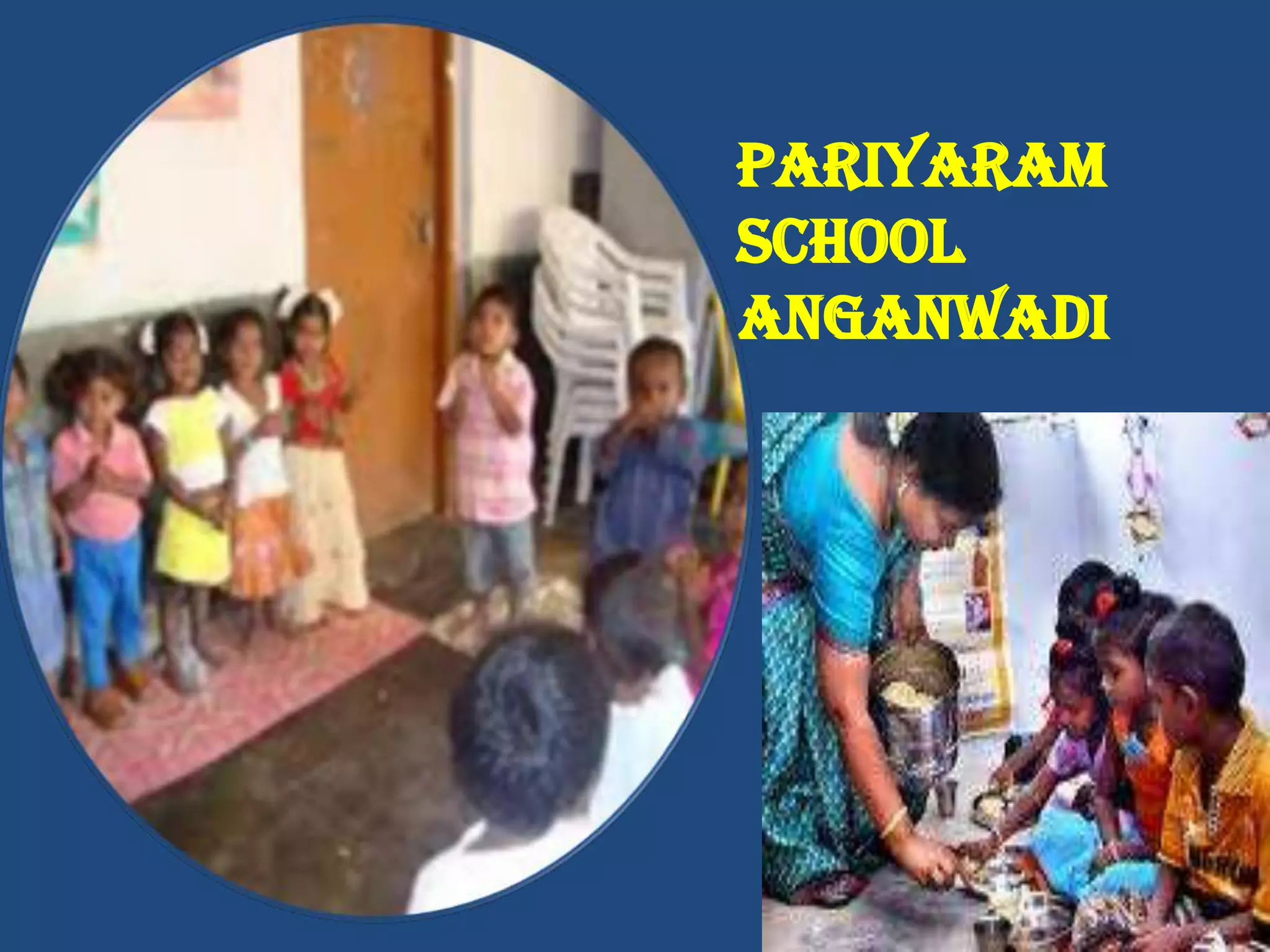
PARIYARAM
SCHOOL
ANGANWADI
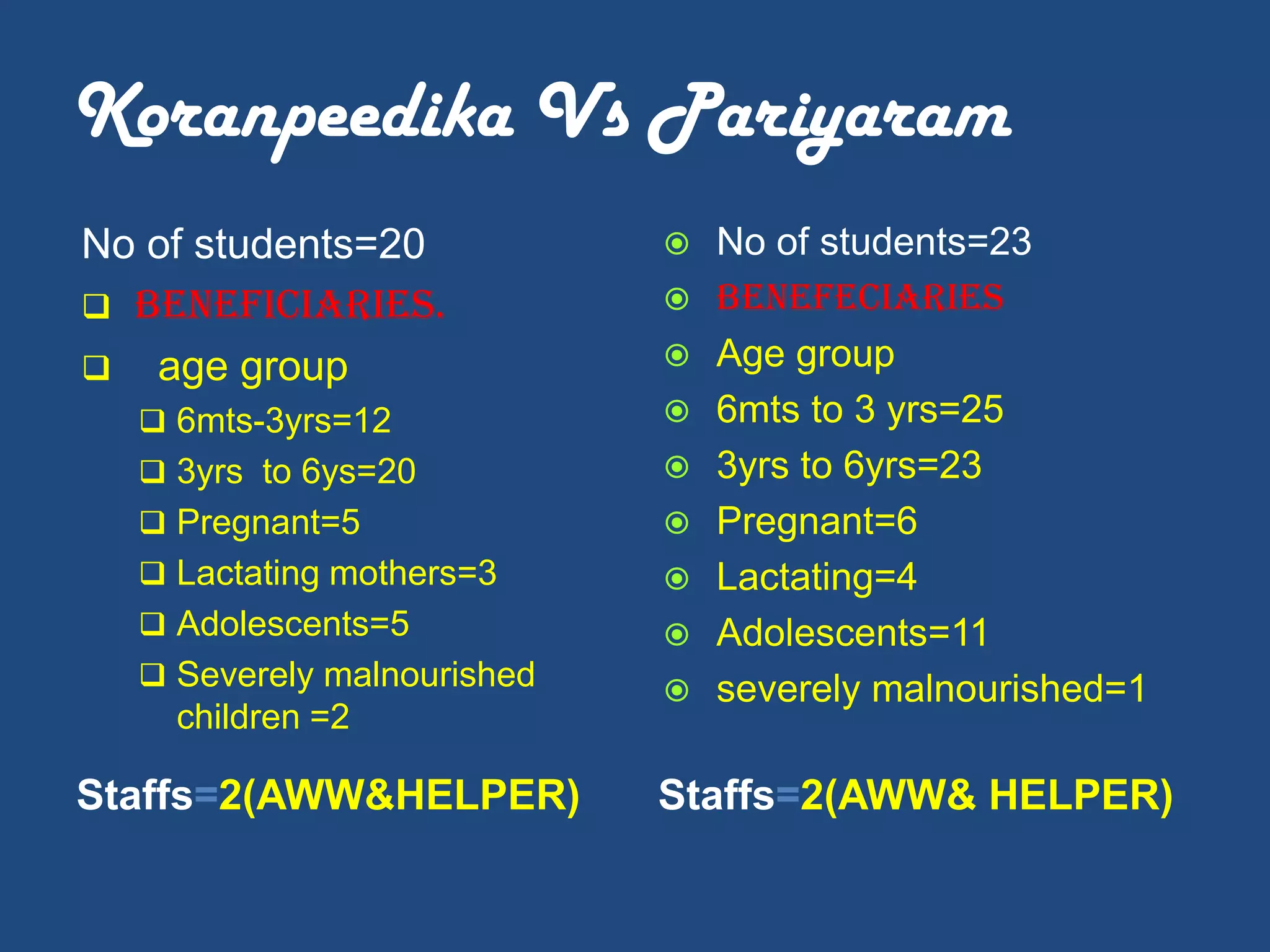
Koranpeedika Vs Pariyaram
No of students=20              No of students=23
 Beneficiaries.               Benefeciaries
 age group                    Age group
   6mts-3yrs=12               6mts to 3 yrs=25
   3yrs to 6ys=20             3yrs to 6yrs=23
   Pregnant=5                 Pregnant=6
   Lactating mothers=3        Lactating=4
   Adolescents=5              Adolescents=11
   Severely malnourished      severely malnourished=1
    children =2

Staffs=2(AWW&HELPER)        Staffs=2(AWW& HELPER)
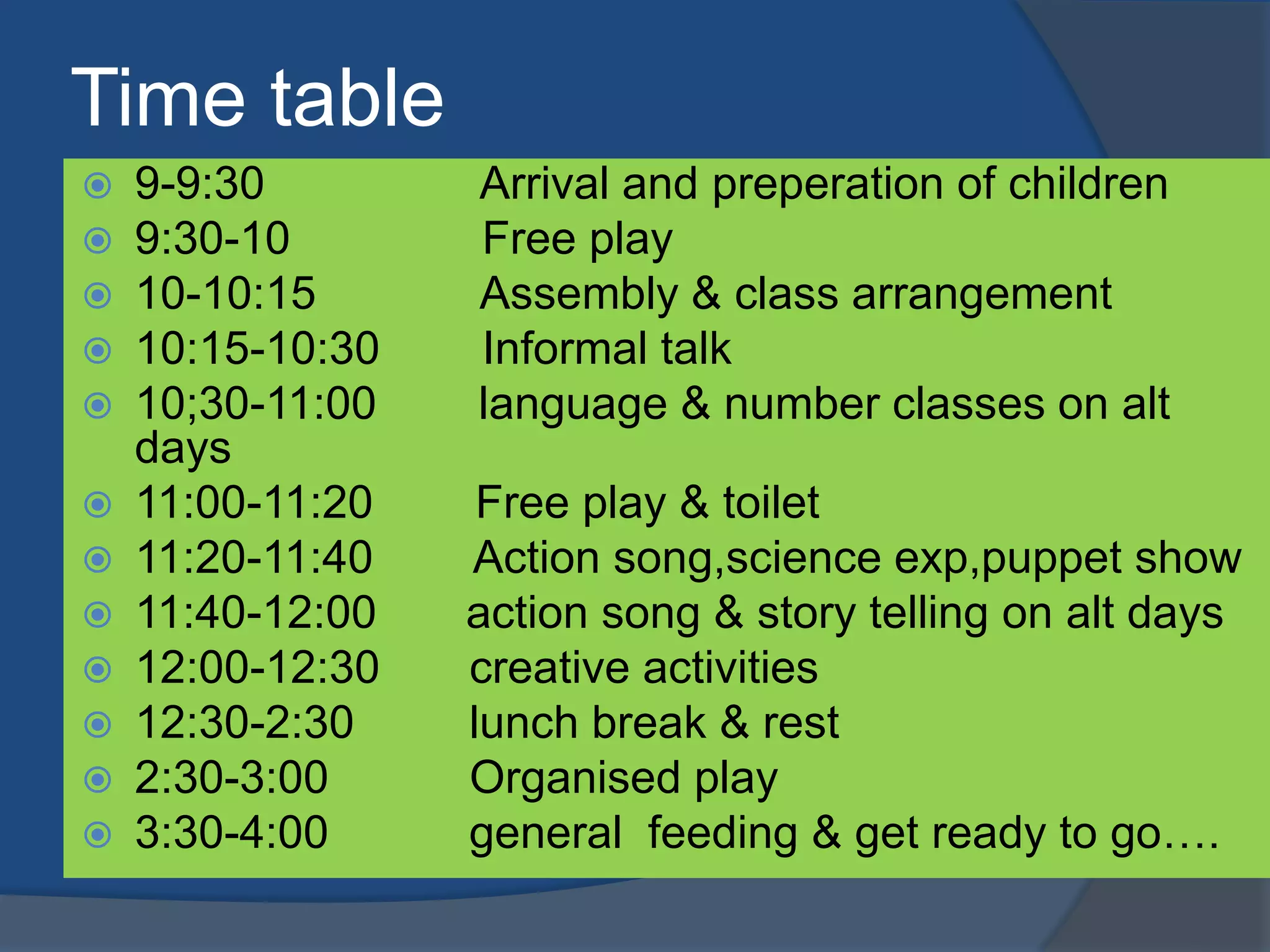
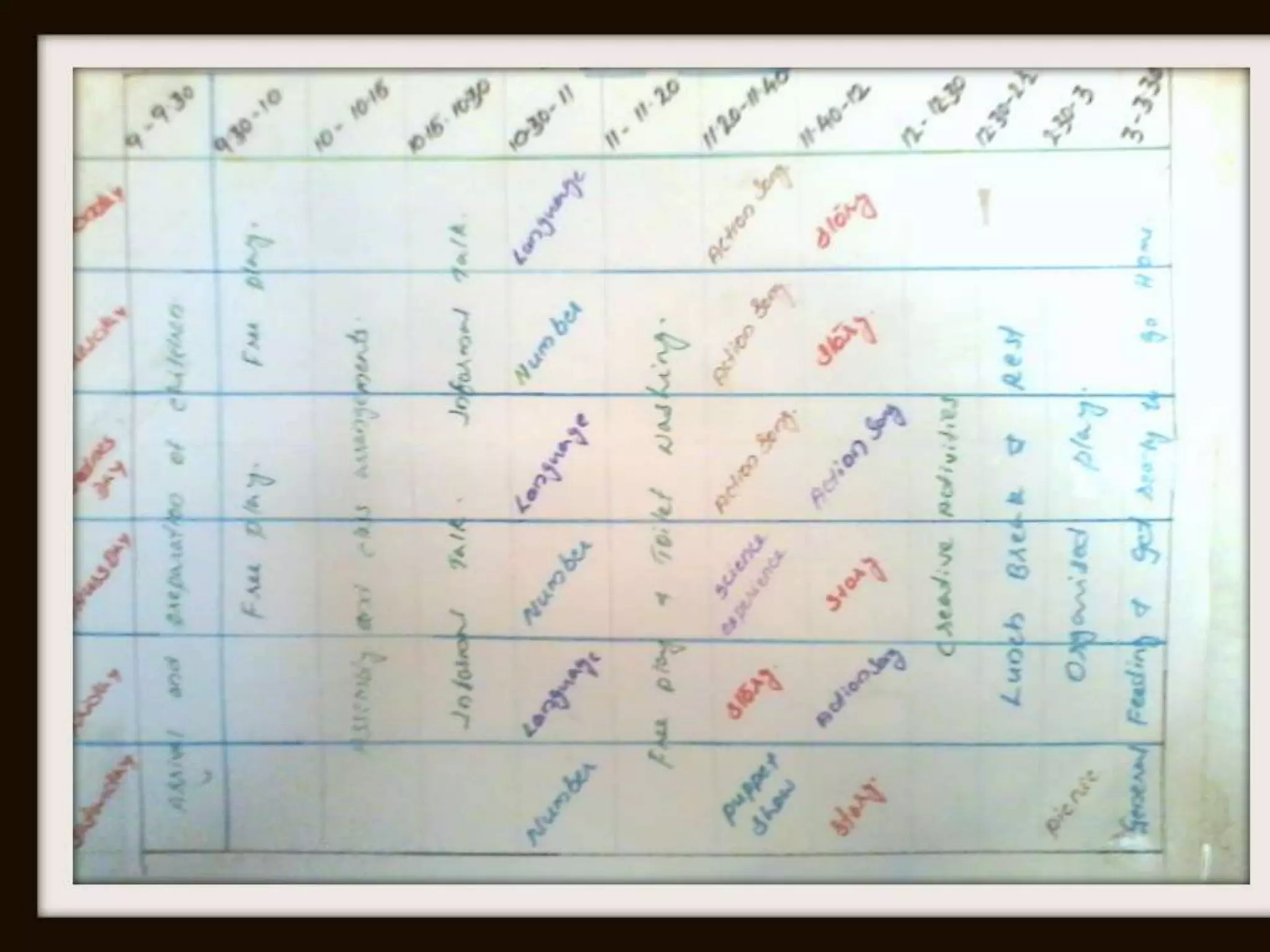
Time table
   9-9:30        Arrival and preperation of children
   9:30-10       Free play
   10-10:15      Assembly & class arrangement
   10:15-10:30   Informal talk
   10;30-11:00   language & number classes on alt
    days
   11:00-11:20    Free play & toilet
   11:20-11:40   Action song,science exp,puppet show
   11:40-12:00   action song & story telling on alt days
   12:00-12:30   creative activities
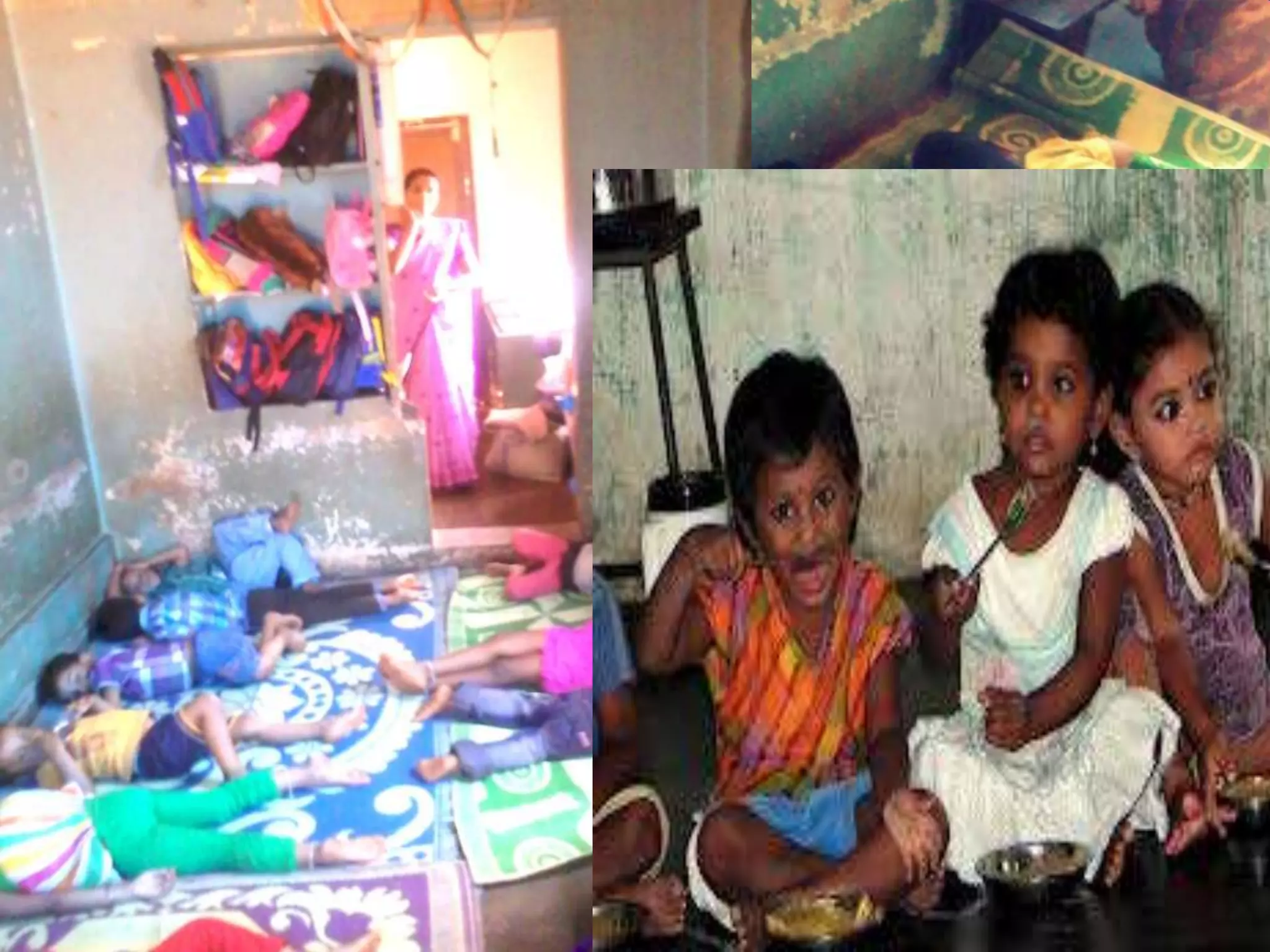
   12:30-2:30    lunch break & rest
   2:30-3:00     Organised play
   3:30-4:00     general feeding & get ready to go….
Teaching themes
 June-family,house and surroundings
 July-garden&flower,veg,fruits
 Aug-domestic animals,independence
  day,food stuffs
 Sep-hospitals,health,gandhijayanthi,onam
 Oct-wind,sky,air,directions,jungle &wild
  animals,museum
 Nov-traffic rules,childrens
  day,water,sea,river,electricity
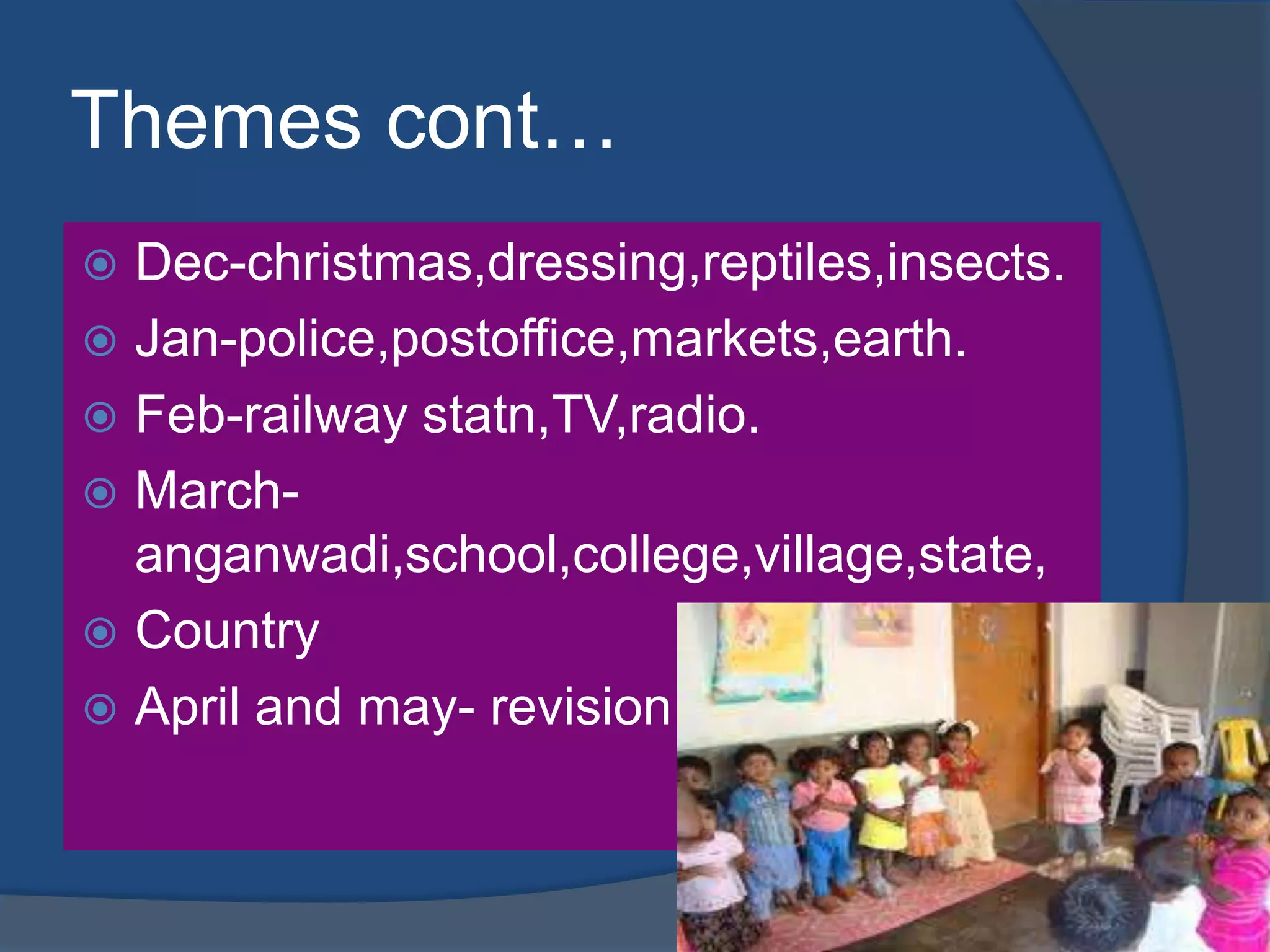
Themes cont…
 Dec-christmas,dressing,reptiles,insects.
 Jan-police,postoffice,markets,earth.
 Feb-railway statn,TV,radio.
 March-
  anganwadi,school,college,village,state,
 Country
 April and may- revision
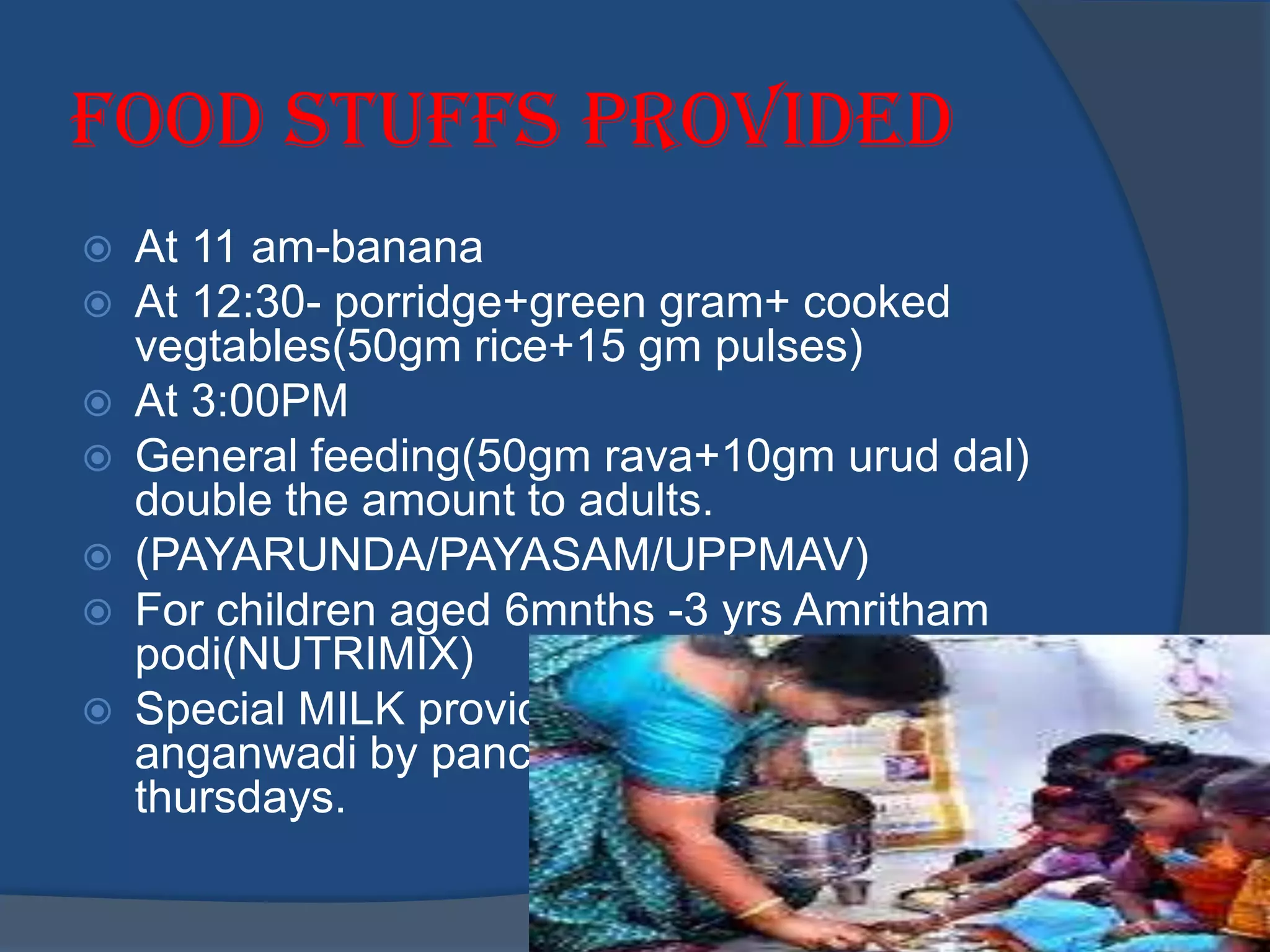
Food stuffs provided
   At 11 am-banana
   At 12:30- porridge+green gram+ cooked
    vegtables(50gm rice+15 gm pulses)
   At 3:00PM
   General feeding(50gm rava+10gm urud dal)
    double the amount to adults.
   (PAYARUNDA/PAYASAM/UPPMAV)
   For children aged 6mnths -3 yrs Amritham
    podi(NUTRIMIX)
   Special MILK provided at pariyaram
    anganwadi by panchayath on tuesdays and
    thursdays.
Additional w0rks by anganwadi
    worker…
   House visit 5 houses/day(records birth wgt,LMP,,immunisation
    status,maintains growth chart,give health education)

   Maintains 30 registers
       viz…(pregnancy regstr,lactation reg,wgt reg,popln survey
    list,movement reg,house visit,asset
    reg,stock,attendence,veg,birth,death,immunsn)

   Give medicines for common
    ailments(Paracetamol,albendazole,Fe&folic,betadine,
    calamine,clotrimazole,gentian violet,first aid pack)

   Calls out meetings of adolescents and middle aged women ang giv
    health education every month. Arranges a psychatric counselling
    class for adolescents once in an year which is conducted by
    doctors from medical college.
Additional programme at
pariyaram anganwadi.
   Conducts parents meeting at anganwadi
    once every month. Usually first Thursday.
   Conducts annual cultural programmes for
    members of anganwadi
   Goes for population survey in month of
    april & may.
   Conducts health education classes with
    help of JPHN & JHI.
   AWW here has an experience of 10 yrs..so
    she has undergone 4 refreshment courses
    and gets an incentive of 50 Rs from govt
    and 150 Rs from panchayath
Qualification of aww-sslc
pass,undergoes 4 months
training and then refresher
courses once in every 2
years
helper-sslc fail
suervisor-sslc+PSC Exam pass
 Holidays-
   National holidays ,sundays and second
    saturdays
supplys
 Supply of all food materials is from the supplyco funded b
  panchayath.
 Daily needs such as vegetables,coconut and banana is
bought everyday by AWW itself and for which she receives a
  reimbursement on submission of bills.
 Inspection Of anganwadi done every month by super visor
  they also supply necessary medicine and food stuffs..
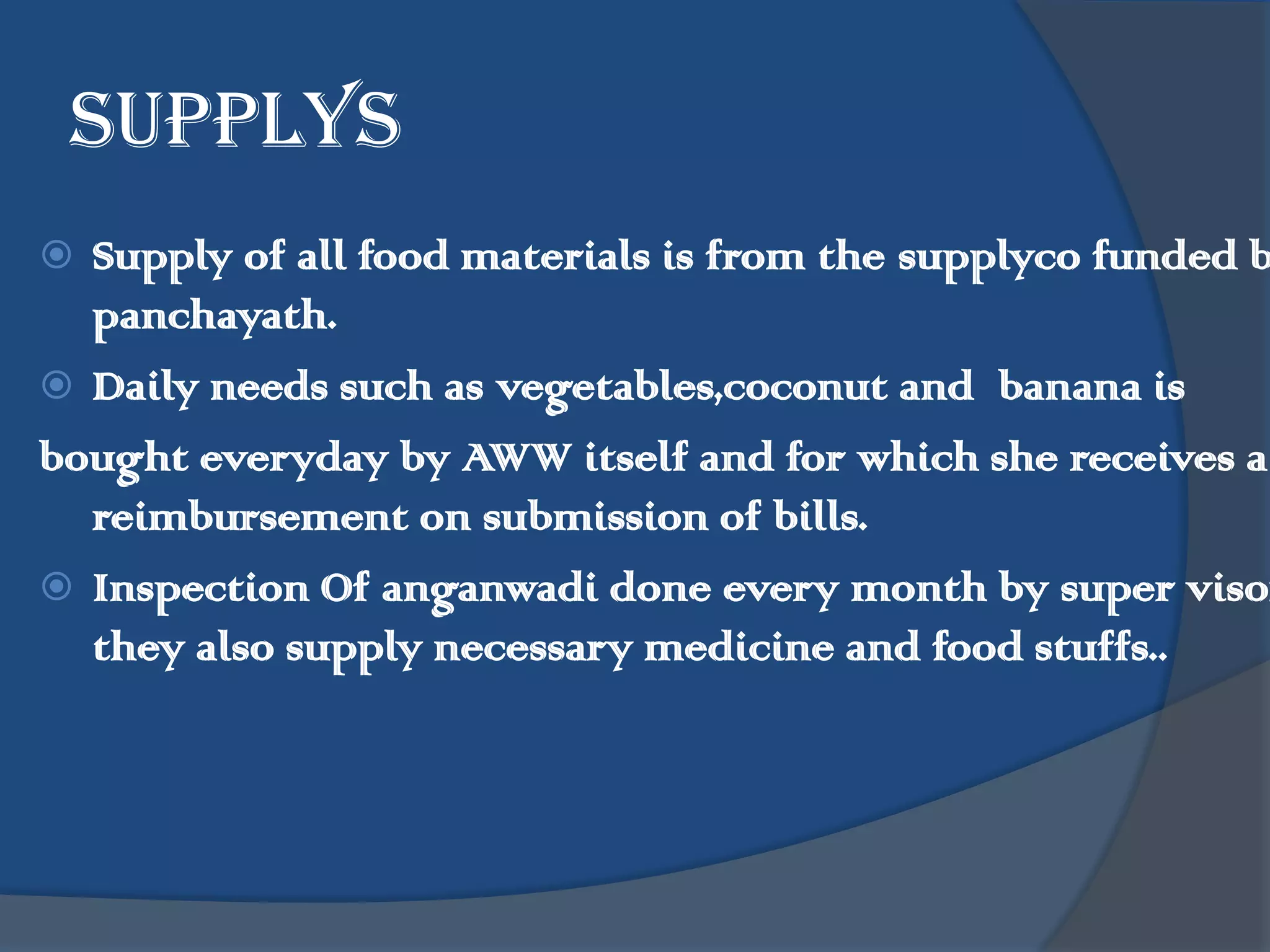
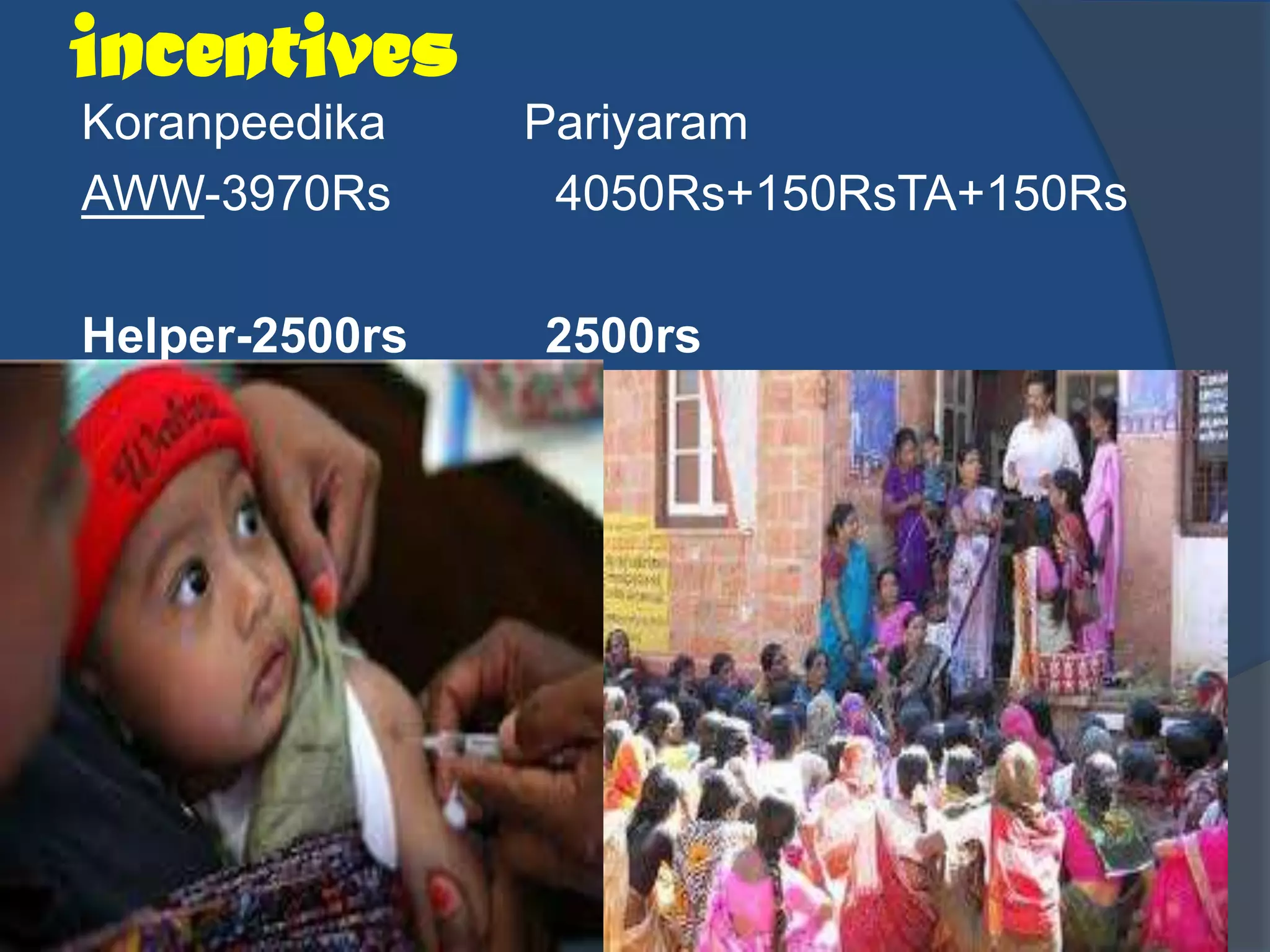
incentives
Koranpeedika    Pariyaram
AWW-3970Rs       4050Rs+150RsTA+150Rs

Helper-2500rs   2500rs
conclusion
   Number of children attending anganwadi is very few
    now a days.
   All the services offered by government are rightly being
    delivered at anganwadis.
   With respect to cleanliness,space,facilities and
    services pariyaram ananwadi is better than
    koranpeedika.
   Local authorities like panchayaths and NGOs should
    take more interest with anganwadis and supply them
    with more food materials and assets.
   More nutritive food alternatives should be provided at
    anganwadis.
   Salary of AWW has to b raised for the services they
    provide.
REFERENCES

    PARKSTEXTBOOK
    20TH EDITION
    www.icdsbih.gov.in
    www.anganwadi.org
    wcd nic.in/icds.htm
    icdsup.nic.in
Thank you…..

Analysis of

  • 1.
    Analysis of ivitiesand Benefeciaries Two nearby Anganwadis By Dr. RAKHI DCRUZ…
  • 2.
    INTRODUCTION  Anganwadi comes under the icds scheme(integrated child devpt services)  Started by the Government of India in 1975 Has been instrumental in improving the health and wellbeing of mothers and children under 6 by providing health and nutrition education, health services, supplementary food, and pre- school education.  The ICDS national development program is one of the largest in the world. It reaches more than 34 million children aged 0-6 years and 7 million pregnant and lactating mothers
  • 3.
    ICDS OBJECTIVES  To improve the nutritional status of preschool children 0-6 years of age group.  To lay the foundation of proper psychological development of the child  To reduce the incidence of mortality, morbidity malnutrition and school drop out  To achieve effective coordination of policy and implementation in various departments to promote child development  To enhance the capability of the mother to look after the normal health and nutritional needs of of the child through proper nutrition and health education.
  • 4.
    Components..  Health Check-ups& referral services  Immunization.  Growth Promotion and Supplementary Feeding  Referral Services.  Early Childhood Care and Pre-school Education.  Nutrition (vit A & iron and folic)and Health Education.
  • 5.
    THE TARGET GROUPS BENEFICIARY SERVICES  Health check-  Pregnant women ups, TT, supplementary nutrition, health education.  Nursing Mothers  Health check-us supplementary nutrition, health education  supplementary  Children less than 3 years nutrition, health check- ups, immunization, referral services  supplementary  Children between 3-6 years nutrition, health check- ups, immunization, referral services, non formal education  Adolescent girls( 11-18  supplementary years) nutrition, health education
  • 6.
    Non-formal Pre-School Education (PSE) Non-formal Pre-school Education (PSE) component of the ICDS may well be considered the backbone of the ICDS program.  This is also the most joyful play-way daily activity, visibly sustained for three hours a day. It brings and keeps young children at the anganwadi centre.  Anganwadi is directed towards providing and ensuring a natural, joyfuI and stimulating environment, with emphasis on necessary inputs for optimal growth and development
  • 8.
    Health check-ups  Record of weight and height of children at periodical intervals  Watch over milestones  Immunization  General check up for detection of disease  Treatment of diseases like diarrhea, ARI  Deworming  Prophylaxis against vitamin A deficiency and anemia  Referral of serious cases
  • 9.
    Adolescent girls scheme (Kishori shakti yojna)  General health check ups  Supplementary nutrition  Immunization  Treatment of minor ailments  Deworming  Prophylactic measures against anemia, IDD, vitamin deficiency  Referral
  • 10.
    Immunization  Immunization of pregnant women and infants protects children from eight vaccine preventable diseases- poliomyelitis, diphtheria, pertussis, tetanus, HIB, HEP,tuberculosis and measles.  These are major preventable causes of child mortality. Immunization of pregnant women against tetanus also reduces maternal and neonatal mortality
  • 12.
    Supplementary nutrition  Eachchild upto 6 years of age to get 500 calories and 12-15grams of protein  Each adolescent girl to get 500 calories and 20-25grams of protein  Each pregnant women and lactating mother to get 600 calories and 18-20 gms of protein  Each malnourished child to get 800 calories and 20-25 grams of protein
  • 13.
    Anganwadi Centre  Anganwadi is the Focal Point for Delivery of ICDS Services.  Anganwadi is run by an AWW who is selcted from the community , supported by a Helper.  AWW is the 1st Point of Contact for Families Nutrition and Health Problems.  She is trained for a period of 4 months and is paid nearly 3500Rs and her helper is given 2300 Rs.
  • 14.
    Role of AWW  Non formal education of children 3-6 yr old  Make home visits  Assist PHC staff  Guide ASHA  Assist in implementation of Kishori Shakti Yojana (KSY)  ROLE OF HELPER  Cook & serve food  Clean the Anganwadi premises  Cleanliness of small children  Bring small children to Anganwadi
  • 15.
    Supplementary Nutrition Beneficiary Pre-revised Revised w.e.f. Feb. 2009 Calories Protein Calories Protein (KCal) (G) (KCal) (Gm) Children (6-72 300 8-10 500 12-15 months) Severely 600 20 800 20-25 malnourished children (6-72 months) Pregnant & Lactating 500 15-20 600 18-20 SIHFW: an ISO9001: 2008 certified institution 15
  • 17.
    CENTRES OF STUDY…. 1.KORANPEEDIKA& 2.PARIYARAM SCHOOL ANGANWADIS
  • 18.
  • 19.
  • 20.
    Koranpeedika Vs Pariyaram Noof students=20  No of students=23  Beneficiaries.  Benefeciaries  age group  Age group  6mts-3yrs=12  6mts to 3 yrs=25  3yrs to 6ys=20  3yrs to 6yrs=23  Pregnant=5  Pregnant=6  Lactating mothers=3  Lactating=4  Adolescents=5  Adolescents=11  Severely malnourished  severely malnourished=1 children =2 Staffs=2(AWW&HELPER) Staffs=2(AWW& HELPER)
  • 21.
    Time table  9-9:30 Arrival and preperation of children  9:30-10 Free play  10-10:15 Assembly & class arrangement  10:15-10:30 Informal talk  10;30-11:00 language & number classes on alt days  11:00-11:20 Free play & toilet  11:20-11:40 Action song,science exp,puppet show  11:40-12:00 action song & story telling on alt days  12:00-12:30 creative activities  12:30-2:30 lunch break & rest  2:30-3:00 Organised play  3:30-4:00 general feeding & get ready to go….
  • 25.
    Teaching themes  June-family,houseand surroundings  July-garden&flower,veg,fruits  Aug-domestic animals,independence day,food stuffs  Sep-hospitals,health,gandhijayanthi,onam  Oct-wind,sky,air,directions,jungle &wild animals,museum  Nov-traffic rules,childrens day,water,sea,river,electricity
  • 26.
    Themes cont…  Dec-christmas,dressing,reptiles,insects. Jan-police,postoffice,markets,earth.  Feb-railway statn,TV,radio.  March- anganwadi,school,college,village,state,  Country  April and may- revision
  • 27.
    Food stuffs provided  At 11 am-banana  At 12:30- porridge+green gram+ cooked vegtables(50gm rice+15 gm pulses)  At 3:00PM  General feeding(50gm rava+10gm urud dal) double the amount to adults.  (PAYARUNDA/PAYASAM/UPPMAV)  For children aged 6mnths -3 yrs Amritham podi(NUTRIMIX)  Special MILK provided at pariyaram anganwadi by panchayath on tuesdays and thursdays.
  • 28.
    Additional w0rks byanganwadi worker…  House visit 5 houses/day(records birth wgt,LMP,,immunisation status,maintains growth chart,give health education)  Maintains 30 registers  viz…(pregnancy regstr,lactation reg,wgt reg,popln survey list,movement reg,house visit,asset reg,stock,attendence,veg,birth,death,immunsn)  Give medicines for common ailments(Paracetamol,albendazole,Fe&folic,betadine, calamine,clotrimazole,gentian violet,first aid pack)  Calls out meetings of adolescents and middle aged women ang giv health education every month. Arranges a psychatric counselling class for adolescents once in an year which is conducted by doctors from medical college.
  • 29.
    Additional programme at pariyaramanganwadi.  Conducts parents meeting at anganwadi once every month. Usually first Thursday.  Conducts annual cultural programmes for members of anganwadi  Goes for population survey in month of april & may.  Conducts health education classes with help of JPHN & JHI.  AWW here has an experience of 10 yrs..so she has undergone 4 refreshment courses and gets an incentive of 50 Rs from govt and 150 Rs from panchayath
  • 30.
    Qualification of aww-sslc pass,undergoes4 months training and then refresher courses once in every 2 years helper-sslc fail suervisor-sslc+PSC Exam pass Holidays-  National holidays ,sundays and second saturdays
  • 31.
    supplys  Supply ofall food materials is from the supplyco funded b panchayath.  Daily needs such as vegetables,coconut and banana is bought everyday by AWW itself and for which she receives a reimbursement on submission of bills.  Inspection Of anganwadi done every month by super visor they also supply necessary medicine and food stuffs..
  • 32.
    incentives Koranpeedika Pariyaram AWW-3970Rs 4050Rs+150RsTA+150Rs Helper-2500rs 2500rs
  • 33.
    conclusion  Number of children attending anganwadi is very few now a days.  All the services offered by government are rightly being delivered at anganwadis.  With respect to cleanliness,space,facilities and services pariyaram ananwadi is better than koranpeedika.  Local authorities like panchayaths and NGOs should take more interest with anganwadis and supply them with more food materials and assets.  More nutritive food alternatives should be provided at anganwadis.  Salary of AWW has to b raised for the services they provide.
  • 34.
    REFERENCES PARKSTEXTBOOK 20TH EDITION www.icdsbih.gov.in www.anganwadi.org wcd nic.in/icds.htm icdsup.nic.in
  • 35.