CONTENTS
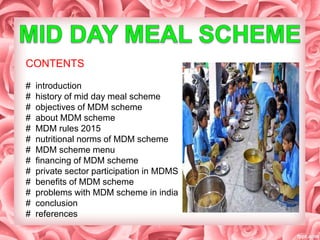
# introduction
# history of mid day meal scheme
# objectives of MDM scheme
# about MDM scheme
# MDM rules 2015
# nutritional norms of MDM scheme
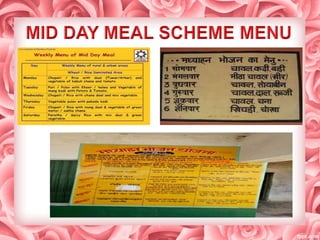
# MDM scheme menu
# financing of MDM scheme
# private sector participation in MDMS
# benefits of MDM scheme
# problems with MDM scheme in india
# conclusion
# references
The Mid Day Meal Scheme (MDMS) is a school meal programme of
government of india designed to better the nutritional standing of
school age children nationwide.
The programme supplies free lunches on working days for children
in primary and upper class in government schools.
Mid day meal scheme serves 120,000,000 children in over
1,265,000 schools and education guarantee scheme centres .
The mid day meal scheme is world’s largest school meal
programme.
Mid day meal in school has long history in india .
In 1925, a mid day meal programme was introduced for
disadvantaged children in in madras municipal corporation .
.
By the mid 1980 , three states , GUJRAT , KERALA, TAMIL NADU &
union territory of PONDICHERRY has universalizes cooked mid day
meal programme.
With the view to enchancing enrollment,retention,attendance and
simultaneously improving nutritional level among children , the
national programme of nutritional support to primary education ( NP-
NSPE), was launched as centrally sponsored scheme on 15 august
1995 intially in 2408 blocks in the country.
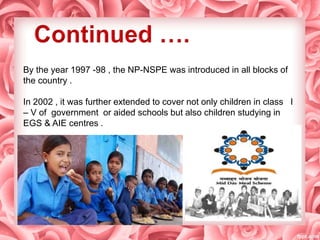
By the year 1997 -98 , the NP-NSPE was introduced in all blocks of
the country .
In 2002 , it was further extended to cover not only children in class I
– V of government or aided schools but also children studying in
EGS & AIE centres .
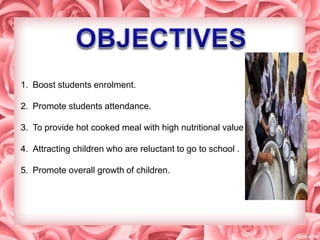
1. Boost students enrolment.
2. Promote students attendance.
3. To provide hot cooked meal with high nutritional value .
4. Attracting children who are reluctant to go to school .
5. Promote overall growth of children.
Mid day meal scheme guarantees one meal to all children in in
government , aided schools and madarsas supported under
“SAMAGRA SHIKSHA” .
Students upto class 8th are guaranteed one nutritional cooked meal
at least 200 days in a year .
The scheme comes under ministry of HRD.
It was launched in year 1995 as national program of nutritional
support to primary education ( NP NSPE) .
IN 2004 , the scheme was relaunched as the mid day meal scheme
( MDMS).
The place of serving meal to the children shall be school only.
If the mid day meal is not provided in the school on any school day
due to non availability of food grains or any other reasons , the state
government shall pay food security allowance by 15th of the suceeding
month.
The mid day meal shall be prepared in accordance with the mid day
meal guidelines issued by central government from time to time .
Procuring “AGMARK” quality items for the preparation of mid day
meals.
Tasting of meals by two or three adult members of the school
management committee , including atleast one teacher , before
serving to children.
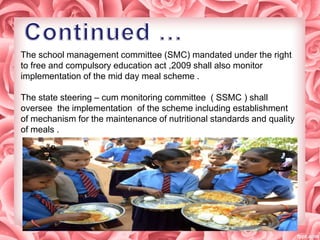
The school management committee (SMC) mandated under the right
to free and compulsory education act ,2009 shall also monitor
implementation of the mid day meal scheme .
The state steering – cum monitoring committee ( SSMC ) shall
oversee the implementation of the scheme including establishment
of mechanism for the maintenance of nutritional standards and quality
of meals .
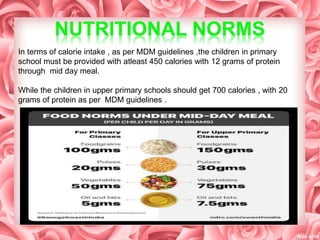
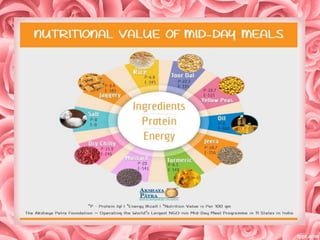
In terms of calorie intake , as per MDM guidelines ,the children in primary
school must be provided with atleast 450 calories with 12 grams of protein
through mid day meal.
While the children in upper primary schools should get 700 calories , with 20
grams of protein as per MDM guidelines .
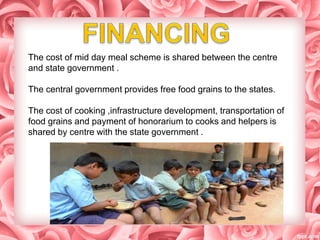
The cost of mid day meal scheme is shared between the centre
and state government .
The central government provides free food grains to the states.
The cost of cooking ,infrastructure development, transportation of
food grains and payment of honorarium to cooks and helpers is
shared by centre with the state government .
“AKSHAYA PATRA “ work under leadership of ISKON is now serving
mid day meal to almost to a million children everyday .
Software companies and NGO’s like INFOSYS , BHARTI, JINDAL
,NAADI foundation etc are major contributors to mid day meal
scheme.
1. Promoting school participation
2. Preventing classroom hunger
3. Facilitating the healthy growth of children
4. Ensuring psychological benefits
5. Enhancing gender equity
6. Address malnutrition .
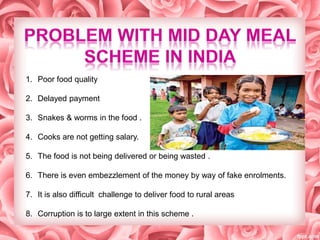
1. Poor food quality
2. Delayed payment
3. Snakes & worms in the food .
4. Cooks are not getting salary.
5. The food is not being delivered or being wasted .
6. There is even embezzlement of the money by way of fake enrolments.
7. It is also difficult challenge to deliver food to rural areas
8. Corruption is to large extent in this scheme .
In conclusion it can be said that school meal programme is very
vital in a school system ,and if guided religiously can be beneficial
not only to the students but also to the families ,communities and
the nation in general.
Dr.APJ Abdul Kalam said regarding mid day meal scheme – “this is
a very important and great mission …..”
Former Prime Minister Atal Bihari Vajpayee message regarding mid
day meal program – “ the scale of the program is truly impressive .”
Uma,H.R.& Manohar,K.(2012).mid day meal program : a study of
primary school in mysore district.LAP Lambert publishing.
Pathania,A & Pathania,K.(2006) . Primary education and mid day
meal scheme . New Delhi . Deep & Deep Publications.
Sikligar,P.C.(2011) .Mid day meal scheme and school education.
Concept Publishing.
MID DAY MEAL SCHEME

MID DAY MEAL SCHEME

  • 2.
    CONTENTS # introduction # historyof mid day meal scheme # objectives of MDM scheme # about MDM scheme # MDM rules 2015 # nutritional norms of MDM scheme # MDM scheme menu # financing of MDM scheme # private sector participation in MDMS # benefits of MDM scheme # problems with MDM scheme in india # conclusion # references
  • 3.
    The Mid DayMeal Scheme (MDMS) is a school meal programme of government of india designed to better the nutritional standing of school age children nationwide. The programme supplies free lunches on working days for children in primary and upper class in government schools. Mid day meal scheme serves 120,000,000 children in over 1,265,000 schools and education guarantee scheme centres . The mid day meal scheme is world’s largest school meal programme.
  • 4.
    Mid day mealin school has long history in india . In 1925, a mid day meal programme was introduced for disadvantaged children in in madras municipal corporation . . By the mid 1980 , three states , GUJRAT , KERALA, TAMIL NADU & union territory of PONDICHERRY has universalizes cooked mid day meal programme. With the view to enchancing enrollment,retention,attendance and simultaneously improving nutritional level among children , the national programme of nutritional support to primary education ( NP- NSPE), was launched as centrally sponsored scheme on 15 august 1995 intially in 2408 blocks in the country.
  • 5.
    By the year1997 -98 , the NP-NSPE was introduced in all blocks of the country . In 2002 , it was further extended to cover not only children in class I – V of government or aided schools but also children studying in EGS & AIE centres .
  • 6.
    1. Boost studentsenrolment. 2. Promote students attendance. 3. To provide hot cooked meal with high nutritional value . 4. Attracting children who are reluctant to go to school . 5. Promote overall growth of children.
  • 7.
    Mid day mealscheme guarantees one meal to all children in in government , aided schools and madarsas supported under “SAMAGRA SHIKSHA” . Students upto class 8th are guaranteed one nutritional cooked meal at least 200 days in a year . The scheme comes under ministry of HRD. It was launched in year 1995 as national program of nutritional support to primary education ( NP NSPE) . IN 2004 , the scheme was relaunched as the mid day meal scheme ( MDMS).
  • 8.
    The place ofserving meal to the children shall be school only. If the mid day meal is not provided in the school on any school day due to non availability of food grains or any other reasons , the state government shall pay food security allowance by 15th of the suceeding month. The mid day meal shall be prepared in accordance with the mid day meal guidelines issued by central government from time to time . Procuring “AGMARK” quality items for the preparation of mid day meals. Tasting of meals by two or three adult members of the school management committee , including atleast one teacher , before serving to children.
  • 9.
    The school managementcommittee (SMC) mandated under the right to free and compulsory education act ,2009 shall also monitor implementation of the mid day meal scheme . The state steering – cum monitoring committee ( SSMC ) shall oversee the implementation of the scheme including establishment of mechanism for the maintenance of nutritional standards and quality of meals .
  • 10.
    In terms ofcalorie intake , as per MDM guidelines ,the children in primary school must be provided with atleast 450 calories with 12 grams of protein through mid day meal. While the children in upper primary schools should get 700 calories , with 20 grams of protein as per MDM guidelines .
  • 13.
    The cost ofmid day meal scheme is shared between the centre and state government . The central government provides free food grains to the states. The cost of cooking ,infrastructure development, transportation of food grains and payment of honorarium to cooks and helpers is shared by centre with the state government .
  • 14.
    “AKSHAYA PATRA “work under leadership of ISKON is now serving mid day meal to almost to a million children everyday . Software companies and NGO’s like INFOSYS , BHARTI, JINDAL ,NAADI foundation etc are major contributors to mid day meal scheme.
  • 15.
    1. Promoting schoolparticipation 2. Preventing classroom hunger 3. Facilitating the healthy growth of children 4. Ensuring psychological benefits 5. Enhancing gender equity 6. Address malnutrition .
  • 16.
    1. Poor foodquality 2. Delayed payment 3. Snakes & worms in the food . 4. Cooks are not getting salary. 5. The food is not being delivered or being wasted . 6. There is even embezzlement of the money by way of fake enrolments. 7. It is also difficult challenge to deliver food to rural areas 8. Corruption is to large extent in this scheme .
  • 17.
    In conclusion itcan be said that school meal programme is very vital in a school system ,and if guided religiously can be beneficial not only to the students but also to the families ,communities and the nation in general. Dr.APJ Abdul Kalam said regarding mid day meal scheme – “this is a very important and great mission …..” Former Prime Minister Atal Bihari Vajpayee message regarding mid day meal program – “ the scale of the program is truly impressive .”
  • 18.
    Uma,H.R.& Manohar,K.(2012).mid daymeal program : a study of primary school in mysore district.LAP Lambert publishing. Pathania,A & Pathania,K.(2006) . Primary education and mid day meal scheme . New Delhi . Deep & Deep Publications. Sikligar,P.C.(2011) .Mid day meal scheme and school education. Concept Publishing.