
ANAESTHESIA FOR
THORACOSCOPIC SURGERY
DR ZIKRULLAH
introduction
• Thoracoscopy is minimally invasive thoracic
surgery performed with the use of small fiber
optic cameras to look inside the chest. it is
also known by the initials VATS, or Video
Assisted Thoracic Surgery.
• it is performed using small incisions and small
instruments to examine the inside of the chest
and to perform limited operations inside the
chest.
• The approach was initially used for simple
diagnostic and therapeutic procedures
involving the pleura, lungs, and mediastinum.
• However, it has replaced many procedures
that formerly required thoracotomy. For
example , pulmonary operations using VATS
have evolved from simple wedge and
segmental resections to complete lobectomy.
• Nowadays a large number of surgeries are
being performed using this approach . The list
includes:
• General intrathoracic cavity
-Diagnosis or biopsy of any intrathoracic
structure
-Laser application for treatment of tumors
-Diagnosis and drainage of pleural effusion
-Treat chylothorax
-Debride empyema Retrieval of intrathoracic
foreign body)
• Lungs
-Wedge resection
-Segmentectomy
-Lobectomy
-Closure of persistent/recurrent pneumothorax
-Identification of broncho-pleural fistula)
• Pleura
-Lysis of adhesions
-Pleurodonesis
-Decortication
• Mediastinum
-Removal of mediastinal cysts
-Thymectomy
-Resection of posterior mediastinal neurogenic
tumors
• Esophagus and diaphragm
-Tumor staging or resection
-Resection of esophagus
-Repair diaphragm
-Anti-reflux operations
• Heart and great vessels
-Pericardectomy
-Diagnosis of cardiac herniation after
pneumonectomy
-Minimally invasive valve and coronary artery
procedures
-Ligation of patent ductus (infants)
• Spine and nerve
-Dorsal thoracic sympathectomy
-SplanchnicolysisDrainage of spinal abscess
-Discectomy
-Fusion and correction of spinal deformity)
• Trauma
-Assess injury
-Treat hemorrhage
-Evacuation of clot
• The surgical approach to thoracoscopy
involves creating a small (2 ±3 cm) incision in
the lateral chest wall with the patient in the
lateral decubitus position.
• Although minor operations (thoracocentesis,
pleural biopsy) can be performed through a
single incision, two or three additional small
incisions are usually made to allow the
application of surgical instruments and
stapling devices.
• A trocar is introduced into the chest cavity
after the lung on that side has been selectively
collapsed. The thoracoscope is then placed
through the trocar into chest. At the
conclusion of the procedure a chest drainage
tube is inserted and the lung is re-expanded.
Pre-operative evaluation
.
• The preoperative evaluation of the patient
undergoing thoracoscopy is, at its basis, the
same as all preoperative evaluations. Its goal is
to define all of the patient's problems and to
elucidate whether the patient is in the best
possible condition, considering each of these
problems.
• However, the question that arises is: does
changing the nature of the surgery from
thoracotomy to thoracoscopy change the nature
of the preoperative evaluation?
• The most aggressive workups for patients
presenting for thoracotomy are of the
respiratory and cardiovascular systems
• A preoperative evaluation of the respiratory
system includes history taking, physical
examination, common laboratory tests,
radiography and pulmonary function tests.
• Considering the usual age, long and heavy
smoking history, and the frequently sedentary
life-style of patients undergoing thoracic
surgery,the cardiovascular system must be
properly evaluated before thoracoscopy .The
workup should proceed, as in the pulmonary
evaluation, from the least to the most invasive
test, as indicated.
Pre-operative preparation
• Thoracic surgical patients are at high risk of
suffering postoperative pulmonary
complications for following reasons:
1.the incidence of postoperative comlications
after any surgical intervention is positively
correlated with the degree of preoperative
respiratory dysfunction.
2.Thoracoscopic procedures can themselves
impair lung function in any patient.
3.The third cause of increased pulmonary
complications relates to postoperative pain.
These patients resist deep breathing and
coughing, leading to retained secretions,
atelectasis, and pneumonia.
• Preoperative respiratory preparation is
directed towards optimally managing any
preexisting pulmonary disease, stopping
smoking, dilating airways, loosening and
removing secretions, and taking measures to
increase patient motivation and education to
facilitate postoperative care.
Monitoring requirements
• In patients with no significant
cardiopulmonary disease, the patient’s
oxygenation, ventilation, circulation, and
temperature should be continually evaluated.
• Patients with preexisting cardiopulmonary
disease should have basic monitoring plus an
arterial line. Deserving of special
consideration is central venous pressure and
pulmonary artery catheterization
• Certain special monitors may be required
depending upon surgery, as one example,
during thoracoscopic procedures for the
treatment of pericardial disease or cardiac
tamponade, adequate visualization of the
extent of pericardial resection or drainage is
constrained. Transesophageal
echocardiography may add considerable
information in this instance
Position of the patient
• Most common position used for thoacoscopy
is lateral decubitus position, operative side
being non-dependant, with dependant arm
flexed at elbow and non-dependant arm
extended at elbow and abducted over head.
• A pillow is kept under non dependant armpit
to stabilize position and enhance visualisation.
Choice of anaesthesia
• Thoracoscopy may be performed with local,
regional, or general anesthesia. The choice is
based on the patient’s safety and comfort.
Local / regional anaesthesia
• Local anesthetic infiltration of the lateral thoracic
wall and parietal pleura is the simplest way to
provide anesthesia for thoracoscopy.
• Intercostal nerve blocks or thoracic epidural
anesthesia at the level of the incision may
provide for more complete analgesia. The
addition of an ipsilateral stellate ganglion block
helps to inhibit the cough reflex that is
sometimes elicited during visualization and
manipulation of the hilum.
• During local or regional anesthesia, partial
collapse of the lung on the operated side
occurs when air enters the pleural cavity,
allowing for good visualization of the pleural
space.
• the spontaneously ventilating patient with an
open chest in the LDP may have impaired gas
exchange due to paradoxical respiration and
mediastinal shift. It is therefore prudent to
furnish the patient with supplemental oxygen
and to keep the surgical procedure short
• However,If the patient does not tolerate the
procedure or the procedure needs to be
converted to a thoracotomy, the awake
patient in the LDP presents a challenge to the
anesthesiologist attempting to induce general
anesthesia.
General anaesthesia
• General anesthesia is appropriate for most
modern thoracoscopies, due to their length and
complexity.
• Controlled positive-pressure ventilation abolishes
the ventilatory and circulatory changes
associated with mediastinal shift and prevents
paradoxical respiration.
• With general anaesthesia, the surgery can be
extended both in terms of time and complexity
without posing great danger to the patient.
• General anesthesia for thoracoscopy is a
relative indication with a high priority for one-
lung ventilation.
• double-lumen endotracheal tubes, in general,
are favored over bronchial blockers for the
purpose of lung separation.this is due to
limited ability of bronchial blockers to
facilitate the creation of a pneumothorax on
initial placement of the operative trocars.
• However, the lateral decubitus position of
thorascopy poses a very specific problem of
ventilation perfusion mismatch during general
anaesthesia.
• It arises due to better ventilation of non
dependant lung during general anaesthesia as
opposed to better ventilation of dependant
lung during awake state.despite this change in
ventilation,perfusion always favours
dependant lung, causing significant
ventilation perfusion mismatch during general
anaesthesia.
• This mismatch may result in significant
hypoxemia, to avoid the same, duration of one
lung ventilation should be kept as short as
possible and 1oo% oxygen should be
administered.the monitors should be carefully
watched and the anaesthesiologist must keep
himself ready to manage any event of
hypoxemia.
• Hypoxemia during one lung ventilation can be
managed with one or more of following
interventions:
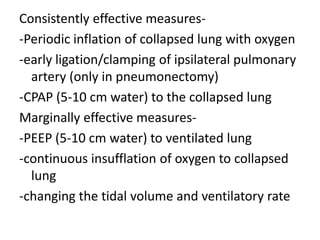
Consistently effective measures-
-Periodic inflation of collapsed lung with oxygen
-early ligation/clamping of ipsilateral pulmonary
artery (only in pneumonectomy)
-CPAP (5-10 cm water) to the collapsed lung
Marginally effective measures-
-PEEP (5-10 cm water) to ventilated lung
-continuous insufflation of oxygen to collapsed
lung
-changing the tidal volume and ventilatory rate
• First step to be taken in event of hypoxemia is
application of CPAP to the collapsed lung,
followed by application of PEEP to ventilated
lung.
• Persistant hypoxemia despite these measures
requires immediate re-expansion of collapsed
lung.
• Alternatives to one lung ventilation include
apneic oxygenation (in which 100% oxygen is
insufflated at rate greater than oxygen
consumption) and high frequency jet
ventilation.
• A variety of general anesthesia techniques can
be used successfully for thoracoscopic
procedures. The chosen technique must allow
for the administration of 100% oxygen and
also allow for early extubation without pain
and without decreasing hemodynamic
function and arterial oxygenation.
• Intubated patients who are in respiratory
failure or patients with severe preexisting
pulmonary disease may not be good
candidates for early weaning and extubation.
Post operative care
• A remarkable decrease in post-operative
complictions is greatest advantage
thoracoscopy has over thoracotomy.
• thoracoscopy patients are spared a great deal
of postoperative pain and respiratory
dysfunction, and this leads to reduced
morbidity and shortened hospitalization.
• A variety of techniques can be used to help
reduce postoperative pulmonary complications.
Incentive spirometry is an ideal respiratory care
maneuver.
• Both maintaining the patient in an upright
position while in bed and early ambulation
augment the FRC and help restore a favorable
FRC-closing volume relationship.
• Percussion and postural drainage aid in the
mobilization of secretions in patients with chronic
bronchitis.
• continuing the administration of
bronchodilating drugs or steroids that were
given preoperatively is important in
maintaining reactive airways quiescent.
• Orally administered analgesics are effective for
the relief of post-thoracoscopy pain,
particularly when a chest tube has not been
placed or after its removal if one was placed.
Potent nonsteroidal antiinflammatory drugs
(NSAIDs) are effective, either by themselves or
as adjuncts to narcotics. NSAIDs such as
ibuprofen and ketorolac are given
continuously, with narcotics supplied as
needed for further pain relief.
• Regional analgesia is usually unnecessary in
patients who undergo simple thoracoscopy
procedures, but can provide superior pain
relief when used.It is almost always instituted
at the end of the procedure when it has been
necessary to convert a thoracoscopy to a
thoracotomy .
• Alternatives to epidural analgesia would be
continuous intercostal nerve blocks or
cryoanalgesia.
THANK YOU

Anaesthesia for thoracoscopic surgery

  • 1.
  • 2.
    introduction • Thoracoscopy isminimally invasive thoracic surgery performed with the use of small fiber optic cameras to look inside the chest. it is also known by the initials VATS, or Video Assisted Thoracic Surgery. • it is performed using small incisions and small instruments to examine the inside of the chest and to perform limited operations inside the chest.
  • 3.
    • The approachwas initially used for simple diagnostic and therapeutic procedures involving the pleura, lungs, and mediastinum. • However, it has replaced many procedures that formerly required thoracotomy. For example , pulmonary operations using VATS have evolved from simple wedge and segmental resections to complete lobectomy.
  • 4.
    • Nowadays alarge number of surgeries are being performed using this approach . The list includes: • General intrathoracic cavity -Diagnosis or biopsy of any intrathoracic structure -Laser application for treatment of tumors -Diagnosis and drainage of pleural effusion -Treat chylothorax -Debride empyema Retrieval of intrathoracic foreign body)
  • 5.
    • Lungs -Wedge resection -Segmentectomy -Lobectomy -Closureof persistent/recurrent pneumothorax -Identification of broncho-pleural fistula) • Pleura -Lysis of adhesions -Pleurodonesis -Decortication
  • 6.
    • Mediastinum -Removal ofmediastinal cysts -Thymectomy -Resection of posterior mediastinal neurogenic tumors • Esophagus and diaphragm -Tumor staging or resection -Resection of esophagus -Repair diaphragm -Anti-reflux operations
  • 7.
    • Heart andgreat vessels -Pericardectomy -Diagnosis of cardiac herniation after pneumonectomy -Minimally invasive valve and coronary artery procedures -Ligation of patent ductus (infants) • Spine and nerve -Dorsal thoracic sympathectomy -SplanchnicolysisDrainage of spinal abscess -Discectomy -Fusion and correction of spinal deformity)
  • 8.
    • Trauma -Assess injury -Treathemorrhage -Evacuation of clot • The surgical approach to thoracoscopy involves creating a small (2 ±3 cm) incision in the lateral chest wall with the patient in the lateral decubitus position.
  • 9.
    • Although minoroperations (thoracocentesis, pleural biopsy) can be performed through a single incision, two or three additional small incisions are usually made to allow the application of surgical instruments and stapling devices. • A trocar is introduced into the chest cavity after the lung on that side has been selectively collapsed. The thoracoscope is then placed through the trocar into chest. At the conclusion of the procedure a chest drainage tube is inserted and the lung is re-expanded.
  • 10.
    Pre-operative evaluation . • Thepreoperative evaluation of the patient undergoing thoracoscopy is, at its basis, the same as all preoperative evaluations. Its goal is to define all of the patient's problems and to elucidate whether the patient is in the best possible condition, considering each of these problems. • However, the question that arises is: does changing the nature of the surgery from thoracotomy to thoracoscopy change the nature of the preoperative evaluation?
  • 11.
    • The mostaggressive workups for patients presenting for thoracotomy are of the respiratory and cardiovascular systems • A preoperative evaluation of the respiratory system includes history taking, physical examination, common laboratory tests, radiography and pulmonary function tests.
  • 12.
    • Considering theusual age, long and heavy smoking history, and the frequently sedentary life-style of patients undergoing thoracic surgery,the cardiovascular system must be properly evaluated before thoracoscopy .The workup should proceed, as in the pulmonary evaluation, from the least to the most invasive test, as indicated.
  • 13.
    Pre-operative preparation • Thoracicsurgical patients are at high risk of suffering postoperative pulmonary complications for following reasons: 1.the incidence of postoperative comlications after any surgical intervention is positively correlated with the degree of preoperative respiratory dysfunction. 2.Thoracoscopic procedures can themselves impair lung function in any patient.
  • 14.
    3.The third causeof increased pulmonary complications relates to postoperative pain. These patients resist deep breathing and coughing, leading to retained secretions, atelectasis, and pneumonia. • Preoperative respiratory preparation is directed towards optimally managing any preexisting pulmonary disease, stopping smoking, dilating airways, loosening and removing secretions, and taking measures to increase patient motivation and education to facilitate postoperative care.
  • 15.
    Monitoring requirements • Inpatients with no significant cardiopulmonary disease, the patient’s oxygenation, ventilation, circulation, and temperature should be continually evaluated. • Patients with preexisting cardiopulmonary disease should have basic monitoring plus an arterial line. Deserving of special consideration is central venous pressure and pulmonary artery catheterization
  • 16.
    • Certain specialmonitors may be required depending upon surgery, as one example, during thoracoscopic procedures for the treatment of pericardial disease or cardiac tamponade, adequate visualization of the extent of pericardial resection or drainage is constrained. Transesophageal echocardiography may add considerable information in this instance
  • 17.
    Position of thepatient • Most common position used for thoacoscopy is lateral decubitus position, operative side being non-dependant, with dependant arm flexed at elbow and non-dependant arm extended at elbow and abducted over head. • A pillow is kept under non dependant armpit to stabilize position and enhance visualisation.
  • 18.
    Choice of anaesthesia •Thoracoscopy may be performed with local, regional, or general anesthesia. The choice is based on the patient’s safety and comfort.
  • 19.
    Local / regionalanaesthesia • Local anesthetic infiltration of the lateral thoracic wall and parietal pleura is the simplest way to provide anesthesia for thoracoscopy. • Intercostal nerve blocks or thoracic epidural anesthesia at the level of the incision may provide for more complete analgesia. The addition of an ipsilateral stellate ganglion block helps to inhibit the cough reflex that is sometimes elicited during visualization and manipulation of the hilum.
  • 20.
    • During localor regional anesthesia, partial collapse of the lung on the operated side occurs when air enters the pleural cavity, allowing for good visualization of the pleural space. • the spontaneously ventilating patient with an open chest in the LDP may have impaired gas exchange due to paradoxical respiration and mediastinal shift. It is therefore prudent to furnish the patient with supplemental oxygen and to keep the surgical procedure short
  • 21.
    • However,If thepatient does not tolerate the procedure or the procedure needs to be converted to a thoracotomy, the awake patient in the LDP presents a challenge to the anesthesiologist attempting to induce general anesthesia.
  • 22.
    General anaesthesia • Generalanesthesia is appropriate for most modern thoracoscopies, due to their length and complexity. • Controlled positive-pressure ventilation abolishes the ventilatory and circulatory changes associated with mediastinal shift and prevents paradoxical respiration. • With general anaesthesia, the surgery can be extended both in terms of time and complexity without posing great danger to the patient.
  • 23.
    • General anesthesiafor thoracoscopy is a relative indication with a high priority for one- lung ventilation. • double-lumen endotracheal tubes, in general, are favored over bronchial blockers for the purpose of lung separation.this is due to limited ability of bronchial blockers to facilitate the creation of a pneumothorax on initial placement of the operative trocars.
  • 24.
    • However, thelateral decubitus position of thorascopy poses a very specific problem of ventilation perfusion mismatch during general anaesthesia. • It arises due to better ventilation of non dependant lung during general anaesthesia as opposed to better ventilation of dependant lung during awake state.despite this change in ventilation,perfusion always favours dependant lung, causing significant ventilation perfusion mismatch during general anaesthesia.
  • 25.
    • This mismatchmay result in significant hypoxemia, to avoid the same, duration of one lung ventilation should be kept as short as possible and 1oo% oxygen should be administered.the monitors should be carefully watched and the anaesthesiologist must keep himself ready to manage any event of hypoxemia. • Hypoxemia during one lung ventilation can be managed with one or more of following interventions:
  • 26.
    Consistently effective measures- -Periodicinflation of collapsed lung with oxygen -early ligation/clamping of ipsilateral pulmonary artery (only in pneumonectomy) -CPAP (5-10 cm water) to the collapsed lung Marginally effective measures- -PEEP (5-10 cm water) to ventilated lung -continuous insufflation of oxygen to collapsed lung -changing the tidal volume and ventilatory rate
  • 27.
    • First stepto be taken in event of hypoxemia is application of CPAP to the collapsed lung, followed by application of PEEP to ventilated lung. • Persistant hypoxemia despite these measures requires immediate re-expansion of collapsed lung. • Alternatives to one lung ventilation include apneic oxygenation (in which 100% oxygen is insufflated at rate greater than oxygen consumption) and high frequency jet ventilation.
  • 28.
    • A varietyof general anesthesia techniques can be used successfully for thoracoscopic procedures. The chosen technique must allow for the administration of 100% oxygen and also allow for early extubation without pain and without decreasing hemodynamic function and arterial oxygenation. • Intubated patients who are in respiratory failure or patients with severe preexisting pulmonary disease may not be good candidates for early weaning and extubation.
  • 29.
    Post operative care •A remarkable decrease in post-operative complictions is greatest advantage thoracoscopy has over thoracotomy. • thoracoscopy patients are spared a great deal of postoperative pain and respiratory dysfunction, and this leads to reduced morbidity and shortened hospitalization.
  • 30.
    • A varietyof techniques can be used to help reduce postoperative pulmonary complications. Incentive spirometry is an ideal respiratory care maneuver. • Both maintaining the patient in an upright position while in bed and early ambulation augment the FRC and help restore a favorable FRC-closing volume relationship. • Percussion and postural drainage aid in the mobilization of secretions in patients with chronic bronchitis.
  • 31.
    • continuing theadministration of bronchodilating drugs or steroids that were given preoperatively is important in maintaining reactive airways quiescent.
  • 32.
    • Orally administeredanalgesics are effective for the relief of post-thoracoscopy pain, particularly when a chest tube has not been placed or after its removal if one was placed. Potent nonsteroidal antiinflammatory drugs (NSAIDs) are effective, either by themselves or as adjuncts to narcotics. NSAIDs such as ibuprofen and ketorolac are given continuously, with narcotics supplied as needed for further pain relief.
  • 33.
    • Regional analgesiais usually unnecessary in patients who undergo simple thoracoscopy procedures, but can provide superior pain relief when used.It is almost always instituted at the end of the procedure when it has been necessary to convert a thoracoscopy to a thoracotomy . • Alternatives to epidural analgesia would be continuous intercostal nerve blocks or cryoanalgesia.
  • 34.