
ANAESTHESIA FOR SICK
LAPAROTOMY
Dr. ZIKRULLAH
1
 Anaesthesia in emergency laparotomy situations is
provided by experienced and competent
anaesthetists.
 They are rarely involved in preoperative
management and frequently only meet the critically
ill patient in theatre.
 Preoperative management is usually prescribed by
a surgeon or general physician.
2
 Patient presenting for emergency laparotomy can be of
any age, neonates to elderly.
 Patients usually present late, after they have taken
some form of local treatment, which chiefly includes
herbal medicines mixed with lots of heavy metals and
steroids.
 Co-morbid conditions should also be taken in account
like – Diabetes mellitus,hypertension,thyroid
conditions,CAD.
 In spite of the correct surgical diagnosis, the critical
condition of these patients is frequently not recognised.
3
 Common causes of sick laparotomies –
 Perforation peritonitis
 AIO
 SAIO
 Blunt trauma abdomen
 Penetrating abdominal injuries like stab wound and
gun shot injuries.
4
Problems in sick laparotomies :
 Sepsis
 Profound dehydration,
 Hypovolaemia & pre renal ARF
 Respiratory compromise
 Electrolyte imbalances and
 Acidosis which are often overlooked and not
corrected.
5
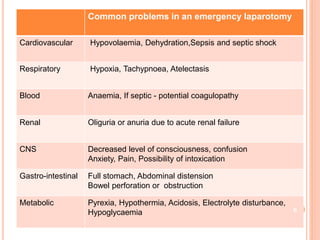
Common problems in an emergency laparotomy
Cardiovascular Hypovolaemia, Dehydration,Sepsis and septic shock
Respiratory Hypoxia, Tachypnoea, Atelectasis
Blood Anaemia, If septic - potential coagulopathy
Renal Oliguria or anuria due to acute renal failure
CNS Decreased level of consciousness, confusion
Anxiety, Pain, Possibility of intoxication
Gastro-intestinal Full stomach, Abdominal distension
Bowel perforation or obstruction
Metabolic Pyrexia, Hypothermia, Acidosis, Electrolyte disturbance,
Hypoglycaemia 6
 As a result perioperative mortality in this group of
patients is very high. These patients sometimes
require more then 10 litres of intravenous fluids in
first 24 hours (excluding intra-operative fluids) and
medical and nursing staff may lack the confidence
to infuse such volumes.
7
 However treating this group of patients with
aggressive resuscitation reduces the mortality
significantly.
 So it is very important to encourage the
perioperative team (anaesthetists and non-
anaesthetists) to provide effective pre-operative
preparation of critically ill patients.
8
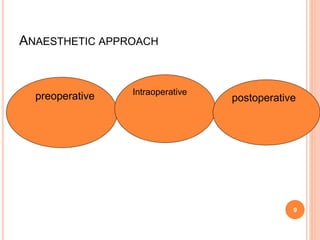
ANAESTHETIC APPROACH
9
 preoperative Intraoperative
postoperative
 Patient presentation
 Patients presenting with abdominal emergencies for
laparotomies often come to hospitals very late.
 They have often been sick for some days with a
perforated or obstructed bowel.
 It is extremely important to establish the duration of
their disease, as this can give some idea of the
degree of dehydration and electrolyte imbalance.
10
DEHYDRATION
Reasons for dehydration include:
 no oral intake especially in children
 vomiting/ diarrhoea
 fever
 high environmental temperature
 third space loss (fluid in the body which is not
available to the circulation for example oedema,
ascites or other collections).
11
12
 When taking the history enquire specifically about the
oral intake,vomiting/diarrhoea,fever and also the colour
and amount of urine over the last day as profound
dehydration and hypovolaemia will result in oliguria or
even anuria.
Physical examination
 The ABCD framework should be used for both
examination and initial management.
 Airway can be a problem so should be checked in
every patient.
Rapid Airway Assessment
 LEMON law
 1,2,3 rule
 Breathing - an increased respiratory rate (RR) is an
early warning sign caused by acidosis or hypoxia and is
often ignored.
 Tachypnoea can also be caused by pain, anxiety or
pyrexia.
 Check the oxygen saturation and record respiratory rate
regularly.
13
 Circulation - the cardiovascular system is usually
significantly compromised due to hypovolaemia.
Assess:
 heart rate (HR)
 blood pressure (BP)
 pulse - is it weak or well filled?
 capillary refill time; make sure it is done properly -
press for 5s (count to 5) then release the pressure
and count refill time.
This sign is very accurate in children and young
adults, less reliable in very anaemic or old patients. 14
 core - peripheral temperature gradient –
 check the difference between the temperature of
the trunk, which is usually hot (pyrexia) and the
extremities which are cold (vasoconstriction).
 This is a very good indicator of the intravascular
volume; especially useful to observe the trend - the
difference should reduce during resuscitation.
15
 degree of dehydration –
 severe thirst, decreased skin turgor, dry tongue,
sunken eyes, sunken fontanelle in a newborn.
 However, decreased skin turgor or sunken eyes
may be masked by oedema resulting from
hypoalbuminaemia.
16
 Disability - assess the mental status; adult patients
can be apathetic occasionally agitated; children can
fluctuate between being apathetic and agitated.
 Document all of your findings on an appropriate
chart.
17
ACIDOSIS
 Increasing risk of death with metabolic acidosis as
demonstrated by arterial pH, lactate, and base
deficit clearance.
The deleterious effects of acidosis -
 CVS - decreased cardiac contractility and cardiac
output,vasodilation and hypotension,bradycardia,
and increased susceptibility to ventricular
dysrhythmias.
 Decreased hepatic and renal blood flow.
 Acidosis directly reduces the activity of the extrinsic
and intrinsic coagulation pathways. 18
 These adverse effects are generally not seen until
pH decreases below 7.2.
 Pre op ABG is important to evaluate the PaO2 &
pH.
 Therapy for metabolic acidosis remains directed
toward correcting the underlying hypoperfusion.
 Resuscitation endpoints include normalization of
arterial pH, base deficit, and lactate.
19
 Bicarbonate administration should be deferred until
the pH persists below 7.15, despite optimal fluid
loading and inotropic support.
20
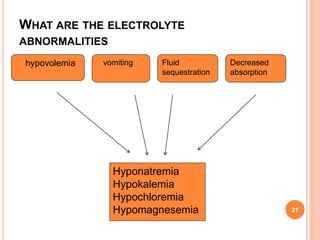
WHAT ARE THE ELECTROLYTE
ABNORMALITIES
21
 hypovolemia vomiting Fluid
sequestration
Decreased
absorption
Hyponatremia
Hypokalemia
Hypochloremia
Hypomagnesemia
22
 In all cases of dehydration due to bowel obstruction there
is a total body deficit of Na+ and water and therefore
whatever the Na+ concentration (i.e. whether the patient
is hyponatremic or hypernatremic) replacement needs to
be with a fluid with a high Na+ content (0.9% saline or
ringer lactate).
 Correct fluid deficit according to U.O., CVP,Vitals etc to
achieve normovolemia.
23
 K+ should be added to the fluid if necessary
(usually 20-40mmol/l provided the patient is not
anuric or hyperkalaemic).
 The aim should be to correct the dehydration over
24 hours, giving half the calculated amount in the
first 8 hours and the second half over the following
16 hours.
 If the patient is very hypernatremic (Na+ >
155mmol/ l) rehydration should be done slowly
because of the risk of cerebral oedema.
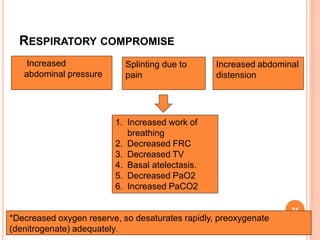
RESPIRATORY COMPROMISE
24
Increased
abdominal pressure
Splinting due to
pain
Increased abdominal
distension
1. Increased work of
breathing
2. Decreased FRC
3. Decreased TV
4. Basal atelectasis.
5. Decreased PaO2
6. Increased PaCO2
*Decreased oxygen reserve, so desaturates rapidly, preoxygenate
(denitrogenate) adequately.
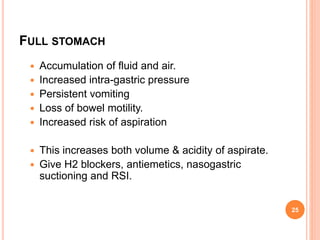
FULL STOMACH
 Accumulation of fluid and air.
 Increased intra-gastric pressure
 Persistent vomiting
 Loss of bowel motility.
 Increased risk of aspiration
 This increases both volume & acidity of aspirate.
 Give H2 blockers, antiemetics, nasogastric
suctioning and RSI.
25
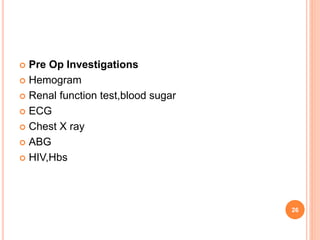
 Pre Op Investigations
 Hemogram
 Renal function test,blood sugar
 ECG
 Chest X ray
 ABG
 HIV,Hbs
26
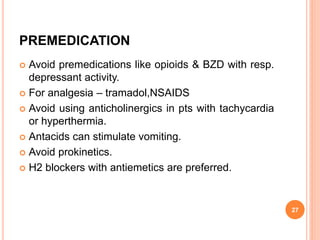
PREMEDICATION
 Avoid premedications like opioids & BZD with resp.
depressant activity.
 For analgesia – tramadol,NSAIDS
 Avoid using anticholinergics in pts with tachycardia
or hyperthermia.
 Antacids can stimulate vomiting.
 Avoid prokinetics.
 H2 blockers with antiemetics are preferred.
27
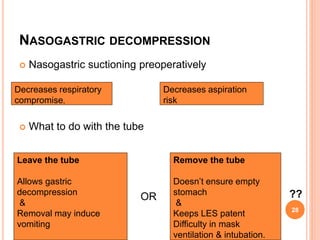
NASOGASTRIC DECOMPRESSION
 Nasogastric suctioning preoperatively
 What to do with the tube
28
Decreases respiratory
compromise,
Decreases aspiration
risk
Leave the tube
Allows gastric
decompression
&
Removal may induce
vomiting
Remove the tube
Doesn’t ensure empty
stomach
&
Keeps LES patent
Difficulty in mask
ventilation & intubation.
OR ??
 Management
 The main purpose of the preoperative treatment
is to optimise the patient’s condition and maximise
their chance of survival.
 Early effective resuscitation improves oxygen
delivery to the tissues and reduces mortality in this
group of patients.
29
 Preoperative resuscitation obviously takes time but
long delays before surgery should be avoided as
early surgical management improves the outcome
in septic patients.
 The preoperative plan should be discussed
between the surgical and anaesthetic teams to
achieve the right balance between providing
adequate resuscitation and the risk of delaying
surgery.
 Most patients will benefit from 2-4hours
preoperative resuscitation.
 The best area to carry out resuscitation is ICU/HDU
if available. 30
 Make a management plan following the ABC
framework.
 Airway and Breathing
 Provide oxygen with the face mask at 2-4 l/min
 Circulation
 insert iv cannula, preferably 16G or 2x 18G
 take a sample for Hb, electrolytes and consider
crossmatching (see below).
 Infuse first litre of normal saline or ringer lactate
rapidly over 15 min. During the following hour give
2000mls,watching clinical signs. 31
 Insert Foley catheter; measure and record the initial
amount and colour (concentration) of urine in the
bag and discard it.
 Crossmatching is essential as the patient may be
severely anaemic, and the “normal” Hb level is due
to haemoconcentration caused by severe
dehydration & hypovolemia.
32
Further treatment
 request urgent surgical opinion.
 if abdominal X-ray requested by surgeon, and
patient is very sick make sure that he/she is
transported to X- ray department on a stretcher or
wheel-chair and iv fluids are continued. If possible
accompany the patient.
 antibiotics prescribed should be administered iv as
soon as possible
 insert NG tube
 check temperature 33
 Further management
 Assess the patient after each 1 - 2 l of fluids. Whenever
possible warm the fluids even if patient is pyrexial. Use
either crystalloids and colloids, but avoid glucose 5 or
10%.
 Ringer lactate seems slightly better then normal saline
as it results in less hyperchloraemic acidosis.
 The correct volume of fluid is more important then the
type.
 When the initial resuscitation is completed, potassium
containing fluids (20mmol KCl /litre) may be used
providing there is an adequate urine output.
34
 Assessment of progress of resuscitation involves
assessment of:
 HR
 BP
 capillary refill time
 RR
 Improving peripheral temperature
 filling of neck veins
 urine output
 CVP monitoring
35
 What about inotropes?
 Noradrenaline & dopamine are frequently used in to
treat sick patients with abdominal emergencies.
36
 Patients who do not respond to fluid resuscitation
and require an inotrope infusion have a very high
mortality and are often in an irreversible clinical
situation.
 Inotropes can also divert attention from providing
adequate fluid resuscitation by increasing the blood
pressure without adequate volume expansion.
 In cases of septic shock, adrenaline or
noradrenaline can be used provided adequate fluid
administration has been achieved.
37
 Electrolyte imbalance
 K+ levels are important as cardiac arrhythmias
may result from hypo or hyperkalaemia. Sick
patients are normally depleted due to K+ loss from
diarrhoea and third space losses.
 However, anuric patients are at risk of
hyperkalaemia.
 After initial resuscitation, when the patient is
passing good volumes of urine, it is justified to add
20 -40mmol of KCl to each litre of IV fluids.
38
 Anaesthesia
 The correct timing of anaesthesia and surgery
depends on the underlying problem.
 Resuscitation should be as complete as possible,
but delay dramatically increases the risk to the
patient in cases of peritonitis or bleeding.
39
 Ideally following resuscitation and before
anaesthesia, the patient will be stable with
 a pulse less than 100/min,
 a blood pressure greater than 90 systolic,
 established urine output and
 good capillary return.
40
 Patients require general anaesthesia with intubation
and ventilation. Diligent preparation is extremely
important.
 On top of the usual routine preparation and
equipment check there is enough oxygen for a long
case, adequate amounts of IV fluids (warmed) and
high volume suction.
 Empty the urine bag and suction NG tube.
41
 Very sick patients are frequently hypotensive
immediately after induction.
 Make sure there is a large bore IV line through
which you can infuse fluids fast.
42
Prepare “emergency” drugs:
 Vasopressor, ready and diluted in the syringe
 Atropine
 In case of high risk patients, also prepare diluted
adrenaline.
43
 Induction
 Preoxygenation is followed by rapid sequence
induction with cricoid pressure.
 Thiopentone or ketamine can be used. In
hypotensive patients, ketamine is a better choice.
 This should be followed by suxamethonium.
 The cricoid pressure is absolutely mandatory as
regurgitation is almost guaranteed.
44
 Maintenance
 If hypotension follows induction of anaesthesia, it
should be treated with rapid infusion of fluids and
ephedrine or adrenaline boluses.
 If hypotension does not respond to vasopressor,
adrenaline is indicated.
 It has been suggested that keeping inspired oxygen
level around 80% intra-operatively and for 2 hours
after surgery might reduce the incident of wound
infection and post operative nausea and vomiting
(PONV).
45
 During anaesthesia make sure that the patient
receives an adequate amount of fluids and use
ephedrine or adrenaline as your second line of
treatment.
 In septic patients who are unresponsive to
inotropes, hydrocortisone 2-3mg/kg should be
considered.
46
 Normothermia during and after surgery improves
recovery, decreases oxygen consumption (increased by
shivering), reduces wound infection and decreases
blood loss.
 Intravenous fluids should be warmed, as patients always
cool down during surgery, especially in air-conditioned
operating theatres.
 This can be achieved by putting the fluids into a simple
water bath. Using hot-water bottles (wrapped in cotton
sheets) and applying them to armpit and groins can also
help to warm up patients.
 Appropriate antibiotics should be administered pre- or
intra-operatively 47
 Post-operative period
 Patients are best managed in a recovery area, and
then in an Intensive Care Unit (ICU) or High
Dependency Unit (HDU) if possible.
 Supplementary oxygen (3-4 litres/minute) should
be continued for the first 24 hours if available.
48
 Careful monitoring of basic physiological
parameters (RR, HR, BP, oxygen saturation, urine
output, temperature) is essential over next 24
hours.
 Signs such as tachypnoea, tachycardia,
hypotension, hypoxia, oliguria, changed mental
state or hypothermia should trigger immediate
review by the medical staff.
49
 Adequate pain control should be established. This
is usually achieved by intravenous opioid in
recovery followed by intramuscular injections when
required.
 Paracetamol suppositories can be a valuable
addition.
 NSAID suppositories should be used only in
patients with good renal function.
50
 Intravenous fluid requirements will remain high in
the immediate post-operative period.
 Patients will continue to have third space loss and
residual fluid deficit from the preoperative period.
 Therefore fluid requirements will be above the
maintenance amount of 3 litres per day.
 Often 4 - 6 litres are required in the first 24 hours
and should be given as normal saline.
51
 Although the calculated fluid balance will be
positive, increased insensible losses (fever, tropical
environment), fluid loss from drains and continuing
third space losses due to the underlying pathology
result in continued fluid deficit in the circulation.
 Adding 20mmol of potassium to each 1000ml bag
of fluid is recommended, providing the urine output
is adequate.
 The daily requirement of potassium is 70 -
100mmol.
52
THANK YOU
53

Anaesthesia for sick laparotomy

  • 1.
  • 2.
     Anaesthesia inemergency laparotomy situations is provided by experienced and competent anaesthetists.  They are rarely involved in preoperative management and frequently only meet the critically ill patient in theatre.  Preoperative management is usually prescribed by a surgeon or general physician. 2
  • 3.
     Patient presentingfor emergency laparotomy can be of any age, neonates to elderly.  Patients usually present late, after they have taken some form of local treatment, which chiefly includes herbal medicines mixed with lots of heavy metals and steroids.  Co-morbid conditions should also be taken in account like – Diabetes mellitus,hypertension,thyroid conditions,CAD.  In spite of the correct surgical diagnosis, the critical condition of these patients is frequently not recognised. 3
  • 4.
     Common causesof sick laparotomies –  Perforation peritonitis  AIO  SAIO  Blunt trauma abdomen  Penetrating abdominal injuries like stab wound and gun shot injuries. 4
  • 5.
    Problems in sicklaparotomies :  Sepsis  Profound dehydration,  Hypovolaemia & pre renal ARF  Respiratory compromise  Electrolyte imbalances and  Acidosis which are often overlooked and not corrected. 5
  • 6.
    Common problems inan emergency laparotomy Cardiovascular Hypovolaemia, Dehydration,Sepsis and septic shock Respiratory Hypoxia, Tachypnoea, Atelectasis Blood Anaemia, If septic - potential coagulopathy Renal Oliguria or anuria due to acute renal failure CNS Decreased level of consciousness, confusion Anxiety, Pain, Possibility of intoxication Gastro-intestinal Full stomach, Abdominal distension Bowel perforation or obstruction Metabolic Pyrexia, Hypothermia, Acidosis, Electrolyte disturbance, Hypoglycaemia 6
  • 7.
     As aresult perioperative mortality in this group of patients is very high. These patients sometimes require more then 10 litres of intravenous fluids in first 24 hours (excluding intra-operative fluids) and medical and nursing staff may lack the confidence to infuse such volumes. 7
  • 8.
     However treatingthis group of patients with aggressive resuscitation reduces the mortality significantly.  So it is very important to encourage the perioperative team (anaesthetists and non- anaesthetists) to provide effective pre-operative preparation of critically ill patients. 8
  • 9.
    ANAESTHETIC APPROACH 9  preoperativeIntraoperative postoperative
  • 10.
     Patient presentation Patients presenting with abdominal emergencies for laparotomies often come to hospitals very late.  They have often been sick for some days with a perforated or obstructed bowel.  It is extremely important to establish the duration of their disease, as this can give some idea of the degree of dehydration and electrolyte imbalance. 10
  • 11.
    DEHYDRATION Reasons for dehydrationinclude:  no oral intake especially in children  vomiting/ diarrhoea  fever  high environmental temperature  third space loss (fluid in the body which is not available to the circulation for example oedema, ascites or other collections). 11
  • 12.
    12  When takingthe history enquire specifically about the oral intake,vomiting/diarrhoea,fever and also the colour and amount of urine over the last day as profound dehydration and hypovolaemia will result in oliguria or even anuria.
  • 13.
    Physical examination  TheABCD framework should be used for both examination and initial management.  Airway can be a problem so should be checked in every patient. Rapid Airway Assessment  LEMON law  1,2,3 rule  Breathing - an increased respiratory rate (RR) is an early warning sign caused by acidosis or hypoxia and is often ignored.  Tachypnoea can also be caused by pain, anxiety or pyrexia.  Check the oxygen saturation and record respiratory rate regularly. 13
  • 14.
     Circulation -the cardiovascular system is usually significantly compromised due to hypovolaemia. Assess:  heart rate (HR)  blood pressure (BP)  pulse - is it weak or well filled?  capillary refill time; make sure it is done properly - press for 5s (count to 5) then release the pressure and count refill time. This sign is very accurate in children and young adults, less reliable in very anaemic or old patients. 14
  • 15.
     core -peripheral temperature gradient –  check the difference between the temperature of the trunk, which is usually hot (pyrexia) and the extremities which are cold (vasoconstriction).  This is a very good indicator of the intravascular volume; especially useful to observe the trend - the difference should reduce during resuscitation. 15
  • 16.
     degree ofdehydration –  severe thirst, decreased skin turgor, dry tongue, sunken eyes, sunken fontanelle in a newborn.  However, decreased skin turgor or sunken eyes may be masked by oedema resulting from hypoalbuminaemia. 16
  • 17.
     Disability -assess the mental status; adult patients can be apathetic occasionally agitated; children can fluctuate between being apathetic and agitated.  Document all of your findings on an appropriate chart. 17
  • 18.
    ACIDOSIS  Increasing riskof death with metabolic acidosis as demonstrated by arterial pH, lactate, and base deficit clearance. The deleterious effects of acidosis -  CVS - decreased cardiac contractility and cardiac output,vasodilation and hypotension,bradycardia, and increased susceptibility to ventricular dysrhythmias.  Decreased hepatic and renal blood flow.  Acidosis directly reduces the activity of the extrinsic and intrinsic coagulation pathways. 18
  • 19.
     These adverseeffects are generally not seen until pH decreases below 7.2.  Pre op ABG is important to evaluate the PaO2 & pH.  Therapy for metabolic acidosis remains directed toward correcting the underlying hypoperfusion.  Resuscitation endpoints include normalization of arterial pH, base deficit, and lactate. 19
  • 20.
     Bicarbonate administrationshould be deferred until the pH persists below 7.15, despite optimal fluid loading and inotropic support. 20
  • 21.
    WHAT ARE THEELECTROLYTE ABNORMALITIES 21  hypovolemia vomiting Fluid sequestration Decreased absorption Hyponatremia Hypokalemia Hypochloremia Hypomagnesemia
  • 22.
    22  In allcases of dehydration due to bowel obstruction there is a total body deficit of Na+ and water and therefore whatever the Na+ concentration (i.e. whether the patient is hyponatremic or hypernatremic) replacement needs to be with a fluid with a high Na+ content (0.9% saline or ringer lactate).  Correct fluid deficit according to U.O., CVP,Vitals etc to achieve normovolemia.
  • 23.
    23  K+ shouldbe added to the fluid if necessary (usually 20-40mmol/l provided the patient is not anuric or hyperkalaemic).  The aim should be to correct the dehydration over 24 hours, giving half the calculated amount in the first 8 hours and the second half over the following 16 hours.  If the patient is very hypernatremic (Na+ > 155mmol/ l) rehydration should be done slowly because of the risk of cerebral oedema.
  • 24.
    RESPIRATORY COMPROMISE 24 Increased abdominal pressure Splintingdue to pain Increased abdominal distension 1. Increased work of breathing 2. Decreased FRC 3. Decreased TV 4. Basal atelectasis. 5. Decreased PaO2 6. Increased PaCO2 *Decreased oxygen reserve, so desaturates rapidly, preoxygenate (denitrogenate) adequately.
  • 25.
    FULL STOMACH  Accumulationof fluid and air.  Increased intra-gastric pressure  Persistent vomiting  Loss of bowel motility.  Increased risk of aspiration  This increases both volume & acidity of aspirate.  Give H2 blockers, antiemetics, nasogastric suctioning and RSI. 25
  • 26.
     Pre OpInvestigations  Hemogram  Renal function test,blood sugar  ECG  Chest X ray  ABG  HIV,Hbs 26
  • 27.
    PREMEDICATION  Avoid premedicationslike opioids & BZD with resp. depressant activity.  For analgesia – tramadol,NSAIDS  Avoid using anticholinergics in pts with tachycardia or hyperthermia.  Antacids can stimulate vomiting.  Avoid prokinetics.  H2 blockers with antiemetics are preferred. 27
  • 28.
    NASOGASTRIC DECOMPRESSION  Nasogastricsuctioning preoperatively  What to do with the tube 28 Decreases respiratory compromise, Decreases aspiration risk Leave the tube Allows gastric decompression & Removal may induce vomiting Remove the tube Doesn’t ensure empty stomach & Keeps LES patent Difficulty in mask ventilation & intubation. OR ??
  • 29.
     Management  Themain purpose of the preoperative treatment is to optimise the patient’s condition and maximise their chance of survival.  Early effective resuscitation improves oxygen delivery to the tissues and reduces mortality in this group of patients. 29
  • 30.
     Preoperative resuscitationobviously takes time but long delays before surgery should be avoided as early surgical management improves the outcome in septic patients.  The preoperative plan should be discussed between the surgical and anaesthetic teams to achieve the right balance between providing adequate resuscitation and the risk of delaying surgery.  Most patients will benefit from 2-4hours preoperative resuscitation.  The best area to carry out resuscitation is ICU/HDU if available. 30
  • 31.
     Make amanagement plan following the ABC framework.  Airway and Breathing  Provide oxygen with the face mask at 2-4 l/min  Circulation  insert iv cannula, preferably 16G or 2x 18G  take a sample for Hb, electrolytes and consider crossmatching (see below).  Infuse first litre of normal saline or ringer lactate rapidly over 15 min. During the following hour give 2000mls,watching clinical signs. 31
  • 32.
     Insert Foleycatheter; measure and record the initial amount and colour (concentration) of urine in the bag and discard it.  Crossmatching is essential as the patient may be severely anaemic, and the “normal” Hb level is due to haemoconcentration caused by severe dehydration & hypovolemia. 32
  • 33.
    Further treatment  requesturgent surgical opinion.  if abdominal X-ray requested by surgeon, and patient is very sick make sure that he/she is transported to X- ray department on a stretcher or wheel-chair and iv fluids are continued. If possible accompany the patient.  antibiotics prescribed should be administered iv as soon as possible  insert NG tube  check temperature 33
  • 34.
     Further management Assess the patient after each 1 - 2 l of fluids. Whenever possible warm the fluids even if patient is pyrexial. Use either crystalloids and colloids, but avoid glucose 5 or 10%.  Ringer lactate seems slightly better then normal saline as it results in less hyperchloraemic acidosis.  The correct volume of fluid is more important then the type.  When the initial resuscitation is completed, potassium containing fluids (20mmol KCl /litre) may be used providing there is an adequate urine output. 34
  • 35.
     Assessment ofprogress of resuscitation involves assessment of:  HR  BP  capillary refill time  RR  Improving peripheral temperature  filling of neck veins  urine output  CVP monitoring 35
  • 36.
     What aboutinotropes?  Noradrenaline & dopamine are frequently used in to treat sick patients with abdominal emergencies. 36
  • 37.
     Patients whodo not respond to fluid resuscitation and require an inotrope infusion have a very high mortality and are often in an irreversible clinical situation.  Inotropes can also divert attention from providing adequate fluid resuscitation by increasing the blood pressure without adequate volume expansion.  In cases of septic shock, adrenaline or noradrenaline can be used provided adequate fluid administration has been achieved. 37
  • 38.
     Electrolyte imbalance K+ levels are important as cardiac arrhythmias may result from hypo or hyperkalaemia. Sick patients are normally depleted due to K+ loss from diarrhoea and third space losses.  However, anuric patients are at risk of hyperkalaemia.  After initial resuscitation, when the patient is passing good volumes of urine, it is justified to add 20 -40mmol of KCl to each litre of IV fluids. 38
  • 39.
     Anaesthesia  Thecorrect timing of anaesthesia and surgery depends on the underlying problem.  Resuscitation should be as complete as possible, but delay dramatically increases the risk to the patient in cases of peritonitis or bleeding. 39
  • 40.
     Ideally followingresuscitation and before anaesthesia, the patient will be stable with  a pulse less than 100/min,  a blood pressure greater than 90 systolic,  established urine output and  good capillary return. 40
  • 41.
     Patients requiregeneral anaesthesia with intubation and ventilation. Diligent preparation is extremely important.  On top of the usual routine preparation and equipment check there is enough oxygen for a long case, adequate amounts of IV fluids (warmed) and high volume suction.  Empty the urine bag and suction NG tube. 41
  • 42.
     Very sickpatients are frequently hypotensive immediately after induction.  Make sure there is a large bore IV line through which you can infuse fluids fast. 42
  • 43.
    Prepare “emergency” drugs: Vasopressor, ready and diluted in the syringe  Atropine  In case of high risk patients, also prepare diluted adrenaline. 43
  • 44.
     Induction  Preoxygenationis followed by rapid sequence induction with cricoid pressure.  Thiopentone or ketamine can be used. In hypotensive patients, ketamine is a better choice.  This should be followed by suxamethonium.  The cricoid pressure is absolutely mandatory as regurgitation is almost guaranteed. 44
  • 45.
     Maintenance  Ifhypotension follows induction of anaesthesia, it should be treated with rapid infusion of fluids and ephedrine or adrenaline boluses.  If hypotension does not respond to vasopressor, adrenaline is indicated.  It has been suggested that keeping inspired oxygen level around 80% intra-operatively and for 2 hours after surgery might reduce the incident of wound infection and post operative nausea and vomiting (PONV). 45
  • 46.
     During anaesthesiamake sure that the patient receives an adequate amount of fluids and use ephedrine or adrenaline as your second line of treatment.  In septic patients who are unresponsive to inotropes, hydrocortisone 2-3mg/kg should be considered. 46
  • 47.
     Normothermia duringand after surgery improves recovery, decreases oxygen consumption (increased by shivering), reduces wound infection and decreases blood loss.  Intravenous fluids should be warmed, as patients always cool down during surgery, especially in air-conditioned operating theatres.  This can be achieved by putting the fluids into a simple water bath. Using hot-water bottles (wrapped in cotton sheets) and applying them to armpit and groins can also help to warm up patients.  Appropriate antibiotics should be administered pre- or intra-operatively 47
  • 48.
     Post-operative period Patients are best managed in a recovery area, and then in an Intensive Care Unit (ICU) or High Dependency Unit (HDU) if possible.  Supplementary oxygen (3-4 litres/minute) should be continued for the first 24 hours if available. 48
  • 49.
     Careful monitoringof basic physiological parameters (RR, HR, BP, oxygen saturation, urine output, temperature) is essential over next 24 hours.  Signs such as tachypnoea, tachycardia, hypotension, hypoxia, oliguria, changed mental state or hypothermia should trigger immediate review by the medical staff. 49
  • 50.
     Adequate paincontrol should be established. This is usually achieved by intravenous opioid in recovery followed by intramuscular injections when required.  Paracetamol suppositories can be a valuable addition.  NSAID suppositories should be used only in patients with good renal function. 50
  • 51.
     Intravenous fluidrequirements will remain high in the immediate post-operative period.  Patients will continue to have third space loss and residual fluid deficit from the preoperative period.  Therefore fluid requirements will be above the maintenance amount of 3 litres per day.  Often 4 - 6 litres are required in the first 24 hours and should be given as normal saline. 51
  • 52.
     Although thecalculated fluid balance will be positive, increased insensible losses (fever, tropical environment), fluid loss from drains and continuing third space losses due to the underlying pathology result in continued fluid deficit in the circulation.  Adding 20mmol of potassium to each 1000ml bag of fluid is recommended, providing the urine output is adequate.  The daily requirement of potassium is 70 - 100mmol. 52
  • 53.