CARDIAC PHYSIOLOGY
Presenter- Dr. Shivangi Khanna
Moderator-Dr. Anjum Saiyed
FUNCTIONS OF CARDIOVASCULAR SYSTEM
 Transport and distribute essential substances to
the tissues.
 Remove metabolic byproducts.
 Adjustment of oxygen and nutrient supply in
different physiologic states.
 Regulation of body temperature.
 Humoral communication.
CARDIOVASCULAR
SYSTEM
HEART
(PUMP)
VESSELS
(DISTRIBUTION SYSTEM)
REGULATION
AUTOREGULATION
NEURAL
HORMONAL
RENAL-BODY FLUID
CONTROL SYSTEM
PRESSURES IN HEART CHAMBERS:
CARDIOVASCULAR
MECHANICS
CARDIAC CYCLE
 The cardiac cycle describes a highly
coordinated, temporally related series of
electrical,mechanical and valvular events.
CARDIAC CYCLE
 The cardiac cycle is the sequence of electrical and mechanical events during
the course of a single heartbeat.
Phases of the cardiac cycle:
 Isovolumic contraction 0.05sec
 Maximal ejection 0.1sec
 Start of relaxation and reduced ejection 0.15sec
 Isovolumic relaxation 0.1sec
 Rapid filling 0.1sec
 Slow filling (diastasis) 0.2sec
 Atrial systole or booster 0.1sec
 TOTAL TIME FOR ONE CARDIAC CYCLE-0.8SEC
LV
systole-
0.3sec
LV
diastole
0.5 sec
VENTRICULAR STRUCTURE
 The LV is ellipsoid in shape
 The myofibrils are longitudinal in the
subepicardial layer, circumferential in
the middle segment and again
longitudinal in the subendocardial
layer.
 The ellipsoid shape causes regional
differences in the myocardial thickness
and cross sectional radius of the LV. This
helps in accomodating variable loading
conditions of the LV
 This type of anatomy also helps in a
corkscrew manner of contraction of the
LV from base to apex, thus allowing
maximal shortening of myofibrils
 Release of this contraction also causes a
suction for filling of the LV
VENTRICULAR STRUCTURE cont…
 The RV is crescent shaped, so much of the contractile
force is recruited from the LV based septum
 Scaffold: supports the heart and adjacent vessels
 M/o cross linked collagen fibres- type I (thick ) and type
III (thin)
 Elastic fibres lie in close proximity to the collagen
fibres
CARDIAC VOLUMES
 Stroke Volume: The volume of blood pumped with each heartbeat
 it is determined by
 Preload: gives the volume of blood that the ventricle has available to
pump
 Contractility : the force that the muscle can create at the given length
 Afterload: the arterial pressure against which the muscle will contract.
 SV=EDV-ESV
 EDV (End Diastolic Volume)- amount of blood collected in a ventricle during
diastole
 ESV(End Systolic Volume)- amount of blood remaining in a ventricle after
contraction
 Ejection fraction: the fraction of EDV pumped with each heart beat
 EF=SV/EDV
 Most commonly used non invasive index of cardiac contractile function
 Assessed by echocardiography, angiography, radionuclide
ventriculography.
VENTRICULAR FUNCTION
 SYSTOLIC FUNCTION:
dependant upon
 Heart rate
 preload
 afterload
 Contractility
 Systolic interaction
( interventricular septum)
•DIASTOLIC
FUNCTION:Depends upon
PRELOAD
 Preload: Preload is the ventricular load at end of diastole.
 This value is related to right atrial pressure.
 The most important determining factor for preload is venous return.
AFTERLOAD
 Afterload: Afterload is the systolic load of the ventricle after the
contraction has begun
 Afterload for the left ventricle is determined by aortic pressure
 Afterload for the right ventricle is determined by pulmonary artery
pressure
 Assessment of afterload- Aortic impedence i.e. aortic
pressure/aortic flow at an instant
 Clinically, SBP is adequately approximate to afterload.
 SVR is the most commonly used clinical estimate of LV afterload.
SVR=(MAP-RAP)*80/CO dynes.sec.cm⁻⁵
FRANK STARLING PRINCIPLE:
 It is an intrinsic property of the
myocardium by which stretch of
the sarcomere results in
enhanced myocardial
performance for subsequent
performances.
 Heart muscle expands to
maximum during filling.
 Maximal length produces
maximum tension on the muscle,
resulting in forceful contraction.
 Therefore, greater filling (more
volume entering the heart)
produces greater ejection (more
volume leaving).
2-2.2µm
FRANK STARLING PRINCIPLE CONT…
 This principle illustrates the relationship between cardiac output and
left ventricular end diastolic volume (or the relationship between
stroke volume and right atrial pressure.)
 It remains intact even in a failing heart
 Ventricular remodelling after injury or heart failure may modify it
FRANK STARLING PRINCIPLE CONT…
 Contractility :
 It is the inotropic state of the heart
 Work performed by the myocardium at any given end-diastolic
fibre length
 Each FS curve specifies a level of contractility
PRESSURE VOLUME LOOPS
 Indirect method of measuring Frank Starling relationship
 Currently, the best way to assess contractility in an intact heart.
PRESSURE VOLUME LOOPS CONT…
 The filling curve of the LV moves along the End
Diastolic Pressure-volume relationship curve
 The slope of the EDPVR curve is the reciprocal of
ventricular compliance.
 The maximal pressure that can be developed by the
ventricle at any given left ventricular volume is
defined by the end-systolic pressure-volume
relationship (ESPVR), which represents the inotropic
state of the ventricle
 The PV loops change with changes in preload,
afterload and inotropic state.
PRESSURE VOLUME LOOPS CONT…
 Effect of preload changes at constant inotropy:
 preload EDV SV( frank starling)
 This increase in SV is not as much as that seen in an isolated heart
with constant afterload
 The CO and BP increase with increase in SV and any increase is
partially offset
PRESSURE VOLUME LOOPS CONT…
 Effect of afterload changes at constant inotropy:
 afterload velocity of muscle contraction (frank starling) SV
 This decrease in SV is offset by the increase in EDV due to increased ESV
PRESSURE VOLUME LOOPS
CONT…
 Effect of contractile state of the heart:
 The ratio of continuous pr. and
volume of the LV during the cardiac
cycle is called the ‘time varying
elastance’.
 Maximal elastance (Emax) occurs
very close to the upper left corner of
PV loop
 These Emax are linearly related and
form the ESPVR, the slope of which
is called the ‘end systolic elastance’
(Ees).
 Alterations in contractile state are
reflected in the Ees
 Clinically EF is the most common
measure of LV contractility.
PRESSURE VOLUME LOOPS CONT…
SYSTOLIC DYSFUNCTION DIASTOLIC DYSFUNCTION
CARDIAC WORK
 External work/stroke work: ejects blood under pressure
 Stroke work=SV×P
 P- pressure developed during ejection of blood
 Internal work: to change the shape of the heart
 wall stress is directly proportional to the internal work
 Efficiency of cardiac contraction:
 Cardiac efficacy=External work/Energy equivalent of O2 consumption
LAPLACE LAW
σ=P×R/2h
σ- wall stress
P- Pressure
R- radius of the ventricle
h – thickness of the ventricle
Wall stress and heart rate are probably the
two most relevant factors that account
for changes in myocardial oxygen
demand
 Ellipsoid shape is responsible for the least
amount of stress,therefore when the shape
changes to spherical during contraction, the
wall stress increases.
 When the afterload is increased, as in aortic
stenosis, the increase in wall thickness of
the LV offsets the increase in wall stress
needed for generating enough pressure to
maintain cardiac output
TREPPE: THE STAIRCASE EFFECT
 Aka Bowditch Effect
 In an isolated cardiac muscle, increase
in frequency of stimulation induces an
increase in the force of contraction
 At 150 to 180 stimuli per minute
maximal contractile force is reached
 When this stimulation becomes
extremely rapid, the force of
contraction decreases.
 In a failing heart, this force frequency
relationship may be less effective
 Pacing induced positive inotropic
effects may be effective only upto a
certain heart rate.
 Due to increased availability of calcium
for binding to troponin C
PRESSURE VOLUME LOOPS CONT…
Aortic
stenosis
CARDIAC OUTPUT
 It is the amount of blood pumped by the heart per unit of time
 Determined by-
 Heart rate
 Myocardial contractility
 Preload
 Afterload
 Measurement of CO:
 Invasive methods
 Fick’s method
 Thermodilution method
 Dye dilution method
 Non invasive methods
 Esophageal doppler
 Transoesophageal Echocardiography
 Pulse contour CO
 Partial CO2 rebreathing
 Thoracic electrical bioimpedence
CARDIAC OUTPUT CONT…
 FICK’S METHOD:
 Concept- O2 delivered from the pulmonary venous blood(q3)is equal
to the total O2 delivered to the pulmonary capillaries through the
pulmonary artery(q1) and the alveolii(q2)
q1+q2=q3
 q1=Q×CpaO2
 q1- amount of O2 delivered to pulmonary capillaries via
pulmonary artery
 Q- total pulmonary arterial blood flow
 CpaO2- O2 concentration in pulmonary arterial blood
 q3=Q×CpvO2
 q3- amount of O2 carried away from pulmonary venous blood
 Q- total pulmonary venous blood flow
 CpvO2- O2 concentration in pulmonary venous blood
CARDIAC OUTPUT CONT…
q1+q2=q3
Q(CpaO2)+q2=Q(CpvO2)
q2=Q{CpvO2-CpaO2)
Q=q2/(CpvO2-CpaO2)
 CpaO2~ mixed venous systemic O2
 CpvO2~peripheral arterial O2
 Oxygen consumption=q2
 Therefore, if CpaO2, CpvO2 and oxygen consumption are known, CO
can be calculated
 it is considered the most accurate method available to evaluate
patients with low cardiac output
CARDIAC OUTPUT CONT…
 THERMODILUTION TECHNIQUE:
 This method uses a special thermistor – tipped
catheter(Swan-Ganz catheter) inserted from a central vein
into the pulmonary artery.
 A cold solution of D/W 5% or normal saline (temperature 0
oC) is injected into the right atrium from a proximal
catheter port.
 This solution causes a decrease in blood temperature, which
is measured by a thermistor placed in the pulmonary artery
catheter.
 The decrease in temperature is inversely proportional to
the dilution of the injectate.
CARDIAC OUTPUT CONT…
 The cardiac output can be
derived from the modified
Stewart-Hamilton
conservation of heat
equation
 most common approach in
use today
 DYE DILUTION TECHNIQUE:
 Uses the same principle as
thermodilution technique
PERICARDIUM
 Pericardium is less compliant than
the myocardium.
 Fluid- 15-35 ml
 The slope of EDPVR increases as
the pericardial pressure increases.
 Plays a crucial role in ventricular
interdependance.
 RV filling RV pr and vol
pr in pericardium compression
of LV and reduced filling. SV
and MAP.
 Constrictive pericarditis and
pericardial tamponade cause
pulsus paradoxus b/c of
exaggerated effects of normal
respiration
REGULATION OF CARDIAC
FUNCTION
EXTRINSIC INNERVATION OF THE HEART
 Afferents:
 SYMPATHETIC- the paired superior, middle and inferior
cardiac nerves from the cervical ganglia and those
originating from the upper 4-5 thoracic ganglia
 PARASYMPATHETIC- the paired vagi
 Form the cardiac plexus
 Efferents:
 Through the C fibres , to the white rami, to bulbar center
 Responsible for perception of cardiogenic pain.
 Through Glossopharyngeal and Vagus nerves
EXTRINSIC INNERVATION OF THE HEART
CONT…
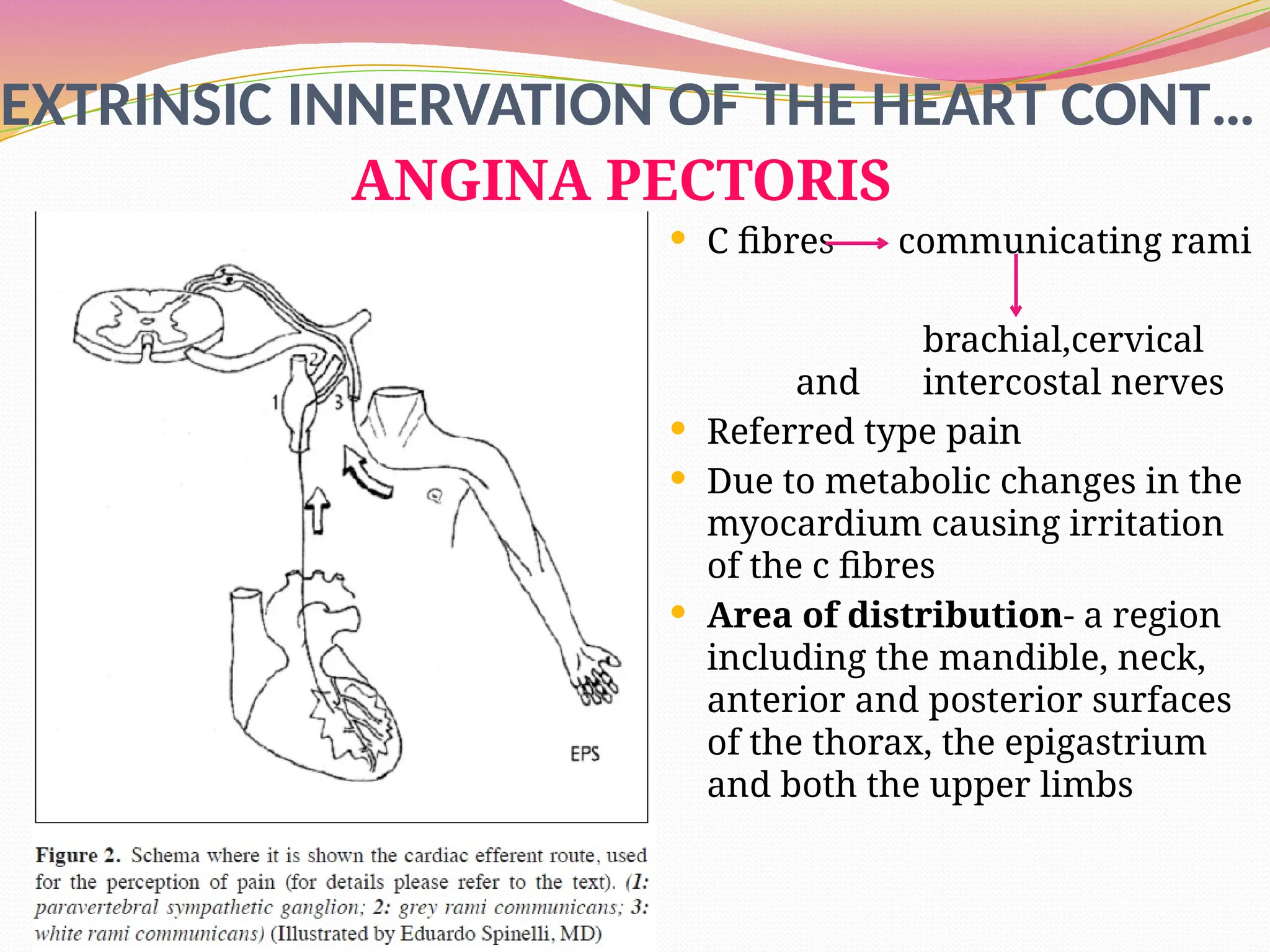
EXTRINSIC INNERVATION OF THE HEART CONT…
 C fibres communicating rami
brachial,cervical
and intercostal nerves
 Referred type pain
 Due to metabolic changes in the
myocardium causing irritation
of the c fibres
 Area of distribution- a region
including the mandible, neck,
anterior and posterior surfaces
of the thorax, the epigastrium
and both the upper limbs
ANGINA PECTORIS
NEURAL REGULATION
 Regulated by the two limbs of the ANS
 At rest, the major influence on the heart is
parasympathetic.
 Sympathetic influence is more in the ventricles, than
on the atria
 The supraventricular tissue receives significantly
more intense vagal stimulation
 Both the neurotransmitters i.e. norepinephrine and
acetylcholine are G- protein coupled receptors.
NEURAL REGULATION CONT..
 Parasympathetic receptors:
 M2 receptors are mainly found in the mammalian heart
 Have action on-potassium channels
calcium channels
funny current
phospholipase A2
phospholipase D
tyrosine kinases
 M3 receptors are found mainly in the coronaries
 Ach- reduces pacemaker activity
slows AV conduction
decreases atrial contractile force
exerts inhibitory modulation of ventricular contractile
force
NEURAL REGULATION CONT..
 Sympathetic receptors:
 All types of β receptors are
found in the human heart.
 β1 receptors are the
predominant subtype in
heart(both atria and ventricles)
 β2 – atria>ventricles
 β3- ventricles
 Both β1 and β2 act by Gs- cAMP
pathway
 β2 receptors have been found
to be coupled with the Gi
pathway to activate the non
cAMP dependant signaling
pathways.
NEURAL REGULATION CONT..
 α₁ receptors-
 G protein coupled
 α₁A, α₁B, and α₁D subtypes
 Both α₁A and α₁B are positive inotropic, but this is of minor
importance
 They are coupled to phospholipase C, D and A₂.
 They increase the intracellular calcium and myocardial
sensitivity to it.
 Cardiac hypertrophy is mediated by them, through Gq
signaling
 α₂ receptors-
 Three subtypes α₂ A, α₂B and α₂C.
 Presynaptic inhibition of NE release.
HORMONAL REGULATION
 Cardiac hormones: Polypeptides secreted by cardiac tissues
 Natriuretic peptides
 Adrenomedullin
 Angiotensin II
 Aldosterone
 Natriuretic peptides:
 Atrial natriuretic protein- secreted from the atria
 B-type natriuretic peptide- from the venttricles
 Generate cGMP
 Cardiac endocrine response to pressure or volume overload
 Organogenesis of the embryonic heart and CVS
 Adrenomedullin:
 Accumulation of cAMP
 Positive inotropic and positive chronotropic
 Increase NO- potent vasodilator
HORMONAL REGULATION CONT..
 Angiotensin II- key modulator of cardiac growth and function
 Two receptors- AT₁ and AT₂
 AT₁
 Predominant subtype
 Positive chronotropic and inotropic
 Cell growth and prol
 proliferation of myocytes and fibroblasts
 Release of growth factors, aldosterone and catecholamines
 Basis for treating heart failure with ACEI’s
 AT₂
 Antiproliferative
 Most abundant in fetal heart
 Upregulated in response to injury and ischemia
 Aldosterone:
 Binds to mineralocorticoid receptors
 Increase expression and activity of- Na⁺/K ⁺ATPase, Na⁺-K ⁺cotransporter,
Cl⁻-HCO₃⁻ antiporter and Na⁺-H⁺antiporter
 Cardiac fibrosis- impairment of contractile function
CARDIAC REFLEXES
BARORECEPTOR REFLEX
 Receptors- circumferential and
longitudinal stretch receptors in
carotid sinus and aortic arch
 Activated by increase in BP
(>170mmHg)
 Inhibited by decrease in BP
 Reflex is lost when BP<50mmHg
 Hormonal and sex differences might
alter baroreceptor responses
 Volatile anaesthetics esp. Halothane
inhibit the heart rate component
 CCBs, ACEIs or PDE inhibitors lessen
the cardiovascular response due to
effects on the peripheral vasculature
 CNS signaling pathways are also
affected due to changes in
calcium or angiotensin
CHEMORECEPTOR REFLEX
 Receptors- chemosensitive cells located
in the carotid bodies and aortic body.
 Respond to changes in pH and blood O2
tension
 pO2<50 mmHg or acidosis
sinus nerve of Hering(IX) and X CN
chemosensitive area of medulla
stimulation activation of
respiratory center parasympathetic
system
Increased ventilatory reduced heart
rate drive and contractility
BAINBRIDGE REFLEX BEZOLD ZARISCH REFLEX
right atrial filling pressure
stretch receptors in the rt. Atrial
wall and cavoatrial junction
Cardiovascular center in medulla
Noxious stimuli to either ventricle associated
with myocardial ischemia,profound
hypovolemia, coronary reperfusion, aortic
stenosis, neuraxial anesthesia associated
with sympathetic blockade and “empty”
ventricle vasovagal syncope
Ventricular chemoreceptors and
mechanoreceptors in LV wall
Hypotension, bradycardia,
parasympathetically induced coronary
vasodilation, and inhibition of
sympathetic outflow from vasomotor
centers
 Less pronounced in hypertrophy or A fib
because of modulation by ANP and BNP
Vagal afferents
Inhibition of
parasympathetic
system
Increased heart rate
Direct effect of
stretch on SA
node
Vagal afferents type
C
VALSALVA MANEUVER MULLER MANEUVER
Forced expiration against closed
glottis
increased ICP
increased CVP and decreased VR
Carotid-afferent nerve of Hering
(glossopharyngeal), Aortic-vagus
Increased venous pressure in head,
upper extremities, with
decreased right heart venous
return causing decreased blood
pressure and cardiac output
reflex increase in heart rate
Inspiratory effort against a closed
airway
Decreased pleural pressure
Right ventricular end-diastolic volume
and left ventricular end-diastolic
pressure increase, while left
ventricular end-diastolic volume is
unchanged or decreased, and
ejection fraction is unchanged
 Müller maneuver may cause
ventricular akinesis due to increased
wall stress, increasing myocardial
oxygen demand, or increased left
ventricular transmural pressure,
decreasing motion in nonfunctional
ventricularmyocardium
CUSHING’S REFLEX OCULOCARDIAC REFLEX
Increased cerebrospinal fluid (CSF)
pressure
compresses cerebral arteries
Cerebral ischemia at vasomotor
center
Sympathetic system activation
increase in arterial pressure, heart
rate and contractility sufficient
to reperfuse the brain
Reflex bradycardia by
baroreceptor reflex
Traction on the extraocular muscles
(more especially the medial rather
than the lateral rectus) or
pressure on the globe
Ciliary ganglion
gasserian ganglion
Increased parasympathetic tone
Bradycardia and hypotension
Long and short
ciliary nerves
Ophthalmic division
of trigeminal
REFERENCES
 Clinical anaesthesia – Barash, cullen, stoelting
 Kaplan’s cardiac anaesthesia
 Miller’s textbook of anaesthesia
 Nerves of the heart: a comprehensive review with a clinical point of view;
Mario P. San MAURO,Facundo PATRONELLI: Neuroanatomy (2009) 8: 26–31
 Measurement of cardiac output: Comparison of four different methodsN
Kothari MD, T Amaria DNB, A Hegde MD, A Mandke MD, NV Mandke
M.Ch.Lilavati Hospital & Research Center, Mumbai
 Editorial:The End-systolic Pressure-Volume Relation of the Ventricle:
Definition,Modifications and Clinical Use,KIICHI SAGAWA, M.D.
 International Journal of Caring Sciences, 1(3):112–117Invasive and non-invasive
methods for cardiac output measurement:Lavdaniti M Alexander Technological
Educational Institute of Thessaloniki, Greece
Thank
You

CARDIAC PHYSIOLOGYhhhhhhgkkkkkkllllll.pptx

  • 1.
    CARDIAC PHYSIOLOGY Presenter- Dr.Shivangi Khanna Moderator-Dr. Anjum Saiyed
  • 2.
    FUNCTIONS OF CARDIOVASCULARSYSTEM  Transport and distribute essential substances to the tissues.  Remove metabolic byproducts.  Adjustment of oxygen and nutrient supply in different physiologic states.  Regulation of body temperature.  Humoral communication.
  • 3.
  • 4.
  • 5.
  • 6.
    CARDIAC CYCLE  Thecardiac cycle describes a highly coordinated, temporally related series of electrical,mechanical and valvular events.
  • 7.
    CARDIAC CYCLE  Thecardiac cycle is the sequence of electrical and mechanical events during the course of a single heartbeat.
  • 8.
    Phases of thecardiac cycle:  Isovolumic contraction 0.05sec  Maximal ejection 0.1sec  Start of relaxation and reduced ejection 0.15sec  Isovolumic relaxation 0.1sec  Rapid filling 0.1sec  Slow filling (diastasis) 0.2sec  Atrial systole or booster 0.1sec  TOTAL TIME FOR ONE CARDIAC CYCLE-0.8SEC LV systole- 0.3sec LV diastole 0.5 sec
  • 11.
    VENTRICULAR STRUCTURE  TheLV is ellipsoid in shape  The myofibrils are longitudinal in the subepicardial layer, circumferential in the middle segment and again longitudinal in the subendocardial layer.  The ellipsoid shape causes regional differences in the myocardial thickness and cross sectional radius of the LV. This helps in accomodating variable loading conditions of the LV  This type of anatomy also helps in a corkscrew manner of contraction of the LV from base to apex, thus allowing maximal shortening of myofibrils  Release of this contraction also causes a suction for filling of the LV
  • 12.
    VENTRICULAR STRUCTURE cont… The RV is crescent shaped, so much of the contractile force is recruited from the LV based septum  Scaffold: supports the heart and adjacent vessels  M/o cross linked collagen fibres- type I (thick ) and type III (thin)  Elastic fibres lie in close proximity to the collagen fibres
  • 13.
    CARDIAC VOLUMES  StrokeVolume: The volume of blood pumped with each heartbeat  it is determined by  Preload: gives the volume of blood that the ventricle has available to pump  Contractility : the force that the muscle can create at the given length  Afterload: the arterial pressure against which the muscle will contract.  SV=EDV-ESV  EDV (End Diastolic Volume)- amount of blood collected in a ventricle during diastole  ESV(End Systolic Volume)- amount of blood remaining in a ventricle after contraction  Ejection fraction: the fraction of EDV pumped with each heart beat  EF=SV/EDV  Most commonly used non invasive index of cardiac contractile function  Assessed by echocardiography, angiography, radionuclide ventriculography.
  • 14.
    VENTRICULAR FUNCTION  SYSTOLICFUNCTION: dependant upon  Heart rate  preload  afterload  Contractility  Systolic interaction ( interventricular septum) •DIASTOLIC FUNCTION:Depends upon
  • 15.
    PRELOAD  Preload: Preloadis the ventricular load at end of diastole.  This value is related to right atrial pressure.  The most important determining factor for preload is venous return.
  • 16.
    AFTERLOAD  Afterload: Afterloadis the systolic load of the ventricle after the contraction has begun  Afterload for the left ventricle is determined by aortic pressure  Afterload for the right ventricle is determined by pulmonary artery pressure  Assessment of afterload- Aortic impedence i.e. aortic pressure/aortic flow at an instant  Clinically, SBP is adequately approximate to afterload.  SVR is the most commonly used clinical estimate of LV afterload. SVR=(MAP-RAP)*80/CO dynes.sec.cm⁻⁵
  • 17.
    FRANK STARLING PRINCIPLE: It is an intrinsic property of the myocardium by which stretch of the sarcomere results in enhanced myocardial performance for subsequent performances.  Heart muscle expands to maximum during filling.  Maximal length produces maximum tension on the muscle, resulting in forceful contraction.  Therefore, greater filling (more volume entering the heart) produces greater ejection (more volume leaving). 2-2.2µm
  • 18.
    FRANK STARLING PRINCIPLECONT…  This principle illustrates the relationship between cardiac output and left ventricular end diastolic volume (or the relationship between stroke volume and right atrial pressure.)  It remains intact even in a failing heart  Ventricular remodelling after injury or heart failure may modify it
  • 19.
    FRANK STARLING PRINCIPLECONT…  Contractility :  It is the inotropic state of the heart  Work performed by the myocardium at any given end-diastolic fibre length  Each FS curve specifies a level of contractility
  • 20.
    PRESSURE VOLUME LOOPS Indirect method of measuring Frank Starling relationship  Currently, the best way to assess contractility in an intact heart.
  • 21.
    PRESSURE VOLUME LOOPSCONT…  The filling curve of the LV moves along the End Diastolic Pressure-volume relationship curve  The slope of the EDPVR curve is the reciprocal of ventricular compliance.  The maximal pressure that can be developed by the ventricle at any given left ventricular volume is defined by the end-systolic pressure-volume relationship (ESPVR), which represents the inotropic state of the ventricle  The PV loops change with changes in preload, afterload and inotropic state.
  • 22.
    PRESSURE VOLUME LOOPSCONT…  Effect of preload changes at constant inotropy:  preload EDV SV( frank starling)  This increase in SV is not as much as that seen in an isolated heart with constant afterload  The CO and BP increase with increase in SV and any increase is partially offset
  • 23.
    PRESSURE VOLUME LOOPSCONT…  Effect of afterload changes at constant inotropy:  afterload velocity of muscle contraction (frank starling) SV  This decrease in SV is offset by the increase in EDV due to increased ESV
  • 24.
    PRESSURE VOLUME LOOPS CONT… Effect of contractile state of the heart:  The ratio of continuous pr. and volume of the LV during the cardiac cycle is called the ‘time varying elastance’.  Maximal elastance (Emax) occurs very close to the upper left corner of PV loop  These Emax are linearly related and form the ESPVR, the slope of which is called the ‘end systolic elastance’ (Ees).  Alterations in contractile state are reflected in the Ees  Clinically EF is the most common measure of LV contractility.
  • 25.
    PRESSURE VOLUME LOOPSCONT… SYSTOLIC DYSFUNCTION DIASTOLIC DYSFUNCTION
  • 26.
    CARDIAC WORK  Externalwork/stroke work: ejects blood under pressure  Stroke work=SV×P  P- pressure developed during ejection of blood  Internal work: to change the shape of the heart  wall stress is directly proportional to the internal work  Efficiency of cardiac contraction:  Cardiac efficacy=External work/Energy equivalent of O2 consumption
  • 27.
    LAPLACE LAW σ=P×R/2h σ- wallstress P- Pressure R- radius of the ventricle h – thickness of the ventricle Wall stress and heart rate are probably the two most relevant factors that account for changes in myocardial oxygen demand  Ellipsoid shape is responsible for the least amount of stress,therefore when the shape changes to spherical during contraction, the wall stress increases.  When the afterload is increased, as in aortic stenosis, the increase in wall thickness of the LV offsets the increase in wall stress needed for generating enough pressure to maintain cardiac output
  • 28.
    TREPPE: THE STAIRCASEEFFECT  Aka Bowditch Effect  In an isolated cardiac muscle, increase in frequency of stimulation induces an increase in the force of contraction  At 150 to 180 stimuli per minute maximal contractile force is reached  When this stimulation becomes extremely rapid, the force of contraction decreases.  In a failing heart, this force frequency relationship may be less effective  Pacing induced positive inotropic effects may be effective only upto a certain heart rate.  Due to increased availability of calcium for binding to troponin C
  • 29.
    PRESSURE VOLUME LOOPSCONT… Aortic stenosis
  • 30.
    CARDIAC OUTPUT  Itis the amount of blood pumped by the heart per unit of time  Determined by-  Heart rate  Myocardial contractility  Preload  Afterload  Measurement of CO:  Invasive methods  Fick’s method  Thermodilution method  Dye dilution method  Non invasive methods  Esophageal doppler  Transoesophageal Echocardiography  Pulse contour CO  Partial CO2 rebreathing  Thoracic electrical bioimpedence
  • 31.
    CARDIAC OUTPUT CONT… FICK’S METHOD:  Concept- O2 delivered from the pulmonary venous blood(q3)is equal to the total O2 delivered to the pulmonary capillaries through the pulmonary artery(q1) and the alveolii(q2) q1+q2=q3  q1=Q×CpaO2  q1- amount of O2 delivered to pulmonary capillaries via pulmonary artery  Q- total pulmonary arterial blood flow  CpaO2- O2 concentration in pulmonary arterial blood  q3=Q×CpvO2  q3- amount of O2 carried away from pulmonary venous blood  Q- total pulmonary venous blood flow  CpvO2- O2 concentration in pulmonary venous blood
  • 32.
    CARDIAC OUTPUT CONT… q1+q2=q3 Q(CpaO2)+q2=Q(CpvO2) q2=Q{CpvO2-CpaO2) Q=q2/(CpvO2-CpaO2) CpaO2~ mixed venous systemic O2  CpvO2~peripheral arterial O2  Oxygen consumption=q2  Therefore, if CpaO2, CpvO2 and oxygen consumption are known, CO can be calculated  it is considered the most accurate method available to evaluate patients with low cardiac output
  • 33.
    CARDIAC OUTPUT CONT… THERMODILUTION TECHNIQUE:  This method uses a special thermistor – tipped catheter(Swan-Ganz catheter) inserted from a central vein into the pulmonary artery.  A cold solution of D/W 5% or normal saline (temperature 0 oC) is injected into the right atrium from a proximal catheter port.  This solution causes a decrease in blood temperature, which is measured by a thermistor placed in the pulmonary artery catheter.  The decrease in temperature is inversely proportional to the dilution of the injectate.
  • 34.
    CARDIAC OUTPUT CONT… The cardiac output can be derived from the modified Stewart-Hamilton conservation of heat equation  most common approach in use today  DYE DILUTION TECHNIQUE:  Uses the same principle as thermodilution technique
  • 35.
    PERICARDIUM  Pericardium isless compliant than the myocardium.  Fluid- 15-35 ml  The slope of EDPVR increases as the pericardial pressure increases.  Plays a crucial role in ventricular interdependance.  RV filling RV pr and vol pr in pericardium compression of LV and reduced filling. SV and MAP.  Constrictive pericarditis and pericardial tamponade cause pulsus paradoxus b/c of exaggerated effects of normal respiration
  • 36.
  • 37.
    EXTRINSIC INNERVATION OFTHE HEART  Afferents:  SYMPATHETIC- the paired superior, middle and inferior cardiac nerves from the cervical ganglia and those originating from the upper 4-5 thoracic ganglia  PARASYMPATHETIC- the paired vagi  Form the cardiac plexus  Efferents:  Through the C fibres , to the white rami, to bulbar center  Responsible for perception of cardiogenic pain.  Through Glossopharyngeal and Vagus nerves
  • 38.
    EXTRINSIC INNERVATION OFTHE HEART CONT…
  • 39.
    EXTRINSIC INNERVATION OFTHE HEART CONT…  C fibres communicating rami brachial,cervical and intercostal nerves  Referred type pain  Due to metabolic changes in the myocardium causing irritation of the c fibres  Area of distribution- a region including the mandible, neck, anterior and posterior surfaces of the thorax, the epigastrium and both the upper limbs ANGINA PECTORIS
  • 40.
    NEURAL REGULATION  Regulatedby the two limbs of the ANS  At rest, the major influence on the heart is parasympathetic.  Sympathetic influence is more in the ventricles, than on the atria  The supraventricular tissue receives significantly more intense vagal stimulation  Both the neurotransmitters i.e. norepinephrine and acetylcholine are G- protein coupled receptors.
  • 41.
    NEURAL REGULATION CONT.. Parasympathetic receptors:  M2 receptors are mainly found in the mammalian heart  Have action on-potassium channels calcium channels funny current phospholipase A2 phospholipase D tyrosine kinases  M3 receptors are found mainly in the coronaries  Ach- reduces pacemaker activity slows AV conduction decreases atrial contractile force exerts inhibitory modulation of ventricular contractile force
  • 42.
    NEURAL REGULATION CONT.. Sympathetic receptors:  All types of β receptors are found in the human heart.  β1 receptors are the predominant subtype in heart(both atria and ventricles)  β2 – atria>ventricles  β3- ventricles  Both β1 and β2 act by Gs- cAMP pathway  β2 receptors have been found to be coupled with the Gi pathway to activate the non cAMP dependant signaling pathways.
  • 43.
    NEURAL REGULATION CONT.. α₁ receptors-  G protein coupled  α₁A, α₁B, and α₁D subtypes  Both α₁A and α₁B are positive inotropic, but this is of minor importance  They are coupled to phospholipase C, D and A₂.  They increase the intracellular calcium and myocardial sensitivity to it.  Cardiac hypertrophy is mediated by them, through Gq signaling  α₂ receptors-  Three subtypes α₂ A, α₂B and α₂C.  Presynaptic inhibition of NE release.
  • 44.
    HORMONAL REGULATION  Cardiachormones: Polypeptides secreted by cardiac tissues  Natriuretic peptides  Adrenomedullin  Angiotensin II  Aldosterone  Natriuretic peptides:  Atrial natriuretic protein- secreted from the atria  B-type natriuretic peptide- from the venttricles  Generate cGMP  Cardiac endocrine response to pressure or volume overload  Organogenesis of the embryonic heart and CVS  Adrenomedullin:  Accumulation of cAMP  Positive inotropic and positive chronotropic  Increase NO- potent vasodilator
  • 45.
    HORMONAL REGULATION CONT.. Angiotensin II- key modulator of cardiac growth and function  Two receptors- AT₁ and AT₂  AT₁  Predominant subtype  Positive chronotropic and inotropic  Cell growth and prol  proliferation of myocytes and fibroblasts  Release of growth factors, aldosterone and catecholamines  Basis for treating heart failure with ACEI’s  AT₂  Antiproliferative  Most abundant in fetal heart  Upregulated in response to injury and ischemia  Aldosterone:  Binds to mineralocorticoid receptors  Increase expression and activity of- Na⁺/K ⁺ATPase, Na⁺-K ⁺cotransporter, Cl⁻-HCO₃⁻ antiporter and Na⁺-H⁺antiporter  Cardiac fibrosis- impairment of contractile function
  • 47.
  • 48.
    BARORECEPTOR REFLEX  Receptors-circumferential and longitudinal stretch receptors in carotid sinus and aortic arch  Activated by increase in BP (>170mmHg)  Inhibited by decrease in BP  Reflex is lost when BP<50mmHg  Hormonal and sex differences might alter baroreceptor responses  Volatile anaesthetics esp. Halothane inhibit the heart rate component  CCBs, ACEIs or PDE inhibitors lessen the cardiovascular response due to effects on the peripheral vasculature  CNS signaling pathways are also affected due to changes in calcium or angiotensin
  • 49.
    CHEMORECEPTOR REFLEX  Receptors-chemosensitive cells located in the carotid bodies and aortic body.  Respond to changes in pH and blood O2 tension  pO2<50 mmHg or acidosis sinus nerve of Hering(IX) and X CN chemosensitive area of medulla stimulation activation of respiratory center parasympathetic system Increased ventilatory reduced heart rate drive and contractility
  • 50.
    BAINBRIDGE REFLEX BEZOLDZARISCH REFLEX right atrial filling pressure stretch receptors in the rt. Atrial wall and cavoatrial junction Cardiovascular center in medulla Noxious stimuli to either ventricle associated with myocardial ischemia,profound hypovolemia, coronary reperfusion, aortic stenosis, neuraxial anesthesia associated with sympathetic blockade and “empty” ventricle vasovagal syncope Ventricular chemoreceptors and mechanoreceptors in LV wall Hypotension, bradycardia, parasympathetically induced coronary vasodilation, and inhibition of sympathetic outflow from vasomotor centers  Less pronounced in hypertrophy or A fib because of modulation by ANP and BNP Vagal afferents Inhibition of parasympathetic system Increased heart rate Direct effect of stretch on SA node Vagal afferents type C
  • 51.
    VALSALVA MANEUVER MULLERMANEUVER Forced expiration against closed glottis increased ICP increased CVP and decreased VR Carotid-afferent nerve of Hering (glossopharyngeal), Aortic-vagus Increased venous pressure in head, upper extremities, with decreased right heart venous return causing decreased blood pressure and cardiac output reflex increase in heart rate Inspiratory effort against a closed airway Decreased pleural pressure Right ventricular end-diastolic volume and left ventricular end-diastolic pressure increase, while left ventricular end-diastolic volume is unchanged or decreased, and ejection fraction is unchanged  Müller maneuver may cause ventricular akinesis due to increased wall stress, increasing myocardial oxygen demand, or increased left ventricular transmural pressure, decreasing motion in nonfunctional ventricularmyocardium
  • 52.
    CUSHING’S REFLEX OCULOCARDIACREFLEX Increased cerebrospinal fluid (CSF) pressure compresses cerebral arteries Cerebral ischemia at vasomotor center Sympathetic system activation increase in arterial pressure, heart rate and contractility sufficient to reperfuse the brain Reflex bradycardia by baroreceptor reflex Traction on the extraocular muscles (more especially the medial rather than the lateral rectus) or pressure on the globe Ciliary ganglion gasserian ganglion Increased parasympathetic tone Bradycardia and hypotension Long and short ciliary nerves Ophthalmic division of trigeminal
  • 53.
    REFERENCES  Clinical anaesthesia– Barash, cullen, stoelting  Kaplan’s cardiac anaesthesia  Miller’s textbook of anaesthesia  Nerves of the heart: a comprehensive review with a clinical point of view; Mario P. San MAURO,Facundo PATRONELLI: Neuroanatomy (2009) 8: 26–31  Measurement of cardiac output: Comparison of four different methodsN Kothari MD, T Amaria DNB, A Hegde MD, A Mandke MD, NV Mandke M.Ch.Lilavati Hospital & Research Center, Mumbai  Editorial:The End-systolic Pressure-Volume Relation of the Ventricle: Definition,Modifications and Clinical Use,KIICHI SAGAWA, M.D.  International Journal of Caring Sciences, 1(3):112–117Invasive and non-invasive methods for cardiac output measurement:Lavdaniti M Alexander Technological Educational Institute of Thessaloniki, Greece
  • 54.