PRESENTED BY
SREELEKSHMI S
COLLEGE OF ENGINEERING
CHERTHALA
AN INTRODUCTION TO
NETWORK ADDRESS SHUFFLING
INTRODUCTION
 Nowadays the security of Internet is always facing
severe challenges.
 Moving Target Defense(MTD) has been proposed
as a new revolutionary technology to alter the
asymmetric situation between attacks and
defenses.
 Network Address Shuffling is an important branch
of MTD technology
MOVING TARGET DEFENSE
 One of the major reasons of the severe Internet
security situation is that the network
configurations nowadays are typically
deterministic, static, and homogeneous.
 The attackers typically have asymmetric
advantages and the defenders are always
disadvantaged by being passive.
 To alter the asymmetric situation between attacks
and defenses, Moving Target Defense (MTD) is
proposed as one of the “game-changing” themes
in cyber security.
 MTD can change one or more system attributes
automatically and continually, such that the attack
surface area available to adversaries is
unpredictable.
 Thus can enhance the security of target system to
a certain extent.
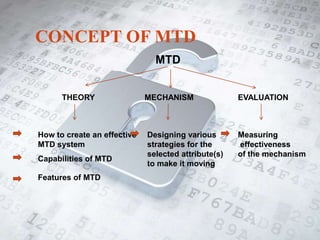
CONCEPT OF MTD
MTD
THEORY MECHANISM EVALUATION
How to create an effective
MTD system
Capabilities of MTD
Features of MTD
Designing various
strategies for the
selected attribute(s)
to make it moving
Measuring
effectiveness
of the mechanism
 One way to achieve the goal is automatically
changing one or more system attributes in a
manner continually.
 According to the selected movement
attribute(s),there are three main schools of
thought providing their solutions for designing
MTD mechanisms, and we call them:
(i) Software Transformations
(ii) Dynamic Platform Techniques
(iii) Network Address Shuffling.
 Changing IP address and/or port number is an
effective way to increase the work effort for
attacking. That is the origin of network address
REVIEW TO NETWORK ADDRESS
SHUFFLING
 For the Internet, addresses are a combination of IP and transport
layer information (protocol and port numbers).
 Network address shuffling technique aims to change the IP
address (and port number) of target periodically or erratically.
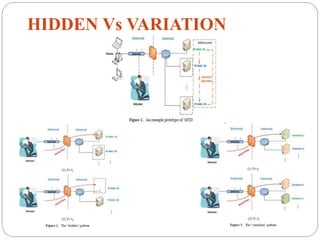
 The two main fundamental running patterns across existing MTDs
are
(i) Hidden
(ii) Variation
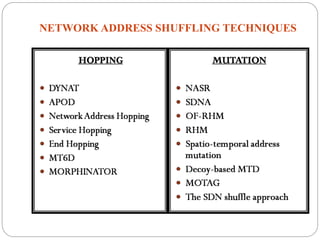
 There are two patterns for the changing of IP address. They are:
(i) Hopping
(ii) Mutation
HIDDEN Vs VARIATION
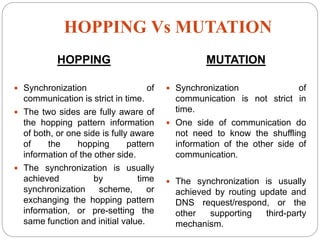
HOPPING Vs MUTATION
HOPPING
 Synchronization of
communication is strict in time.
 The two sides are fully aware of
the hopping pattern information
of both, or one side is fully aware
of the hopping pattern
information of the other side.
 The synchronization is usually
achieved by time
synchronization scheme, or
exchanging the hopping pattern
information, or pre-setting the
same function and initial value.
MUTATION
 Synchronization of
communication is not strict in
time.
 One side of communication do
not need to know the shuffling
information of the other side of
communication.
 The synchronization is usually
achieved by routing update and
DNS request/respond, or the
other supporting third-party
mechanism.
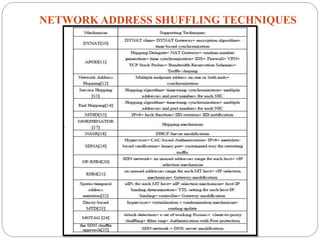
NETWORK ADDRESS SHUFFLING TECHNIQUES
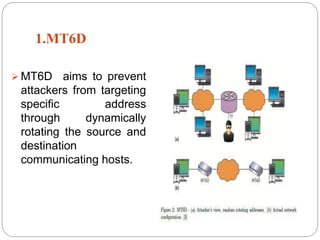
1.MT6D
 MT6D aims to prevent
attackers from targeting
specific address
through dynamically
rotating the source and
destination
communicating hosts.
 At each time increment, MT6D computes the next IIDs
(Interface IDentifier in an IPv6 address, which can
identify a particular node) for both sender and receiver
of each communicating pair, by using a hash function.
 The two sides of the communication can compute its
own and the other’s next IID, i.e., they are fully aware
of the hopping pattern information of both.
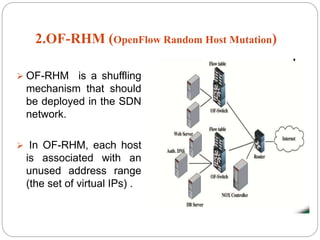
2.OF-RHM (OpenFlow Random Host Mutation)
 OF-RHM is a shuffling
mechanism that should
be deployed in the SDN
network.
 In OF-RHM, each host
is associated with an
unused address range
(the set of virtual IPs) .
A new virtual IP is chosen from the range and
assigned to the host after each mutation interval,
and the new vIP is selected based on uniform
probability.
 The OF-switch can perform the real IP-virtual IP
translation, and thus make that the packets
transmission in the network between the source and
destination gateway are with Vip which increases the
work effort of identifying a particular host.
 However, the OF-RHM can only be used in SDN
network, thus the scalability is low.
3.RHM (Random Host Mutation)
 Its design principles and implementation are similar to
the OF-RHM.
 The main differences from OF-RHM are the vIP
allocation mechanism and the components for
distribution.
 RHM uses a two-phase mutation approach which
consists of LFM (Low Frequency mutation) and HFM
(High Frequency mutation) to assign vIP.
 A LFM interval contains multiple HFM intervals. In
each LFM interval, a random network address range
denoted as VAR (virtual address range) is selected for
each MT (Moving Target) host.
 Then in each HFM interval, a new random Vip within
the VAR assigned during last LFM is chosen for the MT
host, and the selection of the new vIP is based on a
hash function.
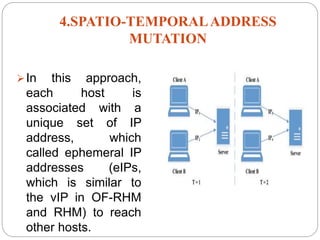
4.SPATIO-TEMPORALADDRESS
MUTATION
In this approach,
each host is
associated with a
unique set of IP
address, which
called ephemeral IP
addresses (eIPs,
which is similar to
the vIP in OF-RHM
and RHM) to reach
other hosts.
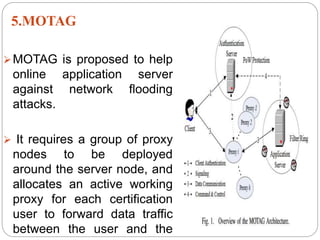
5.MOTAG
MOTAG is proposed to help
online application server
against network flooding
attacks.
 It requires a group of proxy
nodes to be deployed
around the server node, and
allocates an active working
proxy for each certification
user to forward data traffic
between the user and the
It can protect the online server strongly since the
address of the server is privacy for any user,
even each client is only aware of its own working
proxy’s IP address.
When a working proxy is under attack, it would
startup a process called client-to-proxy shuffling.
In other words, the client is passive to accept the
address shuffling of its working ISBNproxy, and
knows nothing about the address of server.
MOTAG can gradually concentrate the attacker
to a particular proxy to minimize the impact of an
attack.
However, it must work together with the attack
6.DYNAT
 DYNAT is proposed to defend any adversary
sniffing the network.
 Before the packet was routed, the host identity
information that can uniquely describe a
connection between two hosts, host portion of
destination’s IP address, and TCP/UDP port
number, were translated by a cryptographic
algorithm.
7.NETWORK ADDRESS HOPPING
 Network Address Hopping is proposed to
enhance the security of data by transferring them
across multiple data connections named
channels.
 The hopping pattern, in which include the hopping
sequence is defined by each endpoint
respectively and sent to the other endpoint, thus
the two sides are fully aware of the hopping
pattern information.
8.NASR
NASR is proposed to against hitlist worms.
 In this approach, the two communicating
hosts are not aware of the other’s next
address until sending a DNS request and
getting a reply.
9.SDNA
 When a DNS response comes to the guest, the
SDNA Entity would replace the real IP with Token IP
which is generated by the SDNA Entity.
 When the guest initiates a connection to a Token IP,
the SDNA Entity would rewrite the packets by
replacing the Token IP with the real IP.
 In other words, one side of a communication does
not know the other’s real address, and the Token IP
is obtained from the other’s SDNA Entity when it
requests a DNS resolution.
10.SDN SHUFFLE APPROACH
The SDN shuffle approach uses synthetic
addressing information to replace the real
addressing information for defending
reconnaissance.
NETWORK ADDRESS SHUFFLING TECHNIQUES
COMPARISON MATRICS
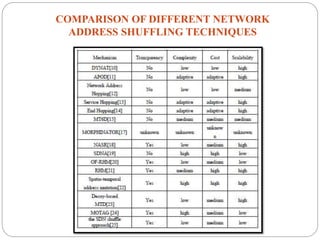
The four comparison metrics are:
1) Transparency: Transparency means that a real
thing seems not to be existing, in other words,
users have no perception on it.
2) Complexity: The Complexity indicates the degree
of simplicity for deploying a network address
shuffling technique.
3) Cost: The Cost includes the deployment cost and
the transmission cost.
4) Scalability: Scalability includes two meanings, one
is whether the mechanism can be deployed on
various network, such as current IPv4 network, IPv6
network, or other type network. And the other is
whether the mechanism can work together with other
security mechanisms, such as IDS and Firewall, to
enhance the performance against attacks.
COMPARISON OF DIFFERENT NETWORK
ADDRESS SHUFFLING TECHNIQUES
ISSUES OF IMPLEMENTATION
 The key issues for implementing an effective and practical
network address shuffling technique are:
1. The unpredictability of shuffling:
 Unpredictability is a key characteristic of the MTD technology.
 Make it hard for the attacker to predict the precise information
of the target in next period, and thus increase the work effort
of attack, decrease the probability of successful attacks and
increase the target’s resiliency.
 In the network address shuffling technology, there is usually a
large configuration space to be used, thus the critical problem is
the way of randomization to achieve unpredictability.
2. The determination of the shuffling frequency:
 For the defender, the speediness is influenced by the
shuffling frequency.
 If the shuffling frequency is too low, while the attacker
is fast enough, there is most likely a successful attack,
i.e., it can’t effectively reduce the success rate of
attacks.
 If the shuffling frequency is too high, although it can
provide a high degree of security, it would reduce the
system performance and availability of the services.
 Therefore, determining the optimal shuffling
3. The security of the rules of shuffling :
 The shuffling has to be controlled and managed by the
administrator to provide active defense while ensuring
the continuity of mission and the functionality of
system.
 In the mutation pattern, the security of the DNS
resolution information would influence the security of
the mechanism.
 In the hopping pattern, the security of the hopping
information transmission would affect the security
provided by the mechanism greatly.
PRACTICABILITY
 Being practical is the basis for a technique to be widely
applied.
 There are two problems that need to be addressed for
practicability:
1. Transparency to the user: Which means that the
deployment of the network address shuffling mechanism
must not change or influence the normal user operation
greatly. Also, the performance loss induced by the
deployment must be acceptable to the user.
2. Acceptable deployment cost and complexity: If the
CONCLUSION
 Introduced the concept of MTD as a solution for cyber
attacks.
 The fundamental running patterns were identified and
described, which consist of two main patterns called
hidden and variation.
 Identified and described two patterns of the network
address shuffling techniques, hopping and mutation, and
then categorized the main existed network address
shuffling techniques according to the two patterns.
 Under each category, we gave a detailed description on
each mechanism and compared their features.
 Discussed some key issues on implementing an effective
REFERENCES
[1] Guilin Cai, Baosheng Wang, Xiaofeng Wang, Yulei
Yuan, Sudan Li College of Computer, National University
of Defense Technology, Changsha, China,”An
Introduction to Network Address Shuffling”.
[2] T. E. Carroll, M. Crouse, E. W. Fulp and K. S.
Berenhaut, "Analysis of network address shuffling as a
moving target defense", in Proc of 2014 IEEE
International Conference on Communications (ICC),
2014, pp.701-706.
[3]Y. Liu, W. Peng and J. Su, "A study of IP prefix hijacking
in cloud computing networks", SECURITY AND
COMMUNICATION NETWORKS, vol.7, no.11, pp.2201-
2210. 2014.
[4] D. Evans, A. Nguyen-Tuong, and J. Knight,
“Effectiveness of moving target defenses,” in Moving
Target Defense: Creating Asymmetric Uncertainty for
Cyber Threats, S. Jajodia, A. K. Ghosh, V. Swarup, C.
AN INTRODUCTION TO NETWORK ADDRESS SHUFFLING

AN INTRODUCTION TO NETWORK ADDRESS SHUFFLING

  • 1.
    PRESENTED BY SREELEKSHMI S COLLEGEOF ENGINEERING CHERTHALA AN INTRODUCTION TO NETWORK ADDRESS SHUFFLING
  • 2.
    INTRODUCTION  Nowadays thesecurity of Internet is always facing severe challenges.  Moving Target Defense(MTD) has been proposed as a new revolutionary technology to alter the asymmetric situation between attacks and defenses.  Network Address Shuffling is an important branch of MTD technology
  • 3.
    MOVING TARGET DEFENSE One of the major reasons of the severe Internet security situation is that the network configurations nowadays are typically deterministic, static, and homogeneous.  The attackers typically have asymmetric advantages and the defenders are always disadvantaged by being passive.  To alter the asymmetric situation between attacks and defenses, Moving Target Defense (MTD) is proposed as one of the “game-changing” themes in cyber security.
  • 4.
     MTD canchange one or more system attributes automatically and continually, such that the attack surface area available to adversaries is unpredictable.  Thus can enhance the security of target system to a certain extent.
  • 5.
    CONCEPT OF MTD MTD THEORYMECHANISM EVALUATION How to create an effective MTD system Capabilities of MTD Features of MTD Designing various strategies for the selected attribute(s) to make it moving Measuring effectiveness of the mechanism
  • 6.
     One wayto achieve the goal is automatically changing one or more system attributes in a manner continually.  According to the selected movement attribute(s),there are three main schools of thought providing their solutions for designing MTD mechanisms, and we call them: (i) Software Transformations (ii) Dynamic Platform Techniques (iii) Network Address Shuffling.  Changing IP address and/or port number is an effective way to increase the work effort for attacking. That is the origin of network address
  • 7.
    REVIEW TO NETWORKADDRESS SHUFFLING  For the Internet, addresses are a combination of IP and transport layer information (protocol and port numbers).  Network address shuffling technique aims to change the IP address (and port number) of target periodically or erratically.  The two main fundamental running patterns across existing MTDs are (i) Hidden (ii) Variation  There are two patterns for the changing of IP address. They are: (i) Hopping (ii) Mutation
  • 8.
  • 9.
    HOPPING Vs MUTATION HOPPING Synchronization of communication is strict in time.  The two sides are fully aware of the hopping pattern information of both, or one side is fully aware of the hopping pattern information of the other side.  The synchronization is usually achieved by time synchronization scheme, or exchanging the hopping pattern information, or pre-setting the same function and initial value. MUTATION  Synchronization of communication is not strict in time.  One side of communication do not need to know the shuffling information of the other side of communication.  The synchronization is usually achieved by routing update and DNS request/respond, or the other supporting third-party mechanism.
  • 10.
  • 11.
    1.MT6D  MT6D aimsto prevent attackers from targeting specific address through dynamically rotating the source and destination communicating hosts.
  • 12.
     At eachtime increment, MT6D computes the next IIDs (Interface IDentifier in an IPv6 address, which can identify a particular node) for both sender and receiver of each communicating pair, by using a hash function.  The two sides of the communication can compute its own and the other’s next IID, i.e., they are fully aware of the hopping pattern information of both.
  • 13.
    2.OF-RHM (OpenFlow RandomHost Mutation)  OF-RHM is a shuffling mechanism that should be deployed in the SDN network.  In OF-RHM, each host is associated with an unused address range (the set of virtual IPs) .
  • 14.
    A new virtualIP is chosen from the range and assigned to the host after each mutation interval, and the new vIP is selected based on uniform probability.  The OF-switch can perform the real IP-virtual IP translation, and thus make that the packets transmission in the network between the source and destination gateway are with Vip which increases the work effort of identifying a particular host.  However, the OF-RHM can only be used in SDN network, thus the scalability is low.
  • 15.
    3.RHM (Random HostMutation)  Its design principles and implementation are similar to the OF-RHM.  The main differences from OF-RHM are the vIP allocation mechanism and the components for distribution.  RHM uses a two-phase mutation approach which consists of LFM (Low Frequency mutation) and HFM (High Frequency mutation) to assign vIP.
  • 16.
     A LFMinterval contains multiple HFM intervals. In each LFM interval, a random network address range denoted as VAR (virtual address range) is selected for each MT (Moving Target) host.  Then in each HFM interval, a new random Vip within the VAR assigned during last LFM is chosen for the MT host, and the selection of the new vIP is based on a hash function.
  • 17.
    4.SPATIO-TEMPORALADDRESS MUTATION In this approach, eachhost is associated with a unique set of IP address, which called ephemeral IP addresses (eIPs, which is similar to the vIP in OF-RHM and RHM) to reach other hosts.
  • 18.
    5.MOTAG MOTAG is proposedto help online application server against network flooding attacks.  It requires a group of proxy nodes to be deployed around the server node, and allocates an active working proxy for each certification user to forward data traffic between the user and the
  • 19.
    It can protectthe online server strongly since the address of the server is privacy for any user, even each client is only aware of its own working proxy’s IP address. When a working proxy is under attack, it would startup a process called client-to-proxy shuffling. In other words, the client is passive to accept the address shuffling of its working ISBNproxy, and knows nothing about the address of server. MOTAG can gradually concentrate the attacker to a particular proxy to minimize the impact of an attack. However, it must work together with the attack
  • 20.
    6.DYNAT  DYNAT isproposed to defend any adversary sniffing the network.  Before the packet was routed, the host identity information that can uniquely describe a connection between two hosts, host portion of destination’s IP address, and TCP/UDP port number, were translated by a cryptographic algorithm.
  • 21.
    7.NETWORK ADDRESS HOPPING Network Address Hopping is proposed to enhance the security of data by transferring them across multiple data connections named channels.  The hopping pattern, in which include the hopping sequence is defined by each endpoint respectively and sent to the other endpoint, thus the two sides are fully aware of the hopping pattern information.
  • 22.
    8.NASR NASR is proposedto against hitlist worms.  In this approach, the two communicating hosts are not aware of the other’s next address until sending a DNS request and getting a reply.
  • 23.
    9.SDNA  When aDNS response comes to the guest, the SDNA Entity would replace the real IP with Token IP which is generated by the SDNA Entity.  When the guest initiates a connection to a Token IP, the SDNA Entity would rewrite the packets by replacing the Token IP with the real IP.  In other words, one side of a communication does not know the other’s real address, and the Token IP is obtained from the other’s SDNA Entity when it requests a DNS resolution.
  • 24.
    10.SDN SHUFFLE APPROACH TheSDN shuffle approach uses synthetic addressing information to replace the real addressing information for defending reconnaissance.
  • 25.
  • 26.
    COMPARISON MATRICS The fourcomparison metrics are: 1) Transparency: Transparency means that a real thing seems not to be existing, in other words, users have no perception on it. 2) Complexity: The Complexity indicates the degree of simplicity for deploying a network address shuffling technique.
  • 27.
    3) Cost: TheCost includes the deployment cost and the transmission cost. 4) Scalability: Scalability includes two meanings, one is whether the mechanism can be deployed on various network, such as current IPv4 network, IPv6 network, or other type network. And the other is whether the mechanism can work together with other security mechanisms, such as IDS and Firewall, to enhance the performance against attacks.
  • 28.
    COMPARISON OF DIFFERENTNETWORK ADDRESS SHUFFLING TECHNIQUES
  • 29.
    ISSUES OF IMPLEMENTATION The key issues for implementing an effective and practical network address shuffling technique are: 1. The unpredictability of shuffling:  Unpredictability is a key characteristic of the MTD technology.  Make it hard for the attacker to predict the precise information of the target in next period, and thus increase the work effort of attack, decrease the probability of successful attacks and increase the target’s resiliency.  In the network address shuffling technology, there is usually a large configuration space to be used, thus the critical problem is the way of randomization to achieve unpredictability.
  • 30.
    2. The determinationof the shuffling frequency:  For the defender, the speediness is influenced by the shuffling frequency.  If the shuffling frequency is too low, while the attacker is fast enough, there is most likely a successful attack, i.e., it can’t effectively reduce the success rate of attacks.  If the shuffling frequency is too high, although it can provide a high degree of security, it would reduce the system performance and availability of the services.  Therefore, determining the optimal shuffling
  • 31.
    3. The securityof the rules of shuffling :  The shuffling has to be controlled and managed by the administrator to provide active defense while ensuring the continuity of mission and the functionality of system.  In the mutation pattern, the security of the DNS resolution information would influence the security of the mechanism.  In the hopping pattern, the security of the hopping information transmission would affect the security provided by the mechanism greatly.
  • 32.
    PRACTICABILITY  Being practicalis the basis for a technique to be widely applied.  There are two problems that need to be addressed for practicability: 1. Transparency to the user: Which means that the deployment of the network address shuffling mechanism must not change or influence the normal user operation greatly. Also, the performance loss induced by the deployment must be acceptable to the user. 2. Acceptable deployment cost and complexity: If the
  • 33.
    CONCLUSION  Introduced theconcept of MTD as a solution for cyber attacks.  The fundamental running patterns were identified and described, which consist of two main patterns called hidden and variation.  Identified and described two patterns of the network address shuffling techniques, hopping and mutation, and then categorized the main existed network address shuffling techniques according to the two patterns.  Under each category, we gave a detailed description on each mechanism and compared their features.  Discussed some key issues on implementing an effective
  • 34.
    REFERENCES [1] Guilin Cai,Baosheng Wang, Xiaofeng Wang, Yulei Yuan, Sudan Li College of Computer, National University of Defense Technology, Changsha, China,”An Introduction to Network Address Shuffling”. [2] T. E. Carroll, M. Crouse, E. W. Fulp and K. S. Berenhaut, "Analysis of network address shuffling as a moving target defense", in Proc of 2014 IEEE International Conference on Communications (ICC), 2014, pp.701-706. [3]Y. Liu, W. Peng and J. Su, "A study of IP prefix hijacking in cloud computing networks", SECURITY AND COMMUNICATION NETWORKS, vol.7, no.11, pp.2201- 2210. 2014. [4] D. Evans, A. Nguyen-Tuong, and J. Knight, “Effectiveness of moving target defenses,” in Moving Target Defense: Creating Asymmetric Uncertainty for Cyber Threats, S. Jajodia, A. K. Ghosh, V. Swarup, C.