








Secure Location BasedSecure Location Based
Routing For Mobile AdHocRouting For Mobile AdHoc
NetworksNetworks
Nitish Srivastava(9910103552)Nitish Srivastava(9910103552)
Sanchit Khurana (9910103519)Sanchit Khurana (9910103519)
INTRODUCTIONINTRODUCTION
• An ad-hoc mobile network is a collection of mobile nodes that areAn ad-hoc mobile network is a collection of mobile nodes that are
dynamically and arbitrarily located in such a manner that thedynamically and arbitrarily located in such a manner that the
interconnections between nodes are capable of changing on a continualinterconnections between nodes are capable of changing on a continual
basis.basis.
• The primary goal of such an ad-hoc network routing protocol is correct andThe primary goal of such an ad-hoc network routing protocol is correct and
efficient route establishment between a pair of nodes so that messages mayefficient route establishment between a pair of nodes so that messages may
be delivered in a timely manner.be delivered in a timely manner.
A short literature study over papers on ad hoc networking shows that manyA short literature study over papers on ad hoc networking shows that many
of the new generation ad hoc networking proposals are not yet able toof the new generation ad hoc networking proposals are not yet able to
address the security problems and they face.address the security problems and they face.
Thus, a proof of concept has been provided in the following report whichThus, a proof of concept has been provided in the following report which
uses the location based routing scheme to locate nodes within range ofuses the location based routing scheme to locate nodes within range of
each other and thus pass messages or files as and when requiredeach other and thus pass messages or files as and when required
EXISTING SYSTEMEXISTING SYSTEM
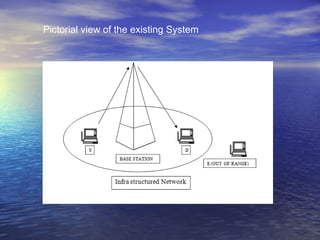
• The first problem is the requirement of a third fixed partyThe first problem is the requirement of a third fixed party
(a base station) that will hand over the offered traffic(a base station) that will hand over the offered traffic
from a station to another, as illustrated in Figure 1. Thefrom a station to another, as illustrated in Figure 1. The
same entity will regulate the attribution of radiosame entity will regulate the attribution of radio
resources, for instance. When a node S wishes toresources, for instance. When a node S wishes to
communicate to a node D, the former notifies the basecommunicate to a node D, the former notifies the base
station, which eventually establishes a communicationstation, which eventually establishes a communication
with the destination node. At this point, thewith the destination node. At this point, the
communicating nodes do not need to know of a route forcommunicating nodes do not need to know of a route for
one to each other. All that matters is that both nodesone to each other. All that matters is that both nodes
source and destination are within the transmission rangesource and destination are within the transmission range
of the base station. If one of them fails to fulfill thisof the base station. If one of them fails to fulfill this
condition, the communication will abort.condition, the communication will abort.
Pictorial view of the existing System
PROPOSEDPROPOSED SYSTEMSYSTEM
• The second approach, called the Ad-Hoc, doesThe second approach, called the Ad-Hoc, does
not rely on any stationary infra structure. Thenot rely on any stationary infra structure. The
concept behind these infra-structurelessconcept behind these infra-structureless
networks is the collaboration between itsnetworks is the collaboration between its
participating members, i.e, instead of makingparticipating members, i.e, instead of making
data transit through a fixed base station, nodesdata transit through a fixed base station, nodes
consequentially forward data packets from oneconsequentially forward data packets from one
to another until a destination node is finallyto another until a destination node is finally
reached. Typically, a packet may travel throughreached. Typically, a packet may travel through
a number of network points before arriving at itsa number of network points before arriving at its
destination.destination.
DATA SECURITYDATA SECURITY
i) Message Encryptioni) Message Encryption
ii) Message Decryptionii) Message Decryption
DATA SECURITY USING RSADATA SECURITY USING RSA
• Source sends the encrypted data packet to theSource sends the encrypted data packet to the
destination through the route discovered.destination through the route discovered.
• Destination decrypts the data packet receivedDestination decrypts the data packet received
from the source and sends thefrom the source and sends the
acknowledgement.acknowledgement.
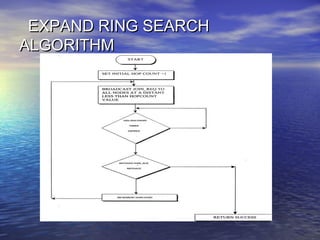
EXPAND RING SEARCHEXPAND RING SEARCH
ALGORITHMALGORITHM
CORE RESOLUTIONCORE RESOLUTION
ALGORITHMALGORITHM
Core finding:
If the core node and user defined destination node are
same then it transmit the file to the corresponding
destination node
After route discovery, to find the core node of the system
then compares core node and user defined node in core
class
Re-Core Selection:
To select the re-core node address for finding the
destination address.
Re-Core selection is used when the core process is not
able to find the destination address.
THRESHOLD CRYPTOGRAPHYTHRESHOLD CRYPTOGRAPHY
Threshold cryptography is the process of encrypting the plain text into
cipher text and decrypting the cipher text into original plain text using
the fixed key and math function. Converted data code can be securely
transmitted over a network. Here the actual content is converted into
Hex-code for transmission.
TESTINGTESTING
Test Cases
Test Id : T1
Input : IP Address of the Destination machine
Expected Output : Connection successfully established
Test Id : T2
Input : Discover route by expand ring search algorithm
Expected Output : Check for the systems in the range of the initiator node
and traverse a path until a successful pat h to the destination is found.
Test Id : T3
Input : Encryption of the message bearing the file to be sent or requested
Expected Output : Implementation of the RSA key Algorithm and
encryption of the message.
Test Id : T4
Input : Decryption of the contents of the message bearing the file at the
receiving or the initiator’s end.
Expected Output : Message received from the containing node is
decrypted at the receiving end.
LIMITATION OF THELIMITATION OF THE
SOLUTIONSOLUTION
No accurate definition of packet size.
The system introduces added communication overhead, since in order for
an edge outer to know the rate at which its packets are leaving the network, it
must exchange feedback with other edge routers.
System sometimes hang due to loss of connection to database.
CONCLUSIONCONCLUSION
The successful transmission of files describes how routing algorithms could be
easily used to reduce the routing overhead in ad hoc networks. These protocols
limit the search for a route to the so-called request zone, determined based on
the expected location of the destination node at the time of route discovery.
Results indicate that using location information results in significantly lower
routing overhead, as compared to an algorithm that does not use location
information. We also suggested several optimizations on the basic LAR
schemes which may improve performance. Further work is required to evaluate
efficacy of these optimizations, and also to develop other ways of using location
information in ad hoc networks, for instance to improve performance of reactive
algorithms such as or to implement location-based multicasting. Security issues
in the transmission were also considered and taken care of by using encrypting
and decrypting techniques which thereby helps in secure transmission of data.
FUTURE WORKFUTURE WORK
There is current and future need for dynamic ad hoc networking technology.
The emerging field of mobile and nomadic computing, with its current
emphasis on mobile IP operation, should gradually broaden and require
highly-adaptive mobile networking technology to effectively manage
multihop, ad hoc network clusters which can operate autonomously or,
more than likely, be attached at some points to the fixed Internet.
The cryptographic algorithm that has been used will be further enhanced
and modified thus providing greater security in terms of routing of
messages and data. Threshold cryptography can now be taken a step
further and SHA-1 algorithm could be implemented in secure transmission
of the data.
THANK YOUTHANK YOU

SECURE LOCATION BASED ROUTING FOR MANETS

  • 1.
    Secure Location BasedSecureLocation Based Routing For Mobile AdHocRouting For Mobile AdHoc NetworksNetworks Nitish Srivastava(9910103552)Nitish Srivastava(9910103552) Sanchit Khurana (9910103519)Sanchit Khurana (9910103519)
  • 2.
    INTRODUCTIONINTRODUCTION • An ad-hocmobile network is a collection of mobile nodes that areAn ad-hoc mobile network is a collection of mobile nodes that are dynamically and arbitrarily located in such a manner that thedynamically and arbitrarily located in such a manner that the interconnections between nodes are capable of changing on a continualinterconnections between nodes are capable of changing on a continual basis.basis. • The primary goal of such an ad-hoc network routing protocol is correct andThe primary goal of such an ad-hoc network routing protocol is correct and efficient route establishment between a pair of nodes so that messages mayefficient route establishment between a pair of nodes so that messages may be delivered in a timely manner.be delivered in a timely manner. A short literature study over papers on ad hoc networking shows that manyA short literature study over papers on ad hoc networking shows that many of the new generation ad hoc networking proposals are not yet able toof the new generation ad hoc networking proposals are not yet able to address the security problems and they face.address the security problems and they face. Thus, a proof of concept has been provided in the following report whichThus, a proof of concept has been provided in the following report which uses the location based routing scheme to locate nodes within range ofuses the location based routing scheme to locate nodes within range of each other and thus pass messages or files as and when requiredeach other and thus pass messages or files as and when required
  • 3.
    EXISTING SYSTEMEXISTING SYSTEM •The first problem is the requirement of a third fixed partyThe first problem is the requirement of a third fixed party (a base station) that will hand over the offered traffic(a base station) that will hand over the offered traffic from a station to another, as illustrated in Figure 1. Thefrom a station to another, as illustrated in Figure 1. The same entity will regulate the attribution of radiosame entity will regulate the attribution of radio resources, for instance. When a node S wishes toresources, for instance. When a node S wishes to communicate to a node D, the former notifies the basecommunicate to a node D, the former notifies the base station, which eventually establishes a communicationstation, which eventually establishes a communication with the destination node. At this point, thewith the destination node. At this point, the communicating nodes do not need to know of a route forcommunicating nodes do not need to know of a route for one to each other. All that matters is that both nodesone to each other. All that matters is that both nodes source and destination are within the transmission rangesource and destination are within the transmission range of the base station. If one of them fails to fulfill thisof the base station. If one of them fails to fulfill this condition, the communication will abort.condition, the communication will abort.
  • 4.
    Pictorial view ofthe existing System
  • 5.
    PROPOSEDPROPOSED SYSTEMSYSTEM • Thesecond approach, called the Ad-Hoc, doesThe second approach, called the Ad-Hoc, does not rely on any stationary infra structure. Thenot rely on any stationary infra structure. The concept behind these infra-structurelessconcept behind these infra-structureless networks is the collaboration between itsnetworks is the collaboration between its participating members, i.e, instead of makingparticipating members, i.e, instead of making data transit through a fixed base station, nodesdata transit through a fixed base station, nodes consequentially forward data packets from oneconsequentially forward data packets from one to another until a destination node is finallyto another until a destination node is finally reached. Typically, a packet may travel throughreached. Typically, a packet may travel through a number of network points before arriving at itsa number of network points before arriving at its destination.destination.
  • 6.
    DATA SECURITYDATA SECURITY i)Message Encryptioni) Message Encryption ii) Message Decryptionii) Message Decryption DATA SECURITY USING RSADATA SECURITY USING RSA • Source sends the encrypted data packet to theSource sends the encrypted data packet to the destination through the route discovered.destination through the route discovered. • Destination decrypts the data packet receivedDestination decrypts the data packet received from the source and sends thefrom the source and sends the acknowledgement.acknowledgement.
  • 7.
    EXPAND RING SEARCHEXPANDRING SEARCH ALGORITHMALGORITHM
  • 8.
    CORE RESOLUTIONCORE RESOLUTION ALGORITHMALGORITHM Corefinding: If the core node and user defined destination node are same then it transmit the file to the corresponding destination node After route discovery, to find the core node of the system then compares core node and user defined node in core class Re-Core Selection: To select the re-core node address for finding the destination address. Re-Core selection is used when the core process is not able to find the destination address.
  • 9.
    THRESHOLD CRYPTOGRAPHYTHRESHOLD CRYPTOGRAPHY Thresholdcryptography is the process of encrypting the plain text into cipher text and decrypting the cipher text into original plain text using the fixed key and math function. Converted data code can be securely transmitted over a network. Here the actual content is converted into Hex-code for transmission.
  • 10.
    TESTINGTESTING Test Cases Test Id: T1 Input : IP Address of the Destination machine Expected Output : Connection successfully established Test Id : T2 Input : Discover route by expand ring search algorithm Expected Output : Check for the systems in the range of the initiator node and traverse a path until a successful pat h to the destination is found. Test Id : T3 Input : Encryption of the message bearing the file to be sent or requested Expected Output : Implementation of the RSA key Algorithm and encryption of the message. Test Id : T4 Input : Decryption of the contents of the message bearing the file at the receiving or the initiator’s end. Expected Output : Message received from the containing node is decrypted at the receiving end.
  • 11.
    LIMITATION OF THELIMITATIONOF THE SOLUTIONSOLUTION No accurate definition of packet size. The system introduces added communication overhead, since in order for an edge outer to know the rate at which its packets are leaving the network, it must exchange feedback with other edge routers. System sometimes hang due to loss of connection to database.
  • 12.
    CONCLUSIONCONCLUSION The successful transmissionof files describes how routing algorithms could be easily used to reduce the routing overhead in ad hoc networks. These protocols limit the search for a route to the so-called request zone, determined based on the expected location of the destination node at the time of route discovery. Results indicate that using location information results in significantly lower routing overhead, as compared to an algorithm that does not use location information. We also suggested several optimizations on the basic LAR schemes which may improve performance. Further work is required to evaluate efficacy of these optimizations, and also to develop other ways of using location information in ad hoc networks, for instance to improve performance of reactive algorithms such as or to implement location-based multicasting. Security issues in the transmission were also considered and taken care of by using encrypting and decrypting techniques which thereby helps in secure transmission of data.
  • 13.
    FUTURE WORKFUTURE WORK Thereis current and future need for dynamic ad hoc networking technology. The emerging field of mobile and nomadic computing, with its current emphasis on mobile IP operation, should gradually broaden and require highly-adaptive mobile networking technology to effectively manage multihop, ad hoc network clusters which can operate autonomously or, more than likely, be attached at some points to the fixed Internet. The cryptographic algorithm that has been used will be further enhanced and modified thus providing greater security in terms of routing of messages and data. Threshold cryptography can now be taken a step further and SHA-1 algorithm could be implemented in secure transmission of the data.
  • 14.