This document discusses a new denial-of-service attack model called the 'snooze attack' that targets the Low Energy Adaptive Clustering Hierarchy (LEACH) protocol in wireless sensor networks. The attack allows a malicious node to become a cluster head but subsequently enter sleep mode, leading to decreased throughput and energy consumption as it fails to forward data. The authors simulated the attack and found that the number of attackers significantly affects network performance and proposed future work on countermeasures to detect such attacks.
![David C. Wyld (Eds) : ICCSEA, SPPR, CSIA, WimoA, SCAI - 2013
pp. 393–399, 2013. © CS & IT-CSCP 2013 DOI : 10.5121/csit.2013.3541
SIMULATION OF SNOOZE ATTACK IN
LEACH
Meenakshi Tripathi, M.S. Gaur and V. Laxmi
Malviya National Institute of Technology, Jaipur-302017
{mtripathi,gaurms,vlaxmi}@mnit.ac.in
ABSTRACT
Wireless Sensor Network (WSN) consists of large number of sensor nodes capable of forming
instantaneous network with dynamic topology. Each node simultaneously as both router and
host. Number of nodes in a WSN can vary either due to the mobility or death of nodes due to
drained conditions. Low Energy Aware Cluster Hierarchy (LEACH) is a most popular dynamic
clustering protocol for WSN. Deployment in unattended environment, limited memory, limited
power and low computational power of a sensor node make these networks susceptible to
attacks launched by malicious nodes. This paper provides an overview of LEACH protocol and
how LEACH can be compromised by malicious nodes. We propose a attack on LEACH –
Snooze attack. This paper we present a way to simulate this attack on NS-2 which is
demonstrative on throughput. We observe that during simulation throughput drops as an effect
of attack. It is observed that the effect of the attack gets aggregated as we increase the number
of attackers.
1. INTRODUCTION
Wireless Sensor Network (WSN) is slowly becoming the integral part of our daily life.
Applications like smart home, smart offices, smart networking, smart security applications etc.
rely on wireless communications among sensor nodes. WSNs are characterized by their flexibility
and dynamism. In a WSN, one sensor node can communicate with other which is not even in the
range of each other. Sensor nodes within communication range act as routers and pass
information via a series of local hops to ensure connectivity to the Base station which may be
situated at a far location. In WSNs, routing protocols help to enable communication between
sensor nodes. Routing protocols can be either Flat or Hierarchical. In Flat protocols all the nodes
perform the same task and have the same functionalities in the network. Data is being transmitted
on the hop by hop by the means of flooding. Flooding and Gossiping [1], Sensor Protocols for
Information via Negotiation (SPIN) [2], Directed Diffusion (DD) [3], Rumor [4] etc. are some of
the examples of flat routing protocols in WSN. While in case of Hierarchical routing protocol
sensor nodes are organized in the form of clusters based on some specific criteria and various
nodes have different functionalities. Generally each cluster comprises a cluster head (CH) and
some cluster member (CM) nodes. Cluster heads may from some more level of hierarchy. Low-
energy Adaptive Clustering Hierarchy (LEACH) [5], Power-Efficient Gathering in Sensor
Information Systems (PEGASIS) [6] , Hybrid Energy-Efficient Distributed clustering (HEED)
[7], Threshold sensitive Energy Efficient sensor Network protocol (TEEN) [8], The Adaptive](https://image.slidesharecdn.com/simulationofsnoozeattackinleach-131007014225-phpapp01/85/Simulation-of-snooze-attack-in-leach-1-320.jpg)
![David C. Wyld (Eds) : ICCSEA, SPPR, CSIA, WimoA, SCAI - 2013
pp. 393–399, 2013. © CS & IT-CSCP 2013 DOI : 10.5121/csit.2013.3541
SIMULATION OF SNOOZE ATTACK IN
LEACH
Meenakshi Tripathi, M.S. Gaur and V. Laxmi
Malviya National Institute of Technology, Jaipur-302017
{mtripathi,gaurms,vlaxmi}@mnit.ac.in
ABSTRACT
Wireless Sensor Network (WSN) consists of large number of sensor nodes capable of forming
instantaneous network with dynamic topology. Each node simultaneously as both router and
host. Number of nodes in a WSN can vary either due to the mobility or death of nodes due to
drained conditions. Low Energy Aware Cluster Hierarchy (LEACH) is a most popular dynamic
clustering protocol for WSN. Deployment in unattended environment, limited memory, limited
power and low computational power of a sensor node make these networks susceptible to
attacks launched by malicious nodes. This paper provides an overview of LEACH protocol and
how LEACH can be compromised by malicious nodes. We propose a attack on LEACH –
Snooze attack. This paper we present a way to simulate this attack on NS-2 which is
demonstrative on throughput. We observe that during simulation throughput drops as an effect
of attack. It is observed that the effect of the attack gets aggregated as we increase the number
of attackers.
1. INTRODUCTION
Wireless Sensor Network (WSN) is slowly becoming the integral part of our daily life.
Applications like smart home, smart offices, smart networking, smart security applications etc.
rely on wireless communications among sensor nodes. WSNs are characterized by their flexibility
and dynamism. In a WSN, one sensor node can communicate with other which is not even in the
range of each other. Sensor nodes within communication range act as routers and pass
information via a series of local hops to ensure connectivity to the Base station which may be
situated at a far location. In WSNs, routing protocols help to enable communication between
sensor nodes. Routing protocols can be either Flat or Hierarchical. In Flat protocols all the nodes
perform the same task and have the same functionalities in the network. Data is being transmitted
on the hop by hop by the means of flooding. Flooding and Gossiping [1], Sensor Protocols for
Information via Negotiation (SPIN) [2], Directed Diffusion (DD) [3], Rumor [4] etc. are some of
the examples of flat routing protocols in WSN. While in case of Hierarchical routing protocol
sensor nodes are organized in the form of clusters based on some specific criteria and various
nodes have different functionalities. Generally each cluster comprises a cluster head (CH) and
some cluster member (CM) nodes. Cluster heads may from some more level of hierarchy. Low-
energy Adaptive Clustering Hierarchy (LEACH) [5], Power-Efficient Gathering in Sensor
Information Systems (PEGASIS) [6] , Hybrid Energy-Efficient Distributed clustering (HEED)
[7], Threshold sensitive Energy Efficient sensor Network protocol (TEEN) [8], The Adaptive](https://image.slidesharecdn.com/simulationofsnoozeattackinleach-131007014225-phpapp01/75/Simulation-of-snooze-attack-in-leach-1-2048.jpg)
![394 Computer Science & Information Technology (CS & IT)
Threshold sensitive Energy Efficient sensor Network protocol (APTEEN) [9] etc. are some of the
popular hierarchical routing protocols in WSN. Hierarchy in WSN provides loads of advantages
[] like more scalability, less load, less energy consumption, more robustness, latency reduction,
fault tolerance, maximizes the lifetime of the network etc.
LEACH is one of the pioneering hierarchical routing protocols used in WSN. It is simple and
efficient. It has been any inspiration for many subsequent hierarchical routing protocols of WSN.
Security is a key issue in any routing protocols. Attacks are launched to disrupt the routing
operation. So to minimize the impact of attack on routing protocol it is essential to study the
impact of attacks in routing protocols. In this paper, we propose a novel attack model on LEACH
named Snooze attack. We implement and analyze effects of number of attackers executing
Snooze attack on the network. Snooze attack mainly affects the hierarchical protocols because in
a WSN we have large number of nodes which causes lots of redundant messages. In this case if
only one node is affected by the attacker the impact will not be as effective as the attacker
launches its attack on group of nodes. We have successfully simulated Snooze attack and to the
best of our knowledge this has not been done before. We show through simulations the effect of
Snooze attack on throughput and energy consumption. The rest of the paper is organized as
follows. Section II introduces LEACH. Section III highlights the Snooze attack model in
LEACH. Section IV presents related work. Simulation of attacks and their effect is described in
Section V. Section VI concludes our work.
2. LEACH ROUTING PROTOCOL
The main idea behind LEACH [5] is to choose the cluster heads dynamically so that high energy
communication with base station can be spread across all the nodes in the network.
LEACH works in rounds and each round consist of two phase set-up phase and steady-state
phase. In set-up phase clusters are formed while in steady state phase data is being transferred to
the Base Station. In set-up phase, initially all the nodes will have same probability to become a
cluster head. Now every node chooses a random number between 0 and 1. A node becomes a
cluster head if the number is less than the threshold T. Threshold is being calculated by the
formula given below, which is based on the suggested number of CHs in every round (P) and the
number of times a node became a cluster head so far.
Where r is the current round and G is the total number of nodes which has not been cluster head
in the last (1/P) rounds.
When a node elects itself as a CH, it broadcast an advertisement message to all the nodes. Based
upon the received signal strength of the advertisement, every node selects its CH for the current
round and sends a join request to it. Now CH prepares a TDMA schedule for its members and
broadcast it to its cluster members. In steady state phase various nodes send their sensed data to
their respective CHs. After performing aggregation to reduce the communication cost, CH further
sends the data to the BS. CDMA codes are used to avoid intra-cluster interference. CH rotation is
∈
−=
otherwise0
Gnif
)
1
mod(*1)(
P
rP
P
nT](https://image.slidesharecdn.com/simulationofsnoozeattackinleach-131007014225-phpapp01/85/Simulation-of-snooze-attack-in-leach-2-320.jpg)
![Computer Science & Information Technology (CS & IT) 395
done after every round to evenly distribute the load among the various nodes. So when the round
time ends again the network enters into set-up phase for the selection of new CHs.
Fig. 1. Hierarchical Wireless Sensor Network
3. ATTACK MODEL IN LEACH
Snooze Attack
This is a DoS attack wherein, a malicious node targets group of nodes by becoming cluster head
of that group. Once it becomes a cluster head and received data from its cluster members it goes
into sleep mode. Target nodes will never come to know about his behavior. Consider the topology
in Figure 1. Malicious node M sends the cluster head advertisement with high power. So it
becomes cluster head in most of the rounds and does not forward the data to the BS. Cluster
members like A, B never come to know about this behavior of M.
4. RELATED WORK
Karlof et al [11] discusses the following threat to the cluster based protocols in WSN.
• An adversary after becoming a cluster head can forward the data to the BS selectively.
• An adversary can generate multiple sybil nodes to disrupt the normal clustering process.
They suggested link-layer encryption and authentication, multipath routing, identity verification,
bidirectional link verification, and authenticated broadcast to secure information exchange among
various sensors and BS.
Ajay et al [14] has proposed sLEACH algorithm to detect the Sybil attack. The detection of sybil
attack was done with the help of RSSI (an indicator of signal strength). The detection of intrusion
was done when the number of cluster heads exceeded the threshold value.
SecLEACH proposed by Leonardo et al [15] uses random key predistribution to secure
communication in LEACH. They provide efficient security to pairwise node to CH
communication.](https://image.slidesharecdn.com/simulationofsnoozeattackinleach-131007014225-phpapp01/85/Simulation-of-snooze-attack-in-leach-3-320.jpg)
![396 Computer Science & Information Technology (CS & IT)
But none of these solutions have considered the case of sleep state of a node. Our attack model
uses sleep mode of a CH to launch the attack which can severely hampers the network
performance.
Simulation set up for Implementation of attack
To model the attack in WSN, NS-2 [13] simulator is used. LEACH module is modified to
simulate snooze attack. Simulations parameters are set as shown in Table I. Nodes are initially
placed in a grid of 100×100. Node id’s are represented as Ni. All nodes are static. Throughput is
used to measure network performance. This is defined as the amount of data transferred from
sensor node to BS in a specified amount of time.
Table 1. Simulation Parameters.
Parameter Value
Terrain Area 100 X 100
Number of Nodes 20, 50,100,150 and 200
Simulation Time 7000 seconds
Application Layer traffic CBR
MAC
Radio Propagation
Item to send
Item size
No of Attackers
SensorMAC
Two ray Ground
500
70 Bytes
0,1,2,3,4
Implementation of Snooze attack
We are assuming that all the nodes are static. The attacker carries out the attack in two steps: First
it declares himself as CH and broadcast the cluster head advertisement with high signal strength
so that most of the nodes can join this cluster. Next, it accepts the data from all its cluster
members, and go into sleep mode i.e. it will not transmit the data to the BS. None of the cluster
member will come to know about this misbehavior of their CH and they keep sending the data to
it.
In LEACH routing protocol after every round the cluster head has to change. To sustain this
attack, we modified the LEACH code such that the attacker declares itself as cluster head in all
the rounds and send a powerful advertisement to the nodes in the network.
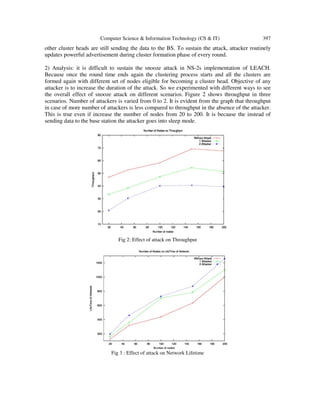
1) Observations: In our experiment, number of nodes is varied from 20 to 200 in the network as
well as number of attacker also increases from 0 to 4. Favorable metrics are transmitted from the
start of simulation to allow the attacker to become cluster head for the most of the nodes in the
network. After collecting the data from all the cluster members, the attacker goes into sleep mode.
Attacker to BS there is no transmission. Figure 2 shows the effect of the attack on throughput.
The graph shows that throughput drops in case of snooze attack. Throughput never falls to zero as](https://image.slidesharecdn.com/simulationofsnoozeattackinleach-131007014225-phpapp01/85/Simulation-of-snooze-attack-in-leach-4-320.jpg)
![Computer Science & Information Technology (CS & IT) 399
more pronounced. As part of the future work, we plan to propose a countermeasure based on
certification provided by BS to detect the snooze attack.
REFERENCES
[1] Li, C.; Zhang, H.X.; Hao, B.B.; Li, J.D. A survey on routing protocols for large-scale wireless sensor
networks. Sensors 2011, 11, 3498–3526.
[2] Kulik, J.; Heinzelman, W.R.; Balakrishnan, H. Negotiation based protocols for dissemi-nating
information in wireless sensor networks. Wirel. Netw. 2002, 8, 169–185.
[3] Intanagonwiwat, C.; Govindan, R.; Estrin, D.; Heidemann, J. Directed diffusion for wireless sensor
networking. IEEE/ACM Trans. Netw. 2003, 11, 2–16.
[4] Braginsky, D.; Estrin, D. Rumor Routing Algorithm for Sensor Networks. In Proceed-ings of the First
ACM International Workshop on Wireless Sensor Networks and Applica-tions (WSNA), Atlanta,
GA, USA, 28 September 2002; pp. 22–31.
[5] W.R. Heinzelman, A.P. Chandrakasan, H. Balakrishnan, An application- specific pro-tocol
architecture for wireless microsensor networks, IEEE Transactions on Wireless Communications 1
(4) (2002) 660–670.
[6] S. Lindsey, C.S. Raghavenda, PEGASIS: power efficient gathering in sensor information systems, in:
Proceeding of the IEEE Aerospace Conference, Big Sky, Montana, March 2002.
[7] O. Younis, S. Fahmy, HEED: A hybrid, energy-efficient, distributed clustering approach for ad hoc
sensor networks, IEEE Transactions on Mobile Computing ,3 (4) (2004) 660–669.
[8] Manjeshwar, E.; Agrawal, D.P. TEEN: A Routing Protocol for Enhanced Efficiency in Wireless
Sensor Networks. In Proceedings of the 15th International Parallel and Distributed Processing
Symposium (IPDPS), San Francisco, CA, USA, 23–27 April 2001,pp. 2009–2015.
[9] 28. Manjeshwar, A.; Agrawal, D. P. APTEEN: A Hybrid Protocol for Efficient Routing and
Comprehensive Information Retrieval in Wireless Sensor Networks. In Proceedings of the 2nd
International Workshop on Parallel and Distributed Computing Issues in Wireless Networks and
Mobile computing, Lauderdale, FL, USA, 15–19 April 2002, pp. 195–202.
[10] Xuxun Liu, A Survey on Clustering Routing Protocols in Wireless Sensor Networks. Sensors 2012,
12, pp. 11113-11153. doi:10.3390/s120811113
[11] Chris Karlof and David Wagner. Secure routing in wireless sensor networks: Attacks and
countermeasures. Elsevier’s AdHoc Networks Journal, Special Issue on Sensor Network Applications
and Protocols, 1(2–3):293–315, September, 2003.
[12] S. Bandyopadhyay, E.J. Coyle, An energy efficient hierarchical clustering algorithm for wireless
sensor networks, in: Proceeding of INFOCOM 2003, April 2003.
[13] The Network Simulator NS-2 (1997). Available at www.isi.edu/nsnam/ns (Accessed: 25 June 2012).
[14] Ajay Jangra1, Swati and Priyanka, Securing LEACH Protocol from Sybil Attack using Jakes Channel
Scheme (JCS), in : Proceeding of International Conference on Advances in ICT for Emerging
Regions 2011, September 2011,Colombo,Sri Lanka.
[15] Leonardo B. Oliveira and Adrian Carlos Ferreira and Marcos Aurélio, SecLEACH – A Random Key
Distribution Solution for Securing Clustered Sensor Networks, Signal Processing,87(12),pp. 2882-
2895,2007.](https://image.slidesharecdn.com/simulationofsnoozeattackinleach-131007014225-phpapp01/85/Simulation-of-snooze-attack-in-leach-7-320.jpg)


