IT8602-MOBILE COMMUNICATION
PREPARED BY
P.MANJULA,AP/IT,VELTECH MULTITECH
 Mobile IP is a communication protocol (created by extending
Internet Protocol, IP) that allows the users to move from one
network to another with the same IP address. It ensures that
the communication will continue without user’s sessions or
connections being dropped.
• Mobile Node (MN):
It is the hand-held communication device that the user caries e.g. Cell
phone.
• Home Network:
It is a network to which the mobile node originally belongs to as per its
assigned IP address (home address).
• Home Agent (HA):
It is a router in home network to which the mobile node was originally
connected
• Home Address:
It is the permanent IP address assigned to the mobile node (within its home
network).
• Foreign Network:
It is the current network to which the mobile node is visiting (away from its
home network).
• Foreign Agent (FA):
It is a router in foreign network to which mobile node is currently
connected. The packets from the home agent are sent to the foreign agent
which delivers it to the mobile node.
• Correspondent Node (CN):
It is a device on the internet communicating to the mobile node.
• Care of Address (COA):
It is the temporary address used by a mobile node while it is moving away
from its home network.
Prof. Dr.-Ing. Jochen Schiller,
http://www.jochenschiller.de/
MC SS02
8.4
CN
router
HA
router
FA
Internet
router
1.
2.
3.
home
network
MN
foreign
network
4.
COA
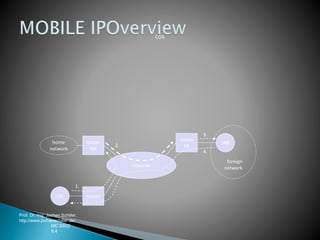
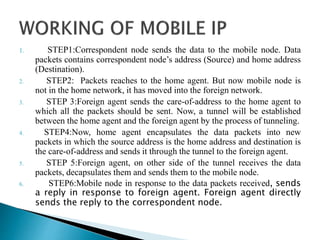
1. STEP1:Correspondent node sends the data to the mobile node. Data
packets contains correspondent node’s address (Source) and home address
(Destination).
2. STEP2: Packets reaches to the home agent. But now mobile node is
not in the home network, it has moved into the foreign network.
3. STEP 3:Foreign agent sends the care-of-address to the home agent to
which all the packets should be sent. Now, a tunnel will be established
between the home agent and the foreign agent by the process of tunneling.
4. STEP4:Now, home agent encapsulates the data packets into new
packets in which the source address is the home address and destination is
the care-of-address and sends it through the tunnel to the foreign agent.
5. STEP 5:Foreign agent, on other side of the tunnel receives the data
packets, decapsulates them and sends them to the mobile node.
6. STEP6:Mobile node in response to the data packets received, sends
a reply in response to foreign agent. Foreign agent directly
sends the reply to the correspondent node.
• The Mobile IP process has three main phases, which
are discussed in the following sections.
1. Agent Discovery
A Mobile Node discovers its Foreign and Home
Agents during agent discovery.
2. Registration
The Mobile Node registers its current location with
the Foreign Agent and Home Agent during
registration.
3. Tunneling
 Mobility agents transmit agent
Advertisements to advertise their services on
a network.
 In the absence of agent advertisements, a
mobile node can solicit advertisements. This
is known as agent solicitation.
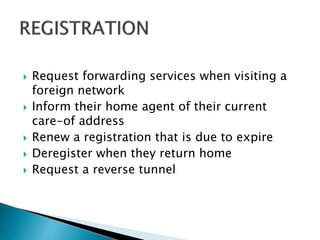
 Request forwarding services when visiting a
foreign network
 Inform their home agent of their current
care-of address
 Renew a registration that is due to expire
 Deregister when they return home
 Request a reverse tunnel
Prof. Dr.-Ing. Jochen Schiller,
http://www.jochenschiller.de/
MC SS02
8.9
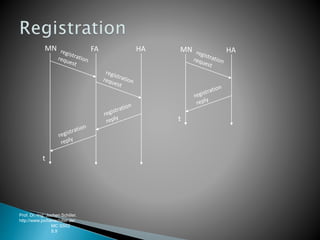
t
MN HA
t
MN FA HA
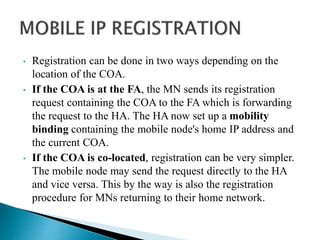
• Registration can be done in two ways depending on the
location of the COA.
• If the COA is at the FA, the MN sends its registration
request containing the COA to the FA which is forwarding
the request to the HA. The HA now set up a mobility
binding containing the mobile node's home IP address and
the current COA.
• If the COA is co-located, registration can be very simpler.
The mobile node may send the request directly to the HA
and vice versa. This by the way is also the registration
procedure for MNs returning to their home network.
 A tunnel is used to establish a virtual pipe for data
packets between a tunnel entry and a tunnel endpoint.
Packets which are entering in a tunnel are forwarded
inside the tunnel and leave the tunnel unchanged.
 Tunneling, i.e., sending a packet through a tunnel is
achieved with the help of encapsulation.
 Tunneling is also known as "port forwarding" is the
transmission and data intended for use only within a
private, usually corporate network through a public
network.
Prof. Dr.-Ing. Jochen Schiller,
http://www.jochenschiller.de/
MC SS02
8.12
Internet
receiver
FA
HA
MN
home network
foreign
network
sender
3
2
1
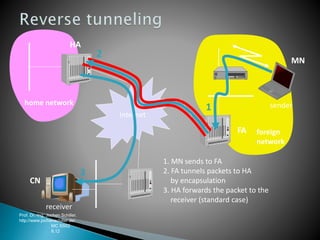
1. MN sends to FA
2. FA tunnels packets to HA
by encapsulation
3. HA forwards the packet to the
receiver (standard case)
CN
 DHCP (Dynamic Host Configuration Protocol)
is a network management protocol used to
dynamically assign an Internet Protocol (IP)
address to any device, or node, on a network
so they can communicate using IP.
 DHCP will assign new IP addresses in each
location when devices are moved from place
to place
• DHCP server -- typically either a server or
router -- is a networked device that runs on
the DHCP service. The DHCP server holds IP
addresses, as well as related information
pertaining to configuration.
• The DHCP client is a device -- such as a
computer or phone -- that can connect to a
network and communicate with a DHCP
server.
• The DHCP relay will manage requests
between DHCP clients and servers
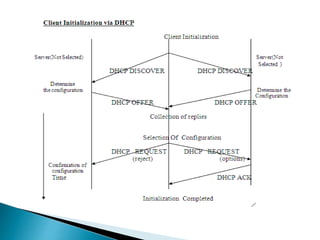
• The client broadcasts a DHCP DISCOVER into subnet. There may be relay
to forwards this broadcast.
• Two servers receive this broadcast and determine the configuration they
offer to the client.
• Servers reply to the client’s request with DHCPOFFER and offer a list of
configuration parameters.
• The client can now choose one of the configurations offered.
• The client in turn replies to the servers accepting one of the configurations
and rejecting the others using DHCP REQUEST.
• If a server receives a DHCP REQUEST with a rejection it can free the
reserved configuration for other possible clients.
• The server with the configuration accepted by the client now confirms the
configuration with DHCP ACK.This completes the initialization phase.
• If a client leaves the subnet it should release the configuration
received by the server using DHCP RELEASE.
• Now the server can free the context stored for the client and offer
the configuration again.
• The configuration a client from a server is only leased for a
certain amount of time it has to be reconfirmed from time to
time.
• Otherwise the server will be free the configuration. This timeout
of configuration helps in the case of crashed nodes or nodes
moved away without realizing the context.
• DHCP makes it easier for network
administrators to add or move devices within
a network, whether it be a LAN or WAN.
• DHCP is not inherently secure, and if
malicious actors access the DHCP server, they
can wreak havoc.
• Also, if the DHCP server does not have a
backup and the server fails, so do the devices
served by it.
 dynamically changing topology;
 absence of fixed infrastructure and
centralized administration;
 bandwidth constrained wireless links;
 energy-constrained nodes.
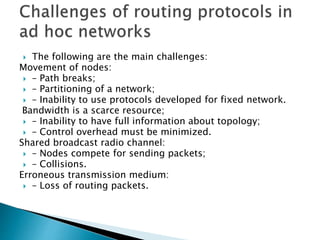
 The following are the main challenges:
Movement of nodes:
 – Path breaks;
 – Partitioning of a network;
 – Inability to use protocols developed for fixed network.
Bandwidth is a scarce resource;
 – Inability to have full information about topology;
 – Control overhead must be minimized.
Shared broadcast radio channel:
 – Nodes compete for sending packets;
 – Collisions.
Erroneous transmission medium:
 – Loss of routing packets.
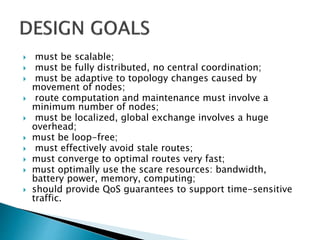
 must be scalable;
 must be fully distributed, no central coordination;
 must be adaptive to topology changes caused by
movement of nodes;
 route computation and maintenance must involve a
minimum number of nodes;
 must be localized, global exchange involves a huge
overhead;
 must be loop-free;
 must effectively avoid stale routes;
 must converge to optimal routes very fast;
 must optimally use the scare resources: bandwidth,
battery power, memory, computing;
 should provide QoS guarantees to support time-sensitive
traffic.
 Modification of the Bellman-Ford algorithm where each node
maintains: the shortest path to destination;
 the first node on this shortest path.
This protocol is characterized by the following:
• routes to destination are readily available at each node in the
routing table (RT);
• RTs are exchanged between neighbors at regular intervals;
• RTs are also exchanged when significant changes in local
topology are observed by a node.
RT updates can be of two types:
• incremental updates: – take place when a node does not observe
significant changes in a local topology;
• full dumps: – take place when significant changes of local
topology are observed;
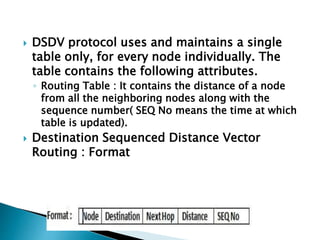
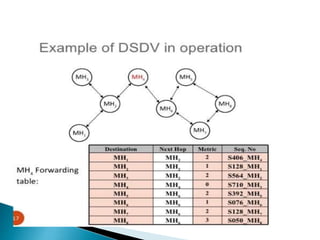
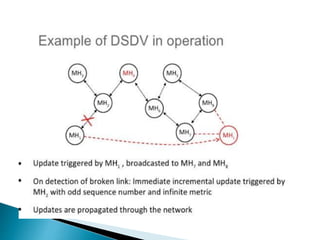
 DSDV protocol uses and maintains a single
table only, for every node individually. The
table contains the following attributes.
◦ Routing Table : It contains the distance of a node
from all the neighboring nodes along with the
sequence number( SEQ No means the time at which
table is updated).
 Destination Sequenced Distance Vector
Routing : Format
1. Each router (node) in the network collects route information
from all its neighbours.
2. After gathering information, the node determines the shortest
path to the destination based on the gathered information.
3. Based on the gathered information, a new routing table is
generated.
4. The router broadcasts this table to its neighbours. On receipt
by neighbours, the neighbour nodes recompute their respective
routingtables.
5. This process continues till the routing information becomes
stable.
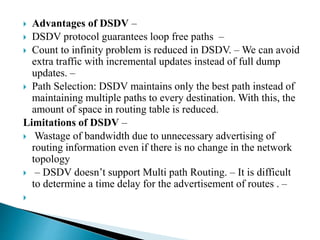
 Advantages of DSDV –
 DSDV protocol guarantees loop free paths –
 Count to infinity problem is reduced in DSDV. – We can avoid
extra traffic with incremental updates instead of full dump
updates. –
 Path Selection: DSDV maintains only the best path instead of
maintaining multiple paths to every destination. With this, the
amount of space in routing table is reduced.
Limitations of DSDV –
 Wastage of bandwidth due to unnecessary advertising of
routing information even if there is no change in the network
topology
 – DSDV doesn’t support Multi path Routing. – It is difficult
to determine a time delay for the advertisement of routes . –

 DSR is a source initiated on-demand (or
reactive) routing protocol for ad hoc
networks. It uses source routing, a technique
in which the sender of a packet determines
the complete sequence of nodes through
which a packet has to travel.
 DSR works in two phases: (i) Route discovery
and (ii) Route maintenance.
 Route discovery -Route discovery allows any host to dynamically discover the route to any
destination in the ad hoc network.
 When a node has a data packet to send, it first checks its own routing cache. If it finds a valid
route in its own routing cache, it sends out the packet using this route.
 Otherwise, it initiates a route discovery process by broadcasting a route request packet to all
its neighbours. .
 The route request packet contains the source address, the request id and a
route record in which the sequence of hops traversed by the request packet,
before reaching the destination is recorded.
 A node upon getting a route request packet does the following. If a packet
does not have the required route in its routing cache, it forwards the packet
to all its neighbours
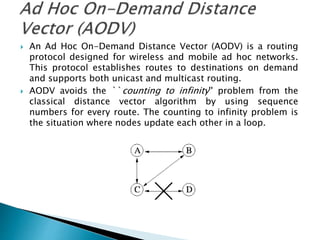
 An Ad Hoc On-Demand Distance Vector (AODV) is a routing
protocol designed for wireless and mobile ad hoc networks.
This protocol establishes routes to destinations on demand
and supports both unicast and multicast routing.
 AODV avoids the ``counting to infinity'' problem from the
classical distance vector algorithm by using sequence
numbers for every route. The counting to infinity problem is
the situation where nodes update each other in a loop.
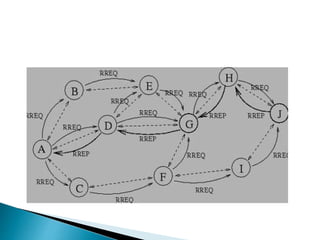
 RREQ - A route request message is transmitted by a node requiring a route to
a node.
 Data packets waiting to be transmitted(i.e. the packets that initiated the
RREQ) should be buffered locally and transmitted by a FIFO principal when a
route is set.
 RREP - A route reply message is unicasted back to the originator of a RREQ if
the receiver is either the node using the requested address, or it has a valid
route to the requested address. The reason one can unicast the message back, is
that every route forwarding a RREQ caches a route back to the originator.
 RERR - Nodes monitor the link status of next hops in active routes. When a
link breakage in an active route is detected, a RERR message is used to notify
other nodes of the loss of the link. In order to enable this reporting mechanism,
each node keeps a ``precursor list'', containing the IP address for each its
neighbors that are likely to use it as a next hop towards each destination.
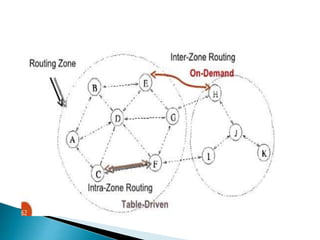
 The Zone Routing Protocol, as its name implies, is based on the concept of zones.
 A routing zone is defined for each node separately, and the zones of neighboring nodes
overlap.
 The routing zone has a radius ρ expressed in hops.
 The nodes of a zone are divided into peripheral nodes and interior nodes.
 Peripheral nodes are nodes whose minimum distance to the central node is exactly equal to
the zone radius ρ.
 The nodes whose minimum distance is less than ρ are interior nodes
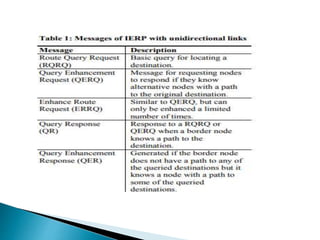
 ZRP refers to the locally proactive routing component as the IntrA-zone
Routing Protocol (IARP).
 The globally reactive routing component is named IntEr-zone Routing
Protocol (IERP).
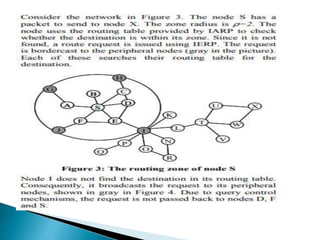
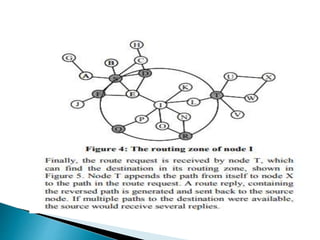
 Instead of broadcasting packets, ZRP uses a concept called bordercasting.
Bordercasting utilizes the topology information provided by IARP to direct
query request to the border of the zone.
MOBILE IP,DHCP,ADHOC ROUTING PROTOCOLS

MOBILE IP,DHCP,ADHOC ROUTING PROTOCOLS

  • 1.
  • 2.
     Mobile IPis a communication protocol (created by extending Internet Protocol, IP) that allows the users to move from one network to another with the same IP address. It ensures that the communication will continue without user’s sessions or connections being dropped.
  • 3.
    • Mobile Node(MN): It is the hand-held communication device that the user caries e.g. Cell phone. • Home Network: It is a network to which the mobile node originally belongs to as per its assigned IP address (home address). • Home Agent (HA): It is a router in home network to which the mobile node was originally connected • Home Address: It is the permanent IP address assigned to the mobile node (within its home network). • Foreign Network: It is the current network to which the mobile node is visiting (away from its home network). • Foreign Agent (FA): It is a router in foreign network to which mobile node is currently connected. The packets from the home agent are sent to the foreign agent which delivers it to the mobile node. • Correspondent Node (CN): It is a device on the internet communicating to the mobile node. • Care of Address (COA): It is the temporary address used by a mobile node while it is moving away from its home network.
  • 4.
    Prof. Dr.-Ing. JochenSchiller, http://www.jochenschiller.de/ MC SS02 8.4 CN router HA router FA Internet router 1. 2. 3. home network MN foreign network 4. COA
  • 5.
    1. STEP1:Correspondent nodesends the data to the mobile node. Data packets contains correspondent node’s address (Source) and home address (Destination). 2. STEP2: Packets reaches to the home agent. But now mobile node is not in the home network, it has moved into the foreign network. 3. STEP 3:Foreign agent sends the care-of-address to the home agent to which all the packets should be sent. Now, a tunnel will be established between the home agent and the foreign agent by the process of tunneling. 4. STEP4:Now, home agent encapsulates the data packets into new packets in which the source address is the home address and destination is the care-of-address and sends it through the tunnel to the foreign agent. 5. STEP 5:Foreign agent, on other side of the tunnel receives the data packets, decapsulates them and sends them to the mobile node. 6. STEP6:Mobile node in response to the data packets received, sends a reply in response to foreign agent. Foreign agent directly sends the reply to the correspondent node.
  • 6.
    • The MobileIP process has three main phases, which are discussed in the following sections. 1. Agent Discovery A Mobile Node discovers its Foreign and Home Agents during agent discovery. 2. Registration The Mobile Node registers its current location with the Foreign Agent and Home Agent during registration. 3. Tunneling
  • 7.
     Mobility agentstransmit agent Advertisements to advertise their services on a network.  In the absence of agent advertisements, a mobile node can solicit advertisements. This is known as agent solicitation.
  • 8.
     Request forwardingservices when visiting a foreign network  Inform their home agent of their current care-of address  Renew a registration that is due to expire  Deregister when they return home  Request a reverse tunnel
  • 9.
    Prof. Dr.-Ing. JochenSchiller, http://www.jochenschiller.de/ MC SS02 8.9 t MN HA t MN FA HA
  • 10.
    • Registration canbe done in two ways depending on the location of the COA. • If the COA is at the FA, the MN sends its registration request containing the COA to the FA which is forwarding the request to the HA. The HA now set up a mobility binding containing the mobile node's home IP address and the current COA. • If the COA is co-located, registration can be very simpler. The mobile node may send the request directly to the HA and vice versa. This by the way is also the registration procedure for MNs returning to their home network.
  • 11.
     A tunnelis used to establish a virtual pipe for data packets between a tunnel entry and a tunnel endpoint. Packets which are entering in a tunnel are forwarded inside the tunnel and leave the tunnel unchanged.  Tunneling, i.e., sending a packet through a tunnel is achieved with the help of encapsulation.  Tunneling is also known as "port forwarding" is the transmission and data intended for use only within a private, usually corporate network through a public network.
  • 12.
    Prof. Dr.-Ing. JochenSchiller, http://www.jochenschiller.de/ MC SS02 8.12 Internet receiver FA HA MN home network foreign network sender 3 2 1 1. MN sends to FA 2. FA tunnels packets to HA by encapsulation 3. HA forwards the packet to the receiver (standard case) CN
  • 13.
     DHCP (DynamicHost Configuration Protocol) is a network management protocol used to dynamically assign an Internet Protocol (IP) address to any device, or node, on a network so they can communicate using IP.  DHCP will assign new IP addresses in each location when devices are moved from place to place
  • 14.
    • DHCP server-- typically either a server or router -- is a networked device that runs on the DHCP service. The DHCP server holds IP addresses, as well as related information pertaining to configuration. • The DHCP client is a device -- such as a computer or phone -- that can connect to a network and communicate with a DHCP server. • The DHCP relay will manage requests between DHCP clients and servers
  • 16.
    • The clientbroadcasts a DHCP DISCOVER into subnet. There may be relay to forwards this broadcast. • Two servers receive this broadcast and determine the configuration they offer to the client. • Servers reply to the client’s request with DHCPOFFER and offer a list of configuration parameters. • The client can now choose one of the configurations offered. • The client in turn replies to the servers accepting one of the configurations and rejecting the others using DHCP REQUEST. • If a server receives a DHCP REQUEST with a rejection it can free the reserved configuration for other possible clients. • The server with the configuration accepted by the client now confirms the configuration with DHCP ACK.This completes the initialization phase.
  • 17.
    • If aclient leaves the subnet it should release the configuration received by the server using DHCP RELEASE. • Now the server can free the context stored for the client and offer the configuration again. • The configuration a client from a server is only leased for a certain amount of time it has to be reconfirmed from time to time. • Otherwise the server will be free the configuration. This timeout of configuration helps in the case of crashed nodes or nodes moved away without realizing the context.
  • 18.
    • DHCP makesit easier for network administrators to add or move devices within a network, whether it be a LAN or WAN. • DHCP is not inherently secure, and if malicious actors access the DHCP server, they can wreak havoc. • Also, if the DHCP server does not have a backup and the server fails, so do the devices served by it.
  • 19.
     dynamically changingtopology;  absence of fixed infrastructure and centralized administration;  bandwidth constrained wireless links;  energy-constrained nodes.
  • 20.
     The followingare the main challenges: Movement of nodes:  – Path breaks;  – Partitioning of a network;  – Inability to use protocols developed for fixed network. Bandwidth is a scarce resource;  – Inability to have full information about topology;  – Control overhead must be minimized. Shared broadcast radio channel:  – Nodes compete for sending packets;  – Collisions. Erroneous transmission medium:  – Loss of routing packets.
  • 21.
     must bescalable;  must be fully distributed, no central coordination;  must be adaptive to topology changes caused by movement of nodes;  route computation and maintenance must involve a minimum number of nodes;  must be localized, global exchange involves a huge overhead;  must be loop-free;  must effectively avoid stale routes;  must converge to optimal routes very fast;  must optimally use the scare resources: bandwidth, battery power, memory, computing;  should provide QoS guarantees to support time-sensitive traffic.
  • 23.
     Modification ofthe Bellman-Ford algorithm where each node maintains: the shortest path to destination;  the first node on this shortest path. This protocol is characterized by the following: • routes to destination are readily available at each node in the routing table (RT); • RTs are exchanged between neighbors at regular intervals; • RTs are also exchanged when significant changes in local topology are observed by a node. RT updates can be of two types: • incremental updates: – take place when a node does not observe significant changes in a local topology; • full dumps: – take place when significant changes of local topology are observed;
  • 24.
     DSDV protocoluses and maintains a single table only, for every node individually. The table contains the following attributes. ◦ Routing Table : It contains the distance of a node from all the neighboring nodes along with the sequence number( SEQ No means the time at which table is updated).  Destination Sequenced Distance Vector Routing : Format
  • 25.
    1. Each router(node) in the network collects route information from all its neighbours. 2. After gathering information, the node determines the shortest path to the destination based on the gathered information. 3. Based on the gathered information, a new routing table is generated. 4. The router broadcasts this table to its neighbours. On receipt by neighbours, the neighbour nodes recompute their respective routingtables. 5. This process continues till the routing information becomes stable.
  • 28.
     Advantages ofDSDV –  DSDV protocol guarantees loop free paths –  Count to infinity problem is reduced in DSDV. – We can avoid extra traffic with incremental updates instead of full dump updates. –  Path Selection: DSDV maintains only the best path instead of maintaining multiple paths to every destination. With this, the amount of space in routing table is reduced. Limitations of DSDV –  Wastage of bandwidth due to unnecessary advertising of routing information even if there is no change in the network topology  – DSDV doesn’t support Multi path Routing. – It is difficult to determine a time delay for the advertisement of routes . – 
  • 29.
     DSR isa source initiated on-demand (or reactive) routing protocol for ad hoc networks. It uses source routing, a technique in which the sender of a packet determines the complete sequence of nodes through which a packet has to travel.  DSR works in two phases: (i) Route discovery and (ii) Route maintenance.
  • 30.
     Route discovery-Route discovery allows any host to dynamically discover the route to any destination in the ad hoc network.  When a node has a data packet to send, it first checks its own routing cache. If it finds a valid route in its own routing cache, it sends out the packet using this route.  Otherwise, it initiates a route discovery process by broadcasting a route request packet to all its neighbours. .  The route request packet contains the source address, the request id and a route record in which the sequence of hops traversed by the request packet, before reaching the destination is recorded.  A node upon getting a route request packet does the following. If a packet does not have the required route in its routing cache, it forwards the packet to all its neighbours
  • 31.
     An AdHoc On-Demand Distance Vector (AODV) is a routing protocol designed for wireless and mobile ad hoc networks. This protocol establishes routes to destinations on demand and supports both unicast and multicast routing.  AODV avoids the ``counting to infinity'' problem from the classical distance vector algorithm by using sequence numbers for every route. The counting to infinity problem is the situation where nodes update each other in a loop.
  • 32.
     RREQ -A route request message is transmitted by a node requiring a route to a node.  Data packets waiting to be transmitted(i.e. the packets that initiated the RREQ) should be buffered locally and transmitted by a FIFO principal when a route is set.  RREP - A route reply message is unicasted back to the originator of a RREQ if the receiver is either the node using the requested address, or it has a valid route to the requested address. The reason one can unicast the message back, is that every route forwarding a RREQ caches a route back to the originator.  RERR - Nodes monitor the link status of next hops in active routes. When a link breakage in an active route is detected, a RERR message is used to notify other nodes of the loss of the link. In order to enable this reporting mechanism, each node keeps a ``precursor list'', containing the IP address for each its neighbors that are likely to use it as a next hop towards each destination.
  • 34.
     The ZoneRouting Protocol, as its name implies, is based on the concept of zones.  A routing zone is defined for each node separately, and the zones of neighboring nodes overlap.  The routing zone has a radius ρ expressed in hops.  The nodes of a zone are divided into peripheral nodes and interior nodes.  Peripheral nodes are nodes whose minimum distance to the central node is exactly equal to the zone radius ρ.  The nodes whose minimum distance is less than ρ are interior nodes  ZRP refers to the locally proactive routing component as the IntrA-zone Routing Protocol (IARP).  The globally reactive routing component is named IntEr-zone Routing Protocol (IERP).  Instead of broadcasting packets, ZRP uses a concept called bordercasting. Bordercasting utilizes the topology information provided by IARP to direct query request to the border of the zone.