@zahidtg
The following presentation is intended for educational
purposes only. There are references to information in public
domain (books, websites, standard documents, etc.) in this
material. Sincere attempt has been made to give credit to all
such references wherever possible. The original copyright
holders retain the copyright to their material. E&OE.
Thanks to Dr. Triantafyllos (Aldo) Kanakis for preparing some
of the slides and Parallel Wireless for giving me time off from
the hectic schedule to complete this presentation.
2
3
4
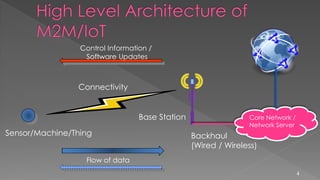
Sensor/Machine/Thing
Connectivity
Base Station
Flow of data
Control Information /
Software Updates
Core Network /
Network Server
Backhaul
(Wired / Wireless)
Machine
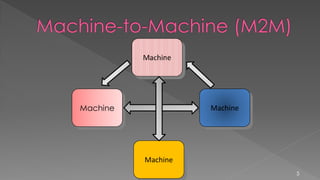
5
Machine
Machine
Machine
Machine
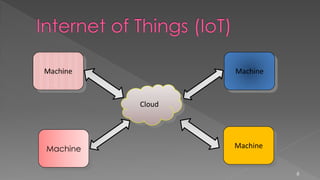
6
Machine
Machine
Machine
Cloud
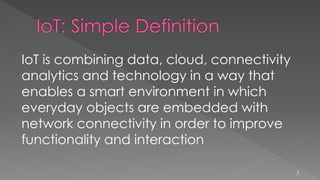
IoT is combining data, cloud, connectivity
analytics and technology in a way that
enables a smart environment in which
everyday objects are embedded with
network connectivity in order to improve
functionality and interaction
7
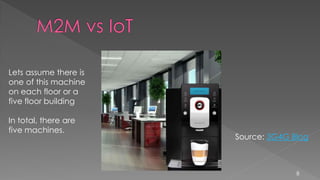
8
Source: 3G4G Blog
Lets assume there is
one of this machine
on each floor or a
five floor building
In total, there are
five machines.
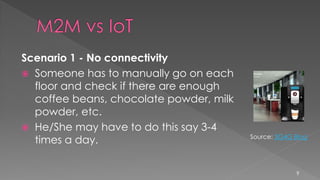
Scenario 1 - No connectivity
 Someone has to manually go on each
floor and check if there are enough
coffee beans, chocolate powder, milk
powder, etc.
 He/She may have to do this say 3-4
times a day.
9
Source: 3G4G Blog
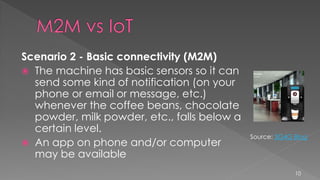
Scenario 2 - Basic connectivity (M2M)
 The machine has basic sensors so it can
send some kind of notification (on your
phone or email or message, etc.)
whenever the coffee beans, chocolate
powder, milk powder, etc., falls below a
certain level.
 An app on phone and/or computer
may be available
10
Source: 3G4G Blog
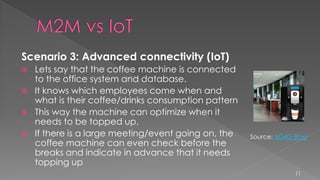
Scenario 3: Advanced connectivity (IoT)
 Lets say that the coffee machine is connected
to the office system and database.
 It knows which employees come when and
what is their coffee/drinks consumption pattern
 This way the machine can optimize when it
needs to be topped up.
 If there is a large meeting/event going on, the
coffee machine can even check before the
breaks and indicate in advance that it needs
topping up
11
Source: 3G4G Blog
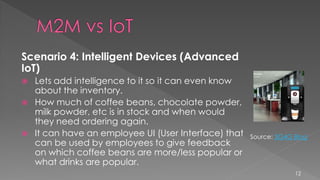
Scenario 4: Intelligent Devices (Advanced
IoT)
 Lets add intelligence to it so it can even know
about the inventory.
 How much of coffee beans, chocolate powder,
milk powder, etc is in stock and when would
they need ordering again.
 It can have an employee UI (User Interface) that
can be used by employees to give feedback
on which coffee beans are more/less popular or
what drinks are popular.
12
Source: 3G4G Blog
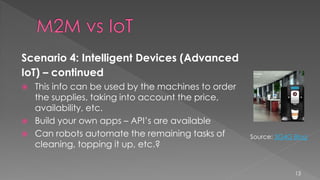
Scenario 4: Intelligent Devices (Advanced
IoT) – continued
 This info can be used by the machines to order
the supplies, taking into account the price,
availability, etc.
 Build your own apps – API’s are available
 Can robots automate the remaining tasks of
cleaning, topping it up, etc.?
13
Source: 3G4G Blog
14
15
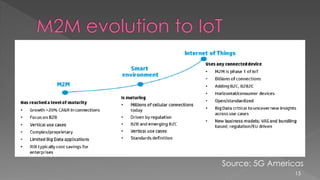
Source: 5G Americas
“There are many different type of devices that can be connected to
the Internet of Things. A device can be something big and complex, like
a car or a house. It can be something you use in everyday life, such as a
golf club, or a printer, or a pair of sneakers. It can be something very,
very small, such as a discrete sensor inside your car or house or golf club,
a single part of a much larger and more complex device.
For that matter, what the IoT calls “things” don’t have to be actual
physical things. A thing can be a piece of data – status information such
as your location or room temperature – collected through separate
general purpose device, such as a thermostat, smartphone or
computer. Put another way, the physical thing itself doesn’t have to be
in the IoT, although data about the thing must.
Know, though, that most IoT devices are simple sensors that monitor
something happening nearby. These simple things are either record or
transmit the information they gather across the network to some other
device or service.”
16
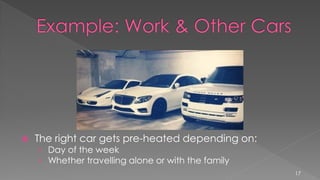
 The right car gets pre-heated depending on:
› Day of the week
› Whether travelling alone or with the family
17
18
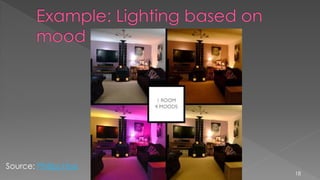
Source: Philips Hue
19
20
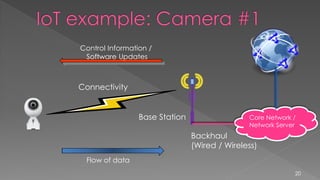
Connectivity
Base Station
Flow of data
Control Information /
Software Updates
Core Network /
Network Server
Backhaul
(Wired / Wireless)
21
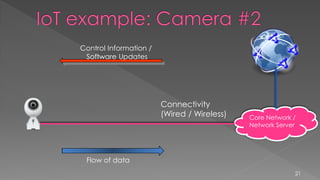
Flow of data
Control Information /
Software Updates
Core Network /
Network Server
Connectivity
(Wired / Wireless)
22Source: Ericsson Part 1, Part 2
23Source: Ericsson Part 1, Part 2
24
25
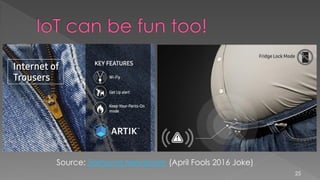
Source: Samsung Newsroom (April Fools 2016 Joke)
26
Source: Venturebeat
27
Source: Forbes/BCG
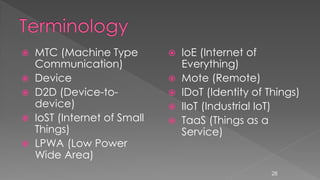
 MTC (Machine Type
Communication)
 Device
 D2D (Device-to-
device)
 IoST (Internet of Small
Things)
 LPWA (Low Power
Wide Area)
 IoE (Internet of
Everything)
 Mote (Remote)
 IDoT (Identity of Things)
 IIoT (Industrial IoT)
 TaaS (Things as a
Service)
28
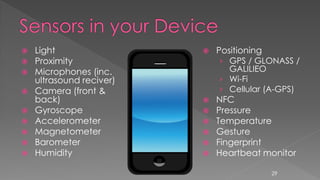
 Light
 Proximity
 Microphones (inc.
ultrasound reciver)
 Camera (front &
back)
 Gyroscope
 Accelerometer
 Magnetometer
 Barometer
 Humidity
 Positioning
› GPS / GLONASS /
GALILIEO
› Wi-Fi
› Cellular (A-GPS)
 NFC
 Pressure
 Temperature
 Gesture
 Fingerprint
 Heartbeat monitor
29
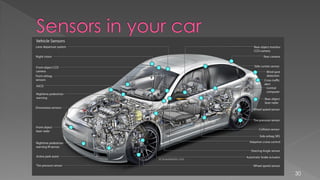
30
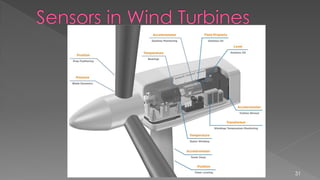
31
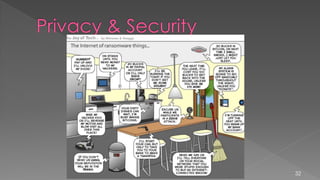
32
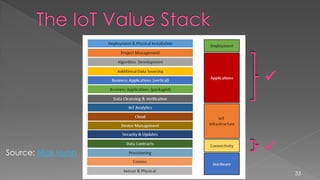
33

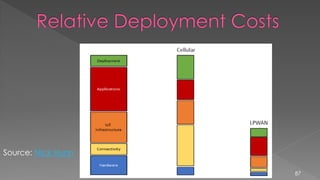
Source: Nick Hunn
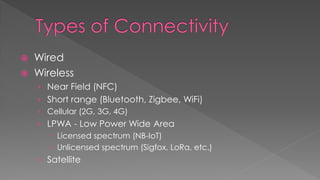
 Wired
 Wireless
› Near Field (NFC)
› Short range (Bluetooth, Zigbee, WiFi)
› Cellular (2G, 3G, 4G)
› LPWA - Low Power Wide Area
 Licensed spectrum (NB-IoT)
 Unlicensed spectrum (Sigfox, LoRa, etc.)
› Satellite
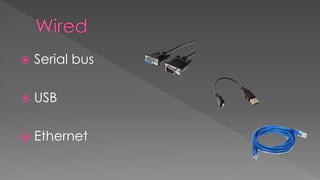
 Serial bus
 USB
 Ethernet
36
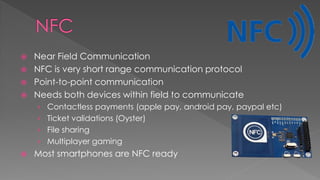
 Near Field Communication
 NFC is very short range communication protocol
 Point-to-point communication
 Needs both devices within field to communicate
› Contactless payments (apple pay, android pay, paypal etc)
› Ticket validations (Oyster)
› File sharing
› Multiplayer gaming
 Most smartphones are NFC ready
 Short range communications
 Transmission at the ISM band
 Low transmission power
 Low penetration properties (walls, doors, windows etc)
 High transmission rate
 High availability
› Smartphones
› Laptops
› Car entertainment units
› IoT devices
 Low cost
 Supports few nodes in a PAN
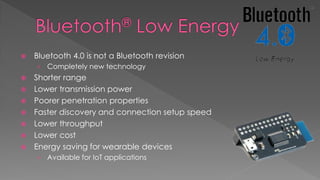
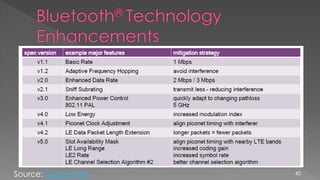
 Bluetooth 4.0 is not a Bluetooth revision
› Completely new technology
 Shorter range
 Lower transmission power
 Poorer penetration properties
 Faster discovery and connection setup speed
 Lower throughput
 Lower cost
 Energy saving for wearable devices
› Available for IoT applications
40Source: Qualcomm
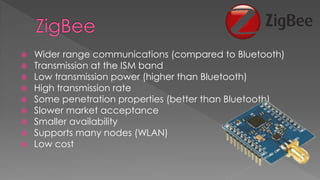
 Wider range communications (compared to Bluetooth)
 Transmission at the ISM band
 Low transmission power (higher than Bluetooth)
 High transmission rate
 Some penetration properties (better than Bluetooth)
 Slower market acceptance
 Smaller availability
 Supports many nodes (WLAN)
 Low cost
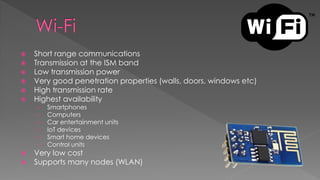
 Short range communications
 Transmission at the ISM band
 Low transmission power
 Very good penetration properties (walls, doors, windows etc)
 High transmission rate
 Highest availability
› Smartphones
› Computers
› Car entertainment units
› IoT devices
› Smart home devices
› Control units
 Very low cost
 Supports many nodes (WLAN)
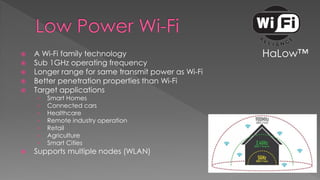
 A Wi-Fi family technology
 Sub 1GHz operating frequency
 Longer range for same transmit power as Wi-Fi
 Better penetration properties than Wi-Fi
 Target applications
› Smart Homes
› Connected cars
› Healthcare
› Remote industry operation
› Retail
› Agriculture
› Smart Cities
 Supports multiple nodes (WLAN)
HaLow™
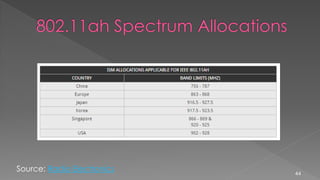
44
Source: Radio Electronics
45
46
47
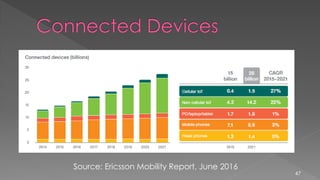
Source: Ericsson Mobility Report, June 2016
48
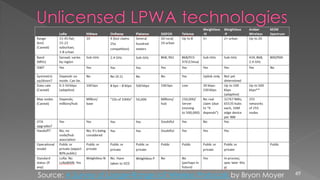
49Source: A Survey of Longer-Range IoT Wireless Protocols by Bryon Moyer
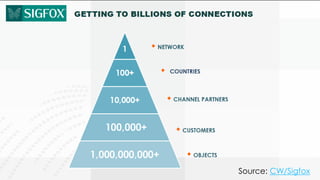
50Source: CW/Sigfox
51
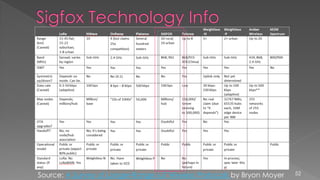
52Source: A Survey of Longer-Range IoT Wireless Protocols by Bryon Moyer
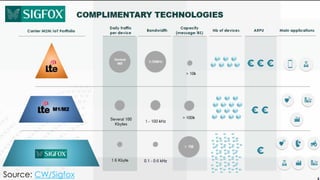
53Source: CW/Sigfox
 Low cost modules $2 - $3
 Subscription prices as low as £1 per year in large volumes
(over 50K)
 Aiming for very low-bandwidth applications that favour low
volumes of messages per device, typically uplink-heavy
(device to cloud)
› 12 bytes per message, and at the same time no more than 140
messages per device per day
 Sigfox devices can work up to 20 years off two AA batteries
Source: Rethink Research
54
 Agriculture and environment: weather
monitoring; irrigation control; soil condition;
security; monitoring the health of livestock;
measuring river water.
 Automotive: vehicle tracking; fleet
management
 Consumer electronics: personal tracking
devices; health products with monitoring of
sensor statuses such as location, blood
pressure and glucose levels; home
automation/domotics.
 Emergency services and security: alarms;
CCTV; fire detection and protection; access
control systems;
 Healthcare: devices enabling first responder
connectivity or clinical trials monitoring.
 Intelligent buildings: heating; ventilation; air
conditioning; lighting; security.
 Manufacturing and supply chain: devices that
monitor waste and fuel consumption,
inventory, maintenance variables, etc.
 Manufacturing and supply chain: devices that
monitor waste and fuel consumption,
inventory, maintenance variables, etc.
 Retail and leisure: supply chain
communication, inventory management,
shopping devices and communication.
 Utilities: energy theft monitoring, feedback for
consumers and repair crews, public safety,
waste, leakage and financial control
 Smart city and public transport: technologies
for public transport, including ticketing and
passenger information systems; parking space
management and payment; charging and
road tolls, traffic volume monitoring;
connected road signs, traffic lights and law-
enforcement cameras; CCTV, street lighting,
waste collection, public alarms and
intercoms; tourist information services; static
advertising and billboards.
Source: Wikipedia
55
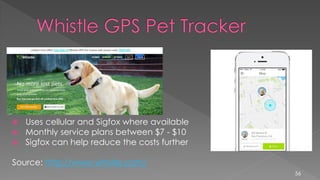
 Uses cellular and Sigfox where available
 Monthly service plans between $7 - $10
 Sigfox can help reduce the costs further
Source: http://www.whistle.com/
56
57
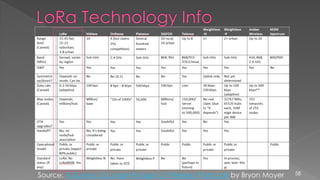
58Source: A Survey of Longer-Range IoT Wireless Protocols by Bryon Moyer
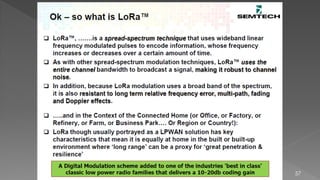
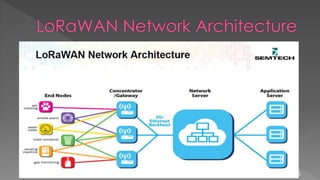
 LoRa refer to a wireless modulation allowing a low power
high radio budget communication.
 LoRaWAN refer to a network protocol using LoRa chips for
the communication. It relies on basestation able to
monitor 8 frequencies with multiple spread factors (virtually
~42 channels).
 It is possible to use LoRa modulation in point to point or star
networks without using LoRaWAN.
 It could be possible to have LoRaWAN like network with
other radio link, but wouldn’t be really practical.
Source: Alexandre Bouillot, Quora
59
60
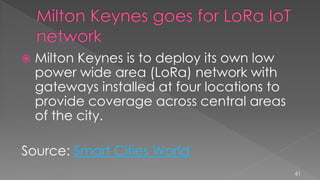
 Milton Keynes is to deploy its own low
power wide area (LoRa) network with
gateways installed at four locations to
provide coverage across central areas
of the city.
Source: Smart Cities World
61
62
63
64
65
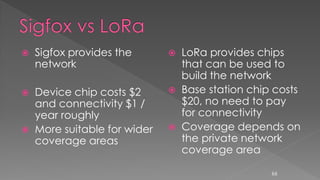
 Sigfox provides the
network
 Device chip costs $2
and connectivity $1 /
year roughly
 More suitable for wider
coverage areas
 LoRa provides chips
that can be used to
build the network
 Base station chip costs
$20, no need to pay
for connectivity
 Coverage depends on
the private network
coverage area
66
67
68
Source: EE Times
69
Source: EE Times
70
Source: Ericsson
Mobility report, June
2014
71
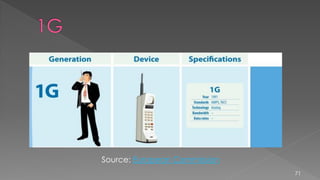
Source: European Commission
72
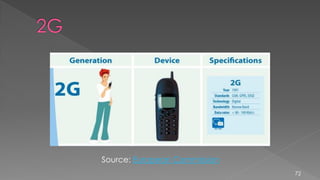
Source: European Commission
73
74
 Provided a 4 year notice of 2G switch off
 2.3 million customers still on 2G at time of
switch off
 San Francisco’s bus systems relied on 2G
network to show the next bus times but
they failed to upgrade their equipment
by deadline so all timings were wrong.
75
 Won the deal to supply connectivity for the UK’s Smart Meter
Implementation Programme in two of the project’s three regions.
 The operator will provide service in the Central and Southern
regions for the programme, which will see the deployment of 53
million connected gas and electricity meters across the UK by
2020.
 The deal is valued at £1.5bn over a 15-year lifespan
 O2 will use 2G (GSM & GPRS) to provide connectivity. They will
also use RF mesh to reach premises with poor cellular
connectivity
 Source: Telecoms.com, Critical articles: Guardian, Nick Hunn
76
77
Source: European Commission
78
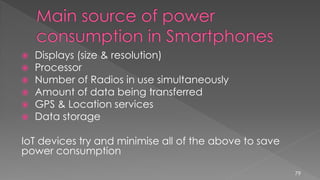
 Displays (size & resolution)
 Processor
 Number of Radios in use simultaneously
 Amount of data being transferred
 GPS & Location services
 Data storage
IoT devices try and minimise all of the above to save
power consumption
79
80
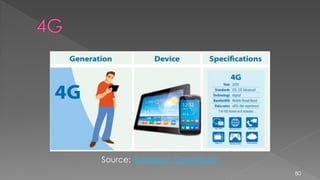
Source: European Commission
81
82
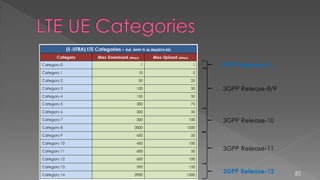
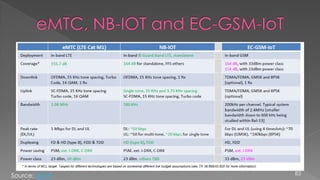
83Source: 3GPP
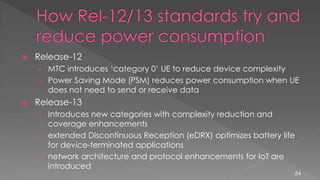
 Release-12
› MTC introduces ‘category 0’ UE to reduce device complexity
› Power Saving Mode (PSM) reduces power consumption when UE
does not need to send or receive data
 Release-13
› Introduces new categories with complexity reduction and
coverage enhancements
› extended Discontinuous Reception (eDRX) optimizes battery life
for device-terminated applications
› network architecture and protocol enhancements for IoT are
introduced
84
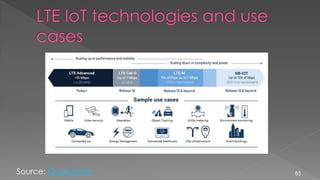
85Source: Qualcomm
86
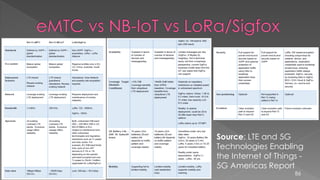
Source: LTE and 5G
Technologies Enabling
the Internet of Things -
5G Americas Report
87
Source: Nick Hunn
88
89Source: Nokia
90
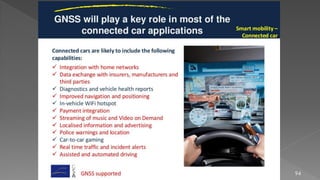
 Automated Vehicles
(GNSS – GPS, GLONASS,
etc.)
 Location Based Services
 Pay as you drive
Insurance
 Tracking of shipping
containers
 Weather and Pollution
monitoring
 eCall (in combination
with cellular)
 Communications with
Aircrafts, Ships, etc. out
of cellular range
 Fleet management and
control
 Oil Platforms monitoring
91
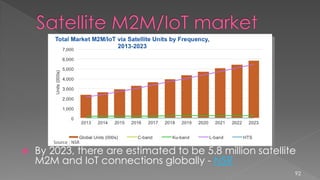
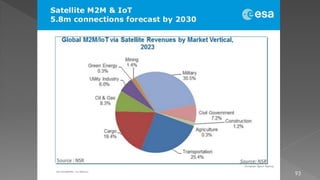
 By 2023, there are estimated to be 5.8 million satellite
M2M and IoT connections globally - NSR
92
93
94
95
96
97
Source of Satellite presentations: techUK
Satellite Applications & Services
Conference
98
99Source: Satellite Applications Catapult
100
101
102Source
103
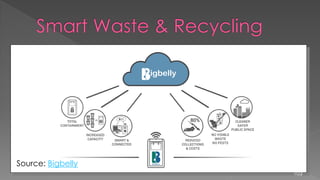
Source: Bigbelly
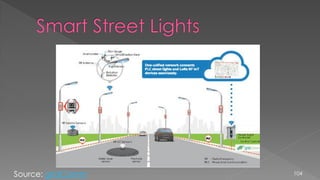
104Source: gridComm
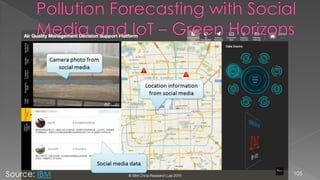
105Source: IBM
106
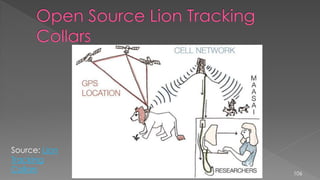
Source: Lion
Tracking
Collars
Source: Illegal Amazonian logging traced by
Cargo Tracck™ and Gemalto’s M2M modules
107
108Source: Onfarm
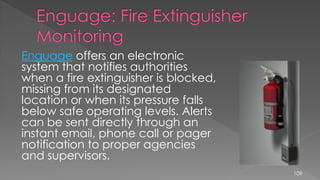
Enguage offers an electronic
system that notifies authorities
when a fire extinguisher is blocked,
missing from its designated
location or when its pressure falls
below safe operating levels. Alerts
can be sent directly through an
instant email, phone call or pager
notification to proper agencies
and supervisors.
109
110Source: TechHive
111
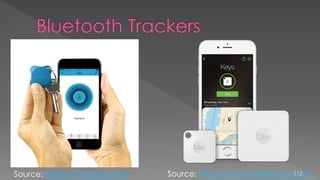
112Source: https://findlapa.com/ Source: https://www.thetileapp.com/
113
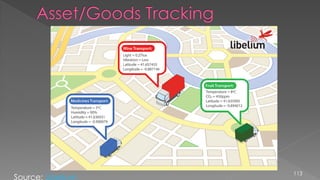
Source: Libelium
114
115
116
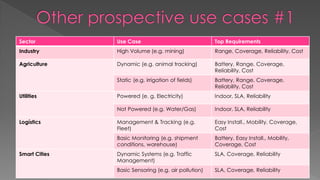
Sector Use Case Top Requirements
Industry High Volume (e.g. mining) Range, Coverage, Reliability, Cost
Agriculture Dynamic (e.g. animal tracking) Battery, Range, Coverage,
Reliability, Cost
Static (e.g. irrigation of fields) Battery, Range, Coverage,
Reliability, Cost
Utilities Powered (e. g. Electricity) Indoor, SLA, Reliability
Not Powered (e.g. Water/Gas) Indoor, SLA, Reliability
Logístics Management & Tracking (e.g.
Fleet)
Easy Install., Mobility, Coverage,
Cost
Basic Monitoring (e.g. shipment
conditions, warehouse)
Battery, Easy Install., Mobility,
Coverage, Cost
Smart Cities Dynamic Systems (e.g. Traffic
Management)
SLA, Coverage, Reliability
Basic Sensoring (e.g. air pollution) SLA, Coverage, Reliability
117
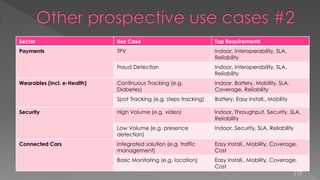
Sector Use Case Top Requirements
Payments TPV Indoor, Interoperability, SLA,
Reliability
Fraud Detection Indoor, Interoperability, SLA,
Reliability
Wearables (incl. e-Health) Continuous Tracking (e.g.
Diabetes)
Indoor, Battery, Mobility, SLA,
Coverage, Reliability
Spot Tracking (e.g. steps tracking) Battery, Easy Install., Mobility
Security High Volume (e.g. video) Indoor, Throughput, Security, SLA,
Reliability
Low Volume (e.g. presence
detection)
Indoor, Security, SLA, Reliability
Connected Cars Integrated solution (e.g. traffic
management)
Easy Install., Mobility, Coverage,
Cost
Basic Monitoring (e.g. location) Easy Install., Mobility, Coverage,
Cost
118
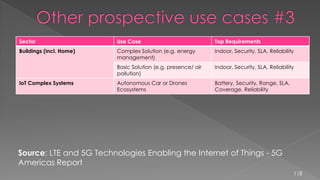
Sector Use Case Top Requirements
Buildings (incl. Home) Complex Solution (e.g. energy
management)
Indoor, Security, SLA, Reliability
Basic Solution (e.g. presence/ air
pollution)
Indoor, Security, SLA, Reliability
IoT Complex Systems Autonomous Car or Drones
Ecosystems
Battery, Security, Range, SLA,
Coverage, Reliability
Source: LTE and 5G Technologies Enabling the Internet of Things - 5G
Americas Report
119
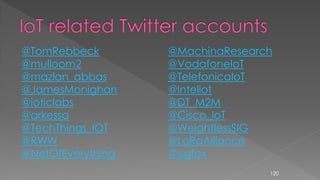
@TomRebbeck
@mulloom2
@mazlan_abbas
@JamesMonighan
@ioticlabs
@arkessa
@TechThings_IOT
@RWW
@NetOfEverything
@MachinaResearch
@VodafoneIoT
@TelefonicaIoT
@Inteliot
@DT_M2M
@Cisco_IoT
@WeightlessSIG
@LoRaAlliance
@sigfox
120
 Cisco VNI Whitepaper, Feb 2016
 LTE and 5G Technologies Enabling the Internet of Things - 5G
Americas Report, Dec 2016
 Ericsson Mobility Report – June 2014, June 2015, Latest
 CW - 'Radio Systems for Mission-Critical IoT Communications'
 CW - 'Boring but lucrative, the real Internet of Things‘
 CW - ‘IoT Security: Will the Internet of Things be Secure Enough to
Run Your Life?’
 CW - 'Don't panic about IoT Security, new technology will sort it
out'
 CW - 'Connected vehicles - the ultimate IoT sensor?‘
 Postscapes – IoT examples
121
122

An Introduction to IoT: Connectivity & Case Studies

  • 1.
  • 2.
    The following presentationis intended for educational purposes only. There are references to information in public domain (books, websites, standard documents, etc.) in this material. Sincere attempt has been made to give credit to all such references wherever possible. The original copyright holders retain the copyright to their material. E&OE. Thanks to Dr. Triantafyllos (Aldo) Kanakis for preparing some of the slides and Parallel Wireless for giving me time off from the hectic schedule to complete this presentation. 2
  • 3.
  • 4.
    4 Sensor/Machine/Thing Connectivity Base Station Flow ofdata Control Information / Software Updates Core Network / Network Server Backhaul (Wired / Wireless)
  • 5.
  • 6.
  • 7.
    IoT is combiningdata, cloud, connectivity analytics and technology in a way that enables a smart environment in which everyday objects are embedded with network connectivity in order to improve functionality and interaction 7
  • 8.
    8 Source: 3G4G Blog Letsassume there is one of this machine on each floor or a five floor building In total, there are five machines.
  • 9.
    Scenario 1 -No connectivity  Someone has to manually go on each floor and check if there are enough coffee beans, chocolate powder, milk powder, etc.  He/She may have to do this say 3-4 times a day. 9 Source: 3G4G Blog
  • 10.
    Scenario 2 -Basic connectivity (M2M)  The machine has basic sensors so it can send some kind of notification (on your phone or email or message, etc.) whenever the coffee beans, chocolate powder, milk powder, etc., falls below a certain level.  An app on phone and/or computer may be available 10 Source: 3G4G Blog
  • 11.
    Scenario 3: Advancedconnectivity (IoT)  Lets say that the coffee machine is connected to the office system and database.  It knows which employees come when and what is their coffee/drinks consumption pattern  This way the machine can optimize when it needs to be topped up.  If there is a large meeting/event going on, the coffee machine can even check before the breaks and indicate in advance that it needs topping up 11 Source: 3G4G Blog
  • 12.
    Scenario 4: IntelligentDevices (Advanced IoT)  Lets add intelligence to it so it can even know about the inventory.  How much of coffee beans, chocolate powder, milk powder, etc is in stock and when would they need ordering again.  It can have an employee UI (User Interface) that can be used by employees to give feedback on which coffee beans are more/less popular or what drinks are popular. 12 Source: 3G4G Blog
  • 13.
    Scenario 4: IntelligentDevices (Advanced IoT) – continued  This info can be used by the machines to order the supplies, taking into account the price, availability, etc.  Build your own apps – API’s are available  Can robots automate the remaining tasks of cleaning, topping it up, etc.? 13 Source: 3G4G Blog
  • 14.
  • 15.
  • 16.
    “There are manydifferent type of devices that can be connected to the Internet of Things. A device can be something big and complex, like a car or a house. It can be something you use in everyday life, such as a golf club, or a printer, or a pair of sneakers. It can be something very, very small, such as a discrete sensor inside your car or house or golf club, a single part of a much larger and more complex device. For that matter, what the IoT calls “things” don’t have to be actual physical things. A thing can be a piece of data – status information such as your location or room temperature – collected through separate general purpose device, such as a thermostat, smartphone or computer. Put another way, the physical thing itself doesn’t have to be in the IoT, although data about the thing must. Know, though, that most IoT devices are simple sensors that monitor something happening nearby. These simple things are either record or transmit the information they gather across the network to some other device or service.” 16
  • 17.
     The rightcar gets pre-heated depending on: › Day of the week › Whether travelling alone or with the family 17
  • 18.
  • 19.
  • 20.
    20 Connectivity Base Station Flow ofdata Control Information / Software Updates Core Network / Network Server Backhaul (Wired / Wireless)
  • 21.
    21 Flow of data ControlInformation / Software Updates Core Network / Network Server Connectivity (Wired / Wireless)
  • 22.
  • 23.
  • 24.
  • 25.
    25 Source: Samsung Newsroom(April Fools 2016 Joke)
  • 26.
  • 27.
  • 28.
     MTC (MachineType Communication)  Device  D2D (Device-to- device)  IoST (Internet of Small Things)  LPWA (Low Power Wide Area)  IoE (Internet of Everything)  Mote (Remote)  IDoT (Identity of Things)  IIoT (Industrial IoT)  TaaS (Things as a Service) 28
  • 29.
     Light  Proximity Microphones (inc. ultrasound reciver)  Camera (front & back)  Gyroscope  Accelerometer  Magnetometer  Barometer  Humidity  Positioning › GPS / GLONASS / GALILIEO › Wi-Fi › Cellular (A-GPS)  NFC  Pressure  Temperature  Gesture  Fingerprint  Heartbeat monitor 29
  • 30.
  • 31.
  • 32.
  • 33.
  • 34.
     Wired  Wireless ›Near Field (NFC) › Short range (Bluetooth, Zigbee, WiFi) › Cellular (2G, 3G, 4G) › LPWA - Low Power Wide Area  Licensed spectrum (NB-IoT)  Unlicensed spectrum (Sigfox, LoRa, etc.) › Satellite
  • 35.
     Serial bus USB  Ethernet
  • 36.
  • 37.
     Near FieldCommunication  NFC is very short range communication protocol  Point-to-point communication  Needs both devices within field to communicate › Contactless payments (apple pay, android pay, paypal etc) › Ticket validations (Oyster) › File sharing › Multiplayer gaming  Most smartphones are NFC ready
  • 38.
     Short rangecommunications  Transmission at the ISM band  Low transmission power  Low penetration properties (walls, doors, windows etc)  High transmission rate  High availability › Smartphones › Laptops › Car entertainment units › IoT devices  Low cost  Supports few nodes in a PAN
  • 39.
     Bluetooth 4.0is not a Bluetooth revision › Completely new technology  Shorter range  Lower transmission power  Poorer penetration properties  Faster discovery and connection setup speed  Lower throughput  Lower cost  Energy saving for wearable devices › Available for IoT applications
  • 40.
  • 41.
     Wider rangecommunications (compared to Bluetooth)  Transmission at the ISM band  Low transmission power (higher than Bluetooth)  High transmission rate  Some penetration properties (better than Bluetooth)  Slower market acceptance  Smaller availability  Supports many nodes (WLAN)  Low cost
  • 42.
     Short rangecommunications  Transmission at the ISM band  Low transmission power  Very good penetration properties (walls, doors, windows etc)  High transmission rate  Highest availability › Smartphones › Computers › Car entertainment units › IoT devices › Smart home devices › Control units  Very low cost  Supports many nodes (WLAN)
  • 43.
     A Wi-Fifamily technology  Sub 1GHz operating frequency  Longer range for same transmit power as Wi-Fi  Better penetration properties than Wi-Fi  Target applications › Smart Homes › Connected cars › Healthcare › Remote industry operation › Retail › Agriculture › Smart Cities  Supports multiple nodes (WLAN) HaLow™

  • 44.
  • 45.
  • 46.
  • 47.
  • 48.
  • 49.
    49Source: A Surveyof Longer-Range IoT Wireless Protocols by Bryon Moyer
  • 50.
  • 51.
  • 52.
    52Source: A Surveyof Longer-Range IoT Wireless Protocols by Bryon Moyer
  • 53.
  • 54.
     Low costmodules $2 - $3  Subscription prices as low as £1 per year in large volumes (over 50K)  Aiming for very low-bandwidth applications that favour low volumes of messages per device, typically uplink-heavy (device to cloud) › 12 bytes per message, and at the same time no more than 140 messages per device per day  Sigfox devices can work up to 20 years off two AA batteries Source: Rethink Research 54
  • 55.
     Agriculture andenvironment: weather monitoring; irrigation control; soil condition; security; monitoring the health of livestock; measuring river water.  Automotive: vehicle tracking; fleet management  Consumer electronics: personal tracking devices; health products with monitoring of sensor statuses such as location, blood pressure and glucose levels; home automation/domotics.  Emergency services and security: alarms; CCTV; fire detection and protection; access control systems;  Healthcare: devices enabling first responder connectivity or clinical trials monitoring.  Intelligent buildings: heating; ventilation; air conditioning; lighting; security.  Manufacturing and supply chain: devices that monitor waste and fuel consumption, inventory, maintenance variables, etc.  Manufacturing and supply chain: devices that monitor waste and fuel consumption, inventory, maintenance variables, etc.  Retail and leisure: supply chain communication, inventory management, shopping devices and communication.  Utilities: energy theft monitoring, feedback for consumers and repair crews, public safety, waste, leakage and financial control  Smart city and public transport: technologies for public transport, including ticketing and passenger information systems; parking space management and payment; charging and road tolls, traffic volume monitoring; connected road signs, traffic lights and law- enforcement cameras; CCTV, street lighting, waste collection, public alarms and intercoms; tourist information services; static advertising and billboards. Source: Wikipedia 55
  • 56.
     Uses cellularand Sigfox where available  Monthly service plans between $7 - $10  Sigfox can help reduce the costs further Source: http://www.whistle.com/ 56
  • 57.
  • 58.
    58Source: A Surveyof Longer-Range IoT Wireless Protocols by Bryon Moyer
  • 59.
     LoRa referto a wireless modulation allowing a low power high radio budget communication.  LoRaWAN refer to a network protocol using LoRa chips for the communication. It relies on basestation able to monitor 8 frequencies with multiple spread factors (virtually ~42 channels).  It is possible to use LoRa modulation in point to point or star networks without using LoRaWAN.  It could be possible to have LoRaWAN like network with other radio link, but wouldn’t be really practical. Source: Alexandre Bouillot, Quora 59
  • 60.
  • 61.
     Milton Keynesis to deploy its own low power wide area (LoRa) network with gateways installed at four locations to provide coverage across central areas of the city. Source: Smart Cities World 61
  • 62.
  • 63.
  • 64.
  • 65.
  • 66.
     Sigfox providesthe network  Device chip costs $2 and connectivity $1 / year roughly  More suitable for wider coverage areas  LoRa provides chips that can be used to build the network  Base station chip costs $20, no need to pay for connectivity  Coverage depends on the private network coverage area 66
  • 67.
  • 68.
  • 69.
  • 70.
  • 71.
  • 72.
  • 73.
  • 74.
  • 75.
     Provided a4 year notice of 2G switch off  2.3 million customers still on 2G at time of switch off  San Francisco’s bus systems relied on 2G network to show the next bus times but they failed to upgrade their equipment by deadline so all timings were wrong. 75
  • 76.
     Won thedeal to supply connectivity for the UK’s Smart Meter Implementation Programme in two of the project’s three regions.  The operator will provide service in the Central and Southern regions for the programme, which will see the deployment of 53 million connected gas and electricity meters across the UK by 2020.  The deal is valued at £1.5bn over a 15-year lifespan  O2 will use 2G (GSM & GPRS) to provide connectivity. They will also use RF mesh to reach premises with poor cellular connectivity  Source: Telecoms.com, Critical articles: Guardian, Nick Hunn 76

  • 77.
  • 78.
  • 79.
     Displays (size& resolution)  Processor  Number of Radios in use simultaneously  Amount of data being transferred  GPS & Location services  Data storage IoT devices try and minimise all of the above to save power consumption 79
  • 80.
  • 81.
  • 82.
  • 83.
  • 84.
     Release-12 › MTCintroduces ‘category 0’ UE to reduce device complexity › Power Saving Mode (PSM) reduces power consumption when UE does not need to send or receive data  Release-13 › Introduces new categories with complexity reduction and coverage enhancements › extended Discontinuous Reception (eDRX) optimizes battery life for device-terminated applications › network architecture and protocol enhancements for IoT are introduced 84
  • 85.
  • 86.
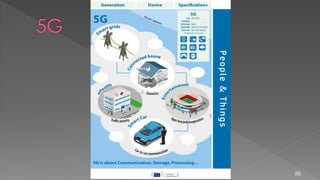
    86 Source: LTE and5G Technologies Enabling the Internet of Things - 5G Americas Report
  • 87.
  • 88.
  • 89.
  • 90.
  • 91.
     Automated Vehicles (GNSS– GPS, GLONASS, etc.)  Location Based Services  Pay as you drive Insurance  Tracking of shipping containers  Weather and Pollution monitoring  eCall (in combination with cellular)  Communications with Aircrafts, Ships, etc. out of cellular range  Fleet management and control  Oil Platforms monitoring 91
  • 92.
     By 2023,there are estimated to be 5.8 million satellite M2M and IoT connections globally - NSR 92
  • 93.
  • 94.
  • 95.
  • 96.
  • 97.
  • 98.
    Source of Satellitepresentations: techUK Satellite Applications & Services Conference 98
  • 99.
  • 100.
  • 101.
  • 102.
  • 103.
  • 104.
  • 105.
  • 106.
  • 107.
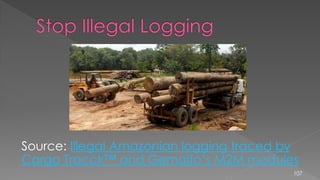
    Source: Illegal Amazonianlogging traced by Cargo Tracck™ and Gemalto’s M2M modules 107
  • 108.
  • 109.
    Enguage offers anelectronic system that notifies authorities when a fire extinguisher is blocked, missing from its designated location or when its pressure falls below safe operating levels. Alerts can be sent directly through an instant email, phone call or pager notification to proper agencies and supervisors. 109
  • 110.
  • 111.
  • 112.
    112Source: https://findlapa.com/ Source:https://www.thetileapp.com/
  • 113.
  • 114.
  • 115.
  • 116.
    116 Sector Use CaseTop Requirements Industry High Volume (e.g. mining) Range, Coverage, Reliability, Cost Agriculture Dynamic (e.g. animal tracking) Battery, Range, Coverage, Reliability, Cost Static (e.g. irrigation of fields) Battery, Range, Coverage, Reliability, Cost Utilities Powered (e. g. Electricity) Indoor, SLA, Reliability Not Powered (e.g. Water/Gas) Indoor, SLA, Reliability Logístics Management & Tracking (e.g. Fleet) Easy Install., Mobility, Coverage, Cost Basic Monitoring (e.g. shipment conditions, warehouse) Battery, Easy Install., Mobility, Coverage, Cost Smart Cities Dynamic Systems (e.g. Traffic Management) SLA, Coverage, Reliability Basic Sensoring (e.g. air pollution) SLA, Coverage, Reliability
  • 117.
    117 Sector Use CaseTop Requirements Payments TPV Indoor, Interoperability, SLA, Reliability Fraud Detection Indoor, Interoperability, SLA, Reliability Wearables (incl. e-Health) Continuous Tracking (e.g. Diabetes) Indoor, Battery, Mobility, SLA, Coverage, Reliability Spot Tracking (e.g. steps tracking) Battery, Easy Install., Mobility Security High Volume (e.g. video) Indoor, Throughput, Security, SLA, Reliability Low Volume (e.g. presence detection) Indoor, Security, SLA, Reliability Connected Cars Integrated solution (e.g. traffic management) Easy Install., Mobility, Coverage, Cost Basic Monitoring (e.g. location) Easy Install., Mobility, Coverage, Cost
  • 118.
    118 Sector Use CaseTop Requirements Buildings (incl. Home) Complex Solution (e.g. energy management) Indoor, Security, SLA, Reliability Basic Solution (e.g. presence/ air pollution) Indoor, Security, SLA, Reliability IoT Complex Systems Autonomous Car or Drones Ecosystems Battery, Security, Range, SLA, Coverage, Reliability Source: LTE and 5G Technologies Enabling the Internet of Things - 5G Americas Report
  • 119.
  • 120.
  • 121.
     Cisco VNIWhitepaper, Feb 2016  LTE and 5G Technologies Enabling the Internet of Things - 5G Americas Report, Dec 2016  Ericsson Mobility Report – June 2014, June 2015, Latest  CW - 'Radio Systems for Mission-Critical IoT Communications'  CW - 'Boring but lucrative, the real Internet of Things‘  CW - ‘IoT Security: Will the Internet of Things be Secure Enough to Run Your Life?’  CW - 'Don't panic about IoT Security, new technology will sort it out'  CW - 'Connected vehicles - the ultimate IoT sensor?‘  Postscapes – IoT examples 121
  • 122.