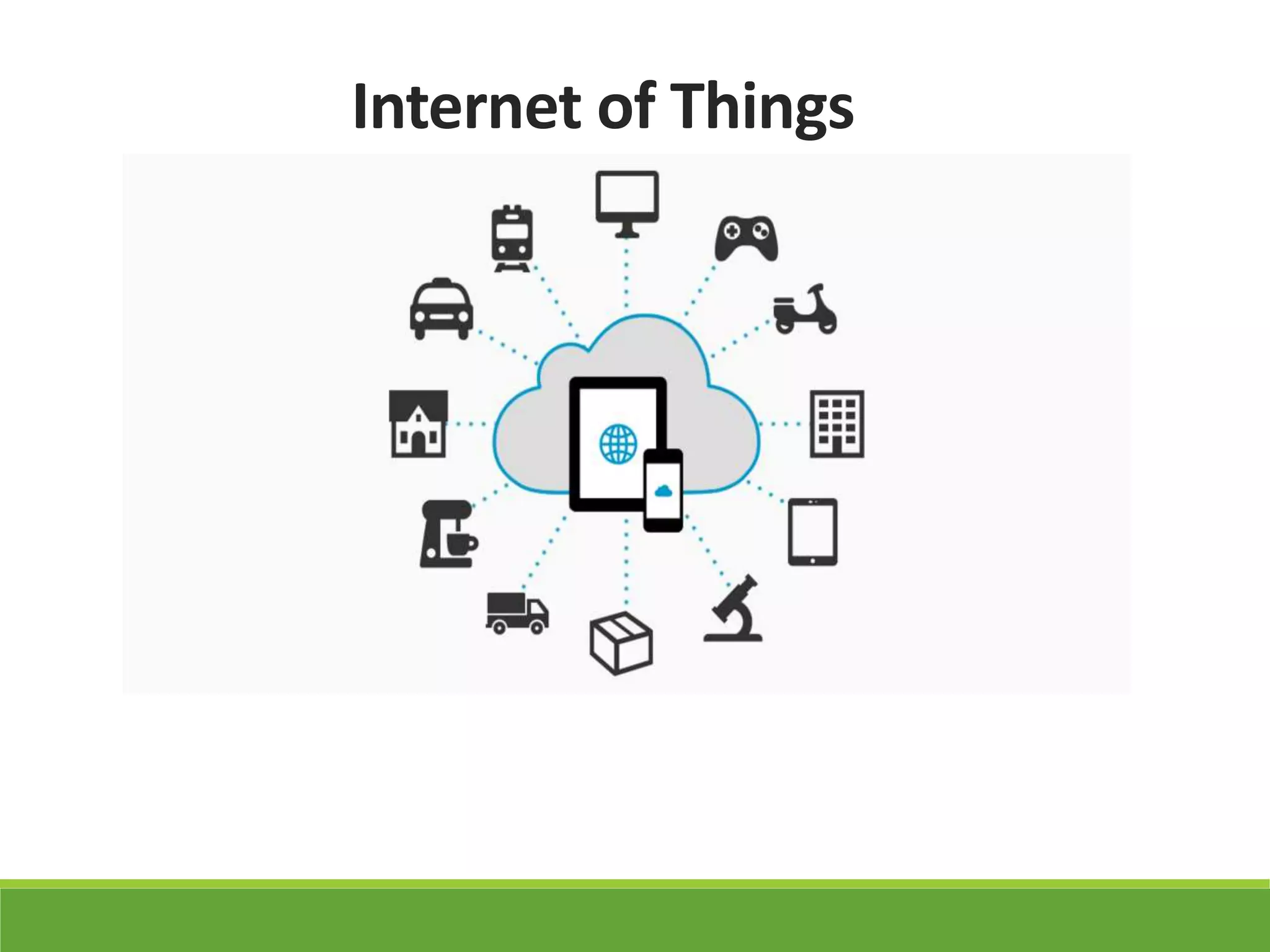
Internet of Things
Contents
• Introduction
• Evolution
• Characteristics
• Architecture
• Components
• Applications
• Challenges
Introduction
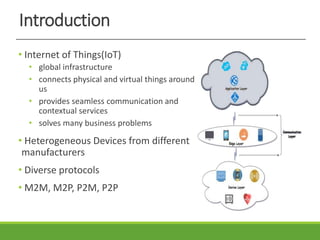
• Internet of Things(IoT)
• global infrastructure
• connects physical and virtual things around
us
• provides seamless communication and
contextual services
• solves many business problems
• Heterogeneous Devices from different
manufacturers
• Diverse protocols
• M2M, M2P, P2M, P2P
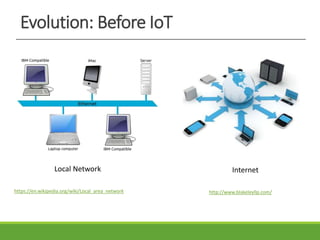
Evolution: Before IoT
Local Network Internet
https://en.wikipedia.org/wiki/Local_area_network http://www.blakeleyllp.com/
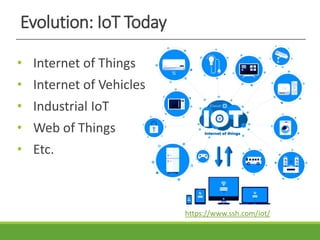
Evolution: IoT Today
• Internet of Things
• Internet of Vehicles
• Industrial IoT
• Web of Things
• Etc.
https://www.ssh.com/iot/
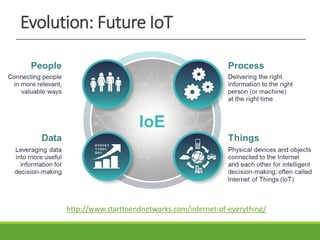
Evolution: Future IoT
http://www.starttoendnetworks.com/internet-of-everything/
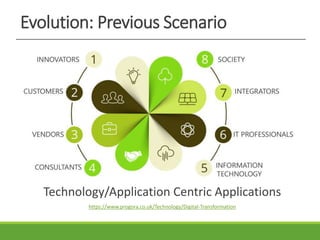
Evolution: Previous Scenario
Technology/Application Centric Applications
https://www.progora.co.uk/Technology/Digital-Transformation
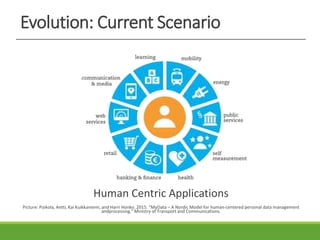
Evolution: Current Scenario
Human Centric Applications
Picture: Poikola, Antti, Kai Kuikkaniemi, and Harri Honko. 2015. “MyData – A Nordic Model for human-centered personal data management
andprocessing.” Ministry of Transport and Communications.
Characteristics
• Connectivity
• Intelligence and Identity
• Scalability
• Distributed Computing
• Dynamic Operations
• Heterogeneous Environment
• Resource Constraint Devices
• Battery Operated Devices
• Low Power Protocols
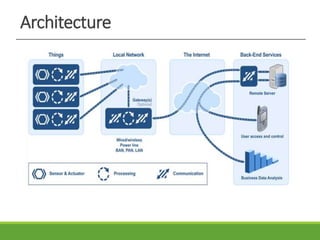
Architecture
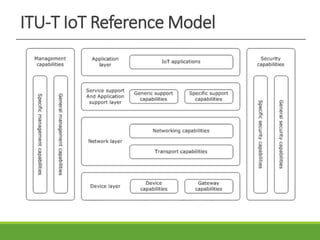
ITU-T IoT Reference Model
• Four Layers
• Application layer
• Service and Application support layer
• Network layer
• Device layer
• Two Capabilities
• Management
• Security
ITU-T IoT Reference Model
• Application layer contains all IoT applications that
interact with IoT devices
• Service support and Application support layer
consists of the two capability groupings
• Generic support capabilities: common
capabilities used by different IoT applications,
such as data processing or data storage
• Specific support capabilities: specific
capabilities for the requirements of diversified
applications
ITU-T IoT Reference Model
• Network layer consists of the two capabilities:
• Networking capabilities provide relevant control
functions of network connectivity between devices
and gateways.
• Transport capabilities focus on providing
connectivity for the transport of IoT service and
application specific data information, as well as the
transport of IoT-related control and management
information.
ITU-T IoT Reference Model
• Device layer capabilities are categorized into
two kinds of capabilities
• Device Capabilities:
• Direct interaction with the communication
network (without gateways)
• Indirect interaction with the communication
network (through gateways)
• Ad-hoc networking
• Sleeping and waking-up
ITU-T IoT Reference Model
• Gateway capabilities:
• Multiple interfaces support – At device layer
through wired or wireless technologies (CAN bus,
ZigBee, Bluetooth or Wi-Fi) and At network layer
through PSTN, 2G or 3G networks, LTE, or DSL
• Protocol conversion when communications at the
device layer use different device layer protocols
and when communications involving both the
device layer and network layer use different
protocols
ITU-T IoT Reference Model
• Management capabilities
• Generic capabilities
• device management such as activation & de-
activation, diagnostics, firmware updating
• local network topology management
• traffic and congestion management such as
detection of network overflow conditions,
implementation of resource reservation
• Specific Capabilities are closely coupled with
application-specific requirements
ITU-T IoT Reference Model
• Security capabilities
• Generic capabilities
• application layer: authorization, authentication,
confidentiality and integrity protection, privacy
protection, security audit
• network layer: authorization, authentication,
confidentiality, and signalling integrity protection
• device layer: authentication, authorization, device
integrity validation, access control, data confidentiality
and integrity protection.
• Specific Capabilities are closely coupled with
application-specific requirements
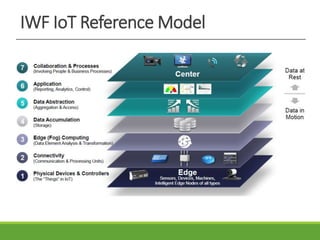
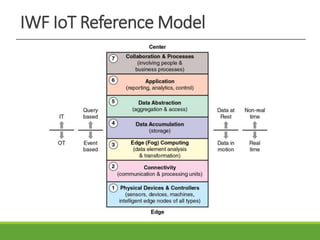
IWF IoT Reference Model
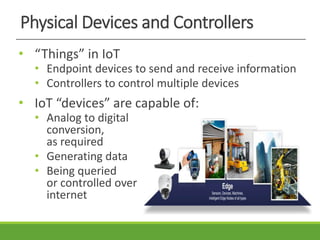
Physical Devices and Controllers
• “Things” in IoT
• Endpoint devices to send and receive information
• Controllers to control multiple devices
• IoT “devices” are capable of:
• Analog to digital
conversion,
as required
• Generating data
• Being queried
or controlled over
internet
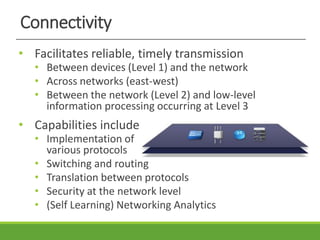
Connectivity
• Facilitates reliable, timely transmission
• Between devices (Level 1) and the network
• Across networks (east-west)
• Between the network (Level 2) and low-level
information processing occurring at Level 3
• Capabilities include
• Implementation of
various protocols
• Switching and routing
• Translation between protocols
• Security at the network level
• (Self Learning) Networking Analytics
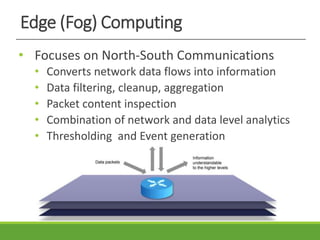
Edge (Fog) Computing
• Focuses on North-South Communications
• Converts network data flows into information
• Data filtering, cleanup, aggregation
• Packet content inspection
• Combination of network and data level analytics
• Thresholding and Event generation
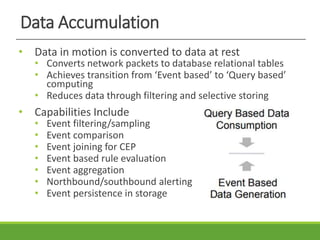
Data Accumulation
• Data in motion is converted to data at rest
• Converts network packets to database relational tables
• Achieves transition from ‘Event based’ to ‘Query based’
computing
• Reduces data through filtering and selective storing
• Capabilities Include
• Event filtering/sampling
• Event comparison
• Event joining for CEP
• Event based rule evaluation
• Event aggregation
• Northbound/southbound alerting
• Event persistence in storage
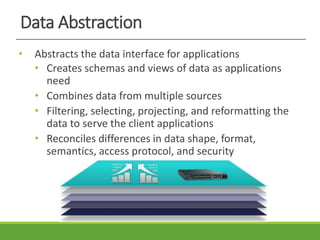
Data Abstraction
• Abstracts the data interface for applications
• Creates schemas and views of data as applications
need
• Combines data from multiple sources
• Filtering, selecting, projecting, and reformatting the
data to serve the client applications
• Reconciles differences in data shape, format,
semantics, access protocol, and security
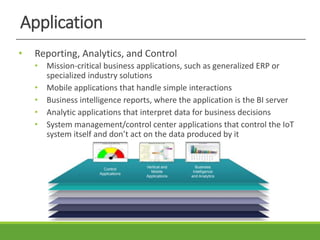
Application
• Reporting, Analytics, and Control
• Mission-critical business applications, such as generalized ERP or
specialized industry solutions
• Mobile applications that handle simple interactions
• Business intelligence reports, where the application is the BI server
• Analytic applications that interpret data for business decisions
• System management/control center applications that control the IoT
system itself and don’t act on the data produced by it
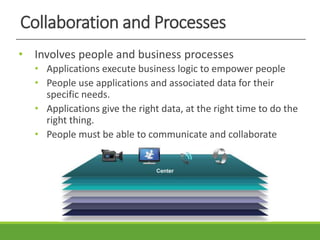
Collaboration and Processes
• Involves people and business processes
• Applications execute business logic to empower people
• People use applications and associated data for their
specific needs.
• Applications give the right data, at the right time to do the
right thing.
• People must be able to communicate and collaborate
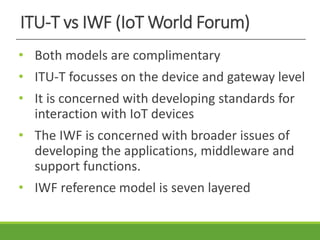
ITU-T vs IWF (IoT World Forum)
• Both models are complimentary
• ITU-T focusses on the device and gateway level
• It is concerned with developing standards for
interaction with IoT devices
• The IWF is concerned with broader issues of
developing the applications, middleware and
support functions.
• IWF reference model is seven layered
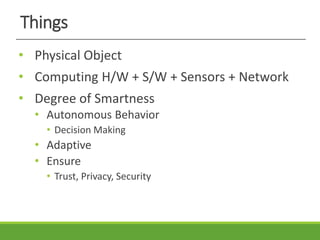
Things
• Physical Object
• Computing H/W + S/W + Sensors + Network
• Degree of Smartness
• Autonomous Behavior
• Decision Making
• Adaptive
• Ensure
• Trust, Privacy, Security
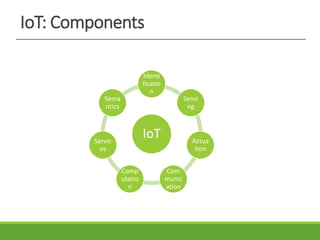
IoT: Components
IoT
Identi
ficatio
n
Sensi
ng
Actua
tion
Com
munic
ation
Comp
utatio
n
Servic
es
Sema
ntics
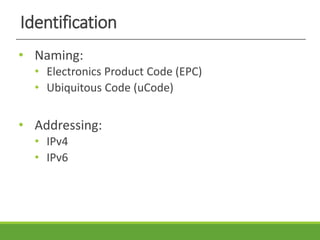
Identification
• Naming:
• Electronics Product Code (EPC)
• Ubiquitous Code (uCode)
• Addressing:
• IPv4
• IPv6
Sensing
• Employs various sensors
• Specialized sensors for various applications
• Smart Sensors
• Wearable Sensing Devices
• Embedded Sensors
• Sense the data
• Transmit to the gateways
Actuation
• Sensor and data analytics technologies from
the IoT are used to send commands to smart
devices
• Decisions are taken on edge/cloud and passed
on to the devices to act upon
• Artificial Intelligence may be used to act
according to the context and environment
Ex: Water Level Sensor & Smart Electric Motor
Communication
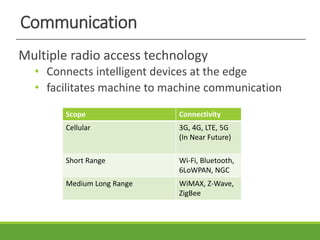
Multiple radio access technology
• Connects intelligent devices at the edge
• facilitates machine to machine communication
Scope Connectivity
Cellular 3G, 4G, LTE, 5G
(In Near Future)
Short Range Wi-Fi, Bluetooth,
6LoWPAN, NGC
Medium Long Range WiMAX, Z-Wave,
ZigBee
Communication
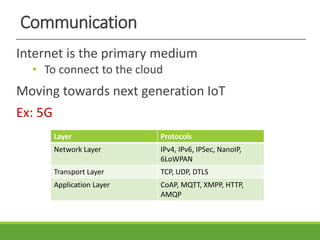
Internet is the primary medium
• To connect to the cloud
Moving towards next generation IoT
Ex: 5G
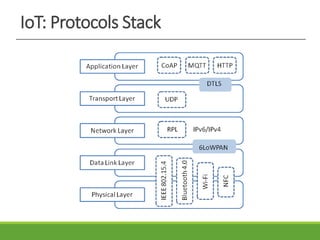
Layer Protocols
Network Layer IPv4, IPv6, IPSec, NanoIP,
6LoWPAN
Transport Layer TCP, UDP, DTLS
Application Layer CoAP, MQTT, XMPP, HTTP,
AMQP
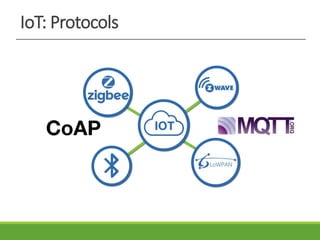
IoT: Protocols
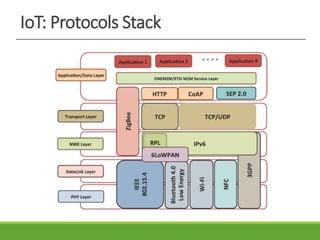
IoT: Protocols Stack
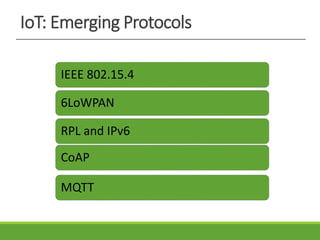
IoT: Emerging Protocols
IEEE 802.15.4
6LoWPAN
RPL and IPv6
CoAP
MQTT
IoT: Communication Features
• Different underlying networks:
 abstraction of the different underlying networks
(e.g., wired, wireless, cellular), support for different
communication modes (e.g., access point-based,
p2p fashion
• Addressing modes
 support of any cast/unicast/multicast/broadcast
transmissions, dynamic replacing of broadcast with
multicast/anycast to reduce network load
IoT: Communication Features
• Massive device transmission:
 handling simultaneous or nearly simultaneous
transmissions from huge number of devices (i.e.,
efficient MAC protocols)
• High reliability:
 guarantee of connectivity/reliable transmissions based
on different solutions (e.g., link adaptation protocols,
modulation/coding schemes, multi-path
establishment)
IoT: Communication Features
• Enhanced access priority:
 management of priority levels of services and
communications services (e.g., preemption
Mechanisms)
• Path Selection:
 optimization of communication paths based on
different policies (e.g., network cost, delay,
transmission failures), dynamic metric selection
IoT: Communication Features
• Mobility:
 seamless roaming and mobility, communication
management towards stationary and low-mobile
devices
• Sleeping Device:
 managing communication towards sleeping devices.
• Low power consumption:
 include mechanisms for reducing energy consumption
IoT: Communication Features
• Notification and interaction:
 functions for supporting data acknowledgment,
failure notifications, and interaction mode
• Traffic Profile:
 management of data traffic with different traffic
profiles (e.g., continuous transmissions, long
periods between two data transmissions, small
amount of transmitted data, burst of data,
bidirectional/unidirectional transmissions)
IoT: Communication Features
• Time dependent traffic:
 support of data traffic with different time requirements
(e.g., time-controlled traffic, delay-tolerant traffic,
extremely low-latency traffic)
• Location reporting support:
 report the device/gateway location to other
devices/applications continuously/upon request
• Secure connections:
 integrity of communications and timestamps, anonymity of
identity and location, detection of abnormal events
Computation
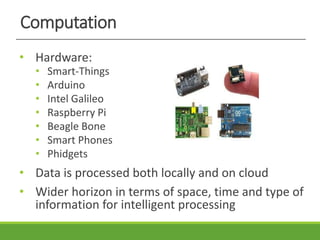
• Hardware:
• Smart-Things
• Arduino
• Intel Galileo
• Raspberry Pi
• Beagle Bone
• Smart Phones
• Phidgets
• Data is processed both locally and on cloud
• Wider horizon in terms of space, time and type of
information for intelligent processing
Computation
OS
• Contiki
• TinyOS
• LiteOS
• RIoT
• Android
Cloud
• Nimbits
• Hadoop
• AWS-IoT
• IBM-Watson
• Cisco-IoT
• Software:
Services
• Identity Related (Shipping)
• Information Aggregation (Smart Grid)
• Collaborative Aware (Smart Home)
• Ubiquitous (Smart Home)
• Smart Retail
• Smart Building
Semantics
• Resource Description Framework (RDF)
• Web Ontology Language (OWL)
• Efficient XML Interchange (EXI)
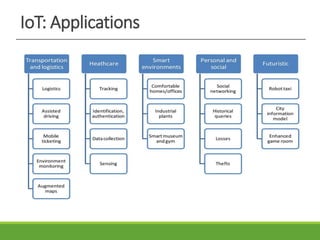
IoT: Applications
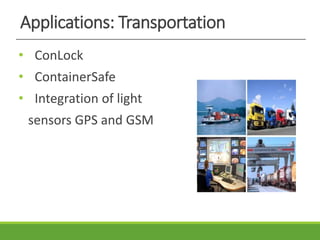
Applications: Transportation
• ConLock
• ContainerSafe
• Integration of light
sensors GPS and GSM
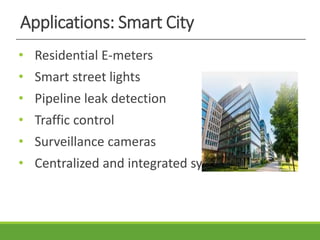
Applications: Smart City
• Residential E-meters
• Smart street lights
• Pipeline leak detection
• Traffic control
• Surveillance cameras
• Centralized and integrated system control
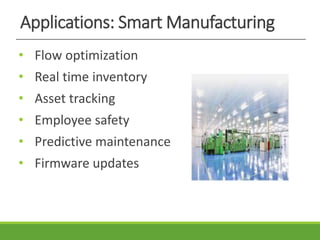
Applications: Smart Manufacturing
• Flow optimization
• Real time inventory
• Asset tracking
• Employee safety
• Predictive maintenance
• Firmware updates
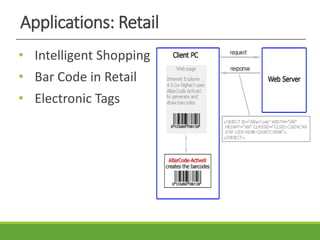
Applications: Retail
• Intelligent Shopping
• Bar Code in Retail
• Electronic Tags
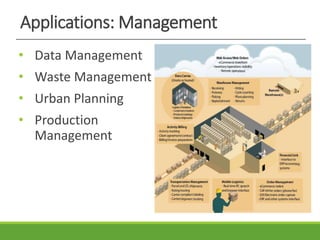
Applications: Management
• Data Management
• Waste Management
• Urban Planning
• Production
Management
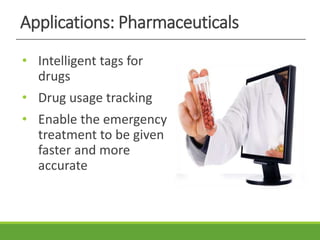
Applications: Pharmaceuticals
• Intelligent tags for
drugs
• Drug usage tracking
• Enable the emergency
treatment to be given
faster and more
accurate
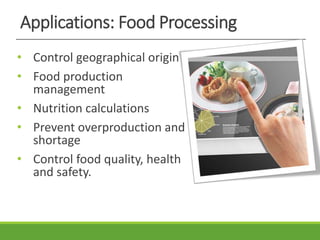
Applications: Food Processing
• Control geographical origin
• Food production
management
• Nutrition calculations
• Prevent overproduction and
shortage
• Control food quality, health
and safety.
Applications: Education
• School Administration
• Attendance Management
• Voting System
• Automatic Feedback
• Instructional Technology
• Media
• Information management
• Foreign language learning
IoT: Challenges
• Scalability
• Security
• Privacy
• Heterogeneity
• Technological standards
• Software complexity
• Costly infrastructure
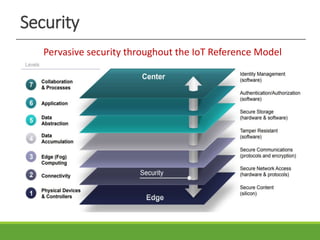
Security
• Key issue in any system
• Keep the things from unauthorized access
• Security in physical access
• Network and Communications Security
• Data Security
• Application Security
• Reprogrammable chips improves security and
flexibility, and enables downstream
configuration
Security
Pervasive security throughout the IoT Reference Model
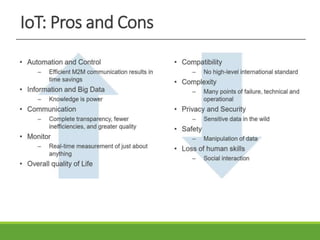
IoT: Pros and Cons
Time for Questions

Atal io t introduction

  • 1.
  • 2.
    Contents • Introduction • Evolution •Characteristics • Architecture • Components • Applications • Challenges
  • 3.
    Introduction • Internet ofThings(IoT) • global infrastructure • connects physical and virtual things around us • provides seamless communication and contextual services • solves many business problems • Heterogeneous Devices from different manufacturers • Diverse protocols • M2M, M2P, P2M, P2P
  • 4.
    Evolution: Before IoT LocalNetwork Internet https://en.wikipedia.org/wiki/Local_area_network http://www.blakeleyllp.com/
  • 5.
    Evolution: IoT Today •Internet of Things • Internet of Vehicles • Industrial IoT • Web of Things • Etc. https://www.ssh.com/iot/
  • 6.
  • 7.
    Evolution: Previous Scenario Technology/ApplicationCentric Applications https://www.progora.co.uk/Technology/Digital-Transformation
  • 8.
    Evolution: Current Scenario HumanCentric Applications Picture: Poikola, Antti, Kai Kuikkaniemi, and Harri Honko. 2015. “MyData – A Nordic Model for human-centered personal data management andprocessing.” Ministry of Transport and Communications.
  • 9.
    Characteristics • Connectivity • Intelligenceand Identity • Scalability • Distributed Computing • Dynamic Operations • Heterogeneous Environment • Resource Constraint Devices • Battery Operated Devices • Low Power Protocols
  • 10.
  • 11.
  • 12.
    ITU-T IoT ReferenceModel • Four Layers • Application layer • Service and Application support layer • Network layer • Device layer • Two Capabilities • Management • Security
  • 13.
    ITU-T IoT ReferenceModel • Application layer contains all IoT applications that interact with IoT devices • Service support and Application support layer consists of the two capability groupings • Generic support capabilities: common capabilities used by different IoT applications, such as data processing or data storage • Specific support capabilities: specific capabilities for the requirements of diversified applications
  • 14.
    ITU-T IoT ReferenceModel • Network layer consists of the two capabilities: • Networking capabilities provide relevant control functions of network connectivity between devices and gateways. • Transport capabilities focus on providing connectivity for the transport of IoT service and application specific data information, as well as the transport of IoT-related control and management information.
  • 15.
    ITU-T IoT ReferenceModel • Device layer capabilities are categorized into two kinds of capabilities • Device Capabilities: • Direct interaction with the communication network (without gateways) • Indirect interaction with the communication network (through gateways) • Ad-hoc networking • Sleeping and waking-up
  • 16.
    ITU-T IoT ReferenceModel • Gateway capabilities: • Multiple interfaces support – At device layer through wired or wireless technologies (CAN bus, ZigBee, Bluetooth or Wi-Fi) and At network layer through PSTN, 2G or 3G networks, LTE, or DSL • Protocol conversion when communications at the device layer use different device layer protocols and when communications involving both the device layer and network layer use different protocols
  • 17.
    ITU-T IoT ReferenceModel • Management capabilities • Generic capabilities • device management such as activation & de- activation, diagnostics, firmware updating • local network topology management • traffic and congestion management such as detection of network overflow conditions, implementation of resource reservation • Specific Capabilities are closely coupled with application-specific requirements
  • 18.
    ITU-T IoT ReferenceModel • Security capabilities • Generic capabilities • application layer: authorization, authentication, confidentiality and integrity protection, privacy protection, security audit • network layer: authorization, authentication, confidentiality, and signalling integrity protection • device layer: authentication, authorization, device integrity validation, access control, data confidentiality and integrity protection. • Specific Capabilities are closely coupled with application-specific requirements
  • 19.
  • 20.
  • 21.
    Physical Devices andControllers • “Things” in IoT • Endpoint devices to send and receive information • Controllers to control multiple devices • IoT “devices” are capable of: • Analog to digital conversion, as required • Generating data • Being queried or controlled over internet
  • 22.
    Connectivity • Facilitates reliable,timely transmission • Between devices (Level 1) and the network • Across networks (east-west) • Between the network (Level 2) and low-level information processing occurring at Level 3 • Capabilities include • Implementation of various protocols • Switching and routing • Translation between protocols • Security at the network level • (Self Learning) Networking Analytics
  • 23.
    Edge (Fog) Computing •Focuses on North-South Communications • Converts network data flows into information • Data filtering, cleanup, aggregation • Packet content inspection • Combination of network and data level analytics • Thresholding and Event generation
  • 24.
    Data Accumulation • Datain motion is converted to data at rest • Converts network packets to database relational tables • Achieves transition from ‘Event based’ to ‘Query based’ computing • Reduces data through filtering and selective storing • Capabilities Include • Event filtering/sampling • Event comparison • Event joining for CEP • Event based rule evaluation • Event aggregation • Northbound/southbound alerting • Event persistence in storage
  • 25.
    Data Abstraction • Abstractsthe data interface for applications • Creates schemas and views of data as applications need • Combines data from multiple sources • Filtering, selecting, projecting, and reformatting the data to serve the client applications • Reconciles differences in data shape, format, semantics, access protocol, and security
  • 26.
    Application • Reporting, Analytics,and Control • Mission-critical business applications, such as generalized ERP or specialized industry solutions • Mobile applications that handle simple interactions • Business intelligence reports, where the application is the BI server • Analytic applications that interpret data for business decisions • System management/control center applications that control the IoT system itself and don’t act on the data produced by it
  • 27.
    Collaboration and Processes •Involves people and business processes • Applications execute business logic to empower people • People use applications and associated data for their specific needs. • Applications give the right data, at the right time to do the right thing. • People must be able to communicate and collaborate
  • 28.
    ITU-T vs IWF(IoT World Forum) • Both models are complimentary • ITU-T focusses on the device and gateway level • It is concerned with developing standards for interaction with IoT devices • The IWF is concerned with broader issues of developing the applications, middleware and support functions. • IWF reference model is seven layered
  • 29.
    Things • Physical Object •Computing H/W + S/W + Sensors + Network • Degree of Smartness • Autonomous Behavior • Decision Making • Adaptive • Ensure • Trust, Privacy, Security
  • 30.
  • 31.
    Identification • Naming: • ElectronicsProduct Code (EPC) • Ubiquitous Code (uCode) • Addressing: • IPv4 • IPv6
  • 32.
    Sensing • Employs varioussensors • Specialized sensors for various applications • Smart Sensors • Wearable Sensing Devices • Embedded Sensors • Sense the data • Transmit to the gateways
  • 33.
    Actuation • Sensor anddata analytics technologies from the IoT are used to send commands to smart devices • Decisions are taken on edge/cloud and passed on to the devices to act upon • Artificial Intelligence may be used to act according to the context and environment Ex: Water Level Sensor & Smart Electric Motor
  • 34.
    Communication Multiple radio accesstechnology • Connects intelligent devices at the edge • facilitates machine to machine communication Scope Connectivity Cellular 3G, 4G, LTE, 5G (In Near Future) Short Range Wi-Fi, Bluetooth, 6LoWPAN, NGC Medium Long Range WiMAX, Z-Wave, ZigBee
  • 35.
    Communication Internet is theprimary medium • To connect to the cloud Moving towards next generation IoT Ex: 5G Layer Protocols Network Layer IPv4, IPv6, IPSec, NanoIP, 6LoWPAN Transport Layer TCP, UDP, DTLS Application Layer CoAP, MQTT, XMPP, HTTP, AMQP
  • 36.
  • 37.
  • 38.
  • 39.
    IoT: Emerging Protocols IEEE802.15.4 6LoWPAN RPL and IPv6 CoAP MQTT
  • 40.
    IoT: Communication Features •Different underlying networks:  abstraction of the different underlying networks (e.g., wired, wireless, cellular), support for different communication modes (e.g., access point-based, p2p fashion • Addressing modes  support of any cast/unicast/multicast/broadcast transmissions, dynamic replacing of broadcast with multicast/anycast to reduce network load
  • 41.
    IoT: Communication Features •Massive device transmission:  handling simultaneous or nearly simultaneous transmissions from huge number of devices (i.e., efficient MAC protocols) • High reliability:  guarantee of connectivity/reliable transmissions based on different solutions (e.g., link adaptation protocols, modulation/coding schemes, multi-path establishment)
  • 42.
    IoT: Communication Features •Enhanced access priority:  management of priority levels of services and communications services (e.g., preemption Mechanisms) • Path Selection:  optimization of communication paths based on different policies (e.g., network cost, delay, transmission failures), dynamic metric selection
  • 43.
    IoT: Communication Features •Mobility:  seamless roaming and mobility, communication management towards stationary and low-mobile devices • Sleeping Device:  managing communication towards sleeping devices. • Low power consumption:  include mechanisms for reducing energy consumption
  • 44.
    IoT: Communication Features •Notification and interaction:  functions for supporting data acknowledgment, failure notifications, and interaction mode • Traffic Profile:  management of data traffic with different traffic profiles (e.g., continuous transmissions, long periods between two data transmissions, small amount of transmitted data, burst of data, bidirectional/unidirectional transmissions)
  • 45.
    IoT: Communication Features •Time dependent traffic:  support of data traffic with different time requirements (e.g., time-controlled traffic, delay-tolerant traffic, extremely low-latency traffic) • Location reporting support:  report the device/gateway location to other devices/applications continuously/upon request • Secure connections:  integrity of communications and timestamps, anonymity of identity and location, detection of abnormal events
  • 46.
    Computation • Hardware: • Smart-Things •Arduino • Intel Galileo • Raspberry Pi • Beagle Bone • Smart Phones • Phidgets • Data is processed both locally and on cloud • Wider horizon in terms of space, time and type of information for intelligent processing
  • 47.
    Computation OS • Contiki • TinyOS •LiteOS • RIoT • Android Cloud • Nimbits • Hadoop • AWS-IoT • IBM-Watson • Cisco-IoT • Software:
  • 48.
    Services • Identity Related(Shipping) • Information Aggregation (Smart Grid) • Collaborative Aware (Smart Home) • Ubiquitous (Smart Home) • Smart Retail • Smart Building
  • 49.
    Semantics • Resource DescriptionFramework (RDF) • Web Ontology Language (OWL) • Efficient XML Interchange (EXI)
  • 50.
  • 51.
    Applications: Transportation • ConLock •ContainerSafe • Integration of light sensors GPS and GSM
  • 52.
    Applications: Smart City •Residential E-meters • Smart street lights • Pipeline leak detection • Traffic control • Surveillance cameras • Centralized and integrated system control
  • 53.
    Applications: Smart Manufacturing •Flow optimization • Real time inventory • Asset tracking • Employee safety • Predictive maintenance • Firmware updates
  • 54.
    Applications: Retail • IntelligentShopping • Bar Code in Retail • Electronic Tags
  • 55.
    Applications: Management • DataManagement • Waste Management • Urban Planning • Production Management
  • 56.
    Applications: Pharmaceuticals • Intelligenttags for drugs • Drug usage tracking • Enable the emergency treatment to be given faster and more accurate
  • 57.
    Applications: Food Processing •Control geographical origin • Food production management • Nutrition calculations • Prevent overproduction and shortage • Control food quality, health and safety.
  • 58.
    Applications: Education • SchoolAdministration • Attendance Management • Voting System • Automatic Feedback • Instructional Technology • Media • Information management • Foreign language learning
  • 59.
    IoT: Challenges • Scalability •Security • Privacy • Heterogeneity • Technological standards • Software complexity • Costly infrastructure
  • 60.
    Security • Key issuein any system • Keep the things from unauthorized access • Security in physical access • Network and Communications Security • Data Security • Application Security • Reprogrammable chips improves security and flexibility, and enables downstream configuration
  • 61.
  • 62.
  • 63.

Editor's Notes

  • #37 WSIS: World Summit on the Information Society, it’s a pair of conference about information society
  • #38 WSIS: World Summit on the Information Society, it’s a pair of conference about information society
  • #40 WSIS: World Summit on the Information Society, it’s a pair of conference about information society