IOT
Working
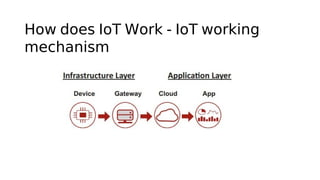
How does IoT Work - IoT working
mechanism
IoT working mechanism
•Device
•Gateway
s
•Cloud
•App
Device
Devices consist of Sensors & Sensor
Technology.
They collect a wide variety of data ranging
from:
• Temperature
• pressure locaton
• weather/environment conditions
• grid parameters
• health essentals of a patent, etc.
Gateways
Gateways as the name suggests, are the gateways to the
internet for all the devices or things that need to interact
with it.
They help to connect the sensor nodes in the internal
network with the external Internet, by collecting data from
the sensor nodes and further transmitting it to the internet
infrastructure.
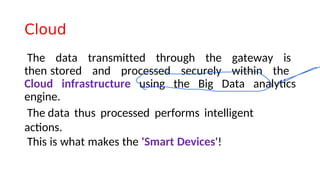
Cloud
The data transmitted through the gateway is
then stored and processed securely within the
Cloud infrastructure using the Big Data analytcs
engine.
The data thus processed performs intelligent
actons.
This is what makes the 'Smart Devices'!
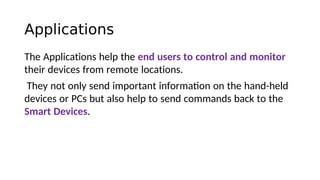
Applications
The Applications help the end users to control and monitor
their devices from remote locations.
They not only send important informaton on the hand-held
devices or PCs but also help to send commands back to the
Smart Devices.
IP Addresses
• Apart from the above, IP addresses play an important role in the
entire IoT ecosystem.
• The Internet recognizes IP addresses only. IPv6 ensures that we
will never run out of IP addresses by providing
• 3.4*10 38 IP addresses.
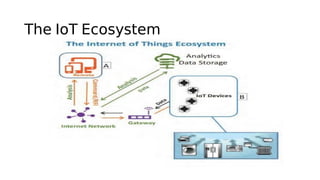
The IoT Ecosystem
The IoT Ecosystem -
Model A
• The main objective in this example is to control the loads (of the AC,
refrigerator, washing machine, etc.) through the Internet
network remotely on the basic principle of the Internet of Things
(IoT).
• A real-time webpage will be essential with a user configurable front
end to control and monitor the load
• The data sent from a password protected webpage returns
commands through allotted IP fed to it.
• A Wi-Fi Module is configured with any nearby wireless modem
to access internet. The received Internet commands are fed to the
Wi-Fi module.
• The program within the Wi-Fi Module executes the commands
received based on which the device gets actvated through Bluetooth
or Zigbee module interfaced to Wi-Fi Module.
The IoT Ecosystem -
Model B
• The devices (B in the Figure) should consist of power management
modules and status data report module interfaced to RF modules used
for communicaton.
• This way the status of the device will also be communicated and
displayed on the web page.
• The devices to be monitored/controlled communicate through RF modules
in their signal processing for WiFi / ZigBee/ Bluetooth/ radio transceiver
(RFID) etc, or through wired LAN.
• The data for control / monitor is harnessed through internet network to
a remote control / monitoring centre.
• PC system, laptop, tablet or smart phone is used for remote
control centres A and monitoring. (A in the figure)
The principal
technologies that
drive IoT system
The principal technologies that drive
IoT
system are:
• Wireless Sensor
Networks
• Embedded Systems
• Communicaton Protocols
• Cloud Computng
• Big Data Analysis
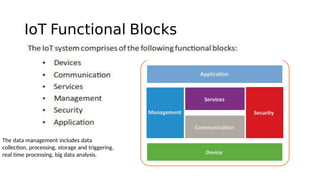
IoT Functional Blocks
The data management includes data
collecton, processing, storage and triggering,
real time processing, big data analysis.
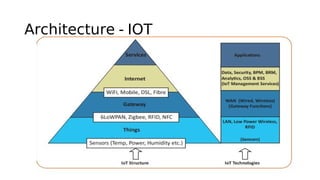
Architecture - IOT
Sensors used in IoT systems.
• Mobile processor as a possible IoT connecvity
• A modern Smartphone is equipped with sensors such as:
• moton sensors
• accelerometers
• magnetometer and compass
• environmental sensors like thermometers, barometer
(pressure
sensor)
• cameras
• microphones etc
Example – Mobile usage
as IOT
• One example of an actual use of the Internet of Things
could be to observe traffic congeston on specific
roads with Google Maps.
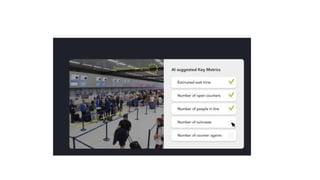
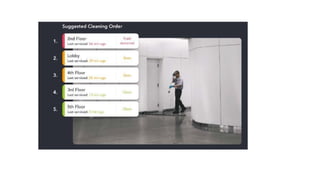
Placemeter
• Placemeter Turns Video Into Meaningful Data
• Since 2012, this platform has processed thousands of video streams and
has
automatcally analyzed billions of movements, in real-time.
• http://www.placemeter.c
om/
Scalability and Machine Learning
• Placemeter is robust and built to scale.
• First, the system handles an ever-increasing amount of video
streams.
• Second using machine learning, the algorithms process video
and classify objects in a wide range of new contexts.
• A series of algorithms first separate moving objects from the
background.
• Computer vision cascades then classify those objects as
pedestrians,
bicycles, motorcycles, vehicles and large vehicles.
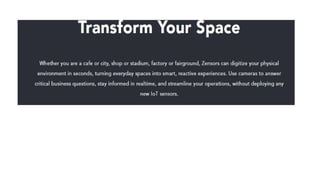
Zensors
• https://www.zensors.com
/
Windows Arduino Libraries:
• At the 2015 Build developer conference, Microsoft announced
two new sofware libraries that essentially allow Windows phones
(or any hardware running Windows 10) to act as Arduino
compatble development boards.
• Windows Virtual Shield for Arduino lets any Windows device to
connect wirelessly to an Arduino board.
• That gives the Arduino access to all of the hardware in the
phone, from gyroscope to touch screen, just as if those
components were hard-wired through an Arduino "shield"
module.
• Windows Remote Arduino runs the equaton backwards, allowing a
Windows application to control and draw on the components of an
Arduino device.
• With the release of the libraries, Windows 10 became the frst
operatng system to join the Arduino Certfed program by making
it easy to add an entire Smartphone's worth of hardware
components to any Arduino project.
IOT network solutions
• Bluetooth low energy (BLE)
• Light-Fidelity (Li-Fi)
• Near-field communicaton (NFC)
• QR codes and barcodes
• Radio-frequency identification (RFID)
• Thread
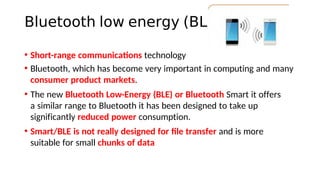
Bluetooth low energy (BLE)
• Short-range communicatons technology
• Bluetooth, which has become very important in computing and many
consumer product markets.
• The new Bluetooth Low-Energy (BLE) or Bluetooth Smart it offers
a similar range to Bluetooth it has been designed to take up
significantly reduced power consumption.
• Smart/BLE is not really designed for fle transfer and is more
suitable for small chunks of data
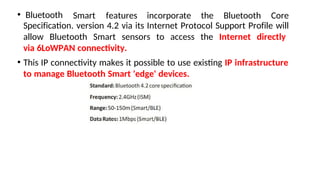
• Bluetooth Smart features incorporate the Bluetooth Core
Specificaton. version 4.2 via its Internet Protocol Support Profile will
allow Bluetooth Smart sensors to access the Internet directly
via 6LoWPAN connectvity.
• This IP connectvity makes it possible to use existng IP infrastructure
to manage Bluetooth Smart 'edge' devices.
Light-Fidelity (Li-Fi)
• Wireless communicaton technology similar to the Wi-Fi standard,
but
uses visible light communication for increased bandwidth.
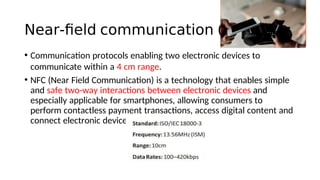
Near-field communication (NFC)
• Communicaton protocols enabling two electronic devices to
communicate within a 4 cm range.
• NFC (Near Field Communicaton) is a technology that enables simple
and safe two-way interactons between electronic devices and
especially applicable for smartphones, allowing consumers to
perform contactless payment transactons, access digital content and
connect electronic devices.
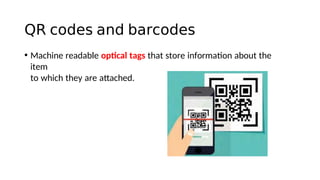
QR codes and barcodes
• Machine readable optcal tags that store informaton about the
item
to which they are atached.
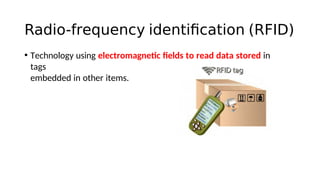
Radio-frequency identification (RFID)
• Technology using electromagnetc felds to read data stored in
tags
embedded in other items.
Thre
ad
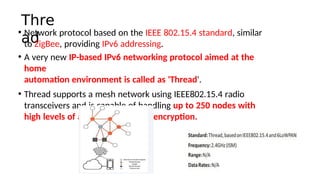
• Network protocol based on the IEEE 802.15.4 standard, similar
to ZigBee, providing IPv6 addressing.
• A very new IP-based IPv6 networking protocol aimed at the
home
automaton environment is called as 'Thread'.
• Thread supports a mesh network using IEEE802.15.4 radio
transceivers and is capable of handling up to 250 nodes with
high levels of authentcaton and encrypton.
Transport Layer Security (network
protocol)
TLS
• Wi-Fi
• Wi-Fi Direct
• Z-Wave
• ZigBee
• HaLow
• LTE-
Advanced
• 6LoWPAN
• Sigfox
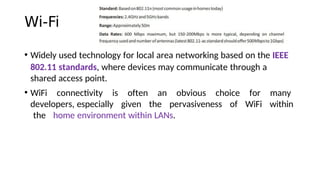
Wi-Fi
• Widely used technology for local area networking based on the IEEE
802.11 standards, where devices may communicate through a
shared access point.
• WiFi connectvity is often an obvious choice for many
developers, especially given the pervasiveness of WiFi within
the home environment within LANs.
Wi-Fi Direct
• A Variant of the Wi-Fi standard for peer-to-peer communicaton,
eliminating the need for an access point.
• making it simple and convenient to print, share, sync, play
games, and display content to another device.
• Wi-Fi Direct devices connect to one another without joining a
traditional home, office, or hotspot network.
• https://www.youtube.com/watch?v=je2lWjfpywQ&feature=youtu.
be
Z-Wave
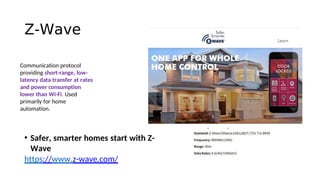
• Safer, smarter homes start with Z-
Wave
https://www.z-wave.com/
Communication protocol
providing short-range, low-
latency data transfer at rates
and power consumption
lower than Wi-Fi. Used
primarily for home
automation.
ZigBee
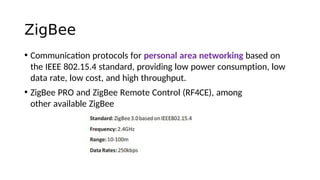
• Communicaton protocols for personal area networking based on
the IEEE 802.15.4 standard, providing low power consumption, low
data rate, low cost, and high throughput.
• ZigBee PRO and ZigBee Remote Control (RF4CE), among
other available ZigBee
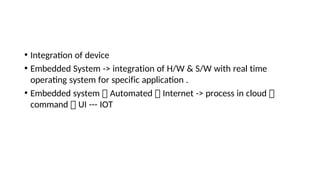
• Integraton of device
• Embedded System -> integration of H/W & S/W with real time
operatng system for specific applicaton .
• Embedded system  Automated  Internet -> process in cloud 
command  UI --- IOT
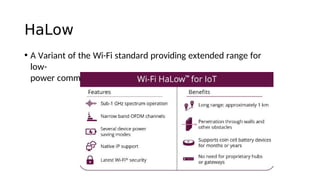
HaLow
• A Variant of the Wi-Fi standard providing extended range for
low-
power communication at a lower data rate
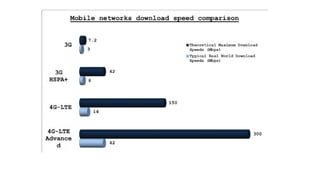
LTE-Advanced
• Long-Term Evoluton (LTE) is a standard for wireless broadband
communication for mobile devices and data terminals, based on
the GSM/EDGE and UMTS/HSPA technologies.
• High-speed communicaton specificaton for mobile networks.
Provides enhancements to the LTE standard with extended
coverage, higher throughput, and lower latency.
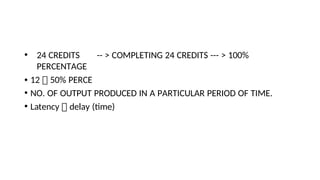
• 24 CREDITS -- > COMPLETING 24 CREDITS --- > 100%
PERCENTAGE
• 12  50% PERCE
• NO. OF OUTPUT PRODUCED IN A PARTICULAR PERIOD OF TIME.
• Latency  delay (tme)
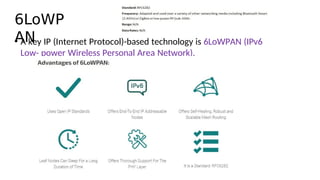
6LoWP
AN
• A key IP (Internet Protocol)-based technology is 6LoWPAN (IPv6
Low- power Wireless Personal Area Network).
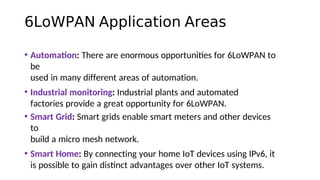
6LoWPAN Application Areas
• Automaton: There are enormous opportunites for 6LoWPAN to
be
used in many different areas of automation.
• Industrial monitoring: Industrial plants and automated
factories provide a great opportunity for 6LoWPAN.
• Smart Grid: Smart grids enable smart meters and other devices
to
build a micro mesh network.
• Smart Home: By connecting your home IoT devices using IPv6, it
is possible to gain distnct advantages over other IoT systems.
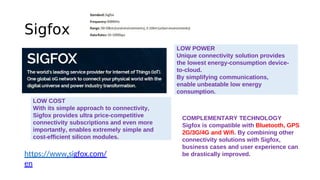
Sigfox
https://www.sigfox.com/
en
LOW POWER
Unique connectivity solution provides
the lowest energy-consumption device-
to-cloud.
By simplifying communications,
enable unbeatable low energy
consumption.
LOW COST
With its simple approach to connectivity,
Sigfox provides ultra price-competitive
connectivity subscriptions and even more
importantly, enables extremely simple and
cost-efficient silicon modules.
COMPLEMENTARY TECHNOLOGY
Sigfox is compatible with Bluetooth, GPS
2G/3G/4G and Wifi. By combining other
connectivity solutions with Sigfox,
business cases and user experience can
be drastically improved.
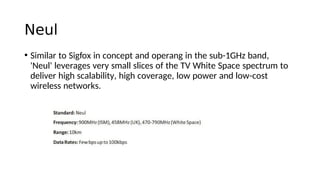
Neul
• Similar to Sigfox in concept and operang in the sub-1GHz band,
'Neul' leverages very small slices of the TV White Space spectrum to
deliver high scalability, high coverage, low power and low-cost
wireless networks.
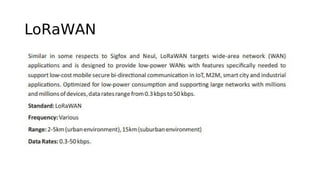
LoRaWAN
• Following videos in the URL can be referred for how IoT works?
hps://www.youtube.com/watch?v=QSIPNhOiMoE – IoT How it
works hps://www.youtube.com/watch?v=o7VXyolenvU – IoT
explained easily

IOT_Working_computer_science_business_recap

  • 1.
  • 2.
    How does IoTWork - IoT working mechanism
  • 3.
  • 4.
    Device Devices consist ofSensors & Sensor Technology. They collect a wide variety of data ranging from: • Temperature • pressure locaton • weather/environment conditions • grid parameters • health essentals of a patent, etc.
  • 5.
    Gateways Gateways as thename suggests, are the gateways to the internet for all the devices or things that need to interact with it. They help to connect the sensor nodes in the internal network with the external Internet, by collecting data from the sensor nodes and further transmitting it to the internet infrastructure.
  • 6.
    Cloud The data transmittedthrough the gateway is then stored and processed securely within the Cloud infrastructure using the Big Data analytcs engine. The data thus processed performs intelligent actons. This is what makes the 'Smart Devices'!
  • 7.
    Applications The Applications helpthe end users to control and monitor their devices from remote locations. They not only send important informaton on the hand-held devices or PCs but also help to send commands back to the Smart Devices.
  • 8.
    IP Addresses • Apartfrom the above, IP addresses play an important role in the entire IoT ecosystem. • The Internet recognizes IP addresses only. IPv6 ensures that we will never run out of IP addresses by providing • 3.4*10 38 IP addresses.
  • 9.
  • 10.
    The IoT Ecosystem- Model A • The main objective in this example is to control the loads (of the AC, refrigerator, washing machine, etc.) through the Internet network remotely on the basic principle of the Internet of Things (IoT). • A real-time webpage will be essential with a user configurable front end to control and monitor the load • The data sent from a password protected webpage returns commands through allotted IP fed to it. • A Wi-Fi Module is configured with any nearby wireless modem to access internet. The received Internet commands are fed to the Wi-Fi module. • The program within the Wi-Fi Module executes the commands received based on which the device gets actvated through Bluetooth or Zigbee module interfaced to Wi-Fi Module.
  • 11.
    The IoT Ecosystem- Model B • The devices (B in the Figure) should consist of power management modules and status data report module interfaced to RF modules used for communicaton. • This way the status of the device will also be communicated and displayed on the web page. • The devices to be monitored/controlled communicate through RF modules in their signal processing for WiFi / ZigBee/ Bluetooth/ radio transceiver (RFID) etc, or through wired LAN. • The data for control / monitor is harnessed through internet network to a remote control / monitoring centre. • PC system, laptop, tablet or smart phone is used for remote control centres A and monitoring. (A in the figure)
  • 12.
  • 13.
    The principal technologiesthat drive IoT system are: • Wireless Sensor Networks • Embedded Systems • Communicaton Protocols • Cloud Computng • Big Data Analysis
  • 14.
    IoT Functional Blocks Thedata management includes data collecton, processing, storage and triggering, real time processing, big data analysis.
  • 15.
  • 17.
    Sensors used inIoT systems. • Mobile processor as a possible IoT connecvity • A modern Smartphone is equipped with sensors such as: • moton sensors • accelerometers • magnetometer and compass • environmental sensors like thermometers, barometer (pressure sensor) • cameras • microphones etc
  • 18.
    Example – Mobileusage as IOT • One example of an actual use of the Internet of Things could be to observe traffic congeston on specific roads with Google Maps.
  • 19.
    Placemeter • Placemeter TurnsVideo Into Meaningful Data • Since 2012, this platform has processed thousands of video streams and has automatcally analyzed billions of movements, in real-time. • http://www.placemeter.c om/
  • 20.
    Scalability and MachineLearning • Placemeter is robust and built to scale. • First, the system handles an ever-increasing amount of video streams. • Second using machine learning, the algorithms process video and classify objects in a wide range of new contexts. • A series of algorithms first separate moving objects from the background. • Computer vision cascades then classify those objects as pedestrians, bicycles, motorcycles, vehicles and large vehicles.
  • 22.
  • 27.
    Windows Arduino Libraries: •At the 2015 Build developer conference, Microsoft announced two new sofware libraries that essentially allow Windows phones (or any hardware running Windows 10) to act as Arduino compatble development boards. • Windows Virtual Shield for Arduino lets any Windows device to connect wirelessly to an Arduino board. • That gives the Arduino access to all of the hardware in the phone, from gyroscope to touch screen, just as if those components were hard-wired through an Arduino "shield" module.
  • 28.
    • Windows RemoteArduino runs the equaton backwards, allowing a Windows application to control and draw on the components of an Arduino device. • With the release of the libraries, Windows 10 became the frst operatng system to join the Arduino Certfed program by making it easy to add an entire Smartphone's worth of hardware components to any Arduino project.
  • 29.
    IOT network solutions •Bluetooth low energy (BLE) • Light-Fidelity (Li-Fi) • Near-field communicaton (NFC) • QR codes and barcodes • Radio-frequency identification (RFID) • Thread
  • 30.
    Bluetooth low energy(BLE) • Short-range communicatons technology • Bluetooth, which has become very important in computing and many consumer product markets. • The new Bluetooth Low-Energy (BLE) or Bluetooth Smart it offers a similar range to Bluetooth it has been designed to take up significantly reduced power consumption. • Smart/BLE is not really designed for fle transfer and is more suitable for small chunks of data
  • 31.
    • Bluetooth Smartfeatures incorporate the Bluetooth Core Specificaton. version 4.2 via its Internet Protocol Support Profile will allow Bluetooth Smart sensors to access the Internet directly via 6LoWPAN connectvity. • This IP connectvity makes it possible to use existng IP infrastructure to manage Bluetooth Smart 'edge' devices.
  • 32.
    Light-Fidelity (Li-Fi) • Wirelesscommunicaton technology similar to the Wi-Fi standard, but uses visible light communication for increased bandwidth.
  • 33.
    Near-field communication (NFC) •Communicaton protocols enabling two electronic devices to communicate within a 4 cm range. • NFC (Near Field Communicaton) is a technology that enables simple and safe two-way interactons between electronic devices and especially applicable for smartphones, allowing consumers to perform contactless payment transactons, access digital content and connect electronic devices.
  • 34.
    QR codes andbarcodes • Machine readable optcal tags that store informaton about the item to which they are atached.
  • 35.
    Radio-frequency identification (RFID) •Technology using electromagnetc felds to read data stored in tags embedded in other items.
  • 36.
    Thre ad • Network protocolbased on the IEEE 802.15.4 standard, similar to ZigBee, providing IPv6 addressing. • A very new IP-based IPv6 networking protocol aimed at the home automaton environment is called as 'Thread'. • Thread supports a mesh network using IEEE802.15.4 radio transceivers and is capable of handling up to 250 nodes with high levels of authentcaton and encrypton.
  • 37.
    Transport Layer Security(network protocol) TLS • Wi-Fi • Wi-Fi Direct • Z-Wave • ZigBee • HaLow • LTE- Advanced • 6LoWPAN • Sigfox
  • 38.
    Wi-Fi • Widely usedtechnology for local area networking based on the IEEE 802.11 standards, where devices may communicate through a shared access point. • WiFi connectvity is often an obvious choice for many developers, especially given the pervasiveness of WiFi within the home environment within LANs.
  • 39.
    Wi-Fi Direct • AVariant of the Wi-Fi standard for peer-to-peer communicaton, eliminating the need for an access point. • making it simple and convenient to print, share, sync, play games, and display content to another device. • Wi-Fi Direct devices connect to one another without joining a traditional home, office, or hotspot network. • https://www.youtube.com/watch?v=je2lWjfpywQ&feature=youtu. be
  • 40.
    Z-Wave • Safer, smarterhomes start with Z- Wave https://www.z-wave.com/ Communication protocol providing short-range, low- latency data transfer at rates and power consumption lower than Wi-Fi. Used primarily for home automation.
  • 42.
    ZigBee • Communicaton protocolsfor personal area networking based on the IEEE 802.15.4 standard, providing low power consumption, low data rate, low cost, and high throughput. • ZigBee PRO and ZigBee Remote Control (RF4CE), among other available ZigBee
  • 43.
    • Integraton ofdevice • Embedded System -> integration of H/W & S/W with real time operatng system for specific applicaton . • Embedded system  Automated  Internet -> process in cloud  command  UI --- IOT
  • 44.
    HaLow • A Variantof the Wi-Fi standard providing extended range for low- power communication at a lower data rate
  • 45.
    LTE-Advanced • Long-Term Evoluton(LTE) is a standard for wireless broadband communication for mobile devices and data terminals, based on the GSM/EDGE and UMTS/HSPA technologies. • High-speed communicaton specificaton for mobile networks. Provides enhancements to the LTE standard with extended coverage, higher throughput, and lower latency.
  • 46.
    • 24 CREDITS-- > COMPLETING 24 CREDITS --- > 100% PERCENTAGE • 12  50% PERCE • NO. OF OUTPUT PRODUCED IN A PARTICULAR PERIOD OF TIME. • Latency  delay (tme)
  • 48.
    6LoWP AN • A keyIP (Internet Protocol)-based technology is 6LoWPAN (IPv6 Low- power Wireless Personal Area Network).
  • 49.
    6LoWPAN Application Areas •Automaton: There are enormous opportunites for 6LoWPAN to be used in many different areas of automation. • Industrial monitoring: Industrial plants and automated factories provide a great opportunity for 6LoWPAN. • Smart Grid: Smart grids enable smart meters and other devices to build a micro mesh network. • Smart Home: By connecting your home IoT devices using IPv6, it is possible to gain distnct advantages over other IoT systems.
  • 50.
    Sigfox https://www.sigfox.com/ en LOW POWER Unique connectivitysolution provides the lowest energy-consumption device- to-cloud. By simplifying communications, enable unbeatable low energy consumption. LOW COST With its simple approach to connectivity, Sigfox provides ultra price-competitive connectivity subscriptions and even more importantly, enables extremely simple and cost-efficient silicon modules. COMPLEMENTARY TECHNOLOGY Sigfox is compatible with Bluetooth, GPS 2G/3G/4G and Wifi. By combining other connectivity solutions with Sigfox, business cases and user experience can be drastically improved.
  • 51.
    Neul • Similar toSigfox in concept and operang in the sub-1GHz band, 'Neul' leverages very small slices of the TV White Space spectrum to deliver high scalability, high coverage, low power and low-cost wireless networks.
  • 52.
  • 53.
    • Following videosin the URL can be referred for how IoT works? hps://www.youtube.com/watch?v=QSIPNhOiMoE – IoT How it works hps://www.youtube.com/watch?v=o7VXyolenvU – IoT explained easily