VISVESVARAYATECHNOLOGICALUNIVERSITY
JNANASANGAMABELAGAVI-590018
Under the guidance of
Prof. LOKESH M
Assistant Professor
Dept. of CSE
Presented By :- KUMAR K S
Usn No:- 1VE20CS070
Dept. of CSE
“GENERATIVE AI TECHNOLOGY”
TECHNICAL SEMINAR PRESENTATION ON
CONTENTS
• Introduction
• History
• Methodology
• Block Diagram
• Advantages & Disadvantages
• Applications
• Results
• Conclusion
• References
INTRODUCTION
• Generative Artificial Intelligence (AI) technology stands at the forefront of innovation,
revolutionizing the way machines interact with data to create content, simulate human creativity,
and solve complex problems.
• Generative AI has emerged as a powerful tool capable of generating realistic images, coherent
text, music compositions, and much more
• Its applications span across various domains, from healthcare to entertainment, from art to
finance, promising transformative impacts on industries and societies worldwide.
HISTORY OF TECHNOLOGY
• The advent of machine learning in the later half of the 20th century marked a significant milestone in the
history of generative AI.
• In the 21st century, deep learning emerged as a dominant paradigm in generative AI, revolutionized the
field by enabling the generation of high-fidelity images, text, audio, and video.
• Generative AI, a collaborative effort by Geoffrey Hinton, Yann LeCun, Ian Goodfellow, Yoshua Bengio,
and Juergen Schmidhuber, encompasses various techniques for generating data autonomously.
.
METHODOLOGY
 Data Preprocessing:
• Data preprocessing is a critical step involving the preparation and transformation of raw data
to make it suitable for training machine learning models.
• Data preprocessing for generative AI involves using technologies and algorithms like TensorFlow
and PyTorch to clean, normalize, encode, and augment datasets.
 Model Selection:
• Model selection in generative AI involves choosing the appropriate architecture and
algorithms like Bayesian optimization, grid search or random search for the specific task,
considering factors such as data type, complexity, and desired output characteristics.
Training Data:
• Generative Adversarial Networks (GANs) are a integral part of generative AI, engaged in a
adversarial training process, to produce high-quality synthetic data resembling real samples.
• Variational Autoencoders (VAEs) are versatile generative models that offer a range of applications
in generative AI, including data generation, representation learning and anomaly detection.
Evaluation:
• The performance of the generated outputs is assessed using metrics such as perceptual similarity,
diversity, and realism to measure the quality and fidelity of the generated samples.
• Commonly used algorithm in the evaluation of generative AI models is the Inception Score (IS)
which assesses the quality and diversity of generated images.
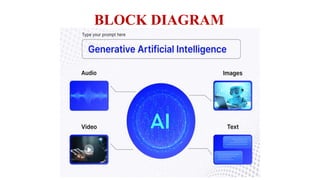
BLOCK DIAGRAM
ADVANTAGES
• Generative AI enables creative expression by generating novel and diverse outputs in various
domains such as art, music, and literature.
• It enhances user engagement and satisfaction in applications such as recommendation systems and
personalized media content.
DISADVANTAGES
• Generative AI models can potentially be misused to create deceptive or malicious content, including
deepfakes and misinformation.
APPLICATIONS
• Media Creation: Generating synthetic images, videos, and audio for content creation, special
effects, and virtual environments in entertainment and advertising industries.
• Art and Design: Creating digital artwork, generating new designs for fashion, architecture, and
product development.
• Healthcare: Generating synthetic medical images for training diagnostic models, simulating patient
data for medical research.
• Natural Language Processing: Generating human-like text for chatbots, language translation, and
content generation in journalism, marketing, and storytelling
RESULTS
• Generative AI yields diverse and realistic outputs in image generation and natural language
processing.
• Applications span healthcare, art, and data augmentation, driving innovation despite
challenges like ethical concerns.
• Continued advancements in generative AI technology hold the potential to further improve
the quality and diversity of generated outputs.
CONCLUSION
Generative AI yields diverse and realistic outputs in image generation and natural language
processing. Applications span healthcare, art, and data augmentation, driving innovation
despite challenges like ethical concerns.
REFERENCES
• Goodfellow, Ian & Pouget-Abadie, Jean & Mirza, Mehdi & Xu, Bing & Warde-Farley, David & Ozair,
Sherjil & Courville, Aaron & Bengio, Y.. (2014). Generative Adversarial Networks. Advances in Neural
Information Processing Systems. 3. 10.1145/3422622.
• L. A. Gatys, A. S. Ecker and M. Bethge, "Image Style Transfer Using Convolutional Neural Networks," 2016
IEEE Conference on Computer Vision and Pattern Recognition (CVPR), Las Vegas, NV, USA, 2016, pp. 2414-
2423, doi: 10.1109/CVPR.2016.265.
• Vaswani, A., Shazeer, N.M., Parmar, N., Uszkoreit, J., Jones, L., Gomez, A.N., Kaiser, L., & Polosukhin, I.
(2017). Attention is All you Need.
• Holtzman, Ari, Jan Buys, Li Du, Maxwell Forbes and Yejin Choi. “The Curious Case of Neural Text
Degeneration.” ArXiv abs/1904.09751 (2019).
• Bengio, Yoshua, Réjean Ducharme, Pascal Vincent and Christian Janvin. “A Neural Probabilistic Language
Model.” J. Mach. Learn. Res. 3 (2003): 1137-1155.

Generative AI or GenAI technology based PPT

  • 1.
    VISVESVARAYATECHNOLOGICALUNIVERSITY JNANASANGAMABELAGAVI-590018 Under the guidanceof Prof. LOKESH M Assistant Professor Dept. of CSE Presented By :- KUMAR K S Usn No:- 1VE20CS070 Dept. of CSE “GENERATIVE AI TECHNOLOGY” TECHNICAL SEMINAR PRESENTATION ON
  • 2.
    CONTENTS • Introduction • History •Methodology • Block Diagram • Advantages & Disadvantages • Applications • Results • Conclusion • References
  • 3.
    INTRODUCTION • Generative ArtificialIntelligence (AI) technology stands at the forefront of innovation, revolutionizing the way machines interact with data to create content, simulate human creativity, and solve complex problems. • Generative AI has emerged as a powerful tool capable of generating realistic images, coherent text, music compositions, and much more • Its applications span across various domains, from healthcare to entertainment, from art to finance, promising transformative impacts on industries and societies worldwide.
  • 4.
    HISTORY OF TECHNOLOGY •The advent of machine learning in the later half of the 20th century marked a significant milestone in the history of generative AI. • In the 21st century, deep learning emerged as a dominant paradigm in generative AI, revolutionized the field by enabling the generation of high-fidelity images, text, audio, and video. • Generative AI, a collaborative effort by Geoffrey Hinton, Yann LeCun, Ian Goodfellow, Yoshua Bengio, and Juergen Schmidhuber, encompasses various techniques for generating data autonomously. .
  • 5.
    METHODOLOGY  Data Preprocessing: •Data preprocessing is a critical step involving the preparation and transformation of raw data to make it suitable for training machine learning models. • Data preprocessing for generative AI involves using technologies and algorithms like TensorFlow and PyTorch to clean, normalize, encode, and augment datasets.  Model Selection: • Model selection in generative AI involves choosing the appropriate architecture and algorithms like Bayesian optimization, grid search or random search for the specific task, considering factors such as data type, complexity, and desired output characteristics.
  • 6.
    Training Data: • GenerativeAdversarial Networks (GANs) are a integral part of generative AI, engaged in a adversarial training process, to produce high-quality synthetic data resembling real samples. • Variational Autoencoders (VAEs) are versatile generative models that offer a range of applications in generative AI, including data generation, representation learning and anomaly detection. Evaluation: • The performance of the generated outputs is assessed using metrics such as perceptual similarity, diversity, and realism to measure the quality and fidelity of the generated samples. • Commonly used algorithm in the evaluation of generative AI models is the Inception Score (IS) which assesses the quality and diversity of generated images.
  • 7.
  • 8.
    ADVANTAGES • Generative AIenables creative expression by generating novel and diverse outputs in various domains such as art, music, and literature. • It enhances user engagement and satisfaction in applications such as recommendation systems and personalized media content. DISADVANTAGES • Generative AI models can potentially be misused to create deceptive or malicious content, including deepfakes and misinformation.
  • 9.
    APPLICATIONS • Media Creation:Generating synthetic images, videos, and audio for content creation, special effects, and virtual environments in entertainment and advertising industries. • Art and Design: Creating digital artwork, generating new designs for fashion, architecture, and product development. • Healthcare: Generating synthetic medical images for training diagnostic models, simulating patient data for medical research. • Natural Language Processing: Generating human-like text for chatbots, language translation, and content generation in journalism, marketing, and storytelling
  • 10.
    RESULTS • Generative AIyields diverse and realistic outputs in image generation and natural language processing. • Applications span healthcare, art, and data augmentation, driving innovation despite challenges like ethical concerns. • Continued advancements in generative AI technology hold the potential to further improve the quality and diversity of generated outputs.
  • 11.
    CONCLUSION Generative AI yieldsdiverse and realistic outputs in image generation and natural language processing. Applications span healthcare, art, and data augmentation, driving innovation despite challenges like ethical concerns.
  • 12.
    REFERENCES • Goodfellow, Ian& Pouget-Abadie, Jean & Mirza, Mehdi & Xu, Bing & Warde-Farley, David & Ozair, Sherjil & Courville, Aaron & Bengio, Y.. (2014). Generative Adversarial Networks. Advances in Neural Information Processing Systems. 3. 10.1145/3422622. • L. A. Gatys, A. S. Ecker and M. Bethge, "Image Style Transfer Using Convolutional Neural Networks," 2016 IEEE Conference on Computer Vision and Pattern Recognition (CVPR), Las Vegas, NV, USA, 2016, pp. 2414- 2423, doi: 10.1109/CVPR.2016.265. • Vaswani, A., Shazeer, N.M., Parmar, N., Uszkoreit, J., Jones, L., Gomez, A.N., Kaiser, L., & Polosukhin, I. (2017). Attention is All you Need. • Holtzman, Ari, Jan Buys, Li Du, Maxwell Forbes and Yejin Choi. “The Curious Case of Neural Text Degeneration.” ArXiv abs/1904.09751 (2019). • Bengio, Yoshua, Réjean Ducharme, Pascal Vincent and Christian Janvin. “A Neural Probabilistic Language Model.” J. Mach. Learn. Res. 3 (2003): 1137-1155.