Actionable Strategy for implementation of AI Help Desk
Gen AI and Future of Help Desks
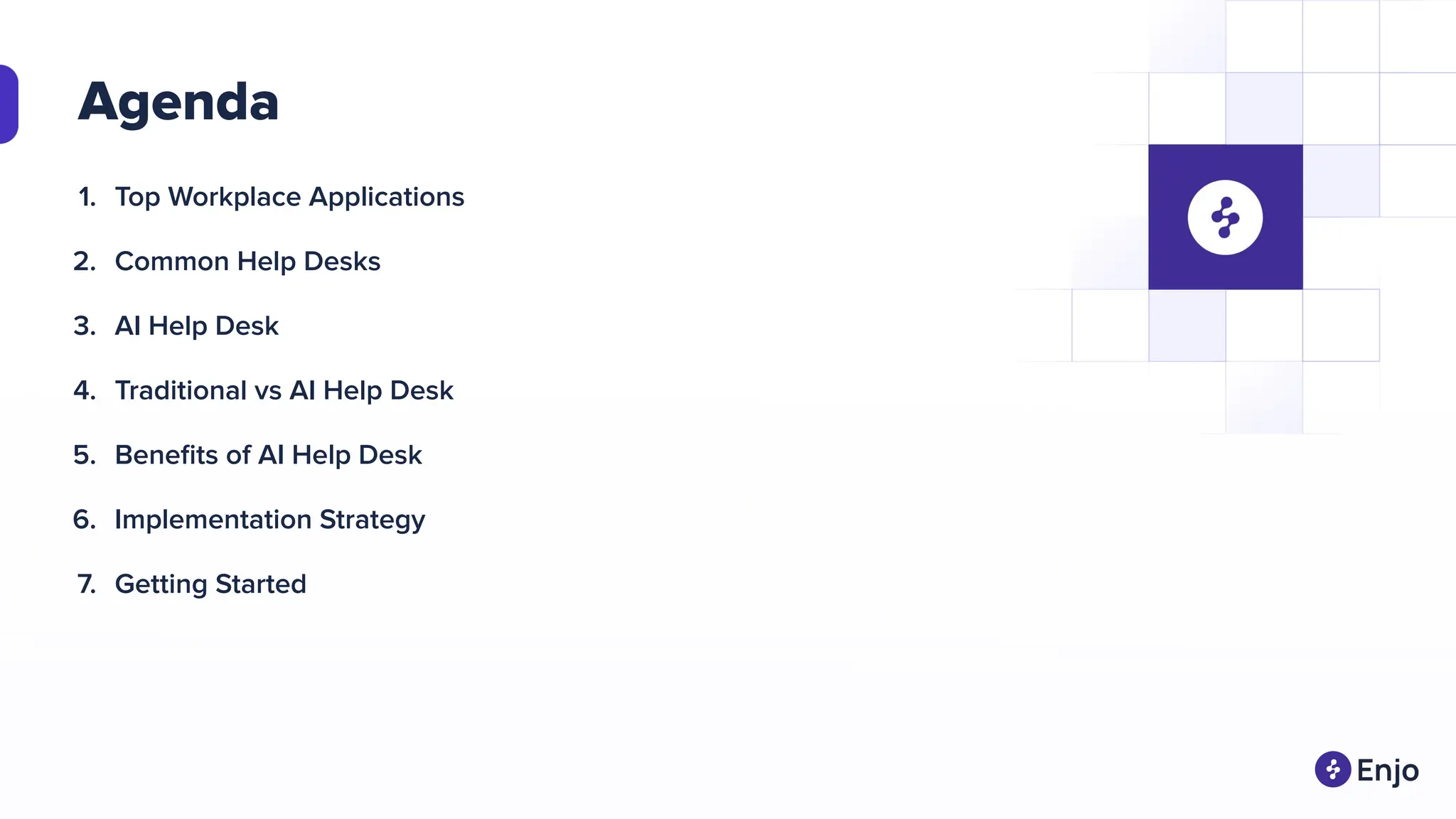
Agenda
1. Top Workplace Applications
2. Common Help Desks
3. AI Help Desk
4. Traditional vs AI Help Desk
5. Benefits of AI Help Desk
6. Implementation Strategy
7. Getting Started
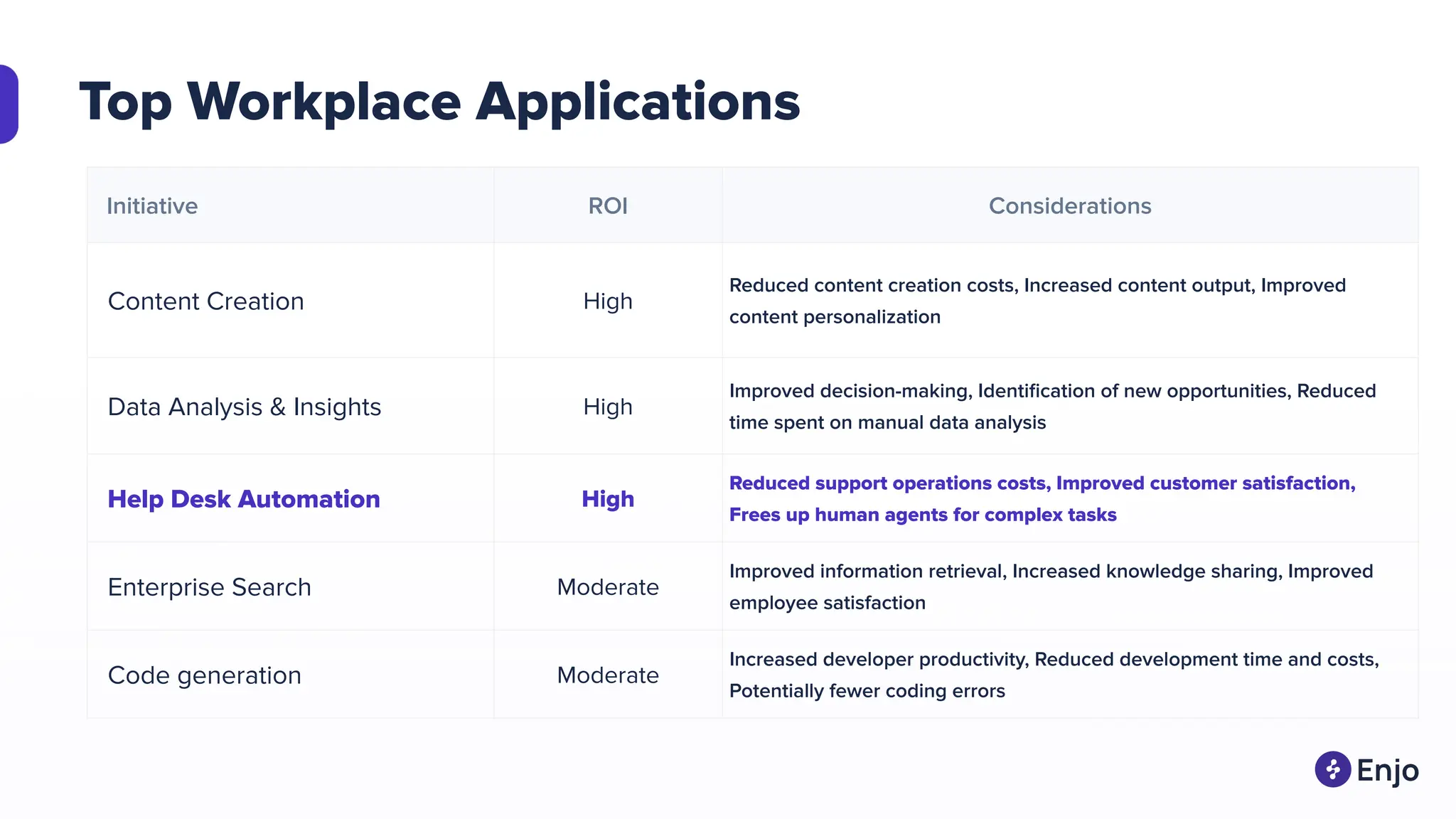
Top Workplace Applications
Initiative ROI Considerations
Content Creation High
Reduced content creation costs, Increased content output, Improved
content personalization
Data Analysis & Insights High
Improved decision-making, Identification of new opportunities, Reduced
time spent on manual data analysis
Help Desk Automation High
Reduced support operations costs, Improved customer satisfaction,
Frees up human agents for complex tasks
Enterprise Search Moderate
Improved information retrieval, Increased knowledge sharing, Improved
employee satisfaction
Code generation Moderate
Increased developer productivity, Reduced development time and costs,
Potentially fewer coding errors
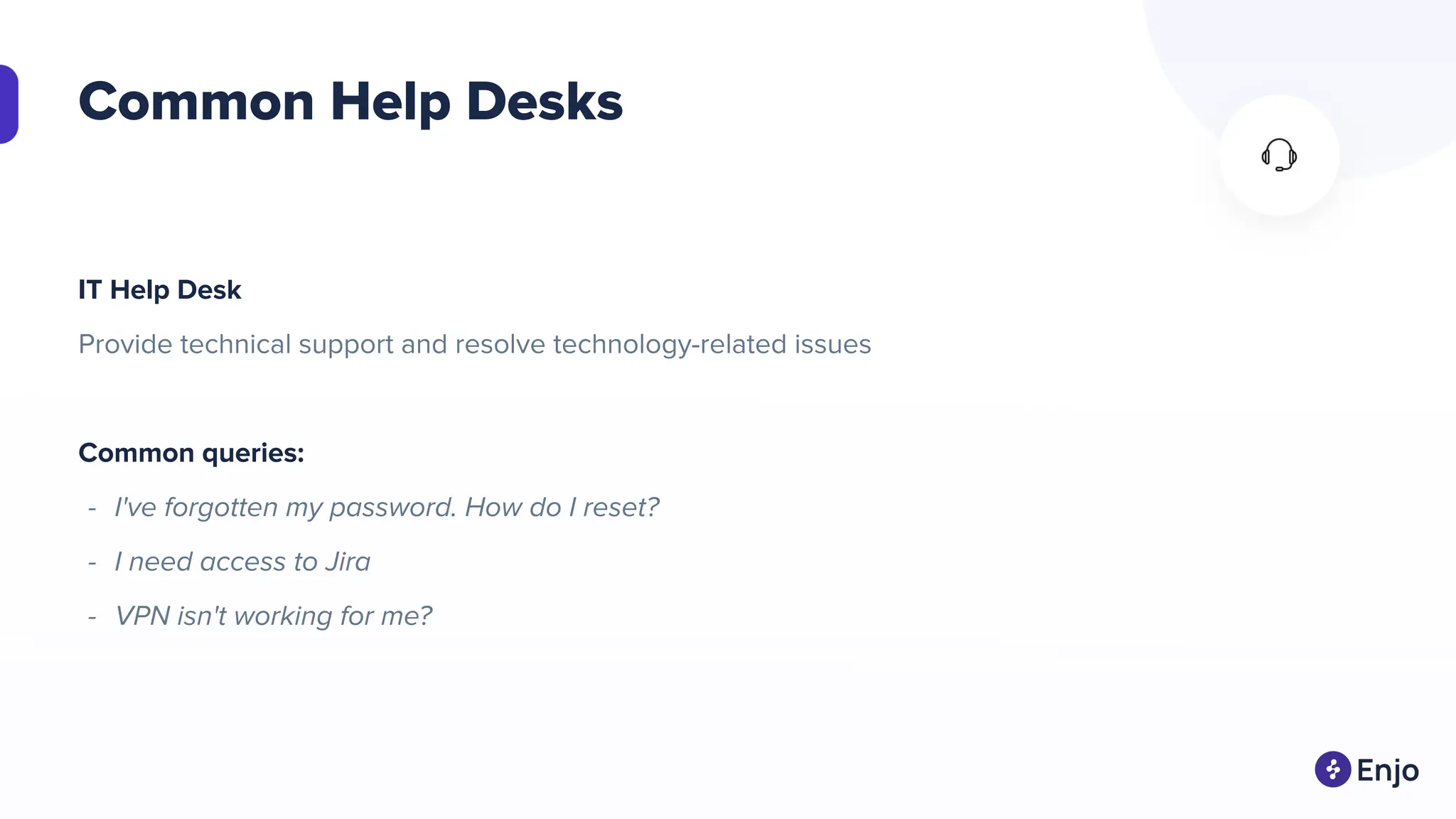
Common Help Desks
IT Help Desk
Provide technical support and resolve technology-related issues
Common queries:
- I've forgotten my password. How do I reset?
- I need access to Jira
- VPN isn't working for me?
Common Help Desks
HR Help Desk
Address employee-related inquiries and support HR processes
Common queries:
- How do I request time off?
- How do I change my 401(k) contribution?
- What's our work-from-home policy?
Common Help Desks
Customer Service Help Desk
Provide support and assistance to external customers
Common queries:
- How do I change our account administrator?
- How do I cancel my subscription?
- We're experiencing [specific error]. How can we resolve this?
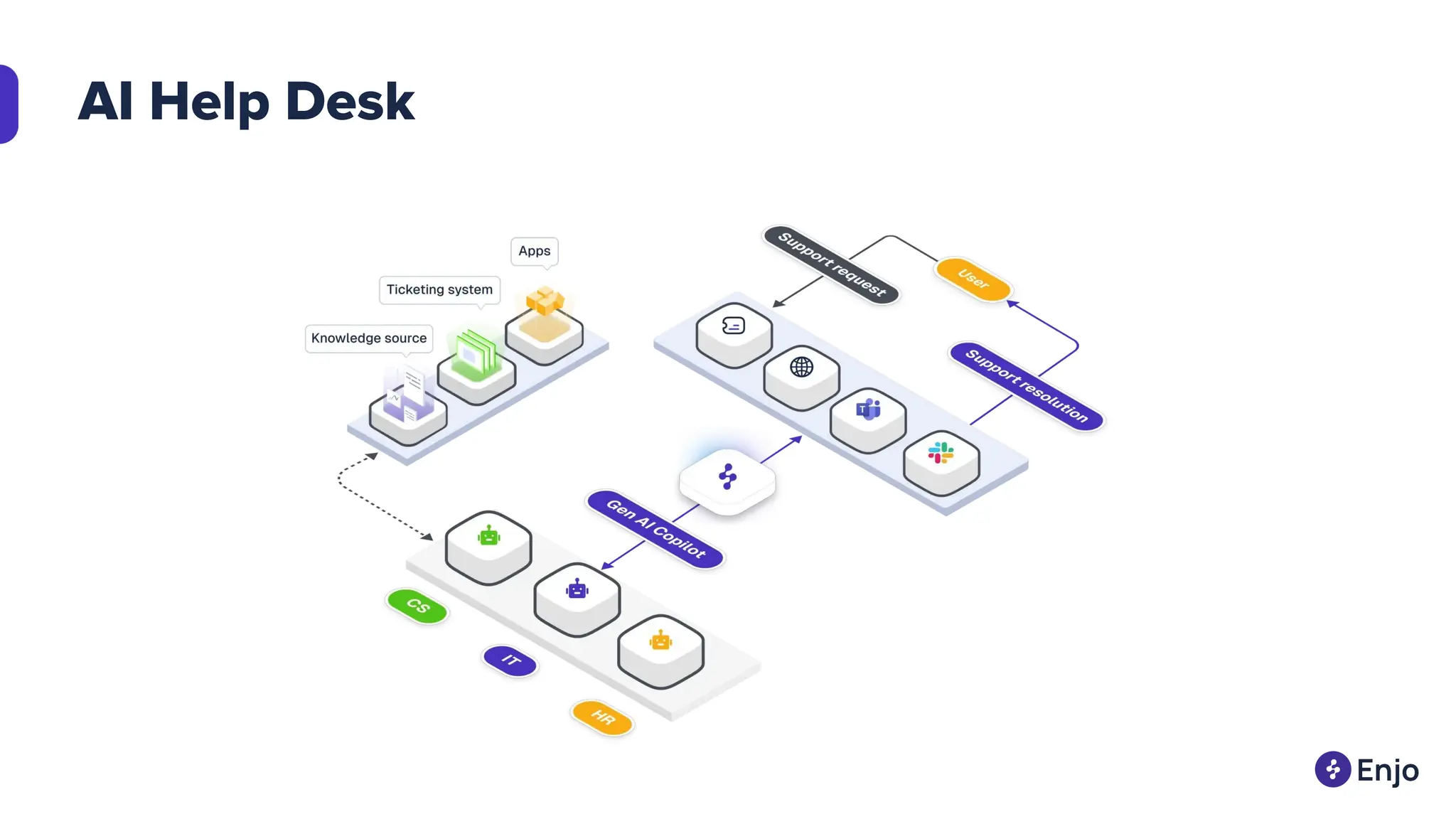
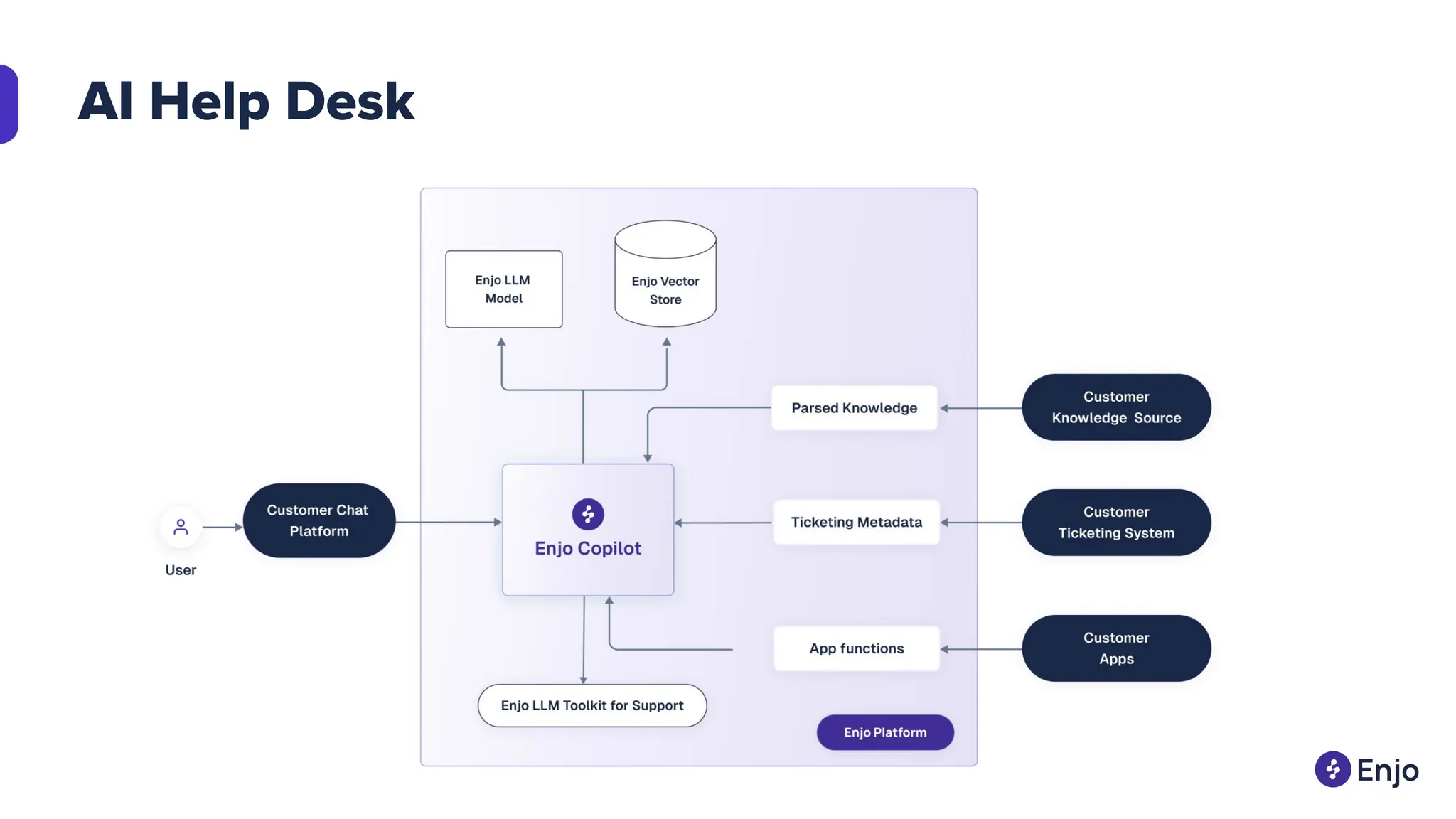
AI Help Desk
AI Help Desk
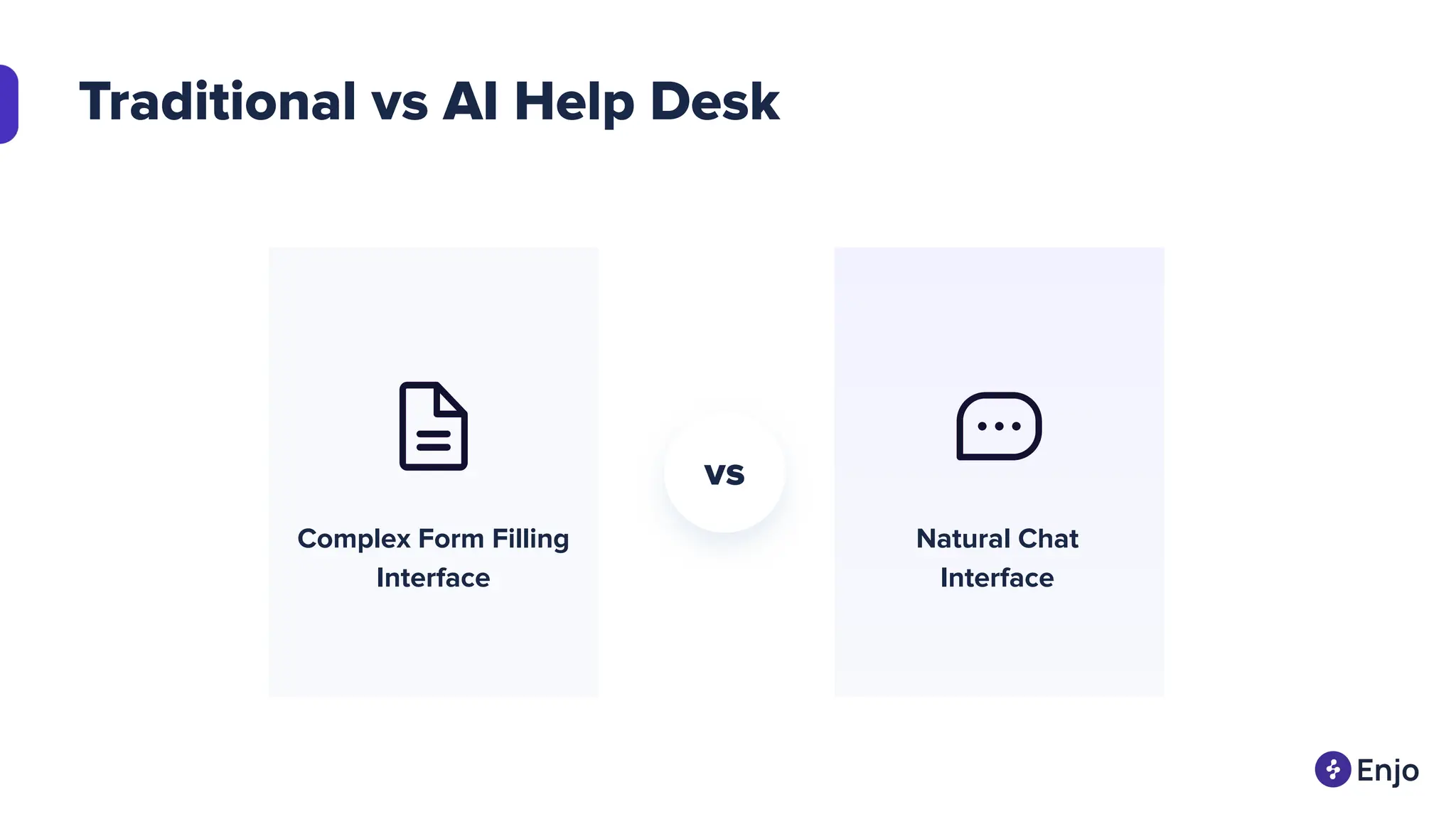
Traditional vs AI Help Desk
Complex Form Filling
Interface
Natural Chat
Interface
vs
Traditional vs AI Help Desk
9-5 Availability 24*7 Availability
vs
Traditional vs AI Help Desk
Slow Manual
Resolutions
Unlimited Instant
Resolutions
vs
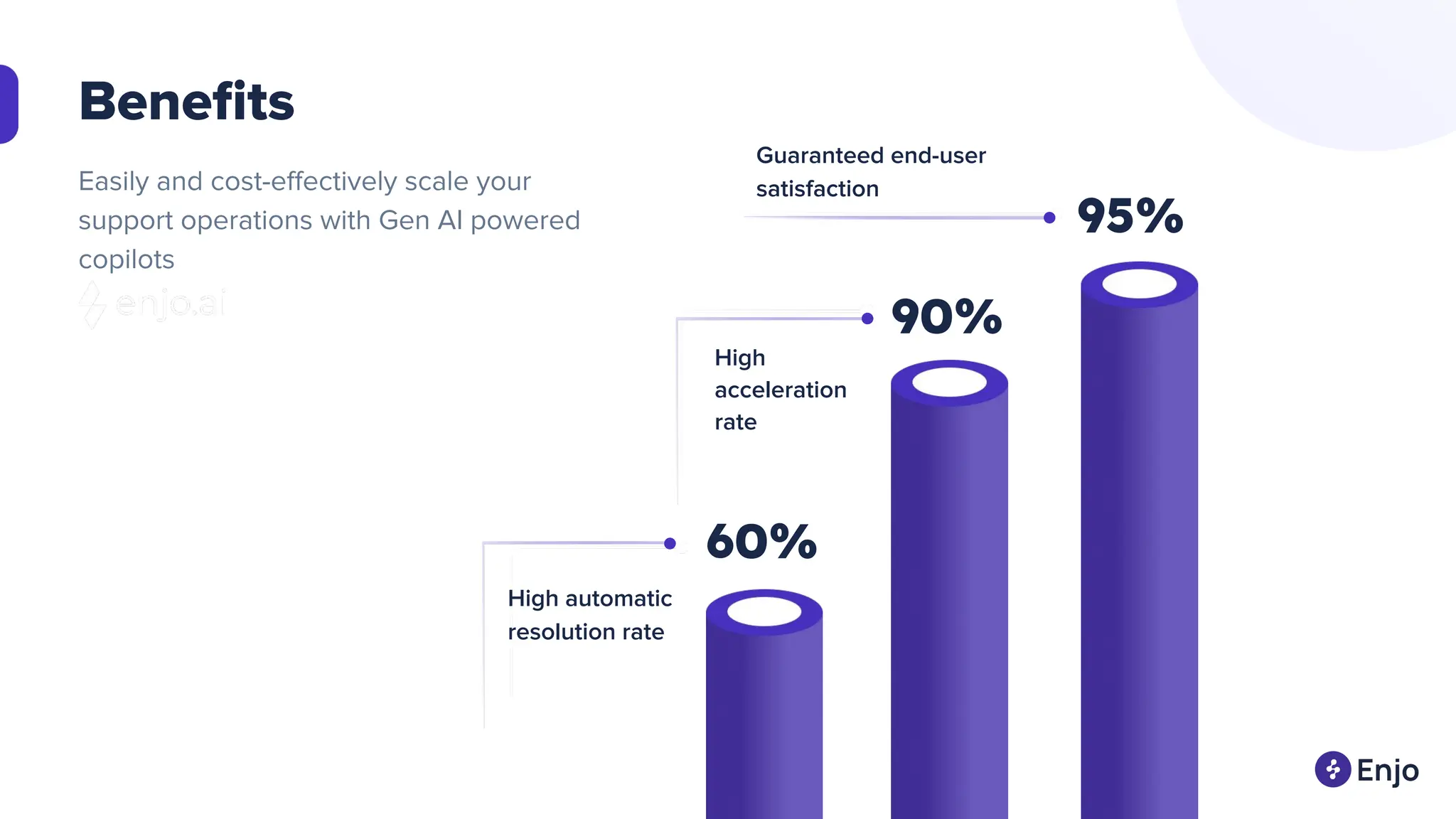
Benefits
Easily and cost-effectively scale your
support operations with Gen AI powered
copilots
95%
90%
60%
Guaranteed end-user
satisfaction
High
acceleration
rate
High automatic
resolution rate
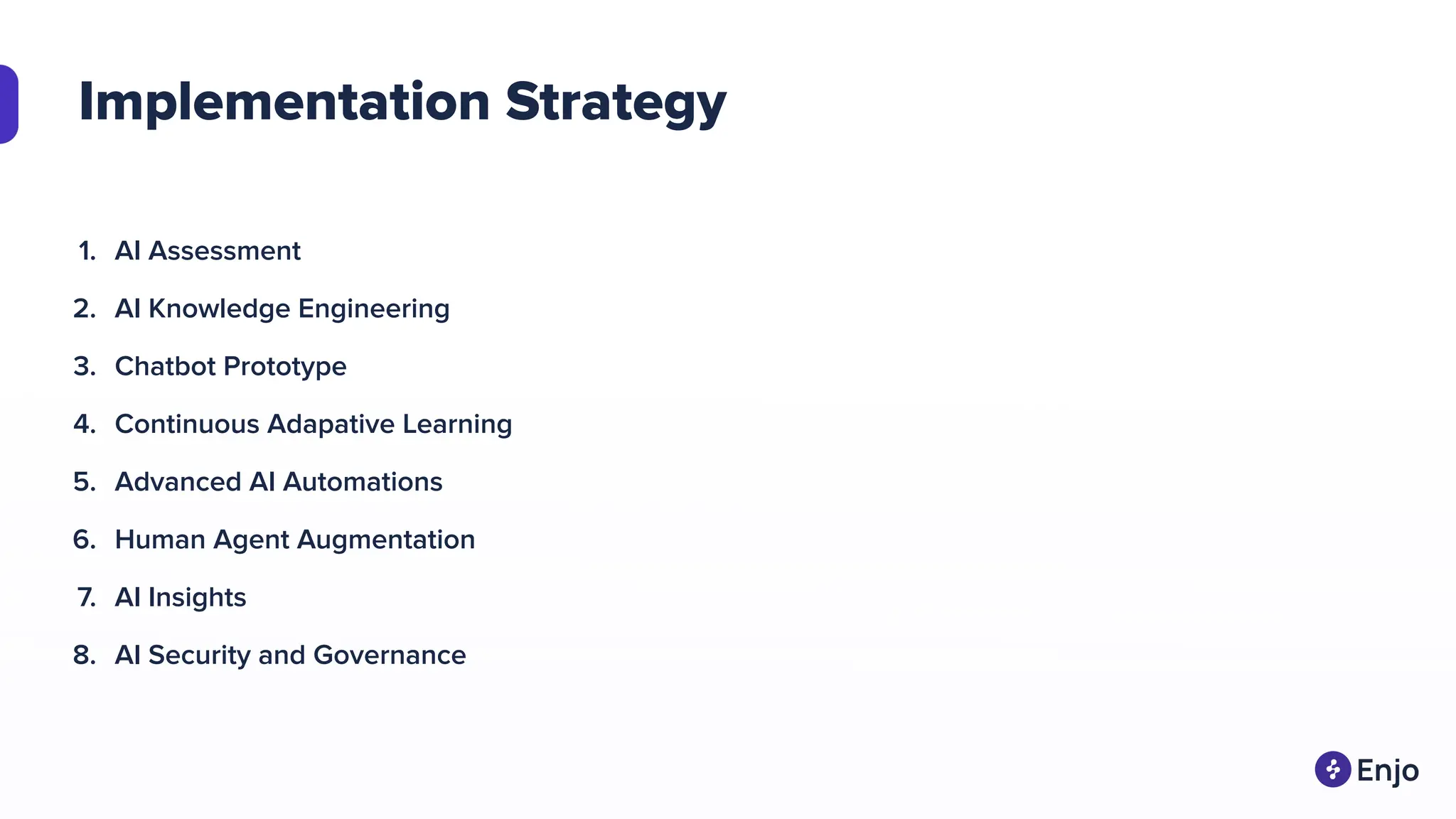
Implementation Strategy
1. AI Assessment
2. AI Knowledge Engineering
3. Chatbot Prototype
4. Continuous Adapative Learning
5. Advanced AI Automations
6. Human Agent Augmentation
7. AI Insights
8. AI Security and Governance
Implementation Strategy
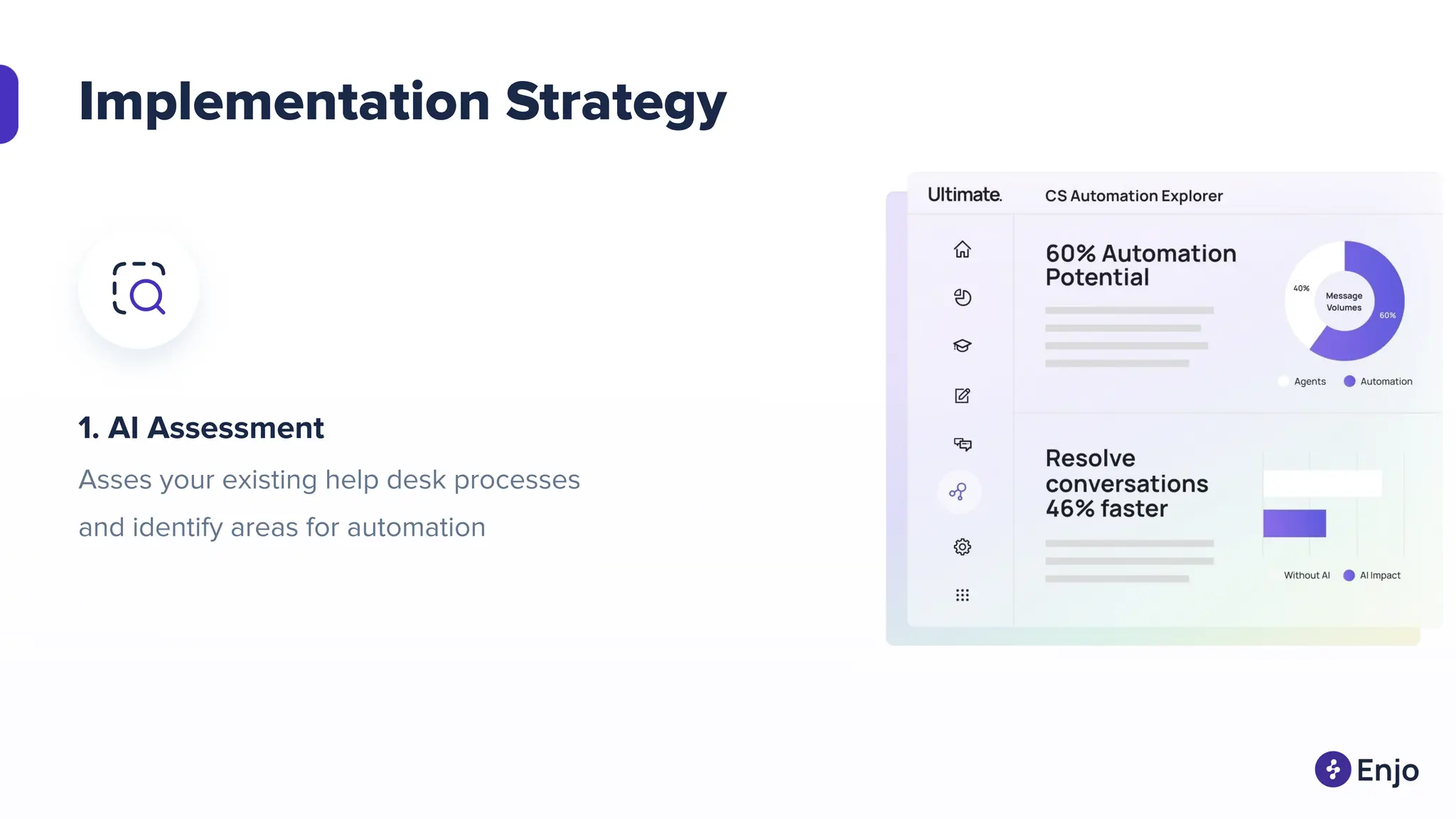
1. AI Assessment
Asses your existing help desk processes
and identify areas for automation
Implementation Strategy
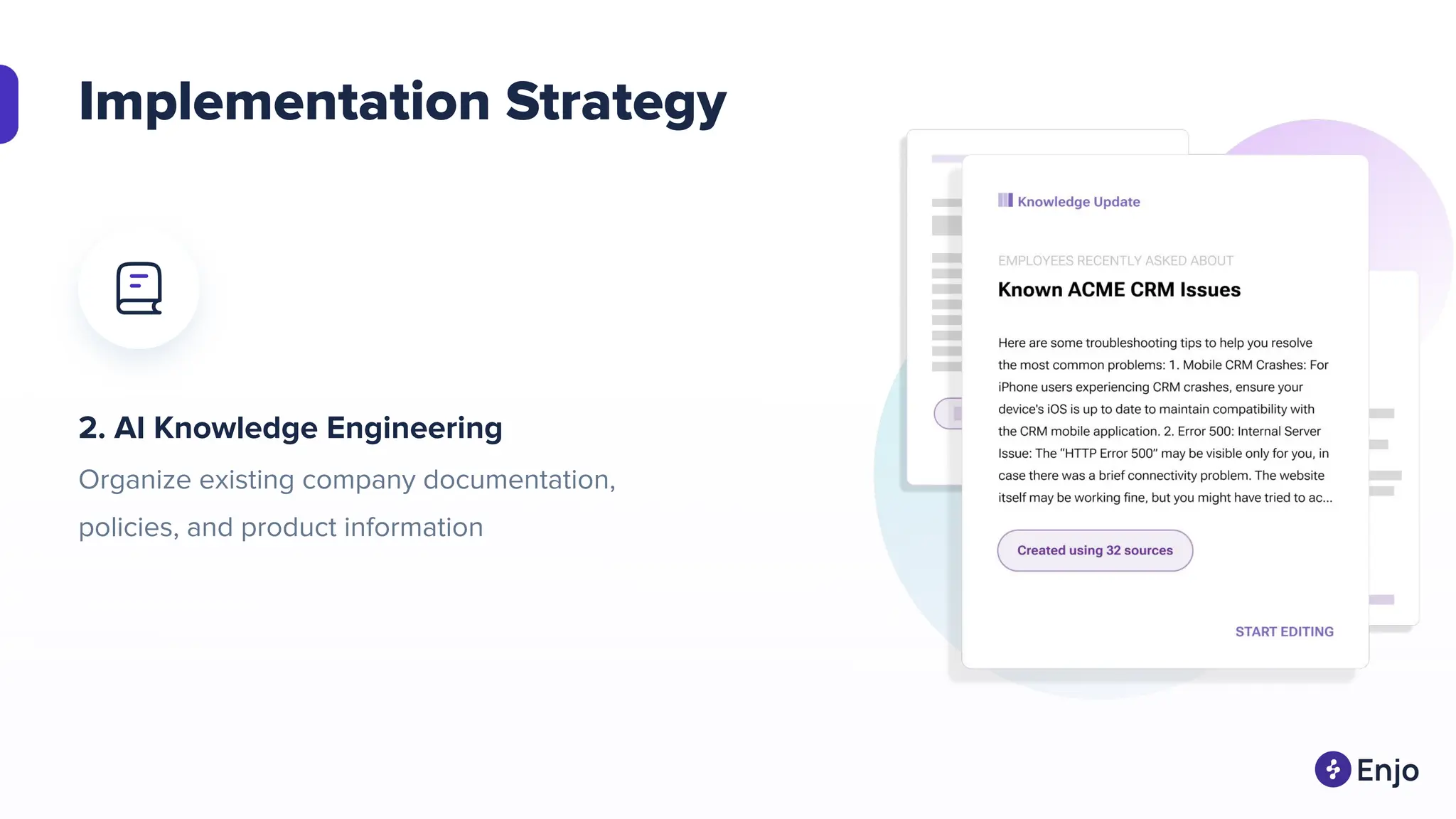
2. AI Knowledge Engineering
Organize existing company documentation,
policies, and product information
Implementation Strategy
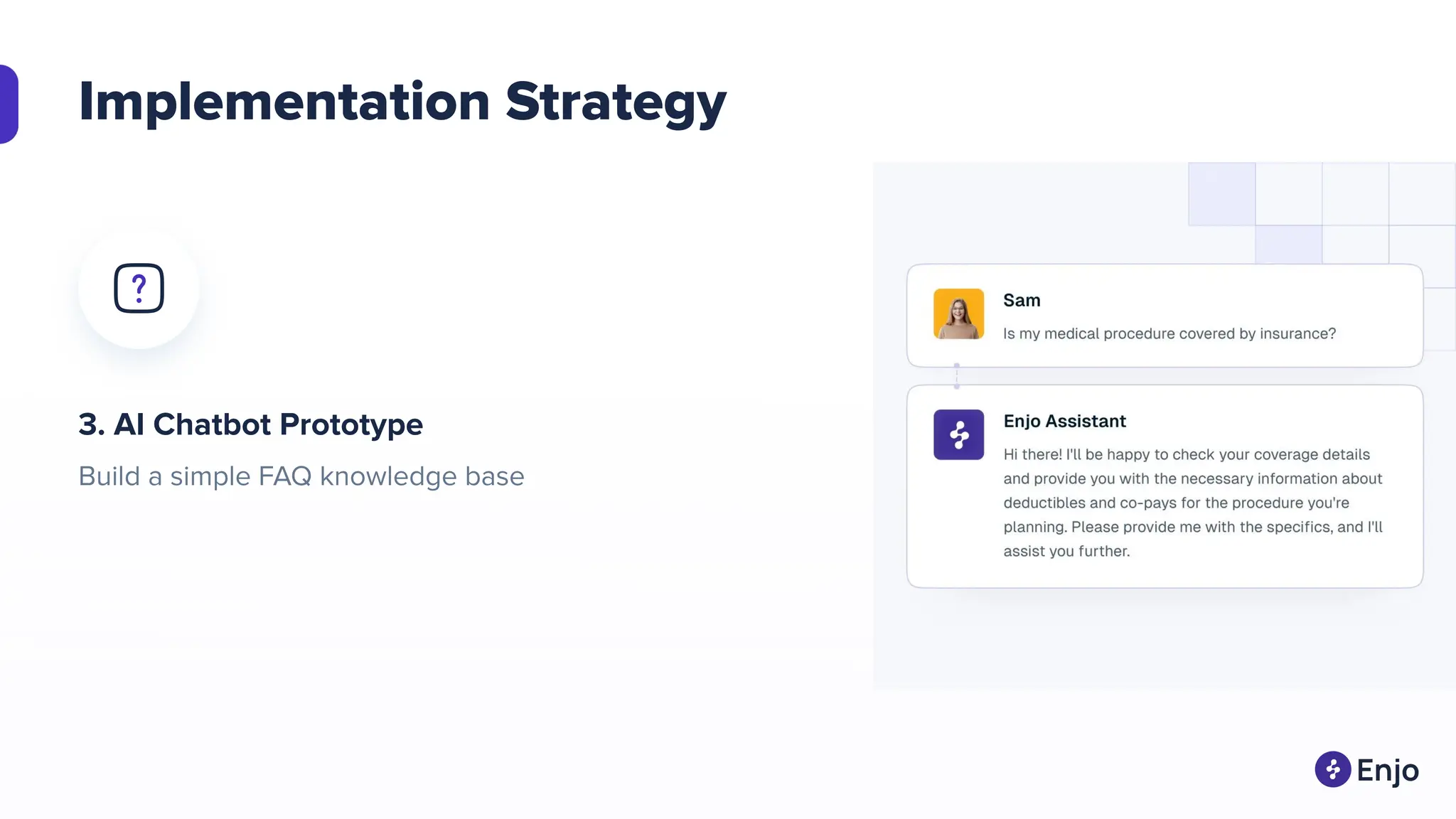
3. AI Chatbot Prototype
Build a simple FAQ knowledge base
Implementation Strategy
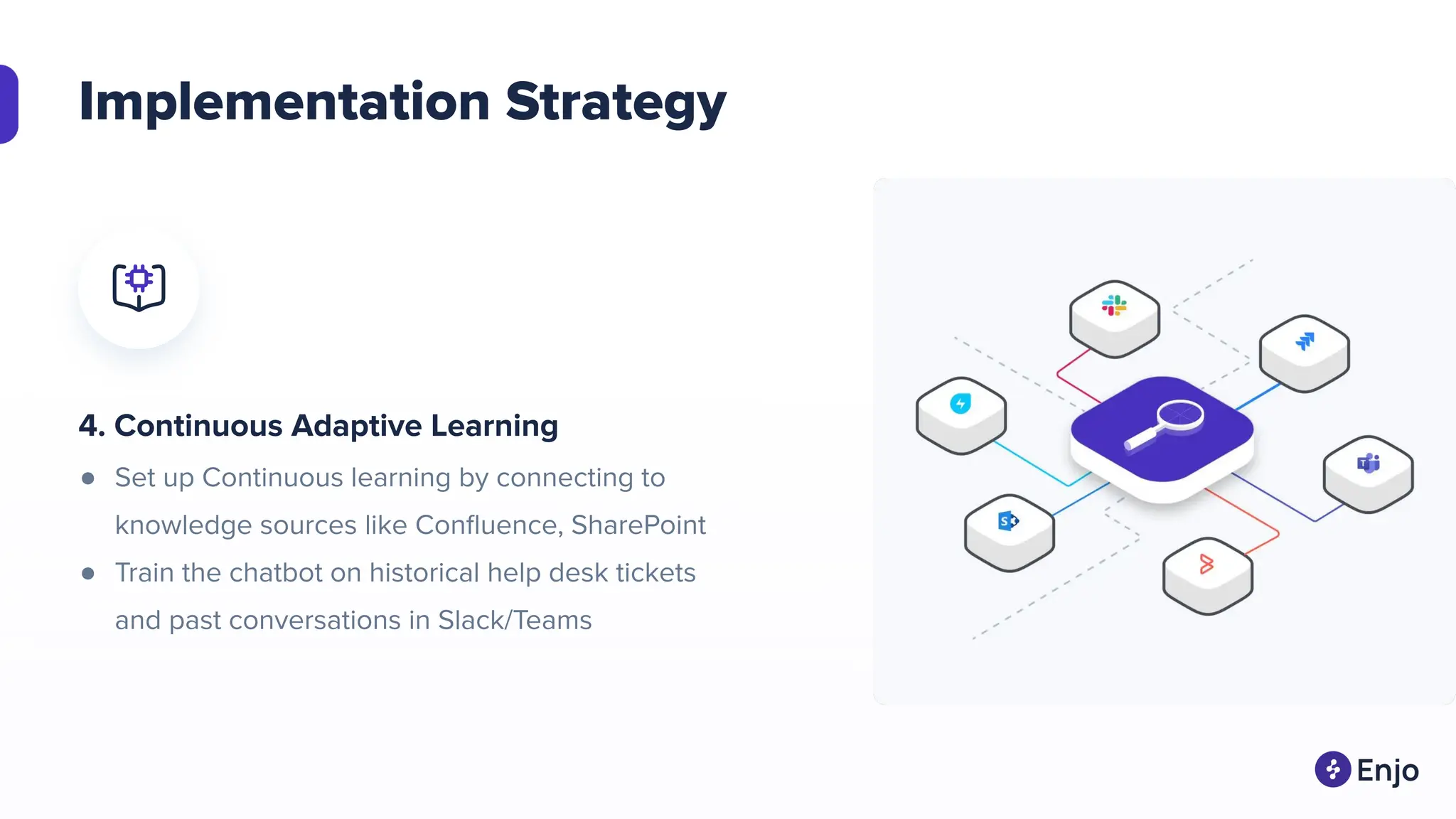
4. Continuous Adaptive Learning
● Set up Continuous learning by connecting to
knowledge sources like Confluence, SharePoint
● Train the chatbot on historical help desk tickets
and past conversations in Slack/Teams
Implementation Strategy
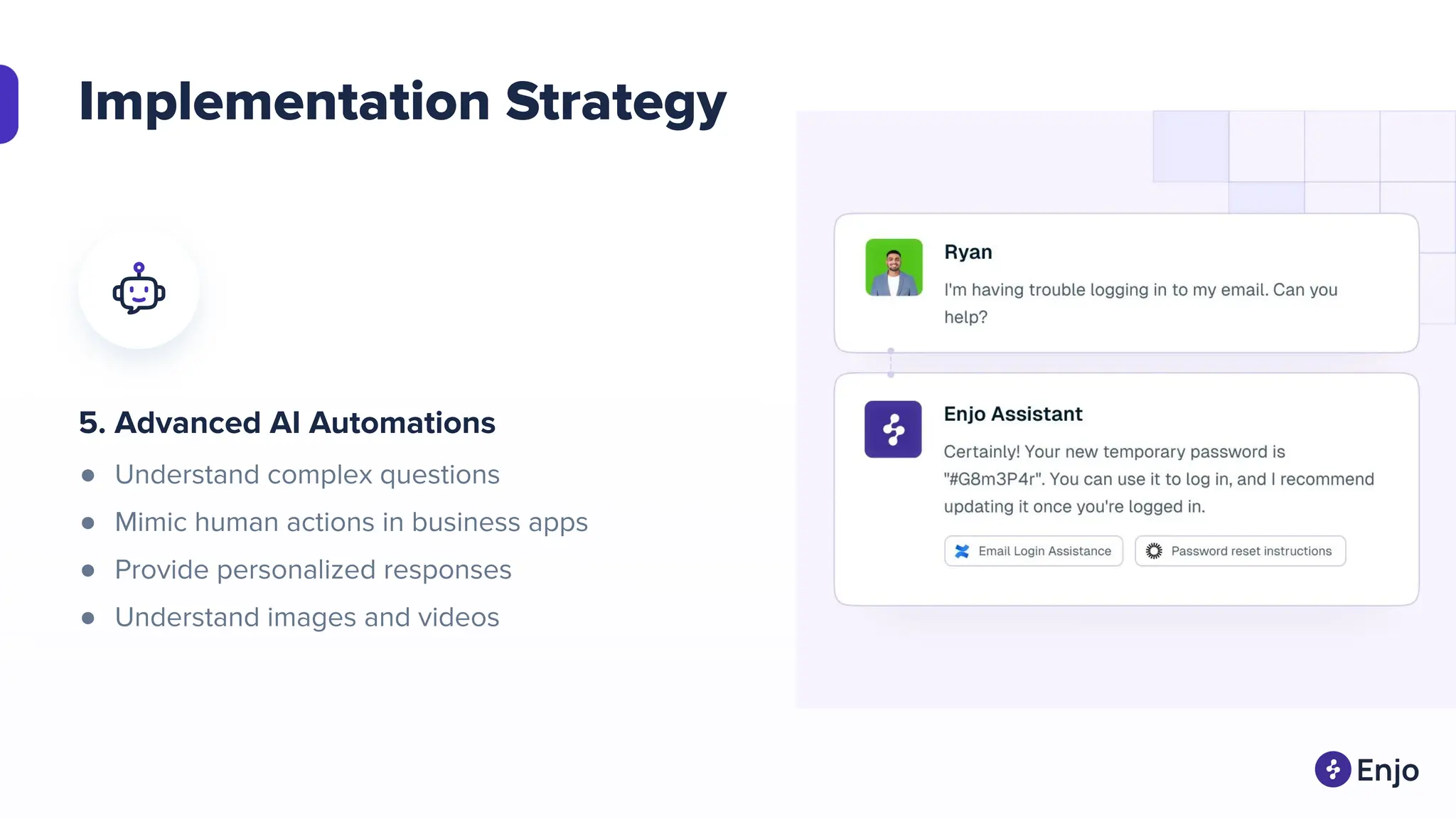
5. Advanced AI Automations
● Understand complex questions
● Mimic human actions in business apps
● Provide personalized responses
● Understand images and videos
Implementation Strategy
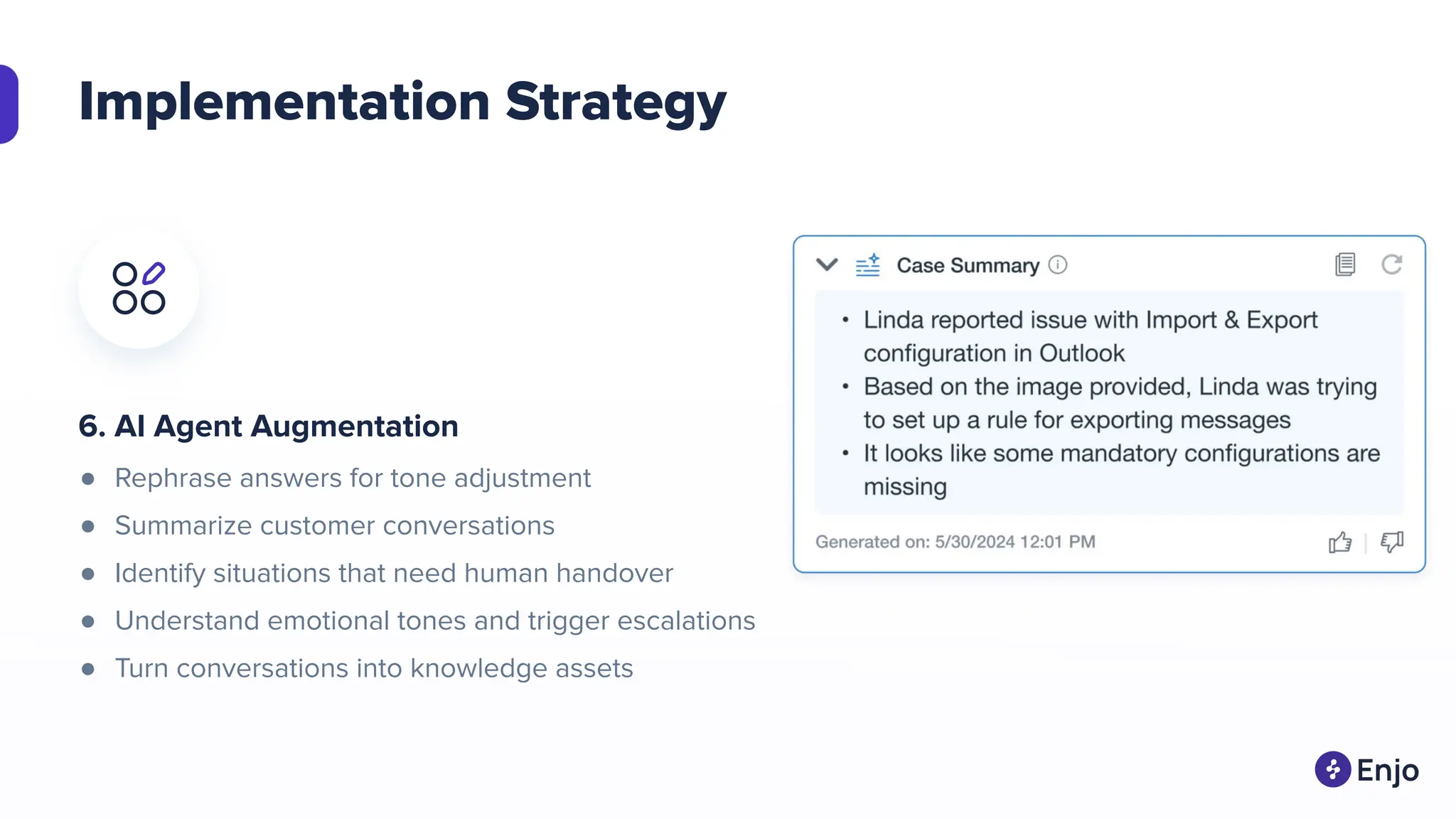
6. AI Agent Augmentation
● Rephrase answers for tone adjustment
● Summarize customer conversations
● Identify situations that need human handover
● Understand emotional tones and trigger escalations
● Turn conversations into knowledge assets
Implementation Strategy
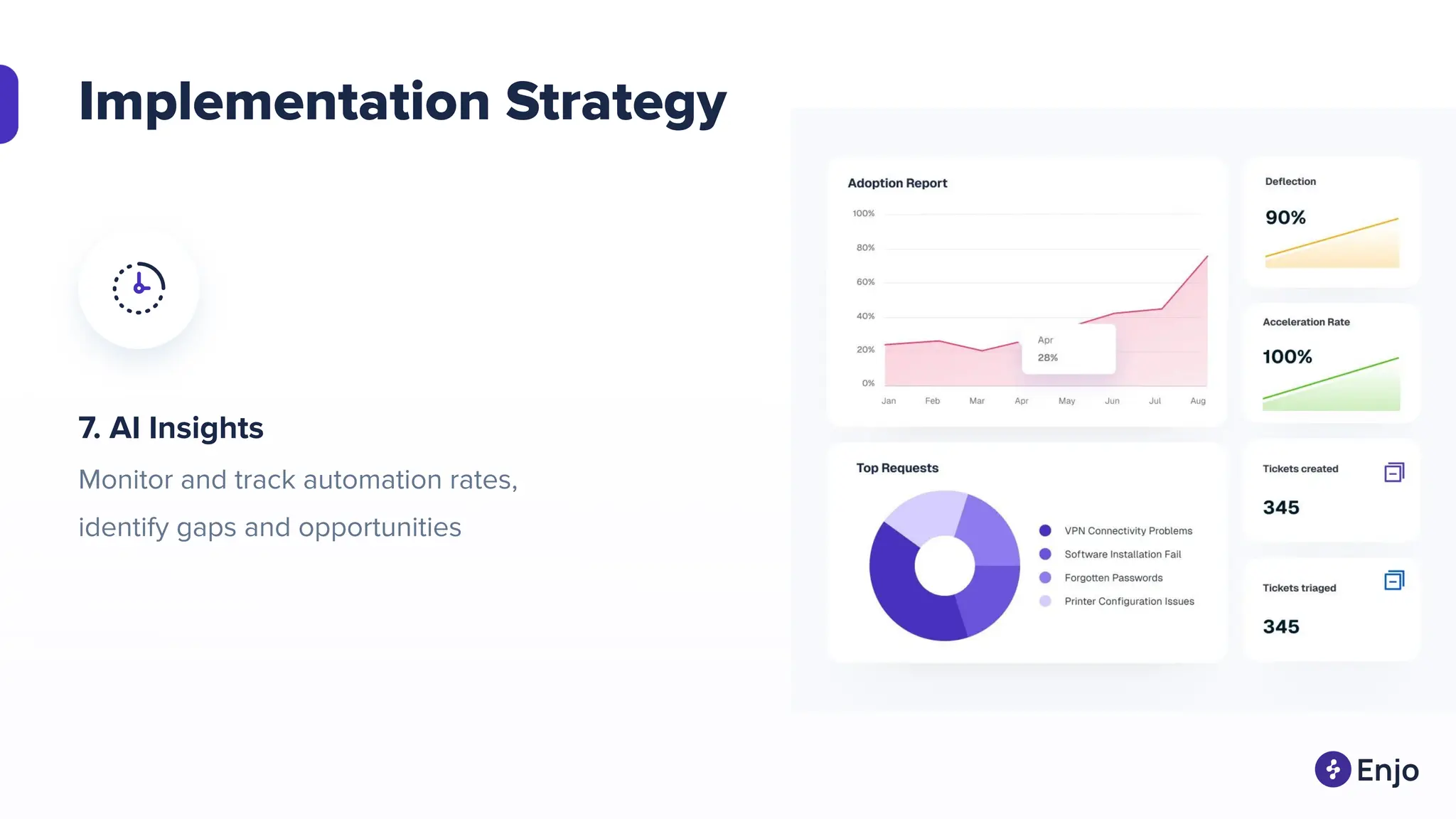
7. AI Insights
Monitor and track automation rates,
identify gaps and opportunities
Implementation Strategy
8. AI Security and Governance
- Anonymize training data, user queries
- Ensure company data is not used train LLMs
- Ensure ISO, SOC2 and GDPR compliance
Getting Started
Build a custom Gen AI chatbot using
- Data layer for RAG (e.g., LlamaIndex, LangChain)
- Foundation models (e.g., Open AI, Claude, Gemini)
- Vector databases (e.g., Pinecone)
Leverage purpose-built vendor products like Enjo AI
Get Started with Enjo AI
1. Personalized Enjo demo
2. Help desk automation potential assessment
3. 14 days no obligation free trial
4. 3 months guided Pilot program
Siddarth Kengadaran
theproductguy.xyz
Who am I?
➔ Product Consultant | Strategy and Design
➔ Information Technology and Psychology
➔ Convenor - The Product Space
➔ Organizer - Google Developer Groups and Friends of Figma, Coimbatore
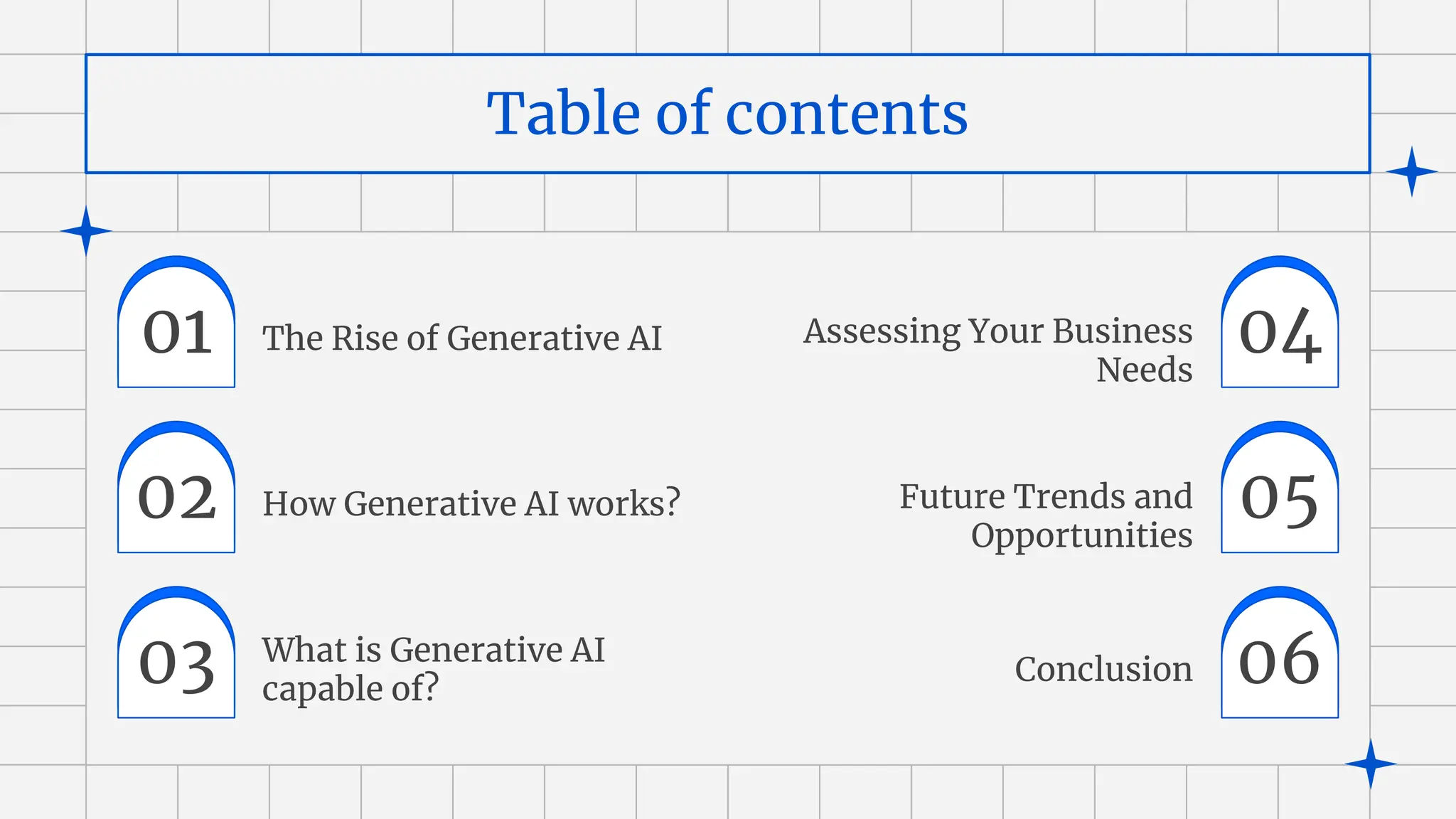
How Generative AI works?
Table of contents
The Rise of Generative AI
What is Generative AI
capable of?
Assessing Your Business
Needs
Future Trends and
Opportunities
Conclusion
01
02
03
04
05
06
Artificial
Intelligence (AI)
Artificial Intelligence (AI) refers to the simulation of
human intelligence in machines that are
programmed to mimic human actions and cognitive
processes.
The Rise of Generative AI
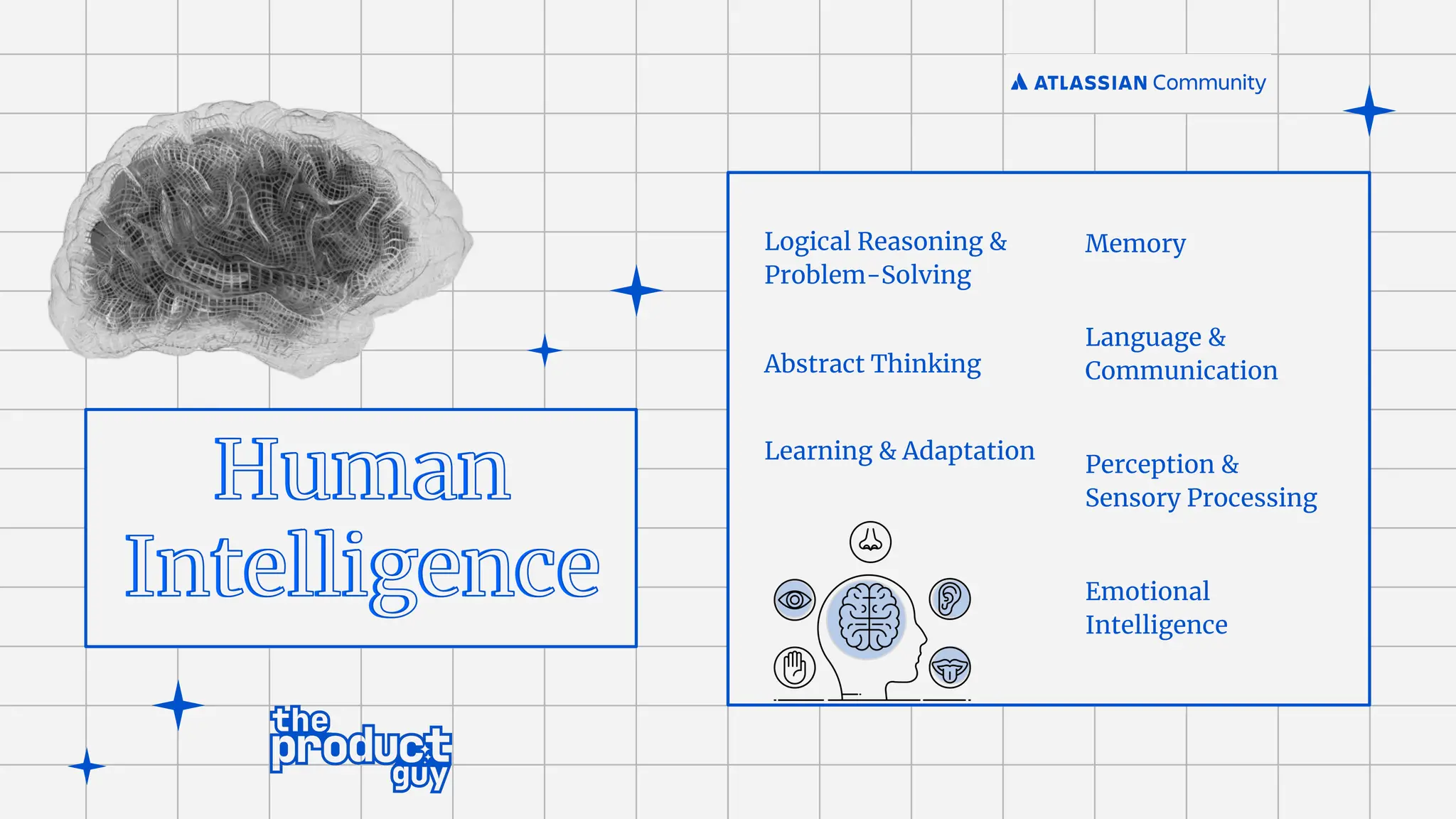
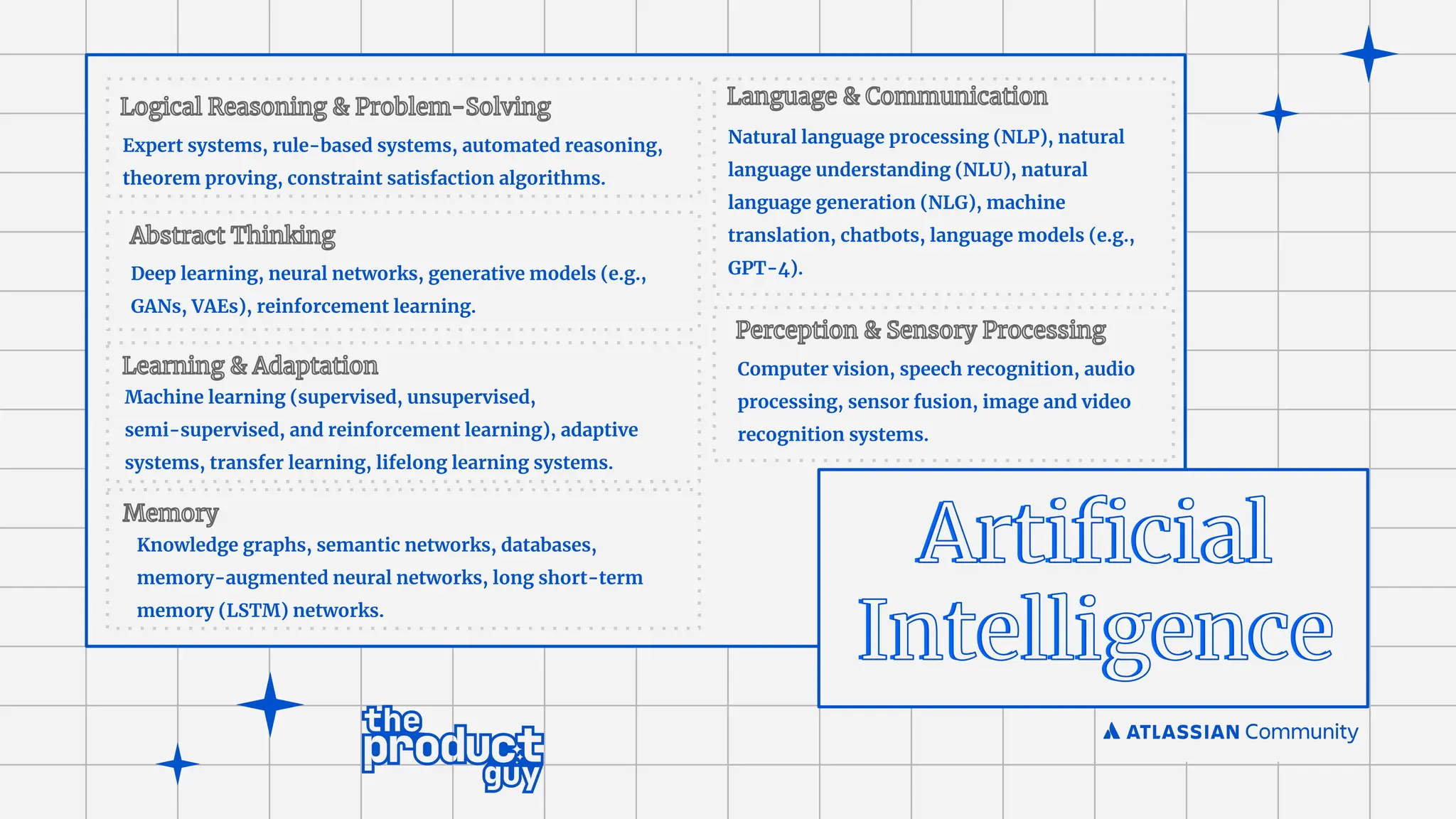
Logical Reasoning &
Problem-Solving
Abstract Thinking
Learning & Adaptation
Memory
Language &
Communication
Perception &
Sensory Processing
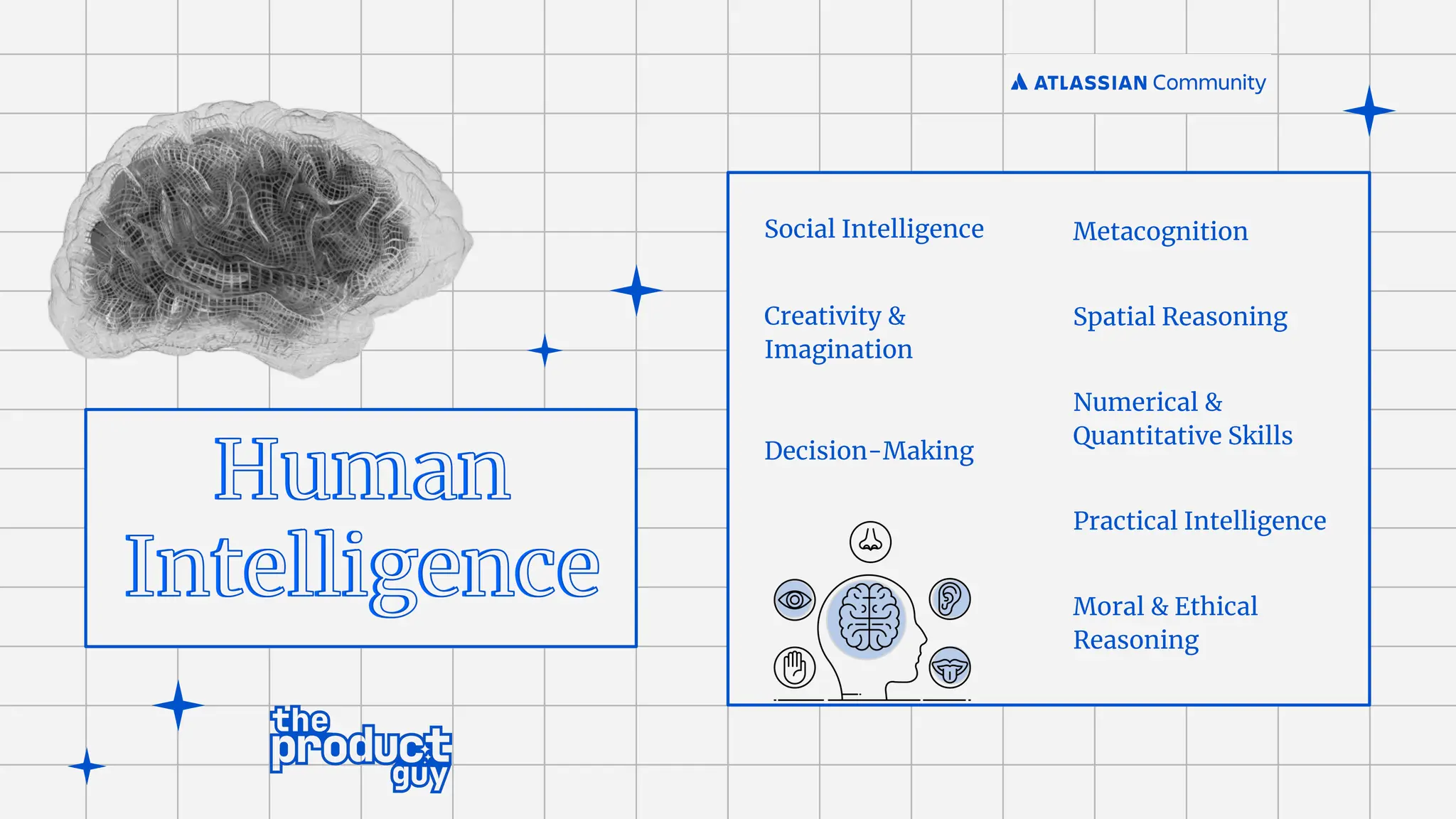
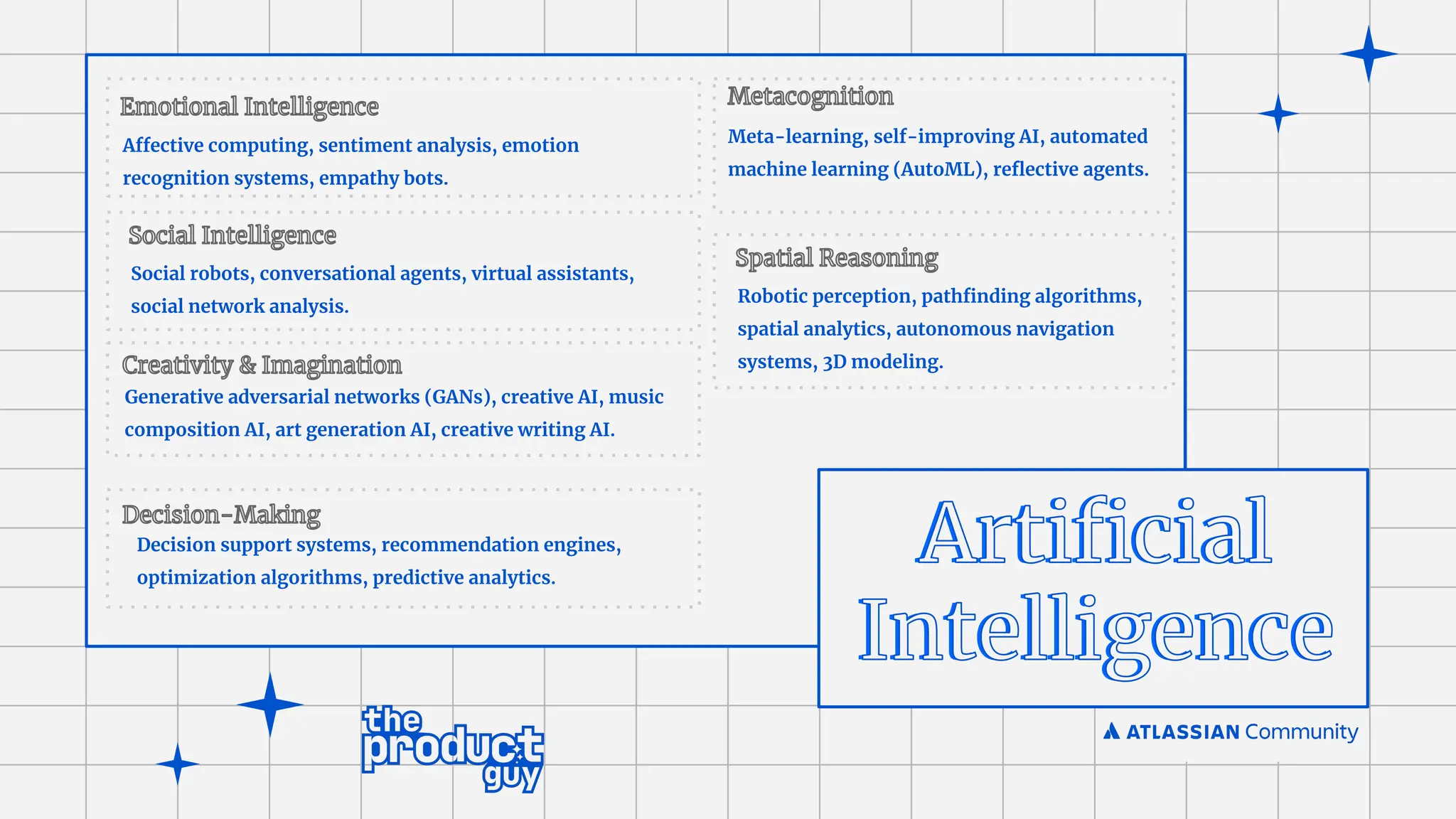
Emotional
Intelligence
Social Intelligence
Creativity &
Imagination
Decision-Making
Metacognition
Spatial Reasoning
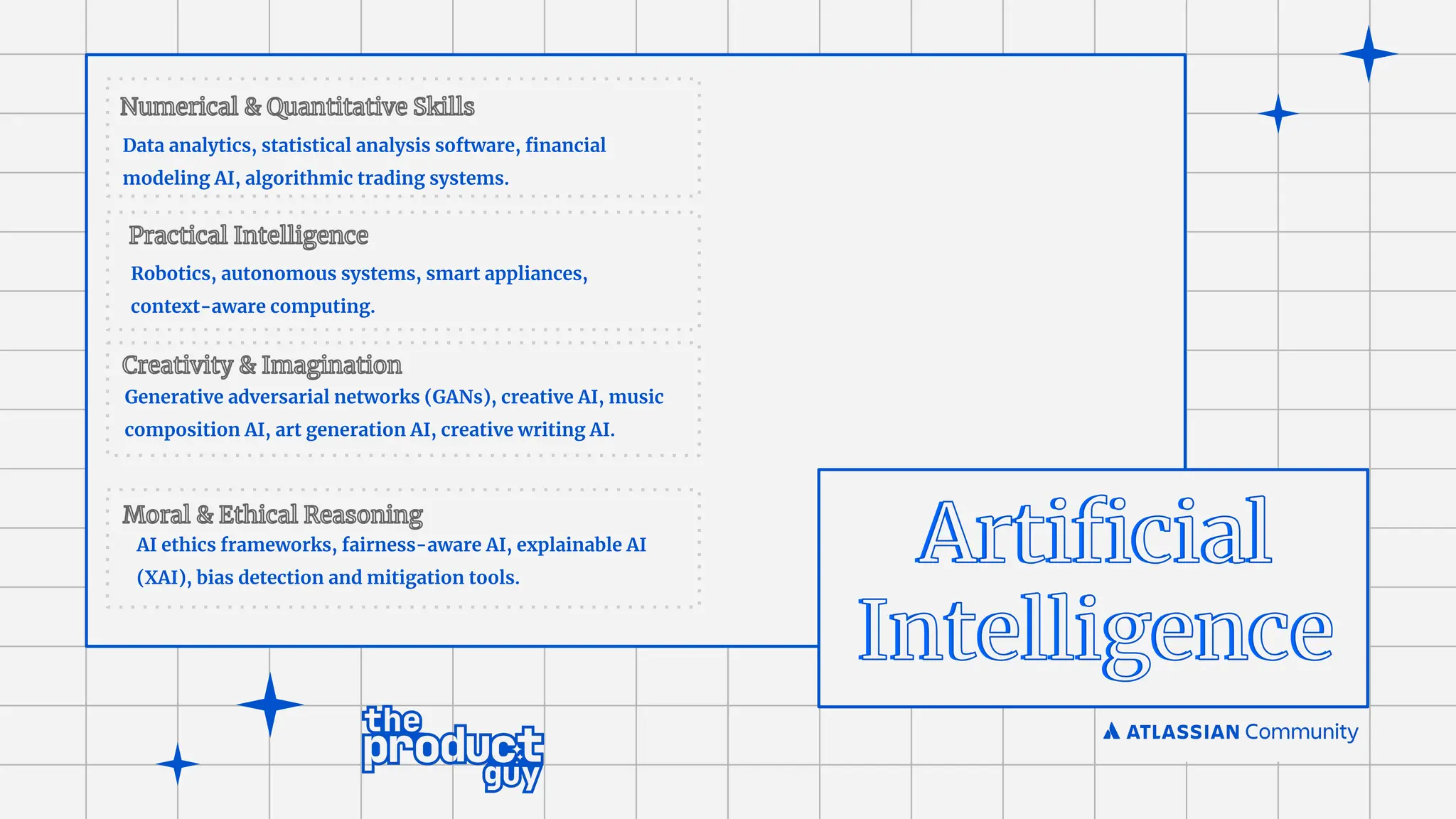
Numerical &
Quantitative Skills
Practical Intelligence
Moral & Ethical
Reasoning
Expert systems, rule-based systems, automated reasoning,
theorem proving, constraint satisfaction algorithms.
Deep learning, neural networks, generative models (e.g.,
GANs, VAEs), reinforcement learning.
Natural language processing (NLP), natural
language understanding (NLU), natural
language generation (NLG), machine
translation, chatbots, language models (e.g.,
GPT-4).
Machine learning (supervised, unsupervised,
semi-supervised, and reinforcement learning), adaptive
systems, transfer learning, lifelong learning systems.
Knowledge graphs, semantic networks, databases,
memory-augmented neural networks, long short-term
memory (LSTM) networks.
Computer vision, speech recognition, audio
processing, sensor fusion, image and video
recognition systems.
Affective computing, sentiment analysis, emotion
recognition systems, empathy bots.
Social robots, conversational agents, virtual assistants,
social network analysis.
Meta-learning, self-improving AI, automated
machine learning (AutoML), reflective agents.
Generative adversarial networks (GANs), creative AI, music
composition AI, art generation AI, creative writing AI.
Decision support systems, recommendation engines,
optimization algorithms, predictive analytics.
Robotic perception, pathfinding algorithms,
spatial analytics, autonomous navigation
systems, 3D modeling.
Data analytics, statistical analysis software, financial
modeling AI, algorithmic trading systems.
Robotics, autonomous systems, smart appliances,
context-aware computing.
Generative adversarial networks (GANs), creative AI, music
composition AI, art generation AI, creative writing AI.
AI ethics frameworks, fairness-aware AI, explainable AI
(XAI), bias detection and mitigation tools.
Artificial
Intelligence[AI]
Machine
Learning [ML]
Natural Language
Processing [NLP]
Deep Learning
Vision Speech
Robotics
Planning
Expert
Systems
Neural Networks
Generative AI
The Rise of Generative AI
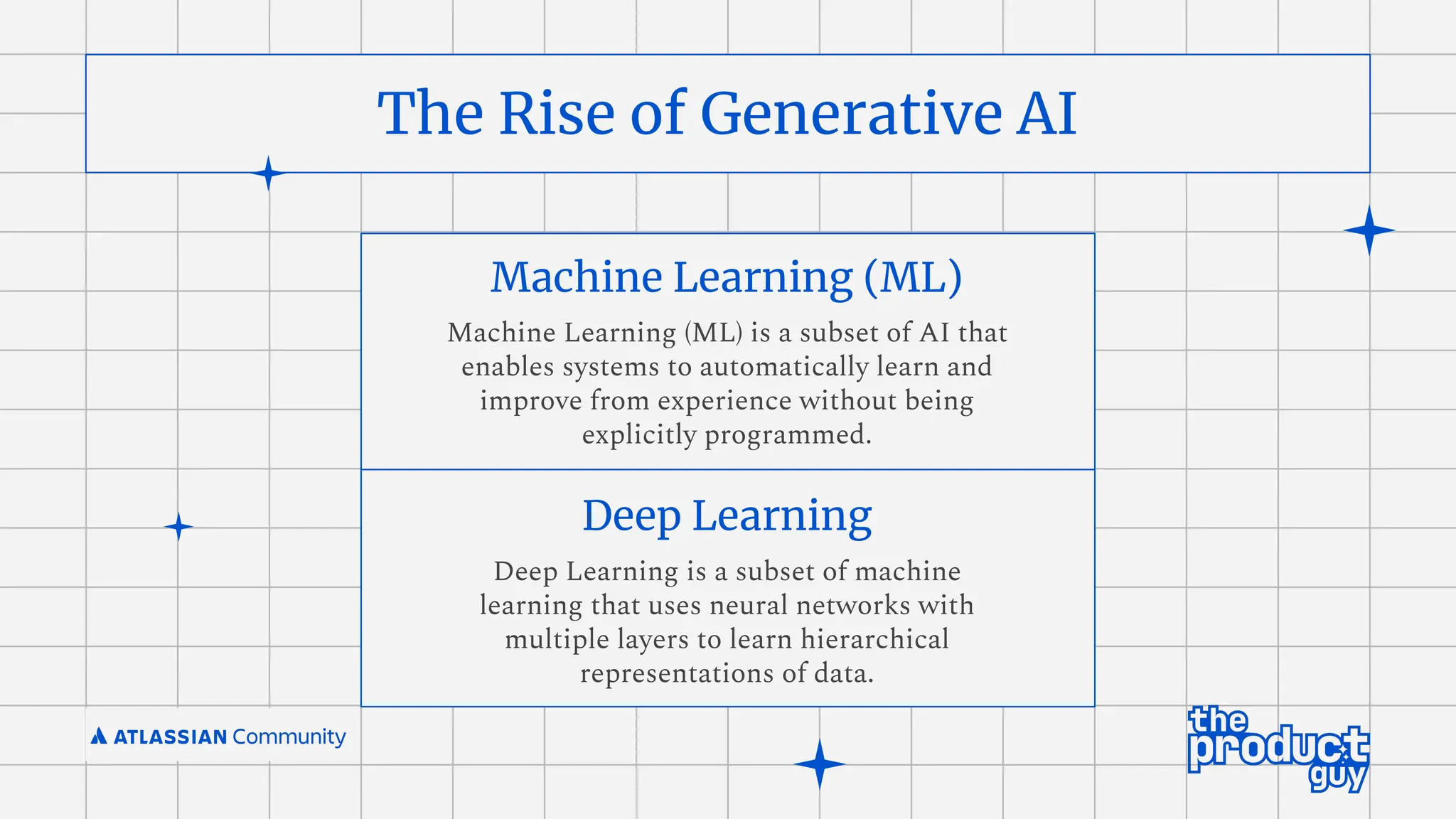
Machine Learning (ML)
Machine Learning (ML) is a subset of AI that
enables systems to automatically learn and
improve from experience without being
explicitly programmed.
Deep Learning
Deep Learning is a subset of machine
learning that uses neural networks with
multiple layers to learn hierarchical
representations of data.
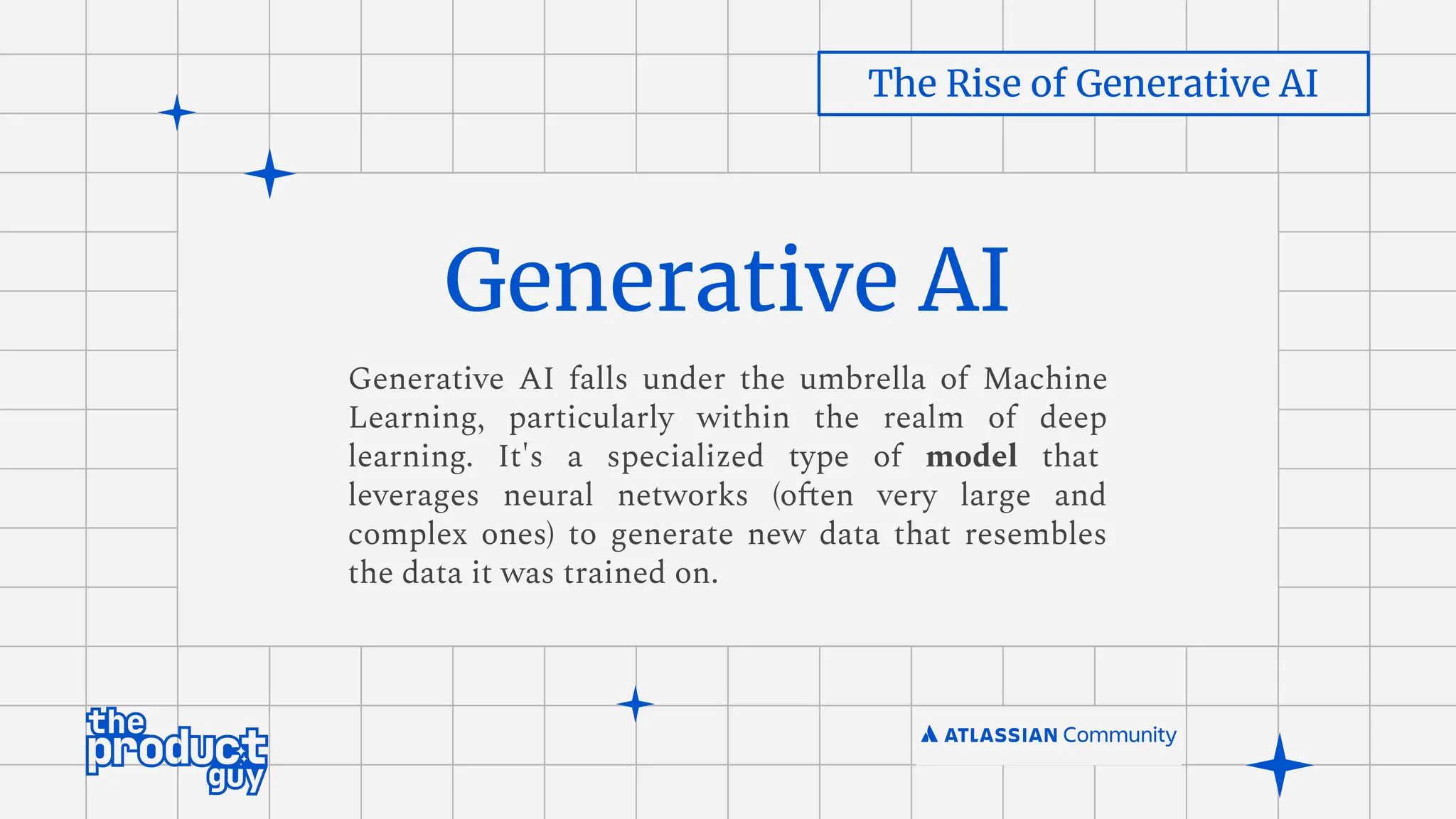
Generative AI
Generative AI falls under the umbrella of Machine
Learning, particularly within the realm of deep
learning. It's a specialized type of model that
leverages neural networks (often very large and
complex ones) to generate new data that resembles
the data it was trained on.
The Rise of Generative AI
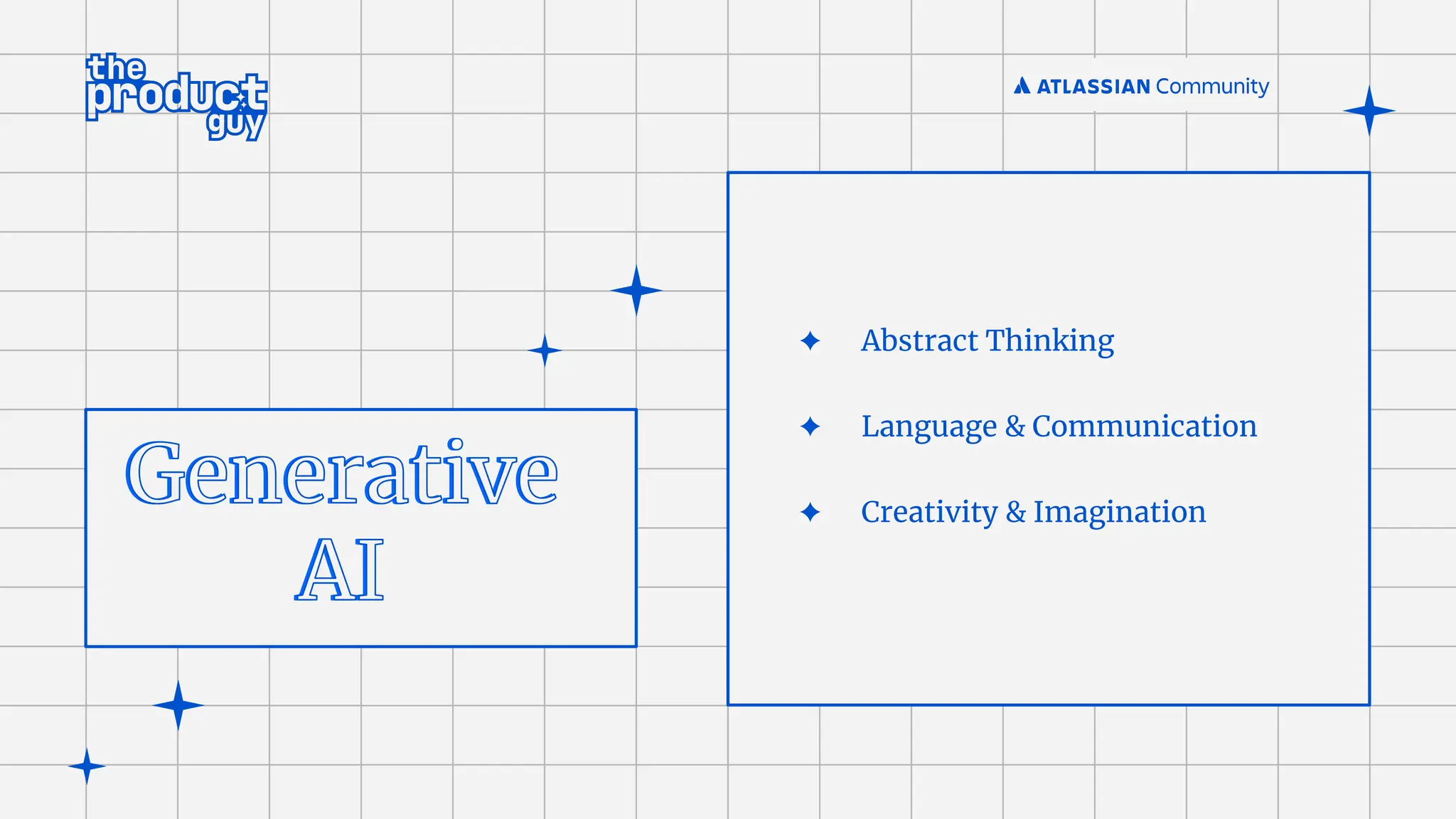
✦ Abstract Thinking
✦ Language & Communication
✦ Creativity & Imagination
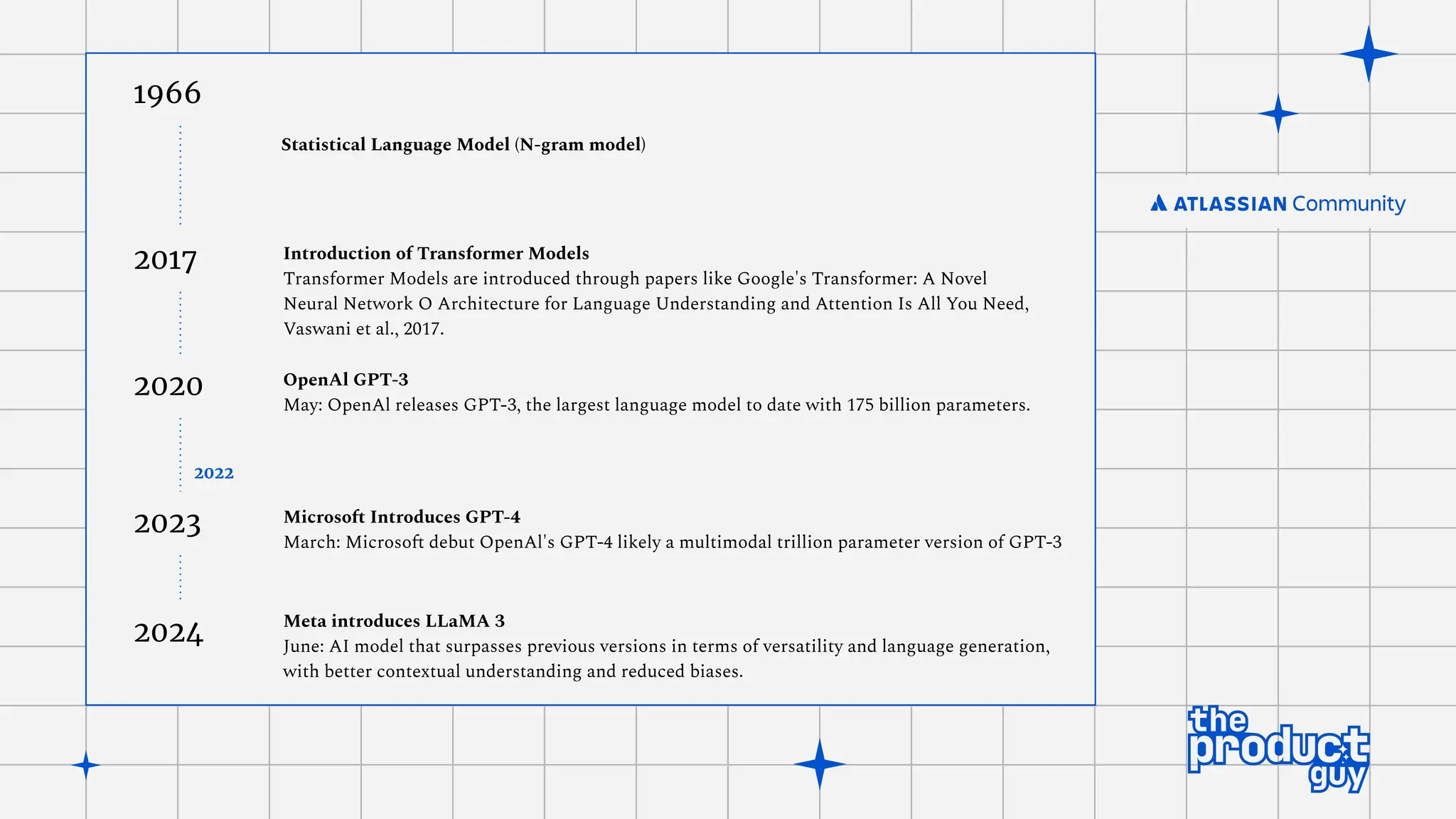
1966
2017
2023
OpenAl GPT-3
May: OpenAl releases GPT-3, the largest language model to date with 175 billion parameters.
Microsoft Introduces GPT-4
March: Microsoft debut OpenAl's GPT-4 likely a multimodal trillion parameter version of GPT-3
Introduction of Transformer Models
Transformer Models are introduced through papers like Google's Transformer: A Novel
Neural Network O Architecture for Language Understanding and Attention Is All You Need,
Vaswani et al., 2017.
2020
2024
Meta introduces LLaMA 3
June: AI model that surpasses previous versions in terms of versatility and language generation,
with better contextual understanding and reduced biases.
Statistical Language Model (N-gram model)
2022
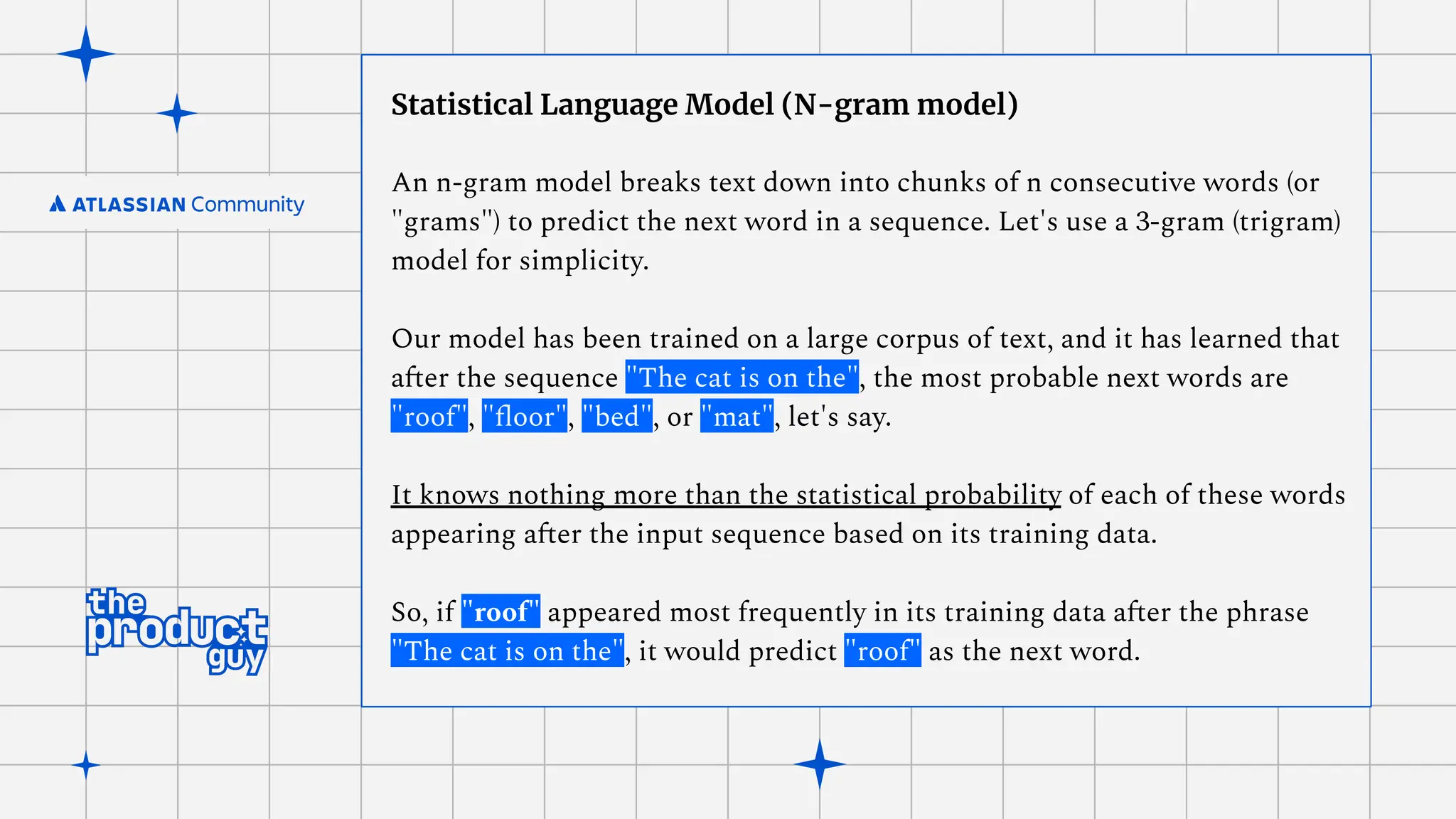
Statistical Language Model (N-gram model)
An n-gram model breaks text down into chunks of n consecutive words (or
"grams") to predict the next word in a sequence. Let's use a 3-gram (trigram)
model for simplicity.
Our model has been trained on a large corpus of text, and it has learned that
after the sequence "The cat is on the", the most probable next words are
"roof", "floor", "bed", or "mat", let's say.
It knows nothing more than the statistical probability of each of these words
appearing after the input sequence based on its training data.
So, if "roof" appeared most frequently in its training data after the phrase
"The cat is on the", it would predict "roof" as the next word.
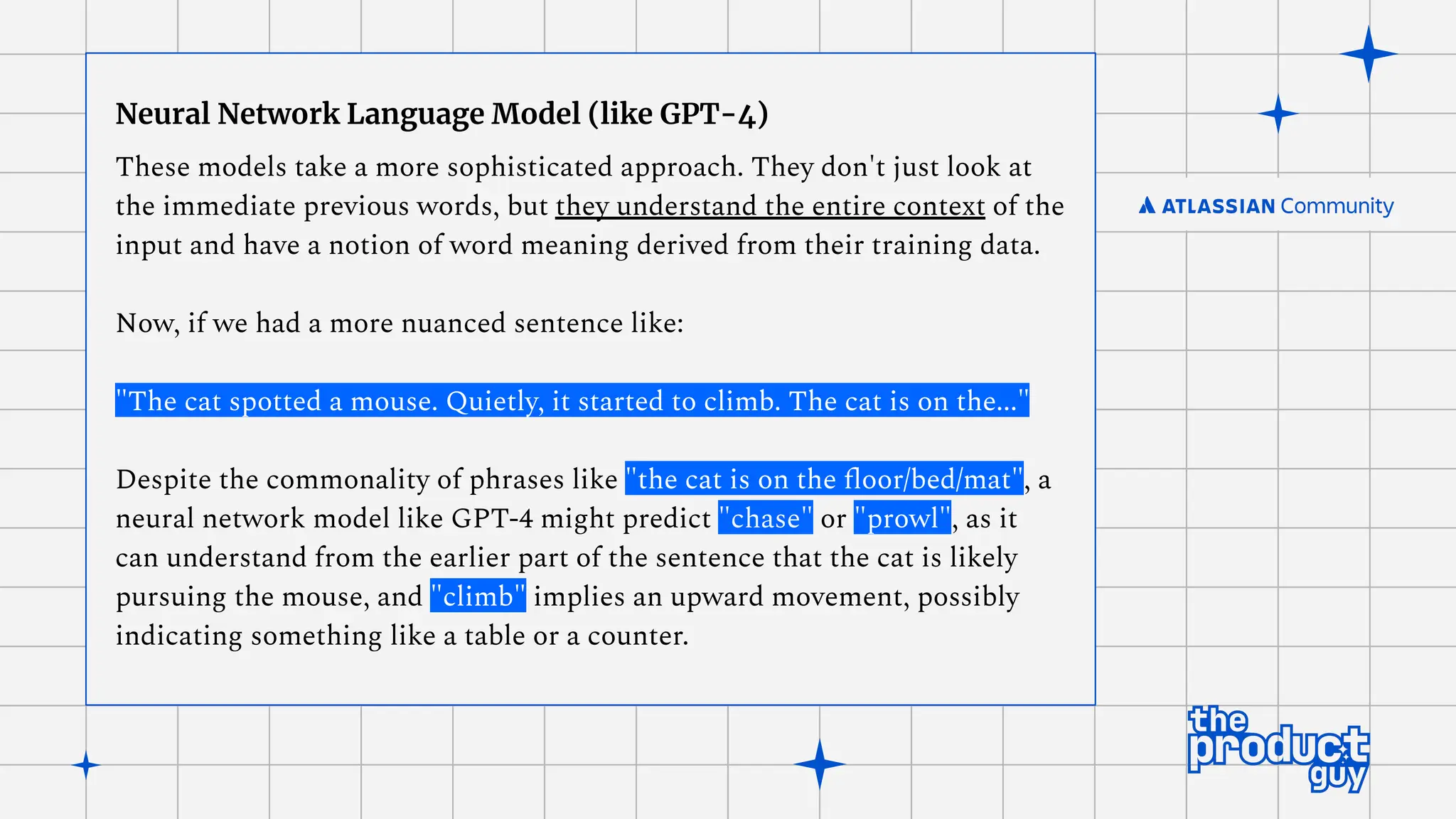
Neural Network Language Model (like GPT-4)
These models take a more sophisticated approach. They don't just look at
the immediate previous words, but they understand the entire context of the
input and have a notion of word meaning derived from their training data.
Now, if we had a more nuanced sentence like:
"The cat spotted a mouse. Quietly, it started to climb. The cat is on the..."
Despite the commonality of phrases like "the cat is on the floor/bed/mat", a
neural network model like GPT-4 might predict "chase" or "prowl", as it
can understand from the earlier part of the sentence that the cat is likely
pursuing the mouse, and "climb" implies an upward movement, possibly
indicating something like a table or a counter.
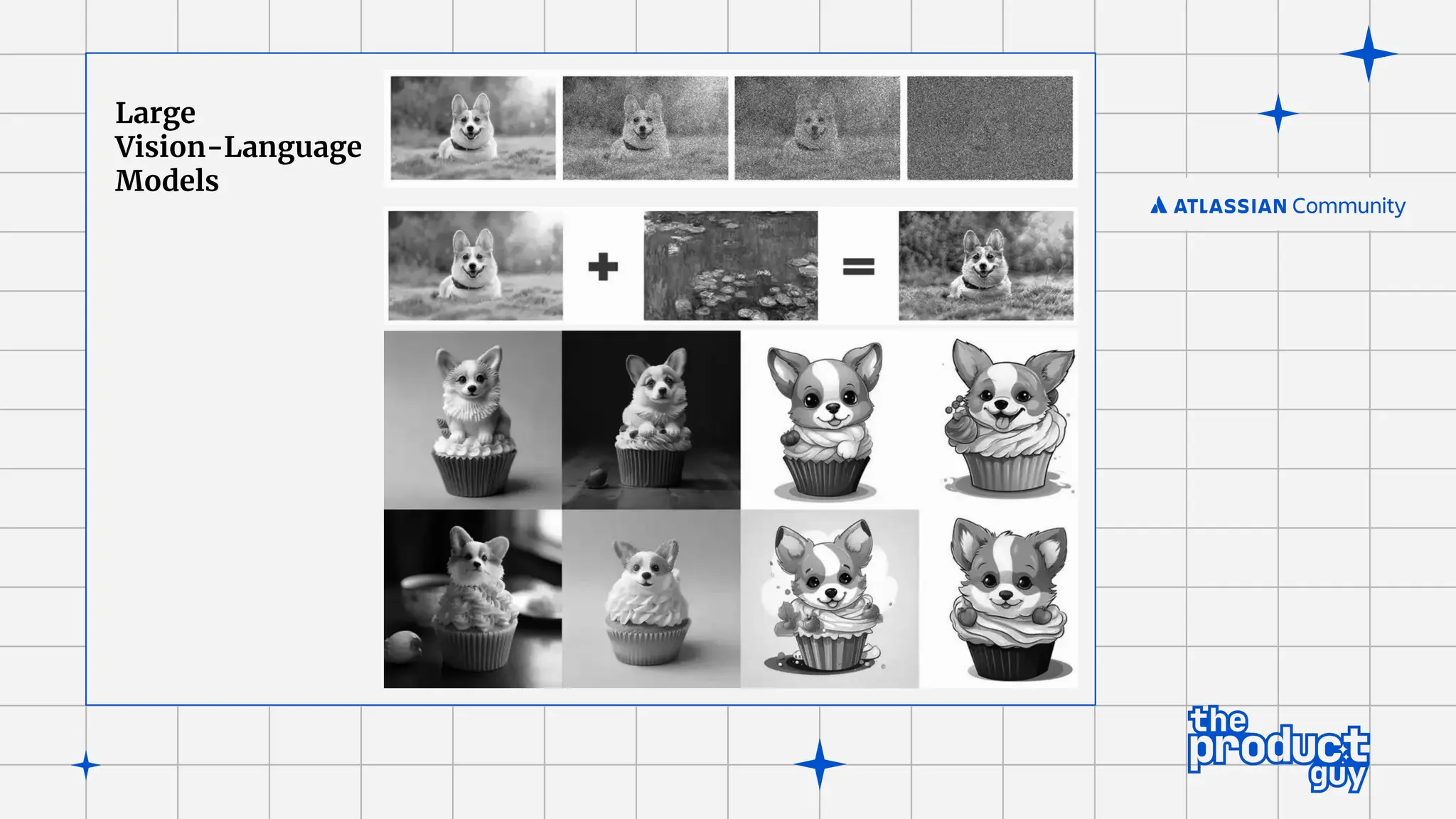
Large
Vision-Language
Models
Model
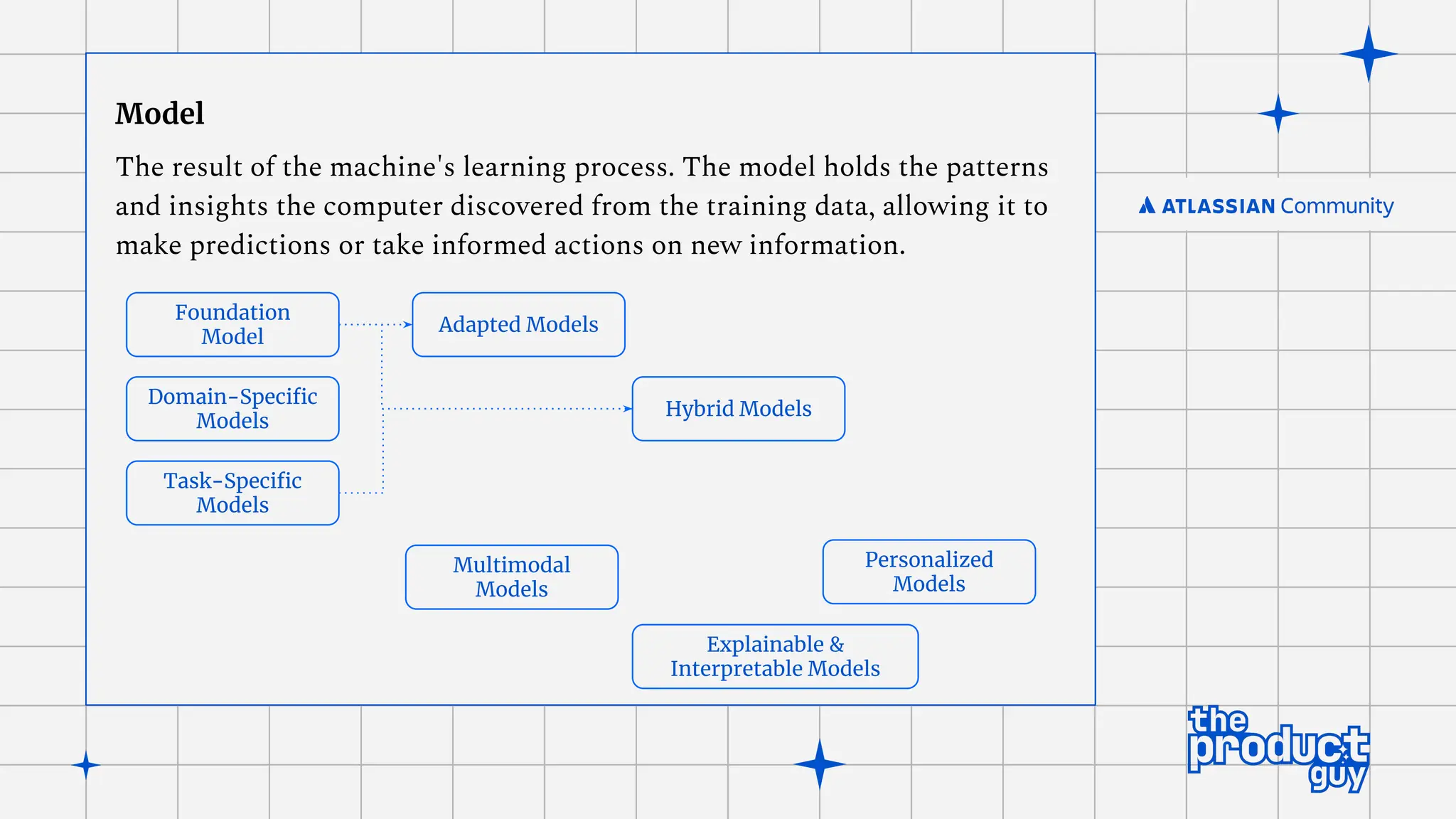
The result of the machine's learning process. The model holds the patterns
and insights the computer discovered from the training data, allowing it to
make predictions or take informed actions on new information.
Foundation
Model
Adapted Models
Domain-Specific
Models
Task-Specific
Models
Hybrid Models
Multimodal
Models
Explainable &
Interpretable Models
Personalized
Models
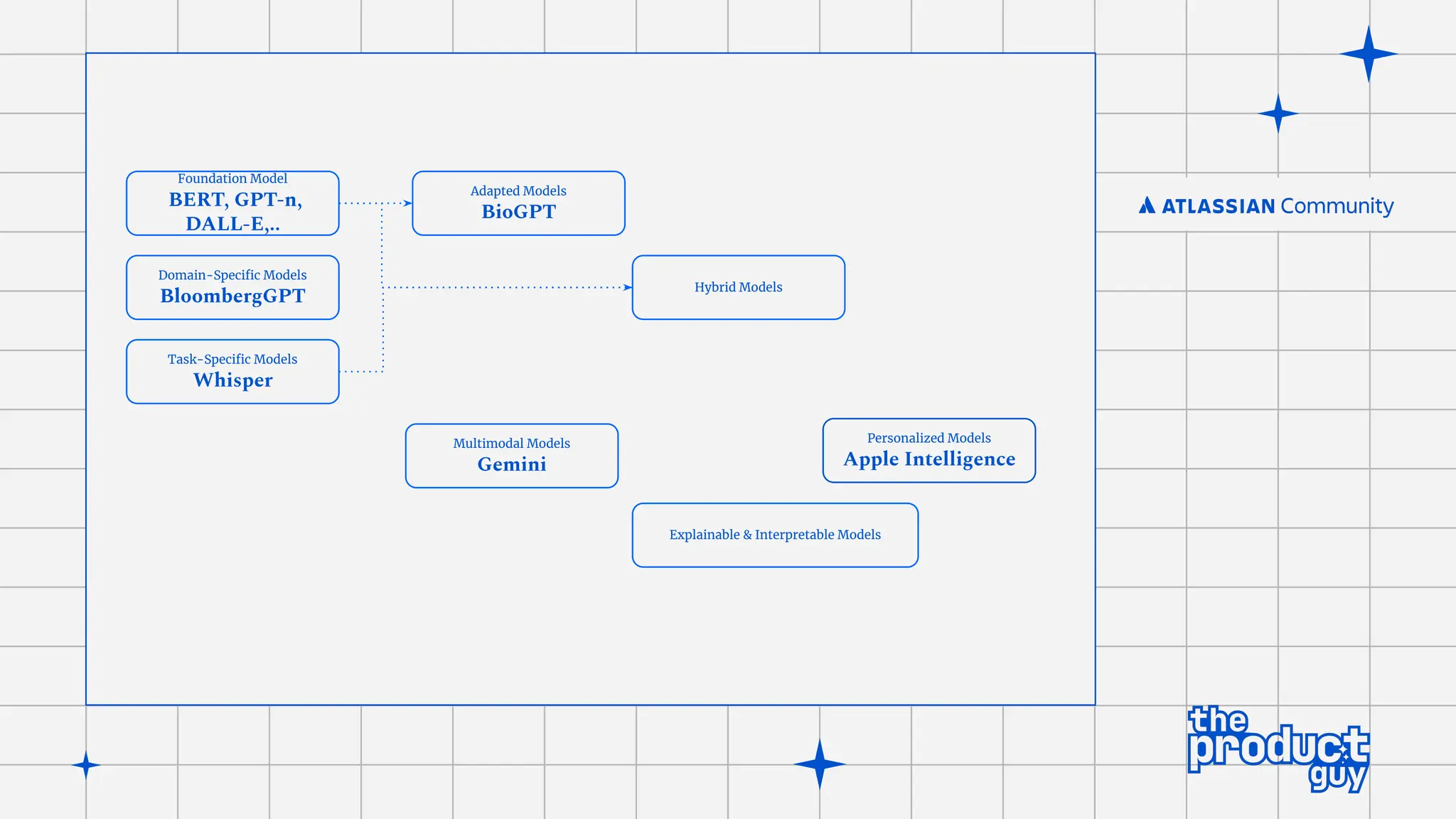
Foundation Model
BERT, GPT-n,
DALL-E,..
Adapted Models
BioGPT
Domain-Specific Models
BloombergGPT
Task-Specific Models
Whisper
Hybrid Models
Multimodal Models
Gemini
Explainable & Interpretable Models
Personalized Models
Apple Intelligence
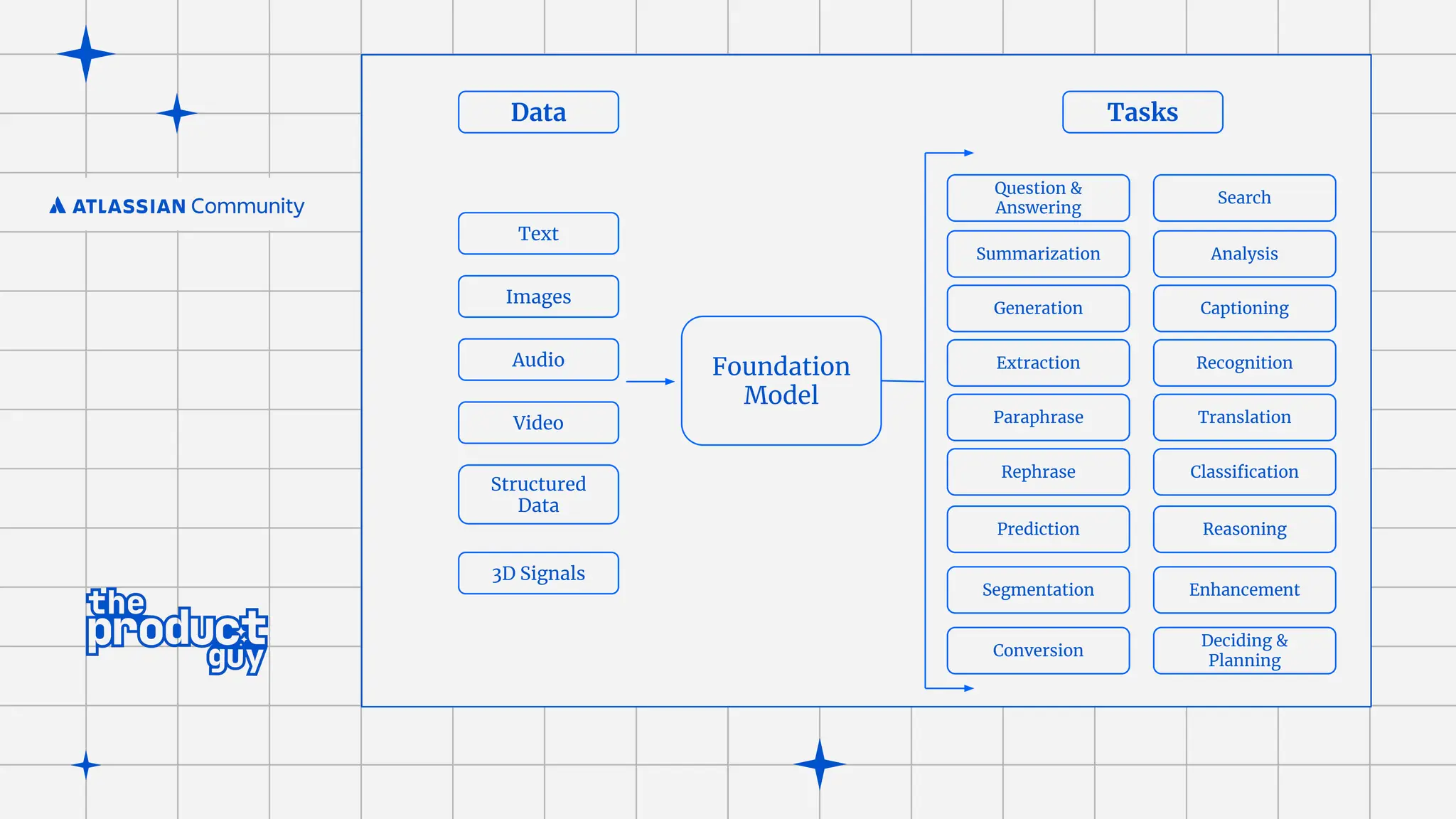
Data
Text
Images
Audio
Structured
Data
3D Signals
Video
Foundation
Model
Tasks
Question &
Answering
Summarization
Generation
Extraction
Paraphrase
Search
Classification
Analysis
Captioning
Recognition
Translation
Rephrase
Reasoning
Prediction
Enhancement
Segmentation
Deciding &
Planning
Conversion
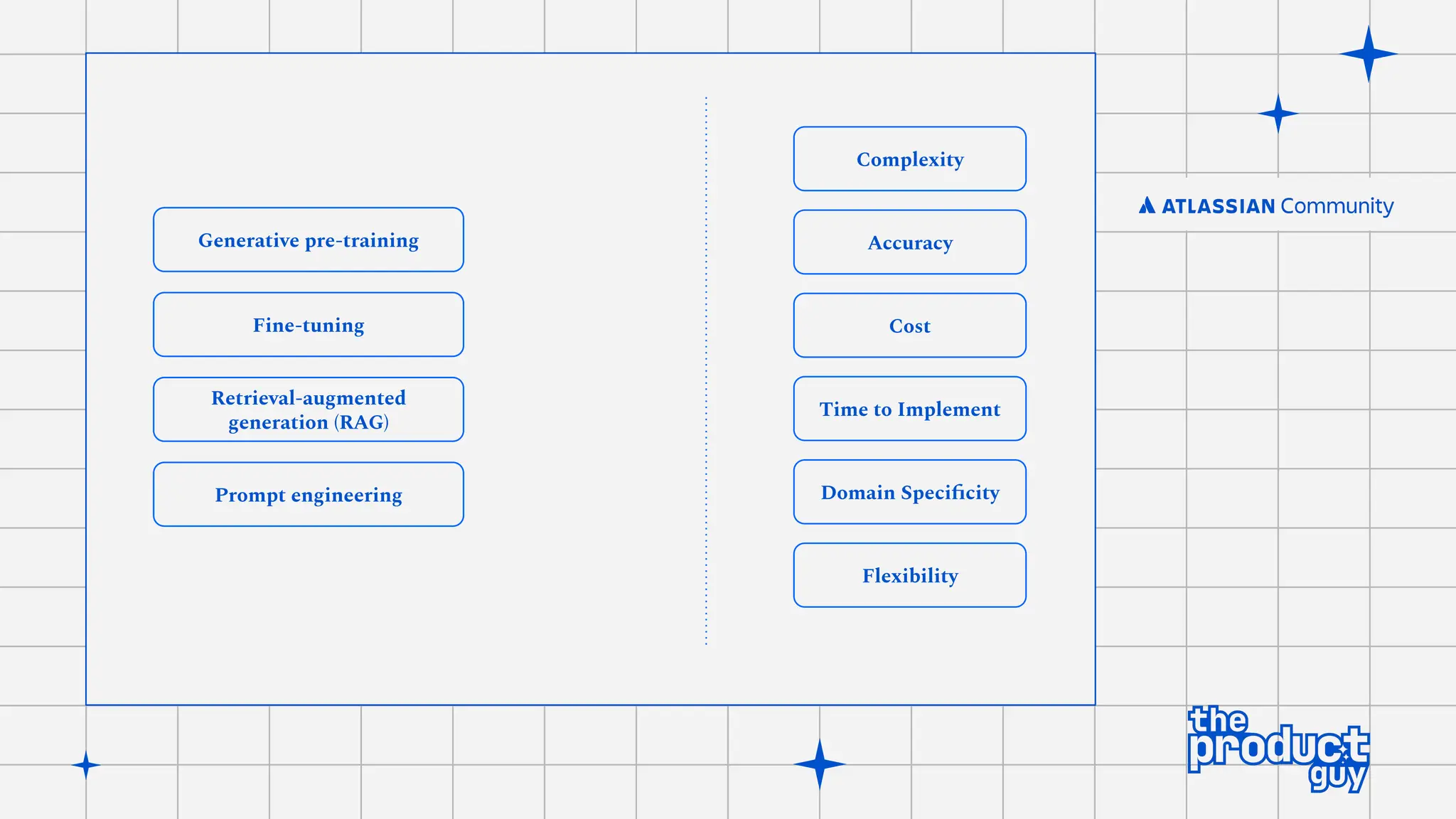
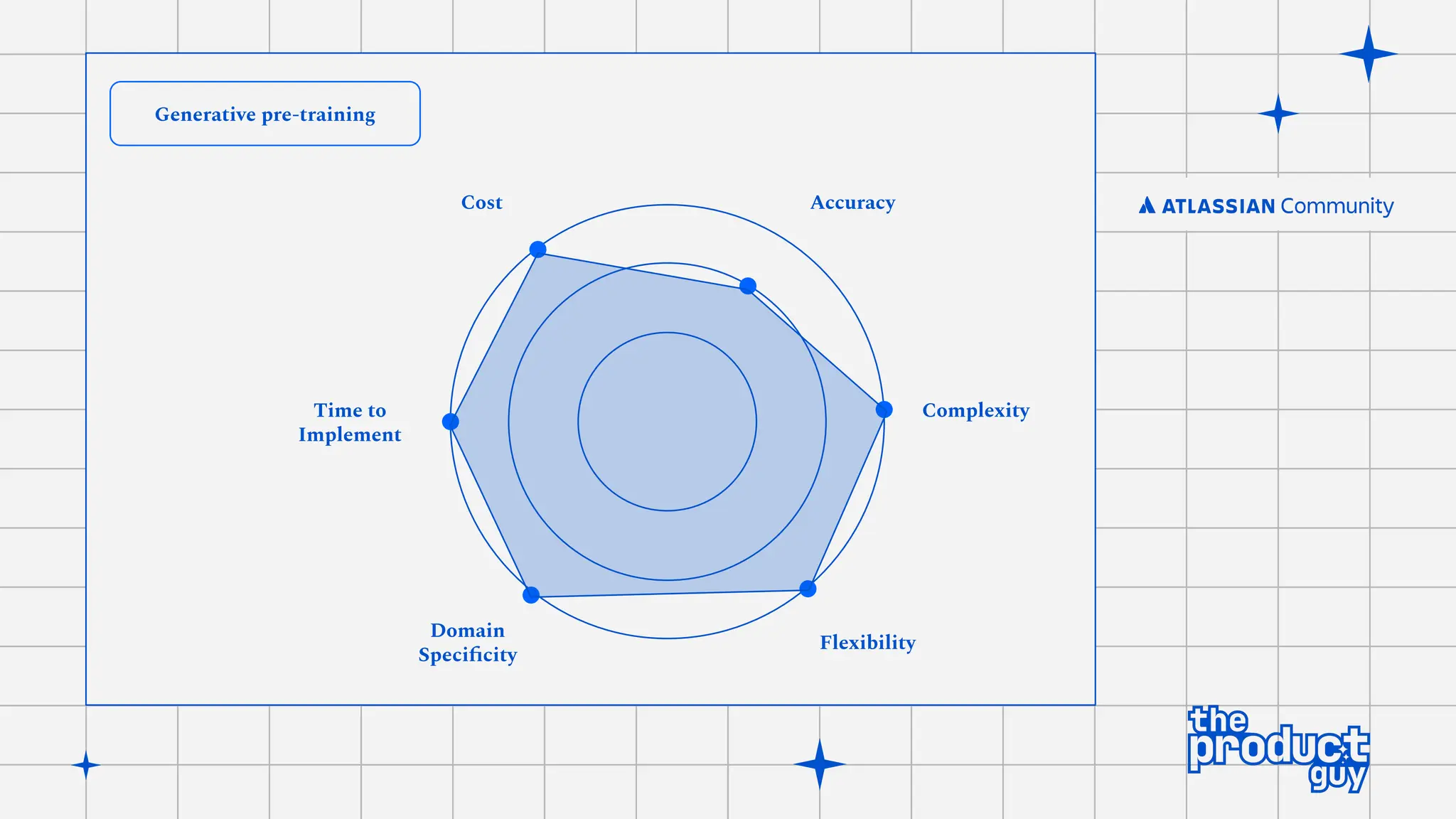
Generative pre-training
Fine-tuning
Retrieval-augmented
generation (RAG)
Prompt engineering
Complexity
Accuracy
Cost
Time to Implement
Domain Specificity
Flexibility
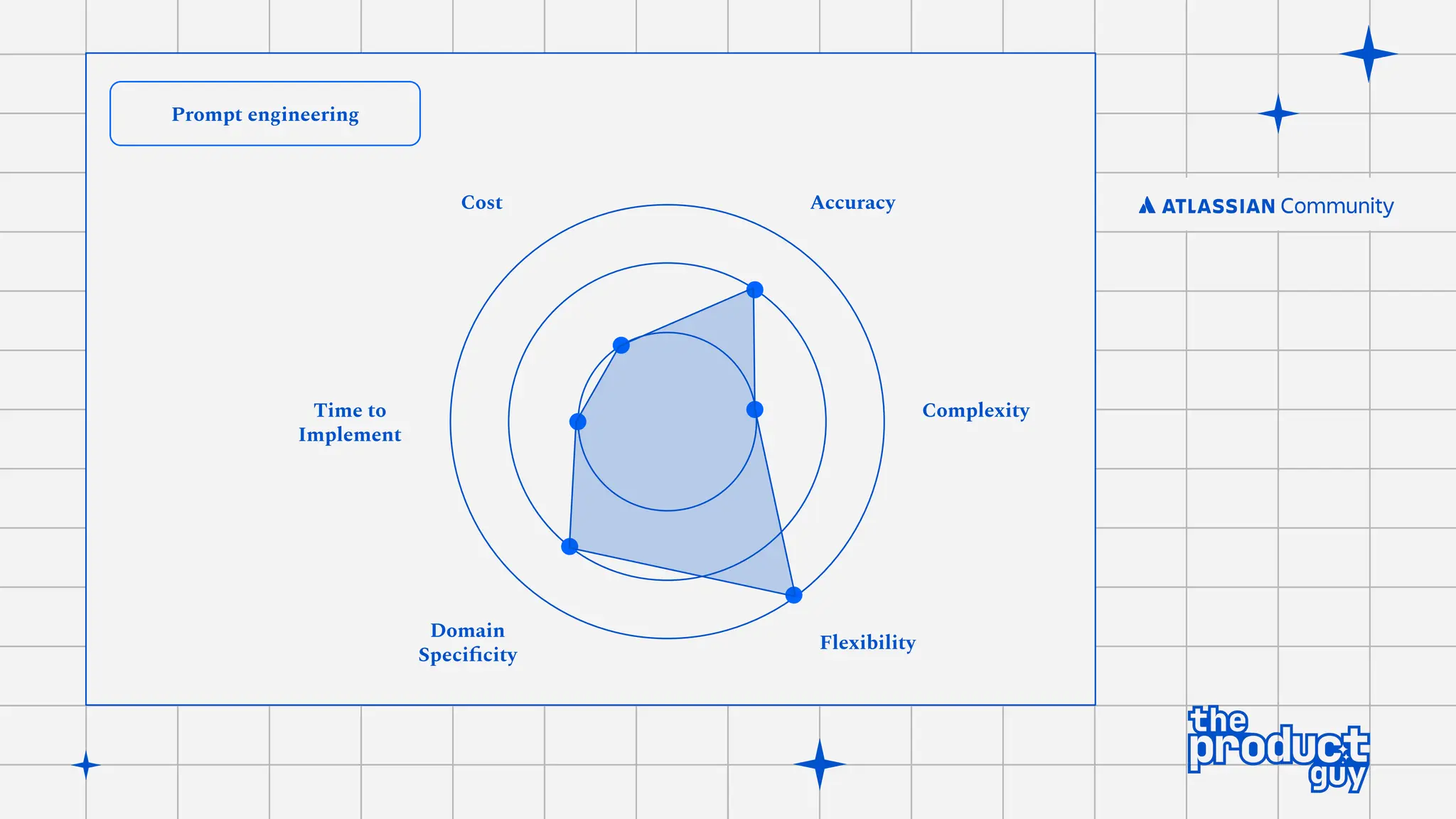
Prompt engineering
Complexity
Accuracy
Cost
Time to
Implement
Domain
Specificity
Flexibility
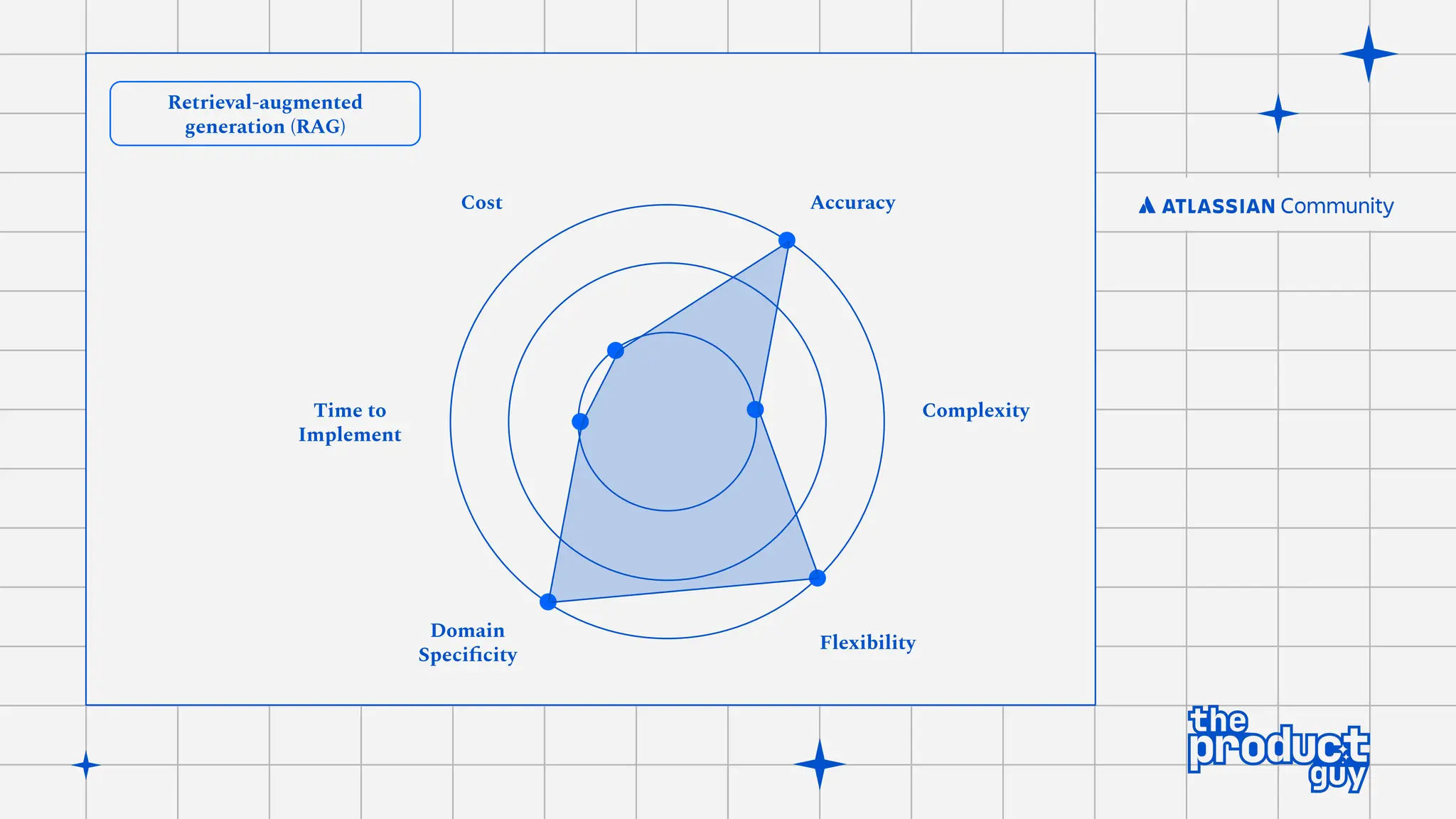
Retrieval-augmented
generation (RAG)
Complexity
Accuracy
Cost
Time to
Implement
Domain
Specificity
Flexibility
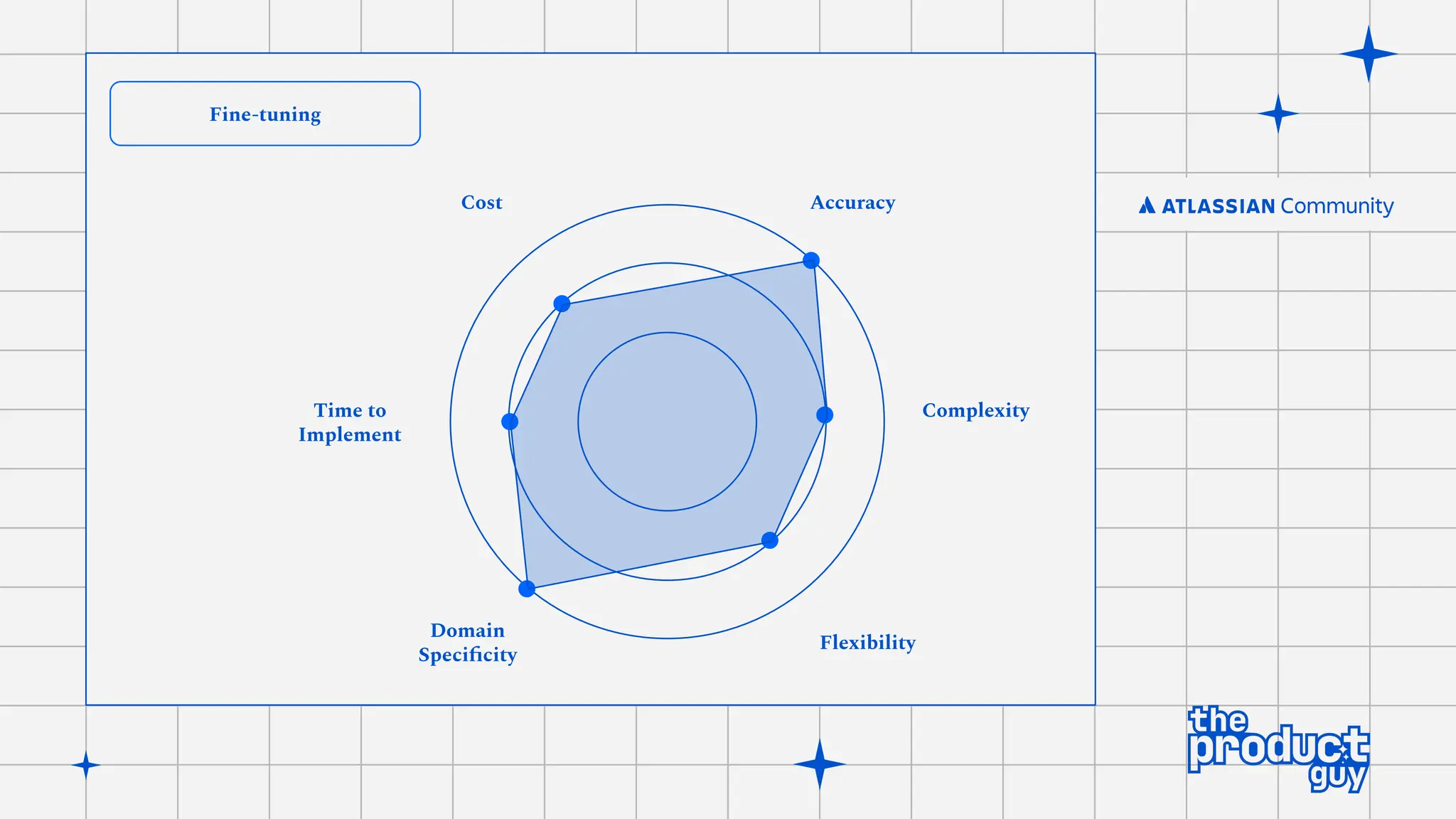
Fine-tuning
Complexity
Accuracy
Cost
Time to
Implement
Domain
Specificity
Flexibility
Generative pre-training
Complexity
Accuracy
Cost
Time to
Implement
Domain
Specificity
Flexibility
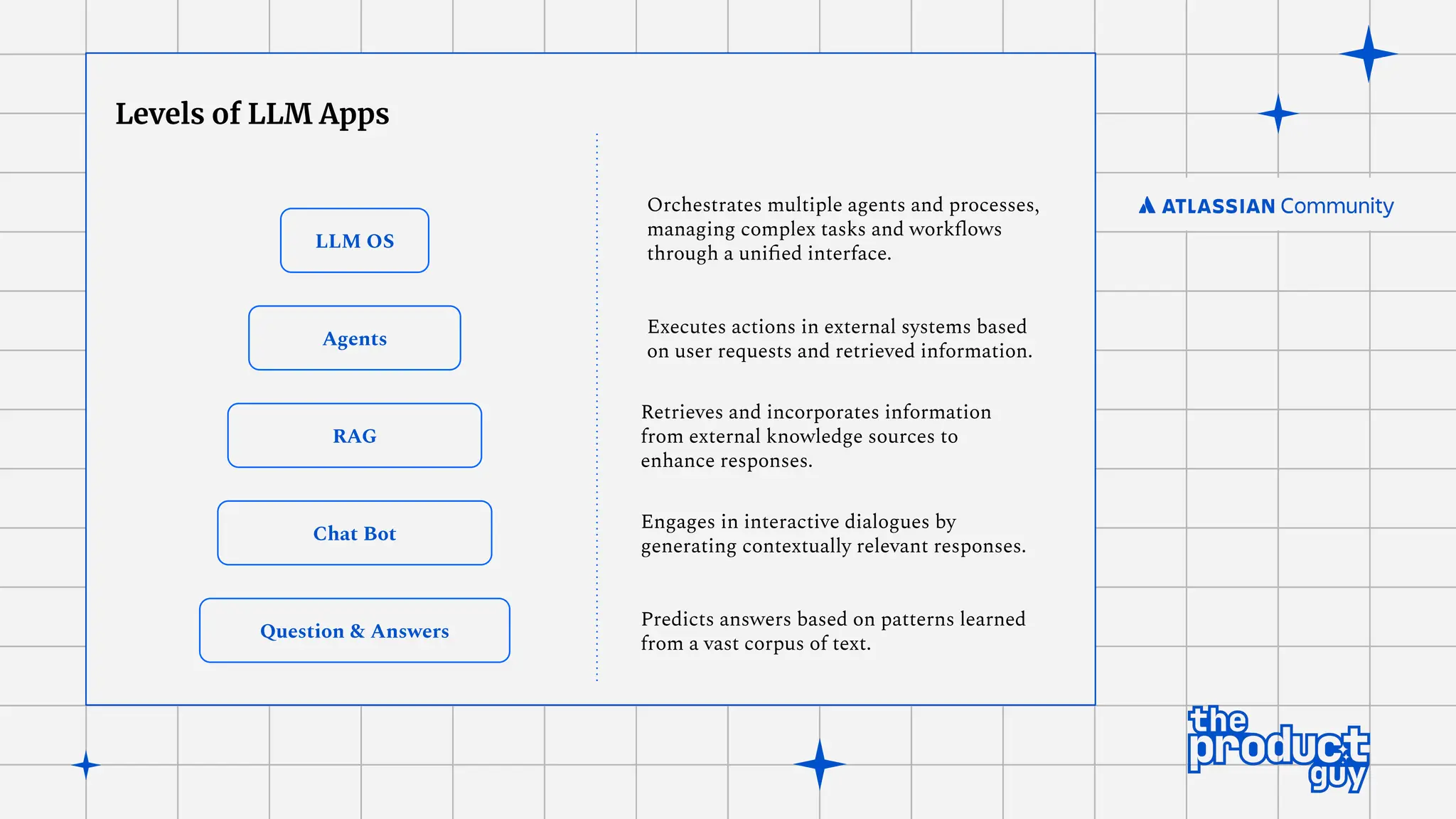
LLM OS
Agents
RAG
Chat Bot
Question & Answers
Levels of LLM Apps
Predicts answers based on patterns learned
from a vast corpus of text.
Engages in interactive dialogues by
generating contextually relevant responses.
Retrieves and incorporates information
from external knowledge sources to
enhance responses.
Executes actions in external systems based
on user requests and retrieved information.
Orchestrates multiple agents and processes,
managing complex tasks and workflows
through a unified interface.
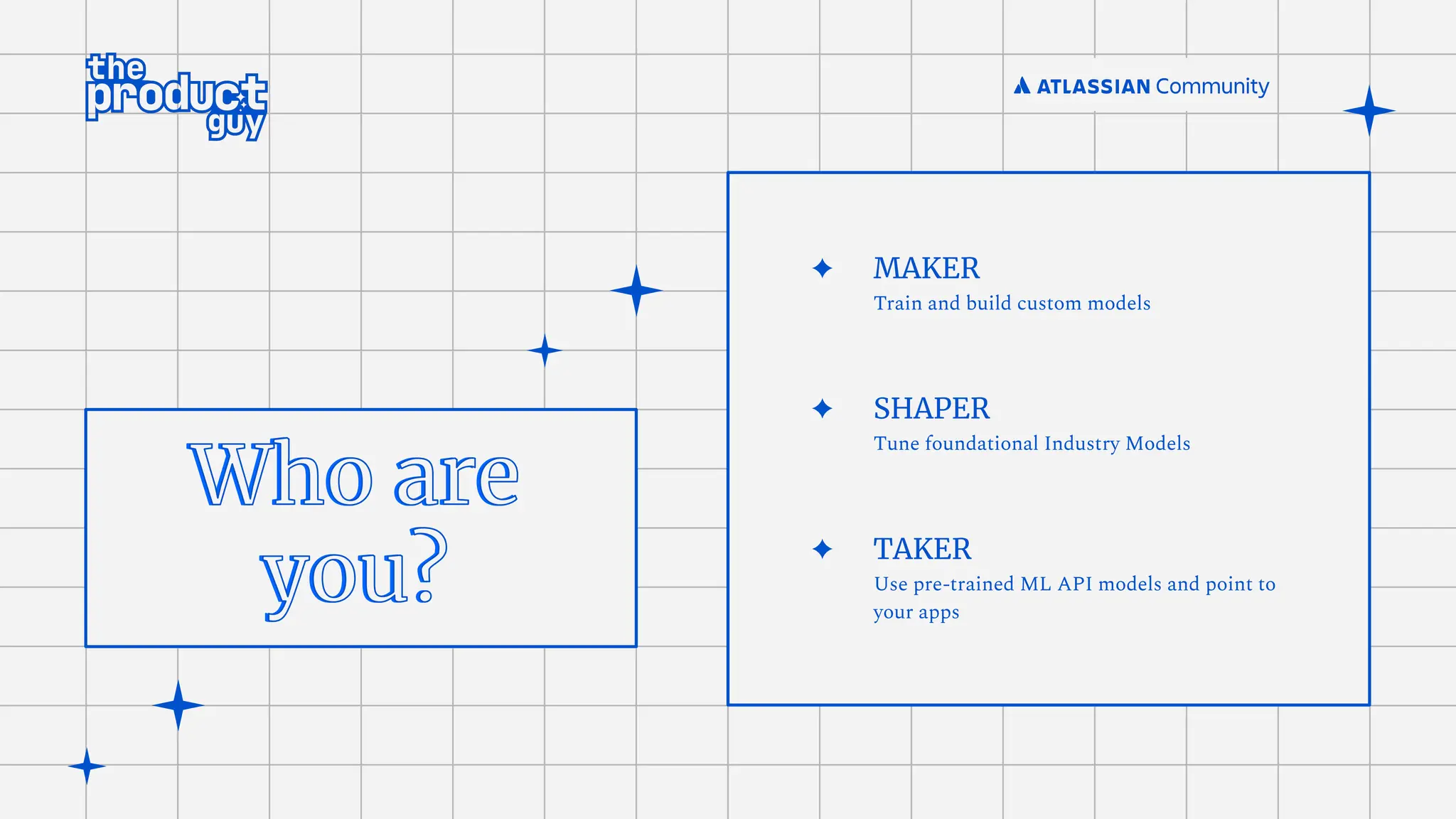
✦ MAKER
Train and build custom models
✦ SHAPER
Tune foundational Industry Models
✦ TAKER
Use pre-trained ML API models and point to
your apps
Thank you!
theproductguy.xyz
The fallacies of Generative AI
Opportunities & Challenges in productionizing
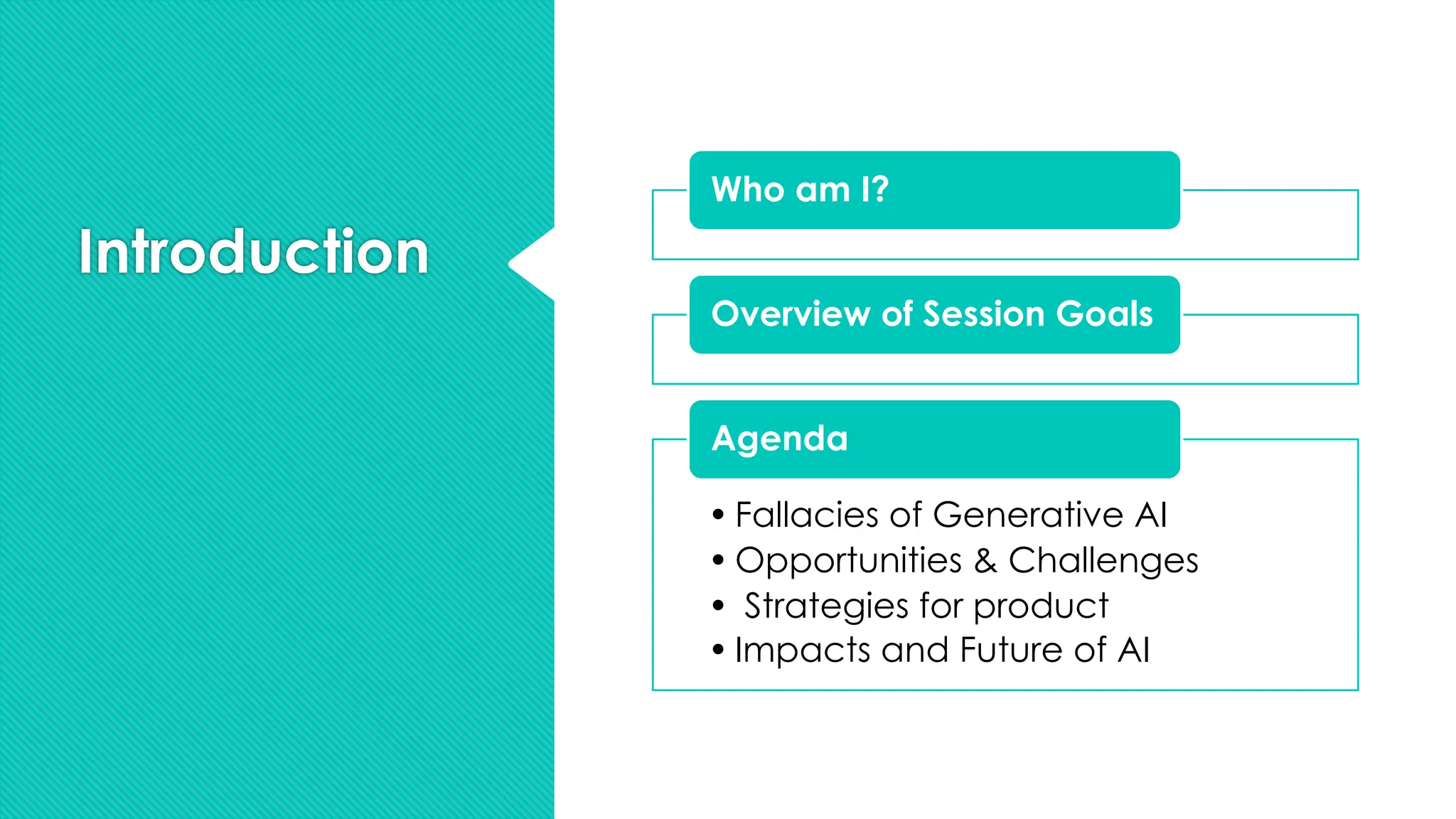
Introduction
Who am I?
Overview of Session Goals
• Fallacies of Generative AI
• Opportunities & Challenges
• Strategies for product
• Impacts and Future of AI
Agenda
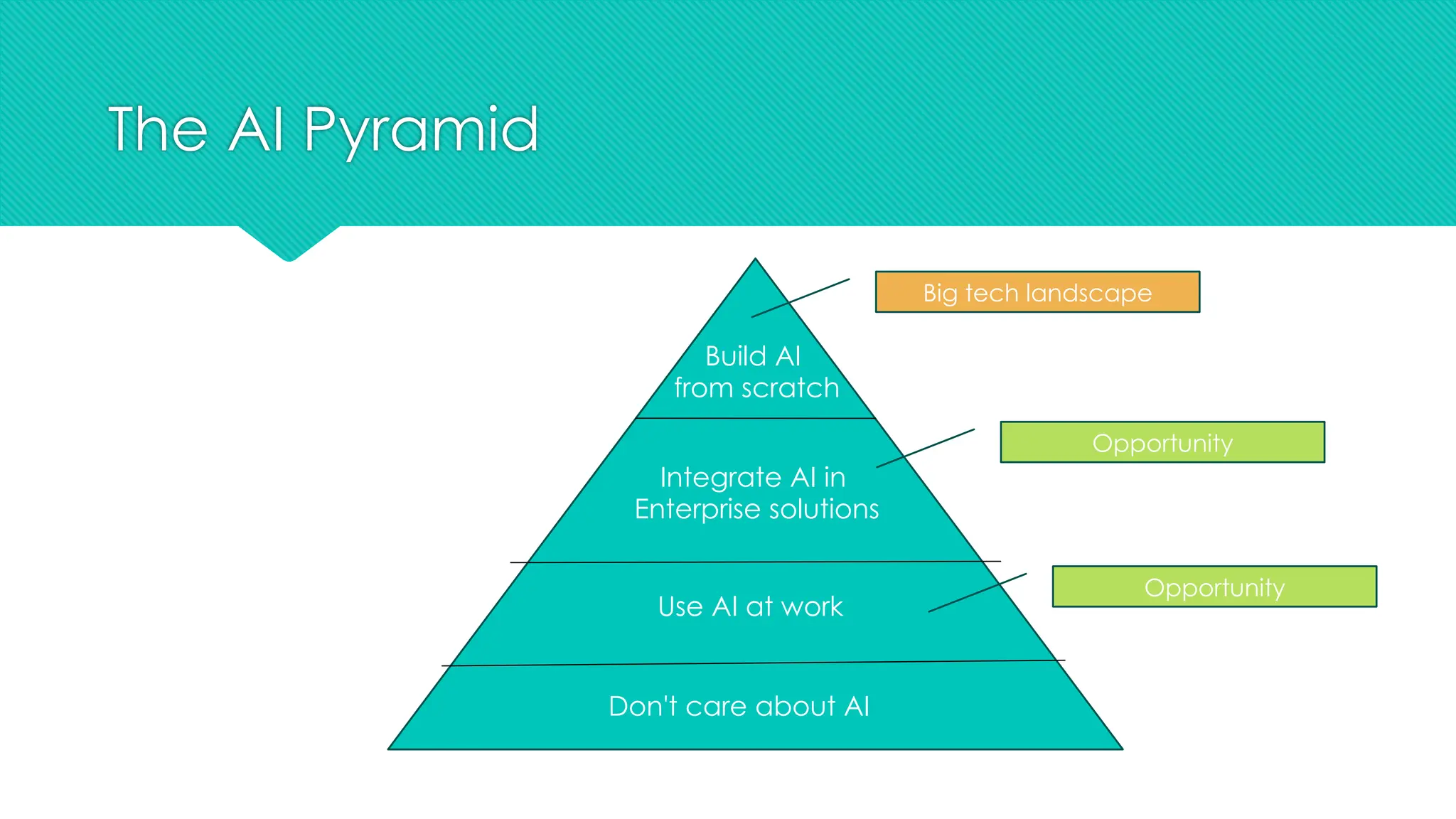
The AI Pyramid
Don't care about AI
Use AI at work
Integrate AI in
Enterprise solutions
Build AI
from scratch
Big tech landscape
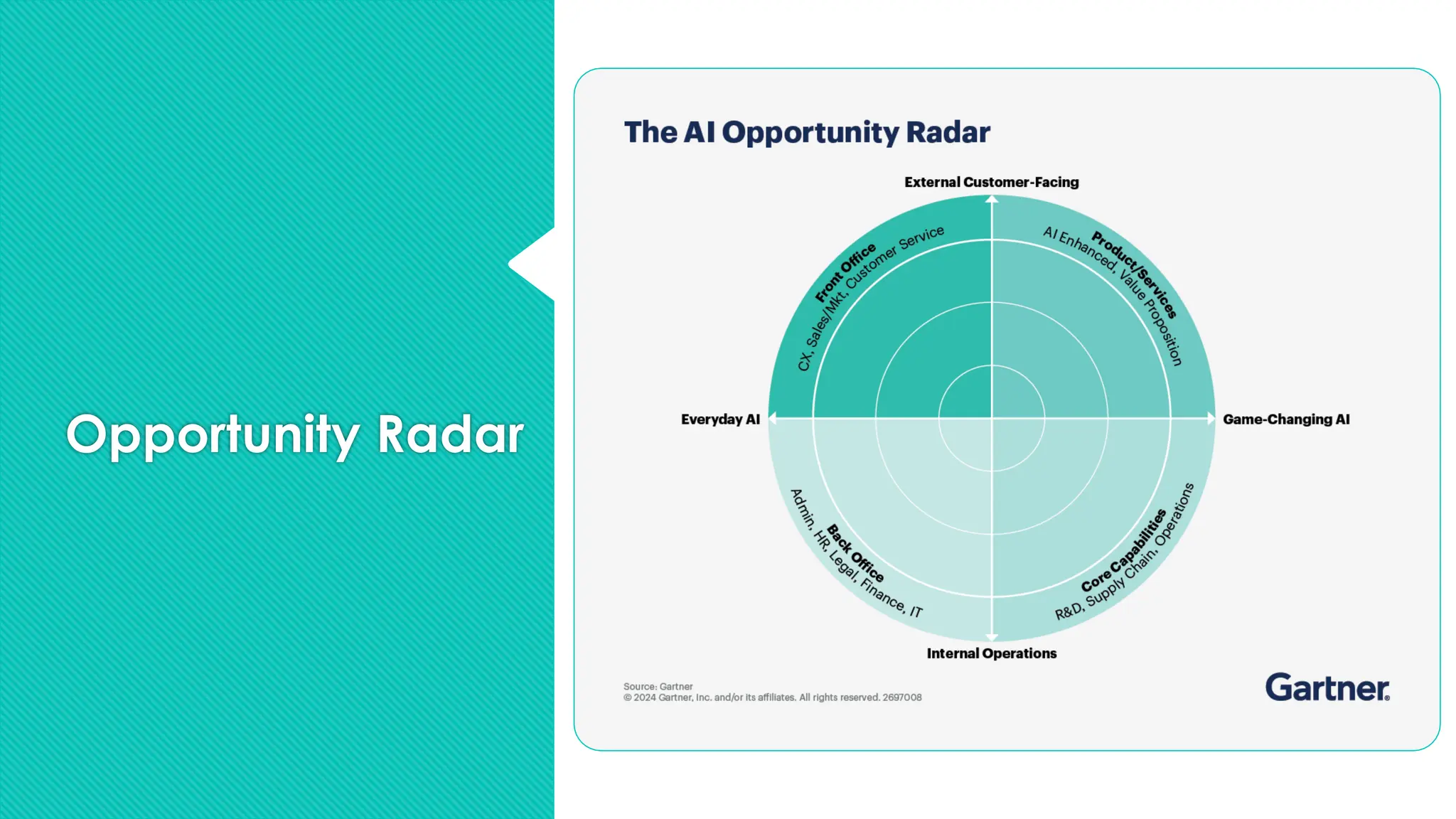
Opportunity
Opportunity
Opportunity Radar
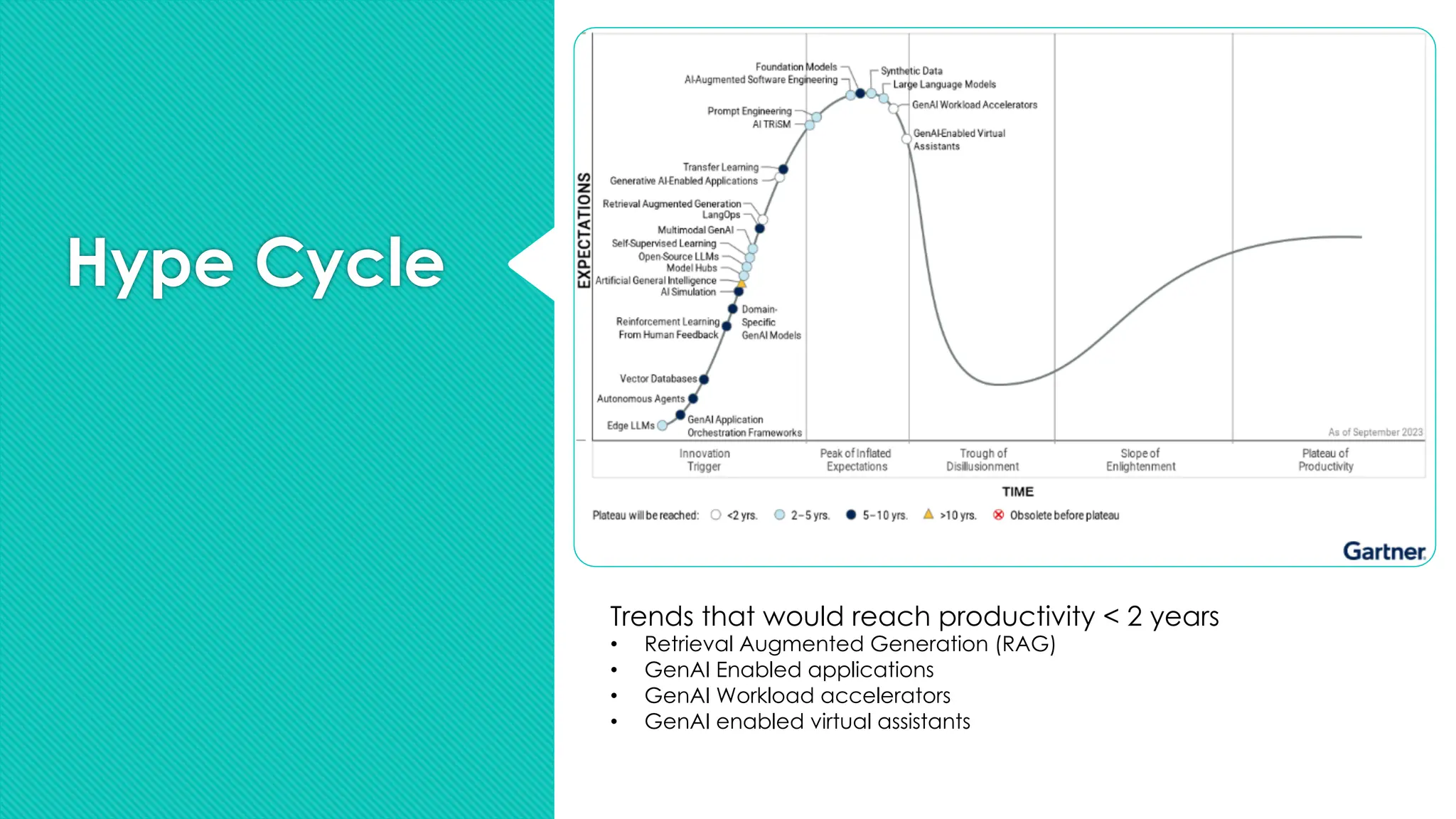
Hype Cycle
Trends that would reach productivity < 2 years
• Retrieval Augmented Generation (RAG)
• GenAI Enabled applications
• GenAI Workload accelerators
• GenAI enabled virtual assistants
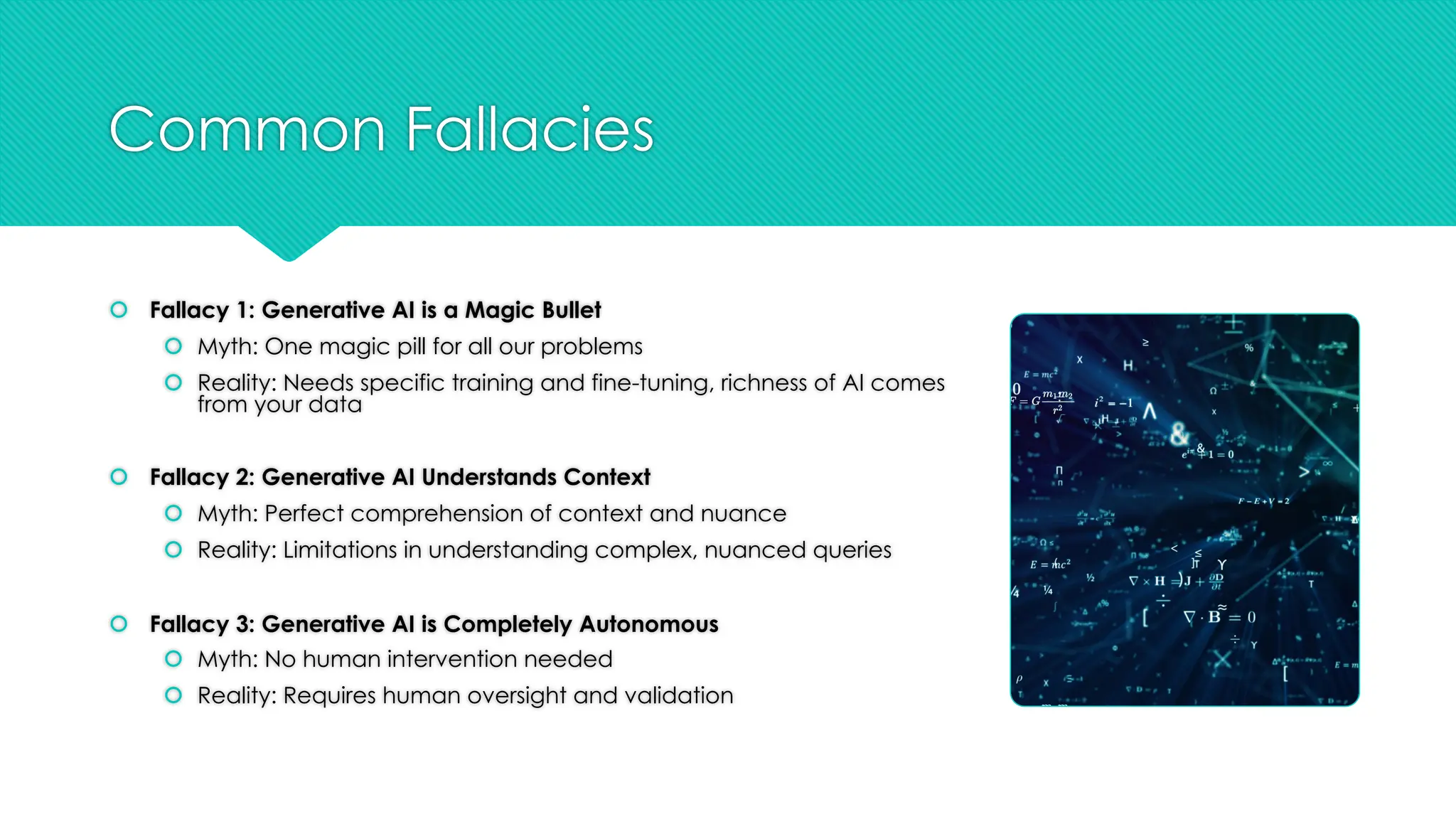
Common Fallacies
š Fallacy 1: Generative AI is a Magic Bullet
š Myth: One magic pill for all our problems
š Reality: Needs specific training and fine-tuning, richness of AI comes
from your data
š Fallacy 2: Generative AI Understands Context
š Myth: Perfect comprehension of context and nuance
š Reality: Limitations in understanding complex, nuanced queries
š Fallacy 3: Generative AI is Completely Autonomous
š Myth: No human intervention needed
š Reality: Requires human oversight and validation
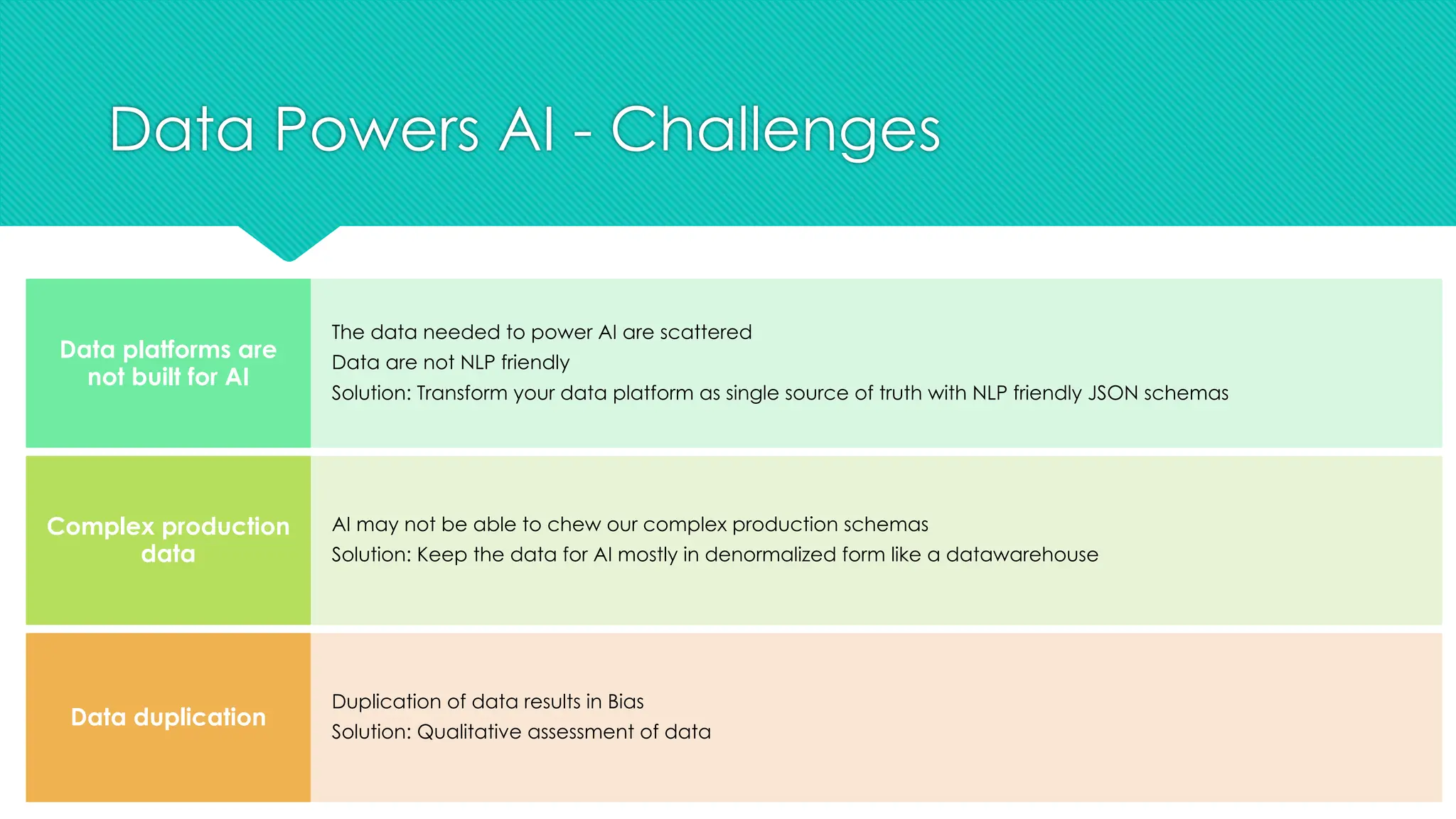
Data Powers AI - Challenges
The data needed to power AI are scattered
Data are not NLP friendly
Solution: Transform your data platform as single source of truth with NLP friendly JSON schemas
Data platforms are
not built for AI
AI may not be able to chew our complex production schemas
Solution: Keep the data for AI mostly in denormalized form like a datawarehouse
Complex production
data
Duplication of data results in Bias
Solution: Qualitative assessment of data
Data duplication
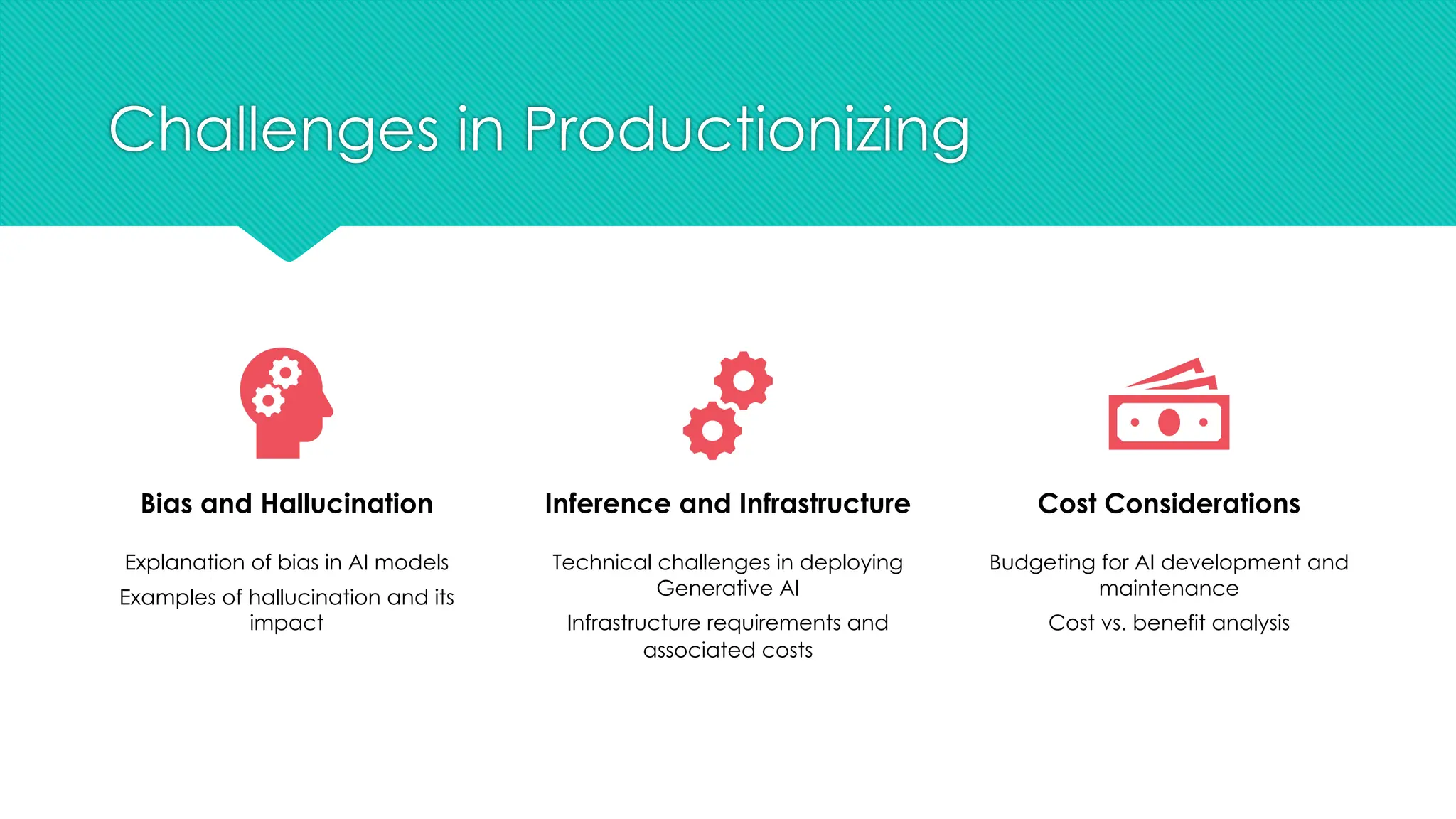
Challenges in Productionizing
Bias and Hallucination
Explanation of bias in AI models
Examples of hallucination and its
impact
Inference and Infrastructure
Technical challenges in deploying
Generative AI
Infrastructure requirements and
associated costs
Cost Considerations
Budgeting for AI development and
maintenance
Cost vs. benefit analysis
Product Strategy
š Not all products and solution need Generative AI
š A successful Generative AI based product exhibits
o Generative AI is not a force fit into the product
o Product delivers value even without Generative AI
o Solves a real user pain point or a problem
o Use of generative AI amplifies the value delivered
o Automates a complex set of operations within the
product
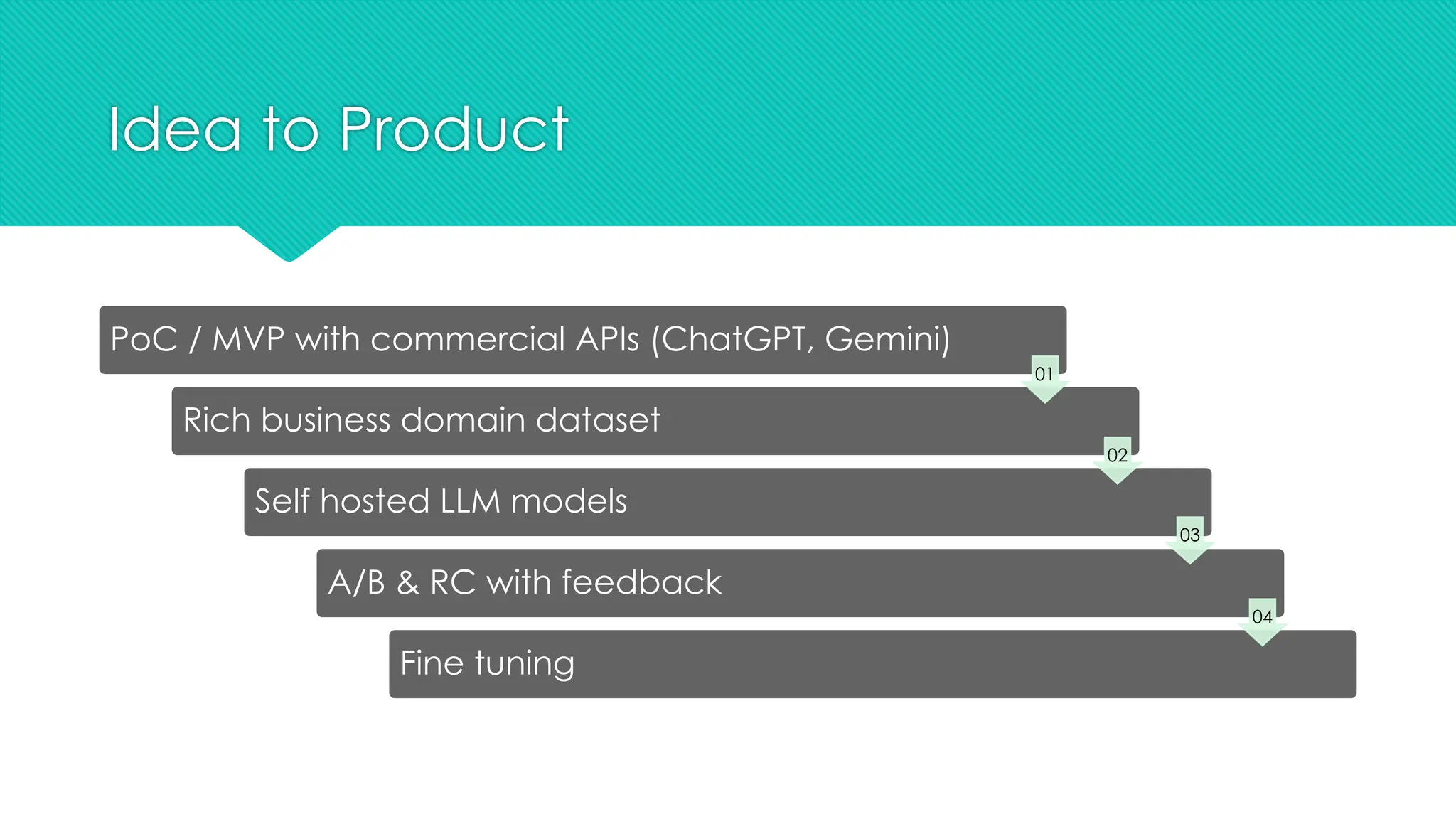
Idea to Product
PoC / MVP with commercial APIs (ChatGPT, Gemini)
Rich business domain dataset
Self hosted LLM models
A/B & RC with feedback
Fine tuning
01
02
03
04
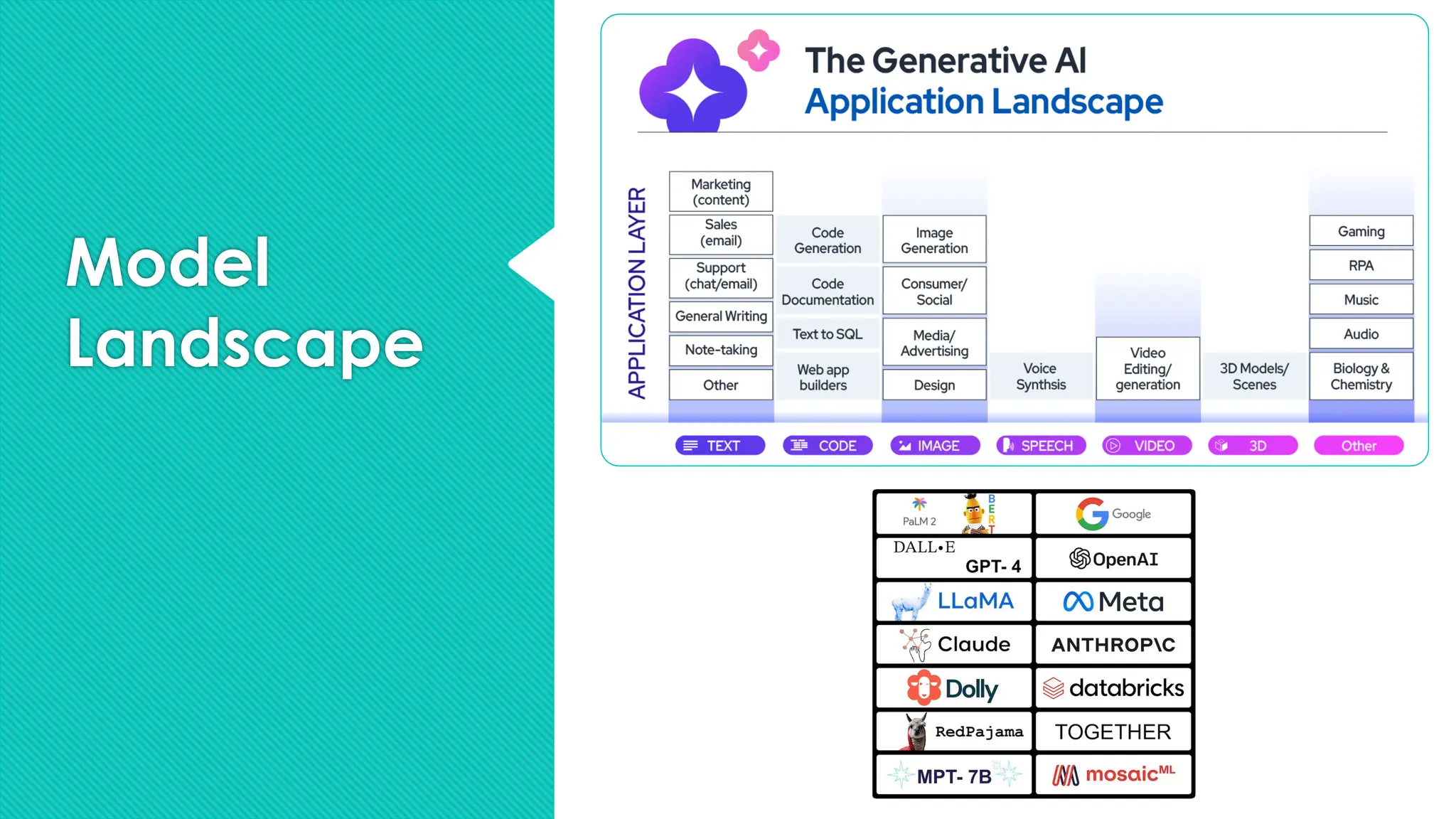
Model
Landscape
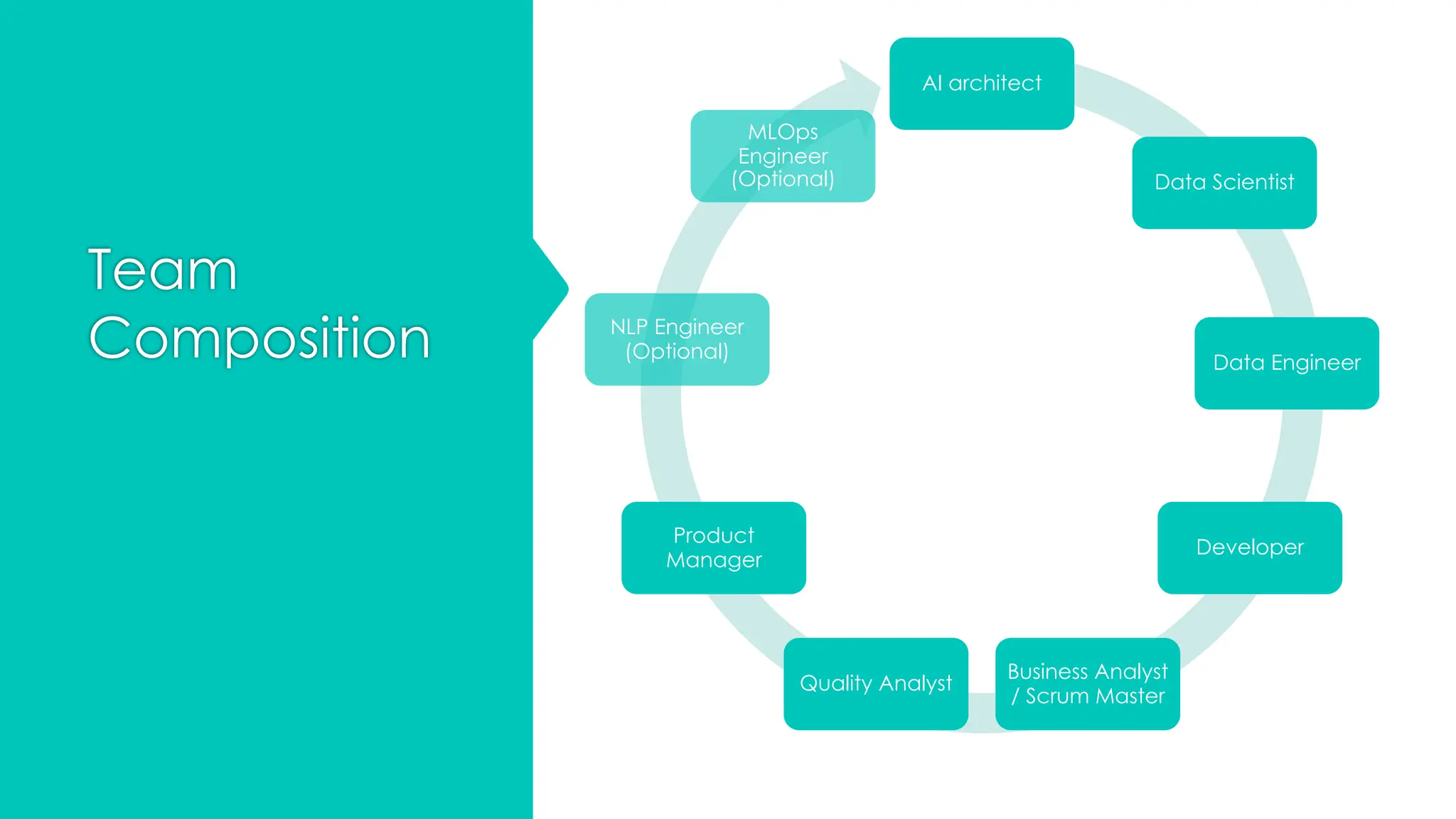
Team
Composition
AI architect
Data Scientist
Data Engineer
Developer
Business Analyst
/ Scrum Master
Quality Analyst
Product
Manager
NLP Engineer
(Optional)
MLOps
Engineer
(Optional)
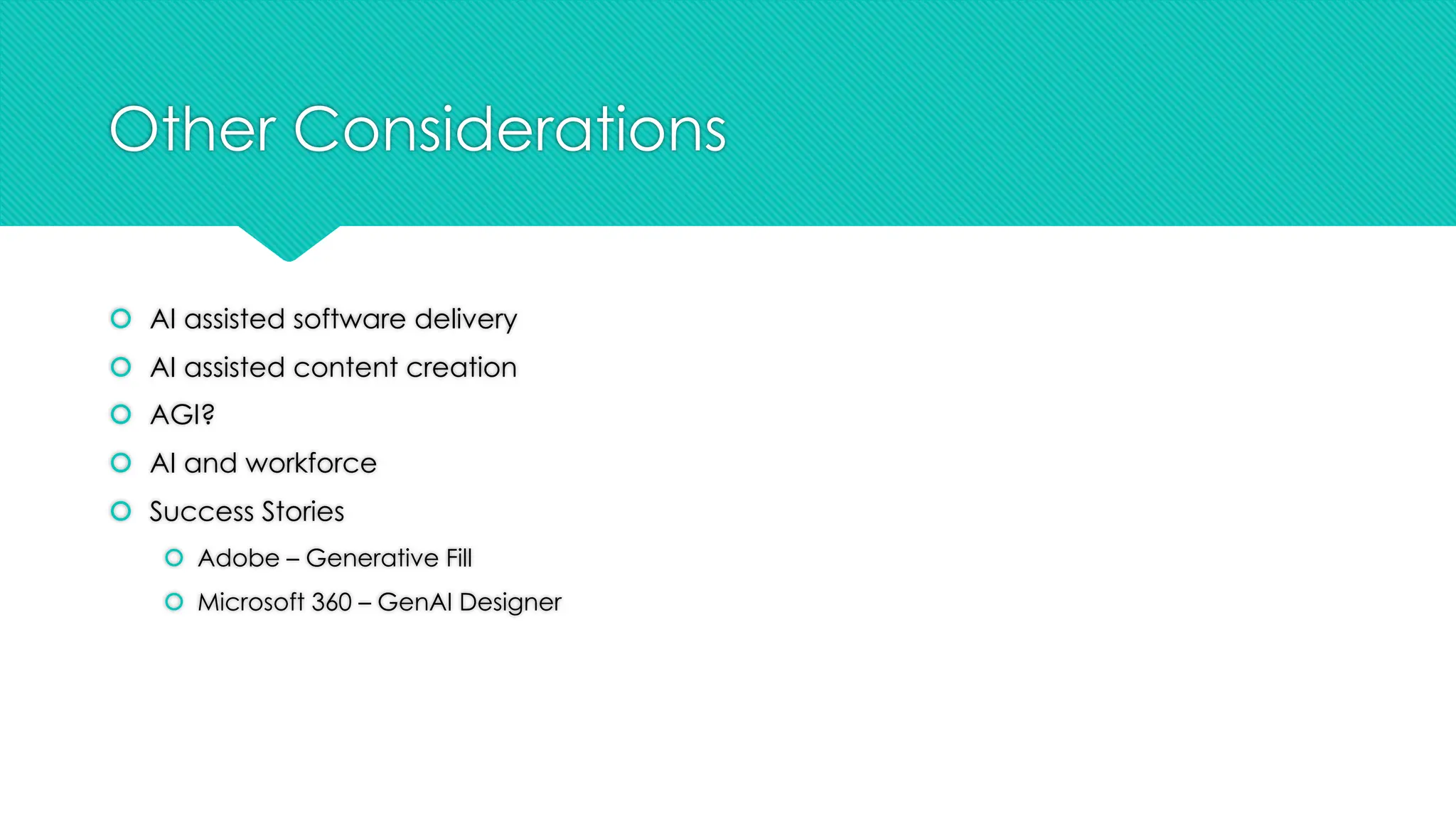
Other Considerations
š AI assisted software delivery
š AI assisted content creation
š AGI?
š AI and workforce
š Success Stories
š Adobe – Generative Fill
š Microsoft 360 – GenAI Designer
Recap
š Opportunities and challenges
š Your AI Strategy
Questions?
Thank you!
Raju Kandaswamy
https://www.linkedin.com/in/rajukandasamy/
https://medium.com/@raju.kandasamy

AC Atlassian Coimbatore Session Slides( 22/06/2024)

  • 1.
    Actionable Strategy forimplementation of AI Help Desk Gen AI and Future of Help Desks
  • 2.
    Agenda 1. Top WorkplaceApplications 2. Common Help Desks 3. AI Help Desk 4. Traditional vs AI Help Desk 5. Benefits of AI Help Desk 6. Implementation Strategy 7. Getting Started
  • 3.
    Top Workplace Applications InitiativeROI Considerations Content Creation High Reduced content creation costs, Increased content output, Improved content personalization Data Analysis & Insights High Improved decision-making, Identification of new opportunities, Reduced time spent on manual data analysis Help Desk Automation High Reduced support operations costs, Improved customer satisfaction, Frees up human agents for complex tasks Enterprise Search Moderate Improved information retrieval, Increased knowledge sharing, Improved employee satisfaction Code generation Moderate Increased developer productivity, Reduced development time and costs, Potentially fewer coding errors
  • 4.
    Common Help Desks ITHelp Desk Provide technical support and resolve technology-related issues Common queries: - I've forgotten my password. How do I reset? - I need access to Jira - VPN isn't working for me?
  • 5.
    Common Help Desks HRHelp Desk Address employee-related inquiries and support HR processes Common queries: - How do I request time off? - How do I change my 401(k) contribution? - What's our work-from-home policy?
  • 6.
    Common Help Desks CustomerService Help Desk Provide support and assistance to external customers Common queries: - How do I change our account administrator? - How do I cancel my subscription? - We're experiencing [specific error]. How can we resolve this?
  • 7.
  • 8.
  • 9.
    Traditional vs AIHelp Desk Complex Form Filling Interface Natural Chat Interface vs
  • 10.
    Traditional vs AIHelp Desk 9-5 Availability 24*7 Availability vs
  • 11.
    Traditional vs AIHelp Desk Slow Manual Resolutions Unlimited Instant Resolutions vs
  • 12.
    Benefits Easily and cost-effectivelyscale your support operations with Gen AI powered copilots 95% 90% 60% Guaranteed end-user satisfaction High acceleration rate High automatic resolution rate
  • 13.
    Implementation Strategy 1. AIAssessment 2. AI Knowledge Engineering 3. Chatbot Prototype 4. Continuous Adapative Learning 5. Advanced AI Automations 6. Human Agent Augmentation 7. AI Insights 8. AI Security and Governance
  • 14.
    Implementation Strategy 1. AIAssessment Asses your existing help desk processes and identify areas for automation
  • 15.
    Implementation Strategy 2. AIKnowledge Engineering Organize existing company documentation, policies, and product information
  • 16.
    Implementation Strategy 3. AIChatbot Prototype Build a simple FAQ knowledge base
  • 17.
    Implementation Strategy 4. ContinuousAdaptive Learning ● Set up Continuous learning by connecting to knowledge sources like Confluence, SharePoint ● Train the chatbot on historical help desk tickets and past conversations in Slack/Teams
  • 18.
    Implementation Strategy 5. AdvancedAI Automations ● Understand complex questions ● Mimic human actions in business apps ● Provide personalized responses ● Understand images and videos
  • 19.
    Implementation Strategy 6. AIAgent Augmentation ● Rephrase answers for tone adjustment ● Summarize customer conversations ● Identify situations that need human handover ● Understand emotional tones and trigger escalations ● Turn conversations into knowledge assets
  • 20.
    Implementation Strategy 7. AIInsights Monitor and track automation rates, identify gaps and opportunities
  • 21.
    Implementation Strategy 8. AISecurity and Governance - Anonymize training data, user queries - Ensure company data is not used train LLMs - Ensure ISO, SOC2 and GDPR compliance
  • 22.
    Getting Started Build acustom Gen AI chatbot using - Data layer for RAG (e.g., LlamaIndex, LangChain) - Foundation models (e.g., Open AI, Claude, Gemini) - Vector databases (e.g., Pinecone) Leverage purpose-built vendor products like Enjo AI
  • 23.
    Get Started withEnjo AI 1. Personalized Enjo demo 2. Help desk automation potential assessment 3. 14 days no obligation free trial 4. 3 months guided Pilot program
  • 25.
  • 26.
    theproductguy.xyz Who am I? ➔Product Consultant | Strategy and Design ➔ Information Technology and Psychology ➔ Convenor - The Product Space ➔ Organizer - Google Developer Groups and Friends of Figma, Coimbatore
  • 27.
    How Generative AIworks? Table of contents The Rise of Generative AI What is Generative AI capable of? Assessing Your Business Needs Future Trends and Opportunities Conclusion 01 02 03 04 05 06
  • 28.
    Artificial Intelligence (AI) Artificial Intelligence(AI) refers to the simulation of human intelligence in machines that are programmed to mimic human actions and cognitive processes. The Rise of Generative AI
  • 29.
    Logical Reasoning & Problem-Solving AbstractThinking Learning & Adaptation Memory Language & Communication Perception & Sensory Processing Emotional Intelligence
  • 30.
    Social Intelligence Creativity & Imagination Decision-Making Metacognition SpatialReasoning Numerical & Quantitative Skills Practical Intelligence Moral & Ethical Reasoning
  • 31.
    Expert systems, rule-basedsystems, automated reasoning, theorem proving, constraint satisfaction algorithms. Deep learning, neural networks, generative models (e.g., GANs, VAEs), reinforcement learning. Natural language processing (NLP), natural language understanding (NLU), natural language generation (NLG), machine translation, chatbots, language models (e.g., GPT-4). Machine learning (supervised, unsupervised, semi-supervised, and reinforcement learning), adaptive systems, transfer learning, lifelong learning systems. Knowledge graphs, semantic networks, databases, memory-augmented neural networks, long short-term memory (LSTM) networks. Computer vision, speech recognition, audio processing, sensor fusion, image and video recognition systems.
  • 32.
    Affective computing, sentimentanalysis, emotion recognition systems, empathy bots. Social robots, conversational agents, virtual assistants, social network analysis. Meta-learning, self-improving AI, automated machine learning (AutoML), reflective agents. Generative adversarial networks (GANs), creative AI, music composition AI, art generation AI, creative writing AI. Decision support systems, recommendation engines, optimization algorithms, predictive analytics. Robotic perception, pathfinding algorithms, spatial analytics, autonomous navigation systems, 3D modeling.
  • 33.
    Data analytics, statisticalanalysis software, financial modeling AI, algorithmic trading systems. Robotics, autonomous systems, smart appliances, context-aware computing. Generative adversarial networks (GANs), creative AI, music composition AI, art generation AI, creative writing AI. AI ethics frameworks, fairness-aware AI, explainable AI (XAI), bias detection and mitigation tools.
  • 34.
    Artificial Intelligence[AI] Machine Learning [ML] Natural Language Processing[NLP] Deep Learning Vision Speech Robotics Planning Expert Systems Neural Networks Generative AI
  • 35.
    The Rise ofGenerative AI Machine Learning (ML) Machine Learning (ML) is a subset of AI that enables systems to automatically learn and improve from experience without being explicitly programmed. Deep Learning Deep Learning is a subset of machine learning that uses neural networks with multiple layers to learn hierarchical representations of data.
  • 36.
    Generative AI Generative AIfalls under the umbrella of Machine Learning, particularly within the realm of deep learning. It's a specialized type of model that leverages neural networks (often very large and complex ones) to generate new data that resembles the data it was trained on. The Rise of Generative AI
  • 37.
    ✦ Abstract Thinking ✦Language & Communication ✦ Creativity & Imagination
  • 39.
    1966 2017 2023 OpenAl GPT-3 May: OpenAlreleases GPT-3, the largest language model to date with 175 billion parameters. Microsoft Introduces GPT-4 March: Microsoft debut OpenAl's GPT-4 likely a multimodal trillion parameter version of GPT-3 Introduction of Transformer Models Transformer Models are introduced through papers like Google's Transformer: A Novel Neural Network O Architecture for Language Understanding and Attention Is All You Need, Vaswani et al., 2017. 2020 2024 Meta introduces LLaMA 3 June: AI model that surpasses previous versions in terms of versatility and language generation, with better contextual understanding and reduced biases. Statistical Language Model (N-gram model) 2022
  • 40.
    Statistical Language Model(N-gram model) An n-gram model breaks text down into chunks of n consecutive words (or "grams") to predict the next word in a sequence. Let's use a 3-gram (trigram) model for simplicity. Our model has been trained on a large corpus of text, and it has learned that after the sequence "The cat is on the", the most probable next words are "roof", "floor", "bed", or "mat", let's say. It knows nothing more than the statistical probability of each of these words appearing after the input sequence based on its training data. So, if "roof" appeared most frequently in its training data after the phrase "The cat is on the", it would predict "roof" as the next word.
  • 41.
    Neural Network LanguageModel (like GPT-4) These models take a more sophisticated approach. They don't just look at the immediate previous words, but they understand the entire context of the input and have a notion of word meaning derived from their training data. Now, if we had a more nuanced sentence like: "The cat spotted a mouse. Quietly, it started to climb. The cat is on the..." Despite the commonality of phrases like "the cat is on the floor/bed/mat", a neural network model like GPT-4 might predict "chase" or "prowl", as it can understand from the earlier part of the sentence that the cat is likely pursuing the mouse, and "climb" implies an upward movement, possibly indicating something like a table or a counter.
  • 42.
  • 43.
    Model The result ofthe machine's learning process. The model holds the patterns and insights the computer discovered from the training data, allowing it to make predictions or take informed actions on new information. Foundation Model Adapted Models Domain-Specific Models Task-Specific Models Hybrid Models Multimodal Models Explainable & Interpretable Models Personalized Models
  • 44.
    Foundation Model BERT, GPT-n, DALL-E,.. AdaptedModels BioGPT Domain-Specific Models BloombergGPT Task-Specific Models Whisper Hybrid Models Multimodal Models Gemini Explainable & Interpretable Models Personalized Models Apple Intelligence
  • 45.
  • 47.
    Generative pre-training Fine-tuning Retrieval-augmented generation (RAG) Promptengineering Complexity Accuracy Cost Time to Implement Domain Specificity Flexibility
  • 48.
  • 49.
  • 50.
  • 51.
  • 53.
    LLM OS Agents RAG Chat Bot Question& Answers Levels of LLM Apps Predicts answers based on patterns learned from a vast corpus of text. Engages in interactive dialogues by generating contextually relevant responses. Retrieves and incorporates information from external knowledge sources to enhance responses. Executes actions in external systems based on user requests and retrieved information. Orchestrates multiple agents and processes, managing complex tasks and workflows through a unified interface.
  • 54.
    ✦ MAKER Train andbuild custom models ✦ SHAPER Tune foundational Industry Models ✦ TAKER Use pre-trained ML API models and point to your apps
  • 55.
  • 56.
    The fallacies ofGenerative AI Opportunities & Challenges in productionizing
  • 57.
    Introduction Who am I? Overviewof Session Goals • Fallacies of Generative AI • Opportunities & Challenges • Strategies for product • Impacts and Future of AI Agenda
  • 58.
    The AI Pyramid Don'tcare about AI Use AI at work Integrate AI in Enterprise solutions Build AI from scratch Big tech landscape Opportunity Opportunity
  • 59.
  • 60.
    Hype Cycle Trends thatwould reach productivity < 2 years • Retrieval Augmented Generation (RAG) • GenAI Enabled applications • GenAI Workload accelerators • GenAI enabled virtual assistants
  • 61.
    Common Fallacies š Fallacy1: Generative AI is a Magic Bullet š Myth: One magic pill for all our problems š Reality: Needs specific training and fine-tuning, richness of AI comes from your data š Fallacy 2: Generative AI Understands Context š Myth: Perfect comprehension of context and nuance š Reality: Limitations in understanding complex, nuanced queries š Fallacy 3: Generative AI is Completely Autonomous š Myth: No human intervention needed š Reality: Requires human oversight and validation
  • 62.
    Data Powers AI- Challenges The data needed to power AI are scattered Data are not NLP friendly Solution: Transform your data platform as single source of truth with NLP friendly JSON schemas Data platforms are not built for AI AI may not be able to chew our complex production schemas Solution: Keep the data for AI mostly in denormalized form like a datawarehouse Complex production data Duplication of data results in Bias Solution: Qualitative assessment of data Data duplication
  • 63.
    Challenges in Productionizing Biasand Hallucination Explanation of bias in AI models Examples of hallucination and its impact Inference and Infrastructure Technical challenges in deploying Generative AI Infrastructure requirements and associated costs Cost Considerations Budgeting for AI development and maintenance Cost vs. benefit analysis
  • 64.
    Product Strategy š Notall products and solution need Generative AI š A successful Generative AI based product exhibits o Generative AI is not a force fit into the product o Product delivers value even without Generative AI o Solves a real user pain point or a problem o Use of generative AI amplifies the value delivered o Automates a complex set of operations within the product
  • 65.
    Idea to Product PoC/ MVP with commercial APIs (ChatGPT, Gemini) Rich business domain dataset Self hosted LLM models A/B & RC with feedback Fine tuning 01 02 03 04
  • 66.
  • 67.
    Team Composition AI architect Data Scientist DataEngineer Developer Business Analyst / Scrum Master Quality Analyst Product Manager NLP Engineer (Optional) MLOps Engineer (Optional)
  • 68.
    Other Considerations š AIassisted software delivery š AI assisted content creation š AGI? š AI and workforce š Success Stories š Adobe – Generative Fill š Microsoft 360 – GenAI Designer
  • 69.
    Recap š Opportunities andchallenges š Your AI Strategy
  • 70.
  • 71.