Introduction to Generative AI
SALIMA LAMSIYAH, UNIVERSITY OF LUXEMBOURG
1
salima.lamsiyah@uni.lu
Lecture Plan
1. Introduction to Machine Learning
2. Generative AI Definition
3. Introduction to Natural Language Processing
4. Large Language Models
• Architecture
• Training Process
• Usage
• Capabilties
• Limitations
2
Introduction to Machine
Learning
3
4
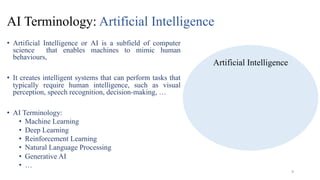
Artificial Intelligence
AI Terminology: Artificial Intelligence
• Artificial Intelligence or AI is a subfield of computer
science that enables machines to mimic human
behaviours,
• It creates intelligent systems that can perform tasks that
typically require human intelligence, such as visual
perception, speech recognition, decision-making, …
• AI Terminology:
• Machine Learning
• Deep Learning
• Reinforcement Learning
• Natural Language Processing
• Generative AI
• …
5
Artificial Intelligence
Machine Learning
AI Terminology: Machine Learning
[Authur Samuel 1959]: Machine learning is a subfield of
Artificial Intelligence that gives Computers the Ability to
Learn from Data, without being explicitly programmed.
Machine Learning algorithms construct predictive models
by learning from a large number of training examples.
By using machine learning, the computer can learn to
recognize patterns and make decisions based on data,
without requiring explicit programming instructions for
every possible scenario.
6
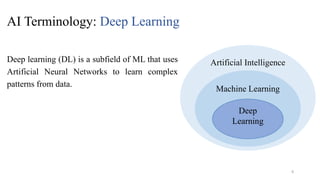
Artificial Intelligence
Machine Learning
AI Terminology: Deep Learning
Deep learning (DL) is a subfield of ML that uses
Artificial Neural Networks to learn complex
patterns from data.
Deep
Learning
7
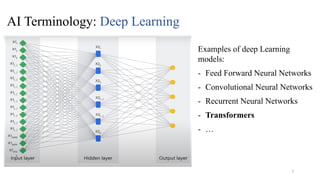
Examples of deep Learning
models:
- Feed Forward Neural Networks
- Convolutional Neural Networks
- Recurrent Neural Networks
- Transformers
- …
AI Terminology: Deep Learning
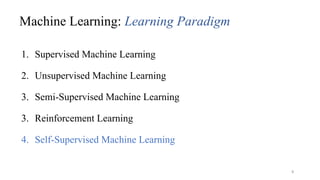
Machine Learning: Learning Paradigm
1. Supervised Machine Learning
2. Unsupervised Machine Learning
3. Semi-Supervised Machine Learning
3. Reinforcement Learning
4. Self-Supervised Machine Learning
8
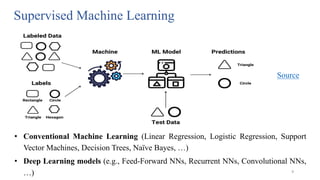
Supervised Machine Learning
9
• Conventional Machine Learning (Linear Regression, Logistic Regression, Support
Vector Machines, Decision Trees, Naïve Bayes, …)
• Deep Learning models (e.g., Feed-Forward NNs, Recurrent NNs, Convolutional NNs,
…)
Source
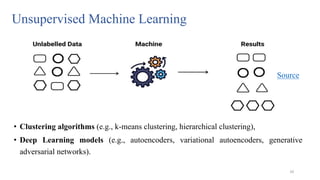
Unsupervised Machine Learning
10
• Clustering algorithms (e.g., k-means clustering, hierarchical clustering),
• Deep Learning models (e.g., autoencoders, variational autoencoders, generative
adversarial networks).
Source
11
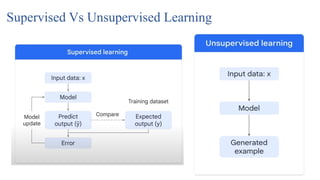
Supervised Vs Unsupervised Learning
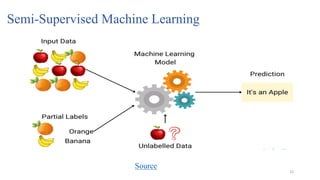
Semi-Supervised Machine Learning
12
Source
13
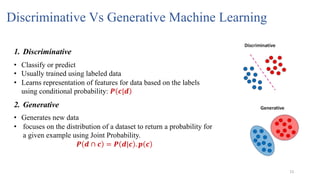
Discriminative Vs Generative Machine Learning
1. Discriminative
• Classify or predict
• Usually trained using labeled data
• Learns representation of features for data based on the labels
using conditional probability: 𝑷 𝒄|𝒅
2. Generative
• Generates new data
• focuses on the distribution of a dataset to return a probability for
a given example using Joint Probability.
𝑷 𝒅 ∩ 𝒄 = 𝑷 𝒅|𝒄 . 𝒑 𝒄
14
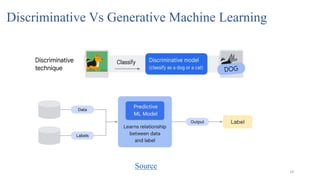
Discriminative Vs Generative Machine Learning
Source
15
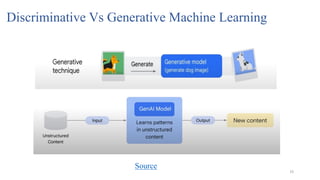
Discriminative Vs Generative Machine Learning
Source
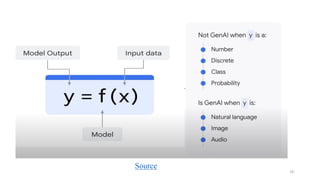
16
Source
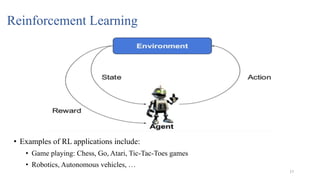
Reinforcement Learning
17
• Examples of RL applications include:
• Game playing: Chess, Go, Atari, Tic-Tac-Toes games
• Robotics, Autonomous vehicles, …
Generative AI Definition
18
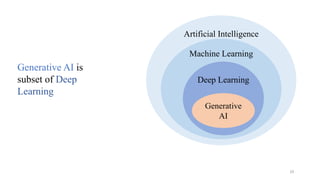
19
Generative AI is
subset of Deep
Learning
Artificial Intelligence
Machine Learning
Deep Learning
Generative
AI
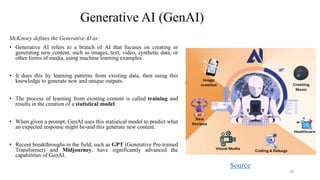
McKinsey defines the Generative AI as:
• Generative AI refers to a branch of AI that focuses on creating or
generating new content, such as images, text, video, synthetic data, or
other forms of media, using machine learning examples.
• It does this by learning patterns from existing data, then using this
knowledge to generate new and unique outputs.
• The process of learning from existing content is called training and
results in the creation of a statistical model.
• When given a prompt, GenAI uses this statistical model to predict what
an expected response might be-and this generate new content.
• Recent breakthroughs in the field, such as GPT (Generative Pre-trained
Transformer) and Midjourney, have significantly advanced the
capabilities of GenAI.
20
Generative AI (GenAI)
Source
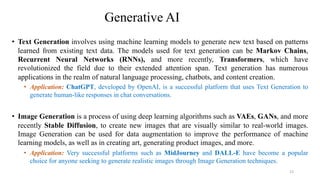
• Text Generation involves using machine learning models to generate new text based on patterns
learned from existing text data. The models used for text generation can be Markov Chains,
Recurrent Neural Networks (RNNs), and more recently, Transformers, which have
revolutionized the field due to their extended attention span. Text generation has numerous
applications in the realm of natural language processing, chatbots, and content creation.
• Application: ChatGPT, developed by OpenAI, is a successful platform that uses Text Generation to
generate human-like responses in chat conversations.
• Image Generation is a process of using deep learning algorithms such as VAEs, GANs, and more
recently Stable Diffusion, to create new images that are visually similar to real-world images.
Image Generation can be used for data augmentation to improve the performance of machine
learning models, as well as in creating art, generating product images, and more.
• Application: Very successful platforms such as MidJourney and DALL-E have become a popular
choice for anyone seeking to generate realistic images through Image Generation techniques.
21
Generative AI
• Video Generation involves deep learning methods such as GANs and Video Diffusion to
generate new videos by predicting frames based on previous frames. Video Generation can be
used in various fields, such as entertainment, sports analysis, and autonomous driving.
• Application: Platforms such as DeepBrain and Synthesia utilize Video and Speech Generation to
create realistic video content, that appears as if a human was speaking on camera.
• Data augmentation is a process of generating new training data by applying various image
transformations such as flipping, cropping, rotating, and color jittering. The goal is to increase the
diversity of training data and avoid overfitting, which can lead to better performance of machine
learning models.
• Application: Synthesis AI simplifies the process of building and optimizing machine learning models
by providing a platform for creating AI models using automated machine learning techniques.
22
Generative AI
23
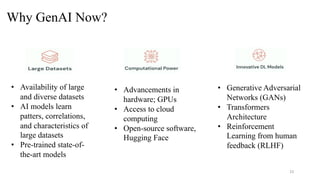
Why GenAI Now?
• Availability of large
and diverse datasets
• AI models learn
patters, correlations,
and characteristics of
large datasets
• Pre-trained state-of-
the-art models
• Advancements in
hardware; GPUs
• Access to cloud
computing
• Open-source software,
Hugging Face
• Generative Adversarial
Networks (GANs)
• Transformers
Architecture
• Reinforcement
Learning from human
feedback (RLHF)
Introduction to Natural
Language Processing
24
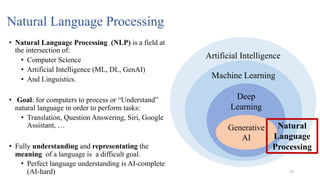
• Natural Language Processing (NLP) is a field at
the intersection of:
• Computer Science
• Artificial Intelligence (ML, DL, GenAI)
• And Linguistics.
• Goal: for computers to process or “Understand”
natural language in order to perform tasks:
• Translation, Question Answering, Siri, Google
Assistant, …
• Fully understanding and representating the
meaning of a language is a difficult goal.
• Perfect language understanding is AI-complete
(AI-hard) 25
Natural Language Processing
Artificial Intelligence
Machine Learning
Deep
Learning
Generative
AI
Natural
Language
Processing
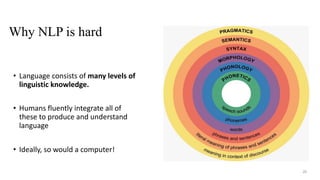
Why NLP is hard
• Language consists of many levels of
linguistic knowledge.
• Humans fluently integrate all of
these to produce and understand
language
• Ideally, so would a computer!
26
Why is NLP hard?
• Ambiguity
• Scale
• Variation
• Expressivity
• Unknown representation
27
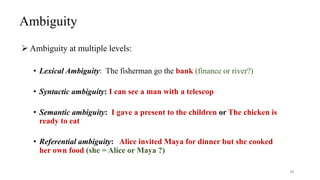
Ambiguity
Ø Ambiguity at multiple levels:
• Lexical Ambiguity: The fisherman go the bank (finance or river?)
• Syntactic ambiguity: I can see a man with a telescop
• Semantic ambiguity: I gave a present to the children or The chicken is
ready to eat
• Referential ambiguity: Alice invited Maya for dinner but she cooked
her own food (she = Alice or Maya ?)
28
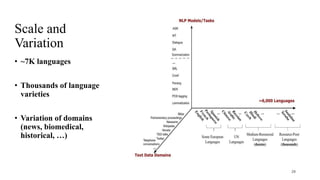
Scale and
Variation
• ~7K languages
• Thousands of language
varieties
• Variation of domains
(news, biomedical,
historical, …)
29
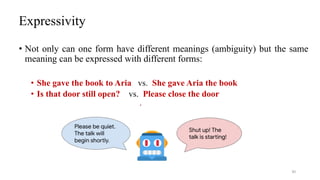
Expressivity
• Not only can one form have different meanings (ambiguity) but the same
meaning can be expressed with different forms:
• She gave the book to Aria vs. She gave Aria the book
• Is that door still open? vs. Please close the door
30
Unknown Representation
• Very difficult to capture what is the representation of the text or speech,
since we don’t even know how to represent the knowledge a human needs:
• What is the “meaning” of a word or sentence?
• How to model context?
• Other general knowledge?
31
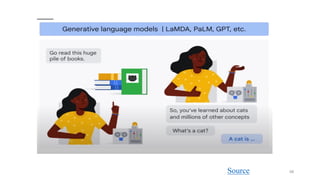
Large Language Models
(LLMs)
32
33
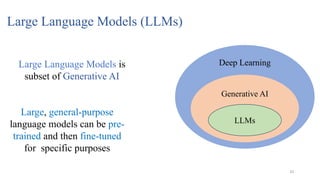
Large Language Models is
subset of Generative AI
Deep Learning
Generative AI
LLMs
Large Language Models (LLMs)
Large, general-purpose
language models can be pre-
trained and then fine-tuned
for specific purposes
34
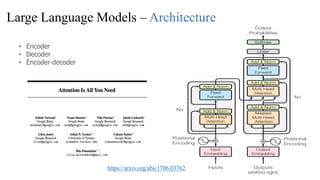
Large Language Models – Architecture
• Encoder
• Decoder
• Encoder-decoder
https://arxiv.org/abs/1706.03762
35
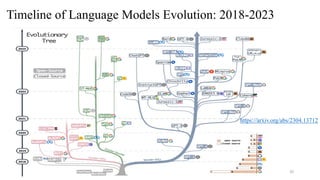
Timeline of Language Models Evolution: 2018-2023
https://arxiv.org/abs/2304.13712
36
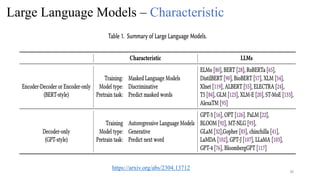
Large Language Models – Characteristic
https://arxiv.org/abs/2304.13712
37
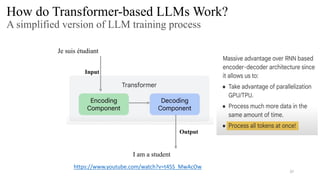
How do Transformer-based LLMs Work?
A simplified version of LLM training process
Je suis étudiant
I am a student
Input
Output
https://www.youtube.com/watch?v=t45S_MwAcOw
38
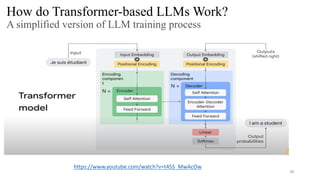
How do Transformer-based LLMs Work?
A simplified version of LLM training process
https://www.youtube.com/watch?v=t45S_MwAcOw
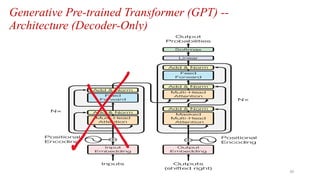
Generative Pre-trained Transformer (GPT) --
Architecture (Decoder-Only)
39
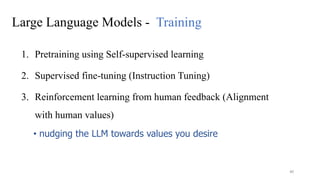
Large Language Models - Training
1. Pretraining using Self-supervised learning
2. Supervised fine-tuning (Instruction Tuning)
3. Reinforcement learning from human feedback (Alignment
with human values)
• nudging the LLM towards values you desire
40
41
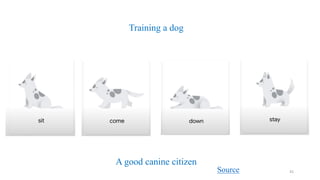
Training a dog
A good canine citizen
Source
42
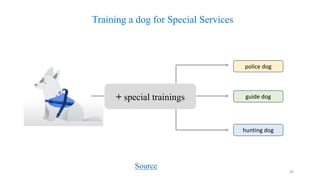
Training a dog for Special Services
police dog
guide dog
hunting dog
+ special trainings
Source
43
Similar idea applied to Large Language
Models (LLMs)
44
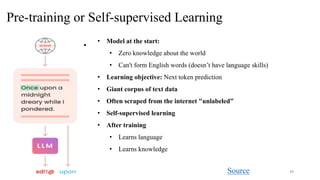
Pre-training or Self-supervised Learning
• Model at the start:
• Zero knowledge about the world
• Can't form English words (doesn’t have language skills)
• Learning objective: Next token prediction
• Giant corpus of text data
• Often scraped from the internet "unlabeled”
• Self-supervised learning
• After training
• Learns language
• Learns knowledge
Source
45
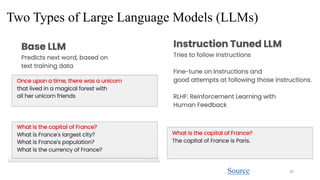
Two Types of Large Language Models (LLMs)
Source
46
How to use LLMs?
1. Fine-Tuning the LLMs (Supervised Learning)
2. LLMs Prompt Engineering
49
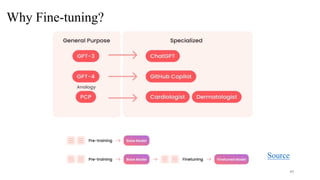
Why Fine-tuning?
Source
50
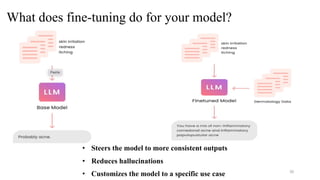
What does fine-tuning do for your model?
• Steers the model to more consistent outputs
• Reduces hallucinations
• Customizes the model to a specific use case
51
How to use LLMs?
1. Fine-Tuning the LLMs
2. LLMs Prompt Engineering
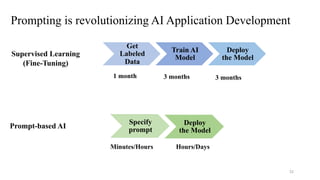
Prompting is revolutionizing AI Application Development
52
Supervised Learning
(Fine-Tuning)
Get
Labeled
Data
Train AI
Model
Deploy
the Model
1 month 3 months 3 months
Prompt-based AI
Specify
prompt
Deploy
the Model
Minutes/Hours Hours/Days
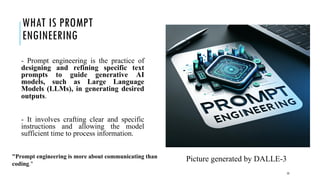
WHAT IS PROMPT
ENGINEERING
- Prompt engineering is the practice of
designing and refining specific text
prompts to guide generative AI
models, such as Large Language
Models (LLMs), in generating desired
outputs.
- It involves crafting clear and specific
instructions and allowing the model
sufficient time to process information.
53
Picture generated by DALLE-3
"Prompt engineering is more about communicating than
coding."
Prompting Techniques
54
• Many advanced prompting techniques have been designed to improve performance on
complex tasks
1. In-Context Learning (ICL)
2. Chain-of-thought (CoT) prompting
3. Self-Consistency
4. Knowledge Generation Prompting
5. ReAct
6. …
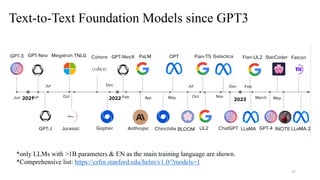
Text-to-Text Foundation Models since GPT3
55
*only LLMs with >1B parameters & EN as the main training language are shown.
*Comprehensive list: https://crfm.stanford.edu/helm/v1.0/?models=1
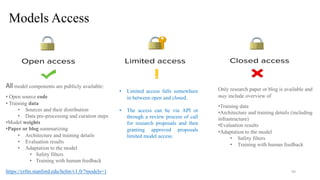
Models Access
56
All model components are publicly available:
• Open source code
• Training data
• Sources and their distribution
• Data pre-processing and curation steps
•Model weights
•Paper or blog summarizing
• Architecture and training details
• Evaluation results
• Adaptation to the model
• Safety filters
• Training with human feedback
https://crfm.stanford.edu/helm/v1.0/?models=1
Only research paper or blog is available and
may include overview of
•Training data
•Architecture and training details (including
infrastructure)
•Evaluation results
•Adaptation to the model
• Safety filters
• Training with human feedback
• Limited access falls somewhere
in between open and closed.
• The access can be via API or
through a review process of call
for research proposals and then
granting approved proposals
limited model access.
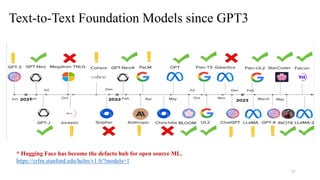
Text-to-Text Foundation Models since GPT3
57
* Hugging Face has become the defacto hub for open source ML.
https://crfm.stanford.edu/helm/v1.0/?models=1
To recap
58
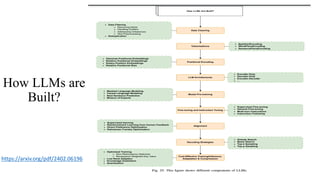
How LLMs are
Built?
https://arxiv.org/pdf/2402.06196
60
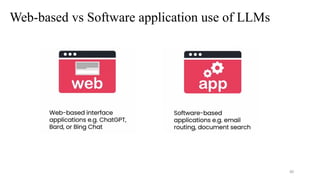
Web-based vs Software application use of LLMs
61
Benefits of using Large Language Models
1. A single model can be used for different tasks
2. The fine-tuning process requires minimal field data (Transfer Learning,
Domain Adaptation)
3. The performance is continuously growing with more data and parameters
62
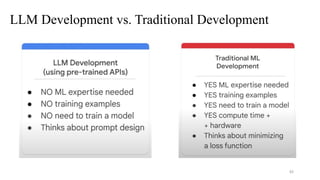
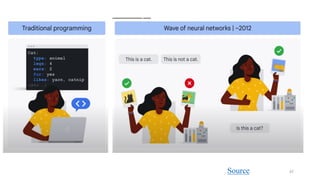
LLM Development vs. Traditional Development
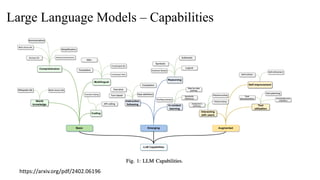
Large Language Models – Capabilities
https://arxiv.org/pdf/2402.06196
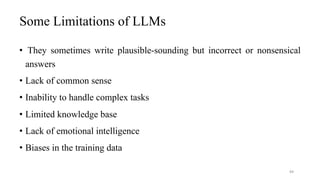
Some Limitations of LLMs
• They sometimes write plausible-sounding but incorrect or nonsensical
answers
• Lack of common sense
• Inability to handle complex tasks
• Limited knowledge base
• Lack of emotional intelligence
• Biases in the training data
64
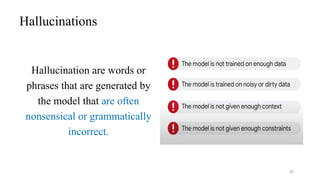
Hallucinations
Hallucination are words or
phrases that are generated by
the model that are often
nonsensical or grammatically
incorrect.
65
To conclude
66
67
Source
68
Source
69
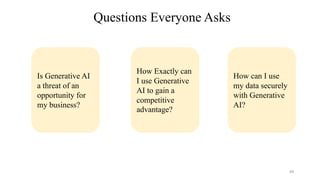
Questions Everyone Asks
Is Generative AI
a threat of an
opportunity for
my business?
How Exactly can
I use Generative
AI to gain a
competitive
advantage?
How can I use
my data securely
with Generative
AI?
Reading
70
• https://www.cloudskillsboost.google/journeys/118/course_templates/536
• https://cloud.google.com/ai/generative-ai
• https://smlbook.org/book/sml-book-draft-latest.pdf?fbclid=IwAR2ztL1GkSuhYJHJJeWACwRFEnAtqZshuq6l-S-
0Z6_MHT9o90Qzoy6eMgA
• https://www.simplilearn.com/tutorials/artificial-intelligence-tutorial/what-is-generative-ai
• GenAI studio: https://cloud.google.com/generative-ai-studio?hl=fr
• Survey on Large Language Models https://arxiv.org/pdf/2303.18223.pdf
Thank You!

Introduction to Generative Artificial Intelligence

  • 1.
    Introduction to GenerativeAI SALIMA LAMSIYAH, UNIVERSITY OF LUXEMBOURG 1 salima.lamsiyah@uni.lu
  • 2.
    Lecture Plan 1. Introductionto Machine Learning 2. Generative AI Definition 3. Introduction to Natural Language Processing 4. Large Language Models • Architecture • Training Process • Usage • Capabilties • Limitations 2
  • 3.
  • 4.
    4 Artificial Intelligence AI Terminology:Artificial Intelligence • Artificial Intelligence or AI is a subfield of computer science that enables machines to mimic human behaviours, • It creates intelligent systems that can perform tasks that typically require human intelligence, such as visual perception, speech recognition, decision-making, … • AI Terminology: • Machine Learning • Deep Learning • Reinforcement Learning • Natural Language Processing • Generative AI • …
  • 5.
    5 Artificial Intelligence Machine Learning AITerminology: Machine Learning [Authur Samuel 1959]: Machine learning is a subfield of Artificial Intelligence that gives Computers the Ability to Learn from Data, without being explicitly programmed. Machine Learning algorithms construct predictive models by learning from a large number of training examples. By using machine learning, the computer can learn to recognize patterns and make decisions based on data, without requiring explicit programming instructions for every possible scenario.
  • 6.
    6 Artificial Intelligence Machine Learning AITerminology: Deep Learning Deep learning (DL) is a subfield of ML that uses Artificial Neural Networks to learn complex patterns from data. Deep Learning
  • 7.
    7 Examples of deepLearning models: - Feed Forward Neural Networks - Convolutional Neural Networks - Recurrent Neural Networks - Transformers - … AI Terminology: Deep Learning
  • 8.
    Machine Learning: LearningParadigm 1. Supervised Machine Learning 2. Unsupervised Machine Learning 3. Semi-Supervised Machine Learning 3. Reinforcement Learning 4. Self-Supervised Machine Learning 8
  • 9.
    Supervised Machine Learning 9 •Conventional Machine Learning (Linear Regression, Logistic Regression, Support Vector Machines, Decision Trees, Naïve Bayes, …) • Deep Learning models (e.g., Feed-Forward NNs, Recurrent NNs, Convolutional NNs, …) Source
  • 10.
    Unsupervised Machine Learning 10 •Clustering algorithms (e.g., k-means clustering, hierarchical clustering), • Deep Learning models (e.g., autoencoders, variational autoencoders, generative adversarial networks). Source
  • 11.
  • 12.
  • 13.
    13 Discriminative Vs GenerativeMachine Learning 1. Discriminative • Classify or predict • Usually trained using labeled data • Learns representation of features for data based on the labels using conditional probability: 𝑷 𝒄|𝒅 2. Generative • Generates new data • focuses on the distribution of a dataset to return a probability for a given example using Joint Probability. 𝑷 𝒅 ∩ 𝒄 = 𝑷 𝒅|𝒄 . 𝒑 𝒄
  • 14.
    14 Discriminative Vs GenerativeMachine Learning Source
  • 15.
    15 Discriminative Vs GenerativeMachine Learning Source
  • 16.
  • 17.
    Reinforcement Learning 17 • Examplesof RL applications include: • Game playing: Chess, Go, Atari, Tic-Tac-Toes games • Robotics, Autonomous vehicles, …
  • 18.
  • 19.
    19 Generative AI is subsetof Deep Learning Artificial Intelligence Machine Learning Deep Learning Generative AI
  • 20.
    McKinsey defines theGenerative AI as: • Generative AI refers to a branch of AI that focuses on creating or generating new content, such as images, text, video, synthetic data, or other forms of media, using machine learning examples. • It does this by learning patterns from existing data, then using this knowledge to generate new and unique outputs. • The process of learning from existing content is called training and results in the creation of a statistical model. • When given a prompt, GenAI uses this statistical model to predict what an expected response might be-and this generate new content. • Recent breakthroughs in the field, such as GPT (Generative Pre-trained Transformer) and Midjourney, have significantly advanced the capabilities of GenAI. 20 Generative AI (GenAI) Source
  • 21.
    • Text Generationinvolves using machine learning models to generate new text based on patterns learned from existing text data. The models used for text generation can be Markov Chains, Recurrent Neural Networks (RNNs), and more recently, Transformers, which have revolutionized the field due to their extended attention span. Text generation has numerous applications in the realm of natural language processing, chatbots, and content creation. • Application: ChatGPT, developed by OpenAI, is a successful platform that uses Text Generation to generate human-like responses in chat conversations. • Image Generation is a process of using deep learning algorithms such as VAEs, GANs, and more recently Stable Diffusion, to create new images that are visually similar to real-world images. Image Generation can be used for data augmentation to improve the performance of machine learning models, as well as in creating art, generating product images, and more. • Application: Very successful platforms such as MidJourney and DALL-E have become a popular choice for anyone seeking to generate realistic images through Image Generation techniques. 21 Generative AI
  • 22.
    • Video Generationinvolves deep learning methods such as GANs and Video Diffusion to generate new videos by predicting frames based on previous frames. Video Generation can be used in various fields, such as entertainment, sports analysis, and autonomous driving. • Application: Platforms such as DeepBrain and Synthesia utilize Video and Speech Generation to create realistic video content, that appears as if a human was speaking on camera. • Data augmentation is a process of generating new training data by applying various image transformations such as flipping, cropping, rotating, and color jittering. The goal is to increase the diversity of training data and avoid overfitting, which can lead to better performance of machine learning models. • Application: Synthesis AI simplifies the process of building and optimizing machine learning models by providing a platform for creating AI models using automated machine learning techniques. 22 Generative AI
  • 23.
    23 Why GenAI Now? •Availability of large and diverse datasets • AI models learn patters, correlations, and characteristics of large datasets • Pre-trained state-of- the-art models • Advancements in hardware; GPUs • Access to cloud computing • Open-source software, Hugging Face • Generative Adversarial Networks (GANs) • Transformers Architecture • Reinforcement Learning from human feedback (RLHF)
  • 24.
  • 25.
    • Natural LanguageProcessing (NLP) is a field at the intersection of: • Computer Science • Artificial Intelligence (ML, DL, GenAI) • And Linguistics. • Goal: for computers to process or “Understand” natural language in order to perform tasks: • Translation, Question Answering, Siri, Google Assistant, … • Fully understanding and representating the meaning of a language is a difficult goal. • Perfect language understanding is AI-complete (AI-hard) 25 Natural Language Processing Artificial Intelligence Machine Learning Deep Learning Generative AI Natural Language Processing
  • 26.
    Why NLP ishard • Language consists of many levels of linguistic knowledge. • Humans fluently integrate all of these to produce and understand language • Ideally, so would a computer! 26
  • 27.
    Why is NLPhard? • Ambiguity • Scale • Variation • Expressivity • Unknown representation 27
  • 28.
    Ambiguity Ø Ambiguity atmultiple levels: • Lexical Ambiguity: The fisherman go the bank (finance or river?) • Syntactic ambiguity: I can see a man with a telescop • Semantic ambiguity: I gave a present to the children or The chicken is ready to eat • Referential ambiguity: Alice invited Maya for dinner but she cooked her own food (she = Alice or Maya ?) 28
  • 29.
    Scale and Variation • ~7Klanguages • Thousands of language varieties • Variation of domains (news, biomedical, historical, …) 29
  • 30.
    Expressivity • Not onlycan one form have different meanings (ambiguity) but the same meaning can be expressed with different forms: • She gave the book to Aria vs. She gave Aria the book • Is that door still open? vs. Please close the door 30
  • 31.
    Unknown Representation • Verydifficult to capture what is the representation of the text or speech, since we don’t even know how to represent the knowledge a human needs: • What is the “meaning” of a word or sentence? • How to model context? • Other general knowledge? 31
  • 32.
  • 33.
    33 Large Language Modelsis subset of Generative AI Deep Learning Generative AI LLMs Large Language Models (LLMs) Large, general-purpose language models can be pre- trained and then fine-tuned for specific purposes
  • 34.
    34 Large Language Models– Architecture • Encoder • Decoder • Encoder-decoder https://arxiv.org/abs/1706.03762
  • 35.
    35 Timeline of LanguageModels Evolution: 2018-2023 https://arxiv.org/abs/2304.13712
  • 36.
    36 Large Language Models– Characteristic https://arxiv.org/abs/2304.13712
  • 37.
    37 How do Transformer-basedLLMs Work? A simplified version of LLM training process Je suis étudiant I am a student Input Output https://www.youtube.com/watch?v=t45S_MwAcOw
  • 38.
    38 How do Transformer-basedLLMs Work? A simplified version of LLM training process https://www.youtube.com/watch?v=t45S_MwAcOw
  • 39.
    Generative Pre-trained Transformer(GPT) -- Architecture (Decoder-Only) 39
  • 40.
    Large Language Models- Training 1. Pretraining using Self-supervised learning 2. Supervised fine-tuning (Instruction Tuning) 3. Reinforcement learning from human feedback (Alignment with human values) • nudging the LLM towards values you desire 40
  • 41.
    41 Training a dog Agood canine citizen Source
  • 42.
    42 Training a dogfor Special Services police dog guide dog hunting dog + special trainings Source
  • 43.
    43 Similar idea appliedto Large Language Models (LLMs)
  • 44.
    44 Pre-training or Self-supervisedLearning • Model at the start: • Zero knowledge about the world • Can't form English words (doesn’t have language skills) • Learning objective: Next token prediction • Giant corpus of text data • Often scraped from the internet "unlabeled” • Self-supervised learning • After training • Learns language • Learns knowledge Source
  • 45.
    45 Two Types ofLarge Language Models (LLMs) Source
  • 46.
    46 How to useLLMs? 1. Fine-Tuning the LLMs (Supervised Learning) 2. LLMs Prompt Engineering
  • 47.
  • 48.
    50 What does fine-tuningdo for your model? • Steers the model to more consistent outputs • Reduces hallucinations • Customizes the model to a specific use case
  • 49.
    51 How to useLLMs? 1. Fine-Tuning the LLMs 2. LLMs Prompt Engineering
  • 50.
    Prompting is revolutionizingAI Application Development 52 Supervised Learning (Fine-Tuning) Get Labeled Data Train AI Model Deploy the Model 1 month 3 months 3 months Prompt-based AI Specify prompt Deploy the Model Minutes/Hours Hours/Days
  • 51.
    WHAT IS PROMPT ENGINEERING -Prompt engineering is the practice of designing and refining specific text prompts to guide generative AI models, such as Large Language Models (LLMs), in generating desired outputs. - It involves crafting clear and specific instructions and allowing the model sufficient time to process information. 53 Picture generated by DALLE-3 "Prompt engineering is more about communicating than coding."
  • 52.
    Prompting Techniques 54 • Manyadvanced prompting techniques have been designed to improve performance on complex tasks 1. In-Context Learning (ICL) 2. Chain-of-thought (CoT) prompting 3. Self-Consistency 4. Knowledge Generation Prompting 5. ReAct 6. …
  • 53.
    Text-to-Text Foundation Modelssince GPT3 55 *only LLMs with >1B parameters & EN as the main training language are shown. *Comprehensive list: https://crfm.stanford.edu/helm/v1.0/?models=1
  • 54.
    Models Access 56 All modelcomponents are publicly available: • Open source code • Training data • Sources and their distribution • Data pre-processing and curation steps •Model weights •Paper or blog summarizing • Architecture and training details • Evaluation results • Adaptation to the model • Safety filters • Training with human feedback https://crfm.stanford.edu/helm/v1.0/?models=1 Only research paper or blog is available and may include overview of •Training data •Architecture and training details (including infrastructure) •Evaluation results •Adaptation to the model • Safety filters • Training with human feedback • Limited access falls somewhere in between open and closed. • The access can be via API or through a review process of call for research proposals and then granting approved proposals limited model access.
  • 55.
    Text-to-Text Foundation Modelssince GPT3 57 * Hugging Face has become the defacto hub for open source ML. https://crfm.stanford.edu/helm/v1.0/?models=1
  • 56.
  • 57.
  • 58.
    60 Web-based vs Softwareapplication use of LLMs
  • 59.
    61 Benefits of usingLarge Language Models 1. A single model can be used for different tasks 2. The fine-tuning process requires minimal field data (Transfer Learning, Domain Adaptation) 3. The performance is continuously growing with more data and parameters
  • 60.
    62 LLM Development vs.Traditional Development
  • 61.
    Large Language Models– Capabilities https://arxiv.org/pdf/2402.06196
  • 62.
    Some Limitations ofLLMs • They sometimes write plausible-sounding but incorrect or nonsensical answers • Lack of common sense • Inability to handle complex tasks • Limited knowledge base • Lack of emotional intelligence • Biases in the training data 64
  • 63.
    Hallucinations Hallucination are wordsor phrases that are generated by the model that are often nonsensical or grammatically incorrect. 65
  • 64.
  • 65.
  • 66.
  • 67.
    69 Questions Everyone Asks IsGenerative AI a threat of an opportunity for my business? How Exactly can I use Generative AI to gain a competitive advantage? How can I use my data securely with Generative AI?
  • 68.
    Reading 70 • https://www.cloudskillsboost.google/journeys/118/course_templates/536 • https://cloud.google.com/ai/generative-ai •https://smlbook.org/book/sml-book-draft-latest.pdf?fbclid=IwAR2ztL1GkSuhYJHJJeWACwRFEnAtqZshuq6l-S- 0Z6_MHT9o90Qzoy6eMgA • https://www.simplilearn.com/tutorials/artificial-intelligence-tutorial/what-is-generative-ai • GenAI studio: https://cloud.google.com/generative-ai-studio?hl=fr • Survey on Large Language Models https://arxiv.org/pdf/2303.18223.pdf
  • 69.