Introduction to
Sustainability
Damian Gordon
Contents
• What is Sustainability?
• Definitions of Sustainability
• History of Sustainability
• Models of Sustainability
• Three Types of Sustainability
• UN Sustainable Development Goals
• The LASERS Model
Sustainability
Sustainability
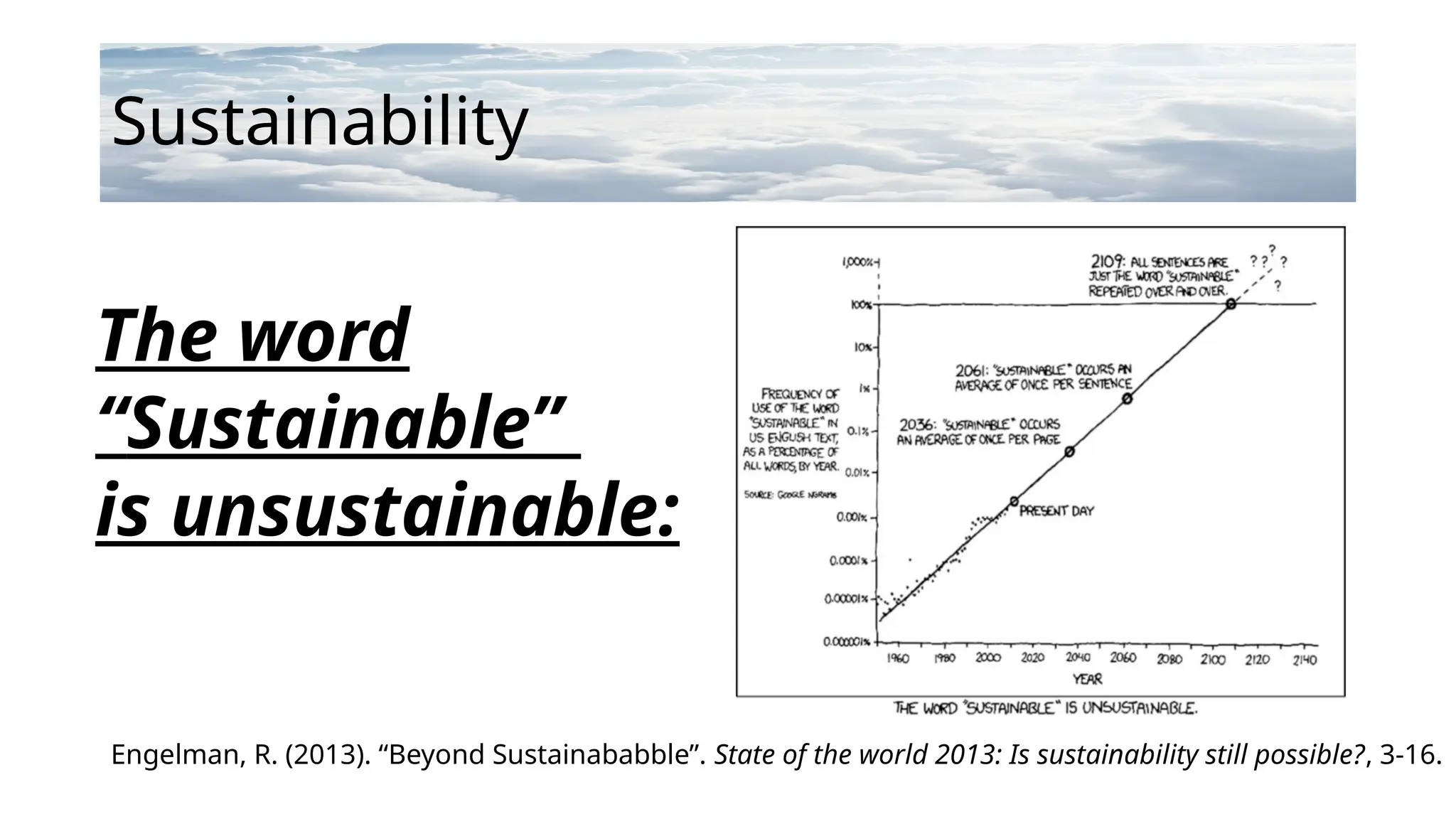
The word
“Sustainable”
is unsustainable:
Engelman, R. (2013). “Beyond Sustainababble”. State of the world 2013: Is sustainability still possible?, 3-16.
Sustainability
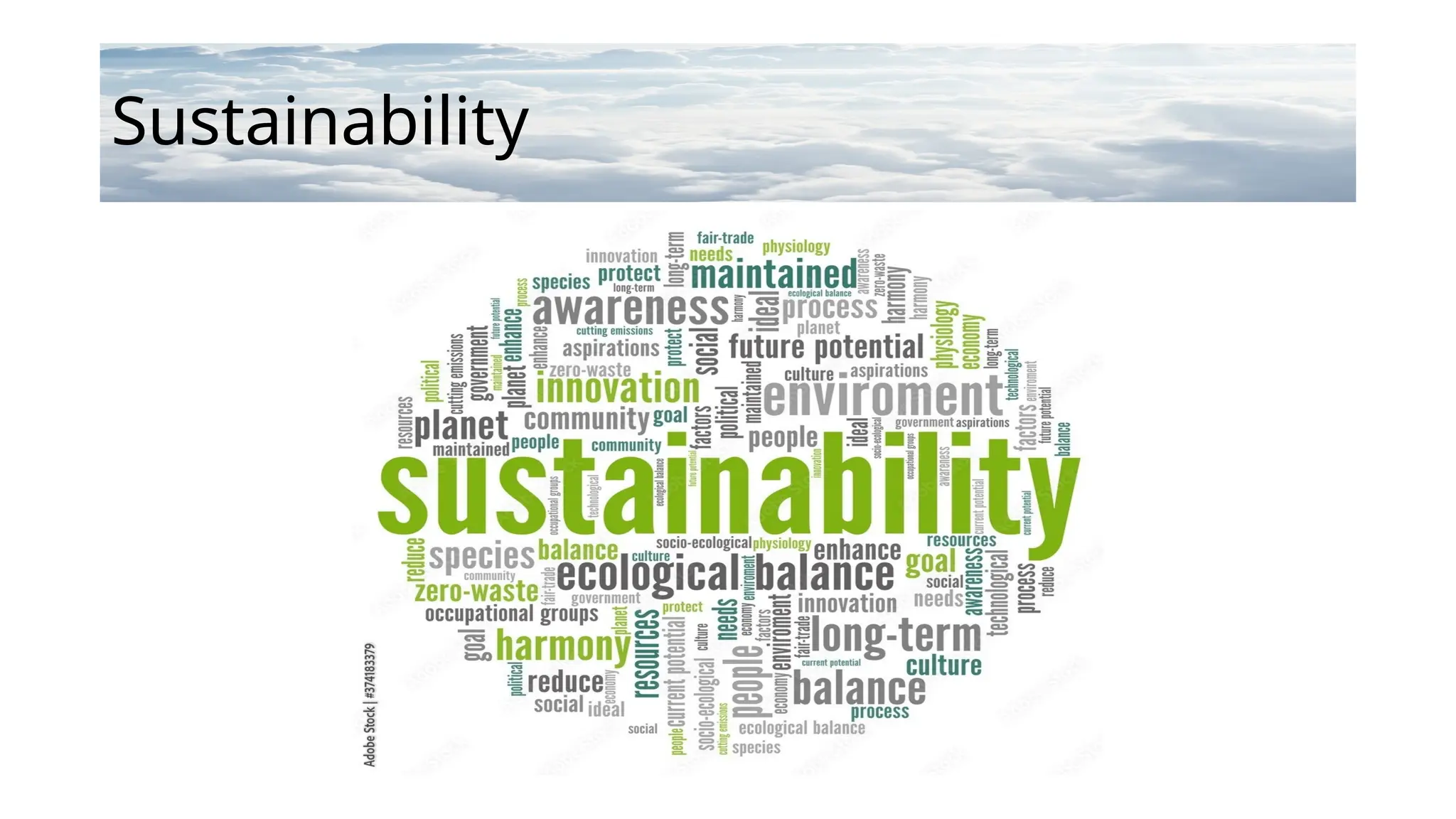
•There is a lot of debate about
what the term “Sustainability”
means, and it means different
things to different people, so
we’ll look at some words
associated with sustainability.
Sustainability
Sustainability
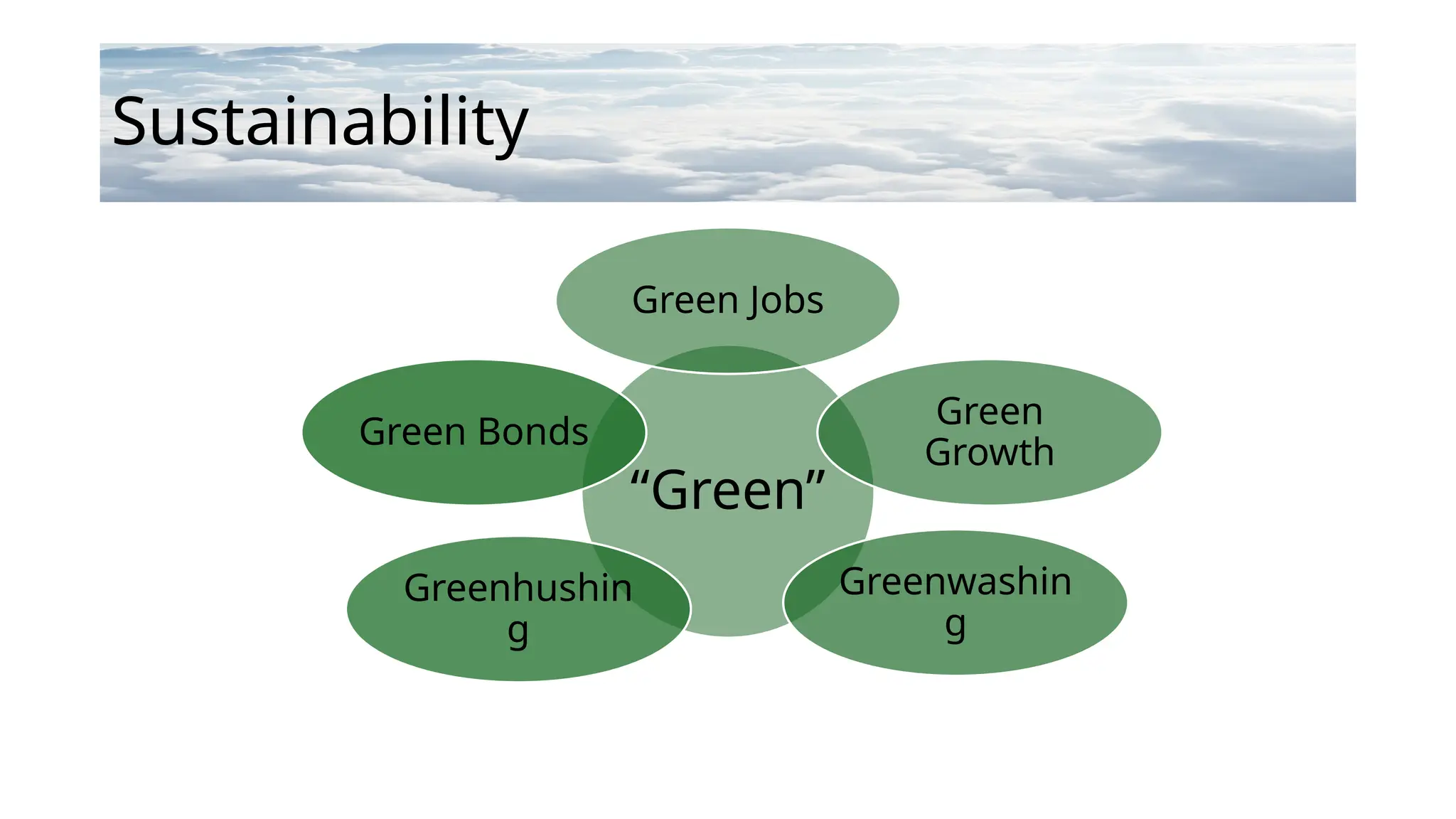
“Green”
Green Jobs
Green
Growth
Greenwashin
g
Greenhushin
g
Green Bonds
Sustainability
•So what is sustainability?
Sustainability
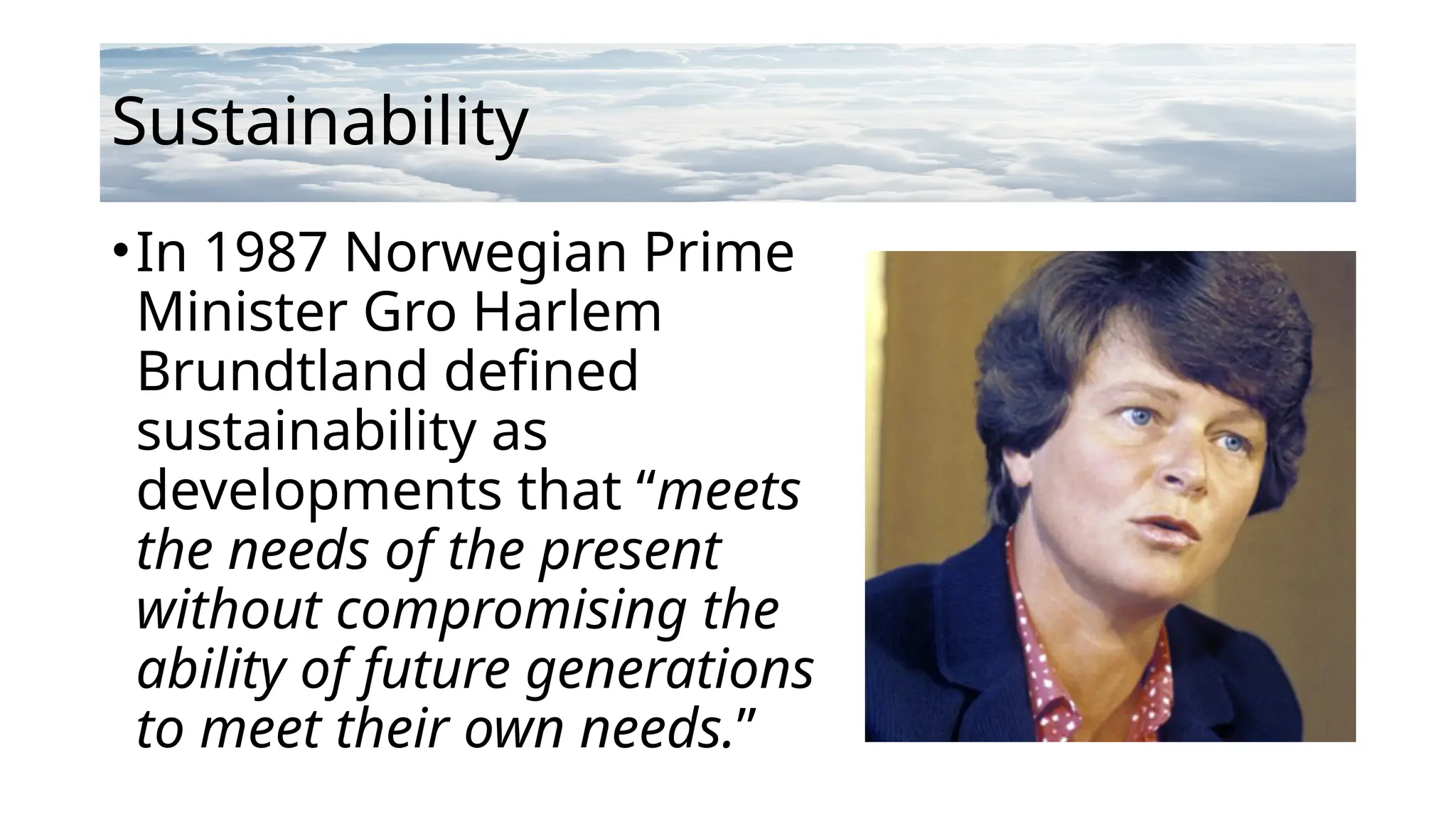
•In 1987 Norwegian Prime
Minister Gro Harlem
Brundtland defined
sustainability as
developments that “meets
the needs of the present
without compromising the
ability of future generations
to meet their own needs.”
Sustainability
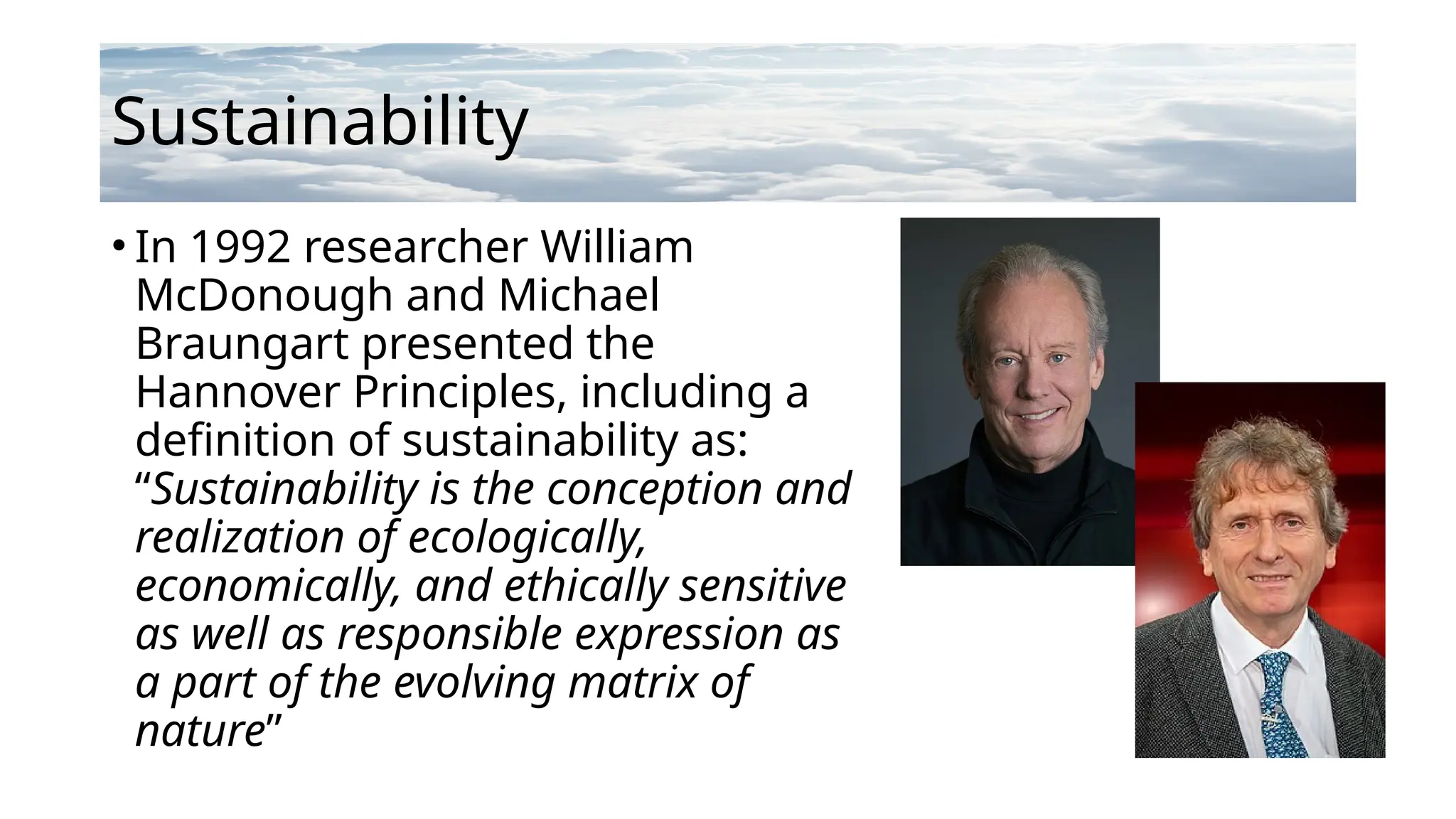
• In 1992 researcher William
McDonough and Michael
Braungart presented the
Hannover Principles, including a
definition of sustainability as:
“Sustainability is the conception and
realization of ecologically,
economically, and ethically sensitive
as well as responsible expression as
a part of the evolving matrix of
nature”
Sustainability
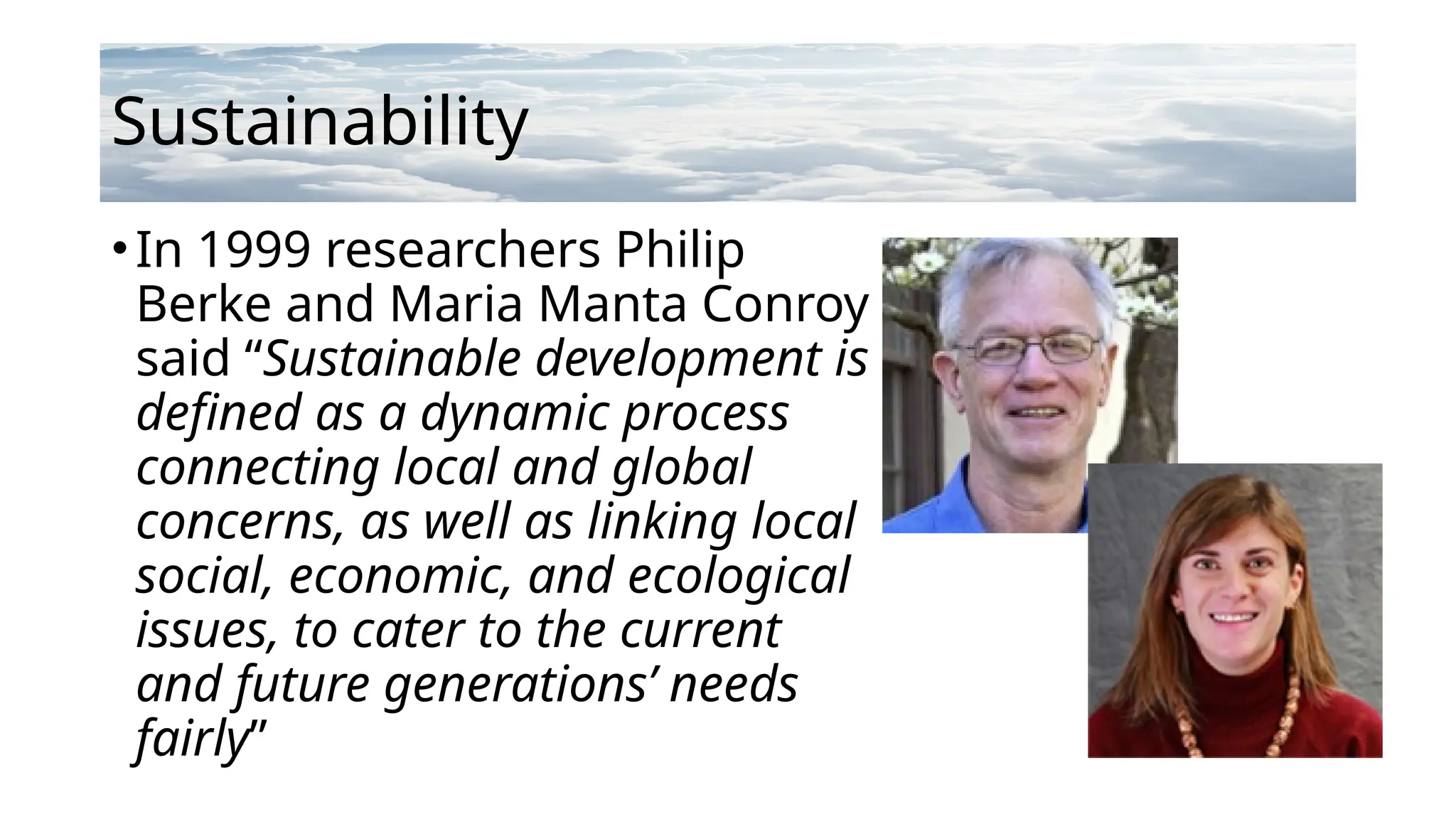
•In 1999 researchers Philip
Berke and Maria Manta Conroy
said “Sustainable development is
defined as a dynamic process
connecting local and global
concerns, as well as linking local
social, economic, and ecological
issues, to cater to the current
and future generations’ needs
fairly”
Sustainability
•Why is sustainability
important?
Sustainability
•Why is sustainability important?
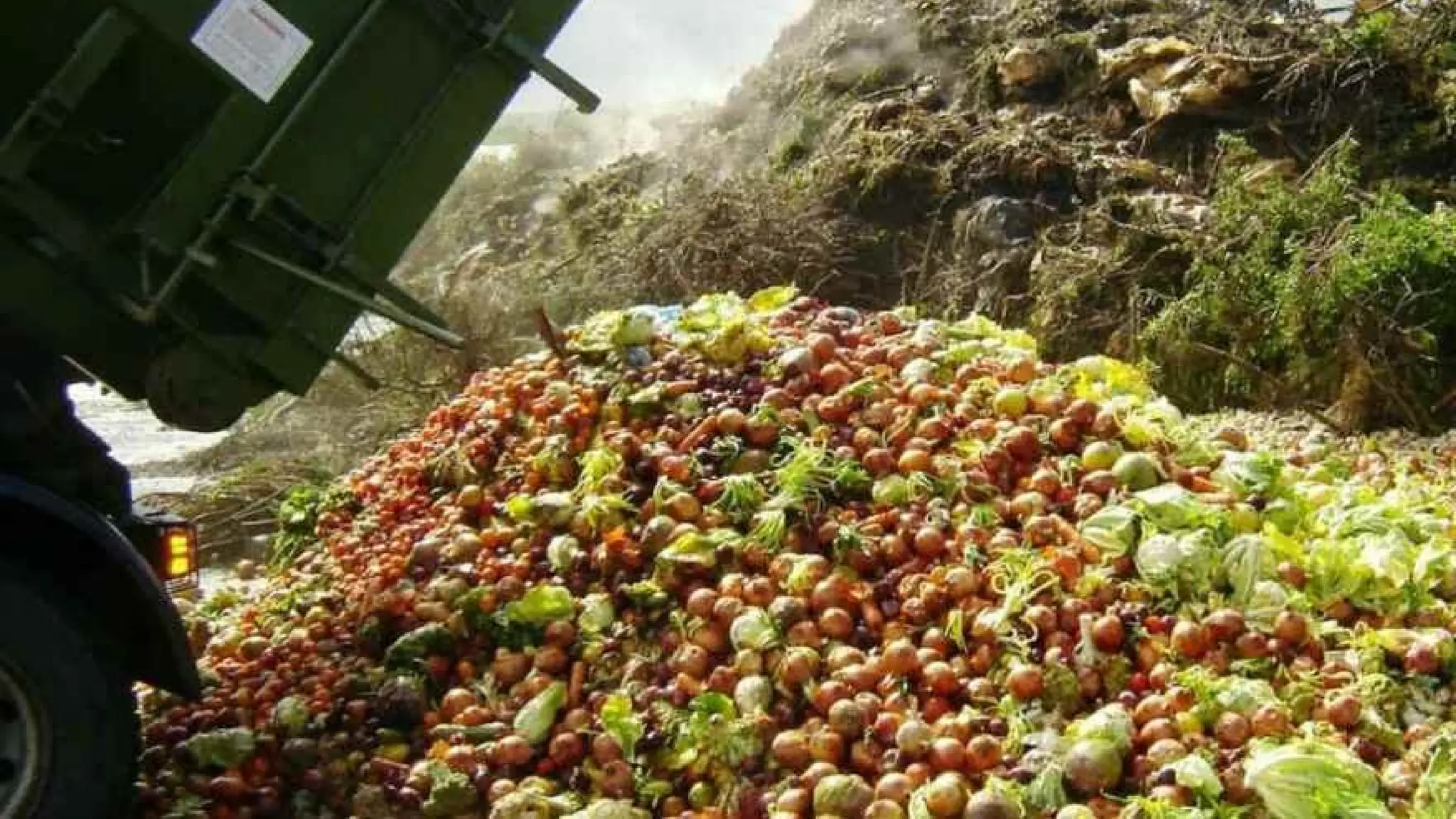
•For me, it’s because
1,300,000,000 tonnes of food
is wasted every year
Sustainability
•We need to do better !!!
Sustainability
•We need to do better !!!
•And with computers, we can !!!
Sustainability
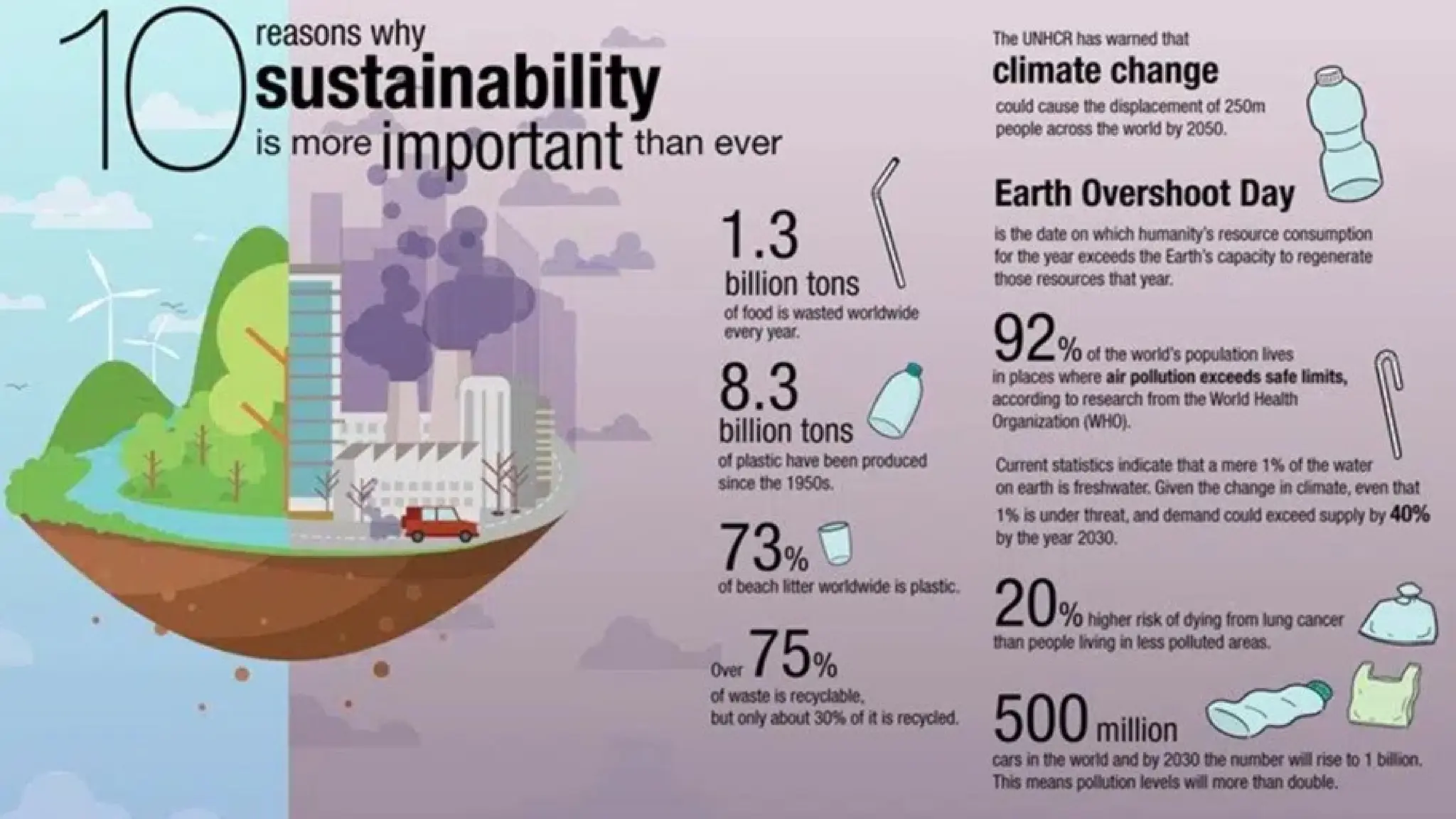
•Other key statistics:
Sustainability
ACTIVITY
• In groups of 3-5 people
• Each team must choose a name related to
sustainability (e.g., Team Green, Team Solar, Team
Zero Waste).
• Pick one of the following scenarios, and suggest
three (3) ways to address it:
Sustainability
• ACTIVITY
• "Your community has a low recycling rate. Design a plan to increase
public participation in the recycling program, focusing on
convenience and education.“
• "A restaurant is throwing away large amounts of food at the end of
each day. How could they reduce food waste and make their
operations more sustainable?“
• "Your company is looking to improve its sustainability performance.
What three policies could you implement to reduce its
environmental footprint and promote social responsibility?“
• "A local café wants to minimize its plastic waste. What three actions
could they take to reduce single-use plastic items?"
History of
Sustainability
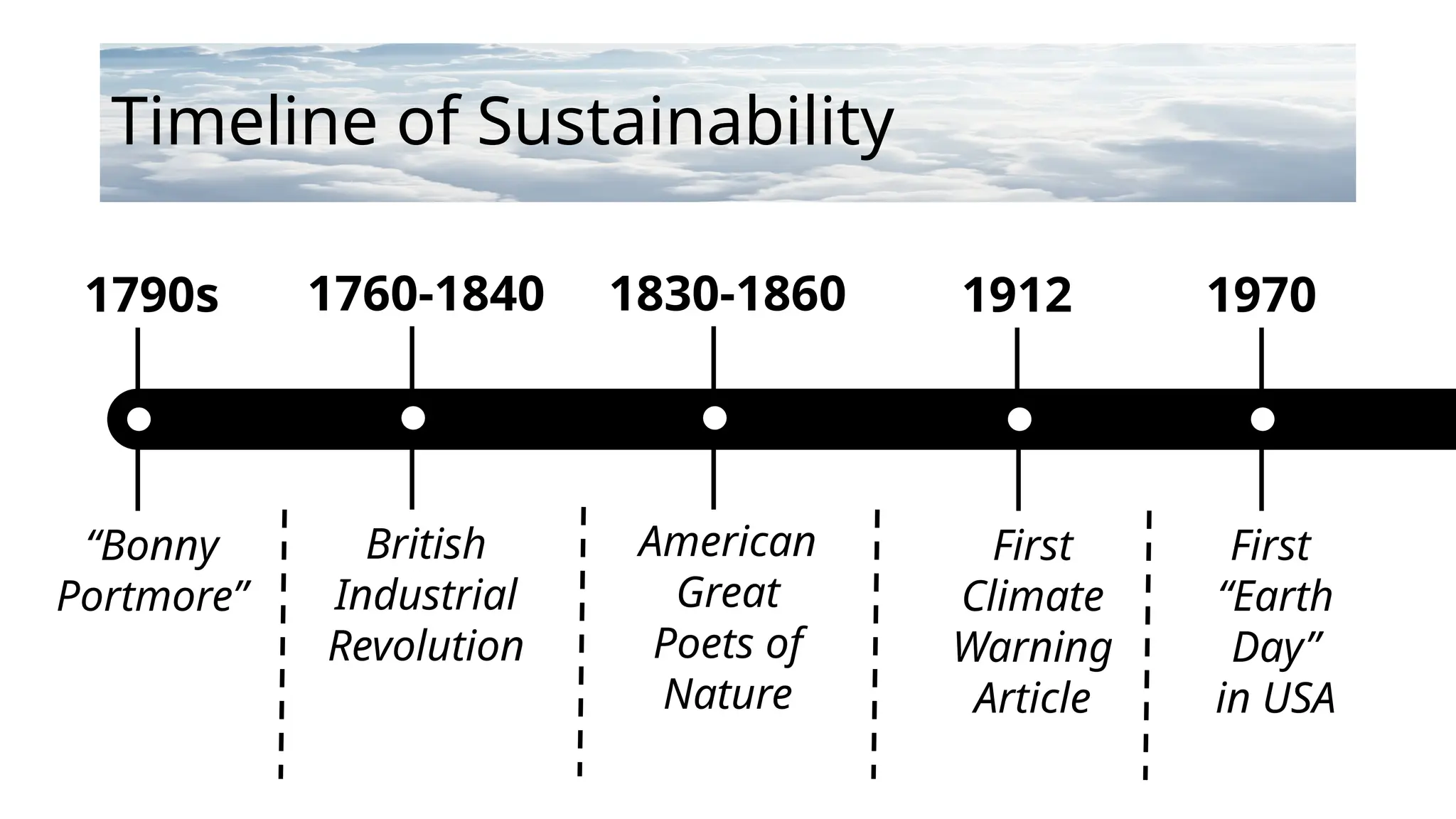
Timeline of Sustainability
1790s
“Bonny
Portmore”
1760-1840
British
Industrial
Revolution
1830-1860
American
Great
Poets of
Nature
1912
First
Climate
Warning
Article
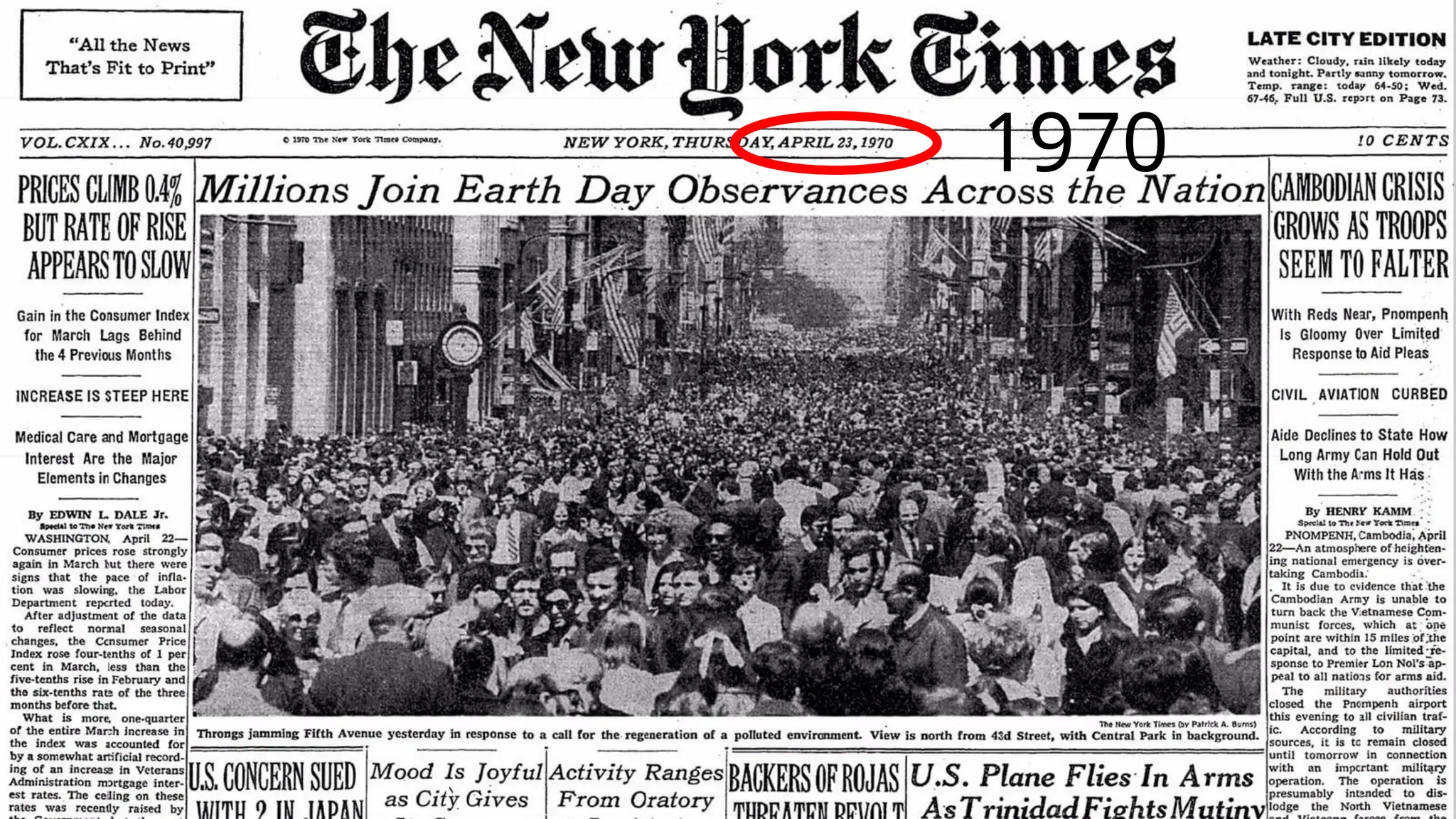
1970
First
“Earth
Day”
in USA
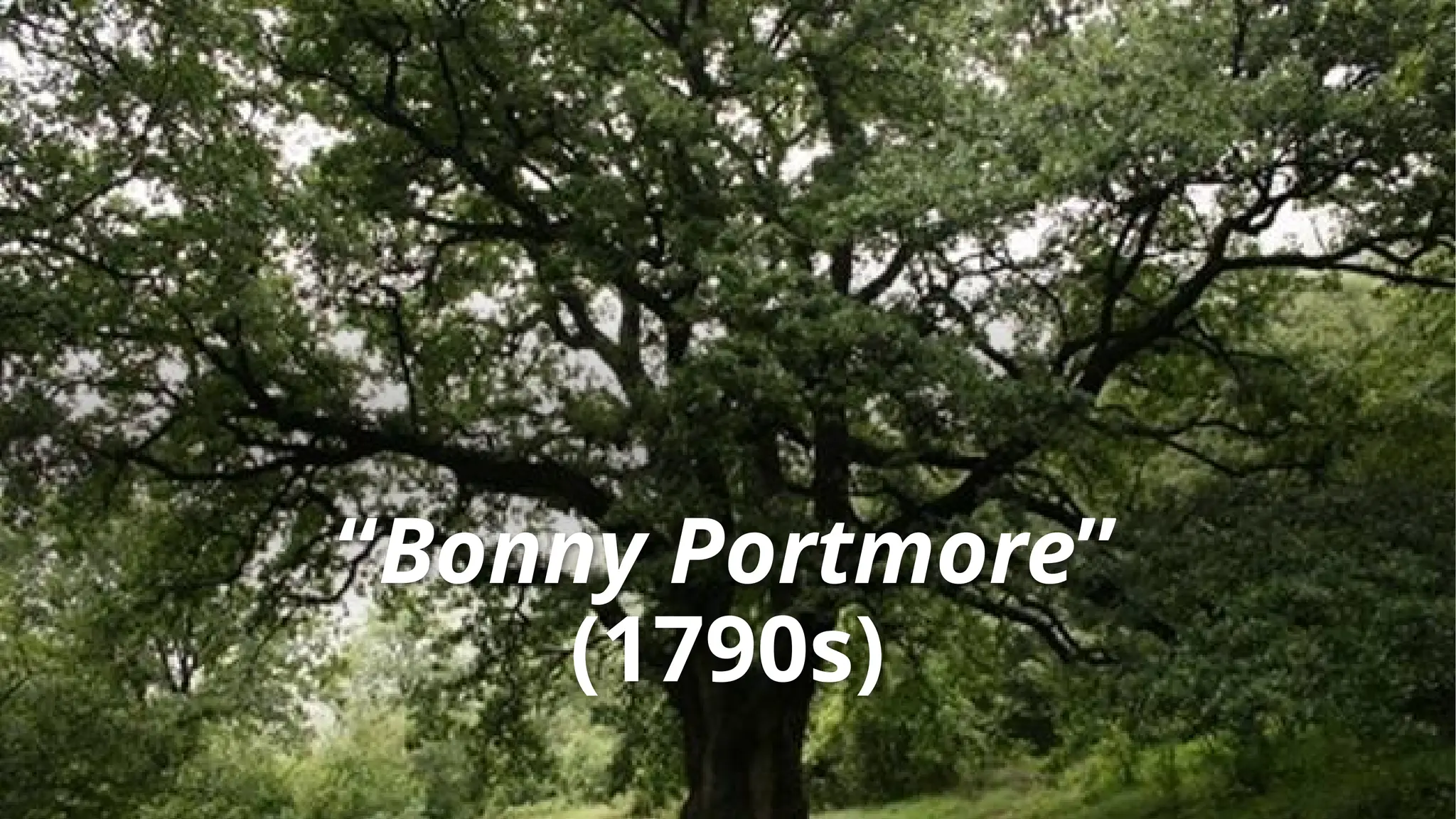
“Bonny Portmore”
(1790s)
Sustainability
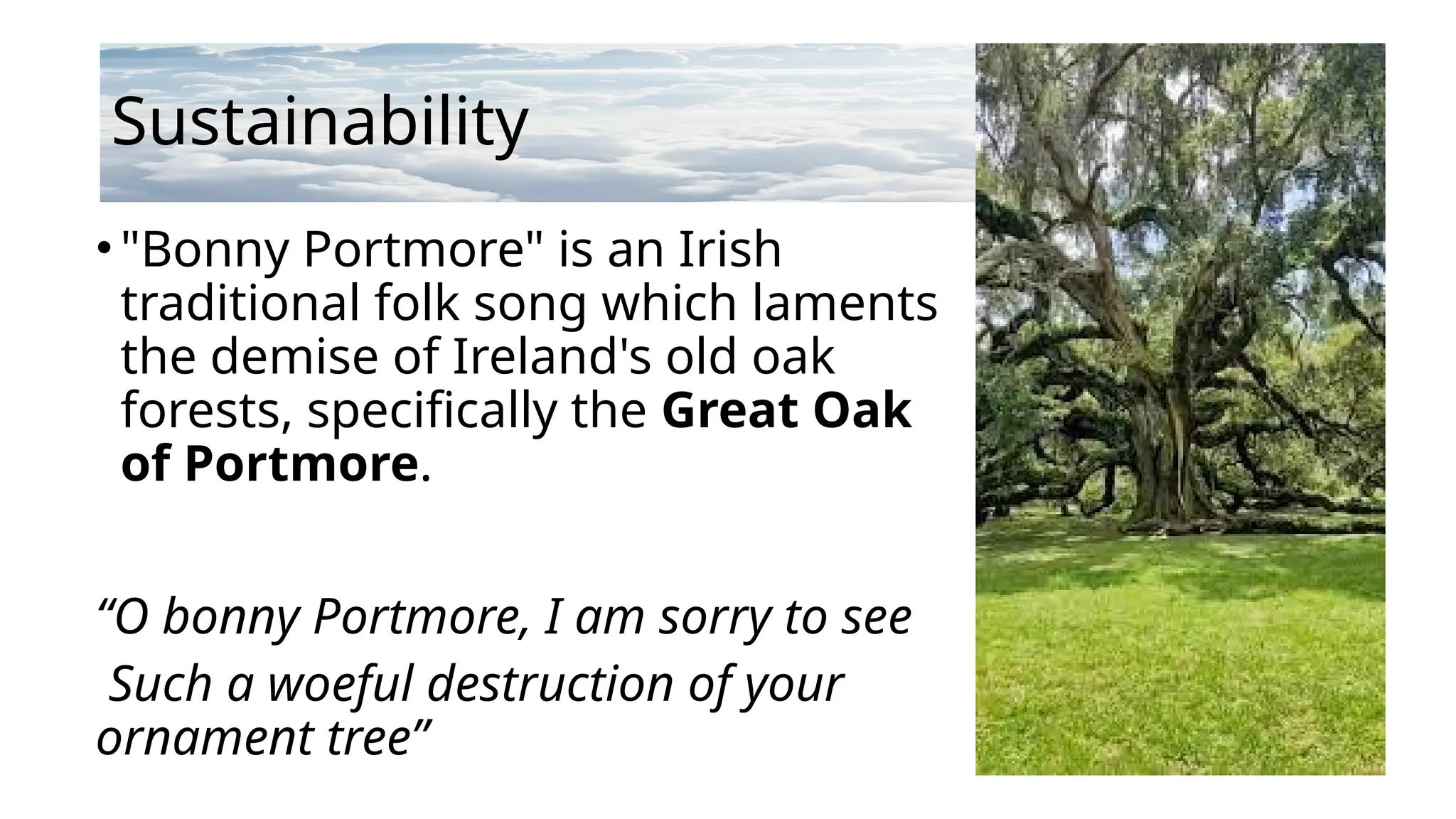
• "Bonny Portmore" is an Irish
traditional folk song which laments
the demise of Ireland's old oak
forests, specifically the Great Oak
of Portmore.
“O bonny Portmore, I am sorry to see
Such a woeful destruction of your
ornament tree”
Sustainability
• O bonny Portmore, you shine where you stand
And the more I think on you the more I think long
If I had you now as I had once before
All the lords in Old England would not purchase
Portmore.
• O bonny Portmore, I am sorry to see
Such a woeful destruction of your ornament tree
For it stood on your shore for many's the long day
Till the long boats from Antrim came to float it away.
• All the birds in the forest they bitterly weep
Saying, "Where shall we shelter or where shall we
sleep?"
For the Oak and the Ash, they are all cutten down
And the walls of bonny Portmore are all down to the
ground.
https://www.youtub
e.com/watch?v=Q3Y
qCu2Y_dM
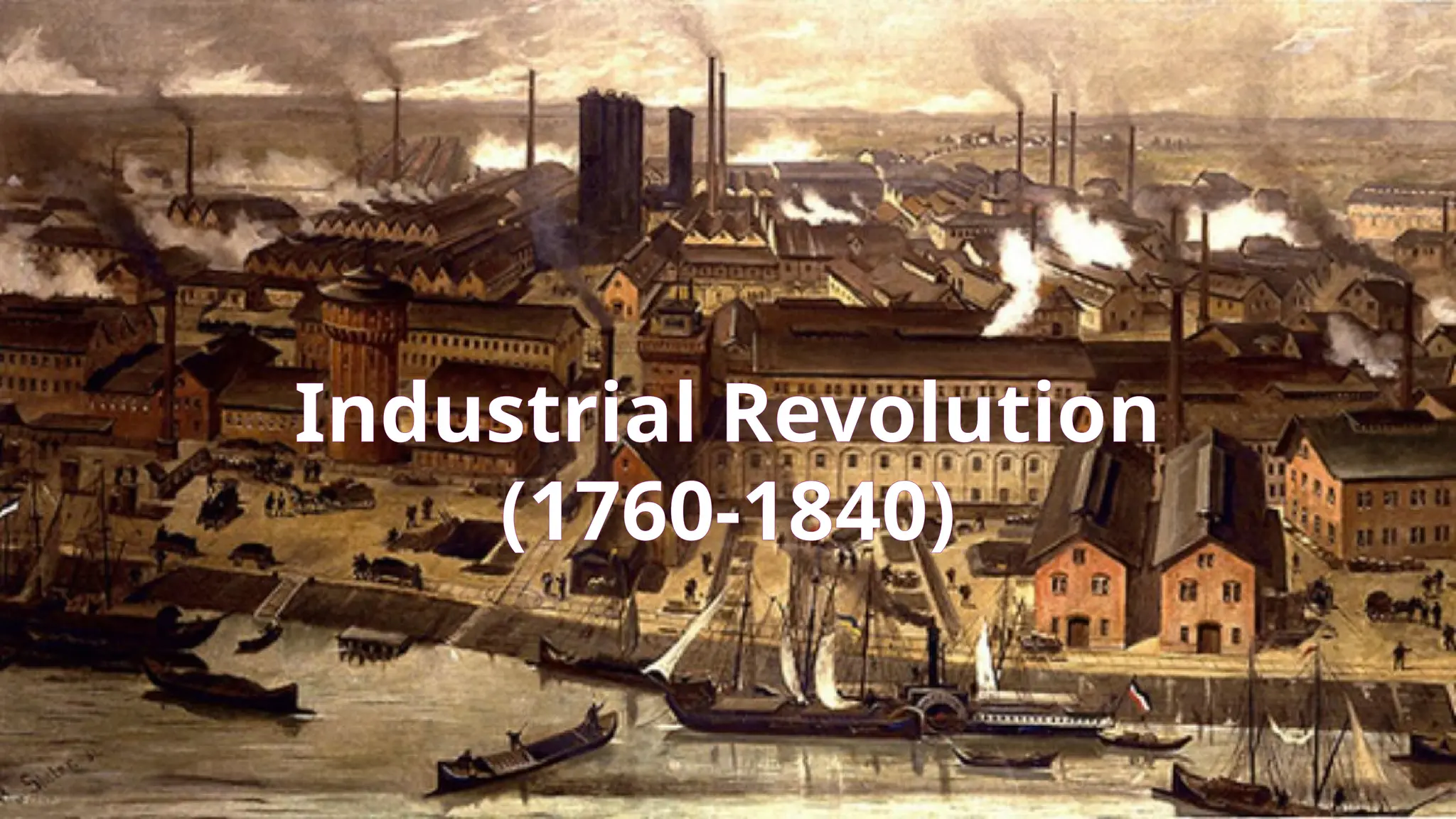
Industrial Revolution
(1760-1840)
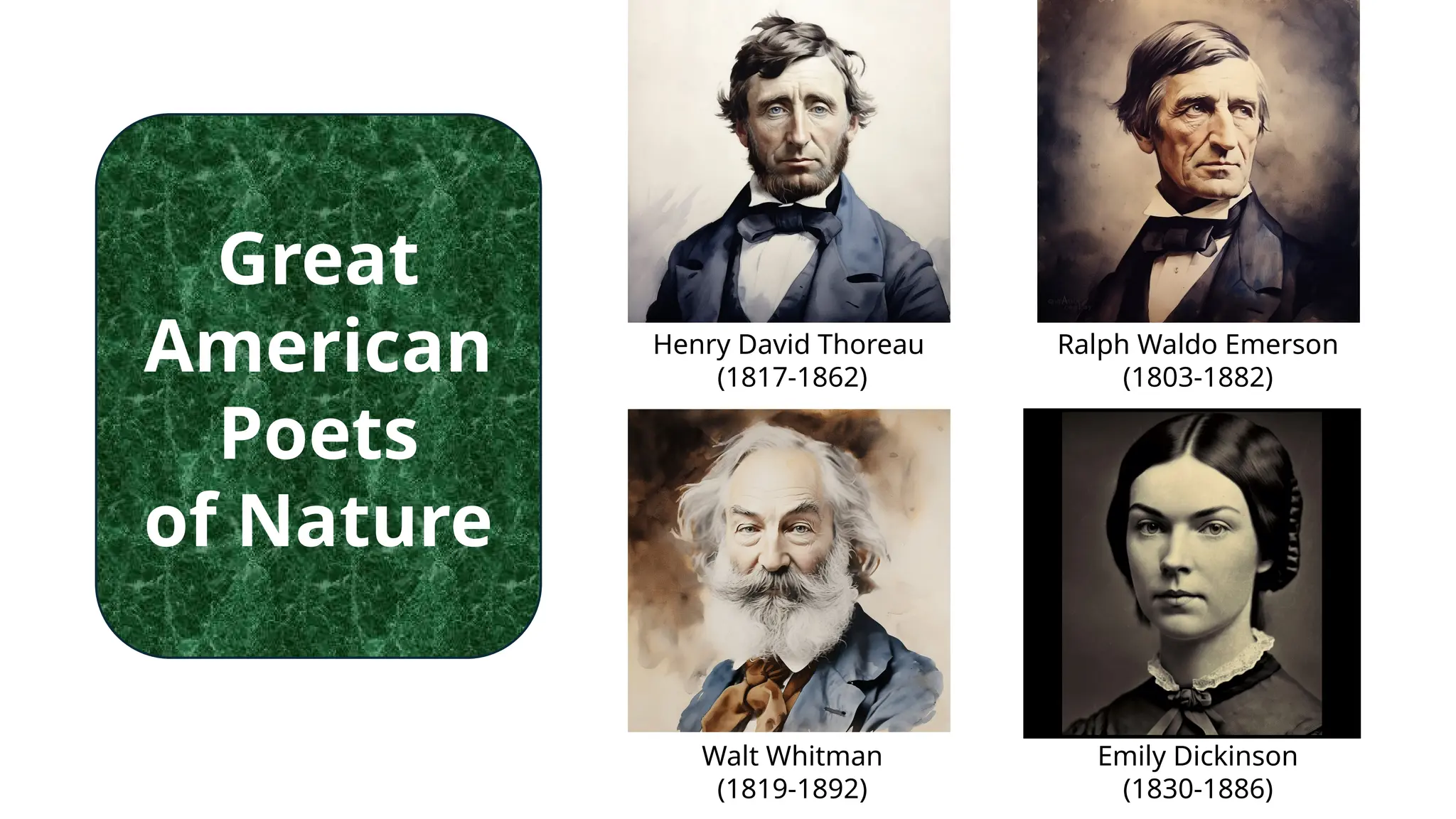
Henry David Thoreau
(1817-1862)
Ralph Waldo Emerson
(1803-1882)
Walt Whitman
(1819-1892)
Emily Dickinson
(1830-1886)
Great
American
Poets
of Nature
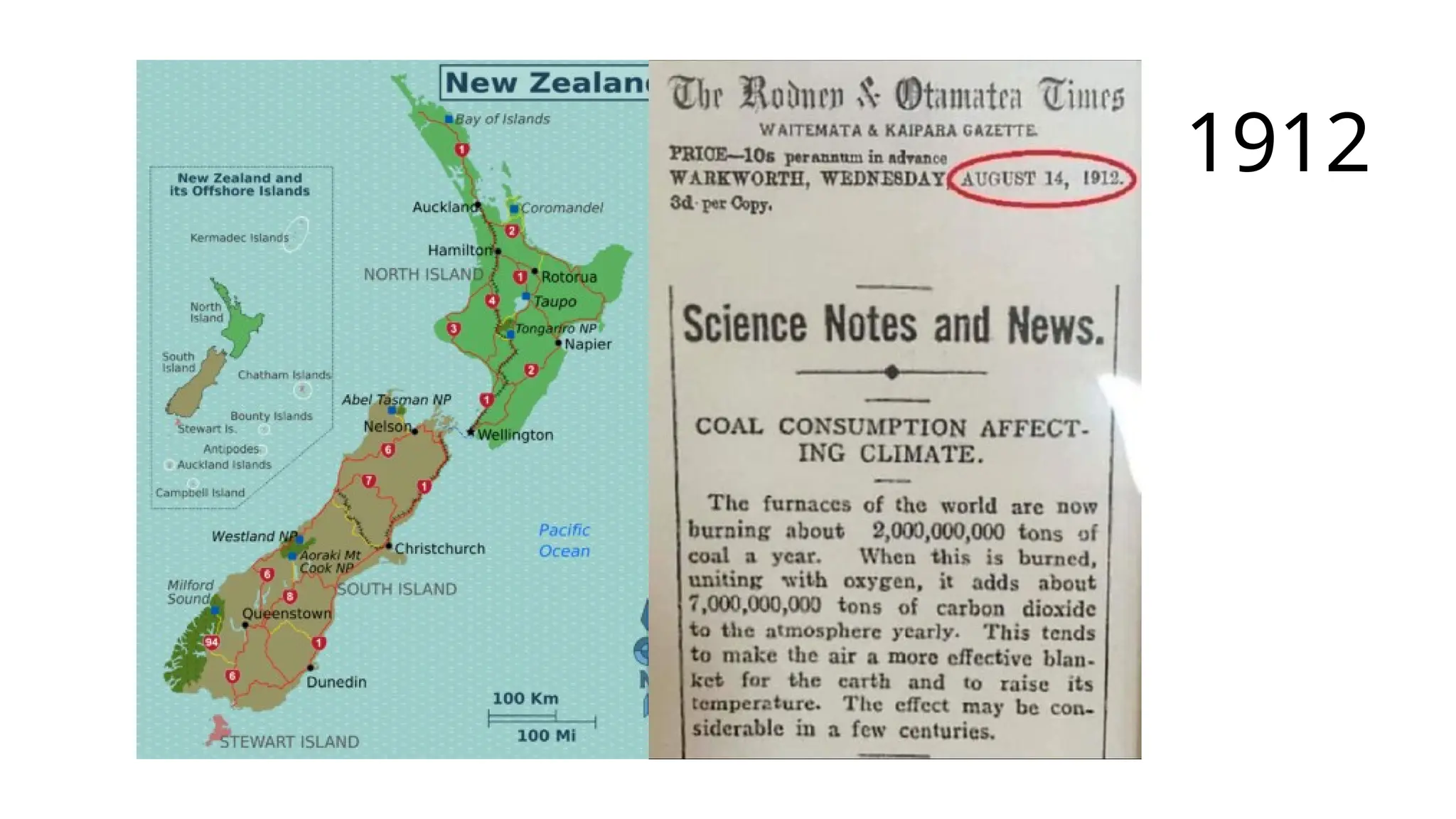
1912
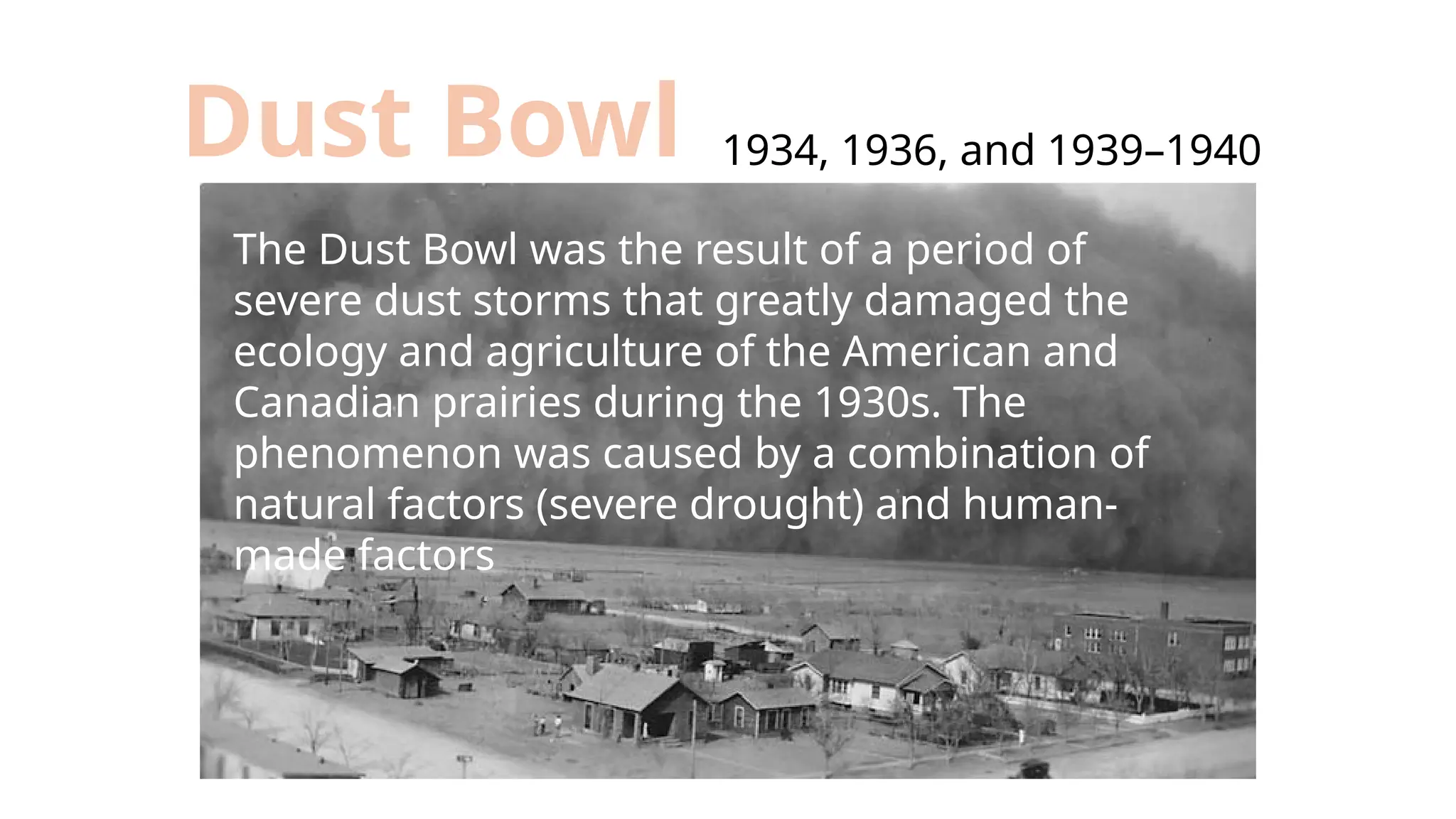
1934, 1936, and 1939–1940
Dust Bowl
The Dust Bowl was the result of a period of
severe dust storms that greatly damaged the
ecology and agriculture of the American and
Canadian prairies during the 1930s. The
phenomenon was caused by a combination of
natural factors (severe drought) and human-
made factors
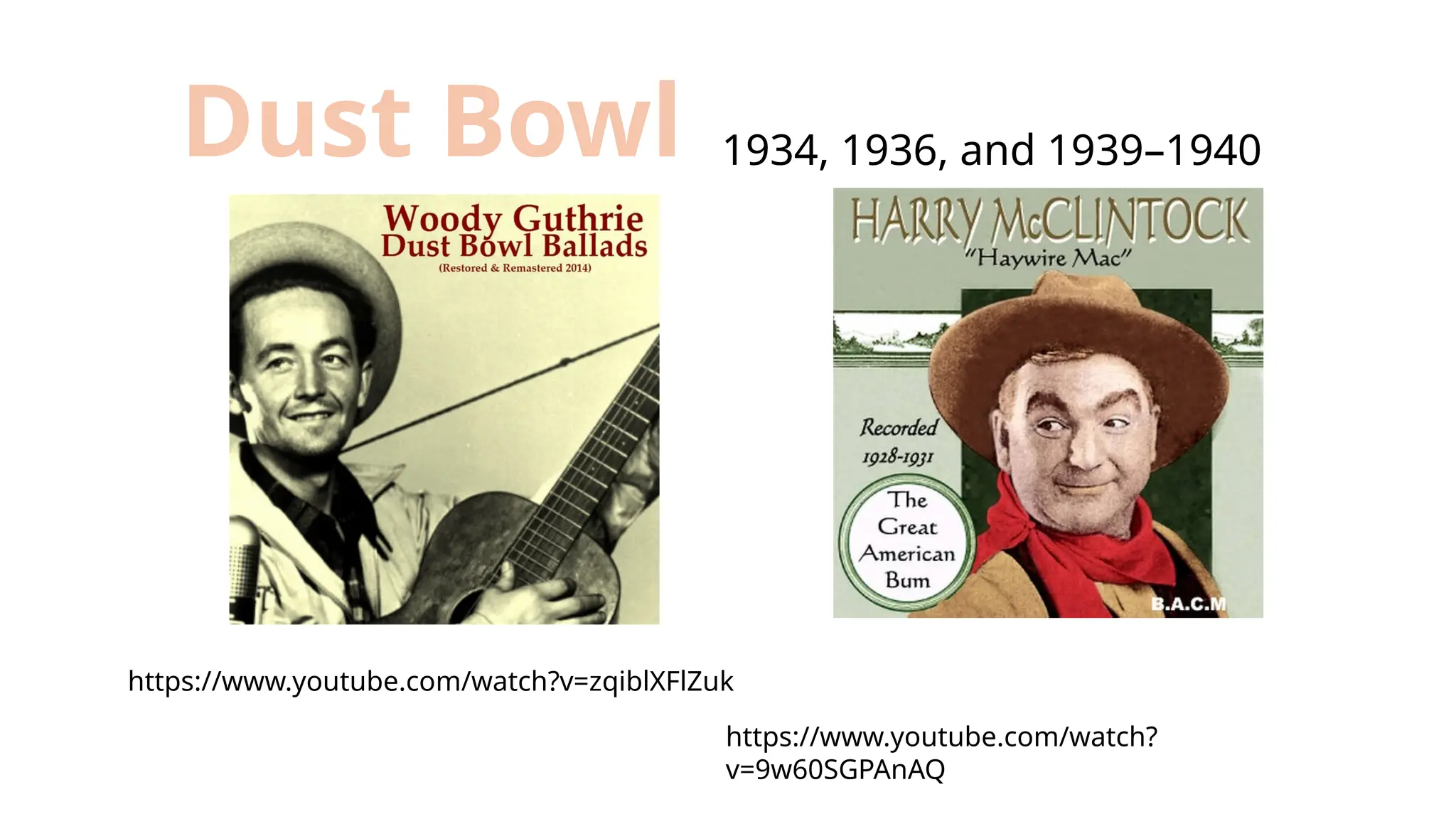
1934, 1936, and 1939–1940
Dust Bowl
https://www.youtube.com/watch?v=zqiblXFlZuk
https://www.youtube.com/watch?
v=9w60SGPAnAQ
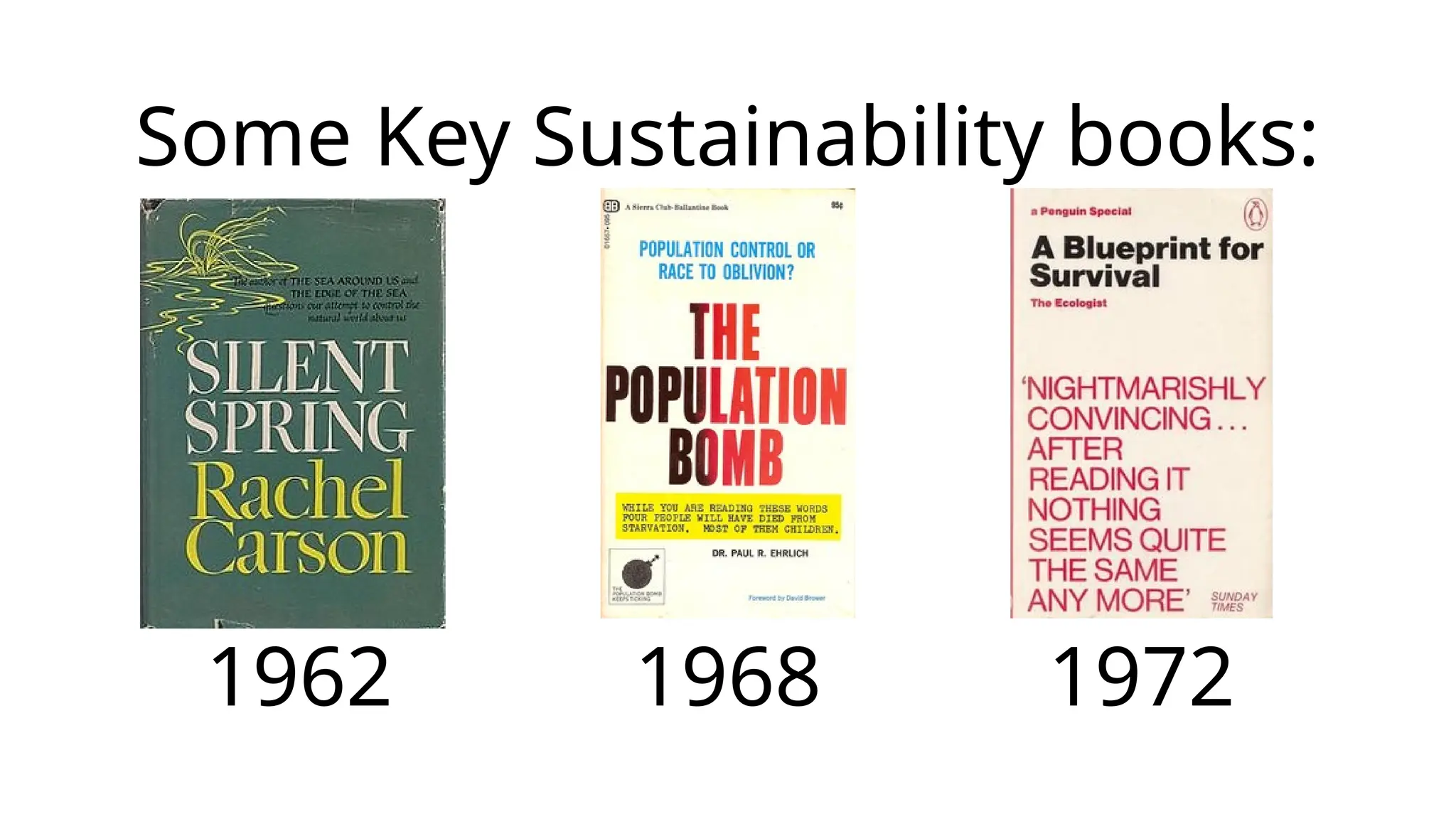
1962 1972
1968
Some Key Sustainability books:
1970
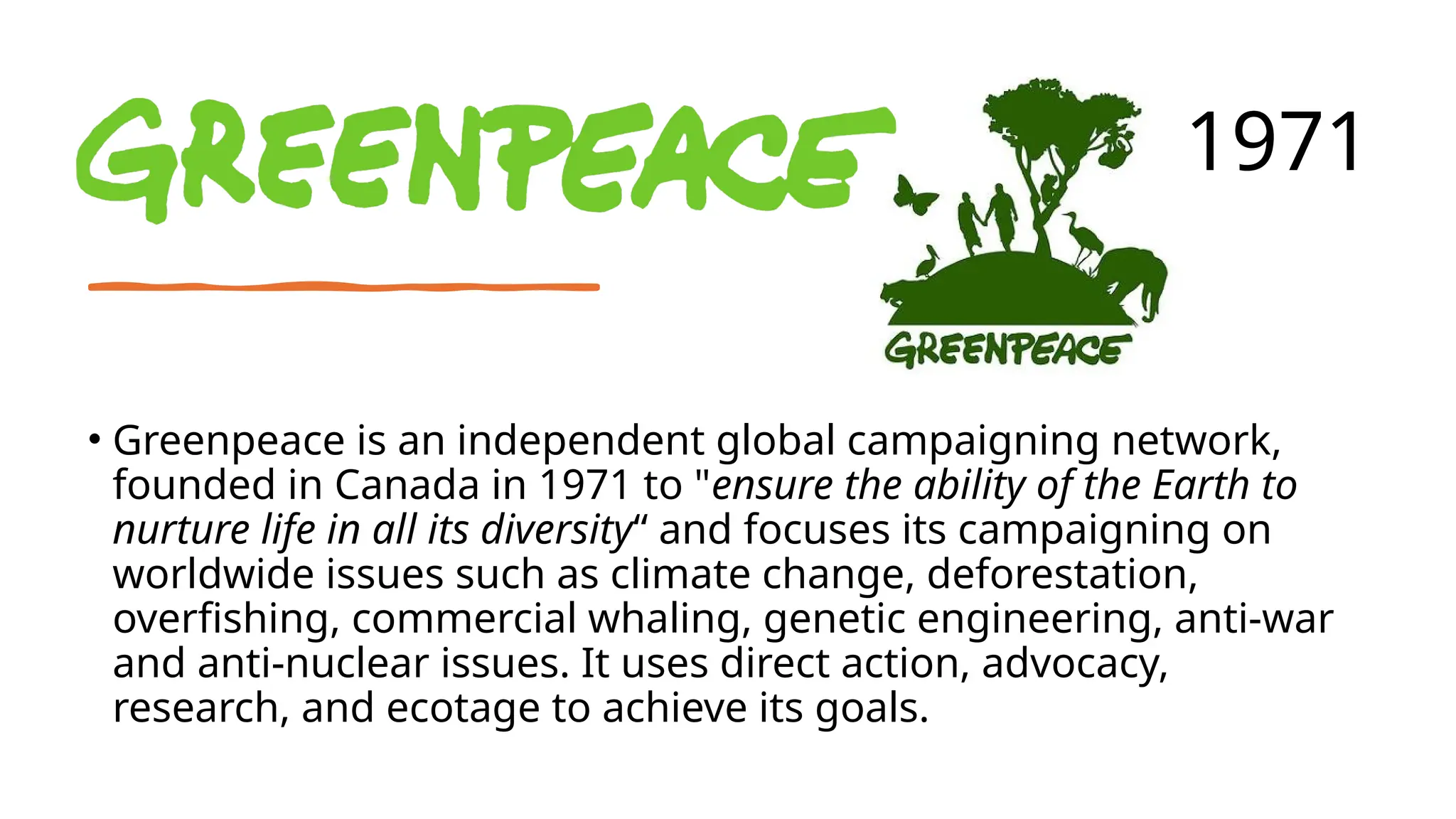
• Greenpeace is an independent global campaigning network,
founded in Canada in 1971 to "ensure the ability of the Earth to
nurture life in all its diversity“ and focuses its campaigning on
worldwide issues such as climate change, deforestation,
overfishing, commercial whaling, genetic engineering, anti-war
and anti-nuclear issues. It uses direct action, advocacy,
research, and ecotage to achieve its goals.
1971
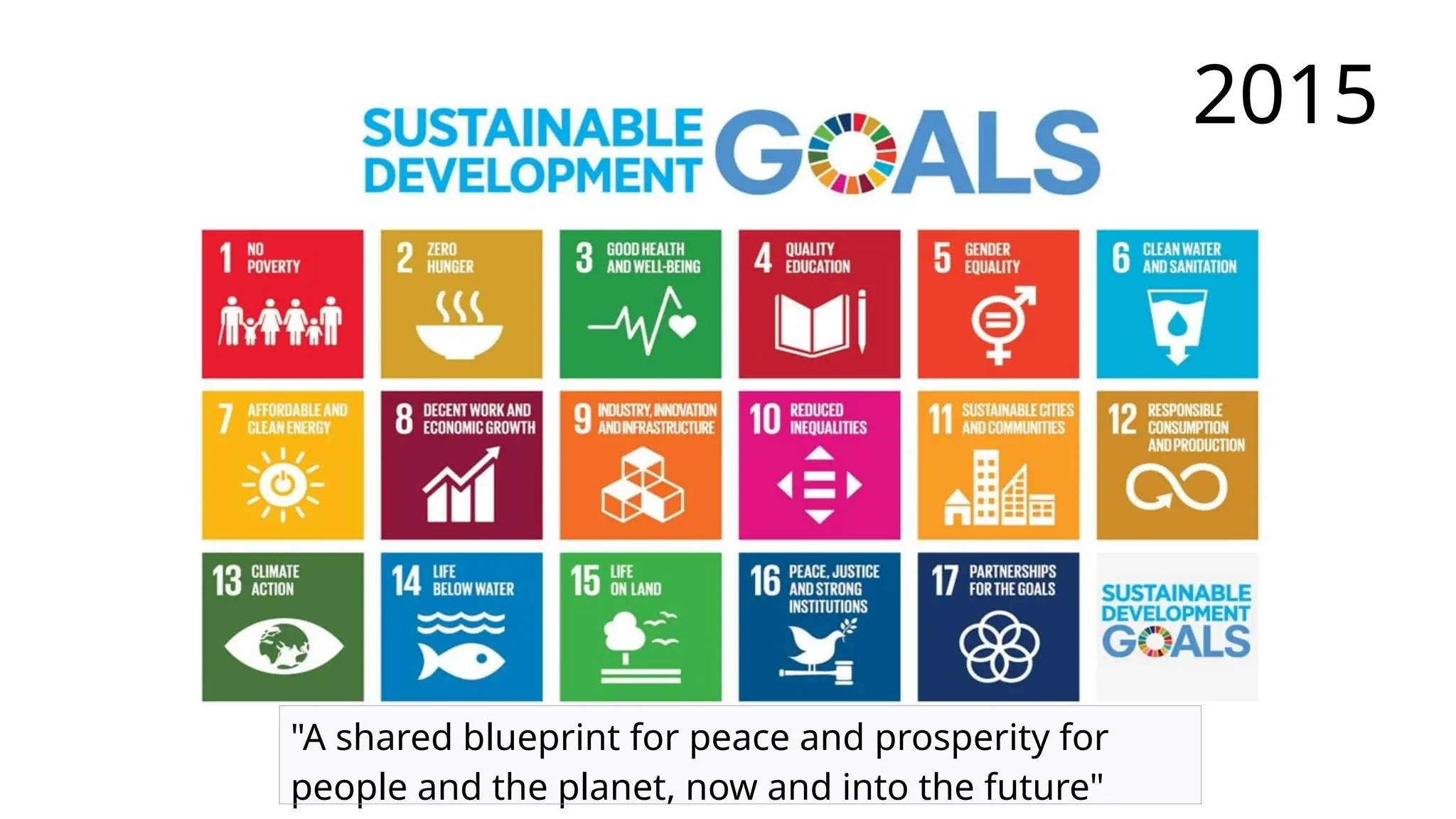
2015
"A shared blueprint for peace and prosperity for
people and the planet, now and into the future"
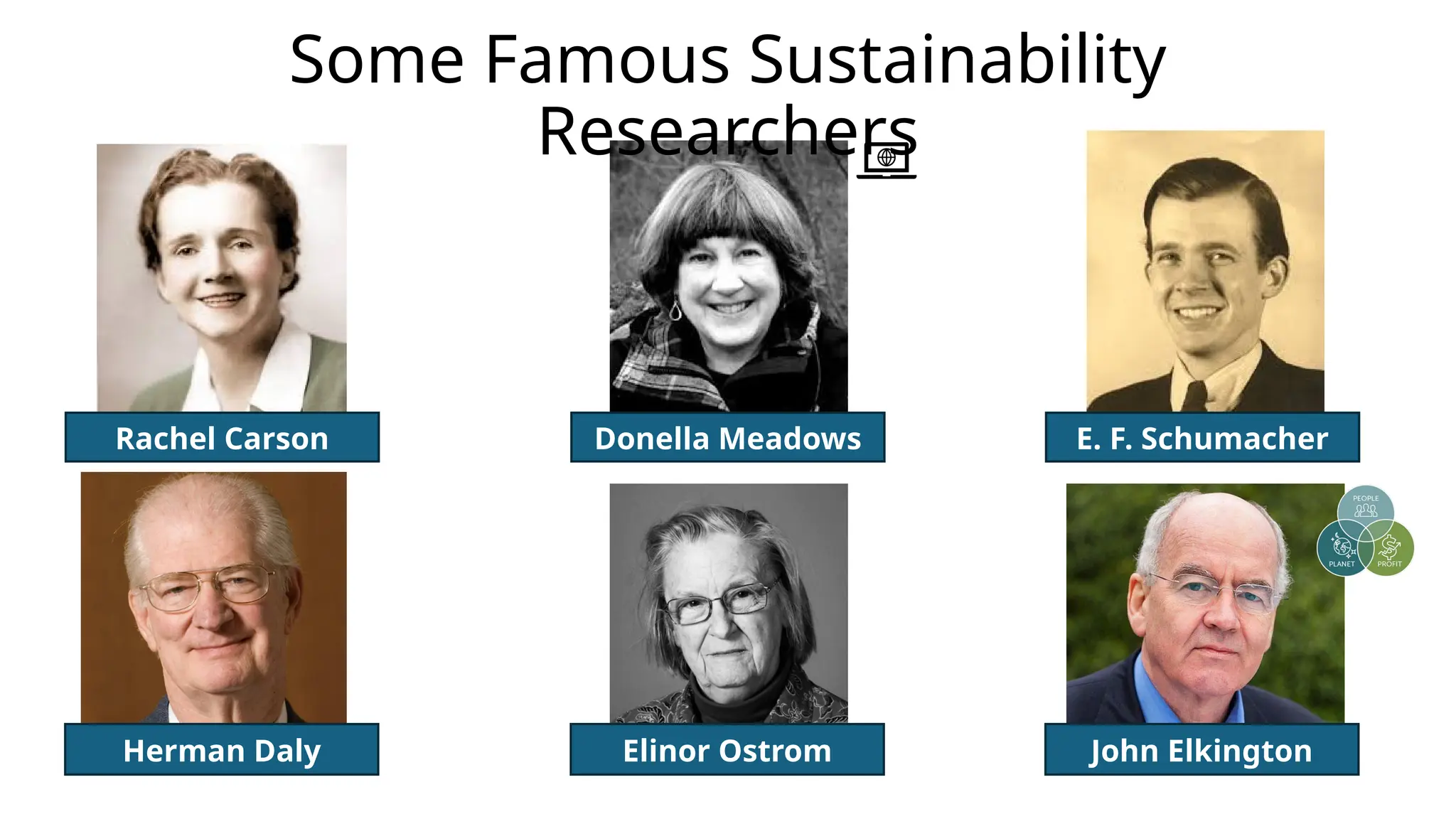
Rachel Carson
Herman Daly
Donella Meadows
Elinor Ostrom
E. F. Schumacher
John Elkington
Some Famous Sustainability
Researchers
Models of
Sustainability
Three Pillars of
Sustainability
Sustainability
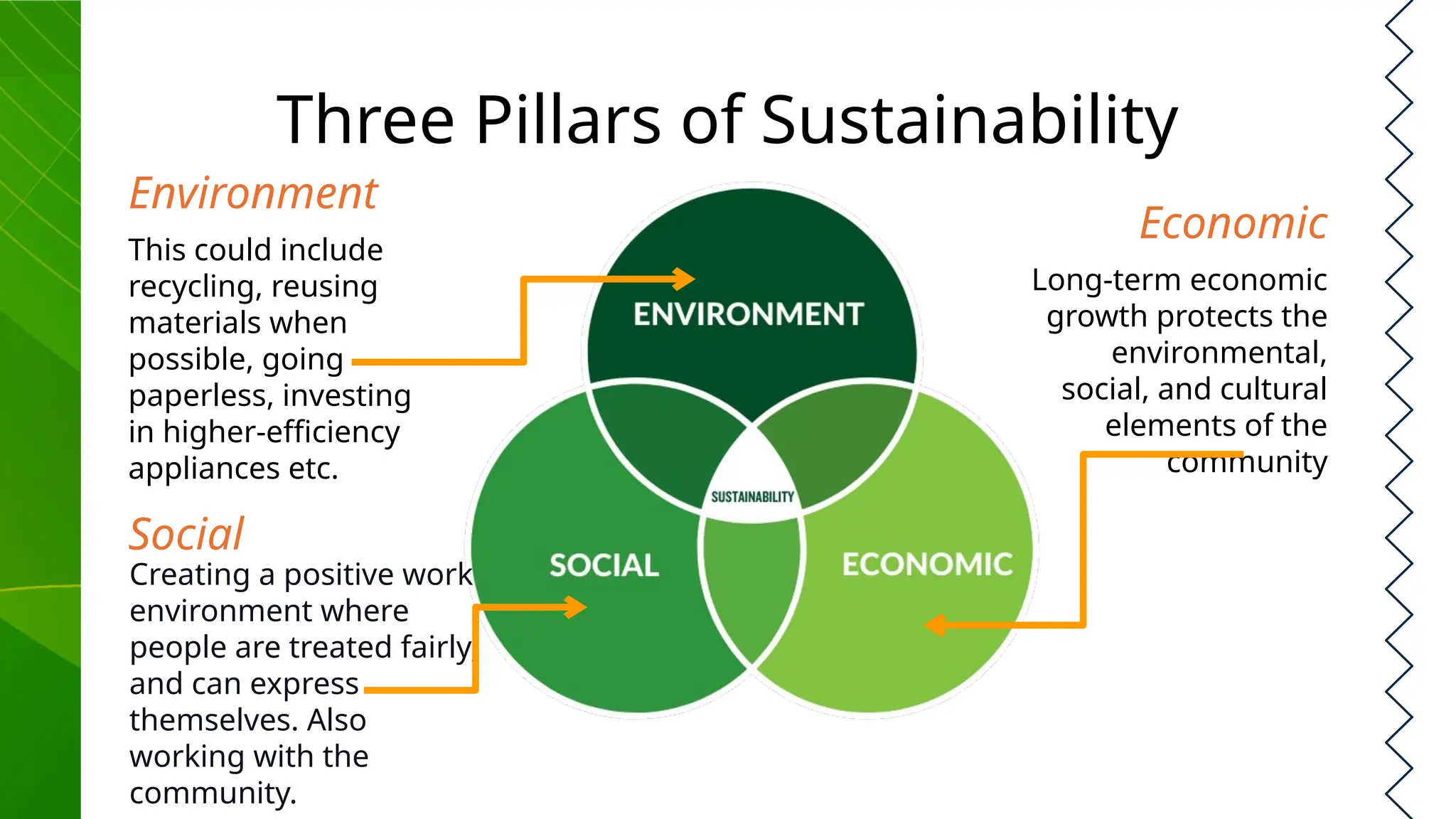
• The most common model of
sustainability is a three-pillar model:
•Environment
•Social
•Economic
•But the origins of this model are elusive.
Three Pillars of Sustainability
This could include
recycling, reusing
materials when
possible, going
paperless, investing
in higher-efficiency
appliances etc.
Long-term economic
growth protects the
environmental,
social, and cultural
elements of the
community
Creating a positive work
environment where
people are treated fairly,
and can express
themselves. Also
working with the
community.
Environment
Economic
Social
UN Sustainable Development
Goals
Sustainability
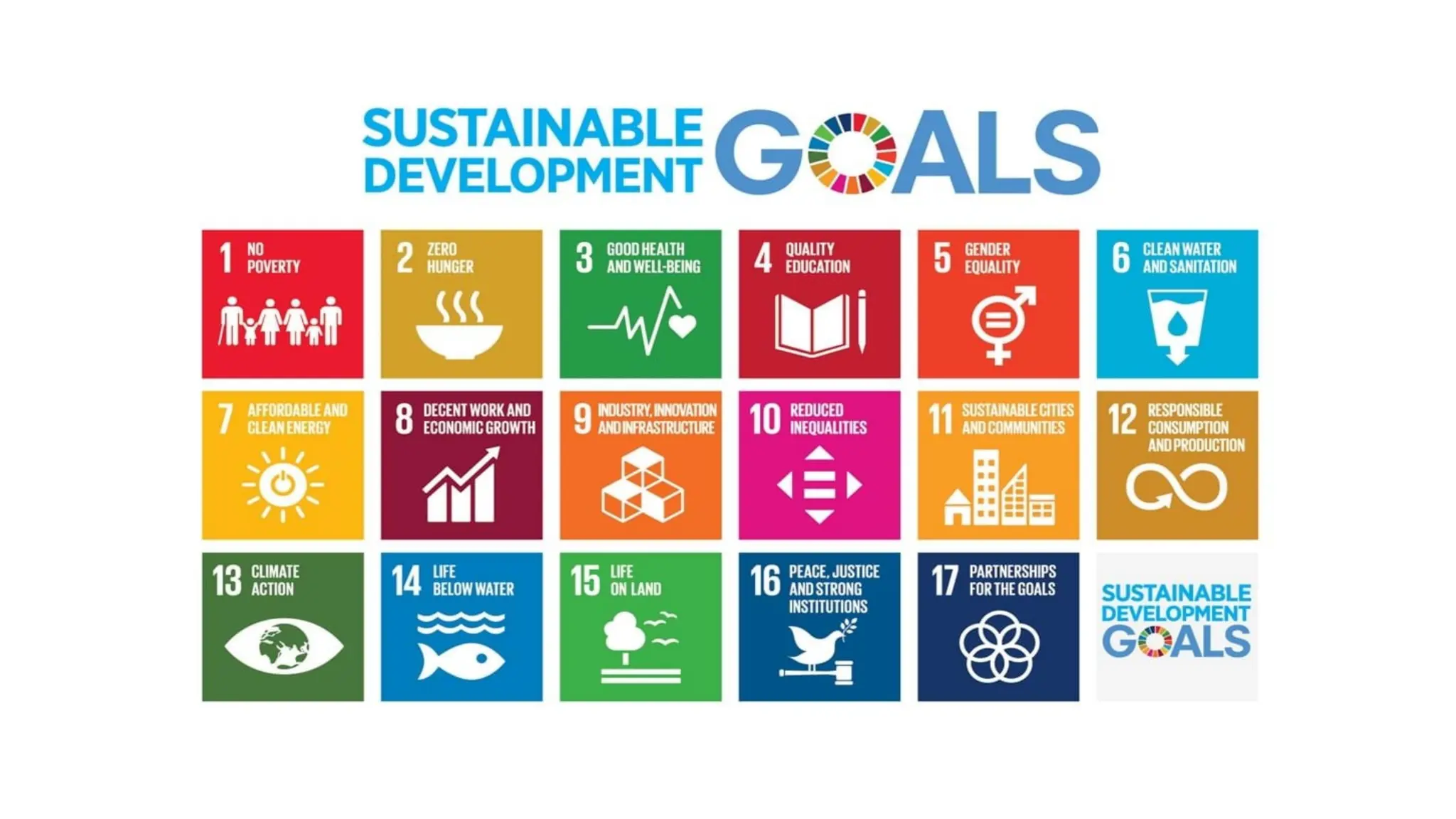
•The 2030 Agenda for Sustainable
Development, adopted by all United
Nations members in 2015, created 17 world
Sustainable Development Goals (SDGs).
•The aim of these global goals is "peace and
prosperity for people and the planet" –
while tackling climate change and working
to preserve oceans and forests.
Sustainability
•The SDGs highlight the connections
between the environmental, social and
economic aspects of sustainable
development. Sustainability is at the
center of the SDGs, as the term
sustainable development implies.
UN Sustainable Development Goals
•Website: https://sdgs.un.org/goals
•Let’s look at each goal, one at a time,
and spend a few minutes thinking
about how computers can help
support each goal…
UN Sustainable Development Goals
•1. No Poverty:
•End poverty in all its forms
everywhere.
UN Sustainable Development Goals
•2. Zero Hunger:
•End hunger, achieve food security and
improved nutrition, and promote
sustainable agriculture.
UN Sustainable Development Goals
•3. Good Health and Well-being:
•Ensure healthy lives and promote
well-being for all at all ages.
UN Sustainable Development Goals
•4. Quality Education:
•Ensure inclusive and equitable quality
education and promote lifelong
learning opportunities for all.
UN Sustainable Development Goals
•5. Gender Equality:
•Achieve gender equality and empower
all women and girls.
UN Sustainable Development Goals
•6. Clean Water and Sanitation:
•Ensure availability and sustainable
management of water and sanitation
for all.
UN Sustainable Development Goals
•7. Affordable and Clean Energy:
•Ensure access to affordable, reliable,
sustainable, and modern energy for
all.
UN Sustainable Development Goals
•8. Decent Work and Economic Growth:
•Promote sustained, inclusive, and
sustainable economic growth, full and
productive employment, and decent
work for all.
UN Sustainable Development Goals
•9. Industry, Innovation, and
Infrastructure:
•Build resilient infrastructure, promote
inclusive and sustainable
industrialization, and foster innovation.
UN Sustainable Development Goals
•10. Reduced Inequality:
•Reduce inequality within and among
countries.
UN Sustainable Development Goals
•11. Sustainable Cities and
Communities:
•Make cities and human settlements
inclusive, safe, resilient, and sustainable.
UN Sustainable Development Goals
•12. Responsible Consumption and
Production:
•Ensure sustainable consumption and
production patterns.
UN Sustainable Development Goals
•13. Climate Action:
•Take urgent action to combat climate
change and its impacts.
UN Sustainable Development Goals
•14. Life Below Water:
•Conserve and sustainably use the
oceans, seas, and marine resources
for sustainable development.
UN Sustainable Development Goals
•15. Life on Land:
•Protect, restore, and promote sustainable use
of terrestrial ecosystems, manage forests,
combat desertification, and halt and reverse
land degradation and halt biodiversity loss.
UN Sustainable Development Goals
•16. Peace, Justice, and Strong Institutions:
•Promote peaceful and inclusive societies for
sustainable development, provide access to
justice for all, and build effective, accountable,
and inclusive institutions at all levels.
UN Sustainable Development Goals
•17. Partnerships for the Goals:
•Strengthen the means of
implementation and revitalize the global
partnership for sustainable
development.
The LASERS Model
UN Sustainable Development Goals
•The LASERS model was developed by Damian
Gordon, TU Dublin, and was first published in the
following venue:
• Gordon, D. (2024), “The Lasers Model: Developing a
Comprehensive Framework for Modelling "Tech for Good"”,
17th Annual International Conference of Education, Research and
Innovation (ICERI), Seville, Spain, 11th-13th of November 2024.
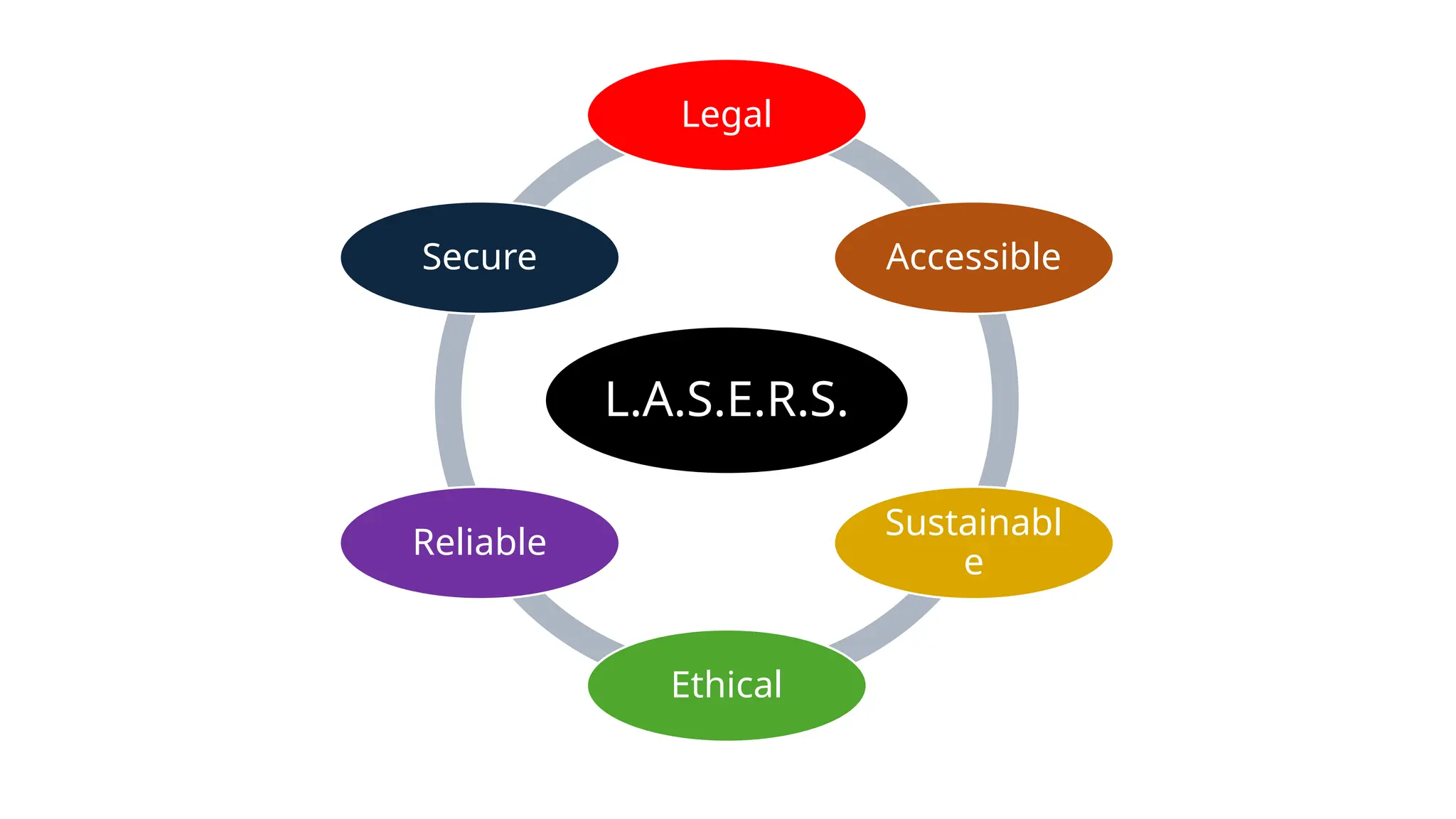
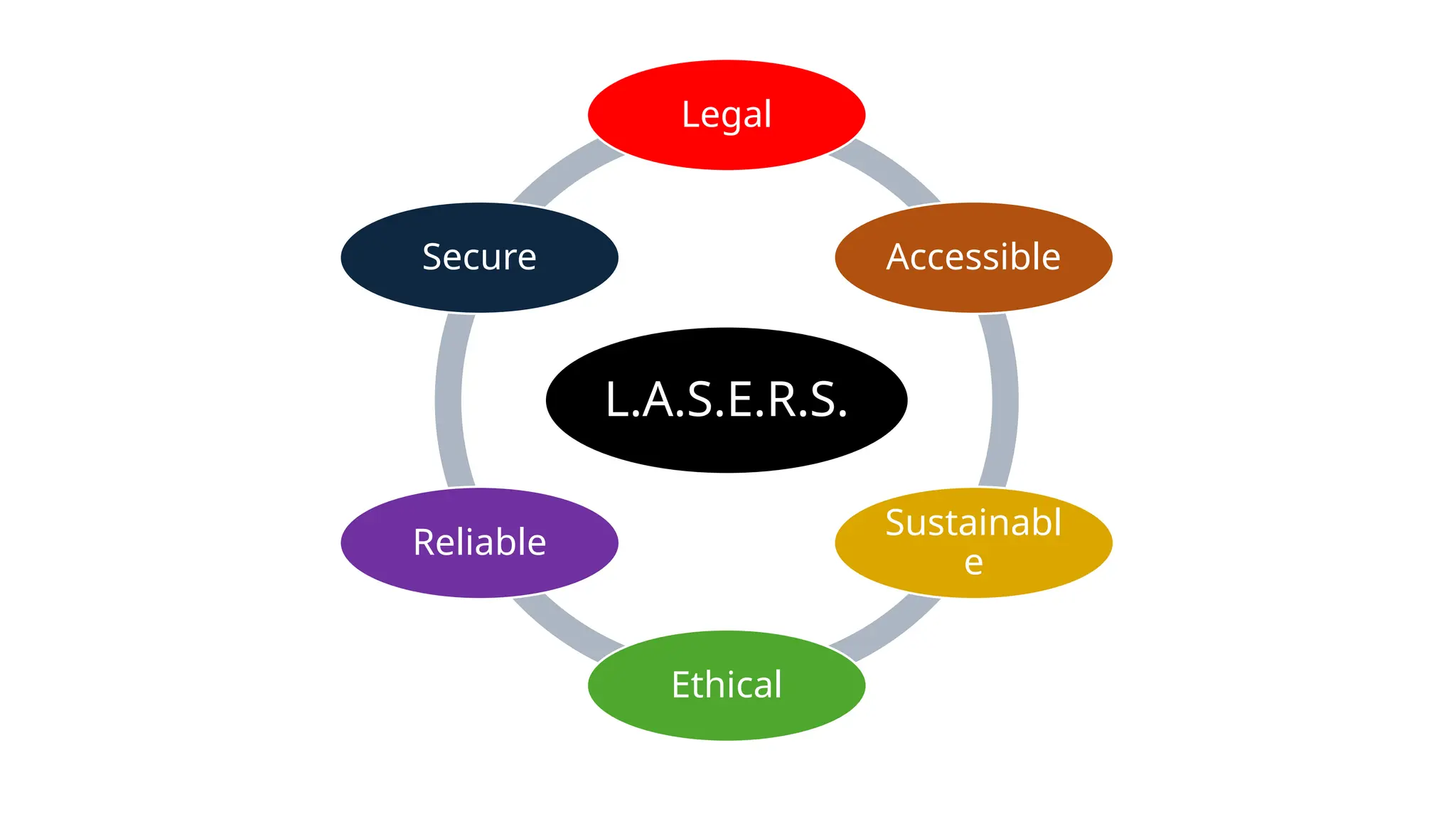
L.A.S.E.R.S.
Legal
Accessible
Sustainabl
e
Ethical
Reliable
Secure
The LASERS Model
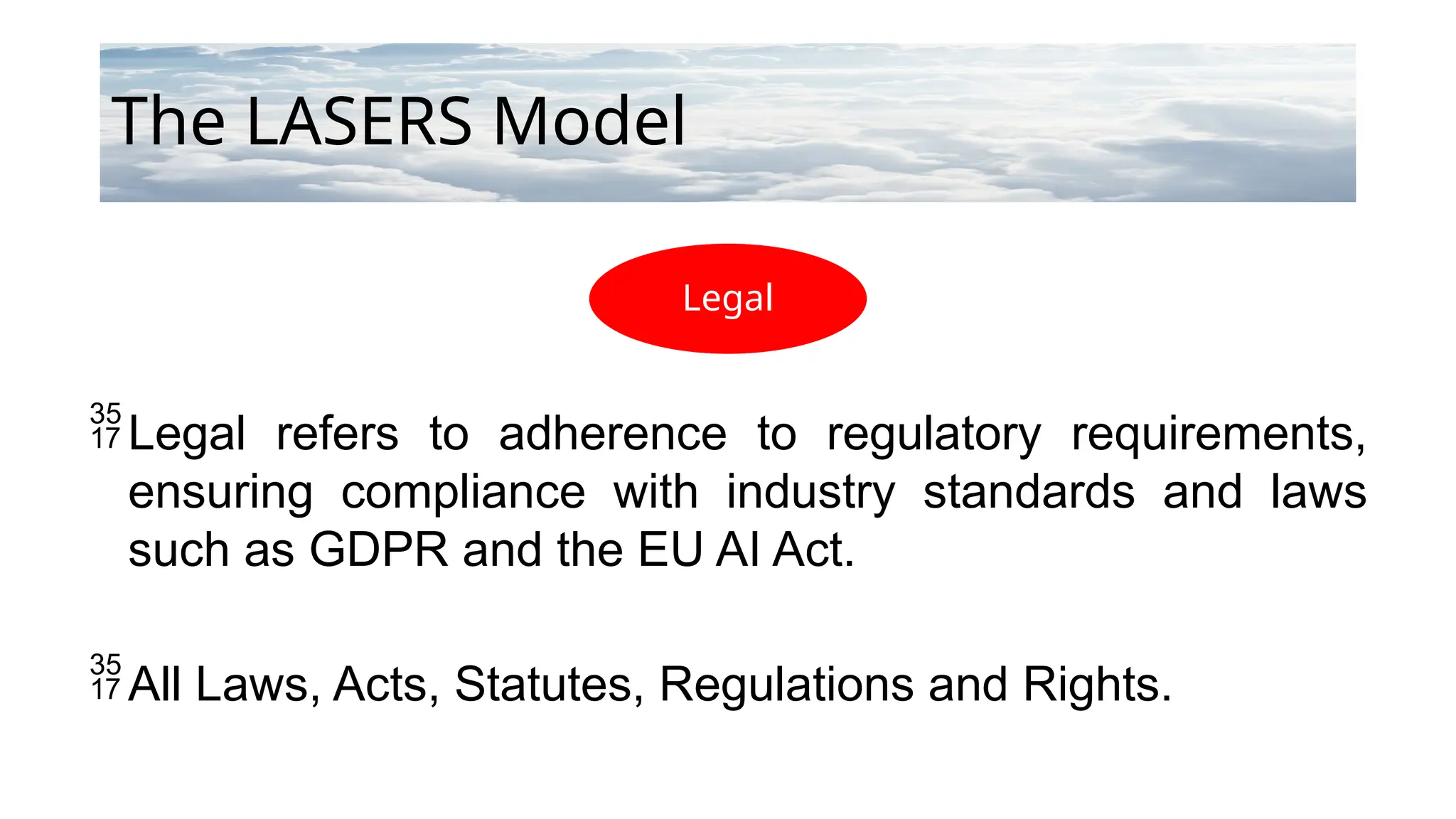
Legal refers to adherence to regulatory requirements,
ensuring compliance with industry standards and laws
such as GDPR and the EU AI Act.
All Laws, Acts, Statutes, Regulations and Rights.
Legal
Accessible
The LASERS Model
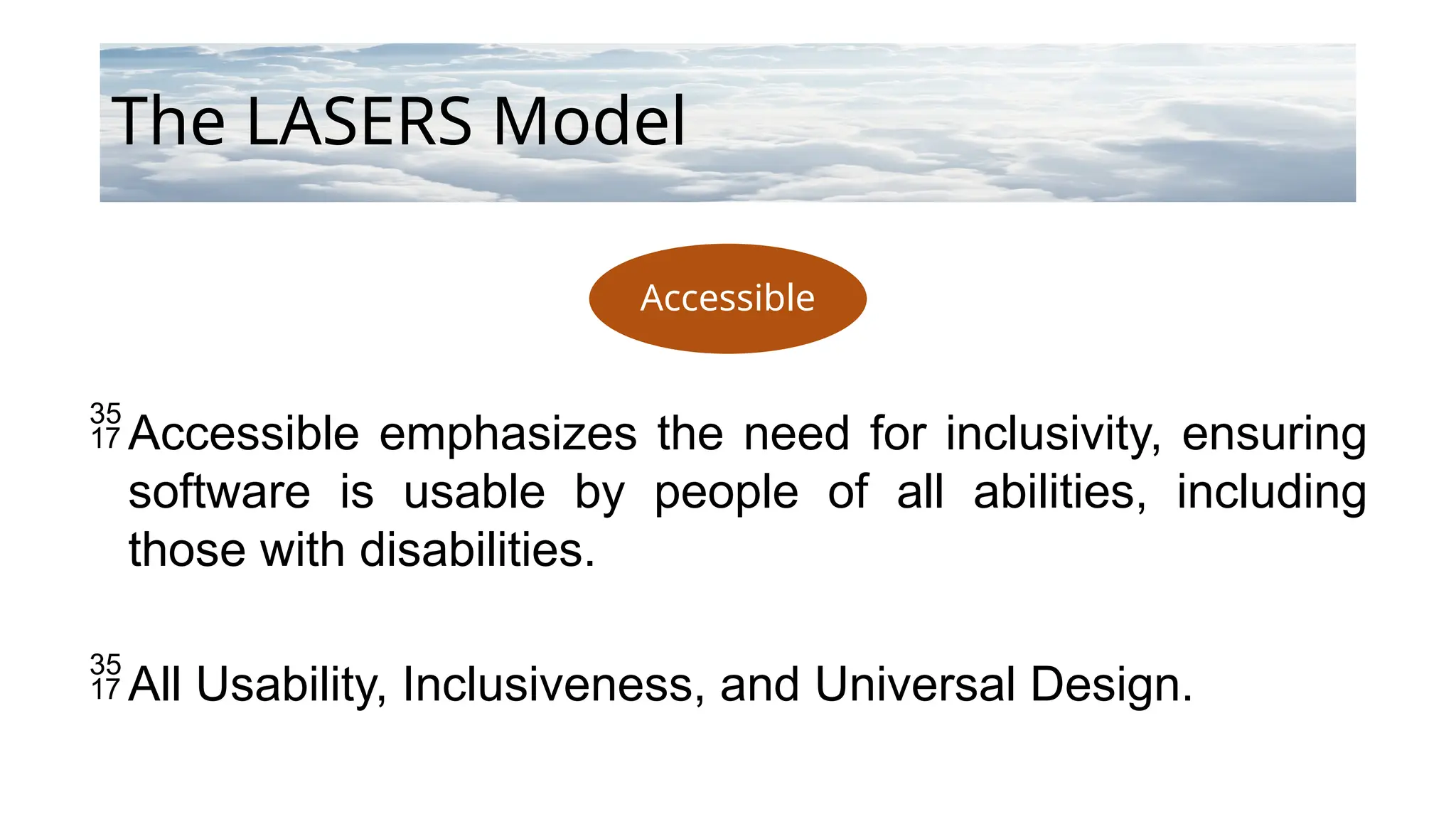
Accessible emphasizes the need for inclusivity, ensuring
software is usable by people of all abilities, including
those with disabilities.
All Usability, Inclusiveness, and Universal Design.
Sustainabl
e
The LASERS Model
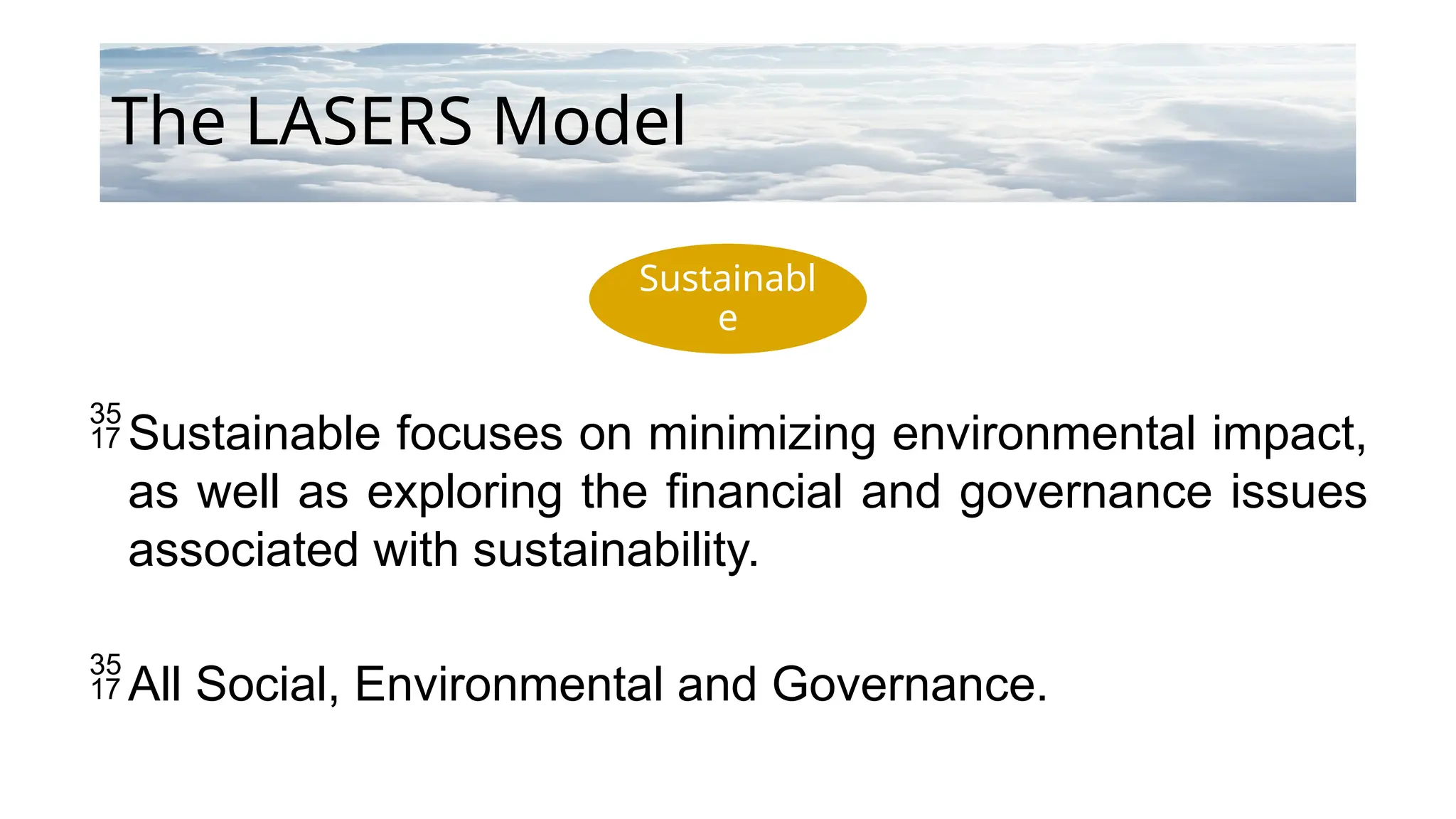
Sustainable focuses on minimizing environmental impact,
as well as exploring the financial and governance issues
associated with sustainability.
All Social, Environmental and Governance.
Ethical
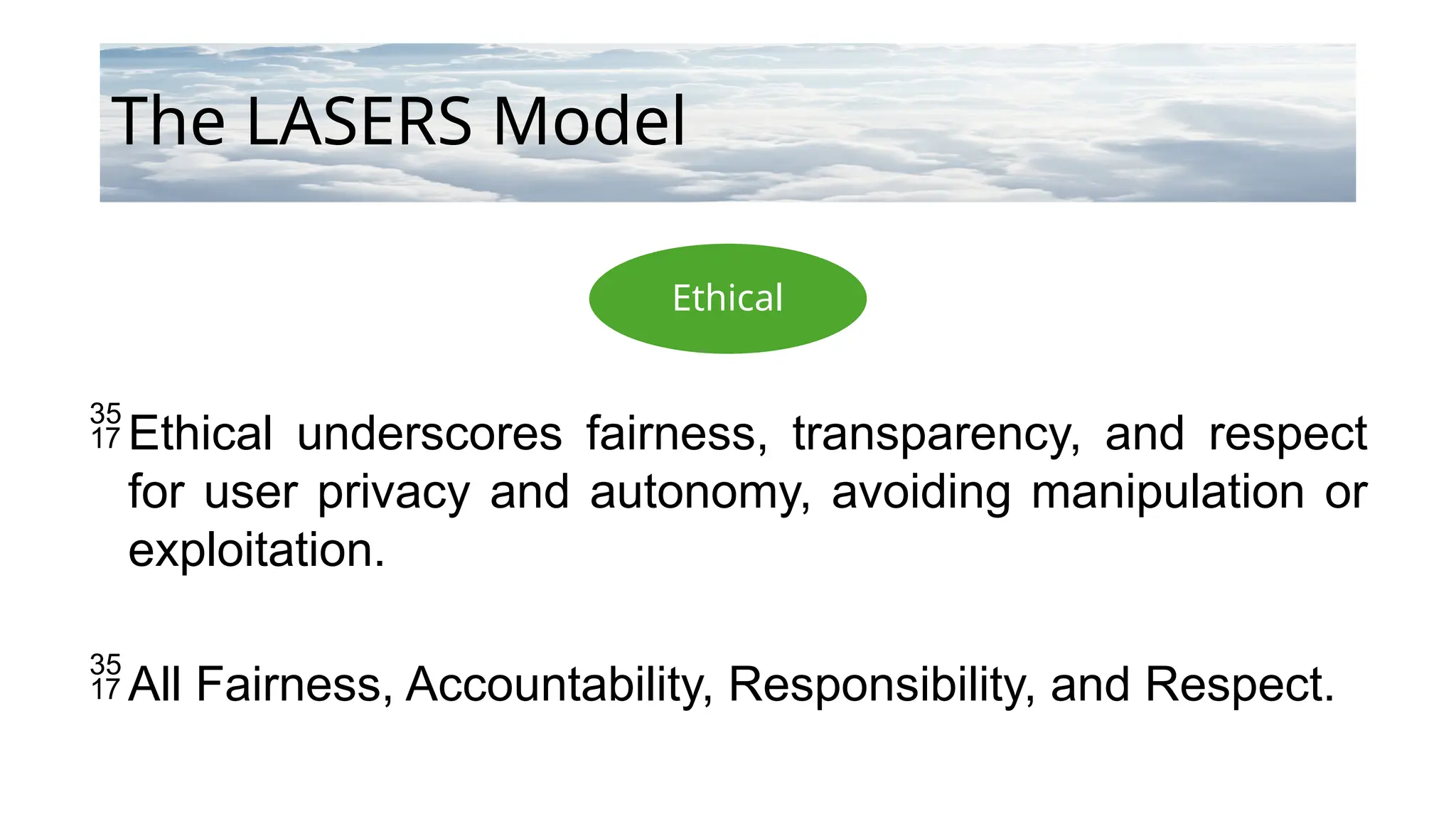
The LASERS Model
Ethical underscores fairness, transparency, and respect
for user privacy and autonomy, avoiding manipulation or
exploitation.
All Fairness, Accountability, Responsibility, and Respect.
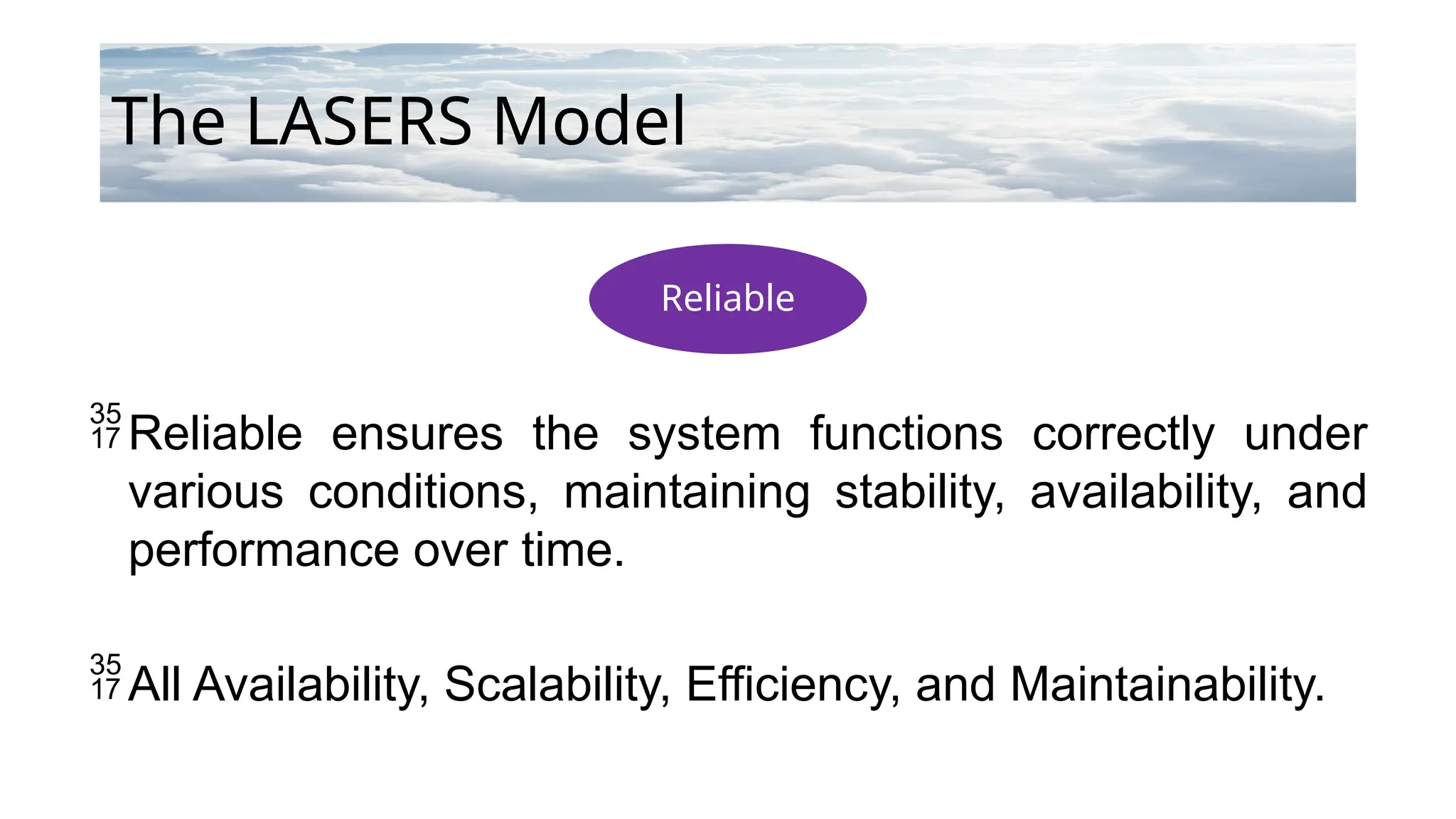
Reliable
The LASERS Model
Reliable ensures the system functions correctly under
various conditions, maintaining stability, availability, and
performance over time.
All Availability, Scalability, Efficiency, and Maintainability.
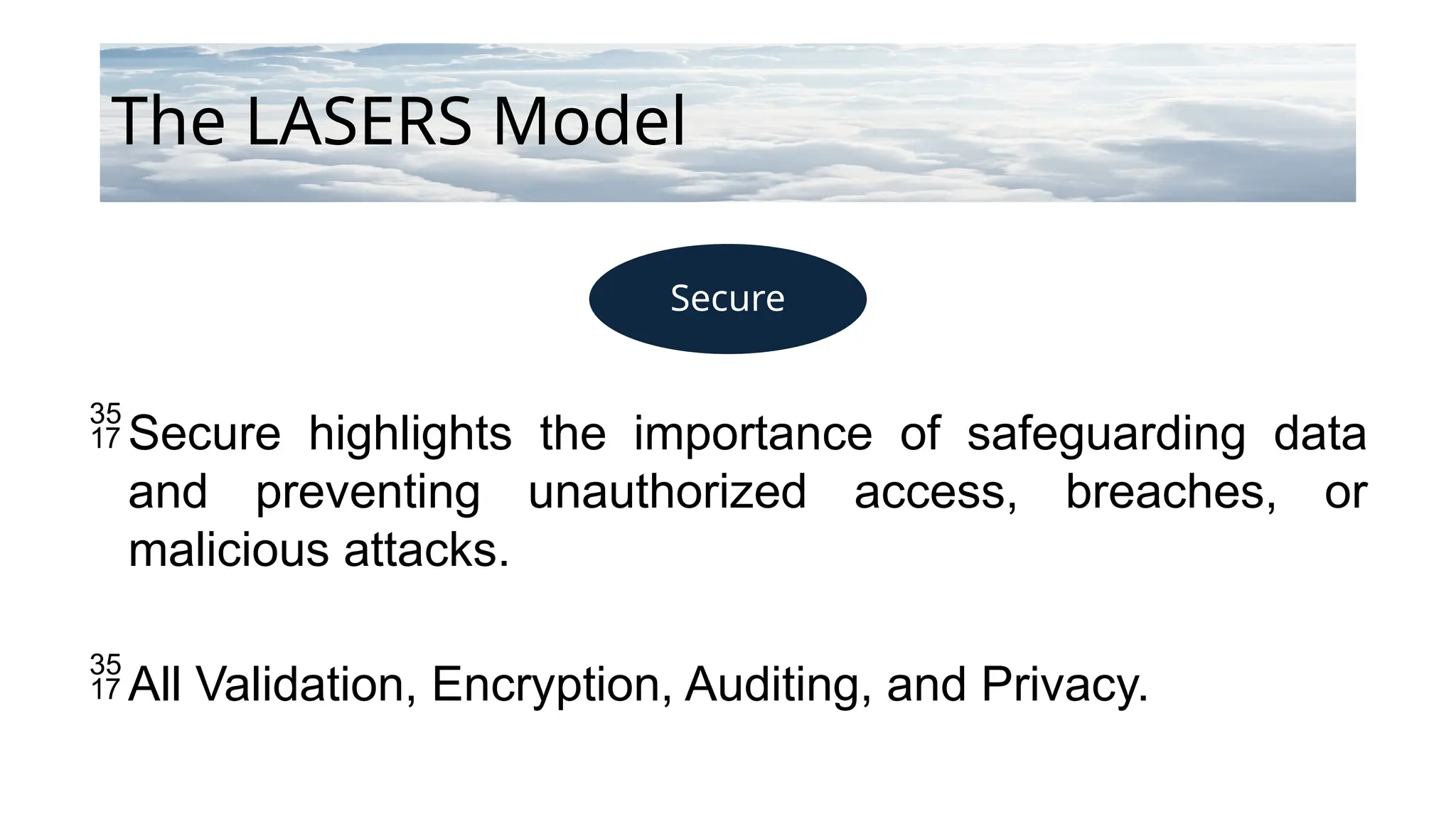
Secure
The LASERS Model
Secure highlights the importance of safeguarding data
and preventing unauthorized access, breaches, or
malicious attacks.
All Validation, Encryption, Auditing, and Privacy.
L.A.S.E.R.S.
Legal
Accessible
Sustainabl
e
Ethical
Reliable
Secure
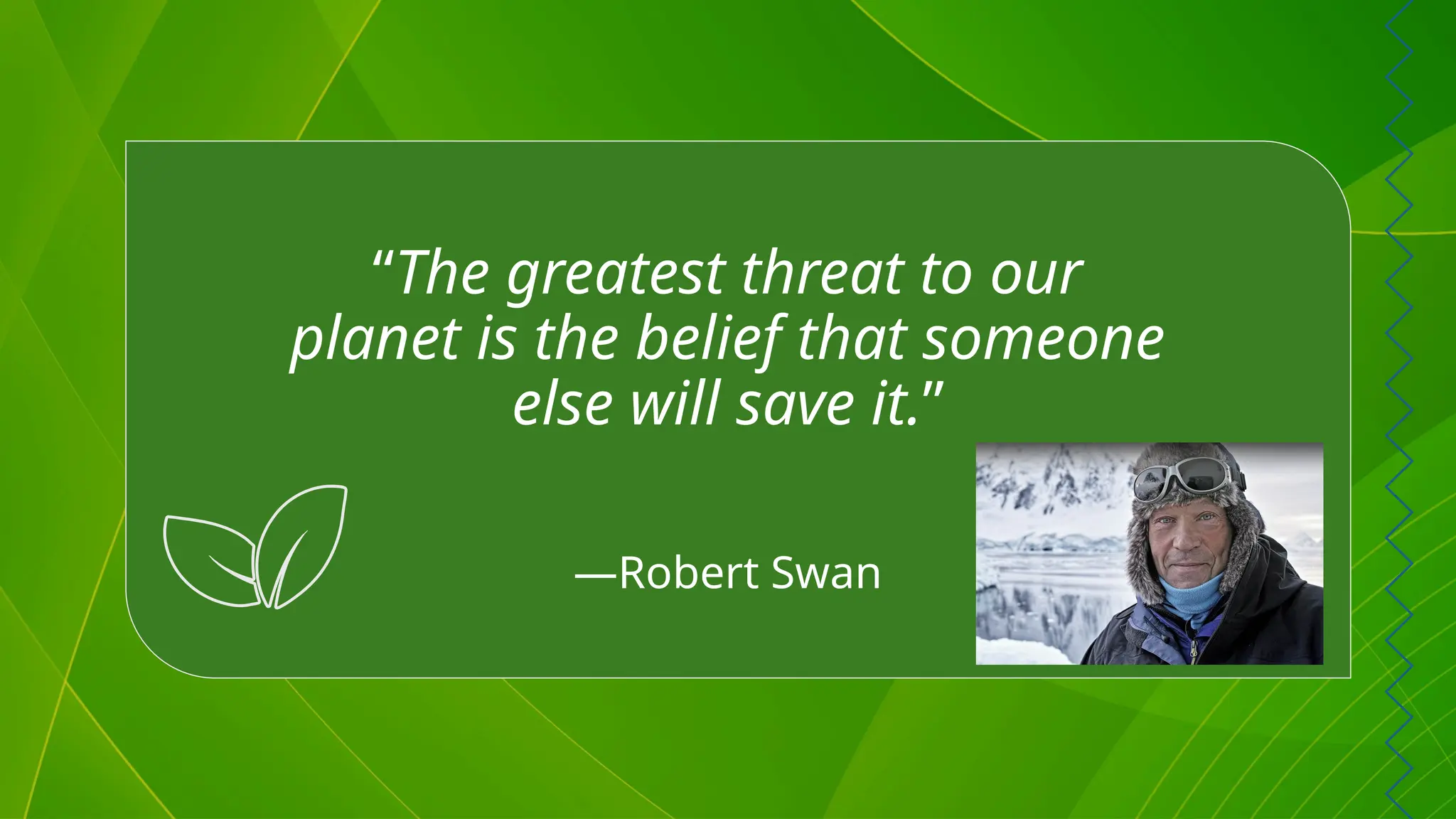
“The greatest threat to our
planet is the belief that someone
else will save it.”
—Robert Swan

Introduction to Sustainability and the UN Sustainable Development Goals

  • 1.
  • 2.
    Contents • What isSustainability? • Definitions of Sustainability • History of Sustainability • Models of Sustainability • Three Types of Sustainability • UN Sustainable Development Goals • The LASERS Model
  • 3.
  • 4.
    Sustainability The word “Sustainable” is unsustainable: Engelman,R. (2013). “Beyond Sustainababble”. State of the world 2013: Is sustainability still possible?, 3-16.
  • 5.
    Sustainability •There is alot of debate about what the term “Sustainability” means, and it means different things to different people, so we’ll look at some words associated with sustainability.
  • 6.
  • 7.
  • 8.
  • 9.
    Sustainability •In 1987 NorwegianPrime Minister Gro Harlem Brundtland defined sustainability as developments that “meets the needs of the present without compromising the ability of future generations to meet their own needs.”
  • 10.
    Sustainability • In 1992researcher William McDonough and Michael Braungart presented the Hannover Principles, including a definition of sustainability as: “Sustainability is the conception and realization of ecologically, economically, and ethically sensitive as well as responsible expression as a part of the evolving matrix of nature”
  • 11.
    Sustainability •In 1999 researchersPhilip Berke and Maria Manta Conroy said “Sustainable development is defined as a dynamic process connecting local and global concerns, as well as linking local social, economic, and ecological issues, to cater to the current and future generations’ needs fairly”
  • 12.
  • 13.
    Sustainability •Why is sustainabilityimportant? •For me, it’s because 1,300,000,000 tonnes of food is wasted every year
  • 15.
  • 16.
    Sustainability •We need todo better !!! •And with computers, we can !!!
  • 17.
  • 19.
    Sustainability ACTIVITY • In groupsof 3-5 people • Each team must choose a name related to sustainability (e.g., Team Green, Team Solar, Team Zero Waste). • Pick one of the following scenarios, and suggest three (3) ways to address it:
  • 20.
    Sustainability • ACTIVITY • "Yourcommunity has a low recycling rate. Design a plan to increase public participation in the recycling program, focusing on convenience and education.“ • "A restaurant is throwing away large amounts of food at the end of each day. How could they reduce food waste and make their operations more sustainable?“ • "Your company is looking to improve its sustainability performance. What three policies could you implement to reduce its environmental footprint and promote social responsibility?“ • "A local café wants to minimize its plastic waste. What three actions could they take to reduce single-use plastic items?"
  • 21.
  • 22.
  • 23.
  • 24.
    Sustainability • "Bonny Portmore"is an Irish traditional folk song which laments the demise of Ireland's old oak forests, specifically the Great Oak of Portmore. “O bonny Portmore, I am sorry to see Such a woeful destruction of your ornament tree”
  • 25.
    Sustainability • O bonnyPortmore, you shine where you stand And the more I think on you the more I think long If I had you now as I had once before All the lords in Old England would not purchase Portmore. • O bonny Portmore, I am sorry to see Such a woeful destruction of your ornament tree For it stood on your shore for many's the long day Till the long boats from Antrim came to float it away. • All the birds in the forest they bitterly weep Saying, "Where shall we shelter or where shall we sleep?" For the Oak and the Ash, they are all cutten down And the walls of bonny Portmore are all down to the ground. https://www.youtub e.com/watch?v=Q3Y qCu2Y_dM
  • 26.
  • 27.
    Henry David Thoreau (1817-1862) RalphWaldo Emerson (1803-1882) Walt Whitman (1819-1892) Emily Dickinson (1830-1886) Great American Poets of Nature
  • 28.
  • 29.
    1934, 1936, and1939–1940 Dust Bowl The Dust Bowl was the result of a period of severe dust storms that greatly damaged the ecology and agriculture of the American and Canadian prairies during the 1930s. The phenomenon was caused by a combination of natural factors (severe drought) and human- made factors
  • 30.
    1934, 1936, and1939–1940 Dust Bowl https://www.youtube.com/watch?v=zqiblXFlZuk https://www.youtube.com/watch? v=9w60SGPAnAQ
  • 31.
    1962 1972 1968 Some KeySustainability books:
  • 32.
  • 33.
    • Greenpeace isan independent global campaigning network, founded in Canada in 1971 to "ensure the ability of the Earth to nurture life in all its diversity“ and focuses its campaigning on worldwide issues such as climate change, deforestation, overfishing, commercial whaling, genetic engineering, anti-war and anti-nuclear issues. It uses direct action, advocacy, research, and ecotage to achieve its goals. 1971
  • 34.
    2015 "A shared blueprintfor peace and prosperity for people and the planet, now and into the future"
  • 35.
    Rachel Carson Herman Daly DonellaMeadows Elinor Ostrom E. F. Schumacher John Elkington Some Famous Sustainability Researchers
  • 36.
  • 37.
  • 38.
    Sustainability • The mostcommon model of sustainability is a three-pillar model: •Environment •Social •Economic •But the origins of this model are elusive.
  • 39.
    Three Pillars ofSustainability This could include recycling, reusing materials when possible, going paperless, investing in higher-efficiency appliances etc. Long-term economic growth protects the environmental, social, and cultural elements of the community Creating a positive work environment where people are treated fairly, and can express themselves. Also working with the community. Environment Economic Social
  • 40.
  • 41.
    Sustainability •The 2030 Agendafor Sustainable Development, adopted by all United Nations members in 2015, created 17 world Sustainable Development Goals (SDGs). •The aim of these global goals is "peace and prosperity for people and the planet" – while tackling climate change and working to preserve oceans and forests.
  • 42.
    Sustainability •The SDGs highlightthe connections between the environmental, social and economic aspects of sustainable development. Sustainability is at the center of the SDGs, as the term sustainable development implies.
  • 44.
    UN Sustainable DevelopmentGoals •Website: https://sdgs.un.org/goals •Let’s look at each goal, one at a time, and spend a few minutes thinking about how computers can help support each goal…
  • 45.
    UN Sustainable DevelopmentGoals •1. No Poverty: •End poverty in all its forms everywhere.
  • 46.
    UN Sustainable DevelopmentGoals •2. Zero Hunger: •End hunger, achieve food security and improved nutrition, and promote sustainable agriculture.
  • 47.
    UN Sustainable DevelopmentGoals •3. Good Health and Well-being: •Ensure healthy lives and promote well-being for all at all ages.
  • 48.
    UN Sustainable DevelopmentGoals •4. Quality Education: •Ensure inclusive and equitable quality education and promote lifelong learning opportunities for all.
  • 49.
    UN Sustainable DevelopmentGoals •5. Gender Equality: •Achieve gender equality and empower all women and girls.
  • 50.
    UN Sustainable DevelopmentGoals •6. Clean Water and Sanitation: •Ensure availability and sustainable management of water and sanitation for all.
  • 51.
    UN Sustainable DevelopmentGoals •7. Affordable and Clean Energy: •Ensure access to affordable, reliable, sustainable, and modern energy for all.
  • 52.
    UN Sustainable DevelopmentGoals •8. Decent Work and Economic Growth: •Promote sustained, inclusive, and sustainable economic growth, full and productive employment, and decent work for all.
  • 53.
    UN Sustainable DevelopmentGoals •9. Industry, Innovation, and Infrastructure: •Build resilient infrastructure, promote inclusive and sustainable industrialization, and foster innovation.
  • 54.
    UN Sustainable DevelopmentGoals •10. Reduced Inequality: •Reduce inequality within and among countries.
  • 55.
    UN Sustainable DevelopmentGoals •11. Sustainable Cities and Communities: •Make cities and human settlements inclusive, safe, resilient, and sustainable.
  • 56.
    UN Sustainable DevelopmentGoals •12. Responsible Consumption and Production: •Ensure sustainable consumption and production patterns.
  • 57.
    UN Sustainable DevelopmentGoals •13. Climate Action: •Take urgent action to combat climate change and its impacts.
  • 58.
    UN Sustainable DevelopmentGoals •14. Life Below Water: •Conserve and sustainably use the oceans, seas, and marine resources for sustainable development.
  • 59.
    UN Sustainable DevelopmentGoals •15. Life on Land: •Protect, restore, and promote sustainable use of terrestrial ecosystems, manage forests, combat desertification, and halt and reverse land degradation and halt biodiversity loss.
  • 60.
    UN Sustainable DevelopmentGoals •16. Peace, Justice, and Strong Institutions: •Promote peaceful and inclusive societies for sustainable development, provide access to justice for all, and build effective, accountable, and inclusive institutions at all levels.
  • 61.
    UN Sustainable DevelopmentGoals •17. Partnerships for the Goals: •Strengthen the means of implementation and revitalize the global partnership for sustainable development.
  • 62.
  • 63.
    UN Sustainable DevelopmentGoals •The LASERS model was developed by Damian Gordon, TU Dublin, and was first published in the following venue: • Gordon, D. (2024), “The Lasers Model: Developing a Comprehensive Framework for Modelling "Tech for Good"”, 17th Annual International Conference of Education, Research and Innovation (ICERI), Seville, Spain, 11th-13th of November 2024.
  • 64.
  • 65.
    The LASERS Model Legalrefers to adherence to regulatory requirements, ensuring compliance with industry standards and laws such as GDPR and the EU AI Act. All Laws, Acts, Statutes, Regulations and Rights. Legal
  • 66.
    Accessible The LASERS Model Accessibleemphasizes the need for inclusivity, ensuring software is usable by people of all abilities, including those with disabilities. All Usability, Inclusiveness, and Universal Design.
  • 67.
    Sustainabl e The LASERS Model Sustainablefocuses on minimizing environmental impact, as well as exploring the financial and governance issues associated with sustainability. All Social, Environmental and Governance.
  • 68.
    Ethical The LASERS Model Ethicalunderscores fairness, transparency, and respect for user privacy and autonomy, avoiding manipulation or exploitation. All Fairness, Accountability, Responsibility, and Respect.
  • 69.
    Reliable The LASERS Model Reliableensures the system functions correctly under various conditions, maintaining stability, availability, and performance over time. All Availability, Scalability, Efficiency, and Maintainability.
  • 70.
    Secure The LASERS Model Securehighlights the importance of safeguarding data and preventing unauthorized access, breaches, or malicious attacks. All Validation, Encryption, Auditing, and Privacy.
  • 71.
  • 72.
    “The greatest threatto our planet is the belief that someone else will save it.” —Robert Swan