AMTH250                                                      Assignment 5
                                Solutions

                            September 16, 2011


Question 1
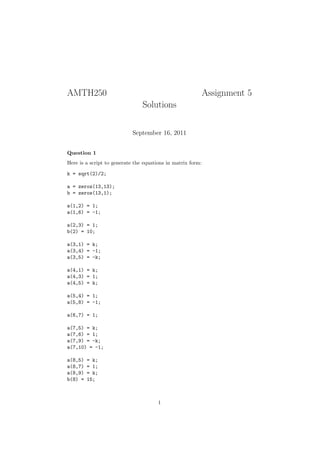
Here is a script to generate the equations in matrix form:
k = sqrt(2)/2;

a = zeros(13,13);
b = zeros(13,1);

a(1,2) = 1;
a(1,6) = -1;

a(2,3) = 1;
b(2) = 10;

a(3,1) = k;
a(3,4) = -1;
a(3,5) = -k;

a(4,1) = k;
a(4,3) = 1;
a(4,5) = k;

a(5,4) = 1;
a(5,8) = -1;

a(6,7) = 1;

a(7,5) = k;
a(7,6) = 1;
a(7,9) = -k;
a(7,10) = -1;

a(8,5)   = k;
a(8,7)   = 1;
a(8,9)   = k;
b(8) =   15;


                                       1
a(9,10) = 1;
a(9,13) = -1;

a(10,11) = 1;
b(10) = 20;

a(11,8) = 1;
a(11,9) = k;
a(11,12) = -k;

a(12,9) = k;
a(12,11) = 1;
a(12,12) = k;

a(13,13) = 1;
a(13,12) = k;

% Exact solution

x0 =[-20*sqrt(2) 20 10 -30 10*sqrt(2) 20 0 -30 5*sqrt(2) 25 20 -25*sqrt(2) 25]’;

(a)
      Solving in Octave:
octave:> x = ab
x =
  -28.28427
   20.00000
   10.00000
  -30.00000
   14.14214
   20.00000
    0.00000
  -30.00000
    7.07107
   25.00000
   20.00000
  -35.35534
   25.00000
The accuracy can be estimated using the condition number of the matrix:
octave:> rerr =cond(a)*eps
rerr = 2.3120e-15

(b)
   The actual error is
octave:> err = norm(x-x0)/norm(x0)
err = 1.3820e-16


                                     2
(c)

octave:> eig(a)
ans =
  -1.27279 + 0.00000i
  -0.49903 + 1.07138i
  -0.49903 - 1.07138i
  -0.52561 + 0.56675i
  -0.52561 - 0.56675i
  -0.12363 + 0.93904i
  -0.12363 - 0.93904i
   1.14770 + 0.96283i
   1.14770 - 0.96283i
   0.87329 + 0.70838i
   0.87329 - 0.70838i
   0.72297 + 0.00000i
   0.51150 + 0.00000i

   The matrix a has three real eigenvalues The real eigenvalues and their cor-
responding eigenvectors are:

octave:> [V L] = eig(a);
octave:> real([L(1,1) L(12,12) L(13,13)])
ans =
  -1.27279   0.72297   0.51150

octave:> real([V(:,1) V(:,12) V(:,13)])
ans =
   0.2707445 -0.2173918 -0.1703240
   0.1057564   0.3980937   0.3917440
  -0.1346055   0.2878090   0.2003763
  -0.2821253 -0.1321592 -0.0946017
   0.4274406 -0.3247553 -0.1814827
   0.4503570   0.5552610   0.4788643
  -0.5732094   0.4014359   0.2449382
   0.2619164   0.1026285 -0.0017736
  -0.0882485 -0.1380302 -0.1661952
   0.0854298   0.1330010   0.3427691
  -0.1087340   0.0961555   0.1753257
   0.0864365 -0.0912040 -0.2955285
  -0.0268920   0.2327925   0.4277776


                                      3
Question 2
(a)

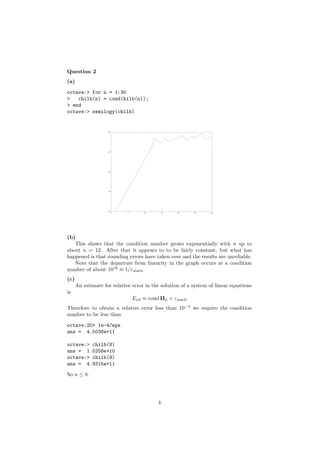
octave:> for n = 1:30
>   chilb(n) = cond(hilb(n));
> end
octave:> semilogy(chilb)


                    1020


                      15
                    10


                    1010


                    105


                    100
                           0   5       10        15   20    25   30


(b)
   This shows that the condition number grows exponentially with n up to
about n = 12. After that it appears to to be fairly constant, but what has
happened is that rounding errors have taken over and the results are unreliable.
   Note that the departure from linearity in the graph occurs at a condition
number of about 1016 ≈ 1/εmach .
(c)
      An estimate for relative error in the solution of a system of linear equations
is
                                   Erel ≈ cond Hn × εmach
Therefore to obtain a relative error less than 10−4 we require the condition
number to be less than
octave:20> 1e-4/eps
ans = 4.5036e+11

octave:> chilb(8)
ans = 1.5258e+10
octave:> chilb(9)
ans = 4.9315e+11

So n ≤ 8.


                                             4
(d)
   Here is a script to compute the maximum and minimum eigenvalues:

maxeig = zeros(30,1);
mineig = zeros(30,1);
for n = 1:30
  eighilb = abs(eig(hilb(n)));
  maxeig(n) = max(eighilb);
  mineig(n) = min(eighilb);
end


                                                             0
               2                                          10


              1.8


                                                         10-5


              1.6


                                                         10-10


              1.4


                                                         10-15

              1.2


               1                                         10-20
                    0   5   10   15   20   25   30               0   5   10   15   20   25   30


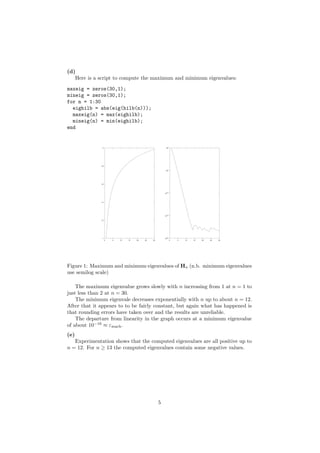
Figure 1: Maximum and minimum eigenvalues of Hn (n.b. minimum eigenvalues
use semilog scale)

    The maximum eigenvalue grows slowly with n increasing from 1 at n = 1 to
just less than 2 at n = 30.
    The minimum eigenvale decreases exponentially with n up to about n = 12.
After that it appears to to be fairly constant, but again what has happened is
that rounding errors have taken over and the results are unreliable.
    The departure from linearity in the graph occurs at a minimum eigenvalue
of about 10−16 ≈ εmach .
(e)
   Experimentation shows that the computed eigenvalues are all positive up to
n = 12. For n ≥ 13 the computed eigenvalues contain some negative values.


                                                     5
(f )

octave:> [chilb(1:12) maxeig(1:12) mineig(1:12) maxeig(1:12)./mineig(1:12)]
ans =
   1.0000e+00   1.0000e+00   1.0000e+00   1.0000e+00
   1.9281e+01   1.2676e+00   6.5741e-02   1.9281e+01
   5.2406e+02   1.4083e+00   2.6873e-03   5.2406e+02
   1.5514e+04   1.5002e+00   9.6702e-05   1.5514e+04
   4.7661e+05   1.5671e+00   3.2879e-06   4.7661e+05
   1.4951e+07   1.6189e+00   1.0828e-07   1.4951e+07
   4.7537e+08   1.6609e+00   3.4939e-09   4.7537e+08
   1.5258e+10   1.6959e+00   1.1115e-10   1.5258e+10
   4.9315e+11   1.7259e+00   3.4997e-12   4.9315e+11
   1.6025e+13   1.7519e+00   1.0931e-13   1.6027e+13
   5.2153e+14   1.7749e+00   3.4480e-15   5.1476e+14
   1.6620e+16   1.7954e+00   1.0942e-16   1.6408e+16


                                            λmax (Hn )
                             cond(Hn ) =
                                            λmin (Hn )

(g)
    Negative eigenvalues occur for n ≥ 13. The values of the condition number
and minimum eigenvalue exhibit a change after n = 12. That these changes
occurs when the condition number reaches 1/εmach and the minimum eigenvalue
reaches εmach indicate that rounding error could well be the cause. Therefore it is
reasonable to conclude that the results for the condition number and minimum
eigenvalue are only reliable up to n = 12. There is no indication that the
computation of the maximum eigenvalue is unreliable for any of the values of n
we have looked at.


                                        6
Question 3
The formulation as a linear programming problem is:
   Variables: A, B, C, D, E — number of units of each product manufactured.
   Objective: Maximize the profit:

                   c =10A + 9B + 10C + 9.5D + 5E
                          9
                      − (15A + 8B + 8C + 12D + 9E)
                         60
                          9
                      − (8A + 10B + 12C + 4D + 4E)
                         60
                         12
                      − (6A + 9B + 10C + 12D + 0E)
                         60
                     =5.35A + 4.5B + 5C + 4.7D + 3.05E


   Constraints:

                     15A + 8B + 8C + 12D + 9E ≤ 4800
                     8A + 10B + 12C + 4D + 4E ≤ 4800
                     6A + 9B + 10C + 12D + 0E ≤ 4800

   Lower Bounds:

                A ≥ 0,   B ≥ 0,    C ≥ 20,   D ≥ 30,    E≥0

    It is a little unclear whether this a linear programming problem or integer
programming problem; i.e. whether fractions of a product can be produced and
sold. Thefore we will solve both the LP and IP problems.
    Here is the Octave script to solve both problems
obj = [5.35 4.5 5 4.7 3.05]’;
vtype1 = "CCCCC";
vtype2 = "IIIII";
ptype = -1;
cnstr=[15 8 8 12 9; 8 10 12 4 4; 6 9 10 12 0];
lb = [0 0 20 30 0]’;
ub = [];
rhs = [4800 4800 4800]’;
ctype = "UUU";

[lx, lopt] = glpk(obj, cnstr, rhs, lb, ub, ctype, vtype1, ptype);
[ix, iopt] = glpk(obj, cnstr, rhs, lb, ub, ctype, vtype2, ptype);


                                      7
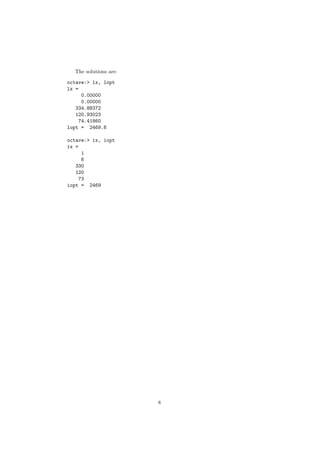
The solutions are:
octave:> lx, lopt
lx =
     0.00000
     0.00000
   334.88372
   120.93023
    74.41860
lopt = 2469.8

octave:> ix, iopt
ix =
     1
     6
   330
   120
    73
iopt = 2469


                       8

Amth250 octave matlab some solutions (4)

  • 1.
    AMTH250 Assignment 5 Solutions September 16, 2011 Question 1 Here is a script to generate the equations in matrix form: k = sqrt(2)/2; a = zeros(13,13); b = zeros(13,1); a(1,2) = 1; a(1,6) = -1; a(2,3) = 1; b(2) = 10; a(3,1) = k; a(3,4) = -1; a(3,5) = -k; a(4,1) = k; a(4,3) = 1; a(4,5) = k; a(5,4) = 1; a(5,8) = -1; a(6,7) = 1; a(7,5) = k; a(7,6) = 1; a(7,9) = -k; a(7,10) = -1; a(8,5) = k; a(8,7) = 1; a(8,9) = k; b(8) = 15; 1
  • 2.
    a(9,10) = 1; a(9,13)= -1; a(10,11) = 1; b(10) = 20; a(11,8) = 1; a(11,9) = k; a(11,12) = -k; a(12,9) = k; a(12,11) = 1; a(12,12) = k; a(13,13) = 1; a(13,12) = k; % Exact solution x0 =[-20*sqrt(2) 20 10 -30 10*sqrt(2) 20 0 -30 5*sqrt(2) 25 20 -25*sqrt(2) 25]’; (a) Solving in Octave: octave:> x = ab x = -28.28427 20.00000 10.00000 -30.00000 14.14214 20.00000 0.00000 -30.00000 7.07107 25.00000 20.00000 -35.35534 25.00000 The accuracy can be estimated using the condition number of the matrix: octave:> rerr =cond(a)*eps rerr = 2.3120e-15 (b) The actual error is octave:> err = norm(x-x0)/norm(x0) err = 1.3820e-16 2
  • 3.
    (c) octave:> eig(a) ans = -1.27279 + 0.00000i -0.49903 + 1.07138i -0.49903 - 1.07138i -0.52561 + 0.56675i -0.52561 - 0.56675i -0.12363 + 0.93904i -0.12363 - 0.93904i 1.14770 + 0.96283i 1.14770 - 0.96283i 0.87329 + 0.70838i 0.87329 - 0.70838i 0.72297 + 0.00000i 0.51150 + 0.00000i The matrix a has three real eigenvalues The real eigenvalues and their cor- responding eigenvectors are: octave:> [V L] = eig(a); octave:> real([L(1,1) L(12,12) L(13,13)]) ans = -1.27279 0.72297 0.51150 octave:> real([V(:,1) V(:,12) V(:,13)]) ans = 0.2707445 -0.2173918 -0.1703240 0.1057564 0.3980937 0.3917440 -0.1346055 0.2878090 0.2003763 -0.2821253 -0.1321592 -0.0946017 0.4274406 -0.3247553 -0.1814827 0.4503570 0.5552610 0.4788643 -0.5732094 0.4014359 0.2449382 0.2619164 0.1026285 -0.0017736 -0.0882485 -0.1380302 -0.1661952 0.0854298 0.1330010 0.3427691 -0.1087340 0.0961555 0.1753257 0.0864365 -0.0912040 -0.2955285 -0.0268920 0.2327925 0.4277776 3
  • 4.
    Question 2 (a) octave:> forn = 1:30 > chilb(n) = cond(hilb(n)); > end octave:> semilogy(chilb) 1020 15 10 1010 105 100 0 5 10 15 20 25 30 (b) This shows that the condition number grows exponentially with n up to about n = 12. After that it appears to to be fairly constant, but what has happened is that rounding errors have taken over and the results are unreliable. Note that the departure from linearity in the graph occurs at a condition number of about 1016 ≈ 1/εmach . (c) An estimate for relative error in the solution of a system of linear equations is Erel ≈ cond Hn × εmach Therefore to obtain a relative error less than 10−4 we require the condition number to be less than octave:20> 1e-4/eps ans = 4.5036e+11 octave:> chilb(8) ans = 1.5258e+10 octave:> chilb(9) ans = 4.9315e+11 So n ≤ 8. 4
  • 5.
    (d) Here is a script to compute the maximum and minimum eigenvalues: maxeig = zeros(30,1); mineig = zeros(30,1); for n = 1:30 eighilb = abs(eig(hilb(n))); maxeig(n) = max(eighilb); mineig(n) = min(eighilb); end 0 2 10 1.8 10-5 1.6 10-10 1.4 10-15 1.2 1 10-20 0 5 10 15 20 25 30 0 5 10 15 20 25 30 Figure 1: Maximum and minimum eigenvalues of Hn (n.b. minimum eigenvalues use semilog scale) The maximum eigenvalue grows slowly with n increasing from 1 at n = 1 to just less than 2 at n = 30. The minimum eigenvale decreases exponentially with n up to about n = 12. After that it appears to to be fairly constant, but again what has happened is that rounding errors have taken over and the results are unreliable. The departure from linearity in the graph occurs at a minimum eigenvalue of about 10−16 ≈ εmach . (e) Experimentation shows that the computed eigenvalues are all positive up to n = 12. For n ≥ 13 the computed eigenvalues contain some negative values. 5
  • 6.
    (f ) octave:> [chilb(1:12)maxeig(1:12) mineig(1:12) maxeig(1:12)./mineig(1:12)] ans = 1.0000e+00 1.0000e+00 1.0000e+00 1.0000e+00 1.9281e+01 1.2676e+00 6.5741e-02 1.9281e+01 5.2406e+02 1.4083e+00 2.6873e-03 5.2406e+02 1.5514e+04 1.5002e+00 9.6702e-05 1.5514e+04 4.7661e+05 1.5671e+00 3.2879e-06 4.7661e+05 1.4951e+07 1.6189e+00 1.0828e-07 1.4951e+07 4.7537e+08 1.6609e+00 3.4939e-09 4.7537e+08 1.5258e+10 1.6959e+00 1.1115e-10 1.5258e+10 4.9315e+11 1.7259e+00 3.4997e-12 4.9315e+11 1.6025e+13 1.7519e+00 1.0931e-13 1.6027e+13 5.2153e+14 1.7749e+00 3.4480e-15 5.1476e+14 1.6620e+16 1.7954e+00 1.0942e-16 1.6408e+16 λmax (Hn ) cond(Hn ) = λmin (Hn ) (g) Negative eigenvalues occur for n ≥ 13. The values of the condition number and minimum eigenvalue exhibit a change after n = 12. That these changes occurs when the condition number reaches 1/εmach and the minimum eigenvalue reaches εmach indicate that rounding error could well be the cause. Therefore it is reasonable to conclude that the results for the condition number and minimum eigenvalue are only reliable up to n = 12. There is no indication that the computation of the maximum eigenvalue is unreliable for any of the values of n we have looked at. 6
  • 7.
    Question 3 The formulationas a linear programming problem is: Variables: A, B, C, D, E — number of units of each product manufactured. Objective: Maximize the profit: c =10A + 9B + 10C + 9.5D + 5E 9 − (15A + 8B + 8C + 12D + 9E) 60 9 − (8A + 10B + 12C + 4D + 4E) 60 12 − (6A + 9B + 10C + 12D + 0E) 60 =5.35A + 4.5B + 5C + 4.7D + 3.05E Constraints: 15A + 8B + 8C + 12D + 9E ≤ 4800 8A + 10B + 12C + 4D + 4E ≤ 4800 6A + 9B + 10C + 12D + 0E ≤ 4800 Lower Bounds: A ≥ 0, B ≥ 0, C ≥ 20, D ≥ 30, E≥0 It is a little unclear whether this a linear programming problem or integer programming problem; i.e. whether fractions of a product can be produced and sold. Thefore we will solve both the LP and IP problems. Here is the Octave script to solve both problems obj = [5.35 4.5 5 4.7 3.05]’; vtype1 = "CCCCC"; vtype2 = "IIIII"; ptype = -1; cnstr=[15 8 8 12 9; 8 10 12 4 4; 6 9 10 12 0]; lb = [0 0 20 30 0]’; ub = []; rhs = [4800 4800 4800]’; ctype = "UUU"; [lx, lopt] = glpk(obj, cnstr, rhs, lb, ub, ctype, vtype1, ptype); [ix, iopt] = glpk(obj, cnstr, rhs, lb, ub, ctype, vtype2, ptype); 7
  • 8.
    The solutions are: octave:>lx, lopt lx = 0.00000 0.00000 334.88372 120.93023 74.41860 lopt = 2469.8 octave:> ix, iopt ix = 1 6 330 120 73 iopt = 2469 8