
1
One World One Health
Silvia Pessah-Eljay. MD., MPh., MSc.
Epidemiology Division. Health Services. Ministry of Health.
Feb, 2016
2
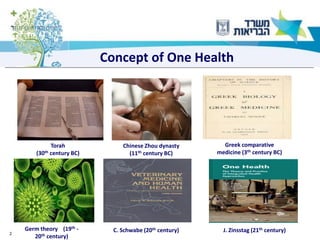
Chinese Zhou dynasty
(11th century BC)
Concept of One Health
Germ theory (19th -
20th century)
Greek comparative
medicine (3th century BC)
C. Schwabe (20th century) J. Zinsstag (21th century)
Torah
(30th century BC)
3
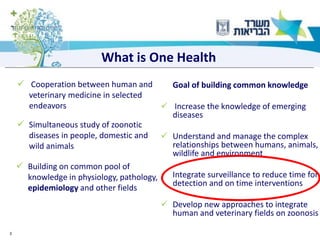
✓ Cooperation between human and
veterinary medicine in selected
endeavors
What is One Health
Goal of building common knowledge
✓ Increase the knowledge of emerging
diseases
✓ Understand and manage the complex
relationships between humans, animals,
wildlife and environment
✓ Integrate surveillance to reduce time for
detection and on time interventions
✓ Develop new approaches to integrate
human and veterinary fields on zoonosis
✓ Simultaneous study of zoonotic
diseases in people, domestic and
wild animals
✓ Building on common pool of
knowledge in physiology, pathology,
epidemiology and other fields
4
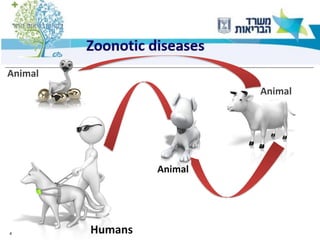
Animal
Zoonotic diseases
Animal
Humans
Animal
5
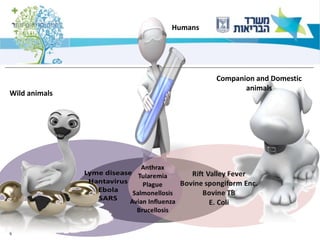
Humans
Wild animals
Companion and Domestic
animals
6
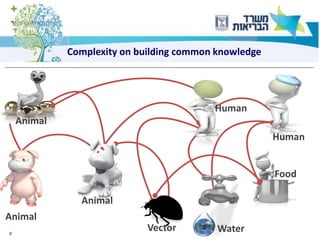
Animal
Animal
Animal
Complexity on building common knowledge
Vector
Food
Water
Human
Human
7
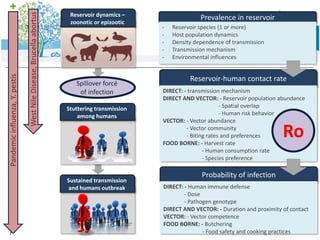
Prevalence in reservoir
- Reservoir species (1 or more)
- Host population dynamics
- Density dependence of transmission
- Transmission mechanism
- Environmental influences
Probability of infection
DIRECT: - Human immune defense
- Dose
- Pathogen genotype
DIRECT AND VECTOR: - Duration and proximity of contact
VECTOR: - Vector competence
FOOD BORNE: - Butchering
- Food safety and cooking practices
Reservoir-human contact rate
DIRECT: - transmission mechanism
DIRECT AND VECTOR: - Reservoir population abundance
- Spatial overlap
- Human risk behavior
VECTOR: - Vector abundance
- Vector community
- Biting rates and preferences
FOOD BORNE: - Harvest rate
- Human consumption rate
- Species preference
Spillover forcé
of infection
Sustained transmission
and humans outbreak
.
Stuttering transmission
among humans
Jane Mary Doe
.
Reservoir dynamics –
zoonotic or epizootic
WestNileDisease,Brucellaabortus
Pandemicinfluenza,Y.pestis
Ro
8
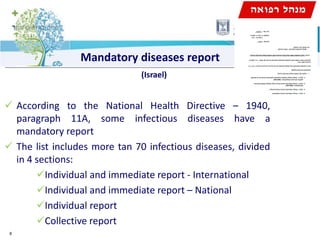
✓ According to the National Health Directive – 1940,
paragraph 11A, some infectious diseases have a
mandatory report
✓ The list includes more tan 70 infectious diseases, divided
in 4 sections:
✓Individual and immediate report - International
✓Individual and immediate report – National
✓Individual report
✓Collective report
Mandatory diseases report
(Israel)
9
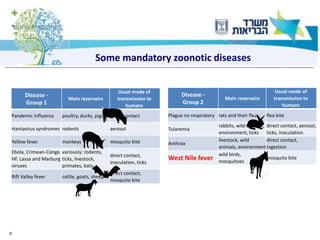
Mandatory diseases report
Disease -
Group 1
Main reservoirs
Usual mode of
transmission to
humans
Pandemic influenza poultry, ducks, pigs direct contact
Hantavirus syndromes rodents aerosol
Yellow fever monkeys mosquito bite
Ebola, Crimean-Congo
HF, Lassa and Marburg
viruses
variously: rodents,
ticks, livestock,
primates, bats
direct contact,
inoculation, ticks
Rift Valley fever cattle, goats, sheep
direct contact,
mosquito bite
Disease -
Group 2
Main reservoirs
Usual mode of
transmission to
humans
Plague no respiratory rats and their fleas flea bite
Tularemia
rabbits, wild animals,
environment, ticks
direct contact, aerosol,
ticks, inoculation
Anthrax
livestock, wild
animals, environment
direct contact,
ingestion
West Nile fever
wild birds,
mosquitoes
mosquito bite
Some mandatory zoonotic diseases
10
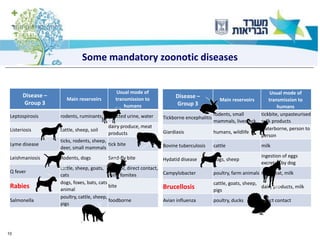
Mandatory diseases report
Disease –
Group 3
Main reservoirs
Usual mode of
transmission to
humans
Tickborne encephalitis
rodents, small
mammals, livestock
tickbite, unpasteurised
milk products
Giardiasis humans, wildlife
waterborne, person to
person
Bovine tuberculosis cattle milk
Hydatid disease dogs, sheep
ingestion of eggs
excreted by dog
Campylobacter poultry, farm animals raw meat, milk
Brucellosis
cattle, goats, sheep,
pigs
dairy products, milk
Avian influenza poultry, ducks direct contact
Some mandatory zoonotic diseases
Disease –
Group 3
Main reservoirs
Usual mode of
transmission to
humans
Leptospirosis rodents, ruminants infected urine, water
Listeriosis cattle, sheep, soil
dairy produce, meat
products
Lyme disease
ticks, rodents, sheep,
deer, small mammals
tick bite
Leishmaniosis Rodents, dogs Sand-fly bite
Q fever
cattle, sheep, goats,
cats
aerosol, direct contact,
milk, fomites
Rabies
dogs, foxes, bats, cats
animal
bite
Salmonella
poultry, cattle, sheep,
pigs
foodborne
11
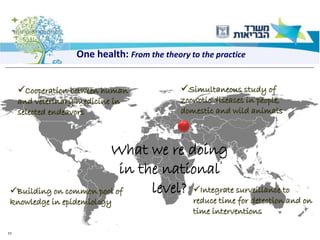
One health: From the theory to the practice
What we re doing
in the national
level?
✓Cooperation between human
and veterinary medicine in
selected endeavors
✓Building on common pool of
knowledge in epidemiology
✓Integrate surveillance to
reduce time for detection and on
time interventions
✓Simultaneous study of
zoonotic diseases in people,
domestic and wild animals
12
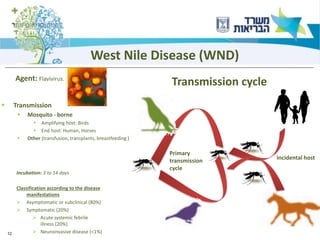
West Nile Disease (WND)
Agent: Flavivirus.
▪ Transmission
▪ Mosquito - borne
▪ Amplifying host: Birds
▪ End host: Human, Horses
▪ Other (transfusion, transplants, breastfeeding )
Transmission cycle
Incidental host
Primary
transmission
cycle
Incubation: 3 to 14 days
Classification according to the disease
manifestations
➢ Asymptomatic or subclinical (80%)
➢ Symptomatic (20%)
➢ Acute systemic febrile
illness (20%)
➢ Neuroinvasive disease (<1%)
13
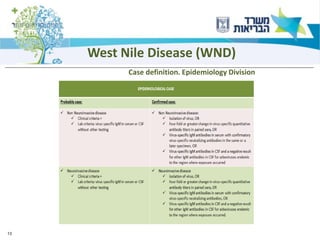
West Nile Disease (WND)
Case definition. Epidemiology Division
14
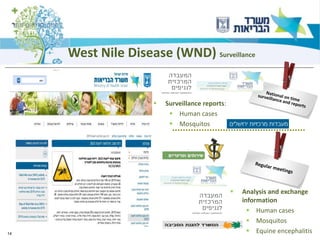
West Nile Disease (WND) Surveillance
▪ Surveillance reports:
▪ Human cases
▪ Mosquitos
▪ Analysis and exchange
information
▪ Human cases
▪ Mosquitos
▪ Equine encephalitis
15
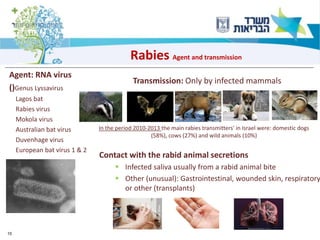
Rabies Agent and transmission
Agent: RNA virus
()Genus Lyssavirus
Lagos bat
Rabies virus
Mokola virus
Australian bat virus
Duvenhage virus
European bat virus 1 & 2
Transmission: Only by infected mammals
In the period 2010-2013 the main rabies transmitters' in Israel were: domestic dogs
(58%), cows (27%) and wild animals (10%)
Contact with the rabid animal secretions
▪ Infected saliva usually from a rabid animal bite
▪ Other (unusual): Gastrointestinal, wounded skin, respiratory
or other (transplants)
16
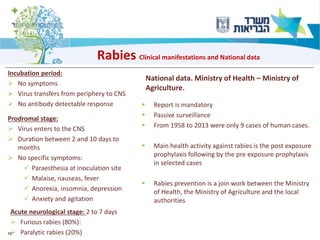
Rabies Clinical manifestations and National data
Incubation period:
➢ No symptoms
➢ Virus transfers from periphery to CNS
➢ No antibody detectable response
Acute neurological stage: 2 to 7 days
➢ Furious rabies (80%):
➢ Paralytic rabies (20%)
Prodromal stage:
➢ Virus enters to the CNS
➢ Duration between 2 and 10 days to
months
➢ No specific symptoms:
✓ Paraesthesia at inoculation site
✓ Malaise, nauseas, fever
✓ Anorexia, insomnia, depression
✓ Anxiety and agitation
National data. Ministry of Health – Ministry of
Agriculture.
▪ Report is mandatory
▪ Passive surveillance
▪ From 1958 to 2013 were only 9 cases of human cases.
▪ Main health activity against rabies is the post exposure
prophylaxis following by the pre exposure prophylaxis
in selected cases
▪ Rabies prevention is a join work between the Ministry
of Health, the Ministry of Agriculture and the local
authorities
17
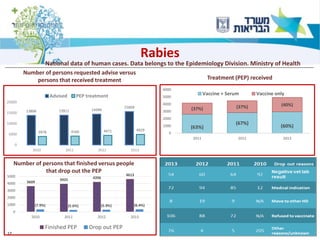
Rabies
National data of human cases. Data belongs to the Epidemiology Division. Ministry of Health
(63%)
(67%)
(60%)
(37%) (37%) (40%)
0
1000
2000
3000
4000
5000
6000
2011 2012 2013
Vaccine + Serum Vaccine only
13806 13911 14394
15604
3978 4160 4471 4929
0
5000
10000
15000
20000
2010 2011 2012 2013
Advised PEP treatment
Number of persons requested advise versus
persons that received treatment Treatment (PEP) received
3609
3925 4206
4613
(7.9%) (5.6%) (5.9%) (6.4%)
0
1000
2000
3000
4000
5000
2010 2011 2012 2013
Finished PEP Drop out PEP
Number of persons that finished versus people
that drop out the PEP
18
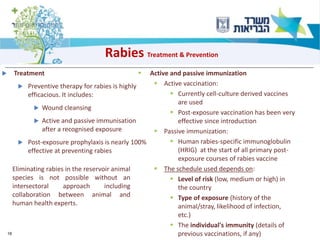
Rabies Treatment & Prevention
 Treatment
 Preventive therapy for rabies is highly
efficacious. It includes:
 Wound cleansing
 Active and passive immunisation
after a recognised exposure
 Post-exposure prophylaxis is nearly 100%
effective at preventing rabies
▪ Active and passive immunization
▪ Active vaccination:
▪ Currently cell-culture derived vaccines
are used
▪ Post-exposure vaccination has been very
effective since introduction
▪ Passive immunization:
▪ Human rabies-specific immunoglobulin
(HRIG) at the start of all primary post-
exposure courses of rabies vaccine
▪ The schedule used depends on:
▪ Level of risk (low, medium or high) in
the country
▪ Type of exposure (history of the
animal/stray, likelihood of infection,
etc.)
▪ The individual's immunity (details of
previous vaccinations, if any)
Eliminating rabies in the reservoir animal
species is not possible without an
intersectoral approach including
collaboration between animal and
human health experts.
19
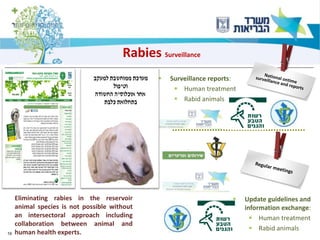
▪ Surveillance reports:
▪ Human treatment
▪ Rabid animals
Rabies Surveillance
Eliminating rabies in the reservoir
animal species is not possible without
an intersectoral approach including
collaboration between animal and
human health experts.
▪ Update guidelines and
information exchange:
▪ Human treatment
▪ Rabid animals
20
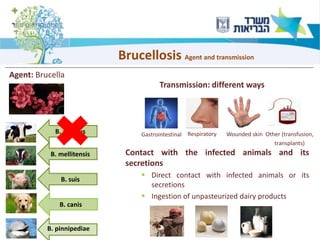
Brucellosis Agent and transmission
Agent: Brucella
Transmission: different ways
Other (transfusion,
transplants)
B. canis
B. pinnipediae
B. suis
B. mellitensis
B. abortus Wounded skinRespiratoryGastrointestinal
Contact with the infected animals and its
secretions
▪ Direct contact with infected animals or its
secretions
▪ Ingestion of unpasteurized dairy products
21
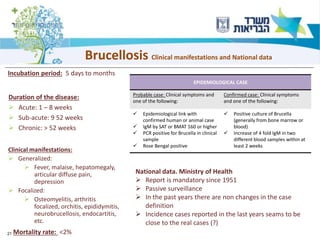
Brucellosis Clinical manifestations and National data
Incubation period: 5 days to months
Clinical manifestations:
➢ Generalized:
➢ Fever, malaise, hepatomegaly,
articular diffuse pain,
depression
➢ Focalized:
➢ Osteomyelitis, arthritis
focalized, orchitis, epididymitis,
neurobrucellosis, endocartitis,
etc.
Duration of the disease:
➢ Acute: 1 – 8 weeks
➢ Sub-acute: 9 52 weeks
➢ Chronic: > 52 weeks
National data. Ministry of Health
➢ Report is mandatory since 1951
➢ Passive surveillance
➢ In the past years there are non changes in the case
definition
➢ Incidence cases reported in the last years seams to be
close to the real cases (?)
Mortality rate: <2%
EPIDEMIOLOGICAL CASE
Probable case: Clinical symptoms and
one of the following:
Confirmed case: Clinical symptoms
and one of the following:
✓ Epidemiological link with
confirmed human or animal case
✓ IgM by SAT or BMAT 160 or higher
✓ PCR positive for Brucella in clinical
sample
✓ Rose Bengal positive
✓ Positive culture of Brucella
(generally from bone marrow or
blood)
✓ Increase of 4 fold IgM in two
different blood samples within at
least 2 weeks
22
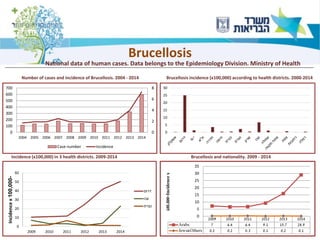
Brucellosis
Number of cases and incidence of Brucellosis. 2004 - 2014 Brucellosis incidence (x100,000) according to health districts. 2000-2014
0
2
4
6
8
0
100
200
300
400
500
600
700
2004 2005 2006 2007 2008 2009 2010 2011 2012 2013 2014
Case number Incidence
0
5
10
15
20
25
30
2009 2010 2011 2012 2013 2014
Arabs 7 6.4 6.4 9.1 15.7 28.9
Jews&Others 0.2 0.2 0.3 0.1 0.2 0.1
0
5
10
15
20
25
30
35Incidencex-100,000
Brucellosis and nationality. 2009 - 2014
0
10
20
30
40
50
60
2009 2010 2011 2012 2013 2014
Incidencex-100,000
‫דרום‬
‫עכו‬
‫נצרת‬
Incidence (x100,000) in 3 health districts. 2009-2014
National data of human cases. Data belongs to the Epidemiology Division. Ministry of Health
23
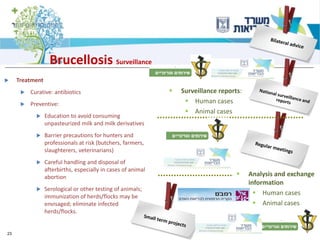
▪ Surveillance reports:
▪ Human cases
▪ Animal cases
▪ Analysis and exchange
information
▪ Human cases
▪ Animal cases
Brucellosis Surveillance
 Treatment
 Curative: antibiotics
 Preventive:
 Education to avoid consuming
unpasteurized milk and milk derivatives
 Barrier precautions for hunters and
professionals at risk (butchers, farmers,
slaughterers, veterinarians)
 Careful handling and disposal of
afterbirths, especially in cases of animal
abortion
 Serological or other testing of animals;
immunization of herds/flocks may be
envisaged; eliminate infected
herds/flocks.
24
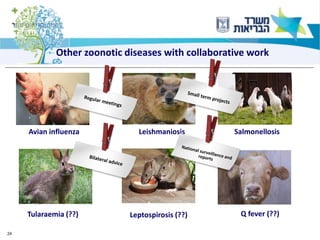
Avian influenza
Other zoonotic diseases with collaborative work
Tularaemia (??)
Leishmaniosis Salmonellosis
Leptospirosis (??) Q fever (??)
25
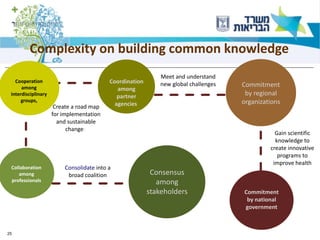
Consensus
among
stakeholders
Commitment
by regional
organizations
Collaboration
among
professionals
Coordination
among
partner
agenciesCreate a road map
for implementation
and sustainable
changer.
Meet and understand
new global challenges
Gain scientific
knowledge to
create innovative
programs to
improve health
Cooperation
among
interdisciplinary
groups,
Consolidate into a
broad coalition
Commitment
by national
government
Complexity on building common knowledge
26
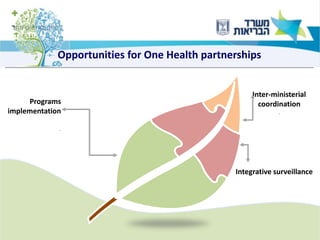
Programs
implementation
.
Integrative surveillance
Inter-ministerial
coordination
.
Opportunities for One Health partnerships
27

One health

  • 1.
    1 One World OneHealth Silvia Pessah-Eljay. MD., MPh., MSc. Epidemiology Division. Health Services. Ministry of Health. Feb, 2016
  • 2.
    2 Chinese Zhou dynasty (11thcentury BC) Concept of One Health Germ theory (19th - 20th century) Greek comparative medicine (3th century BC) C. Schwabe (20th century) J. Zinsstag (21th century) Torah (30th century BC)
  • 3.
    3 ✓ Cooperation betweenhuman and veterinary medicine in selected endeavors What is One Health Goal of building common knowledge ✓ Increase the knowledge of emerging diseases ✓ Understand and manage the complex relationships between humans, animals, wildlife and environment ✓ Integrate surveillance to reduce time for detection and on time interventions ✓ Develop new approaches to integrate human and veterinary fields on zoonosis ✓ Simultaneous study of zoonotic diseases in people, domestic and wild animals ✓ Building on common pool of knowledge in physiology, pathology, epidemiology and other fields
  • 4.
  • 5.
  • 6.
    6 Animal Animal Animal Complexity on buildingcommon knowledge Vector Food Water Human Human
  • 7.
    7 Prevalence in reservoir -Reservoir species (1 or more) - Host population dynamics - Density dependence of transmission - Transmission mechanism - Environmental influences Probability of infection DIRECT: - Human immune defense - Dose - Pathogen genotype DIRECT AND VECTOR: - Duration and proximity of contact VECTOR: - Vector competence FOOD BORNE: - Butchering - Food safety and cooking practices Reservoir-human contact rate DIRECT: - transmission mechanism DIRECT AND VECTOR: - Reservoir population abundance - Spatial overlap - Human risk behavior VECTOR: - Vector abundance - Vector community - Biting rates and preferences FOOD BORNE: - Harvest rate - Human consumption rate - Species preference Spillover forcé of infection Sustained transmission and humans outbreak . Stuttering transmission among humans Jane Mary Doe . Reservoir dynamics – zoonotic or epizootic WestNileDisease,Brucellaabortus Pandemicinfluenza,Y.pestis Ro
  • 8.
    8 ✓ According tothe National Health Directive – 1940, paragraph 11A, some infectious diseases have a mandatory report ✓ The list includes more tan 70 infectious diseases, divided in 4 sections: ✓Individual and immediate report - International ✓Individual and immediate report – National ✓Individual report ✓Collective report Mandatory diseases report (Israel)
  • 9.
    9 Mandatory diseases report Disease- Group 1 Main reservoirs Usual mode of transmission to humans Pandemic influenza poultry, ducks, pigs direct contact Hantavirus syndromes rodents aerosol Yellow fever monkeys mosquito bite Ebola, Crimean-Congo HF, Lassa and Marburg viruses variously: rodents, ticks, livestock, primates, bats direct contact, inoculation, ticks Rift Valley fever cattle, goats, sheep direct contact, mosquito bite Disease - Group 2 Main reservoirs Usual mode of transmission to humans Plague no respiratory rats and their fleas flea bite Tularemia rabbits, wild animals, environment, ticks direct contact, aerosol, ticks, inoculation Anthrax livestock, wild animals, environment direct contact, ingestion West Nile fever wild birds, mosquitoes mosquito bite Some mandatory zoonotic diseases
  • 10.
    10 Mandatory diseases report Disease– Group 3 Main reservoirs Usual mode of transmission to humans Tickborne encephalitis rodents, small mammals, livestock tickbite, unpasteurised milk products Giardiasis humans, wildlife waterborne, person to person Bovine tuberculosis cattle milk Hydatid disease dogs, sheep ingestion of eggs excreted by dog Campylobacter poultry, farm animals raw meat, milk Brucellosis cattle, goats, sheep, pigs dairy products, milk Avian influenza poultry, ducks direct contact Some mandatory zoonotic diseases Disease – Group 3 Main reservoirs Usual mode of transmission to humans Leptospirosis rodents, ruminants infected urine, water Listeriosis cattle, sheep, soil dairy produce, meat products Lyme disease ticks, rodents, sheep, deer, small mammals tick bite Leishmaniosis Rodents, dogs Sand-fly bite Q fever cattle, sheep, goats, cats aerosol, direct contact, milk, fomites Rabies dogs, foxes, bats, cats animal bite Salmonella poultry, cattle, sheep, pigs foodborne
  • 11.
    11 One health: Fromthe theory to the practice What we re doing in the national level? ✓Cooperation between human and veterinary medicine in selected endeavors ✓Building on common pool of knowledge in epidemiology ✓Integrate surveillance to reduce time for detection and on time interventions ✓Simultaneous study of zoonotic diseases in people, domestic and wild animals
  • 12.
    12 West Nile Disease(WND) Agent: Flavivirus. ▪ Transmission ▪ Mosquito - borne ▪ Amplifying host: Birds ▪ End host: Human, Horses ▪ Other (transfusion, transplants, breastfeeding ) Transmission cycle Incidental host Primary transmission cycle Incubation: 3 to 14 days Classification according to the disease manifestations ➢ Asymptomatic or subclinical (80%) ➢ Symptomatic (20%) ➢ Acute systemic febrile illness (20%) ➢ Neuroinvasive disease (<1%)
  • 13.
    13 West Nile Disease(WND) Case definition. Epidemiology Division
  • 14.
    14 West Nile Disease(WND) Surveillance ▪ Surveillance reports: ▪ Human cases ▪ Mosquitos ▪ Analysis and exchange information ▪ Human cases ▪ Mosquitos ▪ Equine encephalitis
  • 15.
    15 Rabies Agent andtransmission Agent: RNA virus ()Genus Lyssavirus Lagos bat Rabies virus Mokola virus Australian bat virus Duvenhage virus European bat virus 1 & 2 Transmission: Only by infected mammals In the period 2010-2013 the main rabies transmitters' in Israel were: domestic dogs (58%), cows (27%) and wild animals (10%) Contact with the rabid animal secretions ▪ Infected saliva usually from a rabid animal bite ▪ Other (unusual): Gastrointestinal, wounded skin, respiratory or other (transplants)
  • 16.
    16 Rabies Clinical manifestationsand National data Incubation period: ➢ No symptoms ➢ Virus transfers from periphery to CNS ➢ No antibody detectable response Acute neurological stage: 2 to 7 days ➢ Furious rabies (80%): ➢ Paralytic rabies (20%) Prodromal stage: ➢ Virus enters to the CNS ➢ Duration between 2 and 10 days to months ➢ No specific symptoms: ✓ Paraesthesia at inoculation site ✓ Malaise, nauseas, fever ✓ Anorexia, insomnia, depression ✓ Anxiety and agitation National data. Ministry of Health – Ministry of Agriculture. ▪ Report is mandatory ▪ Passive surveillance ▪ From 1958 to 2013 were only 9 cases of human cases. ▪ Main health activity against rabies is the post exposure prophylaxis following by the pre exposure prophylaxis in selected cases ▪ Rabies prevention is a join work between the Ministry of Health, the Ministry of Agriculture and the local authorities
  • 17.
    17 Rabies National data ofhuman cases. Data belongs to the Epidemiology Division. Ministry of Health (63%) (67%) (60%) (37%) (37%) (40%) 0 1000 2000 3000 4000 5000 6000 2011 2012 2013 Vaccine + Serum Vaccine only 13806 13911 14394 15604 3978 4160 4471 4929 0 5000 10000 15000 20000 2010 2011 2012 2013 Advised PEP treatment Number of persons requested advise versus persons that received treatment Treatment (PEP) received 3609 3925 4206 4613 (7.9%) (5.6%) (5.9%) (6.4%) 0 1000 2000 3000 4000 5000 2010 2011 2012 2013 Finished PEP Drop out PEP Number of persons that finished versus people that drop out the PEP
  • 18.
    18 Rabies Treatment &Prevention  Treatment  Preventive therapy for rabies is highly efficacious. It includes:  Wound cleansing  Active and passive immunisation after a recognised exposure  Post-exposure prophylaxis is nearly 100% effective at preventing rabies ▪ Active and passive immunization ▪ Active vaccination: ▪ Currently cell-culture derived vaccines are used ▪ Post-exposure vaccination has been very effective since introduction ▪ Passive immunization: ▪ Human rabies-specific immunoglobulin (HRIG) at the start of all primary post- exposure courses of rabies vaccine ▪ The schedule used depends on: ▪ Level of risk (low, medium or high) in the country ▪ Type of exposure (history of the animal/stray, likelihood of infection, etc.) ▪ The individual's immunity (details of previous vaccinations, if any) Eliminating rabies in the reservoir animal species is not possible without an intersectoral approach including collaboration between animal and human health experts.
  • 19.
    19 ▪ Surveillance reports: ▪Human treatment ▪ Rabid animals Rabies Surveillance Eliminating rabies in the reservoir animal species is not possible without an intersectoral approach including collaboration between animal and human health experts. ▪ Update guidelines and information exchange: ▪ Human treatment ▪ Rabid animals
  • 20.
    20 Brucellosis Agent andtransmission Agent: Brucella Transmission: different ways Other (transfusion, transplants) B. canis B. pinnipediae B. suis B. mellitensis B. abortus Wounded skinRespiratoryGastrointestinal Contact with the infected animals and its secretions ▪ Direct contact with infected animals or its secretions ▪ Ingestion of unpasteurized dairy products
  • 21.
    21 Brucellosis Clinical manifestationsand National data Incubation period: 5 days to months Clinical manifestations: ➢ Generalized: ➢ Fever, malaise, hepatomegaly, articular diffuse pain, depression ➢ Focalized: ➢ Osteomyelitis, arthritis focalized, orchitis, epididymitis, neurobrucellosis, endocartitis, etc. Duration of the disease: ➢ Acute: 1 – 8 weeks ➢ Sub-acute: 9 52 weeks ➢ Chronic: > 52 weeks National data. Ministry of Health ➢ Report is mandatory since 1951 ➢ Passive surveillance ➢ In the past years there are non changes in the case definition ➢ Incidence cases reported in the last years seams to be close to the real cases (?) Mortality rate: <2% EPIDEMIOLOGICAL CASE Probable case: Clinical symptoms and one of the following: Confirmed case: Clinical symptoms and one of the following: ✓ Epidemiological link with confirmed human or animal case ✓ IgM by SAT or BMAT 160 or higher ✓ PCR positive for Brucella in clinical sample ✓ Rose Bengal positive ✓ Positive culture of Brucella (generally from bone marrow or blood) ✓ Increase of 4 fold IgM in two different blood samples within at least 2 weeks
  • 22.
    22 Brucellosis Number of casesand incidence of Brucellosis. 2004 - 2014 Brucellosis incidence (x100,000) according to health districts. 2000-2014 0 2 4 6 8 0 100 200 300 400 500 600 700 2004 2005 2006 2007 2008 2009 2010 2011 2012 2013 2014 Case number Incidence 0 5 10 15 20 25 30 2009 2010 2011 2012 2013 2014 Arabs 7 6.4 6.4 9.1 15.7 28.9 Jews&Others 0.2 0.2 0.3 0.1 0.2 0.1 0 5 10 15 20 25 30 35Incidencex-100,000 Brucellosis and nationality. 2009 - 2014 0 10 20 30 40 50 60 2009 2010 2011 2012 2013 2014 Incidencex-100,000 ‫דרום‬ ‫עכו‬ ‫נצרת‬ Incidence (x100,000) in 3 health districts. 2009-2014 National data of human cases. Data belongs to the Epidemiology Division. Ministry of Health
  • 23.
    23 ▪ Surveillance reports: ▪Human cases ▪ Animal cases ▪ Analysis and exchange information ▪ Human cases ▪ Animal cases Brucellosis Surveillance  Treatment  Curative: antibiotics  Preventive:  Education to avoid consuming unpasteurized milk and milk derivatives  Barrier precautions for hunters and professionals at risk (butchers, farmers, slaughterers, veterinarians)  Careful handling and disposal of afterbirths, especially in cases of animal abortion  Serological or other testing of animals; immunization of herds/flocks may be envisaged; eliminate infected herds/flocks.
  • 24.
    24 Avian influenza Other zoonoticdiseases with collaborative work Tularaemia (??) Leishmaniosis Salmonellosis Leptospirosis (??) Q fever (??)
  • 25.
    25 Consensus among stakeholders Commitment by regional organizations Collaboration among professionals Coordination among partner agenciesCreate aroad map for implementation and sustainable changer. Meet and understand new global challenges Gain scientific knowledge to create innovative programs to improve health Cooperation among interdisciplinary groups, Consolidate into a broad coalition Commitment by national government Complexity on building common knowledge
  • 26.
  • 27.