EECE 309
Communication Theory
Amplitude Modulation
2
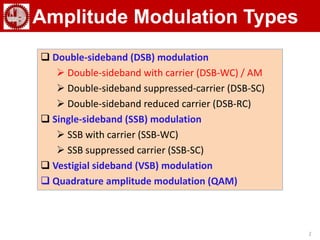
Amplitude Modulation Types
 Double-sideband (DSB) modulation
 Double-sideband with carrier (DSB-WC) / AM
 Double-sideband suppressed-carrier (DSB-SC)
 Double-sideband reduced carrier (DSB-RC)
 Single-sideband (SSB) modulation
 SSB with carrier (SSB-WC)
 SSB suppressed carrier (SSB-SC)
 Vestigial sideband (VSB) modulation
 Quadrature amplitude modulation (QAM)
3
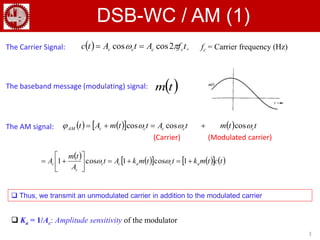
DSB-WC / AM (1)
  tfAtAtc cccc  2coscos 
       ttmtAttmAt cccccAM  coscoscos 
 tm
The Carrier Signal:
The baseband message (modulating) signal:
The AM signal:
, fc = Carrier frequency (Hz)
         tctmkttmkAt
A
tm
A acacc
c
c 





 1cos1cos1 
(Carrier) (Modulated carrier)
 Thus, we transmit an unmodulated carrier in addition to the modulated carrier
 Ka = 1/Ac: Amplitude sensitivity of the modulator
4
AM (2): Frequency Domain
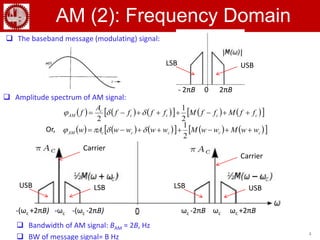
 The baseband message (modulating) signal:
           cccc
c
AM ffMffMffff
A
f 
2
1
2

 Amplitude spectrum of AM signal:
           cccccAM wwMwwMwwwwAw 
2
1
Or,
- 2πB 0 2πB
USBLSB
 Bandwidth of AM signal: BAM = 2B, Hz
 BW of message signal= B Hz
USBLSBLSBUSB
Carrier
Carrier
ωc -2πB ωc ωc +2πB-(ωc +2πB) -ωc -(ωc -2πB)
5
Time Domain of AM (3)
 Thus, the carrier component oscillates between the envelope |Ac + m(t)| and its
negative image –|Ac + m(t)|
 Envelope of the modulated carrier: e(t) = [Ac + m(t)]
 The envelope is an accurate representation of the message, provided -
a. fc >> B, B is the message bandwidth
b. Ac + m(t) > = 0, for all t
 Condition a relates to the overlap of the frequency spectrum components
 Condition b ensures that the message can be recovered from the envelope
Envelope detection
can be used
Envelope detection
can’t be used
6
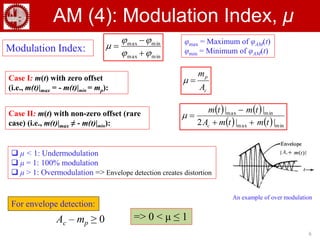
AM (4): Modulation Index, μ
Case I: m(t) with zero offset
(i.e., m(t)|max = - m(t)|min = mp):
Ac – mp ≥ 0
 μ < 1: Undermodulation
 μ = 1: 100% modulation
 μ > 1: Overmodulation => Envelope detection creates distortion
An example of over modulation
=> 0 < μ ≤ 1
For envelope detection:
c
p
A
m

Case II: m(t) with non-zero offset (rare
case) (i.e., m(t)|max ≠ - m(t)|min):
   
    minmax
minmax
||2
||
tmtmA
tmtm
c 


minmax
minmax





Modulation Index:
φmax = Maximum of φAM(t)
φmin = Minimum of φAM(t)
7
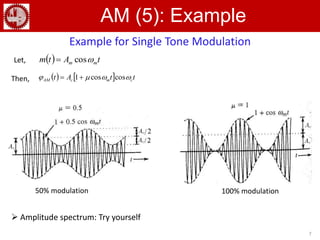
AM (5): Example
Example for Single Tone Modulation
  tAtm mm cos
    ttAt cmcAM  coscos1
Let,
Then,
50% modulation 100% modulation
 Amplitude spectrum: Try yourself
8
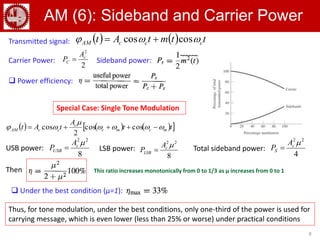
AM (6): Sideband and Carrier Power
      tt
A
tAt mcmc
c
ccAM 

  coscos
2
cos
Carrier Power:
2
2
c
C
A
P 
USB power:
8
22
c
USB
A
P 
8
22
c
LSB
A
P LSB power: Total sideband power:
4
22
c
S
A
P 
    ttmtAt cccAM  coscos Transmitted signal:
Sideband power:
 Power efficiency:
Special Case: Single Tone Modulation
Then
 Under the best condition (μ=1):
This ratio increases monotonically from 0 to 1/3 as μ increases from 0 to 1
Thus, for tone modulation, under the best conditions, only one-third of the power is used for
carrying message, which is even lower (less than 25% or worse) under practical conditions
9
Demodulation of AM Signals
Envelope Detector:
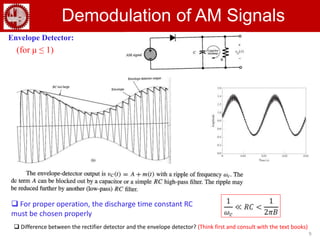
 For proper operation, the discharge time constant RC
must be chosen properly
 Difference between the rectifier detector and the envelope detector? (Think first and consult with the text books)
(for μ ≤ 1)
10
Demodulation of AM Signals
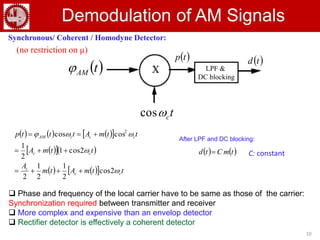
Synchronous/ Coherent / Homodyne Detector:
tccos
 tAM
 td
      
   
     ttmAtm
A
ttmA
ttmAtttp
cc
c
cc
cccAM



2cos
2
1
2
1
2
2cos1
2
1
coscos 2



After LPF and DC blocking:
   tmCtd 
LPF &
DC blocking
 tp
 Phase and frequency of the local carrier have to be same as those of the carrier:
Synchronization required between transmitter and receiver
 More complex and expensive than an envelop detector
 Rectifier detector is effectively a coherent detector
(no restriction on μ)
C: constant
11
AM: Summary
 Wasteful of transmitted power: power efficiency
very low
 Wasteful of channel bandwidth: twice of the
message bandwidth
 Easy to be affected by noise
 Simpler modulator and demodulator
 Less expensive modulator and demodulator

Amplitude Modulation

  • 1.
  • 2.
    2 Amplitude Modulation Types Double-sideband (DSB) modulation  Double-sideband with carrier (DSB-WC) / AM  Double-sideband suppressed-carrier (DSB-SC)  Double-sideband reduced carrier (DSB-RC)  Single-sideband (SSB) modulation  SSB with carrier (SSB-WC)  SSB suppressed carrier (SSB-SC)  Vestigial sideband (VSB) modulation  Quadrature amplitude modulation (QAM)
  • 3.
    3 DSB-WC / AM(1)   tfAtAtc cccc  2coscos         ttmtAttmAt cccccAM  coscoscos   tm The Carrier Signal: The baseband message (modulating) signal: The AM signal: , fc = Carrier frequency (Hz)          tctmkttmkAt A tm A acacc c c        1cos1cos1  (Carrier) (Modulated carrier)  Thus, we transmit an unmodulated carrier in addition to the modulated carrier  Ka = 1/Ac: Amplitude sensitivity of the modulator
  • 4.
    4 AM (2): FrequencyDomain  The baseband message (modulating) signal:            cccc c AM ffMffMffff A f  2 1 2   Amplitude spectrum of AM signal:            cccccAM wwMwwMwwwwAw  2 1 Or, - 2πB 0 2πB USBLSB  Bandwidth of AM signal: BAM = 2B, Hz  BW of message signal= B Hz USBLSBLSBUSB Carrier Carrier ωc -2πB ωc ωc +2πB-(ωc +2πB) -ωc -(ωc -2πB)
  • 5.
    5 Time Domain ofAM (3)  Thus, the carrier component oscillates between the envelope |Ac + m(t)| and its negative image –|Ac + m(t)|  Envelope of the modulated carrier: e(t) = [Ac + m(t)]  The envelope is an accurate representation of the message, provided - a. fc >> B, B is the message bandwidth b. Ac + m(t) > = 0, for all t  Condition a relates to the overlap of the frequency spectrum components  Condition b ensures that the message can be recovered from the envelope Envelope detection can be used Envelope detection can’t be used
  • 6.
    6 AM (4): ModulationIndex, μ Case I: m(t) with zero offset (i.e., m(t)|max = - m(t)|min = mp): Ac – mp ≥ 0  μ < 1: Undermodulation  μ = 1: 100% modulation  μ > 1: Overmodulation => Envelope detection creates distortion An example of over modulation => 0 < μ ≤ 1 For envelope detection: c p A m  Case II: m(t) with non-zero offset (rare case) (i.e., m(t)|max ≠ - m(t)|min):         minmax minmax ||2 || tmtmA tmtm c    minmax minmax      Modulation Index: φmax = Maximum of φAM(t) φmin = Minimum of φAM(t)
  • 7.
    7 AM (5): Example Examplefor Single Tone Modulation   tAtm mm cos     ttAt cmcAM  coscos1 Let, Then, 50% modulation 100% modulation  Amplitude spectrum: Try yourself
  • 8.
    8 AM (6): Sidebandand Carrier Power       tt A tAt mcmc c ccAM     coscos 2 cos Carrier Power: 2 2 c C A P  USB power: 8 22 c USB A P  8 22 c LSB A P LSB power: Total sideband power: 4 22 c S A P      ttmtAt cccAM  coscos Transmitted signal: Sideband power:  Power efficiency: Special Case: Single Tone Modulation Then  Under the best condition (μ=1): This ratio increases monotonically from 0 to 1/3 as μ increases from 0 to 1 Thus, for tone modulation, under the best conditions, only one-third of the power is used for carrying message, which is even lower (less than 25% or worse) under practical conditions
  • 9.
    9 Demodulation of AMSignals Envelope Detector:  For proper operation, the discharge time constant RC must be chosen properly  Difference between the rectifier detector and the envelope detector? (Think first and consult with the text books) (for μ ≤ 1)
  • 10.
    10 Demodulation of AMSignals Synchronous/ Coherent / Homodyne Detector: tccos  tAM  td                 ttmAtm A ttmA ttmAtttp cc c cc cccAM    2cos 2 1 2 1 2 2cos1 2 1 coscos 2    After LPF and DC blocking:    tmCtd  LPF & DC blocking  tp  Phase and frequency of the local carrier have to be same as those of the carrier: Synchronization required between transmitter and receiver  More complex and expensive than an envelop detector  Rectifier detector is effectively a coherent detector (no restriction on μ) C: constant
  • 11.
    11 AM: Summary  Wastefulof transmitted power: power efficiency very low  Wasteful of channel bandwidth: twice of the message bandwidth  Easy to be affected by noise  Simpler modulator and demodulator  Less expensive modulator and demodulator