 Background, history
 Review of digital modulation
 FDMA vs. Multi-carrier modulation
 Theory of OFDM an QAM
 Advantages and disadvantages
 Conclusion
2
 The first QAM-related so-called orthogonal
frequency division multiplexing (OFDM) schem
was proposed by Chang in 1966 for dispersive
fading channels, which has also undergonea
dramatic evolution due to the efforts of
Weinstein, Peled, Ruiz, Hirosaki, Kolb.
 OFDM was standardised as the European digital
audio broadcast (DAB) as well as digital video
broadcast (DVB) scheme.
 It constituted also a credible proposal for the
recent third-generation mobile radio standard
competition in Europe.
 Quadrature Amplitude Modulation, QAM is a
signal in which two carriers shifted in phase
by 90 degrees are modulated and the
resultant output consists of both amplitude
and phase variations.
 In view of the fact that both amplitude and
phase variations are present it may also be
considered as a mixture of amplitude and
phase modulation.
 Digital QAM modulates digital information
onto pulses that are modulated onto
Amplitudes of a sine and a cosine, or equivalently
Amplitude and phase of single sinusoidal.
5
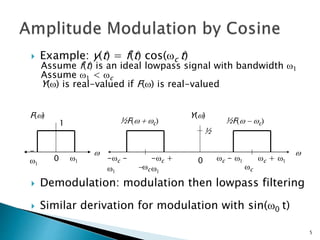
 Example: y(t) = f(t) cos(wc t)
Assume f(t) is an ideal lowpass signal with bandwidth w1
Assume w1 < wc
Y(w) is real-valued if F(w) is real-valued
 Demodulation: modulation then lowpass filtering
 Similar derivation for modulation with sin(w0 t)
w
0
1
w1
-
w1
F(w)
w
0
Y(w)
½
-wc -
w1
-wc +
w1
-wc
wc - w1 wc + w1
wc
½F(w - wc)½F(w + wc)
6
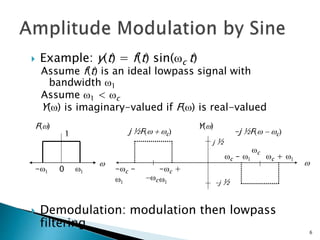
 Example: y(t) = f(t) sin(wc t)
Assume f(t) is an ideal lowpass signal with
bandwidth w1
Assume w1 < wc
Y(w) is imaginary-valued if F(w) is real-valued
 Demodulation: modulation then lowpass
filtering
w
Y(w)
j ½
-wc -
w1
-wc +
w1
-wc
wc - w1 wc + w1
wc
-j ½F(w - wc)j ½F(w + wc)
-j ½
w
0
1
w1-w1
F(w)
7
Serial/Parallel
Map to 2-D
constellation
Impulse modulator
Impulse modulator
Pulse shaping gT(t)
Local
Oscillator
+
90o
Pulse shaping gT(t)
d[n]
an
bn
a*(t)
b*(t)
s(t)
1 J
Matched
Delay
Matched delay matches delay through 90o phase shifter
bit
stream
8
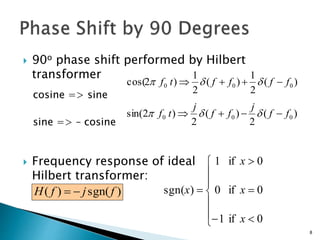
 90o phase shift performed by Hilbert
transformer
cosine => sine
sine => – cosine
 Frequency response of ideal
Hilbert transformer:
)(
2
1
)(
2
1
)2cos( 000 fffftf -++ 
)(
2
)(
2
)2sin( 000 ff
j
ff
j
tf --+ 
)sgn()( fjfH -







-



0if1
0if0
0if1
)sgn(
x
x
x
x
9
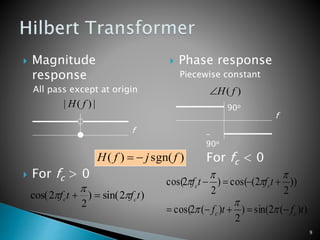
 Magnitude
response
All pass except at origin
 For fc > 0
 Phase response
Piecewise constant
 For fc < 0
)2sin()
2
2cos( tftf cc 

 +
))(2sin()
2
)(2cos(
))
2
2(cos()
2
2cos(
tftf
tftf
cc
cc
-+-
+--







f
)( fH
-
90o
90o
f
|)(| fH
)sgn()( fjfH -
 Multi-carrier Amplitude modulation
scheme
◦ Each Carrier’s amplitude is modulated
 Well-suited for Wireless Communication
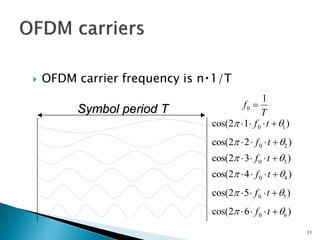
 OFDM carrier frequency is n・1/T
11
Symbol period T
cos( )2 1 0 1    +f t
T
f
1
0 
cos( )2 2 0 2    +f t
cos( )2 3 0 3    +f t
cos( )2 4 0 4    +f t
cos( )2 5 0 5    +f t
cos( )2 6 0 6    +f t
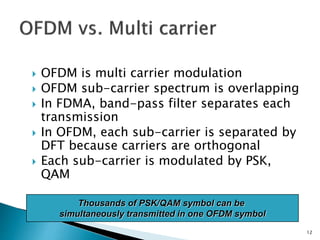
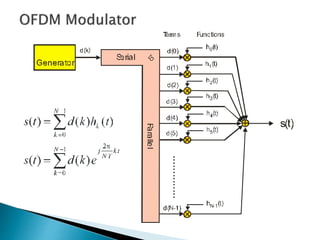
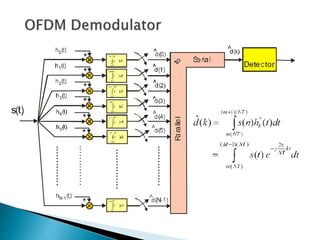
 OFDM is multi carrier modulation
 OFDM sub-carrier spectrum is overlapping
 In FDMA, band-pass filter separates each
transmission
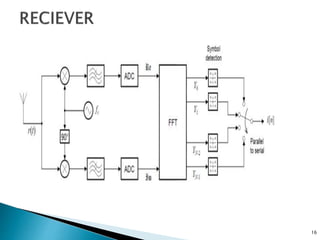
 In OFDM, each sub-carrier is separated by
DFT because carriers are orthogonal
 Each sub-carrier is modulated by PSK,
QAM
12
Thousands of PSK/QAM symbol can be
simultaneously transmitted in one OFDM symbol
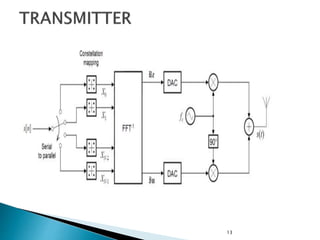
13
16
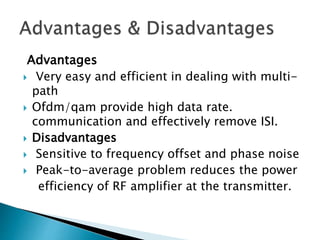
Advantages
 Very easy and efficient in dealing with multi-
path
 Ofdm/qam provide high data rate.
communication and effectively remove ISI.
 Disadvantages
 Sensitive to frequency offset and phase noise
 Peak-to-average problem reduces the power
efficiency of RF amplifier at the transmitter.
 Performs better than a single modulated
carrier in multipath fading
 With a properly implemented guard
interval:
– Time waveform appears periodic
– orthogonality of subcarriers is
ensured
– ISI and ICI are eliminated
18
THANK YOU

Ofdm &amp; qam

  • 2.
     Background, history Review of digital modulation  FDMA vs. Multi-carrier modulation  Theory of OFDM an QAM  Advantages and disadvantages  Conclusion 2
  • 3.
     The firstQAM-related so-called orthogonal frequency division multiplexing (OFDM) schem was proposed by Chang in 1966 for dispersive fading channels, which has also undergonea dramatic evolution due to the efforts of Weinstein, Peled, Ruiz, Hirosaki, Kolb.  OFDM was standardised as the European digital audio broadcast (DAB) as well as digital video broadcast (DVB) scheme.  It constituted also a credible proposal for the recent third-generation mobile radio standard competition in Europe.
  • 4.
     Quadrature AmplitudeModulation, QAM is a signal in which two carriers shifted in phase by 90 degrees are modulated and the resultant output consists of both amplitude and phase variations.  In view of the fact that both amplitude and phase variations are present it may also be considered as a mixture of amplitude and phase modulation.  Digital QAM modulates digital information onto pulses that are modulated onto Amplitudes of a sine and a cosine, or equivalently Amplitude and phase of single sinusoidal.
  • 5.
    5  Example: y(t)= f(t) cos(wc t) Assume f(t) is an ideal lowpass signal with bandwidth w1 Assume w1 < wc Y(w) is real-valued if F(w) is real-valued  Demodulation: modulation then lowpass filtering  Similar derivation for modulation with sin(w0 t) w 0 1 w1 - w1 F(w) w 0 Y(w) ½ -wc - w1 -wc + w1 -wc wc - w1 wc + w1 wc ½F(w - wc)½F(w + wc)
  • 6.
    6  Example: y(t)= f(t) sin(wc t) Assume f(t) is an ideal lowpass signal with bandwidth w1 Assume w1 < wc Y(w) is imaginary-valued if F(w) is real-valued  Demodulation: modulation then lowpass filtering w Y(w) j ½ -wc - w1 -wc + w1 -wc wc - w1 wc + w1 wc -j ½F(w - wc)j ½F(w + wc) -j ½ w 0 1 w1-w1 F(w)
  • 7.
    7 Serial/Parallel Map to 2-D constellation Impulsemodulator Impulse modulator Pulse shaping gT(t) Local Oscillator + 90o Pulse shaping gT(t) d[n] an bn a*(t) b*(t) s(t) 1 J Matched Delay Matched delay matches delay through 90o phase shifter bit stream
  • 8.
    8  90o phaseshift performed by Hilbert transformer cosine => sine sine => – cosine  Frequency response of ideal Hilbert transformer: )( 2 1 )( 2 1 )2cos( 000 fffftf -++  )( 2 )( 2 )2sin( 000 ff j ff j tf --+  )sgn()( fjfH -        -    0if1 0if0 0if1 )sgn( x x x x
  • 9.
    9  Magnitude response All passexcept at origin  For fc > 0  Phase response Piecewise constant  For fc < 0 )2sin() 2 2cos( tftf cc    + ))(2sin() 2 )(2cos( )) 2 2(cos() 2 2cos( tftf tftf cc cc -+- +--        f )( fH - 90o 90o f |)(| fH )sgn()( fjfH -
  • 10.
     Multi-carrier Amplitudemodulation scheme ◦ Each Carrier’s amplitude is modulated  Well-suited for Wireless Communication
  • 11.
     OFDM carrierfrequency is n・1/T 11 Symbol period T cos( )2 1 0 1    +f t T f 1 0  cos( )2 2 0 2    +f t cos( )2 3 0 3    +f t cos( )2 4 0 4    +f t cos( )2 5 0 5    +f t cos( )2 6 0 6    +f t
  • 12.
     OFDM ismulti carrier modulation  OFDM sub-carrier spectrum is overlapping  In FDMA, band-pass filter separates each transmission  In OFDM, each sub-carrier is separated by DFT because carriers are orthogonal  Each sub-carrier is modulated by PSK, QAM 12 Thousands of PSK/QAM symbol can be simultaneously transmitted in one OFDM symbol
  • 13.
  • 16.
  • 17.
    Advantages  Very easyand efficient in dealing with multi- path  Ofdm/qam provide high data rate. communication and effectively remove ISI.  Disadvantages  Sensitive to frequency offset and phase noise  Peak-to-average problem reduces the power efficiency of RF amplifier at the transmitter.
  • 18.
     Performs betterthan a single modulated carrier in multipath fading  With a properly implemented guard interval: – Time waveform appears periodic – orthogonality of subcarriers is ensured – ISI and ICI are eliminated 18
  • 19.