Renewable energy

                                                       Carbon Deposition on Bimetallic Co-Ni/Al2O3 Catalyst
                                                       during Steam Reforming of Glycerol
                                                                                                                   Chin Kui Cheng, Say Yei Foo, Adesoji A. Adesina
                                                                                                  Reactor Engineering & Technology Group, School of Chemical Engineering,
                                                                                                                                                         The University of New South Wales
                                                                                                                                                           Sydney NSW 2052, Australia


        INTRODUCTION AND MOTIVATION                                                                                                                                                                                             Aqueous Glycerol
                                                                                                                                                                                                                                    Solution

• Climate change effects and sustainability                                                                                                Syringe
considerations have necessitated the development of                                                                                         Pump

new production technologies for energy and base                                                                                                            Heating zone

chemicals from renewable resources                                                                  Steam reformed                                                                  H2, CO2, CO
• Syngas - a major base chemical and clean energy fuel
                                                                                                                     Flow
can be produced from biowastes rather than fossil feed                                                             Controller                                                                                                       F             F

                                                                                                                                               Electric
• Glycerol (C3H8O3), the by-product of biodiesel                                                                                              Furnace
                                                                                                                                                                           Vent
                                                                                                                                                                                                                                                                                                                               •   For down-stream
                                                                                                    P = 101.3 kPa
production is cheaply available and may be used as                                                                                                                                                                                                                                                                                 chemical processes
feed to a syngas process                                 Map showing biodiesel plants in Australia  T = 773 – 823 K H                  Argon                                         GC                              2
                                                                                                                                                  Tubular   Manometer
                                                          Source: Biofuels Association of Australia
                                                                                              ‡

• However, due to its high carbon content (40wt%),
                                                                                                                                                  Reactor                                                                                                                                                                      • As      fuel for engine
control and minimisation of carbon deposition during     Excess glycerol is readily available                                                                          Drierite bed
                                                                                                                                                          Condenser                                                                                                                                                            •   Fuel cell application
catalytic steam reforming is vital to process efficiency from biodiesel industry as waste                                     Schematic diagram illustrating the steam reforming set-up


        Catalyst preparation                                                                                             Chemistry of glycerol steam reforming                                                                                                                Post-reaction analysEs
                                                                Co-Ni/Al2O3                                                                                                                                                                                                                                                    (b) TGA for gasification
                                                                                                                                                       +3H2O                                                                                               4H2                                                                 studies
                                                                                                                                                                                                                                        (2)
                         +                                                                                                         7H2                                                                                                                     3CO
                                                                                                                                                                                                                                                                                                                               (c) TOC for carbon
                                                                                                                                                                                                                                                                                                                               content analysis
                                                                                                                                                          (1)
         Al2O3 support                                                                                                                                                                                                                                                                                                         (d) FTIR analysis
                                                                                                                                   3CO2                                                                                                           +3H2O (3)
                              Precursors                                                                                                                                       C3H8O3 (Glycerol)                                                                                                                         (b)   (e) XRD analysis
                                                                                                                                                                                                                                                                3CO2                                                     (c)       (d)
                                       Drying/calcination
                  Titration                                                                                                                                                                                                                                     3H2

                                                                                                                                                                                                                                                                             (a) Autosorb for BET
                                                                                                                                                                                                                                                                             area and pore volume
                                                                 Sieving


        Deposition of carbon                                                   -2.2
                                                                                      Power-law modelling (823 K)                                                                                 Arrhenius plot                                                      Catalyst regeneration
                                                                                                                                                                               -2.8
                                                                                                                                              Glycerol
                                                                                                                                              Steam


        TOC profile at 823 K
                                                                               -2.4
                                                                                                                                     Slope = -0.2213
                                                                                                                                                                               -2.9                                                                                       TPR-TPO on used Al2O3                 TPR-TPO on used Co-Ni/Al2O3
                                                                                                  Slope = 0.5513
                                                                                                                                     R2 = 0.934                                                                    EA = 40.9 kJ mol-1
                                                                                                  R2 = 0.9532
                                                                                                                                                                                                                   R2 = 0.999
                                                                               -2.6
                                                                 ln(rcoking)


                                                                                                                                                                               -3.0
                                                                                                                                                                ln (rcoking)


                                                                               -2.8
                                                                                                                                                                               -3.1


                                                                               -3.0                                                                                            -3.2


                                                                               -3.2                                                                                            -3.3
                                                                                      1                  2                   3                4                                  0.00120      0.00122    0.00124         0.00126        0.00128       0.00130

                                                                                                                   ln (Pressure)                                                                               1/T (K-1)


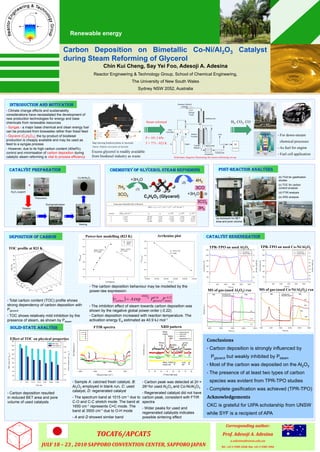
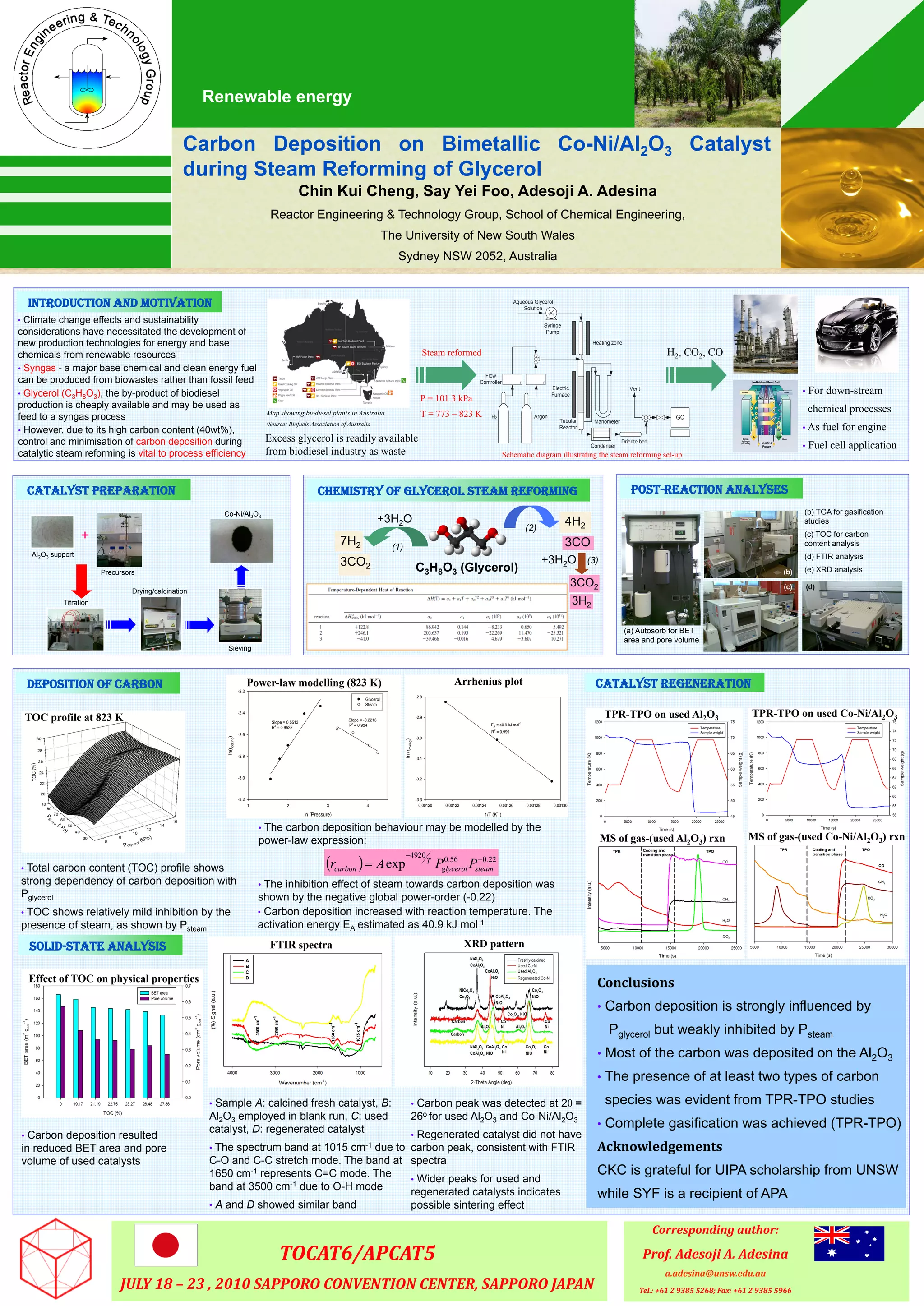
                                                                                          •The carbon deposition behaviour may be modelled by the
                                                                                          power-law expression:                                                                                                                                                        MS of gas-(used Al2O3) rxn              MS of gas-(used Co-Ni/Al2O3) rxn
                                                                                                                                                                        4920
                                                                                                                                                                                      T      0.56        0.22
    •Total carbon content (TOC) profile shows                                                                                    rcarbon            A exp                                  Pglycerol Psteam
    strong dependency of carbon deposition with                                           • The inhibition effect of steam towards carbon deposition was
    Pglycerol                                                                             shown by the negative global power-order (-0.22)
    •TOC shows relatively mild inhibition by the                                          • Carbon deposition increased with reaction temperature. The
    presence of steam, as shown by Psteam                                                 activation energy EA estimated as 40.9 kJ mol-1

        Solid-state analysIs                                                                      FTIR spectra                                                                                          XRD pattern


        Effect of TOC on physical properties                                                                                                                                                                                                                          Conclusions
                                                                                                                                                                                                                                                                      •   Carbon deposition is strongly influenced by
                                                                                                                                                                                                                                                                          Pglycerol but weakly inhibited by Psteam
                                                                                                                                                                                                                                                                      •   Most of the carbon was deposited on the Al2O3
                                                                                                                                                                                                                                                                      •   The presence of at least two types of carbon
                                                            •Sample A: calcined fresh catalyst, B:                                                                        •Carbon peak was detected at 2θ =                                                               species was evident from TPR-TPO studies
                                                            Al2O3 employed in blank run, C: used                                                                          26o for used Al2O3 and Co-Ni/Al2O3
                                                            catalyst, D: regenerated catalyst                                                                                                                                                                         •   Complete gasification was achieved (TPR-TPO)
    • Carbon deposition resulted                                                                      Regenerated catalyst did not have                                   •
    in reduced BET area and pore                            • The spectrum band at 1015 cm-1 due to carbon peak, consistent with FTIR                                                                                                                                 Acknowledgements
    volume of used catalysts                                C-O and C-C stretch mode. The band at spectra
                                                            1650 cm-1 represents C=C mode. The                                                                                                                                                                        CKC is grateful for UIPA scholarship from UNSW
                                                                            -1 due to O-H mode
                                                                                                    • Wider peaks for used and
                                                            band at 3500 cm
                                                                                                    regenerated catalysts indicates                                                                                                                                   while SYF is a recipient of APA
                                                            • A and D showed similar band           possible sintering effect

                                                                                                                                                                                                                                                                                    Corresponding author:

                                                                                                     TOCAT6/APCAT5                                                                                                                                                               Prof. Adesoji A. Adesina
                                                                                                                                                                                                                                                                                        a.adesina@unsw.edu.au
                                   JULY 18 – 23 , 2010 SAPPORO CONVENTION CENTER, SAPPORO JAPAN                                                                                                                                                                                  Tel.: +61 2 9385 5268; Fax: +61 2 9385 5966

APCAT Poster

  • 1.
    Renewable energy Carbon Deposition on Bimetallic Co-Ni/Al2O3 Catalyst during Steam Reforming of Glycerol Chin Kui Cheng, Say Yei Foo, Adesoji A. Adesina Reactor Engineering & Technology Group, School of Chemical Engineering, The University of New South Wales Sydney NSW 2052, Australia INTRODUCTION AND MOTIVATION Aqueous Glycerol Solution • Climate change effects and sustainability Syringe considerations have necessitated the development of Pump new production technologies for energy and base Heating zone chemicals from renewable resources Steam reformed H2, CO2, CO • Syngas - a major base chemical and clean energy fuel Flow can be produced from biowastes rather than fossil feed Controller F F Electric • Glycerol (C3H8O3), the by-product of biodiesel Furnace Vent • For down-stream P = 101.3 kPa production is cheaply available and may be used as chemical processes feed to a syngas process Map showing biodiesel plants in Australia T = 773 – 823 K H Argon GC 2 Tubular Manometer Source: Biofuels Association of Australia ‡ • However, due to its high carbon content (40wt%), Reactor • As fuel for engine control and minimisation of carbon deposition during Excess glycerol is readily available Drierite bed Condenser • Fuel cell application catalytic steam reforming is vital to process efficiency from biodiesel industry as waste Schematic diagram illustrating the steam reforming set-up Catalyst preparation Chemistry of glycerol steam reforming Post-reaction analysEs Co-Ni/Al2O3 (b) TGA for gasification +3H2O 4H2 studies (2) + 7H2 3CO (c) TOC for carbon content analysis (1) Al2O3 support (d) FTIR analysis 3CO2 +3H2O (3) Precursors C3H8O3 (Glycerol) (b) (e) XRD analysis 3CO2 (c) (d) Drying/calcination Titration 3H2 (a) Autosorb for BET area and pore volume Sieving Deposition of carbon -2.2 Power-law modelling (823 K) Arrhenius plot Catalyst regeneration -2.8 Glycerol Steam TOC profile at 823 K -2.4 Slope = -0.2213 -2.9 TPR-TPO on used Al2O3 TPR-TPO on used Co-Ni/Al2O3 Slope = 0.5513 R2 = 0.934 EA = 40.9 kJ mol-1 R2 = 0.9532 R2 = 0.999 -2.6 ln(rcoking) -3.0 ln (rcoking) -2.8 -3.1 -3.0 -3.2 -3.2 -3.3 1 2 3 4 0.00120 0.00122 0.00124 0.00126 0.00128 0.00130 ln (Pressure) 1/T (K-1) •The carbon deposition behaviour may be modelled by the power-law expression: MS of gas-(used Al2O3) rxn MS of gas-(used Co-Ni/Al2O3) rxn 4920 T 0.56 0.22 •Total carbon content (TOC) profile shows rcarbon A exp Pglycerol Psteam strong dependency of carbon deposition with • The inhibition effect of steam towards carbon deposition was Pglycerol shown by the negative global power-order (-0.22) •TOC shows relatively mild inhibition by the • Carbon deposition increased with reaction temperature. The presence of steam, as shown by Psteam activation energy EA estimated as 40.9 kJ mol-1 Solid-state analysIs FTIR spectra XRD pattern Effect of TOC on physical properties Conclusions • Carbon deposition is strongly influenced by Pglycerol but weakly inhibited by Psteam • Most of the carbon was deposited on the Al2O3 • The presence of at least two types of carbon •Sample A: calcined fresh catalyst, B: •Carbon peak was detected at 2θ = species was evident from TPR-TPO studies Al2O3 employed in blank run, C: used 26o for used Al2O3 and Co-Ni/Al2O3 catalyst, D: regenerated catalyst • Complete gasification was achieved (TPR-TPO) • Carbon deposition resulted Regenerated catalyst did not have • in reduced BET area and pore • The spectrum band at 1015 cm-1 due to carbon peak, consistent with FTIR Acknowledgements volume of used catalysts C-O and C-C stretch mode. The band at spectra 1650 cm-1 represents C=C mode. The CKC is grateful for UIPA scholarship from UNSW -1 due to O-H mode • Wider peaks for used and band at 3500 cm regenerated catalysts indicates while SYF is a recipient of APA • A and D showed similar band possible sintering effect Corresponding author: TOCAT6/APCAT5 Prof. Adesoji A. Adesina a.adesina@unsw.edu.au JULY 18 – 23 , 2010 SAPPORO CONVENTION CENTER, SAPPORO JAPAN Tel.: +61 2 9385 5268; Fax: +61 2 9385 5966