
Dr. Zahiruddin Othman
15 November 2009
Amnestic Disor der s
WAYS OF UNDERSTANDING
MEMORY
 Length of storage
 Type of information to be remembered
 The stages involved in remembering
 Recall and recognition
 Explicit and implicit memory
 Retrospective and prospective memory
WAYS OF UNDERSTANDING
MEMORY
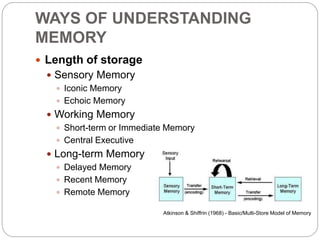
 Length of storage
 Sensory Memory
 Iconic Memory
 Echoic Memory
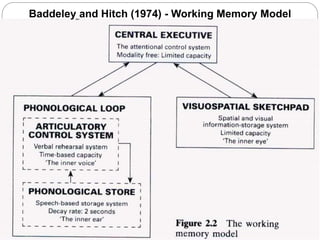
 Working Memory
 Short-term or Immediate Memory
 Central Executive
 Long-term Memory
 Delayed Memory
 Recent Memory
 Remote Memory
Atkinson & Shiffrin (1968) - Basic/Multi-Store Model of Memory
Baddeley and Hitch (1974) - Working Memory Model
WAYS OF UNDERSTANDING
MEMORY
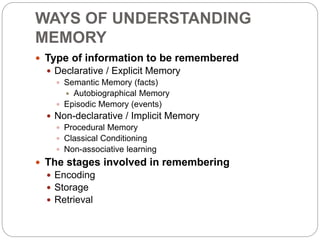
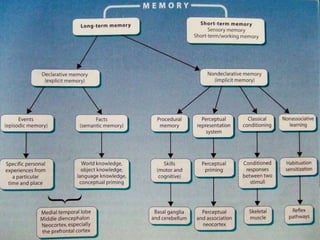
 Type of information to be remembered
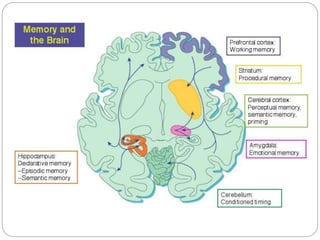
 Declarative / Explicit Memory
 Semantic Memory (facts)
 Autobiographical Memory
 Episodic Memory (events)
 Non-declarative / Implicit Memory
 Procedural Memory
 Classical Conditioning
 Non-associative learning
 The stages involved in remembering
 Encoding
 Storage
 Retrieval
MEMORY DISTURBANCES
 Theoretically varies according to
 Length of storage
 Immediate / Delayed / Recent / Remote
 Type of information lost
 Events / Facts / Skills
 Stages
 Encoding / Storage / Retrieval
 Clinically varies according to
 Amnesia / Paramnesia
 Transient / Persistent
 Acute / Chronic
 Retrograde / Anterograde
 Symptom / Syndrome / Disorder
 Psychological / Organic
 Selective / Global
TRANSIENT AMNESIAS
 Transient global amnesia (TGA)
 Transient epileptic amnesia
 Head injury
 Alcoholic blackouts
 After electroconvulsive therapy
 Posttraumatic stress disorder
 Psychogenic fugue
 Amnesia for offence
Transient Global Amnesia (TGA)
 Most commonly occurs in the middle-aged or
elderly, more frequently in men.
 It is characterized by repetitive questioning, and
there may be some confusion, but patients do not
report any loss of personal identity (they know
who they are).
 It is sometimes preceded by headache or
nausea, a stressful life event, a medical
procedure, or vigorous exercise.
 Hodges & Ward found the mean duration of
amnesia was 4 h and the maximum was 12 h.
 Transient dysfunction in limbic–hippocampal
circuits, crucial to memory formationHodges, J.R. and Ward, C.D. (1989). Observations during transient global amnesia: a behavioural and neuropsychological study of five cases. Brain
Transient Epileptic Amnesia
 This refers to the minority of patients with
transient global amnesia in whom epilepsy
appears to be the underlying cause of the
syndrome.
 AUTOMATISMS or POSTICTAL CONFUSIONAL
STATES
 Bilateral involvement of the limbic structures
involved in memory formation,
 including the hippocampal and parahippocampal structures
bilaterally as well as the mesial diencephalon.
 Amnesia for the period of automatic behaviour is
always present and is usually complete.
Head Injury
 Post-traumatic amnesia is generally assumed to
reflect the degree of underlying diffuse brain
pathology, in particular rotational forces giving
rise to axonal tearing and generalized cognitive
impairment.
 The length of post-traumatic amnesia is predictive
of eventual cognitive outcome, psychiatric
outcome, and social outcome
 Need to be differentiated from persisting
anterograde memory impairment
ALCOHOLIC BLACKOUTS
 Blackouts are periods of amnesia for events that
occur during heavy drinking.
 They are associated with severe intoxication,
usually in the context of a history of prolonged
alcohol abuse
 Typically, a person awakens the morning after
consumption and does not remember what
happened the night before.
 Blackouts are more a measure of the amount of
alcohol consumed at any one time.
 Should not be confused with withdrawal seizures
or other ictal phenomena
After Electroconvulsive Therapy
 This is an iatrogenic form of transient amnesia.
Benzodiazepines and anticholinergic agents can
also give rise to transient memory loss in more
moderate form
 Subjects tested within a few hours of
electroconvulsive therapy (ECT) show a
retrograde impairment for information from the
preceding 1 to 3 years, a pronounced
anterograde memory impairment on both recall
and recognition memory tasks, and an
accelerated rate of forgetting.(13)
 When retested approximately 6 to 9 months after
completion of a course of ECT, memory returns to
normal on objective tests.
13. Frith, C.D., Stevens, M., Johnstone, E.C., Deakin, J.F.W., Lawler, P., and Crow, T.J. (1983). Effects of ECT and depression on various aspects of memory. British Journal
PERSISTENT MEMORY
DISORDERS
 Korsakoff syndrome
 Herpes Encephalitis
 Severe hypoxia
 Vascular disorders
 Head injury
Korsakoff Syndrome
 Clinical features
 Retrograde amnesia that extend back many years
or decade
 Anterograde amnesia
 Confabulation
 Etiology – thiamine deficiency
 Associated with Wernike encephalopathy in
alcoholics
 Pathology – lesion affecting mammillary bodies,
the mammillothalamic tract, or the anterior
thalamus
WERNICKE-KORSAKOFF
SYNDROME [WKS]
Etiology
• Thiamine deficiency
• Encephalistis
• CO poisoning
• 3rd ventricle tumour
Wernicke
Encephalopathy
• Delirium
• Ophtalmoplegia
• Ataxia
• Peripheral neuropathy
Korsakoff
Syndrome
• Amnesia
• Anterograde
• Retrograde
• Confabulation
Acute WKS: Mammillary body hemorrhages
Old WKS: Mammillary body atrophy
DSM-IV Alcohol-induced persisting amnestic disorder
Pathological Process
 Damage to specific diencephalic and
mediotemporal lobe structures (e.g., mamillary
bodies, hippocampus, fornix)
 Head trauma / Surgical intervention
 Vascular disorders
 Thalamic infarction and subarachnoid hemorrhage
 Hypoxia
 Carbon monoxide poisoning, cardiac / respiratory arrest,
failed suicidal attempt, drug overdoses etc
 Herpes simplex encephalitis
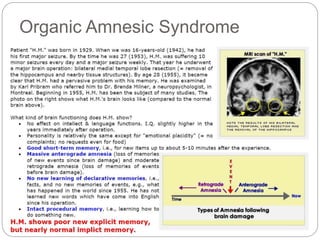
Organic Amnesic Syndrome
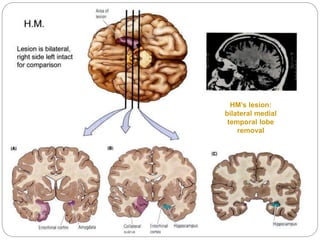
HM’s lesion:
bilateral medial
temporal lobe
removal
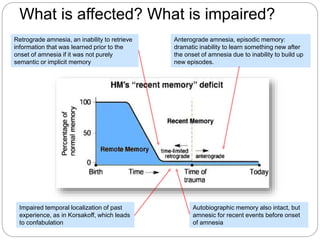
What is affected? What is impaired?
Anterograde amnesia, episodic memory:
dramatic inability to learn something new after
the onset of amnesia due to inability to build up
new episodes.
Retrograde amnesia, an inability to retrieve
information that was learned prior to the
onset of amnesia if it was not purely
semantic or implicit memory
Impaired temporal localization of past
experience, as in Korsakoff, which leads
to confabulation
Autobiographic memory also intact, but
amnesic for recent events before onset
of amnesia
Can You Describe H.M.
Amnesia?
 Theoretically
 Length of storage
 Immediate / Delayed / Recent / Remote
 Type of information lost
 Events / Facts / Skills
 Stages
 Encoding / Storage / Retrieval
 Clinically
 Amnesia / Paramnesia
 Transient / Persisting
 Retrograde / Anterograde
 Symptom / Syndrome / Disorder
 Psychological / Organic
 Selective / G lobal
Confabulation
 ‘‘False statements that are not made to deceive,
are typically more coherent than thoughts
produced during delirium”
 It ranges from small distortions on laboratory
tasks to striking bizarre stories that patients tell in
describing their personal histories
 Typically occurs in the context of executive
deficits such as perseveration, poor self-
monitoring, and difficulty with self-initiated
processes
Confabulation Disorders
1. ‘Spontaneous' confabulation, in which there is a
persistent, unprovoked outpouring of erroneous
memories
 Arises in confusional states and in frontal lobe
disease
 E.g., Wernicke encephalopathy
2. ‘Momentary' or ‘provoked' confabulation, in
which fleeting intrusion errors or distortions are
seen in response to a challenge to memory,
such as a memory test
 Occurs when memory is weak
 E.g., Korsakoff syndrome, dementias and other
clinical amnesic syndromes
Semantic Dementia
 Characterized by loss of semantic memory in
both the verbal and non-verbal domains
 Associated with predominantly temporal lobe
atrophy (left greater than right) and hence is
sometimes called temporal variant FTLD
(tvFTLD)
 Structural MRI imaging shows a characteristic
pattern of atrophy in the temporal lobes
(predominantly on the left) with inferior greater
than superior involvement and anterior temporal
lobe atrophy greater than posterior.
Amnestic disorders 2009

Amnestic disorders 2009

  • 1.
    Dr. Zahiruddin Othman 15November 2009 Amnestic Disor der s
  • 3.
    WAYS OF UNDERSTANDING MEMORY Length of storage  Type of information to be remembered  The stages involved in remembering  Recall and recognition  Explicit and implicit memory  Retrospective and prospective memory
  • 4.
    WAYS OF UNDERSTANDING MEMORY Length of storage  Sensory Memory  Iconic Memory  Echoic Memory  Working Memory  Short-term or Immediate Memory  Central Executive  Long-term Memory  Delayed Memory  Recent Memory  Remote Memory Atkinson & Shiffrin (1968) - Basic/Multi-Store Model of Memory
  • 5.
    Baddeley and Hitch(1974) - Working Memory Model
  • 6.
    WAYS OF UNDERSTANDING MEMORY Type of information to be remembered  Declarative / Explicit Memory  Semantic Memory (facts)  Autobiographical Memory  Episodic Memory (events)  Non-declarative / Implicit Memory  Procedural Memory  Classical Conditioning  Non-associative learning  The stages involved in remembering  Encoding  Storage  Retrieval
  • 8.
    MEMORY DISTURBANCES  Theoreticallyvaries according to  Length of storage  Immediate / Delayed / Recent / Remote  Type of information lost  Events / Facts / Skills  Stages  Encoding / Storage / Retrieval  Clinically varies according to  Amnesia / Paramnesia  Transient / Persistent  Acute / Chronic  Retrograde / Anterograde  Symptom / Syndrome / Disorder  Psychological / Organic  Selective / Global
  • 9.
    TRANSIENT AMNESIAS  Transientglobal amnesia (TGA)  Transient epileptic amnesia  Head injury  Alcoholic blackouts  After electroconvulsive therapy  Posttraumatic stress disorder  Psychogenic fugue  Amnesia for offence
  • 10.
    Transient Global Amnesia(TGA)  Most commonly occurs in the middle-aged or elderly, more frequently in men.  It is characterized by repetitive questioning, and there may be some confusion, but patients do not report any loss of personal identity (they know who they are).  It is sometimes preceded by headache or nausea, a stressful life event, a medical procedure, or vigorous exercise.  Hodges & Ward found the mean duration of amnesia was 4 h and the maximum was 12 h.  Transient dysfunction in limbic–hippocampal circuits, crucial to memory formationHodges, J.R. and Ward, C.D. (1989). Observations during transient global amnesia: a behavioural and neuropsychological study of five cases. Brain
  • 11.
    Transient Epileptic Amnesia This refers to the minority of patients with transient global amnesia in whom epilepsy appears to be the underlying cause of the syndrome.  AUTOMATISMS or POSTICTAL CONFUSIONAL STATES  Bilateral involvement of the limbic structures involved in memory formation,  including the hippocampal and parahippocampal structures bilaterally as well as the mesial diencephalon.  Amnesia for the period of automatic behaviour is always present and is usually complete.
  • 12.
    Head Injury  Post-traumaticamnesia is generally assumed to reflect the degree of underlying diffuse brain pathology, in particular rotational forces giving rise to axonal tearing and generalized cognitive impairment.  The length of post-traumatic amnesia is predictive of eventual cognitive outcome, psychiatric outcome, and social outcome  Need to be differentiated from persisting anterograde memory impairment
  • 13.
    ALCOHOLIC BLACKOUTS  Blackoutsare periods of amnesia for events that occur during heavy drinking.  They are associated with severe intoxication, usually in the context of a history of prolonged alcohol abuse  Typically, a person awakens the morning after consumption and does not remember what happened the night before.  Blackouts are more a measure of the amount of alcohol consumed at any one time.  Should not be confused with withdrawal seizures or other ictal phenomena
  • 15.
    After Electroconvulsive Therapy This is an iatrogenic form of transient amnesia. Benzodiazepines and anticholinergic agents can also give rise to transient memory loss in more moderate form  Subjects tested within a few hours of electroconvulsive therapy (ECT) show a retrograde impairment for information from the preceding 1 to 3 years, a pronounced anterograde memory impairment on both recall and recognition memory tasks, and an accelerated rate of forgetting.(13)  When retested approximately 6 to 9 months after completion of a course of ECT, memory returns to normal on objective tests. 13. Frith, C.D., Stevens, M., Johnstone, E.C., Deakin, J.F.W., Lawler, P., and Crow, T.J. (1983). Effects of ECT and depression on various aspects of memory. British Journal
  • 16.
    PERSISTENT MEMORY DISORDERS  Korsakoffsyndrome  Herpes Encephalitis  Severe hypoxia  Vascular disorders  Head injury
  • 17.
    Korsakoff Syndrome  Clinicalfeatures  Retrograde amnesia that extend back many years or decade  Anterograde amnesia  Confabulation  Etiology – thiamine deficiency  Associated with Wernike encephalopathy in alcoholics  Pathology – lesion affecting mammillary bodies, the mammillothalamic tract, or the anterior thalamus
  • 18.
    WERNICKE-KORSAKOFF SYNDROME [WKS] Etiology • Thiaminedeficiency • Encephalistis • CO poisoning • 3rd ventricle tumour Wernicke Encephalopathy • Delirium • Ophtalmoplegia • Ataxia • Peripheral neuropathy Korsakoff Syndrome • Amnesia • Anterograde • Retrograde • Confabulation Acute WKS: Mammillary body hemorrhages Old WKS: Mammillary body atrophy DSM-IV Alcohol-induced persisting amnestic disorder
  • 19.
    Pathological Process  Damageto specific diencephalic and mediotemporal lobe structures (e.g., mamillary bodies, hippocampus, fornix)  Head trauma / Surgical intervention  Vascular disorders  Thalamic infarction and subarachnoid hemorrhage  Hypoxia  Carbon monoxide poisoning, cardiac / respiratory arrest, failed suicidal attempt, drug overdoses etc  Herpes simplex encephalitis
  • 20.
  • 21.
  • 22.
    What is affected?What is impaired? Anterograde amnesia, episodic memory: dramatic inability to learn something new after the onset of amnesia due to inability to build up new episodes. Retrograde amnesia, an inability to retrieve information that was learned prior to the onset of amnesia if it was not purely semantic or implicit memory Impaired temporal localization of past experience, as in Korsakoff, which leads to confabulation Autobiographic memory also intact, but amnesic for recent events before onset of amnesia
  • 23.
    Can You DescribeH.M. Amnesia?  Theoretically  Length of storage  Immediate / Delayed / Recent / Remote  Type of information lost  Events / Facts / Skills  Stages  Encoding / Storage / Retrieval  Clinically  Amnesia / Paramnesia  Transient / Persisting  Retrograde / Anterograde  Symptom / Syndrome / Disorder  Psychological / Organic  Selective / G lobal
  • 24.
    Confabulation  ‘‘False statementsthat are not made to deceive, are typically more coherent than thoughts produced during delirium”  It ranges from small distortions on laboratory tasks to striking bizarre stories that patients tell in describing their personal histories  Typically occurs in the context of executive deficits such as perseveration, poor self- monitoring, and difficulty with self-initiated processes
  • 25.
    Confabulation Disorders 1. ‘Spontaneous'confabulation, in which there is a persistent, unprovoked outpouring of erroneous memories  Arises in confusional states and in frontal lobe disease  E.g., Wernicke encephalopathy 2. ‘Momentary' or ‘provoked' confabulation, in which fleeting intrusion errors or distortions are seen in response to a challenge to memory, such as a memory test  Occurs when memory is weak  E.g., Korsakoff syndrome, dementias and other clinical amnesic syndromes
  • 26.
    Semantic Dementia  Characterizedby loss of semantic memory in both the verbal and non-verbal domains  Associated with predominantly temporal lobe atrophy (left greater than right) and hence is sometimes called temporal variant FTLD (tvFTLD)  Structural MRI imaging shows a characteristic pattern of atrophy in the temporal lobes (predominantly on the left) with inferior greater than superior involvement and anterior temporal lobe atrophy greater than posterior.