AMNESTIC DISORDERS
Dr Zahiruddin Othman
JANUARY 2013
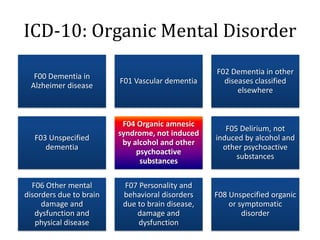
ICD-10: Organic Mental Disorder
F00 Dementia in
Alzheimer disease
F01 Vascular dementia
F02 Dementia in other
diseases classified
elsewhere
F03 Unspecified
dementia
F04 Organic amnesic
syndrome, not induced
by alcohol and other
psychoactive
substances
F05 Delirium, not
induced by alcohol and
other psychoactive
substances
F06 Other mental
disorders due to brain
damage and
dysfunction and
physical disease
F07 Personality and
behavioral disorders
due to brain disease,
damage and
dysfunction
F08 Unspecified organic
or symptomatic
disorder
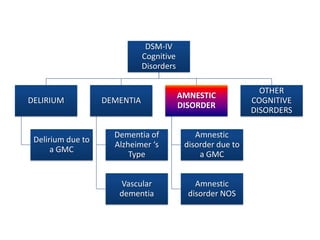
DSM-IV
Cognitive
Disorders
DELIRIUM
Delirium due to
a GMC
DEMENTIA
Dementia of
Alzheimer ‘s
Type
Vascular
dementia
AMNESTIC
DISORDER
Amnestic
disorder due to
a GMC
Amnestic
disorder NOS
OTHER
COGNITIVE
DISORDERS
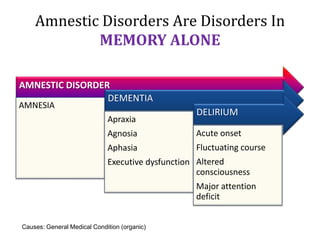
Amnestic Disorders Are Disorders In
MEMORY ALONE
AMNESTIC DISORDER
AMNESIA
DEMENTIA
Apraxia
Agnosia
Aphasia
Executive dysfunction
DELIRIUM
Acute onset
Fluctuating course
Altered
consciousness
Major attention
deficit
Causes: General Medical Condition (organic)
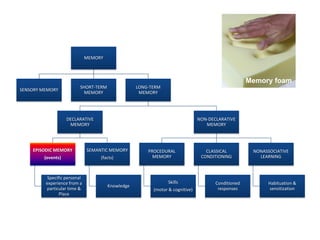
MEMORY
SENSORY MEMORY
SHORT-TERM
MEMORY
LONG-TERM
MEMORY
DECLARATIVE
MEMORY
EPISODIC MEMORY
(events)
Specific personal
experience from a
particular time &
Place
SEMANTIC MEMORY
(facts)
Knowledge
NON-DECLARATIVE
MEMORY
PROCEDURAL
MEMORY
Skills
(motor & cognitive)
CLASSICAL
CONDITIONING
Conditioned
responses
NONASSOCIATIVE
LEARNING
Habituation &
sensitization
Memory foam
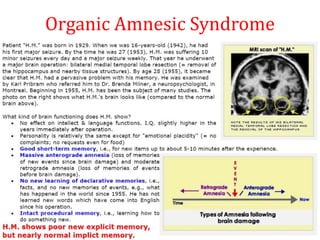
Organic Amnesic Syndrome
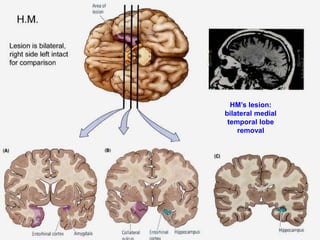
HM’s lesion:
bilateral medial
temporal lobe
removal
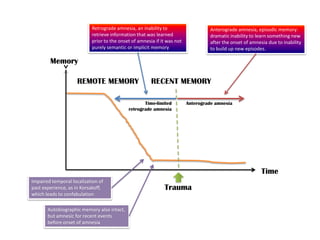
Time
Memory
Trauma
Anterograde amnesiaTime-limited
retrograde amnesia
REMOTE MEMORY RECENT MEMORY
Impaired temporal localization of
past experience, as in Korsakoff,
which leads to confabulation
Autobiographic memory also intact,
but amnesic for recent events
before onset of amnesia
Retrograde amnesia, an inability to
retrieve information that was learned
prior to the onset of amnesia if it was not
purely semantic or implicit memory
Anterograde amnesia, episodic memory:
dramatic inability to learn something new
after the onset of amnesia due to inability
to build up new episodes.
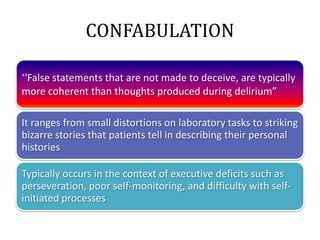
CONFABULATION
‘‘False statements that are not made to deceive, are typically
more coherent than thoughts produced during delirium”
It ranges from small distortions on laboratory tasks to striking
bizarre stories that patients tell in describing their personal
histories
Typically occurs in the context of executive deficits such as
perseveration, poor self-monitoring, and difficulty with self-
initiated processes
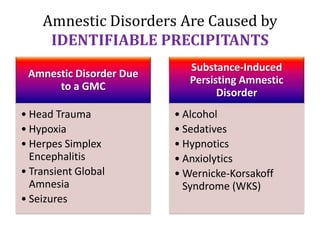
Amnestic Disorders Are Caused by
IDENTIFIABLE PRECIPITANTS
Amnestic Disorder Due
to a GMC
• Head Trauma
• Hypoxia
• Herpes Simplex
Encephalitis
• Transient Global
Amnesia
• Seizures
Substance-Induced
Persisting Amnestic
Disorder
• Alcohol
• Sedatives
• Hypnotics
• Anxiolytics
• Wernicke-Korsakoff
Syndrome (WKS)
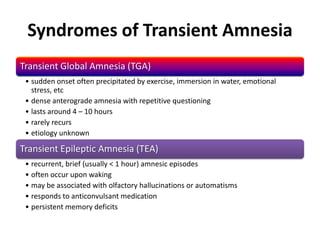
Syndromes of Transient Amnesia
Transient Global Amnesia (TGA)
• sudden onset often precipitated by exercise, immersion in water, emotional
stress, etc
• dense anterograde amnesia with repetitive questioning
• lasts around 4 – 10 hours
• rarely recurs
• etiology unknown
Transient Epileptic Amnesia (TEA)
• recurrent, brief (usually < 1 hour) amnesic episodes
• often occur upon waking
• may be associated with olfactory hallucinations or automatisms
• responds to anticonvulsant medication
• persistent memory deficits
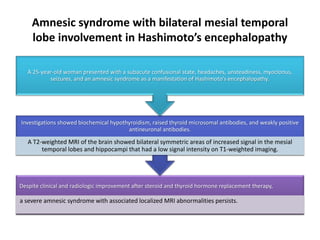
Amnesic syndrome with bilateral mesial temporal
lobe involvement in Hashimoto’s encephalopathy
Despite clinical and radiologic improvement after steroid and thyroid hormone replacement therapy,
a severe amnesic syndrome with associated localized MRI abnormalities persists.
Investigations showed biochemical hypothyroidism, raised thyroid microsomal antibodies, and weakly positive
antineuronal antibodies.
A T2-weighted MRI of the brain showed bilateral symmetric areas of increased signal in the mesial
temporal lobes and hippocampi that had a low signal intensity on T1-weighted imaging.
A 25-year-old woman presented with a subacute confusional state, headaches, unsteadiness, myoclonus,
seizures, and an amnesic syndrome as a manifestation of Hashimoto’s encephalopathy.
BLACKOUTS
• Blackouts are periods of amnesia for events
that occur during heavy drinking.
• Typically, a person awakens the morning after
consumption and does not remember what
happened the night before.
• Blackouts are more a measure of the amount
of alcohol consumed at any one time.
Chronic Amnestic Disorders
Causes - Pathological Process
• Damage to specific diencephalic and
mediotemporal lobe structures (e.g.,
mamillary bodies, hippocampus, fornix)
– head trauma
– surgical intervention
– infarction of the distribution of PCA
– hypoxia
– herpes simplex encephalitis
Substance-Induced Persisting
Amnestic Disorder
• “Persisting” means the memory disturbances
persists long after the effects of substance
intoxication or withdrawal have ended
• CNS depressants
– Alcohol, sedatives, hypnotics, anxiolytics,
anticonvulsants
• Toxin: lead, mercury, intratheceal
methotrexate, organophosphate insecticides,
and industrial solvents
WERNICKE-KORSAKOFF SYNDROME [WKS]
CAUSES
• Alcoholism
• CO poisoning
• Encephalitis
WERNICKE
ENCEPHALOPATHY
• Delirium
• Ophtalmoplegia
• Ataxia
• Peripheral neuropathy
KORSAKOFF
SYNDROME
• Amnesia
• Confabulation
TREATMENT
• The primary goal in the amnestic disorders is
to discover and treat the underlying cause.
• Some of these causes of amnestic disorder are
associated with dangerous self-damaging
behavior
– e.g., suicide attempts by hanging, carbon
monoxide poisoning, deliberate motor vehicle
accidents, self-inflicted gunshot wounds to the
head and chronic alcohol abuse
Amnestic disorders [2013]

Amnestic disorders [2013]

  • 1.
  • 2.
    ICD-10: Organic MentalDisorder F00 Dementia in Alzheimer disease F01 Vascular dementia F02 Dementia in other diseases classified elsewhere F03 Unspecified dementia F04 Organic amnesic syndrome, not induced by alcohol and other psychoactive substances F05 Delirium, not induced by alcohol and other psychoactive substances F06 Other mental disorders due to brain damage and dysfunction and physical disease F07 Personality and behavioral disorders due to brain disease, damage and dysfunction F08 Unspecified organic or symptomatic disorder
  • 3.
    DSM-IV Cognitive Disorders DELIRIUM Delirium due to aGMC DEMENTIA Dementia of Alzheimer ‘s Type Vascular dementia AMNESTIC DISORDER Amnestic disorder due to a GMC Amnestic disorder NOS OTHER COGNITIVE DISORDERS
  • 4.
    Amnestic Disorders AreDisorders In MEMORY ALONE AMNESTIC DISORDER AMNESIA DEMENTIA Apraxia Agnosia Aphasia Executive dysfunction DELIRIUM Acute onset Fluctuating course Altered consciousness Major attention deficit Causes: General Medical Condition (organic)
  • 5.
    MEMORY SENSORY MEMORY SHORT-TERM MEMORY LONG-TERM MEMORY DECLARATIVE MEMORY EPISODIC MEMORY (events) Specificpersonal experience from a particular time & Place SEMANTIC MEMORY (facts) Knowledge NON-DECLARATIVE MEMORY PROCEDURAL MEMORY Skills (motor & cognitive) CLASSICAL CONDITIONING Conditioned responses NONASSOCIATIVE LEARNING Habituation & sensitization Memory foam
  • 6.
  • 7.
  • 8.
    Time Memory Trauma Anterograde amnesiaTime-limited retrograde amnesia REMOTEMEMORY RECENT MEMORY Impaired temporal localization of past experience, as in Korsakoff, which leads to confabulation Autobiographic memory also intact, but amnesic for recent events before onset of amnesia Retrograde amnesia, an inability to retrieve information that was learned prior to the onset of amnesia if it was not purely semantic or implicit memory Anterograde amnesia, episodic memory: dramatic inability to learn something new after the onset of amnesia due to inability to build up new episodes.
  • 9.
    CONFABULATION ‘‘False statements thatare not made to deceive, are typically more coherent than thoughts produced during delirium” It ranges from small distortions on laboratory tasks to striking bizarre stories that patients tell in describing their personal histories Typically occurs in the context of executive deficits such as perseveration, poor self-monitoring, and difficulty with self- initiated processes
  • 10.
    Amnestic Disorders AreCaused by IDENTIFIABLE PRECIPITANTS Amnestic Disorder Due to a GMC • Head Trauma • Hypoxia • Herpes Simplex Encephalitis • Transient Global Amnesia • Seizures Substance-Induced Persisting Amnestic Disorder • Alcohol • Sedatives • Hypnotics • Anxiolytics • Wernicke-Korsakoff Syndrome (WKS)
  • 11.
    Syndromes of TransientAmnesia Transient Global Amnesia (TGA) • sudden onset often precipitated by exercise, immersion in water, emotional stress, etc • dense anterograde amnesia with repetitive questioning • lasts around 4 – 10 hours • rarely recurs • etiology unknown Transient Epileptic Amnesia (TEA) • recurrent, brief (usually < 1 hour) amnesic episodes • often occur upon waking • may be associated with olfactory hallucinations or automatisms • responds to anticonvulsant medication • persistent memory deficits
  • 12.
    Amnesic syndrome withbilateral mesial temporal lobe involvement in Hashimoto’s encephalopathy Despite clinical and radiologic improvement after steroid and thyroid hormone replacement therapy, a severe amnesic syndrome with associated localized MRI abnormalities persists. Investigations showed biochemical hypothyroidism, raised thyroid microsomal antibodies, and weakly positive antineuronal antibodies. A T2-weighted MRI of the brain showed bilateral symmetric areas of increased signal in the mesial temporal lobes and hippocampi that had a low signal intensity on T1-weighted imaging. A 25-year-old woman presented with a subacute confusional state, headaches, unsteadiness, myoclonus, seizures, and an amnesic syndrome as a manifestation of Hashimoto’s encephalopathy.
  • 13.
    BLACKOUTS • Blackouts areperiods of amnesia for events that occur during heavy drinking. • Typically, a person awakens the morning after consumption and does not remember what happened the night before. • Blackouts are more a measure of the amount of alcohol consumed at any one time.
  • 14.
    Chronic Amnestic Disorders Causes- Pathological Process • Damage to specific diencephalic and mediotemporal lobe structures (e.g., mamillary bodies, hippocampus, fornix) – head trauma – surgical intervention – infarction of the distribution of PCA – hypoxia – herpes simplex encephalitis
  • 15.
    Substance-Induced Persisting Amnestic Disorder •“Persisting” means the memory disturbances persists long after the effects of substance intoxication or withdrawal have ended • CNS depressants – Alcohol, sedatives, hypnotics, anxiolytics, anticonvulsants • Toxin: lead, mercury, intratheceal methotrexate, organophosphate insecticides, and industrial solvents
  • 16.
    WERNICKE-KORSAKOFF SYNDROME [WKS] CAUSES •Alcoholism • CO poisoning • Encephalitis WERNICKE ENCEPHALOPATHY • Delirium • Ophtalmoplegia • Ataxia • Peripheral neuropathy KORSAKOFF SYNDROME • Amnesia • Confabulation
  • 17.
    TREATMENT • The primarygoal in the amnestic disorders is to discover and treat the underlying cause. • Some of these causes of amnestic disorder are associated with dangerous self-damaging behavior – e.g., suicide attempts by hanging, carbon monoxide poisoning, deliberate motor vehicle accidents, self-inflicted gunshot wounds to the head and chronic alcohol abuse