DIGESTION OF PROTEIN ,
ABSORPTION OF AMINO ACIDS &
GENERAL REACTIONS OF AMINO
ACIDS
Department of Biochemistry.
DIGESTION OF PROTEIN
 Digestion: It is the process to convert complex
compounds from our diet into simpler compounds
which can be easily taken up by our GIT cells.
 Zymogens: Proteolytic enzymes are secreted in the
form of inactive enzymes which are converted to
their active form in our GIT lumen.
 This prevents autodigestion of secretory glands.
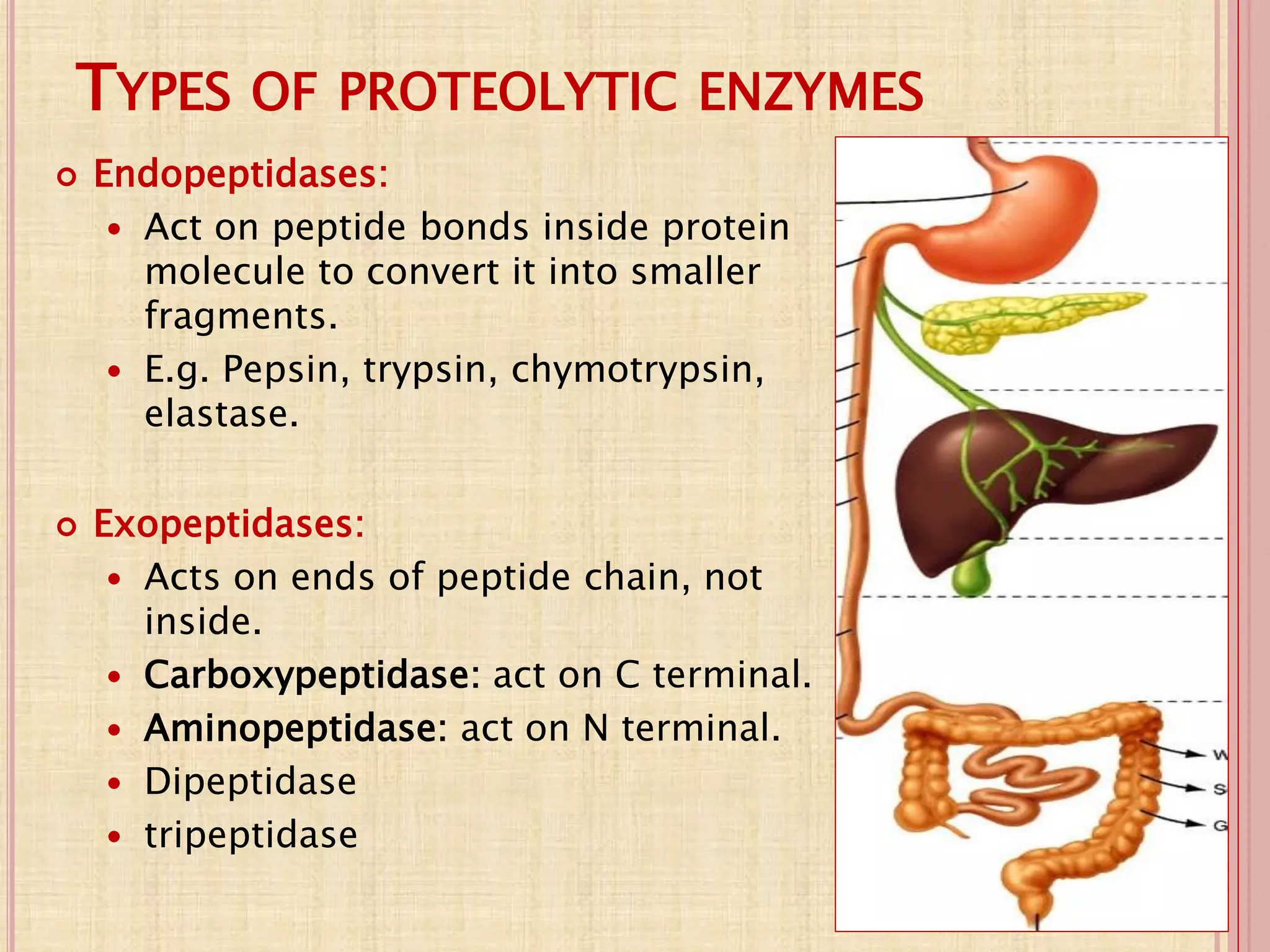
TYPES OF PROTEOLYTIC ENZYMES
 Endopeptidases:
 Act on peptide bonds inside protein
molecule to convert it into smaller
fragments.
 E.g. Pepsin, trypsin, chymotrypsin,
elastase.
 Exopeptidases:
 Acts on ends of peptide chain, not
inside.
 Carboxypeptidase: act on C terminal.
 Aminopeptidase: act on N terminal.
 Dipeptidase
 tripeptidase
DIGESTION IN STOMACH
 Hydrochloric acid (HCl):
 Denatures protein
 Activates Pepsinogen  Pepsin.
 Make pH optimum for action of pepsin. (pH~2)
 Rennin:
 Active in infants & absent in adults
 Causes curdling of milk
 Casein  paracasein. Which is further digested by
pepsin & other enzymes.
 Pepsin:
 Secreted by chief cell as inactive pepsinogen.
 HCl removes N terminal 44 AAs & convert
pepsinogen (inactive)  Pepsin (Active)
 It hydrolyze the bond formed by carboxy groups
of Phe, Tyr, Trp & Met (aromatic AA) & convert
protein  Proteoses & peptones.
DIGESTION BY PANCREATIC ENZYMES
 Optimum pH of pancreatic enzyme is 8 which is
provided by alkaline bile & pancreatic juice.
 Cholecystokinin & Pancreozymin hormones
stimulates secretion of pancreatic juice.
 Enzymes are secreted as zymogen (inactive form) to
protect gland from autodigestion.
 Trypsin: (SERINE PROTEASE)
 Trypsinogen  Trypsin by enterokinase present
of intestinal microvillus membranes.
 Activation needs removal of hexapeptide from N
terminal end.
 Trypsin can autoactivate other trypsinogen & can
activate other zymogens.
 Trypsin hydrolyses bonds formed by carboxyl
groups of Arg & Lys (basic AA).
 Acute pancreatitis:
 Chymotrypsinogen  Chymotrypsin by Trypsin. (SERINE
PROTEASE)
 Proelastase  Elastase by Trypsin. (SERINE PROTEASE)
 Procarboxypeptidase  Carboxypeptidase by Trypsin.
 Required metal ions : Zn
 Intestinal digestion
 Enzymes present on intestinal juice (Succus entericus) leads
to complete digestion of small peptides into amino acids.
 Dipeptidases and tripeptidases
 aminopeptidase
ABSORPTION OF AMINO ACIDS.
 Site: Upper small intestine (Duodenum & Proximal
Jejunum)
 3 different mechanisms:
1. Sodium dependent secondary active transport
2. Sodium independent facilitated transport
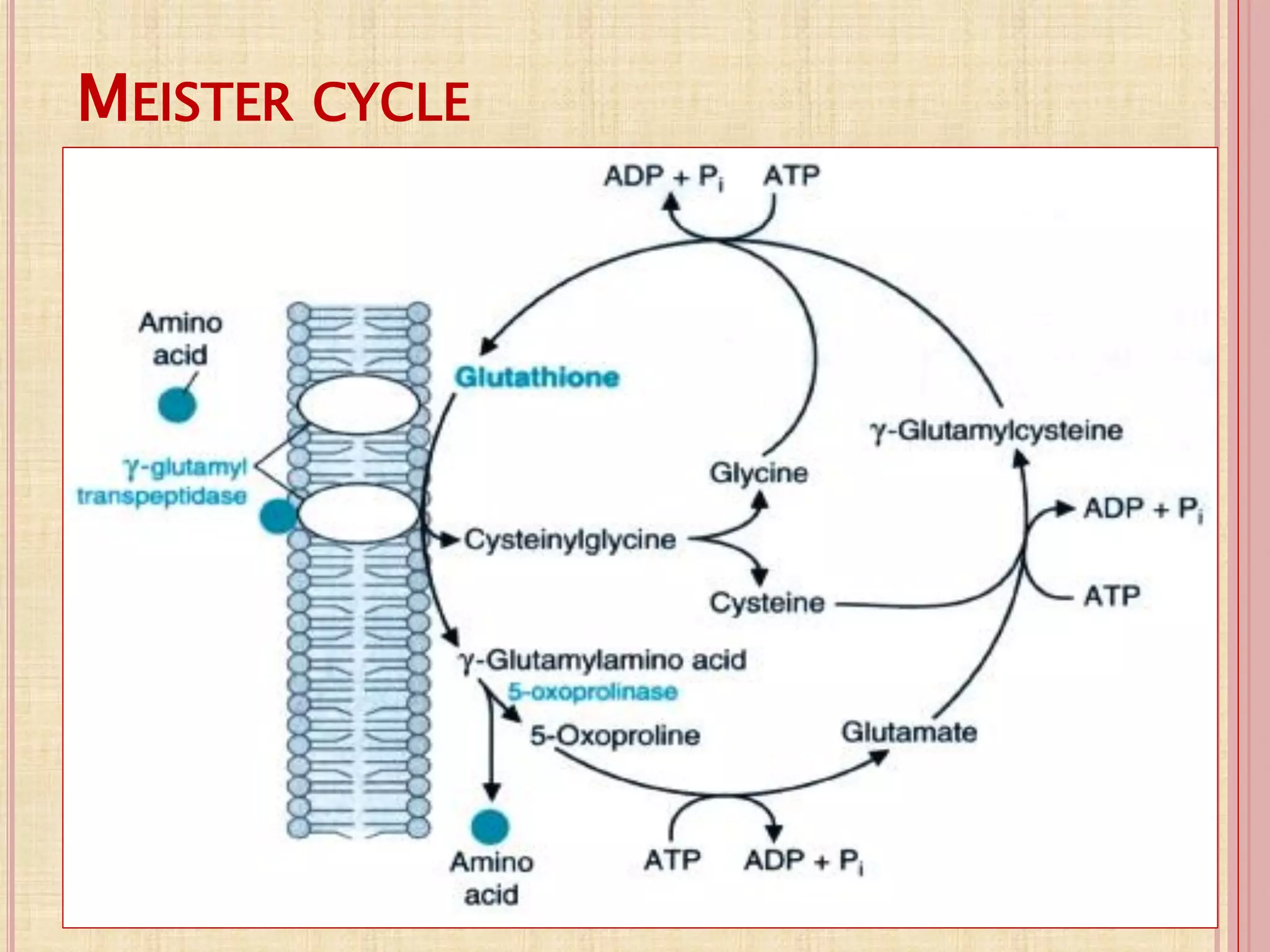
3. Meister cycle
 After absorption they are transported via portal
blood to liver.
SODIUM DEPENDENT SECONDARY ACTIVE
TRANSPORT OF AMINO ACIDS:
SODIUM DEPENDENT SECONDARY ACTIVE
TRANSPORT:
 5 different transporter system for different groups
of amino acids:
1. Neutral AAs: Ala, Val, Leu, Met, Phe, Tyr, Ile.
 Trp & Ala show competitive inhibition.
2. Basic AAs: COAL system  Cys, Ornithine, Arg,
Lys.
3. Acidic AAs: Glu, Asp
4. Imino acids and glycine: Proline, Hydroxyproline,
Glycine.
5. Beta AAs: Beta alanine.
SODIUM INDEPENDENT FACILITATED
TRANSPORT SYSTEM
 Neutral & hydrophobic AAs: Phe, Leu
 Basic AAs: Lys, Arg
MEISTER CYCLE
DISORDERS OF DIGESTION & ABSORPTION
OF PROTEIN
 Disease of pancreas: Acute or chronic pancreatitis,
cystic fibrosis.
 Small intestinal diseases:
 Genetic disorders:
1. Hartnup disease: Defective transport of neutral
AAs (Trp) at PCT of kidney & jejunum  symptoms
of pellagra (Diarrhoea, Dementia, Dermatitis)
2. Glycinuria: Defect in Pro/Gly transporter at PCT &
intestine  loss of Gly/Pro in urine.
3. Cystinuria: Defect in COAL system  cystine renal
stones.
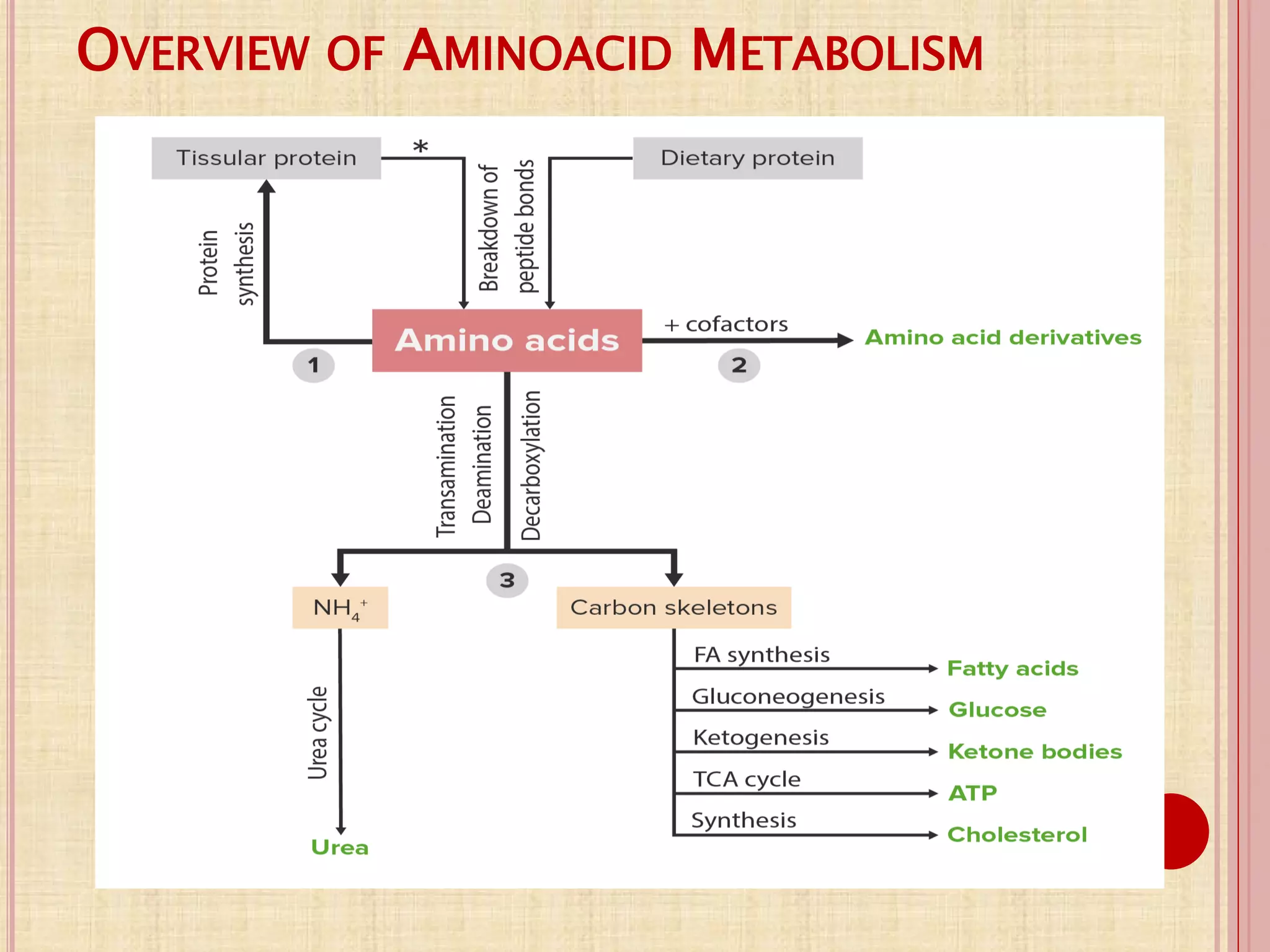
OVERVIEW OF AMINOACID METABOLISM
AMINO ACIDS
 Amino derivative of carboxylic acid
 Central α carbon with four groups attached to it:
I. Carboxyl group
II. Amino group
III. Hydrogen atom
IV. Unique side chain.
 Total 20 amino acids:
 But 21st & 22nd amino acids
are also found.
REACTIONS DUE TO CARBOXYL GROUP
 Decarboxylation: removal of CO2 &
formation of corresponding
amine.
 Histidine  Histamine
 Tyrosine  Tyramine
 Tryptophan  Tryptamine
 Lysine  Cadaverine
 Glutamic acid  GABA
REACTION DUE TO AMINO GROUP
 Transamination: α amino
group transferred to α keto
acid resulting in formation of
corresponding new amino
acid & α keto acid.
 Occur in cytosol
 α keto glutarate/Glutamate
generally act as amino
group acceptor/donor.
PURPOSE OF
TRANSAMINATION
 Removal & detoxification of
ammonia
 Gluconeogenesis from amino
acids
 Biosynthesis of non essential
amino acids.
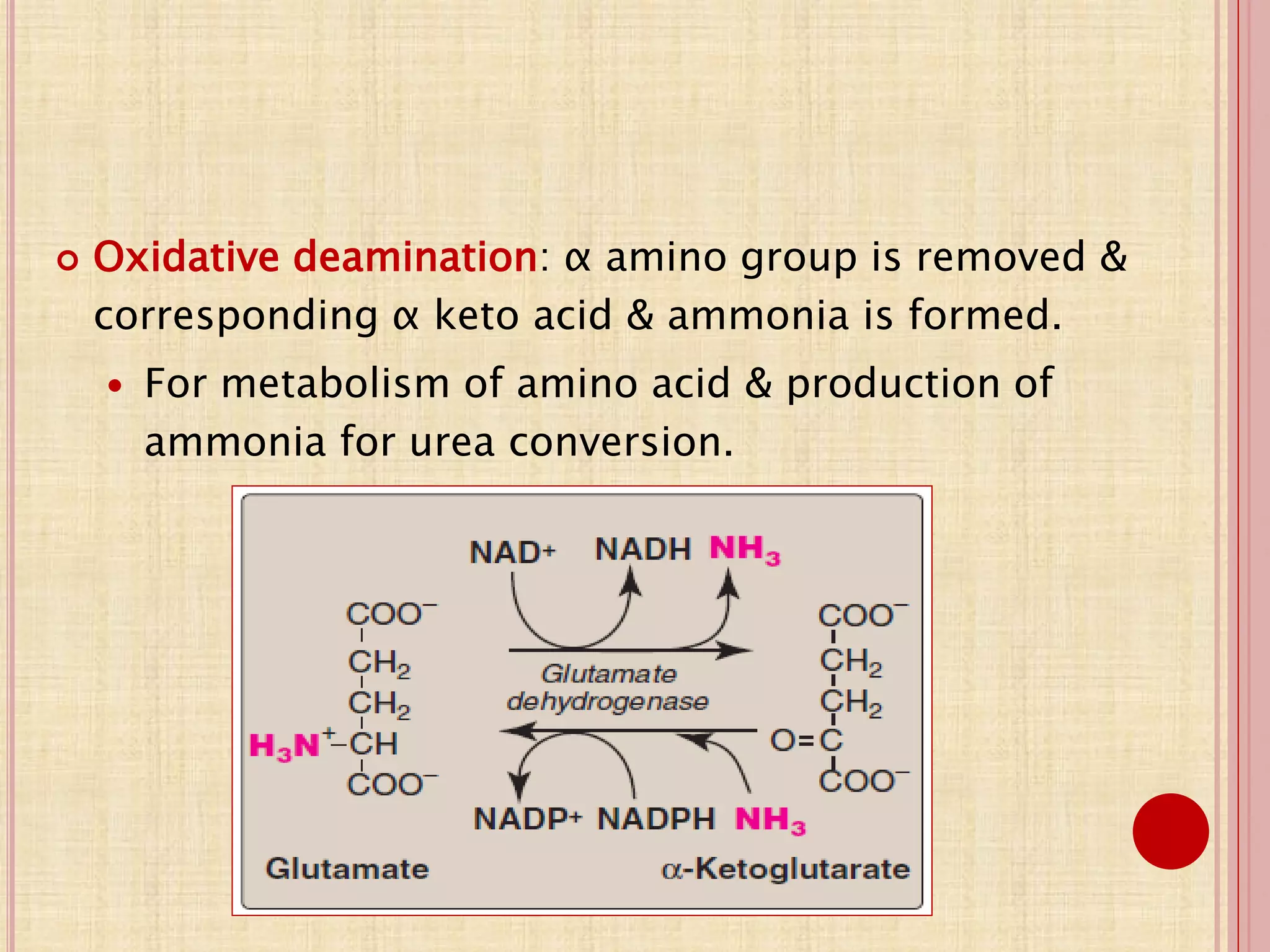
 Oxidative deamination: α amino group is removed &
corresponding α keto acid & ammonia is formed.
 For metabolism of amino acid & production of
ammonia for urea conversion.
L- amino acid oxidase
L-amino acid + FMN α keto acid + NH3
+ FMNH2
Significance:
 Oxidative deamination is involved in metabolism of
amino acid & production of ammonia.
 Non oxidative deamination: Ammonia is released from
AA without oxidation.
Cysteine  Pyruvate + NH3 + H2S (Cys desulfhydrase)
Serine  Pyruvate + NH3 (Serine dehydratase)
Threonine  α ketobutyrate + NH3 (Thr dehydratase)
Histidine  Urocanate + NH3 (Histidase)
Significance: Metabolism of amino acid & Production of
ammonia
TRANSMETHYLATION
 Transfer of methyl group from S-Adenosyl
Methionine to various compounds.
CH3 acceptor  Methylated product
 Norepinephrine  Epinephrine
 Guanidinoacetate  Creatine
 Ethanolamine  Choline
 N acetyl serononin  Melatonin
 Carnosine  Anserine
TRANS-SULFURATION
1. Cystathionine
synthase
2. Cystathioninase
PLP – Pyridoxal
phosphate
Significance:
 Cysteine is formed from Methionine  therefore
cysteine is non-esseatial amino acid
 Inherited defect of enzymes of trans-sulfuration
leads to Homocystinuria and/or cystathionuria.
SOURCES OF AMMONIA
 Transamination followed by oxidative deamination:
Ala/Asp + α KG  Pyruvate/Oxaloacetate + Glu
Glu + NAD+  α KG + NH3 + NADH + H+
 Direct oxidative deamination:
L-Amino acid + FMN  α-Keto acid + NH3 + FMNH2
 Non oxidative deamination:
Ser/Thr dehydratase, Cys desulfhydrase, Histidase
 Non amino acid sources:
Degradation of urea by bacteria in intestinal lumen,
degradation of purine/pyrimidine nucleotides &
biogenic amines.
TRANSPORT OF AMMONIA
 3 forms: Glutamine, Glutamate, Ammonia,alanine
 Glutamine (Gln): from brain & intestine to liver
Glu + NH3 + ATP  Gln + ADP + Pi (Gln synthetase)
 Intracellular ammonia is immediately converted
to Gln to reduce toxicity & transport to liver for
final disposal
 Glutamate (Glu): Through transamination, NH3 is
donated to α KG to form Glu. Glu is transported to
liver for final disposal.
 Free ammonia: Normal level - 15-60 μmol/l. Excess
of free ammonia is toxic to cells especially neurons.
 Muscle : mainly release ammonia as alanine to liver
 Brain : mainly release ammonia as glutamine to liver
 Intestine : mainly release ammonia as alanine to
liver
 Kidney : mainly release ammonia as alanine to liver
and NH4+ as in urine for buffer
FATE OF AMMONIA
 Major fate of ammonia is  conversion to UREA.
 Other fate:
 Formation of Glutamine/Asparagine
 Formation of Glycine
 Formation of nitrogenous compound like purine ,
pyrimidine
SUMMARY
 Digestion of protein
 Absorption of amino acids
 Disorders related to digestion & absorption
 Reactions of amino acids:
 Transamination, Oxidative deamination, non
oxidative deamination
 Transmethylation, Trans-sulfuration.
 Ammonia:
 Sources, Transport & Fate of ammonia
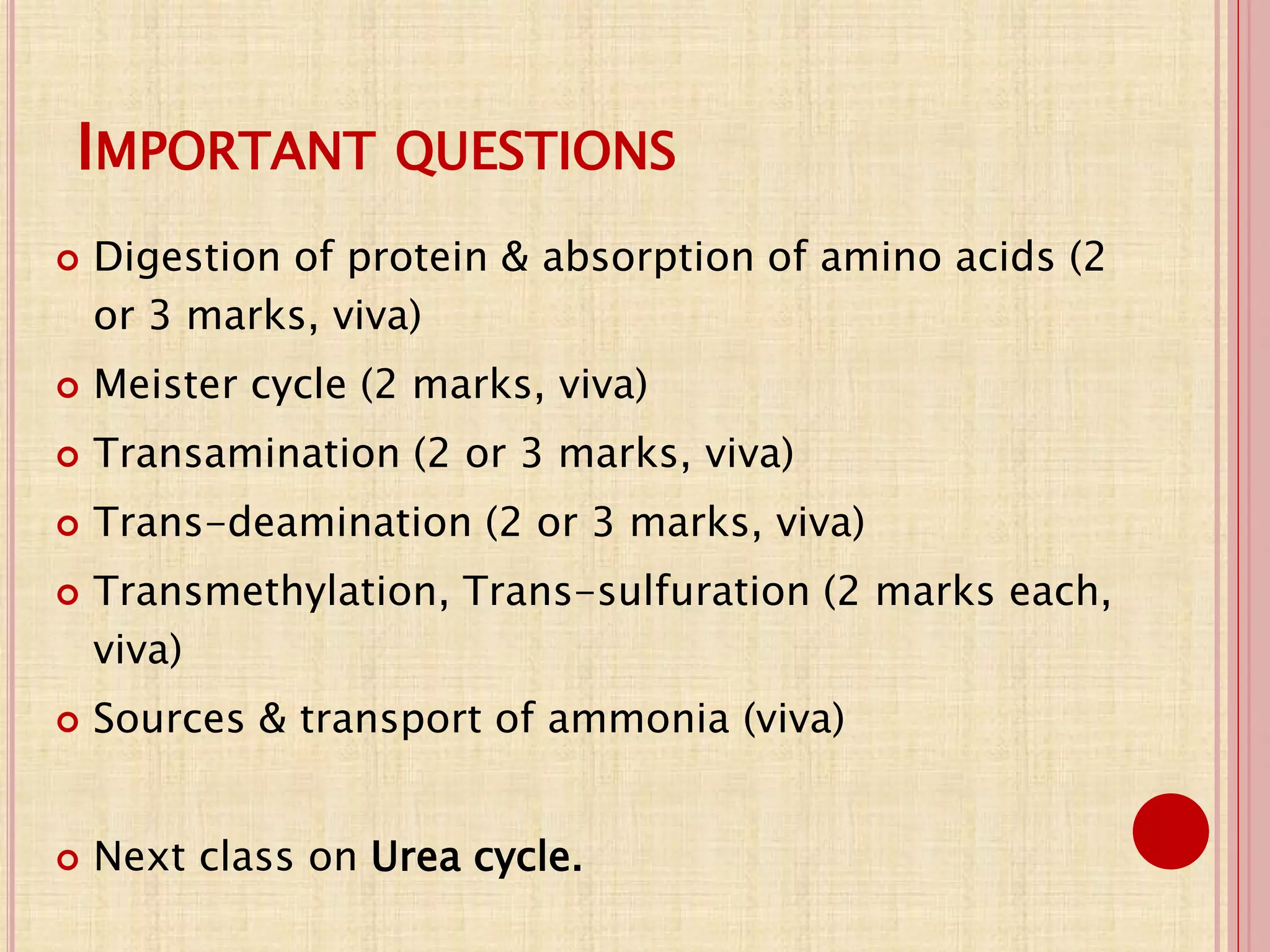
IMPORTANT QUESTIONS
 Digestion of protein & absorption of amino acids (2
or 3 marks, viva)
 Meister cycle (2 marks, viva)
 Transamination (2 or 3 marks, viva)
 Trans-deamination (2 or 3 marks, viva)
 Transmethylation, Trans-sulfuration (2 marks each,
viva)
 Sources & transport of ammonia (viva)
 Next class on Urea cycle.

Amino acid metabolism_digestion & absorption.pdf

  • 1.
    DIGESTION OF PROTEIN, ABSORPTION OF AMINO ACIDS & GENERAL REACTIONS OF AMINO ACIDS Department of Biochemistry.
  • 2.
    DIGESTION OF PROTEIN Digestion: It is the process to convert complex compounds from our diet into simpler compounds which can be easily taken up by our GIT cells.  Zymogens: Proteolytic enzymes are secreted in the form of inactive enzymes which are converted to their active form in our GIT lumen.  This prevents autodigestion of secretory glands.
  • 3.
    TYPES OF PROTEOLYTICENZYMES  Endopeptidases:  Act on peptide bonds inside protein molecule to convert it into smaller fragments.  E.g. Pepsin, trypsin, chymotrypsin, elastase.  Exopeptidases:  Acts on ends of peptide chain, not inside.  Carboxypeptidase: act on C terminal.  Aminopeptidase: act on N terminal.  Dipeptidase  tripeptidase
  • 4.
    DIGESTION IN STOMACH Hydrochloric acid (HCl):  Denatures protein  Activates Pepsinogen  Pepsin.  Make pH optimum for action of pepsin. (pH~2)  Rennin:  Active in infants & absent in adults  Causes curdling of milk  Casein  paracasein. Which is further digested by pepsin & other enzymes.
  • 5.
     Pepsin:  Secretedby chief cell as inactive pepsinogen.  HCl removes N terminal 44 AAs & convert pepsinogen (inactive)  Pepsin (Active)  It hydrolyze the bond formed by carboxy groups of Phe, Tyr, Trp & Met (aromatic AA) & convert protein  Proteoses & peptones.
  • 6.
    DIGESTION BY PANCREATICENZYMES  Optimum pH of pancreatic enzyme is 8 which is provided by alkaline bile & pancreatic juice.  Cholecystokinin & Pancreozymin hormones stimulates secretion of pancreatic juice.  Enzymes are secreted as zymogen (inactive form) to protect gland from autodigestion.
  • 7.
     Trypsin: (SERINEPROTEASE)  Trypsinogen  Trypsin by enterokinase present of intestinal microvillus membranes.  Activation needs removal of hexapeptide from N terminal end.  Trypsin can autoactivate other trypsinogen & can activate other zymogens.  Trypsin hydrolyses bonds formed by carboxyl groups of Arg & Lys (basic AA).  Acute pancreatitis:
  • 8.
     Chymotrypsinogen Chymotrypsin by Trypsin. (SERINE PROTEASE)  Proelastase  Elastase by Trypsin. (SERINE PROTEASE)  Procarboxypeptidase  Carboxypeptidase by Trypsin.  Required metal ions : Zn  Intestinal digestion  Enzymes present on intestinal juice (Succus entericus) leads to complete digestion of small peptides into amino acids.  Dipeptidases and tripeptidases  aminopeptidase
  • 9.
    ABSORPTION OF AMINOACIDS.  Site: Upper small intestine (Duodenum & Proximal Jejunum)  3 different mechanisms: 1. Sodium dependent secondary active transport 2. Sodium independent facilitated transport 3. Meister cycle  After absorption they are transported via portal blood to liver.
  • 10.
    SODIUM DEPENDENT SECONDARYACTIVE TRANSPORT OF AMINO ACIDS:
  • 11.
    SODIUM DEPENDENT SECONDARYACTIVE TRANSPORT:  5 different transporter system for different groups of amino acids: 1. Neutral AAs: Ala, Val, Leu, Met, Phe, Tyr, Ile.  Trp & Ala show competitive inhibition. 2. Basic AAs: COAL system  Cys, Ornithine, Arg, Lys. 3. Acidic AAs: Glu, Asp 4. Imino acids and glycine: Proline, Hydroxyproline, Glycine. 5. Beta AAs: Beta alanine.
  • 12.
    SODIUM INDEPENDENT FACILITATED TRANSPORTSYSTEM  Neutral & hydrophobic AAs: Phe, Leu  Basic AAs: Lys, Arg
  • 13.
  • 14.
    DISORDERS OF DIGESTION& ABSORPTION OF PROTEIN  Disease of pancreas: Acute or chronic pancreatitis, cystic fibrosis.  Small intestinal diseases:  Genetic disorders: 1. Hartnup disease: Defective transport of neutral AAs (Trp) at PCT of kidney & jejunum  symptoms of pellagra (Diarrhoea, Dementia, Dermatitis) 2. Glycinuria: Defect in Pro/Gly transporter at PCT & intestine  loss of Gly/Pro in urine. 3. Cystinuria: Defect in COAL system  cystine renal stones.
  • 15.
  • 16.
    AMINO ACIDS  Aminoderivative of carboxylic acid  Central α carbon with four groups attached to it: I. Carboxyl group II. Amino group III. Hydrogen atom IV. Unique side chain.  Total 20 amino acids:  But 21st & 22nd amino acids are also found.
  • 17.
    REACTIONS DUE TOCARBOXYL GROUP  Decarboxylation: removal of CO2 & formation of corresponding amine.  Histidine  Histamine  Tyrosine  Tyramine  Tryptophan  Tryptamine  Lysine  Cadaverine  Glutamic acid  GABA
  • 18.
    REACTION DUE TOAMINO GROUP  Transamination: α amino group transferred to α keto acid resulting in formation of corresponding new amino acid & α keto acid.  Occur in cytosol  α keto glutarate/Glutamate generally act as amino group acceptor/donor.
  • 19.
    PURPOSE OF TRANSAMINATION  Removal& detoxification of ammonia  Gluconeogenesis from amino acids  Biosynthesis of non essential amino acids.
  • 20.
     Oxidative deamination:α amino group is removed & corresponding α keto acid & ammonia is formed.  For metabolism of amino acid & production of ammonia for urea conversion.
  • 21.
    L- amino acidoxidase L-amino acid + FMN α keto acid + NH3 + FMNH2 Significance:  Oxidative deamination is involved in metabolism of amino acid & production of ammonia.
  • 22.
     Non oxidativedeamination: Ammonia is released from AA without oxidation. Cysteine  Pyruvate + NH3 + H2S (Cys desulfhydrase) Serine  Pyruvate + NH3 (Serine dehydratase) Threonine  α ketobutyrate + NH3 (Thr dehydratase) Histidine  Urocanate + NH3 (Histidase) Significance: Metabolism of amino acid & Production of ammonia
  • 23.
    TRANSMETHYLATION  Transfer ofmethyl group from S-Adenosyl Methionine to various compounds.
  • 24.
    CH3 acceptor Methylated product  Norepinephrine  Epinephrine  Guanidinoacetate  Creatine  Ethanolamine  Choline  N acetyl serononin  Melatonin  Carnosine  Anserine
  • 25.
  • 26.
    Significance:  Cysteine isformed from Methionine  therefore cysteine is non-esseatial amino acid  Inherited defect of enzymes of trans-sulfuration leads to Homocystinuria and/or cystathionuria.
  • 27.
    SOURCES OF AMMONIA Transamination followed by oxidative deamination: Ala/Asp + α KG  Pyruvate/Oxaloacetate + Glu Glu + NAD+  α KG + NH3 + NADH + H+  Direct oxidative deamination: L-Amino acid + FMN  α-Keto acid + NH3 + FMNH2  Non oxidative deamination: Ser/Thr dehydratase, Cys desulfhydrase, Histidase  Non amino acid sources: Degradation of urea by bacteria in intestinal lumen, degradation of purine/pyrimidine nucleotides & biogenic amines.
  • 28.
    TRANSPORT OF AMMONIA 3 forms: Glutamine, Glutamate, Ammonia,alanine  Glutamine (Gln): from brain & intestine to liver Glu + NH3 + ATP  Gln + ADP + Pi (Gln synthetase)  Intracellular ammonia is immediately converted to Gln to reduce toxicity & transport to liver for final disposal  Glutamate (Glu): Through transamination, NH3 is donated to α KG to form Glu. Glu is transported to liver for final disposal.  Free ammonia: Normal level - 15-60 μmol/l. Excess of free ammonia is toxic to cells especially neurons.
  • 29.
     Muscle :mainly release ammonia as alanine to liver  Brain : mainly release ammonia as glutamine to liver  Intestine : mainly release ammonia as alanine to liver  Kidney : mainly release ammonia as alanine to liver and NH4+ as in urine for buffer
  • 30.
    FATE OF AMMONIA Major fate of ammonia is  conversion to UREA.  Other fate:  Formation of Glutamine/Asparagine  Formation of Glycine  Formation of nitrogenous compound like purine , pyrimidine
  • 31.
    SUMMARY  Digestion ofprotein  Absorption of amino acids  Disorders related to digestion & absorption  Reactions of amino acids:  Transamination, Oxidative deamination, non oxidative deamination  Transmethylation, Trans-sulfuration.  Ammonia:  Sources, Transport & Fate of ammonia
  • 32.
    IMPORTANT QUESTIONS  Digestionof protein & absorption of amino acids (2 or 3 marks, viva)  Meister cycle (2 marks, viva)  Transamination (2 or 3 marks, viva)  Trans-deamination (2 or 3 marks, viva)  Transmethylation, Trans-sulfuration (2 marks each, viva)  Sources & transport of ammonia (viva)  Next class on Urea cycle.