SUBJECT : BIOLOGY
Amino acids
Presented to:
Mr. Kailash Vilegave sir
SUBJECT : BIOLOGY
 Amino acids are organic compounds that
contain amine and carboxyl functional
groups, along with a side chain specific to
each amino acid. The key elements of an
amino acid are carbon, hydrogen, oxygen,
and nitrogen, although other elements are
found in the side chains of certain amino
acids.
 Types
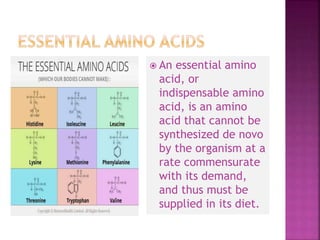
 The 9 essential amino
acids are: histidine, isoleucine, leucine, lys
ine, methionine, phenylalanine, threonine,
tryptophan, and valine.
...
Amino acids are classified into three
groups:
 Essential amino acids.
 Nonessential amino acids.
 Conditional amino acids.
 An essential amino
acid, or
indispensable amino
acid, is an amino
acid that cannot be
synthesized de novo
by the organism at a
rate commensurate
with its demand,
and thus must be
supplied in its diet.
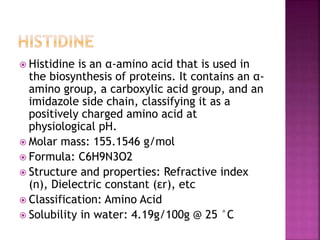
 Histidine is an α-amino acid that is used in
the biosynthesis of proteins. It contains an α-
amino group, a carboxylic acid group, and an
imidazole side chain, classifying it as a
positively charged amino acid at
physiological pH.
 Molar mass: 155.1546 g/mol
 Formula: C6H9N3O2
 Structure and properties: Refractive index
(n), Dielectric constant (εr), etc
 Classification: Amino Acid
 Solubility in water: 4.19g/100g @ 25 °C
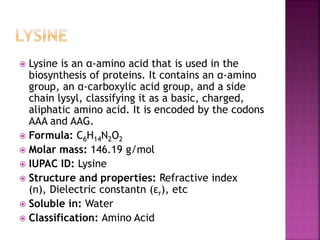
 Lysine is an α-amino acid that is used in the
biosynthesis of proteins. It contains an α-amino
group, an α-carboxylic acid group, and a side
chain lysyl, classifying it as a basic, charged,
aliphatic amino acid. It is encoded by the codons
AAA and AAG.
 Formula: C6H14N2O2
 Molar mass: 146.19 g/mol
 IUPAC ID: Lysine
 Structure and properties: Refractive index
(n), Dielectric constantn (εr), etc
 Soluble in: Water
 Classification: Amino Acid
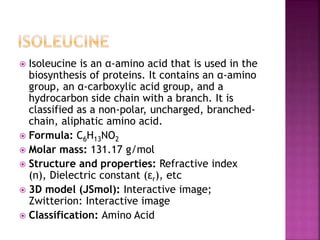
 Isoleucine is an α-amino acid that is used in the
biosynthesis of proteins. It contains an α-amino
group, an α-carboxylic acid group, and a
hydrocarbon side chain with a branch. It is
classified as a non-polar, uncharged, branched-
chain, aliphatic amino acid.
 Formula: C6H13NO2
 Molar mass: 131.17 g/mol
 Structure and properties: Refractive index
(n), Dielectric constant (εr), etc
 3D model (JSmol): Interactive image;
Zwitterion: Interactive image
 Classification: Amino Acid
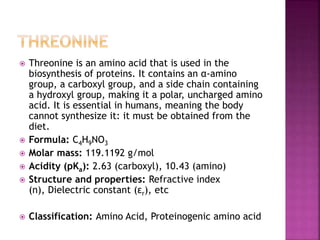
 Threonine is an amino acid that is used in the
biosynthesis of proteins. It contains an α-amino
group, a carboxyl group, and a side chain containing
a hydroxyl group, making it a polar, uncharged amino
acid. It is essential in humans, meaning the body
cannot synthesize it: it must be obtained from the
diet.
 Formula: C4H9NO3
 Molar mass: 119.1192 g/mol
 Acidity (pKa): 2.63 (carboxyl), 10.43 (amino)
 Structure and properties: Refractive index
(n), Dielectric constant (εr), etc
 Classification: Amino Acid, Proteinogenic amino acid
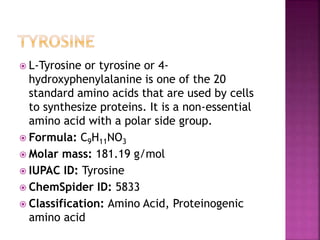
 L-Tyrosine or tyrosine or 4-
hydroxyphenylalanine is one of the 20
standard amino acids that are used by cells
to synthesize proteins. It is a non-essential
amino acid with a polar side group.
 Formula: C9H11NO3
 Molar mass: 181.19 g/mol
 IUPAC ID: Tyrosine
 ChemSpider ID: 5833
 Classification: Amino Acid, Proteinogenic
amino acid
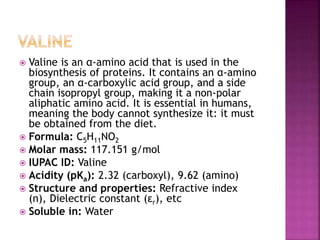
 Valine is an α-amino acid that is used in the
biosynthesis of proteins. It contains an α-amino
group, an α-carboxylic acid group, and a side
chain isopropyl group, making it a non-polar
aliphatic amino acid. It is essential in humans,
meaning the body cannot synthesize it: it must
be obtained from the diet.
 Formula: C5H11NO2
 Molar mass: 117.151 g/mol
 IUPAC ID: Valine
 Acidity (pKa): 2.32 (carboxyl), 9.62 (amino)
 Structure and properties: Refractive index
(n), Dielectric constant (εr), etc
 Soluble in: Water
 Phenylalanine is an essential α-amino acid with
the formula C ₉H ₁₁NO ₂. It can be viewed as a
benzyl group substituted for the methyl group of
alanine, or a phenyl group in place of a terminal
hydrogen of alanine.
 Formula: C9H11NO2
 Molar mass: 165.19 g/mol
 IUPAC ID: Phenylalanine
 Acidity (pKa): 1.83 (carboxyl), 9.13 (amino)
 Structure and properties: Refractive index
(n), Dielectric constant(εr), etc
 Classification: Essential amino acid
 Leucine is an essential amino acid that is
used in the biosynthesis of proteins. Leucine
is an α-amino acid, meaning it contains an α-
amino group, an α-carboxylic acid group, and
a side chain isobutyl group, making it a non-
polar aliphatic amino acid.
 Formula: C6H13NO2
 Molar mass: 131.17 g/mol
 IUPAC ID: Leucine
 Acidity (pKa): 2.36 (carboxyl), 9.60 (amino)
 Structure and properties: Refractive index
(n), Dielectric constant (εr), etc
 Melanin is a broad term for a group of natural
pigments found in most organisms. Melanin is
produced through a multistage chemical process
known as melanogenesis, where the oxidation of
the amino acid tyrosine is followed by
polymerization.
 Chemical formula: C18H10N2O4
 Melting point: < −20 °C (−4 °F; 253 K)
 Molar mass: 318.288 g·mol−1
 Density: 1.6 to 1.8 g/cm
 Boiling point: 450 to 550 °C (842 to 1,022 °F;
723 to 823 K)
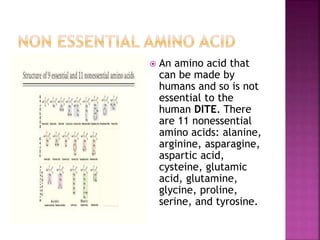
 An amino acid that
can be made by
humans and so is not
essential to the
human DITE. There
are 11 nonessential
amino acids: alanine,
arginine, asparagine,
aspartic acid,
cysteine, glutamic
acid, glutamine,
glycine, proline,
serine, and tyrosine.
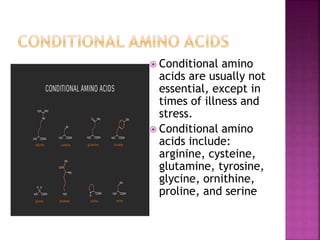
 Conditional amino
acids are usually not
essential, except in
times of illness and
stress.
 Conditional amino
acids include:
arginine, cysteine,
glutamine, tyrosine,
glycine, ornithine,
proline, and serine
 Cysteine is a semiessential proteinogenic
amino acid with the formula HOOC-CH--CH₂-
SH. The thiol side chain in cysteine often
participates in enzymatic reactions, as a
nucleophile.
 Formula: C3H7NO2S
 Molar mass: 121.16 g/mol
 Melting point: 240 °C
 Structure and properties: Refractive index
(n), Dielectric constant (εr), etc
 Chiral rotation (D): +9.4° (H2O, c = 1.3)
 Soluble in: Water, Acetic acid
 Glutamic acid is an α-amino acid that is used by
almost all living beings in the biosynthesis of
proteins. It is non-essential in humans, meaning
the body can synthesize it. It is also an
excitatory neurotransmitter, in fact the most
abundant one, in the vertebrate nervous
system.
 Formula: C5H9NO4
 Molar mass: 147.13 g/mol
 IUPAC ID: 2-Aminopentanedioic acid
 Melting point: 199 °C
 Boiling point: 333.8 °C
 Soluble in: Water
 Aspartic acid, is an α-amino acid that is used
in the biosynthesis of proteins. Like all other
amino acids, it contains an amino group and
a carboxylic acid.
 Formula: C4H7NO4
 Molar mass: 133.11 g/mol
 IUPAC ID: 2-Aminobutanedioic acid
 Solubility in water: 4.5 kg/m³
 Structure and properties: Refractive index
(n), Dielectric constant (εr), etc
 Conjugate base: Aspartate
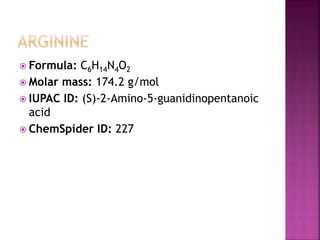
 Formula: C6H14N4O2
 Molar mass: 174.2 g/mol
 IUPAC ID: (S)-2-Amino-5-guanidinopentanoic
acid
 ChemSpider ID: 227
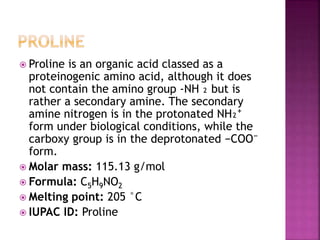
 Proline is an organic acid classed as a
proteinogenic amino acid, although it does
not contain the amino group -NH ₂ but is
rather a secondary amine. The secondary
amine nitrogen is in the protonated NH₂⁺
form under biological conditions, while the
carboxy group is in the deprotonated −COO⁻
form.
 Molar mass: 115.13 g/mol
 Formula: C5H9NO2
 Melting point: 205 °C
 IUPAC ID: Proline
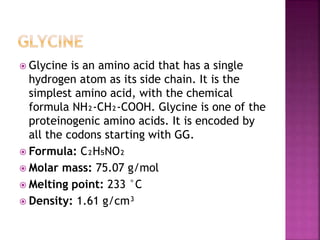
 Glycine is an amino acid that has a single
hydrogen atom as its side chain. It is the
simplest amino acid, with the chemical
formula NH₂‐CH₂‐COOH. Glycine is one of the
proteinogenic amino acids. It is encoded by
all the codons starting with GG.
 Formula: C₂H₅NO₂
 Molar mass: 75.07 g/mol
 Melting point: 233 °C
 Density: 1.61 g/cm³
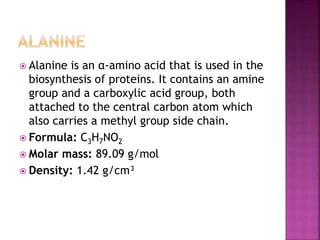
 Alanine is an α-amino acid that is used in the
biosynthesis of proteins. It contains an amine
group and a carboxylic acid group, both
attached to the central carbon atom which
also carries a methyl group side chain.
 Formula: C3H7NO2
 Molar mass: 89.09 g/mol
 Density: 1.42 g/cm³
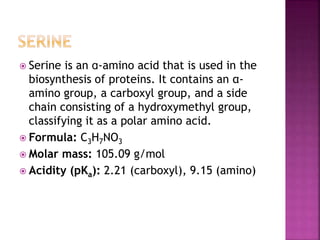
 Serine is an ɑ-amino acid that is used in the
biosynthesis of proteins. It contains an α-
amino group, a carboxyl group, and a side
chain consisting of a hydroxymethyl group,
classifying it as a polar amino acid.
 Formula: C3H7NO3
 Molar mass: 105.09 g/mol
 Acidity (pKa): 2.21 (carboxyl), 9.15 (amino)
 An essential amino acid, or indispensable
amino acid, is an amino acid that cannot be
synthesized de novo by the organism at a
rate commensurate with its demand, and
thus must be supplied in its diet.
 A branched-chain amino acid is an amino acid
having an aliphatic side-chain with a branch.
Among the proteinogenic amino acids, there
are three BCAAs: leucine, isoleucine, and
valine. Non-proteinogenic BCAAs include 2-
aminoisobutyric acid
 An amino acid neurotransmitter is an amino
acid which is able to transmit a nerve
message across a synapse. Neurotransmitters
are packaged into vesicles that cluster
beneath the axon terminal membrane on the
presynaptic side of a synapse in a process
called endocytosis.
 Classification: Amino Acid
 ADDA is a non-proteinogenic amino acid
found in toxins made by cyanobacteria.
Toxins which include this amino acid include
microcystins and nodularins.
 Formula: C20H29NO3
 IUPAC ID: (2S,3S,8S,9S)-3-Amino-9-methoxy-
2,6,8-trimethyl-10-phenyldeca-4,6-dienoic
acid
 ChemSpider ID: 20137047
 PubChem CID: 57357424
 Rebamipide, an amino acid derivative of 2--
quinolinone, is used for mucosal protection,
healing of gastroduodenal ulcers, and
treatment of gastritis. It works by enhancing
mucosal defense, scavenging free radicals,
and temporarily activating genes encoding
cyclooxygenase-2.
 Formula: C19H15ClN2O4
 Molar mass: 370.786 g/mol
~Presentation by Disha deshmukh.

Amino acid

  • 1.
    SUBJECT : BIOLOGY Aminoacids Presented to: Mr. Kailash Vilegave sir
  • 2.
  • 4.
     Amino acidsare organic compounds that contain amine and carboxyl functional groups, along with a side chain specific to each amino acid. The key elements of an amino acid are carbon, hydrogen, oxygen, and nitrogen, although other elements are found in the side chains of certain amino acids.
  • 5.
     Types  The9 essential amino acids are: histidine, isoleucine, leucine, lys ine, methionine, phenylalanine, threonine, tryptophan, and valine. ... Amino acids are classified into three groups:  Essential amino acids.  Nonessential amino acids.  Conditional amino acids.
  • 6.
     An essentialamino acid, or indispensable amino acid, is an amino acid that cannot be synthesized de novo by the organism at a rate commensurate with its demand, and thus must be supplied in its diet.
  • 7.
     Histidine isan α-amino acid that is used in the biosynthesis of proteins. It contains an α- amino group, a carboxylic acid group, and an imidazole side chain, classifying it as a positively charged amino acid at physiological pH.  Molar mass: 155.1546 g/mol  Formula: C6H9N3O2  Structure and properties: Refractive index (n), Dielectric constant (εr), etc  Classification: Amino Acid  Solubility in water: 4.19g/100g @ 25 °C
  • 8.
     Lysine isan α-amino acid that is used in the biosynthesis of proteins. It contains an α-amino group, an α-carboxylic acid group, and a side chain lysyl, classifying it as a basic, charged, aliphatic amino acid. It is encoded by the codons AAA and AAG.  Formula: C6H14N2O2  Molar mass: 146.19 g/mol  IUPAC ID: Lysine  Structure and properties: Refractive index (n), Dielectric constantn (εr), etc  Soluble in: Water  Classification: Amino Acid
  • 9.
     Isoleucine isan α-amino acid that is used in the biosynthesis of proteins. It contains an α-amino group, an α-carboxylic acid group, and a hydrocarbon side chain with a branch. It is classified as a non-polar, uncharged, branched- chain, aliphatic amino acid.  Formula: C6H13NO2  Molar mass: 131.17 g/mol  Structure and properties: Refractive index (n), Dielectric constant (εr), etc  3D model (JSmol): Interactive image; Zwitterion: Interactive image  Classification: Amino Acid
  • 10.
     Threonine isan amino acid that is used in the biosynthesis of proteins. It contains an α-amino group, a carboxyl group, and a side chain containing a hydroxyl group, making it a polar, uncharged amino acid. It is essential in humans, meaning the body cannot synthesize it: it must be obtained from the diet.  Formula: C4H9NO3  Molar mass: 119.1192 g/mol  Acidity (pKa): 2.63 (carboxyl), 10.43 (amino)  Structure and properties: Refractive index (n), Dielectric constant (εr), etc  Classification: Amino Acid, Proteinogenic amino acid
  • 11.
     L-Tyrosine ortyrosine or 4- hydroxyphenylalanine is one of the 20 standard amino acids that are used by cells to synthesize proteins. It is a non-essential amino acid with a polar side group.  Formula: C9H11NO3  Molar mass: 181.19 g/mol  IUPAC ID: Tyrosine  ChemSpider ID: 5833  Classification: Amino Acid, Proteinogenic amino acid
  • 12.
     Valine isan α-amino acid that is used in the biosynthesis of proteins. It contains an α-amino group, an α-carboxylic acid group, and a side chain isopropyl group, making it a non-polar aliphatic amino acid. It is essential in humans, meaning the body cannot synthesize it: it must be obtained from the diet.  Formula: C5H11NO2  Molar mass: 117.151 g/mol  IUPAC ID: Valine  Acidity (pKa): 2.32 (carboxyl), 9.62 (amino)  Structure and properties: Refractive index (n), Dielectric constant (εr), etc  Soluble in: Water
  • 13.
     Phenylalanine isan essential α-amino acid with the formula C ₉H ₁₁NO ₂. It can be viewed as a benzyl group substituted for the methyl group of alanine, or a phenyl group in place of a terminal hydrogen of alanine.  Formula: C9H11NO2  Molar mass: 165.19 g/mol  IUPAC ID: Phenylalanine  Acidity (pKa): 1.83 (carboxyl), 9.13 (amino)  Structure and properties: Refractive index (n), Dielectric constant(εr), etc  Classification: Essential amino acid
  • 14.
     Leucine isan essential amino acid that is used in the biosynthesis of proteins. Leucine is an α-amino acid, meaning it contains an α- amino group, an α-carboxylic acid group, and a side chain isobutyl group, making it a non- polar aliphatic amino acid.  Formula: C6H13NO2  Molar mass: 131.17 g/mol  IUPAC ID: Leucine  Acidity (pKa): 2.36 (carboxyl), 9.60 (amino)  Structure and properties: Refractive index (n), Dielectric constant (εr), etc
  • 15.
     Melanin isa broad term for a group of natural pigments found in most organisms. Melanin is produced through a multistage chemical process known as melanogenesis, where the oxidation of the amino acid tyrosine is followed by polymerization.  Chemical formula: C18H10N2O4  Melting point: < −20 °C (−4 °F; 253 K)  Molar mass: 318.288 g·mol−1  Density: 1.6 to 1.8 g/cm  Boiling point: 450 to 550 °C (842 to 1,022 °F; 723 to 823 K)
  • 16.
     An aminoacid that can be made by humans and so is not essential to the human DITE. There are 11 nonessential amino acids: alanine, arginine, asparagine, aspartic acid, cysteine, glutamic acid, glutamine, glycine, proline, serine, and tyrosine.
  • 17.
     Conditional amino acidsare usually not essential, except in times of illness and stress.  Conditional amino acids include: arginine, cysteine, glutamine, tyrosine, glycine, ornithine, proline, and serine
  • 18.
     Cysteine isa semiessential proteinogenic amino acid with the formula HOOC-CH--CH₂- SH. The thiol side chain in cysteine often participates in enzymatic reactions, as a nucleophile.  Formula: C3H7NO2S  Molar mass: 121.16 g/mol  Melting point: 240 °C  Structure and properties: Refractive index (n), Dielectric constant (εr), etc  Chiral rotation (D): +9.4° (H2O, c = 1.3)  Soluble in: Water, Acetic acid
  • 19.
     Glutamic acidis an α-amino acid that is used by almost all living beings in the biosynthesis of proteins. It is non-essential in humans, meaning the body can synthesize it. It is also an excitatory neurotransmitter, in fact the most abundant one, in the vertebrate nervous system.  Formula: C5H9NO4  Molar mass: 147.13 g/mol  IUPAC ID: 2-Aminopentanedioic acid  Melting point: 199 °C  Boiling point: 333.8 °C  Soluble in: Water
  • 20.
     Aspartic acid,is an α-amino acid that is used in the biosynthesis of proteins. Like all other amino acids, it contains an amino group and a carboxylic acid.  Formula: C4H7NO4  Molar mass: 133.11 g/mol  IUPAC ID: 2-Aminobutanedioic acid  Solubility in water: 4.5 kg/m³  Structure and properties: Refractive index (n), Dielectric constant (εr), etc  Conjugate base: Aspartate
  • 21.
     Formula: C6H14N4O2 Molar mass: 174.2 g/mol  IUPAC ID: (S)-2-Amino-5-guanidinopentanoic acid  ChemSpider ID: 227
  • 22.
     Proline isan organic acid classed as a proteinogenic amino acid, although it does not contain the amino group -NH ₂ but is rather a secondary amine. The secondary amine nitrogen is in the protonated NH₂⁺ form under biological conditions, while the carboxy group is in the deprotonated −COO⁻ form.  Molar mass: 115.13 g/mol  Formula: C5H9NO2  Melting point: 205 °C  IUPAC ID: Proline
  • 23.
     Glycine isan amino acid that has a single hydrogen atom as its side chain. It is the simplest amino acid, with the chemical formula NH₂‐CH₂‐COOH. Glycine is one of the proteinogenic amino acids. It is encoded by all the codons starting with GG.  Formula: C₂H₅NO₂  Molar mass: 75.07 g/mol  Melting point: 233 °C  Density: 1.61 g/cm³
  • 24.
     Alanine isan α-amino acid that is used in the biosynthesis of proteins. It contains an amine group and a carboxylic acid group, both attached to the central carbon atom which also carries a methyl group side chain.  Formula: C3H7NO2  Molar mass: 89.09 g/mol  Density: 1.42 g/cm³
  • 25.
     Serine isan ɑ-amino acid that is used in the biosynthesis of proteins. It contains an α- amino group, a carboxyl group, and a side chain consisting of a hydroxymethyl group, classifying it as a polar amino acid.  Formula: C3H7NO3  Molar mass: 105.09 g/mol  Acidity (pKa): 2.21 (carboxyl), 9.15 (amino)
  • 26.
     An essentialamino acid, or indispensable amino acid, is an amino acid that cannot be synthesized de novo by the organism at a rate commensurate with its demand, and thus must be supplied in its diet.
  • 27.
     A branched-chainamino acid is an amino acid having an aliphatic side-chain with a branch. Among the proteinogenic amino acids, there are three BCAAs: leucine, isoleucine, and valine. Non-proteinogenic BCAAs include 2- aminoisobutyric acid
  • 28.
     An aminoacid neurotransmitter is an amino acid which is able to transmit a nerve message across a synapse. Neurotransmitters are packaged into vesicles that cluster beneath the axon terminal membrane on the presynaptic side of a synapse in a process called endocytosis.  Classification: Amino Acid
  • 29.
     ADDA isa non-proteinogenic amino acid found in toxins made by cyanobacteria. Toxins which include this amino acid include microcystins and nodularins.  Formula: C20H29NO3  IUPAC ID: (2S,3S,8S,9S)-3-Amino-9-methoxy- 2,6,8-trimethyl-10-phenyldeca-4,6-dienoic acid  ChemSpider ID: 20137047  PubChem CID: 57357424
  • 30.
     Rebamipide, anamino acid derivative of 2-- quinolinone, is used for mucosal protection, healing of gastroduodenal ulcers, and treatment of gastritis. It works by enhancing mucosal defense, scavenging free radicals, and temporarily activating genes encoding cyclooxygenase-2.  Formula: C19H15ClN2O4  Molar mass: 370.786 g/mol
  • 31.