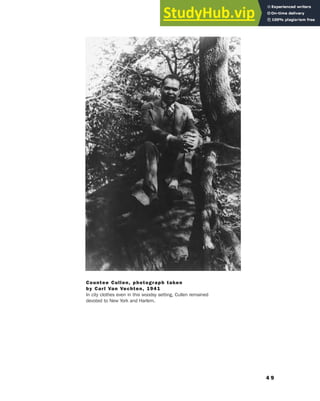
A M E R I C A N
M O D E R N I S M
( 1 9 1 0 – 1 9 4 5 )
Jerry Phillips, Ph.D.
General Editor
Department of English
University of Connecticut, Storrs
Michael Anesko, Ph.D.
Adviser and Contributor
Director, Honors Program in English
Pennsylvania State University
Roger Lathbury
Principal Author
American Modernism (1910–1945)
Copyright © 2006 by DWJ BOOKS LLC
All rights reserved. No part of this book may be reproduced or utilized in any form or by
any means, electronic or mechanical, including photocopying, recording, or by any infor-
mation storage or retrieval systems, without permission in writing from the publisher. For
information contact:
Facts On File, Inc.
An imprint of Infobase Publishing
132 West 31st Street
New York NY 10001
Library of Congress Cataloging-in-Publication Data
Lathbury, Roger.
American modernism: 1910–1945 / Roger Lathbury.
p. cm.— (Backgrounds to American literature)
Includes bibliographical references and index.
ISBN 0–8160–5670–6 (alk. paper)
1. American literature—20th century—History and criticism.
2. Modernism (Literature)—United States.
I. Title. II. Series.
PS228.M63L38 2005
810.9'112—dc22 2005020829
Facts On File books are available at special discounts when purchased in bulk quantities
for businesses, associations, institutions, or sales promotions. Please call our Special
Sales Department in New York at (212) 967–8800 or (800) 322–8755.
You can find Facts On File on the World Wide Web at http://www.factsonfile.com
Printed in the United States of America
VB PKG 10 9 8 7 6 5 4 3 2 1
This book is printed on acid-free paper
Dedication
To Camille
Acknowledgments
pp. 9, 23, 37, 49, 65, 73, 79: Library of Congress, Prints and Photographs Division
p. 15, 25, 57: Courtesy Roger Lathbury
DEVELOPED AND PRODUCED BY DWJ BOOKS LLC
C O N T E N T S
1 . A m e r i c a n M o d e r n i s m 4
2 . T h e L o s t G e n e r a t i o n 1 7
3 . M o d e r n i s m i n t h e A m e r i c a n
N o v e l : J o y c e , D o s P a s s o s ,
a n d F a u l k n e r 2 9
4 . T h e H a r l e m R e n a i s s a n c e
( 1 9 1 9 – 1 9 2 9 ) 4 1
5 . M o d e r n i s m i n P o e t r y
a n d D r a m a 5 4
6 . L i t e r a r y C u l t u r e
o f t h e M o d e r n s 6 8
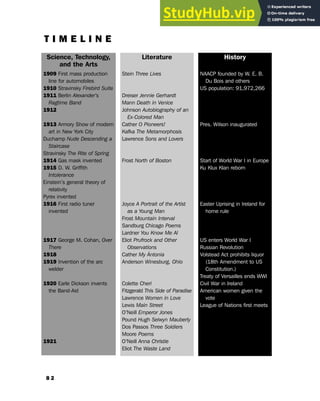
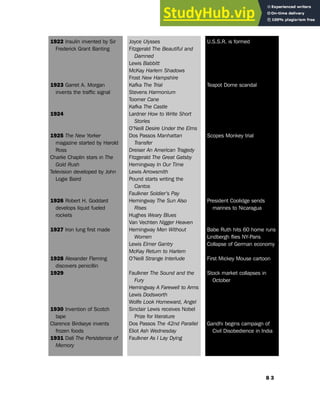
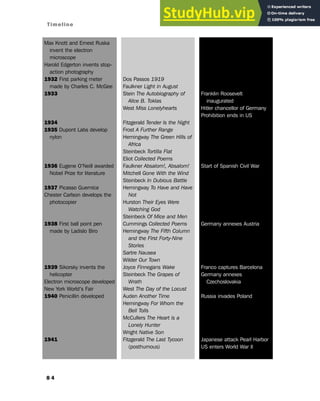
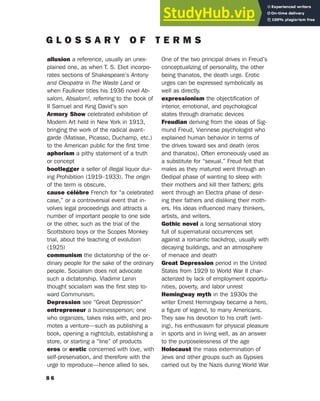
T i m e l i n e 8 2
G l o s s a r y o f Te r m s 8 6
B i o g r a p h i c a l G l o s s a r y 8 9
F u r t h e r R e a d i n g 9 4
I n d e x 9 5
P R E FA C E
The five volumes of Backgrounds to American Literature explore 500
years of American literature by looking at the times during which the
literature developed. Through a period’s historical antecedents and
characteristics—political, cultural, religious, economic, and social—
each chapter covers a specific period, theme, or genre.
In addition to these six chapters, readers will find a useful time-
line of drama and theatrical history, poetry and prose, and history; a
glossary of terms (also identified by SMALL CAPITAL LETTERS throughout
the text); a biographical glossary; suggestions for further reading; and
an index. By helping readers explore literature in the context of
human history, the editors hope to encourage readers to further ex-
plore the literary world.
1 . A M E R I C A N M O D E R N I S M
Organized to commemorate the 400th anniversary of Columbus’s dis-
covery of the New World, the World’s Columbian Exposition in Chi-
cago in 1893 gave physical form to the American Dream. What was
built at Chicago was a monument not only to Columbus but also to a
society increasingly dominated by the power of corporations and
other large-scale organizations that were overtaking traditional confi-
dence in individuals’ abilities to shape their own destinies.
In its earlier phases, capitalist economic development acquired a
kind of “heroic” dimension: the self-made person became the corner-
stone of American business mythology. And the dream of success
was inevitably linked to middle-class ideals of thrift, the Protestant
work ethic, and self-reliant perseverance. After the Civil War, however,
the rise of large-scale organizations made the individual’s role much
more ambiguous.
It has often been said that modern American literature got off to
a timely start in 1900 with the publication of Dreiser’s first novel, Sis-
ter Carrie. Derided by genteel critics, Sister Carrie is a fable of suc-
cess but without affirming the conventional moral formula that virtue
will be rewarded and vice will be punished. Dreiser refuses to make
moral judgments of his characters, and they themselves seem inca-
pable of recognizing their actions in terms of good or evil.
4
Admittedly, the principal American modernists—Gertrude Stein,
Ezra Pound, T. S. Eliot, William Faulkner—would have claimed a
different genealogy, tracing their descent from Henry James, not
Dreiser. It was James, after all, who seemed to make living in Europe
enviable for artists.
Modernism in literature was matched by modernism in the visual
arts. In 1913, the ARMORY SHOW, a great exhibition of modern art on
New York’s Lexington Avenue, opened. This event brought works by
Picasso, Kandinsky, Matisse, and Duchamp to an American audience
for the first time, challenging conventional representation.
Whatever the instrument—poem, novel, canvas, play—the
music to be heard was new. That, after all, was Pound’s fundamen-
tal imperative: “Make it new.” Rejecting their immediate cultural in-
heritance as barren and unworkable, the modernists sought to find
what Van Wyck Brooks memorably called a “usable past.” Pound,
for example, eagerly translated poetry from Japanese, Chinese, and
Provençal, influences that leave their traces throughout his work.
T. S. Eliot’s most famous poem, The Waste Land (1922), recognizes
5
❧ THE FERRIS WHEEL ❧
Jutting out perpendicularly from Daniel H. Burnham’s majestic
“Court of Honor” at the Columbian Exposition of 1893 ran the Mid-
way Plaisance, a carnival of exotic and eclectic tastes. As the official
handbook of the fair described it, the Midway was “a most unusual
collection of almost every type of architecture known to man––oriental
villages, Chinese bazaars, tropical settlements, ice railways, the pon-
derous Ferris wheel, and reproductions of ancient cities.” At the very
center of this strange amalgam stood the enormous amusement ride—
the Ferris wheel.
From the point of view of design, Gustav Eiffel’s Tower and Ferris’s
wheel have much in common: Both, essentially, are collections of steel
beams and rivets. Likewise, both take the fundamental structural prin-
ciple of another nineteenth-century invention (the steel-truss bridge)
and thrust it vertically into the air, symbolically linking earth and
sky. The Ferris wheel, however, Americanized the static vertical “bridge”
of Eiffel by shaping it into a circle and setting it in motion, endlessly
revolving, spinning on an axle.
1. American Modernism
no boundaries of time or place. Its deliberately disjointed lines
crisscross continents and centuries; the range of its allusions—liter-
ary, philosophical, theological—has captivated (and bewildered) crit-
ics and readers since the day it appeared
“These fragments I have shored against my ruins” (line 431 from
The Waste Land) is a metaphor for modernist form. All the modernist
artistic categories (literature, painting, sculpture, dance, musical com-
position) seem deliberately chaotic. Not surprisingly, first reactions to
works of modernist art can be disorienting because it is often difficult
to know even where they begin. When reading a poem, starting at the
first line would seem to be obvious—but so many modernist first lines
are completely (and deliberately) arbitrary that the reader (or viewer,
or listener, as the case may be) might be inclined to think of the work
as fundamentally inaccessible.
6
❧ THE RISE OF BIG BUSINESS ❧
It remains one of the central paradoxes of modern history that while
Americans have always been suspicious of concentrated power—a
fear that lies behind the American Revolution itself and founding
documents such as the federal Constitution—the United States also
has given birth to the modern business corporation. The first
nineteenth-century enterprises to prefigure the bureaucratic complex-
ity of modern companies were the railroads. Because of their enor-
mous appetites for capital, these ventures quickly became dependent
on public initiatives (such as federal land grants) and Wall Street
bankers to underwrite their investments in rights-of-way, rails, loco-
motives, and rolling stock.
At the end of the nineteenth century, other manufacturing enterprises
(notably steel, meatpacking, and oil refining) recognized the tremen-
dous competitive advantage of vertical integration—that is, extending
corporate control to every aspect of production and distribution. Thus,
Andrew Carnegie not only manufactured steel but he also bought up
mines where all the elements for steel production came from (iron ore,
coal, limestone) as well as railroad and steamship lines that carried
those raw materials to Pittsburgh. When Carnegie combined his hold-
ings with that of seven other metalworks to form U.S. Steel in 1901
(the nation’s first billion-dollar corporation), the company controlled
two-thirds of the country’s steel market.
American Modernism (1910–1945)
T h e P o l i t i c s a n d
C u l t u r e o f M o d e r n i s m
For many who experienced it, nothing could
have been less genuine than America’s in-
volvement in World War I. In 1916, Presi-
dent Woodrow Wilson was elected to a
second term largely on the strength of a
campaign slogan: “He kept us out of war.”
Shortly thereafter, he got us into a war that
would usher in the modern era with a ven-
geance.
Unlike previous armed conflicts, where
soldiers squared off on the battlefield and
obeyed time-honored rules of engagement,
World War I demonstrated the horrific po-
tential of new technologies of destruction,
the MECHANIZATION that made killing far less
personal. World War I was the first in which
airplanes, including the German ZEPPELINS,
were used both for reconnaissance and at-
tack. The Zeppelins were easily shot down,
but the men inside the Zeppelin and the
men on the ground did not see each other.
Whether the soldiers were German or
French, Italian or English, or American, ma-
chines and chemicals did the work of kill-
ing. Men died, but machines did the work.
World War I, then, was a brutal assault
on the orderly civilization of the nineteenth
century. In a quieter way, however, intellec-
tual currents had been working to under-
mine “the sea of Faith” that the British
poet Matthew Arnold saw as circling and nourishing “the earth’s
shore.” In England, Charles Darwin (1809–1882) had published The
Origin of the Species in 1859, a work that displaced traditional ideas
of God as the creator of the universe. And in Vienna, Austria, in
1900, Sigmund Freud (1856–1939) rocked the world with his ideas
about infant sexuality and his theories of personality, ideas that col-
lectively came to be referred to as FREUDIAN.
The Interpretation of Dreams, as well as Freud’s other studies of
the workings of the human mind, suggested that men and women
7
❧ THE ARMORY SHOW ❧
The history of twentieth-century
American art properly begins in
1913 with the International Ex-
hibition of Modern Art held at
the 69th Street Regiment Armory
in New York City. Organized by
artists who were eager to displace
accepted modes of representation
and anxious to make Americans
aware of startling new develop-
ments arising in Europe, this
colossal exhibition (1,300 paint-
ings and pieces of sculpture) had
the effect of a guillotine, severing
a new generation from the mori-
bund ideals of the past. The Ar-
mory Show provides a textbook
example of what historians call a
watershed event—a decisive turn-
ing point in cultural develop-
ment. Though academic critics
were disdainful in the extreme,
and newspaper cartoonists could
not resist the urge to satirize the
“highbrow” nature of some of the
works on display, the Exhibition
was a popular success and, more
importantly, a triumph of propa-
ganda on behalf of modernism.
1. American Modernism
were ruled by dark forces of which they
were unaware. Freud’s studies opened a
new window on the human mind just as Al-
bert Einstein’s (1879–1955) theories of
relativity—also in circulation at the time—
did on the physical world. Both thinkers
seemed to say that humans were not in
control of their own lives. At first Freud’s
ideas were ridiculed and met with skepti-
cism, but acceptance of them grew until
they pervaded the culture. Freud became,
in the words of poet W. H. Auden, “a whole
climate of opinion.”
F i v e M o d e r n i s t P o e t s
T. S . E l i o t
( 1 8 8 8 – 1 9 6 5 )
Freud’s influence on the climate of modern
poetry can be seen in T. S. Eliot’s “The Love
Song of J. Alfred Prufrock” (1917). From
the opening lines of “Prufrock,” readers are
in a different world from that of earlier
poetry. Almost all original poetry seems ob-
scure when first encountered, but some of
the confusions in “Prufrock” are intentional.
Let us go then, you and I,
When the evening is spread out
against the sky,
Like a patient etherized upon a
table . . .
The poem never clarifies who “you and I”
are; they may be Prufrock and the reader,
or they may be Prufrock and a friend, real
or imaginary. The first metaphor is unset-
tling in its understated strangeness. How can “evening” be compared
to an “etherized patient”? The automatic association of these two im-
ages in Eliot’s poem—like the free associations of one of Freud’s pa-
tients during a therapy session—suggests a person entirely separated
from his or her surroundings. Together with the succeeding stanzas,
which project disassociated scenes of a future encounter with a
8
❧ MEANINGLESS WORDS— ❧
MEANINGLESS VIOLENCE
In A Farewell to Arms (1929), his
great novel about World War I, Ernest
Hemingway’s hero, Frederic Henry,
suffers a terrible leg wound when his
ambulance company on the Italian
front is shelled. After a long recuper-
ation, he comes to see not only that
war is futile but also the way in which
language has been manipulated to
provoke and justify the senseless kill-
ing that surrounds him. At a crucial
turning point in the novel, Henry re-
flects to himself, “Abstract words such
as glory, honor, courage, or hallow
were obscene beside the concrete
names of villages, the numbers of
roads, the names of rivers, the num-
bers of regiments and dates.” No one
was more adept at using “abstract
words” than President Woodrow Wil-
son, whose administration pioneered
the use of mass-media propaganda to
overcome the country’s traditionally
isolationist stance toward Europe. In
Wilson’s view, America had a moral
destiny “to make the world safe for
democracy.”
American Modernism (1910–1945)
9
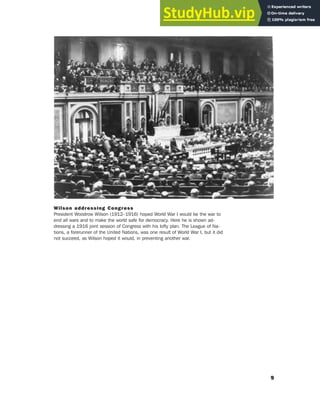
Wilson addressing Congress
President Woodrow Wilson (1912–1916) hoped World War I would be the war to
end all wars and to make the world safe for democracy. Here he is shown ad-
dressing a 1916 joint session of Congress with his lofty plan. The League of Na-
tions, a forerunner of the United Nations, was one result of World War I, but it did
not succeed, as Wilson hoped it would, in preventing another war.
person the poem names as “one,” the poem seems hallucinatory,
only half clear. This effect is paradoxically augmented by the wit of
the lines, many of which have entered the common language:
In the room the women come and go
Talking of Michelangelo.
. . . . . . . . . . . . . . . . . . . . . . . .
I have measured out my life with coffee spoons.
. . . . . . . . . . . . . . . . . . . . . . . .
I grow old . . . I grow old . . .
I shall wear the bottoms of my trousers rolled.
1 0
❧ FREUDIAN SYMBOLISM IN LITERATURE ❧
Sigmund Freud’s discovery of the unconscious had a tremendous impact
on literary modernism. His hypotheses about sexual development and
repression inspired radical possibilities for artists intent on exploring
human motives and psychology.
Twentieth-century drama enthusiastically embraced Freudian themes, not
least because through them playwrights could escape from the hackneyed
traditions of melodrama that had virtually monopolized the American
stage. Because, at least in theory, Freud’s concepts transcended the lim-
its of historical time and space, they empowered a dramatist such as Eu-
gene O’Neill to envision his works not only as period pieces but also as
occasions for exploring the eternal tragedy of the human condition. In
Desire Under the Elms (1924), for example, O’Neill’s opening stage
directions fix a specific historical setting, but they also suggest the power
of psychological symbols to go beyond the limits of realistic details. Note
the symbolic power with which he invests the elm trees:
The action of the entire play takes place in, and immediately outside
of, the Cabot farmhouse in New England, in the year 1850. . . . Two
enormous elms are on each side of the house. They bend their trail-
ing branches down over the roof. They appear to protect and at the
same time subdue. There is a sinister maternity in their aspect, a
crushing, jealous absorption. . . . They brood oppressively over the
house. They are like exhausted women resting their sagging breasts
and hands and hair on its roof, and when it rains, their tears trickle
down monotonously and rot on the shingles.
American Modernism (1910–1945)
The musicality and suppleness of Eliot’s rhythms, the intriguing,
incompletely revealed dramatic situation, and the profusion of details
(“tea and cakes and ices”) bring readers inexorably into participating
in Prufrock’s dilemma; the reader, too, feels alienated, puzzled, wor-
ried, incomplete.
Eliot’s ability to project and intensify this sense of alienation
reached its high point in The Waste Land (1922). Its five sections are
a carefully orchestrated series of vignettes that point up the sterility—
physical, emotional, and spiritual—of Western civilization. Although
the poem is centered in London—where Eliot relocated in 1914—
that city is incidental. It becomes a metaphor for other locales, until
the poem embraces the entire world: London, Munich, Jerusalem,
Athens, Alexandria, and Vienna are all named. The short scenes refer
to classical, medieval, and modern times, equating them at will, al-
luding to previous literature from all periods, making the atmosphere
of post–World War I despair seem to be a symptom of a larger, in-
eradicable uneasiness.
This 434-line poem, notorious for its difficulty when it was first
published, became, for 50 years after its appearance, the dominant
cultural artifact of the twentieth century. It is the purest example of a
modernist poem: uncompromising in its aims, committed to effects of
collage, making ALLUSION to other artistic products. The poem makes
obscure and scholarly references that many readers did not under-
stand. It seemed a total break with the nineteenth century—in other
words, it was utterly and completely modern.
Out of a defeat as total as that portrayed in The Waste Land,
what kind of life can be built? For Eliot, the answer was a return to
religion. The process was gradual, and, as he retreated from the
themes of The Waste Land and found Christian faith—Eliot joined the
Anglican Church in 1930—his poetry changed as well. In place of the
sharp epithet and collage, Eliot’s poems, after The Hollow Men
(1925), became more connected, at times serene; his modernism
gives way to LYRICISM. The most renowned example of Eliot’s lyricism is
found in Four Quartets (1942). More abstract and less tense than
the earlier work, these poems return to a conscious effort to affirm
values, which they embody in carefully orchestrated subtlety.
E z r a P o u n d ( 1 8 8 5 – 1 9 7 2 )
Like Eliot, Ezra Pound was a transplanted American. Born in Idaho,
educated in Pennsylvania, Pound fled to Europe where he made mod-
ernism into a career. Pound is most often associated with IMAGISM, a
poetic credo that he promulgated. Pound insisted that a genuine
1 1
1. American Modernism
poem would focus on the “direct treatment of the ‘thing’ whether
subjective or objective”; it would “use absolutely no word that does
not contribute to the presentation”; and it would be composed “in
the sequence of the musical phrase, not in the sequence of a metro-
nome.” These principles are illustrated by Pound’s two-line poem of
1916 “In a Station of the Metro.”
The apparition of these faces in the crowd;
Petals on a wet, black bough.
The poem presents two images, directly, side by side. No verb is
needed for the presentation; therefore, no verb occurs. The rhythm
of the first line is mostly but not mechanically IAMBIC (the APparition
of these FAces in the CROWD). Line two hammers its point home
with the three accented words at the close (PETals on a WET,
BLACK BOUGH).
Pound eventually broke from the confines of imagism. Hugh Sel-
wyn Mauberly (1920) makes a case against the intellectual narrow-
ness and lack of appreciation of beauty of the modern world by
using rather strict rhyme and rhythm—perhaps a reaction to the ten-
dencies toward formlessness of some imagists—and by the wide-
ness of its literary tastes. Mauberly—the poem’s subject—is, like
Pound, a poet, but Mauberly has written only a single imagistic
poem, in the tradition of the late nineteenth century. In an impres-
sive array of meters and tones, with quotations in Greek and with
echoes of well-known poets of the past, such as Pindar, Horace,
Ronsard, Edmund Waller, and Theophile Gautier, Pound castigates
not only the aesthetic taste of his age but also the shallow tawdri-
ness of contemporary life.
A monument of modernism, The Cantos (1921), published bit by
bit, in booklets, is a fluid mixture of all branches of knowledge,
judged through the understanding of the ancient Chinese philosopher
Confucius. Throughout, Egyptian hieroglyphics and Chinese IDEOGRAPHS
mingle with social theories.
The Cantos is probably the densest, most allusive poem in En-
glish (or mostly in English), but individual cantos often rise to the
beauty and grandeur of which Pound was capable.
What thou lovest well remains, the rest is dross
What thou lov’st well shall not be reft from thee
What thou lov’st well is thy true heritage
1 2
American Modernism (1910–1945)
At their best, Pound’s lines stir by the force of their argument and ed-
ucate by challenging readers to see and hear afresh and so renew
experience.
G e r t r u d e S t e i n ( 1 8 7 4 – 1 9 4 6 )
The writings of a third expatriate American are even more radical in
their distance from conventional prose and poetry. It is not clear how
to characterize the writings of Gertrude Stein. Stein’s first book, Three
Lives (1909), is less a narrative or story than a series of stylistic ex-
periments. The reader becomes less involved with the characters
than with the words on the page. The language of the story has less
to do with referring to something or someone than with creating a
pattern of sound or even sight.
Once established, the variations on that pattern create different
emphases, effects, and layers of awareness in the reader who vari-
ously is absorbed in what is being said and detached from it by an
awareness of its manner. Stein came by such design after moving to
Paris, where she lived among experimental visual artists. With her life-
time companion Alice B. Toklas, Stein established a SALON. Long before
they became well known, visual artists, such as Pablo Picasso, Marcel
Duchamp, and Henri Matisse, and writers, including French poet Guil-
laume Apollinaire, and, after World War I, American expatriates, such
as Sherwood Anderson, William Carlos Williams, T. S. Eliot, and Ernest
Hemingway, visited her in her apartment at 27 rue de Fleurus.
Her own writing became progressively more experimental. Tender
Buttons (1914) represents an intermediate step toward pure lan-
guage. The book is a list, a collection of descriptions that sometimes
connect to the object announced and sometimes do not.
Rhubarb.
Rhubarb is not susan not susan not seat in bunch toys not wild
and laughable not in little places not in neglect and vegetable
not in foal coal age not please.
It is easy to see such experiments as frivolous, or even fraudu-
lent. Some have said that Gertrude Stein wrote in an eccentric way in
order to acquire a reputation as a great artist and to feed her own
ego. Stein’s apparently arbitrary use of words invites misunderstand-
ing. What is the connection of sound to sense?
Stein wrote other, more conventional books, including a best-
seller, The Autobiography of Alice B. Toklas, in which traces of her
1 3
1. American Modernism
distinctive, repetitive style show through. Her fame, however, comes
from the experiments with words. Readers of her work saw that
some of it consisted of APHORISMS. One of the most famous aphor-
isms is “rose is a rose is a rose,” which suggests that beyond saying
rose equals rose one can say nothing more—possibly a Platonic
statement about perfection embodied in “Rose,” whoever or what-
ever Rose may be.
E . E . C u m m i n g s ( 1 8 9 4 – 1 9 6 2 )
Like Stein, E. E. Cummings first came to prominence when readers
were stunned by his disregard for conventional language and syntax
and by unconventional line breaks and “strangeness.”
ta
ppin
g
toe
Like Stein, he ignored conventional punctuation. “If writing should go
on what had colons and semi-colons to do with it?” Stein had asked.
Cummings’s poems cross the border between verbal and pictorial art.
In one of his imagist experimentations, the words “1 leaf falling” are
arranged vertically on the page like the leaf itself. None of his poems
is titled: The reader must confront the poem itself.
Against his visual playfulness and experimentation, Cummings
shows exuberant lyricism and satirical bite. Many of his famous
poems—such as “all in green went my love riding” or “anyone lived in
a pretty how town”—could be reset conventionally and readers would
find them moving lyrical poems. However, the lowercase letters and
lack of punctuation add immediacy; the “direct treatment of the
‘thing,’” in Pound’s words, underpins a fundamental innocence. This
is a man impatient with pretension, apparently opposed to form, and
not drawn to intellect or philosophy, religion or complex theory.
M a r i a n n e M o o r e ( 1 8 8 7 – 1 9 7 2 )
Also living in England, but very much an outsider, was the American
Marianne Moore. If Eliot, Pound, Stein, and Cummings were experi-
menting with language and convention, Moore’s experiments were
more directly formal. Most English poetry is written in accentual
meter; the beats of the line follow a pattern, not, as Pound pointed
out, like a metronome, but essentially regular.
1 4
American Modernism (1910–1945)
1 5
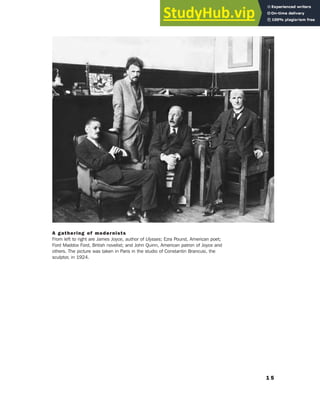
A gathering of modernists
From left to right are James Joyce, author of Ulysses; Ezra Pound, American poet;
Ford Maddox Ford, British novelist; and John Quinn, American patron of Joyce and
others. The picture was taken in Paris in the studio of Constantin Brancusi, the
sculptor, in 1924.
/ ˘ / ˘ / ˘ /
April is the cruellest month
Marianne Moore’s poetry rejects accentual meter in favor of SYLLABICS.
Her stanza patterns are absolutely regular. The syllable count is the
same in each corresponding line. The accents fall where they will.
The result is a different, triumphantly individual poetry. Her sen-
sibility is meticulous and delicate. She thinks her way through her
subject with deliberate care, which her unexpected breaks reinforce
with prickly insistence. The poems often start with an animal or a
natural creature—although she has poems on steamrollers, baseball
players, and a variety of abstract ideas as well—and then move to
unexpected conclusions.
The Fish
wade
through black jade.
Of the crow-blue mussel shells, one keeps
adjusting the ash heaps;
opening and shutting itself like
an
injured fan.
The precise picture presented of sea life is then contrasted to
the cliff that it lives against. If the manner is precise, the images
clear, and the form suited to the topic (waves rushing in and out), the
conclusion of the poem, not included above, is ambiguous and teas-
ingly resists final understanding. The cliff “can live / on what can not
revive / its youth. The sea grows old in it.”
No one has conclusively explained these lines, and the resis-
tance of the poem to final interpretation is another way in which the
poem insists on being itself and not a “statement.” It is part of
Moore’s irreducibility—the idea that the poem cannot be reduced to
other words or to paraphrase. Her most famous poem, “Poetry,” (“I,
too, dislike it . . .”) elaborates this idea. The speaker affirms actuality:
“the raw material of poetry in / all its rawness and / that which is on
the other hand / genuine.” Where Pound confounds his readers with
a breadth of knowledge, Moore confounds hers with complex involu-
tions of thought.
1 6
American Modernism (1910–1945)
2 . T H E L O S T G E N E R AT I O N
The final description of the men and women who experienced the
horrors of World War I and came out of it shaken—having lost their
faith in government, God, and most of their peers and elders—was
provided by Gertrude Stein. In the epigraph to his first novel The Sun
Also Rises, Hemingway quotes Stein as saying, “You are all a LOST
GENERATION.” Hemingway did not reveal the circumstances of Stein’s
remark, but the term stuck.
H . L . M e n c k e n ( 1 8 8 0 – 1 9 5 6 ) a n d
S i n c l a i r L e w i s ( 1 8 8 5 – 1 9 5 1 )
The “lost generation” did not apply only to artists and writers. It ap-
plied to all Americans who, after the war, found life in the United
States to be shallow, empty, vulgar, and unfulfilling. Two famous writ-
ers of the time reinforced these beliefs, even if these spokesmen
were not themselves part of the “lost generation”: H. L. Mencken and
Sinclair Lewis.
H[enry] L[ouis] Mencken was an essayist, editor, journalist,
and critic, associated with the newspaper The Baltimore Sun and
two magazines, The Smart Set and The American Mercury, which
he established in 1924. Terming the American middle class, or
bourgeoisie, the “booboisie,” Mencken, in a series of editorials,
opinion pieces, and book reviews, criticized American beliefs and
sensibilities.
Mencken’s and others’ criticisms hit home when, in 1919, the
Women’s Christian Temperance Union finally succeeded in getting the
United States to ratify a constitutional ban on alcohol (PROHIBITION).
The sale of liquor was illegal in America after January 15, 1920. In
the 1920s in the United States, it was possible to buy liquor from
BOOTLEGGERS. The government that legislated this behavior looked as
foolish as Mencken and others claimed.
Mencken’s most important protégé was the prolific midwest-
ern novelist Sinclair Lewis. In five sharply satirical novels in the
1920s, Lewis presented a sociological survey of America that
reached the common reader. Main Street (1920) depicted the ig-
norance and small mindedness—and ultimate triumph—of a small
town. Babbitt (1922), Lewis’s most telling and humorous fiction,
skewered the American businessman in the person of an oafish,
successful real estate agent who catches a glimpse of a less re-
stricted life but is forced back into the mindless status quo with
1 7
which he began. Arrowsmith (1925)
showed that even science can be cor-
rupted. Elmer Gantry (1927), the most
shocking of Lewis’s novels, portrays a
hypocritical preacher whose real devotion
is to liquor, sex, and money. Dodsworth
(1929) tells the story of a large-minded
business magnate who finds, in Europe,
the woman he should have married in-
stead of his superficial wife.
Both Mencken and Lewis were ICONO-
CLASTS, “idol breakers.” It was characteristic
of the era, and the generation Stein char-
acterized was lost; it had no idols left. The
idols of American life—small town good-
ness, the common man’s righteousness,
faith in business and religion—Mencken
and Lewis broke; the war broke the rest.
F. S c o t t F i t z g e r a l d
( 1 8 9 6 – 1 9 4 0 )
Curiously, the figure who has come to rep-
resent the 1920s as a whole never saw
combat in World War I. His fiction is read
now with an avidity and admiration it rarely
received in his lifetime, and his personal
history has become one of the great Ameri-
can stories: F. Scott Fitzgerald.
A Minnesotan who came east for
schooling, Fitzgerald fell in love with
women whom he idolized and led a
chaotic, irresponsible existence. Eventually, he fell in love with an un-
stable, brilliant, eccentric southern beauty named Zelda Sayre who
married him once the publishing firm of Charles Scribner’s Sons bought
his novel This Side of Paradise (1920). A coming-of-age story, This
Side of Paradise is callow and pretentious, but its hero’s attitudes are
so close to those of Fitzgerald’s peers that it is a faithful recapitulation
of the period.
After a second novel, some memorable stories, and an abortive at-
tempt to make money writing a play, Fitzgerald moved to France. There
he wrote the novel by which his name lives.
1 8
❧ THE QUOTABLE ❧
H. L. MENCKEN
The writer H.L. Menken was known
for his witty one-liners. Here are just
a few of his most quotable remarks:
Any man who afflicts the human
race with ideas must be prepared
to see them misunderstood.
Criticism is prejudice made plausible.
It is even harder for the aver-
age ape to believe that he has
descended from man.
Love is the triumph of imagina-
tion over intelligence.
No one in this world, so far as
I know . . . has ever lost money
by underestimating the intelli-
gence of the great masses of the
plain people.
Conscience is the inner voice
which warns us that somebody
may be looking.
American Modernism (1910–1945)
T h e G r e a t G a t s b y
( 1 9 2 5 )
The doubleness of Fitzgerald’s personality
melds successfully in this short novel, the
subject of which is the American dream:
the rise from poverty to wealth and the win-
ning of a love.
Nick Carraway, from the Midwest, tells
of coming east and meeting the fabulously
high-living and mysteriously wealthy Jay
Gatsby, who is in love with Nick’s cousin,
Daisy Buchanan. Daisy is married and
Gatsby tries unsuccessfully to wrest her
from her husband.
In the course of these efforts, Gatsby
is killed. The novel hints that Gatsby has
made his money bootlegging and, possibly,
trading in stolen securities. Repelled and
saddened, Nick leaves the East to return to
the Midwest. The book closes with Nick’s
mournful, ecstatic meditation on America
and its promises.
T h e G r e a t G a t s b y a s
a n A m e r i c a n W o r k
The Great Gatsby is about all of America.
Nick Carraway’s journey from the Midwest
takes him from the heartland to the eco-
nomic capital of New York. Except for Tom,
who is already wealthy, everyone is “on the
make,” ambitious for money. Gatsby is
making money and helping others do so—
admittedly in illegal ways, but in ways that
the culture supports. The stockbrokers,
theatrical and motion picture people, sports
figures, tobacco importers, and the like
Gatsby entertains represent a cross-section
of the wealthy and those eager to be so.
It is a materialistic, consumer culture.
Like a hero of one of Horatio Alger’s nov-
els—stories of the nineteenth century that inspired countless Ameri-
cans to strive and succeed in commerce—Gatsby is a self-made
1 9
❧ LEWIS, THE ICONOCLAST ❧
Sinclair Lewis’s irreverence made
him a folk hero to some in the
1920s. He came from Sauk Cen-
tre, Minnesota, grew up in stultify-
ing circumstances, and managed
what few people ever do: to see the
limitations of his environment
even while living in it. It gave
him a certain freedom of thought
and speech. Throughout his “life
of noisy desperation” (in Mark
Schorer’s ironic phrase), he said,
drunk or sober, what he thought.
Invited to the Bread Loaf Writer’s
Conference, Lewis asked his audi-
ence, “How many of you want to
be writers?” Lots of hands went
up. “Then why aren’t you home
writing?” And he stalked off the
stage.
Toward the end of his life, in
Florence, Italy, a pompous snob
of the sort Lewis could not abide
lectured his dinner guests at an
official reception. “There are two
things I do not permit in my pres-
ence. One is swearing. The second
is addressing me by my first
name, which only my mother and
Winston Churchill use.” On hear-
ing this, Lewis seized his wine
glass and yelled, “George, where
the hell is the john in this place?”
Iconoclasm was bred deep within.
2. The Lost Generation
man, springing from “his Platonic conception of himself,” beholden to
no one. Other characters in the book are trying to emulate him, but
they lack his drive and largeness of vision.
The girl he wants is presented in terms that make her pure and
alluring. Daisy is charming, she dresses in white, lives in a white
house, wears a white dress, has a white car—even her name is that
of a white flower, and her maiden name is “Fay” (“fey” meaning
“fairy-like”). At the same time as the book sparkles with all this al-
lure and energy, it shows the other side. Daisy is petulant and shal-
low; she is prepared to betray her husband, who has been unfaithful
to her. Her appeal is on the surface. Without reducing his glamour,
2 0
❧ FITZGERALD AND THE JAZZ AGE ❧
The commercial success of his first novel enabled F. Scott and Zelda
Fitzgerald to live in a riotous, extravagant fashion. His short stories
sold to high-paying magazines. He bought Zelda a $600 platinum
watch at a time when annual salaries of $1,800 were common. Stories
of his wild escapades and drinking parties circulated. Whether he and
Zelda really did ride down Fifth Avenue on the top of a taxi is uncer-
tain, but he did jump, out of sudden enthusiasm, into the fountain of
the Plaza Hotel. And he drank hard, at a time when drinking was con-
sidered smart and drinking more considered smarter. He was the living
embodiment of the JAZZ AGE.
His complicated nature always reasserted itself. Although in 1922 he
was already dependent on alcohol, he was not yet the troubled alcoholic
he would become, and he was indelibly a writer. When he abstained, he
wrote. Although his second novel, The Beautiful and Damned (1922),
is in some ways less controlled than his first, it does go deeper into the
lives of its characters, really Zelda and himself, whom he portrayed as
increasingly irresponsible and dissipated. He produced three short sto-
ries during his early period that, in their own way, are masterpieces:
“Bernice Bobs Her Hair,” a slight but perfect tale of high spirits;
“May Day,” a long story about the effects of World War I on members
of his own generation, the socialistic philosophies it encouraged, and
personal failures it abetted; and “The Diamond as Big as the Ritz,” a
fantasy set in Montana that explores, exaggerates, and satirizes the
lives of the extremely wealthy. These latter two were collected in 1922
in his second collection of short stories, Tales of the Jazz Age.
American Modernism (1910–1945)
the book shows that Gatsby is a crook and a liar. The people at his
parties are drunken, vulgar ingrates. The American dream seemingly
can be attained only by compromising the ideals that make it worth
pursuing.
In the final pages of the novel, the sweep of American history is
alluded to in the landscape itself, as Nick is about to leave Long Is-
land. The fresh, virginal country that “Dutch sailors” first saw is
evoked, reinforcing the magic of the American promise. This promise
has been tragically betrayed. It is too late, now. The ideals that give
meaning to American life are illusions, but Americans strive for them
anyway and doing so gives them tragic grandeur.
Its form, its satisfying complexity, its deft selection of detail, its
great natural appeal, and its concision make The Great Gatsby one of
the definitive statements of the American myth.
2 1
❧ GANGSTERS ❧
Since there have been laws, there has been crime. In the 1920s the
usual criminal activities of robbery, prostitution, and illegal buying
and selling of drugs went on, as did smuggling; to these was added the
crime of making and selling illegal liquor. This crime was different
from those others, however, because it was condoned in polite society.
As a result, some gangsters were not seen as criminals so much as folk
heroes of sorts, a fact that lies behind the acceptability of Gatsby in
Fitzgerald’s novel.
Perhaps the most famous and ruthless gangster was Al[phonse] “Scar-
face” Capone (1899–1947). Capone ran brothels, numbers rackets
(gambling), and anything else that would pay. He was utterly ruthless.
The most renowned instance of this was his murder in February 1929
of a rival gang belonging to fellow Chicago gangster, Bugs Moran. By
a ruse Capone induced seven members of Moran’s organization into a
warehouse where his henchmen gunned them all down. Known as the
St. Valentine’s Day Massacre, it added to Capone’s legend. Capone was
never convicted of this or any other murder that he organized. Instead,
the government imprisoned him for income tax evasion in 1931.
Like Capone, many gangsters then and now had colorful nicknames:
Jack “Legs” Diamond, “Samoots” Amatuna, Tony “Ducks” Salerno,
Johnny “Behind-the-Deuce” O’Rourke, and, recently, John Gotti, “The
Teflon Don.”
2. The Lost Generation
F i t z g e r a l d a f t e r G a t s b y
The writer of The Great Gatsby was at the top of his form. His follow-
ing collection of short stories contained some his most famous, all
associated with Gatsby: “Winter Dreams,” “Absolution,” and “The Rich
Boy.” Fitzgerald was busy in other ways, too, helping an up-and-
coming Hemingway in his career. “It was a time of 1000 parties and
no work,” he wrote to his editor Maxwell Perkins.
Exiled in Paris, Fitzgerald tried, not always successfully, to resist
the parties and write his next novel. Two trips home and abroad again
to the Riviera in the south of France occurred before he was able to
write for an extended period. During this time, Fitzgerald’s life
changed. His wife, diagnosed with schizophrenia, was in and out of
mental institutions and Fitzgerald’s drinking increased.
Pulling from these desperate struggles two of his best short sto-
ries, “One Trip Abroad” and “Babylon Revisited,” Fitzgerald supported
himself by selling fiction to his steadiest market, The Saturday Eve-
ning Post. At last in 1934 Tender Is the Night appeared. The book,
the tragic story of a psychiatrist who marries one of his patients but
loses her as he sinks into alcoholic depression, succeeded but not to
the extent he had hoped. This second great novel was to be
Fitzgerald’s last. After the modest success and relative failure of his
longest collection of short stories, Taps at Reveille (1935), Fitzgerald
sank into debt and alcoholism.
In the midst of writing what promised to be a first-rate novel
about Hollywood, The Love of the Last Tycoon (or The Last Tycoon),
his years of indulgence caught up with Fitzgerald. He died, age 44,
his novel half finished.
E r n e s t H e m i n g w a y ( 1 8 9 9 – 1 9 6 1 )
Fitzgerald’s personal fame diminished even as his abilities as a
writer increased, and his friend Ernest Hemingway followed a com-
plementary path. In the first half of the twentieth century, Heming-
way became the most famous American writer in the world. Once
the embodiment of the lost generation, Hemingway was not only a
great writer but also a great sportsman and a great drinker, a man
of discipline who understood how to enjoy life to the fullest. No one
could live up to the HEMINGWAY MYTH, not even the man himself.
However, the early Hemingway was a great writer. More than two
dozen short stories and several novels attest to his power and origi-
nality. He was a formulaic writer. A definable code underlies his
work, but unlike his inferiors and his imitators, which in the 1940s
2 2
American Modernism (1910–1945)
2 3
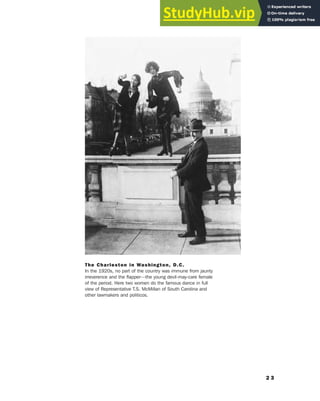
The Charleston in Washington, D.C.
In the 1920s, no part of the country was immune from jaunty
irreverence and the flapper—the young devil-may-care female
of the period. Here two women do the famous dance in full
view of Representative T.S. McMillan of South Carolina and
other lawmakers and politicos.
and 1950s were many, it is his own code; the devices are ones he
developed and used effectively because he understood them better
than anyone else.
If World War I deprived humanity of its faith and made daily living
meaningless and empty, then style—the way in which one lived—be-
comes all important. The lost generation could not redeem the condi-
tions of existence but it could abide in grace and decency. To a
shattered individual, what one did mattered less than how one did it.
T h e S h o r t S t o r i e s
Three prime examples of shattered persons who follow this code are
Nick Adams of In Our Time (1925); Jake Barnes, the hero of The Sun
Also Rises (1926); and Lieutenant Frederic Henry of A Farewell to
Arms (1929). On a solitary fishing trip in the woods Nick Adams is
2 4
❧ HEMINGWAY IN HIS TIME ❧
Although his greatest artistic achievements were written before 1934,
Hemingway’s reputation as a writer increased steadily throughout the
1930s. He appeared on the cover of Time magazine in 1937. What
about Hemingway appealed so deeply to people of the lost generation?
Like many cultural icons, he was both of his time and apart from it.
The despair that T. S. Eliot had set down as early as 1922 and that was
a mantra of the 1920s resonates throughout Hemingway’s writing. The
precision of Hemingway’s expression means that this despair is more
fully realized there than elsewhere, and the writing, the art, also pro-
vides a way out of the despair itself. Doing something well is Heming-
way’s answer to meaninglessness, and art is the supreme expression of
competence. He had found a way.
Moreover, Hemingway’s art was not an exclusive affair, not an activ-
ity of a person who lives in isolation. However rarefied and special his
gifts, Hemingway had nothing of the precious about him. Not only
writing but also drinking, fishing, fighting, and making love were ac-
tivities that in his fiction Hemingway raised to the level of art and
imbued with special significance. These activities are done by people
who feel they have nothing of the aesthetic in them. In an empty age
lost in economic and political ineptness, Hemingway came up with an
affirmation.
American Modernism (1910–1945)
2 5
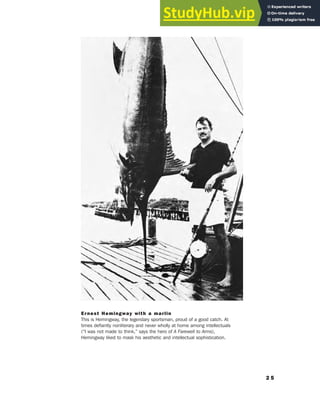
Ernest Hemingway with a marlin
This is Hemingway, the legendary sportsman, proud of a good catch. At
times defiantly nonliterary and never wholly at home among intellectuals
(“I was not made to think,” says the hero of A Farewell to Arms),
Hemingway liked to mask his aesthetic and intellectual sophistication.
aware of the dangers surrounding him, which are psychological as
well as physical.
The prose that describes young Nick Adams (the name “Adams”
suggests the first man, but one who has been “nicked” or marred) is
deliberately simple. Hemingway picked up this technique from Ger-
trude Stein. He put it to his own use, imbuing his prose with omi-
nousness. He interspersed the stories in In Our Time with brief
vignettes that told of the horrors of World War I. Although Hemingway
does not make the connections explicit, they are there.
Hemingway’s stylistic talents were ideally suited to the short
story. The economy and spectacular effects he gained by leaving
elements of the plot unsaid resonate beyond and between his sen-
tences. Short stories, such as “The Battler,” “The Killers,” “Hills Like
White Elephants,” “A Clean, Well-Lighted Place,” “Now I Lay Me,”
“The Short Happy Life of Francis Macomber,” and “The Snows of
Kilimanjaro,” present worlds of menace and despair in which char-
acters try to exhibit the stoic nobility of people trapped in tragic
circumstances.
“Hills Like White Elephants” from Men Without Women (1927)
exhibits Hemingway’s strengths. A woman, Jig, and her lover wait in a
Spanish train station for the train to Madrid, where Jig is to undergo
an abortion.
The word abortion never occurs in the story. The reader is left
to understand the situation from the dialogue. This omission, char-
acteristic of Hemingway, makes the procedure seem more terrifying,
as though it is more than just the “simple operation” that the man
defensively portrays it to be. It is more: It may well be the end of
the relationship.
The setting of the story, a bar in a hot part of Spain, is relevant.
The dryness and heat around the couple are emblematic of their lack
of connection and love. To compensate for this lack, they drink.
“That’s all we do, isn’t it—look at things and try new drinks?” To this
question the man can respond only “I guess so.” However, drinking is
even unsatisfactory in itself. “Everything tastes of licorice. Especially
all the things you’ve waited so long for, like absinthe.”
“Hills Like White Elephants” gains additional force through irreso-
lution. After the man drinks some anisette he sees people “waiting
reasonably for the train.” This ordinary life is something far distant
from him at the moment. When he returns to Jig to continue waiting
for the train, she smiles at him and says, in unconscious defensive-
ness, “I feel fine. . . . There’s nothing wrong with me. I feel fine.” Told
in a flat, reportorial style, the story is as unresolved as the relationship
2 6
American Modernism (1910–1945)
it depicts. The male gives no sign of impatience; he bears his burden
with a certain heroic stoicism that does not wholly condone him, as
his own responses leave Jig more or less on her own in a situation he
also created.
T h e N o v e l s
Heroic stoicism could be judged a quality of Hemingway’s two most
famous novels, The Sun Also Rises and A Farewell to Arms. Jake
Barnes, the hero of the former, is in love with Lady Brett Ashley, a
hard-drinking, high-spirited, at-loose-ends Englishwoman. Prevented
from consummating their relationship by a wound, the nature of
2 7
2. The Lost Generation
❧ HEMINGWAY AND THE MARKET FOR SHORT STORIES ❧
The market for short stories in the 1920s was much more active than
it is today. Many mass-circulation magazines, such as The Saturday
Evening Post, Redbook, and The Metropolitan, published eight or
more short stories in a single issue, whereas now most mass-circulation
periodicals devote an equal or greater space to articles and nonfiction.
In the 1920s short stories paid very well, and at his peak F. Scott Fitz-
gerald could earn $4,000 for a single story. This was at a time when
some families were living on half of that for an entire year.
Interestingly enough, Ernest Hemingway never entered the world of
high-paying short story writing, although it was his short stories as
much as his novels that made him famous. Hemingway published in
smaller-circulation, more exclusively aesthetic magazines, such as
Scribner’s (owned by his publisher, Charles Scribner’s Sons); The Lit-
tle Review, which also once published parts of Joyce’s Ulysses; and,
sometimes, The Atlantic Monthly. Simple sales did not interest him as
much as artistic excellence. Later on, however, Hemingway did write for
Esquire magazine, then considered somewhat risqué, a “man’s maga-
zine.” Two of his greatest short stories, “The Short Happy Life of Fran-
cis Macomber” and “The Snows of Kilimanjaro,” appeared in Esquire.
By the late 1930s, when he brought out his collected short stories,
Hemingway’s interest in the form had died. Although editors, such as
Harold Ross of The New Yorker, asked Hemingway for contributions,
he had nothing to send.
which the novel does not specify, he watches her drift through a se-
ries of unsatisfactory relationships with other men from among their
shiftless, artistic acquaintances. He takes such satisfaction as he can
from a fishing trip in the mountains of Spain and from watching bull-
fights, a sport whose ritualized violence and exactness releases him
by reenacting the grim conditions of existence.
An even greater popular success followed with A Farewell to Arms
(1929). It is a love story. In The Sun Also Rises love between Jake
Barnes and Brett Ashley was impossible. Lieutenant Frederick Henry,
an American attached to an Italian unit, can make love. During an
idyllic summer, nurse Catherine Barkley becomes pregnant by him.
As Hemingway aged, his heroes became simpler and more
besieged, his women less individualized. The ritualistic pleasures—the
sports and the drinking—gave way in the 1930s to a tentatively as-
serted but not fully explored socialism in To Have and Have Not
(1937) and For Whom the Bell Tolls (1940).
By 1940, Hemingway had said what he had to say. In 1950 he
published Across the River and into the Trees, a book on which crit-
ics heaped scorn. The hero, a World War I veteran named Colonel
Cantwell, is in love with a very young woman whom he calls
“daughter.” The rituals in violence and sports that in earlier books
staved off despair here involve opening bottles of champagne and
sitting in restaurants.
Hemingway achieved a comeback of sorts with The Old Man and
the Sea (1952), a NOVELLA about an old Cuban fisherman who
catches an extraordinary marlin only to have it eaten by sharks before
he can bring it home. A classroom staple and a best seller, this last
book was responsible for his reaping the prizes rightfully his for work
he had done years previous. After two disastrous plane crashes and
more hard living, Hemingway deteriorated. In 1961 in his home in
Ketchum, Idaho, at the height of his fame, he committed suicide.
Hemingway’s techniques and his advice on writing continue to in-
fluence practitioners of fiction. His practice of always stopping before
he had truly finished in order to know where to begin when he re-
sumed has influenced many writers. His principle of never interfering
in the story became practically universal. Hemingway’s fiction avoids
conscious authorial intervention. Finally his style, perhaps the most
recognizable one in twentieth century writing, and his focus on letting
the story speak for itself were hugely influential. It was not until the
advent of postmodernism in the 1960s and 1970s that Hemingway’s
influence began to fade.
2 8
American Modernism (1910–1945)
3 . M O D E R N I S M I N T H E
A M E R I C A N N O V E L : J O Y C E ,
D O S PA S S O S , A N D FA U L K N E R
The techniques that Eliot, Stein, and others brought to verse were
also brought to fiction. Collage, associative thinking, verbal play for
the sake of pattern, and bold experimentation characterize modern-
ism in the novel. Just as any discussion of modernism in general has
to deal with the central moral text of modern times, The Waste Land,
any discussion of modernism in the novel has to take into account
the central fictional work of the modernist period, James Joyce’s Ulys-
ses, published in the same year as Eliot’s poem. More than any other
writer, Joyce (1882–1941), an Irishman, changed modern fiction. His
work is central to modernism. It introduced in full realized form the
techniques of modernist fiction. It was read by Dos Passos, Heming-
way, Fitzgerald, Faulkner—by every serious writer after 1922.
J a m e s J o y c e ’ s U l y s s e s ( 1 9 2 2 )
Ulysses is less of a novel with an evident plot line than a presentation
of human existence through a variety of literary techniques. The entire
book, over 700 pages, takes place in Dublin on June 16, 1904, and
concerns the wanderings of two men in that city. Throughout the
course of that day, one or the other of them and sometimes both go
to public baths and a newspaper office, attend a funeral, and visit
various places: the library, pubs, a maternity hospital, a brothel.
As they wander, Joyce dips into the minds of these characters
and into the minds of others whom they meet. He attempts to
present their innermost thoughts, seemingly without editing or any
device that would interfere with what they are thinking; this is the
well-known technique of STREAM OF CONSCIOUSNESS.
At the same time as this is occurring, the story implicitly com-
pares the meanderings to those of Odysseus, the hero of Homer’s
Odyssey. One episode might correspond to the famous encounter
between Odysseus (Ulysses in Latinized form) and Polyphemos, the
Cyclops; another parallels Odysseus’s encounter with the goddess
Circe; still another focuses—with broad irony—on Penelope,
Odysseus’s wife.
James Joyce, the author, disapproved of contrivance, the way
novels depend upon coincidence and forcing events to fit a shaped
plot; he also felt that such fiction could not adequately represent the
2 9
comically bewildering variety of the experience of life itself. Believing
in little except the power of the human mind to recreate experience,
Joyce wanted to present that experience naturally, without interfer-
ence, but at the same time to enrich it, as Eliot and Pound did,
through parallels with myth and through the shapeliness and control
of art. Like Freud, Joyce was not afraid to deal explicitly with sexual
matters, although the myth he chose was not that of Oedipus but of
Odysseus; like Freud, Joyce was censored, and it was not until 1934
that Americans could legally buy and read Ulysses. The exiles in Paris,
however, in Gertrude Stein’s salon or the expatriate circles all knew
the novel.
Revolutionary, allusive, learned, subtle, funny, Ulysses made such
a complete and authoritative rejection of conventional fiction that af-
terward previous ways of writing seemed quaint. Not easy to read, it
3 0
❧ THE ODYSSEY ❧
The story behind Ulysses is one of the oldest stories known. After the
ten-year Trojan War, an event that actually occurred around 1250 B.C.
but was not set down by Homer until some 500 years afterward, one of
the greatest of Greek heroes, Ulysses (the Roman version of the Greek
name Odysseus), was left to find his way back to his native island of
Ithaca. The gods and goddesses had other plans for him, and he had
many adventures on his voyage homeward. He encountered monsters
and natural hardships; he was forced to serve two mistresses—Circe and
Calypso—and he several times had to turn down offers of marriage.
Eventually, however, he does arrive home where he finds that his wife
Penelope has been faithful, putting off suitors who want to marry her
for the family money. He enters his own hall disguised as a beggar and
with the help of his faithful son Telemachus turns the tables on those
who would plunder his house, killing them before being reunited with
his wife.
For Joyce, Ulysses was the complete man: thinker, actor, husband,
lover, farmer, warrior, earthy and noble at once. He finds some of
these same qualities, in comically changed form, in the hero of his
novel Ulysses, Leopold Bloom, a Dublin Jew who sells advertising. In
conflating the stories of Bloom and Ulysses, Joyce joins the modern
world to the ancient one.
American Modernism (1910–1945)
changed writing permanently. The old fiction was limited, perhaps
dead. Even novelists apart from Joyce’s circle, who did not remain in
Paris or never were exiles there, were affected by it. Two of the most
prominent of these were John Dos Passos and William Faulkner.
J o h n D o s P a s s o s ( 1 8 9 6 – 1 9 7 0 )
There is no clearer illustration of the effect of Joyce on the writing of
fiction than the works of John Dos Passos. The difference shows
clearly between Dos Passos’s first two novels—One Man’s Initiation
(1917) and Three Soldiers (1921)—and his breakthrough novel Man-
hattan Transfer (1925). Three Soldiers is a conventional novel. The
reader follows the vagaries of three protagonists with interest, and
there is a nicely balanced feel to the presentation. Dos Passos’s con-
tempt for inhumanity and the waste of war is palpable, and the
story’s full, rounded, self-contained plot neatly contrasts the sensitive
Harvard graduate to the dull conformist. It ends poignantly. But it
pales beside Manhattan Transfer.
This is another kind of book altogether. Whereas the center of
Three Soldiers is clearly indicated by its title, Manhattan Transfer has
many centers, with eight major characters, more or less, and six oth-
ers briefly sketched on the side. It loosely intertwines their lives. The
cover of the first edition, with the author’s painting of Manhattan on
it, suggests the explosion of energy in the prose. Joyce-like but not
Joycean, Manhattan Transfer bursts on the reader in a kaleidoscope
of styles. It moves back and forth through time but is largely set in
the 1920s. It is part straight narration, part NATURALISM in the style of
Theodore Dreiser—detailed reportage with no authorial intervention—
and part dizzying impressionism with fragmented descriptions that
give the feel of the situation without detailed specifics. For short
bursts, it is Joycean stream-of-consciousness, and everywhere stud-
ded with slangy dialogue, French, and snatches of songs. The book
presents New York as a metropolis of ambitious, corrupt businessmen
and show people, where luck betrays and rarely rewards, and, for all
the frenetic riotousness, fails to satisfy.
It is the most detail- and incident-jammed, exhilarating novel in
American letters. Although the book looks forbidding and strange, the
reader is drawn in, and Dos Passos uses the time-tested narrative
technique of breaking off episodes at the height of their interest to
start a new one—which is then broken off. Through it all, the reader
is moved, compelled.
Dos Passos’s most extended triumph in this mode is a set of
three novels: The 42nd Parallel (1930), 1919 (1932), and The Big
3 1
3. Modernism in the American Novel: Joyce, Dos Passos, and Faulkner
Money (1936). He eventually collected them into one large book of
more than 1,000 pages titled U.S.A. This long trilogy presents Amer-
ica from 1905 to 1935, with a number of actual historical characters
appearing.
As in Manhattan Transfer, the lives of the characters intersect.
The brother of Janey Williams, who meets the newspaper owner and
sharp trader J. Ward Moorehouse in The 42nd Parallel, is the brother
of the Joe Williams whose ship is blown up in 1919. J. Ward Moore-
house, with whom Janey Williams has an affair, gives one Richard
Ellsworth Savage a job in his public relations firm. A girl he impreg-
nates is killed, preserving his chances of advancement at the Moore-
house firm. In The Big Money, Savage continues to make
connections among the powerful. Plainly, he will step into the shoes
of his boss at the Moorehouse PR firm.
This is to pick three brief strands from three full-length novels.
There are many other characters—industrialists, failed and success-
ful businessmen, aspiring actresses, Communist organizers, report-
ers, printers, hobos, labor leaders, chorus girls, strikers, and
strikebreakers.
Invented characters are not the only ones in U.S.A. Famous per-
sonalities come in as well: Eugene V. Debs, the socialist labor leader
and five-time presidential candidate; Luther Burbank, the horticultu-
ralist; Andrew Carnegie, the steel magnate; the Wright brothers;
Frank Lloyd Wright, the architect; the dancer Isadora Duncan;
William Randolph Hearst, the newspaper tycoon; Rudolph Valentino,
the actor; Henry Ford, the automobile manufacturer; President Theo-
dore Roosevelt; the poet and journalist John Reed; and even the Un-
known Soldier are there. Dos Passos, in modernist style, blurs the
line between created fiction and reality. It’s all real, or all made-up,
and it all connects.
Set forth in distinct typographic display, two other deliberate fac-
ets of the novel, aside from invented lives and real lives, assault the
eye of the reader. Dos Passos calls the first of these “newsreels.”
These are headlines that might appear in any newspaper of the time
followed by distillations of stories, excerpts from popular songs, sen-
tences cut from wire dispatches, a collage of items that recall the
times not for the sake of nostalgia but to give the events of the ordi-
nary characters a dignity the media miss and to put the reader there.
(from 1919) Newsreel XX
Oh the infantree the infantree
3 2
American Modernism (1910–1945)
With the dirt behind their ears
ARMIES CLASH AT VERDUN IN GLOBE’S
GREATEST BATTLE
150,000 MEN AND WOMEN PARADE
but another question and a very important one is raised. The
New York Stock Exchange is today the only free securities
market in the world. If it maintains that position it is sure to
become the world’s greatest center for the marketing of. . . .
Dos Passos’s political stance is radical. Like many intellectuals of
the 1930s, he was a leftist, more so than Hemingway or Dreiser and
3 3
❧ NEWSREELS IN DOS PASSOS’S NOVELS ❧
Two strategies lie behind Dos Passos’s interspersing his stories with
“newsreels.” The first is to give them the force, authority, and moder-
nity of the short news features shown before full-length films in motion
picture houses. Before television, when only some households in Amer-
ica had radio receivers, newsreels were the means of supplementing
newspapers in keeping Americans informed about the world around them.
This, Dos Passos is saying, is what is happening in America as its own
press reports it. There is no interference or interpretation.
The second strategy, deriving from the first, is to blend, in modernist
fashion, different genres. In order to create a populist literature, a
goal at which U.S.A. is aiming, there is a direct link between events
and so-called fiction.
The typographic distinctiveness of the newsreels in U.S.A. is supple-
mented by other sections, placed close to them, called “The Camera
Eye.” Set in larger type more widely spaced, “The Camera Eye” is Dos
Passos’s equivalent of the collective stream of consciousness. Here is
the thinking of the entire nation, what it believes and how it sees the
world around it.
In The ABC of Reading, Ezra Pound said, famously, “Literature is
news that STAYS news.” Dos Passos inverts Pound’s statement: News is
literature that STAYS literature.
3. Modernism in the American Novel: Joyce, Dos Passos, and Faulkner
certainly more than F. Scott Fitzgerald. Unlike those others, his wide
traveling and his refusal to take a regular job for any length of time,
gave him authority. His sympathy for the common person, those out
of power, and the downtrodden comes from his having been these
things, as well as having been intermittently an acquaintance of the
wealthy and the powerful.
The last section of U.S.A., like that of Manhattan Transfer, is de-
voted to “a young man . . . at the edge of the concrete, with . . . a
rubbed suitcase of phony leather, the other hand almost making a
fist, thumb up.” He is a hobo hitching a ride, having come from New
York and heading west, repeating, as one who has been rejected by
America, the westward journey of America. He is like Huckleberry
Finn—“lighting out for the territory ahead of the rest.” With all the
disaffected feelings of the beat generation and a good deal more
3 4
American Modernism (1910–1945)
❧ COMMUNISM IN AMERICA ❧
Communism is a system of government in which the property of the
community is owned equally by all. Propounded first by Karl Marx and
Frederich Engels in the nineteenth century, the philosophy was first
adopted in the Soviet Union after the Russian Revolution in 1917. Its
leader, Lenin, urged workers everywhere to overthrow their governments.
During World War I, Americans were on the watch for spies and sab-
otage in factories. Because many of the unskilled laborers who worked
in factories were foreigners, communism and foreigners were feared in
the 1920s.
However, when the stock market crashed and thousands of workers lost
their jobs in the 1930s, the period known as the Great Depression,
many began to revise their thinking about communism and communist
ideals. Intellectuals and artists such as Dos Passos openly avowed com-
munist ideas. It is in this context that the U.S.A. trilogy and other
novels, such as Steinbeck’s Grapes of Wrath, were composed.
concrete social awareness, Dos Passos shaped the epic of the first
three decades of the twentieth century in modernist fiction.
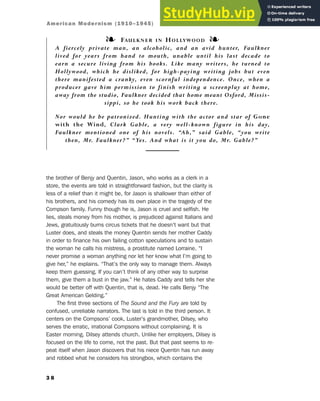
W i l l i a m F a u l k n e r ( 1 8 9 7 – 1 9 6 2 )
Many critics judge William Faulkner as the greatest American novelist
of the twentieth century. The author of more than two dozen books,
he extended the thematic reach of modernism and applied its tech-
niques to new material, allying it to folklore, tall tale, and regionalism.
Stream- of-consciousness technique applied to poor, rural southern
characters pervades Faulkner’s early fiction. Modernism is everywhere
in his blending of nineteenth-century regionalism with experimental
fictional technique. Faulkner is a Joycean raised on southern myth,
tall tales, obsessive morbidity, and sexual fixation. Inventive genius,
flexibility of language, an all-permeating empathy, and sheer intensity
make Faulkner’s narratives universal. The fiction he wrote from 1928
to 1936 is the kernel of his achievement, although several of his
short stories, such as “A Rose for Emily,” “That Evening Sun,” and
“Barn Burning,” have become emblems of the work as a whole.
In 1928, using the stream-of-consciousness techniques learned
from Joyce and emulating Joyce’s example of following his own bent
irrespective of what a reader might expect, Faulkner wrote the first of
his five great novels: The Sound and the Fury. This book, which
makes no concessions to popular expectation, is divided into four
sections, each with a different narrator. The title, from Macbeth
(“Life’s but a walking shadow, a poor player / That struts and frets his
hour upon the stage, / And then is heard no more. It is a tale / Told
by an idiot, full of sound and fury, / Signifying nothing.”) literally in-
spires the first section. Dated April 7, 1928, Chapter 1 is told by an
actual idiot, Benjy Compson, born Maury, age 33, a castrate whose
mental deficiency is biological evidence of the decline of the Comp-
son family.
Although each section of The Sound and the Fury is dated and
although April 7 is Benjy’s own birthday, for Benjy time does not exist.
His reality is a constant present. The cues the reader has that Benjy
is remembering are a repeated word and the switch into italic or
roman type face and whether the caretaker with him is Versh or Lus-
ter, but neither the book nor Benjy makes a distinction between
memory and present occurrence.
Benjy’s life is unrelieved emotional torture and physical pain. At-
tracted to a fire, he tries to touch it. His memories center on the per-
son who has treated him most kindly, his promiscuous sister
3 5
3. Modernism in the American Novel: Joyce, Dos Passos, and Faulkner
Candace, called Caddy. He associates the
young Caddy—she has since left the fam-
ily—with the smell of trees and grass.
Forced to watch Caddy’s lovemaking, Benjy
misinterprets sex as aggression. In this
case the aggression is against his loved ob-
ject, whose leaving him is intertwined with
the memory of her appeal. He is tended in
1928 by a black servant, a boy ironically
named Luster, who leads him near a golf
course to search for a lost quarter so that
he can attend a traveling show. Luster is
unaware of Benjy’s feelings and that the
word “caddie,” heard on the golf course,
will bring Caddy to Benjy’s mind. All this is
conveyed in a flat tone that underscores
Benjy’s lack of self and the separation of
others from him.
The second section occurs eighteen
years before the first. A stylistic contrast,
it is told by Benjy’s brother Quentin, a
Harvard student. Unlike Benjy, Quentin is
preoccupied with time. Shadows, clocks
and watches, and death dominate his
thinking, as does an obsession with vir-
ginity, in particular that of his sister,
Caddy, the mother of a daughter also
named Quentin. Like Benjy, Quentin
moves back and forth in time, but the
events in his section slide into each other
in a way that points to the disintegration
of his personality. (Although Benjy can
communicate nothing, he sees precisely.) Quentin is highly verbal
and subtle, but he is unable to order his life successfully. In taking
us inside his mind in stream-of-consciousness fashion, Faulkner
lets Quentin’s confused connections imbue the archetypically
southern Compson family with a general sense of defeat.
Quentin’s story has a tragic end. The date of the telling, June 2,
1910, is the day Quentin commits suicide by jumping from a
bridge in Cambridge, Massachusetts.
After the unrelieved tragedy of the first two sections, the third is
full of mean-spirited comedy. The date is April 6, 1928. Narrated by
3 6
❧ THE SOUND AND THE FURY ❧
Literary critic Malcolm Cowley,
who knew Faulkner well, offered
this shrewd, droll description of
his friend’s writing.
The truth is that Faulkner
unites in his work two of the
dominant trends in American
literature from the begin-
ning: that of the psychologi-
cal horror story as developed
by Hawthorne, Poe, and Ste-
phen Crane, among others;
and that of realistic frontier
humor, with Mark Twain as
its best example. If you ima-
gine Huckleberry Finn living
in the House of Usher and
telling uproarious stories
while the walls crumble
about him, that will give you
the double quality of Faulk-
ner’s work at its best.
In Otis E. Wheeler’s “Some Uses
of Folk Humor in Faulkner,” in
F. W. Wagner, ed., William Faulk-
ner, Four Decades of Criticism.
American Modernism (1910–1945)
3 7
William Faulkner photo taken in 1954 by the
American photographer Carl Van Vechten
(1880–1964)
This is the older, more public Faulkner, nattily dressed,
having won the Nobel Prize, the author of A Fable.
the brother of Benjy and Quentin, Jason, who works as a clerk in a
store, the events are told in straightforward fashion, but the clarity is
less of a relief than it might be, for Jason is shallower than either of
his brothers, and his comedy has its own place in the tragedy of the
Compson family. Funny though he is, Jason is cruel and selfish. He
lies, steals money from his mother, is prejudiced against Italians and
Jews, gratuitously burns circus tickets that he doesn’t want but that
Luster does, and steals the money Quentin sends her mother Caddy
in order to finance his own failing cotton speculations and to sustain
the woman he calls his mistress, a prostitute named Lorraine. “I
never promise a woman anything nor let her know what I’m going to
give her,” he explains. “That’s the only way to manage them. Always
keep them guessing. If you can’t think of any other way to surprise
them, give them a bust in the jaw.” He hates Caddy and tells her she
would be better off with Quentin, that is, dead. He calls Benjy “The
Great American Gelding.”
The first three sections of The Sound and the Fury are told by
confused, unreliable narrators. The last is told in the third person. It
centers on the Compsons’ cook, Luster’s grandmother, Dilsey, who
serves the erratic, irrational Compsons without complaining. It is
Easter morning. Dilsey attends church. Unlike her employers, Dilsey is
focused on the life to come, not the past. But that past seems to re-
peat itself when Jason discovers that his niece Quentin has run away
and robbed what he considers his strongbox, which contains the
3 8
❧ FAULKNER IN HOLLYWOOD ❧
A fiercely private man, an alcoholic, and an avid hunter, Faulkner
lived for years from hand to mouth, unable until his last decade to
earn a secure living from his books. Like many writers, he turned to
Hollywood, which he disliked, for high-paying writing jobs but even
there manifested a cranky, even scornful independence. Once, when a
producer gave him permission to finish writing a screenplay at home,
away from the studio, Faulkner decided that home meant Oxford, Missis-
sippi, so he took his work back there.
Nor would he be patronized. Hunting with the actor and star of Gone
with the Wind, Clark Gable, a very well-known figure in his day,
Faulkner mentioned one of his novels. “Ah,” said Gable, “you write
then, Mr. Faulkner?” “Yes. And what is it you do, Mr. Gable?”
American Modernism (1910–1945)
money he has been pilfering. Weighed down by past memories, Mrs.
Compson, Jason’s mother, thinks that her granddaughter Quentin has
committed suicide like her son of the same name.
Bold and experimental as The Sound and Fury is, Faulkner had
not finished his modernist experimentations. His succeeding novel, As
I Lay Dying, has no third-person narration. Instead, fifteen different
narrators tell the story. The dirt-poor Bundren family—Cash, Darl,
Jewel, Vardaman, and Dewey Dell and their father Anse—want to
journey to Jefferson to bury their matriarch, Addie Bundren, who lies
dying and in fact does die shortly after the story opens. Faulkner’s
ability to move the narrative forward coherently and to enter the
minds of many distinctively varied narrators makes this short novel a
tour de force, a spectacular demonstration of Faulkner’s skill as a
writer. Moreover, unlike The Sound and the Fury and other modernist
fictions, no final truth emerges from As I Lay Dying. The character
who seems closest to knowing the truth and who is the most reliable
is institutionalized. The moments of tenderness and pain, insensitivity
and cruelty, that the family experiences are balanced in a way that
makes them, poor and primitive as they are, a mirror for all that
human beings do to one another and the story a paradigm for all of
life. The modernist technique dramatizes the essential isolation of
human beings locked within themselves, only intermittently connect-
ing with each other.
After these two remarkable novels, Faulkner wrote at least three
others at the same level of achievement: Sanctuary (1931), Light in
August (1932), and Absalom, Absalom! (1936). The last of these, in
which modernism seems pushed almost as far as it can go, is also a
GOTHIC NOVEL.
Two previous novels, The Sound and the Fury and As I Lay Dying,
show the different realities of distinctly different narrators. In Absa-
lom, Absalom! this theme is to the fore and presented in a new way.
Absalom, Absalom! tells one story, already over before the telling be-
gins, from three perspectives: those of Rosa Coldfield, Mr. Comp-
son—the father of Quentin Compson from The Sound and the
Fury—and then in a reinvented form by Quentin himself, talking to his
Harvard roommate Shreve. It is the account of a man named Thomas
Sutpen who in 1833 arrives in Jefferson, Mississippi, and creates for
himself a southern version of the American dream.
Although each of the narrators in The Sound and the Fury and As
I Lay Dying is clearly delineated, in Absalom, Absalom! the voices
blend into a whole, sustained only by the telling of the story, which is
once again the subject of the book. As with Joyce, it is language that
3 9
3. Modernism in the American Novel: Joyce, Dos Passos, and Faulkner
dominates, language that in Absalom, Absalom! is “that meager and
fragile thread . . . by which the little surface corners and edges of
men’s secret and solitary lives may be joined for an instant now and
then before sinking back into the darkness where the spirit cried for
the first time and was not heard and will cry for the last time and will
not be heard either.” This pessimistic perspective, this isolation is re-
inforced by the lack of chronology and connectivity of the plot and the
apparently rambling quality of Faulkner’s style, where the sentences
stream out of consciousness to carry the reader along so that the
book seems a tissue of words set against the sensual details that the
narrators involuntarily evoke, as though repeating the futile gesture
were the only exercise open to a man (or woman) in a life filled with
remorse and self-contained angst.
Faulkner’s courage in confronting racial issues and his refusal to
compromise his aesthetic aims set an example for novelists to come.
He liberated writers and provided release and pleasure to readers
willing to follow his powerful, convoluted narratives.
4 0
❧ FAULKNER ON FAULKNER ❧
“I’m just a farmer who likes to tell stories.”
Faulkner was fond of downpla yi ng hi s so phi st i ca ti o n a nd i nt el-
ligence with remarks such as tha t, but pa rt o f hi m f o und the se-
riousness with which his no v els were rea d a m usi ng a nd
off-putting. He was a thoroughly m o dern m a n, a t ho m e i n the
most sophisticated of literary ci rcles, but no v eli st s a re a lso en-
tertainers, wanting to make t hei r rea ders la ugh a nd f eel m o v ed
and willing to use every device necessa ry t o a chi ev e tho se ends.
At the height of his inventiveness, Fa ulk ner ’ s no v els used a ll the
tricks of the moderns, although, a s o ne rea der no t ed, The
Sound and the Fur y at its co re i s li k e a Vi cto ri a n no v el: I t i s
about the same things with which nineteenth-century novels
were concerned—the decline of the family, money, orphans,
death and decay, and social co nf li ct . So m a ybe, i n a ddi ti o n to
being an avant-garde writer, Fa ulk ner w a s, a f t er a ll, j ust a
farmer who liked to t ell sto ri es.
American Modernism (1910–1945)
4 . T H E H A R L E M R E N A I S S A N C E
( 1 9 1 9 – 1 9 2 9 )
Harlem was originally a Dutch settlement
in the area above what is now midtown Man-
hattan in New York. During the early years of
World War I (1914–1918) it came to be
settled by black people—some of them
natural American citizens from the South,
others from other countries.
The Great Migration was on. The term
was originally applied in the seventeenth
century to the exodus of people from En-
gland to Massachusetts. In the 1920s the
Great Migration referred to the exodus of
African Americans from the South to Chi-
cago and cities in the North. They were
seeking better jobs. While many worked in
positions as menial and deadening as
those they had left, some did not, and
they found themselves in a new environ-
ment. The sudden influx of blacks, the en-
ergy derived from a change of scenery, and
the celebratory mood of the country ignited
a burst of creativity. It amounted to a
movement and was called the Harlem Re-
naissance.
The Harlem Renaissance was not only a
literary phenomenon. Musicians, actors,
and actresses became stars playing for
black and white audiences. Sometimes per-
formers toured, as performers do today,
but sometimes they worked exclusively in
Harlem. Whites took taxis into Harlem to
be entertained by such performers as Louis
Armstrong, Bessie Smith, Duke Ellington,
Ethel Waters, and Paul Robeson, who, by
the end of the 1920s, were nationally
known figures.
4 1
❧ WHITE LANDLORDS, ❧
BL ACK TENANTS
Harlem accommodated blacks be-
cause the whites who owned build-
ings could make a handsome
profit. Richard Wright, in 12 Mil-
lion Black Voices, detailed how
the system worked. A seven-room
apartment that rented to whites
for $50 a month was spliced into
seven tiny units. Each was rented
to a black family for $6 a week.
Thus, real estate that had been bring-
ing in $50 a month now earned $168
if it was fully occupied.
Whites may have been benefiting, but
blacks benefited too. “Negro was in
vogue,” wrote Langston Hughes, and
many African Americans, wanting to
be where the action was, were glad of
the chance to live in Harlem. The
population of the area doubled from
1900 to 1920, and by 1930 there
were, according to James Weldon
J o hnso n i n Black Manhattan ,
200,000 people living in Harlem.
The result of this cultural explosion
was that Harlem was no longer a
ghetto; it had become a distinctly
black city. What began as exploitation
evolved into something else.
The theaters and nightclubs—these atter were speakeasies,
where bootleg liquor was served—were owned by whites, as were the
publishing houses that printed the works of the writers associated
with the Harlem Renaissance, but the grouping of talent and its
cross-pollination, with one art inspiring another, was distinctively
black. This was the beginning of an independent and sometimes defi-
ant black culture that insisted on its own values. If Alfred A. Knopf,
who published the poetry of Langston Hughes, and the owners of
Harper and Brothers, who published Countee Cullen’s work, Horace
Liveright, who published Jean Toomer’s Cane, and Alfred Harcourt
and Donald Brace, who published Claude McKay’s Harlem Shadows,
were white, they nonetheless purveyed this work to a wider audience
than any black ENTREPRENEUR could have done.
Jazz originated as improvisational music played by black bands
in the South in the early twentieth century. What F. Scott Fitzgerald
4 2
❧ SPEAKEASIES ❧
Prohibition was simply impossible to enforce. People who wanted
to drink in bars found ways to do so that almost openly flouted
the law. One method was the club called a “speakeasy.” This was
an establishment, advertised only by word of mouth, where people
could gather to drink. In many cases, one could gain entrance to
a speakeasy by the use of a password. A patron would knock on
the door and a small partition would be pulled back. “Joe sent
me,” was sometimes all that was required to gain access.
Renowned bars in New York, such as the Stork Club, later legiti-
mate, started as speakeasies. The subsequently famous 21 Club
was another, and it was known for its elaborate mechanical bar
designed to fool the police. If the club was raided by authorities,
as frequently occurred, the bartender pushed a hidden button and
shelves of liquor bottles descended out of view via a dumbwaiter
to a secret room in the basement.
Some owners of speakeasies became celebrities. The most re-
nowned was Texas Guinan, a tough-talking businesswoman who is
reported to have greeted each patron with the phrase, “Hello,
sucker!” That didn’t stop people from coming: Texas Guinan
made a small fortune during the 1920s.
American Modernism (1910–1945)
had called the Jazz Age and the Harlem
Renaissance coincided. In fact, the closest
connection between jazz and literature is
found in writers of the Harlem Renais-
sance. The impulse for much writing of the
Harlem Renaissance was not, however,
purely musical or aesthetic. It was social
and psychological. As Alain Locke, the Ho-
ward University philosophy professor, said,
writers of the Harlem Renaissance
“sense[d] within their group a spiritual
wealth which if they [could] properly ex-
pound, [would] be ample for a new judg-
ment and reappraisal of the race.”
W [ i l l i a m ] E [ d w a r d ]
B [ u r g h a r d t ] D u B o i s
( 1 8 6 8 – 1 9 6 3 )
The great educator, historian, and black
leader whose 95-year life spanned from
Reconstruction, the period after the Civil
War, to the beginning of the Civil Rights
movement, was active in literary, social,
and intellectual circles during the Harlem
Renaissance. Although he published The
Souls of Black Folk a decade before the
movement in Harlem began, his influence
continued, and Du Bois regularly reviewed
books on African American issues during
the 1920s.
A former SOCIALIST still vitally interested
in social issues, Du Bois was an important
editor. He took over The Crisis, the maga-
zine of the National Association for the Ad-
vancement of Colored People (NAACP).
Living in Harlem and actively promoting
interracial understanding, Du Bois founded
a black theater group, Krigwa (a word that
evolved from the first letters of Crisis
Group of Writers and Artists), and began to
focus on the place of blacks worldwide.
His interest in Africa resulted in an essay
4 3
❧ GOING UP TO HARLEM ❧
FOR SOME JAZZ
The impetus for whites to visit
Harlem may have begun in 1921
with a Broadway musical called
Shuffle Along. Midtown Manhat-
tan had never seen an all African
American revue, and the popular-
ity of Shuffle Along was quickly
noted. Imitations followed: Liza,
Chocolate Dandies, and Runnin’
Wild.
Attending a Broadway theater
was different from being in Har-
lem, and it soon became clear
that there was money to be made
from visitors. Soon over 500 jazz
places served white patrons who
wanted to see what the excitement
was about. The best known were
the Cotton Club and Connie’s Inn.
Although ostensibly run by blacks,
they were often white owned,
sometimes by gangsters, such as
George “Big Frenchy” DeMange.
These jazz clubs changed the world of
music forever. Duke Ellington and
Fletcher Henderson worked in this mi-
lieu; Louis Armstrong was there, and
so were Bessie Smith, Ethel Waters,
and the piano virtuoso Fats Waller.
This last one famously responded to a
white woman’s request for a “defini-
tion” of jazz by saying, “Lady, if you
don’t know, I can’t tell you.” Per-
haps that lady was slumming and
never did “get it”; nonetheless, the
Harlem jazz clubs reinvigorated the
musical culture of America.
4. The Harlem Renaissance (1919–1929)
“The Negro Minds Reaches Out” in Alain Locke’s influential collec-
tion, The New Negro: An Intepretation.
The idea of the New Negro was much in the air. This term,
coined by Alain Locke, signified someone who was committed to
erasing the stereotypes and destroying the obstacles that were
placed in the way of black achievement. Du Bois was concerned that
blacks be accepted as individuals and not stereotyped.
From his pulpit at The Crisis, Du Bois promoted the careers of
Marian Anderson, Paul Robeson, Claude McKay, Langston Hughes,
and other black artists. When black or white writers portrayed blacks
in ways that he thought demeaned the race as a whole, he struck
back, objecting to Van Vechten’s Nigger Heaven and McKay’s Back to
Harlem as perpetuating the image of black men as sensualists.
C l a u d e M c K a y ( 1 8 8 9 – 1 9 4 8 )
One of the earliest and most central figures of the Harlem Renais-
sance was born in Jamaica. Claude McKay, born to peasant parents,
was brought up on the poetry of Keats, Milton, and Shelley. He pub-
lished two books in Kingston, Jamaica, before joining Booker T.
Washington’s Tuskeegee Institute and spending time at Kansas State
College. Eventually, he moved to Greenwich Village, then as now a
venue associated with leftist politics and artistic experimentation.
McKay was dismayed by the racism he encountered in America:
Although she feeds me bread of bitterness,
And sinks into my throat her tiger’s tooth,
Stealing my breath of life, I will confess
I love this cultured hell that tests my youth!
His anger found concentrated expression in the two books of his
that reached wide audiences, Harlem Shadows (1922) and Home to
Harlem (1928), the first novel by a black writer to become a best-
seller. His most famous poem, “If We Must Die,” was inspired by the
“Red Summer” of 1919, so called because of the bloodshed that oc-
curred during race riots that followed World War I. Many black vete-
rans who had fought in Woodrow Wilson’s war to “preserve
democracy” applied for jobs also sought by white workers in the
North, leading to intense conflict and violence.
Like men we’ll face the murderous, cowardly pack,
Pressed to the wall, dying, but fighting back!
4 4
American Modernism (1910–1945)
After his first two books, McKay used mostly traditional forms. If
this structure feels imposed, rather than naturally accommodated to
the writing, and the language too direct, McKay was working for a
cause, and that cause, as Alain Locke suggested, was paramount.
The Marxism-Communism to which McKay was attracted is doubtless
behind the poem, but no reader of it would see a program in this or
in McKay’s other sonnets and formal, rather antiquated verse: “The
White City,” “Dawn in New York,” “Harlem Shadows” or “Jasmines.”
It is a different case with his novel Home to Harlem. Although W.
E. B. Du Bois criticized the novel for perpetuating black stereotypes,
Home to Harlem is still an authoritative performance.
McKay’s Marxism is not integrated into the plots of his books.
The characters discuss Marxist ideas and sometimes wish that “the
indecent horde [could] get its chance at the privileged things of life,”
but the novels never reach the point of showing this state. By the
time he wrote his last novel, McKay was living abroad and apart from
the Harlem milieu where he had gained a fine reputation that slowly
declined. He returned to the United States in 1934 and later con-
verted to Roman Catholicism.
J e a n To o m e r ( 1 8 9 4 – 1 9 6 7 ) :
C a n e ( 1 9 2 3 )
Jean Toomer, 28, from rural Georgia, wrote one book. It burst on the
Harlem scene with grand success when it appeared in 1923 from the
mainstream publisher Liveright. Toomer had come to the attention of
writers and critics when his sketches, poems, and stories appeared in
literary magazines of the 1920s, such as The Double Dealer, Dial,
and Little Review, where many famous writers—Sherwood Anderson,
Hemingway, even Joyce—first appeared. Waldo Frank, Allen Tate, as
well as black critics (Lola Rodge, William Stanley Braithwaite) hailed
Cane as the work of a soon-to-be-major writer. Cane is, in fact, a
major book of the Harlem Renaissance. It was perfectly adapted to
the times, a worthy complement to Sherwood Anderson’s Winesburg,
Ohio (1919) and Hemingway’s In Our Time (1925) and, like them,
experimental in form, deriving power from its sense of the life be-
neath the surface of daily existence. It tells its story through a variety
of voices and persons as Toomer manipulates the distance between
the reader and his story.
To create Cane, Toomer took the lyrical stories and poems he
had been publishing and put them into an intuitively right sequence.
There are three sections. The result is an impressionistic collection,
4 5
4. The Harlem Renaissance (1919–1929)
unified by tone and place, that captures a moment in African Ameri-
can history. Interspersed with these short stories Toomer inserts lyric
poems (“Conversion,” “Portrait in Georgia”) in the way Hemingway
interleaves vignettes between the stories in In Our Time. With its con-
centration on a variety of voices and forms and its disconnections,
both those within the stories and the collagelike assemblage of the
book, Cane is the Harlem Renaissance’s most distinctly modernist
production.
Cane had an impact that could have been greater only if Toomer
had continued to write. However, he had done what he wanted to do.
His long silence was one in which his achievement reverberated but
then faded as the century wore on. It returned when the book was re-
discovered in the 1970s.
C o u n t e e C u l l e n ( 1 9 0 3 – 1 9 4 6 )
Countee Cullen burst on the literary scene in 1925, the year his first
and most important collection of poems, Color, appeared. Cullen was
still an M. A. candidate at Harvard when the book appeared and won
five prizes. His aim was not “propaganda” but pure poetry: “If I am
going to be a poet at all, I am going to be a POET and not a NEGRO
POET.”
Color was praised by the established black writer James Weldon
Johnson and, in effusive terms that must have given its author great
satisfaction, by Alain Locke. “Color transcends all the limiting qualifi-
cations that might be brought forward if it were merely a work of tal-
ent . . . it is the work of a Negro poet writing for the most part out of
the intimate emotional experience of race, but the adjective is for the
first time made irrelevant, so thoroughly has he poeticized the sub-
stance and fused it with the universally human moods of life.”
This is high praise indeed. However, without ever PROSELYTIZING, al-
most all of Cullen’s memorable verse is on the subject of race. His
most anthologized poem, which scholars of Harlem Renaissance
maintain was known by heart by African Americans of the 1920s, is
“Heritage.”
What is Africa to me:
Copper sun or scarlet sea . . .
The poem is written in rhymed couplets. Its rhythm is a mesmerizing
TROCHAIC TETRAMETER that recalls the “great drums throbbing through the
air” and “the unremittant beat” mentioned in the poem—all uncon-
scious reminders of the speaker’s African roots. Set against these
4 6
American Modernism (1910–1945)
sensual images is the poet’s alienation from a Christianity he has
come to adopt but that for him is inevitably white: “wishing He I
served were black.” This poem—unlike Cullen’s later “The Black
Christ,” written in the same meter but less mechanically imposed—
concludes in irresolution. That lack of closure gives the poem a ten-
sion that keeps it alive for its readers.
Color was a promising debut. Some of its short poems have
lodged in the public mind. No later book by Cullen reached the inten-
sity of his initial effort.
Cullen was married, briefly, to W. E. B. Du Bois’s daughter
Yolande. He taught English and French at Frederick Douglass Junior
High School in New York. One of his students was James Baldwin,
who later became a distinguished novelist and essayist. A translator
and sometime novelist, Cullen collected his poems in On These I
Stand, one year before his death in 1946.
L a n g s t o n H u g h e s ( 1 9 0 2 – 1 9 6 7 )
The writer of the Harlem Renaissance who has risen to the greatest
visibility in recent years is the poet, novelist, essayist, playwright, and
librettist Langston Hughes. Born in Missouri, Hughes began to write in
mid-adolescence, under the influence of the poetry of Walt Whitman,
especially as Whitman was imitated by the midwestern American poet
Carl Sandburg. A student at Columbia University in New York, he was
in the midst of the excitement of the Harlem Renaissance and at
nineteen published one of his best known poems in Du Bois’s The
Crisis, “The Negro Speaks of Rivers.”
I’ve known rivers:
I’ve known rivers ancient as the world and older than
the flow of human blood in human veins.
This poem, one of Hughes’s best, boldly embraces the world. Its
succinct embodiment and quiet statement use the free- verse tech-
niques of its models and applies them to black culture.
Boldness was a hallmark of the early Hughes. His 1926 essay
“The Negro Artist and the Racial Mountain” announces again the New
Negro, able to stand on his own and indifferent to the opinions of
whites or blacks. “We younger Negro artists . . . intend to express our
individual dark-skinned selves without fear or shame. If white people
are pleased, we are glad. If they are not, it doesn’t matter. We know
we are beautiful. And ugly too. The tom-tom cries and the tom-tom
laughs. If colored people are pleased we are glad. If they are not,
4 7
4. The Harlem Renaissance (1919–1929)
their displeasure doesn’t matter either. We build our temples for to-
morrow, strong as we know how, and we stand on top of the moun-
tain, free within ourselves.” This was a stance that even W. E. B. Du
Bois could champion.
Hughes soon proved to be a magpie when it came to poetic
technique, in that, like the magpie who steals objects to build its
nest, Hughes readily absorbed whatever was around him. By the time
he had completed his first collection of poetry, Weary Blues (1926),
he had begun the poetic practice that would characterize his work:
picking up rhythms from songs, especially African American blues and
jazz, whether from the Harlem musicians of the 1920s or from Dizzy
Gillespie and Charlie Parker. He wanted to be a poet of the people,
and he used the diction of the common people and adapted their
popular structures for his poetry. “Fire” (1927) mimics the evangelical
rhythms of gospel preaching, half way between chant and song.
Fire, Lord!
Fire gonna burn ma soul!
Like McKay and Cullen, Hughes writes about black experience,
and, like them, he expanded in the 1930s as his awareness of ideol-
ogies grew. “Scottsboro,” about the famous Alabama trial where nine
black youths were convicted on a trumped-up rape charge, identifies
the defendants in the case with the rebellious slave Nat Turner, as
well as with Moses and Joan of Arc. “White Man” asks, “Is your
name spelled / C-A-P-I-T-A-L-I-S-T?”
In his enormous poetic output—more than 800 poems—Hughes
managed, like Cullen, to compose a few lyrics that have stayed with
readers, notably his first poem and “Harlem,” which asks the famous
question, “What happens to a dream deferred?” and answers it by
asking in a chilling final line, “does it explode?” He is still beloved be-
cause he was a central figure in the Harlem Renaissance and be-
cause he opened up a technique of using musical rhythms that
others (poet Michael Harper in the 1970s, for one) found useful. His
717 Collected Poems went through eleven printings in eight years
after its initial appearance. Many poets seek a broad, diverse, and
sympathetic audience. Langston Hughes got one.
Z o r a N e a l e H u r s t o n ( 1 8 9 1 – 1 9 6 0 )
Zora Neale Hurston, though from the South, is often associated with
the Harlem Renaissance because, starting in 1925, she lived in
Harlem among its major figures. Early on she wrote stories, one of
4 8
American Modernism (1910–1945)
4 9
Countee Cullen, photograph taken
by Carl Van Vechten, 1941
In city clothes even in this woodsy setting, Cullen remained
devoted to New York and Harlem.
which prompted a request from a publisher and resulted in the publi-
cation of her first novel. Hurston was interested in black folklore. After
her first novel, Jonah’s Gourd Vine (1934), appeared she released a
collection of folk tales, Mules and Men (1935). Hurston even tried to
work one of her folk tales into a play in collaboration with Langston
Hughes but without success.
Shortly afterward, Hurston wrote the novel acknowledged as her
masterpiece, Their Eyes Were Watching God (1937). It is an extraor-
dinary book, even more remarkable when contrasted with some of
the politicized, angry social literature of the Harlem Renaissance, for
Their Eyes Were Watching God has no overt element of protest. It is a
story of love and self-realization. Although the narrative voice is in tra-
ditional English, the dialogue is in dialect. The novel is as funny as it
is perceptive, a unique document in African American letters.
The time in which the events take place is probably the mid-
1930s. Janie Crawford tells her life story to her best friend Phoeby
Watson. Phoeby complains that Janie was too old to have married
her husband Tea Cake. Janie explains how this marriage came about
by explaining her two previous marriages.
Raised by her grandmother, Janie is innocent of the concept of
race; she has no idea that she is black. When this identification is
forced on her, she becomes a different person. Moreover, as the
book makes clear, Janie was simply, naturally sexually awake. Bees
and pollen stirred her. Seeing this, her nanny unfortunately forces her
to marry. It is an African American story of the fall.
The novel recounts the end of this marriage and a second, this
time to a man named Joe, who also turns out to be unsuitable for
Janie. She needs spiritual nourishment.
Food, in fact, literal and spiritual, is an important continuing
metaphor in the novel. Janie needs to be fed as well as to feed.
Eventually, into Janie’s life walks a man whose name refers to food—
Janie’s third husband to be, Tea Cake. After some time and some
doubting, Janie sells a store she has been operating to live with Tea
Cake in the Florida Everglades, in the “muck.” “Folks don’t do nothin’
down dere but make money and fun and foolishness.”
Its affirmation of self-sufficient African American life and the self-
realization and fulfillment of the main character give Their Eyes Were
Watching God the same tensile, undemanding strength as Sarah
Orne Jewett’s Country of the Pointed Firs. Without raising the decibel
level of the prose, or indulging in modernist TROPES, but relying on her
own blend of folklore and understanding, Zora Neale Hurston wrote a
5 0
American Modernism (1910–1945)
novel beside which the more strident and insistently melodramatic
books of other African American novelists may seem contrived.
Two novels, Moses, Man of the Mountain (1939) and Seraph on
the Suwannee (1948), followed, as did legal and financial troubles.
In 1946 Hurston returned to New York but found she could not live
there because of the racism and exclusion she experienced there.
The locus of the Great Migration had become “a basement to hell.”
She moved back to Florida. Although she continued to write profiles
and essays for magazines, her submissions were increasingly re-
jected. Health problems plagued her. She died in obscurity in 1960,
her writing forgotten, but in 1995 her work, including previous uncol-
5 1
❧ STEREOTYPICAL WHITES ❧
W. E. B. Du Bois’s sense of cliché was penetrating. His comical 1922
satirical SQUIB “Ten Phrases” shows the white mentality that Du Bois
was fighting.
The following ten phrases are recommended to white students in Southern
colleges as quite sufficient for all possible discussion of the race problem:
1. The Southerner is the Negro’s Best Friend.
2. Slavery was Beneficial to the Negro.
3. The Races will Never Mix.
4. All Negro Leaders are Mulattos.
5. The Place for the Negro is in the South.
6. I love my Black Mammy.
7. Do you want your sister to marry a Nigger?
8. Do not disturb the present friendly relations between the races.
9. The Negro must be kept in his place.
10. Lynching is the defense of Southern womanhood.
Du Bois’ method of combating this racist mindset is especially effective
because of his straight-faced humor. Instead of explaining what is
wrong with each of these statements, he lets them stand by themselves,
so that the utterer is convicted by his own racism. Such stupidity, Du
Bois is claiming, is its own best commentary. This posture is aristo-
cratic, superior without being condescending, and unanswerable.
4. The Harlem Renaissance (1919–1929)
lected short stories, was collected in the Li-
brary of America series.
C a r l Va n Ve c h t e n
( 1 8 8 0 – 1 9 6 4 )
All the writers thus far in this chapter—
Alain Locke, W. E. B. Du Bois, Jean
Toomer, Claude McKay, Countee Cullen,
Langston Hughes, and Zora Neale Hurs-
ton—were African American. Carl Van
Vechten was white, but he belongs in the
Harlem Renaissance because of his sup-
port and understanding of African American
writers and because of one of his novels,
Nigger Heaven (1926).
Van Vechten’s wide-ranging interests
led him naturally to Harlem and African-
American artists with whose marginal posi-
tion in American culture he felt an
instinctive sympathy and whom personally
he came to like. James Weldon Johnson,
author of a classic novel, The Autobiogra-
phy of an Ex-Colored Man, was a close
friend, as was W. E. B. Du Bois. Through
them and through his position as a novel-
ist, party-goer, and party-giver extraordi-
naire—his daybook The Splendid Drunken
Twenties, published in 2003, records a
whirlwind of socializing—he came to know
Langston Hughes, Paul Robeson, Duke Ell-
ington, Claude McKay, Zora Neale Hurston,
and later James Baldwin.
Although he wrote seven novels, Van
Vechten today is remembered for Nigger
Heaven, which sold an astonishing
500,000 copies in its day. The book
presents low life in Harlem as a model of
PRIMITIVISM: “Hottentots and Bantus swaying
under the amber moon. Love, sex, passion
. . . hate.” However, Nigger Heaven is also
a survey of all levels of black society. A
sensitive black intelligentsia is most hurt by
5 2
❧ THE TRIAL OF ❧
THE SCOT TSBORO BOYS
In 1931 nine black youths, riding the
rails, fought a number of whites—two of
whom were women—also riding the rails.
The blacks pushed the whites off the train.
When one of the whites went to the police,
the order was given “to round up every
Negro on the train and bring them to
Scottsboro.”
The trial rapidly became a brawl
of racism and wild accusation. The
white women, fearing vagrancy charges,
claimed they had been gang raped. They
were made into pillars of southern wom-
anhood. One even claimed that one of
the blacks had chewed off one of her
breasts.
A rapid trial occurred in which the pros-
ecutor declared “Guilty or not, let’s get
rid of these niggers.” The verdict was
guilty, despite the evidence that while
both women had had sex, it had been
neither recent nor forced. The case was
appealed and became a CAUSE CÉLÈBRE.
Albert Einstein and Theodore Dreiser
protested for the blacks. Represented by
a “New York Jew nigger lover” lawyer, as
attorney Samuel Leibowitz was called,
the defendants saw their case thrown out
by the Supreme Court in 1932. It
wasn’t until 1977, long after many of
the original Scottsboro boys had died,
that the remaining defendant, Clarence
Norris, was pardoned and given
$10,000 compensation for the injustices
he had suffered.
American Modernism (1910–1945)
racial prejudice, the novel suggests, while wealthy blacks are far re-
moved from white prejudice because of their money. Indeed, white
guests are flattered to be invited to wealthy black homes.
Van Vechten devoted the last 32 years of his life to photography,
and it is thanks to him that the Beinecke Museum at Yale University
in New Haven, Connecticut, and the Library of Congress in Washing-
ton, D. C., have memorable images of many black writers and artists,
as well as of W. H. Auden, F. Scott Fitzgerald, William Faulkner,
Thomas Mann, Eugene O’Neill, and many important cultural figures of
the Jazz Age and the twentieth century.
5 3
❧ “BRANCHES WITHOUT ROOTS” ❧
(—THEIR EYES WERE WATCHING GOD)
Zora Neale Hurston died in obscurity in 1960. Her grave was un-
marked until 1973, when the African American writer Alice Walker,
who considered Their Eyes Were Watching God a key book in her ex-
perience (“There is no book more important to me than this one”), pre-
tending to be the niece of Hurston, traveled to Fort Pierce, found what
information she could, and located Hurston’s burial place in an ob-
scure cemetery. In the Garden of Heavenly Rest, Walker had a tomb-
stone erected, reading
ZORA NEALE HURSTON
A GENIUS OF THE SOUTH
1901–1960
NOVELIST FOLKLORIST ANTHROPOLOGIST
The grave itself sits near the wild, scraggly Florida landscape vividly
depicted in Hurston’s novel—not perhaps as prominent a venue as the
importance of the book warrants but in other ways entirely appropriate.
Through Walker’s efforts Hurston has rightfully reclaimed her position
in American letters. Their Eyes Were Watching God is often taught
in the classroom, and the entire work of a once-forgotten American au-
thor has now appeared in two volumes in The Library of America se-
ries, the set of books of canonical American literature, writing of
permanent national interest. Hurston now stands on the shelf wit h
Twain, James, Douglass, and Melville.
4. The Harlem Renaissance (1919–1929)
5 . M O D E R N I S M I N
P O E T R Y A N D D R A M A
The impulse to experiment was not confined to prose, and modern-
ism affected poetry in ways less immediate than the imitators of Eliot
and Pound (Gertrude Stein was inimitable). If modernism means ex-
perimentation in the arts, there was considerable borrowing of tech-
niques from one art by another, and some of this cross-pollination
gave new vitality to poetry and drama. In particular painting and the
techniques of European artists affected the way writers conceived of
their work and executed it.
S u r r e a l i s m a n d E x p r e s s i o n i s m
One of the painters closely associated with modernist movements
was Salvador Dalí (1904–1989), from Catalonia in Spain. Dalí was
especially influenced by Freud’s concept of the subconscious. His
paintings were not literal depictions of the known world but discon-
certing “realistic” representations of the subconscious. Objects, such
as watches in his famous The Persistence of Memory (1931), acquire
properties that they do not ordinarily possess; for example, they melt.
Odd and disembodied forms occur; they appear as though they are
human flesh, but they may be distorted. They often evoke breasts,
genitals, and buttocks, and they are usually set in vacant, empty
landscapes of no charm or allure.
Dalí’s emphasis on sexuality, especially perverse and disturbing
varieties of sex, originates from Freud’s The Interpretation of Dreams
(1900). In that book the Viennese psychiatrist argued that dreams,
originating in the subconscious, deal symbolically with conflicts pro-
foundly disturbing to the dreamer, in order to keep the dreamer
asleep. As the rational mind gives way to the subconscious, upsetting
notions rise, transformed, to the surface. These notions spring from
two psychic domains, sex and death, EROS and THANATOS. Freud be-
lieved that both males and females harbor variously directed sexual
impulses—toward their parents, toward other family members, or to-
ward friends, who are perceived as projections of mothers and
fathers. However, at the same time as the emotional makeup or
psyche of a person is directed toward reproduction or perpetuation
(sex, the erotic drive), it is paradoxically directed toward death, to-
ward the cessation of all conflict.
Dalí’s dreamlike pictures, influenced by Freud’s writings, emanate
from Freud’s model. Disembodied sexual parts abound in a setting
5 4
whose emptiness is the absence of all life, the wish for death itself.
Time, a human construct, imprisons; no one escapes. Dalí’s art is,
perhaps, the most intense example of SURREALISM—a term coined by
the French surrealist André Breton in 1924.
Literature also readily adopted Freud’s ideas of the subconscious.
Sometimes, especially in poetry and more readily in fiction, literature
was surreal. In the theater, however, representation of the uncon-
scious took another form. Because plays are staged in actual space
and time with real actors in them, the fanciful nature of the uncon-
scious is difficult to represent. Surreal plays, such as those of the
American humorist Ring Lardner, are rare. Instead, the theater came
to use symbols and stage devices to objectify an inner reality. The
plays of Eugene O’Neill, for instance, written under the sway of Freud,
are instead examples of EXPRESSIONISM. They use symbols perceptible to
the audience to suggest the inner life of the characters before them.
Although some poetry—especially French and German—commit-
ted itself to surrealism and used images drawn from Freudian
psychology, American poetry resisted the tendency. Some poets, such
as Robert Frost, by temperament or by conscious choice, avoided
these trends altogether, whereas others, such as William Carlos
Williams, adhered to the imagism developed by Ezra Pound in the
mid-nineteen teens. At least one great poet, Wallace Stevens, devel-
oped a world of imagination independent of cultural movements,
however accidentally evocative of them the work might appear.
R o b e r t F r o s t ( 1 8 7 4 – 1 9 6 3 )
Robert Frost, though contemporary with all these trends, was deliber-
ately antimodernist, his poetic skill acting as a brake on the impulses
of modernism. He showed what could be done supremely well in tra-
ditional forms. Skeptical and reserved, Frost, even more than Lang-
ston Hughes or Hughes’s model Carl Sandburg (1878–1967),
became a revered public personality. Behind Frost’s public persona,
however, lay a calculating, difficult, highly intelligent, sometimes gen-
erous, sometimes selfish, manipulative man, clever, shrewd, and
complex. His air suggested that he was a simple rustic, a fellow who
liked nature walks. Reading the poetry dispels this image and re-
places it with one wilier and more hard nosed.
Frost read the modernists but never felt he had to be one of
them. Early and late Frost is skeptical, reserved, ironic, dubious, and
playful. Perhaps Frost’s humorously unhelpful notes to the original
1947 edition of his collection Steeple Bush were a parody of Eliot’s
notes to The Waste Land. With Frost one never knows.
5 5
5. Modernism in Poetry and Drama
Frost’s first books, A Boy’s Will (1913) and North of Boston
(1914), were published in England, where Ezra Pound championed
them and helped secure their publication. Although Frost and Pound
maintained a guarded friendship—every relationship with Frost was
guarded—the two men were not emotionally or temperamentally
alike. If Pound on the page rants and screams, Frost maintains a
steady iambic gait that breaks at key moments.
“Anything more than the truth would have seemed too weak,”
writes Frost in an early sonnet. If the modernists think the truth can
be wrested only from new forms, Frost thinks that it is there if one lis-
tens and does not embellish. Why seek new forms when there may
be nothing really new to say and the truth is all around us? “The fact
is the sweetest dream that labor knows.”
Frost’s early poems fall into two categories: tightly organized lyr-
ics, such as “Mowing,” “After Apple Picking,” “To Earthward,” “Stop-
ping By Woods on a Snowy Evening,” and “Birches,” whose
suggestiveness and natural lyricism frequently conceal destructive
and self-destructive impulses; and dramatic monologues of subtle
ruthlessness, such as “The Death of the Hired Man,” “A Servant to
Servants,” or “Home Burial,” as harrowing an account of a family ar-
gument as was ever written. If a gap exists between a man and a
woman, the poem says, it cannot be breached.
Unlike T. S. Eliot or William Carlos Williams, Robert Frost never
wrote the big poem, the one that marks a watershed in his work or
for his time. His own aims, as he declared them, were perhaps small:
to write a few poems that would be “hard to get rid of.” He certainly
succeeded. Can any poet do more? Was that really all Frost hoped
for? It sounds a shade defensive and overly modest. With Frost one
never knows.
W i l l i a m C a r l o s W i l l i a m s
( 1 8 8 3 – 1 9 6 3 )
Although T. S. Eliot worked as a banker and later as an executive for
an English publishing house and although other writers associated
with modernism had jobs in order to support themselves, only
William Carlos Williams and Wallace Stevens were serious practi-
tioners in other fields. Williams was a pediatrician. Born in Ruther-
ford, New Jersey, he attended medical school at the University of
Pennsylvania, where he met Ezra Pound and his companion at that
time, the poet H. D. (Hilda Doolittle). At first a strict disciple of
imagism, Williams all his life was attracted to the “thingness” of
poetry, its irreducible physicality, the permanence of the image,
5 6
American Modernism (1910–1945)
5 7
Robert Frost photographed by Arthur Tourtillot
The portrait was made at the Bread Loaf Writer’s Conference in Vermont, near
Middlebury College, in 1925. Frost helped found the conference, reasoning that
after Middlebury’s School of English had finished, the two sweetest weeks of the
Vermont summer were still to come. Bread Loaf is the oldest writer’s conference
in the country; Frost participated every year until his death in January 1963.
which in Williams’s and the imagists’ views outlast any construction
that may be put on it.
At one point Williams called his poetics “objectivism,” a paring
away of a poem to its essence, its core. He did not want emotion to
enter into the poem directly. That was the space for the reader.
As Williams continued this practice he underplayed himself as an
artist, so that a reader coming on his famous eight-line poem from
Spring and All (1923) that begins
5 8
❧ FROST AND STEVENS ON POETRY ❧
No better way exists to highlight the different personalities of Robert
Frost and Wallace Stevens than to place side by side their statements
about poetry.
First Frost:
Poetry is what gets lost in translation.
Writing free verse is like playing tennis with the net down.
The chief reason for going to school is to get the impression that
there is a book side to everything.
Like a piece of ice on a hot stove the poem must ride on its own
meaning.
The practice of an art is more salutary than talk about it. There is
nothing more composing than composition.
Then Wallace Stevens:
Money is a kind of poetry.
Authors are actors, books are theaters.
The eye sees less than the tongue says. The tongue says less than the
mind thinks.
Poetry is the expression of the experience of poetry.
It is necessary to propose an enigma to the mind. The mind always
proposes a solution.
American Modernism (1910–1945)
so much depends
upon
may miss the joke in “depends.” The word
literally means to hang from, and the next
line does hang. However, it consists of the
word “upon,” whose suspension is ironic.
That suspension thereby suggests the impor-
tance of the red wheelbarrow itself, to which
we are then introduced. By separating
“wheel” “barrow” and “rain” “water,”
Williams breaks these names into their com-
ponent parts, underscoring the “thingness”
of them. The poem has the simplicity of a
stripped and modernist painting, an image
set forth in primitive and spare loveliness.
It has another characteristic, as well,
that Williams was to exploit throughout the
rest of his career. More than simply using
VERNACULAR, Williams wants to capture the
rhythms of American speech. The great mod-
ernists who preceded him, his friend Ezra
Pound and T. S. Eliot, centered themselves in
foreign cultures. They lived in Europe.
Williams, however, was insistently American.
He remained in Rutherford, New Jersey. Un-
like Eliot and Pound, who include foreign lan-
guages (in the case of Pound they include
translations from one foreign language into a
second that the poem then renders into En-
glish), Williams writes in American.
“So much depends,” begin these eight
lines, as though the whole is an offhand
exercise, a casually tossed away comment,
without any elaborate explanation, retrieved
by Williams and presented to the reader as
something found by accident. The two beat
second lines (“upon,” “barrow”) suggest
that the speaker is thinking this out as he
is speaking.
It is impossible to imagine an English poet writing in just this
way. The weight of tradition, in many respects an advantage for an
5 9
❧ PATERSON ❧
The poetical impulse of Williams
sustained itself into old age. For
the last fifteen years of his life, he
was occupied with an epic-length
poem, Paterson, published in five
separate volumes. The hero of the
book is the city in New Jersey of
that name. It is at once personal
and public. Rutherford, where
Williams lived and practiced pe-
diatrics, is near Paterson, and
Williams relished its energy and
spoiled beauty. He describes Pa-
terson with the energetic fervor of
a lover. The book follows the Pas-
saic River through the city, inter-
larding the ecstasy with prose
letters and descriptions—a cata-
log meant to encapsulate Ameri-
can experience in the twentieth
century as a Whitmanesque answer
to Eliot’s Waste Land.
Paterson has been variously
judged by critics, but all have re-
sponded to the grandeur of its
conception and its gusto. The
first book, “The Delineaments of
the Giants,” contains Williams’s
famous dictum “no ideas but in
things” and describes the Passaic
River as it descends on the city
and crashes from the edge of
the gorge
in a recoil of spray and rain-
bow mists—
5. Modernism in Poetry and Drama
English writer by providing a set of ready-made tools to use, or, as the
case may be, to rebel against, has the disadvantage of bookishness.
It urges the writer to produce literature that comes out of other litera-
ture. Williams, in taking literature from the common speech of Ameri-
cans, revitalizes the process of writing, in the same democratic spirit
as Walt Whitman (1819–1892), whose Leaves of Grass (1847–
1892) is written in a free verse that is meant to suggest simplicity
and directness. (Whitman’s poetry is neither simple nor as direct as it
at first seems, of course.)
Many of the followers of Williams—who, like Hemingway, was ex-
tremely influential—have adopted his manner without the depth of
6 0
❧ SNOBBERY AND THE GENERAL READER ❧
American publishing in the nineteenth and twentieth centuries was
centered in Boston and then New York. Some snobbism attaches to these
cities. At a dinner at Holy Cross in 1910, one John Collins Brossidy
famously said
And this is good old Boston,
The home of the bean and the cod,
Where the Lowells talk only to Cabots,
And the Cabots talk only to God.
In the second instance, one might think of Saul Steinberg’s cartoon in
The New Yorker magazine in which the map of America is viewed
from the perspective of a New Yorker, with states increasingly distant
receiving progressively smaller amounts of space.
Such snobbery was completely foreign to William Carlos Williams and
to many others. Middle-class Americans to a certain extent disdained
or were not interested in the writing of the modernists. Few of their
books appeared on the bestseller lists. However, William Carlos
Williams’s poetry, which uses the concepts of imagism and modernism,
was never on those lists either, and his democratic, egalitarian sen-
sibility reached a relatively elite audience. The middle class was, how-
ever, comfortable with biography. Hemingway, Faulkner, and Joyce
were all on the cover of Time magazine in the 1930s and became
known to thousands of Americans who never read their books. Culture
absorbs and embraces new perspectives slowly.
American Modernism (1910–1945)
his art. Nor can they capture the supreme lyricism of his late work, as
notably displayed in “Asphodel, That Greeny Flower.”
W a l l a c e S t e v e n s ( 1 8 7 9 – 1 9 5 5 )
It would be difficult to imagine two poets more different than William
Carlos Williams and Wallace Stevens. If Williams deliberately uses
American language, Stevens adopts a language that, while mostly
American, is anything but the speech of ordinary people. The titles of
some poems in Stevens’s first book and the title itself, point to the
fanciful, the gaudy, the elaborate: “Fabliau of Florida,” “Homunculus
et La Belle Étoile,” “The Comedian as the Letter C,” “The Apostrophe
to Vincentine,” “Jasmine’s Beautiful Thoughts Underneath the Willow,”
and “Peter Quince at the Clavier.” Plainly these poems come from a
universe of precious objects, with language to match. Although Ste-
vens is a modern and a very different kind of poet from his contempo-
raries, a modernist like Eliot or Pound he is not, yet his poems could
have been written only in an atmosphere liberated by the modernists.
Stevens, like Williams, had a nonacademic job. A vice president
of the Hartford Insurance Company, he split his time between litera-
ture and business. Although the indefatigable and ubiquitous Carl Van
Vechten recommended his first collection, Harmonium, to Alfred A.
Knopf for publication and although by the end of his life Stevens had
met Ernest Hemingway (with whom he, drunkenly, tried to box), Robert
Frost, and Marianne Moore, Stevens’s work was done apart from liter-
ary circles. Living in Hartford, Connecticut, with occasional vacations
elsewhere, Stevens pursued his own world of the imagination; a
reader would never suspect that Stevens was an insurance man; his
colleagues in Hartford remained unaware of his writing. If his poems
have unexpected connections and seem at times surreal, that has
nothing to do with a system or set of beliefs or an identification with
any “movement.” As he wrote once to a critic, “We are dealing with
poetry, not philosophy.”
It is poetry of a singularly pure sort, devoted to the imagination,
which, whatever its sources, is sufficient unto itself. In “Disillusionment
of Ten O’Clock” an “old sailor” “catches tigers / in red weather.”
Still other poems of Wallace Stevens have other emphases and
offer verbal pyrotechnics beyond those in Harmonium. Unlike T. S.
Eliot, whose personal experiences provided the impetus for his poems,
Wallace Stevens needed only for his mind to function, for it was fed by
the interplay of sound and idea, with the one suggesting the other,
and the other always suggesting another one.
6 1
5. Modernism in Poetry and Drama
R e a l i s m a n d
M o d e r n i s m i n
t h e T h e a t e r
Given the practical difficulties, a surreal
play might be challenging or impossible to
stage. Surrealism, as practiced by Salvador
Dalí, is not unknown to the theater, al-
though productions have been rare. In
America, the one writer of surreal plays was
the humorist Ring Lardner (1885–1933).
Long before the absurdist, experimental
plays of the French surrealist André Breton
(1896–1966) and the Irish-French play-
wright Samuel Beckett (1906–1989), Lard-
ner produced nine whimsical, wildly
hysterical short plays, one of which, The
Tridget of Greva (the title gives no informa-
tion), was produced in a revue. Although
not among Lardner’s best-known works—
his short stories and the epistolary sports
novel You Know Me Al—they have a follow-
ing of their own. To the right sensibility they
break experience down into helpless
mirth—engendering nonsense. Robert Frost
laughed himself silly over I Gaspiri, The Up-
holsterers. J. D. Salinger, through Holden
Caulfield, as well as the American critic
Maxwell Geismar both admire Lardner’s
plays.
Lardner, possibly without quite realizing
it, happened on avant-garde theater. The
dialogue, full of nonsequiturs and deliber-
ately bad puns and misunderstandings
gives the reader (or viewer) an eerie sense
of regression, something like formal non-
sense without the logic or rigor nonsense
writing requires.
FIRST STRANGER Where was you born?
SECOND STRANGER Out of wedlock.
FIRST STRANGER That’s a mighty pretty
country around there.
6 2
❧ SURREAL THEATER: ❧
RING LARDNER
One of the surprising aspects of
Lardner’s surreal plays—if any-
thing in such a context can be
said to surprise more than any-
thing else—is that the stage di-
rections and casts of characters
are as entertaining and strange
as the dialogue and action. The
cast of I Gaspiri, The Uphol-
sterers, for instance includes the
following.
Padre, a Priest.
Sethso
}Both Twins
Gethso
Wayshattan, a Shepherd’s Boy
Two Capitalists.*
Wama Tammisch, her daughter.
Klema, a Janitor’s third daughter.
Kevela, their mother, afterwards
their aunt.
*NOTE: The two Capitalists don’t
appear in this show.
Not only do the two capitalists
not appear but also the play has
nothing to do with upholstering
or anything like it. We are living
in a random world that makes no
effort at sense.
American Modernism (1910–1945)
In at least one of these short plays, Quadroon, Lardner mocked
the preeminent dramatist of his time, the one indisputable expres-
sionistic playwright of distinction America produced, Eugene O’Neill.
E u g e n e O ’ N e i l l ( 1 8 8 8 – 1 9 5 3 )
Eugene O’Neill’s father was a New York theatrical producer, and al-
though O’Neill spent some of his early years in the company of actors
and producers, he also led a nomadic existence for the first two
decades of his life. He shipped to Honduras, Argentina, and South Af-
rica in search of work and experience, eventually returning to the the-
ater in Connecticut and afterward, productively, in Provincetown,
Massachusetts, then as now a MECCA for artistic experimentation.
O’Neill’s interest in theater was well timed. Although motion pic-
ture theaters had existed for more than a decade by the time O’Neill
began writing, the films were all silent. The theater was still the best
forum for public performance of a serious nature.
Beyond the Horizon (1920) and Anna Christie (1920) were the
first two plays that followed O’Neill’s apprenticeship in Provincetown.
Both of these plays won Pulitzer Prizes.
In Anna Christie, the sordid family life, the pessimistic view of
human nature, and the inescapability of character reflect O’Neill’s
deep reading in Greek tragedies and his willingness to portray low life
in grimly naturalistic terms. The experiences of the characters, espe-
cially the heroine’s, determine their fate. Anna Christie has no moral
in tow, no uplifting message or promise of redemption. Such is what
we refer to as naturalism.
The same year as Anna Christie came O’Neill’s first major exer-
cise in expressionism, The Emperor Jones. The hero of the title is
Brutus Jones, a “tall, powerfully-built, full-blooded negro of middle
age.” Although “his eyes are alive with a deep, cunning intelligence,”
“yet there is something ridiculous about his grandeur.” Jones rules an
island in the West Indies. Cruel and manipulative, he has become
rich fooling “dese black trash.” However, he has a plan to escape
from his island when the exploited begin to rebel. As he boasts to the
cockney trader Henry Smithers, he will flee to France and nothing can
stop him except a silver bullet.
As soon as he offers this explanation, he hears the beat of a
drum. Smithers explains: “The blacks is ’oldin’ a bloody meetin’, ’avin a
war dance, gettin’ their courage worked up b’fore they starts after you.”
The dialect gives a primitive feel to the play, an effect O’Neill enhances
by staging the play almost entirely in darkness, where fears can most
easily dominate, and also through a simple expressionistic device.
6 3
5. Modernism in Poetry and Drama
From the distant hills comes the faint, steady thump of a
tom-tom, low and vibrating. It starts at a rate exactly corre-
sponding to normal pulse beat—72 to the minute—and con-
tinues at a gradually accelerating rate from this point
uninterruptedly to the very end of the play.
The Emperor Jones expresses Jones’s elemental character; the
faster, progressively louder tom-tom both unnerves Jones and aligns
the audience, whose pulses, presumably by sympathetic vibration,
have quickened into fury, with Jones’s anguish. The Emperor Jones
6 4
American Modernism (1910–1945)
❧ THE THEATER IN O’NEILL’S AMERICA ❧
America had its share of theatrical companies, both in New York, the cen-
ter of drama, and elsewhere when O’Neill was starting to write, but it
had had no world-class dramatist until O’Neill. Instead American thea-
ters offered a number of experiences, not all of which were pure drama,
such as the circus, burlesque, vaudeville, rodeos, and medicine shows.
Most of the smaller, non-New York theaters offered a variety of different
stage entertainments in addition to straight plays, although there were
exceptions, and the theater in Provincetown, Massachusetts, with which
O’Neill associated himself, was one of the best in the country.
This situation had both advantages and disadvantages. Theater was
certainly enriched by contact with other genres. W. C. Fields’s
(1880–1946) clowning, for example, owed much to vaudeville and jug-
gling acts. However, there were encroachments and the situation was in
flux. Just at the time O’Neill began his career, new competitors to the-
ater appeared. The first motion picture was made in 1903, and by
1920 the nickel cinema was commonplace throughout America. And by
the mid-1920s the radio craze was sweeping throughout America.
Films in the 1920s were silent. Not until 1929 was the first widely
distributed sound film created. O’Neill’s plays in the 1920s thus of-
fered things that movies could not: extended dialogue interwoven with
theatrical affects. The playwright had at his command a precious gift
not yet available to directors and producers of films—language—as
well as another resource not available to the radio programmer: a vis-
ual stage. A master at conceiving stage affects and a penetrating
writer, O’Neill may be the last complete man of live theater.
6 5
Eugene O’Neill, one of the most photogenic
writers who ever lived
O’Neill is shown here in 1933 with his third wife, Carlotta Monterey O’Neill. Al-
though their relationship was marked by quarrels and bitterness, they loved
each other deeply. He was married to Carlotta when he died in 1953.
induces feelings with elemental directness, rather than by words or
argument. At its heart, expressionism is not intellectual. It is
instinctive and MIMETIC however much it may owe to psychology.
O’Neill continued to explore the possibilities of theatrical expres-
sion. Although the naturalism was matched with a classic tragedy in
his New England drama Desire Under the Elms (1924), the play in
which expressionistic devices, psychology, and Greek fate are aligned
with stream of consciousness is another with a New England setting,
Strange Interlude (1927).
Set in the part of America most associated with Puritanism and
stifled desires, Strange Interlude recounts the frustrations of Nina
Leeds, daughter of a possessive university professor, in terms that de-
rive straight from Sigmund Freud. She tells her last husband that
6 6
❧ EUGENE O’NEILL, ALCOHOLISM, AND WRITING ❧
Eugene O’Neill’s unhappy experiences with alcoholism and the central-
ity of liquor and addictions in his plays raise the general question of
why so many American writers were alcoholics. Of the writers in this
volume, Faulkner, Fitzgerald, Hemingway, Lardner, Lewis, Steinbeck,
and O’Neill would all be so classified.
It is easy to see which writers drank to excess, but it is harder to
understand why they drank. Prohibition may explain the social attrac-
tiveness of drinking for Fitzgerald and his peers, but it does not ex-
plain the profound and tenacious attractiveness alcohol had for them
or why even when they tried to stop drinking they could not.
Part of an answer might be found in The Iceman Cometh. The bar
flies are devoted to their “pipe dreams” in order to keep going; dull re-
ality makes life unbearable. Even though the metaphor of pipe dreams
comes from drug taking—opium pipe dreams—the motivation to escape
from ordinary life is similar. Moreover, after a while, as the Tyrone
family in Long Day’s Journey into Night discovers, the problems
compound themselves. As Fitzgerald wrote once, “I couldn’t get sober
enough to be able to tolerate being sober.”
Of course, not all people who find reality disagreeable become alcohol-
ics, and no one has yet come up with a satisfactory explanation for the
high incidence of alcoholism among literary figures. As Donald W.
Goodwin, a doctor who has studied this problem, writes, “The origin of
alcoholism is as inscrutable as the mystery of . . . writing talent.”
American Modernism (1910–1945)
people are ruled by the impulse to die. “Our lives are merely strange
dark interludes in the electrical display of God the father.”
The Electra complex—Freud’s formulation for the way in which
females chose husbands who are like their fathers—hangs over this
play. The subconscious is always evident as O’Neill shows the split
between what people do and say and what their lonely, interior selves
tell them. Thus, stream-of-consciousness techniques emerge in
Strange Interlude. At one point Nina, at the same time as she is talk-
ing to her new husband Charles Marsden, alternately speaks, in her
head, to her father, who started all her problems. The audience has
to sort out this disturbing scene as best it can. In a further Freudian
fusing of expressionism and psychology, Marsden replies, speaking to
Nina, according to O’Neill’s stage directions, “paternally—in her
father’s tone.”
The source for these bitter family tragedies was O’Neill’s own
family life. His 1941 masterpiece Long Day’s Journey into Night
comes straight from his own background. There are four members of
the Tyrone family: Mary, the drug addicted mother; James, a former
stage idol clearly based on O’Neill’s father James; and their two sons,
Jamie and Edmund, the one an embittered drunk at 33 and the other
an ill intellectual whose deepest impulses are suicidal. Each of the
men throughout the course of the play tries to dominate the others
with their understanding of what has happened, but it is the mother,
as she slips into unreality, who has the last word. When Mary appears
in her wedding gown, trying to recreate a time when she believed she
was happy, the family realizes its own end is imminent. O’Neill’s
sense of time is Faulknerian: “The past is the present, isn’t it?” asks
Mary Tyrone. And she adds, “It’s the future too.”
O’Neill spread his personality throughout all of these characters
yet at the same time kept true to his own memories. The closeness
of the play to his life prevented O’Neill from giving it to the public
when he wrote it. It was not produced on stage until three years after
his death.
By his innovations of theatrical technique, his marrying of classi-
cal theater to modernist techniques, and the empathetic presentation
of his doomed, ruined characters in all their pathetic yearnings and
defeats, O’Neill dominated American theater for the first half of the
twentieth century. His view is tragic. Understanding comes too late
and is ineffective when it arrives. This is the truth that play after play
of Eugene O’Neill reenacts.
6 7
5. Modernism in Poetry and Drama
6 . L I T E R A R Y C U LT U R E
O F T H E M O D E R N S
Modernism did not die. It was supplanted and reemerged in altered
form in the 1980s. However, for a time it was buried. The events of
history overtook it. Perhaps the most universal alteration of circum-
stances was the economic crisis of the 1930s, the GREAT DEPRESSION.
The causes of the Depression were many and mutually reinforc-
ing. The one that casual students of history cite is the crash of the
stock market, and that certainly contributed to the Depression, al-
though by itself, it may not have caused it.
When people sell their stocks because of falling dividends or in
anticipation of falling dividends or because conditions are so bad they
can raise money no other way, the price is likely to drop. If enough
stockholders sell, the stock may become worthless: No one will want
it. If this happens often enough, as it did in 1929, the market as a
whole crashes.
The crash had multiple consequences. Banks that had invested
in the market were out of funds. People who put their savings in
banks lost their money and had none to buy food and goods. Farm-
ers who provided food and manufacturers of consumer goods had
less of a market. Layoffs resulted. One failure reinforced another, and
it seemed to many as though the entire economic system was not
simply badly managed but wrong. The people most hurt were not rich
investors, who still had resources, but ordinary working men and
women. The distance between these groups was huge. John D.
Rockefeller (1839–1937) was worth many millions of dollars and
handed out dimes as charity.
Intellectuals who studied this situation believed that the cause
was the pyramid of labor. Many at the bottom labored for a few at
the top. In Das Kapital (1867), the German social and economic phi-
losopher Karl Marx (1818–1883) condemned a system designed to
produce money or capital that depended on selling goods for more
than they were worth in terms of material workmanship: capitalism. It
promoted inequalities and ultimately, Marx believed, was destined to
self-destruct.
These ideas had great force in the 1930s when evidence of in-
equality was so immediate and when no solutions seemed at hand.
The result was a surge in popularity of Marx’s ideas—not only in his
sharp criticism of the capitalist system but also in his (and others’)
6 8
vision of a system that could replace it and be fairer to all: COMMU-
NISM. Communism derives from the word “common.” Its essential
tenet is that all people own all property and share in the means of
exploiting that property. The result is a classless system in which no
one is better off than anyone else. Conflicts are minimized.
Communism is at odds with Freudianism, which situates conflict
within the family structure. However, a Marxist would contend that the
family structure—a mother and a father, each with different assigned
and agreed-on tasks—is socially constructed, that is, not biological or
natural but, rather, determined by social conditions. As a conse-
quence, the theory suggested, family structure could be altered and
would be altered over time as communism replaced capitalism.
Whether that could ever take place is unclear. The most famous
country to try to put Marx’s ideas into practice, the Soviet Union,
6 9
❧ BUYING ON MARGIN ❧
In the 1920s (as today, with some differences), many investors bought
stocks on MARGIN. They put up only a fraction of the price in anticipa-
tion of a rising market. If I buy x for $10 and it rises to $20, I have
doubled my money. If I buy x for $2, “borrowing” $8, and it rises to
$20 I have increased my money tenfold, less interest charges. That is
buying “on margin.”
Generally speaking, for the most part, prices in the 1920s did rise.
People with very small incomes had margin portfolios worth millions.
F. Scott Fitzgerald wrote a story about one, a barber richer than his
customers.
However, if the price of the stock falls far and fast, those who bought
on margin will be asked to come up with funds to cover the loss because
their “loans” will be in jeopardy. They may be forced to sell to cover
the loss and lose all their investments.
Sometimes prices fall so fast that purchasers cannot cover their losses
even by selling. Then the market has to absorb bankruptcies. If enough
people go bankrupt, the market itself collapses. That is what happened
in October 1929. It happened not only in the United States but also
globally. Resulting devaluations of currency in Europe caused wide-
ranging social unrest.
6. Literary Culture of the Moderns
never did succeed in instituting true communism and collapsed.
Human nature and history intervened.
The Soviet Union, however, was a country to which many artists
and intellectuals were attracted in the 1930s. Older socialist writers,
such as Theodore Dreiser, visited and variously approved of what they
saw. Hemingway flirted with communist thinking in the 1930s. Fitzge-
rald saw himself as “essentially” communist. W. E. B. Du Bois, Coun-
tee Cullen, and Claude McKay wrote books that leaned toward
communist thought because African Americans, disenfranchised or
denied their rights under the old America, could see with special clar-
ity the advantages of a classless society, where the color of their skin
would not be an issue. Even popular writers, such as the detective
novelist Dashiell Hammett (1894–1961), author of Red Harvest
(1929), The Maltese Falcon (1930), The Glass Key (1931), and The
Thin Man (1934), became “reds.” The iconoclasm, the desperate
partying of the 1920s, was over.
The most effective American literary artist whose works imply the
need for Communism was John Steinbeck.
J o h n S t e i n b e c k ( 1 9 0 2 – 1 9 6 8 )
Like William Faulkner, John Steinbeck took some time to discover the
subject he was best able to treat in fiction, and, like Faulkner, he fre-
quently made forays into other topics. He was born in Salinas, a
modest town in the middle of one of California’s great farming areas.
Like other writers associated with the West—for example, Frank Nor-
ris (1870–1902)—Steinbeck has an openness, an uncomplicated
willingness to accept simple people as they are. He came after a
decade in which literary experimentation was dominant, where sheer
artistry was a prime value in and of itself—the decade of Stein, Hem-
ingway, Faulkner, and Fitzgerald, all stylists. Steinbeck pulled back
from modernism, not because he wanted to rebel against it, but be-
cause his own experiences at a variety of jobs and his immediate
sympathies were not oriented in that direction.
His third novel, Tortilla Flat (1935), captured the imagination of
the public. Set near Monterey, California, it has no political message.
It is a rambunctious, humorous, PICARESQUE story of peasants, drinking
parties, love affairs, hardships, and simple persistence in a life that
binds the characters into a community.
The novel that followed the agreeable comedy of Tortilla Flat, In
Dubious Battle (1936), is a contrast. In place of gaily living peasants
are earnest people who must work to make a living. There are strikes
and strikebreakers, and people are hurt or killed. The book ends flatly
7 0
American Modernism (1910–1945)
and bleakly, with no fading action. It starts in the middle of the strug-
gle; it ends in the middle of the struggle, with all the political theoriz-
ing embodied in the speeches and confrontations between the
characters. The author never once intrudes into the book. Based on
an actual event in the San Joaquin Valley in California, In Dubious
Battle has the feel of a newspaper report.
As in Tortilla Flat, the characters are simple, even one dimen-
sional, but this simplicity adds to the narrative force and is necessary
to the theme. The basic needs of all men are the same. Only the
economic system alienates one from the other.
Steinbeck’s greatest literary triumphs were to come: the short
novel Of Mice and Men (1937) and the much more sustained Grapes
of Wrath (1939). The former is simpler. The men in Of Mice and Men
are Lennie Small and George Milton. The latter is of normal intelli-
gence, but the former, although physically strong, is mentally weak.
He likes to touch small furry animals, such as rabbits and mice;
George takes care that Lennie does not harm these animals. To-
gether they dream of buying a small farm on cheap land.
These are primitive people reduced to the starkest of charac-
terizations. Now stock figures, they were not so in 1937 when the
book appeared. The Salinas Valley, which up until that time had
not been explored in fiction, made the characters seem even
fresher. If a crucial seduction scene in a barn was a cliché even in
1937, it is saved because it goes so horribly awry, as the best laid
plans of mice and men often do, and as George and Lennie’s plans
do. That is the buried implication of the title, from Robert Burns’s
poem “To a Mouse.”
Of Mice and Men is a novel with scenes blocked out as for a
play, with each chapter taking place in one location. Plainly, Stein-
beck had one eye on the theatrical possibilities when he composed
it. Indeed, his almost immediate dramatization, staged on Broadway,
with Broderick Crawford in the role of Lennie and Wallace Ford as
George, was a great hit. It was played 207 times and won the New
York Drama Critics’ Circle Award.
Just as he had followed the rollicking Tortilla Flat with a different
kind of novel, so Steinbeck followed Of Mice and Men with a long,
sustained, panoramic story. Where the former book is neatly worked
out, The Grapes of Wrath is expansive. Interleaved throughout the
narrative are chapters that describe the land through which the char-
acters are moving, giving The Grapes of Wrath the feel of an epic.
It is an epic that recapitulates the American movement west
under harsh circumstances. The Joads—Grampa and Granma, Uncle
7 1
6. Literary Culture of the Moderns
John, Pa and Ma, Tom, Noah, Connie and
his wife Rose of Sharon, and their children—
live in the Dust Bowl of Oklahoma, which is
described from a general overview. The novel
is at pains to keep its focus on community
rather than on one central figure, as com-
munity is Steinbeck’s golden value.
Conditions are harsh in the Dust Bowl
for people and animals. In a famous chap-
ter, Steinbeck describes a turtle crossing a
highway. A truck hits the turtle, almost kill-
ing it, but the turtle spins to the side of the
road and lands on its back, eventually mak-
ing its way to its destination. The imperson-
ality of mechanical contrivances, such as
the truck, and their indifference to life re-
semble the tractors that work the machines
that drive the Joads away from their work
on the land. They are like the automobiles
sold by dealers to poor people—dilapi-
dated, mechanically defective cars whose
only purpose is to make the dealers richer.
They are extensions of the banking interests
that finance them and that control the eco-
nomic life that is so harsh to poor families
like the Joads.
Ma Joad, the strongest member of the
family, holds the group together through her
strength of will and common sense, but the
Joads are worse off at the end of the story,
after arriving in California, than they were at
the beginning: Their son Tom has gone, their
number is diminished, and their plight is more
desperate. This mood corresponds to the
deepest feelings of the nation during Great
Depression. The publication of The Grapes of
Wrath in 1939 summed up the decade.
The book also signified for a time the
end of a belief in the American dream of
hard work and rewards. Believers in that
dream, such as Fitzgerald, did not like
Steinbeck’s work, and Hemingway, with
7 2
American Modernism (1910–1945)
❧ DUST BOWL HARDSHIPS ❧
FOR THE OKIES
The term Dust Bowl refers to the
plains in the center of the United
States, from the Dakotas down
through Texas. This area is exten-
sively farmed, and for years farm-
ers planted wheat and other
crops, which grew bountifully.
This was also the era of the big
farm, of thousands of acres.
In the 1930s, however, weather pat-
terns changed, and agribusiness
planting practices led to disaster.
There was an extensive drought, and
no crops would grow. That meant
that the winds that blew across
the plains lifted acres of valuable
topsoil and scattered it as dust. It
drifted like snow because there
was nothing to anchor it. No con-
servation measures had been taken.
Smaller farmers could not sur-
vive. They had no resources, so
many, like the Joads, packed up
what they could salvage and left.
These impoverished farmers were
looked down on. (The folksinger
Woody Guthrie wrote songs about
their plight.) Staying at a mi-
grant labor camp, the Joads and
their friends in The Grapes of
Wrath get their first taste of dis-
crimination when they are called
“Okies.” “Okie use’ ta mean you
was from Oklahoma,” they are
told. “Now it means you’re a dirty
son-of-a-bitch. Okie means you’re
scum.”
7 3
Migrant worker stalled in the desert, 1937
Although this car is in better condition than the one the Joads used to travel
westward in The Grapes of Wrath, the photo captures the hardness of the life
of the period, the discriminating appraisal needed to succeed on such journeys,
and the long distances involved.
his focus on aesthetics, also did not find it to his taste. Steinbeck,
of course, did not write for them and independently pursued his
own ideas.
Steinbeck wrote two more considerable novels. Cannery Row is a
comic story in the manner of Tortilla Flat about the love of working-
class people for the owner of a biological lab in Monterey. East of
Eden, a historical novel set mostly in Salinas Valley, California, covers
the period of 1890 to just after World War I and tells the story of one
brother who is able to break away from a family life filled with recrimi-
nation and hurt to “rule over sin” as God promised Cain he could do
in a land “east of Eden.”
Both of these books furthered Steinbeck’s reputation. He won
the Nobel Prize for literature in 1962, the seventh American to do so.
He took special pride in the award, writing to a friend that he had
had “a long-time feud [with] the cutglass critics, that grey priesthood
which defines literature and has little to do with reading.”
The era of modernism had come to an end.
W o r l d W a r I I
President Franklin D. Roosevelt (1882–1945), elected in 1932 when
the Great Depression was ravaging the country, was a great innovator
of social policy. Social security, many federal agencies still active today,
and a more active social role for the government were his legacy.
Roosevelt’s most immediate motivation for starting these programs was
the struggling economy, and in a small, somewhat patchwork way his
efforts made a difference. Perhaps as important as his programs were
Roosevelt’s hopeful attitude and vital, engaging personality. However,
more crucial than any of these factors was WORLD WAR II.
Nazism was only a movement, not a force, until 1933, when Hit-
ler became chancellor of Germany. In a series of aggressive military
and political moves, Adolf Hitler (1889–1945) started on his quest to
rule Europe, even as Japan began its plans for increasing its territory
in the East. Although theoretically neutral, the United States would
find it even more difficult to stay out of this world war than it had
World War I. The need to manufacture munitions, planes, tanks, guns,
boats, and other items necessary to fight this war, one waged on both
European and Asian fronts, brought an end to the Great Depression.
In 1918, the country was divided on the appropriateness of
America taking part in a European conflict. Few such doubts existed
by the time the Japanese bombed Pearl Harbor on December 7,
1941. That action made the mandate plain. In Europe, the actions
of Adolf Hitler were so evidently the work of a cruel tyrant that no
defense seemed possible.
7 4
American Modernism (1910–1945)
Even today Hitler’s atrocities seem un-
believable. Most notorious was his wish to
exterminate an entire race—the Jewish
people. Economic conditions following
World War I in Germany had been harsh.
Inflation was so high that it took almost a
wheelbarrow full of German banknotes to
buy a loaf of bread. Based on misguided
economic theorizing and personal beliefs
stemming from a deep-seated psychosis,
Hitler blamed the Jews for the economic
troubles in Germany—and for many of its
other social problems as well.
Hitler rounded up Jewish people in
towns throughout Germany and the territo-
ries it conquered or annexed—Poland,
Czechoslovakia, Austria—and simply shot
them or shipped them to labor camps at
Auschwitz, Bergen-Belsen, and other
places, where the able-bodied were worked
until they died, and women, children, and
the sick were herded immediately into
ovens and gassed. Six million Jews per-
ished. The cruelties of the Nazis’ treatment
of the Jews is called the HOLOCAUST. Euro-
pean nations, aware of Hitler as an evil
man, though possibly unaware of just how
evil he was, mobilized in 1939. Soon
America was engaged in the war against
Hitler as well.
Embarking on such an ambitious pro-
ject as fighting a war on two fronts required the mobilization of troops
and the manufacturing of weapons, clothing, tanks, ships, airplanes,
and machinery—a vast array of goods to support troops and provide
them with what they needed in order to fight. It required massive in-
fusions of capital, some of which came from the government. Al-
though Roosevelt’s federal works projects poured millions of dollars
into the economy, World War II required billions more. It was this that
lifted the nation out of the Great Depression.
Scott Fitzgerald characterized the 1920s as an “age of miracles,
an age of art, an age of excess, an age of satire.” The 1930s was
the exact opposite: an age of ordinariness, social activism, restraint,
and earnestness. The first half of the 1940s was another contrast: an
7 5
6. Literary Culture of the Moderns
❧ MOBILIZING FOR ❧
WORLD WAR II
Fighting a war on two fronts re-
quired a massive national effort. The
entire country was put in the service
of the U.S. military. It was during
this time that such figures as
Rosie the Riveter appeared. Rosie
was a strong, capable-looking woman,
showing her biceps, who adorned pos-
ters, encouraging women to take on
jobs previously occupied by men who
had gone to fight in Europe. “We can
do it!” was her motto—and “we”
meant the women and the United
States.
Wartime uses were found for
peacetime machines. For example,
a company that made machines to
fill bottles with soda pop was con-
verted to wartime use by adapting
conveyor belts that held glass bot-
tles to hold shell casings for artil-
lery; the same machine that filled
bottles with carbonated water and
sugar now delivered a more explo-
sive substance: gunpowder.
age of war. In times such as those the
country was united, notwithstanding its
internal struggles, as it seldom has been in
its history. The whole nation felt the neces-
sity of defeating Hitler and the Japanese.
While stirring world events occupied
the minds of most Americans, the same
strains of thought and culture as had char-
acterized the Harlem Renaissance and the
1930s continued, albeit in somewhat less
highlighted circumstances. The American
writer whose career most exactly coincided
with the period of World War II was Richard
Wright.
R i c h a r d W r i g h t
( 1 9 0 8 – 1 9 6 0 )
A self-educated African American from Mis-
sissippi, Richard Wright in literary technique
was a naturalist, who objectively recorded
facts, with minimal authorial interference.
Like many writers of the Harlem Renais-
sance, Wright was a communist, although
he grew increasingly disenchanted with the
Communist Party throughout the course of
his life. After winning a prize from Story
magazine for his first collection, Uncle
Tom’s Children (1938), Wright produced
the two works for which he is best known,
Native Son (1940) and Black Boy (1945).
Native Son is Bigger Thomas, a boy
raised in the slums of Chicago. The novel is
divided into three ominously named sec-
tions: “Fear,” “Flight,” and “Fate.” “Fear”
shows the slum life of Bigger Thomas, in-
cluding an incident in which a vicious rat
with yellow teeth bites Bigger before he kills
it violently.
This violence is a prelude to more. Em-
ployed by a rich white family, Bigger finds
himself carrying a drunken daughter up-
stairs to put her to bed. The woman
7 6
❧ AFRICAN AMERICANS ❧
IN WORLD WAR II
Throughout the history of the
United States, African Americans
have served in the military but
not always alongside whites. World
War II was the last war, however,
in which the races were segregated.
The government held back from
full integration, unwilling, for in-
stance, to let African American
nurses minister to white soldiers
or vice versa.
In 1941, in response to a rising tide
of protests, an all-black aviation
school at Booker T. Washington’s
Tuskeegee Institute was established.
The school’s squadron #99 was sent
to North Africa where the 79th was
engaged in fighting. Its distin-
guished performance and the coop-
eration between the two units was
one of the first steps in integrating
the armed forces. The leader of
the 99th was Captain Benjamin
O. Davis, who later became the
first African American Air Force
general.
In 1948, by which time Richard
Wright had moved to Paris, Presi-
dent Truman signed an executive
order officially integrating the
military. Some soldiers returning
from the war still faced the diffi-
cult life in the South described by
Richard Wright in Black Boy,
but for those who remained in the
service, conditions were improv-
ing, if slowly.
American Modernism (1910–1945)
moans—the scene is filled with sexual innuendo—and Bigger tries to
stifle her moans by covering her face with a pillow, accidentally suffo-
cating her. He ineptly tries to cover up what he has done. Then he
rapes and kills his girlfriend. The police track Bigger to a rooftop, beat
him savagely, and throw him in jail. A trial seals his fate.
Native Son exposes the psychological tragedy of African Ameri-
cans as Wright understands it. One death was an accident, but the
second was motivated by Bigger’s being forced into a position where
his only choice was to rebel and to become that which people did not
want him to be. He wants what he is not supposed to have because
he has been denied it so long there is no other way to define himself.
“What I killed for, I am.”
An intensely exciting novel, Native Son is pessimistic about the
possibilities for an African American to live in the country of his birth.
7 7
6. Literary Culture of the Moderns
❧ HIDDEN ANGER IN RICHARD WRIGHT ❧
In “Alas, Poor Richard,” from Nobody Knows My Name (1961),
James Baldwin (1924–1987) discusses the violence in Richard Wright’s
work. He says that Wright’s violence
is gratuitous and compulsive . . . because the root of the violence
is never examined. The root is rage. It is the rage, almost liter-
ally the howl, of a man who is being castrated . . . . When in
Wright’s pages a Negro male is found hacking a white woman to
death, the very gusto with which this is done, and the great atten-
tion paid to the details of physical destruction reveal a terrible
attempt to break out of the cage in which the American imagina-
tion has placed him for so long.
Baldwin’s understanding owes something to the psychoanalytical theories
of Freud. He sees beyond the immediate motivation ascribed to Bigger
Thomas in Wright’s novel to a psychological pattern in the author, Rich-
ard Wright, and he ascribes to it a primal, sexual cause. Moreover, Bald-
win generalizes further by implying that white America has imprisoned
black men and is at the root of the violence visited on it. This kind of
analysis is symptomatic of an increasing radicalization of African
American thought. Wright’s imagination spoke powerfully to the gener-
ation that followed him, especially to social critics such as Baldwin.
After writing a popular account of his nomadic youth, Black Boy,
Wright moved to Paris. A decade of novel writing from abroad fol-
lowed, but the 1950s were a time of the Cold War, when communists
were seen as America’s major enemy. His later books never had the
impact of Native Son and Black Boy, but Wright was, until his death,
one of the major African American voices.
H i r o s h i m a
Richard Wright’s two major books appeared in the first and last years
of America’s involvement in World War II. Although memorable novels
emerged from that war—Norman Mailer’s (b. 1923) The Naked and
the Dead (1948) and From Here to Eternity (1951) by James Jones
(1921–1977)—it was John Hersey’s (1914–1993) Hiroshima (1946)
at the very end of the war that signaled the start of the new era and
of the Cold War itself. The event with which Hersey was concerned
was the dropping of the first atomic bomb on the city of Hiroshima in
Japan “at exactly fifteen minutes past eight in the morning, on August
6, 1945, Japanese time,” as the account notes with dry precision.
The original publication of Hiroshima was remarkable for breaking
tradition. The New Yorker, a magazine based in New York City and
whose primary readers were sophisticates, devoted a whole issue to
John Hersey’s report. The New Yorker had, in the 1940s, and still has
today, a reputation for irony and detachment, for being able to take
any event in stride. Centering the entire magazine on Hiroshima indi-
cated that this was an event that was outside the normal bounds of
experience.
Through four chapters, “A Noiseless Flash,” “The Fire,” “Details Are
Being Investigated,” and “Panic Grass and Feverview,” the book follows
the lives of six ordinary citizens: Toshiko Saski, a clerk in a tin factory;
Masakazu Fujii, a doctor; Hatsuyo Nakamura, the widow of a tailor;
Father Wilhelm Kleinsorge, a German Jesuit priest living in Japan; Dr.
Terufumi Sasaki, a surgeon in a Red Cross Hospital; and Kiyoshi Tani-
moto, a Methodist pastor. Hersey is not interested in their background,
only in what they were doing at the moment the bomb dropped.
Their lives had been affected by the war, but what occurred that
August day was so different that they were left in utter confusion. Hat-
suyo Nakamura, for example, had become used to air raid sirens, and,
not hearing anything, she decided to let her children sleep a little
longer rather than taking them to a shelter. The bomb, however, is a
“noiseless flash,” so that she is unprepared. Father Kleinsorge sensibly
tried to relate what was happening to his own knowledge and conse-
quently concluded a bomb had fallen on him and that bombs were like
7 8
American Modernism (1910–1945)
7 9
Native son, 1943
Richard Wright, photographed by Gordon Parks. Wright’s books deal with race,
sex, and politics.
meteor collisions on the earth. Toshiko Saski was thrown to the ground,
her leg twisted under her and crushed, ironically, by a bookcase. The
peaceful things of human knowledge have turned into weapons.
Hersey’s detached style contrasts to the anguish and horrors he
reports. Father Kleinsorge wants to take water in a teapot he bor-
rows. He gets lost in the underbrush and finds twenty men who want
something to drink. “Their faces were wholly burned, their eyesockets
were hollow, the fluid from their melted eyes had run down their
cheeks. . . . Their mouths were mere swollen, pus-covered wounds,
which they could not bear to stretch enough to admit the spout of
8 0
❧ HOW E=MC2 SHOOK THE WORLD ❧
The dropping of the atomic bomb and the new era it began had their
origins in the ideas of Albert Einstein (1879–1955), whose under-
standing of physics changed the way scientists understood reality.
Before Einstein, most scientists accepted the universe of Sir Isaac New-
ton (1642–1727), in which space and time existed independently of the
world. They were absolutes. In a series of radical papers, as upsetting
to science as modernism was to literature, Einstein showed this idea to
be false. Space and time are relative to each other. If you and your
friend are wearing identical watches and your friend remains on the
ground while you fly in a very fast airplane around the world, when you
land, your watch will be a tiny fraction of a second slower. Time is not
constant, and another absolute had been removed from the universe.
A further implication of Einstein’s thought was that mass and energy
depend on each other: E=mc2. This equation, although not in itself a
moral challenge, led to the creation of the atomic bomb, a weapon so
horrific that it appalled even the man whose thinking enabled it. It
permitted “manunkind,” in Cummings’s memorable coinage, to take
control of enormous forces by applying the idea that a decrease in mass
means a concomitant release of energy, as when a uranium atom is
split and loses its mass. Einstein, a pacifist, was as stunned as John
Hersey by the devastation that proceeded from E=mc2.
American Modernism (1910–1945)
the teapot.” After some friends tell Toshiko Saski that her family is all
dead, they leave her to die. Later, men find her and remove the
bookcase under which she has lain for two days and two nights. She
“had become convinced that she was dulled to pain” but found that
she was not. When one of the men touches her legs, she faints.
The last chapter of Hiroshima (as originally published; in 1985
Hersey added a fifth) is grimly ironic. The radiation from the bomb
has caused the plants to flower, and the city is awash in a “vivid,
lush, optimistic green.” Those who survived the bomb get radiation
sickness. Father Kleinsorge is weak; his white blood cell count fluctu-
ates wildly. Dr. Sasaki has hemorrhaging spots on his skin. Hatsuyo
Nakamura’s hair falls out. Although these victims eventually do re-
cover, others do not.
Japanese scientists examine the area close to where the bomb
hit. They find that the light was so intense it burned shadows into
those buildings that survived. Although the scientists are awed, “a
surprising number of people of Hiroshima remained more or less in-
different about the ethics of using the bomb.” This point Hersey does
not directly address either. He closes with the account of a schoolboy
who lived through the blast. The day before he had gone swimming.
Then the bomb hit and people were walking around bleeding. He
knew two girls who looked for their mothers, but their mothers were
dead. It is as though all these events, some ordinary and some so
horrific as to be beyond imagination, were equivalent.
With Hiroshima a new era began, an era of warfare even more
terrifying than World War I, with which the modernist period opened.
In Hersey’s account it is an event so horrific it defies comment.
8 1
6. Literary Culture of the Moderns
Science, Technology,
and the Arts
1909 First mass production
line for automobiles
1910 Stravinsky Firebird Suite
1911 Berlin Alexander’s
Ragtime Band
1912
1913 Armory Show of modern
art in New York City
Duchamp Nude Descending a
Staircase
Stravinsky The Rite of Spring
1914 Gas mask invented
1915 D. W. Griffith
Intolerance
Einstein’s general theory of
relativity
Pyrex invented
1916 First radio tuner
invented
1917 George M. Cohan, Over
There
1918
1919 Invention of the arc
welder
1920 Earle Dickson invents
the Band-Aid
1921
History
NAACP founded by W. E. B.
Du Bois and others
US population: 91,972,266
Pres. Wilson inaugurated
Start of World War I in Europe
Ku Klux Klan reborn
Easter Uprising in Ireland for
home rule
US enters World War I
Russian Revolution
Volstead Act prohibits liquor
(18th Amendment to US
Constitution.)
Treaty of Versailles ends WWI
Civil War in Ireland
American women given the
vote
League of Nations first meets
Literature
Stein Three Lives
Dreiser Jennie Gerhardt
Mann Death in Venice
Johnson Autobiography of an
Ex-Colored Man
Cather O Pioneers!
Kafka The Metamorphosis
Lawrence Sons and Lovers
Frost North of Boston
Joyce A Portrait of the Artist
as a Young Man
Frost Mountain Interval
Sandburg Chicago Poems
Lardner You Know Me Al
Eliot Prufrock and Other
Observations
Cather My Ántonia
Anderson Winesburg, Ohio
Colette Cheri
Fitzgerald This Side of Paradise
Lawrence Women in Love
Lewis Main Street
O’Neill Emperor Jones
Pound Hugh Selwyn Mauberly
Dos Passos Three Soldiers
Moore Poems
O’Neill Anna Christie
Eliot The Waste Land
T I M E L I N E
8 2
8 3
Timeline
1922 Insulin invented by Sir
Frederick Grant Banting
1923 Garret A. Morgan
invents the traffic signal
1924
1925 The New Yorker
magazine started by Harold
Ross
Charlie Chaplin stars in The
Gold Rush
Television developed by John
Logie Baird
1926 Robert H. Goddard
develops liquid fueled
rockets
1927 Iron lung first made
1928 Alexander Fleming
discovers penicillin
1929
1930 Invention of Scotch
tape
Clarence Birdseye invents
frozen foods
1931 Dalí The Persistence of
Memory
U.S.S.R. is formed
Teapot Dome scandal
Scopes Monkey trial
President Coolidge sends
marines to Nicaragua
Babe Ruth hits 60 home runs
Lindbergh flies NY-Paris
Collapse of German economy
First Mickey Mouse cartoon
Stock market collapses in
October
Gandhi begins campaign of
Civil Disobedience in India
Joyce Ulysses
Fitzgerald The Beautiful and
Damned
Lewis Babbitt
McKay Harlem Shadows
Frost New Hampshire
Kafka The Trial
Stevens Harmonium
Toomer Cane
Kafka The Castle
Lardner How to Write Short
Stories
O’Neill Desire Under the Elms
Dos Passos Manhattan
Transfer
Dreiser An American Tragedy
Fitzgerald The Great Gatsby
Hemingway In Our Time
Lewis Arrowsmith
Pound starts writing the
Cantos
Faulkner Soldier’s Pay
Hemingway The Sun Also
Rises
Hughes Weary Blues
Van Vechten Nigger Heaven
Hemingway Men Without
Women
Lewis Elmer Gantry
McKay Return to Harlem
O’Neill Strange Interlude
Faulkner The Sound and the
Fury
Hemingway A Farewell to Arms
Lewis Dodsworth
Wolfe Look Homeward, Angel
Sinclair Lewis receives Nobel
Prize for literature
Dos Passos The 42nd Parallel
Eliot Ash Wednesday
Faulkner As I Lay Dying
8 4
Timeline
Max Knott and Ernest Ruska
invent the electron
microscope
Harold Edgerton invents stop-
action photography
1932 First parking meter
made by Charles C. McGee
1933
1934
1935 Dupont Labs develop
nylon
1936 Eugene O’Neill awarded
Nobel Prize for literature
1937 Picasso Guernica
Chester Carlson develops the
photocopier
1938 First ball point pen
made by Ladislo Biro
1939 Sikorsky invents the
helicopter
Electron microscope developed
New York World’s Fair
1940 Penicillin developed
1941
Franklin Roosevelt
inaugurated
Hitler chancellor of Germany
Prohibition ends in US
Start of Spanish Civil War
Germany annexes Austria
Franco captures Barcelona
Germany annexes
Czechoslovakia
Russia invades Poland
Japanese attack Pearl Harbor
US enters World War II
Dos Passos 1919
Faulkner Light in August
Stein The Autobiography of
Alice B. Toklas
West Miss Lonelyhearts
Fitzgerald Tender Is the Night
Frost A Further Range
Hemingway The Green Hills of
Africa
Steinbeck Tortilla Flat
Eliot Collected Poems
Faulkner Absalom!, Absalom!
Mitchell Gone With the Wind
Steinbeck In Dubious Battle
Hemingway To Have and Have
Not
Hurston Their Eyes Were
Watching God
Steinbeck Of Mice and Men
Cummings Collected Poems
Hemingway The Fifth Column
and the First Forty-Nine
Stories
Sartre Nausea
Wilder Our Town
Joyce Finnegans Wake
Steinbeck The Grapes of
Wrath
West The Day of the Locust
Auden Another Time
Hemingway For Whom the
Bell Tolls
McCullers The Heart is a
Lonely Hunter
Wright Native Son
Fitzgerald The Last Tycoon
(posthumous)
8 5
Timeline
1942 John Atanasoff and
Clifford Berry make the first
electronic digital computer
1945 Copeland Appalachian
Spring
1946
Germany surrenders
Nuclear bombs dropped on
Japan
Japan surrenders
McCullers Reflections in a
Golden Eye
Eliot Four Quartets
Wright Black Boy
Hersey Hiroshima
8 6
G L O S S A R Y O F T E R M S
allusion a reference, usually an unex-
plained one, as when T. S. Eliot incorpo-
rates sections of Shakespeare’s Antony
and Cleopatra in The Waste Land or
when Faulkner titles his 1936 novel Ab-
salom, Absalom!, referring to the book of
II Samuel and King David’s son
Armory Show celebrated exhibition of
Modern Art held in New York in 1913,
bringing the work of the radical avant-
garde (Matisse, Picasso, Duchamp, etc.)
to the American public for the first time
aphorism a pithy statement of a truth
or concept
bootlegger a seller of illegal liquor dur-
ing Prohibition (1919–1933). The origin
of the term is obscure.
cause célèbre French for “a celebrated
case,” or a controversial event that in-
volves legal proceedings and attracts a
number of important people to one side
or the other, such as the trial of the
Scottsboro boys or the Scopes Monkey
trial, about the teaching of evolution
(1925)
communism the dictatorship of the or-
dinary people for the sake of the ordinary
people. Socialism does not advocate
such a dictatorship. Vladimir Lenin
thought socialism was the first step to-
ward Communism.
Depression see “Great Depression”
entrepreneur a businessperson; one
who organizes, takes risks with, and pro-
motes a venture—such as publishing a
book, opening a nightclub, establishing a
store, or starting a “line” of products
eros or erotic concerned with love, with
self-preservation, and therefore with the
urge to reproduce—hence allied to sex.
One of the two principal drives in Freud’s
conceptualizing of personality, the other
being thanatos, the death urge. Erotic
urges can be expressed symbolically as
well as directly.
expressionism the objectification of
interior, emotional, and psychological
states through dramatic devices
Freudian deriving from the ideas of Sig-
mund Freud, Viennese psychologist who
explained human behavior in terms of
the drives toward sex and death (eros
and thanatos). Often erroneously used as
a substitute for “sexual.” Freud felt that
males as they matured went through an
Oedipal phase of wanting to sleep with
their mothers and kill their fathers; girls
went through an Electra phase of desir-
ing their fathers and disliking their moth-
ers. His ideas influenced many thinkers,
artists, and writers.
Gothic novel a long sensational story
full of supernatural occurrences set
against a romantic backdrop, usually with
decaying buildings, and an atmosphere
of menace and death
Great Depression period in the United
States from 1929 to World War II char-
acterized by lack of employment opportu-
nities, poverty, and labor unrest
Hemingway myth in the 1930s the
writer Ernest Hemingway became a hero,
a figure of legend, to many Americans.
They saw his devotion to his craft (writ-
ing), his enthusiasm for physical pleasure
in sports and in living well, as an answer
to the purposelessness of the age
Holocaust the mass extermination of
Jews and other groups such as Gypsies
carried out by the Nazis during World War
8 7
Glossary of Terms
II; the mass extermination of any group
of people
iambic one unstressed accent followed by
a stressed one. Most English poetry and
most English speech is more or less iambic:
The MAN could NOT conTROL the TRUCK,
and so it SWERVed and KILLed a CAT.
iconoclast literally “idol breaker” who re-
fuses established values, or someone who
breaks with venerated practices or ideals
ideographs pictures that make up writ-
ing in Chinese, Japanese, and other
Asian languages. Ezra Pound uses ideo-
graphs in his Cantos.
imagism poetic practice started by Ezra
Pound and followed by William Carlos
Williams and others. It supported the di-
rect presentation of a sight, sound, smell,
taste, or feel without any embellishment
Jazz Age period following World War I
(1914–1918) in the United States char-
acterized by listening to jazz music, seek-
ing entertainment, usually with the
understanding that life offered no higher,
transcendent values; phrase coined by
F. Scott Fitzgerald
lost generation men and women in
their twenties and thirties who had lived
through the traumatic event of World War
I and felt themselves bereft of faith in
civilization and distrustful of all ideals
lyricism usual mode of poetry and often
of prose: an intense outpouring of emo-
tion, often of a sensual character. The
word derives from “lyre,” an ancient
Greek instrument that was the precursor
of the guitar.
margin an investor’s equity in securities
bought with credit specifically obtained to
buy those securities. Many investors in
the United States who had purchased
stocks on margin during the 1920s lost
everything when the value of those
stocks dropped precipitously in 1929.
mecca destination for pilgrims in the Is-
lamic world (capitalized); by extension
any center of activity for people engaged
in the pursuit of a common goal
mechanization, myth of the machine
fear after World War I that humanity had
lost control of itself and that machines
had replaced people as the essential ac-
tors in the important activities of living
mimetic the imitation of aspects of real-
ity in literature and art
naturalism literary practice of present-
ing life as it is lived with no moralizing or
editorial interference on the part of the
author
novella work of fiction of intermediate
length between a short story and a novel
picaresque from the Spanish for rogue
or rascal, a style of novel, loosely plot-
ted, that tells the story or series of ad-
ventures of a person of low social status
primitivism a feeling that basic, uncivil-
ized instinctual behavior is more vali-
dated because so-called civilized social
activities are contaminated by things
such as oppression, racism, and deaden-
ing convention
Prohibition a period in the United
States (1919–1933) during which the
sale of liquor (alcohol) was forbidden.
The Volstead Act of 1919 amended the
Constitution to enact this law, which was
not repealed until Franklin D. Roosevelt
became president.
proselytize to induce someone to con-
vert to a faith or idea
salon drawing room or parlor, usually
populated by people of intellectual, cul-
tural, or social distinction, who gather for
the civilized exchange of views
8 8
Glossary of Terms
socialist an adherent of a social system
in which all the workers own all the prop-
erty and work for the common good
squib a short, humorous, piece of writing
stream of consciousness a literary
practice that attempts to depict the men-
tal and emotional reactions of characters
to external events, rather than the events
themselves, through the practice of re-
producing the unedited, continuous se-
quence of thoughts that run through a
person’s head, most usually without
punctuation or literary interference
surrealism an artistic practice that as-
sembles familiar matter in new ways,
with new properties, as exemplified in
the paintings of Salvador Dalí or Réné
Magritte. Literally it means “beyond” re-
alism. The term was coined by the
French surrealist poet André Breton in
1924.
syllabics in poetry the practice of bas-
ing a line on the number of syllables in
it, as opposed to the number of rhythmic
feet (e.g., three iambs, or iambic te-
trameter)
thanatos the urge toward death; a
basic impulse toward death considered
by Sigmund Freud as the opposite of
eros, the life instinct
trochaic tetrameter a verse line of
four feet, with each foot comprised of a
stressed syllable followed by an un-
stressed syllable. This line from William
Blake is in trochaic tetrameter: “Tyger,
tyger, burning bright.”
trope figure of speech
vernacular everyday speech of a people
as opposed to specifically literary language
World War II An international conflict
that began in 1939 with the German in-
vasion of Poland and ended in 1945 with
the detonation of the first nuclear bomb
in Hiroshima, Japan. U.S. involvement
began in 1941, after the Japanese
bombed Pearl Harbor in Hawaii. The prin-
cipal opponents were the Axis powers—
Germany, Italy, and Japan—and the
Allies—principally France, Great Britain,
the United States, and the Soviet Union.
zeppelin A rigid airship consisting of a
covered frame supported by internal gas
cells. Derived from the name of its inven-
tor, Ferdinand Graf von Zeppelin
(1838–1917).
Breton, André (1896–1966) Born in the Depart-
ment of Orne, in France, Breton was a medical stu-
dent and worked in psychiatric units of French
hospitals in World War I. After the war, in Paris, he
became interested in alternative forms of expres-
sion. Influenced by Freud, he wrote frequently for
the magazine Litérature. Breton coined the term
surrealisme in 1924. He wrote a novel and pub-
lished three influential manifestos of surrealist
thought. An antirationalist, Breton’s poetry was influ-
enced by Arthur Rimbaud (1854–1891) and Paul
Valéry (1871–1945).
Cullen, Countee (1903–1946) Born Countee
Porter in Louisville, Kentucky, and raised by his
grandmother, he moved to New York at the age of
fourteen and adopted the name of his foster par-
ents. In 1925 at New York University he won a
poetry prize and published his first collection, Color,
the same year. More prizes and a second volume,
Copper Sun (1927), followed. He was briefly mar-
ried to W. E. B. Du Bois’s daughter Yolande. In
1934 he began teaching high school—English and
French—in New York, where essayist and novelist
James Baldwin was one of his students. His col-
lected poems, On Thee I Stand, appeared one year
before his death.
Cummings, E. E. (1894–1962) Cummings’s father
was a Unitarian minister. Like Du Bois and Eliot, he
attended Harvard and gave the 1915 senior com-
mencement address on “the new art,” that is, mod-
ernism in literature, painting (a lifelong interest;
Cummings was a talented painter as well as a
poet), and music. A friend of John Dos Passos, he
drove an ambulance in World War I and was wrongly
detained on suspicion of being a spy, an experience
that he used in his narrative The Enormous Room
(1922). His first collection, Tulips and Chimneys,
appeared in 1923, followed by XLI Poems (1925).
ViVa came out in 1931. He became the common-
law husband of the model Marion Morehouse in
1933. No Thanks (1935) and several editions of his
collected work followed, together with four volumes
of poems, many with numerical titles: 50 Poems
(1940), 1 × 1 (1945), XIAPE (1950), and 95
Poems (1958).
Dalí, Salvador (1904–1989) Born in Catalonia,
Spain, Dalí began painting in Madrid at the age of
thirteen, rapidly absorbing the schools of cubism
and futurism then fashionable. In 1929 he joined
the surrealist movement and his ability to promote
himself quickly made Dalí the best-known painter of
the movement. He deliberately cultivated the bi-
zarre in his art and his life. Later, he worked in a
number of other media, such as jewelry, motion
pictures, and theatrical design. In his old age Dalí
became something of a recluse, although he con-
tinued to repeat images he favored in the 1930s,
sometimes interweaving portraits of his wife, Gala,
and often increasing the sexual content of his
paintings.
Dos Passos, John (1896–1970) The illegitimate
son of a New York lawyer, John Dos Passos spent
his earliest years traveling with his mother in Europe
and spoke French before he knew English. After ed-
ucation at Choate and Harvard, he served as an
ambulance driver in World War I. He did not believe
in the war and formed a coterie of literary friends,
some of whom he had met at Harvard—e.e. Cum-
mings, Robert Hillyer, and Ernest Hemingway. In
1921 he published Three Soldiers. He exhibited his
paintings in New York and there worked on Manhat-
tan Transfer, published to acclaim. Traveling to Mex-
ico but keeping New York as a base, Dos Passos
published the three volumes of U.S.A. in
1927–1936. He changed from Communist to So-
cialist to “middle class liberal.” He met and in 1929
eventually married Katy Smith, a friend of
Hemingway’s. Throughout his life, Dos Passos suf-
fered from rheumatic fever. He worked on a film
about Spain with Hemingway. Katy died in an auto-
mobile accident in 1947; in the same accident Dos
Passos lost his right eye. Dos Passos died of con-
gestive heart failure in Baltimore, aged 74.
Du Bois, W[illiam] E[dward] B[urkhardt]
(1868–1963) Born in Great Barrington, Massachu-
setts, Du Bois studied philosophy at Harvard, like
T. S. Eliot. At the Paris Exposition of 1900, he orga-
nized an exhibition on black economic progress. The
Souls of Black Folk, essays, appeared three years
later. After a biography of John Brown and a novel,
he helped found the National Association for the
Advancement of Colored People (NAACP) in 1909
and edited its magazine, The Crisis, until 1934.
Du Bois traveled extensively throughout Russia and
Africa, publishing fiction, essays, and an autobiogra-
phy, Dusk of Dawn (1934). Du Bois suffered from
the pandemic distrust of social radicals in the
1950s. He settled in Ghana shortly before his death
at age 95.
Eliot, T[homas] S[tearns] (1888–1965) Born in
St. Louis in 1888, Eliot like Ezra Pound studied ro-
mance and classical languages as a young man. He
8 9
B I O G R A P H I C A L G L O S S A R Y
9 0
Biographical Glossary
returned to Harvard to pursue studies in philosophy
in the same year as he composed “The Love Song
of J. Alfred Prufrock.” In 1915 he married a men-
tally distressed young woman, which probably con-
tributed to his own mental unease. He worked as a
banker even while publishing in Poetry and after his
first book of verse had appeared. He continued to
publish poetry and criticism while suffering a break-
down in 1921, when he composed The Waste
Land. In 1922 he founded The Criterion magazine.
In 1925 he joined the publishing firm of Faber and
Faber and published The Hollow Men. Two years
later Eliot became a British citizen and joined the
Anglican Church. Separated from his wife in 1932,
he wrote verse dramas throughout the 1930s. His
last book of poetry, Four Quartets, appeared in
1942, six years before he won the Nobel Prize and
the English Order of Merit.
Faulkner, William (1897–1962) Although Faulk-
ner was raised in a bourgeois southern family, with
a history of violence as well as some literary produc-
tion, his earliest influence was his mammy Caroline
Barr, the black dedicatee of The Hamlet (1940),
who early on took care of Faulkner and his siblings,
telling them stories and walking in the woods. While
working in his father’s livery stable and courting his
future wife Estelle Oldham, Faulkner met Phil Stone,
a law student, who introduced him to literature.
Faulkner discovered his voice when he started writ-
ing fiction under the guidance of Sherwood Ander-
son. He published five monumental works of
modernism and southern life: The Sound and the
Fury (1929), As I Lay Dying (1930), Sanctuary
(1931), Light in August (1932), and Absalom, Absa-
lom! (1936). He worked in Hollywood to earn
money. The publication in the 1940s of The Port-
able Faulkner consolidated his reputation. Adored by
French intellectuals, Faulkner won the Nobel Prize in
1949, stating magnificently, “I believe that man will
not merely endure: he will prevail.” He alternated
between periods of working and drinking, and died
of a heart attack in Mississippi in 1962.
Fitzgerald, F. Scott (1896–1940) “The poet of
the Jazz Age,” seen today as the embodiment of the
roaring 1920s, Fitzgerald was raised in St. Paul,
Minnesota, and in his teens fell in love with a soci-
ety belle from Lake Forest, Illinois. He attended
Princeton University where he wrote theatricals and
partied, leaving before he completed his degree. In
1918, while stationed in the army in Alabama, he
met Zelda Sayre, a beautiful, unstable young
woman. This romance and the previous he wrote
into his first successful novel, This Side of Paradise,
a commercial success in 1920. The rest of his life
he spent as a writer of popular magazine fiction for
The Saturday Evening Post as well as the author of
increasingly affecting, serious novels. His master-
piece, The Great Gatsby (1925), was followed by
Tender Is the Night (1934) as well as memorable
short stories: “May Day,” “The Diamond as Big as
the Ritz,” “The Rich Boy,” and “Babylon Revisited.”
Alcoholic and temperamental, he spent his last year
paying off debts incurred by high living. He was
working in Hollywood and writing a novel about the
movie business when he died of heart attack.
Freud, Sigmund (1856–1939) Born into a com-
fortable middle-class Jewish family, Freud’s family
relocated to Vienna, the city with which he is per-
manently identified. In 1873 he began studies in
medicine in that city. More interested in science
than in practicing medicine, he started out as a
neurologist. His association with the physiologist
Josef Breuer led him to research what Breuer called
a “talking cure.” In 1900 his researches in this area
led him to publish his most influential book The
Interpretation of Dreams, a study of the uncon-
scious mind. Throughout his career he continued to
reformulate and refine his investigations in this area,
producing study after study, devoted to medical and
psychological subjects (“Character and Anal Eroti-
cism” [1908]), while others explored the lives of art-
ists (Leonardo da Vinci and a Memory of his
Childhood [1910]), religion (The Future of an Illu-
sion [1927]), or dealt with civilization as a whole
(Civilization and Its Discontents [1930]). Suffering
from cancer, he was persecuted by the Nazis.
Forced into exile in 1938, he died in England the
following year.
Frost, Robert (1874–1963) Although most closely
identified with New England, Frost was born in San
Francisco and moved to the East when young. A
brilliant though erratic student, he spent only a brief
time at Dartmouth before trying his hand at farming,
teaching, and writing stories and poetry. A trip to
England, where he met Ezra Pound and European
poets, including Yeats and Edward Thomas, resulted
in the publication of his first two books, A Boy’s Will
(1914) and North of Boston (1915). These became
successful in America. He relocated to northern
New England (New Hampshire and then Vermont)
and continued writing and lecturing for the next 60
years, producing New Hampshire (1923), West Run-
ning Brook (1928), A Further Range (1936), A Wit-
ness Tree (1942), Steeple Bush (1947), and In the
Clearing (1962). Venerated and honored in his last
decades, he read a poem at the inauguration of
President John F. Kennedy (1960).
Hemingway, Ernest (1899–1961) Born in Oak
Park, Illinois, to a religious mother and a father who
was a doctor and who would, in 1927, commit
9 1
Biographical Glossary
suicide, Hemingway early on loved outdoor life,
hunting, and fishing. He served in the Italian army in
World War I, where in 1918 he was wounded. While
in Italy, Hemingway fell in love with a nurse, who
would later serve as a model for Catherine Barkley
in A Farewell to Arms. He associated with the expa-
triates in Paris in the early 1920s, publishing two
small books before his first New York publication, In
Our Time (1925), a group of related stories. A small
satire followed and was succeeded by his first great
success, The Sun Also Rises (1926), the novel of
the “lost generation.” Famous for his rugged, ath-
letic life as well as his impeccable prose style, Hem-
ingway published A Farewell to Arms (1929), a
study of bullfighting, Death in the Afternoon (1932),
and many influential short stories. Hemingway
fought in the Spanish Civil War, an experience that
resulted in For Whom the Bell Tolls (1940). His later
work declined in quality. Ill and depressed, he shot
himself in his home in Ketchum, Idaho, in 1961.
Hughes, Langston (1902–1967) After Hughes’s
father abandoned his family in Missouri, Hughes
grew up in Lawrence, Kansas, with his grandmother.
After visiting Mexico and attending Columbia Univer-
sity for a short while, Hughes worked at various odd
jobs and continued traveling. He was friends with
Countee Cullen and corresponded with Alain Locke.
He was “discovered” when poet Vachel Lindsay, who
was staying at a hotel where Hughes was a busboy,
read some of his poems in public. The Weary Blues
(1926), his first collection, resulted, to be followed
by Fine Clothes to the Jew (1927), and a novel.
Eventually, after teaching in Atlanta, Hughes bought
a property in Harlem. More collections of poems fol-
lowed, all while Hughes was traveling in Africa and
Europe. His final collections were Ask Your Mama
(1961) and The Panther and the Lash (1967).
Hurston, Zora Neale (1891–1960) Although
Hurston was born in Alabama, her family moved to
central Florida in 1894. She later went to Howard
University, where she studied while working as a
manicurist. New York, however, drew her with its cir-
cle of writers and artists, and in 1925 she went
there and began writing and publishing fiction, asso-
ciating with Countee Cullen, Langston Hughes, Fan-
nie Hurst, and Carl Van Vechten and becoming a
part of the Harlem Renaissance. A short marriage to
a medical student slowed down but did not impede
her research in African American folklore, which
eventually resulted in the publication of Mules and
Men (1935). While continuing research in Haiti, she
wrote Their Eyes Were Watching God in 1936, which
was published the next year to good reviews. She
joined the Federal Writers’ Project in Florida while
working on her next novel, Moses, Man of the
Mountain (1939). A notably independent woman,
Hurston continued to work on a variety of projects
and produced numerous magazine articles, eventu-
ally publishing her last novel, Seraph on the Su-
wanee (1948), which was also positively received.
After legal troubles, she returned to central Florida in
the mid-1950s, working as a substitute teacher be-
fore dying in poverty and obscurity from heart
disease.
Lardner, Ring[gold] (1885–1933) Born in Niles,
Michigan, Lardner spent his earliest years as a
sports reporter for the Chicago Tribune, where his
experiences resulted in a comical epistolary novel,
You Know Me Al. Years of magazine writing pro-
duced a series of narratives written in deliberately
ungrammatical dialect (e.g., “The Golden Honey-
moon,” 1922), bitterly satirizing the middle class. A
friend to and drinking partner with F. Scott Fitzgerald
on Long Island from 1923 to 1924, Lardner’s scorn
of American life resulted in a series of satirical non-
sense plays, most of which were collected in What
of It? (1925) and the posthumous First and Last
(1934). He wrote June Moon (1929) with George
S. Kaufman. He died of a heart ailment in 1933.
Lewis, Sinclair (1885–1951) American social
satirist Sinclair Lewis was born in Sauk Centre, Min-
nesota. After attending Yale University, Lewis took
jobs in publishing in New York City. He achieved suc-
cess with his fifth novel, Main Street (1920), and
solidified his reputation with four succeeding novels:
Babbitt (1922), his best work, about a self-
centered, ignorant real estate agent; Arrowsmith
(1925), for which was awarded but refused the Pu-
litzer Prize; Elmer Gantry (1927); and Dodsworth
(1929). After winning the Nobel Prize in 1930, the
literary quality of his works declined, although It
Can’t Happen Here (1935) is a prescient portrayal
of fascism in America. A noisy, boisterous man, and
an alcoholic, Lewis died alone in Rome, Italy.
McKay, Claude (1889–1948) McKay, one of
eleven children, was born in Jamaica and raised by
an older brother. While studying cabinetry, he was
introduced to literature by a British linguist. After
publishing two books written in Jamaican dialect,
Songs of Jamaica and Constab Ballads (both
1912), he studied at Booker T. Washington’s Tus-
keegee Institute in Alabama. He moved to Harlem in
1914 and wrote “If We Must Die” in 1917. Harlem
Shadows appeared in 1922. In that same year he
went to Moscow, and he remained in Europe until
1934. His three novels, about the problems of black
adjustment in a white society, were written abroad.
After returning to America, McKay became a Catho-
lic and worked at the National Catholic Youth Orga-
nization in Chicago before his death in 1948.
9 2
Biographical Glossary
Mencken, H[enry] L[ouis] (1880–1956) Born in
Baltimore, the city with which he would always be
associated, Mencken was the son of a cigar manu-
facturer. He began a journalistic career at the age of
nineteen, moving to the paper that is most asso-
ciated with him, The Baltimore Sun, in 1906. A
consistent opponent of Puritanism (“the great artists
of the world are seldom Puritans and often not even
respectable”), his libertarian views on all manner of
subjects from art to politics to social Darwinism, of-
fended many and made him a hero to others. He
published several books of his collected writings as
“Prejudices,” wrote a seminal study of the American
language (1919 and revised editions in later years),
and an account of his career in three volumes:
Happy Days 1880–1892 (1940), Newspaper Days
1899–1906 (1942), and Heathen Days
1890–1936 (1943). His epitaph reads, with char-
acteristic irreverence, “If after I depart this vale you
ever remember me and have thought to please my
ghost, forgive some sinner, and wink your eye at
some homely girl.”
Moore, Marianne (1887–1972) Moore’s early
years were spent in Missouri, where she was born,
but it was not until she began publishing her poems
in the college literary magazine at Bryn Mawr that
she came into her own. Publication of poems in The
Egoist, Poetry, and Others followed. She moved to
Greenwich Village. Her first book, Poems, was as-
sembled from work selected and then published with-
out Moore’s knowledge in England by Hilda Doolittle,
Moore’s acquaintance from Bryn Mawr. After winning
a prize for Observations (1924) from the Dial Press,
she served as editor for the magazine The Dial. In
1929 she moved with her mother to Brooklyn, where
she stayed, on Cumberland Street, until 1966, when
she returned to Greenwich Village. A retiring person
of diverse interests—baseball, automobiles, biology—
she won the Bollingen Prize, a Pulitzer Prize, and the
National Book Award for her collections of verse: The
Pangolin and Other Verse (1936), What Are the Years
(1941), Nevertheless (1944), Tell Me, Tell Me
(1966), which were admired by T. S. Eliot, W. H.
Auden, and Theodore Roethke.
O’Neill, Eugene (1888–1953) Born in New York
City into a family of actors much like the one por-
trayed in Long Day’s Journey into Night (1940)
(drug addicted mother, alcoholic father), O’Neill
spent his early years in New London, Connecticut,
and New York. In 1909 he secretly married his
twenty-year-old girlfriend. He traveled in Central
America, worked at odd jobs, tried to kill himself,
drank, had numerous affairs, developed tuberculo-
sis, and started writing plays in Provincetown, Mas-
sachusetts, in 1914, and acted in some of them as
well. In 1920 he began to write the distinctive ex-
pressionist plays that made his name, and he even-
tually produced Desire Under the Elms (1924) and
Strange Interlude (1927). He stopped drinking but
relapsed for brief bursts throughout the rest of his
life. In 1936 O’Neill won the Nobel Prize for Litera-
ture. He finished The Iceman Cometh in 1939, al-
though the play was not produced until 1946, and
wrote Long Day’s Journey Into Night in 1940. After
severe illnesses brought on by intemperate living, he
moved into a Boston hotel in 1951. He died of a
degenerative brain disease in 1953.
Pound, Ezra (1885–1972) Born in Idaho, Ezra
Pound moved to Pennsylvania when his father took
a job at the mint there. A prodigy, he entered the
University of Pennsylvania at fifteen because of his
abilities in Latin. After transferring to Hamilton Col-
lege, from which he graduated in 1905, he studied
romance languages and tried teaching in a variety of
colleges but was not happy until he moved to Lon-
don where he made many literary acquaintances,
including W. B. Yeats, who introduced him to the
work of James Joyce, and managed to assist Robert
Frost, T. S. Eliot, and D. H. Lawrence. He became
associated with Harriet Monroe and Poetry maga-
zine. In 1921 he started to write and publish his
cantos, and in 1922 he edited and greatly improved
Eliot’s The Waste Land (1922). Personae, Pound’s
collected poems, was published in 1926. Pound at-
tempted to influence Washington on economic pol-
icy on a visit there in 1939. During World War II,
Pound broadcast anti-Semitic remarks and was in-
dicted for treason. He was found to be of unsound
mind and was placed in St. Elizabeth’s Hospital in
Washington, D.C. He continued to publish his can-
tos. Released in 1958, Pound made one final trip to
America in 1969 before dying in Italy in 1972.
Stein, Gertrude (1874–1946) Born into a Ger-
man Jewish family in Pennsylvania, Stein at age six
moved to California but returned east to attend
school in Baltimore and then at Radcliffe College,
where she studied marine biology and anatomy.
Thanks to shrewd managing of resources, Stein was
free to travel throughout Europe, which increasingly
became home to her, and to buy modern art (paint-
ings by Gaugin, Cézanne, Degas, Toulouse-Lautrec,
and her friend Pablo Picasso). She held salons in
Paris in 1905 and began writing. In 1907 Stein met
her lifelong companion Alice B. Toklas, and after
World War I established herself, famously, at 27, rue
de Fleurus, where Hemingway, Anderson, Fitzgerald,
and a host of European writers, painters, artists,
and intellectuals gathered.
Stevens, Wallace (1879–1955) Stevens’s child-
hood was spent in Reading, Pennsylvania, at the
9 3
Biographical Glossary
Reading Boy’s School. Always writing, he attended
Harvard and obtained his degree in three years. Ste-
vens tried journalism and wanted to devote himself
to writing, but his father insisted that he earn a law
degree. He did so and was admitted to the bar in
1904. Stevens married Elsie Moll in 1904. He es-
tablished himself as an insurance man but contin-
ued to publish poems in Poetry and other
magazines. In 1923 Knopf, on the advice of Carl
Van Vechten, brought out Harmonium. Family duties
precluded more writing until 1936 when Ideas of
Order appeared, establishing Stevens as a major
poet. The Man with the Blue Guitar followed. Ste-
vens traveled with Robert Frost in Florida and broke
his hand trying to punch out Ernest Hemingway.
Transport to Summer (1947) and The Auroras of Au-
tumn (1950) preceded the magisterial Collected
Poems of 1954. Yale awarded Stevens an honorary
degree in 1952. He died of cancer in 1955.
Toomer, Jean (1894–1967) Born in Washington
D.C., Toomer graduated from Dunbar High School in
the District and attended four different colleges. For
a time he sold cars, worked in a shipyard, and
taught physical education. After visiting New York in
1919 and meeting Waldo Frank, Kenneth Burke,
and Hart Crane, Toomer started publishing in The
Dial, Double Dealer, The Crisis, and other literary
magazines. His experimental book Cane appeared in
1923. Toomer eventually settled in a Quaker com-
munity in Pennsylvania. He published only one other
book in his lifetime—Essentials (1931)—although
after his death and the resurgence of interest in
Cane, The Collected Poems of Jean Toomer
appeared.
Van Vechten, Carl (1880–1964) Van Vechten
was born into a well-off family in Cedar Rapids,
Iowa, and graduated from the University of Chicago.
He moved to New York from the Midwest and be-
came music and arts critic for The New York Times.
He then began writing fiction, beginning with the sa-
tirical Peter Whiffle (1922), but it was not until his
empathetic picture of life in Harlem, Nigger Heaven,
appeared in 1926 that he achieved a solid artistic
success. Always sympathetic to black culture and to
alternative life styles, he stopped writing in 1932
and devoted the rest of his life to photography. His
portraits of American artists and writers, especially
African Americans, document the cultural life of the
first half of the twentieth century.
Chapter 1. American Modernism
Kazin, Alfred. On Native Grounds: An Interpreta-
tion of Modern American Prose Literature. New
York: Harcourt, rpt. 1995.
Kenner, Hugh. A Homemade World: The American
Modernist Writers. Baltimore: Johns Hopkins Univer-
sity Press, rpt. 1989.
Miller, J. Hillis. Poets of Reality: Six Twentieth-
Century Writers. New York: Belknap Press, 1965.
North, Michael. The Dialectic of Modernism:
Race, Language and Twentieth-Century Literature.
New York: Oxford University Press, 1994.
Taubman, Howard. The Making of the American
Theater. New York: Putnam, 1967.
Chapter 2. The Politics and Culture
of Modernism
Carroll, Joseph. Evolution and Literary Theory.
Columbia: University of Missouri Press, 1995.
Eliot, T. S. Selected Essays. London: Faber, 1954.
Kenner, Hugh. The Pound Era. Berkeley: Univer-
sity of California Press, 1973.
Matthiessen, F. O. The Achievement of T. S. Eliot.
Oxford: Oxford University Press, 1958.
Nadel, Ira B., ed. The Cambridge Companion to
Ezra Pound (Cambridge Companions to Literature).
New York: Cambridge University Press, 1999.
Stanford, Donald E. Revolution and Convention
in Modern Poetry: Studies in Ezra Pound, T.S. Eliot,
Wallace Stevens, Edwin Arlington Robinson, and
Yvor Winters. Newark: University of Delaware Press,
1983.
Chapter 3. The Lost Generation
Baker, Carlos. Hemingway: The Writer as Artist.
Princeton: Princeton University Press, 1972.
Bruccoli, Matthew J. Some Sort of Epic Gran-
deur. New York: Harcourt, 1998.
DeFazio, Albert J. The Sun Also Rises. Farming-
ton, Michigan: Gale, 2000.
Kazin, Alfred. On Native Grounds. New York: Re-
ynal and Hitchcock, 1942.
Kuehl, John. F. Scott Fitzgerald: A Study of the
Short Fiction. Boston: Twayne, 1991.
Lathbury, Roger. The Great Gatsby. Farmington,
Michigan: Gale, 2000.
Young, Philip. Ernest Hemingway: A Reconsidera-
tion. New York: Harcourt Brace, 1966.
Chapter 4. Modernist American Fiction
Davis, Robert G. John Dos Passos. Minneapolis:
University of Minnesota Press, 1962.
Hlavsa, Virginia V. James. Faulkner and the
Thoroughly Modern Novel. Charlottesville: University
of Virginia Press, 1991.
Hoffman, Daniel. Faulkner’s Country Matters.
Baton Rouge: Louisiana State University Press,
1989.
Moreland, Richard. Faulkner and Modernism.
Madison: University of Wisconsin Press, 1990.
“Selected Resources on William Faulkner,”
<http://www.unf.edu/library/guides/faulkner.html>
Wagner-Martin, Linda. Dos Passos: Artist as
American. Austin: University of Texas Press, 1979.
Chapter 5. The Harlem Renaissance
Baker, Houston A. Modernism and the Harlem
Renaissance. Chicago: University of Chicago Press,
1987.
Powell, Richard J., et. al. Rhapsodies in Black.
Berkeley: University of California Press, 1997.
Singh, Amritjit. et. al., eds. The Harlem Renais-
sance: Revaluations. New York: Garland, 1989.
Wintz, Cary D. The Politics and Aesthetics of the
“New Negro” Literature. New York: Garland, 1996.
Chapter 6. Modernism in Poetry and Drama
Brietzke, Zander. The Aesthetics of Failure: Dy-
namic Structure in the Plays of Eugene O’Neill. Jef-
ferson, N.C.: McFarland, 2001.
Bloom, Harold. Wallace Stevens: The Poems of
Our Climate. Ithaca, N.Y.: Cornell University Press,
1977.
Floyd, Virginia, ed. Eugene O’Neill, A World View.
New York: Ungar, 1979.
Gelb, Arthur and Barbara. O’Neill. New York:
Peter B. Smith, 1988.
Hoffman, Tyler. Robert Frost and the Politics of
Poetry. Hanover, N.H.: Middlebury College Press,
2001.
Mariani, Paul L. William Carlos Williams: A New
World Naked. New York: Norton, 1990.
“Theater Websites”
<http://www.lib.washington.edu/
subject/Drama/elweb.html>
9 4
F U R T H E R R E A D I N G
9 5
1919 31–33
717 Collected Poems 48
ABC of Reading, The 33
Absalom, Absalom! 39–40
“Absolution” 22
Across the River and into the
Trees 28
African Americans
communism and 70, 76
NAACP 43
New Negro 44, 47
racism 44, 51, 52, 76
radicalization 77
“After Apple Picking” 56
alcoholism 66
Anna Christie 63
Armory Show (International Exhi-
bition of Modern Art) 5, 7
Arnold, Matthew 7
Arrowsmith 18
As I Lay Dying 39
“Asphodel, That Greeny Flower”
61
atomic bombs 78, 80–81
Autobiography of Alice B. Toklas,
The 13–14
Babbitt 17
“Babylon Revisited” 22
Back to Harlem 44
Baldwin, James 77
“Battler” 26
Beautiful and the Damned,
The 20
Beckett, Samuel 62
“Bernice Bobs Her Hair” 20
Beyond the Horizon 63
Big Money, The 31–32
“Birches” 56
Black Boy 76–78
“Black Christ, The” 47
Boston 60
Boy’s Will, A 56
Breton, André 55, 62
Brossidy, John Collins 60
Cane 45–46
Cannery Row 74
Cantos, The 12–13
Capone, Al[phonse] “Scarface”
21
“Clean, Well-Lighted Place, A” 26
Cold War 78
Color 46–47
Columbian Exposition of 1893,
Chicago’s 4, 5
Communism/Communists 33–34,
69, 70, 76
consciousness, stream of 33, 40,
66–67
corporations, effects of 4, 6, 68
Crisis, The 43
Cullen, Countee 46–47, 70
Cummings, E. E. 14
Dali, Salvatore 54–55
Darwin, Charles 7
“Death of the Hired Man,
The” 56
“Delineaments of the Giants,
The” 59
Depression, Great 68, 69, 72
Desire Under the Elms 10, 66
“Diamond as Big as the Ritz,
The” 20
discrimination 44, 51, 52, 72,
76
“Disillusionment of Ten O’Clock”
61
Dodsworth 18
Dos Passos, John 31–35
Dreiser, Theodore 4, 70
Du Bois, W[illiam] E[dward] B[ur-
ghardt] 43–44, 51, 70
East of Eden 74
economics 4, 6, 68–69
Eiffel Tower 5
Einstein, Albert 8, 80
Electra complex 67
Eliot, T. S. 5, 8, 10–11, 56
elitism 60
Elmer Gantry 18
Emperor Jones, The 63
eros 54
expressionism 55, 63, 66
Farewell to Arms, A 8, 24, 28
Faulkner, William 5, 35–40, 70
Ferris wheel 5
Fields, W. C. 64
“Fire” 48
Fitzgerald, F. Scott 18–22, 70
For Whom the Bell Tolls 28
Four Quartets 11
Freud, Sigmund 7–8, 10, 54–55,
67, 69, 77
From Here to Eternity 78
Frost, Robert 55–56, 58
Gable, Clark 38
gangsters 21
Grapes of Wrath, The 34, 71–74
Great Gatsby, The 19–21
Hammett, Dashiell 70
“Harlem” 48
Harmonium 61
Hemingway, Ernest 8, 17, 22,
24, 26–28, 70
“Heritage” 46–47
Hersey, John 78, 80–81
“Hills Like White Elephants”
26–27
Hiroshima 78, 80–81
Hitler, Adolf 74–75
Holocaust 75
“Home Burial” 56
Home to Harlem 45
Homer 29
Huckleberry Finn 34
Hugh Selwyn Mauberly 12
Hughes, Langston 41, 47–48
Hurston, Zora Neale 48, 50–52
Iceman Cometh, The 66
“If We Must Die” 44
imagism 11–12
In Dubious Battle 70–71
In Our Time 24, 26
Interpretation of Dreams, The
7–8, 54
James, Henry 5
Jazz Age 20, 42–43
Joyce, James 29–31
“Killers, The” 26
Krigwa 43
Lardner, Ring 55, 62–63
Last Tycoon, The 22
Leaves of Grass 60
Lewis, Sinclair 17–18, 19
Long Day’s Journey into Night
66, 67
“lost generation” 17, 18
Love of the Last Tycoon, The 22
“Love Song of J. Alfred Prufrock,
The” 8, 10–11
Macbeth 35
Main Street 17
Manhattan Transfer 31–32, 34
Marxism 45, 68–69
materialism 19–21
“May Day” 20
McKay, Claude 44–45, 70
mechanization 7
Men Without Women 26–27
Mencken, H[enry] L[ouis]
17–18
Migration, Great 41, 52
Moore, Marianne 14, 16
Moses, Man of the Mountain 51
“Mowing” 56
I N D E X
9 6
Index
Naked and the Dead, The 78
National Association for the Ad-
vancement of Colored Peo-
ple (NAACP) 43
Native Son 76–78
naturalism 63
“Negro Artist and the Racial
Mountain, The” 47–48
“Negro Minds Reaches Out, The”
44
“Negro Speaks of Rivers, The” 47
New Negro: An Interpretation,
The 44
New York 60
New York Drama Critic’s Circle
Award 71
New Yorker, The 60, 78
“newsreels” 32–33
Newton, Sir Isaac 80
Nigger Heaven 44, 52–53
Nobel Prizes 74
Nobody Knows My Name 77
North of Boston 56
“Now I Lay Me” 26
objectivism 58
Odyssey 29, 30
Of Mice and Men 71
Old Man and the Sea, The 28
One Man’s Initiation 31
“One Trip Abroad” 22
O’Neill, Eugene 10, 55, 63–67
Origin of the Species, The 7
Paterson 59
Persistence of Memory, The 54
photography 53
“Poetry” 16
Pound, Ezra 5, 11–13, 14, 33,
55, 56
prohibition 17, 42
Quadroon 63
racism 44, 51, 52, 76
“Rich Boy, The” 22
Roosevelt, Franklin 74
Rosie the Riveter 75
Russia 69–70
Scottsboro Boys 52
Seraph on the Suwannee 51
“Servant to Servants, A” 56
sexuality 54–55
“Short Happy Life of Francis Ma-
comber, The” 26, 27
short stories, market for 27
Shuffle Along 43
Sister Carrie 4
snobbery 60
“Snows of Kilimanjaro,
The” 26, 27
Souls of Black Folk, The 43
Sound and the Fury, The 35–36,
38–39, 40
speakeasies 42
speech patterns, American
59–61
Spring and All 58–59
42st Parallel, The 31–32
stage effects 63–64, 66
Steeple Bush 55
Stein, Gertrude, 5, 13–14, 17,
18
Steinbeck, John 34, 70–74
Stevens, Wallace 55, 58, 61
“Stopping by Woods on a Snowy
Evening” 56
Strange Interlude 66–67
stream of consciousness 33, 40,
66–67
Sun Also Rises, The 17, 24,
27–28
surrealism 54–55, 62
syllabics 16
Tales of the Jazz Age 20
Taps at Reveille 22
“Ten Phrases” 51
Tender Buttons 13
Tender Is the Night 22
thanatos 54–55
Their Eyes Were Watching God
50–51, 53
This Side of Paradise 18
Three Lives 13
Three Soldiers 31
“To Earthward” 56
To Have and Have Not 28
Toomer, Jean 45–46
Tortilla Flat 70
tragedy 67
Tridget of Greva, The 62
Ulysses 29–31
Uncle Tom’s Children 76
U.S.A. 32–35
Van Vechten, Carl 52–53
Walker, Alice 53
Waste Land, The 5–6, 11, 55
Weary Blues 48
Whitman, Walt 60
Williams, William Carlos 55, 56,
58–61
Wilson, Woodrow 7, 8
“Winter Dreams” 22
World War I 7, 17, 24, 34
World War II 74–81
Wright, Richard 76–78

American Modernism

  • 2.
    A M ER I C A N M O D E R N I S M ( 1 9 1 0 – 1 9 4 5 ) Jerry Phillips, Ph.D. General Editor Department of English University of Connecticut, Storrs Michael Anesko, Ph.D. Adviser and Contributor Director, Honors Program in English Pennsylvania State University Roger Lathbury Principal Author
  • 3.
    American Modernism (1910–1945) Copyright© 2006 by DWJ BOOKS LLC All rights reserved. No part of this book may be reproduced or utilized in any form or by any means, electronic or mechanical, including photocopying, recording, or by any infor- mation storage or retrieval systems, without permission in writing from the publisher. For information contact: Facts On File, Inc. An imprint of Infobase Publishing 132 West 31st Street New York NY 10001 Library of Congress Cataloging-in-Publication Data Lathbury, Roger. American modernism: 1910–1945 / Roger Lathbury. p. cm.— (Backgrounds to American literature) Includes bibliographical references and index. ISBN 0–8160–5670–6 (alk. paper) 1. American literature—20th century—History and criticism. 2. Modernism (Literature)—United States. I. Title. II. Series. PS228.M63L38 2005 810.9'112—dc22 2005020829 Facts On File books are available at special discounts when purchased in bulk quantities for businesses, associations, institutions, or sales promotions. Please call our Special Sales Department in New York at (212) 967–8800 or (800) 322–8755. You can find Facts On File on the World Wide Web at http://www.factsonfile.com Printed in the United States of America VB PKG 10 9 8 7 6 5 4 3 2 1 This book is printed on acid-free paper Dedication To Camille Acknowledgments pp. 9, 23, 37, 49, 65, 73, 79: Library of Congress, Prints and Photographs Division p. 15, 25, 57: Courtesy Roger Lathbury DEVELOPED AND PRODUCED BY DWJ BOOKS LLC
  • 4.
    C O NT E N T S 1 . A m e r i c a n M o d e r n i s m 4 2 . T h e L o s t G e n e r a t i o n 1 7 3 . M o d e r n i s m i n t h e A m e r i c a n N o v e l : J o y c e , D o s P a s s o s , a n d F a u l k n e r 2 9 4 . T h e H a r l e m R e n a i s s a n c e ( 1 9 1 9 – 1 9 2 9 ) 4 1 5 . M o d e r n i s m i n P o e t r y a n d D r a m a 5 4 6 . L i t e r a r y C u l t u r e o f t h e M o d e r n s 6 8 T i m e l i n e 8 2 G l o s s a r y o f Te r m s 8 6 B i o g r a p h i c a l G l o s s a r y 8 9 F u r t h e r R e a d i n g 9 4 I n d e x 9 5
  • 5.
    P R EFA C E The five volumes of Backgrounds to American Literature explore 500 years of American literature by looking at the times during which the literature developed. Through a period’s historical antecedents and characteristics—political, cultural, religious, economic, and social— each chapter covers a specific period, theme, or genre. In addition to these six chapters, readers will find a useful time- line of drama and theatrical history, poetry and prose, and history; a glossary of terms (also identified by SMALL CAPITAL LETTERS throughout the text); a biographical glossary; suggestions for further reading; and an index. By helping readers explore literature in the context of human history, the editors hope to encourage readers to further ex- plore the literary world. 1 . A M E R I C A N M O D E R N I S M Organized to commemorate the 400th anniversary of Columbus’s dis- covery of the New World, the World’s Columbian Exposition in Chi- cago in 1893 gave physical form to the American Dream. What was built at Chicago was a monument not only to Columbus but also to a society increasingly dominated by the power of corporations and other large-scale organizations that were overtaking traditional confi- dence in individuals’ abilities to shape their own destinies. In its earlier phases, capitalist economic development acquired a kind of “heroic” dimension: the self-made person became the corner- stone of American business mythology. And the dream of success was inevitably linked to middle-class ideals of thrift, the Protestant work ethic, and self-reliant perseverance. After the Civil War, however, the rise of large-scale organizations made the individual’s role much more ambiguous. It has often been said that modern American literature got off to a timely start in 1900 with the publication of Dreiser’s first novel, Sis- ter Carrie. Derided by genteel critics, Sister Carrie is a fable of suc- cess but without affirming the conventional moral formula that virtue will be rewarded and vice will be punished. Dreiser refuses to make moral judgments of his characters, and they themselves seem inca- pable of recognizing their actions in terms of good or evil. 4
  • 6.
    Admittedly, the principalAmerican modernists—Gertrude Stein, Ezra Pound, T. S. Eliot, William Faulkner—would have claimed a different genealogy, tracing their descent from Henry James, not Dreiser. It was James, after all, who seemed to make living in Europe enviable for artists. Modernism in literature was matched by modernism in the visual arts. In 1913, the ARMORY SHOW, a great exhibition of modern art on New York’s Lexington Avenue, opened. This event brought works by Picasso, Kandinsky, Matisse, and Duchamp to an American audience for the first time, challenging conventional representation. Whatever the instrument—poem, novel, canvas, play—the music to be heard was new. That, after all, was Pound’s fundamen- tal imperative: “Make it new.” Rejecting their immediate cultural in- heritance as barren and unworkable, the modernists sought to find what Van Wyck Brooks memorably called a “usable past.” Pound, for example, eagerly translated poetry from Japanese, Chinese, and Provençal, influences that leave their traces throughout his work. T. S. Eliot’s most famous poem, The Waste Land (1922), recognizes 5 ❧ THE FERRIS WHEEL ❧ Jutting out perpendicularly from Daniel H. Burnham’s majestic “Court of Honor” at the Columbian Exposition of 1893 ran the Mid- way Plaisance, a carnival of exotic and eclectic tastes. As the official handbook of the fair described it, the Midway was “a most unusual collection of almost every type of architecture known to man––oriental villages, Chinese bazaars, tropical settlements, ice railways, the pon- derous Ferris wheel, and reproductions of ancient cities.” At the very center of this strange amalgam stood the enormous amusement ride— the Ferris wheel. From the point of view of design, Gustav Eiffel’s Tower and Ferris’s wheel have much in common: Both, essentially, are collections of steel beams and rivets. Likewise, both take the fundamental structural prin- ciple of another nineteenth-century invention (the steel-truss bridge) and thrust it vertically into the air, symbolically linking earth and sky. The Ferris wheel, however, Americanized the static vertical “bridge” of Eiffel by shaping it into a circle and setting it in motion, endlessly revolving, spinning on an axle. 1. American Modernism
  • 7.
    no boundaries oftime or place. Its deliberately disjointed lines crisscross continents and centuries; the range of its allusions—liter- ary, philosophical, theological—has captivated (and bewildered) crit- ics and readers since the day it appeared “These fragments I have shored against my ruins” (line 431 from The Waste Land) is a metaphor for modernist form. All the modernist artistic categories (literature, painting, sculpture, dance, musical com- position) seem deliberately chaotic. Not surprisingly, first reactions to works of modernist art can be disorienting because it is often difficult to know even where they begin. When reading a poem, starting at the first line would seem to be obvious—but so many modernist first lines are completely (and deliberately) arbitrary that the reader (or viewer, or listener, as the case may be) might be inclined to think of the work as fundamentally inaccessible. 6 ❧ THE RISE OF BIG BUSINESS ❧ It remains one of the central paradoxes of modern history that while Americans have always been suspicious of concentrated power—a fear that lies behind the American Revolution itself and founding documents such as the federal Constitution—the United States also has given birth to the modern business corporation. The first nineteenth-century enterprises to prefigure the bureaucratic complex- ity of modern companies were the railroads. Because of their enor- mous appetites for capital, these ventures quickly became dependent on public initiatives (such as federal land grants) and Wall Street bankers to underwrite their investments in rights-of-way, rails, loco- motives, and rolling stock. At the end of the nineteenth century, other manufacturing enterprises (notably steel, meatpacking, and oil refining) recognized the tremen- dous competitive advantage of vertical integration—that is, extending corporate control to every aspect of production and distribution. Thus, Andrew Carnegie not only manufactured steel but he also bought up mines where all the elements for steel production came from (iron ore, coal, limestone) as well as railroad and steamship lines that carried those raw materials to Pittsburgh. When Carnegie combined his hold- ings with that of seven other metalworks to form U.S. Steel in 1901 (the nation’s first billion-dollar corporation), the company controlled two-thirds of the country’s steel market. American Modernism (1910–1945)
  • 8.
    T h eP o l i t i c s a n d C u l t u r e o f M o d e r n i s m For many who experienced it, nothing could have been less genuine than America’s in- volvement in World War I. In 1916, Presi- dent Woodrow Wilson was elected to a second term largely on the strength of a campaign slogan: “He kept us out of war.” Shortly thereafter, he got us into a war that would usher in the modern era with a ven- geance. Unlike previous armed conflicts, where soldiers squared off on the battlefield and obeyed time-honored rules of engagement, World War I demonstrated the horrific po- tential of new technologies of destruction, the MECHANIZATION that made killing far less personal. World War I was the first in which airplanes, including the German ZEPPELINS, were used both for reconnaissance and at- tack. The Zeppelins were easily shot down, but the men inside the Zeppelin and the men on the ground did not see each other. Whether the soldiers were German or French, Italian or English, or American, ma- chines and chemicals did the work of kill- ing. Men died, but machines did the work. World War I, then, was a brutal assault on the orderly civilization of the nineteenth century. In a quieter way, however, intellec- tual currents had been working to under- mine “the sea of Faith” that the British poet Matthew Arnold saw as circling and nourishing “the earth’s shore.” In England, Charles Darwin (1809–1882) had published The Origin of the Species in 1859, a work that displaced traditional ideas of God as the creator of the universe. And in Vienna, Austria, in 1900, Sigmund Freud (1856–1939) rocked the world with his ideas about infant sexuality and his theories of personality, ideas that col- lectively came to be referred to as FREUDIAN. The Interpretation of Dreams, as well as Freud’s other studies of the workings of the human mind, suggested that men and women 7 ❧ THE ARMORY SHOW ❧ The history of twentieth-century American art properly begins in 1913 with the International Ex- hibition of Modern Art held at the 69th Street Regiment Armory in New York City. Organized by artists who were eager to displace accepted modes of representation and anxious to make Americans aware of startling new develop- ments arising in Europe, this colossal exhibition (1,300 paint- ings and pieces of sculpture) had the effect of a guillotine, severing a new generation from the mori- bund ideals of the past. The Ar- mory Show provides a textbook example of what historians call a watershed event—a decisive turn- ing point in cultural develop- ment. Though academic critics were disdainful in the extreme, and newspaper cartoonists could not resist the urge to satirize the “highbrow” nature of some of the works on display, the Exhibition was a popular success and, more importantly, a triumph of propa- ganda on behalf of modernism. 1. American Modernism
  • 9.
    were ruled bydark forces of which they were unaware. Freud’s studies opened a new window on the human mind just as Al- bert Einstein’s (1879–1955) theories of relativity—also in circulation at the time— did on the physical world. Both thinkers seemed to say that humans were not in control of their own lives. At first Freud’s ideas were ridiculed and met with skepti- cism, but acceptance of them grew until they pervaded the culture. Freud became, in the words of poet W. H. Auden, “a whole climate of opinion.” F i v e M o d e r n i s t P o e t s T. S . E l i o t ( 1 8 8 8 – 1 9 6 5 ) Freud’s influence on the climate of modern poetry can be seen in T. S. Eliot’s “The Love Song of J. Alfred Prufrock” (1917). From the opening lines of “Prufrock,” readers are in a different world from that of earlier poetry. Almost all original poetry seems ob- scure when first encountered, but some of the confusions in “Prufrock” are intentional. Let us go then, you and I, When the evening is spread out against the sky, Like a patient etherized upon a table . . . The poem never clarifies who “you and I” are; they may be Prufrock and the reader, or they may be Prufrock and a friend, real or imaginary. The first metaphor is unset- tling in its understated strangeness. How can “evening” be compared to an “etherized patient”? The automatic association of these two im- ages in Eliot’s poem—like the free associations of one of Freud’s pa- tients during a therapy session—suggests a person entirely separated from his or her surroundings. Together with the succeeding stanzas, which project disassociated scenes of a future encounter with a 8 ❧ MEANINGLESS WORDS— ❧ MEANINGLESS VIOLENCE In A Farewell to Arms (1929), his great novel about World War I, Ernest Hemingway’s hero, Frederic Henry, suffers a terrible leg wound when his ambulance company on the Italian front is shelled. After a long recuper- ation, he comes to see not only that war is futile but also the way in which language has been manipulated to provoke and justify the senseless kill- ing that surrounds him. At a crucial turning point in the novel, Henry re- flects to himself, “Abstract words such as glory, honor, courage, or hallow were obscene beside the concrete names of villages, the numbers of roads, the names of rivers, the num- bers of regiments and dates.” No one was more adept at using “abstract words” than President Woodrow Wil- son, whose administration pioneered the use of mass-media propaganda to overcome the country’s traditionally isolationist stance toward Europe. In Wilson’s view, America had a moral destiny “to make the world safe for democracy.” American Modernism (1910–1945)
  • 10.
    9 Wilson addressing Congress PresidentWoodrow Wilson (1912–1916) hoped World War I would be the war to end all wars and to make the world safe for democracy. Here he is shown ad- dressing a 1916 joint session of Congress with his lofty plan. The League of Na- tions, a forerunner of the United Nations, was one result of World War I, but it did not succeed, as Wilson hoped it would, in preventing another war.
  • 11.
    person the poemnames as “one,” the poem seems hallucinatory, only half clear. This effect is paradoxically augmented by the wit of the lines, many of which have entered the common language: In the room the women come and go Talking of Michelangelo. . . . . . . . . . . . . . . . . . . . . . . . . I have measured out my life with coffee spoons. . . . . . . . . . . . . . . . . . . . . . . . . I grow old . . . I grow old . . . I shall wear the bottoms of my trousers rolled. 1 0 ❧ FREUDIAN SYMBOLISM IN LITERATURE ❧ Sigmund Freud’s discovery of the unconscious had a tremendous impact on literary modernism. His hypotheses about sexual development and repression inspired radical possibilities for artists intent on exploring human motives and psychology. Twentieth-century drama enthusiastically embraced Freudian themes, not least because through them playwrights could escape from the hackneyed traditions of melodrama that had virtually monopolized the American stage. Because, at least in theory, Freud’s concepts transcended the lim- its of historical time and space, they empowered a dramatist such as Eu- gene O’Neill to envision his works not only as period pieces but also as occasions for exploring the eternal tragedy of the human condition. In Desire Under the Elms (1924), for example, O’Neill’s opening stage directions fix a specific historical setting, but they also suggest the power of psychological symbols to go beyond the limits of realistic details. Note the symbolic power with which he invests the elm trees: The action of the entire play takes place in, and immediately outside of, the Cabot farmhouse in New England, in the year 1850. . . . Two enormous elms are on each side of the house. They bend their trail- ing branches down over the roof. They appear to protect and at the same time subdue. There is a sinister maternity in their aspect, a crushing, jealous absorption. . . . They brood oppressively over the house. They are like exhausted women resting their sagging breasts and hands and hair on its roof, and when it rains, their tears trickle down monotonously and rot on the shingles. American Modernism (1910–1945)
  • 12.
    The musicality andsuppleness of Eliot’s rhythms, the intriguing, incompletely revealed dramatic situation, and the profusion of details (“tea and cakes and ices”) bring readers inexorably into participating in Prufrock’s dilemma; the reader, too, feels alienated, puzzled, wor- ried, incomplete. Eliot’s ability to project and intensify this sense of alienation reached its high point in The Waste Land (1922). Its five sections are a carefully orchestrated series of vignettes that point up the sterility— physical, emotional, and spiritual—of Western civilization. Although the poem is centered in London—where Eliot relocated in 1914— that city is incidental. It becomes a metaphor for other locales, until the poem embraces the entire world: London, Munich, Jerusalem, Athens, Alexandria, and Vienna are all named. The short scenes refer to classical, medieval, and modern times, equating them at will, al- luding to previous literature from all periods, making the atmosphere of post–World War I despair seem to be a symptom of a larger, in- eradicable uneasiness. This 434-line poem, notorious for its difficulty when it was first published, became, for 50 years after its appearance, the dominant cultural artifact of the twentieth century. It is the purest example of a modernist poem: uncompromising in its aims, committed to effects of collage, making ALLUSION to other artistic products. The poem makes obscure and scholarly references that many readers did not under- stand. It seemed a total break with the nineteenth century—in other words, it was utterly and completely modern. Out of a defeat as total as that portrayed in The Waste Land, what kind of life can be built? For Eliot, the answer was a return to religion. The process was gradual, and, as he retreated from the themes of The Waste Land and found Christian faith—Eliot joined the Anglican Church in 1930—his poetry changed as well. In place of the sharp epithet and collage, Eliot’s poems, after The Hollow Men (1925), became more connected, at times serene; his modernism gives way to LYRICISM. The most renowned example of Eliot’s lyricism is found in Four Quartets (1942). More abstract and less tense than the earlier work, these poems return to a conscious effort to affirm values, which they embody in carefully orchestrated subtlety. E z r a P o u n d ( 1 8 8 5 – 1 9 7 2 ) Like Eliot, Ezra Pound was a transplanted American. Born in Idaho, educated in Pennsylvania, Pound fled to Europe where he made mod- ernism into a career. Pound is most often associated with IMAGISM, a poetic credo that he promulgated. Pound insisted that a genuine 1 1 1. American Modernism
  • 13.
    poem would focuson the “direct treatment of the ‘thing’ whether subjective or objective”; it would “use absolutely no word that does not contribute to the presentation”; and it would be composed “in the sequence of the musical phrase, not in the sequence of a metro- nome.” These principles are illustrated by Pound’s two-line poem of 1916 “In a Station of the Metro.” The apparition of these faces in the crowd; Petals on a wet, black bough. The poem presents two images, directly, side by side. No verb is needed for the presentation; therefore, no verb occurs. The rhythm of the first line is mostly but not mechanically IAMBIC (the APparition of these FAces in the CROWD). Line two hammers its point home with the three accented words at the close (PETals on a WET, BLACK BOUGH). Pound eventually broke from the confines of imagism. Hugh Sel- wyn Mauberly (1920) makes a case against the intellectual narrow- ness and lack of appreciation of beauty of the modern world by using rather strict rhyme and rhythm—perhaps a reaction to the ten- dencies toward formlessness of some imagists—and by the wide- ness of its literary tastes. Mauberly—the poem’s subject—is, like Pound, a poet, but Mauberly has written only a single imagistic poem, in the tradition of the late nineteenth century. In an impres- sive array of meters and tones, with quotations in Greek and with echoes of well-known poets of the past, such as Pindar, Horace, Ronsard, Edmund Waller, and Theophile Gautier, Pound castigates not only the aesthetic taste of his age but also the shallow tawdri- ness of contemporary life. A monument of modernism, The Cantos (1921), published bit by bit, in booklets, is a fluid mixture of all branches of knowledge, judged through the understanding of the ancient Chinese philosopher Confucius. Throughout, Egyptian hieroglyphics and Chinese IDEOGRAPHS mingle with social theories. The Cantos is probably the densest, most allusive poem in En- glish (or mostly in English), but individual cantos often rise to the beauty and grandeur of which Pound was capable. What thou lovest well remains, the rest is dross What thou lov’st well shall not be reft from thee What thou lov’st well is thy true heritage 1 2 American Modernism (1910–1945)
  • 14.
    At their best,Pound’s lines stir by the force of their argument and ed- ucate by challenging readers to see and hear afresh and so renew experience. G e r t r u d e S t e i n ( 1 8 7 4 – 1 9 4 6 ) The writings of a third expatriate American are even more radical in their distance from conventional prose and poetry. It is not clear how to characterize the writings of Gertrude Stein. Stein’s first book, Three Lives (1909), is less a narrative or story than a series of stylistic ex- periments. The reader becomes less involved with the characters than with the words on the page. The language of the story has less to do with referring to something or someone than with creating a pattern of sound or even sight. Once established, the variations on that pattern create different emphases, effects, and layers of awareness in the reader who vari- ously is absorbed in what is being said and detached from it by an awareness of its manner. Stein came by such design after moving to Paris, where she lived among experimental visual artists. With her life- time companion Alice B. Toklas, Stein established a SALON. Long before they became well known, visual artists, such as Pablo Picasso, Marcel Duchamp, and Henri Matisse, and writers, including French poet Guil- laume Apollinaire, and, after World War I, American expatriates, such as Sherwood Anderson, William Carlos Williams, T. S. Eliot, and Ernest Hemingway, visited her in her apartment at 27 rue de Fleurus. Her own writing became progressively more experimental. Tender Buttons (1914) represents an intermediate step toward pure lan- guage. The book is a list, a collection of descriptions that sometimes connect to the object announced and sometimes do not. Rhubarb. Rhubarb is not susan not susan not seat in bunch toys not wild and laughable not in little places not in neglect and vegetable not in foal coal age not please. It is easy to see such experiments as frivolous, or even fraudu- lent. Some have said that Gertrude Stein wrote in an eccentric way in order to acquire a reputation as a great artist and to feed her own ego. Stein’s apparently arbitrary use of words invites misunderstand- ing. What is the connection of sound to sense? Stein wrote other, more conventional books, including a best- seller, The Autobiography of Alice B. Toklas, in which traces of her 1 3 1. American Modernism
  • 15.
    distinctive, repetitive styleshow through. Her fame, however, comes from the experiments with words. Readers of her work saw that some of it consisted of APHORISMS. One of the most famous aphor- isms is “rose is a rose is a rose,” which suggests that beyond saying rose equals rose one can say nothing more—possibly a Platonic statement about perfection embodied in “Rose,” whoever or what- ever Rose may be. E . E . C u m m i n g s ( 1 8 9 4 – 1 9 6 2 ) Like Stein, E. E. Cummings first came to prominence when readers were stunned by his disregard for conventional language and syntax and by unconventional line breaks and “strangeness.” ta ppin g toe Like Stein, he ignored conventional punctuation. “If writing should go on what had colons and semi-colons to do with it?” Stein had asked. Cummings’s poems cross the border between verbal and pictorial art. In one of his imagist experimentations, the words “1 leaf falling” are arranged vertically on the page like the leaf itself. None of his poems is titled: The reader must confront the poem itself. Against his visual playfulness and experimentation, Cummings shows exuberant lyricism and satirical bite. Many of his famous poems—such as “all in green went my love riding” or “anyone lived in a pretty how town”—could be reset conventionally and readers would find them moving lyrical poems. However, the lowercase letters and lack of punctuation add immediacy; the “direct treatment of the ‘thing,’” in Pound’s words, underpins a fundamental innocence. This is a man impatient with pretension, apparently opposed to form, and not drawn to intellect or philosophy, religion or complex theory. M a r i a n n e M o o r e ( 1 8 8 7 – 1 9 7 2 ) Also living in England, but very much an outsider, was the American Marianne Moore. If Eliot, Pound, Stein, and Cummings were experi- menting with language and convention, Moore’s experiments were more directly formal. Most English poetry is written in accentual meter; the beats of the line follow a pattern, not, as Pound pointed out, like a metronome, but essentially regular. 1 4 American Modernism (1910–1945)
  • 16.
    1 5 A gatheringof modernists From left to right are James Joyce, author of Ulysses; Ezra Pound, American poet; Ford Maddox Ford, British novelist; and John Quinn, American patron of Joyce and others. The picture was taken in Paris in the studio of Constantin Brancusi, the sculptor, in 1924.
  • 17.
    / ˘ /˘ / ˘ / April is the cruellest month Marianne Moore’s poetry rejects accentual meter in favor of SYLLABICS. Her stanza patterns are absolutely regular. The syllable count is the same in each corresponding line. The accents fall where they will. The result is a different, triumphantly individual poetry. Her sen- sibility is meticulous and delicate. She thinks her way through her subject with deliberate care, which her unexpected breaks reinforce with prickly insistence. The poems often start with an animal or a natural creature—although she has poems on steamrollers, baseball players, and a variety of abstract ideas as well—and then move to unexpected conclusions. The Fish wade through black jade. Of the crow-blue mussel shells, one keeps adjusting the ash heaps; opening and shutting itself like an injured fan. The precise picture presented of sea life is then contrasted to the cliff that it lives against. If the manner is precise, the images clear, and the form suited to the topic (waves rushing in and out), the conclusion of the poem, not included above, is ambiguous and teas- ingly resists final understanding. The cliff “can live / on what can not revive / its youth. The sea grows old in it.” No one has conclusively explained these lines, and the resis- tance of the poem to final interpretation is another way in which the poem insists on being itself and not a “statement.” It is part of Moore’s irreducibility—the idea that the poem cannot be reduced to other words or to paraphrase. Her most famous poem, “Poetry,” (“I, too, dislike it . . .”) elaborates this idea. The speaker affirms actuality: “the raw material of poetry in / all its rawness and / that which is on the other hand / genuine.” Where Pound confounds his readers with a breadth of knowledge, Moore confounds hers with complex involu- tions of thought. 1 6 American Modernism (1910–1945)
  • 18.
    2 . TH E L O S T G E N E R AT I O N The final description of the men and women who experienced the horrors of World War I and came out of it shaken—having lost their faith in government, God, and most of their peers and elders—was provided by Gertrude Stein. In the epigraph to his first novel The Sun Also Rises, Hemingway quotes Stein as saying, “You are all a LOST GENERATION.” Hemingway did not reveal the circumstances of Stein’s remark, but the term stuck. H . L . M e n c k e n ( 1 8 8 0 – 1 9 5 6 ) a n d S i n c l a i r L e w i s ( 1 8 8 5 – 1 9 5 1 ) The “lost generation” did not apply only to artists and writers. It ap- plied to all Americans who, after the war, found life in the United States to be shallow, empty, vulgar, and unfulfilling. Two famous writ- ers of the time reinforced these beliefs, even if these spokesmen were not themselves part of the “lost generation”: H. L. Mencken and Sinclair Lewis. H[enry] L[ouis] Mencken was an essayist, editor, journalist, and critic, associated with the newspaper The Baltimore Sun and two magazines, The Smart Set and The American Mercury, which he established in 1924. Terming the American middle class, or bourgeoisie, the “booboisie,” Mencken, in a series of editorials, opinion pieces, and book reviews, criticized American beliefs and sensibilities. Mencken’s and others’ criticisms hit home when, in 1919, the Women’s Christian Temperance Union finally succeeded in getting the United States to ratify a constitutional ban on alcohol (PROHIBITION). The sale of liquor was illegal in America after January 15, 1920. In the 1920s in the United States, it was possible to buy liquor from BOOTLEGGERS. The government that legislated this behavior looked as foolish as Mencken and others claimed. Mencken’s most important protégé was the prolific midwest- ern novelist Sinclair Lewis. In five sharply satirical novels in the 1920s, Lewis presented a sociological survey of America that reached the common reader. Main Street (1920) depicted the ig- norance and small mindedness—and ultimate triumph—of a small town. Babbitt (1922), Lewis’s most telling and humorous fiction, skewered the American businessman in the person of an oafish, successful real estate agent who catches a glimpse of a less re- stricted life but is forced back into the mindless status quo with 1 7
  • 19.
    which he began.Arrowsmith (1925) showed that even science can be cor- rupted. Elmer Gantry (1927), the most shocking of Lewis’s novels, portrays a hypocritical preacher whose real devotion is to liquor, sex, and money. Dodsworth (1929) tells the story of a large-minded business magnate who finds, in Europe, the woman he should have married in- stead of his superficial wife. Both Mencken and Lewis were ICONO- CLASTS, “idol breakers.” It was characteristic of the era, and the generation Stein char- acterized was lost; it had no idols left. The idols of American life—small town good- ness, the common man’s righteousness, faith in business and religion—Mencken and Lewis broke; the war broke the rest. F. S c o t t F i t z g e r a l d ( 1 8 9 6 – 1 9 4 0 ) Curiously, the figure who has come to rep- resent the 1920s as a whole never saw combat in World War I. His fiction is read now with an avidity and admiration it rarely received in his lifetime, and his personal history has become one of the great Ameri- can stories: F. Scott Fitzgerald. A Minnesotan who came east for schooling, Fitzgerald fell in love with women whom he idolized and led a chaotic, irresponsible existence. Eventually, he fell in love with an un- stable, brilliant, eccentric southern beauty named Zelda Sayre who married him once the publishing firm of Charles Scribner’s Sons bought his novel This Side of Paradise (1920). A coming-of-age story, This Side of Paradise is callow and pretentious, but its hero’s attitudes are so close to those of Fitzgerald’s peers that it is a faithful recapitulation of the period. After a second novel, some memorable stories, and an abortive at- tempt to make money writing a play, Fitzgerald moved to France. There he wrote the novel by which his name lives. 1 8 ❧ THE QUOTABLE ❧ H. L. MENCKEN The writer H.L. Menken was known for his witty one-liners. Here are just a few of his most quotable remarks: Any man who afflicts the human race with ideas must be prepared to see them misunderstood. Criticism is prejudice made plausible. It is even harder for the aver- age ape to believe that he has descended from man. Love is the triumph of imagina- tion over intelligence. No one in this world, so far as I know . . . has ever lost money by underestimating the intelli- gence of the great masses of the plain people. Conscience is the inner voice which warns us that somebody may be looking. American Modernism (1910–1945)
  • 20.
    T h eG r e a t G a t s b y ( 1 9 2 5 ) The doubleness of Fitzgerald’s personality melds successfully in this short novel, the subject of which is the American dream: the rise from poverty to wealth and the win- ning of a love. Nick Carraway, from the Midwest, tells of coming east and meeting the fabulously high-living and mysteriously wealthy Jay Gatsby, who is in love with Nick’s cousin, Daisy Buchanan. Daisy is married and Gatsby tries unsuccessfully to wrest her from her husband. In the course of these efforts, Gatsby is killed. The novel hints that Gatsby has made his money bootlegging and, possibly, trading in stolen securities. Repelled and saddened, Nick leaves the East to return to the Midwest. The book closes with Nick’s mournful, ecstatic meditation on America and its promises. T h e G r e a t G a t s b y a s a n A m e r i c a n W o r k The Great Gatsby is about all of America. Nick Carraway’s journey from the Midwest takes him from the heartland to the eco- nomic capital of New York. Except for Tom, who is already wealthy, everyone is “on the make,” ambitious for money. Gatsby is making money and helping others do so— admittedly in illegal ways, but in ways that the culture supports. The stockbrokers, theatrical and motion picture people, sports figures, tobacco importers, and the like Gatsby entertains represent a cross-section of the wealthy and those eager to be so. It is a materialistic, consumer culture. Like a hero of one of Horatio Alger’s nov- els—stories of the nineteenth century that inspired countless Ameri- cans to strive and succeed in commerce—Gatsby is a self-made 1 9 ❧ LEWIS, THE ICONOCLAST ❧ Sinclair Lewis’s irreverence made him a folk hero to some in the 1920s. He came from Sauk Cen- tre, Minnesota, grew up in stultify- ing circumstances, and managed what few people ever do: to see the limitations of his environment even while living in it. It gave him a certain freedom of thought and speech. Throughout his “life of noisy desperation” (in Mark Schorer’s ironic phrase), he said, drunk or sober, what he thought. Invited to the Bread Loaf Writer’s Conference, Lewis asked his audi- ence, “How many of you want to be writers?” Lots of hands went up. “Then why aren’t you home writing?” And he stalked off the stage. Toward the end of his life, in Florence, Italy, a pompous snob of the sort Lewis could not abide lectured his dinner guests at an official reception. “There are two things I do not permit in my pres- ence. One is swearing. The second is addressing me by my first name, which only my mother and Winston Churchill use.” On hear- ing this, Lewis seized his wine glass and yelled, “George, where the hell is the john in this place?” Iconoclasm was bred deep within. 2. The Lost Generation
  • 21.
    man, springing from“his Platonic conception of himself,” beholden to no one. Other characters in the book are trying to emulate him, but they lack his drive and largeness of vision. The girl he wants is presented in terms that make her pure and alluring. Daisy is charming, she dresses in white, lives in a white house, wears a white dress, has a white car—even her name is that of a white flower, and her maiden name is “Fay” (“fey” meaning “fairy-like”). At the same time as the book sparkles with all this al- lure and energy, it shows the other side. Daisy is petulant and shal- low; she is prepared to betray her husband, who has been unfaithful to her. Her appeal is on the surface. Without reducing his glamour, 2 0 ❧ FITZGERALD AND THE JAZZ AGE ❧ The commercial success of his first novel enabled F. Scott and Zelda Fitzgerald to live in a riotous, extravagant fashion. His short stories sold to high-paying magazines. He bought Zelda a $600 platinum watch at a time when annual salaries of $1,800 were common. Stories of his wild escapades and drinking parties circulated. Whether he and Zelda really did ride down Fifth Avenue on the top of a taxi is uncer- tain, but he did jump, out of sudden enthusiasm, into the fountain of the Plaza Hotel. And he drank hard, at a time when drinking was con- sidered smart and drinking more considered smarter. He was the living embodiment of the JAZZ AGE. His complicated nature always reasserted itself. Although in 1922 he was already dependent on alcohol, he was not yet the troubled alcoholic he would become, and he was indelibly a writer. When he abstained, he wrote. Although his second novel, The Beautiful and Damned (1922), is in some ways less controlled than his first, it does go deeper into the lives of its characters, really Zelda and himself, whom he portrayed as increasingly irresponsible and dissipated. He produced three short sto- ries during his early period that, in their own way, are masterpieces: “Bernice Bobs Her Hair,” a slight but perfect tale of high spirits; “May Day,” a long story about the effects of World War I on members of his own generation, the socialistic philosophies it encouraged, and personal failures it abetted; and “The Diamond as Big as the Ritz,” a fantasy set in Montana that explores, exaggerates, and satirizes the lives of the extremely wealthy. These latter two were collected in 1922 in his second collection of short stories, Tales of the Jazz Age. American Modernism (1910–1945)
  • 22.
    the book showsthat Gatsby is a crook and a liar. The people at his parties are drunken, vulgar ingrates. The American dream seemingly can be attained only by compromising the ideals that make it worth pursuing. In the final pages of the novel, the sweep of American history is alluded to in the landscape itself, as Nick is about to leave Long Is- land. The fresh, virginal country that “Dutch sailors” first saw is evoked, reinforcing the magic of the American promise. This promise has been tragically betrayed. It is too late, now. The ideals that give meaning to American life are illusions, but Americans strive for them anyway and doing so gives them tragic grandeur. Its form, its satisfying complexity, its deft selection of detail, its great natural appeal, and its concision make The Great Gatsby one of the definitive statements of the American myth. 2 1 ❧ GANGSTERS ❧ Since there have been laws, there has been crime. In the 1920s the usual criminal activities of robbery, prostitution, and illegal buying and selling of drugs went on, as did smuggling; to these was added the crime of making and selling illegal liquor. This crime was different from those others, however, because it was condoned in polite society. As a result, some gangsters were not seen as criminals so much as folk heroes of sorts, a fact that lies behind the acceptability of Gatsby in Fitzgerald’s novel. Perhaps the most famous and ruthless gangster was Al[phonse] “Scar- face” Capone (1899–1947). Capone ran brothels, numbers rackets (gambling), and anything else that would pay. He was utterly ruthless. The most renowned instance of this was his murder in February 1929 of a rival gang belonging to fellow Chicago gangster, Bugs Moran. By a ruse Capone induced seven members of Moran’s organization into a warehouse where his henchmen gunned them all down. Known as the St. Valentine’s Day Massacre, it added to Capone’s legend. Capone was never convicted of this or any other murder that he organized. Instead, the government imprisoned him for income tax evasion in 1931. Like Capone, many gangsters then and now had colorful nicknames: Jack “Legs” Diamond, “Samoots” Amatuna, Tony “Ducks” Salerno, Johnny “Behind-the-Deuce” O’Rourke, and, recently, John Gotti, “The Teflon Don.” 2. The Lost Generation
  • 23.
    F i tz g e r a l d a f t e r G a t s b y The writer of The Great Gatsby was at the top of his form. His follow- ing collection of short stories contained some his most famous, all associated with Gatsby: “Winter Dreams,” “Absolution,” and “The Rich Boy.” Fitzgerald was busy in other ways, too, helping an up-and- coming Hemingway in his career. “It was a time of 1000 parties and no work,” he wrote to his editor Maxwell Perkins. Exiled in Paris, Fitzgerald tried, not always successfully, to resist the parties and write his next novel. Two trips home and abroad again to the Riviera in the south of France occurred before he was able to write for an extended period. During this time, Fitzgerald’s life changed. His wife, diagnosed with schizophrenia, was in and out of mental institutions and Fitzgerald’s drinking increased. Pulling from these desperate struggles two of his best short sto- ries, “One Trip Abroad” and “Babylon Revisited,” Fitzgerald supported himself by selling fiction to his steadiest market, The Saturday Eve- ning Post. At last in 1934 Tender Is the Night appeared. The book, the tragic story of a psychiatrist who marries one of his patients but loses her as he sinks into alcoholic depression, succeeded but not to the extent he had hoped. This second great novel was to be Fitzgerald’s last. After the modest success and relative failure of his longest collection of short stories, Taps at Reveille (1935), Fitzgerald sank into debt and alcoholism. In the midst of writing what promised to be a first-rate novel about Hollywood, The Love of the Last Tycoon (or The Last Tycoon), his years of indulgence caught up with Fitzgerald. He died, age 44, his novel half finished. E r n e s t H e m i n g w a y ( 1 8 9 9 – 1 9 6 1 ) Fitzgerald’s personal fame diminished even as his abilities as a writer increased, and his friend Ernest Hemingway followed a com- plementary path. In the first half of the twentieth century, Heming- way became the most famous American writer in the world. Once the embodiment of the lost generation, Hemingway was not only a great writer but also a great sportsman and a great drinker, a man of discipline who understood how to enjoy life to the fullest. No one could live up to the HEMINGWAY MYTH, not even the man himself. However, the early Hemingway was a great writer. More than two dozen short stories and several novels attest to his power and origi- nality. He was a formulaic writer. A definable code underlies his work, but unlike his inferiors and his imitators, which in the 1940s 2 2 American Modernism (1910–1945)
  • 24.
    2 3 The Charlestonin Washington, D.C. In the 1920s, no part of the country was immune from jaunty irreverence and the flapper—the young devil-may-care female of the period. Here two women do the famous dance in full view of Representative T.S. McMillan of South Carolina and other lawmakers and politicos.
  • 25.
    and 1950s weremany, it is his own code; the devices are ones he developed and used effectively because he understood them better than anyone else. If World War I deprived humanity of its faith and made daily living meaningless and empty, then style—the way in which one lived—be- comes all important. The lost generation could not redeem the condi- tions of existence but it could abide in grace and decency. To a shattered individual, what one did mattered less than how one did it. T h e S h o r t S t o r i e s Three prime examples of shattered persons who follow this code are Nick Adams of In Our Time (1925); Jake Barnes, the hero of The Sun Also Rises (1926); and Lieutenant Frederic Henry of A Farewell to Arms (1929). On a solitary fishing trip in the woods Nick Adams is 2 4 ❧ HEMINGWAY IN HIS TIME ❧ Although his greatest artistic achievements were written before 1934, Hemingway’s reputation as a writer increased steadily throughout the 1930s. He appeared on the cover of Time magazine in 1937. What about Hemingway appealed so deeply to people of the lost generation? Like many cultural icons, he was both of his time and apart from it. The despair that T. S. Eliot had set down as early as 1922 and that was a mantra of the 1920s resonates throughout Hemingway’s writing. The precision of Hemingway’s expression means that this despair is more fully realized there than elsewhere, and the writing, the art, also pro- vides a way out of the despair itself. Doing something well is Heming- way’s answer to meaninglessness, and art is the supreme expression of competence. He had found a way. Moreover, Hemingway’s art was not an exclusive affair, not an activ- ity of a person who lives in isolation. However rarefied and special his gifts, Hemingway had nothing of the precious about him. Not only writing but also drinking, fishing, fighting, and making love were ac- tivities that in his fiction Hemingway raised to the level of art and imbued with special significance. These activities are done by people who feel they have nothing of the aesthetic in them. In an empty age lost in economic and political ineptness, Hemingway came up with an affirmation. American Modernism (1910–1945)
  • 26.
    2 5 Ernest Hemingwaywith a marlin This is Hemingway, the legendary sportsman, proud of a good catch. At times defiantly nonliterary and never wholly at home among intellectuals (“I was not made to think,” says the hero of A Farewell to Arms), Hemingway liked to mask his aesthetic and intellectual sophistication.
  • 27.
    aware of thedangers surrounding him, which are psychological as well as physical. The prose that describes young Nick Adams (the name “Adams” suggests the first man, but one who has been “nicked” or marred) is deliberately simple. Hemingway picked up this technique from Ger- trude Stein. He put it to his own use, imbuing his prose with omi- nousness. He interspersed the stories in In Our Time with brief vignettes that told of the horrors of World War I. Although Hemingway does not make the connections explicit, they are there. Hemingway’s stylistic talents were ideally suited to the short story. The economy and spectacular effects he gained by leaving elements of the plot unsaid resonate beyond and between his sen- tences. Short stories, such as “The Battler,” “The Killers,” “Hills Like White Elephants,” “A Clean, Well-Lighted Place,” “Now I Lay Me,” “The Short Happy Life of Francis Macomber,” and “The Snows of Kilimanjaro,” present worlds of menace and despair in which char- acters try to exhibit the stoic nobility of people trapped in tragic circumstances. “Hills Like White Elephants” from Men Without Women (1927) exhibits Hemingway’s strengths. A woman, Jig, and her lover wait in a Spanish train station for the train to Madrid, where Jig is to undergo an abortion. The word abortion never occurs in the story. The reader is left to understand the situation from the dialogue. This omission, char- acteristic of Hemingway, makes the procedure seem more terrifying, as though it is more than just the “simple operation” that the man defensively portrays it to be. It is more: It may well be the end of the relationship. The setting of the story, a bar in a hot part of Spain, is relevant. The dryness and heat around the couple are emblematic of their lack of connection and love. To compensate for this lack, they drink. “That’s all we do, isn’t it—look at things and try new drinks?” To this question the man can respond only “I guess so.” However, drinking is even unsatisfactory in itself. “Everything tastes of licorice. Especially all the things you’ve waited so long for, like absinthe.” “Hills Like White Elephants” gains additional force through irreso- lution. After the man drinks some anisette he sees people “waiting reasonably for the train.” This ordinary life is something far distant from him at the moment. When he returns to Jig to continue waiting for the train, she smiles at him and says, in unconscious defensive- ness, “I feel fine. . . . There’s nothing wrong with me. I feel fine.” Told in a flat, reportorial style, the story is as unresolved as the relationship 2 6 American Modernism (1910–1945)
  • 28.
    it depicts. Themale gives no sign of impatience; he bears his burden with a certain heroic stoicism that does not wholly condone him, as his own responses leave Jig more or less on her own in a situation he also created. T h e N o v e l s Heroic stoicism could be judged a quality of Hemingway’s two most famous novels, The Sun Also Rises and A Farewell to Arms. Jake Barnes, the hero of the former, is in love with Lady Brett Ashley, a hard-drinking, high-spirited, at-loose-ends Englishwoman. Prevented from consummating their relationship by a wound, the nature of 2 7 2. The Lost Generation ❧ HEMINGWAY AND THE MARKET FOR SHORT STORIES ❧ The market for short stories in the 1920s was much more active than it is today. Many mass-circulation magazines, such as The Saturday Evening Post, Redbook, and The Metropolitan, published eight or more short stories in a single issue, whereas now most mass-circulation periodicals devote an equal or greater space to articles and nonfiction. In the 1920s short stories paid very well, and at his peak F. Scott Fitz- gerald could earn $4,000 for a single story. This was at a time when some families were living on half of that for an entire year. Interestingly enough, Ernest Hemingway never entered the world of high-paying short story writing, although it was his short stories as much as his novels that made him famous. Hemingway published in smaller-circulation, more exclusively aesthetic magazines, such as Scribner’s (owned by his publisher, Charles Scribner’s Sons); The Lit- tle Review, which also once published parts of Joyce’s Ulysses; and, sometimes, The Atlantic Monthly. Simple sales did not interest him as much as artistic excellence. Later on, however, Hemingway did write for Esquire magazine, then considered somewhat risqué, a “man’s maga- zine.” Two of his greatest short stories, “The Short Happy Life of Fran- cis Macomber” and “The Snows of Kilimanjaro,” appeared in Esquire. By the late 1930s, when he brought out his collected short stories, Hemingway’s interest in the form had died. Although editors, such as Harold Ross of The New Yorker, asked Hemingway for contributions, he had nothing to send.
  • 29.
    which the noveldoes not specify, he watches her drift through a se- ries of unsatisfactory relationships with other men from among their shiftless, artistic acquaintances. He takes such satisfaction as he can from a fishing trip in the mountains of Spain and from watching bull- fights, a sport whose ritualized violence and exactness releases him by reenacting the grim conditions of existence. An even greater popular success followed with A Farewell to Arms (1929). It is a love story. In The Sun Also Rises love between Jake Barnes and Brett Ashley was impossible. Lieutenant Frederick Henry, an American attached to an Italian unit, can make love. During an idyllic summer, nurse Catherine Barkley becomes pregnant by him. As Hemingway aged, his heroes became simpler and more besieged, his women less individualized. The ritualistic pleasures—the sports and the drinking—gave way in the 1930s to a tentatively as- serted but not fully explored socialism in To Have and Have Not (1937) and For Whom the Bell Tolls (1940). By 1940, Hemingway had said what he had to say. In 1950 he published Across the River and into the Trees, a book on which crit- ics heaped scorn. The hero, a World War I veteran named Colonel Cantwell, is in love with a very young woman whom he calls “daughter.” The rituals in violence and sports that in earlier books staved off despair here involve opening bottles of champagne and sitting in restaurants. Hemingway achieved a comeback of sorts with The Old Man and the Sea (1952), a NOVELLA about an old Cuban fisherman who catches an extraordinary marlin only to have it eaten by sharks before he can bring it home. A classroom staple and a best seller, this last book was responsible for his reaping the prizes rightfully his for work he had done years previous. After two disastrous plane crashes and more hard living, Hemingway deteriorated. In 1961 in his home in Ketchum, Idaho, at the height of his fame, he committed suicide. Hemingway’s techniques and his advice on writing continue to in- fluence practitioners of fiction. His practice of always stopping before he had truly finished in order to know where to begin when he re- sumed has influenced many writers. His principle of never interfering in the story became practically universal. Hemingway’s fiction avoids conscious authorial intervention. Finally his style, perhaps the most recognizable one in twentieth century writing, and his focus on letting the story speak for itself were hugely influential. It was not until the advent of postmodernism in the 1960s and 1970s that Hemingway’s influence began to fade. 2 8 American Modernism (1910–1945)
  • 30.
    3 . MO D E R N I S M I N T H E A M E R I C A N N O V E L : J O Y C E , D O S PA S S O S , A N D FA U L K N E R The techniques that Eliot, Stein, and others brought to verse were also brought to fiction. Collage, associative thinking, verbal play for the sake of pattern, and bold experimentation characterize modern- ism in the novel. Just as any discussion of modernism in general has to deal with the central moral text of modern times, The Waste Land, any discussion of modernism in the novel has to take into account the central fictional work of the modernist period, James Joyce’s Ulys- ses, published in the same year as Eliot’s poem. More than any other writer, Joyce (1882–1941), an Irishman, changed modern fiction. His work is central to modernism. It introduced in full realized form the techniques of modernist fiction. It was read by Dos Passos, Heming- way, Fitzgerald, Faulkner—by every serious writer after 1922. J a m e s J o y c e ’ s U l y s s e s ( 1 9 2 2 ) Ulysses is less of a novel with an evident plot line than a presentation of human existence through a variety of literary techniques. The entire book, over 700 pages, takes place in Dublin on June 16, 1904, and concerns the wanderings of two men in that city. Throughout the course of that day, one or the other of them and sometimes both go to public baths and a newspaper office, attend a funeral, and visit various places: the library, pubs, a maternity hospital, a brothel. As they wander, Joyce dips into the minds of these characters and into the minds of others whom they meet. He attempts to present their innermost thoughts, seemingly without editing or any device that would interfere with what they are thinking; this is the well-known technique of STREAM OF CONSCIOUSNESS. At the same time as this is occurring, the story implicitly com- pares the meanderings to those of Odysseus, the hero of Homer’s Odyssey. One episode might correspond to the famous encounter between Odysseus (Ulysses in Latinized form) and Polyphemos, the Cyclops; another parallels Odysseus’s encounter with the goddess Circe; still another focuses—with broad irony—on Penelope, Odysseus’s wife. James Joyce, the author, disapproved of contrivance, the way novels depend upon coincidence and forcing events to fit a shaped plot; he also felt that such fiction could not adequately represent the 2 9
  • 31.
    comically bewildering varietyof the experience of life itself. Believing in little except the power of the human mind to recreate experience, Joyce wanted to present that experience naturally, without interfer- ence, but at the same time to enrich it, as Eliot and Pound did, through parallels with myth and through the shapeliness and control of art. Like Freud, Joyce was not afraid to deal explicitly with sexual matters, although the myth he chose was not that of Oedipus but of Odysseus; like Freud, Joyce was censored, and it was not until 1934 that Americans could legally buy and read Ulysses. The exiles in Paris, however, in Gertrude Stein’s salon or the expatriate circles all knew the novel. Revolutionary, allusive, learned, subtle, funny, Ulysses made such a complete and authoritative rejection of conventional fiction that af- terward previous ways of writing seemed quaint. Not easy to read, it 3 0 ❧ THE ODYSSEY ❧ The story behind Ulysses is one of the oldest stories known. After the ten-year Trojan War, an event that actually occurred around 1250 B.C. but was not set down by Homer until some 500 years afterward, one of the greatest of Greek heroes, Ulysses (the Roman version of the Greek name Odysseus), was left to find his way back to his native island of Ithaca. The gods and goddesses had other plans for him, and he had many adventures on his voyage homeward. He encountered monsters and natural hardships; he was forced to serve two mistresses—Circe and Calypso—and he several times had to turn down offers of marriage. Eventually, however, he does arrive home where he finds that his wife Penelope has been faithful, putting off suitors who want to marry her for the family money. He enters his own hall disguised as a beggar and with the help of his faithful son Telemachus turns the tables on those who would plunder his house, killing them before being reunited with his wife. For Joyce, Ulysses was the complete man: thinker, actor, husband, lover, farmer, warrior, earthy and noble at once. He finds some of these same qualities, in comically changed form, in the hero of his novel Ulysses, Leopold Bloom, a Dublin Jew who sells advertising. In conflating the stories of Bloom and Ulysses, Joyce joins the modern world to the ancient one. American Modernism (1910–1945)
  • 32.
    changed writing permanently.The old fiction was limited, perhaps dead. Even novelists apart from Joyce’s circle, who did not remain in Paris or never were exiles there, were affected by it. Two of the most prominent of these were John Dos Passos and William Faulkner. J o h n D o s P a s s o s ( 1 8 9 6 – 1 9 7 0 ) There is no clearer illustration of the effect of Joyce on the writing of fiction than the works of John Dos Passos. The difference shows clearly between Dos Passos’s first two novels—One Man’s Initiation (1917) and Three Soldiers (1921)—and his breakthrough novel Man- hattan Transfer (1925). Three Soldiers is a conventional novel. The reader follows the vagaries of three protagonists with interest, and there is a nicely balanced feel to the presentation. Dos Passos’s con- tempt for inhumanity and the waste of war is palpable, and the story’s full, rounded, self-contained plot neatly contrasts the sensitive Harvard graduate to the dull conformist. It ends poignantly. But it pales beside Manhattan Transfer. This is another kind of book altogether. Whereas the center of Three Soldiers is clearly indicated by its title, Manhattan Transfer has many centers, with eight major characters, more or less, and six oth- ers briefly sketched on the side. It loosely intertwines their lives. The cover of the first edition, with the author’s painting of Manhattan on it, suggests the explosion of energy in the prose. Joyce-like but not Joycean, Manhattan Transfer bursts on the reader in a kaleidoscope of styles. It moves back and forth through time but is largely set in the 1920s. It is part straight narration, part NATURALISM in the style of Theodore Dreiser—detailed reportage with no authorial intervention— and part dizzying impressionism with fragmented descriptions that give the feel of the situation without detailed specifics. For short bursts, it is Joycean stream-of-consciousness, and everywhere stud- ded with slangy dialogue, French, and snatches of songs. The book presents New York as a metropolis of ambitious, corrupt businessmen and show people, where luck betrays and rarely rewards, and, for all the frenetic riotousness, fails to satisfy. It is the most detail- and incident-jammed, exhilarating novel in American letters. Although the book looks forbidding and strange, the reader is drawn in, and Dos Passos uses the time-tested narrative technique of breaking off episodes at the height of their interest to start a new one—which is then broken off. Through it all, the reader is moved, compelled. Dos Passos’s most extended triumph in this mode is a set of three novels: The 42nd Parallel (1930), 1919 (1932), and The Big 3 1 3. Modernism in the American Novel: Joyce, Dos Passos, and Faulkner
  • 33.
    Money (1936). Heeventually collected them into one large book of more than 1,000 pages titled U.S.A. This long trilogy presents Amer- ica from 1905 to 1935, with a number of actual historical characters appearing. As in Manhattan Transfer, the lives of the characters intersect. The brother of Janey Williams, who meets the newspaper owner and sharp trader J. Ward Moorehouse in The 42nd Parallel, is the brother of the Joe Williams whose ship is blown up in 1919. J. Ward Moore- house, with whom Janey Williams has an affair, gives one Richard Ellsworth Savage a job in his public relations firm. A girl he impreg- nates is killed, preserving his chances of advancement at the Moore- house firm. In The Big Money, Savage continues to make connections among the powerful. Plainly, he will step into the shoes of his boss at the Moorehouse PR firm. This is to pick three brief strands from three full-length novels. There are many other characters—industrialists, failed and success- ful businessmen, aspiring actresses, Communist organizers, report- ers, printers, hobos, labor leaders, chorus girls, strikers, and strikebreakers. Invented characters are not the only ones in U.S.A. Famous per- sonalities come in as well: Eugene V. Debs, the socialist labor leader and five-time presidential candidate; Luther Burbank, the horticultu- ralist; Andrew Carnegie, the steel magnate; the Wright brothers; Frank Lloyd Wright, the architect; the dancer Isadora Duncan; William Randolph Hearst, the newspaper tycoon; Rudolph Valentino, the actor; Henry Ford, the automobile manufacturer; President Theo- dore Roosevelt; the poet and journalist John Reed; and even the Un- known Soldier are there. Dos Passos, in modernist style, blurs the line between created fiction and reality. It’s all real, or all made-up, and it all connects. Set forth in distinct typographic display, two other deliberate fac- ets of the novel, aside from invented lives and real lives, assault the eye of the reader. Dos Passos calls the first of these “newsreels.” These are headlines that might appear in any newspaper of the time followed by distillations of stories, excerpts from popular songs, sen- tences cut from wire dispatches, a collage of items that recall the times not for the sake of nostalgia but to give the events of the ordi- nary characters a dignity the media miss and to put the reader there. (from 1919) Newsreel XX Oh the infantree the infantree 3 2 American Modernism (1910–1945)
  • 34.
    With the dirtbehind their ears ARMIES CLASH AT VERDUN IN GLOBE’S GREATEST BATTLE 150,000 MEN AND WOMEN PARADE but another question and a very important one is raised. The New York Stock Exchange is today the only free securities market in the world. If it maintains that position it is sure to become the world’s greatest center for the marketing of. . . . Dos Passos’s political stance is radical. Like many intellectuals of the 1930s, he was a leftist, more so than Hemingway or Dreiser and 3 3 ❧ NEWSREELS IN DOS PASSOS’S NOVELS ❧ Two strategies lie behind Dos Passos’s interspersing his stories with “newsreels.” The first is to give them the force, authority, and moder- nity of the short news features shown before full-length films in motion picture houses. Before television, when only some households in Amer- ica had radio receivers, newsreels were the means of supplementing newspapers in keeping Americans informed about the world around them. This, Dos Passos is saying, is what is happening in America as its own press reports it. There is no interference or interpretation. The second strategy, deriving from the first, is to blend, in modernist fashion, different genres. In order to create a populist literature, a goal at which U.S.A. is aiming, there is a direct link between events and so-called fiction. The typographic distinctiveness of the newsreels in U.S.A. is supple- mented by other sections, placed close to them, called “The Camera Eye.” Set in larger type more widely spaced, “The Camera Eye” is Dos Passos’s equivalent of the collective stream of consciousness. Here is the thinking of the entire nation, what it believes and how it sees the world around it. In The ABC of Reading, Ezra Pound said, famously, “Literature is news that STAYS news.” Dos Passos inverts Pound’s statement: News is literature that STAYS literature. 3. Modernism in the American Novel: Joyce, Dos Passos, and Faulkner
  • 35.
    certainly more thanF. Scott Fitzgerald. Unlike those others, his wide traveling and his refusal to take a regular job for any length of time, gave him authority. His sympathy for the common person, those out of power, and the downtrodden comes from his having been these things, as well as having been intermittently an acquaintance of the wealthy and the powerful. The last section of U.S.A., like that of Manhattan Transfer, is de- voted to “a young man . . . at the edge of the concrete, with . . . a rubbed suitcase of phony leather, the other hand almost making a fist, thumb up.” He is a hobo hitching a ride, having come from New York and heading west, repeating, as one who has been rejected by America, the westward journey of America. He is like Huckleberry Finn—“lighting out for the territory ahead of the rest.” With all the disaffected feelings of the beat generation and a good deal more 3 4 American Modernism (1910–1945) ❧ COMMUNISM IN AMERICA ❧ Communism is a system of government in which the property of the community is owned equally by all. Propounded first by Karl Marx and Frederich Engels in the nineteenth century, the philosophy was first adopted in the Soviet Union after the Russian Revolution in 1917. Its leader, Lenin, urged workers everywhere to overthrow their governments. During World War I, Americans were on the watch for spies and sab- otage in factories. Because many of the unskilled laborers who worked in factories were foreigners, communism and foreigners were feared in the 1920s. However, when the stock market crashed and thousands of workers lost their jobs in the 1930s, the period known as the Great Depression, many began to revise their thinking about communism and communist ideals. Intellectuals and artists such as Dos Passos openly avowed com- munist ideas. It is in this context that the U.S.A. trilogy and other novels, such as Steinbeck’s Grapes of Wrath, were composed.
  • 36.
    concrete social awareness,Dos Passos shaped the epic of the first three decades of the twentieth century in modernist fiction. W i l l i a m F a u l k n e r ( 1 8 9 7 – 1 9 6 2 ) Many critics judge William Faulkner as the greatest American novelist of the twentieth century. The author of more than two dozen books, he extended the thematic reach of modernism and applied its tech- niques to new material, allying it to folklore, tall tale, and regionalism. Stream- of-consciousness technique applied to poor, rural southern characters pervades Faulkner’s early fiction. Modernism is everywhere in his blending of nineteenth-century regionalism with experimental fictional technique. Faulkner is a Joycean raised on southern myth, tall tales, obsessive morbidity, and sexual fixation. Inventive genius, flexibility of language, an all-permeating empathy, and sheer intensity make Faulkner’s narratives universal. The fiction he wrote from 1928 to 1936 is the kernel of his achievement, although several of his short stories, such as “A Rose for Emily,” “That Evening Sun,” and “Barn Burning,” have become emblems of the work as a whole. In 1928, using the stream-of-consciousness techniques learned from Joyce and emulating Joyce’s example of following his own bent irrespective of what a reader might expect, Faulkner wrote the first of his five great novels: The Sound and the Fury. This book, which makes no concessions to popular expectation, is divided into four sections, each with a different narrator. The title, from Macbeth (“Life’s but a walking shadow, a poor player / That struts and frets his hour upon the stage, / And then is heard no more. It is a tale / Told by an idiot, full of sound and fury, / Signifying nothing.”) literally in- spires the first section. Dated April 7, 1928, Chapter 1 is told by an actual idiot, Benjy Compson, born Maury, age 33, a castrate whose mental deficiency is biological evidence of the decline of the Comp- son family. Although each section of The Sound and the Fury is dated and although April 7 is Benjy’s own birthday, for Benjy time does not exist. His reality is a constant present. The cues the reader has that Benjy is remembering are a repeated word and the switch into italic or roman type face and whether the caretaker with him is Versh or Lus- ter, but neither the book nor Benjy makes a distinction between memory and present occurrence. Benjy’s life is unrelieved emotional torture and physical pain. At- tracted to a fire, he tries to touch it. His memories center on the per- son who has treated him most kindly, his promiscuous sister 3 5 3. Modernism in the American Novel: Joyce, Dos Passos, and Faulkner
  • 37.
    Candace, called Caddy.He associates the young Caddy—she has since left the fam- ily—with the smell of trees and grass. Forced to watch Caddy’s lovemaking, Benjy misinterprets sex as aggression. In this case the aggression is against his loved ob- ject, whose leaving him is intertwined with the memory of her appeal. He is tended in 1928 by a black servant, a boy ironically named Luster, who leads him near a golf course to search for a lost quarter so that he can attend a traveling show. Luster is unaware of Benjy’s feelings and that the word “caddie,” heard on the golf course, will bring Caddy to Benjy’s mind. All this is conveyed in a flat tone that underscores Benjy’s lack of self and the separation of others from him. The second section occurs eighteen years before the first. A stylistic contrast, it is told by Benjy’s brother Quentin, a Harvard student. Unlike Benjy, Quentin is preoccupied with time. Shadows, clocks and watches, and death dominate his thinking, as does an obsession with vir- ginity, in particular that of his sister, Caddy, the mother of a daughter also named Quentin. Like Benjy, Quentin moves back and forth in time, but the events in his section slide into each other in a way that points to the disintegration of his personality. (Although Benjy can communicate nothing, he sees precisely.) Quentin is highly verbal and subtle, but he is unable to order his life successfully. In taking us inside his mind in stream-of-consciousness fashion, Faulkner lets Quentin’s confused connections imbue the archetypically southern Compson family with a general sense of defeat. Quentin’s story has a tragic end. The date of the telling, June 2, 1910, is the day Quentin commits suicide by jumping from a bridge in Cambridge, Massachusetts. After the unrelieved tragedy of the first two sections, the third is full of mean-spirited comedy. The date is April 6, 1928. Narrated by 3 6 ❧ THE SOUND AND THE FURY ❧ Literary critic Malcolm Cowley, who knew Faulkner well, offered this shrewd, droll description of his friend’s writing. The truth is that Faulkner unites in his work two of the dominant trends in American literature from the begin- ning: that of the psychologi- cal horror story as developed by Hawthorne, Poe, and Ste- phen Crane, among others; and that of realistic frontier humor, with Mark Twain as its best example. If you ima- gine Huckleberry Finn living in the House of Usher and telling uproarious stories while the walls crumble about him, that will give you the double quality of Faulk- ner’s work at its best. In Otis E. Wheeler’s “Some Uses of Folk Humor in Faulkner,” in F. W. Wagner, ed., William Faulk- ner, Four Decades of Criticism. American Modernism (1910–1945)
  • 38.
    3 7 William Faulknerphoto taken in 1954 by the American photographer Carl Van Vechten (1880–1964) This is the older, more public Faulkner, nattily dressed, having won the Nobel Prize, the author of A Fable.
  • 39.
    the brother ofBenjy and Quentin, Jason, who works as a clerk in a store, the events are told in straightforward fashion, but the clarity is less of a relief than it might be, for Jason is shallower than either of his brothers, and his comedy has its own place in the tragedy of the Compson family. Funny though he is, Jason is cruel and selfish. He lies, steals money from his mother, is prejudiced against Italians and Jews, gratuitously burns circus tickets that he doesn’t want but that Luster does, and steals the money Quentin sends her mother Caddy in order to finance his own failing cotton speculations and to sustain the woman he calls his mistress, a prostitute named Lorraine. “I never promise a woman anything nor let her know what I’m going to give her,” he explains. “That’s the only way to manage them. Always keep them guessing. If you can’t think of any other way to surprise them, give them a bust in the jaw.” He hates Caddy and tells her she would be better off with Quentin, that is, dead. He calls Benjy “The Great American Gelding.” The first three sections of The Sound and the Fury are told by confused, unreliable narrators. The last is told in the third person. It centers on the Compsons’ cook, Luster’s grandmother, Dilsey, who serves the erratic, irrational Compsons without complaining. It is Easter morning. Dilsey attends church. Unlike her employers, Dilsey is focused on the life to come, not the past. But that past seems to re- peat itself when Jason discovers that his niece Quentin has run away and robbed what he considers his strongbox, which contains the 3 8 ❧ FAULKNER IN HOLLYWOOD ❧ A fiercely private man, an alcoholic, and an avid hunter, Faulkner lived for years from hand to mouth, unable until his last decade to earn a secure living from his books. Like many writers, he turned to Hollywood, which he disliked, for high-paying writing jobs but even there manifested a cranky, even scornful independence. Once, when a producer gave him permission to finish writing a screenplay at home, away from the studio, Faulkner decided that home meant Oxford, Missis- sippi, so he took his work back there. Nor would he be patronized. Hunting with the actor and star of Gone with the Wind, Clark Gable, a very well-known figure in his day, Faulkner mentioned one of his novels. “Ah,” said Gable, “you write then, Mr. Faulkner?” “Yes. And what is it you do, Mr. Gable?” American Modernism (1910–1945)
  • 40.
    money he hasbeen pilfering. Weighed down by past memories, Mrs. Compson, Jason’s mother, thinks that her granddaughter Quentin has committed suicide like her son of the same name. Bold and experimental as The Sound and Fury is, Faulkner had not finished his modernist experimentations. His succeeding novel, As I Lay Dying, has no third-person narration. Instead, fifteen different narrators tell the story. The dirt-poor Bundren family—Cash, Darl, Jewel, Vardaman, and Dewey Dell and their father Anse—want to journey to Jefferson to bury their matriarch, Addie Bundren, who lies dying and in fact does die shortly after the story opens. Faulkner’s ability to move the narrative forward coherently and to enter the minds of many distinctively varied narrators makes this short novel a tour de force, a spectacular demonstration of Faulkner’s skill as a writer. Moreover, unlike The Sound and the Fury and other modernist fictions, no final truth emerges from As I Lay Dying. The character who seems closest to knowing the truth and who is the most reliable is institutionalized. The moments of tenderness and pain, insensitivity and cruelty, that the family experiences are balanced in a way that makes them, poor and primitive as they are, a mirror for all that human beings do to one another and the story a paradigm for all of life. The modernist technique dramatizes the essential isolation of human beings locked within themselves, only intermittently connect- ing with each other. After these two remarkable novels, Faulkner wrote at least three others at the same level of achievement: Sanctuary (1931), Light in August (1932), and Absalom, Absalom! (1936). The last of these, in which modernism seems pushed almost as far as it can go, is also a GOTHIC NOVEL. Two previous novels, The Sound and the Fury and As I Lay Dying, show the different realities of distinctly different narrators. In Absa- lom, Absalom! this theme is to the fore and presented in a new way. Absalom, Absalom! tells one story, already over before the telling be- gins, from three perspectives: those of Rosa Coldfield, Mr. Comp- son—the father of Quentin Compson from The Sound and the Fury—and then in a reinvented form by Quentin himself, talking to his Harvard roommate Shreve. It is the account of a man named Thomas Sutpen who in 1833 arrives in Jefferson, Mississippi, and creates for himself a southern version of the American dream. Although each of the narrators in The Sound and the Fury and As I Lay Dying is clearly delineated, in Absalom, Absalom! the voices blend into a whole, sustained only by the telling of the story, which is once again the subject of the book. As with Joyce, it is language that 3 9 3. Modernism in the American Novel: Joyce, Dos Passos, and Faulkner
  • 41.
    dominates, language thatin Absalom, Absalom! is “that meager and fragile thread . . . by which the little surface corners and edges of men’s secret and solitary lives may be joined for an instant now and then before sinking back into the darkness where the spirit cried for the first time and was not heard and will cry for the last time and will not be heard either.” This pessimistic perspective, this isolation is re- inforced by the lack of chronology and connectivity of the plot and the apparently rambling quality of Faulkner’s style, where the sentences stream out of consciousness to carry the reader along so that the book seems a tissue of words set against the sensual details that the narrators involuntarily evoke, as though repeating the futile gesture were the only exercise open to a man (or woman) in a life filled with remorse and self-contained angst. Faulkner’s courage in confronting racial issues and his refusal to compromise his aesthetic aims set an example for novelists to come. He liberated writers and provided release and pleasure to readers willing to follow his powerful, convoluted narratives. 4 0 ❧ FAULKNER ON FAULKNER ❧ “I’m just a farmer who likes to tell stories.” Faulkner was fond of downpla yi ng hi s so phi st i ca ti o n a nd i nt el- ligence with remarks such as tha t, but pa rt o f hi m f o und the se- riousness with which his no v els were rea d a m usi ng a nd off-putting. He was a thoroughly m o dern m a n, a t ho m e i n the most sophisticated of literary ci rcles, but no v eli st s a re a lso en- tertainers, wanting to make t hei r rea ders la ugh a nd f eel m o v ed and willing to use every device necessa ry t o a chi ev e tho se ends. At the height of his inventiveness, Fa ulk ner ’ s no v els used a ll the tricks of the moderns, although, a s o ne rea der no t ed, The Sound and the Fur y at its co re i s li k e a Vi cto ri a n no v el: I t i s about the same things with which nineteenth-century novels were concerned—the decline of the family, money, orphans, death and decay, and social co nf li ct . So m a ybe, i n a ddi ti o n to being an avant-garde writer, Fa ulk ner w a s, a f t er a ll, j ust a farmer who liked to t ell sto ri es. American Modernism (1910–1945)
  • 42.
    4 . TH E H A R L E M R E N A I S S A N C E ( 1 9 1 9 – 1 9 2 9 ) Harlem was originally a Dutch settlement in the area above what is now midtown Man- hattan in New York. During the early years of World War I (1914–1918) it came to be settled by black people—some of them natural American citizens from the South, others from other countries. The Great Migration was on. The term was originally applied in the seventeenth century to the exodus of people from En- gland to Massachusetts. In the 1920s the Great Migration referred to the exodus of African Americans from the South to Chi- cago and cities in the North. They were seeking better jobs. While many worked in positions as menial and deadening as those they had left, some did not, and they found themselves in a new environ- ment. The sudden influx of blacks, the en- ergy derived from a change of scenery, and the celebratory mood of the country ignited a burst of creativity. It amounted to a movement and was called the Harlem Re- naissance. The Harlem Renaissance was not only a literary phenomenon. Musicians, actors, and actresses became stars playing for black and white audiences. Sometimes per- formers toured, as performers do today, but sometimes they worked exclusively in Harlem. Whites took taxis into Harlem to be entertained by such performers as Louis Armstrong, Bessie Smith, Duke Ellington, Ethel Waters, and Paul Robeson, who, by the end of the 1920s, were nationally known figures. 4 1 ❧ WHITE LANDLORDS, ❧ BL ACK TENANTS Harlem accommodated blacks be- cause the whites who owned build- ings could make a handsome profit. Richard Wright, in 12 Mil- lion Black Voices, detailed how the system worked. A seven-room apartment that rented to whites for $50 a month was spliced into seven tiny units. Each was rented to a black family for $6 a week. Thus, real estate that had been bring- ing in $50 a month now earned $168 if it was fully occupied. Whites may have been benefiting, but blacks benefited too. “Negro was in vogue,” wrote Langston Hughes, and many African Americans, wanting to be where the action was, were glad of the chance to live in Harlem. The population of the area doubled from 1900 to 1920, and by 1930 there were, according to James Weldon J o hnso n i n Black Manhattan , 200,000 people living in Harlem. The result of this cultural explosion was that Harlem was no longer a ghetto; it had become a distinctly black city. What began as exploitation evolved into something else.
  • 43.
    The theaters andnightclubs—these atter were speakeasies, where bootleg liquor was served—were owned by whites, as were the publishing houses that printed the works of the writers associated with the Harlem Renaissance, but the grouping of talent and its cross-pollination, with one art inspiring another, was distinctively black. This was the beginning of an independent and sometimes defi- ant black culture that insisted on its own values. If Alfred A. Knopf, who published the poetry of Langston Hughes, and the owners of Harper and Brothers, who published Countee Cullen’s work, Horace Liveright, who published Jean Toomer’s Cane, and Alfred Harcourt and Donald Brace, who published Claude McKay’s Harlem Shadows, were white, they nonetheless purveyed this work to a wider audience than any black ENTREPRENEUR could have done. Jazz originated as improvisational music played by black bands in the South in the early twentieth century. What F. Scott Fitzgerald 4 2 ❧ SPEAKEASIES ❧ Prohibition was simply impossible to enforce. People who wanted to drink in bars found ways to do so that almost openly flouted the law. One method was the club called a “speakeasy.” This was an establishment, advertised only by word of mouth, where people could gather to drink. In many cases, one could gain entrance to a speakeasy by the use of a password. A patron would knock on the door and a small partition would be pulled back. “Joe sent me,” was sometimes all that was required to gain access. Renowned bars in New York, such as the Stork Club, later legiti- mate, started as speakeasies. The subsequently famous 21 Club was another, and it was known for its elaborate mechanical bar designed to fool the police. If the club was raided by authorities, as frequently occurred, the bartender pushed a hidden button and shelves of liquor bottles descended out of view via a dumbwaiter to a secret room in the basement. Some owners of speakeasies became celebrities. The most re- nowned was Texas Guinan, a tough-talking businesswoman who is reported to have greeted each patron with the phrase, “Hello, sucker!” That didn’t stop people from coming: Texas Guinan made a small fortune during the 1920s. American Modernism (1910–1945)
  • 44.
    had called theJazz Age and the Harlem Renaissance coincided. In fact, the closest connection between jazz and literature is found in writers of the Harlem Renais- sance. The impulse for much writing of the Harlem Renaissance was not, however, purely musical or aesthetic. It was social and psychological. As Alain Locke, the Ho- ward University philosophy professor, said, writers of the Harlem Renaissance “sense[d] within their group a spiritual wealth which if they [could] properly ex- pound, [would] be ample for a new judg- ment and reappraisal of the race.” W [ i l l i a m ] E [ d w a r d ] B [ u r g h a r d t ] D u B o i s ( 1 8 6 8 – 1 9 6 3 ) The great educator, historian, and black leader whose 95-year life spanned from Reconstruction, the period after the Civil War, to the beginning of the Civil Rights movement, was active in literary, social, and intellectual circles during the Harlem Renaissance. Although he published The Souls of Black Folk a decade before the movement in Harlem began, his influence continued, and Du Bois regularly reviewed books on African American issues during the 1920s. A former SOCIALIST still vitally interested in social issues, Du Bois was an important editor. He took over The Crisis, the maga- zine of the National Association for the Ad- vancement of Colored People (NAACP). Living in Harlem and actively promoting interracial understanding, Du Bois founded a black theater group, Krigwa (a word that evolved from the first letters of Crisis Group of Writers and Artists), and began to focus on the place of blacks worldwide. His interest in Africa resulted in an essay 4 3 ❧ GOING UP TO HARLEM ❧ FOR SOME JAZZ The impetus for whites to visit Harlem may have begun in 1921 with a Broadway musical called Shuffle Along. Midtown Manhat- tan had never seen an all African American revue, and the popular- ity of Shuffle Along was quickly noted. Imitations followed: Liza, Chocolate Dandies, and Runnin’ Wild. Attending a Broadway theater was different from being in Har- lem, and it soon became clear that there was money to be made from visitors. Soon over 500 jazz places served white patrons who wanted to see what the excitement was about. The best known were the Cotton Club and Connie’s Inn. Although ostensibly run by blacks, they were often white owned, sometimes by gangsters, such as George “Big Frenchy” DeMange. These jazz clubs changed the world of music forever. Duke Ellington and Fletcher Henderson worked in this mi- lieu; Louis Armstrong was there, and so were Bessie Smith, Ethel Waters, and the piano virtuoso Fats Waller. This last one famously responded to a white woman’s request for a “defini- tion” of jazz by saying, “Lady, if you don’t know, I can’t tell you.” Per- haps that lady was slumming and never did “get it”; nonetheless, the Harlem jazz clubs reinvigorated the musical culture of America. 4. The Harlem Renaissance (1919–1929)
  • 45.
    “The Negro MindsReaches Out” in Alain Locke’s influential collec- tion, The New Negro: An Intepretation. The idea of the New Negro was much in the air. This term, coined by Alain Locke, signified someone who was committed to erasing the stereotypes and destroying the obstacles that were placed in the way of black achievement. Du Bois was concerned that blacks be accepted as individuals and not stereotyped. From his pulpit at The Crisis, Du Bois promoted the careers of Marian Anderson, Paul Robeson, Claude McKay, Langston Hughes, and other black artists. When black or white writers portrayed blacks in ways that he thought demeaned the race as a whole, he struck back, objecting to Van Vechten’s Nigger Heaven and McKay’s Back to Harlem as perpetuating the image of black men as sensualists. C l a u d e M c K a y ( 1 8 8 9 – 1 9 4 8 ) One of the earliest and most central figures of the Harlem Renais- sance was born in Jamaica. Claude McKay, born to peasant parents, was brought up on the poetry of Keats, Milton, and Shelley. He pub- lished two books in Kingston, Jamaica, before joining Booker T. Washington’s Tuskeegee Institute and spending time at Kansas State College. Eventually, he moved to Greenwich Village, then as now a venue associated with leftist politics and artistic experimentation. McKay was dismayed by the racism he encountered in America: Although she feeds me bread of bitterness, And sinks into my throat her tiger’s tooth, Stealing my breath of life, I will confess I love this cultured hell that tests my youth! His anger found concentrated expression in the two books of his that reached wide audiences, Harlem Shadows (1922) and Home to Harlem (1928), the first novel by a black writer to become a best- seller. His most famous poem, “If We Must Die,” was inspired by the “Red Summer” of 1919, so called because of the bloodshed that oc- curred during race riots that followed World War I. Many black vete- rans who had fought in Woodrow Wilson’s war to “preserve democracy” applied for jobs also sought by white workers in the North, leading to intense conflict and violence. Like men we’ll face the murderous, cowardly pack, Pressed to the wall, dying, but fighting back! 4 4 American Modernism (1910–1945)
  • 46.
    After his firsttwo books, McKay used mostly traditional forms. If this structure feels imposed, rather than naturally accommodated to the writing, and the language too direct, McKay was working for a cause, and that cause, as Alain Locke suggested, was paramount. The Marxism-Communism to which McKay was attracted is doubtless behind the poem, but no reader of it would see a program in this or in McKay’s other sonnets and formal, rather antiquated verse: “The White City,” “Dawn in New York,” “Harlem Shadows” or “Jasmines.” It is a different case with his novel Home to Harlem. Although W. E. B. Du Bois criticized the novel for perpetuating black stereotypes, Home to Harlem is still an authoritative performance. McKay’s Marxism is not integrated into the plots of his books. The characters discuss Marxist ideas and sometimes wish that “the indecent horde [could] get its chance at the privileged things of life,” but the novels never reach the point of showing this state. By the time he wrote his last novel, McKay was living abroad and apart from the Harlem milieu where he had gained a fine reputation that slowly declined. He returned to the United States in 1934 and later con- verted to Roman Catholicism. J e a n To o m e r ( 1 8 9 4 – 1 9 6 7 ) : C a n e ( 1 9 2 3 ) Jean Toomer, 28, from rural Georgia, wrote one book. It burst on the Harlem scene with grand success when it appeared in 1923 from the mainstream publisher Liveright. Toomer had come to the attention of writers and critics when his sketches, poems, and stories appeared in literary magazines of the 1920s, such as The Double Dealer, Dial, and Little Review, where many famous writers—Sherwood Anderson, Hemingway, even Joyce—first appeared. Waldo Frank, Allen Tate, as well as black critics (Lola Rodge, William Stanley Braithwaite) hailed Cane as the work of a soon-to-be-major writer. Cane is, in fact, a major book of the Harlem Renaissance. It was perfectly adapted to the times, a worthy complement to Sherwood Anderson’s Winesburg, Ohio (1919) and Hemingway’s In Our Time (1925) and, like them, experimental in form, deriving power from its sense of the life be- neath the surface of daily existence. It tells its story through a variety of voices and persons as Toomer manipulates the distance between the reader and his story. To create Cane, Toomer took the lyrical stories and poems he had been publishing and put them into an intuitively right sequence. There are three sections. The result is an impressionistic collection, 4 5 4. The Harlem Renaissance (1919–1929)
  • 47.
    unified by toneand place, that captures a moment in African Ameri- can history. Interspersed with these short stories Toomer inserts lyric poems (“Conversion,” “Portrait in Georgia”) in the way Hemingway interleaves vignettes between the stories in In Our Time. With its con- centration on a variety of voices and forms and its disconnections, both those within the stories and the collagelike assemblage of the book, Cane is the Harlem Renaissance’s most distinctly modernist production. Cane had an impact that could have been greater only if Toomer had continued to write. However, he had done what he wanted to do. His long silence was one in which his achievement reverberated but then faded as the century wore on. It returned when the book was re- discovered in the 1970s. C o u n t e e C u l l e n ( 1 9 0 3 – 1 9 4 6 ) Countee Cullen burst on the literary scene in 1925, the year his first and most important collection of poems, Color, appeared. Cullen was still an M. A. candidate at Harvard when the book appeared and won five prizes. His aim was not “propaganda” but pure poetry: “If I am going to be a poet at all, I am going to be a POET and not a NEGRO POET.” Color was praised by the established black writer James Weldon Johnson and, in effusive terms that must have given its author great satisfaction, by Alain Locke. “Color transcends all the limiting qualifi- cations that might be brought forward if it were merely a work of tal- ent . . . it is the work of a Negro poet writing for the most part out of the intimate emotional experience of race, but the adjective is for the first time made irrelevant, so thoroughly has he poeticized the sub- stance and fused it with the universally human moods of life.” This is high praise indeed. However, without ever PROSELYTIZING, al- most all of Cullen’s memorable verse is on the subject of race. His most anthologized poem, which scholars of Harlem Renaissance maintain was known by heart by African Americans of the 1920s, is “Heritage.” What is Africa to me: Copper sun or scarlet sea . . . The poem is written in rhymed couplets. Its rhythm is a mesmerizing TROCHAIC TETRAMETER that recalls the “great drums throbbing through the air” and “the unremittant beat” mentioned in the poem—all uncon- scious reminders of the speaker’s African roots. Set against these 4 6 American Modernism (1910–1945)
  • 48.
    sensual images isthe poet’s alienation from a Christianity he has come to adopt but that for him is inevitably white: “wishing He I served were black.” This poem—unlike Cullen’s later “The Black Christ,” written in the same meter but less mechanically imposed— concludes in irresolution. That lack of closure gives the poem a ten- sion that keeps it alive for its readers. Color was a promising debut. Some of its short poems have lodged in the public mind. No later book by Cullen reached the inten- sity of his initial effort. Cullen was married, briefly, to W. E. B. Du Bois’s daughter Yolande. He taught English and French at Frederick Douglass Junior High School in New York. One of his students was James Baldwin, who later became a distinguished novelist and essayist. A translator and sometime novelist, Cullen collected his poems in On These I Stand, one year before his death in 1946. L a n g s t o n H u g h e s ( 1 9 0 2 – 1 9 6 7 ) The writer of the Harlem Renaissance who has risen to the greatest visibility in recent years is the poet, novelist, essayist, playwright, and librettist Langston Hughes. Born in Missouri, Hughes began to write in mid-adolescence, under the influence of the poetry of Walt Whitman, especially as Whitman was imitated by the midwestern American poet Carl Sandburg. A student at Columbia University in New York, he was in the midst of the excitement of the Harlem Renaissance and at nineteen published one of his best known poems in Du Bois’s The Crisis, “The Negro Speaks of Rivers.” I’ve known rivers: I’ve known rivers ancient as the world and older than the flow of human blood in human veins. This poem, one of Hughes’s best, boldly embraces the world. Its succinct embodiment and quiet statement use the free- verse tech- niques of its models and applies them to black culture. Boldness was a hallmark of the early Hughes. His 1926 essay “The Negro Artist and the Racial Mountain” announces again the New Negro, able to stand on his own and indifferent to the opinions of whites or blacks. “We younger Negro artists . . . intend to express our individual dark-skinned selves without fear or shame. If white people are pleased, we are glad. If they are not, it doesn’t matter. We know we are beautiful. And ugly too. The tom-tom cries and the tom-tom laughs. If colored people are pleased we are glad. If they are not, 4 7 4. The Harlem Renaissance (1919–1929)
  • 49.
    their displeasure doesn’tmatter either. We build our temples for to- morrow, strong as we know how, and we stand on top of the moun- tain, free within ourselves.” This was a stance that even W. E. B. Du Bois could champion. Hughes soon proved to be a magpie when it came to poetic technique, in that, like the magpie who steals objects to build its nest, Hughes readily absorbed whatever was around him. By the time he had completed his first collection of poetry, Weary Blues (1926), he had begun the poetic practice that would characterize his work: picking up rhythms from songs, especially African American blues and jazz, whether from the Harlem musicians of the 1920s or from Dizzy Gillespie and Charlie Parker. He wanted to be a poet of the people, and he used the diction of the common people and adapted their popular structures for his poetry. “Fire” (1927) mimics the evangelical rhythms of gospel preaching, half way between chant and song. Fire, Lord! Fire gonna burn ma soul! Like McKay and Cullen, Hughes writes about black experience, and, like them, he expanded in the 1930s as his awareness of ideol- ogies grew. “Scottsboro,” about the famous Alabama trial where nine black youths were convicted on a trumped-up rape charge, identifies the defendants in the case with the rebellious slave Nat Turner, as well as with Moses and Joan of Arc. “White Man” asks, “Is your name spelled / C-A-P-I-T-A-L-I-S-T?” In his enormous poetic output—more than 800 poems—Hughes managed, like Cullen, to compose a few lyrics that have stayed with readers, notably his first poem and “Harlem,” which asks the famous question, “What happens to a dream deferred?” and answers it by asking in a chilling final line, “does it explode?” He is still beloved be- cause he was a central figure in the Harlem Renaissance and be- cause he opened up a technique of using musical rhythms that others (poet Michael Harper in the 1970s, for one) found useful. His 717 Collected Poems went through eleven printings in eight years after its initial appearance. Many poets seek a broad, diverse, and sympathetic audience. Langston Hughes got one. Z o r a N e a l e H u r s t o n ( 1 8 9 1 – 1 9 6 0 ) Zora Neale Hurston, though from the South, is often associated with the Harlem Renaissance because, starting in 1925, she lived in Harlem among its major figures. Early on she wrote stories, one of 4 8 American Modernism (1910–1945)
  • 50.
    4 9 Countee Cullen,photograph taken by Carl Van Vechten, 1941 In city clothes even in this woodsy setting, Cullen remained devoted to New York and Harlem.
  • 51.
    which prompted arequest from a publisher and resulted in the publi- cation of her first novel. Hurston was interested in black folklore. After her first novel, Jonah’s Gourd Vine (1934), appeared she released a collection of folk tales, Mules and Men (1935). Hurston even tried to work one of her folk tales into a play in collaboration with Langston Hughes but without success. Shortly afterward, Hurston wrote the novel acknowledged as her masterpiece, Their Eyes Were Watching God (1937). It is an extraor- dinary book, even more remarkable when contrasted with some of the politicized, angry social literature of the Harlem Renaissance, for Their Eyes Were Watching God has no overt element of protest. It is a story of love and self-realization. Although the narrative voice is in tra- ditional English, the dialogue is in dialect. The novel is as funny as it is perceptive, a unique document in African American letters. The time in which the events take place is probably the mid- 1930s. Janie Crawford tells her life story to her best friend Phoeby Watson. Phoeby complains that Janie was too old to have married her husband Tea Cake. Janie explains how this marriage came about by explaining her two previous marriages. Raised by her grandmother, Janie is innocent of the concept of race; she has no idea that she is black. When this identification is forced on her, she becomes a different person. Moreover, as the book makes clear, Janie was simply, naturally sexually awake. Bees and pollen stirred her. Seeing this, her nanny unfortunately forces her to marry. It is an African American story of the fall. The novel recounts the end of this marriage and a second, this time to a man named Joe, who also turns out to be unsuitable for Janie. She needs spiritual nourishment. Food, in fact, literal and spiritual, is an important continuing metaphor in the novel. Janie needs to be fed as well as to feed. Eventually, into Janie’s life walks a man whose name refers to food— Janie’s third husband to be, Tea Cake. After some time and some doubting, Janie sells a store she has been operating to live with Tea Cake in the Florida Everglades, in the “muck.” “Folks don’t do nothin’ down dere but make money and fun and foolishness.” Its affirmation of self-sufficient African American life and the self- realization and fulfillment of the main character give Their Eyes Were Watching God the same tensile, undemanding strength as Sarah Orne Jewett’s Country of the Pointed Firs. Without raising the decibel level of the prose, or indulging in modernist TROPES, but relying on her own blend of folklore and understanding, Zora Neale Hurston wrote a 5 0 American Modernism (1910–1945)
  • 52.
    novel beside whichthe more strident and insistently melodramatic books of other African American novelists may seem contrived. Two novels, Moses, Man of the Mountain (1939) and Seraph on the Suwannee (1948), followed, as did legal and financial troubles. In 1946 Hurston returned to New York but found she could not live there because of the racism and exclusion she experienced there. The locus of the Great Migration had become “a basement to hell.” She moved back to Florida. Although she continued to write profiles and essays for magazines, her submissions were increasingly re- jected. Health problems plagued her. She died in obscurity in 1960, her writing forgotten, but in 1995 her work, including previous uncol- 5 1 ❧ STEREOTYPICAL WHITES ❧ W. E. B. Du Bois’s sense of cliché was penetrating. His comical 1922 satirical SQUIB “Ten Phrases” shows the white mentality that Du Bois was fighting. The following ten phrases are recommended to white students in Southern colleges as quite sufficient for all possible discussion of the race problem: 1. The Southerner is the Negro’s Best Friend. 2. Slavery was Beneficial to the Negro. 3. The Races will Never Mix. 4. All Negro Leaders are Mulattos. 5. The Place for the Negro is in the South. 6. I love my Black Mammy. 7. Do you want your sister to marry a Nigger? 8. Do not disturb the present friendly relations between the races. 9. The Negro must be kept in his place. 10. Lynching is the defense of Southern womanhood. Du Bois’ method of combating this racist mindset is especially effective because of his straight-faced humor. Instead of explaining what is wrong with each of these statements, he lets them stand by themselves, so that the utterer is convicted by his own racism. Such stupidity, Du Bois is claiming, is its own best commentary. This posture is aristo- cratic, superior without being condescending, and unanswerable. 4. The Harlem Renaissance (1919–1929)
  • 53.
    lected short stories,was collected in the Li- brary of America series. C a r l Va n Ve c h t e n ( 1 8 8 0 – 1 9 6 4 ) All the writers thus far in this chapter— Alain Locke, W. E. B. Du Bois, Jean Toomer, Claude McKay, Countee Cullen, Langston Hughes, and Zora Neale Hurs- ton—were African American. Carl Van Vechten was white, but he belongs in the Harlem Renaissance because of his sup- port and understanding of African American writers and because of one of his novels, Nigger Heaven (1926). Van Vechten’s wide-ranging interests led him naturally to Harlem and African- American artists with whose marginal posi- tion in American culture he felt an instinctive sympathy and whom personally he came to like. James Weldon Johnson, author of a classic novel, The Autobiogra- phy of an Ex-Colored Man, was a close friend, as was W. E. B. Du Bois. Through them and through his position as a novel- ist, party-goer, and party-giver extraordi- naire—his daybook The Splendid Drunken Twenties, published in 2003, records a whirlwind of socializing—he came to know Langston Hughes, Paul Robeson, Duke Ell- ington, Claude McKay, Zora Neale Hurston, and later James Baldwin. Although he wrote seven novels, Van Vechten today is remembered for Nigger Heaven, which sold an astonishing 500,000 copies in its day. The book presents low life in Harlem as a model of PRIMITIVISM: “Hottentots and Bantus swaying under the amber moon. Love, sex, passion . . . hate.” However, Nigger Heaven is also a survey of all levels of black society. A sensitive black intelligentsia is most hurt by 5 2 ❧ THE TRIAL OF ❧ THE SCOT TSBORO BOYS In 1931 nine black youths, riding the rails, fought a number of whites—two of whom were women—also riding the rails. The blacks pushed the whites off the train. When one of the whites went to the police, the order was given “to round up every Negro on the train and bring them to Scottsboro.” The trial rapidly became a brawl of racism and wild accusation. The white women, fearing vagrancy charges, claimed they had been gang raped. They were made into pillars of southern wom- anhood. One even claimed that one of the blacks had chewed off one of her breasts. A rapid trial occurred in which the pros- ecutor declared “Guilty or not, let’s get rid of these niggers.” The verdict was guilty, despite the evidence that while both women had had sex, it had been neither recent nor forced. The case was appealed and became a CAUSE CÉLÈBRE. Albert Einstein and Theodore Dreiser protested for the blacks. Represented by a “New York Jew nigger lover” lawyer, as attorney Samuel Leibowitz was called, the defendants saw their case thrown out by the Supreme Court in 1932. It wasn’t until 1977, long after many of the original Scottsboro boys had died, that the remaining defendant, Clarence Norris, was pardoned and given $10,000 compensation for the injustices he had suffered. American Modernism (1910–1945)
  • 54.
    racial prejudice, thenovel suggests, while wealthy blacks are far re- moved from white prejudice because of their money. Indeed, white guests are flattered to be invited to wealthy black homes. Van Vechten devoted the last 32 years of his life to photography, and it is thanks to him that the Beinecke Museum at Yale University in New Haven, Connecticut, and the Library of Congress in Washing- ton, D. C., have memorable images of many black writers and artists, as well as of W. H. Auden, F. Scott Fitzgerald, William Faulkner, Thomas Mann, Eugene O’Neill, and many important cultural figures of the Jazz Age and the twentieth century. 5 3 ❧ “BRANCHES WITHOUT ROOTS” ❧ (—THEIR EYES WERE WATCHING GOD) Zora Neale Hurston died in obscurity in 1960. Her grave was un- marked until 1973, when the African American writer Alice Walker, who considered Their Eyes Were Watching God a key book in her ex- perience (“There is no book more important to me than this one”), pre- tending to be the niece of Hurston, traveled to Fort Pierce, found what information she could, and located Hurston’s burial place in an ob- scure cemetery. In the Garden of Heavenly Rest, Walker had a tomb- stone erected, reading ZORA NEALE HURSTON A GENIUS OF THE SOUTH 1901–1960 NOVELIST FOLKLORIST ANTHROPOLOGIST The grave itself sits near the wild, scraggly Florida landscape vividly depicted in Hurston’s novel—not perhaps as prominent a venue as the importance of the book warrants but in other ways entirely appropriate. Through Walker’s efforts Hurston has rightfully reclaimed her position in American letters. Their Eyes Were Watching God is often taught in the classroom, and the entire work of a once-forgotten American au- thor has now appeared in two volumes in The Library of America se- ries, the set of books of canonical American literature, writing of permanent national interest. Hurston now stands on the shelf wit h Twain, James, Douglass, and Melville. 4. The Harlem Renaissance (1919–1929)
  • 55.
    5 . MO D E R N I S M I N P O E T R Y A N D D R A M A The impulse to experiment was not confined to prose, and modern- ism affected poetry in ways less immediate than the imitators of Eliot and Pound (Gertrude Stein was inimitable). If modernism means ex- perimentation in the arts, there was considerable borrowing of tech- niques from one art by another, and some of this cross-pollination gave new vitality to poetry and drama. In particular painting and the techniques of European artists affected the way writers conceived of their work and executed it. S u r r e a l i s m a n d E x p r e s s i o n i s m One of the painters closely associated with modernist movements was Salvador Dalí (1904–1989), from Catalonia in Spain. Dalí was especially influenced by Freud’s concept of the subconscious. His paintings were not literal depictions of the known world but discon- certing “realistic” representations of the subconscious. Objects, such as watches in his famous The Persistence of Memory (1931), acquire properties that they do not ordinarily possess; for example, they melt. Odd and disembodied forms occur; they appear as though they are human flesh, but they may be distorted. They often evoke breasts, genitals, and buttocks, and they are usually set in vacant, empty landscapes of no charm or allure. Dalí’s emphasis on sexuality, especially perverse and disturbing varieties of sex, originates from Freud’s The Interpretation of Dreams (1900). In that book the Viennese psychiatrist argued that dreams, originating in the subconscious, deal symbolically with conflicts pro- foundly disturbing to the dreamer, in order to keep the dreamer asleep. As the rational mind gives way to the subconscious, upsetting notions rise, transformed, to the surface. These notions spring from two psychic domains, sex and death, EROS and THANATOS. Freud be- lieved that both males and females harbor variously directed sexual impulses—toward their parents, toward other family members, or to- ward friends, who are perceived as projections of mothers and fathers. However, at the same time as the emotional makeup or psyche of a person is directed toward reproduction or perpetuation (sex, the erotic drive), it is paradoxically directed toward death, to- ward the cessation of all conflict. Dalí’s dreamlike pictures, influenced by Freud’s writings, emanate from Freud’s model. Disembodied sexual parts abound in a setting 5 4
  • 56.
    whose emptiness isthe absence of all life, the wish for death itself. Time, a human construct, imprisons; no one escapes. Dalí’s art is, perhaps, the most intense example of SURREALISM—a term coined by the French surrealist André Breton in 1924. Literature also readily adopted Freud’s ideas of the subconscious. Sometimes, especially in poetry and more readily in fiction, literature was surreal. In the theater, however, representation of the uncon- scious took another form. Because plays are staged in actual space and time with real actors in them, the fanciful nature of the uncon- scious is difficult to represent. Surreal plays, such as those of the American humorist Ring Lardner, are rare. Instead, the theater came to use symbols and stage devices to objectify an inner reality. The plays of Eugene O’Neill, for instance, written under the sway of Freud, are instead examples of EXPRESSIONISM. They use symbols perceptible to the audience to suggest the inner life of the characters before them. Although some poetry—especially French and German—commit- ted itself to surrealism and used images drawn from Freudian psychology, American poetry resisted the tendency. Some poets, such as Robert Frost, by temperament or by conscious choice, avoided these trends altogether, whereas others, such as William Carlos Williams, adhered to the imagism developed by Ezra Pound in the mid-nineteen teens. At least one great poet, Wallace Stevens, devel- oped a world of imagination independent of cultural movements, however accidentally evocative of them the work might appear. R o b e r t F r o s t ( 1 8 7 4 – 1 9 6 3 ) Robert Frost, though contemporary with all these trends, was deliber- ately antimodernist, his poetic skill acting as a brake on the impulses of modernism. He showed what could be done supremely well in tra- ditional forms. Skeptical and reserved, Frost, even more than Lang- ston Hughes or Hughes’s model Carl Sandburg (1878–1967), became a revered public personality. Behind Frost’s public persona, however, lay a calculating, difficult, highly intelligent, sometimes gen- erous, sometimes selfish, manipulative man, clever, shrewd, and complex. His air suggested that he was a simple rustic, a fellow who liked nature walks. Reading the poetry dispels this image and re- places it with one wilier and more hard nosed. Frost read the modernists but never felt he had to be one of them. Early and late Frost is skeptical, reserved, ironic, dubious, and playful. Perhaps Frost’s humorously unhelpful notes to the original 1947 edition of his collection Steeple Bush were a parody of Eliot’s notes to The Waste Land. With Frost one never knows. 5 5 5. Modernism in Poetry and Drama
  • 57.
    Frost’s first books,A Boy’s Will (1913) and North of Boston (1914), were published in England, where Ezra Pound championed them and helped secure their publication. Although Frost and Pound maintained a guarded friendship—every relationship with Frost was guarded—the two men were not emotionally or temperamentally alike. If Pound on the page rants and screams, Frost maintains a steady iambic gait that breaks at key moments. “Anything more than the truth would have seemed too weak,” writes Frost in an early sonnet. If the modernists think the truth can be wrested only from new forms, Frost thinks that it is there if one lis- tens and does not embellish. Why seek new forms when there may be nothing really new to say and the truth is all around us? “The fact is the sweetest dream that labor knows.” Frost’s early poems fall into two categories: tightly organized lyr- ics, such as “Mowing,” “After Apple Picking,” “To Earthward,” “Stop- ping By Woods on a Snowy Evening,” and “Birches,” whose suggestiveness and natural lyricism frequently conceal destructive and self-destructive impulses; and dramatic monologues of subtle ruthlessness, such as “The Death of the Hired Man,” “A Servant to Servants,” or “Home Burial,” as harrowing an account of a family ar- gument as was ever written. If a gap exists between a man and a woman, the poem says, it cannot be breached. Unlike T. S. Eliot or William Carlos Williams, Robert Frost never wrote the big poem, the one that marks a watershed in his work or for his time. His own aims, as he declared them, were perhaps small: to write a few poems that would be “hard to get rid of.” He certainly succeeded. Can any poet do more? Was that really all Frost hoped for? It sounds a shade defensive and overly modest. With Frost one never knows. W i l l i a m C a r l o s W i l l i a m s ( 1 8 8 3 – 1 9 6 3 ) Although T. S. Eliot worked as a banker and later as an executive for an English publishing house and although other writers associated with modernism had jobs in order to support themselves, only William Carlos Williams and Wallace Stevens were serious practi- tioners in other fields. Williams was a pediatrician. Born in Ruther- ford, New Jersey, he attended medical school at the University of Pennsylvania, where he met Ezra Pound and his companion at that time, the poet H. D. (Hilda Doolittle). At first a strict disciple of imagism, Williams all his life was attracted to the “thingness” of poetry, its irreducible physicality, the permanence of the image, 5 6 American Modernism (1910–1945)
  • 58.
    5 7 Robert Frostphotographed by Arthur Tourtillot The portrait was made at the Bread Loaf Writer’s Conference in Vermont, near Middlebury College, in 1925. Frost helped found the conference, reasoning that after Middlebury’s School of English had finished, the two sweetest weeks of the Vermont summer were still to come. Bread Loaf is the oldest writer’s conference in the country; Frost participated every year until his death in January 1963.
  • 59.
    which in Williams’sand the imagists’ views outlast any construction that may be put on it. At one point Williams called his poetics “objectivism,” a paring away of a poem to its essence, its core. He did not want emotion to enter into the poem directly. That was the space for the reader. As Williams continued this practice he underplayed himself as an artist, so that a reader coming on his famous eight-line poem from Spring and All (1923) that begins 5 8 ❧ FROST AND STEVENS ON POETRY ❧ No better way exists to highlight the different personalities of Robert Frost and Wallace Stevens than to place side by side their statements about poetry. First Frost: Poetry is what gets lost in translation. Writing free verse is like playing tennis with the net down. The chief reason for going to school is to get the impression that there is a book side to everything. Like a piece of ice on a hot stove the poem must ride on its own meaning. The practice of an art is more salutary than talk about it. There is nothing more composing than composition. Then Wallace Stevens: Money is a kind of poetry. Authors are actors, books are theaters. The eye sees less than the tongue says. The tongue says less than the mind thinks. Poetry is the expression of the experience of poetry. It is necessary to propose an enigma to the mind. The mind always proposes a solution. American Modernism (1910–1945)
  • 60.
    so much depends upon maymiss the joke in “depends.” The word literally means to hang from, and the next line does hang. However, it consists of the word “upon,” whose suspension is ironic. That suspension thereby suggests the impor- tance of the red wheelbarrow itself, to which we are then introduced. By separating “wheel” “barrow” and “rain” “water,” Williams breaks these names into their com- ponent parts, underscoring the “thingness” of them. The poem has the simplicity of a stripped and modernist painting, an image set forth in primitive and spare loveliness. It has another characteristic, as well, that Williams was to exploit throughout the rest of his career. More than simply using VERNACULAR, Williams wants to capture the rhythms of American speech. The great mod- ernists who preceded him, his friend Ezra Pound and T. S. Eliot, centered themselves in foreign cultures. They lived in Europe. Williams, however, was insistently American. He remained in Rutherford, New Jersey. Un- like Eliot and Pound, who include foreign lan- guages (in the case of Pound they include translations from one foreign language into a second that the poem then renders into En- glish), Williams writes in American. “So much depends,” begin these eight lines, as though the whole is an offhand exercise, a casually tossed away comment, without any elaborate explanation, retrieved by Williams and presented to the reader as something found by accident. The two beat second lines (“upon,” “barrow”) suggest that the speaker is thinking this out as he is speaking. It is impossible to imagine an English poet writing in just this way. The weight of tradition, in many respects an advantage for an 5 9 ❧ PATERSON ❧ The poetical impulse of Williams sustained itself into old age. For the last fifteen years of his life, he was occupied with an epic-length poem, Paterson, published in five separate volumes. The hero of the book is the city in New Jersey of that name. It is at once personal and public. Rutherford, where Williams lived and practiced pe- diatrics, is near Paterson, and Williams relished its energy and spoiled beauty. He describes Pa- terson with the energetic fervor of a lover. The book follows the Pas- saic River through the city, inter- larding the ecstasy with prose letters and descriptions—a cata- log meant to encapsulate Ameri- can experience in the twentieth century as a Whitmanesque answer to Eliot’s Waste Land. Paterson has been variously judged by critics, but all have re- sponded to the grandeur of its conception and its gusto. The first book, “The Delineaments of the Giants,” contains Williams’s famous dictum “no ideas but in things” and describes the Passaic River as it descends on the city and crashes from the edge of the gorge in a recoil of spray and rain- bow mists— 5. Modernism in Poetry and Drama
  • 61.
    English writer byproviding a set of ready-made tools to use, or, as the case may be, to rebel against, has the disadvantage of bookishness. It urges the writer to produce literature that comes out of other litera- ture. Williams, in taking literature from the common speech of Ameri- cans, revitalizes the process of writing, in the same democratic spirit as Walt Whitman (1819–1892), whose Leaves of Grass (1847– 1892) is written in a free verse that is meant to suggest simplicity and directness. (Whitman’s poetry is neither simple nor as direct as it at first seems, of course.) Many of the followers of Williams—who, like Hemingway, was ex- tremely influential—have adopted his manner without the depth of 6 0 ❧ SNOBBERY AND THE GENERAL READER ❧ American publishing in the nineteenth and twentieth centuries was centered in Boston and then New York. Some snobbism attaches to these cities. At a dinner at Holy Cross in 1910, one John Collins Brossidy famously said And this is good old Boston, The home of the bean and the cod, Where the Lowells talk only to Cabots, And the Cabots talk only to God. In the second instance, one might think of Saul Steinberg’s cartoon in The New Yorker magazine in which the map of America is viewed from the perspective of a New Yorker, with states increasingly distant receiving progressively smaller amounts of space. Such snobbery was completely foreign to William Carlos Williams and to many others. Middle-class Americans to a certain extent disdained or were not interested in the writing of the modernists. Few of their books appeared on the bestseller lists. However, William Carlos Williams’s poetry, which uses the concepts of imagism and modernism, was never on those lists either, and his democratic, egalitarian sen- sibility reached a relatively elite audience. The middle class was, how- ever, comfortable with biography. Hemingway, Faulkner, and Joyce were all on the cover of Time magazine in the 1930s and became known to thousands of Americans who never read their books. Culture absorbs and embraces new perspectives slowly. American Modernism (1910–1945)
  • 62.
    his art. Norcan they capture the supreme lyricism of his late work, as notably displayed in “Asphodel, That Greeny Flower.” W a l l a c e S t e v e n s ( 1 8 7 9 – 1 9 5 5 ) It would be difficult to imagine two poets more different than William Carlos Williams and Wallace Stevens. If Williams deliberately uses American language, Stevens adopts a language that, while mostly American, is anything but the speech of ordinary people. The titles of some poems in Stevens’s first book and the title itself, point to the fanciful, the gaudy, the elaborate: “Fabliau of Florida,” “Homunculus et La Belle Étoile,” “The Comedian as the Letter C,” “The Apostrophe to Vincentine,” “Jasmine’s Beautiful Thoughts Underneath the Willow,” and “Peter Quince at the Clavier.” Plainly these poems come from a universe of precious objects, with language to match. Although Ste- vens is a modern and a very different kind of poet from his contempo- raries, a modernist like Eliot or Pound he is not, yet his poems could have been written only in an atmosphere liberated by the modernists. Stevens, like Williams, had a nonacademic job. A vice president of the Hartford Insurance Company, he split his time between litera- ture and business. Although the indefatigable and ubiquitous Carl Van Vechten recommended his first collection, Harmonium, to Alfred A. Knopf for publication and although by the end of his life Stevens had met Ernest Hemingway (with whom he, drunkenly, tried to box), Robert Frost, and Marianne Moore, Stevens’s work was done apart from liter- ary circles. Living in Hartford, Connecticut, with occasional vacations elsewhere, Stevens pursued his own world of the imagination; a reader would never suspect that Stevens was an insurance man; his colleagues in Hartford remained unaware of his writing. If his poems have unexpected connections and seem at times surreal, that has nothing to do with a system or set of beliefs or an identification with any “movement.” As he wrote once to a critic, “We are dealing with poetry, not philosophy.” It is poetry of a singularly pure sort, devoted to the imagination, which, whatever its sources, is sufficient unto itself. In “Disillusionment of Ten O’Clock” an “old sailor” “catches tigers / in red weather.” Still other poems of Wallace Stevens have other emphases and offer verbal pyrotechnics beyond those in Harmonium. Unlike T. S. Eliot, whose personal experiences provided the impetus for his poems, Wallace Stevens needed only for his mind to function, for it was fed by the interplay of sound and idea, with the one suggesting the other, and the other always suggesting another one. 6 1 5. Modernism in Poetry and Drama
  • 63.
    R e al i s m a n d M o d e r n i s m i n t h e T h e a t e r Given the practical difficulties, a surreal play might be challenging or impossible to stage. Surrealism, as practiced by Salvador Dalí, is not unknown to the theater, al- though productions have been rare. In America, the one writer of surreal plays was the humorist Ring Lardner (1885–1933). Long before the absurdist, experimental plays of the French surrealist André Breton (1896–1966) and the Irish-French play- wright Samuel Beckett (1906–1989), Lard- ner produced nine whimsical, wildly hysterical short plays, one of which, The Tridget of Greva (the title gives no informa- tion), was produced in a revue. Although not among Lardner’s best-known works— his short stories and the epistolary sports novel You Know Me Al—they have a follow- ing of their own. To the right sensibility they break experience down into helpless mirth—engendering nonsense. Robert Frost laughed himself silly over I Gaspiri, The Up- holsterers. J. D. Salinger, through Holden Caulfield, as well as the American critic Maxwell Geismar both admire Lardner’s plays. Lardner, possibly without quite realizing it, happened on avant-garde theater. The dialogue, full of nonsequiturs and deliber- ately bad puns and misunderstandings gives the reader (or viewer) an eerie sense of regression, something like formal non- sense without the logic or rigor nonsense writing requires. FIRST STRANGER Where was you born? SECOND STRANGER Out of wedlock. FIRST STRANGER That’s a mighty pretty country around there. 6 2 ❧ SURREAL THEATER: ❧ RING LARDNER One of the surprising aspects of Lardner’s surreal plays—if any- thing in such a context can be said to surprise more than any- thing else—is that the stage di- rections and casts of characters are as entertaining and strange as the dialogue and action. The cast of I Gaspiri, The Uphol- sterers, for instance includes the following. Padre, a Priest. Sethso }Both Twins Gethso Wayshattan, a Shepherd’s Boy Two Capitalists.* Wama Tammisch, her daughter. Klema, a Janitor’s third daughter. Kevela, their mother, afterwards their aunt. *NOTE: The two Capitalists don’t appear in this show. Not only do the two capitalists not appear but also the play has nothing to do with upholstering or anything like it. We are living in a random world that makes no effort at sense. American Modernism (1910–1945)
  • 64.
    In at leastone of these short plays, Quadroon, Lardner mocked the preeminent dramatist of his time, the one indisputable expres- sionistic playwright of distinction America produced, Eugene O’Neill. E u g e n e O ’ N e i l l ( 1 8 8 8 – 1 9 5 3 ) Eugene O’Neill’s father was a New York theatrical producer, and al- though O’Neill spent some of his early years in the company of actors and producers, he also led a nomadic existence for the first two decades of his life. He shipped to Honduras, Argentina, and South Af- rica in search of work and experience, eventually returning to the the- ater in Connecticut and afterward, productively, in Provincetown, Massachusetts, then as now a MECCA for artistic experimentation. O’Neill’s interest in theater was well timed. Although motion pic- ture theaters had existed for more than a decade by the time O’Neill began writing, the films were all silent. The theater was still the best forum for public performance of a serious nature. Beyond the Horizon (1920) and Anna Christie (1920) were the first two plays that followed O’Neill’s apprenticeship in Provincetown. Both of these plays won Pulitzer Prizes. In Anna Christie, the sordid family life, the pessimistic view of human nature, and the inescapability of character reflect O’Neill’s deep reading in Greek tragedies and his willingness to portray low life in grimly naturalistic terms. The experiences of the characters, espe- cially the heroine’s, determine their fate. Anna Christie has no moral in tow, no uplifting message or promise of redemption. Such is what we refer to as naturalism. The same year as Anna Christie came O’Neill’s first major exer- cise in expressionism, The Emperor Jones. The hero of the title is Brutus Jones, a “tall, powerfully-built, full-blooded negro of middle age.” Although “his eyes are alive with a deep, cunning intelligence,” “yet there is something ridiculous about his grandeur.” Jones rules an island in the West Indies. Cruel and manipulative, he has become rich fooling “dese black trash.” However, he has a plan to escape from his island when the exploited begin to rebel. As he boasts to the cockney trader Henry Smithers, he will flee to France and nothing can stop him except a silver bullet. As soon as he offers this explanation, he hears the beat of a drum. Smithers explains: “The blacks is ’oldin’ a bloody meetin’, ’avin a war dance, gettin’ their courage worked up b’fore they starts after you.” The dialect gives a primitive feel to the play, an effect O’Neill enhances by staging the play almost entirely in darkness, where fears can most easily dominate, and also through a simple expressionistic device. 6 3 5. Modernism in Poetry and Drama
  • 65.
    From the distanthills comes the faint, steady thump of a tom-tom, low and vibrating. It starts at a rate exactly corre- sponding to normal pulse beat—72 to the minute—and con- tinues at a gradually accelerating rate from this point uninterruptedly to the very end of the play. The Emperor Jones expresses Jones’s elemental character; the faster, progressively louder tom-tom both unnerves Jones and aligns the audience, whose pulses, presumably by sympathetic vibration, have quickened into fury, with Jones’s anguish. The Emperor Jones 6 4 American Modernism (1910–1945) ❧ THE THEATER IN O’NEILL’S AMERICA ❧ America had its share of theatrical companies, both in New York, the cen- ter of drama, and elsewhere when O’Neill was starting to write, but it had had no world-class dramatist until O’Neill. Instead American thea- ters offered a number of experiences, not all of which were pure drama, such as the circus, burlesque, vaudeville, rodeos, and medicine shows. Most of the smaller, non-New York theaters offered a variety of different stage entertainments in addition to straight plays, although there were exceptions, and the theater in Provincetown, Massachusetts, with which O’Neill associated himself, was one of the best in the country. This situation had both advantages and disadvantages. Theater was certainly enriched by contact with other genres. W. C. Fields’s (1880–1946) clowning, for example, owed much to vaudeville and jug- gling acts. However, there were encroachments and the situation was in flux. Just at the time O’Neill began his career, new competitors to the- ater appeared. The first motion picture was made in 1903, and by 1920 the nickel cinema was commonplace throughout America. And by the mid-1920s the radio craze was sweeping throughout America. Films in the 1920s were silent. Not until 1929 was the first widely distributed sound film created. O’Neill’s plays in the 1920s thus of- fered things that movies could not: extended dialogue interwoven with theatrical affects. The playwright had at his command a precious gift not yet available to directors and producers of films—language—as well as another resource not available to the radio programmer: a vis- ual stage. A master at conceiving stage affects and a penetrating writer, O’Neill may be the last complete man of live theater.
  • 66.
    6 5 Eugene O’Neill,one of the most photogenic writers who ever lived O’Neill is shown here in 1933 with his third wife, Carlotta Monterey O’Neill. Al- though their relationship was marked by quarrels and bitterness, they loved each other deeply. He was married to Carlotta when he died in 1953.
  • 67.
    induces feelings withelemental directness, rather than by words or argument. At its heart, expressionism is not intellectual. It is instinctive and MIMETIC however much it may owe to psychology. O’Neill continued to explore the possibilities of theatrical expres- sion. Although the naturalism was matched with a classic tragedy in his New England drama Desire Under the Elms (1924), the play in which expressionistic devices, psychology, and Greek fate are aligned with stream of consciousness is another with a New England setting, Strange Interlude (1927). Set in the part of America most associated with Puritanism and stifled desires, Strange Interlude recounts the frustrations of Nina Leeds, daughter of a possessive university professor, in terms that de- rive straight from Sigmund Freud. She tells her last husband that 6 6 ❧ EUGENE O’NEILL, ALCOHOLISM, AND WRITING ❧ Eugene O’Neill’s unhappy experiences with alcoholism and the central- ity of liquor and addictions in his plays raise the general question of why so many American writers were alcoholics. Of the writers in this volume, Faulkner, Fitzgerald, Hemingway, Lardner, Lewis, Steinbeck, and O’Neill would all be so classified. It is easy to see which writers drank to excess, but it is harder to understand why they drank. Prohibition may explain the social attrac- tiveness of drinking for Fitzgerald and his peers, but it does not ex- plain the profound and tenacious attractiveness alcohol had for them or why even when they tried to stop drinking they could not. Part of an answer might be found in The Iceman Cometh. The bar flies are devoted to their “pipe dreams” in order to keep going; dull re- ality makes life unbearable. Even though the metaphor of pipe dreams comes from drug taking—opium pipe dreams—the motivation to escape from ordinary life is similar. Moreover, after a while, as the Tyrone family in Long Day’s Journey into Night discovers, the problems compound themselves. As Fitzgerald wrote once, “I couldn’t get sober enough to be able to tolerate being sober.” Of course, not all people who find reality disagreeable become alcohol- ics, and no one has yet come up with a satisfactory explanation for the high incidence of alcoholism among literary figures. As Donald W. Goodwin, a doctor who has studied this problem, writes, “The origin of alcoholism is as inscrutable as the mystery of . . . writing talent.” American Modernism (1910–1945)
  • 68.
    people are ruledby the impulse to die. “Our lives are merely strange dark interludes in the electrical display of God the father.” The Electra complex—Freud’s formulation for the way in which females chose husbands who are like their fathers—hangs over this play. The subconscious is always evident as O’Neill shows the split between what people do and say and what their lonely, interior selves tell them. Thus, stream-of-consciousness techniques emerge in Strange Interlude. At one point Nina, at the same time as she is talk- ing to her new husband Charles Marsden, alternately speaks, in her head, to her father, who started all her problems. The audience has to sort out this disturbing scene as best it can. In a further Freudian fusing of expressionism and psychology, Marsden replies, speaking to Nina, according to O’Neill’s stage directions, “paternally—in her father’s tone.” The source for these bitter family tragedies was O’Neill’s own family life. His 1941 masterpiece Long Day’s Journey into Night comes straight from his own background. There are four members of the Tyrone family: Mary, the drug addicted mother; James, a former stage idol clearly based on O’Neill’s father James; and their two sons, Jamie and Edmund, the one an embittered drunk at 33 and the other an ill intellectual whose deepest impulses are suicidal. Each of the men throughout the course of the play tries to dominate the others with their understanding of what has happened, but it is the mother, as she slips into unreality, who has the last word. When Mary appears in her wedding gown, trying to recreate a time when she believed she was happy, the family realizes its own end is imminent. O’Neill’s sense of time is Faulknerian: “The past is the present, isn’t it?” asks Mary Tyrone. And she adds, “It’s the future too.” O’Neill spread his personality throughout all of these characters yet at the same time kept true to his own memories. The closeness of the play to his life prevented O’Neill from giving it to the public when he wrote it. It was not produced on stage until three years after his death. By his innovations of theatrical technique, his marrying of classi- cal theater to modernist techniques, and the empathetic presentation of his doomed, ruined characters in all their pathetic yearnings and defeats, O’Neill dominated American theater for the first half of the twentieth century. His view is tragic. Understanding comes too late and is ineffective when it arrives. This is the truth that play after play of Eugene O’Neill reenacts. 6 7 5. Modernism in Poetry and Drama
  • 69.
    6 . LI T E R A R Y C U LT U R E O F T H E M O D E R N S Modernism did not die. It was supplanted and reemerged in altered form in the 1980s. However, for a time it was buried. The events of history overtook it. Perhaps the most universal alteration of circum- stances was the economic crisis of the 1930s, the GREAT DEPRESSION. The causes of the Depression were many and mutually reinforc- ing. The one that casual students of history cite is the crash of the stock market, and that certainly contributed to the Depression, al- though by itself, it may not have caused it. When people sell their stocks because of falling dividends or in anticipation of falling dividends or because conditions are so bad they can raise money no other way, the price is likely to drop. If enough stockholders sell, the stock may become worthless: No one will want it. If this happens often enough, as it did in 1929, the market as a whole crashes. The crash had multiple consequences. Banks that had invested in the market were out of funds. People who put their savings in banks lost their money and had none to buy food and goods. Farm- ers who provided food and manufacturers of consumer goods had less of a market. Layoffs resulted. One failure reinforced another, and it seemed to many as though the entire economic system was not simply badly managed but wrong. The people most hurt were not rich investors, who still had resources, but ordinary working men and women. The distance between these groups was huge. John D. Rockefeller (1839–1937) was worth many millions of dollars and handed out dimes as charity. Intellectuals who studied this situation believed that the cause was the pyramid of labor. Many at the bottom labored for a few at the top. In Das Kapital (1867), the German social and economic phi- losopher Karl Marx (1818–1883) condemned a system designed to produce money or capital that depended on selling goods for more than they were worth in terms of material workmanship: capitalism. It promoted inequalities and ultimately, Marx believed, was destined to self-destruct. These ideas had great force in the 1930s when evidence of in- equality was so immediate and when no solutions seemed at hand. The result was a surge in popularity of Marx’s ideas—not only in his sharp criticism of the capitalist system but also in his (and others’) 6 8
  • 70.
    vision of asystem that could replace it and be fairer to all: COMMU- NISM. Communism derives from the word “common.” Its essential tenet is that all people own all property and share in the means of exploiting that property. The result is a classless system in which no one is better off than anyone else. Conflicts are minimized. Communism is at odds with Freudianism, which situates conflict within the family structure. However, a Marxist would contend that the family structure—a mother and a father, each with different assigned and agreed-on tasks—is socially constructed, that is, not biological or natural but, rather, determined by social conditions. As a conse- quence, the theory suggested, family structure could be altered and would be altered over time as communism replaced capitalism. Whether that could ever take place is unclear. The most famous country to try to put Marx’s ideas into practice, the Soviet Union, 6 9 ❧ BUYING ON MARGIN ❧ In the 1920s (as today, with some differences), many investors bought stocks on MARGIN. They put up only a fraction of the price in anticipa- tion of a rising market. If I buy x for $10 and it rises to $20, I have doubled my money. If I buy x for $2, “borrowing” $8, and it rises to $20 I have increased my money tenfold, less interest charges. That is buying “on margin.” Generally speaking, for the most part, prices in the 1920s did rise. People with very small incomes had margin portfolios worth millions. F. Scott Fitzgerald wrote a story about one, a barber richer than his customers. However, if the price of the stock falls far and fast, those who bought on margin will be asked to come up with funds to cover the loss because their “loans” will be in jeopardy. They may be forced to sell to cover the loss and lose all their investments. Sometimes prices fall so fast that purchasers cannot cover their losses even by selling. Then the market has to absorb bankruptcies. If enough people go bankrupt, the market itself collapses. That is what happened in October 1929. It happened not only in the United States but also globally. Resulting devaluations of currency in Europe caused wide- ranging social unrest. 6. Literary Culture of the Moderns
  • 71.
    never did succeedin instituting true communism and collapsed. Human nature and history intervened. The Soviet Union, however, was a country to which many artists and intellectuals were attracted in the 1930s. Older socialist writers, such as Theodore Dreiser, visited and variously approved of what they saw. Hemingway flirted with communist thinking in the 1930s. Fitzge- rald saw himself as “essentially” communist. W. E. B. Du Bois, Coun- tee Cullen, and Claude McKay wrote books that leaned toward communist thought because African Americans, disenfranchised or denied their rights under the old America, could see with special clar- ity the advantages of a classless society, where the color of their skin would not be an issue. Even popular writers, such as the detective novelist Dashiell Hammett (1894–1961), author of Red Harvest (1929), The Maltese Falcon (1930), The Glass Key (1931), and The Thin Man (1934), became “reds.” The iconoclasm, the desperate partying of the 1920s, was over. The most effective American literary artist whose works imply the need for Communism was John Steinbeck. J o h n S t e i n b e c k ( 1 9 0 2 – 1 9 6 8 ) Like William Faulkner, John Steinbeck took some time to discover the subject he was best able to treat in fiction, and, like Faulkner, he fre- quently made forays into other topics. He was born in Salinas, a modest town in the middle of one of California’s great farming areas. Like other writers associated with the West—for example, Frank Nor- ris (1870–1902)—Steinbeck has an openness, an uncomplicated willingness to accept simple people as they are. He came after a decade in which literary experimentation was dominant, where sheer artistry was a prime value in and of itself—the decade of Stein, Hem- ingway, Faulkner, and Fitzgerald, all stylists. Steinbeck pulled back from modernism, not because he wanted to rebel against it, but be- cause his own experiences at a variety of jobs and his immediate sympathies were not oriented in that direction. His third novel, Tortilla Flat (1935), captured the imagination of the public. Set near Monterey, California, it has no political message. It is a rambunctious, humorous, PICARESQUE story of peasants, drinking parties, love affairs, hardships, and simple persistence in a life that binds the characters into a community. The novel that followed the agreeable comedy of Tortilla Flat, In Dubious Battle (1936), is a contrast. In place of gaily living peasants are earnest people who must work to make a living. There are strikes and strikebreakers, and people are hurt or killed. The book ends flatly 7 0 American Modernism (1910–1945)
  • 72.
    and bleakly, withno fading action. It starts in the middle of the strug- gle; it ends in the middle of the struggle, with all the political theoriz- ing embodied in the speeches and confrontations between the characters. The author never once intrudes into the book. Based on an actual event in the San Joaquin Valley in California, In Dubious Battle has the feel of a newspaper report. As in Tortilla Flat, the characters are simple, even one dimen- sional, but this simplicity adds to the narrative force and is necessary to the theme. The basic needs of all men are the same. Only the economic system alienates one from the other. Steinbeck’s greatest literary triumphs were to come: the short novel Of Mice and Men (1937) and the much more sustained Grapes of Wrath (1939). The former is simpler. The men in Of Mice and Men are Lennie Small and George Milton. The latter is of normal intelli- gence, but the former, although physically strong, is mentally weak. He likes to touch small furry animals, such as rabbits and mice; George takes care that Lennie does not harm these animals. To- gether they dream of buying a small farm on cheap land. These are primitive people reduced to the starkest of charac- terizations. Now stock figures, they were not so in 1937 when the book appeared. The Salinas Valley, which up until that time had not been explored in fiction, made the characters seem even fresher. If a crucial seduction scene in a barn was a cliché even in 1937, it is saved because it goes so horribly awry, as the best laid plans of mice and men often do, and as George and Lennie’s plans do. That is the buried implication of the title, from Robert Burns’s poem “To a Mouse.” Of Mice and Men is a novel with scenes blocked out as for a play, with each chapter taking place in one location. Plainly, Stein- beck had one eye on the theatrical possibilities when he composed it. Indeed, his almost immediate dramatization, staged on Broadway, with Broderick Crawford in the role of Lennie and Wallace Ford as George, was a great hit. It was played 207 times and won the New York Drama Critics’ Circle Award. Just as he had followed the rollicking Tortilla Flat with a different kind of novel, so Steinbeck followed Of Mice and Men with a long, sustained, panoramic story. Where the former book is neatly worked out, The Grapes of Wrath is expansive. Interleaved throughout the narrative are chapters that describe the land through which the char- acters are moving, giving The Grapes of Wrath the feel of an epic. It is an epic that recapitulates the American movement west under harsh circumstances. The Joads—Grampa and Granma, Uncle 7 1 6. Literary Culture of the Moderns
  • 73.
    John, Pa andMa, Tom, Noah, Connie and his wife Rose of Sharon, and their children— live in the Dust Bowl of Oklahoma, which is described from a general overview. The novel is at pains to keep its focus on community rather than on one central figure, as com- munity is Steinbeck’s golden value. Conditions are harsh in the Dust Bowl for people and animals. In a famous chap- ter, Steinbeck describes a turtle crossing a highway. A truck hits the turtle, almost kill- ing it, but the turtle spins to the side of the road and lands on its back, eventually mak- ing its way to its destination. The imperson- ality of mechanical contrivances, such as the truck, and their indifference to life re- semble the tractors that work the machines that drive the Joads away from their work on the land. They are like the automobiles sold by dealers to poor people—dilapi- dated, mechanically defective cars whose only purpose is to make the dealers richer. They are extensions of the banking interests that finance them and that control the eco- nomic life that is so harsh to poor families like the Joads. Ma Joad, the strongest member of the family, holds the group together through her strength of will and common sense, but the Joads are worse off at the end of the story, after arriving in California, than they were at the beginning: Their son Tom has gone, their number is diminished, and their plight is more desperate. This mood corresponds to the deepest feelings of the nation during Great Depression. The publication of The Grapes of Wrath in 1939 summed up the decade. The book also signified for a time the end of a belief in the American dream of hard work and rewards. Believers in that dream, such as Fitzgerald, did not like Steinbeck’s work, and Hemingway, with 7 2 American Modernism (1910–1945) ❧ DUST BOWL HARDSHIPS ❧ FOR THE OKIES The term Dust Bowl refers to the plains in the center of the United States, from the Dakotas down through Texas. This area is exten- sively farmed, and for years farm- ers planted wheat and other crops, which grew bountifully. This was also the era of the big farm, of thousands of acres. In the 1930s, however, weather pat- terns changed, and agribusiness planting practices led to disaster. There was an extensive drought, and no crops would grow. That meant that the winds that blew across the plains lifted acres of valuable topsoil and scattered it as dust. It drifted like snow because there was nothing to anchor it. No con- servation measures had been taken. Smaller farmers could not sur- vive. They had no resources, so many, like the Joads, packed up what they could salvage and left. These impoverished farmers were looked down on. (The folksinger Woody Guthrie wrote songs about their plight.) Staying at a mi- grant labor camp, the Joads and their friends in The Grapes of Wrath get their first taste of dis- crimination when they are called “Okies.” “Okie use’ ta mean you was from Oklahoma,” they are told. “Now it means you’re a dirty son-of-a-bitch. Okie means you’re scum.”
  • 74.
    7 3 Migrant workerstalled in the desert, 1937 Although this car is in better condition than the one the Joads used to travel westward in The Grapes of Wrath, the photo captures the hardness of the life of the period, the discriminating appraisal needed to succeed on such journeys, and the long distances involved.
  • 75.
    his focus onaesthetics, also did not find it to his taste. Steinbeck, of course, did not write for them and independently pursued his own ideas. Steinbeck wrote two more considerable novels. Cannery Row is a comic story in the manner of Tortilla Flat about the love of working- class people for the owner of a biological lab in Monterey. East of Eden, a historical novel set mostly in Salinas Valley, California, covers the period of 1890 to just after World War I and tells the story of one brother who is able to break away from a family life filled with recrimi- nation and hurt to “rule over sin” as God promised Cain he could do in a land “east of Eden.” Both of these books furthered Steinbeck’s reputation. He won the Nobel Prize for literature in 1962, the seventh American to do so. He took special pride in the award, writing to a friend that he had had “a long-time feud [with] the cutglass critics, that grey priesthood which defines literature and has little to do with reading.” The era of modernism had come to an end. W o r l d W a r I I President Franklin D. Roosevelt (1882–1945), elected in 1932 when the Great Depression was ravaging the country, was a great innovator of social policy. Social security, many federal agencies still active today, and a more active social role for the government were his legacy. Roosevelt’s most immediate motivation for starting these programs was the struggling economy, and in a small, somewhat patchwork way his efforts made a difference. Perhaps as important as his programs were Roosevelt’s hopeful attitude and vital, engaging personality. However, more crucial than any of these factors was WORLD WAR II. Nazism was only a movement, not a force, until 1933, when Hit- ler became chancellor of Germany. In a series of aggressive military and political moves, Adolf Hitler (1889–1945) started on his quest to rule Europe, even as Japan began its plans for increasing its territory in the East. Although theoretically neutral, the United States would find it even more difficult to stay out of this world war than it had World War I. The need to manufacture munitions, planes, tanks, guns, boats, and other items necessary to fight this war, one waged on both European and Asian fronts, brought an end to the Great Depression. In 1918, the country was divided on the appropriateness of America taking part in a European conflict. Few such doubts existed by the time the Japanese bombed Pearl Harbor on December 7, 1941. That action made the mandate plain. In Europe, the actions of Adolf Hitler were so evidently the work of a cruel tyrant that no defense seemed possible. 7 4 American Modernism (1910–1945)
  • 76.
    Even today Hitler’satrocities seem un- believable. Most notorious was his wish to exterminate an entire race—the Jewish people. Economic conditions following World War I in Germany had been harsh. Inflation was so high that it took almost a wheelbarrow full of German banknotes to buy a loaf of bread. Based on misguided economic theorizing and personal beliefs stemming from a deep-seated psychosis, Hitler blamed the Jews for the economic troubles in Germany—and for many of its other social problems as well. Hitler rounded up Jewish people in towns throughout Germany and the territo- ries it conquered or annexed—Poland, Czechoslovakia, Austria—and simply shot them or shipped them to labor camps at Auschwitz, Bergen-Belsen, and other places, where the able-bodied were worked until they died, and women, children, and the sick were herded immediately into ovens and gassed. Six million Jews per- ished. The cruelties of the Nazis’ treatment of the Jews is called the HOLOCAUST. Euro- pean nations, aware of Hitler as an evil man, though possibly unaware of just how evil he was, mobilized in 1939. Soon America was engaged in the war against Hitler as well. Embarking on such an ambitious pro- ject as fighting a war on two fronts required the mobilization of troops and the manufacturing of weapons, clothing, tanks, ships, airplanes, and machinery—a vast array of goods to support troops and provide them with what they needed in order to fight. It required massive in- fusions of capital, some of which came from the government. Al- though Roosevelt’s federal works projects poured millions of dollars into the economy, World War II required billions more. It was this that lifted the nation out of the Great Depression. Scott Fitzgerald characterized the 1920s as an “age of miracles, an age of art, an age of excess, an age of satire.” The 1930s was the exact opposite: an age of ordinariness, social activism, restraint, and earnestness. The first half of the 1940s was another contrast: an 7 5 6. Literary Culture of the Moderns ❧ MOBILIZING FOR ❧ WORLD WAR II Fighting a war on two fronts re- quired a massive national effort. The entire country was put in the service of the U.S. military. It was during this time that such figures as Rosie the Riveter appeared. Rosie was a strong, capable-looking woman, showing her biceps, who adorned pos- ters, encouraging women to take on jobs previously occupied by men who had gone to fight in Europe. “We can do it!” was her motto—and “we” meant the women and the United States. Wartime uses were found for peacetime machines. For example, a company that made machines to fill bottles with soda pop was con- verted to wartime use by adapting conveyor belts that held glass bot- tles to hold shell casings for artil- lery; the same machine that filled bottles with carbonated water and sugar now delivered a more explo- sive substance: gunpowder.
  • 77.
    age of war.In times such as those the country was united, notwithstanding its internal struggles, as it seldom has been in its history. The whole nation felt the neces- sity of defeating Hitler and the Japanese. While stirring world events occupied the minds of most Americans, the same strains of thought and culture as had char- acterized the Harlem Renaissance and the 1930s continued, albeit in somewhat less highlighted circumstances. The American writer whose career most exactly coincided with the period of World War II was Richard Wright. R i c h a r d W r i g h t ( 1 9 0 8 – 1 9 6 0 ) A self-educated African American from Mis- sissippi, Richard Wright in literary technique was a naturalist, who objectively recorded facts, with minimal authorial interference. Like many writers of the Harlem Renais- sance, Wright was a communist, although he grew increasingly disenchanted with the Communist Party throughout the course of his life. After winning a prize from Story magazine for his first collection, Uncle Tom’s Children (1938), Wright produced the two works for which he is best known, Native Son (1940) and Black Boy (1945). Native Son is Bigger Thomas, a boy raised in the slums of Chicago. The novel is divided into three ominously named sec- tions: “Fear,” “Flight,” and “Fate.” “Fear” shows the slum life of Bigger Thomas, in- cluding an incident in which a vicious rat with yellow teeth bites Bigger before he kills it violently. This violence is a prelude to more. Em- ployed by a rich white family, Bigger finds himself carrying a drunken daughter up- stairs to put her to bed. The woman 7 6 ❧ AFRICAN AMERICANS ❧ IN WORLD WAR II Throughout the history of the United States, African Americans have served in the military but not always alongside whites. World War II was the last war, however, in which the races were segregated. The government held back from full integration, unwilling, for in- stance, to let African American nurses minister to white soldiers or vice versa. In 1941, in response to a rising tide of protests, an all-black aviation school at Booker T. Washington’s Tuskeegee Institute was established. The school’s squadron #99 was sent to North Africa where the 79th was engaged in fighting. Its distin- guished performance and the coop- eration between the two units was one of the first steps in integrating the armed forces. The leader of the 99th was Captain Benjamin O. Davis, who later became the first African American Air Force general. In 1948, by which time Richard Wright had moved to Paris, Presi- dent Truman signed an executive order officially integrating the military. Some soldiers returning from the war still faced the diffi- cult life in the South described by Richard Wright in Black Boy, but for those who remained in the service, conditions were improv- ing, if slowly. American Modernism (1910–1945)
  • 78.
    moans—the scene isfilled with sexual innuendo—and Bigger tries to stifle her moans by covering her face with a pillow, accidentally suffo- cating her. He ineptly tries to cover up what he has done. Then he rapes and kills his girlfriend. The police track Bigger to a rooftop, beat him savagely, and throw him in jail. A trial seals his fate. Native Son exposes the psychological tragedy of African Ameri- cans as Wright understands it. One death was an accident, but the second was motivated by Bigger’s being forced into a position where his only choice was to rebel and to become that which people did not want him to be. He wants what he is not supposed to have because he has been denied it so long there is no other way to define himself. “What I killed for, I am.” An intensely exciting novel, Native Son is pessimistic about the possibilities for an African American to live in the country of his birth. 7 7 6. Literary Culture of the Moderns ❧ HIDDEN ANGER IN RICHARD WRIGHT ❧ In “Alas, Poor Richard,” from Nobody Knows My Name (1961), James Baldwin (1924–1987) discusses the violence in Richard Wright’s work. He says that Wright’s violence is gratuitous and compulsive . . . because the root of the violence is never examined. The root is rage. It is the rage, almost liter- ally the howl, of a man who is being castrated . . . . When in Wright’s pages a Negro male is found hacking a white woman to death, the very gusto with which this is done, and the great atten- tion paid to the details of physical destruction reveal a terrible attempt to break out of the cage in which the American imagina- tion has placed him for so long. Baldwin’s understanding owes something to the psychoanalytical theories of Freud. He sees beyond the immediate motivation ascribed to Bigger Thomas in Wright’s novel to a psychological pattern in the author, Rich- ard Wright, and he ascribes to it a primal, sexual cause. Moreover, Bald- win generalizes further by implying that white America has imprisoned black men and is at the root of the violence visited on it. This kind of analysis is symptomatic of an increasing radicalization of African American thought. Wright’s imagination spoke powerfully to the gener- ation that followed him, especially to social critics such as Baldwin.
  • 79.
    After writing apopular account of his nomadic youth, Black Boy, Wright moved to Paris. A decade of novel writing from abroad fol- lowed, but the 1950s were a time of the Cold War, when communists were seen as America’s major enemy. His later books never had the impact of Native Son and Black Boy, but Wright was, until his death, one of the major African American voices. H i r o s h i m a Richard Wright’s two major books appeared in the first and last years of America’s involvement in World War II. Although memorable novels emerged from that war—Norman Mailer’s (b. 1923) The Naked and the Dead (1948) and From Here to Eternity (1951) by James Jones (1921–1977)—it was John Hersey’s (1914–1993) Hiroshima (1946) at the very end of the war that signaled the start of the new era and of the Cold War itself. The event with which Hersey was concerned was the dropping of the first atomic bomb on the city of Hiroshima in Japan “at exactly fifteen minutes past eight in the morning, on August 6, 1945, Japanese time,” as the account notes with dry precision. The original publication of Hiroshima was remarkable for breaking tradition. The New Yorker, a magazine based in New York City and whose primary readers were sophisticates, devoted a whole issue to John Hersey’s report. The New Yorker had, in the 1940s, and still has today, a reputation for irony and detachment, for being able to take any event in stride. Centering the entire magazine on Hiroshima indi- cated that this was an event that was outside the normal bounds of experience. Through four chapters, “A Noiseless Flash,” “The Fire,” “Details Are Being Investigated,” and “Panic Grass and Feverview,” the book follows the lives of six ordinary citizens: Toshiko Saski, a clerk in a tin factory; Masakazu Fujii, a doctor; Hatsuyo Nakamura, the widow of a tailor; Father Wilhelm Kleinsorge, a German Jesuit priest living in Japan; Dr. Terufumi Sasaki, a surgeon in a Red Cross Hospital; and Kiyoshi Tani- moto, a Methodist pastor. Hersey is not interested in their background, only in what they were doing at the moment the bomb dropped. Their lives had been affected by the war, but what occurred that August day was so different that they were left in utter confusion. Hat- suyo Nakamura, for example, had become used to air raid sirens, and, not hearing anything, she decided to let her children sleep a little longer rather than taking them to a shelter. The bomb, however, is a “noiseless flash,” so that she is unprepared. Father Kleinsorge sensibly tried to relate what was happening to his own knowledge and conse- quently concluded a bomb had fallen on him and that bombs were like 7 8 American Modernism (1910–1945)
  • 80.
    7 9 Native son,1943 Richard Wright, photographed by Gordon Parks. Wright’s books deal with race, sex, and politics.
  • 81.
    meteor collisions onthe earth. Toshiko Saski was thrown to the ground, her leg twisted under her and crushed, ironically, by a bookcase. The peaceful things of human knowledge have turned into weapons. Hersey’s detached style contrasts to the anguish and horrors he reports. Father Kleinsorge wants to take water in a teapot he bor- rows. He gets lost in the underbrush and finds twenty men who want something to drink. “Their faces were wholly burned, their eyesockets were hollow, the fluid from their melted eyes had run down their cheeks. . . . Their mouths were mere swollen, pus-covered wounds, which they could not bear to stretch enough to admit the spout of 8 0 ❧ HOW E=MC2 SHOOK THE WORLD ❧ The dropping of the atomic bomb and the new era it began had their origins in the ideas of Albert Einstein (1879–1955), whose under- standing of physics changed the way scientists understood reality. Before Einstein, most scientists accepted the universe of Sir Isaac New- ton (1642–1727), in which space and time existed independently of the world. They were absolutes. In a series of radical papers, as upsetting to science as modernism was to literature, Einstein showed this idea to be false. Space and time are relative to each other. If you and your friend are wearing identical watches and your friend remains on the ground while you fly in a very fast airplane around the world, when you land, your watch will be a tiny fraction of a second slower. Time is not constant, and another absolute had been removed from the universe. A further implication of Einstein’s thought was that mass and energy depend on each other: E=mc2. This equation, although not in itself a moral challenge, led to the creation of the atomic bomb, a weapon so horrific that it appalled even the man whose thinking enabled it. It permitted “manunkind,” in Cummings’s memorable coinage, to take control of enormous forces by applying the idea that a decrease in mass means a concomitant release of energy, as when a uranium atom is split and loses its mass. Einstein, a pacifist, was as stunned as John Hersey by the devastation that proceeded from E=mc2. American Modernism (1910–1945)
  • 82.
    the teapot.” Aftersome friends tell Toshiko Saski that her family is all dead, they leave her to die. Later, men find her and remove the bookcase under which she has lain for two days and two nights. She “had become convinced that she was dulled to pain” but found that she was not. When one of the men touches her legs, she faints. The last chapter of Hiroshima (as originally published; in 1985 Hersey added a fifth) is grimly ironic. The radiation from the bomb has caused the plants to flower, and the city is awash in a “vivid, lush, optimistic green.” Those who survived the bomb get radiation sickness. Father Kleinsorge is weak; his white blood cell count fluctu- ates wildly. Dr. Sasaki has hemorrhaging spots on his skin. Hatsuyo Nakamura’s hair falls out. Although these victims eventually do re- cover, others do not. Japanese scientists examine the area close to where the bomb hit. They find that the light was so intense it burned shadows into those buildings that survived. Although the scientists are awed, “a surprising number of people of Hiroshima remained more or less in- different about the ethics of using the bomb.” This point Hersey does not directly address either. He closes with the account of a schoolboy who lived through the blast. The day before he had gone swimming. Then the bomb hit and people were walking around bleeding. He knew two girls who looked for their mothers, but their mothers were dead. It is as though all these events, some ordinary and some so horrific as to be beyond imagination, were equivalent. With Hiroshima a new era began, an era of warfare even more terrifying than World War I, with which the modernist period opened. In Hersey’s account it is an event so horrific it defies comment. 8 1 6. Literary Culture of the Moderns
  • 83.
    Science, Technology, and theArts 1909 First mass production line for automobiles 1910 Stravinsky Firebird Suite 1911 Berlin Alexander’s Ragtime Band 1912 1913 Armory Show of modern art in New York City Duchamp Nude Descending a Staircase Stravinsky The Rite of Spring 1914 Gas mask invented 1915 D. W. Griffith Intolerance Einstein’s general theory of relativity Pyrex invented 1916 First radio tuner invented 1917 George M. Cohan, Over There 1918 1919 Invention of the arc welder 1920 Earle Dickson invents the Band-Aid 1921 History NAACP founded by W. E. B. Du Bois and others US population: 91,972,266 Pres. Wilson inaugurated Start of World War I in Europe Ku Klux Klan reborn Easter Uprising in Ireland for home rule US enters World War I Russian Revolution Volstead Act prohibits liquor (18th Amendment to US Constitution.) Treaty of Versailles ends WWI Civil War in Ireland American women given the vote League of Nations first meets Literature Stein Three Lives Dreiser Jennie Gerhardt Mann Death in Venice Johnson Autobiography of an Ex-Colored Man Cather O Pioneers! Kafka The Metamorphosis Lawrence Sons and Lovers Frost North of Boston Joyce A Portrait of the Artist as a Young Man Frost Mountain Interval Sandburg Chicago Poems Lardner You Know Me Al Eliot Prufrock and Other Observations Cather My Ántonia Anderson Winesburg, Ohio Colette Cheri Fitzgerald This Side of Paradise Lawrence Women in Love Lewis Main Street O’Neill Emperor Jones Pound Hugh Selwyn Mauberly Dos Passos Three Soldiers Moore Poems O’Neill Anna Christie Eliot The Waste Land T I M E L I N E 8 2
  • 84.
    8 3 Timeline 1922 Insulininvented by Sir Frederick Grant Banting 1923 Garret A. Morgan invents the traffic signal 1924 1925 The New Yorker magazine started by Harold Ross Charlie Chaplin stars in The Gold Rush Television developed by John Logie Baird 1926 Robert H. Goddard develops liquid fueled rockets 1927 Iron lung first made 1928 Alexander Fleming discovers penicillin 1929 1930 Invention of Scotch tape Clarence Birdseye invents frozen foods 1931 Dalí The Persistence of Memory U.S.S.R. is formed Teapot Dome scandal Scopes Monkey trial President Coolidge sends marines to Nicaragua Babe Ruth hits 60 home runs Lindbergh flies NY-Paris Collapse of German economy First Mickey Mouse cartoon Stock market collapses in October Gandhi begins campaign of Civil Disobedience in India Joyce Ulysses Fitzgerald The Beautiful and Damned Lewis Babbitt McKay Harlem Shadows Frost New Hampshire Kafka The Trial Stevens Harmonium Toomer Cane Kafka The Castle Lardner How to Write Short Stories O’Neill Desire Under the Elms Dos Passos Manhattan Transfer Dreiser An American Tragedy Fitzgerald The Great Gatsby Hemingway In Our Time Lewis Arrowsmith Pound starts writing the Cantos Faulkner Soldier’s Pay Hemingway The Sun Also Rises Hughes Weary Blues Van Vechten Nigger Heaven Hemingway Men Without Women Lewis Elmer Gantry McKay Return to Harlem O’Neill Strange Interlude Faulkner The Sound and the Fury Hemingway A Farewell to Arms Lewis Dodsworth Wolfe Look Homeward, Angel Sinclair Lewis receives Nobel Prize for literature Dos Passos The 42nd Parallel Eliot Ash Wednesday Faulkner As I Lay Dying
  • 85.
    8 4 Timeline Max Knottand Ernest Ruska invent the electron microscope Harold Edgerton invents stop- action photography 1932 First parking meter made by Charles C. McGee 1933 1934 1935 Dupont Labs develop nylon 1936 Eugene O’Neill awarded Nobel Prize for literature 1937 Picasso Guernica Chester Carlson develops the photocopier 1938 First ball point pen made by Ladislo Biro 1939 Sikorsky invents the helicopter Electron microscope developed New York World’s Fair 1940 Penicillin developed 1941 Franklin Roosevelt inaugurated Hitler chancellor of Germany Prohibition ends in US Start of Spanish Civil War Germany annexes Austria Franco captures Barcelona Germany annexes Czechoslovakia Russia invades Poland Japanese attack Pearl Harbor US enters World War II Dos Passos 1919 Faulkner Light in August Stein The Autobiography of Alice B. Toklas West Miss Lonelyhearts Fitzgerald Tender Is the Night Frost A Further Range Hemingway The Green Hills of Africa Steinbeck Tortilla Flat Eliot Collected Poems Faulkner Absalom!, Absalom! Mitchell Gone With the Wind Steinbeck In Dubious Battle Hemingway To Have and Have Not Hurston Their Eyes Were Watching God Steinbeck Of Mice and Men Cummings Collected Poems Hemingway The Fifth Column and the First Forty-Nine Stories Sartre Nausea Wilder Our Town Joyce Finnegans Wake Steinbeck The Grapes of Wrath West The Day of the Locust Auden Another Time Hemingway For Whom the Bell Tolls McCullers The Heart is a Lonely Hunter Wright Native Son Fitzgerald The Last Tycoon (posthumous)
  • 86.
    8 5 Timeline 1942 JohnAtanasoff and Clifford Berry make the first electronic digital computer 1945 Copeland Appalachian Spring 1946 Germany surrenders Nuclear bombs dropped on Japan Japan surrenders McCullers Reflections in a Golden Eye Eliot Four Quartets Wright Black Boy Hersey Hiroshima
  • 87.
    8 6 G LO S S A R Y O F T E R M S allusion a reference, usually an unex- plained one, as when T. S. Eliot incorpo- rates sections of Shakespeare’s Antony and Cleopatra in The Waste Land or when Faulkner titles his 1936 novel Ab- salom, Absalom!, referring to the book of II Samuel and King David’s son Armory Show celebrated exhibition of Modern Art held in New York in 1913, bringing the work of the radical avant- garde (Matisse, Picasso, Duchamp, etc.) to the American public for the first time aphorism a pithy statement of a truth or concept bootlegger a seller of illegal liquor dur- ing Prohibition (1919–1933). The origin of the term is obscure. cause célèbre French for “a celebrated case,” or a controversial event that in- volves legal proceedings and attracts a number of important people to one side or the other, such as the trial of the Scottsboro boys or the Scopes Monkey trial, about the teaching of evolution (1925) communism the dictatorship of the or- dinary people for the sake of the ordinary people. Socialism does not advocate such a dictatorship. Vladimir Lenin thought socialism was the first step to- ward Communism. Depression see “Great Depression” entrepreneur a businessperson; one who organizes, takes risks with, and pro- motes a venture—such as publishing a book, opening a nightclub, establishing a store, or starting a “line” of products eros or erotic concerned with love, with self-preservation, and therefore with the urge to reproduce—hence allied to sex. One of the two principal drives in Freud’s conceptualizing of personality, the other being thanatos, the death urge. Erotic urges can be expressed symbolically as well as directly. expressionism the objectification of interior, emotional, and psychological states through dramatic devices Freudian deriving from the ideas of Sig- mund Freud, Viennese psychologist who explained human behavior in terms of the drives toward sex and death (eros and thanatos). Often erroneously used as a substitute for “sexual.” Freud felt that males as they matured went through an Oedipal phase of wanting to sleep with their mothers and kill their fathers; girls went through an Electra phase of desir- ing their fathers and disliking their moth- ers. His ideas influenced many thinkers, artists, and writers. Gothic novel a long sensational story full of supernatural occurrences set against a romantic backdrop, usually with decaying buildings, and an atmosphere of menace and death Great Depression period in the United States from 1929 to World War II char- acterized by lack of employment opportu- nities, poverty, and labor unrest Hemingway myth in the 1930s the writer Ernest Hemingway became a hero, a figure of legend, to many Americans. They saw his devotion to his craft (writ- ing), his enthusiasm for physical pleasure in sports and in living well, as an answer to the purposelessness of the age Holocaust the mass extermination of Jews and other groups such as Gypsies carried out by the Nazis during World War
  • 88.
    8 7 Glossary ofTerms II; the mass extermination of any group of people iambic one unstressed accent followed by a stressed one. Most English poetry and most English speech is more or less iambic: The MAN could NOT conTROL the TRUCK, and so it SWERVed and KILLed a CAT. iconoclast literally “idol breaker” who re- fuses established values, or someone who breaks with venerated practices or ideals ideographs pictures that make up writ- ing in Chinese, Japanese, and other Asian languages. Ezra Pound uses ideo- graphs in his Cantos. imagism poetic practice started by Ezra Pound and followed by William Carlos Williams and others. It supported the di- rect presentation of a sight, sound, smell, taste, or feel without any embellishment Jazz Age period following World War I (1914–1918) in the United States char- acterized by listening to jazz music, seek- ing entertainment, usually with the understanding that life offered no higher, transcendent values; phrase coined by F. Scott Fitzgerald lost generation men and women in their twenties and thirties who had lived through the traumatic event of World War I and felt themselves bereft of faith in civilization and distrustful of all ideals lyricism usual mode of poetry and often of prose: an intense outpouring of emo- tion, often of a sensual character. The word derives from “lyre,” an ancient Greek instrument that was the precursor of the guitar. margin an investor’s equity in securities bought with credit specifically obtained to buy those securities. Many investors in the United States who had purchased stocks on margin during the 1920s lost everything when the value of those stocks dropped precipitously in 1929. mecca destination for pilgrims in the Is- lamic world (capitalized); by extension any center of activity for people engaged in the pursuit of a common goal mechanization, myth of the machine fear after World War I that humanity had lost control of itself and that machines had replaced people as the essential ac- tors in the important activities of living mimetic the imitation of aspects of real- ity in literature and art naturalism literary practice of present- ing life as it is lived with no moralizing or editorial interference on the part of the author novella work of fiction of intermediate length between a short story and a novel picaresque from the Spanish for rogue or rascal, a style of novel, loosely plot- ted, that tells the story or series of ad- ventures of a person of low social status primitivism a feeling that basic, uncivil- ized instinctual behavior is more vali- dated because so-called civilized social activities are contaminated by things such as oppression, racism, and deaden- ing convention Prohibition a period in the United States (1919–1933) during which the sale of liquor (alcohol) was forbidden. The Volstead Act of 1919 amended the Constitution to enact this law, which was not repealed until Franklin D. Roosevelt became president. proselytize to induce someone to con- vert to a faith or idea salon drawing room or parlor, usually populated by people of intellectual, cul- tural, or social distinction, who gather for the civilized exchange of views
  • 89.
    8 8 Glossary ofTerms socialist an adherent of a social system in which all the workers own all the prop- erty and work for the common good squib a short, humorous, piece of writing stream of consciousness a literary practice that attempts to depict the men- tal and emotional reactions of characters to external events, rather than the events themselves, through the practice of re- producing the unedited, continuous se- quence of thoughts that run through a person’s head, most usually without punctuation or literary interference surrealism an artistic practice that as- sembles familiar matter in new ways, with new properties, as exemplified in the paintings of Salvador Dalí or Réné Magritte. Literally it means “beyond” re- alism. The term was coined by the French surrealist poet André Breton in 1924. syllabics in poetry the practice of bas- ing a line on the number of syllables in it, as opposed to the number of rhythmic feet (e.g., three iambs, or iambic te- trameter) thanatos the urge toward death; a basic impulse toward death considered by Sigmund Freud as the opposite of eros, the life instinct trochaic tetrameter a verse line of four feet, with each foot comprised of a stressed syllable followed by an un- stressed syllable. This line from William Blake is in trochaic tetrameter: “Tyger, tyger, burning bright.” trope figure of speech vernacular everyday speech of a people as opposed to specifically literary language World War II An international conflict that began in 1939 with the German in- vasion of Poland and ended in 1945 with the detonation of the first nuclear bomb in Hiroshima, Japan. U.S. involvement began in 1941, after the Japanese bombed Pearl Harbor in Hawaii. The prin- cipal opponents were the Axis powers— Germany, Italy, and Japan—and the Allies—principally France, Great Britain, the United States, and the Soviet Union. zeppelin A rigid airship consisting of a covered frame supported by internal gas cells. Derived from the name of its inven- tor, Ferdinand Graf von Zeppelin (1838–1917).
  • 90.
    Breton, André (1896–1966)Born in the Depart- ment of Orne, in France, Breton was a medical stu- dent and worked in psychiatric units of French hospitals in World War I. After the war, in Paris, he became interested in alternative forms of expres- sion. Influenced by Freud, he wrote frequently for the magazine Litérature. Breton coined the term surrealisme in 1924. He wrote a novel and pub- lished three influential manifestos of surrealist thought. An antirationalist, Breton’s poetry was influ- enced by Arthur Rimbaud (1854–1891) and Paul Valéry (1871–1945). Cullen, Countee (1903–1946) Born Countee Porter in Louisville, Kentucky, and raised by his grandmother, he moved to New York at the age of fourteen and adopted the name of his foster par- ents. In 1925 at New York University he won a poetry prize and published his first collection, Color, the same year. More prizes and a second volume, Copper Sun (1927), followed. He was briefly mar- ried to W. E. B. Du Bois’s daughter Yolande. In 1934 he began teaching high school—English and French—in New York, where essayist and novelist James Baldwin was one of his students. His col- lected poems, On Thee I Stand, appeared one year before his death. Cummings, E. E. (1894–1962) Cummings’s father was a Unitarian minister. Like Du Bois and Eliot, he attended Harvard and gave the 1915 senior com- mencement address on “the new art,” that is, mod- ernism in literature, painting (a lifelong interest; Cummings was a talented painter as well as a poet), and music. A friend of John Dos Passos, he drove an ambulance in World War I and was wrongly detained on suspicion of being a spy, an experience that he used in his narrative The Enormous Room (1922). His first collection, Tulips and Chimneys, appeared in 1923, followed by XLI Poems (1925). ViVa came out in 1931. He became the common- law husband of the model Marion Morehouse in 1933. No Thanks (1935) and several editions of his collected work followed, together with four volumes of poems, many with numerical titles: 50 Poems (1940), 1 × 1 (1945), XIAPE (1950), and 95 Poems (1958). Dalí, Salvador (1904–1989) Born in Catalonia, Spain, Dalí began painting in Madrid at the age of thirteen, rapidly absorbing the schools of cubism and futurism then fashionable. In 1929 he joined the surrealist movement and his ability to promote himself quickly made Dalí the best-known painter of the movement. He deliberately cultivated the bi- zarre in his art and his life. Later, he worked in a number of other media, such as jewelry, motion pictures, and theatrical design. In his old age Dalí became something of a recluse, although he con- tinued to repeat images he favored in the 1930s, sometimes interweaving portraits of his wife, Gala, and often increasing the sexual content of his paintings. Dos Passos, John (1896–1970) The illegitimate son of a New York lawyer, John Dos Passos spent his earliest years traveling with his mother in Europe and spoke French before he knew English. After ed- ucation at Choate and Harvard, he served as an ambulance driver in World War I. He did not believe in the war and formed a coterie of literary friends, some of whom he had met at Harvard—e.e. Cum- mings, Robert Hillyer, and Ernest Hemingway. In 1921 he published Three Soldiers. He exhibited his paintings in New York and there worked on Manhat- tan Transfer, published to acclaim. Traveling to Mex- ico but keeping New York as a base, Dos Passos published the three volumes of U.S.A. in 1927–1936. He changed from Communist to So- cialist to “middle class liberal.” He met and in 1929 eventually married Katy Smith, a friend of Hemingway’s. Throughout his life, Dos Passos suf- fered from rheumatic fever. He worked on a film about Spain with Hemingway. Katy died in an auto- mobile accident in 1947; in the same accident Dos Passos lost his right eye. Dos Passos died of con- gestive heart failure in Baltimore, aged 74. Du Bois, W[illiam] E[dward] B[urkhardt] (1868–1963) Born in Great Barrington, Massachu- setts, Du Bois studied philosophy at Harvard, like T. S. Eliot. At the Paris Exposition of 1900, he orga- nized an exhibition on black economic progress. The Souls of Black Folk, essays, appeared three years later. After a biography of John Brown and a novel, he helped found the National Association for the Advancement of Colored People (NAACP) in 1909 and edited its magazine, The Crisis, until 1934. Du Bois traveled extensively throughout Russia and Africa, publishing fiction, essays, and an autobiogra- phy, Dusk of Dawn (1934). Du Bois suffered from the pandemic distrust of social radicals in the 1950s. He settled in Ghana shortly before his death at age 95. Eliot, T[homas] S[tearns] (1888–1965) Born in St. Louis in 1888, Eliot like Ezra Pound studied ro- mance and classical languages as a young man. He 8 9 B I O G R A P H I C A L G L O S S A R Y
  • 91.
    9 0 Biographical Glossary returnedto Harvard to pursue studies in philosophy in the same year as he composed “The Love Song of J. Alfred Prufrock.” In 1915 he married a men- tally distressed young woman, which probably con- tributed to his own mental unease. He worked as a banker even while publishing in Poetry and after his first book of verse had appeared. He continued to publish poetry and criticism while suffering a break- down in 1921, when he composed The Waste Land. In 1922 he founded The Criterion magazine. In 1925 he joined the publishing firm of Faber and Faber and published The Hollow Men. Two years later Eliot became a British citizen and joined the Anglican Church. Separated from his wife in 1932, he wrote verse dramas throughout the 1930s. His last book of poetry, Four Quartets, appeared in 1942, six years before he won the Nobel Prize and the English Order of Merit. Faulkner, William (1897–1962) Although Faulk- ner was raised in a bourgeois southern family, with a history of violence as well as some literary produc- tion, his earliest influence was his mammy Caroline Barr, the black dedicatee of The Hamlet (1940), who early on took care of Faulkner and his siblings, telling them stories and walking in the woods. While working in his father’s livery stable and courting his future wife Estelle Oldham, Faulkner met Phil Stone, a law student, who introduced him to literature. Faulkner discovered his voice when he started writ- ing fiction under the guidance of Sherwood Ander- son. He published five monumental works of modernism and southern life: The Sound and the Fury (1929), As I Lay Dying (1930), Sanctuary (1931), Light in August (1932), and Absalom, Absa- lom! (1936). He worked in Hollywood to earn money. The publication in the 1940s of The Port- able Faulkner consolidated his reputation. Adored by French intellectuals, Faulkner won the Nobel Prize in 1949, stating magnificently, “I believe that man will not merely endure: he will prevail.” He alternated between periods of working and drinking, and died of a heart attack in Mississippi in 1962. Fitzgerald, F. Scott (1896–1940) “The poet of the Jazz Age,” seen today as the embodiment of the roaring 1920s, Fitzgerald was raised in St. Paul, Minnesota, and in his teens fell in love with a soci- ety belle from Lake Forest, Illinois. He attended Princeton University where he wrote theatricals and partied, leaving before he completed his degree. In 1918, while stationed in the army in Alabama, he met Zelda Sayre, a beautiful, unstable young woman. This romance and the previous he wrote into his first successful novel, This Side of Paradise, a commercial success in 1920. The rest of his life he spent as a writer of popular magazine fiction for The Saturday Evening Post as well as the author of increasingly affecting, serious novels. His master- piece, The Great Gatsby (1925), was followed by Tender Is the Night (1934) as well as memorable short stories: “May Day,” “The Diamond as Big as the Ritz,” “The Rich Boy,” and “Babylon Revisited.” Alcoholic and temperamental, he spent his last year paying off debts incurred by high living. He was working in Hollywood and writing a novel about the movie business when he died of heart attack. Freud, Sigmund (1856–1939) Born into a com- fortable middle-class Jewish family, Freud’s family relocated to Vienna, the city with which he is per- manently identified. In 1873 he began studies in medicine in that city. More interested in science than in practicing medicine, he started out as a neurologist. His association with the physiologist Josef Breuer led him to research what Breuer called a “talking cure.” In 1900 his researches in this area led him to publish his most influential book The Interpretation of Dreams, a study of the uncon- scious mind. Throughout his career he continued to reformulate and refine his investigations in this area, producing study after study, devoted to medical and psychological subjects (“Character and Anal Eroti- cism” [1908]), while others explored the lives of art- ists (Leonardo da Vinci and a Memory of his Childhood [1910]), religion (The Future of an Illu- sion [1927]), or dealt with civilization as a whole (Civilization and Its Discontents [1930]). Suffering from cancer, he was persecuted by the Nazis. Forced into exile in 1938, he died in England the following year. Frost, Robert (1874–1963) Although most closely identified with New England, Frost was born in San Francisco and moved to the East when young. A brilliant though erratic student, he spent only a brief time at Dartmouth before trying his hand at farming, teaching, and writing stories and poetry. A trip to England, where he met Ezra Pound and European poets, including Yeats and Edward Thomas, resulted in the publication of his first two books, A Boy’s Will (1914) and North of Boston (1915). These became successful in America. He relocated to northern New England (New Hampshire and then Vermont) and continued writing and lecturing for the next 60 years, producing New Hampshire (1923), West Run- ning Brook (1928), A Further Range (1936), A Wit- ness Tree (1942), Steeple Bush (1947), and In the Clearing (1962). Venerated and honored in his last decades, he read a poem at the inauguration of President John F. Kennedy (1960). Hemingway, Ernest (1899–1961) Born in Oak Park, Illinois, to a religious mother and a father who was a doctor and who would, in 1927, commit
  • 92.
    9 1 Biographical Glossary suicide,Hemingway early on loved outdoor life, hunting, and fishing. He served in the Italian army in World War I, where in 1918 he was wounded. While in Italy, Hemingway fell in love with a nurse, who would later serve as a model for Catherine Barkley in A Farewell to Arms. He associated with the expa- triates in Paris in the early 1920s, publishing two small books before his first New York publication, In Our Time (1925), a group of related stories. A small satire followed and was succeeded by his first great success, The Sun Also Rises (1926), the novel of the “lost generation.” Famous for his rugged, ath- letic life as well as his impeccable prose style, Hem- ingway published A Farewell to Arms (1929), a study of bullfighting, Death in the Afternoon (1932), and many influential short stories. Hemingway fought in the Spanish Civil War, an experience that resulted in For Whom the Bell Tolls (1940). His later work declined in quality. Ill and depressed, he shot himself in his home in Ketchum, Idaho, in 1961. Hughes, Langston (1902–1967) After Hughes’s father abandoned his family in Missouri, Hughes grew up in Lawrence, Kansas, with his grandmother. After visiting Mexico and attending Columbia Univer- sity for a short while, Hughes worked at various odd jobs and continued traveling. He was friends with Countee Cullen and corresponded with Alain Locke. He was “discovered” when poet Vachel Lindsay, who was staying at a hotel where Hughes was a busboy, read some of his poems in public. The Weary Blues (1926), his first collection, resulted, to be followed by Fine Clothes to the Jew (1927), and a novel. Eventually, after teaching in Atlanta, Hughes bought a property in Harlem. More collections of poems fol- lowed, all while Hughes was traveling in Africa and Europe. His final collections were Ask Your Mama (1961) and The Panther and the Lash (1967). Hurston, Zora Neale (1891–1960) Although Hurston was born in Alabama, her family moved to central Florida in 1894. She later went to Howard University, where she studied while working as a manicurist. New York, however, drew her with its cir- cle of writers and artists, and in 1925 she went there and began writing and publishing fiction, asso- ciating with Countee Cullen, Langston Hughes, Fan- nie Hurst, and Carl Van Vechten and becoming a part of the Harlem Renaissance. A short marriage to a medical student slowed down but did not impede her research in African American folklore, which eventually resulted in the publication of Mules and Men (1935). While continuing research in Haiti, she wrote Their Eyes Were Watching God in 1936, which was published the next year to good reviews. She joined the Federal Writers’ Project in Florida while working on her next novel, Moses, Man of the Mountain (1939). A notably independent woman, Hurston continued to work on a variety of projects and produced numerous magazine articles, eventu- ally publishing her last novel, Seraph on the Su- wanee (1948), which was also positively received. After legal troubles, she returned to central Florida in the mid-1950s, working as a substitute teacher be- fore dying in poverty and obscurity from heart disease. Lardner, Ring[gold] (1885–1933) Born in Niles, Michigan, Lardner spent his earliest years as a sports reporter for the Chicago Tribune, where his experiences resulted in a comical epistolary novel, You Know Me Al. Years of magazine writing pro- duced a series of narratives written in deliberately ungrammatical dialect (e.g., “The Golden Honey- moon,” 1922), bitterly satirizing the middle class. A friend to and drinking partner with F. Scott Fitzgerald on Long Island from 1923 to 1924, Lardner’s scorn of American life resulted in a series of satirical non- sense plays, most of which were collected in What of It? (1925) and the posthumous First and Last (1934). He wrote June Moon (1929) with George S. Kaufman. He died of a heart ailment in 1933. Lewis, Sinclair (1885–1951) American social satirist Sinclair Lewis was born in Sauk Centre, Min- nesota. After attending Yale University, Lewis took jobs in publishing in New York City. He achieved suc- cess with his fifth novel, Main Street (1920), and solidified his reputation with four succeeding novels: Babbitt (1922), his best work, about a self- centered, ignorant real estate agent; Arrowsmith (1925), for which was awarded but refused the Pu- litzer Prize; Elmer Gantry (1927); and Dodsworth (1929). After winning the Nobel Prize in 1930, the literary quality of his works declined, although It Can’t Happen Here (1935) is a prescient portrayal of fascism in America. A noisy, boisterous man, and an alcoholic, Lewis died alone in Rome, Italy. McKay, Claude (1889–1948) McKay, one of eleven children, was born in Jamaica and raised by an older brother. While studying cabinetry, he was introduced to literature by a British linguist. After publishing two books written in Jamaican dialect, Songs of Jamaica and Constab Ballads (both 1912), he studied at Booker T. Washington’s Tus- keegee Institute in Alabama. He moved to Harlem in 1914 and wrote “If We Must Die” in 1917. Harlem Shadows appeared in 1922. In that same year he went to Moscow, and he remained in Europe until 1934. His three novels, about the problems of black adjustment in a white society, were written abroad. After returning to America, McKay became a Catho- lic and worked at the National Catholic Youth Orga- nization in Chicago before his death in 1948.
  • 93.
    9 2 Biographical Glossary Mencken,H[enry] L[ouis] (1880–1956) Born in Baltimore, the city with which he would always be associated, Mencken was the son of a cigar manu- facturer. He began a journalistic career at the age of nineteen, moving to the paper that is most asso- ciated with him, The Baltimore Sun, in 1906. A consistent opponent of Puritanism (“the great artists of the world are seldom Puritans and often not even respectable”), his libertarian views on all manner of subjects from art to politics to social Darwinism, of- fended many and made him a hero to others. He published several books of his collected writings as “Prejudices,” wrote a seminal study of the American language (1919 and revised editions in later years), and an account of his career in three volumes: Happy Days 1880–1892 (1940), Newspaper Days 1899–1906 (1942), and Heathen Days 1890–1936 (1943). His epitaph reads, with char- acteristic irreverence, “If after I depart this vale you ever remember me and have thought to please my ghost, forgive some sinner, and wink your eye at some homely girl.” Moore, Marianne (1887–1972) Moore’s early years were spent in Missouri, where she was born, but it was not until she began publishing her poems in the college literary magazine at Bryn Mawr that she came into her own. Publication of poems in The Egoist, Poetry, and Others followed. She moved to Greenwich Village. Her first book, Poems, was as- sembled from work selected and then published with- out Moore’s knowledge in England by Hilda Doolittle, Moore’s acquaintance from Bryn Mawr. After winning a prize for Observations (1924) from the Dial Press, she served as editor for the magazine The Dial. In 1929 she moved with her mother to Brooklyn, where she stayed, on Cumberland Street, until 1966, when she returned to Greenwich Village. A retiring person of diverse interests—baseball, automobiles, biology— she won the Bollingen Prize, a Pulitzer Prize, and the National Book Award for her collections of verse: The Pangolin and Other Verse (1936), What Are the Years (1941), Nevertheless (1944), Tell Me, Tell Me (1966), which were admired by T. S. Eliot, W. H. Auden, and Theodore Roethke. O’Neill, Eugene (1888–1953) Born in New York City into a family of actors much like the one por- trayed in Long Day’s Journey into Night (1940) (drug addicted mother, alcoholic father), O’Neill spent his early years in New London, Connecticut, and New York. In 1909 he secretly married his twenty-year-old girlfriend. He traveled in Central America, worked at odd jobs, tried to kill himself, drank, had numerous affairs, developed tuberculo- sis, and started writing plays in Provincetown, Mas- sachusetts, in 1914, and acted in some of them as well. In 1920 he began to write the distinctive ex- pressionist plays that made his name, and he even- tually produced Desire Under the Elms (1924) and Strange Interlude (1927). He stopped drinking but relapsed for brief bursts throughout the rest of his life. In 1936 O’Neill won the Nobel Prize for Litera- ture. He finished The Iceman Cometh in 1939, al- though the play was not produced until 1946, and wrote Long Day’s Journey Into Night in 1940. After severe illnesses brought on by intemperate living, he moved into a Boston hotel in 1951. He died of a degenerative brain disease in 1953. Pound, Ezra (1885–1972) Born in Idaho, Ezra Pound moved to Pennsylvania when his father took a job at the mint there. A prodigy, he entered the University of Pennsylvania at fifteen because of his abilities in Latin. After transferring to Hamilton Col- lege, from which he graduated in 1905, he studied romance languages and tried teaching in a variety of colleges but was not happy until he moved to Lon- don where he made many literary acquaintances, including W. B. Yeats, who introduced him to the work of James Joyce, and managed to assist Robert Frost, T. S. Eliot, and D. H. Lawrence. He became associated with Harriet Monroe and Poetry maga- zine. In 1921 he started to write and publish his cantos, and in 1922 he edited and greatly improved Eliot’s The Waste Land (1922). Personae, Pound’s collected poems, was published in 1926. Pound at- tempted to influence Washington on economic pol- icy on a visit there in 1939. During World War II, Pound broadcast anti-Semitic remarks and was in- dicted for treason. He was found to be of unsound mind and was placed in St. Elizabeth’s Hospital in Washington, D.C. He continued to publish his can- tos. Released in 1958, Pound made one final trip to America in 1969 before dying in Italy in 1972. Stein, Gertrude (1874–1946) Born into a Ger- man Jewish family in Pennsylvania, Stein at age six moved to California but returned east to attend school in Baltimore and then at Radcliffe College, where she studied marine biology and anatomy. Thanks to shrewd managing of resources, Stein was free to travel throughout Europe, which increasingly became home to her, and to buy modern art (paint- ings by Gaugin, Cézanne, Degas, Toulouse-Lautrec, and her friend Pablo Picasso). She held salons in Paris in 1905 and began writing. In 1907 Stein met her lifelong companion Alice B. Toklas, and after World War I established herself, famously, at 27, rue de Fleurus, where Hemingway, Anderson, Fitzgerald, and a host of European writers, painters, artists, and intellectuals gathered. Stevens, Wallace (1879–1955) Stevens’s child- hood was spent in Reading, Pennsylvania, at the
  • 94.
    9 3 Biographical Glossary ReadingBoy’s School. Always writing, he attended Harvard and obtained his degree in three years. Ste- vens tried journalism and wanted to devote himself to writing, but his father insisted that he earn a law degree. He did so and was admitted to the bar in 1904. Stevens married Elsie Moll in 1904. He es- tablished himself as an insurance man but contin- ued to publish poems in Poetry and other magazines. In 1923 Knopf, on the advice of Carl Van Vechten, brought out Harmonium. Family duties precluded more writing until 1936 when Ideas of Order appeared, establishing Stevens as a major poet. The Man with the Blue Guitar followed. Ste- vens traveled with Robert Frost in Florida and broke his hand trying to punch out Ernest Hemingway. Transport to Summer (1947) and The Auroras of Au- tumn (1950) preceded the magisterial Collected Poems of 1954. Yale awarded Stevens an honorary degree in 1952. He died of cancer in 1955. Toomer, Jean (1894–1967) Born in Washington D.C., Toomer graduated from Dunbar High School in the District and attended four different colleges. For a time he sold cars, worked in a shipyard, and taught physical education. After visiting New York in 1919 and meeting Waldo Frank, Kenneth Burke, and Hart Crane, Toomer started publishing in The Dial, Double Dealer, The Crisis, and other literary magazines. His experimental book Cane appeared in 1923. Toomer eventually settled in a Quaker com- munity in Pennsylvania. He published only one other book in his lifetime—Essentials (1931)—although after his death and the resurgence of interest in Cane, The Collected Poems of Jean Toomer appeared. Van Vechten, Carl (1880–1964) Van Vechten was born into a well-off family in Cedar Rapids, Iowa, and graduated from the University of Chicago. He moved to New York from the Midwest and be- came music and arts critic for The New York Times. He then began writing fiction, beginning with the sa- tirical Peter Whiffle (1922), but it was not until his empathetic picture of life in Harlem, Nigger Heaven, appeared in 1926 that he achieved a solid artistic success. Always sympathetic to black culture and to alternative life styles, he stopped writing in 1932 and devoted the rest of his life to photography. His portraits of American artists and writers, especially African Americans, document the cultural life of the first half of the twentieth century.
  • 95.
    Chapter 1. AmericanModernism Kazin, Alfred. On Native Grounds: An Interpreta- tion of Modern American Prose Literature. New York: Harcourt, rpt. 1995. Kenner, Hugh. A Homemade World: The American Modernist Writers. Baltimore: Johns Hopkins Univer- sity Press, rpt. 1989. Miller, J. Hillis. Poets of Reality: Six Twentieth- Century Writers. New York: Belknap Press, 1965. North, Michael. The Dialectic of Modernism: Race, Language and Twentieth-Century Literature. New York: Oxford University Press, 1994. Taubman, Howard. The Making of the American Theater. New York: Putnam, 1967. Chapter 2. The Politics and Culture of Modernism Carroll, Joseph. Evolution and Literary Theory. Columbia: University of Missouri Press, 1995. Eliot, T. S. Selected Essays. London: Faber, 1954. Kenner, Hugh. The Pound Era. Berkeley: Univer- sity of California Press, 1973. Matthiessen, F. O. The Achievement of T. S. Eliot. Oxford: Oxford University Press, 1958. Nadel, Ira B., ed. The Cambridge Companion to Ezra Pound (Cambridge Companions to Literature). New York: Cambridge University Press, 1999. Stanford, Donald E. Revolution and Convention in Modern Poetry: Studies in Ezra Pound, T.S. Eliot, Wallace Stevens, Edwin Arlington Robinson, and Yvor Winters. Newark: University of Delaware Press, 1983. Chapter 3. The Lost Generation Baker, Carlos. Hemingway: The Writer as Artist. Princeton: Princeton University Press, 1972. Bruccoli, Matthew J. Some Sort of Epic Gran- deur. New York: Harcourt, 1998. DeFazio, Albert J. The Sun Also Rises. Farming- ton, Michigan: Gale, 2000. Kazin, Alfred. On Native Grounds. New York: Re- ynal and Hitchcock, 1942. Kuehl, John. F. Scott Fitzgerald: A Study of the Short Fiction. Boston: Twayne, 1991. Lathbury, Roger. The Great Gatsby. Farmington, Michigan: Gale, 2000. Young, Philip. Ernest Hemingway: A Reconsidera- tion. New York: Harcourt Brace, 1966. Chapter 4. Modernist American Fiction Davis, Robert G. John Dos Passos. Minneapolis: University of Minnesota Press, 1962. Hlavsa, Virginia V. James. Faulkner and the Thoroughly Modern Novel. Charlottesville: University of Virginia Press, 1991. Hoffman, Daniel. Faulkner’s Country Matters. Baton Rouge: Louisiana State University Press, 1989. Moreland, Richard. Faulkner and Modernism. Madison: University of Wisconsin Press, 1990. “Selected Resources on William Faulkner,” <http://www.unf.edu/library/guides/faulkner.html> Wagner-Martin, Linda. Dos Passos: Artist as American. Austin: University of Texas Press, 1979. Chapter 5. The Harlem Renaissance Baker, Houston A. Modernism and the Harlem Renaissance. Chicago: University of Chicago Press, 1987. Powell, Richard J., et. al. Rhapsodies in Black. Berkeley: University of California Press, 1997. Singh, Amritjit. et. al., eds. The Harlem Renais- sance: Revaluations. New York: Garland, 1989. Wintz, Cary D. The Politics and Aesthetics of the “New Negro” Literature. New York: Garland, 1996. Chapter 6. Modernism in Poetry and Drama Brietzke, Zander. The Aesthetics of Failure: Dy- namic Structure in the Plays of Eugene O’Neill. Jef- ferson, N.C.: McFarland, 2001. Bloom, Harold. Wallace Stevens: The Poems of Our Climate. Ithaca, N.Y.: Cornell University Press, 1977. Floyd, Virginia, ed. Eugene O’Neill, A World View. New York: Ungar, 1979. Gelb, Arthur and Barbara. O’Neill. New York: Peter B. Smith, 1988. Hoffman, Tyler. Robert Frost and the Politics of Poetry. Hanover, N.H.: Middlebury College Press, 2001. Mariani, Paul L. William Carlos Williams: A New World Naked. New York: Norton, 1990. “Theater Websites” <http://www.lib.washington.edu/ subject/Drama/elweb.html> 9 4 F U R T H E R R E A D I N G
  • 96.
    9 5 1919 31–33 717Collected Poems 48 ABC of Reading, The 33 Absalom, Absalom! 39–40 “Absolution” 22 Across the River and into the Trees 28 African Americans communism and 70, 76 NAACP 43 New Negro 44, 47 racism 44, 51, 52, 76 radicalization 77 “After Apple Picking” 56 alcoholism 66 Anna Christie 63 Armory Show (International Exhi- bition of Modern Art) 5, 7 Arnold, Matthew 7 Arrowsmith 18 As I Lay Dying 39 “Asphodel, That Greeny Flower” 61 atomic bombs 78, 80–81 Autobiography of Alice B. Toklas, The 13–14 Babbitt 17 “Babylon Revisited” 22 Back to Harlem 44 Baldwin, James 77 “Battler” 26 Beautiful and the Damned, The 20 Beckett, Samuel 62 “Bernice Bobs Her Hair” 20 Beyond the Horizon 63 Big Money, The 31–32 “Birches” 56 Black Boy 76–78 “Black Christ, The” 47 Boston 60 Boy’s Will, A 56 Breton, André 55, 62 Brossidy, John Collins 60 Cane 45–46 Cannery Row 74 Cantos, The 12–13 Capone, Al[phonse] “Scarface” 21 “Clean, Well-Lighted Place, A” 26 Cold War 78 Color 46–47 Columbian Exposition of 1893, Chicago’s 4, 5 Communism/Communists 33–34, 69, 70, 76 consciousness, stream of 33, 40, 66–67 corporations, effects of 4, 6, 68 Crisis, The 43 Cullen, Countee 46–47, 70 Cummings, E. E. 14 Dali, Salvatore 54–55 Darwin, Charles 7 “Death of the Hired Man, The” 56 “Delineaments of the Giants, The” 59 Depression, Great 68, 69, 72 Desire Under the Elms 10, 66 “Diamond as Big as the Ritz, The” 20 discrimination 44, 51, 52, 72, 76 “Disillusionment of Ten O’Clock” 61 Dodsworth 18 Dos Passos, John 31–35 Dreiser, Theodore 4, 70 Du Bois, W[illiam] E[dward] B[ur- ghardt] 43–44, 51, 70 East of Eden 74 economics 4, 6, 68–69 Eiffel Tower 5 Einstein, Albert 8, 80 Electra complex 67 Eliot, T. S. 5, 8, 10–11, 56 elitism 60 Elmer Gantry 18 Emperor Jones, The 63 eros 54 expressionism 55, 63, 66 Farewell to Arms, A 8, 24, 28 Faulkner, William 5, 35–40, 70 Ferris wheel 5 Fields, W. C. 64 “Fire” 48 Fitzgerald, F. Scott 18–22, 70 For Whom the Bell Tolls 28 Four Quartets 11 Freud, Sigmund 7–8, 10, 54–55, 67, 69, 77 From Here to Eternity 78 Frost, Robert 55–56, 58 Gable, Clark 38 gangsters 21 Grapes of Wrath, The 34, 71–74 Great Gatsby, The 19–21 Hammett, Dashiell 70 “Harlem” 48 Harmonium 61 Hemingway, Ernest 8, 17, 22, 24, 26–28, 70 “Heritage” 46–47 Hersey, John 78, 80–81 “Hills Like White Elephants” 26–27 Hiroshima 78, 80–81 Hitler, Adolf 74–75 Holocaust 75 “Home Burial” 56 Home to Harlem 45 Homer 29 Huckleberry Finn 34 Hugh Selwyn Mauberly 12 Hughes, Langston 41, 47–48 Hurston, Zora Neale 48, 50–52 Iceman Cometh, The 66 “If We Must Die” 44 imagism 11–12 In Dubious Battle 70–71 In Our Time 24, 26 Interpretation of Dreams, The 7–8, 54 James, Henry 5 Jazz Age 20, 42–43 Joyce, James 29–31 “Killers, The” 26 Krigwa 43 Lardner, Ring 55, 62–63 Last Tycoon, The 22 Leaves of Grass 60 Lewis, Sinclair 17–18, 19 Long Day’s Journey into Night 66, 67 “lost generation” 17, 18 Love of the Last Tycoon, The 22 “Love Song of J. Alfred Prufrock, The” 8, 10–11 Macbeth 35 Main Street 17 Manhattan Transfer 31–32, 34 Marxism 45, 68–69 materialism 19–21 “May Day” 20 McKay, Claude 44–45, 70 mechanization 7 Men Without Women 26–27 Mencken, H[enry] L[ouis] 17–18 Migration, Great 41, 52 Moore, Marianne 14, 16 Moses, Man of the Mountain 51 “Mowing” 56 I N D E X
  • 97.
    9 6 Index Naked andthe Dead, The 78 National Association for the Ad- vancement of Colored Peo- ple (NAACP) 43 Native Son 76–78 naturalism 63 “Negro Artist and the Racial Mountain, The” 47–48 “Negro Minds Reaches Out, The” 44 “Negro Speaks of Rivers, The” 47 New Negro: An Interpretation, The 44 New York 60 New York Drama Critic’s Circle Award 71 New Yorker, The 60, 78 “newsreels” 32–33 Newton, Sir Isaac 80 Nigger Heaven 44, 52–53 Nobel Prizes 74 Nobody Knows My Name 77 North of Boston 56 “Now I Lay Me” 26 objectivism 58 Odyssey 29, 30 Of Mice and Men 71 Old Man and the Sea, The 28 One Man’s Initiation 31 “One Trip Abroad” 22 O’Neill, Eugene 10, 55, 63–67 Origin of the Species, The 7 Paterson 59 Persistence of Memory, The 54 photography 53 “Poetry” 16 Pound, Ezra 5, 11–13, 14, 33, 55, 56 prohibition 17, 42 Quadroon 63 racism 44, 51, 52, 76 “Rich Boy, The” 22 Roosevelt, Franklin 74 Rosie the Riveter 75 Russia 69–70 Scottsboro Boys 52 Seraph on the Suwannee 51 “Servant to Servants, A” 56 sexuality 54–55 “Short Happy Life of Francis Ma- comber, The” 26, 27 short stories, market for 27 Shuffle Along 43 Sister Carrie 4 snobbery 60 “Snows of Kilimanjaro, The” 26, 27 Souls of Black Folk, The 43 Sound and the Fury, The 35–36, 38–39, 40 speakeasies 42 speech patterns, American 59–61 Spring and All 58–59 42st Parallel, The 31–32 stage effects 63–64, 66 Steeple Bush 55 Stein, Gertrude, 5, 13–14, 17, 18 Steinbeck, John 34, 70–74 Stevens, Wallace 55, 58, 61 “Stopping by Woods on a Snowy Evening” 56 Strange Interlude 66–67 stream of consciousness 33, 40, 66–67 Sun Also Rises, The 17, 24, 27–28 surrealism 54–55, 62 syllabics 16 Tales of the Jazz Age 20 Taps at Reveille 22 “Ten Phrases” 51 Tender Buttons 13 Tender Is the Night 22 thanatos 54–55 Their Eyes Were Watching God 50–51, 53 This Side of Paradise 18 Three Lives 13 Three Soldiers 31 “To Earthward” 56 To Have and Have Not 28 Toomer, Jean 45–46 Tortilla Flat 70 tragedy 67 Tridget of Greva, The 62 Ulysses 29–31 Uncle Tom’s Children 76 U.S.A. 32–35 Van Vechten, Carl 52–53 Walker, Alice 53 Waste Land, The 5–6, 11, 55 Weary Blues 48 Whitman, Walt 60 Williams, William Carlos 55, 56, 58–61 Wilson, Woodrow 7, 8 “Winter Dreams” 22 World War I 7, 17, 24, 34 World War II 74–81 Wright, Richard 76–78