PUBERTY – NORMAL AND
ABNORMAL
OUTLINE
• Definitions
• Normal puberty
• At birth
• Pubertal events
• Abnormal puberty
• Precocious puberty
• Delayed puberty
DEFINITIONS
• ADOLESCENCE - the period of life during which a child becomes an
adult i.e. the physical , sexual and psychological development are
complete.
• PUBERTY - a physiological phase lasting 2 to 5 years, during which the
genital organs mature. It represents the first stage of adolescence
• THELARCHE – breast growth
• ADRENARCHE/PUBARCHE – increased activity of the suprarenal
cortex at puberty with increased production ofadrenal androgens
resulting in pubic hair (and axillary hair) growth
• MENARCHE– onset of menstruation
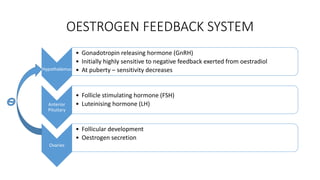
OESTROGEN FEEDBACK SYSTEM
Hypothalamus
• Gonadotropin releasing hormone (GnRH)
• Initially highly sensitive to negative feedback exerted from oestradiol
• At puberty – sensitivity decreases
Anterior
Pituitary
• Follicle stimulating hormone (FSH)
• Luteinising hormone (LH)
Ovaries
• Follicular development
• Oestrogen secretion
FACTORS ASSOCIATED WITH ONSET OF
PUBERTY
• Genetics
• Height and weight ratio (nutritional factors)
• Critical weight for menarche – 47.8kg
• Increased fat deposition from 17% to 23% for ovulation
• Therefore increased BMI = earlier menarche
• Maturation of the hypothalamus – sensitivity to oestrogen feedback
system
• Increased neurotransmitter output in CNS
• Onset of adrenal androgen activity
EFFECTS OF OESTROGEN
• Secondary sexual characteristics
• Thelarche
• Pubic/axillary hair growth to a small extent
• Skeletal growth  growth spurt
• Menarche:
• Midpuberty  oestrogen endometrial proliferation significant enough to result in the first
menstruation
• Genital organ changes:
• Vaginal length increases along with the size of the mons pubis, labia majora and minora
• Vaginal rugae become apparent, epithelium becomes thickened stratified squamous containing
glycogen
• Acidic environment
• Uterus and ovaries enlarge. Uterus:cervix ratio 2:1
• 2 million follicles present at birth are now closer to 300 000
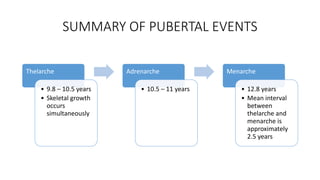
SUMMARY OF PUBERTAL EVENTS
Thelarche
• 9.8 – 10.5 years
• Skeletal growth
occurs
simultaneously
Adrenarche
• 10.5 – 11 years
Menarche
• 12.8 years
• Mean interval
between
thelarche and
menarche is
approximately
2.5 years
ABNORMAL PUBERTY
• Precocious puberty: Appearance of secondary sexual characteristics
before age 8 OR menarche before age 9
• Delayed puberty: Sexual characteristics don’t develop by the age of
14 OR no menstruation until age 16
ABNORMAL PUBERTY
Precocious puberty:
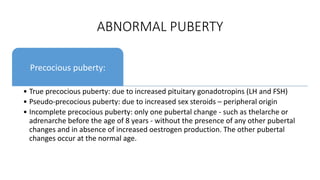
• True precocious puberty: due to increased pituitary gonadotropins (LH and FSH)
• Pseudo-precocious puberty: due to increased sex steroids – peripheral origin
• Incomplete precocious puberty: only one pubertal change - such as thelarche or
adrenarche before the age of 8 years - without the presence of any other pubertal
changes and in absence of increased oestrogen production. The other pubertal
changes occur at the normal age.
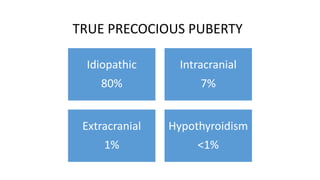
Idiopathic
80%
Intracranial
7%
Extracranial
1%
Hypothyroidism
<1%
TRUE PRECOCIOUS PUBERTY
• Constitutional – premature maturation of the hypothalamic-pituitary-
ovarian axis GnRH is secreted earlier which stimulates sex steroid
production  puberty occurs in the normal order but earlier
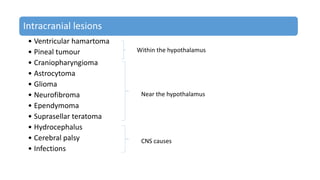
Intracranial lesions
• Ventricular hamartoma
• Pineal tumour
• Craniopharyngioma
• Astrocytoma
• Glioma
• Neurofibroma
• Ependymoma
• Suprasellar teratoma
• Hydrocephalus
• Cerebral palsy
• Infections
Within the hypothalamus
Near the hypothalamus
CNS causes
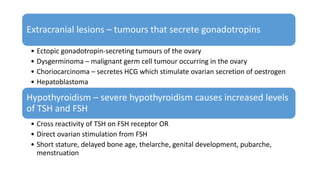
Extracranial lesions – tumours that secrete gonadotropins
• Ectopic gonadotropin-secreting tumours of the ovary
• Dysgerminoma – malignant germ cell tumour occurring in the ovary
• Choriocarcinoma – secretes HCG which stimulate ovarian secretion of oestrogen
• Hepatoblastoma
Hypothyroidism – severe hypothyroidism causes increased levels
of TSH and FSH
• Cross reactivity of TSH on FSH receptor OR
• Direct ovarian stimulation from FSH
• Short stature, delayed bone age, thelarche, genital development, pubarche,
menstruation
PSEUDO-PRECOCIOUS PUBERTY
Ovarian tumours
11%
McCune-Albright
syndrome
5%
Exogenous
oestrogen
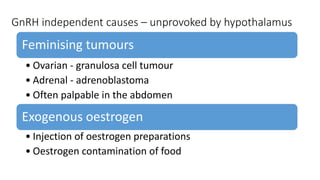
GnRH independent causes – unprovoked by hypothalamus
Feminising tumours
• Ovarian - granulosa cell tumour
• Adrenal - adrenoblastoma
• Often palpable in the abdomen
Exogenous oestrogen
• Injection of oestrogen preparations
• Oestrogen contamination of food
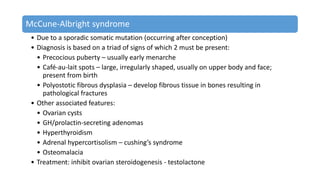
McCune-Albright syndrome
• Due to a sporadic somatic mutation (occurring after conception)
• Diagnosis is based on a triad of signs of which 2 must be present:
• Precocious puberty – usually early menarche
• Café-au-lait spots – large, irregularly shaped, usually on upper body and face;
present from birth
• Polyostotic fibrous dysplasia – develop fibrous tissue in bones resulting in
pathological fractures
• Other associated features:
• Ovarian cysts
• GH/prolactin-secreting adenomas
• Hyperthyroidism
• Adrenal hypercortisolism – cushing’s syndrome
• Osteomalacia
• Treatment: inhibit ovarian steroidogenesis - testolactone
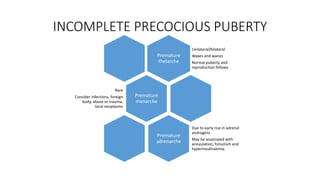
INCOMPLETE PRECOCIOUS PUBERTY
Premature
thelarche
Unilateral/bilateral
Waxes and wanes
Normal puberty and
reproduction follows
Premature
menarche
Rare
Consider infections, foreign
body, abuse or trauma,
local neoplasms
Premature
adrenarche
Due to early rise in adrenal
androgens
May be associated with
anovulation, hirsutism and
hyperinsulinaemia.
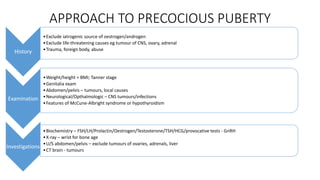
APPROACH TO PRECOCIOUS PUBERTY
History
•Exclude iatrogenic source of oestrogen/androgen
•Exclude life-threatening causes eg tumour of CNS, ovary, adrenal
•Trauma, foreign body, abuse
Examination
•Weight/height = BMI; Tanner stage
•Genitalia exam
•Abdomen/pelvis – tumours, local causes
•Neurological/Opthalmologic – CNS tumours/infections
•Features of McCune-Albright syndrome or hypothyroidism
Investigations
•Biochemistry – FSH/LH/Prolactin/Oestrogen/Testosterone/TSH/HCG/provocative tests - GnRH
•X-ray – wrist for bone age
•U/S abdomen/pelvis – exclude tumours of ovaries, adrenals, liver
•CT brain - tumours
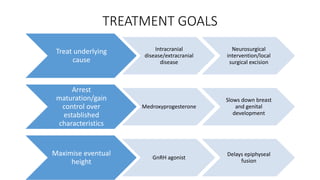
TREATMENT GOALS
Treat underlying
cause
Intracranial
disease/extracranial
disease
Neurosurgical
intervention/local
surgical excision
Arrest
maturation/gain
control over
established
characteristics
Medroxyprogesterone
Slows down breast
and genital
development
Maximise eventual
height
GnRH agonist
Delays epiphyseal
fusion
PSYCHOSOCIAL ASPECTS
• Counselling parents and child in order to avoid abuse
• Reduce emotional problems
• Provide contraception if necessary
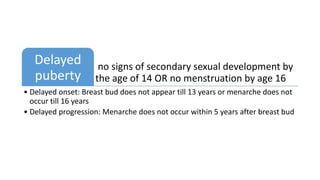
no signs of secondary sexual development by
the age of 14 OR no menstruation by age 16
Delayed
puberty
• Delayed onset: Breast bud does not appear till 13 years or menarche does not
occur till 16 years
• Delayed progression: Menarche does not occur within 5 years after breast bud
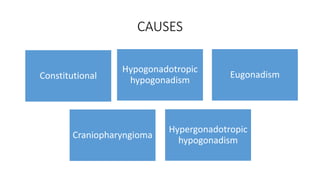
CAUSES
Hypergonadotropic
hypogonadism
Hypogonadotropic
hypogonadism
Eugonadism
Craniopharyngioma
Constitutional
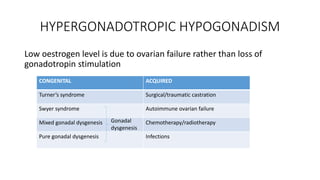
HYPERGONADOTROPIC HYPOGONADISM
Low oestrogen level is due to ovarian failure rather than loss of
gonadotropin stimulation
CONGENITAL ACQUIRED
Turner’s syndrome Surgical/traumatic castration
Swyer syndrome Autoimmune ovarian failure
Mixed gonadal dysgenesis Chemotherapy/radiotherapy
Pure gonadal dysgenesis Infections
Gonadal
dysgenesis
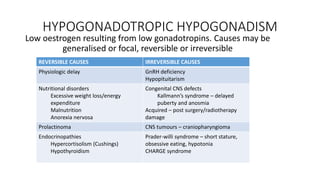
HYPOGONADOTROPIC HYPOGONADISM
Low oestrogen resulting from low gonadotropins. Causes may be
generalised or focal, reversible or irreversible
REVERSIBLE CAUSES IRREVERSIBLE CAUSES
Physiologic delay GnRH deficiency
Hypopituitarism
Nutritional disorders
Excessive weight loss/energy
expenditure
Malnutrition
Anorexia nervosa
Congenital CNS defects
Kallmann’s syndrome – delayed
puberty and anosmia
Acquired – post surgery/radiotherapy
damage
Prolactinoma CNS tumours – craniopharyngioma
Endocrinopathies
Hypercortisolism (Cushings)
Hypothyroidism
Prader-willi syndrome – short stature,
obsessive eating, hypotonia
CHARGE syndrome
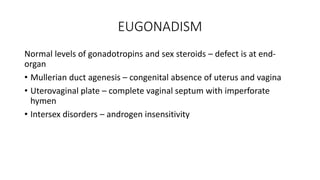
EUGONADISM
Normal levels of gonadotropins and sex steroids – defect is at end-
organ
• Mullerian duct agenesis – congenital absence of uterus and vagina
• Uterovaginal plate – complete vaginal septum with imperforate
hymen
• Intersex disorders – androgen insensitivity
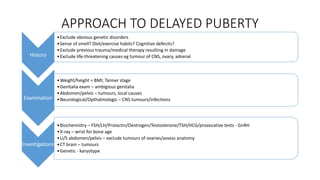
APPROACH TO DELAYED PUBERTY
History
•Exclude obvious genetic disorders
•Sense of smell? Diet/exercise habits? Cognitive defecits?
•Exclude previous trauma/medical therapy resulting in damage
•Exclude life-threatening causes eg tumour of CNS, ovary, adrenal
Examination
•Weight/height = BMI; Tanner stage
•Genitalia exam – ambigious genitalia
•Abdomen/pelvis – tumours, local causes
•Neurological/Opthalmologic – CNS tumours/infections
Investigations
•Biochemistry – FSH/LH/Prolactin/Oestrogen/Testosterone/TSH/HCG/provocative tests - GnRH
•X-ray – wrist for bone age
•U/S abdomen/pelvis – exclude tumours of ovaries/assess anatomy
•CT brain – tumours
•Genetic - karyotype
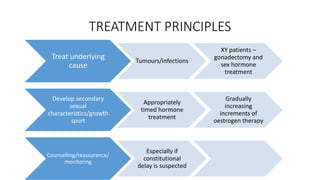
TREATMENT PRINCIPLES
Treat underlying
cause
Tumours/infections
XY patients –
gonadectomy and
sex hormone
treatment
Develop secondary
sexual
characteristics/growth
spurt
Appropriately
timed hormone
treatment
Gradually
increasing
increments of
oestrogen therapy
Counselling/reassurance/
monitoring
Especially if
constitutional
delay is suspected

Puberty - Normal and Abnormal

  • 1.
    PUBERTY – NORMALAND ABNORMAL
  • 2.
    OUTLINE • Definitions • Normalpuberty • At birth • Pubertal events • Abnormal puberty • Precocious puberty • Delayed puberty
  • 3.
    DEFINITIONS • ADOLESCENCE -the period of life during which a child becomes an adult i.e. the physical , sexual and psychological development are complete. • PUBERTY - a physiological phase lasting 2 to 5 years, during which the genital organs mature. It represents the first stage of adolescence • THELARCHE – breast growth • ADRENARCHE/PUBARCHE – increased activity of the suprarenal cortex at puberty with increased production ofadrenal androgens resulting in pubic hair (and axillary hair) growth • MENARCHE– onset of menstruation
  • 4.
    OESTROGEN FEEDBACK SYSTEM Hypothalamus •Gonadotropin releasing hormone (GnRH) • Initially highly sensitive to negative feedback exerted from oestradiol • At puberty – sensitivity decreases Anterior Pituitary • Follicle stimulating hormone (FSH) • Luteinising hormone (LH) Ovaries • Follicular development • Oestrogen secretion
  • 5.
    FACTORS ASSOCIATED WITHONSET OF PUBERTY • Genetics • Height and weight ratio (nutritional factors) • Critical weight for menarche – 47.8kg • Increased fat deposition from 17% to 23% for ovulation • Therefore increased BMI = earlier menarche • Maturation of the hypothalamus – sensitivity to oestrogen feedback system • Increased neurotransmitter output in CNS • Onset of adrenal androgen activity
  • 6.
    EFFECTS OF OESTROGEN •Secondary sexual characteristics • Thelarche • Pubic/axillary hair growth to a small extent • Skeletal growth  growth spurt • Menarche: • Midpuberty  oestrogen endometrial proliferation significant enough to result in the first menstruation • Genital organ changes: • Vaginal length increases along with the size of the mons pubis, labia majora and minora • Vaginal rugae become apparent, epithelium becomes thickened stratified squamous containing glycogen • Acidic environment • Uterus and ovaries enlarge. Uterus:cervix ratio 2:1 • 2 million follicles present at birth are now closer to 300 000
  • 7.
    SUMMARY OF PUBERTALEVENTS Thelarche • 9.8 – 10.5 years • Skeletal growth occurs simultaneously Adrenarche • 10.5 – 11 years Menarche • 12.8 years • Mean interval between thelarche and menarche is approximately 2.5 years
  • 8.
    ABNORMAL PUBERTY • Precociouspuberty: Appearance of secondary sexual characteristics before age 8 OR menarche before age 9 • Delayed puberty: Sexual characteristics don’t develop by the age of 14 OR no menstruation until age 16
  • 9.
    ABNORMAL PUBERTY Precocious puberty: •True precocious puberty: due to increased pituitary gonadotropins (LH and FSH) • Pseudo-precocious puberty: due to increased sex steroids – peripheral origin • Incomplete precocious puberty: only one pubertal change - such as thelarche or adrenarche before the age of 8 years - without the presence of any other pubertal changes and in absence of increased oestrogen production. The other pubertal changes occur at the normal age.
  • 10.
  • 11.
    • Constitutional –premature maturation of the hypothalamic-pituitary- ovarian axis GnRH is secreted earlier which stimulates sex steroid production  puberty occurs in the normal order but earlier
  • 12.
    Intracranial lesions • Ventricularhamartoma • Pineal tumour • Craniopharyngioma • Astrocytoma • Glioma • Neurofibroma • Ependymoma • Suprasellar teratoma • Hydrocephalus • Cerebral palsy • Infections Within the hypothalamus Near the hypothalamus CNS causes
  • 13.
    Extracranial lesions –tumours that secrete gonadotropins • Ectopic gonadotropin-secreting tumours of the ovary • Dysgerminoma – malignant germ cell tumour occurring in the ovary • Choriocarcinoma – secretes HCG which stimulate ovarian secretion of oestrogen • Hepatoblastoma Hypothyroidism – severe hypothyroidism causes increased levels of TSH and FSH • Cross reactivity of TSH on FSH receptor OR • Direct ovarian stimulation from FSH • Short stature, delayed bone age, thelarche, genital development, pubarche, menstruation
  • 14.
  • 15.
    GnRH independent causes– unprovoked by hypothalamus Feminising tumours • Ovarian - granulosa cell tumour • Adrenal - adrenoblastoma • Often palpable in the abdomen Exogenous oestrogen • Injection of oestrogen preparations • Oestrogen contamination of food
  • 16.
    McCune-Albright syndrome • Dueto a sporadic somatic mutation (occurring after conception) • Diagnosis is based on a triad of signs of which 2 must be present: • Precocious puberty – usually early menarche • Café-au-lait spots – large, irregularly shaped, usually on upper body and face; present from birth • Polyostotic fibrous dysplasia – develop fibrous tissue in bones resulting in pathological fractures • Other associated features: • Ovarian cysts • GH/prolactin-secreting adenomas • Hyperthyroidism • Adrenal hypercortisolism – cushing’s syndrome • Osteomalacia • Treatment: inhibit ovarian steroidogenesis - testolactone
  • 17.
    INCOMPLETE PRECOCIOUS PUBERTY Premature thelarche Unilateral/bilateral Waxesand wanes Normal puberty and reproduction follows Premature menarche Rare Consider infections, foreign body, abuse or trauma, local neoplasms Premature adrenarche Due to early rise in adrenal androgens May be associated with anovulation, hirsutism and hyperinsulinaemia.
  • 18.
    APPROACH TO PRECOCIOUSPUBERTY History •Exclude iatrogenic source of oestrogen/androgen •Exclude life-threatening causes eg tumour of CNS, ovary, adrenal •Trauma, foreign body, abuse Examination •Weight/height = BMI; Tanner stage •Genitalia exam •Abdomen/pelvis – tumours, local causes •Neurological/Opthalmologic – CNS tumours/infections •Features of McCune-Albright syndrome or hypothyroidism Investigations •Biochemistry – FSH/LH/Prolactin/Oestrogen/Testosterone/TSH/HCG/provocative tests - GnRH •X-ray – wrist for bone age •U/S abdomen/pelvis – exclude tumours of ovaries, adrenals, liver •CT brain - tumours
  • 19.
    TREATMENT GOALS Treat underlying cause Intracranial disease/extracranial disease Neurosurgical intervention/local surgicalexcision Arrest maturation/gain control over established characteristics Medroxyprogesterone Slows down breast and genital development Maximise eventual height GnRH agonist Delays epiphyseal fusion
  • 20.
    PSYCHOSOCIAL ASPECTS • Counsellingparents and child in order to avoid abuse • Reduce emotional problems • Provide contraception if necessary
  • 21.
    no signs ofsecondary sexual development by the age of 14 OR no menstruation by age 16 Delayed puberty • Delayed onset: Breast bud does not appear till 13 years or menarche does not occur till 16 years • Delayed progression: Menarche does not occur within 5 years after breast bud
  • 22.
  • 23.
    HYPERGONADOTROPIC HYPOGONADISM Low oestrogenlevel is due to ovarian failure rather than loss of gonadotropin stimulation CONGENITAL ACQUIRED Turner’s syndrome Surgical/traumatic castration Swyer syndrome Autoimmune ovarian failure Mixed gonadal dysgenesis Chemotherapy/radiotherapy Pure gonadal dysgenesis Infections Gonadal dysgenesis
  • 24.
    HYPOGONADOTROPIC HYPOGONADISM Low oestrogenresulting from low gonadotropins. Causes may be generalised or focal, reversible or irreversible REVERSIBLE CAUSES IRREVERSIBLE CAUSES Physiologic delay GnRH deficiency Hypopituitarism Nutritional disorders Excessive weight loss/energy expenditure Malnutrition Anorexia nervosa Congenital CNS defects Kallmann’s syndrome – delayed puberty and anosmia Acquired – post surgery/radiotherapy damage Prolactinoma CNS tumours – craniopharyngioma Endocrinopathies Hypercortisolism (Cushings) Hypothyroidism Prader-willi syndrome – short stature, obsessive eating, hypotonia CHARGE syndrome
  • 25.
    EUGONADISM Normal levels ofgonadotropins and sex steroids – defect is at end- organ • Mullerian duct agenesis – congenital absence of uterus and vagina • Uterovaginal plate – complete vaginal septum with imperforate hymen • Intersex disorders – androgen insensitivity
  • 26.
    APPROACH TO DELAYEDPUBERTY History •Exclude obvious genetic disorders •Sense of smell? Diet/exercise habits? Cognitive defecits? •Exclude previous trauma/medical therapy resulting in damage •Exclude life-threatening causes eg tumour of CNS, ovary, adrenal Examination •Weight/height = BMI; Tanner stage •Genitalia exam – ambigious genitalia •Abdomen/pelvis – tumours, local causes •Neurological/Opthalmologic – CNS tumours/infections Investigations •Biochemistry – FSH/LH/Prolactin/Oestrogen/Testosterone/TSH/HCG/provocative tests - GnRH •X-ray – wrist for bone age •U/S abdomen/pelvis – exclude tumours of ovaries/assess anatomy •CT brain – tumours •Genetic - karyotype
  • 27.
    TREATMENT PRINCIPLES Treat underlying cause Tumours/infections XYpatients – gonadectomy and sex hormone treatment Develop secondary sexual characteristics/growth spurt Appropriately timed hormone treatment Gradually increasing increments of oestrogen therapy Counselling/reassurance/ monitoring Especially if constitutional delay is suspected

Editor's Notes

  • #5 At birth oestradiol suppresses hypothalamus from secreting GnRH At puberty, there is decreased sensitivity to negative oestrogen feedback  GnRH secretion to upregulate oestrogen and progesterone secretion