1
BY
DR.AKINBI OLUBAYODE.O
AMENORRHOEA
INTRODUCTION
2
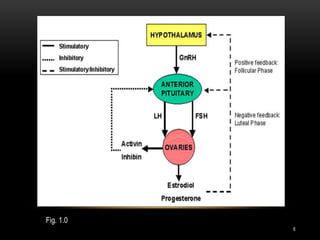
• Proper function of the Hypothalamic-Pituitary ovarian
system is required for normal menstruation.(GnRH-
LH/FSH-EST./PROG).
• Regular and predictable menstrual cycles occur if the
ovarian hormones estradiol and progesterone are
secreted in an orderly fashion in response to stimulation
by the hypothalamus and pituitary.
• The occurrence of menstruation also requires healthy and
intact outflow tract
• AMENORRHOEA occurs if the above are not met
DEFINATION
3
• Amenorrhoea, derived from the Greek words men (month) and rein
(to flow), denotes the absence or suppression of menstruation.
• Amenorrhoea is a symptom, not a disease, and it has a variety of
causes.
• Traditionally, amenorrhoea is classified as primary or secondary.
• PRIMARY AMENORRHOEA is defined as the absence of
menstruation by the age of 14 years in the absence of 20 sexual
characteristics, or the absence of menstruation by 16 years.
• The median age of menarche is 10-15 years and weight 51.1kg.
DEFINATION CTD
4
• SECONDARY AMENORRHOEA is defined as secondary when
no menses have occurred for 6 months in a woman who
previously had normal menstrual function, or for 12 months if her
cycles were irregular.
• OTHER TERMS:
1. OLIGOMENORRHOEA (INT.>35DAYS
2. HYPOMENORRHOEA (SCANTY VOLUME& SHORT
DURATION OF FLOW
3. POLYMENORRHOEA (INT.<21DAYS)
4. HYPERMENORRHOEA (PROLONGD FOR >10DYS)
PATHOPHYSIOLOGY
5
• The menstrual cycle is an orderly progression of coordinated
hormonal events in the female body that stimulates growth of a
follicle to release an egg and prepare a site for implantation if
fertilization should occur. Menstruation occurs when an egg
released by the ovary remains unfertilized.
• The menstrual cycle can be divided into 3 physiologic phases:
follicular, ovulatory, and luteal. Each phase has a distinct
hormonal secretory milieu. Consideration of the target organs of
these reproductive hormones (hypothalamus, pituitary, ovary,
uterus) is helpful for identifying the disease process responsible
for a patient’s amenorrhea.
6
Fig. 1.0
ETIOLOGY
7
1. PHYSIOLOGICAL AMENORRHOEA: Puberty (in young girls),
Pregnancy(in women of reproductive age groups), Post menopause (in
elderly women)
2. HYPOTHALAMIC DISORDER
• Eating disorder (a minimum of 17% body fat is required for the onset
of menarche and 22% body fat for maintenance or resumption of
normal menstrual function
• Exercise induced amenorrhea (6% to 18% of women who are
recreational runners)
• Medication
• Stress
• Chronic illness
• Kallmanns syndrome
8
3. PITUITARY DISORDER
• Hyperprolactinaemia (10–40% of women with
hyperprolactinaemia present to their physician with
amenorrhea).
• Prolactinoma
• Isolated gonadotrophin deficiency
• Craniopharyngioma (They are epithelial tumors arising from
the craniopharyngeal duct in the sellar or parasellar region).
9
4. THYROID DISORDER
• Hypothyroidism
• Hyperthyroidism
5. ADRENAL DISORDER
• Congenital adrenal hyperplasia
• Cushing syndrome
6. VAGINAL ANOMALY
• Imperforate hymen
• Transverse vaginal septum
• Vaginal agenesis
10
7. UTERINE ANOMALY
• Androgen insensitivity
• Mullerian agenesis (The syndrome, often referred to as
Mayer– Rokitansky–Kuster–Hauser syndrome, is the
second most common cause of primary amenorrhea).
• Uterine adhesion (Asherman syndrome is the presence
of intrauterine synechiae or scarring preventing normal
growth of endometrium, typically from a previous infection,
endometrium curettage or endometritis).
• Cervical agenesis
11
8. OVARIAN DISORDER
• Gonadal dysgenesis (Turner's syndrome 45XO)
• Ovarian insufficiency or premature ovarian failure
(Onset of menopause before 40 years).
• Chemotherapy or radiation injury
• Ovarian insensitivity syndrome (Savage's
syndrome)
• Polycystic ovarian syndrome
12
Polycystic ovarian syndrome
PCOS is a syndrome of ovarian dysfunction along with the cardinal
features of hyperandrogenism and polycystic ovary morphology
Its clinical manifestation include menstrual irregularities,signs of
androgen excess and obesity
• They are oligo-ovulatory or anovulatory and have oligomenorrhea
or amenorrhea.
• In typical cases, the ovaries are enlarged, with white, thickened
capsules beneath which are multiple cystic follicles in various
developmental stages.
• High incidence of related Hyperprolactinemia.
• Serum LH levels are chronically elevated:LH;FSH INCREASES
TO 2:OR 3:1
• The constant, tonic LH stimulation of the ovaries results in
abnormal follicular stimulation—hence the polycystic appearance
CLINICAL EVALUATION OF THE AMENORRHOEIC
PATIENT
13
• HISTORY TAKING
• PHYSICAL EXAMINATION
• INVESTIGATIONS
• TREATMENT
HISTORY
14
• Pregnancy is the most common cause of amenorrhea.
• Ask about sexual activity
• Use of contraceptive methods
• Difficulty with dates; menstrual calendar X 3 months.
• Absence of breast development or pubertal growth 14 years is
abnormal.& requires investigation.
• Breast development, pubertal growth spurt, and adrenarche are
delayed or absent in persons with hypothalamic pituitary failure.
15
• Normal growth and pubertal development plus
primary amenorrhea may suggests:
• Imperforate Hymen(cyclical abd.pain+heamatocolpos)
• Rokitansky Syndrome(lap.shows rudimentary uterus)
• Test.Feminisation syndrome(blind end vaginal, absent
uterus, XY KARYOTYPE
History of evacuation, post abortal infection, post partum
endometritis, major myomectomy, endometrial
procedures may suggest Asherman
OVARIAN DISORDER
16
• Symptoms of vaginal dryness, hot flashes,
night sweats, or disordered sleep may be a
sign of ovarian insufficiency or premature
ovarian failure.
• History of chemotherapy or radiation
• Hormonal contraceptives use in recent times
• Recent surgery .e.g TATH+BSO
• Sometimes no clear cut symptom or sign
HYPOTHALAMIC DISORDER
17
• Intracranial tumor; galactorrhea, headaches,
or ↓↓peripheral vision
• Impaired sense of smell +primary
amenorrhea& failure of normal pubertal
development = Kallmann syndrome
• Dieting with excessive restriction of energy
intake, especially fat restriction, may lead to
loss of menstrual regularity and associated
bone loss.
18
• Strenuous exercise related to a wide variety of athletic
activities can be associated with the development of
amenorrhea.
• Abuse of drugs such as cocaine and opioids have
central effects that may disrupt the menstrual cycle.
• Anorexia nervosa;intense fear of fatness and a body
image that is heavier than observed.
EXAMINATION
19
• GENERAL EXAMINATION.
• SECONDARY SEXUAL CHARACTERISTICS.
• EXAMINATION OF THE EYE-VISUAL FIELD.
• ABDOMINAL EXAMINATION.
• PELVIC EXAMINATION
INVESTIGATION
20
• Pregnancy test.
• Ultrasound, CT, MRI.
• Hormonal assay- LH, FSH, prolactin and androgens
• Thyroid function tests.
• Karyotype.
• Autoimmune screen
TREATMENT
21
• Depends on the cause of amenorrhoea.
• The most common cause of primary amenorrhoea is
constitutional delay.
• MEDICAL.
• SURGICAL
22
MEDICAL THERAPY:
• Dopamine agonists e.g Bromocriptine for treatment
of Hyper.PRL(build the dose up to 2.5mg tds)
• Hormone replacement therapy; In cases of Estrogen
deficiency(estrogen + 10-14 days of
medroxyprogesterone)
• Ovulation Induction in those desiring pregnancy:
clomiphene, FSH/LH combination, GnRH analogue.
• Treatment of Hyperandrogenism(5α-reductase
inhibitors e.g spironolactone, cyproterone acetate,
Finasteride)
• cocp+depo provera :rx of hirsuitism
23
• SURGICAL THERAPIES:
• GONADECTOMY; XY DYSGENESIS
• TUMOR EXCISION FOR LARGE ADENOMAS
• RECONSTRUCTIVE SX:VAGINOPLASTY, PROGRESSIVE VAGINAL.
DILATATION
• ADHESIOLYSIS(HYSTEROSCOPY, MANUAL SHARP
DISSECTION)+FOLEYS CATHETER OR LIPPES LOOP
• OVARIAN DIATHERMY:4-POINT DIATHERMY AT 40W FOR 4SEC.
• IVF : FOR TURNERS&OTHER GONADAL DYSGENETIC CASES
• ELECTROLYSIS RX.FOR HIRSUITISM
• WEIGHT REDUCTION ORAL CONTRACEPTIVES,OVULATION
INDUCTION FOR PCOS
24
THANK YOU

Amenorrhoea

  • 1.
  • 2.
    INTRODUCTION 2 • Proper functionof the Hypothalamic-Pituitary ovarian system is required for normal menstruation.(GnRH- LH/FSH-EST./PROG). • Regular and predictable menstrual cycles occur if the ovarian hormones estradiol and progesterone are secreted in an orderly fashion in response to stimulation by the hypothalamus and pituitary. • The occurrence of menstruation also requires healthy and intact outflow tract • AMENORRHOEA occurs if the above are not met
  • 3.
    DEFINATION 3 • Amenorrhoea, derivedfrom the Greek words men (month) and rein (to flow), denotes the absence or suppression of menstruation. • Amenorrhoea is a symptom, not a disease, and it has a variety of causes. • Traditionally, amenorrhoea is classified as primary or secondary. • PRIMARY AMENORRHOEA is defined as the absence of menstruation by the age of 14 years in the absence of 20 sexual characteristics, or the absence of menstruation by 16 years. • The median age of menarche is 10-15 years and weight 51.1kg.
  • 4.
    DEFINATION CTD 4 • SECONDARYAMENORRHOEA is defined as secondary when no menses have occurred for 6 months in a woman who previously had normal menstrual function, or for 12 months if her cycles were irregular. • OTHER TERMS: 1. OLIGOMENORRHOEA (INT.>35DAYS 2. HYPOMENORRHOEA (SCANTY VOLUME& SHORT DURATION OF FLOW 3. POLYMENORRHOEA (INT.<21DAYS) 4. HYPERMENORRHOEA (PROLONGD FOR >10DYS)
  • 5.
    PATHOPHYSIOLOGY 5 • The menstrualcycle is an orderly progression of coordinated hormonal events in the female body that stimulates growth of a follicle to release an egg and prepare a site for implantation if fertilization should occur. Menstruation occurs when an egg released by the ovary remains unfertilized. • The menstrual cycle can be divided into 3 physiologic phases: follicular, ovulatory, and luteal. Each phase has a distinct hormonal secretory milieu. Consideration of the target organs of these reproductive hormones (hypothalamus, pituitary, ovary, uterus) is helpful for identifying the disease process responsible for a patient’s amenorrhea.
  • 6.
  • 7.
    ETIOLOGY 7 1. PHYSIOLOGICAL AMENORRHOEA:Puberty (in young girls), Pregnancy(in women of reproductive age groups), Post menopause (in elderly women) 2. HYPOTHALAMIC DISORDER • Eating disorder (a minimum of 17% body fat is required for the onset of menarche and 22% body fat for maintenance or resumption of normal menstrual function • Exercise induced amenorrhea (6% to 18% of women who are recreational runners) • Medication • Stress • Chronic illness • Kallmanns syndrome
  • 8.
    8 3. PITUITARY DISORDER •Hyperprolactinaemia (10–40% of women with hyperprolactinaemia present to their physician with amenorrhea). • Prolactinoma • Isolated gonadotrophin deficiency • Craniopharyngioma (They are epithelial tumors arising from the craniopharyngeal duct in the sellar or parasellar region).
  • 9.
    9 4. THYROID DISORDER •Hypothyroidism • Hyperthyroidism 5. ADRENAL DISORDER • Congenital adrenal hyperplasia • Cushing syndrome 6. VAGINAL ANOMALY • Imperforate hymen • Transverse vaginal septum • Vaginal agenesis
  • 10.
    10 7. UTERINE ANOMALY •Androgen insensitivity • Mullerian agenesis (The syndrome, often referred to as Mayer– Rokitansky–Kuster–Hauser syndrome, is the second most common cause of primary amenorrhea). • Uterine adhesion (Asherman syndrome is the presence of intrauterine synechiae or scarring preventing normal growth of endometrium, typically from a previous infection, endometrium curettage or endometritis). • Cervical agenesis
  • 11.
    11 8. OVARIAN DISORDER •Gonadal dysgenesis (Turner's syndrome 45XO) • Ovarian insufficiency or premature ovarian failure (Onset of menopause before 40 years). • Chemotherapy or radiation injury • Ovarian insensitivity syndrome (Savage's syndrome) • Polycystic ovarian syndrome
  • 12.
    12 Polycystic ovarian syndrome PCOSis a syndrome of ovarian dysfunction along with the cardinal features of hyperandrogenism and polycystic ovary morphology Its clinical manifestation include menstrual irregularities,signs of androgen excess and obesity • They are oligo-ovulatory or anovulatory and have oligomenorrhea or amenorrhea. • In typical cases, the ovaries are enlarged, with white, thickened capsules beneath which are multiple cystic follicles in various developmental stages. • High incidence of related Hyperprolactinemia. • Serum LH levels are chronically elevated:LH;FSH INCREASES TO 2:OR 3:1 • The constant, tonic LH stimulation of the ovaries results in abnormal follicular stimulation—hence the polycystic appearance
  • 13.
    CLINICAL EVALUATION OFTHE AMENORRHOEIC PATIENT 13 • HISTORY TAKING • PHYSICAL EXAMINATION • INVESTIGATIONS • TREATMENT
  • 14.
    HISTORY 14 • Pregnancy isthe most common cause of amenorrhea. • Ask about sexual activity • Use of contraceptive methods • Difficulty with dates; menstrual calendar X 3 months. • Absence of breast development or pubertal growth 14 years is abnormal.& requires investigation. • Breast development, pubertal growth spurt, and adrenarche are delayed or absent in persons with hypothalamic pituitary failure.
  • 15.
    15 • Normal growthand pubertal development plus primary amenorrhea may suggests: • Imperforate Hymen(cyclical abd.pain+heamatocolpos) • Rokitansky Syndrome(lap.shows rudimentary uterus) • Test.Feminisation syndrome(blind end vaginal, absent uterus, XY KARYOTYPE History of evacuation, post abortal infection, post partum endometritis, major myomectomy, endometrial procedures may suggest Asherman
  • 16.
    OVARIAN DISORDER 16 • Symptomsof vaginal dryness, hot flashes, night sweats, or disordered sleep may be a sign of ovarian insufficiency or premature ovarian failure. • History of chemotherapy or radiation • Hormonal contraceptives use in recent times • Recent surgery .e.g TATH+BSO • Sometimes no clear cut symptom or sign
  • 17.
    HYPOTHALAMIC DISORDER 17 • Intracranialtumor; galactorrhea, headaches, or ↓↓peripheral vision • Impaired sense of smell +primary amenorrhea& failure of normal pubertal development = Kallmann syndrome • Dieting with excessive restriction of energy intake, especially fat restriction, may lead to loss of menstrual regularity and associated bone loss.
  • 18.
    18 • Strenuous exerciserelated to a wide variety of athletic activities can be associated with the development of amenorrhea. • Abuse of drugs such as cocaine and opioids have central effects that may disrupt the menstrual cycle. • Anorexia nervosa;intense fear of fatness and a body image that is heavier than observed.
  • 19.
    EXAMINATION 19 • GENERAL EXAMINATION. •SECONDARY SEXUAL CHARACTERISTICS. • EXAMINATION OF THE EYE-VISUAL FIELD. • ABDOMINAL EXAMINATION. • PELVIC EXAMINATION
  • 20.
    INVESTIGATION 20 • Pregnancy test. •Ultrasound, CT, MRI. • Hormonal assay- LH, FSH, prolactin and androgens • Thyroid function tests. • Karyotype. • Autoimmune screen
  • 21.
    TREATMENT 21 • Depends onthe cause of amenorrhoea. • The most common cause of primary amenorrhoea is constitutional delay. • MEDICAL. • SURGICAL
  • 22.
    22 MEDICAL THERAPY: • Dopamineagonists e.g Bromocriptine for treatment of Hyper.PRL(build the dose up to 2.5mg tds) • Hormone replacement therapy; In cases of Estrogen deficiency(estrogen + 10-14 days of medroxyprogesterone) • Ovulation Induction in those desiring pregnancy: clomiphene, FSH/LH combination, GnRH analogue. • Treatment of Hyperandrogenism(5α-reductase inhibitors e.g spironolactone, cyproterone acetate, Finasteride) • cocp+depo provera :rx of hirsuitism
  • 23.
    23 • SURGICAL THERAPIES: •GONADECTOMY; XY DYSGENESIS • TUMOR EXCISION FOR LARGE ADENOMAS • RECONSTRUCTIVE SX:VAGINOPLASTY, PROGRESSIVE VAGINAL. DILATATION • ADHESIOLYSIS(HYSTEROSCOPY, MANUAL SHARP DISSECTION)+FOLEYS CATHETER OR LIPPES LOOP • OVARIAN DIATHERMY:4-POINT DIATHERMY AT 40W FOR 4SEC. • IVF : FOR TURNERS&OTHER GONADAL DYSGENETIC CASES • ELECTROLYSIS RX.FOR HIRSUITISM • WEIGHT REDUCTION ORAL CONTRACEPTIVES,OVULATION INDUCTION FOR PCOS
  • 24.