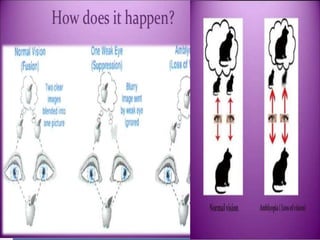
AMBLYOPIA
SHRADHA
83
Definition
Amblyopia, by definition, refers to a partial
loss of vision in one or both eyes, in the absence of
any organic disease of ocular media, retina and
visual pathway.
produced by certain amblyogeneic factors operating during
the critical period of visual development (birth to 6 years of
age).
Pathogenesis
Amblyogenic factors include :
 Visual (form sense) deprivation as occurs in
anisometropia,
 Light deprivation e.g., due to congenital cataract,and
 Abnormal binocular interaction e.g., in strabismus.
Types
Depending upon the cause, amblyopia is of following types:
1. Strabismic amblyopia results from prolonged uniocular
suppression in children with unilateral constant squint
who fixate with normal eye
2.Stimulus deprivation amblyopia (old term: amblyopia ex
anopsia) develops when one eye is totally excluded from seeing
early in life as, in congenital or traumatic cataract, complete
ptosis and dense central corneal opacity.
3.Anisometropic amblyopia occurs in an eye having higher
degree of refractive error than the fellow eye. It is more
common in anisohypermetropic than the anisomyopic children.
4. Isoametropic amblyopia is bilateral amblyopia
occurring in children with bilateral uncorrected
high refractive error.
5. Meridional amblyopia occurs in children with
uncorrected astigmatic refractive error. It is a
selective amblyopia for a specific visual meridian
Clinical characteristics
1. Visual acuity is reduced. Recognition acuity is more affected
than resolution acuity.
2. Effect of neutral density filter. Visual acuity when tested
thsrough neutral density filter improves by one or two lines in
amblyopia and decreases in patients with organic lesions.
3. Crowding phenomenon is present in amblyopics i.e., visual
acuity is less when tested with multiple letter charts
(e.g.,Snellen’s chart) than when tested with single charts
(optotype).
4. Fixation pattern may be central or eccentric. Degree of
amblyopia in eccentric fixation is proportionate to the distance
of the eccentric point from the fovea.
5. Colour vision is usually normal, may be affected
in deep amblyopia with vision below 6/36.
Treatment
started as early as possible (younger the child, better the prognosis).
Occlusion therapy i.e., occlusion of the sound eye, to force use of amblyopic eye
is the main stay in the treatment of amblyopia.
However, before the occlusion therapy is started, it should be ensured
that:
Opacity in the media (e.g., cataract), if any, should be removed first, and
Refractive error, if any, should be fully corrected.
Simplified schedule for occlusion therapy depending up on the age is as below:
Upto 2 years, the occlusion should be done in 2:1, i.e., 2 days in sound eye and
one day in amblyopic eye.
At the age of 3 years, 3:1,
At the age of 4 years, 4:1,
At the age of 5 years, 5:1, and
After the age of 6 years, 6:1
Duration of occlusion should be until the visual acuity develops fully, or there is
no further improvement of vision for 3 months.

Amblyopia

  • 1.
  • 2.
    Definition Amblyopia, by definition,refers to a partial loss of vision in one or both eyes, in the absence of any organic disease of ocular media, retina and visual pathway. produced by certain amblyogeneic factors operating during the critical period of visual development (birth to 6 years of age). Pathogenesis
  • 4.
    Amblyogenic factors include:  Visual (form sense) deprivation as occurs in anisometropia,  Light deprivation e.g., due to congenital cataract,and  Abnormal binocular interaction e.g., in strabismus. Types Depending upon the cause, amblyopia is of following types: 1. Strabismic amblyopia results from prolonged uniocular suppression in children with unilateral constant squint who fixate with normal eye
  • 5.
    2.Stimulus deprivation amblyopia(old term: amblyopia ex anopsia) develops when one eye is totally excluded from seeing early in life as, in congenital or traumatic cataract, complete ptosis and dense central corneal opacity. 3.Anisometropic amblyopia occurs in an eye having higher degree of refractive error than the fellow eye. It is more common in anisohypermetropic than the anisomyopic children. 4. Isoametropic amblyopia is bilateral amblyopia occurring in children with bilateral uncorrected high refractive error. 5. Meridional amblyopia occurs in children with uncorrected astigmatic refractive error. It is a selective amblyopia for a specific visual meridian
  • 6.
    Clinical characteristics 1. Visualacuity is reduced. Recognition acuity is more affected than resolution acuity. 2. Effect of neutral density filter. Visual acuity when tested thsrough neutral density filter improves by one or two lines in amblyopia and decreases in patients with organic lesions. 3. Crowding phenomenon is present in amblyopics i.e., visual acuity is less when tested with multiple letter charts (e.g.,Snellen’s chart) than when tested with single charts (optotype). 4. Fixation pattern may be central or eccentric. Degree of amblyopia in eccentric fixation is proportionate to the distance of the eccentric point from the fovea. 5. Colour vision is usually normal, may be affected in deep amblyopia with vision below 6/36.
  • 7.
    Treatment started as earlyas possible (younger the child, better the prognosis). Occlusion therapy i.e., occlusion of the sound eye, to force use of amblyopic eye is the main stay in the treatment of amblyopia. However, before the occlusion therapy is started, it should be ensured that: Opacity in the media (e.g., cataract), if any, should be removed first, and Refractive error, if any, should be fully corrected. Simplified schedule for occlusion therapy depending up on the age is as below: Upto 2 years, the occlusion should be done in 2:1, i.e., 2 days in sound eye and one day in amblyopic eye. At the age of 3 years, 3:1, At the age of 4 years, 4:1, At the age of 5 years, 5:1, and After the age of 6 years, 6:1 Duration of occlusion should be until the visual acuity develops fully, or there is no further improvement of vision for 3 months.