THE MAGLEV TECHNOLOGY
PRESENTED BY : AMAN CHAND
COLLEGE : GH RAISONI COLLEGE OF ENGINEERING AND
MANAGEMENT
PLACE : PUNE
COURSE : SE MECHANICAL ENGINEERING
About maglev trains
 Maglev = magnetic + levitation
 Maglev technology has used electromagnetic force to hold up the
entire train compartment.
 Electricity is the main source of energy.
 The train propels or move forward without any friction with moving
mechanical parts.
 The beauty of maglev is that it travels on air.
Basic principles of maglev trains
Maglev trains have to perform the following
functions to operate on high speeds
 LEVITATION
 PROPULSION
 LATERAL GUIDANCE
PRINCIPLE OF MAGNETIC
LEVITATION
 Strong magnets are attached to the train.
 Magnets with same polarity are used
Which repels and levitates the train.
 Has ferromagnetic stators on the
track and levitate the train.
 A computer changes the amount
of current to keep the train 1 cm to
10 from the track.
TYPES OF MAGLEV
TECHNOLOGY
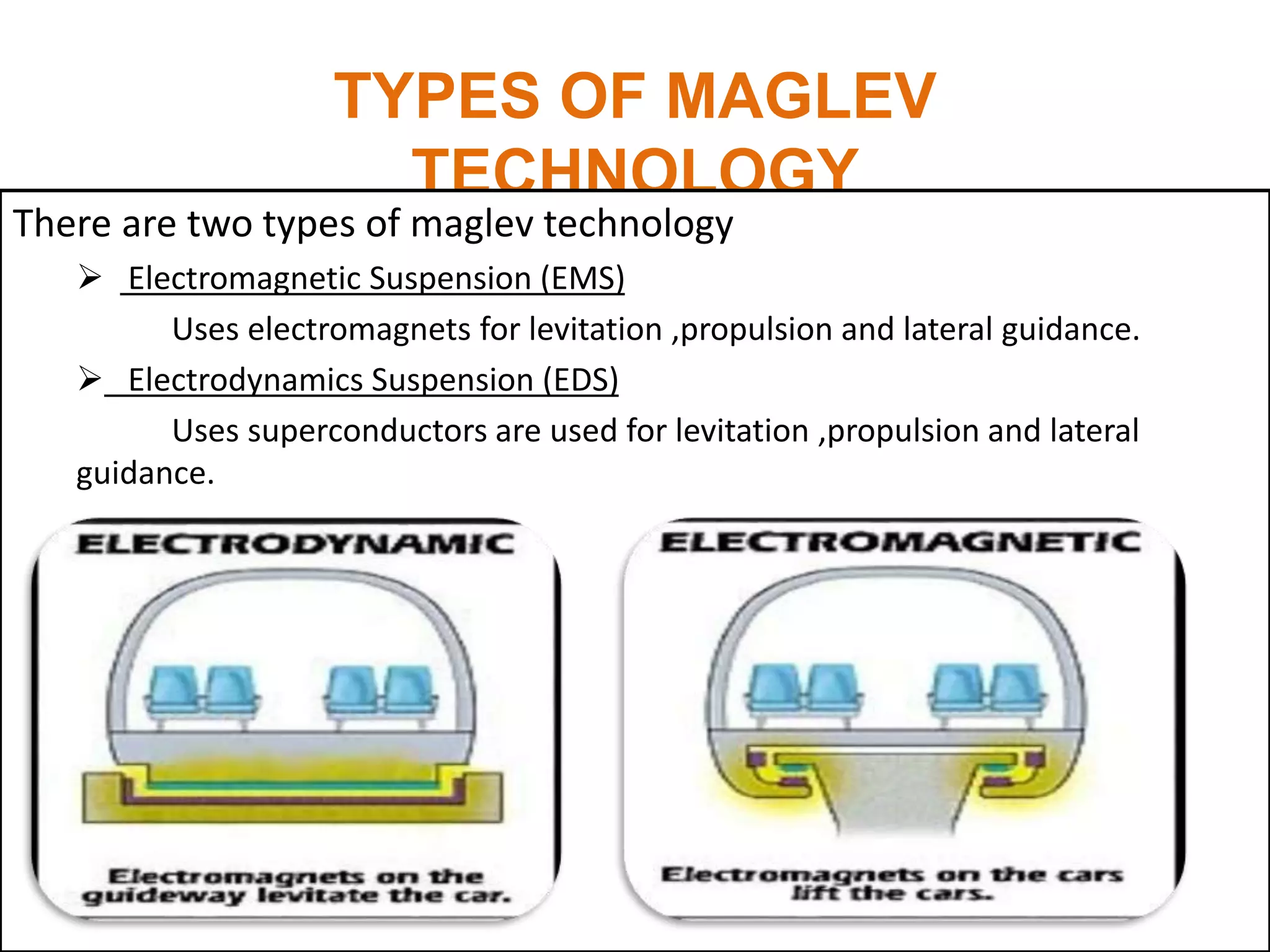
There are two types of maglev technology
 Electromagnetic Suspension (EMS)
Uses electromagnets for levitation ,propulsion and lateral guidance.
 Electrodynamics Suspension (EDS)
Uses superconductors are used for levitation ,propulsion and lateral
guidance.
PRINCIPLE OF PROPULSION
 Attractive forces between unlike magnetic poles pull each element
of the rotor toward the corresponding element of the stator.
 Just as the two poles are coming into alignment, the polarity of
the armature magnets is reversed, resulting in a repulsive force
that keeps the motor turning in the same direction.
 This is happened vice –versa and train attain the speed of – 450km/hr.
PRINCIPLE OF LATERAL GUIDANCE
 The levitation magnets and rail are both
U shaped, with rail being an inverted U.
 The mouths of U face one another.
 When one side of the train nears the side of the guide way, the super
conducting magnet on the train induces a repulsive force from the
levitation coils on the side closer to the train and an attractive force
from the coils on the farther side.
 This keeps the train in the center.
DRAWBACKS USING OF LIM
The main draw back of this type of maglev train is
its speed limit i.e. upto 500 km/hr Because of air
resistance and aerodynamic noise, greater speeds
are difficult to reach.
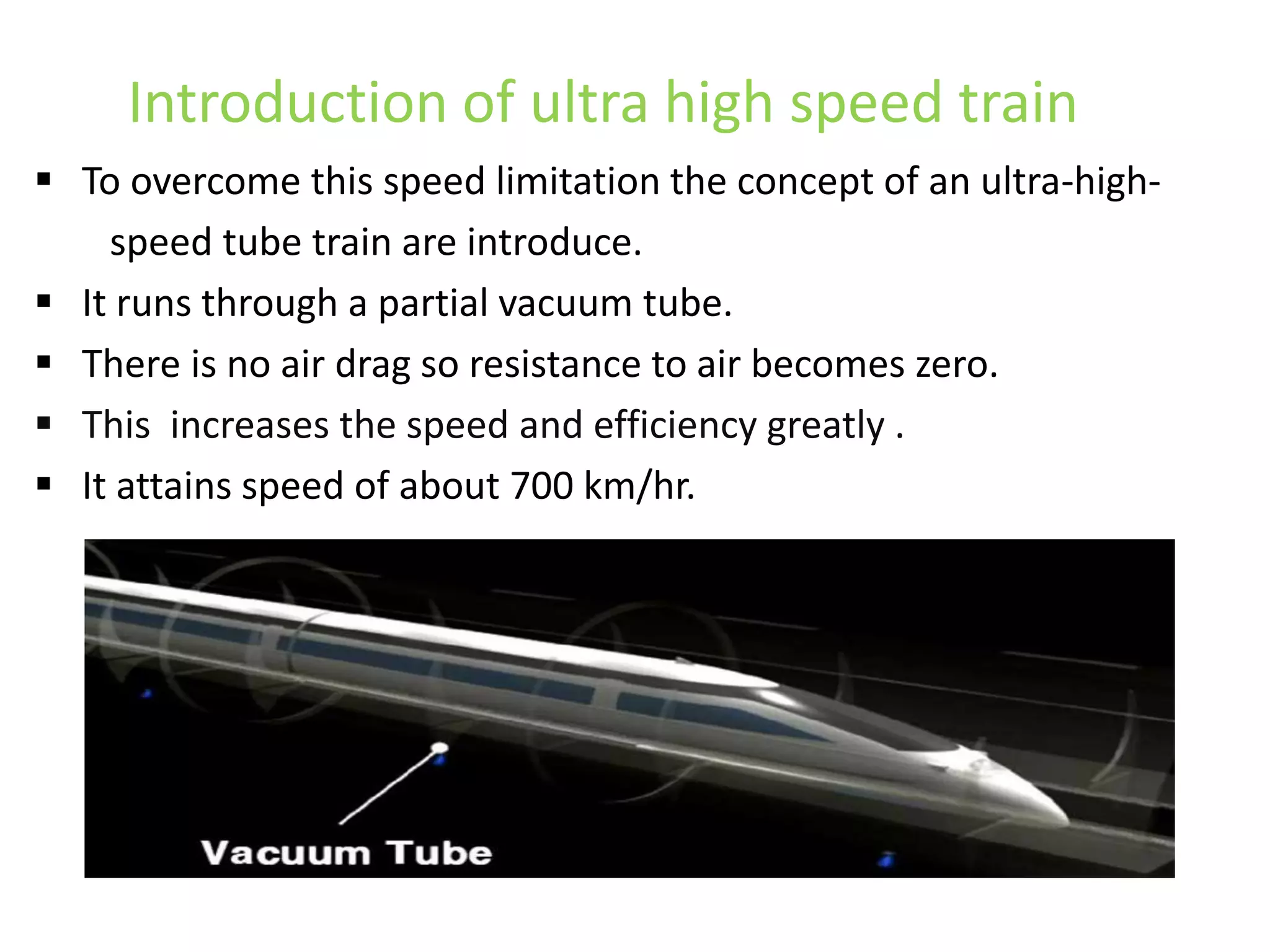
Introduction of ultra high speed train
 To overcome this speed limitation the concept of an ultra-high-
speed tube train are introduce.
 It runs through a partial vacuum tube.
 There is no air drag so resistance to air becomes zero.
 This increases the speed and efficiency greatly .
 It attains speed of about 700 km/hr.
PROBLEM FACED BY TUBE TRAIN
 At a speed of 700 km/hr a large thrust force ripple
causes vibration, noise and severe levitation disturbance
during the train operation.
 The passengers may suffer from the risk of cabin
depressurization in the event of a train malfunction.
LET’S SEE HOW IT WORKS
-the video will automatically starts
@Aman -The Maglev Technology

@Aman -The Maglev Technology

  • 1.
    THE MAGLEV TECHNOLOGY PRESENTEDBY : AMAN CHAND COLLEGE : GH RAISONI COLLEGE OF ENGINEERING AND MANAGEMENT PLACE : PUNE COURSE : SE MECHANICAL ENGINEERING
  • 2.
    About maglev trains Maglev = magnetic + levitation  Maglev technology has used electromagnetic force to hold up the entire train compartment.  Electricity is the main source of energy.  The train propels or move forward without any friction with moving mechanical parts.  The beauty of maglev is that it travels on air.
  • 3.
    Basic principles ofmaglev trains Maglev trains have to perform the following functions to operate on high speeds  LEVITATION  PROPULSION  LATERAL GUIDANCE
  • 4.
    PRINCIPLE OF MAGNETIC LEVITATION Strong magnets are attached to the train.  Magnets with same polarity are used Which repels and levitates the train.  Has ferromagnetic stators on the track and levitate the train.  A computer changes the amount of current to keep the train 1 cm to 10 from the track.
  • 5.
    TYPES OF MAGLEV TECHNOLOGY Thereare two types of maglev technology  Electromagnetic Suspension (EMS) Uses electromagnets for levitation ,propulsion and lateral guidance.  Electrodynamics Suspension (EDS) Uses superconductors are used for levitation ,propulsion and lateral guidance.
  • 6.
    PRINCIPLE OF PROPULSION Attractive forces between unlike magnetic poles pull each element of the rotor toward the corresponding element of the stator.  Just as the two poles are coming into alignment, the polarity of the armature magnets is reversed, resulting in a repulsive force that keeps the motor turning in the same direction.  This is happened vice –versa and train attain the speed of – 450km/hr.
  • 7.
    PRINCIPLE OF LATERALGUIDANCE  The levitation magnets and rail are both U shaped, with rail being an inverted U.  The mouths of U face one another.  When one side of the train nears the side of the guide way, the super conducting magnet on the train induces a repulsive force from the levitation coils on the side closer to the train and an attractive force from the coils on the farther side.  This keeps the train in the center.
  • 8.
    DRAWBACKS USING OFLIM The main draw back of this type of maglev train is its speed limit i.e. upto 500 km/hr Because of air resistance and aerodynamic noise, greater speeds are difficult to reach.
  • 9.
    Introduction of ultrahigh speed train  To overcome this speed limitation the concept of an ultra-high- speed tube train are introduce.  It runs through a partial vacuum tube.  There is no air drag so resistance to air becomes zero.  This increases the speed and efficiency greatly .  It attains speed of about 700 km/hr.
  • 10.
    PROBLEM FACED BYTUBE TRAIN  At a speed of 700 km/hr a large thrust force ripple causes vibration, noise and severe levitation disturbance during the train operation.  The passengers may suffer from the risk of cabin depressurization in the event of a train malfunction.
  • 11.
    LET’S SEE HOWIT WORKS -the video will automatically starts