CREEPS AND
MARGINAL
DETERIORATION
A M A L G A M
Presented by Villanueva, Justin and Limonar, Shane
CREEP
CREEP
CREEP
it is defined as the time-
dependent plastic strain of a
material under static load or
constant stress.
CREEP
CREEP
CREEP
O t h e r F a c t o r s t h a t c a u s e s c r e e p s o f a m a l g a m
I t a r i s e s f r o m t h e c o n t i n u e d s e t t i n g e x p a n s i o n o f t h e
a m a l g a m , t h e f o r m a t i o n o f c o r r o s i o n p r o d u c t s ,
m a s t i c a t i o n , o r f r o m t h e t h e r m a l e x p a n s i o n o f t h e
a m a l g a m d u r i n g i n g e s t i o n o f h o t f o o d s .
CREEP
CREEP
CREEP
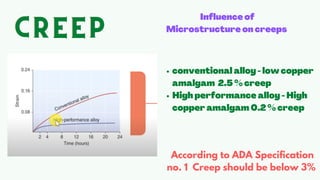
conventional alloy -low copper
amalgam 2.5%creep
High performance alloy -High
copper amalgam 0.2%creep
CREEP
CREEP
CREEP
According to ADA Specification
no. 1 Creep should be below 3%
Influence of
Microstructure on creeps
CREEP
CREEP
CREEP
Instrument has been built in a
solid aluminum block containing
two amalgam specimen test
stations where the temperature
of 37degrees celsius is prescisely
controlled with a digital
microprocessor controller and a
designated creep test, weight is
applied onto the specimens.
Determining
Creep


CREEP
CREEP
CREEP
CREEP
CREEP
CREEP
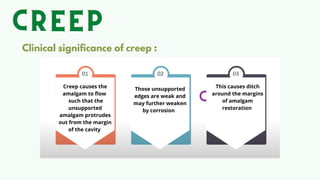
Clinical significance of creep :
Creep causes the
amalgam to flow
such that the
unsupported
amalgam protrudes
out from the margin
of the cavity
Those unsupported
edges are weak and
may further weaken
by corrosion
This causes ditch
around the margins
of amalgam
restoration
MARGINAL
MARGINAL
MARGINAL
DETERIORATION
DETERIORATION
DETERIORATION
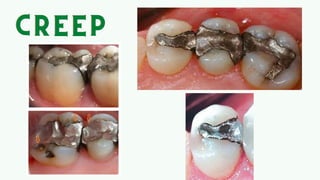
Referred to as “Marginal breakdown”,
“ditching”, and “crevice formation”.
Regardless of the type of amalgam,
marginal fracture increases with
time
“Marginal breakdown”,
ditching crevice formation
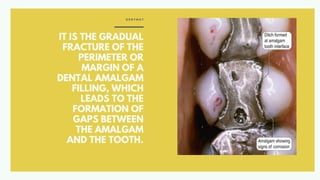
IT IS THE GRADUAL
FRACTURE OF THE
PERIMETER OR
MARGIN OF A
DENTAL AMALGAM
FILLING, WHICH
LEADS TO THE
FORMATION OF
GAPS BETWEEN
THE AMALGAM
AND THE TOOTH.
D E N T M A T
Excess amalgam, left lying over the occlusal or
proximal surface should be carved correctly
The angle of the carvo-surface margin should be
greater than 70º and the cavity should be
designed to allow for this.
On completion of packing, burnish the margins
both before and after carving to improve
marginal adaptation.
CLINICAL TECHNIQUES TO PREVENT
MARGINAL BREAKDOWN
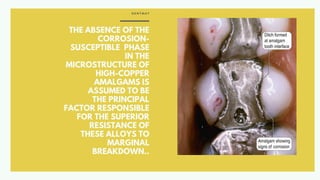
THE ABSENCE OF THE
CORROSION-
SUSCEPTIBLE PHASE
IN THE
MICROSTRUCTURE OF
HIGH-COPPER
AMALGAMS IS
ASSUMED TO BE
THE PRINCIPAL
FACTOR RESPONSIBLE
FOR THE SUPERIOR
RESISTANCE OF
THESE ALLOYS TO
MARGINAL
BREAKDOWN..
D E N T M A T
marginal breakdown with alloys having creep
values below 1%, restorations made from higher-
creep alloys generally experience greater
marginal breakdown than do restorations of
lower-creep
alloys.
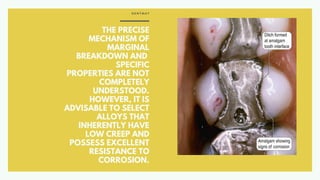
THE PRECISE
MECHANISM OF
MARGINAL
BREAKDOWN AND
SPECIFIC
PROPERTIES ARE NOT
COMPLETELY
UNDERSTOOD.
HOWEVER, IT IS
ADVISABLE TO SELECT
ALLOYS THAT
INHERENTLY HAVE
LOW CREEP AND
POSSESS EXCELLENT
RESISTANCE TO
CORROSION.
D E N T M A T
https://pubmed.ncbi.nlm.nih.gov/3855901/
https://www.slideshare.net/achillies88/strength-and-creep-of-dental-
amalgam-3837449
https://youtu.be/o_n-v7HVrt4
REFERENCE:
thank you for
listening!
Amalgam Creeps and Marginal Breakdown

Amalgam Creeps and Marginal Breakdown

  • 1.
    CREEPS AND MARGINAL DETERIORATION A MA L G A M Presented by Villanueva, Justin and Limonar, Shane
  • 2.
    CREEP CREEP CREEP it is definedas the time- dependent plastic strain of a material under static load or constant stress.
  • 3.
    CREEP CREEP CREEP O t he r F a c t o r s t h a t c a u s e s c r e e p s o f a m a l g a m I t a r i s e s f r o m t h e c o n t i n u e d s e t t i n g e x p a n s i o n o f t h e a m a l g a m , t h e f o r m a t i o n o f c o r r o s i o n p r o d u c t s , m a s t i c a t i o n , o r f r o m t h e t h e r m a l e x p a n s i o n o f t h e a m a l g a m d u r i n g i n g e s t i o n o f h o t f o o d s .
  • 4.
  • 5.
    conventional alloy -lowcopper amalgam 2.5%creep High performance alloy -High copper amalgam 0.2%creep CREEP CREEP CREEP According to ADA Specification no. 1 Creep should be below 3% Influence of Microstructure on creeps
  • 6.
  • 7.
    Instrument has beenbuilt in a solid aluminum block containing two amalgam specimen test stations where the temperature of 37degrees celsius is prescisely controlled with a digital microprocessor controller and a designated creep test, weight is applied onto the specimens. Determining Creep CREEP CREEP CREEP
  • 8.
    CREEP CREEP CREEP Clinical significance ofcreep : Creep causes the amalgam to flow such that the unsupported amalgam protrudes out from the margin of the cavity Those unsupported edges are weak and may further weaken by corrosion This causes ditch around the margins of amalgam restoration
  • 9.
  • 10.
    Referred to as“Marginal breakdown”, “ditching”, and “crevice formation”. Regardless of the type of amalgam, marginal fracture increases with time “Marginal breakdown”, ditching crevice formation
  • 11.
    IT IS THEGRADUAL FRACTURE OF THE PERIMETER OR MARGIN OF A DENTAL AMALGAM FILLING, WHICH LEADS TO THE FORMATION OF GAPS BETWEEN THE AMALGAM AND THE TOOTH. D E N T M A T
  • 12.
    Excess amalgam, leftlying over the occlusal or proximal surface should be carved correctly The angle of the carvo-surface margin should be greater than 70º and the cavity should be designed to allow for this. On completion of packing, burnish the margins both before and after carving to improve marginal adaptation. CLINICAL TECHNIQUES TO PREVENT MARGINAL BREAKDOWN
  • 13.
    THE ABSENCE OFTHE CORROSION- SUSCEPTIBLE PHASE IN THE MICROSTRUCTURE OF HIGH-COPPER AMALGAMS IS ASSUMED TO BE THE PRINCIPAL FACTOR RESPONSIBLE FOR THE SUPERIOR RESISTANCE OF THESE ALLOYS TO MARGINAL BREAKDOWN.. D E N T M A T
  • 14.
    marginal breakdown withalloys having creep values below 1%, restorations made from higher- creep alloys generally experience greater marginal breakdown than do restorations of lower-creep alloys.
  • 15.
    THE PRECISE MECHANISM OF MARGINAL BREAKDOWNAND SPECIFIC PROPERTIES ARE NOT COMPLETELY UNDERSTOOD. HOWEVER, IT IS ADVISABLE TO SELECT ALLOYS THAT INHERENTLY HAVE LOW CREEP AND POSSESS EXCELLENT RESISTANCE TO CORROSION. D E N T M A T
  • 16.
  • 17.