DENTAL CHAIR, PATIENT AND
OPERATOR POSITION
Made by Jatin Suresh
TY BDS
Batch-F
Roll Number - 76
DEPARTMENT OF CONSERVATIVE DENTISTRY AND ENDODONTIA
Introduction
• The dental chair, patient and
operator position are important
because:
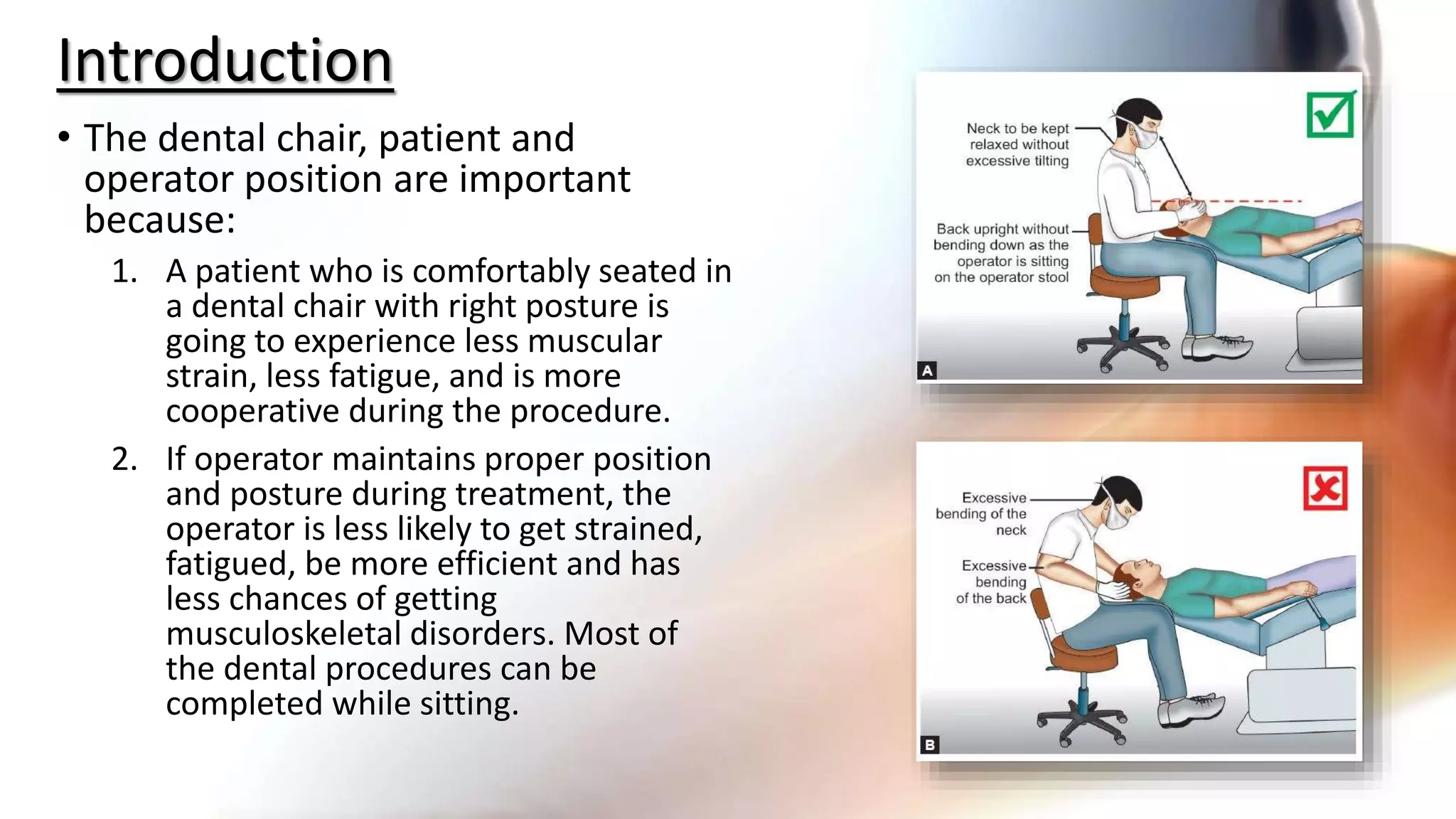
1. A patient who is comfortably seated in
a dental chair with right posture is
going to experience less muscular
strain, less fatigue, and is more
cooperative during the procedure.
2. If operator maintains proper position
and posture during treatment, the
operator is less likely to get strained,
fatigued, be more efficient and has
less chances of getting
musculoskeletal disorders. Most of
the dental procedures can be
completed while sitting.
Points To Be Kept In Mind In Relation To The Dental Chair
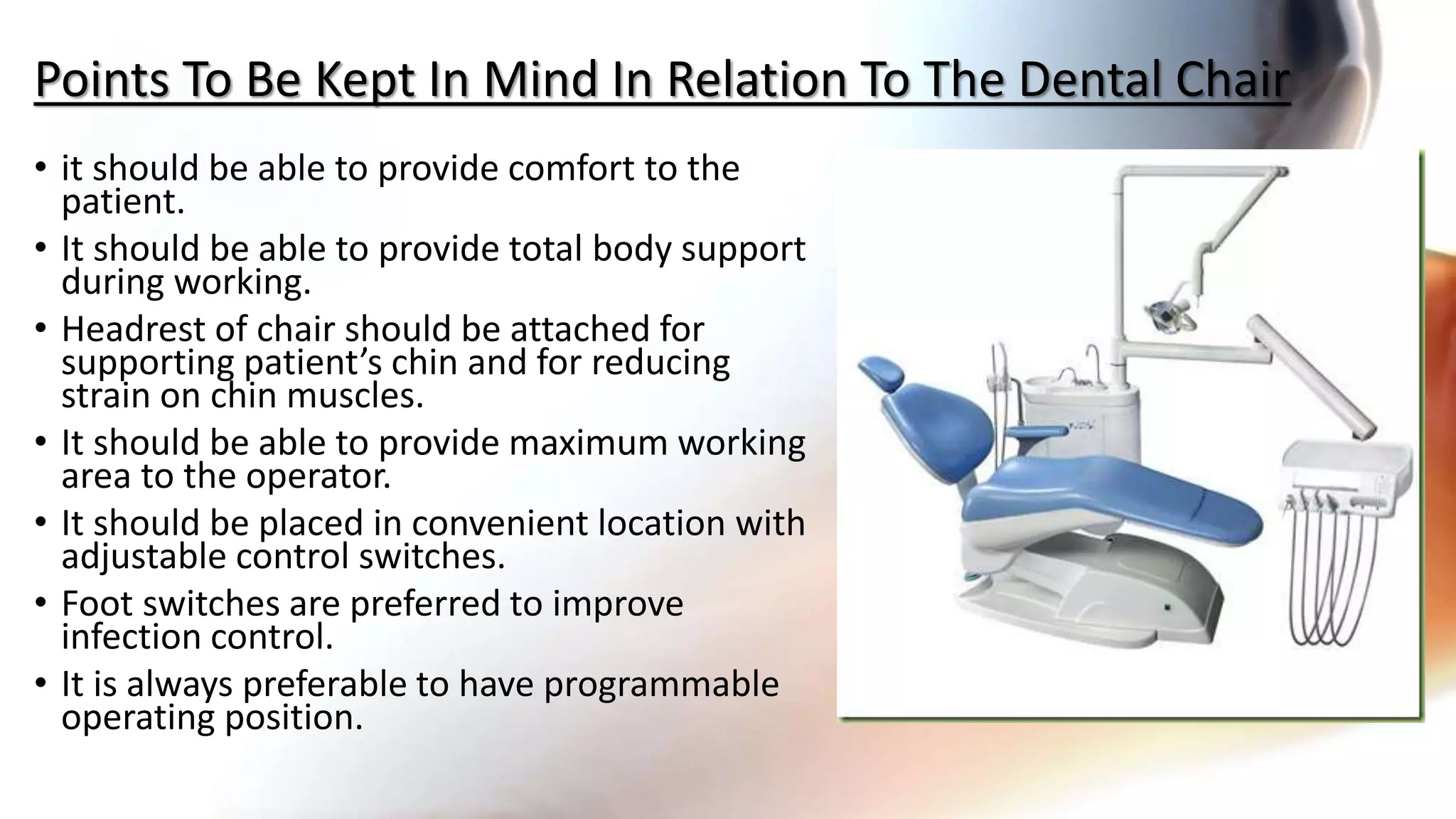
• it should be able to provide comfort to the
patient.
• It should be able to provide total body support
during working.
• Headrest of chair should be attached for
supporting patient’s chin and for reducing
strain on chin muscles.
• It should be able to provide maximum working
area to the operator.
• It should be placed in convenient location with
adjustable control switches.
• Foot switches are preferred to improve
infection control.
• It is always preferable to have programmable
operating position.
Dental Chair And Operator Positions
• Modern dental chairs are designed to provide total body support and
comfort in any position.
• The patient should be seated in such a way that all his body parts are
well supported.
• Patient’s head should be in line with his back irrespective of the fact
that patient is reclined or parallel to the floor.
• Common positions for dental procedures:
1. Upright position
2. Almost supine
3. Reclined at 45ºto the floor
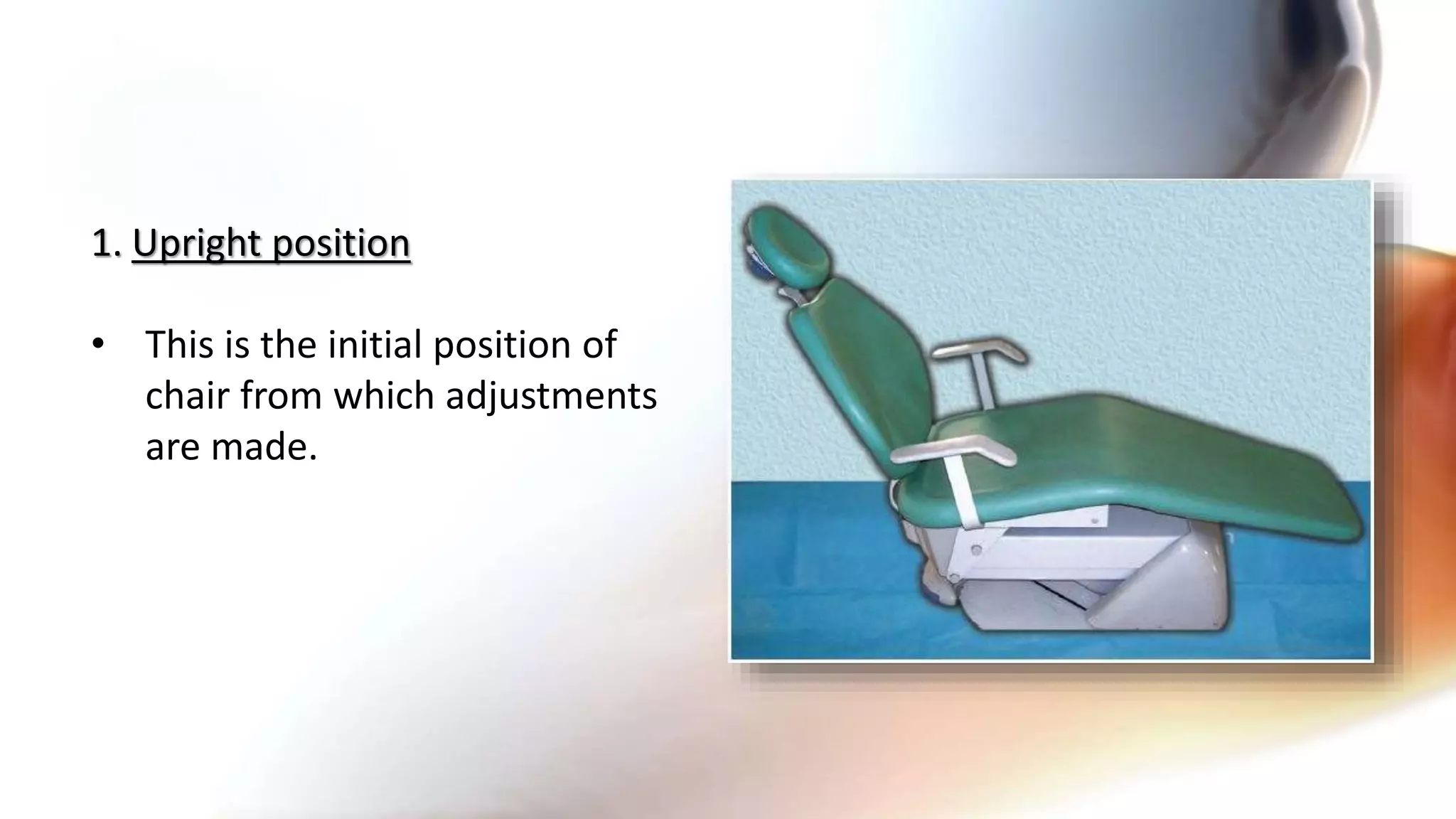
1. Upright position
• This is the initial position of
chair from which adjustments
are made.
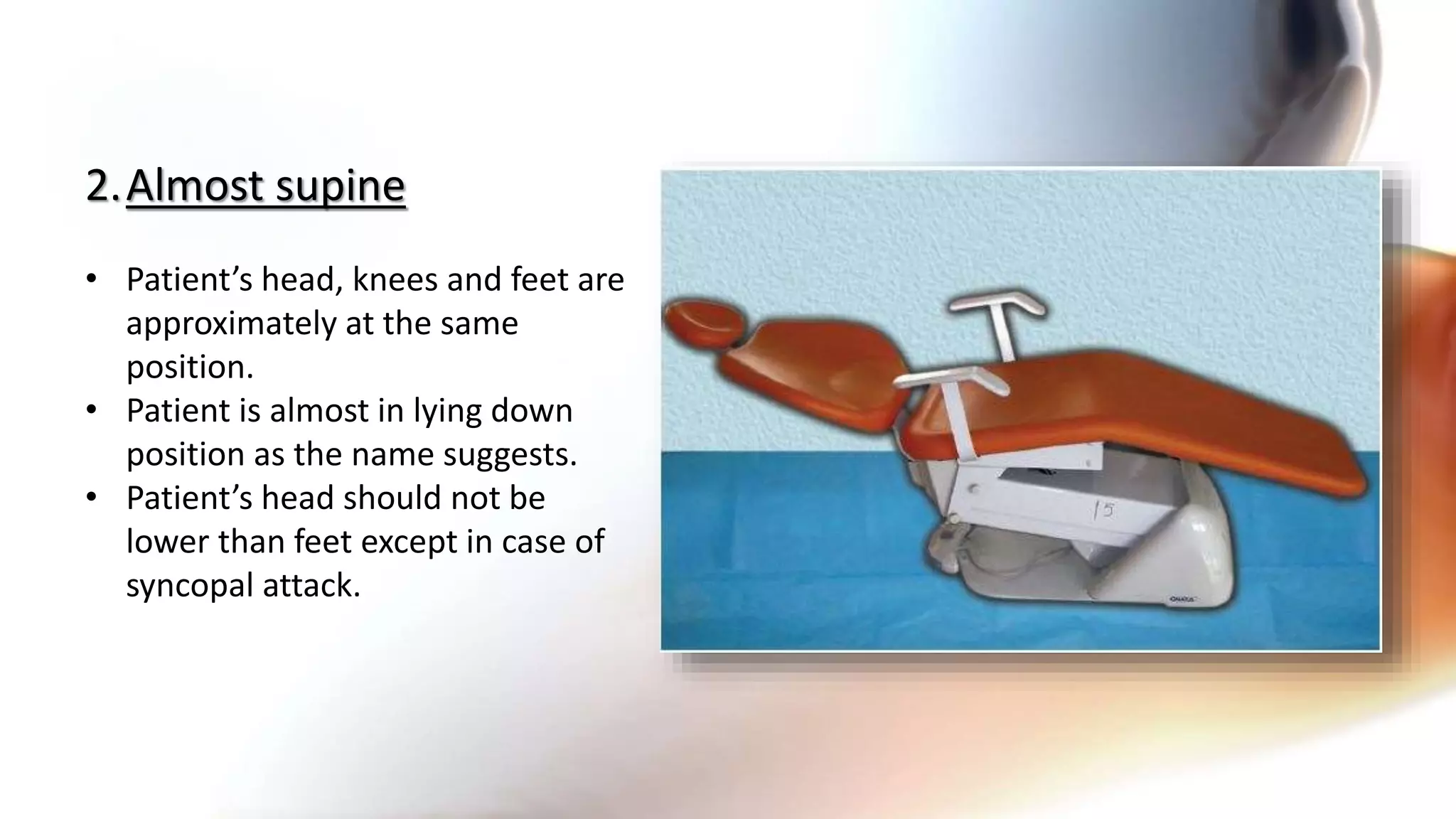
2.Almost supine
• Patient’s head, knees and feet are
approximately at the same
position.
• Patient is almost in lying down
position as the name suggests.
• Patient’s head should not be
lower than feet except in case of
syncopal attack.
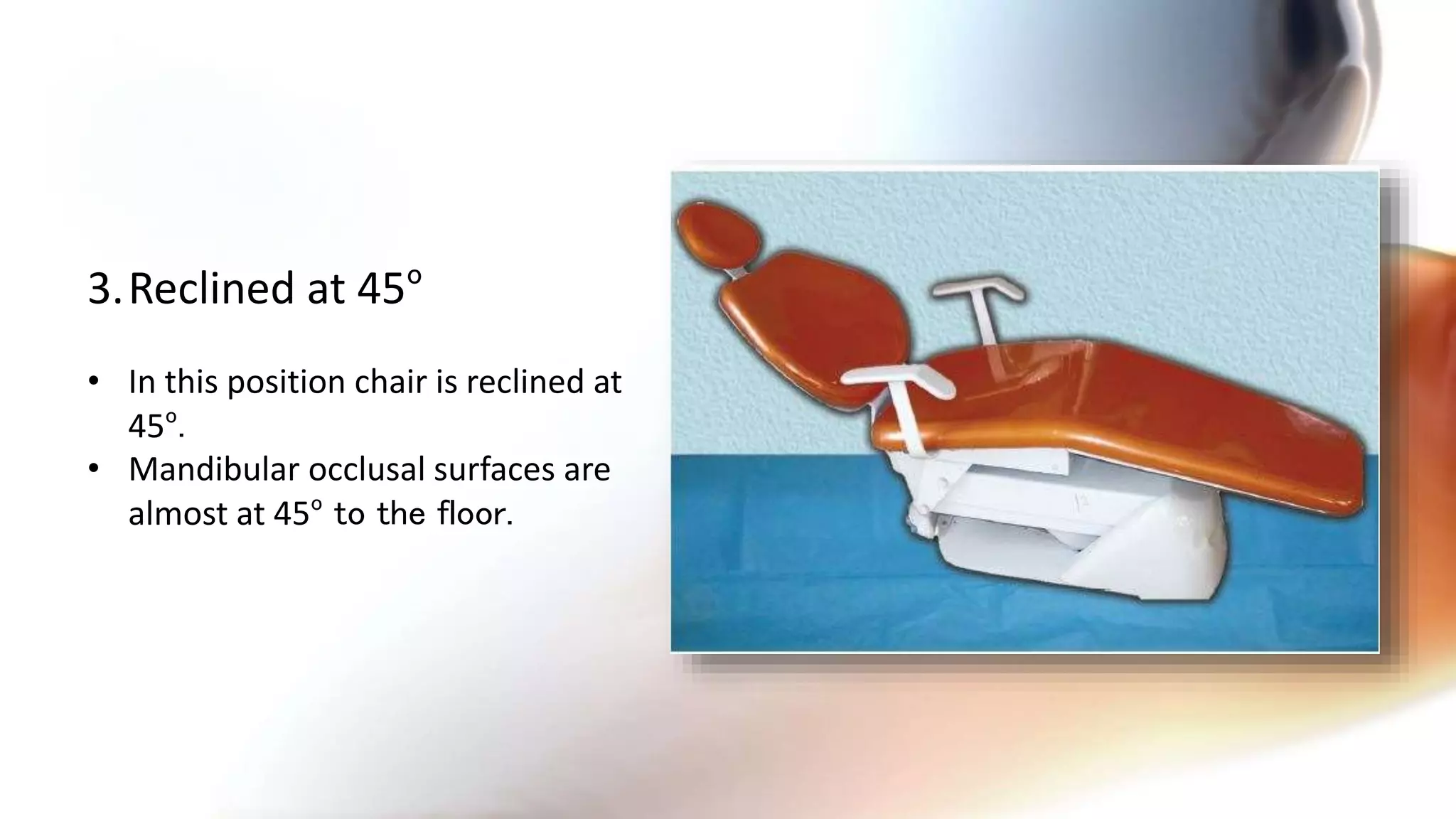
3.Reclined at 45º
• In this position chair is reclined at
45º.
• Mandibular occlusal surfaces are
almost at 45º to the floor.
Operating Position
• Accurate operating positions are essential while doing a
procedure so as to increase the efficiency and to decrease the
physical strain.
• Position of the patient depends on the type of procedure.
• Once the patient has been seated properly the operator and
the assistant should sit in the proper position for the
treatment.
• usually sitting position is preferred in modern dentistry to
relive stress on the operator’s leg and support operator’s back.
• Level of the teeth being treated should be same as that of
operator's elbow.
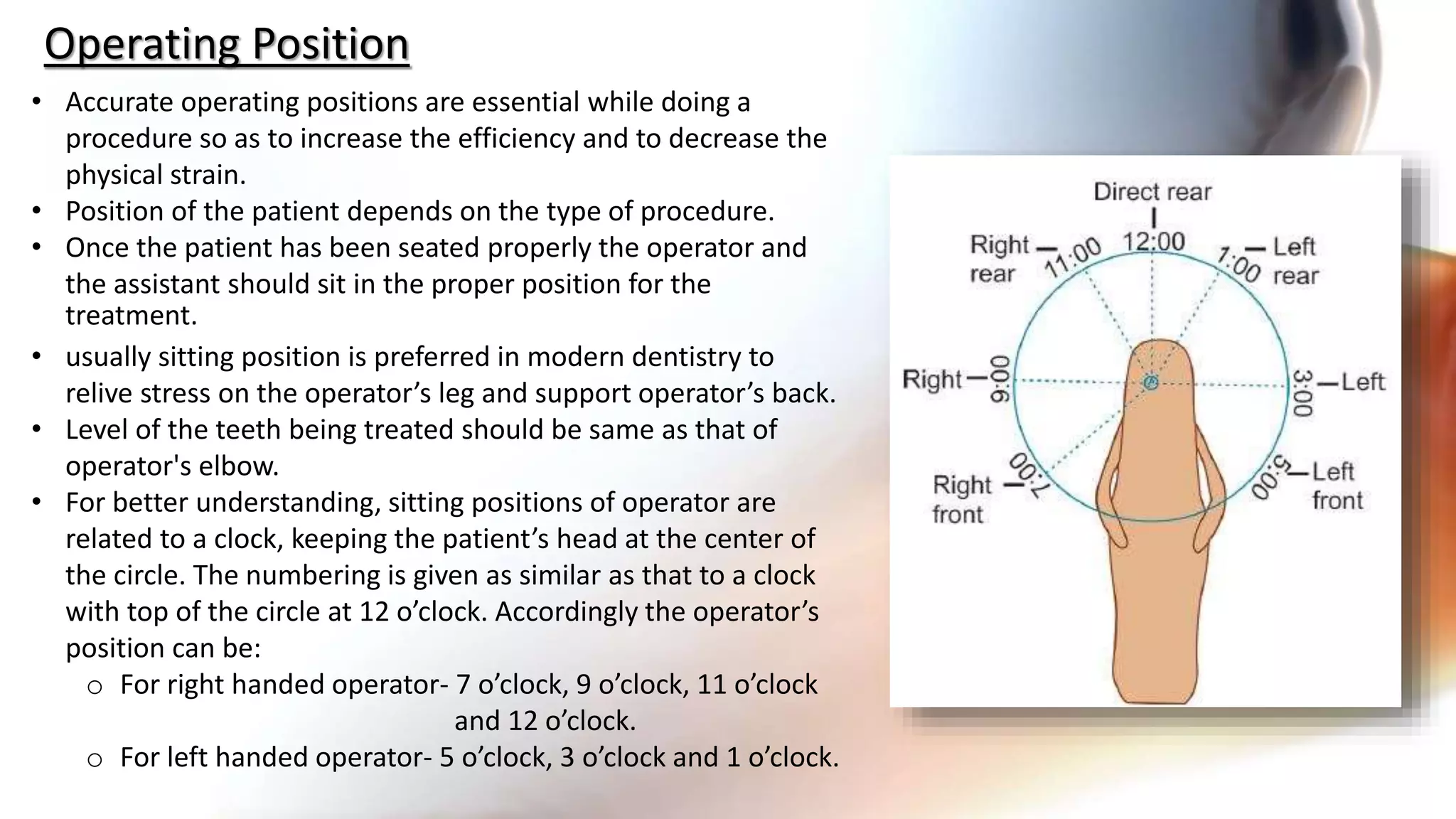
• For better understanding, sitting positions of operator are
related to a clock, keeping the patient’s head at the center of
the circle. The numbering is given as similar as that to a clock
with top of the circle at 12 o’clock. Accordingly the operator’s
position can be:
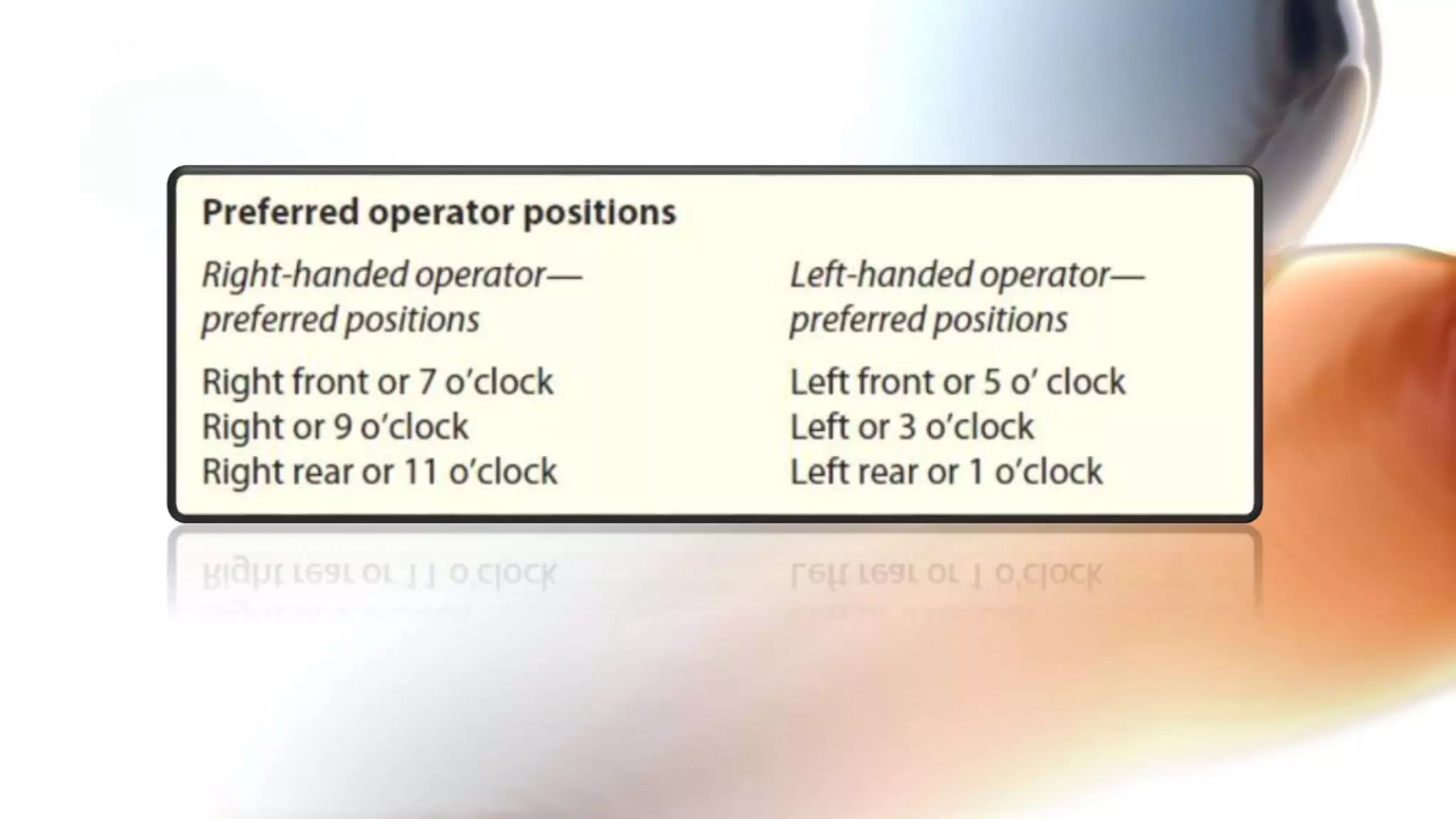
o For right handed operator- 7 o’clock, 9 o’clock, 11 o’clock
and 12 o’clock.
o For left handed operator- 5 o’clock, 3 o’clock and 1 o’clock.
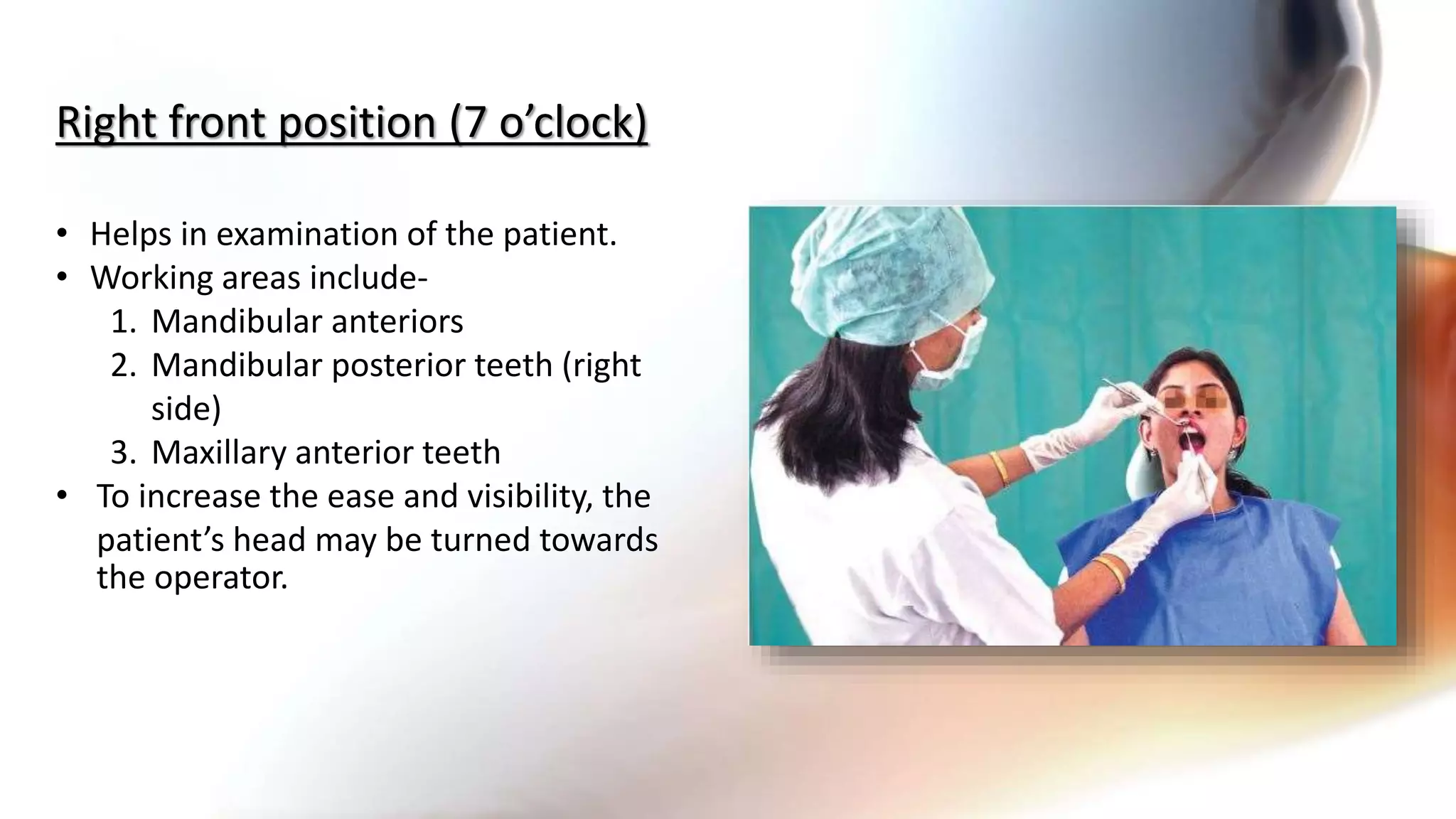
Right front position (7 o’clock)
• Helps in examination of the patient.
• Working areas include-
1. Mandibular anteriors
2. Mandibular posterior teeth (right
side)
3. Maxillary anterior teeth
• To increase the ease and visibility, the
patient’s head may be turned towards
the operator.
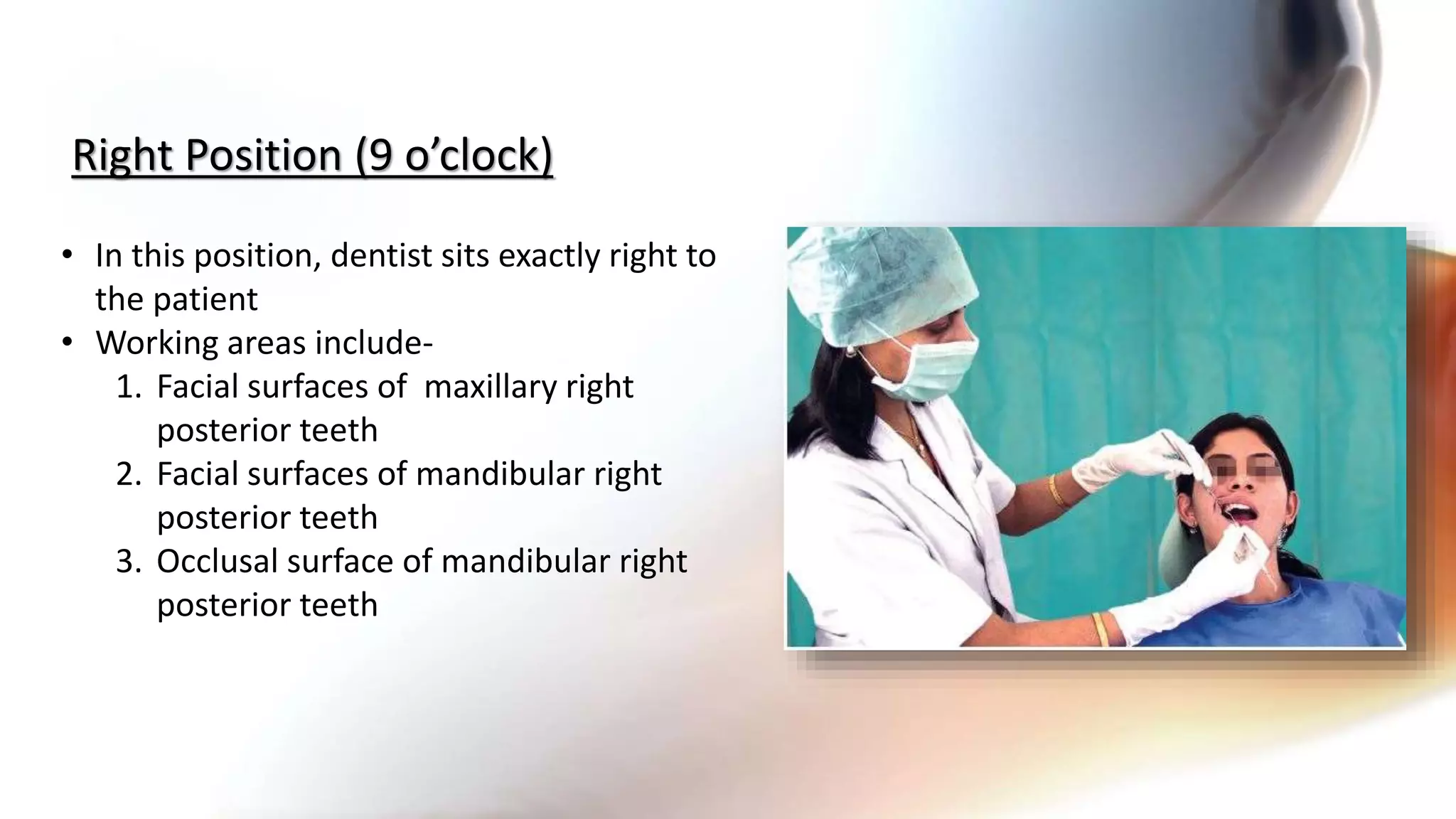
Right Position (9 o’clock)
• In this position, dentist sits exactly right to
the patient
• Working areas include-
1. Facial surfaces of maxillary right
posterior teeth
2. Facial surfaces of mandibular right
posterior teeth
3. Occlusal surface of mandibular right
posterior teeth
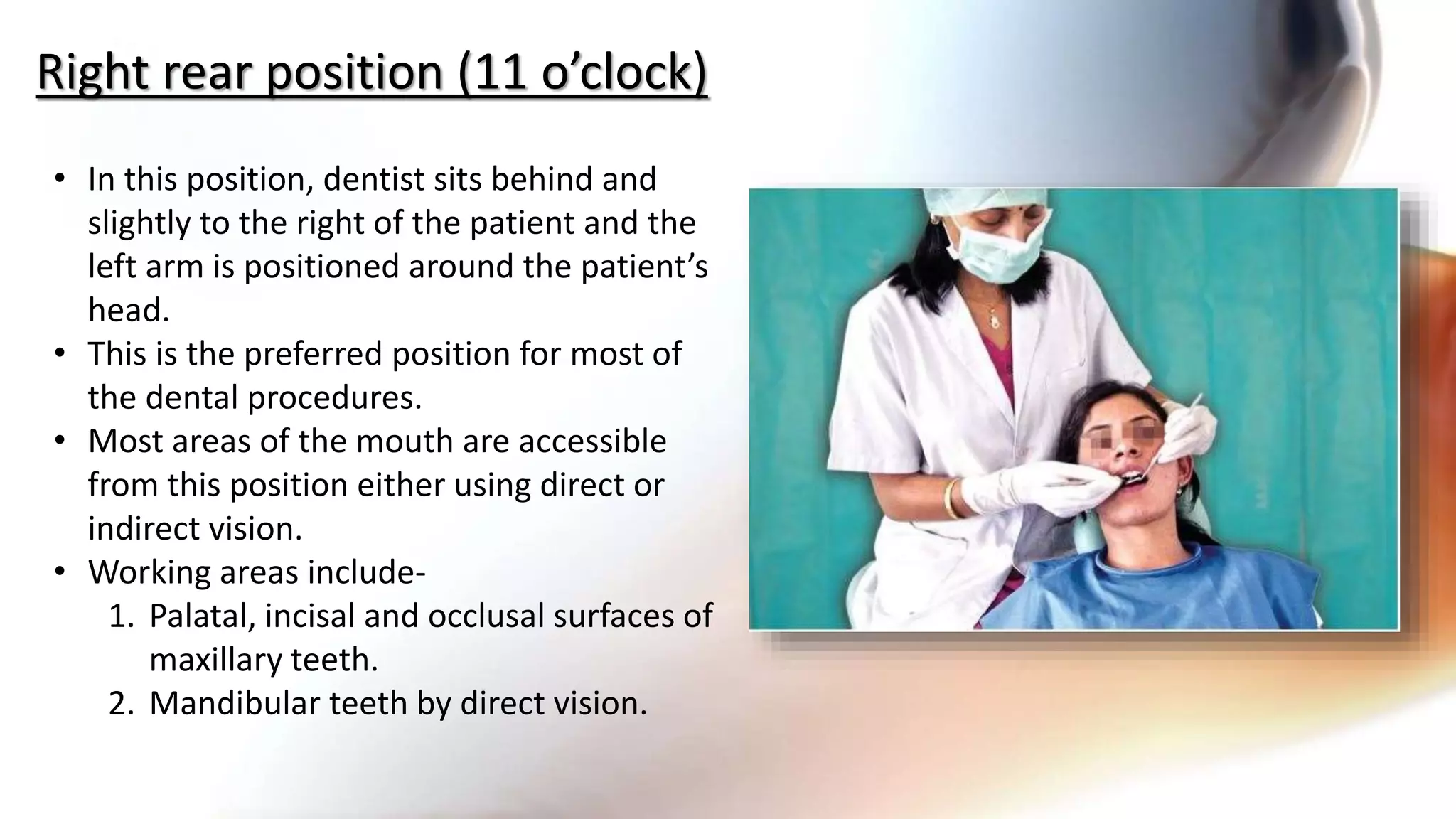
Right rear position (11 o’clock)
• In this position, dentist sits behind and
slightly to the right of the patient and the
left arm is positioned around the patient’s
head.
• This is the preferred position for most of
the dental procedures.
• Most areas of the mouth are accessible
from this position either using direct or
indirect vision.
• Working areas include-
1. Palatal, incisal and occlusal surfaces of
maxillary teeth.
2. Mandibular teeth by direct vision.
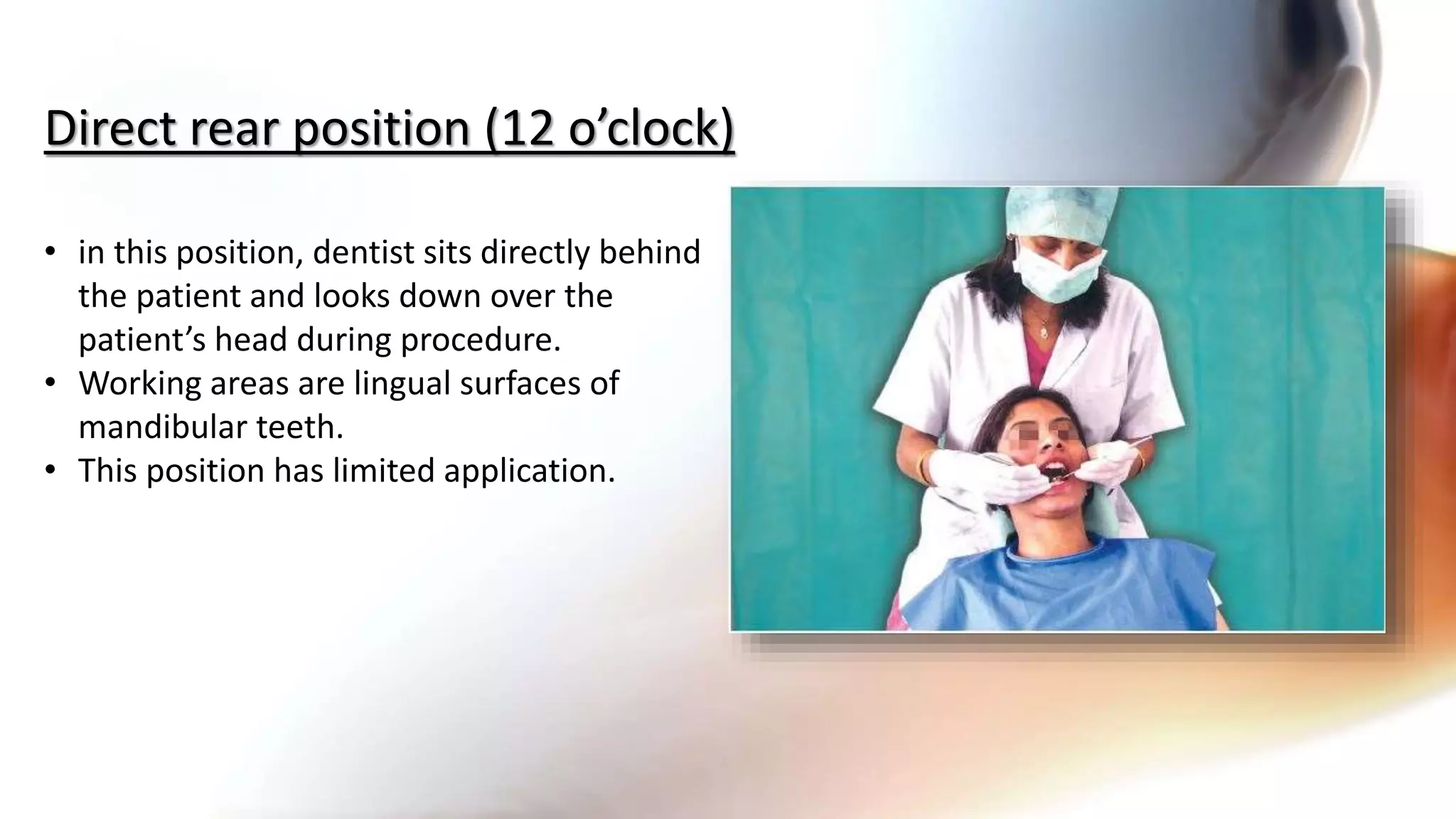
Direct rear position (12 o’clock)
• in this position, dentist sits directly behind
the patient and looks down over the
patient’s head during procedure.
• Working areas are lingual surfaces of
mandibular teeth.
• This position has limited application.
Considerations For Dentists While Doing Cases
1. While doing work in the maxillary arch, the maxillary occlusal surfaces should be oriented
perpendicular to the floor.
2. While working in the mandibular arch, the mandibular occlusal surfaces should be oriented at 45º
to the floor.
3. Patient’s head can be rotated backward, forward or side to side by the operator for better
visibility and convenience.
4. Dentist should not sacrifice good operating position as it will sabotage visibility, accessibility and
efficiency.
5. Maintain proper distance from the patient while working. This will result in increased cooperation
and confidence from the patient.
6. Dentist should avoid/minimize body contact with the patient. Dentist should not rest forearms on
the patient’s shoulders and hands on the face.
7. Dentist should not use patient’s chest as an instrument trolley.
8. The operator should leave left hands free so as to use it for retraction using mouth mirror or
fingers of the left hand.
9. Operator should keep changing position if procedure is of long duration to decrease fatigue and
strain on muscles.
Operating Stool
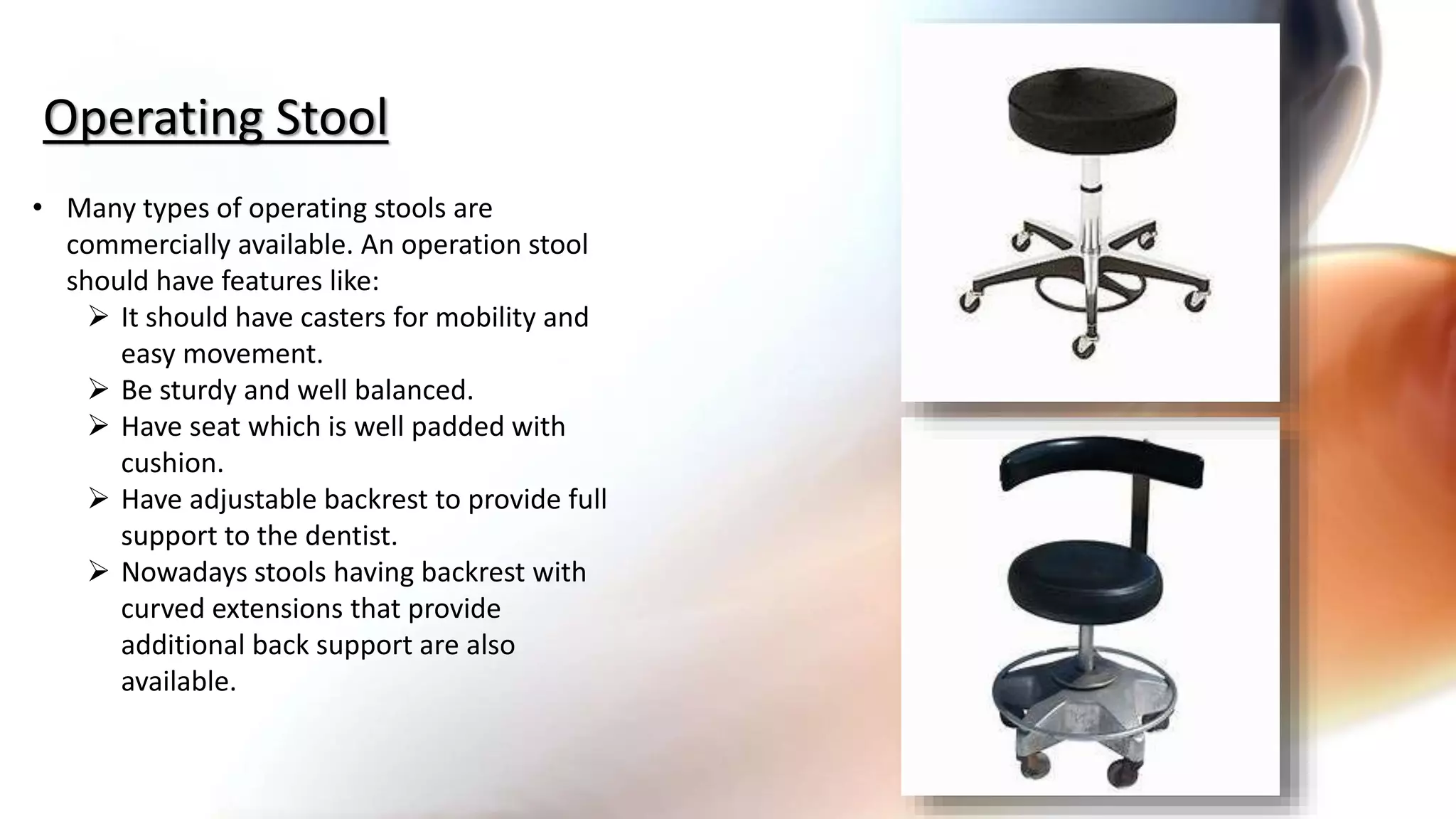
• Many types of operating stools are
commercially available. An operation stool
should have features like:
 It should have casters for mobility and
easy movement.
 Be sturdy and well balanced.
 Have seat which is well padded with
cushion.
 Have adjustable backrest to provide full
support to the dentist.
 Nowadays stools having backrest with
curved extensions that provide
additional back support are also
available.
Sitting Arrangement Of Operator And Assistant
• The dentist should sit on the middle of the cushion rather than the edges.
• The dentist should sit on the stool such that:
o Spinal column is straight or slightly bent taking the advantage of the
backrest.
o Thighs should be kept parallel to the floor
o Lower legs are kept perpendicular to the floor.
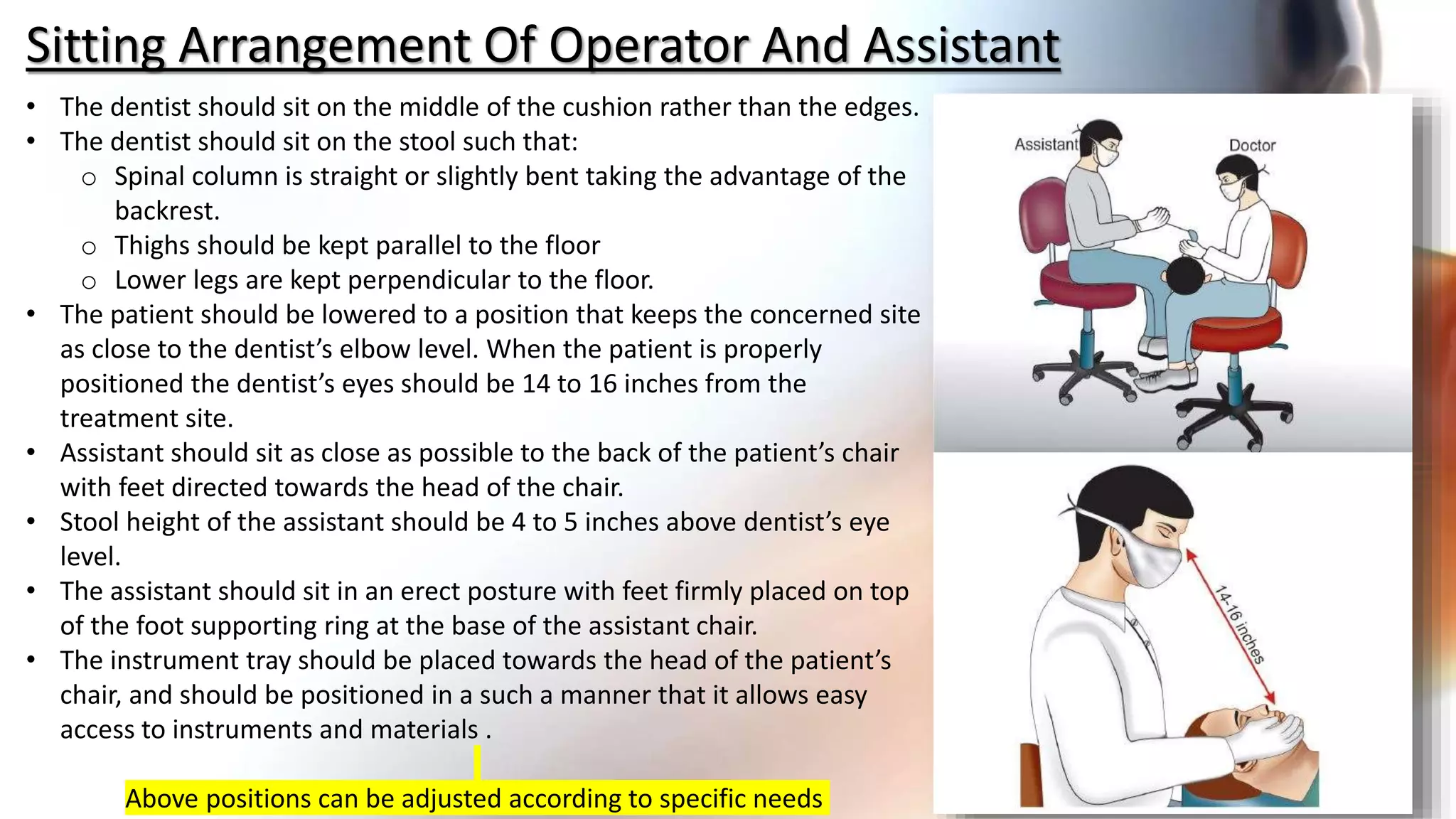
• The patient should be lowered to a position that keeps the concerned site
as close to the dentist’s elbow level. When the patient is properly
positioned the dentist’s eyes should be 14 to 16 inches from the
treatment site.
• Assistant should sit as close as possible to the back of the patient’s chair
with feet directed towards the head of the chair.
• Stool height of the assistant should be 4 to 5 inches above dentist’s eye
level.
• The assistant should sit in an erect posture with feet firmly placed on top
of the foot supporting ring at the base of the assistant chair.
• The instrument tray should be placed towards the head of the patient’s
chair, and should be positioned in a such a manner that it allows easy
access to instruments and materials .
Above positions can be adjusted according to specific needs
Zones Of Working Area
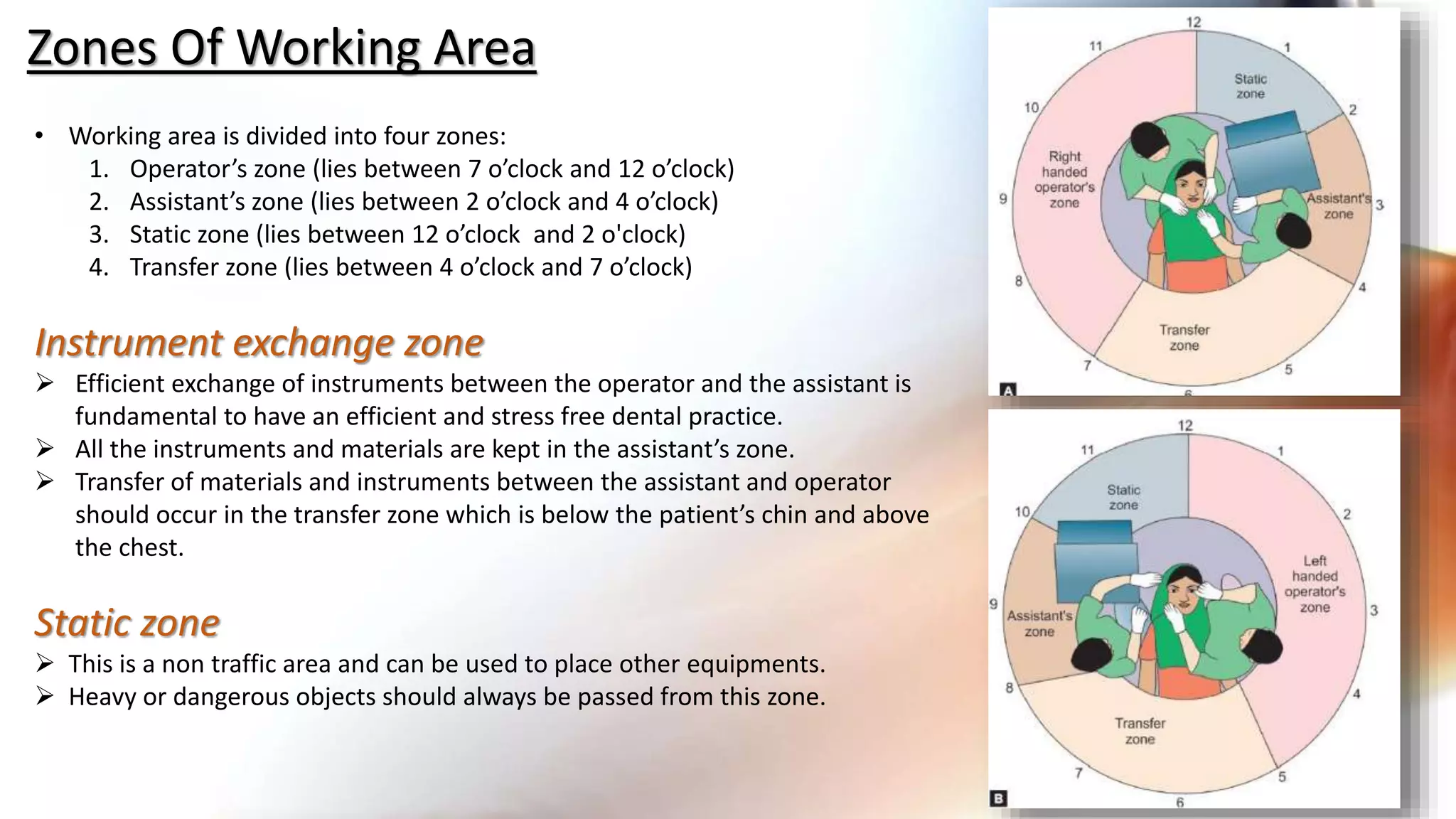
• Working area is divided into four zones:
1. Operator’s zone (lies between 7 o’clock and 12 o’clock)
2. Assistant’s zone (lies between 2 o’clock and 4 o’clock)
3. Static zone (lies between 12 o’clock and 2 o'clock)
4. Transfer zone (lies between 4 o’clock and 7 o’clock)
Instrument exchange zone
 Efficient exchange of instruments between the operator and the assistant is
fundamental to have an efficient and stress free dental practice.
 All the instruments and materials are kept in the assistant’s zone.
 Transfer of materials and instruments between the assistant and operator
should occur in the transfer zone which is below the patient’s chin and above
the chest.
Static zone
 This is a non traffic area and can be used to place other equipments.
 Heavy or dangerous objects should always be passed from this zone.
Instrument Exchange
• Instrument transfer should be accomplished by
minimum motion involving movements of only fingers,
wrist and elbow.
• Assistant should be ready when signaled by the dentist
for passing the next instrument and receive the used
one in a smooth motion.
• Instruments should be arranged in an orderly fashion
for comfortable exchange. As a rule, instruments
should be set from left to right in order of their use.
After use, they should be returned to their original
positions in case they are needed again.
Magnification
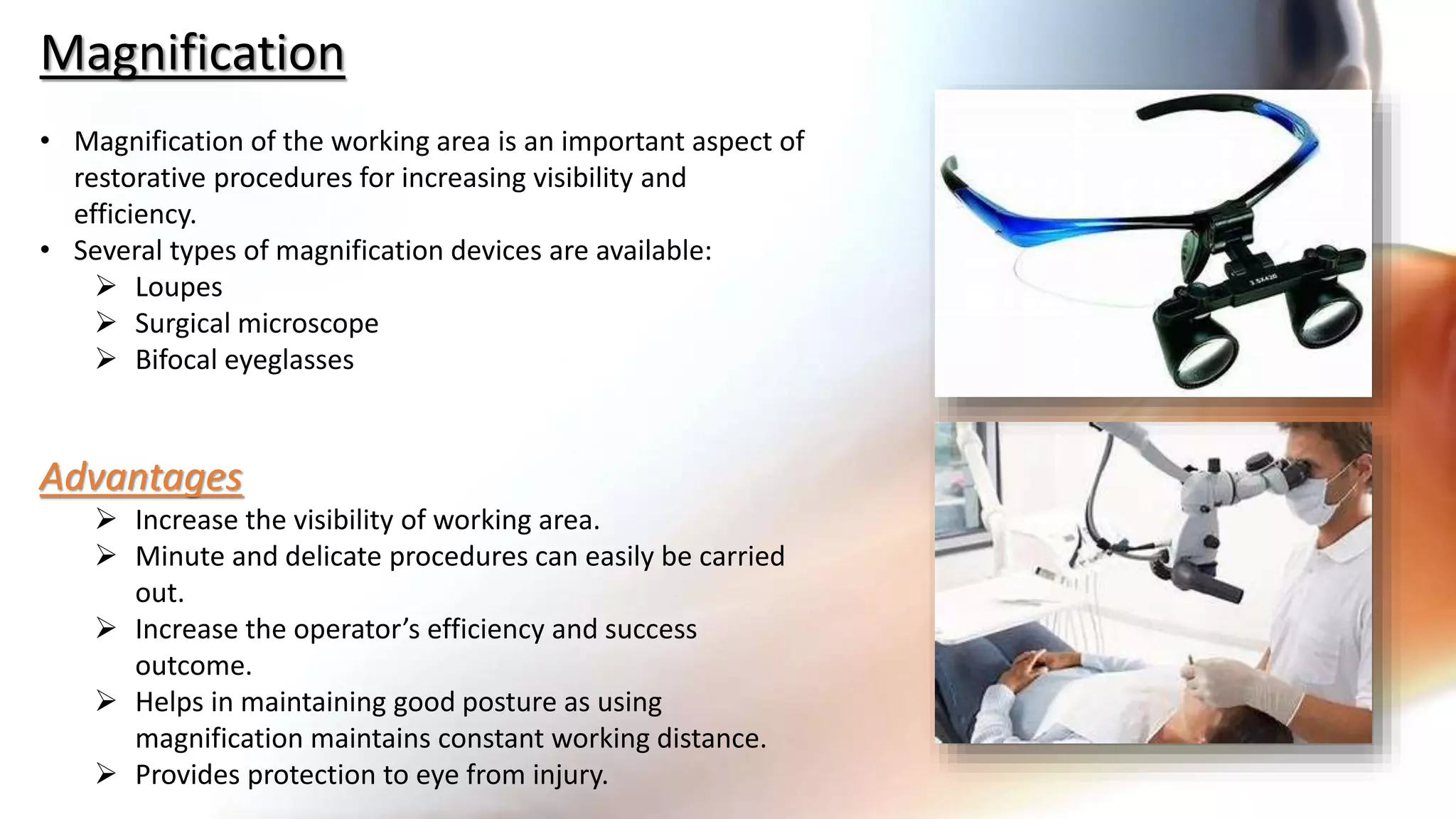
• Magnification of the working area is an important aspect of
restorative procedures for increasing visibility and
efficiency.
• Several types of magnification devices are available:
 Loupes
 Surgical microscope
 Bifocal eyeglasses
Advantages
 Increase the visibility of working area.
 Minute and delicate procedures can easily be carried
out.
 Increase the operator’s efficiency and success
outcome.
 Helps in maintaining good posture as using
magnification maintains constant working distance.
 Provides protection to eye from injury.
References
 Textbook of operative dentistry 3rd edition by Nisha Garg and Amit Garg.
THANK YOU

Dental chair, patient and operator position

  • 1.
    DENTAL CHAIR, PATIENTAND OPERATOR POSITION Made by Jatin Suresh TY BDS Batch-F Roll Number - 76 DEPARTMENT OF CONSERVATIVE DENTISTRY AND ENDODONTIA
  • 2.
    Introduction • The dentalchair, patient and operator position are important because: 1. A patient who is comfortably seated in a dental chair with right posture is going to experience less muscular strain, less fatigue, and is more cooperative during the procedure. 2. If operator maintains proper position and posture during treatment, the operator is less likely to get strained, fatigued, be more efficient and has less chances of getting musculoskeletal disorders. Most of the dental procedures can be completed while sitting.
  • 3.
    Points To BeKept In Mind In Relation To The Dental Chair • it should be able to provide comfort to the patient. • It should be able to provide total body support during working. • Headrest of chair should be attached for supporting patient’s chin and for reducing strain on chin muscles. • It should be able to provide maximum working area to the operator. • It should be placed in convenient location with adjustable control switches. • Foot switches are preferred to improve infection control. • It is always preferable to have programmable operating position.
  • 4.
    Dental Chair AndOperator Positions • Modern dental chairs are designed to provide total body support and comfort in any position. • The patient should be seated in such a way that all his body parts are well supported. • Patient’s head should be in line with his back irrespective of the fact that patient is reclined or parallel to the floor. • Common positions for dental procedures: 1. Upright position 2. Almost supine 3. Reclined at 45ºto the floor
  • 5.
    1. Upright position •This is the initial position of chair from which adjustments are made.
  • 6.
    2.Almost supine • Patient’shead, knees and feet are approximately at the same position. • Patient is almost in lying down position as the name suggests. • Patient’s head should not be lower than feet except in case of syncopal attack.
  • 7.
    3.Reclined at 45º •In this position chair is reclined at 45º. • Mandibular occlusal surfaces are almost at 45º to the floor.
  • 8.
    Operating Position • Accurateoperating positions are essential while doing a procedure so as to increase the efficiency and to decrease the physical strain. • Position of the patient depends on the type of procedure. • Once the patient has been seated properly the operator and the assistant should sit in the proper position for the treatment. • usually sitting position is preferred in modern dentistry to relive stress on the operator’s leg and support operator’s back. • Level of the teeth being treated should be same as that of operator's elbow. • For better understanding, sitting positions of operator are related to a clock, keeping the patient’s head at the center of the circle. The numbering is given as similar as that to a clock with top of the circle at 12 o’clock. Accordingly the operator’s position can be: o For right handed operator- 7 o’clock, 9 o’clock, 11 o’clock and 12 o’clock. o For left handed operator- 5 o’clock, 3 o’clock and 1 o’clock.
  • 9.
    Right front position(7 o’clock) • Helps in examination of the patient. • Working areas include- 1. Mandibular anteriors 2. Mandibular posterior teeth (right side) 3. Maxillary anterior teeth • To increase the ease and visibility, the patient’s head may be turned towards the operator.
  • 10.
    Right Position (9o’clock) • In this position, dentist sits exactly right to the patient • Working areas include- 1. Facial surfaces of maxillary right posterior teeth 2. Facial surfaces of mandibular right posterior teeth 3. Occlusal surface of mandibular right posterior teeth
  • 11.
    Right rear position(11 o’clock) • In this position, dentist sits behind and slightly to the right of the patient and the left arm is positioned around the patient’s head. • This is the preferred position for most of the dental procedures. • Most areas of the mouth are accessible from this position either using direct or indirect vision. • Working areas include- 1. Palatal, incisal and occlusal surfaces of maxillary teeth. 2. Mandibular teeth by direct vision.
  • 12.
    Direct rear position(12 o’clock) • in this position, dentist sits directly behind the patient and looks down over the patient’s head during procedure. • Working areas are lingual surfaces of mandibular teeth. • This position has limited application.
  • 14.
    Considerations For DentistsWhile Doing Cases 1. While doing work in the maxillary arch, the maxillary occlusal surfaces should be oriented perpendicular to the floor. 2. While working in the mandibular arch, the mandibular occlusal surfaces should be oriented at 45º to the floor. 3. Patient’s head can be rotated backward, forward or side to side by the operator for better visibility and convenience. 4. Dentist should not sacrifice good operating position as it will sabotage visibility, accessibility and efficiency. 5. Maintain proper distance from the patient while working. This will result in increased cooperation and confidence from the patient. 6. Dentist should avoid/minimize body contact with the patient. Dentist should not rest forearms on the patient’s shoulders and hands on the face. 7. Dentist should not use patient’s chest as an instrument trolley. 8. The operator should leave left hands free so as to use it for retraction using mouth mirror or fingers of the left hand. 9. Operator should keep changing position if procedure is of long duration to decrease fatigue and strain on muscles.
  • 15.
    Operating Stool • Manytypes of operating stools are commercially available. An operation stool should have features like:  It should have casters for mobility and easy movement.  Be sturdy and well balanced.  Have seat which is well padded with cushion.  Have adjustable backrest to provide full support to the dentist.  Nowadays stools having backrest with curved extensions that provide additional back support are also available.
  • 16.
    Sitting Arrangement OfOperator And Assistant • The dentist should sit on the middle of the cushion rather than the edges. • The dentist should sit on the stool such that: o Spinal column is straight or slightly bent taking the advantage of the backrest. o Thighs should be kept parallel to the floor o Lower legs are kept perpendicular to the floor. • The patient should be lowered to a position that keeps the concerned site as close to the dentist’s elbow level. When the patient is properly positioned the dentist’s eyes should be 14 to 16 inches from the treatment site. • Assistant should sit as close as possible to the back of the patient’s chair with feet directed towards the head of the chair. • Stool height of the assistant should be 4 to 5 inches above dentist’s eye level. • The assistant should sit in an erect posture with feet firmly placed on top of the foot supporting ring at the base of the assistant chair. • The instrument tray should be placed towards the head of the patient’s chair, and should be positioned in a such a manner that it allows easy access to instruments and materials . Above positions can be adjusted according to specific needs
  • 17.
    Zones Of WorkingArea • Working area is divided into four zones: 1. Operator’s zone (lies between 7 o’clock and 12 o’clock) 2. Assistant’s zone (lies between 2 o’clock and 4 o’clock) 3. Static zone (lies between 12 o’clock and 2 o'clock) 4. Transfer zone (lies between 4 o’clock and 7 o’clock) Instrument exchange zone  Efficient exchange of instruments between the operator and the assistant is fundamental to have an efficient and stress free dental practice.  All the instruments and materials are kept in the assistant’s zone.  Transfer of materials and instruments between the assistant and operator should occur in the transfer zone which is below the patient’s chin and above the chest. Static zone  This is a non traffic area and can be used to place other equipments.  Heavy or dangerous objects should always be passed from this zone.
  • 18.
    Instrument Exchange • Instrumenttransfer should be accomplished by minimum motion involving movements of only fingers, wrist and elbow. • Assistant should be ready when signaled by the dentist for passing the next instrument and receive the used one in a smooth motion. • Instruments should be arranged in an orderly fashion for comfortable exchange. As a rule, instruments should be set from left to right in order of their use. After use, they should be returned to their original positions in case they are needed again.
  • 19.
    Magnification • Magnification ofthe working area is an important aspect of restorative procedures for increasing visibility and efficiency. • Several types of magnification devices are available:  Loupes  Surgical microscope  Bifocal eyeglasses Advantages  Increase the visibility of working area.  Minute and delicate procedures can easily be carried out.  Increase the operator’s efficiency and success outcome.  Helps in maintaining good posture as using magnification maintains constant working distance.  Provides protection to eye from injury.
  • 20.
    References  Textbook ofoperative dentistry 3rd edition by Nisha Garg and Amit Garg.
  • 21.