THE BASICS:
Memory Loss, Dementia and
Alzheimer's Disease
Ellen Phipps, CTRS, MSG
Devin Bowers, MPH
Webinar made possible through a grant from the
Administration for Community Living.
March 17, 2017
Additional support:
Department for Aging and Rehabilitative Services (DARS)
Alzheimer’s Association Central and Western Virginia
POLL – select all TRUE statements:
 Dementia is a normal part of aging
 Dementia is reversible
 Alzheimer’s disease and dementia are the same
 There is a cure for Alzheimer’s disease
 Alzheimer’s disease is the sixth leading cause of death in the US
2
LEARNING OBJECTIVES - AT COURSE COMPLETION ATTENDEES WILL:
3
Be able to explain the difference between dementia and
Alzheimer’s disease
Be able to list at least 3 common characteristics of early
stages of dementia
Demonstrate an understanding of what families may be
experiencing
Be able to identify two principles of a person centered approach
FACTS AND FIGURES 2016
 http://www.alz.org/facts/
4
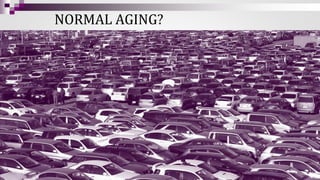
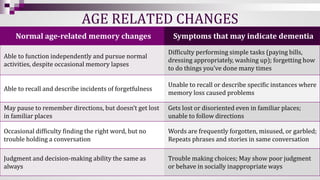
NORMAL AGING?
AGE RELATED CHANGES
6
Normal age-related memory changes Symptoms that may indicate dementia
Able to function independently and pursue normal
activities, despite occasional memory lapses
Difficulty performing simple tasks (paying bills,
dressing appropriately, washing up); forgetting how
to do things you’ve done many times
Able to recall and describe incidents of forgetfulness
Unable to recall or describe specific instances where
memory loss caused problems
May pause to remember directions, but doesn’t get lost
in familiar places
Gets lost or disoriented even in familiar places;
unable to follow directions
Occasional difficulty finding the right word, but no
trouble holding a conversation
Words are frequently forgotten, misused, or garbled;
Repeats phrases and stories in same conversation
Judgment and decision-making ability the same as
always
Trouble making choices; May show poor judgment
or behave in socially inappropriate ways
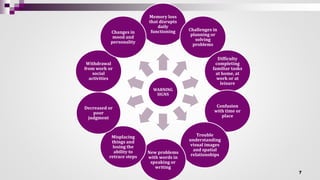
7
WARNING
SIGNS
Memory loss
that disrupts
daily
functioning Challenges in
planning or
solving
problems
Difficulty
completing
familiar tasks
at home, at
work or at
leisure
Confusion
with time or
place
Trouble
understanding
visual images
and spatial
relationshipsNew problems
with words in
speaking or
writing
Misplacing
things and
losing the
ability to
retrace steps
Decreased or
poor
judgment
Withdrawal
from work or
social
activities
Changes in
mood and
personality
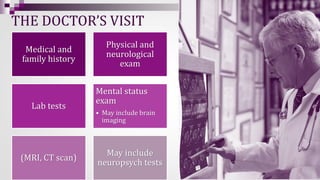
THE DOCTOR’S VISIT
Medical and
family history
Physical and
neurological
exam
Lab tests
Mental status
exam
• May include brain
imaging
(MRI, CT scan)
May include
neuropsych tests
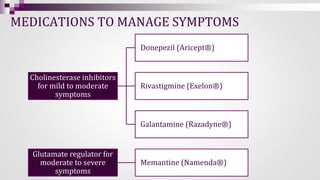
MEDICATIONS TO MANAGE SYMPTOMS
Cholinesterase inhibitors
for mild to moderate
symptoms
Donepezil (Aricept®)
Rivastigmine (Exelon®)
Galantamine (Razadyne®)
Glutamate regulator for
moderate to severe
symptoms
Memantine (Namenda®)
10
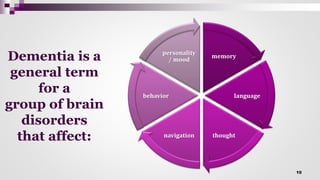
Dementia is a
general term
for a
group of brain
disorders
that affect:
memory
language
thoughtnavigation
behavior
personality
/ mood
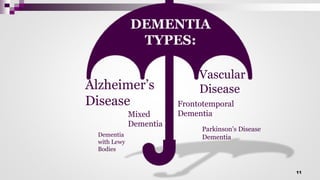
11
Alzheimer’s
Disease
Vascular
Disease
Mixed
Dementia
Dementia
with Lewy
Bodies
Frontotemporal
Dementia
Parkinson’s Disease
Dementia
DEMENTIA
TYPES:
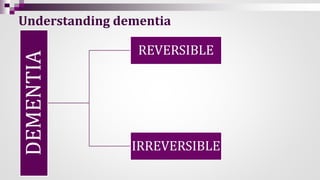
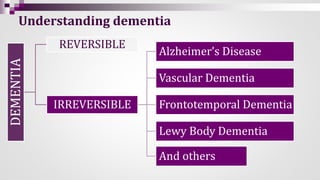
Understanding dementia
DEMENTIA
REVERSIBLE
IRREVERSIBLE
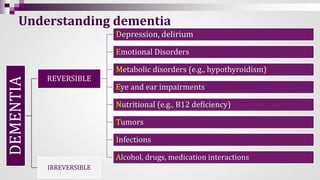
Understanding dementiaDEMENTIA
REVERSIBLE
Depression, delirium
Emotional Disorders
Metabolic disorders (e.g., hypothyroidism)
Eye and ear impairments
Nutritional (e.g., B12 deficiency)
Tumors
Infections
Alcohol, drugs, medication interactions
IRREVERSIBLE
Understanding dementiaDEMENTIA
REVERSIBLE
IRREVERSIBLE
Alzheimer’s Disease
Vascular Dementia
Frontotemporal Dementia
Lewy Body Dementia
And others
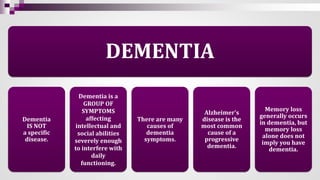
DEMENTIA
Dementia
IS NOT
a specific
disease.
Dementia is a
GROUP OF
SYMPTOMS
affecting
intellectual and
social abilities
severely enough
to interfere with
daily
functioning.
There are many
causes of
dementia
symptoms.
Alzheimer's
disease is the
most common
cause of a
progressive
dementia.
Memory loss
generally occurs
in dementia, but
memory loss
alone does not
imply you have
dementia.
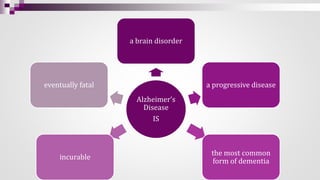
Alzheimer’s
Disease
IS
a brain disorder
a progressive disease
the most common
form of dementia
incurable
eventually fatal
17
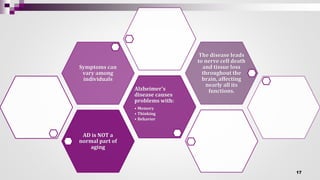
AD is NOT a
normal part of
aging
Alzheimer’s
disease causes
problems with:
• Memory
• Thinking
• Behavior
Symptoms can
vary among
individuals
The disease leads
to nerve cell death
and tissue loss
throughout the
brain, affecting
nearly all its
functions.
Unraveling the Mystery video clip
https://www.youtube.com/watch?v=wzkQyWpu10E
18
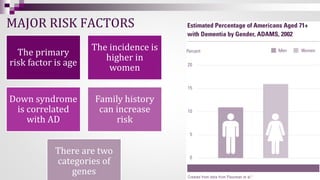
MAJOR RISK FACTORS
The primary
risk factor is age
The incidence is
higher in
women
Down syndrome
is correlated
with AD
Family history
can increase
risk
There are two
categories of
genes
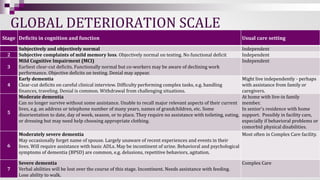
GLOBAL DETERIORATION SCALE
20
Stage Deficits in cognition and function Usual care setting
Subjectively and objectively normal Independent
2 Subjective complaints of mild memory loss. Objectively normal on testing. No functional deficit Independent
3
Mild Cognitive Impairment (MCI)
Earliest clear-cut deficits. Functionally normal but co-workers may be aware of declining work
performance. Objective deficits on testing. Denial may appear.
Independent
4
Early dementia
Clear-cut deficits on careful clinical interview. Difficulty performing complex tasks, e.g. handling
finances, traveling. Denial is common. Withdrawal from challenging situations.
Might live independently - perhaps
with assistance from family or
caregivers.
5
Moderate dementia
Can no longer survive without some assistance. Unable to recall major relevant aspects of their current
lives, e.g. an address or telephone number of many years, names of grandchildren, etc. Some
disorientation to date, day of week, season, or to place. They require no assistance with toileting, eating,
or dressing but may need help choosing appropriate clothing.
At home with live-in family
member.
In senior's residence with home
support. Possibly in facility care,
especially if behavioral problems or
comorbid physical disabilities.
6
Moderately severe dementia
May occasionally forget name of spouse. Largely unaware of recent experiences and events in their
lives. Will require assistance with basic ADLs. May be incontinent of urine. Behavioral and psychological
symptoms of dementia (BPSD) are common, e.g. delusions, repetitive behaviors, agitation.
Most often in Complex Care facility.
7
Severe dementia
Verbal abilities will be lost over the course of this stage. Incontinent. Needs assistance with feeding.
Lose ability to walk.
Complex Care
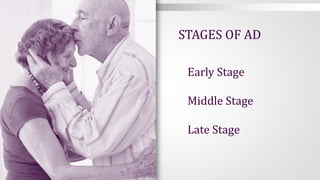
STAGES OF AD
Early Stage
Middle Stage
Late Stage
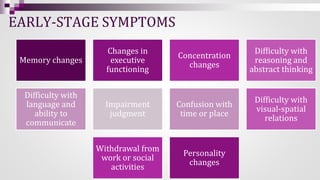
EARLY-STAGE SYMPTOMS
Memory changes
Changes in
executive
functioning
Concentration
changes
Difficulty with
reasoning and
abstract thinking
Difficulty with
language and
ability to
communicate
Impairment
judgment
Confusion with
time or place
Difficulty with
visual-spatial
relations
Withdrawal from
work or social
activities
Personality
changes
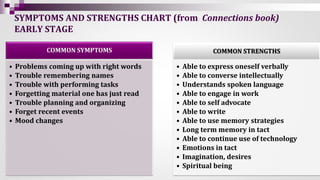
SYMPTOMS AND STRENGTHS CHART (from Connections book)
EARLY STAGE
COMMON SYMPTOMS
• Problems coming up with right words
• Trouble remembering names
• Trouble with performing tasks
• Forgetting material one has just read
• Trouble planning and organizing
• Forget recent events
• Mood changes
COMMON STRENGTHS
• Able to express oneself verbally
• Able to converse intellectually
• Understands spoken language
• Able to engage in work
• Able to self advocate
• Able to write
• Able to use memory strategies
• Long term memory in tact
• Able to continue use of technology
• Emotions in tact
• Imagination, desires
• Spiritual being
24
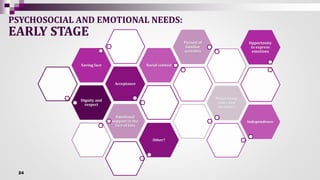
Dignity and
respect
Acceptance
Saving face Social contact
Pursuit of
familiar
activities
Maintaining
roles and
identities
Emotional
support in the
face of loss
Independence
Opportunity
to express
emotions
Other?
PSYCHOSOCIAL AND EMOTIONAL NEEDS:
EARLY STAGE
25
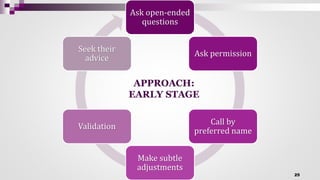
Ask open-ended
questions
Ask permission
Call by
preferred name
Make subtle
adjustments
Validation
Seek their
advice
APPROACH:
EARLY STAGE
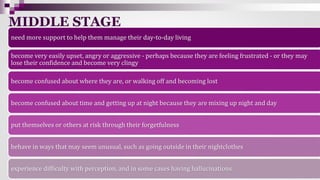
need more support to help them manage their day-to-day living
become very easily upset, angry or aggressive - perhaps because they are feeling frustrated - or they may
lose their confidence and become very clingy
become confused about where they are, or walking off and becoming lost
become confused about time and getting up at night because they are mixing up night and day
put themselves or others at risk through their forgetfulness
behave in ways that may seem unusual, such as going outside in their nightclothes
experience difficulty with perception, and in some cases having hallucinations.
MIDDLE STAGE
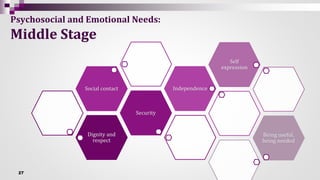
Psychosocial and Emotional Needs:
Middle Stage
27
Dignity and
respect
Security
Social contact Independence
Self
expression
Being useful,
being needed
28
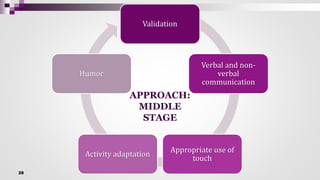
Validation
Verbal and non-
verbal
communication
Appropriate use of
touch
Activity adaptation
Humor
APPROACH:
MIDDLE
STAGE
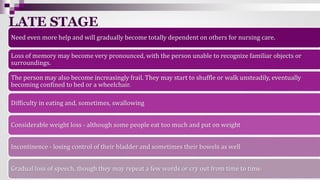
Need even more help and will gradually become totally dependent on others for nursing care.
Loss of memory may become very pronounced, with the person unable to recognize familiar objects or
surroundings.
The person may also become increasingly frail. They may start to shuffle or walk unsteadily, eventually
becoming confined to bed or a wheelchair.
Difficulty in eating and, sometimes, swallowing
Considerable weight loss - although some people eat too much and put on weight
Incontinence - losing control of their bladder and sometimes their bowels as well
Gradual loss of speech, though they may repeat a few words or cry out from time to time.
LATE STAGE
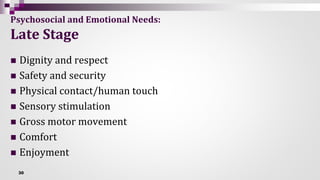
Psychosocial and Emotional Needs:
Late Stage
 Dignity and respect
 Safety and security
 Physical contact/human touch
 Sensory stimulation
 Gross motor movement
 Comfort
 Enjoyment
30
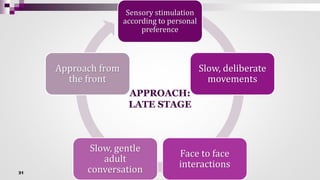
31
Sensory stimulation
according to personal
preference
Slow, deliberate
movements
Face to face
interactions
Slow, gentle
adult
conversation
Approach from
the front
APPROACH:
LATE STAGE
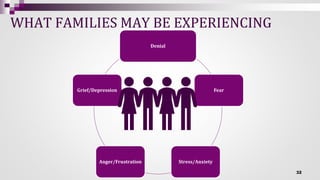
WHAT FAMILIES MAY BE EXPERIENCING
Denial
Fear
Stress/AnxietyAnger/Frustration
Grief/Depression
32
33
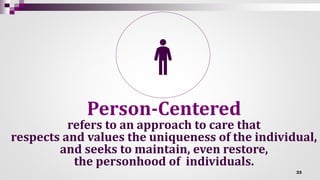
Person-Centered
refers to an approach to care that
respects and values the uniqueness of the individual,
and seeks to maintain, even restore,
the personhood of individuals.
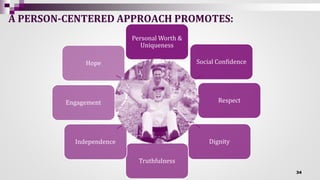
A PERSON-CENTERED APPROACH PROMOTES:
34
.
Personal Worth &
Uniqueness
Social Confidence
Respect
Dignity
Truthfulness
Independence
Engagement
Hope
35
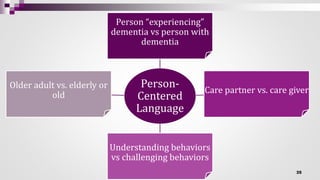
Person-
Centered
Language
Person “experiencing”
dementia vs person with
dementia
Care partner vs. care giver
Understanding behaviors
vs challenging behaviors
Older adult vs. elderly or
old
PERSON-CENTERED MATTERS
http://daanow.org/an-extraordinary-video-about-dementia/
36
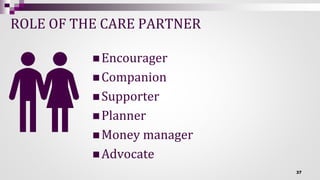
ROLE OF THE CARE PARTNER
 Encourager
 Companion
 Supporter
 Planner
 Money manager
 Advocate
37
POLL – select all FALSE statements:
38
 Dementia is a normal part of aging
 Some types of dementia are reversible
 Alzheimer’s disease and dementia are the same
 There is a cure for Alzheimer’s disease
 Alzheimer’s disease is the sixth leading cause of death in the US
RECAP
Be able to explain the difference between dementia and
Alzheimer’s disease
Be able to list at least 3 common characteristics of early stages
of dementia
Demonstrate an understanding of what families may be
experiencing
Be able to identify two principles of a person centered approach