Alzheimer’s By Jillian Adams Human Anatomy & Physiology Due Date: April 20, 2011
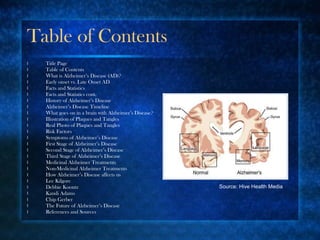
Table of Contents Title Page Table of Contents What is Alzheimer’s Disease (AD)? Early onset vs. Late Onset AD Facts and Statistics Facts and Statistics cont. History of Alzheimer’s Disease Alzheimer’s Disease Timeline What goes on in a brain with Alzheimer’s Disease? Illustration of Plaques and Tangles Real Photo of Plaques and Tangles Risk Factors Symptoms of Alzheimer’s Disease First Stage of Alzheimer’s Disease Second Stage of Alzheimer’s Disease Third Stage of Alzheimer’s Disease Medicinal Alzheimer Treatments Non-Medicinal Alzheimer Treatments How Alzheimer’s Disease affects us Lee Kilgore Debbie Koontz Kandi Adams Chip Gerber The Future of Alzheimer’s Disease References and Sources Source: Hive Health Media
What is Alzheimer’s Disease (AD)? “ Alzheimer's is a brain disease that causes problems with memory, thinking and behavior.” (Alzheimer’s Association) Most common cause of dementia Severely interferes with daily life Grows worse over time Currently no known cure and few effective treatments
Early Onset vs. Late Onset AD Early Onset symptoms appear in people younger than 60 years old. Less common, only 5% of Alzheimer cases begin before age 65. (Mayo Clinic) Can run in families, several genes have already been identified (APP, PSEN 1 & PSEN 2). Late Onset symptoms appear in people 60 years old and over. Most common May be genetic, but the “role of genes is less clear.” (PubMed Health)
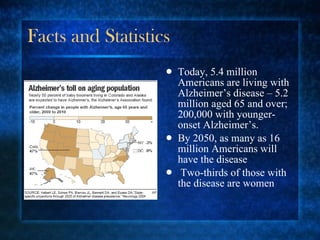
Facts and Statistics Today, 5.4 million Americans are living with Alzheimer’s disease – 5.2 million aged 65 and over; 200,000 with younger-onset Alzheimer’s. By 2050, as many as 16 million Americans will have the disease Two-thirds of those with the disease are women
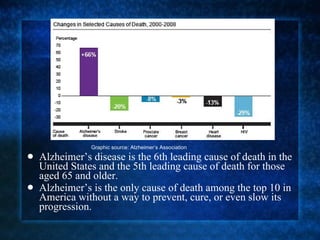
Graphic source: Alzheimer’s Association Alzheimer’s disease is the 6th leading cause of death in the United States and the 5th leading cause of death for those aged 65 and older. Alzheimer’s is the only cause of death among the top 10 in America without a way to prevent, cure, or even slow its progression.
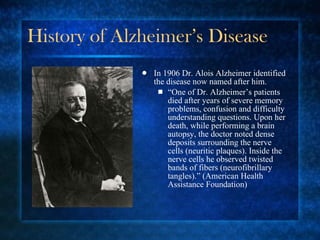
History of Alzheimer’s Disease In 1906 Dr. Alois Alzheimer identified the disease now named after him. “ One of Dr. Alzheimer’s patients died after years of severe memory problems, confusion and difficulty understanding questions. Upon her death, while performing a brain autopsy, the doctor noted dense deposits surrounding the nerve cells (neuritic plaques). Inside the nerve cells he observed twisted bands of fibers (neurofibrillary tangles).” (American Health Assistance Foundation)
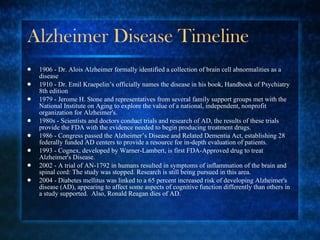
Alzheimer Disease Timeline 1906 - Dr. Alois Alzheimer formally identified a collection of brain cell abnormalities as a disease 1910 - Dr. Emil Kraepelin’s officially names the disease in his book, Handbook of Psychiatry 8th edition 1979 - Jerome H. Stone and representatives from several family support groups met with the National Institute on Aging to explore the value of a national, independent, nonprofit organization for Alzheimer's. 1980s - Scientists and doctors conduct trials and research of AD, the results of these trials provide the FDA with the evidence needed to begin producing treatment drugs. 1986 - Congress passed the Alzheimer’s Disease and Related Dementia Act, establishing 28 federally funded AD centers to provide a resource for in-depth evaluation of patients. 1993 - Cognex, developed by Warner-Lambert, is first FDA-Approved drug to treat Alzheimer's Disease. 2002 - A trial of AN-1792 in humans resulted in symptoms of inflammation of the brain and spinal cord: The study was stopped. Research is still being pursued in this area.  2004 - Diabetes mellitus was linked to a 65 percent increased risk of developing Alzheimer's disease (AD), appearing to affect some aspects of cognitive function differently than others in a study supported.  Also, Ronald Reagan dies of AD.
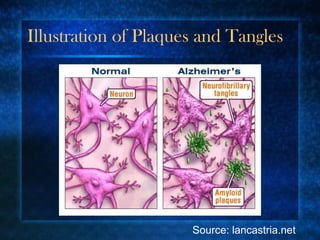
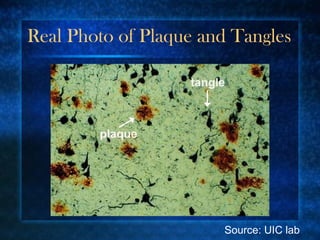
What goes on in a brain with Alzheimer’s Disease? The brain shrinks, sometimes starting nearly a decade before AD is diagnosed (Reuters) As Dr. Alzheimer discovered, “Alzheimer's disease is characterized by a build-up of proteins in the brain. Though this cannot be measured in a living person, extensive autopsy studies have revealed this phenomenon.” (Carrie Hill, PhD) This happens in two ways: Plaques – deposits of the protein beta-amyloid that accumulate in the spaces between nerve cells. This interferes with cell-to-cell communication and is thought to be the reason brain cell death in Alzheimer’s Disease occurs. Tangles – deposits of the protein tau that accumulate inside of nerve cells. Tau’s normal function is to transport nutrients between brain cells. When Tau systems tangle, this becomes difficult.
Illustration of Plaques and Tangles Source: lancastria.net
Real Photo of Plaque and Tangles Source: UIC lab
Risk Factors Age People over the age of 65 are most likely to suffer from Alzheimer’s Disease, almost half of all people over the age of 85 have AD Gender Women have a higher risk of AD than men Genetics Early onset AD is hereditary. Although it’s not certain with late onset AD, many suspect there to be a higher risk for those who have a family history of AD. Diabetes “ In Type 2 diabetes insulin does not work effectively to convert blood sugar into energy. This inefficiency results in production of higher levels of insulin and blood sugar which may harm the brain and contribute to the progression of Alzheimer's.” (Alzheimer’s Disease Research) Cardiovascular Health High blood pressure and high cholesterol may damage blood vessels in the brain and also inhibit the ability of the blood to clear protein from the brain.
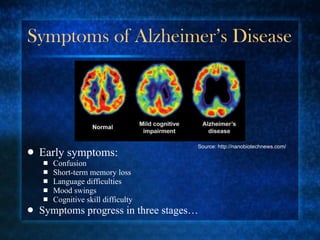
Symptoms of Alzheimer’s Disease Early symptoms: Confusion Short-term memory loss Language difficulties Mood swings Cognitive skill difficulty Symptoms progress in three stages… Source: http://nanobiotechnews.com/
First Stage of Alzheimer’s Disease Usually lasts 2-4 years Energy loss Minor memory loss Minor mood swings Confusion Those with stage one can get lost easily, lose things easily, become withdrawn and stick to the familiar, have trouble concentrating, trouble communicating, become angry and frustrated with their symptoms.
Second Stage of Alzheimer’s Disease Longest stage, can last up to 10 years Symptoms become more noticeable Speech difficulties Changes in sleep patterns Poor judgment, difficulties assessing risks Moderate memory loss including recent events and personal history. Distant events and recent events may become mixed up. Those with stage two AD can still perform daily tasks independently but may require assistance with complicated tasks. They may also become disconnected from reality and have difficulties recognizing people. Frustration with symptoms may lead to depression and irritability.
Third Stage of Alzheimer’s Disease Final and most severe stage Shortest stage, usually lasting 1-3 years Those with stage three AD may be unable to independently perform basic tasks like eating, dressing, and speaking. Constant care such as a live-in nurse or assisted living facility are needed during this stage. A person with stage three AD sleeps often and usually loses most of his or her personality and interests.
Medicinal Alzheimer Treatments Medication helps cognitive and memory symptoms for a time. Aricept, Razadyne, and Excelon are popular Cholinesterase inhibitors on the market for treatment of AD. Cholinesterase is a chemical which assists with cell-to-cell communication in the brain. Side effects include nausea, fatigue, diarrhea, vomiting, and muscle cramps. Namenda is often used in conjunction with Cholinesterase inhibitors. The most common side effect is dizziness.
Non-Medicinal Alzheimer Treatments Exercise improves mood and heart health Proper Nutrition Provide a safe comfortable home by removing clutter and slippery surfaces, installing sturdy handrails on staircases, and removing mirrors (which can confuse those with AD). Patience and support to help with the frustration a person with Alzheimer’s feels
How Alzheimer’s Disease affects us I interviewed my friends and family that have seen a loved one battle Alzheimer’s Disease.  They told me their stories and how it made them feel. I also found online the diary of Chip Gerber, a man who was diagnosed with early onset Alzheimer’s Disease at the age of 52.
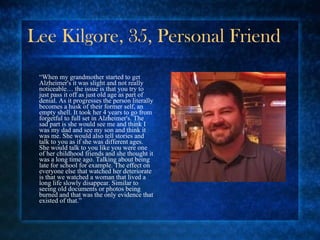
Lee Kilgore, 35, Personal Friend “ When my grandmother started to get Alzheimer's it was slight and not really noticeable… the issue is that you try to just pass it off as just old age as part of denial. As it progresses the person literally becomes a husk of their former self, an empty shell. It took her 4 years to go from forgetful to full set in Alzheimer's. The sad part is she would see me and think I was my dad and see my son and think it was me. She would also tell stories and talk to you as if she was different ages. She would talk to you like you were one of her childhood friends and she thought it was a long time ago. Talking about being late for school for example. The effect on everyone else that watched her deteriorate is that we watched a woman that lived a long life slowly disappear. Similar to seeing old documents or photos being burned and that was the only evidence that existed of that.”
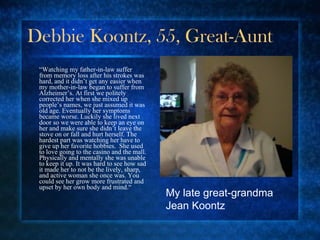
Debbie Koontz, 55, Great-Aunt “ Watching my father-in-law suffer from memory loss after his strokes was hard, and it didn’t get any easier when my mother-in-law began to suffer from Alzheimer’s. At first we politely corrected her when she mixed up people’s names, we just assumed it was old age. Eventually her symptoms became worse. Luckily she lived next door so we were able to keep an eye on her and make sure she didn’t leave the stove on or fall and hurt herself. The hardest part was watching her have to give up her favorite hobbies.  She used to love going to the casino and the mall. Physically and mentally she was unable to keep it up. It was hard to see how sad it made her to not be the lively, sharp, and active woman she once was. You could see her grow more frustrated and upset by her own body and mind.“ My late great-grandma Jean Koontz
Kandi Adams, Grandmother My grandma’s friend Nancy passed away recently from cancer, but suffered from Alzheimer’s for years. “ When I first saw that things were not quite right with her was when she would forget things like her keys, purse, address, etc. She would get lost really easy. One time she went to the park for her walk, like usual, and she got there and had no idea where she was or how she got there. She was pretty scared. It was hard to see her losing it...Sometimes things were be really clear for her and she would be angry... hit her head with her hand and say "I feel so stupid"... "why can't I remember stuff"... then slip back a few seconds later and not know where she was. In September she was with me for a week and she had another moment of clarity and said "why is it I can't remember things...why would God do this to me". I told her that sometimes God does things to protect us and maybe he was just protecting her (she did not remember she was dying). It was really hard on the family when she didn't know who she was [or] who they were…It was so bad at one point that she didn't know how to use the phone... she would hold up the wrong end to talk. Then she didn't even know what the heck it was so Lori [her daughter] just had it disconnected…I am missing her lots and for a woman who was never ever sick and was always taking care of others, it just seems like when she did need health care, it was something that could not be cured.”
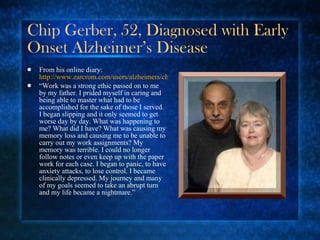
Chip Gerber, 52, Diagnosed with Early Onset Alzheimer’s Disease From his online diary:  http://www.zarcrom.com/users/alzheimers/chip.html “ Work was a strong ethic passed on to me by my father. I prided myself in caring and being able to master what had to be accomplished for the sake of those I served. I began slipping and it only seemed to get worse day by day. What was happening to me? What did I have? What was causing my memory loss and causing me to be unable to carry out my work assignments? My memory was terrible. I could no longer follow notes or even keep up with the paper work for each case. I began to panic, to have anxiety attacks, to lose control. I became clinically depressed. My journey and many of my goals seemed to take an abrupt turn and my life became a nightmare.”
The Future of Alzheimer’s Disease The search for a cure for Alzheimer’s is never-ending. Some interesting studies have come up with some possible clues, but so far a cure has been elusive. Until then, research will continue to be conducted and awareness of this disease will hopefully spread.
References and Sources Mayo Clinic  http://www.mayoclinic.com Alzheimer’s Association  http://www.alz.org The National Center for Biotechnology Information  http://www.ncbi.nlm.nih.gov MSNBC  http://www.msnbc.msn.com/id/17694931/ns/health-alzheimers_disease/ American Health Assistance Foundation  http://www.ahaf.org/alzheimers/treatment/ PubMed Health http://www.ncbi.nlm.nih.gov/pubmedhealth/PMH0001767/#adam_000760.disease.treatment Kalamazoo Center for Medical Studies http://hod.kcms.msu.edu/index.php The LaRue Research Lab at University of Illinois at Chicago http://ladulab.anat.uic.edu/ Reuters http://www.reuters.com/article/2011/04/13/us-alzheimers-scans-idUSTRE73C7Z820110413 Sources of graphics are listed underneath the graphic About.com http://alzheimers.about.com/od/whatisalzheimer1/a/causes.htm My Journey by Chip Gerber http://www.zarcrom.com/users/alzheimers/chip.html   Kandi Adams Debbie Koontz Lee Kilgore

Alzheimer Project

  • 1.
    Alzheimer’s By JillianAdams Human Anatomy & Physiology Due Date: April 20, 2011
  • 2.
    Table of ContentsTitle Page Table of Contents What is Alzheimer’s Disease (AD)? Early onset vs. Late Onset AD Facts and Statistics Facts and Statistics cont. History of Alzheimer’s Disease Alzheimer’s Disease Timeline What goes on in a brain with Alzheimer’s Disease? Illustration of Plaques and Tangles Real Photo of Plaques and Tangles Risk Factors Symptoms of Alzheimer’s Disease First Stage of Alzheimer’s Disease Second Stage of Alzheimer’s Disease Third Stage of Alzheimer’s Disease Medicinal Alzheimer Treatments Non-Medicinal Alzheimer Treatments How Alzheimer’s Disease affects us Lee Kilgore Debbie Koontz Kandi Adams Chip Gerber The Future of Alzheimer’s Disease References and Sources Source: Hive Health Media
  • 3.
    What is Alzheimer’sDisease (AD)? “ Alzheimer's is a brain disease that causes problems with memory, thinking and behavior.” (Alzheimer’s Association) Most common cause of dementia Severely interferes with daily life Grows worse over time Currently no known cure and few effective treatments
  • 4.
    Early Onset vs.Late Onset AD Early Onset symptoms appear in people younger than 60 years old. Less common, only 5% of Alzheimer cases begin before age 65. (Mayo Clinic) Can run in families, several genes have already been identified (APP, PSEN 1 & PSEN 2). Late Onset symptoms appear in people 60 years old and over. Most common May be genetic, but the “role of genes is less clear.” (PubMed Health)
  • 5.
    Facts and StatisticsToday, 5.4 million Americans are living with Alzheimer’s disease – 5.2 million aged 65 and over; 200,000 with younger-onset Alzheimer’s. By 2050, as many as 16 million Americans will have the disease Two-thirds of those with the disease are women
  • 6.
    Graphic source: Alzheimer’sAssociation Alzheimer’s disease is the 6th leading cause of death in the United States and the 5th leading cause of death for those aged 65 and older. Alzheimer’s is the only cause of death among the top 10 in America without a way to prevent, cure, or even slow its progression.
  • 7.
    History of Alzheimer’sDisease In 1906 Dr. Alois Alzheimer identified the disease now named after him. “ One of Dr. Alzheimer’s patients died after years of severe memory problems, confusion and difficulty understanding questions. Upon her death, while performing a brain autopsy, the doctor noted dense deposits surrounding the nerve cells (neuritic plaques). Inside the nerve cells he observed twisted bands of fibers (neurofibrillary tangles).” (American Health Assistance Foundation)
  • 8.
    Alzheimer Disease Timeline1906 - Dr. Alois Alzheimer formally identified a collection of brain cell abnormalities as a disease 1910 - Dr. Emil Kraepelin’s officially names the disease in his book, Handbook of Psychiatry 8th edition 1979 - Jerome H. Stone and representatives from several family support groups met with the National Institute on Aging to explore the value of a national, independent, nonprofit organization for Alzheimer's. 1980s - Scientists and doctors conduct trials and research of AD, the results of these trials provide the FDA with the evidence needed to begin producing treatment drugs. 1986 - Congress passed the Alzheimer’s Disease and Related Dementia Act, establishing 28 federally funded AD centers to provide a resource for in-depth evaluation of patients. 1993 - Cognex, developed by Warner-Lambert, is first FDA-Approved drug to treat Alzheimer's Disease. 2002 - A trial of AN-1792 in humans resulted in symptoms of inflammation of the brain and spinal cord: The study was stopped. Research is still being pursued in this area. 2004 - Diabetes mellitus was linked to a 65 percent increased risk of developing Alzheimer's disease (AD), appearing to affect some aspects of cognitive function differently than others in a study supported. Also, Ronald Reagan dies of AD.
  • 9.
    What goes onin a brain with Alzheimer’s Disease? The brain shrinks, sometimes starting nearly a decade before AD is diagnosed (Reuters) As Dr. Alzheimer discovered, “Alzheimer's disease is characterized by a build-up of proteins in the brain. Though this cannot be measured in a living person, extensive autopsy studies have revealed this phenomenon.” (Carrie Hill, PhD) This happens in two ways: Plaques – deposits of the protein beta-amyloid that accumulate in the spaces between nerve cells. This interferes with cell-to-cell communication and is thought to be the reason brain cell death in Alzheimer’s Disease occurs. Tangles – deposits of the protein tau that accumulate inside of nerve cells. Tau’s normal function is to transport nutrients between brain cells. When Tau systems tangle, this becomes difficult.
  • 10.
    Illustration of Plaquesand Tangles Source: lancastria.net
  • 11.
    Real Photo ofPlaque and Tangles Source: UIC lab
  • 12.
    Risk Factors AgePeople over the age of 65 are most likely to suffer from Alzheimer’s Disease, almost half of all people over the age of 85 have AD Gender Women have a higher risk of AD than men Genetics Early onset AD is hereditary. Although it’s not certain with late onset AD, many suspect there to be a higher risk for those who have a family history of AD. Diabetes “ In Type 2 diabetes insulin does not work effectively to convert blood sugar into energy. This inefficiency results in production of higher levels of insulin and blood sugar which may harm the brain and contribute to the progression of Alzheimer's.” (Alzheimer’s Disease Research) Cardiovascular Health High blood pressure and high cholesterol may damage blood vessels in the brain and also inhibit the ability of the blood to clear protein from the brain.
  • 13.
    Symptoms of Alzheimer’sDisease Early symptoms: Confusion Short-term memory loss Language difficulties Mood swings Cognitive skill difficulty Symptoms progress in three stages… Source: http://nanobiotechnews.com/
  • 14.
    First Stage ofAlzheimer’s Disease Usually lasts 2-4 years Energy loss Minor memory loss Minor mood swings Confusion Those with stage one can get lost easily, lose things easily, become withdrawn and stick to the familiar, have trouble concentrating, trouble communicating, become angry and frustrated with their symptoms.
  • 15.
    Second Stage ofAlzheimer’s Disease Longest stage, can last up to 10 years Symptoms become more noticeable Speech difficulties Changes in sleep patterns Poor judgment, difficulties assessing risks Moderate memory loss including recent events and personal history. Distant events and recent events may become mixed up. Those with stage two AD can still perform daily tasks independently but may require assistance with complicated tasks. They may also become disconnected from reality and have difficulties recognizing people. Frustration with symptoms may lead to depression and irritability.
  • 16.
    Third Stage ofAlzheimer’s Disease Final and most severe stage Shortest stage, usually lasting 1-3 years Those with stage three AD may be unable to independently perform basic tasks like eating, dressing, and speaking. Constant care such as a live-in nurse or assisted living facility are needed during this stage. A person with stage three AD sleeps often and usually loses most of his or her personality and interests.
  • 17.
    Medicinal Alzheimer TreatmentsMedication helps cognitive and memory symptoms for a time. Aricept, Razadyne, and Excelon are popular Cholinesterase inhibitors on the market for treatment of AD. Cholinesterase is a chemical which assists with cell-to-cell communication in the brain. Side effects include nausea, fatigue, diarrhea, vomiting, and muscle cramps. Namenda is often used in conjunction with Cholinesterase inhibitors. The most common side effect is dizziness.
  • 18.
    Non-Medicinal Alzheimer TreatmentsExercise improves mood and heart health Proper Nutrition Provide a safe comfortable home by removing clutter and slippery surfaces, installing sturdy handrails on staircases, and removing mirrors (which can confuse those with AD). Patience and support to help with the frustration a person with Alzheimer’s feels
  • 19.
    How Alzheimer’s Diseaseaffects us I interviewed my friends and family that have seen a loved one battle Alzheimer’s Disease. They told me their stories and how it made them feel. I also found online the diary of Chip Gerber, a man who was diagnosed with early onset Alzheimer’s Disease at the age of 52.
  • 20.
    Lee Kilgore, 35,Personal Friend “ When my grandmother started to get Alzheimer's it was slight and not really noticeable… the issue is that you try to just pass it off as just old age as part of denial. As it progresses the person literally becomes a husk of their former self, an empty shell. It took her 4 years to go from forgetful to full set in Alzheimer's. The sad part is she would see me and think I was my dad and see my son and think it was me. She would also tell stories and talk to you as if she was different ages. She would talk to you like you were one of her childhood friends and she thought it was a long time ago. Talking about being late for school for example. The effect on everyone else that watched her deteriorate is that we watched a woman that lived a long life slowly disappear. Similar to seeing old documents or photos being burned and that was the only evidence that existed of that.”
  • 21.
    Debbie Koontz, 55,Great-Aunt “ Watching my father-in-law suffer from memory loss after his strokes was hard, and it didn’t get any easier when my mother-in-law began to suffer from Alzheimer’s. At first we politely corrected her when she mixed up people’s names, we just assumed it was old age. Eventually her symptoms became worse. Luckily she lived next door so we were able to keep an eye on her and make sure she didn’t leave the stove on or fall and hurt herself. The hardest part was watching her have to give up her favorite hobbies. She used to love going to the casino and the mall. Physically and mentally she was unable to keep it up. It was hard to see how sad it made her to not be the lively, sharp, and active woman she once was. You could see her grow more frustrated and upset by her own body and mind.“ My late great-grandma Jean Koontz
  • 22.
    Kandi Adams, GrandmotherMy grandma’s friend Nancy passed away recently from cancer, but suffered from Alzheimer’s for years. “ When I first saw that things were not quite right with her was when she would forget things like her keys, purse, address, etc. She would get lost really easy. One time she went to the park for her walk, like usual, and she got there and had no idea where she was or how she got there. She was pretty scared. It was hard to see her losing it...Sometimes things were be really clear for her and she would be angry... hit her head with her hand and say "I feel so stupid"... "why can't I remember stuff"... then slip back a few seconds later and not know where she was. In September she was with me for a week and she had another moment of clarity and said "why is it I can't remember things...why would God do this to me". I told her that sometimes God does things to protect us and maybe he was just protecting her (she did not remember she was dying). It was really hard on the family when she didn't know who she was [or] who they were…It was so bad at one point that she didn't know how to use the phone... she would hold up the wrong end to talk. Then she didn't even know what the heck it was so Lori [her daughter] just had it disconnected…I am missing her lots and for a woman who was never ever sick and was always taking care of others, it just seems like when she did need health care, it was something that could not be cured.”
  • 23.
    Chip Gerber, 52,Diagnosed with Early Onset Alzheimer’s Disease From his online diary: http://www.zarcrom.com/users/alzheimers/chip.html “ Work was a strong ethic passed on to me by my father. I prided myself in caring and being able to master what had to be accomplished for the sake of those I served. I began slipping and it only seemed to get worse day by day. What was happening to me? What did I have? What was causing my memory loss and causing me to be unable to carry out my work assignments? My memory was terrible. I could no longer follow notes or even keep up with the paper work for each case. I began to panic, to have anxiety attacks, to lose control. I became clinically depressed. My journey and many of my goals seemed to take an abrupt turn and my life became a nightmare.”
  • 24.
    The Future ofAlzheimer’s Disease The search for a cure for Alzheimer’s is never-ending. Some interesting studies have come up with some possible clues, but so far a cure has been elusive. Until then, research will continue to be conducted and awareness of this disease will hopefully spread.
  • 25.
    References and SourcesMayo Clinic http://www.mayoclinic.com Alzheimer’s Association http://www.alz.org The National Center for Biotechnology Information http://www.ncbi.nlm.nih.gov MSNBC http://www.msnbc.msn.com/id/17694931/ns/health-alzheimers_disease/ American Health Assistance Foundation http://www.ahaf.org/alzheimers/treatment/ PubMed Health http://www.ncbi.nlm.nih.gov/pubmedhealth/PMH0001767/#adam_000760.disease.treatment Kalamazoo Center for Medical Studies http://hod.kcms.msu.edu/index.php The LaRue Research Lab at University of Illinois at Chicago http://ladulab.anat.uic.edu/ Reuters http://www.reuters.com/article/2011/04/13/us-alzheimers-scans-idUSTRE73C7Z820110413 Sources of graphics are listed underneath the graphic About.com http://alzheimers.about.com/od/whatisalzheimer1/a/causes.htm My Journey by Chip Gerber http://www.zarcrom.com/users/alzheimers/chip.html Kandi Adams Debbie Koontz Lee Kilgore