DIVISION OF LIBRARY SERVICES
Altmetrics, Apples and Oranges
Academic Libraries in the Brave New World of Research Impact
Western Australian Group of University Librarians (WAGUL) Research Day
22 July 2014
DIVISION OF LIBRARY SERVICES
Ranganathan’s 5 laws of library science
1. Books are for use.
2. Every reader his [or her] book.
3. Every book its reader.
4. Save the time of the reader.
5. The library is a growing organism.
DIVISION OF LIBRARY SERVICES
5 laws applied to research impact
1. Research is for impact.
2. All research impact its artefacts.
3. All research artefacts their impact.
4. Save the time of the researcher!
5. Research impact is a growing organism.
DIVISION OF LIBRARY SERVICES
Problems with traditional impact metrics
•Citation databases favour STEM fields of research
•H-index favours senior researchers in STEM fields
•JIF is not a surrogate measure of author or article impact
•Traditional metrics measure only scholarly impact
•Scholarly citations can take a long time to accumulate
•Scholarly citations do necessarily indicate positive impact
DIVISION OF LIBRARY SERVICES
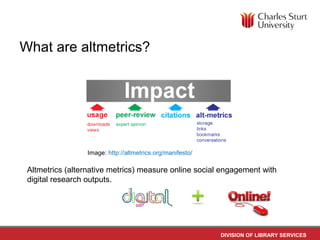
What are altmetrics?
Altmetrics (alternative metrics) measure online social engagement with
digital research outputs.
Image: http://altmetrics.org/manifesto/
DIVISION OF LIBRARY SERVICES
What do altmetrics measure?
Research outputs:
•Scholarly articles
•Conference papers
•Books and book chapters
•Cases and clinical trials
•Videos and presentations
•Programming code
•Figures and datasets
•Blogs and web pages
•Media coverage
•Grants and patents
Social impact:
•Scholarly citations
•Views and downloads
•Tweets, shares and posts
•Comments and ratings
•Library holdings
•Favourites & bookmarks
•Readers and followers
•Clicks and comments
•Blog and forum counts
•Likes, reviews and +1s
DIVISION OF LIBRARY SERVICES
What are the advantages of altmetrics?
•Monitor social engagement with digital research outputs
•Competitive advantage for grant and promotion applications
•Provide evidence of social impact for performance reviews
•Provide evaluation data for reviewing social media strategy
•Provide evidence of public impact for open access artefacts
•Complement other impact data and add to impact narrative
•Open source data that is harvestable by third-party systems
DIVISION OF LIBRARY SERVICES
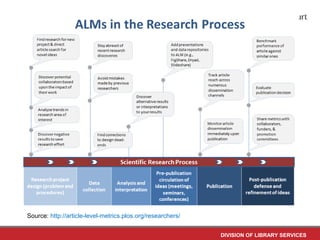
Source: http://article-level-metrics.plos.org/researchers/
DIVISION OF LIBRARY SERVICES
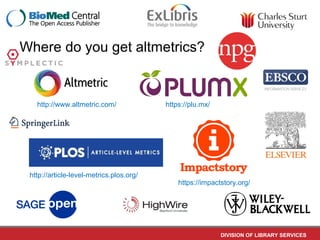
Where do you get altmetrics?
http://www.altmetric.com/
https://impactstory.org/
http://article-level-metrics.plos.org/
https://plu.mx/
DIVISION OF LIBRARY SERVICES
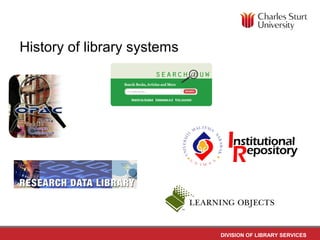
History of library systems
DIVISION OF LIBRARY SERVICES
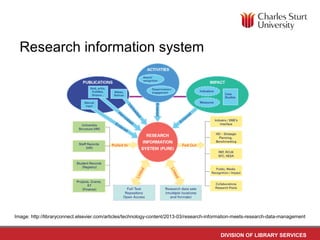
Research information system
Image: http://libraryconnect.elsevier.com/articles/technology-content/2013-03/research-information-meets-research-data-management
DIVISION OF LIBRARY SERVICES
Issues with “closed” information systems
•Information silos and predetermined outputs and impact
•Inflexibility of harvesting and feed options
•Limited interfacing options with competing systems
•Lack of metadata and relationship control
•Potential conflict of interest with institutional priorities
•Risk of adversely influencing researcher behaviour
DIVISION OF LIBRARY SERVICES
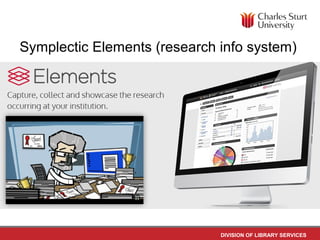
Symplectic Elements (research info system)
DIVISION OF LIBRARY SERVICES
Altmetrics and academic libraries
•Raising awareness and providing training and support
•Facilitating access & defining metadata and relationships
•Working with stakeholders to determine roles & workflows
•We can collaborate with & influence altmetrics developers
DIVISION OF LIBRARY SERVICES
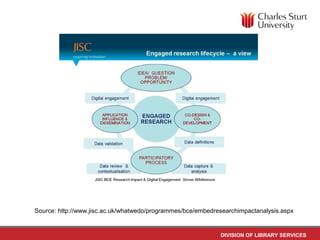
Source: http://www.jisc.ac.uk/whatwedo/programmes/bce/embedresearchimpactanalysis.aspx
DIVISION OF LIBRARY SERVICES
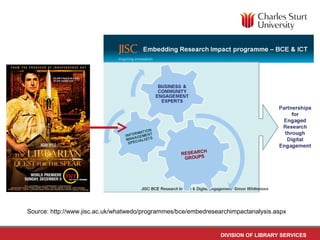
Source: http://www.jisc.ac.uk/whatwedo/programmes/bce/embedresearchimpactanalysis.aspx
DIVISION OF LIBRARY SERVICES
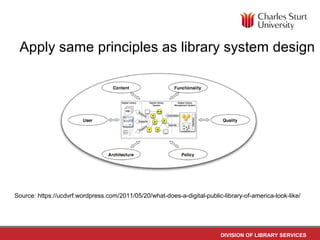
Apply same principles as library system design
Source: https://ucdvrf.wordpress.com/2011/05/20/what-does-a-digital-public-library-of-america-look-like/
DIVISION OF LIBRARY SERVICES
5 laws applied to altmetrics
1. Digital research with impact has altmetrics.
2. All altmetrics their research outputs.
3. All research outputs their altmetrics.
4. Altmetrics save the time of the researcher!
5. Altmetrics is a growing organism.
For example: NISO Alternative Metrics (Altmetrics) Project
DIVISION OF LIBRARY SERVICES
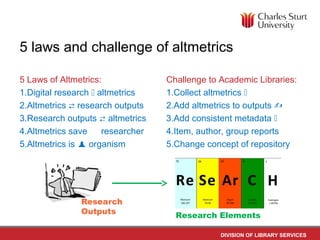
5 laws and challenge of altmetrics
5 Laws of Altmetrics:
1.Digital research  altmetrics
2.Altmetrics  research outputs
3.Research outputs  altmetrics
4.Altmetrics save  researcher
5.Altmetrics is  organism
Challenge to Academic Libraries:
1.Collect altmetrics 
2.Add altmetrics to outputs 
3.Add consistent metadata 
4.Item, author, group reports 
5.Change concept of repository
Research Elements
DIVISION OF LIBRARY SERVICES
Thank You!
Pat Loria, Manager Information Services
Charles Sturt University Library
Email: ploria@csu.edu.au
Twitter: @pat_loria

Altmetrics apples and oranges

  • 1.
    DIVISION OF LIBRARYSERVICES Altmetrics, Apples and Oranges Academic Libraries in the Brave New World of Research Impact Western Australian Group of University Librarians (WAGUL) Research Day 22 July 2014
  • 2.
    DIVISION OF LIBRARYSERVICES Ranganathan’s 5 laws of library science 1. Books are for use. 2. Every reader his [or her] book. 3. Every book its reader. 4. Save the time of the reader. 5. The library is a growing organism.
  • 3.
    DIVISION OF LIBRARYSERVICES 5 laws applied to research impact 1. Research is for impact. 2. All research impact its artefacts. 3. All research artefacts their impact. 4. Save the time of the researcher! 5. Research impact is a growing organism.
  • 4.
    DIVISION OF LIBRARYSERVICES Problems with traditional impact metrics •Citation databases favour STEM fields of research •H-index favours senior researchers in STEM fields •JIF is not a surrogate measure of author or article impact •Traditional metrics measure only scholarly impact •Scholarly citations can take a long time to accumulate •Scholarly citations do necessarily indicate positive impact
  • 5.
    DIVISION OF LIBRARYSERVICES What are altmetrics? Altmetrics (alternative metrics) measure online social engagement with digital research outputs. Image: http://altmetrics.org/manifesto/
  • 6.
    DIVISION OF LIBRARYSERVICES What do altmetrics measure? Research outputs: •Scholarly articles •Conference papers •Books and book chapters •Cases and clinical trials •Videos and presentations •Programming code •Figures and datasets •Blogs and web pages •Media coverage •Grants and patents Social impact: •Scholarly citations •Views and downloads •Tweets, shares and posts •Comments and ratings •Library holdings •Favourites & bookmarks •Readers and followers •Clicks and comments •Blog and forum counts •Likes, reviews and +1s
  • 7.
    DIVISION OF LIBRARYSERVICES What are the advantages of altmetrics? •Monitor social engagement with digital research outputs •Competitive advantage for grant and promotion applications •Provide evidence of social impact for performance reviews •Provide evaluation data for reviewing social media strategy •Provide evidence of public impact for open access artefacts •Complement other impact data and add to impact narrative •Open source data that is harvestable by third-party systems
  • 8.
    DIVISION OF LIBRARYSERVICES Source: http://article-level-metrics.plos.org/researchers/
  • 9.
    DIVISION OF LIBRARYSERVICES Where do you get altmetrics? http://www.altmetric.com/ https://impactstory.org/ http://article-level-metrics.plos.org/ https://plu.mx/
  • 10.
    DIVISION OF LIBRARYSERVICES History of library systems
  • 11.
    DIVISION OF LIBRARYSERVICES Research information system Image: http://libraryconnect.elsevier.com/articles/technology-content/2013-03/research-information-meets-research-data-management
  • 12.
    DIVISION OF LIBRARYSERVICES Issues with “closed” information systems •Information silos and predetermined outputs and impact •Inflexibility of harvesting and feed options •Limited interfacing options with competing systems •Lack of metadata and relationship control •Potential conflict of interest with institutional priorities •Risk of adversely influencing researcher behaviour
  • 13.
    DIVISION OF LIBRARYSERVICES Symplectic Elements (research info system)
  • 14.
    DIVISION OF LIBRARYSERVICES Altmetrics and academic libraries •Raising awareness and providing training and support •Facilitating access & defining metadata and relationships •Working with stakeholders to determine roles & workflows •We can collaborate with & influence altmetrics developers
  • 15.
    DIVISION OF LIBRARYSERVICES Source: http://www.jisc.ac.uk/whatwedo/programmes/bce/embedresearchimpactanalysis.aspx
  • 16.
    DIVISION OF LIBRARYSERVICES Source: http://www.jisc.ac.uk/whatwedo/programmes/bce/embedresearchimpactanalysis.aspx
  • 17.
    DIVISION OF LIBRARYSERVICES Apply same principles as library system design Source: https://ucdvrf.wordpress.com/2011/05/20/what-does-a-digital-public-library-of-america-look-like/
  • 18.
    DIVISION OF LIBRARYSERVICES 5 laws applied to altmetrics 1. Digital research with impact has altmetrics. 2. All altmetrics their research outputs. 3. All research outputs their altmetrics. 4. Altmetrics save the time of the researcher! 5. Altmetrics is a growing organism. For example: NISO Alternative Metrics (Altmetrics) Project
  • 19.
    DIVISION OF LIBRARYSERVICES 5 laws and challenge of altmetrics 5 Laws of Altmetrics: 1.Digital research  altmetrics 2.Altmetrics  research outputs 3.Research outputs  altmetrics 4.Altmetrics save  researcher 5.Altmetrics is  organism Challenge to Academic Libraries: 1.Collect altmetrics  2.Add altmetrics to outputs  3.Add consistent metadata  4.Item, author, group reports  5.Change concept of repository Research Elements
  • 20.
    DIVISION OF LIBRARYSERVICES Thank You! Pat Loria, Manager Information Services Charles Sturt University Library Email: ploria@csu.edu.au Twitter: @pat_loria