ALTMETRICS:
What is it and how is it relevant to
librarians?

Cross Timbers Library Collaborative
Scholarly Communications & Digital Curation Affinity Group Meeting
Friday, December 13th 2013

Clarke Iakovakis
Data & E-Science Librarian
clarke@uta.edu
University of Texas at Arlington

Rafia Mirza
Digital Humanities Librarian
rafia@uta.edu
University of Texas at Arlington
THE DECLINE OF JOURNALBASED METRICS
“Do not use journal-based metrics, such as
Journal Impact Factors, as a surrogate measure
of the quality of individual research articles, to
assess an individual scientist's contributions, or
in hiring, promotion, or funding decisions.”
-Recommendation #1
San Francisco Declaration on Research
Assessment, December 2012
http://am.ascb.org/dora/
OUTLINE FOR TODAY’S TALK

• Traditional Metrics & Their Limitations
• Globalized & Networked Research
• Altmetrics: What is it?
• Implications of altmetrics for
researchers and librarians
• Limitations of altmetrics
• Examples of altmetrics
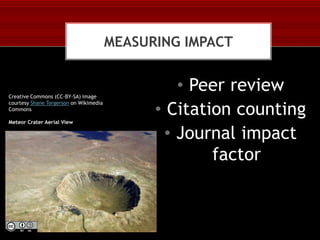
MEASURING IMPACT

Creative Commons (CC-BY-SA) image
courtesy Shane Torgerson on Wikimedia
Commons
Meteor Crater Aerial View

• Peer review
• Citation counting
• Journal impact
factor
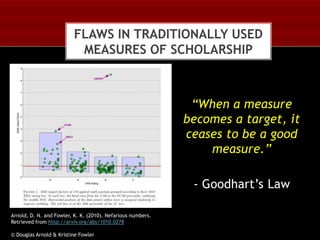
FLAWS IN TRADITIONALLY USED
MEASURES OF SCHOLARSHIP

“When a measure
becomes a target, it
ceases to be a good
measure.”
- Goodhart’s Law
Arnold, D. N. and Fowler, K. K. (2010). Nefarious numbers.
Retrieved from http://arxiv.org/abs/1010.0278
© Douglas Arnold & Kristine Fowler
GLOBALIZED & NETWORKED
RESEARCH
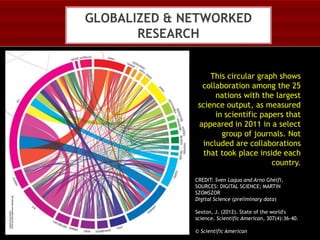
This circular graph shows
collaboration among the 25
nations with the largest
science output, as measured
in scientific papers that
appeared in 2011 in a select
group of journals. Not
included are collaborations
that took place inside each
country.
CREDIT: Sven Laqua and Arno Ghelfi,
SOURCES: DIGITAL SCIENCE; MARTIN
SZOMSZOR
Digital Science (preliminary data)
Sexton, J. (2012). State of the world's
science. Scientific American, 307(4):36-40.
© Scientific American
NETWORKED RESEARCH
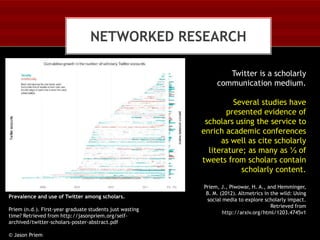
Twitter is a scholarly
communication medium.
Several studies have
presented evidence of
scholars using the service to
enrich academic conferences
as well as cite scholarly
literature; as many as ⅓ of
tweets from scholars contain
scholarly content.
Prevalence and use of Twitter among scholars.
Priem (n.d.). First-year graduate students just wasting
time? Retrieved from http://jasonpriem.org/selfarchived/twitter-scholars-poster-abstract.pdf
© Jason Priem

Priem, J., Piwowar, H. A., and Hemminger,
B. M. (2012). Altmetrics in the wild: Using
social media to explore scholarly impact.
Retrieved from
http://arxiv.org/html/1203.4745v1
VARIETIES OF RESEARCH

Creative Commons image (CC-BY-NC) courtesy maniacyak on
Flickr

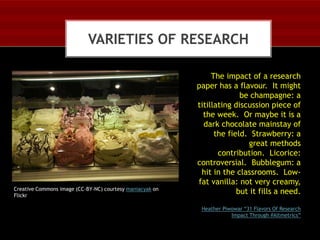
The impact of a research
paper has a flavour. It might
be champagne: a
titillating discussion piece of
the week. Or maybe it is a
dark chocolate mainstay of
the field. Strawberry: a
great methods
contribution. Licorice:
controversial. Bubblegum: a
hit in the classrooms. Lowfat vanilla: not very creamy,
but it fills a need.
Heather Piwowar “31 Flavors Of Research
Impact Through #Altmetrics”
VARIETIES OF RESEARCH

Creative Commons image (CC BY-SA 2.0) courtesy
opensourceway on flickr

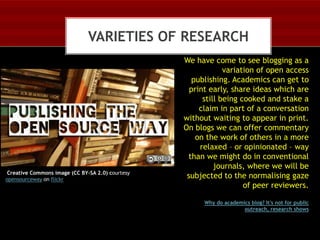
We have come to see blogging as a
variation of open access
publishing. Academics can get to
print early, share ideas which are
still being cooked and stake a
claim in part of a conversation
without waiting to appear in print.
On blogs we can offer commentary
on the work of others in a more
relaxed – or opinionated – way
than we might do in conventional
journals, where we will be
subjected to the normalising gaze
of peer reviewers.
Why do academics blog? It's not for public
outreach, research shows
WHAT IS ALTMETRICS?
How many times an output
• article, website, blog, dataset, grey literature, software, etc

has been:
• Viewed (Publisher websites, Dryad)
• Downloaded (Slideshare, publisher websites, Dryad)
• Cited (PubMed, CrossRef, Scopus, Wikipedia, DOI, Web of Science)
• Reused/Adapted (Github)
• Shared (Facebook, Twitter)
• Bookmarked (Mendeley, CiteULike, Delicious)
• Commented upon (Twitter, Mendeley, blogs, publisher websites,
Wikipedia, Faculty of 1000)
- Creative Commons (CC-BY-NC) slide derived from
Stacy Konkiel, E-Science Librarian, Indiana University
http://hdl.handle.net/2022/14714
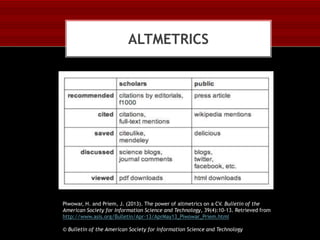
ALTMETRICS

Piwowar, H. and Priem, J. (2013). The power of altmetrics on a CV. Bulletin of the
American Society for Information Science and Technology, 39(4):10-13. Retrieved from
http://www.asis.org/Bulletin/Apr-13/AprMay13_Piwowar_Priem.html
© Bulletin of the American Society for Information Science and Technology
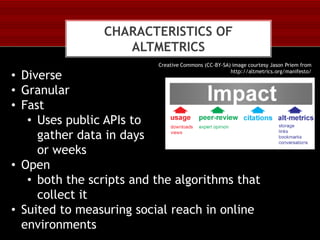
CHARACTERISTICS OF
ALTMETRICS
Creative Commons (CC-BY-SA) image courtesy Jason Priem from
http://altmetrics.org/manifesto/

• Diverse
• Granular
• Fast
• Uses public APIs to
gather data in days
or weeks
• Open
• both the scripts and the algorithms that
collect it
• Suited to measuring social reach in online
environments
IMPLICATIONS OF ALTMETRICS FOR
RESEARCHERS

• Offers additional measures of influence
• Can deliver information about impact of the
research output itself (not just its venue)
• On diverse audiences like clinicians,
practitioners, and the general public
• Of influential, but uncited work
• Tracks use of diverse research output
IMPLICATIONS OF ALTMETRICS FOR
RESEARCHERS

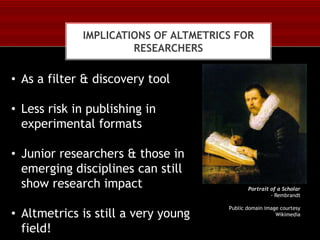
• As a filter & discovery tool
• Less risk in publishing in
experimental formats
• Junior researchers & those in
emerging disciplines can still
show research impact
• Altmetrics is still a very young
field!

Portrait of a Scholar
- Rembrandt
Public domain image courtesy
Wikimedia
WHY IS THIS RELEVANT TO LIBRARIANS?

• Supports our role as scholarly communications specialists
& communication partners with researchers
• Moving towards a more integral role in research
process
• Helping faculty understand their own impact
• Altmetrics may be integrated into the IR

• Additional information to make collection management
and acquisitions decisions
• Fulfills learning support/information literacy function
LOTS OF QUESTIONS TO BE ANSWERED
• How susceptible are altmetrics to gaming?
• How do we determine the motives of users engaging in the
social activities that altmetrics measures?
• Otherwise stated: How do we get at the qualitative
understanding underlying the quantitative measurements?
• How do we account for the ephemeral nature of social media
platforms, many of which quickly rise to prominence and fade
away into disuse?
• How do altmetrics indicators relate/correlate?
• How do altmetrics work with disciplines that do not publish
articles?
• Humanities and other disciplines that communicate
primarily via book publication
• Applied scientists doing translational research
ESPECIALLY USEFUL REFERENCES
Articles:
Galligan, F. and Dyas-Correia, S. (2013). Altmetrics: Rethinking the way we measure. Serials Review, 39(1):56-61.
http://dx.doi.org/10.1016/j.serrev.2013.01.003
Garwood, J. (2013). Time to change how research is assessed. Lab Times, (5):18-23. Retrieved from http://www.labtimesarchiv.de/epaper/LT_13_05/#18/z
Konkiel, S. Altmetrics: A 21st-Century solution to determining research quality. Information Today. Retrieved from
http://www.infotoday.com/OnlineSearcher/Articles/Features/Altmetrics-A-stCentury-Solution-to-Determining-ResearchQuality-90551.shtml
Mounce, R. (2013). Open access and altmetrics: Distinct but complementary. Bulletin of the American Society for Information
Science and Technology, 39(4):14-17. http://dx.doi.org/10.1002/bult.2013.1720390406
Piwowar, H. and Priem, J. (2013). The power of altmetrics on a CV. Bulletin of the American Society for Information Science and
Technology, 39(4):10-13. http://dx.doi.org/10.1002/bult.2013.1720390405
Priem, J. (2013). Scholarship: Beyond the paper. Nature, 495(7442):437-440. http://dx.doi.org/10.1002/bult.2013.1720390405
Priem, J., Piwowar, H. A., and Hemminger, B. M. (2012). Altmetrics in the wild: Using social media to explore scholarly impact.
Retrieved from http://arxiv.org/pdf/1203.4745
Tananbaum, G. Article-Level metrics: A SPARC primer. Retrieved from http://sparc.arl.org/resource/sparc-article-level-metricsprimer
Torres-Salinas, D., Cabezas-Clavijo, A., and Jimenez-Contreras, E. (2013). Altmetrics: New indicators for scientific communication in
web 2.0. Comunicar, 21(41):53-60. Retrieved from http://arxiv.org/pdf/1306.6595

Video:
Konkiel, Stacy: OCLC Innovations in Libraries 2012 Altmetrics App Review
Priem, J., Holmes, K., and Aptowicz Trasande, C.: Columbia University Speaker Series: Measuring Scholarly Impact

See a longer list of scholarly references used for this presentation at
http://www.citeulike.org/user/ciakov/altmetrics
And bookmarked list of blogs & websites at https://delicious.com/ciakov/altmetrics
EXAMPLES OF ALTMETRICS

http://president-icinghower.tumblr.com/
© Altmetric
QUESTIONS?

Altmetrics: What is it and how is it relevant to librarians?

  • 1.
    ALTMETRICS: What is itand how is it relevant to librarians? Cross Timbers Library Collaborative Scholarly Communications & Digital Curation Affinity Group Meeting Friday, December 13th 2013 Clarke Iakovakis Data & E-Science Librarian clarke@uta.edu University of Texas at Arlington Rafia Mirza Digital Humanities Librarian rafia@uta.edu University of Texas at Arlington
  • 2.
    THE DECLINE OFJOURNALBASED METRICS “Do not use journal-based metrics, such as Journal Impact Factors, as a surrogate measure of the quality of individual research articles, to assess an individual scientist's contributions, or in hiring, promotion, or funding decisions.” -Recommendation #1 San Francisco Declaration on Research Assessment, December 2012 http://am.ascb.org/dora/
  • 3.
    OUTLINE FOR TODAY’STALK • Traditional Metrics & Their Limitations • Globalized & Networked Research • Altmetrics: What is it? • Implications of altmetrics for researchers and librarians • Limitations of altmetrics • Examples of altmetrics
  • 4.
    MEASURING IMPACT Creative Commons(CC-BY-SA) image courtesy Shane Torgerson on Wikimedia Commons Meteor Crater Aerial View • Peer review • Citation counting • Journal impact factor
  • 5.
    FLAWS IN TRADITIONALLYUSED MEASURES OF SCHOLARSHIP “When a measure becomes a target, it ceases to be a good measure.” - Goodhart’s Law Arnold, D. N. and Fowler, K. K. (2010). Nefarious numbers. Retrieved from http://arxiv.org/abs/1010.0278 © Douglas Arnold & Kristine Fowler
  • 6.
    GLOBALIZED & NETWORKED RESEARCH Thiscircular graph shows collaboration among the 25 nations with the largest science output, as measured in scientific papers that appeared in 2011 in a select group of journals. Not included are collaborations that took place inside each country. CREDIT: Sven Laqua and Arno Ghelfi, SOURCES: DIGITAL SCIENCE; MARTIN SZOMSZOR Digital Science (preliminary data) Sexton, J. (2012). State of the world's science. Scientific American, 307(4):36-40. © Scientific American
  • 7.
    NETWORKED RESEARCH Twitter isa scholarly communication medium. Several studies have presented evidence of scholars using the service to enrich academic conferences as well as cite scholarly literature; as many as ⅓ of tweets from scholars contain scholarly content. Prevalence and use of Twitter among scholars. Priem (n.d.). First-year graduate students just wasting time? Retrieved from http://jasonpriem.org/selfarchived/twitter-scholars-poster-abstract.pdf © Jason Priem Priem, J., Piwowar, H. A., and Hemminger, B. M. (2012). Altmetrics in the wild: Using social media to explore scholarly impact. Retrieved from http://arxiv.org/html/1203.4745v1
  • 8.
    VARIETIES OF RESEARCH CreativeCommons image (CC-BY-NC) courtesy maniacyak on Flickr The impact of a research paper has a flavour. It might be champagne: a titillating discussion piece of the week. Or maybe it is a dark chocolate mainstay of the field. Strawberry: a great methods contribution. Licorice: controversial. Bubblegum: a hit in the classrooms. Lowfat vanilla: not very creamy, but it fills a need. Heather Piwowar “31 Flavors Of Research Impact Through #Altmetrics”
  • 9.
    VARIETIES OF RESEARCH CreativeCommons image (CC BY-SA 2.0) courtesy opensourceway on flickr We have come to see blogging as a variation of open access publishing. Academics can get to print early, share ideas which are still being cooked and stake a claim in part of a conversation without waiting to appear in print. On blogs we can offer commentary on the work of others in a more relaxed – or opinionated – way than we might do in conventional journals, where we will be subjected to the normalising gaze of peer reviewers. Why do academics blog? It's not for public outreach, research shows
  • 10.
    WHAT IS ALTMETRICS? Howmany times an output • article, website, blog, dataset, grey literature, software, etc has been: • Viewed (Publisher websites, Dryad) • Downloaded (Slideshare, publisher websites, Dryad) • Cited (PubMed, CrossRef, Scopus, Wikipedia, DOI, Web of Science) • Reused/Adapted (Github) • Shared (Facebook, Twitter) • Bookmarked (Mendeley, CiteULike, Delicious) • Commented upon (Twitter, Mendeley, blogs, publisher websites, Wikipedia, Faculty of 1000) - Creative Commons (CC-BY-NC) slide derived from Stacy Konkiel, E-Science Librarian, Indiana University http://hdl.handle.net/2022/14714
  • 11.
    ALTMETRICS Piwowar, H. andPriem, J. (2013). The power of altmetrics on a CV. Bulletin of the American Society for Information Science and Technology, 39(4):10-13. Retrieved from http://www.asis.org/Bulletin/Apr-13/AprMay13_Piwowar_Priem.html © Bulletin of the American Society for Information Science and Technology
  • 12.
    CHARACTERISTICS OF ALTMETRICS Creative Commons(CC-BY-SA) image courtesy Jason Priem from http://altmetrics.org/manifesto/ • Diverse • Granular • Fast • Uses public APIs to gather data in days or weeks • Open • both the scripts and the algorithms that collect it • Suited to measuring social reach in online environments
  • 13.
    IMPLICATIONS OF ALTMETRICSFOR RESEARCHERS • Offers additional measures of influence • Can deliver information about impact of the research output itself (not just its venue) • On diverse audiences like clinicians, practitioners, and the general public • Of influential, but uncited work • Tracks use of diverse research output
  • 14.
    IMPLICATIONS OF ALTMETRICSFOR RESEARCHERS • As a filter & discovery tool • Less risk in publishing in experimental formats • Junior researchers & those in emerging disciplines can still show research impact • Altmetrics is still a very young field! Portrait of a Scholar - Rembrandt Public domain image courtesy Wikimedia
  • 15.
    WHY IS THISRELEVANT TO LIBRARIANS? • Supports our role as scholarly communications specialists & communication partners with researchers • Moving towards a more integral role in research process • Helping faculty understand their own impact • Altmetrics may be integrated into the IR • Additional information to make collection management and acquisitions decisions • Fulfills learning support/information literacy function
  • 16.
    LOTS OF QUESTIONSTO BE ANSWERED • How susceptible are altmetrics to gaming? • How do we determine the motives of users engaging in the social activities that altmetrics measures? • Otherwise stated: How do we get at the qualitative understanding underlying the quantitative measurements? • How do we account for the ephemeral nature of social media platforms, many of which quickly rise to prominence and fade away into disuse? • How do altmetrics indicators relate/correlate? • How do altmetrics work with disciplines that do not publish articles? • Humanities and other disciplines that communicate primarily via book publication • Applied scientists doing translational research
  • 17.
    ESPECIALLY USEFUL REFERENCES Articles: Galligan,F. and Dyas-Correia, S. (2013). Altmetrics: Rethinking the way we measure. Serials Review, 39(1):56-61. http://dx.doi.org/10.1016/j.serrev.2013.01.003 Garwood, J. (2013). Time to change how research is assessed. Lab Times, (5):18-23. Retrieved from http://www.labtimesarchiv.de/epaper/LT_13_05/#18/z Konkiel, S. Altmetrics: A 21st-Century solution to determining research quality. Information Today. Retrieved from http://www.infotoday.com/OnlineSearcher/Articles/Features/Altmetrics-A-stCentury-Solution-to-Determining-ResearchQuality-90551.shtml Mounce, R. (2013). Open access and altmetrics: Distinct but complementary. Bulletin of the American Society for Information Science and Technology, 39(4):14-17. http://dx.doi.org/10.1002/bult.2013.1720390406 Piwowar, H. and Priem, J. (2013). The power of altmetrics on a CV. Bulletin of the American Society for Information Science and Technology, 39(4):10-13. http://dx.doi.org/10.1002/bult.2013.1720390405 Priem, J. (2013). Scholarship: Beyond the paper. Nature, 495(7442):437-440. http://dx.doi.org/10.1002/bult.2013.1720390405 Priem, J., Piwowar, H. A., and Hemminger, B. M. (2012). Altmetrics in the wild: Using social media to explore scholarly impact. Retrieved from http://arxiv.org/pdf/1203.4745 Tananbaum, G. Article-Level metrics: A SPARC primer. Retrieved from http://sparc.arl.org/resource/sparc-article-level-metricsprimer Torres-Salinas, D., Cabezas-Clavijo, A., and Jimenez-Contreras, E. (2013). Altmetrics: New indicators for scientific communication in web 2.0. Comunicar, 21(41):53-60. Retrieved from http://arxiv.org/pdf/1306.6595 Video: Konkiel, Stacy: OCLC Innovations in Libraries 2012 Altmetrics App Review Priem, J., Holmes, K., and Aptowicz Trasande, C.: Columbia University Speaker Series: Measuring Scholarly Impact See a longer list of scholarly references used for this presentation at http://www.citeulike.org/user/ciakov/altmetrics And bookmarked list of blogs & websites at https://delicious.com/ciakov/altmetrics
  • 18.
  • 19.