What’s the difference between altmetrics
and other measures of research
influence? Exploring alternative metrics,
impact factors, and more.
Lillian Hoffecker, PhD, MLS
Dana Abbey, MLS
MLA 2014: Building Our Information
Future
Objective
• To demonstrate ways librarians can assist
clinicians and researchers discover their
scholarly value by understanding different
research metrics
What’s Being Measured?
• Citation metrics
– How often an individual article was cited
• Altmetrics
– “Crowdsourcing” the social web for analyzing
reach and visibility of research
Changing Landscape of Research
Metrics
• Citation Metrics
– Impact factor
– Eigenfactor
• Other Metrics
– PlumX
– Altmetric.com
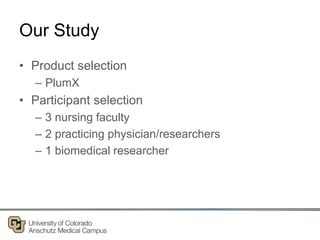
Our Study
• Product selection
– PlumX
• Participant selection
– 3 nursing faculty
– 2 practicing physician/researchers
– 1 biomedical researcher
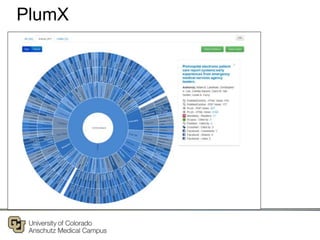
PlumX
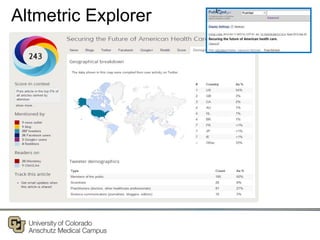
Altmetric Explorer
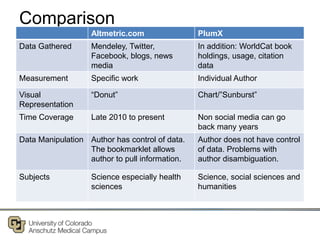
Comparison
Altmetric.com PlumX
Data Gathered Mendeley, Twitter,
Facebook, blogs, news
media
In addition: WorldCat book
holdings, usage, citation
data
Measurement Specific work Individual Author
Visual
Representation
“Donut” Chart/”Sunburst”
Time Coverage Late 2010 to present Non social media can go
back many years
Data Manipulation Author has control of data.
The bookmarklet allows
author to pull information.
Author does not have control
of data. Problems with
author disambiguation.
Subjects Science especially health
sciences
Science, social sciences and
humanities
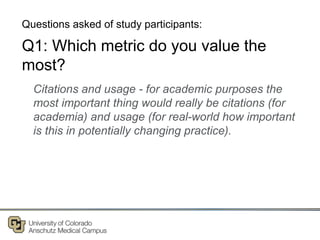
Q1: Which metric do you value the
most?
Citations and usage - for academic purposes the
most important thing would really be citations (for
academia) and usage (for real-world how important
is this in potentially changing practice).
Questions asked of study participants:
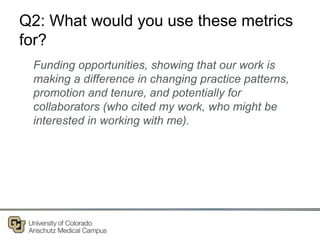
Q2: What would you use these metrics
for?
Funding opportunities, showing that our work is
making a difference in changing practice patterns,
promotion and tenure, and potentially for
collaborators (who cited my work, who might be
interested in working with me).
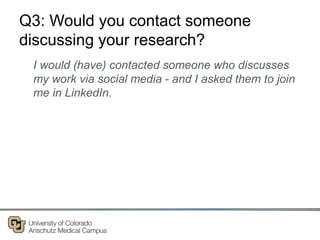
Q3: Would you contact someone
discussing your research?
I would (have) contacted someone who discusses
my work via social media - and I asked them to join
me in LinkedIn.
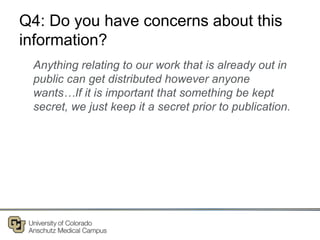
Q4: Do you have concerns about this
information?
Anything relating to our work that is already out in
public can get distributed however anyone
wants…If it is important that something be kept
secret, we just keep it a secret prior to publication.
Role of the Librarian
• Promote open access and in particular an OA fund
at your institution
• Communicate with researchers on ways to raise
profile
• Contribute to social media (department liaisons)
• Develop a knowledge base for tools to get people
started
• Encourage use of unique author identifiers like
ORCID (Open Researcher and Contributor ID)
Raising Researcher Profiles
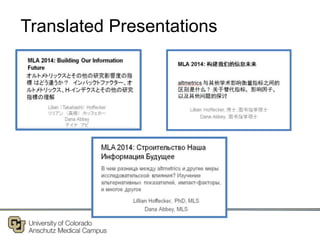
• Translate presentations
• Make available in open access venues
• Self-promote through social media and professional
networking
• Utilize curating, bookmarking, and sharing tools to
promote content
• Get in touch with those who download your work
• Create a “plain language” version of your technical
work
Translated Presentations
Acknowledgments
• Faculty Participants
• Translators
• Plum Analytics
• Altmetric LLP
Thank You!

Altmetrics presentation mla'14 english version

  • 1.
    What’s the differencebetween altmetrics and other measures of research influence? Exploring alternative metrics, impact factors, and more. Lillian Hoffecker, PhD, MLS Dana Abbey, MLS MLA 2014: Building Our Information Future
  • 2.
    Objective • To demonstrateways librarians can assist clinicians and researchers discover their scholarly value by understanding different research metrics
  • 3.
    What’s Being Measured? •Citation metrics – How often an individual article was cited • Altmetrics – “Crowdsourcing” the social web for analyzing reach and visibility of research
  • 4.
    Changing Landscape ofResearch Metrics • Citation Metrics – Impact factor – Eigenfactor • Other Metrics – PlumX – Altmetric.com
  • 5.
    Our Study • Productselection – PlumX • Participant selection – 3 nursing faculty – 2 practicing physician/researchers – 1 biomedical researcher
  • 6.
  • 7.
  • 8.
    Comparison Altmetric.com PlumX Data GatheredMendeley, Twitter, Facebook, blogs, news media In addition: WorldCat book holdings, usage, citation data Measurement Specific work Individual Author Visual Representation “Donut” Chart/”Sunburst” Time Coverage Late 2010 to present Non social media can go back many years Data Manipulation Author has control of data. The bookmarklet allows author to pull information. Author does not have control of data. Problems with author disambiguation. Subjects Science especially health sciences Science, social sciences and humanities
  • 9.
    Q1: Which metricdo you value the most? Citations and usage - for academic purposes the most important thing would really be citations (for academia) and usage (for real-world how important is this in potentially changing practice). Questions asked of study participants:
  • 10.
    Q2: What wouldyou use these metrics for? Funding opportunities, showing that our work is making a difference in changing practice patterns, promotion and tenure, and potentially for collaborators (who cited my work, who might be interested in working with me).
  • 11.
    Q3: Would youcontact someone discussing your research? I would (have) contacted someone who discusses my work via social media - and I asked them to join me in LinkedIn.
  • 12.
    Q4: Do youhave concerns about this information? Anything relating to our work that is already out in public can get distributed however anyone wants…If it is important that something be kept secret, we just keep it a secret prior to publication.
  • 13.
    Role of theLibrarian • Promote open access and in particular an OA fund at your institution • Communicate with researchers on ways to raise profile • Contribute to social media (department liaisons) • Develop a knowledge base for tools to get people started • Encourage use of unique author identifiers like ORCID (Open Researcher and Contributor ID)
  • 14.
    Raising Researcher Profiles •Translate presentations • Make available in open access venues • Self-promote through social media and professional networking • Utilize curating, bookmarking, and sharing tools to promote content • Get in touch with those who download your work • Create a “plain language” version of your technical work
  • 15.
  • 16.
    Acknowledgments • Faculty Participants •Translators • Plum Analytics • Altmetric LLP
  • 17.