

Getting Started with
Article-Level Metrics
altmetric.com | @altmetric
Jean Liu and Euan Adie
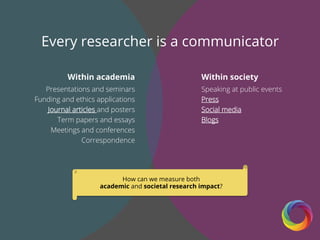
Every researcher is a communicator
Within academia
Presentations and seminars
Funding and ethics applications
Journal articles and posters
Term papers and essays
Meetings and conferences
Correspondence
Within society
Speaking at public events
Press
Social media
Blogs
How can we measure both
academic and societal research impact?
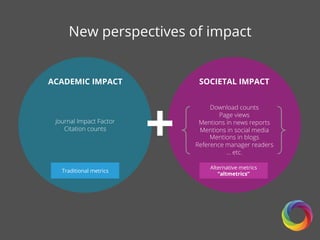
Download counts
Page views
Mentions in news reports
Mentions in social media
Mentions in blogs
Reference manager readers
… etc.
Journal Impact Factor
Citation counts
New perspectives of impact
ACADEMIC IMPACT SOCIETAL IMPACT
Alternative metrics
“altmetrics”
+
Traditional metrics
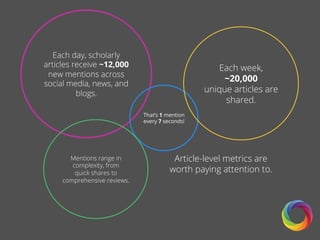
Each day, scholarly
articles receive ~12,000
new mentions across
social media, news, and
blogs.
That’s 1 mention
every 7 seconds!
Each week,
~20,000
unique articles are
shared.
Mentions range in
complexity, from
quick shares to
comprehensive reviews.
Article-level metrics are
worth paying attention to.
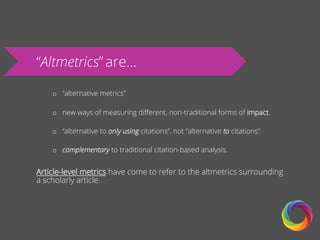
“Altmetrics” are…
o  “alternative metrics”
o  new ways of measuring different, non-traditional forms of impact.
o  “alternative to only using citations”, not “alternative to citations”.
o  complementary to traditional citation-based analysis.
Article-level metrics have come to refer to the altmetrics surrounding
a scholarly article.
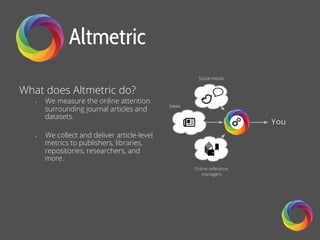
What does Altmetric do?
§  We measure the online attention
surrounding journal articles and
datasets.
§  We collect and deliver article-level
metrics to publishers, libraries,
repositories, researchers, and
more.
Social media
News
Online reference
managers
You
1
2
3
1
2
3
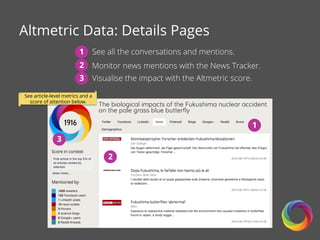
Altmetric Data: Details Pages
Visualise the impact with the Altmetric score.
Monitor news mentions with the News Tracker.
See all the conversations and mentions.
See article-level metrics and a
score of attention below.
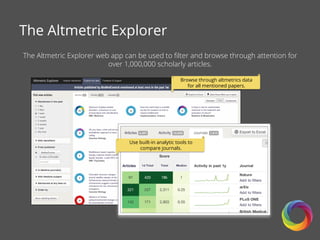
The Altmetric Explorer
The Altmetric Explorer web app can be used to filter and browse through attention for
over 1,000,000 scholarly articles.
Browse through altmetrics data
for all mentioned papers.
Use built-in analytic tools to
compare journals.
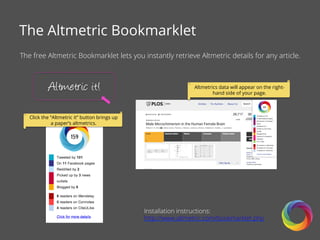
The Altmetric Bookmarklet
The free Altmetric Bookmarklet lets you instantly retrieve Altmetric details for any article.
Altmetrics data will appear on the right-
hand side of your page.
Installation instructions:
http://www.altmetric.com/bookmarklet.php
Altmetric it!
Click the “Altmetric it” button brings up
a paper’s altmetrics.
What can I do with
article-level metrics?
3
2
1
You can use article-level metrics to…
Track an article’s uptake within a community.
Assess the overall impact of a body of
scholarly work.
Characterise reader communities.
4 Discover new articles to read.
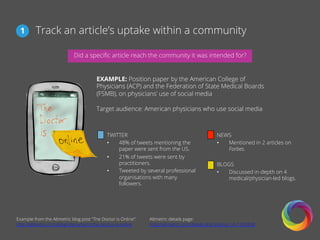
Did a specific article reach the community it was intended for?
Track an article’s uptake within a community1
TWITTER
•  48% of tweets mentioning the
paper were sent from the US.
•  21% of tweets were sent by
practitioners.
•  Tweeted by several professional
organisations with many
followers.
NEWS
•  Mentioned in 2 articles on
Forbes.
BLOGS
•  Discussed in-depth on 4
medical/physician-led blogs.
EXAMPLE: Position paper by the American College of
Physicians (ACP) and the Federation of State Medical Boards
(FSMB), on physicians’ use of social media
Target audience: American physicians who use social media
Altmetric details page:
http://altmetric.com/details.php?citation_id=1363338
Example from the Altmetric blog post “The Doctor is Online”:
http://altmetric.com/blog/interactions-the-doctor-is-online
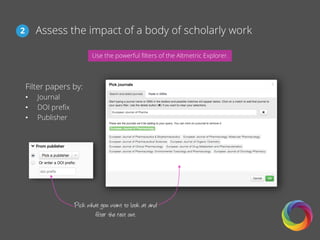
Filter papers by:
•  Journal
•  DOI prefix
•  Publisher
Assess the impact of a body of scholarly work2
Pick what you want to look at and
filter the rest out.
Use the powerful filters of the Altmetric Explorer.
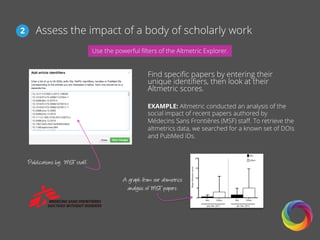
Find specific papers by entering their
unique identifiers, then look at their
Altmetric scores.
Assess the impact of a body of scholarly work2
Use the powerful filters of the Altmetric Explorer.
Publications by MSF staff.
EXAMPLE: Altmetric conducted an analysis of the
social impact of recent papers authored by
Médecins Sans Frontières (MSF) staff. To retrieve the
altmetrics data, we searched for a known set of DOIs
and PubMed IDs.
A graph from our altmetrics
analysis of MSF papers.
Characterise reader communities3
Many distinct online communities come together to discuss papers.
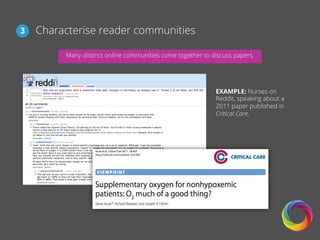
EXAMPLE: Nurses on
Reddit, speaking about a
2011 paper published in
Critical Care.
Characterise reader communities3
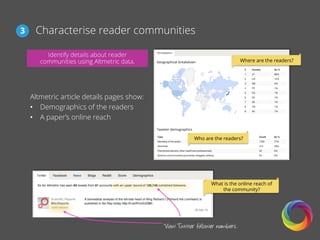
Where are the readers?
Who are the readers?
What is the online reach of
the community?
View Twitter follower numbers.
Altmetric article details pages show:
•  Demographics of the readers
•  A paper’s online reach
Identify details about reader
communities using Altmetric data.
Characterise reader communities
Attention surrounding a single paper can reveal the
existence of a large online community.
3
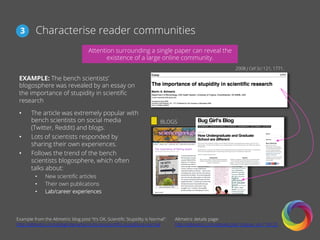
EXAMPLE: The bench scientists’
blogosphere was revealed by an essay on
the importance of stupidity in scientific
research
2008 J Cell Sci 121, 1771.
•  The article was extremely popular with
bench scientists on social media
(Twitter, Reddit) and blogs.
•  Lots of scientists responded by
sharing their own experiences.
•  Follows the trend of the bench
scientists blogosphere, which often
talks about:
•  New scientific articles
•  Their own publications
•  Lab/career experiences
BLOGS
Altmetric details page:
http://altmetric.com/details.php?citation_id=174125
Example from the Altmetric blog post “It’s OK, Scientific Stupidity is Normal”:
http://altmetric.com/blog/interactions-its-ok-scientific-stupidity-is-normal
Characterise reader communities
Attention surrounding a single paper can reveal the
existence of a large online community.
3
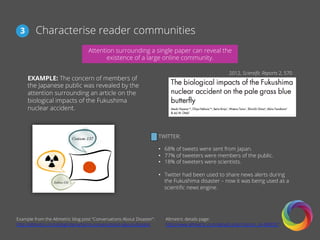
EXAMPLE: The concern of members of
the Japanese public was revealed by the
attention surrounding an article on the
biological impacts of the Fukushima
nuclear accident.
TWITTER:
•  68% of tweets were sent from Japan.
•  77% of tweeters were members of the public.
•  18% of tweeters were scientists.
•  Twitter had been used to share news alerts during
the Fukushima disaster – now it was being used as a
scientific news engine.
Altmetric details page:
http://www.altmetric.com/details.php?citation_id=880007
Example from the Altmetric blog post “Conversations About Disaster”:
http://altmetric.com/blog/interactions-conversations-about-disaster
2012, Scientific Reports 2, 570
Discover new articles to read4
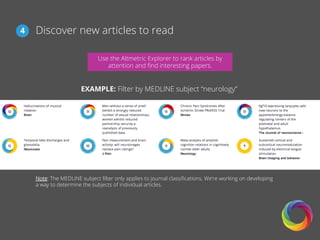
Note: The MEDLINE subject filter only applies to journal classifications. We’re working on developing
a way to determine the subjects of individual articles.
EXAMPLE: Filter by MEDLINE subject “neurology”
Use the Altmetric Explorer to rank articles by
attention and find interesting papers.
Discover new articles to read4
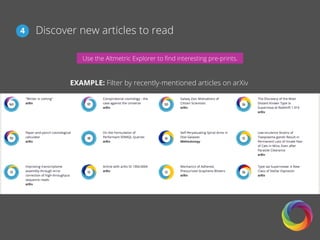
EXAMPLE: Filter by recently-mentioned articles on arXiv
Use the Altmetric Explorer to find interesting pre-prints.
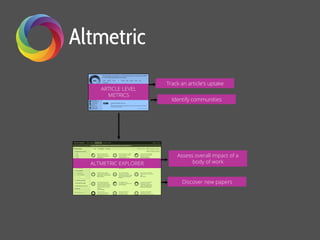
ARTICLE LEVEL
METRICS
ALTMETRIC EXPLORER
Identify communities
Discover new papers
Assess overall impact of a
body of work
Track an article’s uptake
Interested? Let’s talk.
E-mail Jean: jean@altmetric.com
Visit us on the web: www.altmetric.com
Read our blog: www.altmetric.com/blog
Follow us on Twitter: @altmetric

Altmetric: Getting Started with Article-Level Metrics

  • 1.
    Getting Started with Article-LevelMetrics altmetric.com | @altmetric Jean Liu and Euan Adie
  • 2.
    Every researcher isa communicator Within academia Presentations and seminars Funding and ethics applications Journal articles and posters Term papers and essays Meetings and conferences Correspondence Within society Speaking at public events Press Social media Blogs How can we measure both academic and societal research impact?
  • 3.
    Download counts Page views Mentionsin news reports Mentions in social media Mentions in blogs Reference manager readers … etc. Journal Impact Factor Citation counts New perspectives of impact ACADEMIC IMPACT SOCIETAL IMPACT Alternative metrics “altmetrics” + Traditional metrics
  • 4.
    Each day, scholarly articlesreceive ~12,000 new mentions across social media, news, and blogs. That’s 1 mention every 7 seconds! Each week, ~20,000 unique articles are shared. Mentions range in complexity, from quick shares to comprehensive reviews. Article-level metrics are worth paying attention to.
  • 5.
    “Altmetrics” are… o  “alternativemetrics” o  new ways of measuring different, non-traditional forms of impact. o  “alternative to only using citations”, not “alternative to citations”. o  complementary to traditional citation-based analysis. Article-level metrics have come to refer to the altmetrics surrounding a scholarly article.
  • 6.
    What does Altmetricdo? §  We measure the online attention surrounding journal articles and datasets. §  We collect and deliver article-level metrics to publishers, libraries, repositories, researchers, and more. Social media News Online reference managers You
  • 7.
    1 2 3 1 2 3 Altmetric Data: DetailsPages Visualise the impact with the Altmetric score. Monitor news mentions with the News Tracker. See all the conversations and mentions. See article-level metrics and a score of attention below.
  • 8.
    The Altmetric Explorer TheAltmetric Explorer web app can be used to filter and browse through attention for over 1,000,000 scholarly articles. Browse through altmetrics data for all mentioned papers. Use built-in analytic tools to compare journals.
  • 9.
    The Altmetric Bookmarklet Thefree Altmetric Bookmarklet lets you instantly retrieve Altmetric details for any article. Altmetrics data will appear on the right- hand side of your page. Installation instructions: http://www.altmetric.com/bookmarklet.php Altmetric it! Click the “Altmetric it” button brings up a paper’s altmetrics.
  • 10.
    What can Ido with article-level metrics?
  • 11.
    3 2 1 You can usearticle-level metrics to… Track an article’s uptake within a community. Assess the overall impact of a body of scholarly work. Characterise reader communities. 4 Discover new articles to read.
  • 12.
    Did a specificarticle reach the community it was intended for? Track an article’s uptake within a community1 TWITTER •  48% of tweets mentioning the paper were sent from the US. •  21% of tweets were sent by practitioners. •  Tweeted by several professional organisations with many followers. NEWS •  Mentioned in 2 articles on Forbes. BLOGS •  Discussed in-depth on 4 medical/physician-led blogs. EXAMPLE: Position paper by the American College of Physicians (ACP) and the Federation of State Medical Boards (FSMB), on physicians’ use of social media Target audience: American physicians who use social media Altmetric details page: http://altmetric.com/details.php?citation_id=1363338 Example from the Altmetric blog post “The Doctor is Online”: http://altmetric.com/blog/interactions-the-doctor-is-online
  • 13.
    Filter papers by: • Journal •  DOI prefix •  Publisher Assess the impact of a body of scholarly work2 Pick what you want to look at and filter the rest out. Use the powerful filters of the Altmetric Explorer.
  • 14.
    Find specific papersby entering their unique identifiers, then look at their Altmetric scores. Assess the impact of a body of scholarly work2 Use the powerful filters of the Altmetric Explorer. Publications by MSF staff. EXAMPLE: Altmetric conducted an analysis of the social impact of recent papers authored by Médecins Sans Frontières (MSF) staff. To retrieve the altmetrics data, we searched for a known set of DOIs and PubMed IDs. A graph from our altmetrics analysis of MSF papers.
  • 15.
    Characterise reader communities3 Manydistinct online communities come together to discuss papers. EXAMPLE: Nurses on Reddit, speaking about a 2011 paper published in Critical Care.
  • 16.
    Characterise reader communities3 Whereare the readers? Who are the readers? What is the online reach of the community? View Twitter follower numbers. Altmetric article details pages show: •  Demographics of the readers •  A paper’s online reach Identify details about reader communities using Altmetric data.
  • 17.
    Characterise reader communities Attentionsurrounding a single paper can reveal the existence of a large online community. 3 EXAMPLE: The bench scientists’ blogosphere was revealed by an essay on the importance of stupidity in scientific research 2008 J Cell Sci 121, 1771. •  The article was extremely popular with bench scientists on social media (Twitter, Reddit) and blogs. •  Lots of scientists responded by sharing their own experiences. •  Follows the trend of the bench scientists blogosphere, which often talks about: •  New scientific articles •  Their own publications •  Lab/career experiences BLOGS Altmetric details page: http://altmetric.com/details.php?citation_id=174125 Example from the Altmetric blog post “It’s OK, Scientific Stupidity is Normal”: http://altmetric.com/blog/interactions-its-ok-scientific-stupidity-is-normal
  • 18.
    Characterise reader communities Attentionsurrounding a single paper can reveal the existence of a large online community. 3 EXAMPLE: The concern of members of the Japanese public was revealed by the attention surrounding an article on the biological impacts of the Fukushima nuclear accident. TWITTER: •  68% of tweets were sent from Japan. •  77% of tweeters were members of the public. •  18% of tweeters were scientists. •  Twitter had been used to share news alerts during the Fukushima disaster – now it was being used as a scientific news engine. Altmetric details page: http://www.altmetric.com/details.php?citation_id=880007 Example from the Altmetric blog post “Conversations About Disaster”: http://altmetric.com/blog/interactions-conversations-about-disaster 2012, Scientific Reports 2, 570
  • 19.
    Discover new articlesto read4 Note: The MEDLINE subject filter only applies to journal classifications. We’re working on developing a way to determine the subjects of individual articles. EXAMPLE: Filter by MEDLINE subject “neurology” Use the Altmetric Explorer to rank articles by attention and find interesting papers.
  • 20.
    Discover new articlesto read4 EXAMPLE: Filter by recently-mentioned articles on arXiv Use the Altmetric Explorer to find interesting pre-prints.
  • 21.
    ARTICLE LEVEL METRICS ALTMETRIC EXPLORER Identifycommunities Discover new papers Assess overall impact of a body of work Track an article’s uptake
  • 22.
    Interested? Let’s talk. E-mailJean: jean@altmetric.com Visit us on the web: www.altmetric.com Read our blog: www.altmetric.com/blog Follow us on Twitter: @altmetric