

Lessons Learned:
New Teachers Talk About
Their Jobs, Challenges
and Long-Range Plans
Issue No. 2
Working Without a Net:
How New Teachers from Three Prominent
Alternate Route Programs Describe Their
First Year on the Job
A Report from the National Comprehensive Center
for Teacher Quality and Public Agenda

                                  PUBLIC AGENDA

Questionnaire design and analysis in cooperation
with REL Midwest at Learning Point Associates
Lessons Learned:
New Teachers Talk About
Their Jobs, Challenges
and Long-Range Plans
Issue No. 2
Working Without a Net:
How New Teachers from Three Prominent
Alternate Route Programs Describe Their
First Year on the Job

Based on research conducted and reported by Jonathan Rochkind,
Amber Ott, John Immerwahr, John Doble and Jean Johnson

A Report from the National Comprehensive Center
for Teacher Quality and Public Agenda
Questionnaire design and analysis in cooperation
with REL Midwest at Learning Point Associates


This report is available for free download at publicagenda.org.
© 2007 National Comprehensive Center for Teacher Quality and Public Agenda.
Unauthorized duplication of this report is a violation of copyright.
Table of Contents

Introduction and background . . . . . . . . . . . . . . . . . . . . . . . . . . . . . . . . . . . . . . . . . . 5

Summary and implications . . . . . . . . . . . . . . . . . . . . . . . . . . . . . . . . . . . . . . . . . . .12

Finding One: Idealism and a strong desire to help
Nearly all new teachers are idealistic and believe that good teachers
can help all children learn, even those from disadvantaged
backgrounds. But new teachers from Teach for America, Troops to
Teachers and the New Teachers Project/Baltimore were even more
likely to say this. These new alt-route teachers were also more likely
to say that wanting to help underprivileged youngsters was their main
reason for becoming teachers . . . . . . . . . . . . . . . . . . . . . . . . . . . . . . . . . . . . . . . . . . .15

Finding Two: Day one in the classroom…the most difficult
classes and needing more support
The majority of the alt-route teachers surveyed here say they
believe that as a new teacher they have been assigned to teach the
hardest-to-reach students. They are also more likely than traditionally
trained teachers to see lack of support by administrators as the major
drawback of teaching . . . . . . . . . . . . . . . . . . . . . . . . . . . . . . . . . . . . . . . . . . . . . . . . .17

Finding Three: Doing a tough job with minimal backup
The new alt-route teachers surveyed here are more likely than
traditionally trained teachers to give their administrators low ratings
for their instructional leadership and support on discipline issues.
They are also more likely to give their fellow teachers lower marks
for supporting and advising them . . . . . . . . . . . . . . . . . . . . . . . . . . . . . . . . . . . . . . . .20

Finding Four: Less satisfied with their preparation and
cooperating teachers
The vast majority of new teachers feel comfortable with their subject
matter, but there is a substantial difference between the alt-routes
and the traditionally trained when it comes to how they view their
readiness for the classroom and the kind of guidance they received
from their cooperating teacher during their preparation . . . . . . . . . . . . . . . . . . . . . .21
Table of Contents                             (continued)


Finding Five: Aspirations and exit plans
The alternate route teachers surveyed here are less likely to say that
teaching is their lifelong career goal and more likely to plan on leaving
classroom teaching in the next two years. Surprisingly, however,
nearly half of the alternate route teachers say they are considering
another job in education. All in all, nearly two-thirds of the teachers
from the three alt-route programs voice a long-term interest in
working in education . . . . . . . . . . . . . . . . . . . . . . . . . . . . . . . . . . . . . . . . . . . . . . . . . .24

Finding Six: Agreement on ways to improve teachers
Despite their differing experiences as new teachers, both alt-routes
and traditionally trained teachers back similar ideas for improving
teacher quality . . . . . . . . . . . . . . . . . . . . . . . . . . . . . . . . . . . . . . . . . . . . . . . . . . . . . . .26

Finding Seven: The subtle story on money
All new teachers agree that it is possible to make a decent living as
a new teacher, and a majority see raising salaries as a way to improve
teachers’ performance, though other ideas were seen as considerably
more effective. The alt-route teachers from the three programs we
interviewed were somewhat more likely to think that not being
rewarded for superior performance was a problem, yet as with
the traditionally trained teachers, performance pay was toward
the bottom of the list as a way to improve the profession . . . . . . . . . . . . . . . . . . . . . .27

Methodology. . . . . . . . . . . . . . . . . . . . . . . . . . . . . . . . . . . . . . . . . . . . . . . . . . . . . . . .30

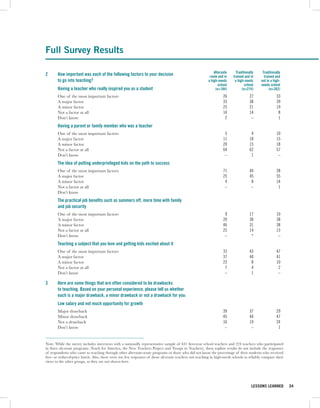
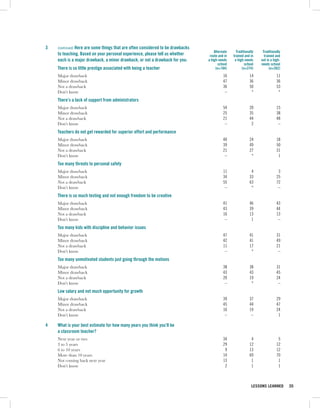
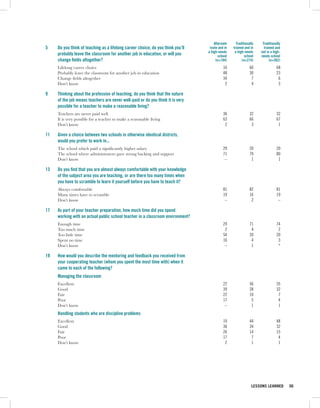
Full survey results . . . . . . . . . . . . . . . . . . . . . . . . . . . . . . . . . . . . . . . . . . . . . . . . . . .34

Acknowledgments . . . . . . . . . . . . . . . . . . . . . . . . . . . . . . . . . . . . . . . . . . . . . . . . . . .44


                                                                                                  WORKING WITHOUT A NET           6
Introduction and background

In the early 1980s, throughout most of the        dispute over exactly what constitutes an “al-
United States, attending a traditional school     ternate” path to teaching. Some experts have
of education was the only option open to          criticized the philosophy and courses offered
someone who wanted to be a certified pub-         in traditional education schools; they see alter-
lic school classroom teacher. At that time, ac-   nate (or alternative) routes as a way to bring
cording to statistics gathered by the National    into the field highly qualified individuals with
Center for Education Information, just eight      fresh ideas.4 The National Center for Alterna-
states offered an alternate route for training    tive Certification,5 as the name suggests, has
and certifying classroom teachers. Today,         been an advocate for a broad array of alternate
nearly every state offers an “alternate route”    programs. According to its studies, nearly half
option, and more than 100 different programs      of those completing alternate certification pro-
are operating nationwide to prepare teachers      grams say they would not have entered teach-
for the classroom and as a strategy to address    ing had these new avenues not been available to
teacher shortages by offering additional routes   them.6 But Chester E. Finn Jr., president of the
to the teaching profession.1                      Thomas B. Fordham Foundation, has voiced
                                                  concern that the alternate certification move-
These programs often attract college students     ment has been “co-opted and compromised”7
who want to teach but have not completed          by entry into the field of many traditional
education courses during their undergraduate      schools of education. His foundation recently
years. They also attract experienced profes-      issued a report criticizing many alternate certi-
sionals from business, military and other sec-    fication programs for lack of selectivity and too
tors who are drawn to teaching as a second        many conventional education course require-
career. Today, programs such as Teach for         ments.8 The National Center for Alternative
America, Troops to Teachers and the New           Certification has also noted the diversity in the
Teachers Project, along with dozens of oth-
ers, are visible and important players in the     1
                                                      See, for example: National Center for Alternative Certifica-
field of teacher recruitment and training.            tion (teach-now.org/myresults.cfm) and “Alternative Teacher
More than half of public school principals            Certification,” Education Week Research Center (edweek.
                                                      org/re/issues/alternative-teacher-certification).
report hiring or working with teachers from
                                                  2
                                                      “Reality Check 2006,” Public Agenda.
alternative route programs; most (55 percent)
                                                  3
                                                      Elia Powers, “The State of Alternative Teacher Certification,”
say that, based on their experience, teachers         Inside Higher Education, September 18, 2007.
coming from an alternate route are as good as     4
                                                      See, for example: Fred M. Hess, “Tear Down This Wall: The
those from traditional education programs.2           Case for a Radical Overhaul of Teacher Certification,” Pro-
According to the National Center for Alterna-         gressive Policy Institute: policy report, November 27, 2001.

tive Certification, about 60,000 new teachers     5
                                                      Visit their website at teach-now.org.
completed some sort of alternative training in    6
                                                      C. Emily Feistritzer, “Profile of Alternate Route Teachers,”
                                                      National Center for Education Information, 2005.
2005–2006.3                                       7
                                                      Elia Powers, “The State of Alternative Teacher Certification,”
                                                      Inside Higher Education, September 18, 2007.
How do you define “alternate”?                    8
                                                      Kate Walsh and Sandi Jacobs, “Alternative Certification Isn’t
Even so, there is a healthy policy debate about       Alternative,” Thomas B. Fordham Institute, September 2007.
                                                      Available for download at edexcellence.net/foundation/pub-
the merits and drawbacks of both traditional          lication/publication.cfm?id=375.
teacher education and certification versus
the newer alternatives, along with a growing


                                                                                        WORKING WITHOUT A NET          7
field. It has developed 11 different categories                          In “Working Without a Net” we hope to con-
in hopes of providing a classification system of                         tribute to the growing body of work in this
the many different types of programs now in                              area by gathering detailed observations and
existence.9 Researchers at Mathematica Policy                            experiences of new teachers coming from
Research and Phi Lambda Theta, among oth-                                three alternate paths—Teach for America,
ers, have also explored the degree to which al-                          Troops to Teachers and the New Teacher Proj-
ternate teacher training and certification have                          ect—and comparing their perspective with
an impact on student learning and on the pro-                            those coming into the field from traditional
fession itself.10 In short, alternate routes are an                      education schools. This exploratory study is
innovation that is being debated and tested as                           a joint project of the National Comprehen-
public education’s experience with it continues                          sive Center for Teacher Quality (NCCTQ)
to expand.11                                                             and Public Agenda, a nonprofit, nonparti-
                                                                         san research organization that has conducted
Certification = minimal skills,                                          numerous opinion studies on public educa-
but not much more                                                        tion. The research is distinctive in that it
Among educators, attitudes about traditional                             focuses on the experiences of teachers in
training versus alternate routes are mixed. On                           their very first year on the job; that is, the
the one hand, very few principals (18 percent)                           teachers completed questionnaires for us just
and superintendents (12 percent) believe that                            months after completing their pre-service
traditional certification provides full assurance                        training but with some real-life teaching ex-
that an individual has what it takes to be a good                        perience under their belts. Because of this, we
classroom teacher. Most say it guarantees only                           could ask them specific questions regarding
“a minimum of skills” or “very little.”12 On                             their preparation and the support they are re-
the other hand, relatively few teachers, princi-                         ceiving now that they have taken on full-time
pals or superintendents view alternate routes                            teaching responsibilities.
as a pivotal breakthrough for improving the
field. Majorities say better mentoring and pro-                          The limitations of this research
fessional development once the teacher is in                             We believe that what we heard from our new
the school are more effective ways to improve                            teachers from these three alternate route pro-
teaching, although in reality, these approaches                          grams offers important signals for the field.
can easily exist alongside either traditional or                         Their views and experiences attest to the
alternate training paths.13                                              strength and promise of the “alt route” move-
                                                                         ment but also raise questions about the support
                                                                         and mentoring they receive. And although
9
    See “Classification of State Alternate Routes” by the                there are intriguing differences between the
    National Center for Alternative Certification (teach-now.org/
    classification.cfm).                                                 views of these alt-routes and those of the tra-
10
     See “Alternative Teacher Certification,” Education Week:            ditionally trained, the study also raises ques-
     Research Center (edweek.org/re/issues/alternative-teacher-          tions about the number of new teachers left to
     certification), for an overview of the key studies and links to
     research and organizations.                                         tackle tough assignments and solve problems
11
     While the merits of alternate certification programs continue       with minimal support—regardless of how
     to be debated in the education community, some also defend          they entered the field.
     traditional routes to teaching. See, for example: Linda Dar-
     ling-Hammond, “The Research and Rhetoric on Teacher
     Certification: A Response to ‘Teacher Certification Recon-          Even so, it is essential to emphasize the limi-
     sidered,’” National Commission on Teaching and America’s            tations of the research and its specific char-
     Future, October 15, 2001.
                                                                         acteristics. Our report is essentially based on
12
     More than half of principals (54 percent) and superintendents
     (56 percent) say that teacher certification guarantees “only a      two separate surveys using virtually identical
     minimum of skills,” and roughly 3 in 10 (27 percent of princi-      questionnaires. The questionnaires were ad-
     pals; 30 percent of superintendents) say that it “guarantees very
     little.” “Reality Check 2006,” Public Agenda.                       ministered to:
13
     “Reality Check 2006,” Public Agenda, or “Stand by Me,”
     Public Agenda, 2003.


                                                                                                  WORKING WITHOUT A NET    8
1. A random sample of 577 traditionally                                  Teachers Project/Baltimore (TNTP) and
trained first-year teachers working in public                            Troops to Teachers (TTT).14 This is not a ran-
schools nationwide. Respondents were asked                               dom sample survey, but rather a survey of 224
about their training, and our “traditional”                              respondents culled from lists provided by these
sample includes those who told us that they                              organizations. At the current time, it is not
have a major or minor in education or an                                 practical to conduct a random sample survey
M.A. or M.A.T. from a school of education.                               of new teachers coming into the profession
                                                                         through alternate route programs nationwide.
2. Lists of first-year teachers from three prom-
inent and well-respected alternate route pro-                            However, like other organizations that have
grams: Teach for America (TFA), the New                                  examined alt-route programs, notably the
                                                                         National Center for Alternative Certification
14
     Since Troops to Teachers participants can attend either a tra-
                                                                         and researchers at SRI International for the
     ditional school of education or an alternative program, TTT         Carnegie Corporation of New York,15 Public
     respondents were screened to include only those saying they         Agenda has focused its research on selected
     are completing an alternate certification path.
15
     C. Emily Feistritzer, “Profile of Alternate Route Teachers,”
                                                                         programs, in this case, three programs that are
     National Center for Education Information, 2005 and an              well established and often cited as leaders in
     SRI study described in Carnegie report, Anne Grosso de              the field.
     Leon, “Alternative Path to Teacher Certification,” Carnegie
     Reporter (Spring 2005).


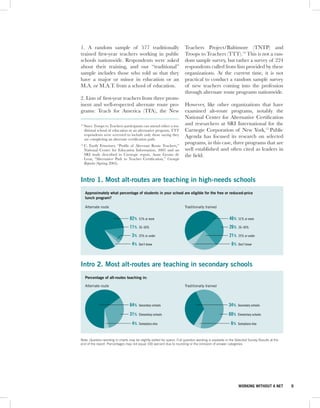
Intro 1. Most alt-routes are teaching in high-needs schools
     Approximately what percentage of students in your school are eligible for the free or reduced-price
     lunch program?

     Alternate route                                                     Traditionally trained


                                  82%    51% or more                                                    46%    51% or more

                                  11%    26–50%                                                         26%    26–50%

                                    3%   25% or under                                                   21%    25% or under

                                    4%   Don’t know                                                       6%   Don’t know


Intro 2. Most alt-routes are teaching in secondary schools
     Percentage of alt-routes teaching in:

     Alternate route                                                     Traditionally trained


                                  64%    Secondary schools                                              34%    Secondary schools

                                  31%    Elementary schools                                             60%    Elementary schools

                                    4%   Someplace else                                                  6%    Someplace else


Note: Question wording in charts may be slightly edited for space. Full question wording is available in the Selected Survey Results at the
end of the report. Percentages may not equal 100 percent due to rounding or the omission of answer categories.


                                                                                                               WORKING WITHOUT A NET          9
A special group                                                          For the rest of this report, we chose to com-
We recognize that results from this study may                            pare only the alternate route sample that are
not apply to the many diverse alternate pro-                             in high-needs schools (184 responses) with only
grams that now exist throughout the country.                             the traditionally trained teachers in high-needs
They are a varied group, and new adapta-                                 schools (274 responses). Based on our analysis,
tions and offshoots seem to be appearing every                           1 in 5 of the alt-route teachers in the group sur-
year.16 However, the three programs surveyed                             veyed here attended an elite college or univer-
here are frequently cited and discussed as es-                           sity compared with only 1 percent of the tradi-
pecially prominent in the field. Over the years,                         tionally trained teachers in the sample.17
Teach for America alone has supplied nearly
17,000 teachers to public schools nationwide,                            We have included short descriptions of each
and at least as a starting point, we believe the                         of the three alternate route organizations
experiences and views of teachers in these                               below, along with contact information for
three programs do provide important food for                             them.18 We would like to take this opportunity
thought. However, since our alt-route group is                           to thank these organizations for their coop-
not a traditional random sample, it is important                         eration. They were interested in hearing more
to point out some of their key characteristics.                          from their participants now at work in public
Two-thirds of teachers (67 percent) in this alt-                         schools and gracious enough to help us ad-
route group are teaching in middle school or                             minister our survey to them.
high school. The vast majority (82 percent) are
also teaching in high-needs schools, which we                            The study also included focus groups or one-
have defined as schools where more than half                             on-one interviews with new alt-route teachers
of students receive free or reduced-price lunch.                         and new and student teachers from traditional
                                                                         programs. In addition, researchers inter-
                                                                         viewed a small group of experts on alternate
16
     Indeed, some say that traditional programs are just as varied;
     see, for example, Linda Darling-Hammond, Barnett Berry              routes as background to developing the survey
     and Amy Thoreson, “Does Teacher Certification Matter?               and survey sample. Needless to say, conduct-
     Evaluating the Evidence,” Educational Evaluation and Policy
     Analysis, Spring 2001.                                              ing a study of this kind presents a number of
                                                                         methodological challenges, and researchers
17
     Elite schools are defined as those listed in the top 25 national    took some time thinking through sampling
     universities or liberal arts colleges identified by the U.S. News
     & World Report 2008 College Rankings.                               and definitional issues connected with the sur-
18
     Note: Information about these three alt-route programs is           vey. These issues are discussed in more detail
     drawn from their own literature.                                    starting on on page 30.


About Teach for America                                                  In the short run, corps members work relent-
Teach for America is the national corps of out-                          lessly to ensure that more students growing
standing recent college graduates and profes-                            up today in the country’s lowest-income com-
sionals of all academic majors, career interests                         munities are given the educational opportu-
and professional backgrounds who commit                                  nities they deserve. In the long run, alumni
two years to teach in urban and rural public                             are a powerful force of leaders working from
schools and become leaders in the effort to                              inside education and from every other sector
expand educational opportunity. Since 1990,                              to effect the fundamental changes needed to
TFA has become the nation’s largest provider                             ensure that all children have an equal chance
of teachers for low-income communities.                                  in life.

The organization’s mission is to build the                               Teach for America
movement to eliminate educational inequity                               315 West 36th Street
by enlisting our nation’s most promising fu-                             7th Floor
ture leaders in the effort.                                              New York, NY 10018
                                                                         800.832.1230


                                                                                                    WORKING WITHOUT A NET     10
About Troops to Teachers                            About the New Teacher Project
Troops to Teachers was originally established       The New Teacher Project is a national non-
in 1994 as a Department of Defense program.         profit organization dedicated to increasing the
The National Defense Authorization Act for          number of outstanding individuals who be-
fiscal year (FY) 2000 transferred the respon-       come public school teachers and to creating
sibility for program oversight and funding to       environments for all educators that maximize
the U.S. Department of Education, but its           their impact on student achievement. TNTP
operation was maintained by the Department          strives to accomplish these goals by creating
of Defense. The No Child Left Behind Act of         innovative teacher recruitment and hiring
2001 provides for the continuation of TTT           programs, identifying the policy obstacles that
through FY 2008. Under this program, eligi-         school districts face to hiring the best teach-
ble military personnel have the opportunity to      ers possible, partnering with school districts to
pursue a second career in public education.         optimize their teacher hiring and school staff-
                                                    ing functions and developing new and better
The goal of this legislation is to help improve     ways to prepare and certify teachers for high-
American education by providing motivated,          need schools.
experienced and dedicated personnel for the
nation’s classrooms.                                Since 1997, TNTP has recruited, trained,
                                                    placed and/or certified approximately 28,000
The three main objectives of the program            high-quality teachers, worked with over 200
are to:                                             school districts, and established more than 55
                                                    programs or initiatives in 26 states. TNTP has
• Help relieve teacher shortages, especially        also published two major studies on teacher
  in the areas of mathematics, the sciences         hiring and school staffing in urban areas:
  and special education. The retention rate is      Missed Opportunities: How We Keep High-
  85 percent after five years of teaching, while    Quality Teachers Out of Urban Classrooms
  85 percent of the candidates are males and        (2003) and Unintended Consequences: The
  43 percent are persons of color;                  Case for Reforming the Staffing Rules in Ur-
                                                    ban Teachers Union Contracts (2005). Among
• Provide positive role models for the nation’s     others, TNTP’s clients include the school dis-
  public school students; and                       tricts of Atlanta, Baltimore, Chicago, Denver,
                                                    Memphis, Miami, New York, Oakland, Phila-
• Assist military personnel to successfully tran-   delphia and Washington, DC and the states
  sition to teaching as a second career.            of Louisiana, Texas and Virginia. For more
                                                    information, please visit tntp.org..
Eligible veterans may receive either a stipend
of not more than $5,000 to assist in attain-        The New Teacher Project
ing teacher certification or a $10,000 incen-       304 Park Avenue South
tive grant bonus for participants who teach for     11th Floor
three years in a high-needs school. Funding         New York, NY 10010
supplements any other GI Bill and other De-         212.590.2484
partment of Veterans Affairs benefits.

DANTES-TTT
6490 Saufley Field Road
Pensacola, FL 32509-5243
800.231.6242


                                                                              WORKING WITHOUT A NET     11
Summary and implications

“Working Without a Net” summarizes the ex-                            • More likely to give fair or poor ratings to
periences of new alt-route teachers who come                            administrators for providing strong instruc-
from Teach for America, Troops to Teachers                              tional leadership or for supporting them on
and the New Teachers Project/Baltimore as                               discipline issues;
they take over their own classrooms in public
schools around the country. The results paint                         • More likely to give fair or poor ratings to col-
a fascinating but unsettling picture of their                           leagues and mentors for giving them support
initiation into the field. Nearly all, the data                         and good advice;
show, are highly idealistic and motivated, and
they have high expectations for their students                        • Less likely to say that their cooperating
and colleagues.                                                         teacher was a good role model;

Contrary to conventional wisdom, most are                             • Less likely to give their cooperating teacher
not planning a hasty exit from the field of                             high marks for providing good advice and
public education. Although just 16 percent                              guidance in important areas;
say they want to remain classroom teachers,
nearly half (48 percent) say they are interested                      • Less likely to say they had enough time work-
in leaving the classroom for another job in ed-                         ing with a real teacher before having their
ucation, meaning that nearly two-thirds from                            own classroom; and
these three programs express an intent to stay
in the field.19                                                       • More likely to say they plan to leave the pro-
                                                                        fession within the next year or two.
Overall, however, the experiences of teachers
from these alt-route programs, as they them-                          It is hard to look at the results without think-
selves describe them, are more negative than                          ing that the idealism and enthusiasm of too
those of their traditionally trained peers. Part                      many of these new alt-route teachers are be-
of the difference undoubtedly stems from their                        ing squandered rather than nurtured. Based
more challenging work environments. Yet even                          on their own evaluations, too many are being
when we compare these new alt-route teach-                            asked to tackle some of teaching’s toughest as-
ers with new traditionally trained teachers                           signments, and they do not believe they are
also working in high-needs schools, there is a                        getting the level of support, mentoring or en-
strong and recurrent pattern of more negative                         couragement they need.
responses. For example, these new alt-route
teachers are:                                                         What’s behind these differences?
                                                                      This study cannot provide definitive answers
• More likely to believe they have been assigned                      about all alt-route programs or all alt-route
  to teach the hardest-to-reach students;                             teachers everywhere. Some may be receiv-
                                                                      ing more support and a warmer welcome to
                                                                      the teaching profession than the results here
19
     Since Teach for America teachers constitute roughly half the
     alt-route sample, the relatively low number planning to stay     suggest. Even more important, this study does
     in the classroom may reflect the specific goals of that pro-     not provide a full explanation of why the ex-
     gram. Teach for America asks for a two-year commitment
     and believes that even though many participants move on to       periences of our alt-route respondents are so
     other careers, public schools, the participants and society in   different. It is important to reiterate one key
     general benefit from their teaching experience.


                                                                                                 WORKING WITHOUT A NET     12
point: Even when we compare these new alt-          have spent years preparing for the classroom
route teachers with new traditionally trained       or perhaps attended less prestigious under-
teachers working in similar high-needs envi-        graduate programs?
ronments, the alt-routes are more likely to say
they are not getting strong support.               • Do some of the differences stem from the
                                                     simple fact that many alt-routes have a short-
Our goal in conducting this study was to hear        er training period? Are there similar differ-
from the teachers themselves, and on that ba-        ences among the different types of tradition-
sis, what we heard raises questions and sug-         al teacher training programs?
gests areas for further discussion. Here are
some that may be important:                        Readers will undoubtedly suggest other hy-
                                                   potheses and bring other insights to the data.
• Are new alt-routes more likely to teach in the   NCCTQ is already sharing this data set with
  most dysfunctional high-needs schools, while     other researchers and will continue to ana-
  traditionally trained teachers typically teach   lyze and probe the results in the coming year.
  in better-run high-needs schools or work         We hope this study will spur additional re-
  with less troubled students? Are traditionally   search, and we would be pleased to consult with
  trained teachers coming out of local edu-        others and share what we have learned in doing
  cation schools better positioned to choose       this work.
  teaching positions in high-needs schools with
  more effective leadership?                       Despite the small scale of this study and its
                                                   limitations, we believe the results illuminate
• Are new alt-route teachers more likely to be     an important dilemma and challenge for the
  placed in schools farther from home? When        field. The plight of new teachers wrestling
  teachers are assigned to positions in parts of   with difficult assignments with limited guid-
  the country that are new to them, do they        ance and minimal mentorship is more pro-
  experience more difficult transitions? Do        nounced among the alt-routes, but significant
  traditionally trained teachers coming out of     numbers of new traditionally trained teachers
  local education schools have better networks     find themselves in the same predicament. So
  of support?                                      our question is: Are we willing to create a sys-
                                                   tem that gives new teachers the support that
• Do alt-routes bring a different set of expec-    will help them succeed regardless of the route
  tations to teaching? Are they more likely to     they take to teaching? Or, to use the words of
  be critical of their schools, colleagues and     one of the new teachers interviewed for the
  administrators because of their educational      project, will we continue to treat many of them
  background or previous experience in the         like “independent contractor[s]” expected to
  military or other types of work?                 “just manage [their] little society in the class-
                                                   room”? Their situation deserves a thoughtful
• Do they often encounter a less welcoming         response and genuine answers.
  atmosphere or perhaps some level of resent-
  ment from teachers and administrators who


                                                                             WORKING WITHOUT A NET     13
Lessons Learned, the NCCTQ/Public Agenda survey of first-year teachers, consists of
three reports:

• Issue No 1: They’re Not Little Kids Anymore compares the views of first-year
  teachers in high school with those of teachers in elementary schools, high-needs schools
  and other schools. The report, issued October 2007, is available at publicagenda.org/
  LessonsLearned1 and at ncctq.org/publications/LessonsLearned1.pdf.

• Issue No 2: Working Without a Net reports on the views and experiences of new
  teachers from three prominent alternate route programs, Teach for America, Troops to
  Teachers and the New Teachers Project/Baltimore and compares their views with the
  nationwide sample of first-year traditionally trained teachers.

• Issue No. 3: Here’s Where I Need Help, which is to be released at a later date, will
  describe three areas where many new teachers believe they could use more guidance and
  advice—the challenge of working with diverse classrooms, helping gifted and special-
  needs students and communicating and working with parents.

Following the release of the reports, the entire data set will be housed at the National Com-
prehensive Center for Teacher Quality and available to its analysts and other researchers
exploring teachers training, recruitment and support issues. All three Lessons Learned
reports will be available online from both NCCTQ and Public Agenda.


                                                                         WORKING WITHOUT A NET   14
Finding One: Idealism and a strong desire to help

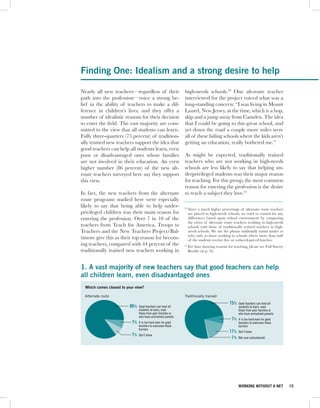
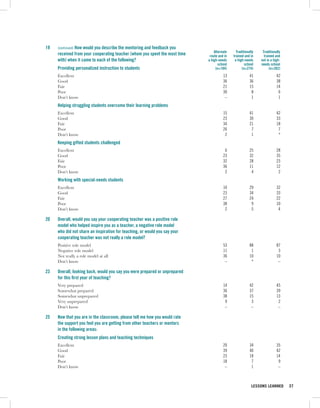
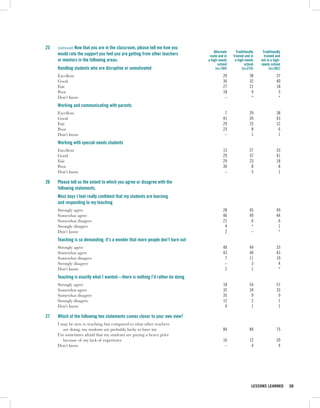
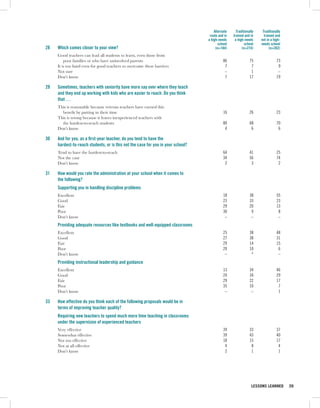
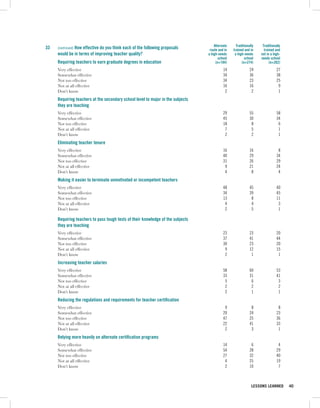
Nearly all new teachers—regardless of their                     high-needs schools.20 One alt-route teacher
path into the profession—voice a strong be-                     interviewed for the project voiced what was a
lief in the ability of teachers to make a dif-                  long-standing concern: “I was living in Mount
ference in children’s lives, and they offer a                   Laurel, New Jersey, at the time, which is a hop,
number of idealistic reasons for their decision                 skip and a jump away from Camden. The idea
to enter the field. The vast majority are com-                  that I could be going to this great school, and
mitted to the view that all students can learn.                 yet down the road a couple more miles were
Fully three-quarters (75 percent) of tradition-                 all of these failing schools where the kids aren’t
ally trained new teachers support the idea that                 getting an education, really bothered me.”
good teachers can help all students learn, even
poor or disadvantaged ones whose families                       As might be expected, traditionally trained
are not involved in their education. An even                    teachers who are not working in high-needs
higher number (86 percent) of the new alt-                      schools are less likely to say that helping un-
route teachers surveyed here say they support                   derprivileged students was their major reason
this view.                                                      for teaching. For this group, the most common
                                                                reason for entering the profession is the desire
In fact, the new teachers from the alternate                    to teach a subject they love.21
route programs studied here were especially
likely to say that being able to help under-                    20
                                                                     Since a much higher percentage of alternate route teachers
privileged children was their main reason for                        are placed in high-needs schools, we tried to control for any
entering the profession. Over 7 in 10 of the                         differences based upon school environment by comparing
                                                                     the views of alternate route teachers working in high-needs
teachers from Teach for America, Troops to                           schools with those of traditionally trained teachers in high-
Teachers and the New Teachers Project/Bal-                           needs schools. We use the phrase traditionally trained teachers to
                                                                     refer only to those working in schools where more than half
timore give this as their top reason for becom-                      of the students receive free or reduced-priced lunches.
ing teachers, compared with 44 percent of the                   21
                                                                     For data showing reasons for teaching, please see Full Survey
traditionally trained new teachers working in                        Results on p. 34.


1. A vast majority of new teachers say that good teachers can help
all children learn, even disadvantaged ones
  Which comes closest to your view?

  Alternate route                                               Traditionally trained
                                                                                                 75%    Good teachers can lead all
                           86%   Good teachers can lead all                                             students to learn, even
                                 students to learn, even                                                those from poor families or
                                 those from poor families or                                            who have uninvolved parents
                                 who have uninvolved parents
                                                                                                   7%   It is too hard even for good
                            7%   It is too hard even for good                                           teachers to overcome these
                                 teachers to overcome these                                             barriers
                                 barriers
                                                                                                 17%    Don’t know
                            7%   Don’t know
                                                                                                  1%    Not sure (volunteered)


                                                                                                        WORKING WITHOUT A NET             15
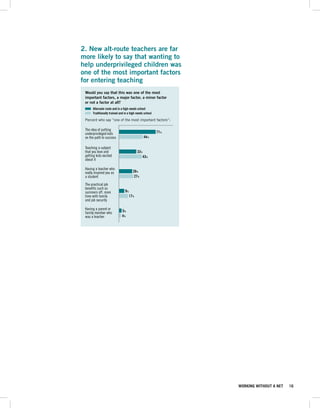
2. New alt-route teachers are far
more likely to say that wanting to
help underprivileged children was
one of the most important factors
for entering teaching
 Would you say that this was one of the most
 important factors, a major factor, a minor factor
 or not a factor at all?
      Alternate route and in a high-needs school
      Traditionally trained and in a high-needs school

 Percent who say “one of the most important factors”:

 The idea of putting
 underprivileged kids                                    71%
 on the path to success                        44%

 Teaching a subject
 that you love and                         33%
 getting kids excited                         43%
 about it

 Having a teacher who
 really inspired you as                26%
 a student                              27%

 The practical job
 benefits such as
 summers off, more              9%
 time with family                    17%
 and job security

 Having a parent or
 family member who           5%
 was a teacher               4%
                                                               0   20   40   60   80   100


                                                                                   WORKING WITHOUT A NET   16
Finding Two: Day one in the classroom…
the most difficult classes and needing
more support

Although they come to their jobs with enthu-                       pline problems at the very top of the lists of
siasm and idealism, large numbers of the al-                       the drawbacks to teaching; these issues are of
ternate route teachers we surveyed voice con-                      lesser concern among the traditionally trained
cerns about their first teaching assignments,                      teachers. As one alt-route teacher told us: “For
and many see problems such as lack of support                      me, the worst thing is the administration and
by administrators and discipline issues with                       the lack of support. I’ll have kids [who] get
students as the major drawbacks of teaching.                       in fights. I’ll send them to the administration,
Traditionally trained teachers working in high-                    and they’re back in class in 10 minutes.” More
needs schools and at the secondary level22 re-                     than half (54 percent) of new alt-routes in
port similar problems to some degree, but the                      high-needs schools say “lack of support from
issues are more pronounced among the alter-                        administrators” is a major drawback to teach-
nate route teachers in the survey. For example,                    ing, compared with just 1 in 5 (20 percent)
alt-route teachers are much more likely than                       new teachers who are traditionally trained.
traditionally trained teachers to say that they                    Another of our first-year alt-route teachers
have been assigned classes with some of the                        said: “Teachers have to go it alone, especially
hardest-to-reach students in the school, while                     in the city. You cannot send a student out of
the more experienced teachers are assigned less                    your room. You have to deal with the behavior
challenging classes. One new alt-route teacher                     problem and fill out forms. You know what? I
put it this way: “I think that in a lot of other                   think it’s part of the job. You’re kind of like
professions, first-year people are mentored and                    an independent contractor. You’ve just got to
eased into it. You start them with easy assign-                    manage your little society in the classroom.”
ments. I think in education, the older teachers
have paid their dues, and therefore they teach                     Despite the differing experiences of new alt-
fewer classes, get the honors classes. If you’re a                 route and new traditionally trained teachers,
first-year teacher, you are just muscle almost. I                  they share many concerns about their jobs.
know that’s what we’re here for.” Traditionally                    More than 4 in 10 of each group see “testing
trained teachers—even in high-needs schools—                       and not enough freedom to be creative” as a
are much less likely to feel that their schools have               major drawback. As one novice teacher in a tra-
assigned them to the toughest classes. Although                    ditional program told us, “I think it’s absolutely
majorities of all groups surveyed say that it is                   a matter of testing, taking away too much time.
“wrong” to place “inexperienced teachers with                      The entire plan and scheduling timeline, at
the hardest-to-reach students,” the numbers                        least for English, is catered towards cramming
questioning this practice are highest among the                    as much in as possible before the standardized
new alternate route teachers—8 in 10 among                         test occurs. You are penalized severely if you
the new alt-routes compared with about 7 in 10                     are not on track, if they come into your class-
among the traditionally trained group.                             room and if you’re not on the exact page of
                                                                   what you’re supposed to be on.” On the other
The alt-route group is also more likely to place                   hand, neither group sees low pay and limited
lack of support from administrators and disci-                     potential for career growth as the chief draw-
                                                                   back to teaching, and very low numbers voice
                                                                   concerns about the lack of prestige in teaching
22
     Please see “Lessons Learned Issue No. 1: They’re Not Little
     Kids Anymore: The Special Challenges of New Teachers in       or about their personal safety in their school.
     High Schools and Middle Schools,” Public Agenda, 2007.


                                                                                              WORKING WITHOUT A NET     17
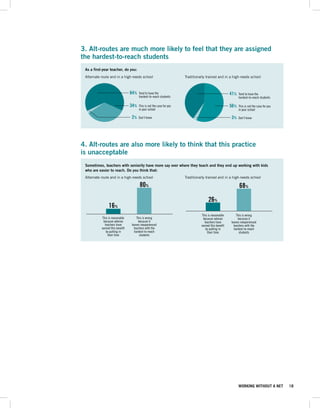
3. Alt-routes are much more likely to feel that they are assigned
the hardest-to-reach students
  As a first-year teacher, do you:
  Alternate route and in a high-needs school                                Traditionally trained and in a high-needs school


  As a first-year teacher, do 64% Tend to have the
                              you:                                                                          41%   Tend to have the
                                        hardest-to-reach students                                                 hardest-to-reach students
  Alternate route and in a high-needs school                                Traditionally trained and in a high-needs school
                                  34%   This is not the case for you                                        56%   This is not the case for you
                                        in your school                                                            in your school

                                  64%
                                   2%   Don’t to have the
                                        Tend know                                                           41%
                                                                                                             3    Don’tto have the
                                                                                                                  Tend know
                                        hardest-to-reach students                                                 hardest-to-reach students

                                  34%   This is not the case for you                                        56%   This is not the case for you
                                        in your school                                                            in your school

                                  2%    Don’t know                                                          3%    Don’t know
4. Alt-routes are seniority more likely where they teach and they end practice kids
  Sometimes, teachers with
  who are easier to reach. Doalso
                                        have more say over
                                you think that:            to think that this up working with
isAlternate route and in a high-needs school
   unacceptable                                              Traditionally trained and in a high-needs school

                                    80%                                                         68%
  Sometimes, teachers with seniority have more say over where they teach and they end up working with kids
  who are easier to reach. Do you think that:
  Alternate route and in a high-needs school                                               26   %
                                                                            Traditionally trained and in a high-needs school
                 16%                    80%                                                                       68%
                                                                                      This is reasonable        This is wrong
            This is reasonable        This is wrong                                    because veteran           because it
             because veteran
              teachers have
                                       because it
                                  leaves inexperienced                                     26
                                                                                        teachers have
                                                                                      earned this%benefit
                                                                                                            leaves inexperienced
                                                                                                              teachers with the
                 16
            earned this benefit
                       %
               by putting in
                                    teachers with the
                                    hardest-to-reach
                                                                                         by putting in
                                                                                          their time
                                                                                                              hardest-to-reach
                                                                                                                  students
                their time              students
                                                                                      This is reasonable        This is wrong
            This is reasonable        This is wrong                                    because veteran           because it
             because veteran           because it                                       teachers have       leaves inexperienced
              teachers have       leaves inexperienced                                earned this benefit     teachers with the
            earned this benefit     teachers with the                                    by putting in        hardest-to-reach
               by putting in        hardest-to-reach                                      their time              students
                their time              students


    80                                                                 80
    70                                                                 70
    60                                                                 60
    50                                                                 50
    40                                                                 40
    30                                                                 30
    80                                                                 80
                                                                       20
    20
    70                                                                 70
                                                                       10
    10
    60                                                                 60
                                                                        0
     0
    50                                                                 50
    40                                                                 40
    30                                                                 30
    20                                                                 20
    10                                                                 10
     0                                                                  0


                                                                                                                  WORKING WITHOUT A NET          18
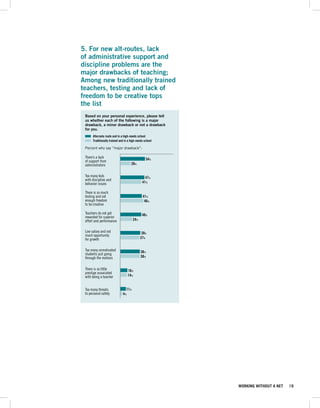
5. For new alt-routes, lack
of administrative support and
discipline problems are the
major drawbacks of teaching;
Among new traditionally trained
teachers, testing and lack of
freedom to be creative tops
the list
 Based on your personal experience, please tell
 us whether each of the following is a major
 drawback, a minor drawback or not a drawback
 for you.
      Alternate route and in a high-needs school
      Traditionally trained and in a high-needs school

 Percent who say “major drawback”:

 There’s a lack                                  54%
 of support from
 administrators                      20%


 Too many kids                                  47%
 with discipline and
 behavior issues                              41%

 There is so much
 testing and not                              41%
 enough freedom                                46%
 to be creative

 Teachers do not get                          40%
 rewarded for superior
 effort and performance               24%


 Low salary and not                          39%         0   20   40   60   80     100
 much opportunity
 for growth                                 37%


 Too many unmotivated                        38%
 students just going
 through the motions                         38%


 There is so little               16%
 prestige associated
 with being a teacher             14%


 Too many threats               11%
 to personal safety           4%


                                                                                 WORKING WITHOUT A NET   19
Finding Three: Doing a tough job
with minimal backup

New alt-route teachers report a variety of con-                 to steal an overhead light bulb from someone
cerns about administrative functions in their                   else’s overhead to get mine to work. It’s just
schools as well as concerns about the commit-                   kind of like a lack of resources and not having
ment and collegiality of their fellow teachers.                 an administration that’s supportive.” Another
Even when we compare the experiences and                        striking difference is the alt-routes’ judgments
judgments of the new alt-routes with those of                   about the kind of help and feedback they can
new traditionally trained teachers working in                   count on from other, presumably more experi-
similar schools, the contrasts are remarkable.                  enced teaching staff. One new alt-route teacher
New alt-routes in high-needs schools are about                  described her colleagues as outright demoral-
twice as likely as the traditionally trained group              izing rather than supportive and encouraging:
to give administrators fair or poor marks for                   “The days where I feel most like I don’t want
instructional leadership (64 percent vs. 32 per-                to go to work, it’s because of the other teach-
cent), support on discipline problems (59 per-                  ers in the building. It’s not even the administra-
cent vs. 29 percent) and providing resources                    tion. It’s the other teachers in the building who
like textbooks and well-equipped classes (48                    have such a poor attitude toward the students.
percent vs. 24 percent). One alt-route teacher                  I can handle my students any day of the week.
commented: “I buy all my cases of paper, be-                    But I can’t handle you guys. Grow up and take
cause we have no paper at our school. I had                     some responsibility.”

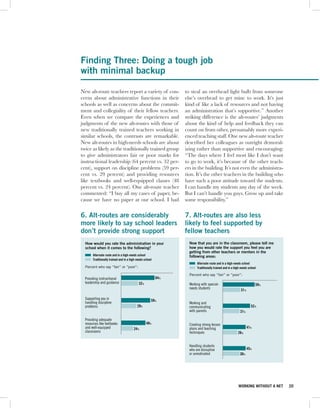
6. Alt-routes are considerably                                  7. Alt-routes are also less
more likely to say school leaders                               likely to feel supported by
don’t provide strong support                                    fellow teachers
  How would you rate the administration in your                   Now that you are in the classroom, please tell me
  school when it comes to the following?                          how you would rate the support you feel you are
                                                                  getting from other teachers or mentors in the
       Alternate route and in a high-needs school                 following areas:
       Traditionally trained and in a high-needs school
                                                                         Alternate route and in a high-needs school
  Percent who say “fair” or “poor”:                                      Traditionally trained and in a high-needs school

                                                                  Percent who say “fair” or “poor”:
  Providing instructional                                 64%
  leadership and guidance                   32%                   Working with special-                                     59%
                                                                  needs students                              31%

  Supporting you in                                   59%
  handling discipline                                             Working and
  problems                                 29%                    communicating                                           52%
                                                                  with parents                                31%

  Providing adequate
  resources like textbooks                        48%             Creating strong lesson
  and well-equipped                     24%                       plans and teaching                                41%
  classrooms                                                      techniques                              26%


                                                                  Handling students
                                                                  who are disruptive                                45%
                                                                  or unmotivated                              30%


                                                                     0         20       40      60       80         100


                                                                                                          WORKING WITHOUT A NET   20
Finding Four: Less satisfied with their preparation
and cooperating teachers

Many different kinds of alternate route pro-         versus the most negative ones, but the survey
grams are operating today, and even though           shows a similar pattern. Less than a quarter
our study is confined to three programs, partic-     (22 percent) of alt-routes in high-needs schools
ipants in them actually receive training at a va-    said their cooperating teachers gave them “ex-
riety of institutions and programs nationwide.       cellent” feedback on managing the classroom,
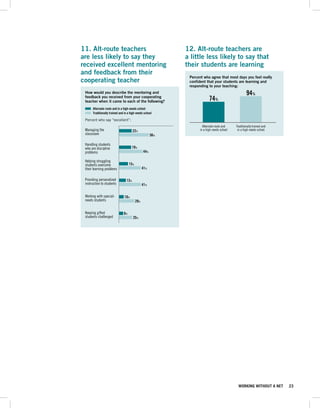
As a group, however, the alt-route teachers          compared with over half (56 percent) of tradi-
surveyed here say they could have used more          tionally trained teachers in high-needs schools.
time working with a classroom teacher during         Just over half of the alt-routes said their coop-
their preparation period. And while most alt-        erating teacher was a positive role model, com-
routes give reasonable marks to the teachers         pared with 88 percent among the traditionally
they worked with prior to full-time teaching,        trained teachers. In addition, 16 percent of the
their ratings are consistently less positive than    alt-routes said they did not spend any time at
the ratings traditionally trained teachers give.     all with a cooperating teacher.
It is, of course, reasonable to ask whether alt-
route teachers may be applying a different set       Note that the alt-route teachers are somewhat
of standards when they make their judgments,         less confident about the impact they are hav-
but focus groups and one-on-one interviews           ing on their students. While more than 9 in
suggest that in some cases, at least, the train-     10 traditionally trained teachers in high-needs
ing differences are indisputable. For example,       schools say they are confident their students are
one student teacher in a traditional education       responding to their teaching most days, only
school program was enormously enthusiastic           74 percent of the alt-route teachers say this.
about her cooperating teacher: “My cooperat-         Whatever self-questioning they may engage
ing teacher is great. He’s in his late 30s, and      in, however, the vast majority of alt-routes are
he’s really smart. The kids love him, and he         confident that at least they offer more to their
loves being there. He’s very willing to help me.     students than do other teachers in their school.
He’s helped me put together lesson plans. He’s       One alt-route teacher told us: “I’m teaching all
willing to talk. I’m really excited for him to be    of ninth-grade algebra at my school. I didn’t
my cooperating teacher. He’s probably the best       take a math class since high school. I was a
person that I’ve observed so far.” Meanwhile, a      Spanish and anthropology major, and now I
new teacher in an alternate route program de-        am an algebra teacher. The students think I’m
scribed a far more dispiriting situation with the    a great teacher. They’re like, ‘She’s here every
more experienced teacher she worked with:            day. She doesn’t send the kids out all the time.’
“She was supposed to teach math and science,         I could be doing who even knows what in my
but she said, ‘They can’t do science anyway,         classroom, but I know I’m way better than
so I’m just going to do math. I’m not going          some of the other teachers who are watching
to waste my time. I don’t have time to plan.         soap operas in class. I’m glad my students have
I can’t do this. I can’t do that.’ Her attitude is   a teacher who is there and who cares. But I’m
that the kids are not worth it.” These two com-      sorry, I’m not highly qualified. I don’t know
ments may exemplify the most positive views          what I’m doing. I really don’t.”


                                                                               WORKING WITHOUT A NET     21
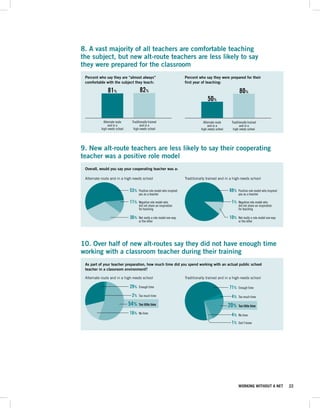
8. A vast majority of all teachers are comfortable teaching
the subject, but new alt-route teachers are less likely to say
they were prepared for the classroom
 Percent who say they are “almost always”                                  Percent who say they were prepared for their
 comfortable with the subject they teach:                                  first year of teaching:

                 81%                     82%                                                                     80%
                                                                                         50%


               Alternate route     Traditionally trained                               Alternate route     Traditionally trained
                   and in a              and in a                                          and in a              and in a
             high-needs school      high-needs school                                high-needs school      high-needs school


9. New alt-route teachers are less likely to say their cooperating
     100

teacher was a positive role model
      80

        60

 Overall, would you say your cooperating teacher was a:
        40

        20
 Alternate route and in a high-needs school                                Traditionally trained and in a high-needs school
         0

                                  53%   Positive role model who inspired                                  88%   Positive role model who inspired
                                        you as a teacher                                                        you as a teacher

                                  11%   Negative role model who                                            1%   Negative role model who
                                        did not share an inspiration                                            did not share an inspiration
                                        for teaching                                                            for teaching

                                  36%   Not really a role model one way                                   10%   Not really a role model one way
                                        or the other                                                            or the other


10. Over half of new alt-routes say they did not have enough time
working with a classroom teacher during their training
 As part of your teacher preparation, how much time did you spend working with an actual public school
 teacher in a classroom environment?

 Alternate route and in a high-needs school                                Traditionally trained and in a high-needs school

                                  29%   Enough time                                                       71%   Enough time

                                   2%   Too much time                                                      4%   Too much time

                                 54% Too little time                                                     20% Too little time
                                  16%   No time
                                                                                                           4%   No time

                                                                                                           1%   Don’t know


                                                                                                                WORKING WITHOUT A NET              22
11. Alt-route teachers                                      12. Alt-route teachers are
are less likely to say they                                 a little less likely to say that
received excellent mentoring                                their students are learning
and feedback from their
                                                             Percent who agree that most days you feel really
cooperating teacher                                          confident that your students are learning and
                                                             responding to your teaching:
 How would you describe the mentoring and                                                                 94%
 feedback you received from your cooperating
 teacher when it came to each of the following?                             74%
      Alternate route and in a high-needs school
      Traditionally trained and in a high-needs school

 Percent who say “excellent”:
                                                                      Alternate route and         Traditionally trained and
 Managing the                          22%                          in a high-needs school         in a high-needs school
 classroom                                            56%

 Handling students
 who are discipline                  19%
 problems                                       44%

 Helping struggling
 students overcome                  15%
 their learning problems                        41%

 Providing personalized          13%
 instruction to students                        41%

 Working with special-         10%
 needs students                           29%

 Keeping gifted                6%
 students challenged                   25%                      0      20       40       60 100   80       100

                                                                                             80

                                                                                             60

                                                                                             40

                                                                                             20

                                                                                              0


                                                                                                   WORKING WITHOUT A NET      23
Finding Five: Aspirations and exit plans

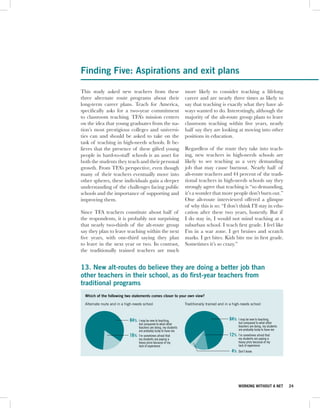
This study asked new teachers from these                           more likely to consider teaching a lifelong
three alternate route programs about their                         career and are nearly three times as likely to
long-term career plans. Teach for America,                         say that teaching is exactly what they have al-
specifically asks for a two-year commitment                        ways wanted to do. Interestingly, although the
to classroom teaching. TFA’s mission centers                       majority of the alt-route group plans to leave
on the idea that young graduates from the na-                      classroom teaching within five years, nearly
tion’s most prestigious colleges and universi-                     half say they are looking at moving into other
ties can and should be asked to take on the                        positions in education.
task of teaching in high-needs schools. It be-
lieves that the presence of these gifted young                     Regardless of the route they take into teach-
people in hard-to-staff schools is an asset for                    ing, new teachers in high-needs schools are
both the students they teach and their personal                    likely to see teaching as a very demanding
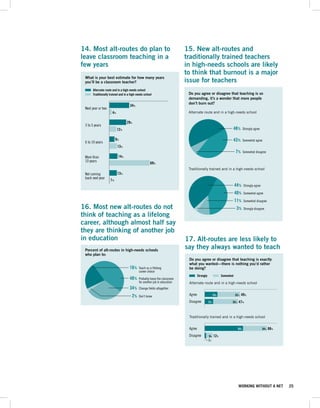
growth. From TFA’s perspective, even though                        job that may cause burnout. Nearly half of
many of their teachers eventually move into                        alt-route teachers and 44 percent of the tradi-
other spheres, these individuals gain a deeper                     tional teachers in high-needs schools say they
understanding of the challenges facing public                      strongly agree that teaching is “so demanding,
schools and the importance of supporting and                       it’s a wonder that more people don’t burn out.”
improving them.                                                    One alt-route interviewed offered a glimpse
                                                                   of why this is so: “I don’t think I’ll stay in edu-
Since TFA teachers constitute about half of                        cation after these two years, honestly. But if
the respondents, it is probably not surprising                     I do stay in, I would not mind teaching at a
that nearly two-thirds of the alt-route group                      suburban school. I teach first grade. I feel like
say they plan to leave teaching within the next                    I’m in a war zone. I get bruises and scratch
five years, with one-third saying they plan                        marks. I get bites. Kids bite me in first grade.
to leave in the next year or two. In contrast,                     Sometimes it’s so crazy.”
the traditionally trained teachers are much


13. New alt-routes do believe they are doing a better job than
other teachers in their school, as do first-year teachers from
traditional programs
  Which of the following two statements comes closer to your own view?

  Alternate route and in a high-needs school                       Traditionally trained and in a high-needs school


                             84% I may be new to teaching,                                     84%   I may be new to teaching,
                                 but compared to what other                                          but compared to what other
                                 teachers are doing, my students                                     teachers are doing, my students
                                 are probably lucky to have me                                       are probably lucky to have me
                             16% I’m sometimes afraid that                                     12%   I’m sometimes afraid that
                                 my students are paying a                                            my students are paying a
                                 heavy price because of my                                           heavy price because of my
                                 lack of experience                                                  lack of experience
                                                                                                4%   Don’t know


                                                                                                     WORKING WITHOUT A NET             24
14. Most alt-routes do plan to                                            15. New alt-routes and
                                               leave classroom teaching in a                                             traditionally trained teachers
                                               few years                                                                 in high-needs schools are likely
                                                                                                                         to think that burnout is a major
                                                What is your best estimate for how many years                            Percent of alt-routes in high-needs schools
                                                you’ll be a classroom teacher?                                           issue to: teachers
                                                                                                                         who plan for

                                                     Alternate route and in a high-needs school
                                                     Traditionally trained and in a high-needs school                      Do you agree or disagree that Teach as a lifelong
                                                                                                                                                  16% teaching is so
                                                                                                                           demanding, it’s a wonder that more people
                                                                                                                                                         career choice
                                                                                                                           don’t burn out?
                                                Next year or two
                                                                                   34%                                                            48% Probably leave the classroom
                                                                                                                                                                              for another job in education
                                                                    4%                                                     Alternate route and in a high-needs school
                                                                                                                                                                    34%       Change fields altogether
                                                                                29%                                                                                     2% Don’t know
                                                3 to 5 years
                                                                         12%                                                                                             48% Strongly agree

                                                6 to 10 years
                                                                        9%                                                                                               43%        Somewhat agree
                                                                         13%
                                                                                                                                                                          7%        Somewhat disagree
                                                More than                14%
                                                10 years
                                                                                                   69%
                                                                                                                           Traditionally trained and in a high-needs school
                                                Not coming               13%
                                                back next year
                                                                   1%
                                                                                                                                                                          44%       Strongly agree

                                                                                                                                                                          40%       Somewhat agree
                                                                                                                                                                                                                      0   20

                                                                                                                                                                          11%       Somewhat disagree
                                               16. Most new alt-routes do not                                                                                              3%       Strongly disagree

                                               think of teaching as a lifelong
                                               career, although almost half say
                                               they are thinking of another job
                                               in education                                                              17. Alt-routes are less likely to
your best estimate for how many years           Percent of alt-routes in high-needs schools
                                                                                                                         say they always wanted to teach
 a classroom teacher?                           who plan to:
                                                                                                                           Do you agree or disagree that teaching is exactly
nate route and in a high-needs school                                                                                      what you wanted—there is nothing you’d rather
tionally trained and in a high-needs school                                        16%    Teach as a lifelong              be doing?
                                                                                          career choice
                                                                                                                                   Strongly                    Somewhat
or two
                         34%                                                       48%    Probably leave the classroom
                                                                                          for another job in education     Alternate route and in a high-needs school
           4%
                                                                                   34%    Change fields altogether
                      29%                                                           2%    Don’t know                       Agree                    18%                   32%      49%
s
                12%                                                                                                        Disagree           12%                       35%   47%

              9%
ars
                                                                                                                           Traditionally trained and in a high-needs school
                13%

                14%                                                                                                        Agree                                              54%                    34%   88%
                                         69%                                                                               Disagree           9%    12%
                                                                                                                                              2%

g               13%
year
         1%


                                                                                                                                          0               20       40         60         80     100


                                                                                                                                                                              WORKING WITHOUT A NET              25
Finding Six: Agreement on ways
to improve teachers

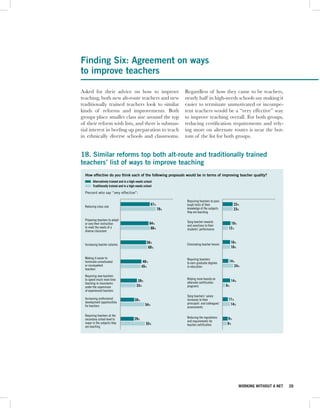
Asked for their advice on how to improve                            Regardless of how they came to be teachers,
teaching, both new alt-route teachers and new                       nearly half in high-needs schools say making it
traditionally trained teachers look to similar                      easier to terminate unmotivated or incompe-
kinds of reforms and improvements. Both                             tent teachers would be a “very effective” way
groups place smaller class size around the top                      to improve teaching overall. For both groups,
of their reform wish lists, and there is substan-                   reducing certification requirements and rely-
tial interest in beefing up preparation to teach                    ing more on alternate routes is near the bot-
in ethnically diverse schools and classrooms.                       tom of the list for both groups.


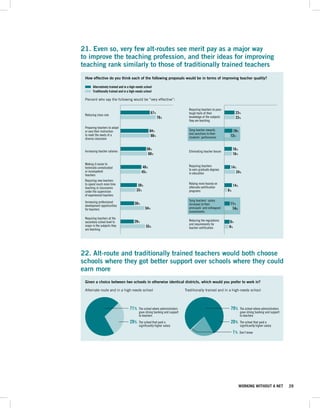
18. Similar reforms top both alt-route and traditionally trained
teachers’ list of ways to improve teaching
  How effective do you think each of the following proposals would be in terms of improving teacher quality?
        Alternatively trained and in a high-needs school
        Traditionally trained and in a high-needs school

  Percent who say “very effective”:

                                                                     Requiring teachers to pass
                                                        67%          tough tests of their                23%
  Reducing class size
                                                              79%    knowledge of the subjects           23%
                                                                     they are teaching

  Preparing teachers to adapt
                                                       64%           Tying teacher rewards           19%
  or vary their instruction
                                                                     and sanctions to their
  to meet the needs of a                                66%                                         12%
                                                                     students’ performance
  diverse classroom


                                                   58%                                                  16%
  Increasing teacher salaries                                        Eliminating teacher tenure
                                                    60%                                                 16%

  Making it easier to                                                Requiring teachers
  terminate unmotivated                          48%                 to earn graduate degrees       14%
  or incompetent                                45%                  in education                      24%
  teachers

  Requiring new teachers
  to spend much more time                                            Relying more heavily on
                                            39%                      alternate certification            14%
  teaching in classrooms
  under the supervision                    33%                       programs                      6%
  of experienced teachers                                                                                                             0    20   40

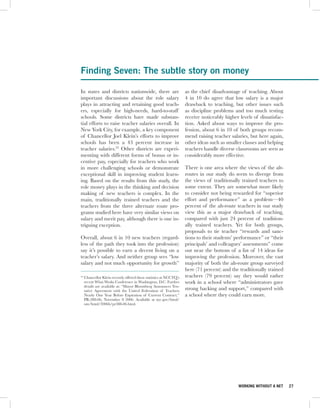
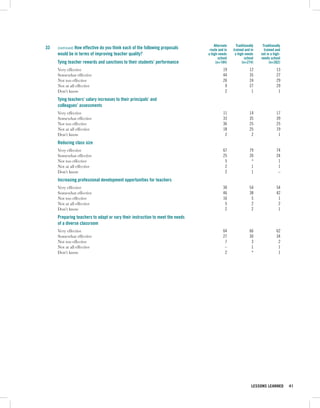
                                                                     Tying teachers’ salary
  Increasing professional                 30%                        increases to their             11%
  development opportunities                                          principals’ and colleagues’
  for teachers                                    54%                                                14%
                                                                     assessments

  Requiring teachers at the
                                         29%                         Reducing the regulations      9%
  secondary school level to
                                                                     and requirements for
  major in the subjects they                       55%                                             8%
                                                                     teacher certification
  are teaching


                                                                                                              WORKING WITHOUT A NET   26
Finding Seven: The subtle story on money

In states and districts nationwide, there are                        as the chief disadvantage of teaching. About
important discussions about the role salary                          4 in 10 do agree that low salary is a major
plays in attracting and retaining good teach-                        drawback to teaching, but other issues such
ers, especially for high-needs, hard-to-staff                        as discipline problems and too much testing
schools. Some districts have made substan-                           receive noticeably higher levels of dissatisfac-
tial efforts to raise teacher salaries overall. In                   tion. Asked about ways to improve the pro-
New York City, for example, a key component                          fession, about 6 in 10 of both groups recom-
of Chancellor Joel Klein’s efforts to improve                        mend raising teacher salaries, but here again,
schools has been a 43 percent increase in                            other ideas such as smaller classes and helping
teacher salaries.23 Other districts are experi-                      teachers handle diverse classrooms are seen as
menting with different forms of bonus or in-                         considerably more effective.
centive pay, especially for teachers who work
in more challenging schools or demonstrate                           There is one area where the views of the alt-
exceptional skill in improving student learn-                        routes in our study do seem to diverge from
ing. Based on the results from this study, the                       the views of traditionally trained teachers to
role money plays in the thinking and decision                        some extent. They are somewhat more likely
making of new teachers is complex. In the                            to consider not being rewarded for “superior
main, traditionally trained teachers and the                         effort and performance” as a problem—40
teachers from the three alternate route pro-                         percent of the alt-route teachers in our study
grams studied here have very similar views on                        view this as a major drawback of teaching,
salary and merit pay, although there is one in-                      compared with just 24 percent of tradition-
triguing exception.                                                  ally trained teachers. Yet for both groups,
                                                                     proposals to tie teacher “rewards and sanc-
Overall, about 6 in 10 new teachers (regard-                         tions to their students’ performance” or “their
less of the path they took into the profession)                      principals’ and colleagues’ assessments” come
say it’s possible to earn a decent living on a                       out near the bottom of a list of 14 ideas for
teacher’s salary. And neither group sees “low                        improving the profession. Moreover, the vast
salary and not much opportunity for growth”                          majority of both the alt-route group surveyed
                                                                     here (71 percent) and the traditionally trained
23
     Chancellor Klein recently offered these statistics at NCCTQ’s   teachers (79 percent) say they would rather
     recent What Works Conference in Washington, D.C. Further        work in a school where “administrators gave
     details are available at: “Mayor Bloomberg Announces Ten-
     tative Agreement with the United Federation of Teachers         strong backing and support,” compared with
     Nearly One Year Before Expiration of Current Contract,”         a school where they could earn more.
     PR-388-06, November 8 2006. Available at nyc.gov/html/
     om/html/2006b/pr388-06.html.


                                                                                               WORKING WITHOUT A NET    27
19. Both alt-routes and                                        20. While alt-routes and
traditionally trained teachers                                 traditionally trained teachers
say it’s possible to earn                                      do not differ about their view
a reasonable living as a teacher                               of salary as a drawback,
                                                               alt-routes are more likely to say
 Thinking about the profession of teaching,
 do you think that the nature of the job means:
                                                               not being rewarded for superior
 Alternate route and in a high-needs school
                                                               effort is a major drawback
                                                                Based on your personal experience, please tell us
                             63%    It is very possible for     whether each of the following is a major drawback,
                                    a teacher to make a         a minor drawback or not a drawback for you.
                                    reasonable living
                                                                     Alternate route and in a high-needs school
                                                                     Traditionally trained and in a high-needs school
                             36%    Teachers are never
                                    paid well                   Percent who say the following is a “major drawback”:
                              2%    Don’t know                  There’s a lack                                  54%
                                                                of support from
                                                                administrators                      20%
 Traditionally trained and in a high-needs school
                                                                Too many kids                                  47%
                                                                with discipline and
                                                                                                             41%
                              66%    It is very possible for    behavior issues
                                     a teacher to make a
                                     reasonable living          There is so much
                                                                testing and not                              41%
                              32%    Teachers are never         enough freedom                                46%
                                     paid well                  to be creative

                               3%    Don’t know                 Teachers do not get                          40%
                                                                rewarded for superior
                                                                effort and performance               24%


                                                                Low salary and not                          39%
                                                                much opportunity
                                                                for growth                                 37%
                                                                                                                                    0   20   40


                                                                Too many unmotivated                        38%
                                                                students just going
                                                                through the motions                         38%


                                                                There is so little               16%
                                                                prestige associated
                                                                with being a teacher             14%


                                                                Too many threats               11%
                                                                to personal safety           4%


                                                                                                       WORKING WITHOUT A NET   28
21. Even so, very few alt-routes see merit pay as a major way
to improve the teaching profession, and their ideas for improving
teaching rank similarly to those of traditionally trained teachers
 How effective do you think each of the following proposals would be in terms of improving teacher quality?

       Alternatively trained and in a high-needs school
       Traditionally trained and in a high-needs school

 Percent who say the following would be “very effective”:

                                                                                Requiring teachers to pass
                                                       67%                      tough tests of their                23%
 Reducing class size
                                                             79%                knowledge of the subjects           23%
                                                                                they are teaching

 Preparing teachers to adapt
 or vary their instruction                            64%                       Tying teacher rewards           19%
 to meet the needs of a                                                         and sanctions to their
                                                       66%                      students’ performance          12%
 diverse classroom


                                                  58%                                                              16%
 Increasing teacher salaries                                                    Eliminating teacher tenure
                                                   60%                                                             16%

 Making it easier to
                                                48%                             Requiring teachers             14%
 terminate unmotivated
                                                                                to earn graduate degrees
 or incompetent                                45%                                                                24%
                                                                                in education
 teachers
 Requiring new teachers
 to spend much more time                                                        Relying more heavily on
                                           39%                                  alternate certification            14%
 teaching in classrooms
 under the supervision                    33%                                   programs                      6%
 of experienced teachers

 Increasing professional                                                        Tying teachers’ salary                                                          0   20   40
                                         30%                                    increases to their             11%
 development opportunities
 for teachers                                    54%                            principals’ and colleagues’     14%
                                                                                assessments
 Requiring teachers at the
 secondary school level to              29%                                     Reducing the regulations      9%
 major in the subjects they                                                     and requirements for
                                                  55%                           teacher certification         8%
 are teaching


22. Alt-route and traditionally trained teachers would both choose
schools where they got better support over schools where they could
earn more
 Given a choice between two schools in otherwise identical districts, which would you prefer to work in?

 Alternate route and in a high-needs school                                   Traditionally trained and in a high-needs school


                                     71%    The school where administrators                                    79%       The school where administrators
                                            gave strong backing and support                                              gave strong backing and support
                                            to teachers                                                                  to teachers
                                     29%    The school that paid a                                             20%       The school that paid a
                                            significantly higher salary                                                  significantly higher salary
                                                                                                                   1%    Don’t know


                                                                                                                         WORKING WITHOUT A NET             29
Methodology

This survey includes interviews with two dif-       respondents could not identify their school as
ferent samples equaling 865 interviews overall.     high-needs or not. The total number of teach-
The first sample, a national representative sam-    ers from this sample serving in high-needs
ple of 641 first-year schoolteachers throughout     schools is 184.
the continental United States comes from a
national list of first-year teachers. This sam-     Data for both samples were collected between
ple was drawn from Market Data Retrieval’s          March 12 and April 23, 2007.
(MDR) New Teachers list. MDR,24 a company
of Dunn & Bradstreet, is a leading U.S. pro-        In designing the survey questions and sample,
vider of marketing information and services         Public Agenda conducted interviews with lead-
for the education industry. The sample includes     ing experts from both university-based schools
oversamples of teachers in both Midwest and         of education and alternate programs to discuss
high-needs schools. The final data were weight-     the sampling frame and the topics to explore in
ed to account for the disproportionate sample       the survey. The National Comprehensive Cen-
design. Final results based on this sample are      ter for Teacher Quality (NCCTQ), the Farkas-
representative of all first-year teachers’ in the   Duffett Research Group and REL-Midwest
continental U.S. public schools. For this re-       were consulted further regarding sampling,
port, we excluded the responses of 55 teachers      survey topics and questionnaire design.
who said they took “an alternative certification
path” to teaching, as we wanted this sample to      The response rate for the general portion of the
represent only traditionally trained teachers.      survey was 29 percent, which is derived as the
Since most of the findings in this report com-      product of the contact rate (32 percent), the co-
pare the views teachers serving in high-needs       operation rate (89 percent) and the completion
schools, we excluded an additional 34 cases         rate (99 percent). Please note that respondents
where respondents could not say if their school     deemed ineligible because they were not first-
was a high-needs school or not. Interviews were     year teachers or were no longer teachers were
conducted either by telephone or online. We         excluded from the survey. Further details on the
interviewed 274 traditionally trained teachers      design, execution and analysis of the survey are
working in high-needs schools.                      discussed on the NCCTQ website, ncctq.org.

A second sample came from online interviews         The margin of error for the national sample
with 224 teachers pulled from lists of three        is the largest 95 percent confidence interval
specific alt-route programs (Teach for Ameri-       for any estimated proportion based on the to-
ca [TFA], the New Teachers Project [TNTP]           tal sample—the one around 50 percent. For
and Troops to Teachers [TTT]). This alt-route       example, the margin of error for the entire
sample was provided by the selected alt-route       sample is ±3.8 percent. This means that in 95
programs. We again excluded 9 cases where           out of every 100 samples drawn using the same
                                                    methodology, estimated proportions based on
24
     See marketdataretrieval.com/mdrlists.asp.


                                                                              WORKING WITHOUT A NET     30
Table 1: Margins of Error for Key Subgroups
                                                                                              n=
     Total sample                                                                             865
     Total high-needs                                                                         458
     Total not high-needs                                                                     366

     Total traditional                                                                        577
     Total alt-route (from both samples)                                                      288

                                                                                                             Margin
     Sample used in this report                                                               n=             of error
     High-needs and traditional                                                               274             6.0%
     High-needs and alt-route (from 3 alt-route programs only)                                184             7.2%


the entire sample will be no more than 3.8 per-                        Many of the four-point scales used in this sur-
centage points away from their true values in                          vey are Likert scales, where we ask the degree
the population. It is important to remember                            to which a respondent accepts a particular
that sampling fluctuations are only one pos-                           statement.25 In the report, we often collapse
sible source of error in a survey estimate. Other                      the choices to the nominal level by combin-
sources, such as respondent selection bias, ques-                      ing the positive responses together and nega-
tionnaire wording and reporting inaccuracy,                            tive responses together.26 Those interested in
may contribute additional errors of greater or                         seeing the degree to which someone agreed or
lesser magnitude. Table 1 shows margins of er-                         disagreed with the statement can consult either
ror for key sample subgroups.                                          the Selected Survey Results on page 34 in the
                                                                       report, which break out the strength of accep-
Respondents were asked 111 items. These in-                            tance, or the full questionnaire and results at
cluded screener questions to ensure respon-                            ncctq.com and publicagenda.org.
dents were first-year teachers, demographic
questions to describe the teachers who took part                       We also used questions in which respondents
in our survey and closed-ended opinion ques-                           are asked to choose between two mutually
tions. This questionnaire used a blend of dif-                         exclusive and balanced statements involving
ferent kinds of questions, some of which tackle                        trade-offs. Analyzed in context with other re-
similar issues in different ways. Most questions                       sults, these “forced choice” items shed light on
ask the respondents to use a scale (either three                       respondents’ priorities and avoid the central
or four points) to rate different aspects of their                     tendency bias inherent in Likert-style questions.
training or experiences teaching and to mea-                           The choices themselves may be artificial, but
sure the strength of various beliefs they may                          they typically echo natural language gleaned
have about teaching. The full questionnaire is                         from qualitative research. This questionnaire
available at ncctq.com and publicagenda.org.                           reflects the language and expressions used by
                                                                       teachers during focus groups for this project
                                                                       and from previous research with teachers.

25
     R. Likert, “A Technique for the Measurement of Attitudes,”        For example, one of the questions asked
     Archives of Psychology 140 (1932): 55.                            new teachers:
26
     Collapsing Likert scales into their nominal components
     (agree/disagree) is a commonly used technique in public
     opinion research. After transforming the data, it is subject to
     chi-square assessments.


                                                                                                 WORKING WITHOUT A NET     31
Which comes closer to your view?                          break apart these questions and ask separate
                                                          items—indeed, we invite them to do so. How-
• I may be new to teaching, but compared to what other    ever, we believe these compound items cap-
  teachers are doing, my students are probably lucky to   ture authentic and useful information about
  have me [OR]                                            new teachers’ overall priorities and concerns
                                                          and are consistent with previous studies con-
                                                          ducted by Public Agenda.
• I’m sometimes afraid that my students are paying a
  heavy price because of my lack of experience            The focus groups
                                                          Focus groups allow for an in-depth, qualitative
This item is drawn directly from the                      exploration of the dynamics underlying the
qualita¬tive research, where a new teacher                public’s attitudes toward complex issues. In-
said in a focus group, “I’m a teacher to these            sights from participants in these focus groups
kids. I’m not qualified at all. Yet I’m still pos-        were important to the survey design. All focus
sibly better than what could be there. It’s ab-           groups were moderated by Public Agenda se-
solutely ridiculous.” Since the other teachers            nior staff.
in the focus group agreed with this perspec-
tive, we counterbalanced the perspective with             Four focus groups were conducted. One was
the notion that students are lucky to have the            with participants from one of the three alter-
new teacher with one that gives an equally                nate route programs included in our survey
reasonable but very different response. In this           from the Philadelphia, Pennsylvania region.
instance, the presentation of the alternate sec-          Two more were also conducted in Philadel-
ond viewpoint is intended to test and probe               phia, one with senior education majors and
whether this response is strongly held even               master’s-plus students from an urban univer-
when positioned against a robust alternate.               sity and one with the same population from
                                                          a suburban university. The last group was
In a few instances, the questionnaire contains            conducted in Chicago, Illinois, with first-year
compound questions combining two seem-                    teachers in an urban alt-cert program and
ingly separate concepts. The decision to com-             with urban master’s-plus students.
bine concepts within a single item mirrors the
way teachers discuss and couple ideas in focus            Follow-up e-mails
groups.                                                   To more fully examine new teachers’ views on
                                                          student behavior in the classroom and their
For example, one item in our series of ques-              teacher preparation, seven follow-up ques-
tions about potential drawbacks to teaching is            tions were sent to survey respondents who of-
the following:                                            fered their e-mail addresses to researchers. Ac-
                                                          tual quotes were drawn from e-mail responses
There is so much testing and not enough freedom to be     to give voice to attitudes captured statistically
creative.                                                 through the surveys.

This item mirrors a comment by a new teach-               Questions were as follows:
er in a focus group: “I think it’s absolutely a
matter of testing taking away too much time               1. Thinking about your classes last year, how
… you are very restricted in the amount of                would you rate your students’ overall behav-
time that you have to try new, creative theo-             ior—excellent, good, fair or poor?
ries, because you have to get this, this and this
in before.”                                               2. Can you give an example of some students’
                                                          behavior last year that illustrates the rating
Obviously, compound items could be asked                  you gave above?
separately, and other researchers may wish to


                                                                                    WORKING WITHOUT A NET     32
3. Last year, what aspect of the job did you
feel least prepared for?

4. Can you think of a particular classroom ex-
perience that you did not feel prepared for?

5. What was your MAIN reason for becoming
a teacher?

6. Now that you have a year of teaching expe-
rience, do you think this reason will motivate
you to continue teaching? Why or why not?

7. Last year, did you teach in an elementary
school, a middle or junior high school or a
high school?


                                                 WORKING WITHOUT A NET   33
Full Survey Results

                                                                                                            Alternate     Traditionally    Traditionally
2      How important was each of the following factors to your decision                                  route and in   trained and in      trained and
       to go into teaching?                                                                             a high-needs     a high-needs     not in a high-
                                                                                                               school           school    needs school
       Having a teacher who really inspired you as a student                                                 (n=184)          (n=274)           (n=262)
       One of the most important factors                                                                          26                27               33
       A major factor                                                                                             33                38               39
       A minor factor                                                                                             25                21               19
       Not a factor at all                                                                                        14                14                8
       Don’t know                                                                                                  2                 –                1
       Having a parent or family member who was a teacher
       One of the most important factors                                                                           5                 4               10
       A major factor                                                                                             11                18               15
       A minor factor                                                                                             20                15               18
       Not a factor at all                                                                                        64                62               57
       Don’t know                                                                                                  –                 1                –
       The idea of putting underprivileged kids on the path to success
       One of the most important factors                                                                          71                44               28
       A major factor                                                                                             25                45               55
       A minor factor                                                                                              4                 8               14
       Not a factor at all                                                                                         –                 –                1
       Don’t know
       The practical job benefits such as summers off, more time with family
       and job security
       One of the most important factors                                                                           9                17               10
       A major factor                                                                                             20                38               38
       A minor factor                                                                                             46                31               38
       Not a factor at all                                                                                        25                14               13
       Don’t know                                                                                                  –                 *                –
       Teaching a subject that you love and getting kids excited about it
       One of the most important factors                                                                          33                43               47
       A major factor                                                                                             37                44               41
       A minor factor                                                                                             23                 8               10
       Not a factor at all                                                                                         7                 4                2
       Don’t know                                                                                                  –                 1                –

3      Here are some things that are often considered to be drawbacks
       to teaching. Based on your personal experience, please tell us whether
       each is a major drawback, a minor drawback or not a drawback for you:
       Low salary and not much opportunity for growth
       Major drawback                                                                                             39                37               29
       Minor drawback                                                                                             45                44               47
       Not a drawback                                                                                             16                19               24
       Don’t know                                                                                                  –                 –                1


Note: While the survey includes interviews with a nationally representative sample of 641 first-year school teachers and 224 teachers who participated
in three alt-route programs (Teach for America, the New Teachers Project and Troops to Teachers), these topline results do not include the responses
of respondents who came to teaching through other alternate-route programs or those who did not know the percentage of their students who received
free- or reduced-price lunch. Also, there were too few responses of those alt-route teachers not teaching in high-needs schools to reliably compare their
views to the other groups, so they are not shown here.


                                                                                                                                     LESSONS LEARNED        34
3   (continued) Here are some things that are often considered to be drawbacks
                                                                                     Alternate     Traditionally    Traditionally
    to teaching. Based on your personal experience, please tell us whether        route and in   trained and in      trained and
    each is a major drawback, a minor drawback, or not a drawback for you:       a high-needs     a high-needs     not in a high-
                                                                                        school           school    needs school
    There is so little prestige associated with being a teacher                       (n=184)          (n=274)           (n=262)
    Major drawback                                                                         16                14               11
    Minor drawback                                                                         47                36               36
    Not a drawback                                                                         36                50               53
    Don’t know                                                                              –                 *                *
    There’s a lack of support from administrators
    Major drawback                                                                         54                20               15
    Minor drawback                                                                         25                35               38
    Not a drawback                                                                         21                44               48
    Don’t know                                                                              –                 2                –
    Teachers do not get rewarded for superior effort and performance
    Major drawback                                                                         40                24               18
    Minor drawback                                                                         39                49               50
    Not a drawback                                                                         21                27               31
    Don’t know                                                                              –                 *                1
    Too many threats to personal safety
    Major drawback                                                                         11                 4                3
    Minor drawback                                                                         34                33               25
    Not a drawback                                                                         55                63               72
    Don’t know                                                                              –                 *                –
    There is so much testing and not enough freedom to be creative
    Major drawback                                                                         41                46               43
    Minor drawback                                                                         43                39               44
    Not a drawback                                                                         16                13               13
    Don’t know                                                                              –                 1                –
    Too many kids with discipline and behavior issues
    Major drawback                                                                         47                41               31
    Minor drawback                                                                         42                41               49
    Not a drawback                                                                         11                17               21
    Don’t know                                                                              –                 *                –
    Too many unmotivated students just going through the motions
    Major drawback                                                                         38                38               31
    Minor drawback                                                                         43                43               45
    Not a drawback                                                                         20                19               24
    Don’t know                                                                              –                 *                –
    Low salary and not much opportunity for growth
    Major drawback                                                                         39                37               29
    Minor drawback                                                                         45                44               47
    Not a drawback                                                                         16                19               24
    Don’t know                                                                              –                 –                1

4   What is your best estimate for how many years you think you’ll be
    a classroom teacher?
    Next year or two                                                                       34                 4                5
    3 to 5 years                                                                           29                12               12
    6 to 10 years                                                                           9                13               12
    More than 10 years                                                                     14                69               70
    Not coming back next year                                                              13                 1                1
    Don’t know                                                                              2                 1                1


                                                                                                              LESSONS LEARNED       35
Alternate     Traditionally    Traditionally
5    Do you think of teaching as a lifelong career choice, do you think you’ll    route and in   trained and in      trained and
                                                                                 a high-needs     a high-needs     not in a high-
     probably leave the classroom for another job in education, or will you             school           school    needs school
     change fields altogether?                                                        (n=184)          (n=274)           (n=262)
     Lifelong career choice                                                                16                60               68
     Probably leave the classroom for another job in education                             48                30               23
     Change fields altogether                                                              34                 7                6
     Don’t know                                                                             2                 4                3

9    Thinking about the profession of teaching, do you think that the nature
     of the job means teachers are never well-paid or do you think it is very
     possible for a teacher to make a reasonable living?
     Teachers are never paid well                                                          36                32               32
     It is very possible for a teacher to make a reasonable living                         63                66               67
     Don’t know                                                                             2                 3                1

11   Given a choice between two schools in otherwise identical districts,
     would you prefer to work in...
     The school which paid a significantly higher salary                                   29                20               20
     The school where administrators gave strong backing and support                       71                79               80
     Don’t know                                                                             –                 1                1

13   Do you find that you are almost always comfortable with your knowledge
     of the subject area you are teaching, or are there too many times when
     you have to scramble to learn it yourself before you have to teach it?
     Always comfortable                                                                    81                82               81
     Many times have to scramble                                                           19                16               19
     Don’t know                                                                             –                 2                –

17   As part of your teacher preparation, how much time did you spend
     working with an actual public school teacher in a classroom environment?
     Enough time                                                                           29                71               74
     Too much time                                                                          2                 4                2
     Too little time                                                                       54                20               20
     Spent no time                                                                         16                 4                3
     Don’t know                                                                             –                 1                *

19   How would you describe the mentoring and feedback you received from
     your cooperating teacher (whom you spent the most time with) when it
     came to each of the following?
     Managing the classroom
     Excellent                                                                             22                56               55
     Good                                                                                  39                28               32
     Fair                                                                                  22                10                7
     Poor                                                                                  17                 5                4
     Don’t know                                                                             –                 1                1
     Handling students who are discipline problems
     Excellent                                                                             19                44               48
     Good                                                                                  36                34               32
     Fair                                                                                  26                14               15
     Poor                                                                                  17                 7                4
     Don’t know                                                                             2                 1                1


                                                                                                              LESSONS LEARNED       36
19   (continued) How would you describe the mentoring and feedback you
                                                                                Alternate     Traditionally    Traditionally
     received from your cooperating teacher (whom you spent the most time    route and in   trained and in      trained and
     with) when it came to each of the following?                           a high-needs     a high-needs     not in a high-
                                                                                   school           school    needs school
     Providing personalized instruction to students                              (n=184)          (n=274)           (n=262)
     Excellent                                                                        13                41               42
     Good                                                                             36                36               38
     Fair                                                                             21                15               14
     Poor                                                                             30                 8                6
     Don’t know                                                                        –                 1                1
     Helping struggling students overcome their learning problems
     Excellent                                                                        15                41               42
     Good                                                                             23                30               33
     Fair                                                                             34                21               18
     Poor                                                                             26                 7                7
     Don’t know                                                                        2                 1                *
     Keeping gifted students challenged
     Excellent                                                                         6                25               28
     Good                                                                             23                32               35
     Fair                                                                             32                28               23
     Poor                                                                             36                11               12
     Don’t know                                                                        2                 4                2
     Working with special-needs students
     Excellent                                                                        10                29               32
     Good                                                                             23                34               33
     Fair                                                                             27                24               22
     Poor                                                                             38                 9               10
     Don’t know                                                                        2                 5                4

20   Overall, would you say your cooperating teacher was a positive role
     model who helped inspire you as a teacher, a negative role model
     who did not share an inspiration for teaching, or would you say your
     cooperating teacher was not really a role model?
     Positive role model                                                              53                88               87
     Negative role model                                                              11                 1                3
     Not really a role model at all                                                   36                10               10
     Don’t know                                                                        –                 *                –

23   Overall, looking back, would you say you were prepared or unprepared
     for this first year of teaching?
     Very prepared                                                                    14                42               45
     Somewhat prepared                                                                36                37               39
     Somewhat unprepared                                                              38                15               13
     Very unprepared                                                                   9                 3                2
     Don’t know                                                                        –                 –                –

25   Now that you are in the classroom, please tell me how you would rate
     the support you feel you are getting from other teachers or mentors
     in the following areas:
     Creating strong lesson plans and teaching techniques
     Excellent                                                                        20                34               35
     Good                                                                             39                40               42
     Fair                                                                             23                18               14
     Poor                                                                             18                 7                9
     Don’t know                                                                        –                 1                –


                                                                                                         LESSONS LEARNED       37
25   (continued) Now that you are in the classroom, please tell me how you
                                                                                   Alternate     Traditionally    Traditionally
     would rate the support you feel you are getting from other teachers        route and in   trained and in      trained and
     or mentors in the following areas:                                        a high-needs     a high-needs     not in a high-
                                                                                      school           school    needs school
     Handling students who are disruptive or unmotivated                            (n=184)          (n=274)           (n=262)
     Excellent                                                                           20                38               37
     Good                                                                                36                32               40
     Fair                                                                                27                21               18
     Poor                                                                                18                 9                5
     Don’t know                                                                           –                 *                *
     Working and communicating with parents
     Excellent                                                                            7                29               38
     Good                                                                                41                39               43
     Fair                                                                                29                23               12
     Poor                                                                                23                 8                6
     Don’t know                                                                           –                 1                1
     Working with special-needs students
     Excellent                                                                           13                27               33
     Good                                                                                29                37               41
     Fair                                                                                29                23               18
     Poor                                                                                30                 8                8
     Don’t know                                                                           –                 5                1

26   Please tell us the extent to which you agree or disagree with the
     following statements.
     Most days I feel really confident that my students are learning
     and responding to my teaching
     Strongly agree                                                                      28                45               49
     Somewhat agree                                                                      46                49               44
     Somewhat disagree                                                                   21                 6                6
     Strongly disagree                                                                    4                 *                1
     Don’t know                                                                           2                 –                *
     Teaching is so demanding, it’s a wonder that more people don’t burn out
     Strongly agree                                                                      48                44               33
     Somewhat agree                                                                      43                40               43
     Somewhat disagree                                                                    7                11               19
     Strongly disagree                                                                    –                 3                4
     Don’t know                                                                           2                 1                *
     Teaching is exactly what I wanted—there is nothing I’d rather be doing
     Strongly agree                                                                      18                54               57
     Somewhat agree                                                                      32                34               33
     Somewhat disagree                                                                   35                 9                9
     Strongly disagree                                                                   12                 2                1
     Don’t know                                                                           4                 1                1

27   Which of the following two statements comes closer to your own view?
     I may be new to teaching, but compared to what other teachers
        are doing, my students are probably lucky to have me                             84                84               75
     I’m sometimes afraid that my students are paying a heavy price
        because of my lack of experience                                                 16                12               20
     Don’t know                                                                           –                 4                4


                                                                                                            LESSONS LEARNED       38
Alternate     Traditionally    Traditionally
                                                                                   route and in   trained and in      trained and
                                                                                  a high-needs     a high-needs     not in a high-
                                                                                         school           school    needs school
28   Which comes closer to your view?                                                  (n=184)          (n=274)           (n=262)
     Good teachers can lead all students to learn, even those from
         poor families or who have uninvolved parents                                       86                75               73
     It is too hard even for good teachers to overcome these barriers                        7                 7                9
     Not sure                                                                                –                 1                –
     Don’t know                                                                              7                17               19

29   Sometimes, teachers with seniority have more say over where they teach
     and they end up working with kids who are easier to reach. Do you think
     that …
     This is reasonable because veteran teachers have earned this
       benefit by putting in their time                                                     16                26               23
     This is wrong because it leaves inexperienced teachers with
       the hardest-to-reach students                                                        80                68               70
     Don’t know                                                                              4                 6                6

30   And for you, as a first-year teacher, do you tend to have the
     hardest-to-reach students, or is this not the case for you in your school?
     Tend to have the hardest-to-reach                                                      64                41               25
     Not the case                                                                           34                56               74
     Don’t know                                                                              2                 3                2

31   How would you rate the administration at your school when it comes to
     the following?
     Supporting you in handling discipline problems
     Excellent                                                                              18                38               55
     Good                                                                                   23                33               23
     Fair                                                                                   29                20               13
     Poor                                                                                   30                 9                8
     Don’t know                                                                              –                 –                –
     Providing adequate resources like textbooks and well-equipped classrooms
     Excellent                                                                              25                38               48
     Good                                                                                   27                38               31
     Fair                                                                                   29                14               15
     Poor                                                                                   20                10                6
     Don’t know                                                                              –                 *                –
     Providing instructional leadership and guidance
     Excellent                                                                              13                34               46
     Good                                                                                   24                34               29
     Fair                                                                                   29                22               17
     Poor                                                                                   35                10                7
     Don’t know                                                                              –                 –                1

33   How effective do you think each of the following proposals would be in
     terms of improving teacher quality?
     Requiring new teachers to spend much more time teaching in classrooms
     under the supervision of experienced teachers
     Very effective                                                                         39                33               37
     Somewhat effective                                                                     39                43               40
     Not too effective                                                                      18                15               17
     Not at all effective                                                                    4                 8                4
     Don’t know                                                                              2                 1                1


                                                                                                               LESSONS LEARNED       39
Alternate     Traditionally    Traditionally
33   (continued) How effective do you think each of the following proposals       route and in   trained and in      trained and
     would be in terms of improving teacher quality?                             a high-needs     a high-needs     not in a high-
                                                                                        school           school    needs school
     Requiring teachers to earn graduate degrees in education                         (n=184)          (n=274)           (n=262)
     Very effective                                                                        14                24               27
     Somewhat effective                                                                    34                36               38
     Not too effective                                                                     34                23               25
     Not at all effective                                                                  16                16                9
     Don’t know                                                                             2                 2                1
     Requiring teachers at the secondary school level to major in the subjects
     they are teaching
     Very effective                                                                        29                55               58
     Somewhat effective                                                                    45                30               34
     Not too effective                                                                     18                 8                6
     Not at all effective                                                                   7                 5                1
     Don’t know                                                                             2                 2                1
     Eliminating teacher tenure
     Very effective                                                                        16                16                8
     Somewhat effective                                                                    40                29               34
     Not too effective                                                                     31                26               29
     Not at all effective                                                                   9                21               24
     Don’t know                                                                             4                 8                4
     Making it easier to terminate unmotivated or incompetent teachers
     Very effective                                                                        48                45               40
     Somewhat effective                                                                    34                39               45
     Not too effective                                                                     13                 8               11
     Not at all effective                                                                   4                 4                3
     Don’t know                                                                             2                 5                1

     Requiring teachers to pass tough tests of their knowledge of the subjects
     they are teaching
     Very effective                                                                        23                23               20
     Somewhat effective                                                                    37                41               44
     Not too effective                                                                     30                23               20
     Not at all effective                                                                   9                12               15
     Don’t know                                                                             2                 1                1
     Increasing teacher salaries
     Very effective                                                                        58                60               53
     Somewhat effective                                                                    33                31               41
     Not too effective                                                                      5                 6                3
     Not at all effective                                                                   2                 2                2
     Don’t know                                                                             2                 1                1
     Reducing the regulations and requirements for teacher certification
     Very effective                                                                         9                 8                8
     Somewhat effective                                                                    20                24               23
     Not too effective                                                                     47                25               36
     Not at all effective                                                                  22                41               33
     Don’t know                                                                             2                 3                1
     Relying more heavily on alternate certification programs
     Very effective                                                                        14                 6                4
     Somewhat effective                                                                    54                28               29
     Not too effective                                                                     27                32               40
     Not at all effective                                                                   4                25               19
     Don’t know                                                                             2                10                7


                                                                                                              LESSONS LEARNED       40
Alternate     Traditionally    Traditionally
33   (continued) How effective do you think each of the following proposals     route and in   trained and in      trained and
     would be in terms of improving teacher quality?                           a high-needs     a high-needs     not in a high-
                                                                                      school           school    needs school
     Tying teacher rewards and sanctions to their students’ performance             (n=184)          (n=274)           (n=262)
     Very effective                                                                      19                12               13
     Somewhat effective                                                                  44                35               27
     Not too effective                                                                   26                24               29
     Not at all effective                                                                 9                27               29
     Don’t know                                                                           2                 1                1
     Tying teachers’ salary increases to their principals’ and
     colleagues’ assessments
     Very effective                                                                      11                14               17
     Somewhat effective                                                                  33                35               39
     Not too effective                                                                   36                25               25
     Not at all effective                                                                18                25               19
     Don’t know                                                                           2                 2                1
     Reducing class size
     Very effective                                                                      67                79               74
     Somewhat effective                                                                  25                20               24
     Not too effective                                                                    5                 *                1
     Not at all effective                                                                 2                 1                1
     Don’t know                                                                           2                 1                –
     Increasing professional development opportunities for teachers
     Very effective                                                                      30                54               54
     Somewhat effective                                                                  46                38               42
     Not too effective                                                                   16                 5                1
     Not at all effective                                                                 5                 2                2
     Don’t know                                                                           2                 2                1
     Preparing teachers to adapt or vary their instruction to meet the needs
     of a diverse classroom
     Very effective                                                                      64                66               62
     Somewhat effective                                                                  27                30               34
     Not too effective                                                                    7                 3                2
     Not at all effective                                                                 –                 1                1
     Don’t know                                                                           2                 *                1


                                                                                                            LESSONS LEARNED       41
Characteristics of the sample
                                                                                                                    Alt-route       Traditional
   Gender                                                                                                             sample*          sample
   Male                                                                                                                     37              20
   Female                                                                                                                   63              80

   Do you teach at …
   An elementary school                                                                                                     31              60
   A middle or junior high school                                                                                           29              20
   A high school                                                                                                            35              14
   Someplace else                                                                                                            4               6

   Approximately what percentage of students in your school are eligible
   for the free or reduced-price lunch program?
   25% or under                                                                                                              3              20
   26%–50%                                                                                                                  11              26
   51% or more                                                                                                              82              48
   Don’t know                                                                                                                4               6

   In a typical class, about how many of your students would be classified
   as having special needs?
   Virtually all                                                                                                            16               9
   Most                                                                                                                     13               6
   Some                                                                                                                     35              34
   Only a few                                                                                                               30              44
   None of your students have special needs                                                                                  2               5
   Don’t know                                                                                                                4               2

   What is the LAST grade or class that you COMPLETED in school?
   Less than a 4-year college degree                                                                                         1               2
   College graduate (B.S., B.A. or other four-year degree)                                                                  23              61
   Some post-graduate training or professional schooling after                                                              48              20
   Master’s, Ph.D. or other higher degree                                                                                   24              17
   Don’t know                                                                                                                4               1

   What college or university did you receive your undergraduate
   degree from?
   Elite college or university                                                                                              31               1
   Other                                                                                                                    65              97
   Refused                                                                                                                   4               2

   Thinking about the time you were in high school, would you
   characterize yourself as …
   An excellent student                                                                                                     60              42
   A good student                                                                                                           27              46
   A fair student                                                                                                            7               9
   A poor student                                                                                                            2               1
   Don’t know                                                                                                                4               1


* Alt-route figures only include the demographics of the respondents from the Teach for America, the New Teachers Project
  and Troops to Teachers programs.


                                                                                                                                 LESSONS LEARNED   42
Characteristics of the sample (continued)

   Are you teaching any subjects that do not match your current                                                     Alt-route       Traditional
   certification or area of study?                                                                                    sample*          sample
   Yes                                                                                                                      15              11
   No                                                                                                                       80              87
   Don’t know                                                                                                                5               2

   Age
   20–24                                                                                                                    50              43
   25–29                                                                                                                    13              29
   30+                                                                                                                      37              27

   Ethnicity
   White                                                                                                                    79              91
   Black                                                                                                                    16               5
   Hispanic                                                                                                                  6               3


* Alt-route figures only include the demographics of the respondents from the Teach for America, the New Teachers Project
  and Troops to Teachers programs.


                                                                                                                                 LESSONS LEARNED   43
Acknowledgments

The authors of “Lessons Learned” would like to thank the following people for their support
and assistance during the preparation of this report:

Our partners at the National Comprehensive Center for Teaching Quality, especially Sabrina
Laine, Amy Jackson, Laura Goe and Jane Coggshall, and REL Midwest, particularly Steve
Cantrell, Jean Hess and Chris Brandt, for their expertise and valuable advice on questionnaire
design and survey analysis. We appreciate their reliable good humor and spirit of teamwork
and cooperation that has been so evident throughout this project;

Ann Duffett and Steve Farkas, of the Farkas-Duffett Research Group, for their consultation
and guidance at the beginning stages of this research and on the sample design and question-
naire development;

Richard Correti, of the University of Michigan, and Sarah Enterline, of Boston College,
for their thoughtful review of our findings and their presentation;

Chiaki Rochkind and Valerie Mitchell for their indispensable input on the questionnaire;

Deborah Wadswoth, Thomas Payzant and Hugh Price for their advice in the early stages
of the project;

Scott Bittle, Peiting Chen, Jenny Choi and David White, of Public Agenda Online,
for bringing this report to the attention of our online audience;

Daniel Yankelovich, who joined Cyrus Vance more than two decades ago to found
Public Agenda. Dan’s thinking on public opinion remains at the core of our work;

And Public Agenda president Ruth A. Wooden for her vision, insight and guidance.


                                                                         WORKING WITHOUT A NET   44
About the National Comprehensive Center
for Teacher Quality
The National Comprehensive Center for Teacher Quality (NCCTQ) is the premier national
resource to which the regional comprehensive assistance centers, states and other education
stakeholders turn for strengthening the quality of teaching—especially in high-poverty, low-
performing and hard-to-staff schools—and for finding guidance in addressing specific needs,
thereby ensuring highly qualified teachers are serving students with special needs.

NCCTQ , funded by the U.S. Department of Education, is a collaborative effort of the Educa-
tion Commission of the States, ETS, Learning Point Associates and Vanderbilt University.


About REL Midwest
REL Midwest is part of a federally funded network of 10 regional educational laboratories, and
it exists to bring the latest and best research and proven practices to school improvement efforts.
Serving the seven states of Illinois, Indiana, Iowa, Michigan, Minnesota, Ohio and Wisconsin,
REL Midwest provides policy-makers and practitioners with resources based on the highest-
quality evidence as defined by scientifically valid research principles.

REL Midwest’s work includes short-term, fast-response applied research and development
projects based on annual needs-sensing data as well as studies conducted over a five-year period
using randomized controlled trials. A National Laboratory Network website is the primary dis-
semination vehicle for reports, briefs and other materials issued from each of the 10 regional
laboratories. In addition to disseminating resources and information through the national web-
site, REL Midwest will use webcasts, e-mails and stakeholder meetings in its regional commu-
nications efforts.


About Public Agenda
Founded in 1975 by social scientist and author Daniel Yankelovich and former U.S. Secretary
of State Cyrus Vance, Public Agenda works to help the nation’s leaders better understand
the public’s point of view and to help average citizens better understand critical policy issues.
Our in-depth research on how citizens think about policy has won praise for its credibility and
fairness from elected officials both from political parties and from experts and decision mak-
ers across the political spectrum. Our citizen education materials and award-winning website,
publicagenda.org, offer unbiased information about the challenges the country faces. Twice
nominated for the prestigious Webby award for best political site, Public Agenda Online pro-
vides comprehensive information on a wide range of policy issues.


                                                                             WORKING WITHOUT A NET    45

Lessons Learned 2: New Teachers Talk About Their Jobs, Challenges and Long-Range Plans

  • 1.
    Lessons Learned: New TeachersTalk About Their Jobs, Challenges and Long-Range Plans Issue No. 2 Working Without a Net: How New Teachers from Three Prominent Alternate Route Programs Describe Their First Year on the Job A Report from the National Comprehensive Center for Teacher Quality and Public Agenda PUBLIC AGENDA Questionnaire design and analysis in cooperation with REL Midwest at Learning Point Associates
  • 3.
    Lessons Learned: New TeachersTalk About Their Jobs, Challenges and Long-Range Plans Issue No. 2 Working Without a Net: How New Teachers from Three Prominent Alternate Route Programs Describe Their First Year on the Job Based on research conducted and reported by Jonathan Rochkind, Amber Ott, John Immerwahr, John Doble and Jean Johnson A Report from the National Comprehensive Center for Teacher Quality and Public Agenda Questionnaire design and analysis in cooperation with REL Midwest at Learning Point Associates This report is available for free download at publicagenda.org. © 2007 National Comprehensive Center for Teacher Quality and Public Agenda. Unauthorized duplication of this report is a violation of copyright.
  • 5.
    Table of Contents Introductionand background . . . . . . . . . . . . . . . . . . . . . . . . . . . . . . . . . . . . . . . . . . 5 Summary and implications . . . . . . . . . . . . . . . . . . . . . . . . . . . . . . . . . . . . . . . . . . .12 Finding One: Idealism and a strong desire to help Nearly all new teachers are idealistic and believe that good teachers can help all children learn, even those from disadvantaged backgrounds. But new teachers from Teach for America, Troops to Teachers and the New Teachers Project/Baltimore were even more likely to say this. These new alt-route teachers were also more likely to say that wanting to help underprivileged youngsters was their main reason for becoming teachers . . . . . . . . . . . . . . . . . . . . . . . . . . . . . . . . . . . . . . . . . . .15 Finding Two: Day one in the classroom…the most difficult classes and needing more support The majority of the alt-route teachers surveyed here say they believe that as a new teacher they have been assigned to teach the hardest-to-reach students. They are also more likely than traditionally trained teachers to see lack of support by administrators as the major drawback of teaching . . . . . . . . . . . . . . . . . . . . . . . . . . . . . . . . . . . . . . . . . . . . . . . . .17 Finding Three: Doing a tough job with minimal backup The new alt-route teachers surveyed here are more likely than traditionally trained teachers to give their administrators low ratings for their instructional leadership and support on discipline issues. They are also more likely to give their fellow teachers lower marks for supporting and advising them . . . . . . . . . . . . . . . . . . . . . . . . . . . . . . . . . . . . . . . .20 Finding Four: Less satisfied with their preparation and cooperating teachers The vast majority of new teachers feel comfortable with their subject matter, but there is a substantial difference between the alt-routes and the traditionally trained when it comes to how they view their readiness for the classroom and the kind of guidance they received from their cooperating teacher during their preparation . . . . . . . . . . . . . . . . . . . . . .21
  • 6.
    Table of Contents (continued) Finding Five: Aspirations and exit plans The alternate route teachers surveyed here are less likely to say that teaching is their lifelong career goal and more likely to plan on leaving classroom teaching in the next two years. Surprisingly, however, nearly half of the alternate route teachers say they are considering another job in education. All in all, nearly two-thirds of the teachers from the three alt-route programs voice a long-term interest in working in education . . . . . . . . . . . . . . . . . . . . . . . . . . . . . . . . . . . . . . . . . . . . . . . . . .24 Finding Six: Agreement on ways to improve teachers Despite their differing experiences as new teachers, both alt-routes and traditionally trained teachers back similar ideas for improving teacher quality . . . . . . . . . . . . . . . . . . . . . . . . . . . . . . . . . . . . . . . . . . . . . . . . . . . . . . .26 Finding Seven: The subtle story on money All new teachers agree that it is possible to make a decent living as a new teacher, and a majority see raising salaries as a way to improve teachers’ performance, though other ideas were seen as considerably more effective. The alt-route teachers from the three programs we interviewed were somewhat more likely to think that not being rewarded for superior performance was a problem, yet as with the traditionally trained teachers, performance pay was toward the bottom of the list as a way to improve the profession . . . . . . . . . . . . . . . . . . . . . .27 Methodology. . . . . . . . . . . . . . . . . . . . . . . . . . . . . . . . . . . . . . . . . . . . . . . . . . . . . . . .30 Full survey results . . . . . . . . . . . . . . . . . . . . . . . . . . . . . . . . . . . . . . . . . . . . . . . . . . .34 Acknowledgments . . . . . . . . . . . . . . . . . . . . . . . . . . . . . . . . . . . . . . . . . . . . . . . . . . .44 WORKING WITHOUT A NET 6
  • 7.
    Introduction and background Inthe early 1980s, throughout most of the dispute over exactly what constitutes an “al- United States, attending a traditional school ternate” path to teaching. Some experts have of education was the only option open to criticized the philosophy and courses offered someone who wanted to be a certified pub- in traditional education schools; they see alter- lic school classroom teacher. At that time, ac- nate (or alternative) routes as a way to bring cording to statistics gathered by the National into the field highly qualified individuals with Center for Education Information, just eight fresh ideas.4 The National Center for Alterna- states offered an alternate route for training tive Certification,5 as the name suggests, has and certifying classroom teachers. Today, been an advocate for a broad array of alternate nearly every state offers an “alternate route” programs. According to its studies, nearly half option, and more than 100 different programs of those completing alternate certification pro- are operating nationwide to prepare teachers grams say they would not have entered teach- for the classroom and as a strategy to address ing had these new avenues not been available to teacher shortages by offering additional routes them.6 But Chester E. Finn Jr., president of the to the teaching profession.1 Thomas B. Fordham Foundation, has voiced concern that the alternate certification move- These programs often attract college students ment has been “co-opted and compromised”7 who want to teach but have not completed by entry into the field of many traditional education courses during their undergraduate schools of education. His foundation recently years. They also attract experienced profes- issued a report criticizing many alternate certi- sionals from business, military and other sec- fication programs for lack of selectivity and too tors who are drawn to teaching as a second many conventional education course require- career. Today, programs such as Teach for ments.8 The National Center for Alternative America, Troops to Teachers and the New Certification has also noted the diversity in the Teachers Project, along with dozens of oth- ers, are visible and important players in the 1 See, for example: National Center for Alternative Certifica- field of teacher recruitment and training. tion (teach-now.org/myresults.cfm) and “Alternative Teacher More than half of public school principals Certification,” Education Week Research Center (edweek. org/re/issues/alternative-teacher-certification). report hiring or working with teachers from 2 “Reality Check 2006,” Public Agenda. alternative route programs; most (55 percent) 3 Elia Powers, “The State of Alternative Teacher Certification,” say that, based on their experience, teachers Inside Higher Education, September 18, 2007. coming from an alternate route are as good as 4 See, for example: Fred M. Hess, “Tear Down This Wall: The those from traditional education programs.2 Case for a Radical Overhaul of Teacher Certification,” Pro- According to the National Center for Alterna- gressive Policy Institute: policy report, November 27, 2001. tive Certification, about 60,000 new teachers 5 Visit their website at teach-now.org. completed some sort of alternative training in 6 C. Emily Feistritzer, “Profile of Alternate Route Teachers,” National Center for Education Information, 2005. 2005–2006.3 7 Elia Powers, “The State of Alternative Teacher Certification,” Inside Higher Education, September 18, 2007. How do you define “alternate”? 8 Kate Walsh and Sandi Jacobs, “Alternative Certification Isn’t Even so, there is a healthy policy debate about Alternative,” Thomas B. Fordham Institute, September 2007. Available for download at edexcellence.net/foundation/pub- the merits and drawbacks of both traditional lication/publication.cfm?id=375. teacher education and certification versus the newer alternatives, along with a growing WORKING WITHOUT A NET 7
  • 8.
    field. It hasdeveloped 11 different categories In “Working Without a Net” we hope to con- in hopes of providing a classification system of tribute to the growing body of work in this the many different types of programs now in area by gathering detailed observations and existence.9 Researchers at Mathematica Policy experiences of new teachers coming from Research and Phi Lambda Theta, among oth- three alternate paths—Teach for America, ers, have also explored the degree to which al- Troops to Teachers and the New Teacher Proj- ternate teacher training and certification have ect—and comparing their perspective with an impact on student learning and on the pro- those coming into the field from traditional fession itself.10 In short, alternate routes are an education schools. This exploratory study is innovation that is being debated and tested as a joint project of the National Comprehen- public education’s experience with it continues sive Center for Teacher Quality (NCCTQ) to expand.11 and Public Agenda, a nonprofit, nonparti- san research organization that has conducted Certification = minimal skills, numerous opinion studies on public educa- but not much more tion. The research is distinctive in that it Among educators, attitudes about traditional focuses on the experiences of teachers in training versus alternate routes are mixed. On their very first year on the job; that is, the the one hand, very few principals (18 percent) teachers completed questionnaires for us just and superintendents (12 percent) believe that months after completing their pre-service traditional certification provides full assurance training but with some real-life teaching ex- that an individual has what it takes to be a good perience under their belts. Because of this, we classroom teacher. Most say it guarantees only could ask them specific questions regarding “a minimum of skills” or “very little.”12 On their preparation and the support they are re- the other hand, relatively few teachers, princi- ceiving now that they have taken on full-time pals or superintendents view alternate routes teaching responsibilities. as a pivotal breakthrough for improving the field. Majorities say better mentoring and pro- The limitations of this research fessional development once the teacher is in We believe that what we heard from our new the school are more effective ways to improve teachers from these three alternate route pro- teaching, although in reality, these approaches grams offers important signals for the field. can easily exist alongside either traditional or Their views and experiences attest to the alternate training paths.13 strength and promise of the “alt route” move- ment but also raise questions about the support and mentoring they receive. And although 9 See “Classification of State Alternate Routes” by the there are intriguing differences between the National Center for Alternative Certification (teach-now.org/ classification.cfm). views of these alt-routes and those of the tra- 10 See “Alternative Teacher Certification,” Education Week: ditionally trained, the study also raises ques- Research Center (edweek.org/re/issues/alternative-teacher- tions about the number of new teachers left to certification), for an overview of the key studies and links to research and organizations. tackle tough assignments and solve problems 11 While the merits of alternate certification programs continue with minimal support—regardless of how to be debated in the education community, some also defend they entered the field. traditional routes to teaching. See, for example: Linda Dar- ling-Hammond, “The Research and Rhetoric on Teacher Certification: A Response to ‘Teacher Certification Recon- Even so, it is essential to emphasize the limi- sidered,’” National Commission on Teaching and America’s tations of the research and its specific char- Future, October 15, 2001. acteristics. Our report is essentially based on 12 More than half of principals (54 percent) and superintendents (56 percent) say that teacher certification guarantees “only a two separate surveys using virtually identical minimum of skills,” and roughly 3 in 10 (27 percent of princi- questionnaires. The questionnaires were ad- pals; 30 percent of superintendents) say that it “guarantees very little.” “Reality Check 2006,” Public Agenda. ministered to: 13 “Reality Check 2006,” Public Agenda, or “Stand by Me,” Public Agenda, 2003. WORKING WITHOUT A NET 8
  • 9.
    1. A randomsample of 577 traditionally Teachers Project/Baltimore (TNTP) and trained first-year teachers working in public Troops to Teachers (TTT).14 This is not a ran- schools nationwide. Respondents were asked dom sample survey, but rather a survey of 224 about their training, and our “traditional” respondents culled from lists provided by these sample includes those who told us that they organizations. At the current time, it is not have a major or minor in education or an practical to conduct a random sample survey M.A. or M.A.T. from a school of education. of new teachers coming into the profession through alternate route programs nationwide. 2. Lists of first-year teachers from three prom- inent and well-respected alternate route pro- However, like other organizations that have grams: Teach for America (TFA), the New examined alt-route programs, notably the National Center for Alternative Certification 14 Since Troops to Teachers participants can attend either a tra- and researchers at SRI International for the ditional school of education or an alternative program, TTT Carnegie Corporation of New York,15 Public respondents were screened to include only those saying they Agenda has focused its research on selected are completing an alternate certification path. 15 C. Emily Feistritzer, “Profile of Alternate Route Teachers,” programs, in this case, three programs that are National Center for Education Information, 2005 and an well established and often cited as leaders in SRI study described in Carnegie report, Anne Grosso de the field. Leon, “Alternative Path to Teacher Certification,” Carnegie Reporter (Spring 2005). Intro 1. Most alt-routes are teaching in high-needs schools Approximately what percentage of students in your school are eligible for the free or reduced-price lunch program? Alternate route Traditionally trained 82% 51% or more 46% 51% or more 11% 26–50% 26% 26–50% 3% 25% or under 21% 25% or under 4% Don’t know 6% Don’t know Intro 2. Most alt-routes are teaching in secondary schools Percentage of alt-routes teaching in: Alternate route Traditionally trained 64% Secondary schools 34% Secondary schools 31% Elementary schools 60% Elementary schools 4% Someplace else 6% Someplace else Note: Question wording in charts may be slightly edited for space. Full question wording is available in the Selected Survey Results at the end of the report. Percentages may not equal 100 percent due to rounding or the omission of answer categories. WORKING WITHOUT A NET 9
  • 10.
    A special group For the rest of this report, we chose to com- We recognize that results from this study may pare only the alternate route sample that are not apply to the many diverse alternate pro- in high-needs schools (184 responses) with only grams that now exist throughout the country. the traditionally trained teachers in high-needs They are a varied group, and new adapta- schools (274 responses). Based on our analysis, tions and offshoots seem to be appearing every 1 in 5 of the alt-route teachers in the group sur- year.16 However, the three programs surveyed veyed here attended an elite college or univer- here are frequently cited and discussed as es- sity compared with only 1 percent of the tradi- pecially prominent in the field. Over the years, tionally trained teachers in the sample.17 Teach for America alone has supplied nearly 17,000 teachers to public schools nationwide, We have included short descriptions of each and at least as a starting point, we believe the of the three alternate route organizations experiences and views of teachers in these below, along with contact information for three programs do provide important food for them.18 We would like to take this opportunity thought. However, since our alt-route group is to thank these organizations for their coop- not a traditional random sample, it is important eration. They were interested in hearing more to point out some of their key characteristics. from their participants now at work in public Two-thirds of teachers (67 percent) in this alt- schools and gracious enough to help us ad- route group are teaching in middle school or minister our survey to them. high school. The vast majority (82 percent) are also teaching in high-needs schools, which we The study also included focus groups or one- have defined as schools where more than half on-one interviews with new alt-route teachers of students receive free or reduced-price lunch. and new and student teachers from traditional programs. In addition, researchers inter- viewed a small group of experts on alternate 16 Indeed, some say that traditional programs are just as varied; see, for example, Linda Darling-Hammond, Barnett Berry routes as background to developing the survey and Amy Thoreson, “Does Teacher Certification Matter? and survey sample. Needless to say, conduct- Evaluating the Evidence,” Educational Evaluation and Policy Analysis, Spring 2001. ing a study of this kind presents a number of methodological challenges, and researchers 17 Elite schools are defined as those listed in the top 25 national took some time thinking through sampling universities or liberal arts colleges identified by the U.S. News & World Report 2008 College Rankings. and definitional issues connected with the sur- 18 Note: Information about these three alt-route programs is vey. These issues are discussed in more detail drawn from their own literature. starting on on page 30. About Teach for America In the short run, corps members work relent- Teach for America is the national corps of out- lessly to ensure that more students growing standing recent college graduates and profes- up today in the country’s lowest-income com- sionals of all academic majors, career interests munities are given the educational opportu- and professional backgrounds who commit nities they deserve. In the long run, alumni two years to teach in urban and rural public are a powerful force of leaders working from schools and become leaders in the effort to inside education and from every other sector expand educational opportunity. Since 1990, to effect the fundamental changes needed to TFA has become the nation’s largest provider ensure that all children have an equal chance of teachers for low-income communities. in life. The organization’s mission is to build the Teach for America movement to eliminate educational inequity 315 West 36th Street by enlisting our nation’s most promising fu- 7th Floor ture leaders in the effort. New York, NY 10018 800.832.1230 WORKING WITHOUT A NET 10
  • 11.
    About Troops toTeachers About the New Teacher Project Troops to Teachers was originally established The New Teacher Project is a national non- in 1994 as a Department of Defense program. profit organization dedicated to increasing the The National Defense Authorization Act for number of outstanding individuals who be- fiscal year (FY) 2000 transferred the respon- come public school teachers and to creating sibility for program oversight and funding to environments for all educators that maximize the U.S. Department of Education, but its their impact on student achievement. TNTP operation was maintained by the Department strives to accomplish these goals by creating of Defense. The No Child Left Behind Act of innovative teacher recruitment and hiring 2001 provides for the continuation of TTT programs, identifying the policy obstacles that through FY 2008. Under this program, eligi- school districts face to hiring the best teach- ble military personnel have the opportunity to ers possible, partnering with school districts to pursue a second career in public education. optimize their teacher hiring and school staff- ing functions and developing new and better The goal of this legislation is to help improve ways to prepare and certify teachers for high- American education by providing motivated, need schools. experienced and dedicated personnel for the nation’s classrooms. Since 1997, TNTP has recruited, trained, placed and/or certified approximately 28,000 The three main objectives of the program high-quality teachers, worked with over 200 are to: school districts, and established more than 55 programs or initiatives in 26 states. TNTP has • Help relieve teacher shortages, especially also published two major studies on teacher in the areas of mathematics, the sciences hiring and school staffing in urban areas: and special education. The retention rate is Missed Opportunities: How We Keep High- 85 percent after five years of teaching, while Quality Teachers Out of Urban Classrooms 85 percent of the candidates are males and (2003) and Unintended Consequences: The 43 percent are persons of color; Case for Reforming the Staffing Rules in Ur- ban Teachers Union Contracts (2005). Among • Provide positive role models for the nation’s others, TNTP’s clients include the school dis- public school students; and tricts of Atlanta, Baltimore, Chicago, Denver, Memphis, Miami, New York, Oakland, Phila- • Assist military personnel to successfully tran- delphia and Washington, DC and the states sition to teaching as a second career. of Louisiana, Texas and Virginia. For more information, please visit tntp.org.. Eligible veterans may receive either a stipend of not more than $5,000 to assist in attain- The New Teacher Project ing teacher certification or a $10,000 incen- 304 Park Avenue South tive grant bonus for participants who teach for 11th Floor three years in a high-needs school. Funding New York, NY 10010 supplements any other GI Bill and other De- 212.590.2484 partment of Veterans Affairs benefits. DANTES-TTT 6490 Saufley Field Road Pensacola, FL 32509-5243 800.231.6242 WORKING WITHOUT A NET 11
  • 12.
    Summary and implications “WorkingWithout a Net” summarizes the ex- • More likely to give fair or poor ratings to periences of new alt-route teachers who come administrators for providing strong instruc- from Teach for America, Troops to Teachers tional leadership or for supporting them on and the New Teachers Project/Baltimore as discipline issues; they take over their own classrooms in public schools around the country. The results paint • More likely to give fair or poor ratings to col- a fascinating but unsettling picture of their leagues and mentors for giving them support initiation into the field. Nearly all, the data and good advice; show, are highly idealistic and motivated, and they have high expectations for their students • Less likely to say that their cooperating and colleagues. teacher was a good role model; Contrary to conventional wisdom, most are • Less likely to give their cooperating teacher not planning a hasty exit from the field of high marks for providing good advice and public education. Although just 16 percent guidance in important areas; say they want to remain classroom teachers, nearly half (48 percent) say they are interested • Less likely to say they had enough time work- in leaving the classroom for another job in ed- ing with a real teacher before having their ucation, meaning that nearly two-thirds from own classroom; and these three programs express an intent to stay in the field.19 • More likely to say they plan to leave the pro- fession within the next year or two. Overall, however, the experiences of teachers from these alt-route programs, as they them- It is hard to look at the results without think- selves describe them, are more negative than ing that the idealism and enthusiasm of too those of their traditionally trained peers. Part many of these new alt-route teachers are be- of the difference undoubtedly stems from their ing squandered rather than nurtured. Based more challenging work environments. Yet even on their own evaluations, too many are being when we compare these new alt-route teach- asked to tackle some of teaching’s toughest as- ers with new traditionally trained teachers signments, and they do not believe they are also working in high-needs schools, there is a getting the level of support, mentoring or en- strong and recurrent pattern of more negative couragement they need. responses. For example, these new alt-route teachers are: What’s behind these differences? This study cannot provide definitive answers • More likely to believe they have been assigned about all alt-route programs or all alt-route to teach the hardest-to-reach students; teachers everywhere. Some may be receiv- ing more support and a warmer welcome to the teaching profession than the results here 19 Since Teach for America teachers constitute roughly half the alt-route sample, the relatively low number planning to stay suggest. Even more important, this study does in the classroom may reflect the specific goals of that pro- not provide a full explanation of why the ex- gram. Teach for America asks for a two-year commitment and believes that even though many participants move on to periences of our alt-route respondents are so other careers, public schools, the participants and society in different. It is important to reiterate one key general benefit from their teaching experience. WORKING WITHOUT A NET 12
  • 13.
    point: Even whenwe compare these new alt- have spent years preparing for the classroom route teachers with new traditionally trained or perhaps attended less prestigious under- teachers working in similar high-needs envi- graduate programs? ronments, the alt-routes are more likely to say they are not getting strong support. • Do some of the differences stem from the simple fact that many alt-routes have a short- Our goal in conducting this study was to hear er training period? Are there similar differ- from the teachers themselves, and on that ba- ences among the different types of tradition- sis, what we heard raises questions and sug- al teacher training programs? gests areas for further discussion. Here are some that may be important: Readers will undoubtedly suggest other hy- potheses and bring other insights to the data. • Are new alt-routes more likely to teach in the NCCTQ is already sharing this data set with most dysfunctional high-needs schools, while other researchers and will continue to ana- traditionally trained teachers typically teach lyze and probe the results in the coming year. in better-run high-needs schools or work We hope this study will spur additional re- with less troubled students? Are traditionally search, and we would be pleased to consult with trained teachers coming out of local edu- others and share what we have learned in doing cation schools better positioned to choose this work. teaching positions in high-needs schools with more effective leadership? Despite the small scale of this study and its limitations, we believe the results illuminate • Are new alt-route teachers more likely to be an important dilemma and challenge for the placed in schools farther from home? When field. The plight of new teachers wrestling teachers are assigned to positions in parts of with difficult assignments with limited guid- the country that are new to them, do they ance and minimal mentorship is more pro- experience more difficult transitions? Do nounced among the alt-routes, but significant traditionally trained teachers coming out of numbers of new traditionally trained teachers local education schools have better networks find themselves in the same predicament. So of support? our question is: Are we willing to create a sys- tem that gives new teachers the support that • Do alt-routes bring a different set of expec- will help them succeed regardless of the route tations to teaching? Are they more likely to they take to teaching? Or, to use the words of be critical of their schools, colleagues and one of the new teachers interviewed for the administrators because of their educational project, will we continue to treat many of them background or previous experience in the like “independent contractor[s]” expected to military or other types of work? “just manage [their] little society in the class- room”? Their situation deserves a thoughtful • Do they often encounter a less welcoming response and genuine answers. atmosphere or perhaps some level of resent- ment from teachers and administrators who WORKING WITHOUT A NET 13
  • 14.
    Lessons Learned, theNCCTQ/Public Agenda survey of first-year teachers, consists of three reports: • Issue No 1: They’re Not Little Kids Anymore compares the views of first-year teachers in high school with those of teachers in elementary schools, high-needs schools and other schools. The report, issued October 2007, is available at publicagenda.org/ LessonsLearned1 and at ncctq.org/publications/LessonsLearned1.pdf. • Issue No 2: Working Without a Net reports on the views and experiences of new teachers from three prominent alternate route programs, Teach for America, Troops to Teachers and the New Teachers Project/Baltimore and compares their views with the nationwide sample of first-year traditionally trained teachers. • Issue No. 3: Here’s Where I Need Help, which is to be released at a later date, will describe three areas where many new teachers believe they could use more guidance and advice—the challenge of working with diverse classrooms, helping gifted and special- needs students and communicating and working with parents. Following the release of the reports, the entire data set will be housed at the National Com- prehensive Center for Teacher Quality and available to its analysts and other researchers exploring teachers training, recruitment and support issues. All three Lessons Learned reports will be available online from both NCCTQ and Public Agenda. WORKING WITHOUT A NET 14
  • 15.
    Finding One: Idealismand a strong desire to help Nearly all new teachers—regardless of their high-needs schools.20 One alt-route teacher path into the profession—voice a strong be- interviewed for the project voiced what was a lief in the ability of teachers to make a dif- long-standing concern: “I was living in Mount ference in children’s lives, and they offer a Laurel, New Jersey, at the time, which is a hop, number of idealistic reasons for their decision skip and a jump away from Camden. The idea to enter the field. The vast majority are com- that I could be going to this great school, and mitted to the view that all students can learn. yet down the road a couple more miles were Fully three-quarters (75 percent) of tradition- all of these failing schools where the kids aren’t ally trained new teachers support the idea that getting an education, really bothered me.” good teachers can help all students learn, even poor or disadvantaged ones whose families As might be expected, traditionally trained are not involved in their education. An even teachers who are not working in high-needs higher number (86 percent) of the new alt- schools are less likely to say that helping un- route teachers surveyed here say they support derprivileged students was their major reason this view. for teaching. For this group, the most common reason for entering the profession is the desire In fact, the new teachers from the alternate to teach a subject they love.21 route programs studied here were especially likely to say that being able to help under- 20 Since a much higher percentage of alternate route teachers privileged children was their main reason for are placed in high-needs schools, we tried to control for any entering the profession. Over 7 in 10 of the differences based upon school environment by comparing the views of alternate route teachers working in high-needs teachers from Teach for America, Troops to schools with those of traditionally trained teachers in high- Teachers and the New Teachers Project/Bal- needs schools. We use the phrase traditionally trained teachers to refer only to those working in schools where more than half timore give this as their top reason for becom- of the students receive free or reduced-priced lunches. ing teachers, compared with 44 percent of the 21 For data showing reasons for teaching, please see Full Survey traditionally trained new teachers working in Results on p. 34. 1. A vast majority of new teachers say that good teachers can help all children learn, even disadvantaged ones Which comes closest to your view? Alternate route Traditionally trained 75% Good teachers can lead all 86% Good teachers can lead all students to learn, even students to learn, even those from poor families or those from poor families or who have uninvolved parents who have uninvolved parents 7% It is too hard even for good 7% It is too hard even for good teachers to overcome these teachers to overcome these barriers barriers 17% Don’t know 7% Don’t know 1% Not sure (volunteered) WORKING WITHOUT A NET 15
  • 16.
    2. New alt-routeteachers are far more likely to say that wanting to help underprivileged children was one of the most important factors for entering teaching Would you say that this was one of the most important factors, a major factor, a minor factor or not a factor at all? Alternate route and in a high-needs school Traditionally trained and in a high-needs school Percent who say “one of the most important factors”: The idea of putting underprivileged kids 71% on the path to success 44% Teaching a subject that you love and 33% getting kids excited 43% about it Having a teacher who really inspired you as 26% a student 27% The practical job benefits such as summers off, more 9% time with family 17% and job security Having a parent or family member who 5% was a teacher 4% 0 20 40 60 80 100 WORKING WITHOUT A NET 16
  • 17.
    Finding Two: Dayone in the classroom… the most difficult classes and needing more support Although they come to their jobs with enthu- pline problems at the very top of the lists of siasm and idealism, large numbers of the al- the drawbacks to teaching; these issues are of ternate route teachers we surveyed voice con- lesser concern among the traditionally trained cerns about their first teaching assignments, teachers. As one alt-route teacher told us: “For and many see problems such as lack of support me, the worst thing is the administration and by administrators and discipline issues with the lack of support. I’ll have kids [who] get students as the major drawbacks of teaching. in fights. I’ll send them to the administration, Traditionally trained teachers working in high- and they’re back in class in 10 minutes.” More needs schools and at the secondary level22 re- than half (54 percent) of new alt-routes in port similar problems to some degree, but the high-needs schools say “lack of support from issues are more pronounced among the alter- administrators” is a major drawback to teach- nate route teachers in the survey. For example, ing, compared with just 1 in 5 (20 percent) alt-route teachers are much more likely than new teachers who are traditionally trained. traditionally trained teachers to say that they Another of our first-year alt-route teachers have been assigned classes with some of the said: “Teachers have to go it alone, especially hardest-to-reach students in the school, while in the city. You cannot send a student out of the more experienced teachers are assigned less your room. You have to deal with the behavior challenging classes. One new alt-route teacher problem and fill out forms. You know what? I put it this way: “I think that in a lot of other think it’s part of the job. You’re kind of like professions, first-year people are mentored and an independent contractor. You’ve just got to eased into it. You start them with easy assign- manage your little society in the classroom.” ments. I think in education, the older teachers have paid their dues, and therefore they teach Despite the differing experiences of new alt- fewer classes, get the honors classes. If you’re a route and new traditionally trained teachers, first-year teacher, you are just muscle almost. I they share many concerns about their jobs. know that’s what we’re here for.” Traditionally More than 4 in 10 of each group see “testing trained teachers—even in high-needs schools— and not enough freedom to be creative” as a are much less likely to feel that their schools have major drawback. As one novice teacher in a tra- assigned them to the toughest classes. Although ditional program told us, “I think it’s absolutely majorities of all groups surveyed say that it is a matter of testing, taking away too much time. “wrong” to place “inexperienced teachers with The entire plan and scheduling timeline, at the hardest-to-reach students,” the numbers least for English, is catered towards cramming questioning this practice are highest among the as much in as possible before the standardized new alternate route teachers—8 in 10 among test occurs. You are penalized severely if you the new alt-routes compared with about 7 in 10 are not on track, if they come into your class- among the traditionally trained group. room and if you’re not on the exact page of what you’re supposed to be on.” On the other The alt-route group is also more likely to place hand, neither group sees low pay and limited lack of support from administrators and disci- potential for career growth as the chief draw- back to teaching, and very low numbers voice concerns about the lack of prestige in teaching 22 Please see “Lessons Learned Issue No. 1: They’re Not Little Kids Anymore: The Special Challenges of New Teachers in or about their personal safety in their school. High Schools and Middle Schools,” Public Agenda, 2007. WORKING WITHOUT A NET 17
  • 18.
    3. Alt-routes aremuch more likely to feel that they are assigned the hardest-to-reach students As a first-year teacher, do you: Alternate route and in a high-needs school Traditionally trained and in a high-needs school As a first-year teacher, do 64% Tend to have the you: 41% Tend to have the hardest-to-reach students hardest-to-reach students Alternate route and in a high-needs school Traditionally trained and in a high-needs school 34% This is not the case for you 56% This is not the case for you in your school in your school 64% 2% Don’t to have the Tend know 41% 3 Don’tto have the Tend know hardest-to-reach students hardest-to-reach students 34% This is not the case for you 56% This is not the case for you in your school in your school 2% Don’t know 3% Don’t know 4. Alt-routes are seniority more likely where they teach and they end practice kids Sometimes, teachers with who are easier to reach. Doalso have more say over you think that: to think that this up working with isAlternate route and in a high-needs school unacceptable Traditionally trained and in a high-needs school 80% 68% Sometimes, teachers with seniority have more say over where they teach and they end up working with kids who are easier to reach. Do you think that: Alternate route and in a high-needs school 26 % Traditionally trained and in a high-needs school 16% 80% 68% This is reasonable This is wrong This is reasonable This is wrong because veteran because it because veteran teachers have because it leaves inexperienced 26 teachers have earned this%benefit leaves inexperienced teachers with the 16 earned this benefit % by putting in teachers with the hardest-to-reach by putting in their time hardest-to-reach students their time students This is reasonable This is wrong This is reasonable This is wrong because veteran because it because veteran because it teachers have leaves inexperienced teachers have leaves inexperienced earned this benefit teachers with the earned this benefit teachers with the by putting in hardest-to-reach by putting in hardest-to-reach their time students their time students 80 80 70 70 60 60 50 50 40 40 30 30 80 80 20 20 70 70 10 10 60 60 0 0 50 50 40 40 30 30 20 20 10 10 0 0 WORKING WITHOUT A NET 18
  • 19.
    5. For newalt-routes, lack of administrative support and discipline problems are the major drawbacks of teaching; Among new traditionally trained teachers, testing and lack of freedom to be creative tops the list Based on your personal experience, please tell us whether each of the following is a major drawback, a minor drawback or not a drawback for you. Alternate route and in a high-needs school Traditionally trained and in a high-needs school Percent who say “major drawback”: There’s a lack 54% of support from administrators 20% Too many kids 47% with discipline and behavior issues 41% There is so much testing and not 41% enough freedom 46% to be creative Teachers do not get 40% rewarded for superior effort and performance 24% Low salary and not 39% 0 20 40 60 80 100 much opportunity for growth 37% Too many unmotivated 38% students just going through the motions 38% There is so little 16% prestige associated with being a teacher 14% Too many threats 11% to personal safety 4% WORKING WITHOUT A NET 19
  • 20.
    Finding Three: Doinga tough job with minimal backup New alt-route teachers report a variety of con- to steal an overhead light bulb from someone cerns about administrative functions in their else’s overhead to get mine to work. It’s just schools as well as concerns about the commit- kind of like a lack of resources and not having ment and collegiality of their fellow teachers. an administration that’s supportive.” Another Even when we compare the experiences and striking difference is the alt-routes’ judgments judgments of the new alt-routes with those of about the kind of help and feedback they can new traditionally trained teachers working in count on from other, presumably more experi- similar schools, the contrasts are remarkable. enced teaching staff. One new alt-route teacher New alt-routes in high-needs schools are about described her colleagues as outright demoral- twice as likely as the traditionally trained group izing rather than supportive and encouraging: to give administrators fair or poor marks for “The days where I feel most like I don’t want instructional leadership (64 percent vs. 32 per- to go to work, it’s because of the other teach- cent), support on discipline problems (59 per- ers in the building. It’s not even the administra- cent vs. 29 percent) and providing resources tion. It’s the other teachers in the building who like textbooks and well-equipped classes (48 have such a poor attitude toward the students. percent vs. 24 percent). One alt-route teacher I can handle my students any day of the week. commented: “I buy all my cases of paper, be- But I can’t handle you guys. Grow up and take cause we have no paper at our school. I had some responsibility.” 6. Alt-routes are considerably 7. Alt-routes are also less more likely to say school leaders likely to feel supported by don’t provide strong support fellow teachers How would you rate the administration in your Now that you are in the classroom, please tell me school when it comes to the following? how you would rate the support you feel you are getting from other teachers or mentors in the Alternate route and in a high-needs school following areas: Traditionally trained and in a high-needs school Alternate route and in a high-needs school Percent who say “fair” or “poor”: Traditionally trained and in a high-needs school Percent who say “fair” or “poor”: Providing instructional 64% leadership and guidance 32% Working with special- 59% needs students 31% Supporting you in 59% handling discipline Working and problems 29% communicating 52% with parents 31% Providing adequate resources like textbooks 48% Creating strong lesson and well-equipped 24% plans and teaching 41% classrooms techniques 26% Handling students who are disruptive 45% or unmotivated 30% 0 20 40 60 80 100 WORKING WITHOUT A NET 20
  • 21.
    Finding Four: Lesssatisfied with their preparation and cooperating teachers Many different kinds of alternate route pro- versus the most negative ones, but the survey grams are operating today, and even though shows a similar pattern. Less than a quarter our study is confined to three programs, partic- (22 percent) of alt-routes in high-needs schools ipants in them actually receive training at a va- said their cooperating teachers gave them “ex- riety of institutions and programs nationwide. cellent” feedback on managing the classroom, As a group, however, the alt-route teachers compared with over half (56 percent) of tradi- surveyed here say they could have used more tionally trained teachers in high-needs schools. time working with a classroom teacher during Just over half of the alt-routes said their coop- their preparation period. And while most alt- erating teacher was a positive role model, com- routes give reasonable marks to the teachers pared with 88 percent among the traditionally they worked with prior to full-time teaching, trained teachers. In addition, 16 percent of the their ratings are consistently less positive than alt-routes said they did not spend any time at the ratings traditionally trained teachers give. all with a cooperating teacher. It is, of course, reasonable to ask whether alt- route teachers may be applying a different set Note that the alt-route teachers are somewhat of standards when they make their judgments, less confident about the impact they are hav- but focus groups and one-on-one interviews ing on their students. While more than 9 in suggest that in some cases, at least, the train- 10 traditionally trained teachers in high-needs ing differences are indisputable. For example, schools say they are confident their students are one student teacher in a traditional education responding to their teaching most days, only school program was enormously enthusiastic 74 percent of the alt-route teachers say this. about her cooperating teacher: “My cooperat- Whatever self-questioning they may engage ing teacher is great. He’s in his late 30s, and in, however, the vast majority of alt-routes are he’s really smart. The kids love him, and he confident that at least they offer more to their loves being there. He’s very willing to help me. students than do other teachers in their school. He’s helped me put together lesson plans. He’s One alt-route teacher told us: “I’m teaching all willing to talk. I’m really excited for him to be of ninth-grade algebra at my school. I didn’t my cooperating teacher. He’s probably the best take a math class since high school. I was a person that I’ve observed so far.” Meanwhile, a Spanish and anthropology major, and now I new teacher in an alternate route program de- am an algebra teacher. The students think I’m scribed a far more dispiriting situation with the a great teacher. They’re like, ‘She’s here every more experienced teacher she worked with: day. She doesn’t send the kids out all the time.’ “She was supposed to teach math and science, I could be doing who even knows what in my but she said, ‘They can’t do science anyway, classroom, but I know I’m way better than so I’m just going to do math. I’m not going some of the other teachers who are watching to waste my time. I don’t have time to plan. soap operas in class. I’m glad my students have I can’t do this. I can’t do that.’ Her attitude is a teacher who is there and who cares. But I’m that the kids are not worth it.” These two com- sorry, I’m not highly qualified. I don’t know ments may exemplify the most positive views what I’m doing. I really don’t.” WORKING WITHOUT A NET 21
  • 22.
    8. A vastmajority of all teachers are comfortable teaching the subject, but new alt-route teachers are less likely to say they were prepared for the classroom Percent who say they are “almost always” Percent who say they were prepared for their comfortable with the subject they teach: first year of teaching: 81% 82% 80% 50% Alternate route Traditionally trained Alternate route Traditionally trained and in a and in a and in a and in a high-needs school high-needs school high-needs school high-needs school 9. New alt-route teachers are less likely to say their cooperating 100 teacher was a positive role model 80 60 Overall, would you say your cooperating teacher was a: 40 20 Alternate route and in a high-needs school Traditionally trained and in a high-needs school 0 53% Positive role model who inspired 88% Positive role model who inspired you as a teacher you as a teacher 11% Negative role model who 1% Negative role model who did not share an inspiration did not share an inspiration for teaching for teaching 36% Not really a role model one way 10% Not really a role model one way or the other or the other 10. Over half of new alt-routes say they did not have enough time working with a classroom teacher during their training As part of your teacher preparation, how much time did you spend working with an actual public school teacher in a classroom environment? Alternate route and in a high-needs school Traditionally trained and in a high-needs school 29% Enough time 71% Enough time 2% Too much time 4% Too much time 54% Too little time 20% Too little time 16% No time 4% No time 1% Don’t know WORKING WITHOUT A NET 22
  • 23.
    11. Alt-route teachers 12. Alt-route teachers are are less likely to say they a little less likely to say that received excellent mentoring their students are learning and feedback from their Percent who agree that most days you feel really cooperating teacher confident that your students are learning and responding to your teaching: How would you describe the mentoring and 94% feedback you received from your cooperating teacher when it came to each of the following? 74% Alternate route and in a high-needs school Traditionally trained and in a high-needs school Percent who say “excellent”: Alternate route and Traditionally trained and Managing the 22% in a high-needs school in a high-needs school classroom 56% Handling students who are discipline 19% problems 44% Helping struggling students overcome 15% their learning problems 41% Providing personalized 13% instruction to students 41% Working with special- 10% needs students 29% Keeping gifted 6% students challenged 25% 0 20 40 60 100 80 100 80 60 40 20 0 WORKING WITHOUT A NET 23
  • 24.
    Finding Five: Aspirationsand exit plans This study asked new teachers from these more likely to consider teaching a lifelong three alternate route programs about their career and are nearly three times as likely to long-term career plans. Teach for America, say that teaching is exactly what they have al- specifically asks for a two-year commitment ways wanted to do. Interestingly, although the to classroom teaching. TFA’s mission centers majority of the alt-route group plans to leave on the idea that young graduates from the na- classroom teaching within five years, nearly tion’s most prestigious colleges and universi- half say they are looking at moving into other ties can and should be asked to take on the positions in education. task of teaching in high-needs schools. It be- lieves that the presence of these gifted young Regardless of the route they take into teach- people in hard-to-staff schools is an asset for ing, new teachers in high-needs schools are both the students they teach and their personal likely to see teaching as a very demanding growth. From TFA’s perspective, even though job that may cause burnout. Nearly half of many of their teachers eventually move into alt-route teachers and 44 percent of the tradi- other spheres, these individuals gain a deeper tional teachers in high-needs schools say they understanding of the challenges facing public strongly agree that teaching is “so demanding, schools and the importance of supporting and it’s a wonder that more people don’t burn out.” improving them. One alt-route interviewed offered a glimpse of why this is so: “I don’t think I’ll stay in edu- Since TFA teachers constitute about half of cation after these two years, honestly. But if the respondents, it is probably not surprising I do stay in, I would not mind teaching at a that nearly two-thirds of the alt-route group suburban school. I teach first grade. I feel like say they plan to leave teaching within the next I’m in a war zone. I get bruises and scratch five years, with one-third saying they plan marks. I get bites. Kids bite me in first grade. to leave in the next year or two. In contrast, Sometimes it’s so crazy.” the traditionally trained teachers are much 13. New alt-routes do believe they are doing a better job than other teachers in their school, as do first-year teachers from traditional programs Which of the following two statements comes closer to your own view? Alternate route and in a high-needs school Traditionally trained and in a high-needs school 84% I may be new to teaching, 84% I may be new to teaching, but compared to what other but compared to what other teachers are doing, my students teachers are doing, my students are probably lucky to have me are probably lucky to have me 16% I’m sometimes afraid that 12% I’m sometimes afraid that my students are paying a my students are paying a heavy price because of my heavy price because of my lack of experience lack of experience 4% Don’t know WORKING WITHOUT A NET 24
  • 25.
    14. Most alt-routesdo plan to 15. New alt-routes and leave classroom teaching in a traditionally trained teachers few years in high-needs schools are likely to think that burnout is a major What is your best estimate for how many years Percent of alt-routes in high-needs schools you’ll be a classroom teacher? issue to: teachers who plan for Alternate route and in a high-needs school Traditionally trained and in a high-needs school Do you agree or disagree that Teach as a lifelong 16% teaching is so demanding, it’s a wonder that more people career choice don’t burn out? Next year or two 34% 48% Probably leave the classroom for another job in education 4% Alternate route and in a high-needs school 34% Change fields altogether 29% 2% Don’t know 3 to 5 years 12% 48% Strongly agree 6 to 10 years 9% 43% Somewhat agree 13% 7% Somewhat disagree More than 14% 10 years 69% Traditionally trained and in a high-needs school Not coming 13% back next year 1% 44% Strongly agree 40% Somewhat agree 0 20 11% Somewhat disagree 16. Most new alt-routes do not 3% Strongly disagree think of teaching as a lifelong career, although almost half say they are thinking of another job in education 17. Alt-routes are less likely to your best estimate for how many years Percent of alt-routes in high-needs schools say they always wanted to teach a classroom teacher? who plan to: Do you agree or disagree that teaching is exactly nate route and in a high-needs school what you wanted—there is nothing you’d rather tionally trained and in a high-needs school 16% Teach as a lifelong be doing? career choice Strongly Somewhat or two 34% 48% Probably leave the classroom for another job in education Alternate route and in a high-needs school 4% 34% Change fields altogether 29% 2% Don’t know Agree 18% 32% 49% s 12% Disagree 12% 35% 47% 9% ars Traditionally trained and in a high-needs school 13% 14% Agree 54% 34% 88% 69% Disagree 9% 12% 2% g 13% year 1% 0 20 40 60 80 100 WORKING WITHOUT A NET 25
  • 26.
    Finding Six: Agreementon ways to improve teachers Asked for their advice on how to improve Regardless of how they came to be teachers, teaching, both new alt-route teachers and new nearly half in high-needs schools say making it traditionally trained teachers look to similar easier to terminate unmotivated or incompe- kinds of reforms and improvements. Both tent teachers would be a “very effective” way groups place smaller class size around the top to improve teaching overall. For both groups, of their reform wish lists, and there is substan- reducing certification requirements and rely- tial interest in beefing up preparation to teach ing more on alternate routes is near the bot- in ethnically diverse schools and classrooms. tom of the list for both groups. 18. Similar reforms top both alt-route and traditionally trained teachers’ list of ways to improve teaching How effective do you think each of the following proposals would be in terms of improving teacher quality? Alternatively trained and in a high-needs school Traditionally trained and in a high-needs school Percent who say “very effective”: Requiring teachers to pass 67% tough tests of their 23% Reducing class size 79% knowledge of the subjects 23% they are teaching Preparing teachers to adapt 64% Tying teacher rewards 19% or vary their instruction and sanctions to their to meet the needs of a 66% 12% students’ performance diverse classroom 58% 16% Increasing teacher salaries Eliminating teacher tenure 60% 16% Making it easier to Requiring teachers terminate unmotivated 48% to earn graduate degrees 14% or incompetent 45% in education 24% teachers Requiring new teachers to spend much more time Relying more heavily on 39% alternate certification 14% teaching in classrooms under the supervision 33% programs 6% of experienced teachers 0 20 40 Tying teachers’ salary Increasing professional 30% increases to their 11% development opportunities principals’ and colleagues’ for teachers 54% 14% assessments Requiring teachers at the 29% Reducing the regulations 9% secondary school level to and requirements for major in the subjects they 55% 8% teacher certification are teaching WORKING WITHOUT A NET 26
  • 27.
    Finding Seven: Thesubtle story on money In states and districts nationwide, there are as the chief disadvantage of teaching. About important discussions about the role salary 4 in 10 do agree that low salary is a major plays in attracting and retaining good teach- drawback to teaching, but other issues such ers, especially for high-needs, hard-to-staff as discipline problems and too much testing schools. Some districts have made substan- receive noticeably higher levels of dissatisfac- tial efforts to raise teacher salaries overall. In tion. Asked about ways to improve the pro- New York City, for example, a key component fession, about 6 in 10 of both groups recom- of Chancellor Joel Klein’s efforts to improve mend raising teacher salaries, but here again, schools has been a 43 percent increase in other ideas such as smaller classes and helping teacher salaries.23 Other districts are experi- teachers handle diverse classrooms are seen as menting with different forms of bonus or in- considerably more effective. centive pay, especially for teachers who work in more challenging schools or demonstrate There is one area where the views of the alt- exceptional skill in improving student learn- routes in our study do seem to diverge from ing. Based on the results from this study, the the views of traditionally trained teachers to role money plays in the thinking and decision some extent. They are somewhat more likely making of new teachers is complex. In the to consider not being rewarded for “superior main, traditionally trained teachers and the effort and performance” as a problem—40 teachers from the three alternate route pro- percent of the alt-route teachers in our study grams studied here have very similar views on view this as a major drawback of teaching, salary and merit pay, although there is one in- compared with just 24 percent of tradition- triguing exception. ally trained teachers. Yet for both groups, proposals to tie teacher “rewards and sanc- Overall, about 6 in 10 new teachers (regard- tions to their students’ performance” or “their less of the path they took into the profession) principals’ and colleagues’ assessments” come say it’s possible to earn a decent living on a out near the bottom of a list of 14 ideas for teacher’s salary. And neither group sees “low improving the profession. Moreover, the vast salary and not much opportunity for growth” majority of both the alt-route group surveyed here (71 percent) and the traditionally trained 23 Chancellor Klein recently offered these statistics at NCCTQ’s teachers (79 percent) say they would rather recent What Works Conference in Washington, D.C. Further work in a school where “administrators gave details are available at: “Mayor Bloomberg Announces Ten- tative Agreement with the United Federation of Teachers strong backing and support,” compared with Nearly One Year Before Expiration of Current Contract,” a school where they could earn more. PR-388-06, November 8 2006. Available at nyc.gov/html/ om/html/2006b/pr388-06.html. WORKING WITHOUT A NET 27
  • 28.
    19. Both alt-routesand 20. While alt-routes and traditionally trained teachers traditionally trained teachers say it’s possible to earn do not differ about their view a reasonable living as a teacher of salary as a drawback, alt-routes are more likely to say Thinking about the profession of teaching, do you think that the nature of the job means: not being rewarded for superior Alternate route and in a high-needs school effort is a major drawback Based on your personal experience, please tell us 63% It is very possible for whether each of the following is a major drawback, a teacher to make a a minor drawback or not a drawback for you. reasonable living Alternate route and in a high-needs school Traditionally trained and in a high-needs school 36% Teachers are never paid well Percent who say the following is a “major drawback”: 2% Don’t know There’s a lack 54% of support from administrators 20% Traditionally trained and in a high-needs school Too many kids 47% with discipline and 41% 66% It is very possible for behavior issues a teacher to make a reasonable living There is so much testing and not 41% 32% Teachers are never enough freedom 46% paid well to be creative 3% Don’t know Teachers do not get 40% rewarded for superior effort and performance 24% Low salary and not 39% much opportunity for growth 37% 0 20 40 Too many unmotivated 38% students just going through the motions 38% There is so little 16% prestige associated with being a teacher 14% Too many threats 11% to personal safety 4% WORKING WITHOUT A NET 28
  • 29.
    21. Even so,very few alt-routes see merit pay as a major way to improve the teaching profession, and their ideas for improving teaching rank similarly to those of traditionally trained teachers How effective do you think each of the following proposals would be in terms of improving teacher quality? Alternatively trained and in a high-needs school Traditionally trained and in a high-needs school Percent who say the following would be “very effective”: Requiring teachers to pass 67% tough tests of their 23% Reducing class size 79% knowledge of the subjects 23% they are teaching Preparing teachers to adapt or vary their instruction 64% Tying teacher rewards 19% to meet the needs of a and sanctions to their 66% students’ performance 12% diverse classroom 58% 16% Increasing teacher salaries Eliminating teacher tenure 60% 16% Making it easier to 48% Requiring teachers 14% terminate unmotivated to earn graduate degrees or incompetent 45% 24% in education teachers Requiring new teachers to spend much more time Relying more heavily on 39% alternate certification 14% teaching in classrooms under the supervision 33% programs 6% of experienced teachers Increasing professional Tying teachers’ salary 0 20 40 30% increases to their 11% development opportunities for teachers 54% principals’ and colleagues’ 14% assessments Requiring teachers at the secondary school level to 29% Reducing the regulations 9% major in the subjects they and requirements for 55% teacher certification 8% are teaching 22. Alt-route and traditionally trained teachers would both choose schools where they got better support over schools where they could earn more Given a choice between two schools in otherwise identical districts, which would you prefer to work in? Alternate route and in a high-needs school Traditionally trained and in a high-needs school 71% The school where administrators 79% The school where administrators gave strong backing and support gave strong backing and support to teachers to teachers 29% The school that paid a 20% The school that paid a significantly higher salary significantly higher salary 1% Don’t know WORKING WITHOUT A NET 29
  • 30.
    Methodology This survey includesinterviews with two dif- respondents could not identify their school as ferent samples equaling 865 interviews overall. high-needs or not. The total number of teach- The first sample, a national representative sam- ers from this sample serving in high-needs ple of 641 first-year schoolteachers throughout schools is 184. the continental United States comes from a national list of first-year teachers. This sam- Data for both samples were collected between ple was drawn from Market Data Retrieval’s March 12 and April 23, 2007. (MDR) New Teachers list. MDR,24 a company of Dunn & Bradstreet, is a leading U.S. pro- In designing the survey questions and sample, vider of marketing information and services Public Agenda conducted interviews with lead- for the education industry. The sample includes ing experts from both university-based schools oversamples of teachers in both Midwest and of education and alternate programs to discuss high-needs schools. The final data were weight- the sampling frame and the topics to explore in ed to account for the disproportionate sample the survey. The National Comprehensive Cen- design. Final results based on this sample are ter for Teacher Quality (NCCTQ), the Farkas- representative of all first-year teachers’ in the Duffett Research Group and REL-Midwest continental U.S. public schools. For this re- were consulted further regarding sampling, port, we excluded the responses of 55 teachers survey topics and questionnaire design. who said they took “an alternative certification path” to teaching, as we wanted this sample to The response rate for the general portion of the represent only traditionally trained teachers. survey was 29 percent, which is derived as the Since most of the findings in this report com- product of the contact rate (32 percent), the co- pare the views teachers serving in high-needs operation rate (89 percent) and the completion schools, we excluded an additional 34 cases rate (99 percent). Please note that respondents where respondents could not say if their school deemed ineligible because they were not first- was a high-needs school or not. Interviews were year teachers or were no longer teachers were conducted either by telephone or online. We excluded from the survey. Further details on the interviewed 274 traditionally trained teachers design, execution and analysis of the survey are working in high-needs schools. discussed on the NCCTQ website, ncctq.org. A second sample came from online interviews The margin of error for the national sample with 224 teachers pulled from lists of three is the largest 95 percent confidence interval specific alt-route programs (Teach for Ameri- for any estimated proportion based on the to- ca [TFA], the New Teachers Project [TNTP] tal sample—the one around 50 percent. For and Troops to Teachers [TTT]). This alt-route example, the margin of error for the entire sample was provided by the selected alt-route sample is ±3.8 percent. This means that in 95 programs. We again excluded 9 cases where out of every 100 samples drawn using the same methodology, estimated proportions based on 24 See marketdataretrieval.com/mdrlists.asp. WORKING WITHOUT A NET 30
  • 31.
    Table 1: Marginsof Error for Key Subgroups n= Total sample 865 Total high-needs 458 Total not high-needs 366 Total traditional 577 Total alt-route (from both samples) 288 Margin Sample used in this report n= of error High-needs and traditional 274 6.0% High-needs and alt-route (from 3 alt-route programs only) 184 7.2% the entire sample will be no more than 3.8 per- Many of the four-point scales used in this sur- centage points away from their true values in vey are Likert scales, where we ask the degree the population. It is important to remember to which a respondent accepts a particular that sampling fluctuations are only one pos- statement.25 In the report, we often collapse sible source of error in a survey estimate. Other the choices to the nominal level by combin- sources, such as respondent selection bias, ques- ing the positive responses together and nega- tionnaire wording and reporting inaccuracy, tive responses together.26 Those interested in may contribute additional errors of greater or seeing the degree to which someone agreed or lesser magnitude. Table 1 shows margins of er- disagreed with the statement can consult either ror for key sample subgroups. the Selected Survey Results on page 34 in the report, which break out the strength of accep- Respondents were asked 111 items. These in- tance, or the full questionnaire and results at cluded screener questions to ensure respon- ncctq.com and publicagenda.org. dents were first-year teachers, demographic questions to describe the teachers who took part We also used questions in which respondents in our survey and closed-ended opinion ques- are asked to choose between two mutually tions. This questionnaire used a blend of dif- exclusive and balanced statements involving ferent kinds of questions, some of which tackle trade-offs. Analyzed in context with other re- similar issues in different ways. Most questions sults, these “forced choice” items shed light on ask the respondents to use a scale (either three respondents’ priorities and avoid the central or four points) to rate different aspects of their tendency bias inherent in Likert-style questions. training or experiences teaching and to mea- The choices themselves may be artificial, but sure the strength of various beliefs they may they typically echo natural language gleaned have about teaching. The full questionnaire is from qualitative research. This questionnaire available at ncctq.com and publicagenda.org. reflects the language and expressions used by teachers during focus groups for this project and from previous research with teachers. 25 R. Likert, “A Technique for the Measurement of Attitudes,” For example, one of the questions asked Archives of Psychology 140 (1932): 55. new teachers: 26 Collapsing Likert scales into their nominal components (agree/disagree) is a commonly used technique in public opinion research. After transforming the data, it is subject to chi-square assessments. WORKING WITHOUT A NET 31
  • 32.
    Which comes closerto your view? break apart these questions and ask separate items—indeed, we invite them to do so. How- • I may be new to teaching, but compared to what other ever, we believe these compound items cap- teachers are doing, my students are probably lucky to ture authentic and useful information about have me [OR] new teachers’ overall priorities and concerns and are consistent with previous studies con- ducted by Public Agenda. • I’m sometimes afraid that my students are paying a heavy price because of my lack of experience The focus groups Focus groups allow for an in-depth, qualitative This item is drawn directly from the exploration of the dynamics underlying the qualita¬tive research, where a new teacher public’s attitudes toward complex issues. In- said in a focus group, “I’m a teacher to these sights from participants in these focus groups kids. I’m not qualified at all. Yet I’m still pos- were important to the survey design. All focus sibly better than what could be there. It’s ab- groups were moderated by Public Agenda se- solutely ridiculous.” Since the other teachers nior staff. in the focus group agreed with this perspec- tive, we counterbalanced the perspective with Four focus groups were conducted. One was the notion that students are lucky to have the with participants from one of the three alter- new teacher with one that gives an equally nate route programs included in our survey reasonable but very different response. In this from the Philadelphia, Pennsylvania region. instance, the presentation of the alternate sec- Two more were also conducted in Philadel- ond viewpoint is intended to test and probe phia, one with senior education majors and whether this response is strongly held even master’s-plus students from an urban univer- when positioned against a robust alternate. sity and one with the same population from a suburban university. The last group was In a few instances, the questionnaire contains conducted in Chicago, Illinois, with first-year compound questions combining two seem- teachers in an urban alt-cert program and ingly separate concepts. The decision to com- with urban master’s-plus students. bine concepts within a single item mirrors the way teachers discuss and couple ideas in focus Follow-up e-mails groups. To more fully examine new teachers’ views on student behavior in the classroom and their For example, one item in our series of ques- teacher preparation, seven follow-up ques- tions about potential drawbacks to teaching is tions were sent to survey respondents who of- the following: fered their e-mail addresses to researchers. Ac- tual quotes were drawn from e-mail responses There is so much testing and not enough freedom to be to give voice to attitudes captured statistically creative. through the surveys. This item mirrors a comment by a new teach- Questions were as follows: er in a focus group: “I think it’s absolutely a matter of testing taking away too much time 1. Thinking about your classes last year, how … you are very restricted in the amount of would you rate your students’ overall behav- time that you have to try new, creative theo- ior—excellent, good, fair or poor? ries, because you have to get this, this and this in before.” 2. Can you give an example of some students’ behavior last year that illustrates the rating Obviously, compound items could be asked you gave above? separately, and other researchers may wish to WORKING WITHOUT A NET 32
  • 33.
    3. Last year,what aspect of the job did you feel least prepared for? 4. Can you think of a particular classroom ex- perience that you did not feel prepared for? 5. What was your MAIN reason for becoming a teacher? 6. Now that you have a year of teaching expe- rience, do you think this reason will motivate you to continue teaching? Why or why not? 7. Last year, did you teach in an elementary school, a middle or junior high school or a high school? WORKING WITHOUT A NET 33
  • 34.
    Full Survey Results Alternate Traditionally Traditionally 2 How important was each of the following factors to your decision route and in trained and in trained and to go into teaching? a high-needs a high-needs not in a high- school school needs school Having a teacher who really inspired you as a student (n=184) (n=274) (n=262) One of the most important factors 26 27 33 A major factor 33 38 39 A minor factor 25 21 19 Not a factor at all 14 14 8 Don’t know 2 – 1 Having a parent or family member who was a teacher One of the most important factors 5 4 10 A major factor 11 18 15 A minor factor 20 15 18 Not a factor at all 64 62 57 Don’t know – 1 – The idea of putting underprivileged kids on the path to success One of the most important factors 71 44 28 A major factor 25 45 55 A minor factor 4 8 14 Not a factor at all – – 1 Don’t know The practical job benefits such as summers off, more time with family and job security One of the most important factors 9 17 10 A major factor 20 38 38 A minor factor 46 31 38 Not a factor at all 25 14 13 Don’t know – * – Teaching a subject that you love and getting kids excited about it One of the most important factors 33 43 47 A major factor 37 44 41 A minor factor 23 8 10 Not a factor at all 7 4 2 Don’t know – 1 – 3 Here are some things that are often considered to be drawbacks to teaching. Based on your personal experience, please tell us whether each is a major drawback, a minor drawback or not a drawback for you: Low salary and not much opportunity for growth Major drawback 39 37 29 Minor drawback 45 44 47 Not a drawback 16 19 24 Don’t know – – 1 Note: While the survey includes interviews with a nationally representative sample of 641 first-year school teachers and 224 teachers who participated in three alt-route programs (Teach for America, the New Teachers Project and Troops to Teachers), these topline results do not include the responses of respondents who came to teaching through other alternate-route programs or those who did not know the percentage of their students who received free- or reduced-price lunch. Also, there were too few responses of those alt-route teachers not teaching in high-needs schools to reliably compare their views to the other groups, so they are not shown here. LESSONS LEARNED 34
  • 35.
    3 (continued) Here are some things that are often considered to be drawbacks Alternate Traditionally Traditionally to teaching. Based on your personal experience, please tell us whether route and in trained and in trained and each is a major drawback, a minor drawback, or not a drawback for you: a high-needs a high-needs not in a high- school school needs school There is so little prestige associated with being a teacher (n=184) (n=274) (n=262) Major drawback 16 14 11 Minor drawback 47 36 36 Not a drawback 36 50 53 Don’t know – * * There’s a lack of support from administrators Major drawback 54 20 15 Minor drawback 25 35 38 Not a drawback 21 44 48 Don’t know – 2 – Teachers do not get rewarded for superior effort and performance Major drawback 40 24 18 Minor drawback 39 49 50 Not a drawback 21 27 31 Don’t know – * 1 Too many threats to personal safety Major drawback 11 4 3 Minor drawback 34 33 25 Not a drawback 55 63 72 Don’t know – * – There is so much testing and not enough freedom to be creative Major drawback 41 46 43 Minor drawback 43 39 44 Not a drawback 16 13 13 Don’t know – 1 – Too many kids with discipline and behavior issues Major drawback 47 41 31 Minor drawback 42 41 49 Not a drawback 11 17 21 Don’t know – * – Too many unmotivated students just going through the motions Major drawback 38 38 31 Minor drawback 43 43 45 Not a drawback 20 19 24 Don’t know – * – Low salary and not much opportunity for growth Major drawback 39 37 29 Minor drawback 45 44 47 Not a drawback 16 19 24 Don’t know – – 1 4 What is your best estimate for how many years you think you’ll be a classroom teacher? Next year or two 34 4 5 3 to 5 years 29 12 12 6 to 10 years 9 13 12 More than 10 years 14 69 70 Not coming back next year 13 1 1 Don’t know 2 1 1 LESSONS LEARNED 35
  • 36.
    Alternate Traditionally Traditionally 5 Do you think of teaching as a lifelong career choice, do you think you’ll route and in trained and in trained and a high-needs a high-needs not in a high- probably leave the classroom for another job in education, or will you school school needs school change fields altogether? (n=184) (n=274) (n=262) Lifelong career choice 16 60 68 Probably leave the classroom for another job in education 48 30 23 Change fields altogether 34 7 6 Don’t know 2 4 3 9 Thinking about the profession of teaching, do you think that the nature of the job means teachers are never well-paid or do you think it is very possible for a teacher to make a reasonable living? Teachers are never paid well 36 32 32 It is very possible for a teacher to make a reasonable living 63 66 67 Don’t know 2 3 1 11 Given a choice between two schools in otherwise identical districts, would you prefer to work in... The school which paid a significantly higher salary 29 20 20 The school where administrators gave strong backing and support 71 79 80 Don’t know – 1 1 13 Do you find that you are almost always comfortable with your knowledge of the subject area you are teaching, or are there too many times when you have to scramble to learn it yourself before you have to teach it? Always comfortable 81 82 81 Many times have to scramble 19 16 19 Don’t know – 2 – 17 As part of your teacher preparation, how much time did you spend working with an actual public school teacher in a classroom environment? Enough time 29 71 74 Too much time 2 4 2 Too little time 54 20 20 Spent no time 16 4 3 Don’t know – 1 * 19 How would you describe the mentoring and feedback you received from your cooperating teacher (whom you spent the most time with) when it came to each of the following? Managing the classroom Excellent 22 56 55 Good 39 28 32 Fair 22 10 7 Poor 17 5 4 Don’t know – 1 1 Handling students who are discipline problems Excellent 19 44 48 Good 36 34 32 Fair 26 14 15 Poor 17 7 4 Don’t know 2 1 1 LESSONS LEARNED 36
  • 37.
    19 (continued) How would you describe the mentoring and feedback you Alternate Traditionally Traditionally received from your cooperating teacher (whom you spent the most time route and in trained and in trained and with) when it came to each of the following? a high-needs a high-needs not in a high- school school needs school Providing personalized instruction to students (n=184) (n=274) (n=262) Excellent 13 41 42 Good 36 36 38 Fair 21 15 14 Poor 30 8 6 Don’t know – 1 1 Helping struggling students overcome their learning problems Excellent 15 41 42 Good 23 30 33 Fair 34 21 18 Poor 26 7 7 Don’t know 2 1 * Keeping gifted students challenged Excellent 6 25 28 Good 23 32 35 Fair 32 28 23 Poor 36 11 12 Don’t know 2 4 2 Working with special-needs students Excellent 10 29 32 Good 23 34 33 Fair 27 24 22 Poor 38 9 10 Don’t know 2 5 4 20 Overall, would you say your cooperating teacher was a positive role model who helped inspire you as a teacher, a negative role model who did not share an inspiration for teaching, or would you say your cooperating teacher was not really a role model? Positive role model 53 88 87 Negative role model 11 1 3 Not really a role model at all 36 10 10 Don’t know – * – 23 Overall, looking back, would you say you were prepared or unprepared for this first year of teaching? Very prepared 14 42 45 Somewhat prepared 36 37 39 Somewhat unprepared 38 15 13 Very unprepared 9 3 2 Don’t know – – – 25 Now that you are in the classroom, please tell me how you would rate the support you feel you are getting from other teachers or mentors in the following areas: Creating strong lesson plans and teaching techniques Excellent 20 34 35 Good 39 40 42 Fair 23 18 14 Poor 18 7 9 Don’t know – 1 – LESSONS LEARNED 37
  • 38.
    25 (continued) Now that you are in the classroom, please tell me how you Alternate Traditionally Traditionally would rate the support you feel you are getting from other teachers route and in trained and in trained and or mentors in the following areas: a high-needs a high-needs not in a high- school school needs school Handling students who are disruptive or unmotivated (n=184) (n=274) (n=262) Excellent 20 38 37 Good 36 32 40 Fair 27 21 18 Poor 18 9 5 Don’t know – * * Working and communicating with parents Excellent 7 29 38 Good 41 39 43 Fair 29 23 12 Poor 23 8 6 Don’t know – 1 1 Working with special-needs students Excellent 13 27 33 Good 29 37 41 Fair 29 23 18 Poor 30 8 8 Don’t know – 5 1 26 Please tell us the extent to which you agree or disagree with the following statements. Most days I feel really confident that my students are learning and responding to my teaching Strongly agree 28 45 49 Somewhat agree 46 49 44 Somewhat disagree 21 6 6 Strongly disagree 4 * 1 Don’t know 2 – * Teaching is so demanding, it’s a wonder that more people don’t burn out Strongly agree 48 44 33 Somewhat agree 43 40 43 Somewhat disagree 7 11 19 Strongly disagree – 3 4 Don’t know 2 1 * Teaching is exactly what I wanted—there is nothing I’d rather be doing Strongly agree 18 54 57 Somewhat agree 32 34 33 Somewhat disagree 35 9 9 Strongly disagree 12 2 1 Don’t know 4 1 1 27 Which of the following two statements comes closer to your own view? I may be new to teaching, but compared to what other teachers are doing, my students are probably lucky to have me 84 84 75 I’m sometimes afraid that my students are paying a heavy price because of my lack of experience 16 12 20 Don’t know – 4 4 LESSONS LEARNED 38
  • 39.
    Alternate Traditionally Traditionally route and in trained and in trained and a high-needs a high-needs not in a high- school school needs school 28 Which comes closer to your view? (n=184) (n=274) (n=262) Good teachers can lead all students to learn, even those from poor families or who have uninvolved parents 86 75 73 It is too hard even for good teachers to overcome these barriers 7 7 9 Not sure – 1 – Don’t know 7 17 19 29 Sometimes, teachers with seniority have more say over where they teach and they end up working with kids who are easier to reach. Do you think that … This is reasonable because veteran teachers have earned this benefit by putting in their time 16 26 23 This is wrong because it leaves inexperienced teachers with the hardest-to-reach students 80 68 70 Don’t know 4 6 6 30 And for you, as a first-year teacher, do you tend to have the hardest-to-reach students, or is this not the case for you in your school? Tend to have the hardest-to-reach 64 41 25 Not the case 34 56 74 Don’t know 2 3 2 31 How would you rate the administration at your school when it comes to the following? Supporting you in handling discipline problems Excellent 18 38 55 Good 23 33 23 Fair 29 20 13 Poor 30 9 8 Don’t know – – – Providing adequate resources like textbooks and well-equipped classrooms Excellent 25 38 48 Good 27 38 31 Fair 29 14 15 Poor 20 10 6 Don’t know – * – Providing instructional leadership and guidance Excellent 13 34 46 Good 24 34 29 Fair 29 22 17 Poor 35 10 7 Don’t know – – 1 33 How effective do you think each of the following proposals would be in terms of improving teacher quality? Requiring new teachers to spend much more time teaching in classrooms under the supervision of experienced teachers Very effective 39 33 37 Somewhat effective 39 43 40 Not too effective 18 15 17 Not at all effective 4 8 4 Don’t know 2 1 1 LESSONS LEARNED 39
  • 40.
    Alternate Traditionally Traditionally 33 (continued) How effective do you think each of the following proposals route and in trained and in trained and would be in terms of improving teacher quality? a high-needs a high-needs not in a high- school school needs school Requiring teachers to earn graduate degrees in education (n=184) (n=274) (n=262) Very effective 14 24 27 Somewhat effective 34 36 38 Not too effective 34 23 25 Not at all effective 16 16 9 Don’t know 2 2 1 Requiring teachers at the secondary school level to major in the subjects they are teaching Very effective 29 55 58 Somewhat effective 45 30 34 Not too effective 18 8 6 Not at all effective 7 5 1 Don’t know 2 2 1 Eliminating teacher tenure Very effective 16 16 8 Somewhat effective 40 29 34 Not too effective 31 26 29 Not at all effective 9 21 24 Don’t know 4 8 4 Making it easier to terminate unmotivated or incompetent teachers Very effective 48 45 40 Somewhat effective 34 39 45 Not too effective 13 8 11 Not at all effective 4 4 3 Don’t know 2 5 1 Requiring teachers to pass tough tests of their knowledge of the subjects they are teaching Very effective 23 23 20 Somewhat effective 37 41 44 Not too effective 30 23 20 Not at all effective 9 12 15 Don’t know 2 1 1 Increasing teacher salaries Very effective 58 60 53 Somewhat effective 33 31 41 Not too effective 5 6 3 Not at all effective 2 2 2 Don’t know 2 1 1 Reducing the regulations and requirements for teacher certification Very effective 9 8 8 Somewhat effective 20 24 23 Not too effective 47 25 36 Not at all effective 22 41 33 Don’t know 2 3 1 Relying more heavily on alternate certification programs Very effective 14 6 4 Somewhat effective 54 28 29 Not too effective 27 32 40 Not at all effective 4 25 19 Don’t know 2 10 7 LESSONS LEARNED 40
  • 41.
    Alternate Traditionally Traditionally 33 (continued) How effective do you think each of the following proposals route and in trained and in trained and would be in terms of improving teacher quality? a high-needs a high-needs not in a high- school school needs school Tying teacher rewards and sanctions to their students’ performance (n=184) (n=274) (n=262) Very effective 19 12 13 Somewhat effective 44 35 27 Not too effective 26 24 29 Not at all effective 9 27 29 Don’t know 2 1 1 Tying teachers’ salary increases to their principals’ and colleagues’ assessments Very effective 11 14 17 Somewhat effective 33 35 39 Not too effective 36 25 25 Not at all effective 18 25 19 Don’t know 2 2 1 Reducing class size Very effective 67 79 74 Somewhat effective 25 20 24 Not too effective 5 * 1 Not at all effective 2 1 1 Don’t know 2 1 – Increasing professional development opportunities for teachers Very effective 30 54 54 Somewhat effective 46 38 42 Not too effective 16 5 1 Not at all effective 5 2 2 Don’t know 2 2 1 Preparing teachers to adapt or vary their instruction to meet the needs of a diverse classroom Very effective 64 66 62 Somewhat effective 27 30 34 Not too effective 7 3 2 Not at all effective – 1 1 Don’t know 2 * 1 LESSONS LEARNED 41
  • 42.
    Characteristics of thesample Alt-route Traditional Gender sample* sample Male 37 20 Female 63 80 Do you teach at … An elementary school 31 60 A middle or junior high school 29 20 A high school 35 14 Someplace else 4 6 Approximately what percentage of students in your school are eligible for the free or reduced-price lunch program? 25% or under 3 20 26%–50% 11 26 51% or more 82 48 Don’t know 4 6 In a typical class, about how many of your students would be classified as having special needs? Virtually all 16 9 Most 13 6 Some 35 34 Only a few 30 44 None of your students have special needs 2 5 Don’t know 4 2 What is the LAST grade or class that you COMPLETED in school? Less than a 4-year college degree 1 2 College graduate (B.S., B.A. or other four-year degree) 23 61 Some post-graduate training or professional schooling after 48 20 Master’s, Ph.D. or other higher degree 24 17 Don’t know 4 1 What college or university did you receive your undergraduate degree from? Elite college or university 31 1 Other 65 97 Refused 4 2 Thinking about the time you were in high school, would you characterize yourself as … An excellent student 60 42 A good student 27 46 A fair student 7 9 A poor student 2 1 Don’t know 4 1 * Alt-route figures only include the demographics of the respondents from the Teach for America, the New Teachers Project and Troops to Teachers programs. LESSONS LEARNED 42
  • 43.
    Characteristics of thesample (continued) Are you teaching any subjects that do not match your current Alt-route Traditional certification or area of study? sample* sample Yes 15 11 No 80 87 Don’t know 5 2 Age 20–24 50 43 25–29 13 29 30+ 37 27 Ethnicity White 79 91 Black 16 5 Hispanic 6 3 * Alt-route figures only include the demographics of the respondents from the Teach for America, the New Teachers Project and Troops to Teachers programs. LESSONS LEARNED 43
  • 44.
    Acknowledgments The authors of“Lessons Learned” would like to thank the following people for their support and assistance during the preparation of this report: Our partners at the National Comprehensive Center for Teaching Quality, especially Sabrina Laine, Amy Jackson, Laura Goe and Jane Coggshall, and REL Midwest, particularly Steve Cantrell, Jean Hess and Chris Brandt, for their expertise and valuable advice on questionnaire design and survey analysis. We appreciate their reliable good humor and spirit of teamwork and cooperation that has been so evident throughout this project; Ann Duffett and Steve Farkas, of the Farkas-Duffett Research Group, for their consultation and guidance at the beginning stages of this research and on the sample design and question- naire development; Richard Correti, of the University of Michigan, and Sarah Enterline, of Boston College, for their thoughtful review of our findings and their presentation; Chiaki Rochkind and Valerie Mitchell for their indispensable input on the questionnaire; Deborah Wadswoth, Thomas Payzant and Hugh Price for their advice in the early stages of the project; Scott Bittle, Peiting Chen, Jenny Choi and David White, of Public Agenda Online, for bringing this report to the attention of our online audience; Daniel Yankelovich, who joined Cyrus Vance more than two decades ago to found Public Agenda. Dan’s thinking on public opinion remains at the core of our work; And Public Agenda president Ruth A. Wooden for her vision, insight and guidance. WORKING WITHOUT A NET 44
  • 45.
    About the NationalComprehensive Center for Teacher Quality The National Comprehensive Center for Teacher Quality (NCCTQ) is the premier national resource to which the regional comprehensive assistance centers, states and other education stakeholders turn for strengthening the quality of teaching—especially in high-poverty, low- performing and hard-to-staff schools—and for finding guidance in addressing specific needs, thereby ensuring highly qualified teachers are serving students with special needs. NCCTQ , funded by the U.S. Department of Education, is a collaborative effort of the Educa- tion Commission of the States, ETS, Learning Point Associates and Vanderbilt University. About REL Midwest REL Midwest is part of a federally funded network of 10 regional educational laboratories, and it exists to bring the latest and best research and proven practices to school improvement efforts. Serving the seven states of Illinois, Indiana, Iowa, Michigan, Minnesota, Ohio and Wisconsin, REL Midwest provides policy-makers and practitioners with resources based on the highest- quality evidence as defined by scientifically valid research principles. REL Midwest’s work includes short-term, fast-response applied research and development projects based on annual needs-sensing data as well as studies conducted over a five-year period using randomized controlled trials. A National Laboratory Network website is the primary dis- semination vehicle for reports, briefs and other materials issued from each of the 10 regional laboratories. In addition to disseminating resources and information through the national web- site, REL Midwest will use webcasts, e-mails and stakeholder meetings in its regional commu- nications efforts. About Public Agenda Founded in 1975 by social scientist and author Daniel Yankelovich and former U.S. Secretary of State Cyrus Vance, Public Agenda works to help the nation’s leaders better understand the public’s point of view and to help average citizens better understand critical policy issues. Our in-depth research on how citizens think about policy has won praise for its credibility and fairness from elected officials both from political parties and from experts and decision mak- ers across the political spectrum. Our citizen education materials and award-winning website, publicagenda.org, offer unbiased information about the challenges the country faces. Twice nominated for the prestigious Webby award for best political site, Public Agenda Online pro- vides comprehensive information on a wide range of policy issues. WORKING WITHOUT A NET 45