Lessons Learned:
New Teachers Talk About
Their Jobs, Challenges
and Long-Range Plans
Issue No. 1
They’re Not Little Kids Anymore:
The Special Challenges of New Teachers
in High Schools and Middle Schools
A Report from the National Comprehensive Center
for Teacher Quality and Public Agenda

                                    PUBLIC AGENDA

Questionnaire design and analysis
in cooperation with REL Midwest
Lessons Learned:
New Teachers Talk About
Their Jobs, Challenges
and Long-Range Plans
Issue No. 1
They’re Not Little Kids Anymore:
The Special Challenges of New Teachers
in High Schools and Middle Schools
Based on research conducted and reported by Jonathan Rochkind,
Amber Ott, John Immerwahr, John Doble and Jean Johnson

A Report from the National Comprehensive Center
for Teacher Quality and Public Agenda
Questionnaire design and analysis in cooperation
with REL Midwest


This report is available for free download at publicagenda.org.
© 2007 National Comprehensive Center for Teacher Quality and Public Agenda.
Unauthorized duplication of this report is a violation of copyright.
Table of Contents

Introduction  .  .  .  .  .  .  .  .  .  .  .  .  .  .  .  .  .  .  .  .  .  .  .  .  .  .  .  .  .  .  .  .  .  .  .  .  .  .  .  .  .  .  .  .  .  .  .  .  .  . 4

Finding One: Secondary School Teachers vs.
Grade School Teachers—Why They Teach
and How Long They’ll Stay  .  .  .  .  .  .  .  .  .  .  .  .  .  .  .  .  .  .  .  .  .  .  .  .  .  .  .  .  .  .  .  .  .  .  .  .  .  .  . 7

Finding Two: Secondary School Teachers vs.
Elementary School Teachers—How Prepared
Do They Feel?  .  .  .  .  .  .  .  .  .  .  .  .  .  .  .  .  .  .  .  .  .  .  .  .  .  .  .  .  .  .  .  .  .  .  .  .  .  .  .  .  .  .  .  .  .  .  .  .  . 9

Finding Three: Secondary School Teachers vs.
Elementary School Teachers—The Drawbacks
of Teaching  .  .  .  .  .  .  .  .  .  .  .  .  .  .  .  .  .  .  .  .  .  .  .  .  .  .  .  .  .  .  .  .  .  .  .  .  .  .  .  .  .  .  .  .  .  .  .  .  .  . 12

Finding Four: The Special Challenges
of Teaching in High-Needs Schools  .  .  .  .  .  .  .  .  .  .  .  .  .  .  .  .  .  .  .  .  .  .  .  .  .  .  .  .  .  .  .  . 15

Finding Five: How New Teachers Would
Improve the Profession  .  .  .  .  .  .  .  .  .  .  .  .  .  .  .  .  .  .  .  .  .  .  .  .  .  .  .  .  .  .  .  .  .  .  .  .  .  .  .  .  . 17

Finding Six: How Important Is Salary?  .  .  .  .  .  .  .  .  .  .  .  .  .  .  .  .  .  .  .  .  .  .  .  .  .  .  .  .  . 19

Methodology  .  .  .  .  .  .  .  .  .  .  .  .  .  .  .  .  .  .  .  .  .  .  .  .  .  .  .  .  .  .  .  .  .  .  .  .  .  .  .  .  .  .  .  .  .  .  .  .  . 21

Selected Survey Results  .  .  .  .  .  .  .  .  .  .  .  .  .  .  .  .  .  .  .  .  .  .  .  .  .  .  .  .  .  .  .  .  .  .  .  .  .  .  .  . 24

Acknowledgments  .  .  .  .  .  .  .  .  .  .  .  .  .  .  .  .  .  .  .  .  .  .  .  .  .  .  .  .  .  .  .  .  .  .  .  .  .  .  .  .  .  .  .  .  . 33
Introduction

Secondary school     It goes without saying that almost all parents      Notably, the new high school and middle school
     teachers are    love their children dearly, but nearly 9 in 10      teachers surveyed here are also more likely to
    more likely to   admit that “kids become a lot more challeng-        question the preparation they received and
    say that their   ing when they hit the teen years.”1 So in a way,    say that their training put too much emphasis
 training put too    it shouldn’t be surprising that first-year teach-   on theories of learning versus more practical
 much emphasis       ers who enter the nation’s high schools and         classroom issues.
                     middle schools would have different experi-
    on theories of
                     ences and concerns from those who come into         These findings are just a few of the highlights
  learning versus    elementary schools. The differences emerge          from the survey of 641 first-year teachers con-
   more practical    strongly in a new survey of first-year teachers     ducted in spring 2007. Designed to help lead-
classroom issues     across the country conducted by the National        ers in education and government understand
                     Comprehensive Center for Teacher Quality            more about the quality of current teacher
                     (NCCTQ) and Public Agenda, with consul-             education and on-the-job support for new
                     tation by REL Midwest on questionnaire de-          teachers, the survey included more than 100
                     sign and analysis. The contrasts are striking       items covering issues related to teacher train-
                     and may have significant implications for ef-       ing, recruitment, professional development
                     forts among policymakers to enhance teacher         and retention. The study explored why new
                     preparation, mentoring and support.                 teachers come into the profession, what their
                                                                         expectations are and what factors contribute
                     It’s just different in high school                  to their desire to either stay in teaching or
                     According to the survey, new high school and        leave it. There are also important findings on
                     middle school teachers are:                         how first-year teachers view policy issues such
                                                                         as merit pay and alternative certification.
                     • Less likely than elementary school teachers
                       to say that teaching is exactly what they want    The benefit of hindsight
                       to be doing;                                      In this report, we lay out what we have heard
                                                                         from first-year teachers across the country and
                     • More likely to report frustrations with stu-      take a look at the views of new teachers in dif-
                       dent motivation;                                  ferent circumstances, such as those teaching
                                                                         in high-needs schools versus those teaching in
                     • More likely to be concerned about lack of         more prosperous communities. But the con-
                       administrative support in their schools;          trasts between the first-year high school and
                                                                         middle school teachers and the first-year el-
                     • Less likely to believe that good teachers can     ementary school teachers are among the most
                       lead all students to learn; and                   significant and strongest emerging from this
                                                                         research.
                     • Less likely to say they regard teaching as a
                       long-term career choice.                          NCCTQ and Public Agenda, working in con-
                                                                         sultation with REL Midwest on the question-
                                                                         naire and data analysis, focused the research
                     1
                         “Easier Said than Done,” Public Agenda 2002.    on first-year teachers because we believe their


                                                                                                         LESSONS LEARNED    4
The findings    insights may be especially revealing for those               America, Troops to Teachers and the New
suggest that there     working to enhance teacher preparation and                   Teachers Project. The results from this ad-
     are significant   training. Since our respondents were roughly                 ditional oversample are not included in this
      challenges in    six months into their first teaching jobs, their             initial analysis, but will be released later in
  teaching today’s     pre-service preparation was still fresh in their             2007. The comparison of the views of new
 adolescents that      minds. This allowed us to ask detailed ques-                 “alt-cert” teachers with those entering the
                       tions about their coursework and student                     profession from college and university-based
      are not being
                       teaching experiences and get crisp recollec-                 education programs will be presented at
        adequately
                       tions. At the same time, the new teachers                    NCCTQ’s annual conference, “Advanc-
 addressed in the      also had the perspective of having assumed                   ing Student Achievement Through Effective
    current system     the responsibilities of full-time public school              Teaching and Leadership,” which will be host-
                       teachers. Respondents were able to reflect on                ed in Washington, D.C. November 5–7, 2007.
                       their experiences—both pre-service and on
                       the job—and comment on the usefulness and                    In the following pages, we present our key
                       applicability of their preparation.                          findings on the differences between new sec-
                                                                                    ondary and elementary school teachers and
                       Based on the survey results, the vast majority               among new teachers in high-needs schools.
                       of the new teachers (96 percent) entered the                 Each finding is accompanied by charts report-
                       profession through college or university-based               ing the responses in more detail.
                       schools of education—most had a B.A. in
                       education (70 percent); 11 percent completed                 In our view, the survey offers genuine food
                       a fifth-year program to get a degree in edu-                 for thought concerning how the country at-
                       cation; and 15 percent had a master’s degree                 tracts, trains, supports, rewards and manages
                       in education. The remaining 4 percent                        teachers. The findings suggest that there are
                       reported that they had completed an alterna-                 significant challenges in teaching and moti-
                       tive certification program. Data from the Na-                vating today’s adolescents that are not being
                       tional Center for Education Statistics shows                 adequately addressed in the current system.
                       similar education levels and paths of entry                  The findings also suggest that the broad policy
                       into the profession.2                                        debate on how to respond to teacher turnover
                                                                                    and retention may need to focus more of its
                       Coming soon                                                  attention on the special concerns of second-
                       This survey also included a special over-                    ary school teachers. All new teachers share
                       sample of new teachers entering the profes-                  many of the same aspirations and challenges,
                       sion through three of the most prominent                     but the differences in concerns and challenges
                       alternative certification programs: Teach for                between new high school and middle school
                       2
                           See nces.ed.gov and teach-now.org for more demographic
                                                                                    teachers and new grade school teachers are
                           data on teachers.                                        too significant to be ignored.


                                                                                                                   LESSONS LEARNED    5
About the study
Commissioned by the National Comprehen-             Public Agenda is a nonprofit, nonpartisan re-
sive Center for Teacher Quality, this nation-       search and engagement organization that has
ally representative survey aimed to further         conducted dozens of opinion studies on public
understand the aspirations and experiences          education, including surveys of teachers, par-
of new teachers, including those teaching in        ents, students, principals and superintendents.
high-needs schools and coming to the profes-        Public Agenda prepared this written report
sion through different paths. Public Agenda         and takes full responsibility for its contents.
completed a random sample survey of 641             Additional information about Public Agenda
public school teachers during their first year in   and its other work in education can be found
the classroom in spring 2007. NCCTQ , REL           at publicagenda.org.
Midwest and Public Agenda developed the re-
search design for this project working in close
consultation, and teams from the three orga-
nizations cooperated to generate the lines of
inquiry. The survey covered a wide variety of
topics, including the new teachers’ motivation
for entering the profession; subject areas cov-
ered during training; experiences as student
teachers; relationships with cooperating teach-
ers; experiences as beginning teachers; degree
of support and counsel from colleagues; de-
gree of support from administration; expec-
tations about their future in the profession;
and reactions to different ideas about ways to
improve teacher quality. Complete question
wording and full responses for the findings re-
ported here are included beginning on page
24. We have also included a more detailed
methodology on page 21.


                                                                                   LESSONS LEARNED    6
Finding One: Secondary School Teachers
vs. Grade School Teachers—Why They Teach
and How Long They’ll Stay

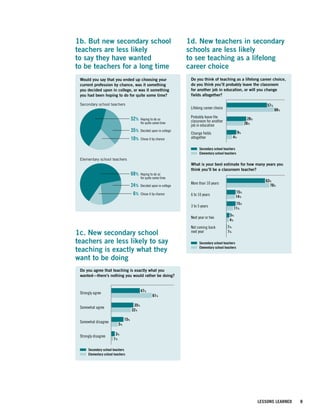
According to the survey, a solid majority of              1a. Most new teachers say
all first-year teachers are inspired to teach and
are dedicated to the profession. At least dur-
                                                          teaching subjects they love and
ing their initial year, most say that they plan           helping disadvantaged kids are the
to teach for quite a while. But there are im-             chief reasons they choose to teach
portant differences between the views of new
high school and middle school teachers and                  How important was each of the following factors
those of new grade school teachers. The new                 to your decision to go into teaching? Would you
                                                            say that this was one of the most important factors,
high school and middle school teachers are less             a major factor, a minor factor or not a factor at all?
likely to say that teaching is something they’ve                 One of the most important factors
wanted to do for a long time (52 percent for                     A major factor

secondary school teachers versus 68 percent                 Teaching a subject that you love and getting kids
                                                            excited about it
for elementary school teachers), and they are
less likely to agree strongly that it’s what they           Secondary school
                                                                                                      49%                   43%   92%
                                                            teachers
really want to be doing (47 percent versus 61
                                                            Elementary school                                                85%
percent). All new teachers say that the idea of             teachers
                                                                                                  41%                  44%

teaching subjects they love and helping under-
privileged students are more important rea-                 The idea of putting underprivileged kids on the path
                                                            to success
sons for choosing the profession than practical
advantages such as summers off and job secu-                Secondary school
                                                            teachers                                  31%                  48%    79%
rity. But for the new high school and middle
                                                            Elementary school                                                      89%
school teachers, teaching a subject they love               teachers
                                                                                                      40%                    49%

is the somewhat more important factor. Some
of the comments from teachers in follow-up e-               Having a teacher who really inspired you as a student
mails suggest this distinction could affect their           Secondary school
                                                                                            36%                 33%   69%
feelings about their jobs over time. One mid-               teachers
dle school teacher told us, for example, “My                Elementary school             25%                  41%   66%
                                                            teachers
main reason [for entering the profession] was
to teach students about science and interact                The practical job benefits such as summers off, more
with young people.” Yet later, this same teach-             time with family and job security
er said, “My utopian dream of having moti-                  Secondary school
                                                            teachers                13%                 43%   56%
vated students who are naturally interested in
science has probably passed. I love interacting             Elementary school       15%                 37%   51%
                                                            teachers
with the students and still want to teach them
science, but [I] realize now that most won’t                Having a parent or family member who was a teacher
appreciate it intrinsically.”
                                                            Secondary school
                                                            teachers              9%      16%   25%
Note: Question wording in charts may be slightly            Elementary school     7%      17%   24%
edited for space. Full question wording is available in     teachers
the Selected Survey Results at the end of this report.
                                                            Note: See Selected Survey Results at the end of this report
Percentages may not equal 100 percent due to rounding       for total figures.
or the omission of some answer categories.
                                                          Figure 1a.


                                                                                                                LESSONS LEARNED          7
1b. But new secondary school                                            1d. New teachers in secondary
teachers are less likely                                                schools are less likely
toBut new secondary school teachers
    say they have wanted                                                toNew teachers in secondarylifelong
                                                                            see teaching as a schools are
toare less likely to say they have wanted
    be teachers for a long time                                         career choice teaching as a lifelong
                                                                          less likely to see
  to be teachers for a long time                                          career choice
  Would you say that you ended up choosing your                           Do you think of teaching as a lifelong career choice,
  current profession by chance, was it something                          do you think you’ll probably leave the classroom
  you decided upon in college, or was it something                        for another job in education, or will you change
  you had been hoping to do for quite some time?                          fields altogether?

  Secondary school teachers                                                                                                   57%
                                                                          Lifelong career choice                                    68%
                                                                          Probably leave the
                                       52%    Hoping to do so
                                                                          classroom for another
                                                                                                                    28%
                                              for quite some time                                                 26%
                                                                          job in education
                                       35%    Decided upon in college
                                                                                                             9%
                                                                          Change fields
                                       10%    Chose it by chance          altogether                    4%

                                                                               Secondary school teachers
                                                                               Elementary school teachers
                                                                                                                                                0
  Elementary school teachers
                                                                          What is your best estimate for how many years you
                                                                          think you’ll be a classroom teacher?
                                       68%    Hoping to do so
                                              for quite some time
                                                                                                                             63%
                                                                          More than 10 years
                                       24%    Decided upon in college                                                          70%

                                       6%     Chose it by chance                                         15%
                                                                          6 to 10 years                  14%
                                                                                                         15%
                                                                          3 to 5 years
                                                                                                        11%
                                                                                                    5%
Figure 1b.                                                                Next year or two
                                                                                                    4%
                                                                          Not coming back          1%
1c. New secondary school                                                  next year                1%

teachers are less likely to say                                                Secondary school teachers

teaching is exactly what are less
  New secondary school teachers they
                                                                               Elementary school teachers


want to say teaching is exactly what they
  likely to be doing                                                    Figure 1d.
  want to be doing
  Do you agree that teaching is exactly what you
  wanted—there’s nothing you would rather be doing?


                                              47%
  Strongly agree
                                                       61%

                                        35%
  Somewhat agree
                                       32%

                                 15%
  Somewhat disagree
                            5%                                                                                                                  0

                         3%
  Strongly disagree
                        1%

       Secondary school teachers
       Elementary school teachers


Figure 1c.

                                                                                                                                            0       20


                                                                                                                          LESSONS LEARNED   8
Finding Two: Secondary School Teachers
vs. Elementary School Teachers—How Prepared
Do They Feel?

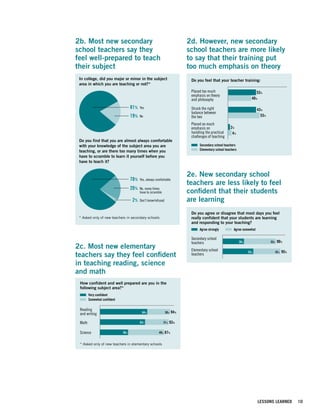
Overall, the new teachers are confident that          The new high school and middle school
their students are learning, and most believe         teachers are also noticeably less confident
that even though they are new to teaching,            their students are learning. Only 38 percent of
their students are “lucky to have them.” Most         them “strongly agree” that their students are
of the high school and middle school teach-           “learning and responding” to their teaching,
ers say they either majored or minored in the         compared with more than half (53 percent)
subject they teach and feel confident teaching        of elementary school teachers who say this.
it in class. Moreover, the majority of the grade      Perhaps most haunting for those concerned
school teachers say that they are confident           about teachers’ ability to reach out to students
teaching reading, science and math.                   of all backgrounds, there is a striking differ-
                                                      ence among the secondary school teachers
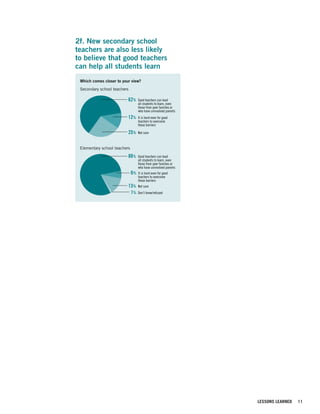
Yet here again, there are important differences       on whether severely disadvantaged students
in the secondary school teachers’ perspective.        can learn in school. While the vast majority
The new high school and middle school teach-          of elementary school teachers (80 percent) say
ers are more likely to criticize their training for   that “good teachers can lead all students to
putting too much emphasis on theory com-              learn, even those from poor families or who
pared with the practical demands of the class-        have uninvolved parents,” significantly fewer
room. More than half (53 percent) say their           new high school and middle school teachers
preparation was too theoretical, while just 4 in      (62 percent) say this.
10 elementary school teachers say this. Some
of the teachers gave us specific examples of          2a. The vast majority of teachers
the practical challenges: “I was not prepared
to handle the continuous testing of limits that       say theymajority of new teachers say
                                                        The vast are confident that their
is part of being an adolescent,” one told us.         students are learning students
                                                        they are confident that their
“I had trouble being consistent and follow-             are learning
ing through with consequences.” Meanwhile,              Which of the following two statements comes closer
                                                        to your own view?
another talked about the gap between her
preparation and what she encountered in the             I may be new to teaching,
                                                        but compared with what
                                                                                                        80%
classroom: “Every day [I have to] fight for my          other teachers are doing,
                                                                                                       78%
                                                        my students are probably
students’ attention. I was prepared to deal with        lucky to have me
the politics of the school and with the lesson
                                                        I’m sometimes afraid
planning and extra duties teachers have. I was          that my students are              16%
completely taken aback by the lack of interest          paying a heavy price
                                                        because of my lack                16%
in the students in learning and even more sur-          of experience
prised at their disrespect for teachers.”                    Secondary school teachers
                                                             Elementary school teachers


                                                      Figure 2a.


                                                                                                LESSONS LEARNED   9
2b. Most new secondary                                                     2d. However, new secondary
                                                                             However, new secondary teachers are
school teachers say they                                                   school teachers are more likely
                                                                             more likely to say that their training put
                                                                             too much emphasis on theory versus the
feel well-prepared to teachers
 Most new secondary school teach                                           topractical challenges of the classroom
                                                                               say that their training put
their subject or minored in the
 say they majored                                                          too much emphasis on theory
  subject they teach
  In college, did you major or minor in the subject                          Do you feel that your teacher training:
  area in which you are teaching or not?*
                                                                             Placed too much                              53%
                                                                             emphasis on theory
                                                                             and philosophy                            40%

                                    81%   Yes                                Struck the right                              43%
                                                                             balance between
                                    19%   No                                 the two                                         53%

                                                                             Placed oo much
                                                                             emphasis on               2%
                                                                             handling the practical     4%
                                                                             challenges of teaching
  Do you find that you are almost always comfortable
  with your knowledge of the subject area you are                                 Secondary school teachers
  teaching, or are there too many times when you                                  Elementary school teachers
  have to scramble to learn it yourself before you
  have to teach it?                                                        Figure 2d.


                                                                           2e. New secondary school                                               0
                                    78%   Yes, always comfortable
                                                                           teachers are less likely to feel
                                                                             But new secondary school teachers are
                                    20%                                      less likely to feel confident that their
                                          No, many times
                                          have to scramble                 confident that their students
                                                                             students are learning and responding
                                    2%    Don’t know/refused               are their teaching
                                                                             to learning

                                                                             Do you agree or disagree that most days you feel
  * Asked only of new teachers in secondary schools                          really confident that your students are learning
                                                                             and responding to your teaching?
                                                                                  Agree strongly          Agree somewhat
 Most new elementary school teachers                                         Secondary school
 say they feel confident in teaching                                         teachers                          38%                 53%   90%
2c. Most new and math
 reading, science elementary                                                 Elementary school                                             95%
teachers say they feel confident
                                                                                                                     53%             42%
                                                                             teachers

in teaching reading, science                                               Figure 2e.
and math
  How confident and well prepared are you in the
  following subject area?*
         Very confident
         Somewhat confident

  Reading
  and writing                              64%                 30%   94%

  Math                                    62%                31%   93%

  Science                     38%                       49%    87%

  * Asked only of new teachers in elementary schools


Figure 2c.


                                                                                                                           LESSONS LEARNED       10
2f. New secondary school
teachers are school less likelyalso
  New secondary also teachers are
toless likely tothat goodgood teachers
    believe believe that teachers
  can help all students learn
can help all students learn
  Which comes closer to your view?
  Secondary school teachers

                           62%      Good teachers can lead
                                    all students to learn, even
                                    those from poor families or
                                    who have uninvolved parents
                           12%      It is hard even for good
                                    teachers to overcome
                                    these barriers

                           25%      Not sure


  Elementary school teachers
                           80%      Good teachers can lead
                                    all students to learn, even
                                    those from poor families or
                                    who have uninvolved parents
                               6%   It is hard even for good
                                    teachers to overcome
                                    these barriers
                           13%      Not sure
                            1%      Don’t know/refused


Figure 2f.


                                                                  LESSONS LEARNED   11
Finding Three: Secondary School Teachers
vs. Elementary School Teachers—The Drawbacks
of Teaching

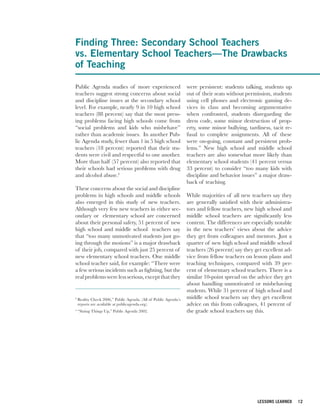
Public Agenda studies of more experienced                         were persistent: students talking, students up
teachers suggest strong concerns about social                     out of their seats without permission, students
and discipline issues at the secondary school                     using cell phones and electronic gaming de-
level. For example, nearly 9 in 10 high school                    vices in class and becoming argumentative
teachers (88 percent) say that the most press-                    when confronted, students disregarding the
ing problems facing high schools come from                        dress code, some minor destruction of prop-
“social problems and kids who misbehave”                          erty, some minor bullying, tardiness, tacit re-
rather than academic issues. In another Pub-                      fusal to complete assignments. All of these
lic Agenda study, fewer than 1 in 5 high school                   were on-going, constant and persistent prob-
teachers (18 percent) reported that their stu-                    lems.” New high school and middle school
dents were civil and respectful to one another.                   teachers are also somewhat more likely than
More than half (57 percent) also reported that                    elementary school students (41 percent versus
their schools had serious problems with drug                      33 percent) to consider “too many kids with
and alcohol abuse.4                                               discipline and behavior issues” a major draw-
                                                                  back of teaching.
These concerns about the social and discipline
problems in high schools and middle schools                       While majorities of all new teachers say they
also emerged in this study of new teachers.                       are generally satisfied with their administra-
Although very few new teachers in either sec-                     tors and fellow teachers, new high school and
ondary or elementary school are concerned                         middle school teachers are significantly less
about their personal safety, 51 percent of new                    content. The differences are especially notable
high school and middle school teachers say                        in the new teachers’ views about the advice
that “too many unmotivated students just go-                      they get from colleagues and mentors. Just a
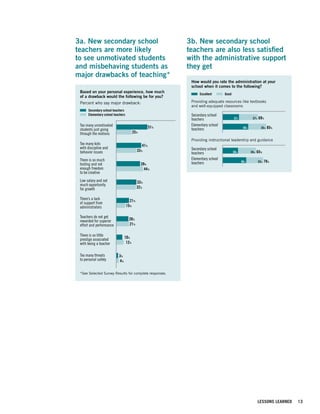
ing through the motions” is a major drawback                      quarter of new high school and middle school
of their job, compared with just 25 percent of                    teachers (26 percent) say they get excellent ad-
new elementary school teachers. One middle                        vice from fellow teachers on lesson plans and
school teacher said, for example: “There were                     teaching techniques, compared with 39 per-
a few serious incidents such as fighting, but the                 cent of elementary school teachers. There is a
real problems were less serious, except that they                 similar 10-point spread on the advice they get
                                                                  about handling unmotivated or misbehaving
                                                                  students. While 31 percent of high school and
3
    Reality Check 2006,” Public Agenda. (All of Public Agenda’s   middle school teachers say they get excellent
    reports are available at publicagenda.org.)                   advice on this from colleagues, 41 percent of
4
    “Sizing Things Up,” Public Agenda 2002.                       the grade school teachers say this.


                                                                                                  LESSONS LEARNED    12
3a. New secondary school                                  3b. New secondary school
teachers are more likely                                  teachers are also less satisfied
                                                            New secondary school teachers are also
toNew secondary school teachers are
   see unmotivated students                               with satisfied with the administrative
                                                            less the administrative support
and misbehaving students as
  more likely to see unmotivated students                 they get get
                                                            support they
  and misbehaving students as major
major drawbacks of teaching*
  drawbacks of teaching*
                                                              How would you rate the administration at your
                                                              school when it comes to the following?
  Based on your personal experience, how much                      Excellent      Good
  of a drawback would the following be for you?
  Percent who say major drawback:                             Providing adequate resources like textbooks
                                                              and well-equipped classrooms
       Secondary school teachers
       Elementary school teachers                             Secondary school
                                                              teachers                   32%           37%   69%
  Too many unmotivated                                        Elementary school
                                                    51%       teachers                          50%            35%   85%
  students just going
  through the motions                   25%
                                                              Providing instructional leadership and guidance
  Too many kids                               41%
  with discipline and                                         Secondary school
  behavior issues                           33%                                          30%          35%   65%
                                                              teachers
  There is so much                                            Elementary school
                                                              teachers                         46%           33%   79%
  testing and not                             39%
  enough freedom                                44%
  to be creative
                                                          Figure 3b.
  Low salary and not                        33%
  much opportunity
  for growth                                32%

  There’s a lack                      21%
  of support from                                                                                                                     0
  administrators                    15%

  Teachers do not get
  rewarded for superior              20%
  effort and performance             21%

  There is so little
  prestige associated            10%
  with being a teacher            12%                     0            20         40            60             80          100


  Too many threats          3%
  to personal safety        4%

  *See Selected Survey Results for complete responses.


Figure 3a.


                                                                                                             LESSONS LEARNED     13
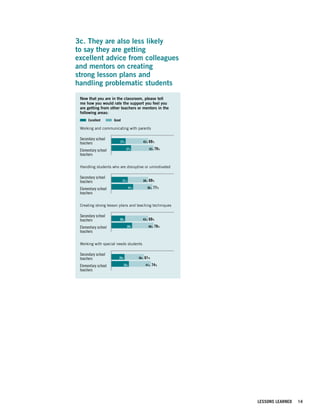
3c. They are also less likely
to say they are getting
excellent advice from colleagues
  They are also less likely to say they are
and mentors on creating
  getting excellent advice from colleagues
  and mentors on how to create strong
strong plans and planshandle
  lesson lesson how to and
handling problematic students
  problematic students

  Now that you are in the classroom, please tell
  me how you would rate the support you feel you
  are getting from other teachers or mentors in the
  following areas:
       Excellent      Good

  Working and communicating with parents

  Secondary school
  teachers               27%                   42%   69%

  Elementary school            37%                   42% 79%
  teachers

  Handling students who are disruptive or unmotivated

  Secondary school
  teachers                   31%           38%       69%
  Elementary school                41%           36%       77%
  teachers

  Creating strong lesson plans and teaching techniques

  Secondary school
  teachers               26%               43%       69%
  Elementary school            39%                   40%   79%
  teachers
                                                                 0   20   40      60        80   100

  Working with special needs students

  Secondary school
  teachers               25%             36%   61%
  Elementary school          33%                41%    74%
  teachers


Figure 3c.


                                                                          LESSONS LEARNED   14
Finding Four: The Special Challenges
of Teaching in High-Needs Schools

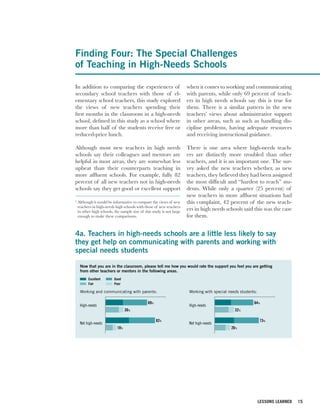
In addition to comparing the experiences of                             when it comes to working and communicating
secondary school teachers with those of el-                             with parents, while only 69 percent of teach-
ementary school teachers, this study explored                           ers in high needs schools say this is true for
the views of new teachers spending their                                them. There is a similar pattern in the new
first months in the classroom in a high-needs                           teachers’ views about administrative support
school, defined in this study as a school where                         in other areas, such as such as handling dis-
more than half of the students receive free or                          cipline problems, having adequate resources
reduced-price lunch.                                                    and receiving instructional guidance.

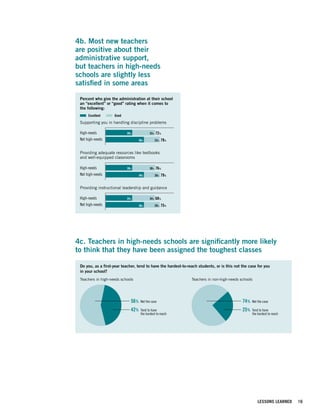
Although most new teachers in high needs                                There is one area where high-needs teach-
schools say their colleagues and mentors are                            ers are distinctly more troubled than other
helpful in most areas, they are somewhat less                           teachers, and it is an important one. The sur-
upbeat than their counterparts teaching in                              vey asked the new teachers whether, as new
more affluent schools. For example, fully 82                            teachers, they believed they had been assigned
percent of all new teachers not in high-needs                           the most difficult and “hardest to reach” stu-
schools say they get good or excellent support                          dents. While only a quarter (25 percent) of
                                                                        new teachers in more affluent situations had
5
    Although it would be informative to compare the views of new        this complaint, 42 percent of the new teach-
    teachers in high-needs high schools with those of new teachers
    in other high schools, the sample size of this study is not large
                                                                        ers in high needs schools said this was the case
    enough to make these comparisons.                                   for them.


4a. Teachers in high-needs schools are a little less likely to say
they get help on communicating with parents and working with
special needs needs schools are aworking with special needs students
  Teachers in high
                   students
  on communicating with parents and
                                    little less likely to say they get help


     Now that you are in the classroom, please tell me how you would rate the support you feel you are getting
     from other teachers or mentors in the following areas.
          Excellent        Good
          Fair             Poor

     Working and communicating with parents:                             Working with special needs students:

                                                69%                                                        64%
     High-needs                                                          High-needs
                                   30%                                                           32%

                                                      82%                                                       73%
     Not high-needs                                                      Not high-needs
                             18%                                                               26%


Figure 4b.


                                                                                                                LESSONS LEARNED   15
4b. Most new teachers
are positive about their
administrative support,
but teachers in are positive about
 Most new teachers
                      high-needs
schools are slightly less teachers
 their administrative support, but
satisfiedininschools are slightly less
 in high need some areas
 satisfied some areas

  Percent who give the administration at their school
  an “excellent” or “good” rating when it comes to
  the following:
       Excellent     Good
  Supporting you in handling discipline problems

  High-needs                39%             33%   72%
  Not high-needs                    56%           23%   79%


  Providing adequate resources like textbooks                  Providing adequate resources like textbooks
  and well-equipped classrooms                                 and well-equipped classrooms:

  High-needs                38%             38%   76%
  Not high-needs                    49%           30%   79%


  Providing instructional leadership and guidance              Providing instructional leadership and guidance:

  High-needs                34%             34%   68%
  Not high-needs                    46%           29%   75%

                                                                         Note: These differences are not statistically significant.


Figure 4c.


4c. Teachers in high-needs schools are significantly more likely
  Teachers in high needs schools are significantly more likely to think that they have
tobeen assigned the toughest classes assigned the toughest classes
   think that they have been

  Do you, as a first-year teacher, tend to have the hardest-to-reach students, or is this not the case for you
  in your school?
  Teachers in high-needs schools                                 Teachers in non-high-needs schools


                              56%    Not the case                                                          74%      Not the case

                              42%    Tend to have                                                          25%      Tend to have
                                     the hardest to reach                                                           the hardest to reach


Figure 4d.


                                                                                                                          LESSONS LEARNED   16
Finding Five: How New Teachers
Would Improve the Profession

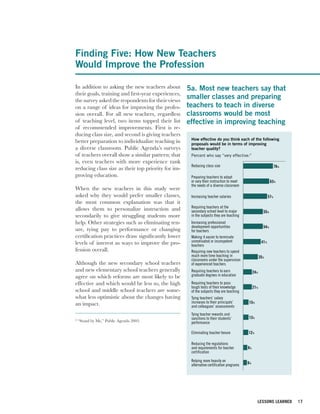
In addition to asking the new teachers about        5a. Most new teachers say that
their goals, training and first-year experiences,
the survey asked the respondents for their views
                                                    smaller classes and preparing
on a range of ideas for improving the profes-       teachers to say that smaller classes
                                                      New teachers
                                                                    teach in diverse
sion overall. For all new teachers, regardless      classrooms would beteach in diverse
                                                      and preparing teachers to most
of teaching level, two items topped their list      effective in improving teaching
                                                      classrooms would be most effective in
of recommended improvements. First is re-            improving teaching
ducing class size, and second is giving teachers
                                                     How effective do you think each of the following
better preparation to individualize teaching in      proposals would be in terms of improving
a diverse classroom. Public Agenda’s surveys         teacher quality?
of teachers overall show a similar pattern; that     Percent who say “very effective:”
is, even teachers with more experience rank
                                                     Reducing class size                                          76%
reducing class size as their top priority for im-
proving education.                                   Preparing teachers to adapt
                                                     or vary their instruction to meet                       63%
                                                     the needs of a diverse classroom
When the new teachers in this study were
asked why they would prefer smaller classes,         Increasing teacher salaries                            57%
the most common explanation was that it
                                                     Requiring teachers at the
allows them to personalize instruction and           secondary school level to major                   55%
secondarily to give struggling students more         in the subjects they are teaching
help. Other strategies such as eliminating ten-      Increasing professional
                                                     development opportunities                         54%
ure, tying pay to performance or changing            for teachers
certification practices draw significantly lower     Making it easier to terminate
levels of interest as ways to improve the pro-       unmotivated or incompetent                       41%
                                                     teachers
fession overall.                                     Requiring new teachers to spend
                                                     much more time teaching in                      35%
                                                     classrooms under the supervision
Although the new secondary school teachers           of experienced teachers
and new elementary school teachers generally         Requiring teachers to earn                24%
agree on which reforms are most likely to be         graduate degrees in education

effective and which would be less so, the high       Requiring teachers to pass
                                                     tough tests of their knowledge            21%
school and middle school teachers are some-          of the subjects they are teaching
what less optimistic about the changes having        Tying teachers’ salary
an impact.                                           increases to their principals’       15%
                                                     and colleagues’ assessments
                                                     Tying teacher rewards and
                                                     sanctions to their students’         13%
6
    “Stand by Me,” Public Agenda 2003.               performance

                                                     Eliminating teacher tenure           12%

                                                     Reducing the regulations
                                                     and requirements for teacher         8%
                                                     certification

                                                     Relying more heavily on
                                                     alternative certification programs   6%


                                                                                                 LESSONS LEARNED        17
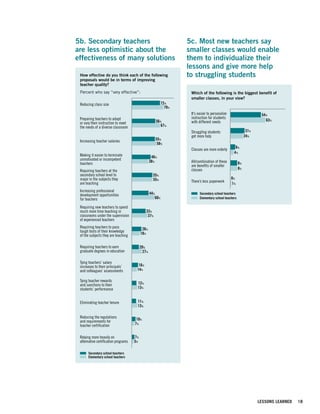
New secondary and elementary school
 teachers agree on which reforms are
5b. Secondary teachers compared
 most likely to be effective, but                                   5c. Most new teachers say
are their elementary school peers, the
 to less optimistic about                                           smaller classes would enable
 secondary teachers are less optimistic
effectiveness of many solutions
 about many solutions                                               themteachers say smaller classes would
                                                                      New to individualize their
                                                                    lessons more help tomore their lessons
                                                                      enable them to individualize
                                                                      and give
                                                                               and give struggling students
                                                                                                   help
  How effective do you think each of the following                  to struggling students
  proposals would be in terms of improving
  teacher quality?
  Percent who say “very effective”:                                   Which of the following is the biggest benefit of
                                                                      smaller classes, in your view?
  Reducing class size                                       72%
                                                              79%
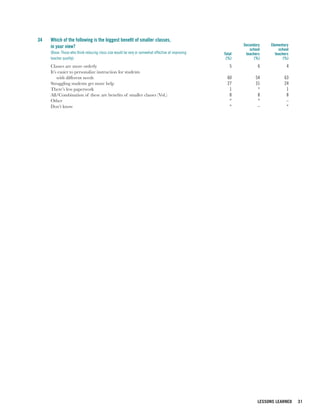
                                                                      It’s easier to personalize                      54%
  Preparing teachers to adapt                                         instruction for students
                                                       56%            with different needs                              63%
  or vary their instruction to meet
  the needs of a diverse classroom                        67%                                                                                    80
                                                                      Struggling students                      31%                               70
                                                                      get more help                           24%                                60

  Increasing teacher salaries                          55%                                                                                       50
                                                        58%                                                                                      40
                                                                                                     6%                                          30
                                                                      Classes are more orderly                                                   20
                                                                                                    4%
  Making it easier to terminate                      46%
                                                                                                                                                 10
  unmotivated or incompetent                        38%
                                                                                                                                                  0
  teachers                                                            All/combination of these           8%
                                                                      are benefits of smaller
                                                                      classes                            8%
  Requiring teachers at the
  secondary school level to                           55%
  major in the subjects they                          55%                                          0%                                   80.000000
  are teaching                                                        There’s less paperwork
                                                                                                   1%                                   68.571429
                                                                                                                                        57.142857
  Increasing professional
  development opportunities                         44%                     Secondary school teachers                                   45.714286

  for teachers                                         60%                  Elementary school teachers                                  34.285714
                                                                                                                                        22.857143
  Requiring new teachers to spend                                                                                                       11.428571
  much more time teaching in                   33%                  Figure 5c.                                0       20       40       0.000000
                                                                                                                                       60              8
  classrooms under the supervision              37%
  of experienced teachers
  Requiring teachers to pass                 26%
  tough tests of their knowledge
  of the subjects they are teaching         18%
                                                                                                                                        80.000000
                                                                                                                                        66.666667
  Requiring teachers to earn                20%                                                                                         53.333333
  graduate degrees in education               27%                                                                                       40.000000
                                                                                                                                        26.666667
  Tying teachers’ salary                                                                                                                13.333333
  increases to their principals’         16%
  and colleagues’ assessments           14%                                                                                                 0.000000


  Tying teacher rewards
  and sanctions to their                12%
  students’ performance                 13%
                                                                                                                                                 80
                                                                                                                                                 70
                                                                                                                                                 60
  Eliminating teacher tenure            11%                                                                                                      50
                                        13%                                                                                                      40
                                                                                                                                                 30
                                                                                                                                                 20
  Reducing the regulations              10%                                                                                                      10
  and requirements for                                                                                                                            0
  teacher certification                7%


  Relying more heavily on              7%
  alternative certification programs   5%

       Secondary school teachers
       Elementary school teachers


Figure 5b.


                                                                                                                     LESSONS LEARNED   18
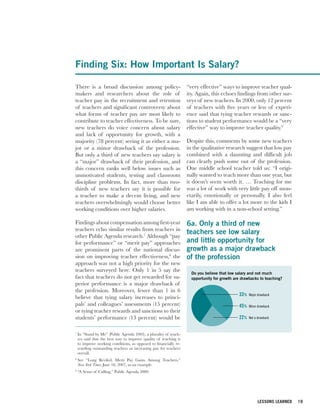
Finding Six: How Important Is Salary?

There is a broad discussion among policy-                          “very effective” ways to improve teacher qual-
makers and researchers about the role of                           ity. Again, this echoes findings from other sur-
teacher pay in the recruitment and retention                       veys of new teachers. In 2000, only 12 percent
of teachers and significant controversy about                      of teachers with five years or less of experi-
what forms of teacher pay are most likely to                       ence said that tying teacher rewards or sanc-
contribute to teacher effectiveness. To be sure,                   tions to student performance would be a “very
new teachers do voice concern about salary                         effective” way to improve teacher quality.9
and lack of opportunity for growth, with a
majority (78 percent) seeing it as either a ma-                    Despite this, comments by some new teachers
jor or a minor drawback of the profession.                         in the qualitative research suggest that low pay
But only a third of new teachers say salary is                     combined with a daunting and difficult job
a “major” drawback of their profession, and                        can clearly push some out of the profession.
this concern ranks well below issues such as                       One middle school teacher told us: “I origi-
unmotivated students, testing and classroom                        nally wanted to teach more than one year, but
discipline problems. In fact, more than two-                       it doesn’t seem worth it. … Teaching for me
thirds of new teachers say it is possible for                      was a lot of work with very little pay off mon-
a teacher to make a decent living, and new                         etarily, emotionally or personally. I also feel
teachers overwhelmingly would choose better                        like I am able to offer a lot more to the kids I
working conditions over higher salaries.                           am working with in a non-school setting.”

Findings about compensation among first-year                       6a. Only a third of new
teachers echo similar results from teachers in
                                                                   teachers see low salary
other Public Agenda research.7 Although “pay
for performance” or “merit pay” approaches                         and little opportunity for
are prominent parts of the national discus-                        growththird a major drawback
                                                                     Only a as of new teachers see low
sion on improving teacher effectiveness,8 the                      ofsalary and little opportunity for growth
                                                                      the profession
approach was not a high priority for the new                         as a major drawback of the profession
teachers surveyed here. Only 1 in 5 say the                          Do you believe that low salary and not much
fact that teachers do not get rewarded for su-                       opportunity for growth are drawbacks to teaching?
perior performance is a major drawback of
the profession. Moreover, fewer than 1 in 6
                                                                                              33%   Major drawback
believe that tying salary increases to princi-
pals’ and colleagues’ assessments (15 percent)                                                45%   Minor drawback
or tying teacher rewards and sanctions to their
students’ performance (13 percent) would be                                                   22%   Not a drawback


7
    In “Stand by Me” (Public Agenda 2003), a plurality of teach-
    ers said that the best way to improve quality of teaching is   Figure 6a.
    to improve working conditions, as opposed to financially re-
    warding outstanding teachers or increasing pay for teachers
    overall.
8
    See “Long Reviled, Merit Pay Gains Among Teachers,”
    New York Times June 18, 2007, as an example.
9
    “A Sense of Calling,” Public Agenda 2000.


                                                                                                          LESSONS LEARNED   19
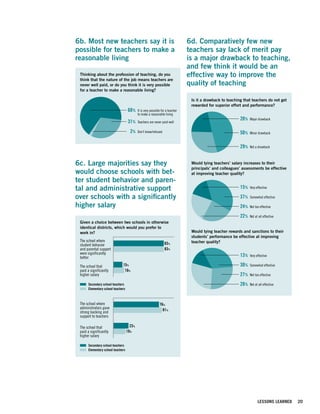
6b. Most new teachers say it is                                                 6d. Comparatively few new
possible for teachers to make a                                                 teachers say lack of merit pay
reasonable living it is possible
  Most new teachers say                                                         is a major drawback to teaching,
  for teachers to make a reasonable living
                                                                                and fewnew teachers say lackbe merit
                                                                                  Very few think it would of an
  Thinking about the profession of teaching, do you                             effective way to improve the
                                                                                  pay is a major drawback to teaching
                                                                                qualityimproveitthe qualityan effective
                                                                                  and few think would be
  think that the nature of the job means teachers are
  never well paid, or do you think it is very possible                            way to of teaching of teaching
  for a teacher to make a reasonable living?

                                                                                  Is it a drawback to teaching that teachers do not get
                                                                                  rewarded for superior effort and performance?
                                     68%    It is very possible for a teacher
                                            to make a reasonable living
                                                                                                             20%   Major drawback
                                     31%    Teachers are never paid well

                                      2%    Don’t know/refused                                               50%   Minor drawback


                                                                                                             29%   Not a drawback
Figure 6b.


6c. Large majorities say they                                                     Would tying teachers’ salary increases to their
                                                                                  principals’ and colleagues’ assessments be effective
would choose schools with bet-                                                    at improving teacher quality?
ter student behavior and paren-
tal and administrative support
  Large majorities say they would choose                                                                     15%   Very effective
  schools with better student behavior and
over schools with a significantly
  parental and administrative support over                                                                   37%   Somewhat effective

higher salary
  schools with a significantly higher salary                                                                 24%   Not too effective

                                                                                                             22%   Not at all effective
  Given a choice between two schools in otherwise
  identical districts, which would you prefer to
  work in?                                                                        Would tying teacher rewards and sanctions to their
                                                                                  students’ performance be effective at improving
  The school where                                                                teacher quality?
  student behavior                                                83%
  and parental support                                            83%
  were significantly
  better                                                                                                     13%   Very effective

  The school that              15%                                                                           30%   Somewhat effective
  paid a significantly          16%
  higher salary                                                                                              27%   Not too effective

       Secondary school teachers                                                                             28%   Not at all effective
       Elementary school teachers


  The school where                                            76%               Figure 5d.
  administrators gave                                           81%
  strong backing and
  support to teachers

  The school that                     23%
  paid a significantly              19%
  higher salary

       Secondary school teachers                                                                   0         20            40             60   80   100
       Elementary school teachers


Figure 6c.


                                                                                                                         LESSONS LEARNED       20
Methodology

This survey includes interviews with a nation-      Respondents were asked 111 items. These
ally representative sample of 641 first-year        included screener questions to ensure our
school teachers throughout the continental          respondents were first-year teachers, demo-
United States. We also conducted oversamples        graphic questions to describe the teachers
of teachers who participated in alternative         who took part in our survey and closed-ended
teaching certification programs. Those inter-       opinion questions. This questionnaire uses a
views are not included in this analysis but will    blend of different kinds of questions, some of
be included in subsequent reports on this data.     which tackle similar issues in different ways.
Data were collected by telephone or online          Most questions ask the respondents to use a
between March 12 and April 23, 2007. In de-         scale (either three or four points) to rate dif-
signing the survey questions and sample, Pub-       ferent aspects of their training or experiences
lic Agenda conducted interviews with leading        teaching and to measure the strength of vari-
experts from both university-based schools of       ous beliefs they may have about teaching. The
education and alternative programs to discuss       full questionnaire is available at ncctq.com
the sampling frame and the topics to explore in     and publicagenda.org.
the survey. The National Comprehensive Cen-
ter for Teacher Quality (NCCTQ), the Farkas         Many of our four-point scales are Likert
Duffett Research Group and REL Midwest              scales, where we ask the degree to which a re-
were consulted further regarding sampling,          spondent accepts a particular statement.10 In
survey topics and questionnaire design.             the report, we often collapse the choices to the
                                                    nominal level by combining the positive and
The sample includes oversamples of teachers         negative responses.11 Those interested in see-
in both Midwest and high-needs schools. The         ing the degree to which someone agreed or
final data were weighted to account for the         disagreed with the statement can consult ei-
disproportionate sample design. Final results       ther the charts in the report, which break out
based on the general sample are representa-         the strength of acceptance, or the full ques-
tive of all first-year teachers’ continental U.S.   tionnaire and results at ncctq.com and publi-
public schools. The margin of sampling error        cagenda.org.
for the complete set of weighted data is ±4
percent. The response rate for this survey was      We also used questions in which respondents
29 percent, which is derived as the product of      are asked to choose between two mutually
the contact rate (32 percent), the cooperation      exclusive and balanced statements involving
rate (89 percent) and the completion rate (99       tradeoffs. Analyzed in context with other re-
percent). Respondents deemed ineligible be-         sults, these “forced choice” items shed light on
cause they were not first-year teachers or were
no longer teachers were excluded from the           10
                                                         Likert, R,. “A Technique for the Measurement of Attitudes”
survey. Further details on the design, execu-            Archives of Psychology 140 (1932): 55.
tion and analysis of the survey are discussed       11
                                                         Collapsing Likert scales into their nominal components
                                                         (agree/disagree) is a commonly used technique in public
on the NCCTQ website, ncctq.org.                         opinion research. After transforming the data, it is subject to
                                                         chi-square assessments.


                                                                                                  LESSONS LEARNED          21
respondents’ priorities and avoid the central           This items mirrors a comment by a new teach-
tendency bias inherent in Likert-style ques-            er in a focus group: “I think it’s absolutely a
tions. The choices themselves may be artifi-            matter of testing taking away too much time
cial, but they typically echo natural language          … You are very restricted in the amount of
gleaned from qualitative research. This ques-           time that you have to try new, creative theo-
tionnaire reflects the language and expres-             ries, because you have to get this, this and this
sions used by teachers during focus groups              in before.”
for this project and from previous research
with teachers.                                          Obviously, compound items could be asked
                                                        separately, and other researchers may wish to
For example, one of the questions asked                 tease them apart in future research.
new teachers:
                                                        Focus groups
Which comes closer to your view?                        Focus groups allow for an in-depth, qualitative
                                                        exploration of the dynamics underlying the
1. I may be new to teaching, but compared to what       public’s attitudes toward complex issues. In-
   other teachers are doing, my students are probably   sights from participants in these focus groups
   lucky to have me [OR]                                were important to the survey design. All focus
                                                        groups were moderated by Public Agenda se-
2. I’m sometimes afraid that my students are paying     nior staff.
   a heavy price because of my lack of experience
                                                        Four focus groups were conducted. One was
This item is drawn directly from the qualita-           with participants in an alt-cert program in
tive research where a new teacher said in a             the Philadelphia, Pennsylvania region. Two
focus group, “I’m a teacher to these kids. I’m          more were also conducted in Philadelphia,
not qualified at all. Yet I’m still possibly bet-       one with senior education majors and mas-
ter than what could be there. It’s absolutely           ter’s-plus students from an urban university
ridiculous.” Since the other teachers in the fo-        and one with the same population from a sub-
cus group agreed with this perspective, we de-          urban university. The last group was conduct-
cided to counter-balance the notion that stu-           ed in Chicago, Illinois, with first-year teachers
dents are lucky to have the new teacher with            in an urban alt-cert program and with urban
one that gives an equally reasonable, but very          master’s-plus students.
different response. In this instance, the presen-
tation of the second viewpoint is intended to           Follow-up e-mails
test and probe whether this response is strong-         To more fully examine new teachers’ views on
ly held even when positioned against a robust           student behavior in the classroom and their
alternative.                                            teacher preparation, seven follow-up ques-
                                                        tions were sent to survey respondents who of-
In a few instances, the questionnaire contains          fered their e-mail addresses to researchers. Ac-
compound questions combining two seem-                  tual quotes were drawn from email responses
ingly separate concepts. The decision to com-           to give voice to attitudes captured statistically
bine concepts within a single item mirrors the          through the surveys.
way teachers discuss and couple ideas in focus
groups.                                                 Questions were as follows:

For example, one item in our series of                  1. Thinking about your classes last year, how would
questions about potential drawbacks to                     you rate your students’ overall behavior—excellent,
teaching is the following:                                 good, fair or poor?

There is so much testing and not enough freedom
to be creative


                                                                                            LESSONS LEARNED      22
2. Can you give an example of some students’ behavior      5. What was your MAIN reason for becoming
   last year that illustrates the rating you gave above?      a teacher?

3. Last year, what aspect of the job did you feel least    6. Now that you have a year of teaching experience do
   prepared for?                                              you think this reason will motivate you to continue
                                                              teaching? Why or why not?
4. Can you think of a particular classroom experience
   that you did not feel prepared for?                     7. Last year, did you teach in an elementary school,
                                                              a middle or junior high school, or a high school?


                                                                                               LESSONS LEARNED      23
Selected Survey Results

1   Would you say that you ended up choosing your current profession                Secondary   Elementary
                                                                                       school        school
    by chance, was it something you decided upon in college, or was it      Total    teachers      teachers
    something you had been hoping to do for quite some time?                 (%)          (%)           (%)
    Chose it by chance                                                         8          10             6
    Decided upon in college                                                   28          35            24
    Hoping to do for quite some time                                          62          52            68
    Don’t know                                                                 2           3             1

2   How important was each of the following factors to your decision
    to go into teaching?
    Having a teacher who really inspired you as a student
    One of the most important factors                                         29          36            25
    A major factor                                                            38          33            41
    A minor factor                                                            22          19            23
    Not a factor at all                                                       11          12            10
    Don’t know                                                                 *           –             *
    Having a parent or family member who was a teacher
    One of the most important factors                                          7           9             7
    A major factor                                                            17          16            17
    A minor factor                                                            17          17            17
    Not a factor at all                                                       58          57            58
    Don’t know                                                                 1           1             *
    The idea of putting underprivileged kids on the path to success
    One of the most important factors                                         37          31            40
    A major factor                                                            49          48            49
    A minor factor                                                            12          17             8
    Not a factor at all                                                        3           2             3
    Don’t know                                                                 *           1             –
    The practical job benefits such as summers off, more time with family
    and job security
    One of the most important factors                                         14          13            15
    A major factor                                                            39          43            37
    A minor factor                                                            35          32            37
    Not a factor at all                                                       12          12            12
    Don’t know                                                                 *           –             *
    Teaching a subject that you love and getting kids excited about it
    One of the most important factors                                         44          49            41
    A major factor                                                            44          43            44
    A minor factor                                                             9           7            11
    Not a factor at all                                                        3           1             3
    Don’t know                                                                 1           –             1


                                                                                           LESSONS LEARNED    24
3   Here are some things that are often considered to be drawbacks
    to teaching. Based on your personal experience, please tell us whether           Secondary   Elementary
    each is a major drawback, a minor drawback, or not a drawback for you:              school        school
                                                                             Total    teachers      teachers
    Low salary and not much opportunity for growth                            (%)          (%)           (%)
    Major drawback                                                             33          33            32
    Minor drawback                                                             45          45            44
    Not a drawback                                                             22          21            23
    Don’t know                                                                  *           –             1
    There is so little prestige associated with being a teacher
    Major drawback                                                             12          10            12
    Minor drawback                                                             35          35            35
    Not a drawback                                                             53          55            52
    Don’t know                                                                  *           –             *
    There’s a lack of support from administrators
    Major drawback                                                             17          21            15
    Minor drawback                                                             36          36            35
    Not a drawback                                                             47          42            49
    Don’t know                                                                  1           1             1
    Teachers do not get rewarded for superior effort and performance
    Major drawback                                                             20          20            21
    Minor drawback                                                             50          53            48
    Not a drawback                                                             29          27            30
    Don’t know                                                                  1           *             1
    Too many threats to personal safety
    Major drawback                                                              3           3             4
    Minor drawback                                                             29          32            27
    Not a drawback                                                             67          64            69
    Don’t know                                                                  *           1             *
    There is so much testing and not enough freedom to be creative
    Major drawback                                                             42          39            44
    Minor drawback                                                             44          45            44
    Not a drawback                                                             13          17            11
    Don’t know                                                                  *           –             1
    Too many kids with discipline and behavior issues
    Major drawback                                                             36          41            33
    Minor drawback                                                             45          42            46
    Not a drawback                                                             19          17            20
    Don’t know                                                                  *           –             *
    Too many unmotivated students just going through the motions
    Major drawback                                                             34          51            25
    Minor drawback                                                             45          42            47
    Not a drawback                                                             21           8            28
    Don’t know                                                                  *           –             *


                                                                                            LESSONS LEARNED    25
Secondary   Elementary
                                                                                            school        school
4    What is your best estimate for how many years you think you’ll be           Total    teachers      teachers
     a classroom teacher?                                                         (%)          (%)           (%)
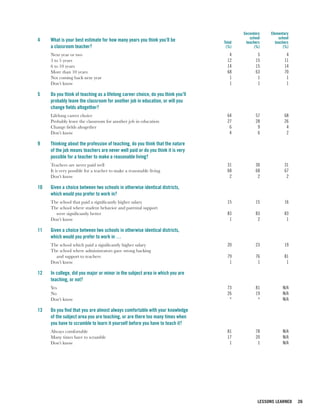
     Next year or two                                                               4           5             4
     3 to 5 years                                                                  12          15            11
     6 to 10 years                                                                 14          15            14
     More than 10 years                                                            68          63            70
     Not coming back next year                                                      1           1             1
     Don’t know                                                                     1           1             1

5    Do you think of teaching as a lifelong career choice, do you think you’ll
     probably leave the classroom for another job in education, or will you
     change fields altogether?
     Lifelong career choice                                                        64          57            68
     Probably leave the classroom for another job in education                     27          28            26
     Change fields altogether                                                       6           9             4
     Don’t know                                                                     4           6             2

9    Thinking about the profession of teaching, do you think that the nature
     of the job means teachers are never well paid or do you think it is very
     possible for a teacher to make a reasonable living?
     Teachers are never paid well                                                  31          30            31
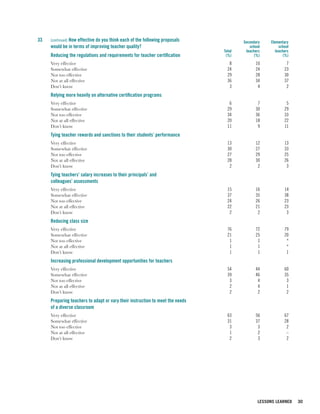
     It is very possible for a teacher to make a reasonable living                 68          68            67
     Don’t know                                                                     2           2             2

10   Given a choice between two schools in otherwise identical districts,
     which would you prefer to work in?
     The school that paid a significantly higher salary                            15          15            16
     The school where student behavior and parental support
       were significantly better                                                   83          83            83
     Don’t know                                                                     1           2             1

11   Given a choice between two schools in otherwise identical districts,
     which would you prefer to work in …
     The school which paid a significantly higher salary                           20          23            19
     The school where administrators gave strong backing
       and support to teachers                                                     79          76            81
     Don’t know                                                                     1           1             1

12   In college, did you major or minor in the subject area in which you are
     teaching, or not?
     Yes                                                                           73          81           N/A
     No                                                                            26          19           N/A
     Don’t know                                                                     *           *           N/A

13   Do you find that you are almost always comfortable with your knowledge
     of the subject area you are teaching, or are there too many times when
     you have to scramble to learn it yourself before you have to teach it?
     Always comfortable                                                            81          78           N/A
     Many times have to scramble                                                   17          20           N/A
     Don’t know                                                                     1           1           N/A


                                                                                                LESSONS LEARNED    26
Secondary   Elementary
                                                                                            school        school
14   How confident and well-prepared are you in reading and writing?             Total    teachers      teachers
     (Base: Elementary school teachers)                                           (%)          (%)           (%)
     Very confident and well-prepared                                              64           –            64
     Somewhat confident and well-prepared                                          30           –            30
     Not too confident and well-prepared                                            3           –             3
     Not at all confident and well-prepared                                         *           –             *
     Don’t know                                                                     2           –             2

23   Overall, looking back, would you say you were prepared or unprepared
     for this first year of teaching?
     Very prepared                                                                 42          36            46
     Somewhat prepared                                                             38          38            37
     Somewhat unprepared                                                           16          22            12
     Very unprepared                                                                3           2             3
     Don’t know                                                                     1           1             2

24   Do you feel that your teacher training put too much emphasis on the
     theory and philosophy of education, or did it put too much emphasis on
     handling the practical challenges of teaching, or did it strike the right
     balance between the two?
     Too much emphasis on the theory and philosophy                                45          53            40
     Too much emphasis on handling the practical challenges
        of teaching                                                                 3           2             4
     Struck the right balance between the two                                      50          43            53
     Don’t know                                                                     2           1             3

25   Now that you are in the classroom, please tell me how you would rate
     the support you feel you are getting from other teachers or mentors
     in the following areas:
     Creating strong lesson plans and teaching techniques
     Excellent                                                                     34          26            39
     Good                                                                          41          43            40
     Fair                                                                          16          21            14
     Poor                                                                           8          10             7
     Don’t know                                                                     *           1             *
     Handling students who are disruptive or unmotivated
     Excellent                                                                     37          31            41
     Good                                                                          37          38            36
     Fair                                                                          19          22            17
     Poor                                                                           7           9             5
     Don’t know                                                                     *           *             *
     Working and communicating with parents
     Excellent                                                                     34          27            37
     Good                                                                          42          42            42
     Fair                                                                          17          21            15
     Poor                                                                           7          10             5
     Don’t know                                                                     *           –             1
     Working with special needs students
     Excellent                                                                     30          25            33
     Good                                                                          39          36            41
     Fair                                                                          20          24            18
     Poor                                                                           8          12             6
     Don’t know                                                                     2           3             2


                                                                                                LESSONS LEARNED    27
26   Please tell us the extent to which you agree or disagree with the
     following statements.                                                              Secondary   Elementary
                                                                                           school        school
     Most days I feel really confident that my students are learning            Total    teachers      teachers
     and responding to my teaching                                               (%)          (%)           (%)
     Strongly agree                                                               48          38            53
     Somewhat agree                                                               46          53            42
     Somewhat disagree                                                             6           9             4
     Strongly disagree                                                             1           1             *
     Don’t know                                                                    *           –             *
     Teaching is exactly what I wanted—there is nothing I’d rather be doing
     Strongly agree                                                               56          47            61
     Somewhat agree                                                               33          35            32
     Somewhat disagree                                                             9          15             5
     Strongly disagree                                                             2           3             1
     Don’t know                                                                    *           –             *

27   Which of the following two statements comes closer to your own view?
     I may be new to teaching, but compared to what other teachers
        are doing, my students are probably lucky to have me                      79          80            78
     I’m sometimes afraid that my students are paying a heavy price
        because of my lack of experience                                          16          16            16
     Don’t know                                                                    5           4             6

28   Which comes closer to your view?
     Good teachers can lead all students to learn, even those from
         poor families or who have uninvolved parents                             74          62            80
     It is too hard even for good teachers to overcome these barriers              8          12             6
     Not sure                                                                     17          25            13

31   How would you rate the administration at your school when it comes to
     the following?
     Supporting you in handling discipline problems
     Excellent                                                                    47          41            51
     Good                                                                         28          30            27
     Fair                                                                         16          19            14
     Poor                                                                          9          11             7
     Don’t know                                                                    –           –             –
     Providing adequate resources like textbooks and well-equipped classrooms
     Excellent                                                                    43          32            50
     Good                                                                         36          37            35
     Fair                                                                         14          19            11
     Poor                                                                          7          12             4
     Don’t know                                                                    *           –             *
     Providing instructional leadership and guidance
     Excellent                                                                    40          30            46
     Good                                                                         33          35            33
     Fair                                                                         18          24            15
     Poor                                                                          8          11             7
     Don’t know                                                                    –           –             –


                                                                                               LESSONS LEARNED    28
33   How effective do you think each of the following proposals would be in
     terms of improving teacher quality?                                                 Secondary   Elementary
                                                                                            school        school
     Requiring new teachers to spend much more time teaching in classrooms       Total    teachers      teachers
     under the supervision of experienced teachers                                (%)          (%)           (%)
     Very effective                                                                35          33            37
     Somewhat effective                                                            41          42            40
     Not too effective                                                             16          17            15
     Not at all effective                                                           6           7             6
     Don’t know                                                                     1           1             2
     Requiring teachers to earn graduate degrees in education
     Very effective                                                                24          20            27
     Somewhat effective                                                            37          39            36
     Not too effective                                                             24          26            23
     Not at all effective                                                          13          14            12
     Don’t know                                                                     2           2             2
     Requiring teachers at the secondary school level to major in the subjects
     they are teaching
     Very effective                                                                55          55            55
     Somewhat effective                                                            32          31            33
     Not too effective                                                              7           9             6
     Not at all effective                                                           3           4             3
     Don’t know                                                                     2           1             2
     Eliminating teacher tenure
     Very effective                                                                12          11            13
     Somewhat effective                                                            31          31            31
     Not too effective                                                             27          27            27
     Not at all effective                                                          22          24            21
     Don’t know                                                                     8           6             9
     Making it easier to terminate unmotivated or incompetent teachers
     Very effective                                                                41          46            38
     Somewhat effective                                                            43          39            46
     Not too effective                                                              9          11             9
     Not at all effective                                                           3           3             4
     Don’t know                                                                     3           2             4

     Requiring teachers to pass tough tests of their knowledge of the subjects
     they are teaching
     Very effective                                                                21          26            18
     Somewhat effective                                                            43          43            43
     Not too effective                                                             22          20            23
     Not at all effective                                                          13          11            15
     Don’t know                                                                     1           1             1
     Increasing teacher salaries
     Very effective                                                                57          55            58
     Somewhat effective                                                            36          38            35
     Not too effective                                                              5           4             5
     Not at all effective                                                           2           1             2
     Don’t know                                                                     1           2             *


                                                                                                LESSONS LEARNED    29
33   [continued) How effective do you think each of the following proposals            Secondary   Elementary
     would be in terms of improving teacher quality?                                      school        school
                                                                               Total    teachers      teachers
     Reducing the regulations and requirements for teacher certification        (%)          (%)           (%)
     Very effective                                                               8          10             7
     Somewhat effective                                                          24          24            23
     Not too effective                                                           29          28            30
     Not at all effective                                                        36          34            37
     Don’t know                                                                   3           4             2
     Relying more heavily on alternative certification programs
     Very effective                                                               6           7             5
     Somewhat effective                                                          29          30            29
     Not too effective                                                           34          36            33
     Not at all effective                                                        20          18            22
     Don’t know                                                                  11           9            11
     Tying teacher rewards and sanctions to their students’ performance
     Very effective                                                              13          12            13
     Somewhat effective                                                          30          27            33
     Not too effective                                                           27          29            25
     Not at all effective                                                        28          30            26
     Don’t know                                                                   2           2             3
     Tying teachers’ salary increases to their principals’ and
     colleagues’ assessments
     Very effective                                                              15          16            14
     Somewhat effective                                                          37          35            38
     Not too effective                                                           24          26            23
     Not at all effective                                                        22          21            23
     Don’t know                                                                   2           2             3
     Reducing class size
     Very effective                                                              76          72            79
     Somewhat effective                                                          21          25            20
     Not too effective                                                            1           1             *
     Not at all effective                                                         1           1             *
     Don’t know                                                                   1           1             1
     Increasing professional development opportunities for teachers
     Very effective                                                              54          44            60
     Somewhat effective                                                          39          46            35
     Not too effective                                                            3           4             3
     Not at all effective                                                         2           4             1
     Don’t know                                                                   2           2             2
     Preparing teachers to adapt or vary their instruction to meet the needs
     of a diverse classroom
     Very effective                                                              63          56            67
     Somewhat effective                                                          31          37            28
     Not too effective                                                            3           3             2
     Not at all effective                                                         1           2             –
     Don’t know                                                                   2           3             2


                                                                                              LESSONS LEARNED    30
34   Which of the following is the biggest benefit of smaller classes,
     in your view?                                                                                         Secondary   Elementary
                                                                                                              school        school
     (Base: Those who think reducing class size would be very or somewhat effective at improving   Total    teachers      teachers
     teacher quality)                                                                               (%)          (%)           (%)
     Classes are more orderly                                                                         5           6             4
     It’s easier to personalize instruction for students
         with different needs                                                                        60          54            63
     Struggling students get more help                                                               27          31            24
     There’s less paperwork                                                                           1           *             1
     All/Combination of these are benefits of smaller classes (Vol.)                                  8           8             8
     Other                                                                                            *           *             –
     Don’t know                                                                                       *           –             *


                                                                                                                  LESSONS LEARNED    31
Characteristics of the sample
                                                                                                       Total
Are you teaching any subjects that do not match your current certification or area of study?            (%)
Yes                                                                                                     11
No                                                                                                      87
Don’t know/Refused                                                                                       2

Last school grade teachers completed:
Less than a 4-year college degree                                                                        2
College graduate (B.S., B.A., or other 4-year degree)                                                   59
Some post-graduate training or professional schooling after college
     (in Master’s or Ph.D program, e.g.) but no degree                                                  54
Masters, Ph.D or other higher degree                                                                    17

Teachers rank themselves in high school as:
An excellent student                                                                                    43
A good student                                                                                          45
A fair student                                                                                           9
A poor student                                                                                           1
Don’t know/Refused                                                                                       1

Teachers who are of Hispanic or Latino background:
Yes                                                                                                      7
No                                                                                                      91
Don’t know/Refused                                                                                       2

Race of teachers:
White                                                                                                   84
Black/African-American                                                                                   5
Asian                                                                                                    3
Other or mixed race                                                                                      5
Don’t know/Refused                                                                                       3


                                                                                               LESSONS LEARNED   32
Acknowledgments

The authors of “Lessons Learned” would like to thank the following people for their support
and assistance during the preparation of this report:

Our partners at the National Comprehensive Center for Teaching Quality, especially Sabrina
Laine, Amy Jackson, Laura Goe and Jane Coggshall, and REL Midwest, particularly Steve
Cantrell, Jean Hess and Chris Brandt, for their expertise and valuable advice on questionnaire
design and survey analysis. We appreciate their reliable good humor and spirit of teamwork
and cooperation that has been so evident throughout this project;

Ann Duffett and Steve Farkas, of the Farkas Duffett Research Group, for their consultation
and guidance at the beginning stages of this research and on the sample design and question-
naire development;

Richard Correti, of the University of Michigan, and Sarah Enterline, of Boston College,
for their thoughtful review of our findings and their presentation;

Chiaki Rochkind and Valerie Mitchell for their indispensable input on the questionnaire;

Deborah Wadswoth, Thomas Payzant and Hugh Price for their advice in the early stages
of the project;

Scott Bittle, Peiting Chen, Jenny Choi and David White, of Public Agenda Online,
for bringing this report to the attention of our online audience;

Daniel Yankelovich, who joined Cyrus Vance more than two decades ago to found
Public Agenda. Dan’s thinking on public opinion remains at the core of our work;

And Public Agenda president Ruth A. Wooden for her vision, insight and guidance.


                                                                               LESSONS LEARNED   33
About the National Comprehensive Center
for Teacher Quality
The National Comprehensive Center for Teacher Quality (NCCTQ) is the premier national
resource to which the regional comprehensive assistance centers, states and other education
stakeholders turn for strengthening the quality of teaching—especially in high-poverty, low-
performing, and hard-to-staff schools—and for finding guidance in addressing specific needs,
thereby ensuring highly qualified teachers are serving students with special needs.

NCCTQ , funded by the U.S. Department of Education, is a collaborative effort of the Educa-
tion Commission of the States, ETS, Learning Point Associates and Vanderbilt University.


About REL Midwest
REL Midwest is part of a federally funded network of 10 regional educational laboratories, and
it exists to bring the latest and best research and proven practices to school improvement efforts.
Serving the seven states of Illinois, Indiana, Iowa, Michigan, Minnesota, Ohio and Wisconsin,
REL Midwest provides policymakers and practitioners with resources based on the highest-
quality evidence as defined by scientifically valid research principles.

REL Midwest’s work includes short-term, fast-response applied research and development
projects based on annual needs-sensing data as well as studies conducted over a five-year period
using randomized controlled trials. A National Laboratory Network website is the primary dis-
semination vehicle for reports, briefs, and other materials issued from each of the 10 regional
laboratories. In addition to disseminating resources and information through the national web-
site, REL Midwest will use webcasts, e-mails and stakeholder meetings in its regional commu-
nications efforts.


About Public Agenda
Founded in 1975 by social scientist and author Daniel Yankelovich and former U.S. Secretary
of State Cyrus Vance, Public Agenda works to help the nation’s leaders better understand
the public’s point of view and to help average citizens better understand critical policy issues.
Our in-depth research on how citizens think about policy has won praise for its credibility and
fairness from elected officials from both political parties and from experts and decision mak-
ers across the political spectrum. Our citizen education materials and award-winning website,
publicagenda.org, offer unbiased information about the challenges the country faces. Twice
nominated for the prestigious Webby award for best political site, Public Agenda Online pro-
vides comprehensive information on a wide range of policy issues.


                                                                                   LESSONS LEARNED    34

Lessons Learned 1

  • 1.
    Lessons Learned: New TeachersTalk About Their Jobs, Challenges and Long-Range Plans Issue No. 1 They’re Not Little Kids Anymore: The Special Challenges of New Teachers in High Schools and Middle Schools A Report from the National Comprehensive Center for Teacher Quality and Public Agenda PUBLIC AGENDA Questionnaire design and analysis in cooperation with REL Midwest
  • 2.
    Lessons Learned: New TeachersTalk About Their Jobs, Challenges and Long-Range Plans Issue No. 1 They’re Not Little Kids Anymore: The Special Challenges of New Teachers in High Schools and Middle Schools Based on research conducted and reported by Jonathan Rochkind, Amber Ott, John Immerwahr, John Doble and Jean Johnson A Report from the National Comprehensive Center for Teacher Quality and Public Agenda Questionnaire design and analysis in cooperation with REL Midwest This report is available for free download at publicagenda.org. © 2007 National Comprehensive Center for Teacher Quality and Public Agenda. Unauthorized duplication of this report is a violation of copyright.
  • 3.
    Table of Contents Introduction . . . . . . . . . . . . . . . . . . . . . . . . . . . . . . . . . . . . . . . . . . . . . . . . . . 4 Finding One: Secondary School Teachers vs. Grade School Teachers—Why They Teach and How Long They’ll Stay . . . . . . . . . . . . . . . . . . . . . . . . . . . . . . . . . . . . . . . 7 Finding Two: Secondary School Teachers vs. Elementary School Teachers—How Prepared Do They Feel? . . . . . . . . . . . . . . . . . . . . . . . . . . . . . . . . . . . . . . . . . . . . . . . . . 9 Finding Three: Secondary School Teachers vs. Elementary School Teachers—The Drawbacks of Teaching . . . . . . . . . . . . . . . . . . . . . . . . . . . . . . . . . . . . . . . . . . . . . . . . . . 12 Finding Four: The Special Challenges of Teaching in High-Needs Schools . . . . . . . . . . . . . . . . . . . . . . . . . . . . . . . . 15 Finding Five: How New Teachers Would Improve the Profession . . . . . . . . . . . . . . . . . . . . . . . . . . . . . . . . . . . . . . . . . 17 Finding Six: How Important Is Salary? . . . . . . . . . . . . . . . . . . . . . . . . . . . . . 19 Methodology . . . . . . . . . . . . . . . . . . . . . . . . . . . . . . . . . . . . . . . . . . . . . . . . . 21 Selected Survey Results . . . . . . . . . . . . . . . . . . . . . . . . . . . . . . . . . . . . . . . . 24 Acknowledgments . . . . . . . . . . . . . . . . . . . . . . . . . . . . . . . . . . . . . . . . . . . . . 33
  • 4.
    Introduction Secondary school It goes without saying that almost all parents Notably, the new high school and middle school teachers are love their children dearly, but nearly 9 in 10 teachers surveyed here are also more likely to more likely to admit that “kids become a lot more challeng- question the preparation they received and say that their ing when they hit the teen years.”1 So in a way, say that their training put too much emphasis training put too it shouldn’t be surprising that first-year teach- on theories of learning versus more practical much emphasis ers who enter the nation’s high schools and classroom issues. middle schools would have different experi- on theories of ences and concerns from those who come into These findings are just a few of the highlights learning versus elementary schools. The differences emerge from the survey of 641 first-year teachers con- more practical strongly in a new survey of first-year teachers ducted in spring 2007. Designed to help lead- classroom issues across the country conducted by the National ers in education and government understand Comprehensive Center for Teacher Quality more about the quality of current teacher (NCCTQ) and Public Agenda, with consul- education and on-the-job support for new tation by REL Midwest on questionnaire de- teachers, the survey included more than 100 sign and analysis. The contrasts are striking items covering issues related to teacher train- and may have significant implications for ef- ing, recruitment, professional development forts among policymakers to enhance teacher and retention. The study explored why new preparation, mentoring and support. teachers come into the profession, what their expectations are and what factors contribute It’s just different in high school to their desire to either stay in teaching or According to the survey, new high school and leave it. There are also important findings on middle school teachers are: how first-year teachers view policy issues such as merit pay and alternative certification. • Less likely than elementary school teachers to say that teaching is exactly what they want The benefit of hindsight to be doing; In this report, we lay out what we have heard from first-year teachers across the country and • More likely to report frustrations with stu- take a look at the views of new teachers in dif- dent motivation; ferent circumstances, such as those teaching in high-needs schools versus those teaching in • More likely to be concerned about lack of more prosperous communities. But the con- administrative support in their schools; trasts between the first-year high school and middle school teachers and the first-year el- • Less likely to believe that good teachers can ementary school teachers are among the most lead all students to learn; and significant and strongest emerging from this research. • Less likely to say they regard teaching as a long-term career choice. NCCTQ and Public Agenda, working in con- sultation with REL Midwest on the question- naire and data analysis, focused the research 1 “Easier Said than Done,” Public Agenda 2002. on first-year teachers because we believe their LESSONS LEARNED 4
  • 5.
    The findings insights may be especially revealing for those America, Troops to Teachers and the New suggest that there working to enhance teacher preparation and Teachers Project. The results from this ad- are significant training. Since our respondents were roughly ditional oversample are not included in this challenges in six months into their first teaching jobs, their initial analysis, but will be released later in teaching today’s pre-service preparation was still fresh in their 2007. The comparison of the views of new adolescents that minds. This allowed us to ask detailed ques- “alt-cert” teachers with those entering the tions about their coursework and student profession from college and university-based are not being teaching experiences and get crisp recollec- education programs will be presented at adequately tions. At the same time, the new teachers NCCTQ’s annual conference, “Advanc- addressed in the also had the perspective of having assumed ing Student Achievement Through Effective current system the responsibilities of full-time public school Teaching and Leadership,” which will be host- teachers. Respondents were able to reflect on ed in Washington, D.C. November 5–7, 2007. their experiences—both pre-service and on the job—and comment on the usefulness and In the following pages, we present our key applicability of their preparation. findings on the differences between new sec- ondary and elementary school teachers and Based on the survey results, the vast majority among new teachers in high-needs schools. of the new teachers (96 percent) entered the Each finding is accompanied by charts report- profession through college or university-based ing the responses in more detail. schools of education—most had a B.A. in education (70 percent); 11 percent completed In our view, the survey offers genuine food a fifth-year program to get a degree in edu- for thought concerning how the country at- cation; and 15 percent had a master’s degree tracts, trains, supports, rewards and manages in education. The remaining 4 percent teachers. The findings suggest that there are reported that they had completed an alterna- significant challenges in teaching and moti- tive certification program. Data from the Na- vating today’s adolescents that are not being tional Center for Education Statistics shows adequately addressed in the current system. similar education levels and paths of entry The findings also suggest that the broad policy into the profession.2 debate on how to respond to teacher turnover and retention may need to focus more of its Coming soon attention on the special concerns of second- This survey also included a special over- ary school teachers. All new teachers share sample of new teachers entering the profes- many of the same aspirations and challenges, sion through three of the most prominent but the differences in concerns and challenges alternative certification programs: Teach for between new high school and middle school 2 See nces.ed.gov and teach-now.org for more demographic teachers and new grade school teachers are data on teachers. too significant to be ignored. LESSONS LEARNED 5
  • 6.
    About the study Commissionedby the National Comprehen- Public Agenda is a nonprofit, nonpartisan re- sive Center for Teacher Quality, this nation- search and engagement organization that has ally representative survey aimed to further conducted dozens of opinion studies on public understand the aspirations and experiences education, including surveys of teachers, par- of new teachers, including those teaching in ents, students, principals and superintendents. high-needs schools and coming to the profes- Public Agenda prepared this written report sion through different paths. Public Agenda and takes full responsibility for its contents. completed a random sample survey of 641 Additional information about Public Agenda public school teachers during their first year in and its other work in education can be found the classroom in spring 2007. NCCTQ , REL at publicagenda.org. Midwest and Public Agenda developed the re- search design for this project working in close consultation, and teams from the three orga- nizations cooperated to generate the lines of inquiry. The survey covered a wide variety of topics, including the new teachers’ motivation for entering the profession; subject areas cov- ered during training; experiences as student teachers; relationships with cooperating teach- ers; experiences as beginning teachers; degree of support and counsel from colleagues; de- gree of support from administration; expec- tations about their future in the profession; and reactions to different ideas about ways to improve teacher quality. Complete question wording and full responses for the findings re- ported here are included beginning on page 24. We have also included a more detailed methodology on page 21. LESSONS LEARNED 6
  • 7.
    Finding One: SecondarySchool Teachers vs. Grade School Teachers—Why They Teach and How Long They’ll Stay According to the survey, a solid majority of 1a. Most new teachers say all first-year teachers are inspired to teach and are dedicated to the profession. At least dur- teaching subjects they love and ing their initial year, most say that they plan helping disadvantaged kids are the to teach for quite a while. But there are im- chief reasons they choose to teach portant differences between the views of new high school and middle school teachers and How important was each of the following factors those of new grade school teachers. The new to your decision to go into teaching? Would you say that this was one of the most important factors, high school and middle school teachers are less a major factor, a minor factor or not a factor at all? likely to say that teaching is something they’ve One of the most important factors wanted to do for a long time (52 percent for A major factor secondary school teachers versus 68 percent Teaching a subject that you love and getting kids excited about it for elementary school teachers), and they are less likely to agree strongly that it’s what they Secondary school 49% 43% 92% teachers really want to be doing (47 percent versus 61 Elementary school 85% percent). All new teachers say that the idea of teachers 41% 44% teaching subjects they love and helping under- privileged students are more important rea- The idea of putting underprivileged kids on the path to success sons for choosing the profession than practical advantages such as summers off and job secu- Secondary school teachers 31% 48% 79% rity. But for the new high school and middle Elementary school 89% school teachers, teaching a subject they love teachers 40% 49% is the somewhat more important factor. Some of the comments from teachers in follow-up e- Having a teacher who really inspired you as a student mails suggest this distinction could affect their Secondary school 36% 33% 69% feelings about their jobs over time. One mid- teachers dle school teacher told us, for example, “My Elementary school 25% 41% 66% teachers main reason [for entering the profession] was to teach students about science and interact The practical job benefits such as summers off, more with young people.” Yet later, this same teach- time with family and job security er said, “My utopian dream of having moti- Secondary school teachers 13% 43% 56% vated students who are naturally interested in science has probably passed. I love interacting Elementary school 15% 37% 51% teachers with the students and still want to teach them science, but [I] realize now that most won’t Having a parent or family member who was a teacher appreciate it intrinsically.” Secondary school teachers 9% 16% 25% Note: Question wording in charts may be slightly Elementary school 7% 17% 24% edited for space. Full question wording is available in teachers the Selected Survey Results at the end of this report. Note: See Selected Survey Results at the end of this report Percentages may not equal 100 percent due to rounding for total figures. or the omission of some answer categories. Figure 1a. LESSONS LEARNED 7
  • 8.
    1b. But newsecondary school 1d. New teachers in secondary teachers are less likely schools are less likely toBut new secondary school teachers say they have wanted toNew teachers in secondarylifelong see teaching as a schools are toare less likely to say they have wanted be teachers for a long time career choice teaching as a lifelong less likely to see to be teachers for a long time career choice Would you say that you ended up choosing your Do you think of teaching as a lifelong career choice, current profession by chance, was it something do you think you’ll probably leave the classroom you decided upon in college, or was it something for another job in education, or will you change you had been hoping to do for quite some time? fields altogether? Secondary school teachers 57% Lifelong career choice 68% Probably leave the 52% Hoping to do so classroom for another 28% for quite some time 26% job in education 35% Decided upon in college 9% Change fields 10% Chose it by chance altogether 4% Secondary school teachers Elementary school teachers 0 Elementary school teachers What is your best estimate for how many years you think you’ll be a classroom teacher? 68% Hoping to do so for quite some time 63% More than 10 years 24% Decided upon in college 70% 6% Chose it by chance 15% 6 to 10 years 14% 15% 3 to 5 years 11% 5% Figure 1b. Next year or two 4% Not coming back 1% 1c. New secondary school next year 1% teachers are less likely to say Secondary school teachers teaching is exactly what are less New secondary school teachers they Elementary school teachers want to say teaching is exactly what they likely to be doing Figure 1d. want to be doing Do you agree that teaching is exactly what you wanted—there’s nothing you would rather be doing? 47% Strongly agree 61% 35% Somewhat agree 32% 15% Somewhat disagree 5% 0 3% Strongly disagree 1% Secondary school teachers Elementary school teachers Figure 1c. 0 20 LESSONS LEARNED 8
  • 9.
    Finding Two: SecondarySchool Teachers vs. Elementary School Teachers—How Prepared Do They Feel? Overall, the new teachers are confident that The new high school and middle school their students are learning, and most believe teachers are also noticeably less confident that even though they are new to teaching, their students are learning. Only 38 percent of their students are “lucky to have them.” Most them “strongly agree” that their students are of the high school and middle school teach- “learning and responding” to their teaching, ers say they either majored or minored in the compared with more than half (53 percent) subject they teach and feel confident teaching of elementary school teachers who say this. it in class. Moreover, the majority of the grade Perhaps most haunting for those concerned school teachers say that they are confident about teachers’ ability to reach out to students teaching reading, science and math. of all backgrounds, there is a striking differ- ence among the secondary school teachers Yet here again, there are important differences on whether severely disadvantaged students in the secondary school teachers’ perspective. can learn in school. While the vast majority The new high school and middle school teach- of elementary school teachers (80 percent) say ers are more likely to criticize their training for that “good teachers can lead all students to putting too much emphasis on theory com- learn, even those from poor families or who pared with the practical demands of the class- have uninvolved parents,” significantly fewer room. More than half (53 percent) say their new high school and middle school teachers preparation was too theoretical, while just 4 in (62 percent) say this. 10 elementary school teachers say this. Some of the teachers gave us specific examples of 2a. The vast majority of teachers the practical challenges: “I was not prepared to handle the continuous testing of limits that say theymajority of new teachers say The vast are confident that their is part of being an adolescent,” one told us. students are learning students they are confident that their “I had trouble being consistent and follow- are learning ing through with consequences.” Meanwhile, Which of the following two statements comes closer to your own view? another talked about the gap between her preparation and what she encountered in the I may be new to teaching, but compared with what 80% classroom: “Every day [I have to] fight for my other teachers are doing, 78% my students are probably students’ attention. I was prepared to deal with lucky to have me the politics of the school and with the lesson I’m sometimes afraid planning and extra duties teachers have. I was that my students are 16% completely taken aback by the lack of interest paying a heavy price because of my lack 16% in the students in learning and even more sur- of experience prised at their disrespect for teachers.” Secondary school teachers Elementary school teachers Figure 2a. LESSONS LEARNED 9
  • 10.
    2b. Most newsecondary 2d. However, new secondary However, new secondary teachers are school teachers say they school teachers are more likely more likely to say that their training put too much emphasis on theory versus the feel well-prepared to teachers Most new secondary school teach topractical challenges of the classroom say that their training put their subject or minored in the say they majored too much emphasis on theory subject they teach In college, did you major or minor in the subject Do you feel that your teacher training: area in which you are teaching or not?* Placed too much 53% emphasis on theory and philosophy 40% 81% Yes Struck the right 43% balance between 19% No the two 53% Placed oo much emphasis on 2% handling the practical 4% challenges of teaching Do you find that you are almost always comfortable with your knowledge of the subject area you are Secondary school teachers teaching, or are there too many times when you Elementary school teachers have to scramble to learn it yourself before you have to teach it? Figure 2d. 2e. New secondary school 0 78% Yes, always comfortable teachers are less likely to feel But new secondary school teachers are 20% less likely to feel confident that their No, many times have to scramble confident that their students students are learning and responding 2% Don’t know/refused are their teaching to learning Do you agree or disagree that most days you feel * Asked only of new teachers in secondary schools really confident that your students are learning and responding to your teaching? Agree strongly Agree somewhat Most new elementary school teachers Secondary school say they feel confident in teaching teachers 38% 53% 90% 2c. Most new and math reading, science elementary Elementary school 95% teachers say they feel confident 53% 42% teachers in teaching reading, science Figure 2e. and math How confident and well prepared are you in the following subject area?* Very confident Somewhat confident Reading and writing 64% 30% 94% Math 62% 31% 93% Science 38% 49% 87% * Asked only of new teachers in elementary schools Figure 2c. LESSONS LEARNED 10
  • 11.
    2f. New secondaryschool teachers are school less likelyalso New secondary also teachers are toless likely tothat goodgood teachers believe believe that teachers can help all students learn can help all students learn Which comes closer to your view? Secondary school teachers 62% Good teachers can lead all students to learn, even those from poor families or who have uninvolved parents 12% It is hard even for good teachers to overcome these barriers 25% Not sure Elementary school teachers 80% Good teachers can lead all students to learn, even those from poor families or who have uninvolved parents 6% It is hard even for good teachers to overcome these barriers 13% Not sure 1% Don’t know/refused Figure 2f. LESSONS LEARNED 11
  • 12.
    Finding Three: SecondarySchool Teachers vs. Elementary School Teachers—The Drawbacks of Teaching Public Agenda studies of more experienced were persistent: students talking, students up teachers suggest strong concerns about social out of their seats without permission, students and discipline issues at the secondary school using cell phones and electronic gaming de- level. For example, nearly 9 in 10 high school vices in class and becoming argumentative teachers (88 percent) say that the most press- when confronted, students disregarding the ing problems facing high schools come from dress code, some minor destruction of prop- “social problems and kids who misbehave” erty, some minor bullying, tardiness, tacit re- rather than academic issues. In another Pub- fusal to complete assignments. All of these lic Agenda study, fewer than 1 in 5 high school were on-going, constant and persistent prob- teachers (18 percent) reported that their stu- lems.” New high school and middle school dents were civil and respectful to one another. teachers are also somewhat more likely than More than half (57 percent) also reported that elementary school students (41 percent versus their schools had serious problems with drug 33 percent) to consider “too many kids with and alcohol abuse.4 discipline and behavior issues” a major draw- back of teaching. These concerns about the social and discipline problems in high schools and middle schools While majorities of all new teachers say they also emerged in this study of new teachers. are generally satisfied with their administra- Although very few new teachers in either sec- tors and fellow teachers, new high school and ondary or elementary school are concerned middle school teachers are significantly less about their personal safety, 51 percent of new content. The differences are especially notable high school and middle school teachers say in the new teachers’ views about the advice that “too many unmotivated students just go- they get from colleagues and mentors. Just a ing through the motions” is a major drawback quarter of new high school and middle school of their job, compared with just 25 percent of teachers (26 percent) say they get excellent ad- new elementary school teachers. One middle vice from fellow teachers on lesson plans and school teacher said, for example: “There were teaching techniques, compared with 39 per- a few serious incidents such as fighting, but the cent of elementary school teachers. There is a real problems were less serious, except that they similar 10-point spread on the advice they get about handling unmotivated or misbehaving students. While 31 percent of high school and 3 Reality Check 2006,” Public Agenda. (All of Public Agenda’s middle school teachers say they get excellent reports are available at publicagenda.org.) advice on this from colleagues, 41 percent of 4 “Sizing Things Up,” Public Agenda 2002. the grade school teachers say this. LESSONS LEARNED 12
  • 13.
    3a. New secondaryschool 3b. New secondary school teachers are more likely teachers are also less satisfied New secondary school teachers are also toNew secondary school teachers are see unmotivated students with satisfied with the administrative less the administrative support and misbehaving students as more likely to see unmotivated students they get get support they and misbehaving students as major major drawbacks of teaching* drawbacks of teaching* How would you rate the administration at your school when it comes to the following? Based on your personal experience, how much Excellent Good of a drawback would the following be for you? Percent who say major drawback: Providing adequate resources like textbooks and well-equipped classrooms Secondary school teachers Elementary school teachers Secondary school teachers 32% 37% 69% Too many unmotivated Elementary school 51% teachers 50% 35% 85% students just going through the motions 25% Providing instructional leadership and guidance Too many kids 41% with discipline and Secondary school behavior issues 33% 30% 35% 65% teachers There is so much Elementary school teachers 46% 33% 79% testing and not 39% enough freedom 44% to be creative Figure 3b. Low salary and not 33% much opportunity for growth 32% There’s a lack 21% of support from 0 administrators 15% Teachers do not get rewarded for superior 20% effort and performance 21% There is so little prestige associated 10% with being a teacher 12% 0 20 40 60 80 100 Too many threats 3% to personal safety 4% *See Selected Survey Results for complete responses. Figure 3a. LESSONS LEARNED 13
  • 14.
    3c. They arealso less likely to say they are getting excellent advice from colleagues They are also less likely to say they are and mentors on creating getting excellent advice from colleagues and mentors on how to create strong strong plans and planshandle lesson lesson how to and handling problematic students problematic students Now that you are in the classroom, please tell me how you would rate the support you feel you are getting from other teachers or mentors in the following areas: Excellent Good Working and communicating with parents Secondary school teachers 27% 42% 69% Elementary school 37% 42% 79% teachers Handling students who are disruptive or unmotivated Secondary school teachers 31% 38% 69% Elementary school 41% 36% 77% teachers Creating strong lesson plans and teaching techniques Secondary school teachers 26% 43% 69% Elementary school 39% 40% 79% teachers 0 20 40 60 80 100 Working with special needs students Secondary school teachers 25% 36% 61% Elementary school 33% 41% 74% teachers Figure 3c. LESSONS LEARNED 14
  • 15.
    Finding Four: TheSpecial Challenges of Teaching in High-Needs Schools In addition to comparing the experiences of when it comes to working and communicating secondary school teachers with those of el- with parents, while only 69 percent of teach- ementary school teachers, this study explored ers in high needs schools say this is true for the views of new teachers spending their them. There is a similar pattern in the new first months in the classroom in a high-needs teachers’ views about administrative support school, defined in this study as a school where in other areas, such as such as handling dis- more than half of the students receive free or cipline problems, having adequate resources reduced-price lunch. and receiving instructional guidance. Although most new teachers in high needs There is one area where high-needs teach- schools say their colleagues and mentors are ers are distinctly more troubled than other helpful in most areas, they are somewhat less teachers, and it is an important one. The sur- upbeat than their counterparts teaching in vey asked the new teachers whether, as new more affluent schools. For example, fully 82 teachers, they believed they had been assigned percent of all new teachers not in high-needs the most difficult and “hardest to reach” stu- schools say they get good or excellent support dents. While only a quarter (25 percent) of new teachers in more affluent situations had 5 Although it would be informative to compare the views of new this complaint, 42 percent of the new teach- teachers in high-needs high schools with those of new teachers in other high schools, the sample size of this study is not large ers in high needs schools said this was the case enough to make these comparisons. for them. 4a. Teachers in high-needs schools are a little less likely to say they get help on communicating with parents and working with special needs needs schools are aworking with special needs students Teachers in high students on communicating with parents and little less likely to say they get help Now that you are in the classroom, please tell me how you would rate the support you feel you are getting from other teachers or mentors in the following areas. Excellent Good Fair Poor Working and communicating with parents: Working with special needs students: 69% 64% High-needs High-needs 30% 32% 82% 73% Not high-needs Not high-needs 18% 26% Figure 4b. LESSONS LEARNED 15
  • 16.
    4b. Most newteachers are positive about their administrative support, but teachers in are positive about Most new teachers high-needs schools are slightly less teachers their administrative support, but satisfiedininschools are slightly less in high need some areas satisfied some areas Percent who give the administration at their school an “excellent” or “good” rating when it comes to the following: Excellent Good Supporting you in handling discipline problems High-needs 39% 33% 72% Not high-needs 56% 23% 79% Providing adequate resources like textbooks Providing adequate resources like textbooks and well-equipped classrooms and well-equipped classrooms: High-needs 38% 38% 76% Not high-needs 49% 30% 79% Providing instructional leadership and guidance Providing instructional leadership and guidance: High-needs 34% 34% 68% Not high-needs 46% 29% 75% Note: These differences are not statistically significant. Figure 4c. 4c. Teachers in high-needs schools are significantly more likely Teachers in high needs schools are significantly more likely to think that they have tobeen assigned the toughest classes assigned the toughest classes think that they have been Do you, as a first-year teacher, tend to have the hardest-to-reach students, or is this not the case for you in your school? Teachers in high-needs schools Teachers in non-high-needs schools 56% Not the case 74% Not the case 42% Tend to have 25% Tend to have the hardest to reach the hardest to reach Figure 4d. LESSONS LEARNED 16
  • 17.
    Finding Five: HowNew Teachers Would Improve the Profession In addition to asking the new teachers about 5a. Most new teachers say that their goals, training and first-year experiences, the survey asked the respondents for their views smaller classes and preparing on a range of ideas for improving the profes- teachers to say that smaller classes New teachers teach in diverse sion overall. For all new teachers, regardless classrooms would beteach in diverse and preparing teachers to most of teaching level, two items topped their list effective in improving teaching classrooms would be most effective in of recommended improvements. First is re- improving teaching ducing class size, and second is giving teachers How effective do you think each of the following better preparation to individualize teaching in proposals would be in terms of improving a diverse classroom. Public Agenda’s surveys teacher quality? of teachers overall show a similar pattern; that Percent who say “very effective:” is, even teachers with more experience rank Reducing class size 76% reducing class size as their top priority for im- proving education. Preparing teachers to adapt or vary their instruction to meet 63% the needs of a diverse classroom When the new teachers in this study were asked why they would prefer smaller classes, Increasing teacher salaries 57% the most common explanation was that it Requiring teachers at the allows them to personalize instruction and secondary school level to major 55% secondarily to give struggling students more in the subjects they are teaching help. Other strategies such as eliminating ten- Increasing professional development opportunities 54% ure, tying pay to performance or changing for teachers certification practices draw significantly lower Making it easier to terminate levels of interest as ways to improve the pro- unmotivated or incompetent 41% teachers fession overall. Requiring new teachers to spend much more time teaching in 35% classrooms under the supervision Although the new secondary school teachers of experienced teachers and new elementary school teachers generally Requiring teachers to earn 24% agree on which reforms are most likely to be graduate degrees in education effective and which would be less so, the high Requiring teachers to pass tough tests of their knowledge 21% school and middle school teachers are some- of the subjects they are teaching what less optimistic about the changes having Tying teachers’ salary an impact. increases to their principals’ 15% and colleagues’ assessments Tying teacher rewards and sanctions to their students’ 13% 6 “Stand by Me,” Public Agenda 2003. performance Eliminating teacher tenure 12% Reducing the regulations and requirements for teacher 8% certification Relying more heavily on alternative certification programs 6% LESSONS LEARNED 17
  • 18.
    New secondary andelementary school teachers agree on which reforms are 5b. Secondary teachers compared most likely to be effective, but 5c. Most new teachers say are their elementary school peers, the to less optimistic about smaller classes would enable secondary teachers are less optimistic effectiveness of many solutions about many solutions themteachers say smaller classes would New to individualize their lessons more help tomore their lessons enable them to individualize and give and give struggling students help How effective do you think each of the following to struggling students proposals would be in terms of improving teacher quality? Percent who say “very effective”: Which of the following is the biggest benefit of smaller classes, in your view? Reducing class size 72% 79% It’s easier to personalize 54% Preparing teachers to adapt instruction for students 56% with different needs 63% or vary their instruction to meet the needs of a diverse classroom 67% 80 Struggling students 31% 70 get more help 24% 60 Increasing teacher salaries 55% 50 58% 40 6% 30 Classes are more orderly 20 4% Making it easier to terminate 46% 10 unmotivated or incompetent 38% 0 teachers All/combination of these 8% are benefits of smaller classes 8% Requiring teachers at the secondary school level to 55% major in the subjects they 55% 0% 80.000000 are teaching There’s less paperwork 1% 68.571429 57.142857 Increasing professional development opportunities 44% Secondary school teachers 45.714286 for teachers 60% Elementary school teachers 34.285714 22.857143 Requiring new teachers to spend 11.428571 much more time teaching in 33% Figure 5c. 0 20 40 0.000000 60 8 classrooms under the supervision 37% of experienced teachers Requiring teachers to pass 26% tough tests of their knowledge of the subjects they are teaching 18% 80.000000 66.666667 Requiring teachers to earn 20% 53.333333 graduate degrees in education 27% 40.000000 26.666667 Tying teachers’ salary 13.333333 increases to their principals’ 16% and colleagues’ assessments 14% 0.000000 Tying teacher rewards and sanctions to their 12% students’ performance 13% 80 70 60 Eliminating teacher tenure 11% 50 13% 40 30 20 Reducing the regulations 10% 10 and requirements for 0 teacher certification 7% Relying more heavily on 7% alternative certification programs 5% Secondary school teachers Elementary school teachers Figure 5b. LESSONS LEARNED 18
  • 19.
    Finding Six: HowImportant Is Salary? There is a broad discussion among policy- “very effective” ways to improve teacher qual- makers and researchers about the role of ity. Again, this echoes findings from other sur- teacher pay in the recruitment and retention veys of new teachers. In 2000, only 12 percent of teachers and significant controversy about of teachers with five years or less of experi- what forms of teacher pay are most likely to ence said that tying teacher rewards or sanc- contribute to teacher effectiveness. To be sure, tions to student performance would be a “very new teachers do voice concern about salary effective” way to improve teacher quality.9 and lack of opportunity for growth, with a majority (78 percent) seeing it as either a ma- Despite this, comments by some new teachers jor or a minor drawback of the profession. in the qualitative research suggest that low pay But only a third of new teachers say salary is combined with a daunting and difficult job a “major” drawback of their profession, and can clearly push some out of the profession. this concern ranks well below issues such as One middle school teacher told us: “I origi- unmotivated students, testing and classroom nally wanted to teach more than one year, but discipline problems. In fact, more than two- it doesn’t seem worth it. … Teaching for me thirds of new teachers say it is possible for was a lot of work with very little pay off mon- a teacher to make a decent living, and new etarily, emotionally or personally. I also feel teachers overwhelmingly would choose better like I am able to offer a lot more to the kids I working conditions over higher salaries. am working with in a non-school setting.” Findings about compensation among first-year 6a. Only a third of new teachers echo similar results from teachers in teachers see low salary other Public Agenda research.7 Although “pay for performance” or “merit pay” approaches and little opportunity for are prominent parts of the national discus- growththird a major drawback Only a as of new teachers see low sion on improving teacher effectiveness,8 the ofsalary and little opportunity for growth the profession approach was not a high priority for the new as a major drawback of the profession teachers surveyed here. Only 1 in 5 say the Do you believe that low salary and not much fact that teachers do not get rewarded for su- opportunity for growth are drawbacks to teaching? perior performance is a major drawback of the profession. Moreover, fewer than 1 in 6 33% Major drawback believe that tying salary increases to princi- pals’ and colleagues’ assessments (15 percent) 45% Minor drawback or tying teacher rewards and sanctions to their students’ performance (13 percent) would be 22% Not a drawback 7 In “Stand by Me” (Public Agenda 2003), a plurality of teach- ers said that the best way to improve quality of teaching is Figure 6a. to improve working conditions, as opposed to financially re- warding outstanding teachers or increasing pay for teachers overall. 8 See “Long Reviled, Merit Pay Gains Among Teachers,” New York Times June 18, 2007, as an example. 9 “A Sense of Calling,” Public Agenda 2000. LESSONS LEARNED 19
  • 20.
    6b. Most newteachers say it is 6d. Comparatively few new possible for teachers to make a teachers say lack of merit pay reasonable living it is possible Most new teachers say is a major drawback to teaching, for teachers to make a reasonable living and fewnew teachers say lackbe merit Very few think it would of an Thinking about the profession of teaching, do you effective way to improve the pay is a major drawback to teaching qualityimproveitthe qualityan effective and few think would be think that the nature of the job means teachers are never well paid, or do you think it is very possible way to of teaching of teaching for a teacher to make a reasonable living? Is it a drawback to teaching that teachers do not get rewarded for superior effort and performance? 68% It is very possible for a teacher to make a reasonable living 20% Major drawback 31% Teachers are never paid well 2% Don’t know/refused 50% Minor drawback 29% Not a drawback Figure 6b. 6c. Large majorities say they Would tying teachers’ salary increases to their principals’ and colleagues’ assessments be effective would choose schools with bet- at improving teacher quality? ter student behavior and paren- tal and administrative support Large majorities say they would choose 15% Very effective schools with better student behavior and over schools with a significantly parental and administrative support over 37% Somewhat effective higher salary schools with a significantly higher salary 24% Not too effective 22% Not at all effective Given a choice between two schools in otherwise identical districts, which would you prefer to work in? Would tying teacher rewards and sanctions to their students’ performance be effective at improving The school where teacher quality? student behavior 83% and parental support 83% were significantly better 13% Very effective The school that 15% 30% Somewhat effective paid a significantly 16% higher salary 27% Not too effective Secondary school teachers 28% Not at all effective Elementary school teachers The school where 76% Figure 5d. administrators gave 81% strong backing and support to teachers The school that 23% paid a significantly 19% higher salary Secondary school teachers 0 20 40 60 80 100 Elementary school teachers Figure 6c. LESSONS LEARNED 20
  • 21.
    Methodology This survey includesinterviews with a nation- Respondents were asked 111 items. These ally representative sample of 641 first-year included screener questions to ensure our school teachers throughout the continental respondents were first-year teachers, demo- United States. We also conducted oversamples graphic questions to describe the teachers of teachers who participated in alternative who took part in our survey and closed-ended teaching certification programs. Those inter- opinion questions. This questionnaire uses a views are not included in this analysis but will blend of different kinds of questions, some of be included in subsequent reports on this data. which tackle similar issues in different ways. Data were collected by telephone or online Most questions ask the respondents to use a between March 12 and April 23, 2007. In de- scale (either three or four points) to rate dif- signing the survey questions and sample, Pub- ferent aspects of their training or experiences lic Agenda conducted interviews with leading teaching and to measure the strength of vari- experts from both university-based schools of ous beliefs they may have about teaching. The education and alternative programs to discuss full questionnaire is available at ncctq.com the sampling frame and the topics to explore in and publicagenda.org. the survey. The National Comprehensive Cen- ter for Teacher Quality (NCCTQ), the Farkas Many of our four-point scales are Likert Duffett Research Group and REL Midwest scales, where we ask the degree to which a re- were consulted further regarding sampling, spondent accepts a particular statement.10 In survey topics and questionnaire design. the report, we often collapse the choices to the nominal level by combining the positive and The sample includes oversamples of teachers negative responses.11 Those interested in see- in both Midwest and high-needs schools. The ing the degree to which someone agreed or final data were weighted to account for the disagreed with the statement can consult ei- disproportionate sample design. Final results ther the charts in the report, which break out based on the general sample are representa- the strength of acceptance, or the full ques- tive of all first-year teachers’ continental U.S. tionnaire and results at ncctq.com and publi- public schools. The margin of sampling error cagenda.org. for the complete set of weighted data is ±4 percent. The response rate for this survey was We also used questions in which respondents 29 percent, which is derived as the product of are asked to choose between two mutually the contact rate (32 percent), the cooperation exclusive and balanced statements involving rate (89 percent) and the completion rate (99 tradeoffs. Analyzed in context with other re- percent). Respondents deemed ineligible be- sults, these “forced choice” items shed light on cause they were not first-year teachers or were no longer teachers were excluded from the 10 Likert, R,. “A Technique for the Measurement of Attitudes” survey. Further details on the design, execu- Archives of Psychology 140 (1932): 55. tion and analysis of the survey are discussed 11 Collapsing Likert scales into their nominal components (agree/disagree) is a commonly used technique in public on the NCCTQ website, ncctq.org. opinion research. After transforming the data, it is subject to chi-square assessments. LESSONS LEARNED 21
  • 22.
    respondents’ priorities andavoid the central This items mirrors a comment by a new teach- tendency bias inherent in Likert-style ques- er in a focus group: “I think it’s absolutely a tions. The choices themselves may be artifi- matter of testing taking away too much time cial, but they typically echo natural language … You are very restricted in the amount of gleaned from qualitative research. This ques- time that you have to try new, creative theo- tionnaire reflects the language and expres- ries, because you have to get this, this and this sions used by teachers during focus groups in before.” for this project and from previous research with teachers. Obviously, compound items could be asked separately, and other researchers may wish to For example, one of the questions asked tease them apart in future research. new teachers: Focus groups Which comes closer to your view? Focus groups allow for an in-depth, qualitative exploration of the dynamics underlying the 1. I may be new to teaching, but compared to what public’s attitudes toward complex issues. In- other teachers are doing, my students are probably sights from participants in these focus groups lucky to have me [OR] were important to the survey design. All focus groups were moderated by Public Agenda se- 2. I’m sometimes afraid that my students are paying nior staff. a heavy price because of my lack of experience Four focus groups were conducted. One was This item is drawn directly from the qualita- with participants in an alt-cert program in tive research where a new teacher said in a the Philadelphia, Pennsylvania region. Two focus group, “I’m a teacher to these kids. I’m more were also conducted in Philadelphia, not qualified at all. Yet I’m still possibly bet- one with senior education majors and mas- ter than what could be there. It’s absolutely ter’s-plus students from an urban university ridiculous.” Since the other teachers in the fo- and one with the same population from a sub- cus group agreed with this perspective, we de- urban university. The last group was conduct- cided to counter-balance the notion that stu- ed in Chicago, Illinois, with first-year teachers dents are lucky to have the new teacher with in an urban alt-cert program and with urban one that gives an equally reasonable, but very master’s-plus students. different response. In this instance, the presen- tation of the second viewpoint is intended to Follow-up e-mails test and probe whether this response is strong- To more fully examine new teachers’ views on ly held even when positioned against a robust student behavior in the classroom and their alternative. teacher preparation, seven follow-up ques- tions were sent to survey respondents who of- In a few instances, the questionnaire contains fered their e-mail addresses to researchers. Ac- compound questions combining two seem- tual quotes were drawn from email responses ingly separate concepts. The decision to com- to give voice to attitudes captured statistically bine concepts within a single item mirrors the through the surveys. way teachers discuss and couple ideas in focus groups. Questions were as follows: For example, one item in our series of 1. Thinking about your classes last year, how would questions about potential drawbacks to you rate your students’ overall behavior—excellent, teaching is the following: good, fair or poor? There is so much testing and not enough freedom to be creative LESSONS LEARNED 22
  • 23.
    2. Can yougive an example of some students’ behavior 5. What was your MAIN reason for becoming last year that illustrates the rating you gave above? a teacher? 3. Last year, what aspect of the job did you feel least 6. Now that you have a year of teaching experience do prepared for? you think this reason will motivate you to continue teaching? Why or why not? 4. Can you think of a particular classroom experience that you did not feel prepared for? 7. Last year, did you teach in an elementary school, a middle or junior high school, or a high school? LESSONS LEARNED 23
  • 24.
    Selected Survey Results 1 Would you say that you ended up choosing your current profession Secondary Elementary school school by chance, was it something you decided upon in college, or was it Total teachers teachers something you had been hoping to do for quite some time? (%) (%) (%) Chose it by chance 8 10 6 Decided upon in college 28 35 24 Hoping to do for quite some time 62 52 68 Don’t know 2 3 1 2 How important was each of the following factors to your decision to go into teaching? Having a teacher who really inspired you as a student One of the most important factors 29 36 25 A major factor 38 33 41 A minor factor 22 19 23 Not a factor at all 11 12 10 Don’t know * – * Having a parent or family member who was a teacher One of the most important factors 7 9 7 A major factor 17 16 17 A minor factor 17 17 17 Not a factor at all 58 57 58 Don’t know 1 1 * The idea of putting underprivileged kids on the path to success One of the most important factors 37 31 40 A major factor 49 48 49 A minor factor 12 17 8 Not a factor at all 3 2 3 Don’t know * 1 – The practical job benefits such as summers off, more time with family and job security One of the most important factors 14 13 15 A major factor 39 43 37 A minor factor 35 32 37 Not a factor at all 12 12 12 Don’t know * – * Teaching a subject that you love and getting kids excited about it One of the most important factors 44 49 41 A major factor 44 43 44 A minor factor 9 7 11 Not a factor at all 3 1 3 Don’t know 1 – 1 LESSONS LEARNED 24
  • 25.
    3 Here are some things that are often considered to be drawbacks to teaching. Based on your personal experience, please tell us whether Secondary Elementary each is a major drawback, a minor drawback, or not a drawback for you: school school Total teachers teachers Low salary and not much opportunity for growth (%) (%) (%) Major drawback 33 33 32 Minor drawback 45 45 44 Not a drawback 22 21 23 Don’t know * – 1 There is so little prestige associated with being a teacher Major drawback 12 10 12 Minor drawback 35 35 35 Not a drawback 53 55 52 Don’t know * – * There’s a lack of support from administrators Major drawback 17 21 15 Minor drawback 36 36 35 Not a drawback 47 42 49 Don’t know 1 1 1 Teachers do not get rewarded for superior effort and performance Major drawback 20 20 21 Minor drawback 50 53 48 Not a drawback 29 27 30 Don’t know 1 * 1 Too many threats to personal safety Major drawback 3 3 4 Minor drawback 29 32 27 Not a drawback 67 64 69 Don’t know * 1 * There is so much testing and not enough freedom to be creative Major drawback 42 39 44 Minor drawback 44 45 44 Not a drawback 13 17 11 Don’t know * – 1 Too many kids with discipline and behavior issues Major drawback 36 41 33 Minor drawback 45 42 46 Not a drawback 19 17 20 Don’t know * – * Too many unmotivated students just going through the motions Major drawback 34 51 25 Minor drawback 45 42 47 Not a drawback 21 8 28 Don’t know * – * LESSONS LEARNED 25
  • 26.
    Secondary Elementary school school 4 What is your best estimate for how many years you think you’ll be Total teachers teachers a classroom teacher? (%) (%) (%) Next year or two 4 5 4 3 to 5 years 12 15 11 6 to 10 years 14 15 14 More than 10 years 68 63 70 Not coming back next year 1 1 1 Don’t know 1 1 1 5 Do you think of teaching as a lifelong career choice, do you think you’ll probably leave the classroom for another job in education, or will you change fields altogether? Lifelong career choice 64 57 68 Probably leave the classroom for another job in education 27 28 26 Change fields altogether 6 9 4 Don’t know 4 6 2 9 Thinking about the profession of teaching, do you think that the nature of the job means teachers are never well paid or do you think it is very possible for a teacher to make a reasonable living? Teachers are never paid well 31 30 31 It is very possible for a teacher to make a reasonable living 68 68 67 Don’t know 2 2 2 10 Given a choice between two schools in otherwise identical districts, which would you prefer to work in? The school that paid a significantly higher salary 15 15 16 The school where student behavior and parental support were significantly better 83 83 83 Don’t know 1 2 1 11 Given a choice between two schools in otherwise identical districts, which would you prefer to work in … The school which paid a significantly higher salary 20 23 19 The school where administrators gave strong backing and support to teachers 79 76 81 Don’t know 1 1 1 12 In college, did you major or minor in the subject area in which you are teaching, or not? Yes 73 81 N/A No 26 19 N/A Don’t know * * N/A 13 Do you find that you are almost always comfortable with your knowledge of the subject area you are teaching, or are there too many times when you have to scramble to learn it yourself before you have to teach it? Always comfortable 81 78 N/A Many times have to scramble 17 20 N/A Don’t know 1 1 N/A LESSONS LEARNED 26
  • 27.
    Secondary Elementary school school 14 How confident and well-prepared are you in reading and writing? Total teachers teachers (Base: Elementary school teachers) (%) (%) (%) Very confident and well-prepared 64 – 64 Somewhat confident and well-prepared 30 – 30 Not too confident and well-prepared 3 – 3 Not at all confident and well-prepared * – * Don’t know 2 – 2 23 Overall, looking back, would you say you were prepared or unprepared for this first year of teaching? Very prepared 42 36 46 Somewhat prepared 38 38 37 Somewhat unprepared 16 22 12 Very unprepared 3 2 3 Don’t know 1 1 2 24 Do you feel that your teacher training put too much emphasis on the theory and philosophy of education, or did it put too much emphasis on handling the practical challenges of teaching, or did it strike the right balance between the two? Too much emphasis on the theory and philosophy 45 53 40 Too much emphasis on handling the practical challenges of teaching 3 2 4 Struck the right balance between the two 50 43 53 Don’t know 2 1 3 25 Now that you are in the classroom, please tell me how you would rate the support you feel you are getting from other teachers or mentors in the following areas: Creating strong lesson plans and teaching techniques Excellent 34 26 39 Good 41 43 40 Fair 16 21 14 Poor 8 10 7 Don’t know * 1 * Handling students who are disruptive or unmotivated Excellent 37 31 41 Good 37 38 36 Fair 19 22 17 Poor 7 9 5 Don’t know * * * Working and communicating with parents Excellent 34 27 37 Good 42 42 42 Fair 17 21 15 Poor 7 10 5 Don’t know * – 1 Working with special needs students Excellent 30 25 33 Good 39 36 41 Fair 20 24 18 Poor 8 12 6 Don’t know 2 3 2 LESSONS LEARNED 27
  • 28.
    26 Please tell us the extent to which you agree or disagree with the following statements. Secondary Elementary school school Most days I feel really confident that my students are learning Total teachers teachers and responding to my teaching (%) (%) (%) Strongly agree 48 38 53 Somewhat agree 46 53 42 Somewhat disagree 6 9 4 Strongly disagree 1 1 * Don’t know * – * Teaching is exactly what I wanted—there is nothing I’d rather be doing Strongly agree 56 47 61 Somewhat agree 33 35 32 Somewhat disagree 9 15 5 Strongly disagree 2 3 1 Don’t know * – * 27 Which of the following two statements comes closer to your own view? I may be new to teaching, but compared to what other teachers are doing, my students are probably lucky to have me 79 80 78 I’m sometimes afraid that my students are paying a heavy price because of my lack of experience 16 16 16 Don’t know 5 4 6 28 Which comes closer to your view? Good teachers can lead all students to learn, even those from poor families or who have uninvolved parents 74 62 80 It is too hard even for good teachers to overcome these barriers 8 12 6 Not sure 17 25 13 31 How would you rate the administration at your school when it comes to the following? Supporting you in handling discipline problems Excellent 47 41 51 Good 28 30 27 Fair 16 19 14 Poor 9 11 7 Don’t know – – – Providing adequate resources like textbooks and well-equipped classrooms Excellent 43 32 50 Good 36 37 35 Fair 14 19 11 Poor 7 12 4 Don’t know * – * Providing instructional leadership and guidance Excellent 40 30 46 Good 33 35 33 Fair 18 24 15 Poor 8 11 7 Don’t know – – – LESSONS LEARNED 28
  • 29.
    33 How effective do you think each of the following proposals would be in terms of improving teacher quality? Secondary Elementary school school Requiring new teachers to spend much more time teaching in classrooms Total teachers teachers under the supervision of experienced teachers (%) (%) (%) Very effective 35 33 37 Somewhat effective 41 42 40 Not too effective 16 17 15 Not at all effective 6 7 6 Don’t know 1 1 2 Requiring teachers to earn graduate degrees in education Very effective 24 20 27 Somewhat effective 37 39 36 Not too effective 24 26 23 Not at all effective 13 14 12 Don’t know 2 2 2 Requiring teachers at the secondary school level to major in the subjects they are teaching Very effective 55 55 55 Somewhat effective 32 31 33 Not too effective 7 9 6 Not at all effective 3 4 3 Don’t know 2 1 2 Eliminating teacher tenure Very effective 12 11 13 Somewhat effective 31 31 31 Not too effective 27 27 27 Not at all effective 22 24 21 Don’t know 8 6 9 Making it easier to terminate unmotivated or incompetent teachers Very effective 41 46 38 Somewhat effective 43 39 46 Not too effective 9 11 9 Not at all effective 3 3 4 Don’t know 3 2 4 Requiring teachers to pass tough tests of their knowledge of the subjects they are teaching Very effective 21 26 18 Somewhat effective 43 43 43 Not too effective 22 20 23 Not at all effective 13 11 15 Don’t know 1 1 1 Increasing teacher salaries Very effective 57 55 58 Somewhat effective 36 38 35 Not too effective 5 4 5 Not at all effective 2 1 2 Don’t know 1 2 * LESSONS LEARNED 29
  • 30.
    33 [continued) How effective do you think each of the following proposals Secondary Elementary would be in terms of improving teacher quality? school school Total teachers teachers Reducing the regulations and requirements for teacher certification (%) (%) (%) Very effective 8 10 7 Somewhat effective 24 24 23 Not too effective 29 28 30 Not at all effective 36 34 37 Don’t know 3 4 2 Relying more heavily on alternative certification programs Very effective 6 7 5 Somewhat effective 29 30 29 Not too effective 34 36 33 Not at all effective 20 18 22 Don’t know 11 9 11 Tying teacher rewards and sanctions to their students’ performance Very effective 13 12 13 Somewhat effective 30 27 33 Not too effective 27 29 25 Not at all effective 28 30 26 Don’t know 2 2 3 Tying teachers’ salary increases to their principals’ and colleagues’ assessments Very effective 15 16 14 Somewhat effective 37 35 38 Not too effective 24 26 23 Not at all effective 22 21 23 Don’t know 2 2 3 Reducing class size Very effective 76 72 79 Somewhat effective 21 25 20 Not too effective 1 1 * Not at all effective 1 1 * Don’t know 1 1 1 Increasing professional development opportunities for teachers Very effective 54 44 60 Somewhat effective 39 46 35 Not too effective 3 4 3 Not at all effective 2 4 1 Don’t know 2 2 2 Preparing teachers to adapt or vary their instruction to meet the needs of a diverse classroom Very effective 63 56 67 Somewhat effective 31 37 28 Not too effective 3 3 2 Not at all effective 1 2 – Don’t know 2 3 2 LESSONS LEARNED 30
  • 31.
    34 Which of the following is the biggest benefit of smaller classes, in your view? Secondary Elementary school school (Base: Those who think reducing class size would be very or somewhat effective at improving Total teachers teachers teacher quality) (%) (%) (%) Classes are more orderly 5 6 4 It’s easier to personalize instruction for students with different needs 60 54 63 Struggling students get more help 27 31 24 There’s less paperwork 1 * 1 All/Combination of these are benefits of smaller classes (Vol.) 8 8 8 Other * * – Don’t know * – * LESSONS LEARNED 31
  • 32.
    Characteristics of thesample Total Are you teaching any subjects that do not match your current certification or area of study? (%) Yes 11 No 87 Don’t know/Refused 2 Last school grade teachers completed: Less than a 4-year college degree 2 College graduate (B.S., B.A., or other 4-year degree) 59 Some post-graduate training or professional schooling after college (in Master’s or Ph.D program, e.g.) but no degree 54 Masters, Ph.D or other higher degree 17 Teachers rank themselves in high school as: An excellent student 43 A good student 45 A fair student 9 A poor student 1 Don’t know/Refused 1 Teachers who are of Hispanic or Latino background: Yes 7 No 91 Don’t know/Refused 2 Race of teachers: White 84 Black/African-American 5 Asian 3 Other or mixed race 5 Don’t know/Refused 3 LESSONS LEARNED 32
  • 33.
    Acknowledgments The authors of“Lessons Learned” would like to thank the following people for their support and assistance during the preparation of this report: Our partners at the National Comprehensive Center for Teaching Quality, especially Sabrina Laine, Amy Jackson, Laura Goe and Jane Coggshall, and REL Midwest, particularly Steve Cantrell, Jean Hess and Chris Brandt, for their expertise and valuable advice on questionnaire design and survey analysis. We appreciate their reliable good humor and spirit of teamwork and cooperation that has been so evident throughout this project; Ann Duffett and Steve Farkas, of the Farkas Duffett Research Group, for their consultation and guidance at the beginning stages of this research and on the sample design and question- naire development; Richard Correti, of the University of Michigan, and Sarah Enterline, of Boston College, for their thoughtful review of our findings and their presentation; Chiaki Rochkind and Valerie Mitchell for their indispensable input on the questionnaire; Deborah Wadswoth, Thomas Payzant and Hugh Price for their advice in the early stages of the project; Scott Bittle, Peiting Chen, Jenny Choi and David White, of Public Agenda Online, for bringing this report to the attention of our online audience; Daniel Yankelovich, who joined Cyrus Vance more than two decades ago to found Public Agenda. Dan’s thinking on public opinion remains at the core of our work; And Public Agenda president Ruth A. Wooden for her vision, insight and guidance. LESSONS LEARNED 33
  • 34.
    About the NationalComprehensive Center for Teacher Quality The National Comprehensive Center for Teacher Quality (NCCTQ) is the premier national resource to which the regional comprehensive assistance centers, states and other education stakeholders turn for strengthening the quality of teaching—especially in high-poverty, low- performing, and hard-to-staff schools—and for finding guidance in addressing specific needs, thereby ensuring highly qualified teachers are serving students with special needs. NCCTQ , funded by the U.S. Department of Education, is a collaborative effort of the Educa- tion Commission of the States, ETS, Learning Point Associates and Vanderbilt University. About REL Midwest REL Midwest is part of a federally funded network of 10 regional educational laboratories, and it exists to bring the latest and best research and proven practices to school improvement efforts. Serving the seven states of Illinois, Indiana, Iowa, Michigan, Minnesota, Ohio and Wisconsin, REL Midwest provides policymakers and practitioners with resources based on the highest- quality evidence as defined by scientifically valid research principles. REL Midwest’s work includes short-term, fast-response applied research and development projects based on annual needs-sensing data as well as studies conducted over a five-year period using randomized controlled trials. A National Laboratory Network website is the primary dis- semination vehicle for reports, briefs, and other materials issued from each of the 10 regional laboratories. In addition to disseminating resources and information through the national web- site, REL Midwest will use webcasts, e-mails and stakeholder meetings in its regional commu- nications efforts. About Public Agenda Founded in 1975 by social scientist and author Daniel Yankelovich and former U.S. Secretary of State Cyrus Vance, Public Agenda works to help the nation’s leaders better understand the public’s point of view and to help average citizens better understand critical policy issues. Our in-depth research on how citizens think about policy has won praise for its credibility and fairness from elected officials from both political parties and from experts and decision mak- ers across the political spectrum. Our citizen education materials and award-winning website, publicagenda.org, offer unbiased information about the challenges the country faces. Twice nominated for the prestigious Webby award for best political site, Public Agenda Online pro- vides comprehensive information on a wide range of policy issues. LESSONS LEARNED 34